LOVE IS NOT WAr

How many times have we heard that one? Speaking very frankly, I think this phrase is highly meaningless. Love does not have to mean war unless you make it into a fight, a fight for what you deserve, i.e., to love freely. To quote James Kirkup in his poem No Men Are Foreign, “The land our brothers walk upon is earth like this, in which we all shall lie.”, we are all born the same and eventually perish on the same land. 

People who belong to the LGBTQ+ community are no different than the ones who don’t. It is very straightforward and simple when you really think about it and are willing to open your mind to acceptance without wrongly judging somebody’s strength of character based on who they identify as. Gender well as sexuality, are two very subjective terms. It might mean one thing to someone and something entirely different to another. The term ‘LGBTQ’ is an acronym for Lesbian, Gay, Bisexual, Transgender, and Queer. These are all umbrella terms for the people who resonate with the particular label. Some people might not want to label themselves at all, which is also completely natural. As allies of the community, we should encourage them to be true to themselves and help them feel safe in their chosen environment. We should talk more freely about this taboo topic in order to ensure the development of people’s mindsets by educating them on the subject. 

It is not important what labels a person has, or no labels at all. What matters is their metal, what they are made of, who they are as humans.

ARE WE LOSING OUR CULTURE AS A NATION

India is, the cradle of the human race, the birthplace of human speech, the mother of history, the grandmother of legend, and the great grandmother of tradition. our most valuable and most instructive materials in the history of man are treasured up in India only. India is country whose foundation are culture and tradition. Indian culture is several centuries old and consist of ethical values and traditional practices. Today in 21st century, we have evolved, it’s a century where we have access to different societies and part of the globe. We are getting to know about the world and in this process, we are losing our culture which is our identity, we are influenced towards the western world and western culture. Culture is one of the strongest pillars of our country and I feel that we are losing it day by day. Although globalization has played an immense role towards the economic growth of our country, but when its dark side is witnessed, we get to know that a great amount of cultural identity and traditional values have been lost, which cannot be regained through any amount of economic prosperity.

 It’s not a doubt that we have made English a superior language. If a person speaks his mother tongue, we may judge him on the other hand when someone speaks fluent English, we are impressed by it. Sanskrit is India’s one of the oldest languages which seems like it doesn’t exist much. Few years ago, touching feet of elders as a greeting was a mandatory practice but today its not followed in many parts of our nation. If we talk about Food, we want to eat pizza and burger over dal roti and when it comes to clothing, we find our comfort in western clothes. Today, for most of us western dresses are our daily wear clothes and not the traditional ones. If we talk about sports, our traditional games like kho-kho, kabaddi and our national sport Hockey is not much famous in our country. If given a choice we rather watch and play cricket, football or the digital gaming world like PlayStation games which is now the favorite of our youth.  People get annoyed hearing Indian music which have Ragas, Talas which give us pleasure. But on the other hand the they like pop, rock and hip-hop. India offers a number of classical dance each of which can be traced to different parts of the country and because of the western outlook most of them tend to follow it. Some festivals are associated with renowned historical or cultural places like the Khajrao festival, Taj Mahoutsav, etc. We must give equal importance to the Indian culture as we are Indians and shouldn’t let any culture to come in our way. 

Culture is the name for what people are interested in, their thoughts, their models, the books they read and the speeches they hear. Respect and preserve our culture because it gives us an identity and defines us- what we are, who we are and where we have come from, it makes us unique. Don’t forget your roots and be proud of our culture.

Why is SQL important? What problem is it solving?

Database administration or data management is incomplete without the SQL. For comfortable use of  SQL as part of your administration or development requires that you understand the basics of SQL, which will take you a long way in your career.

Before we start with the introduction to the SQL itself, and then, understand the important features of SQL Server. It will take you through a demonstration of the internal workings of SQL, starting from SQL standards, evolution, and progresses to creating tables, understanding and defining relationships, writing Transact‑SQL commands, and so on.

You will also understand that SQL is a special-purpose programming language; special-purpose, as in, it is different from the general-purpose programming languages such as C, C++, Java/JavaScript, etc., meaning, it has a very particular purpose: manipulation of datasets. And this manipulation happens using what is known as Relational Calculus.

But isn’t studying SQL alone, restrictive? Turns out, it isn’t. Of course, we can use SQL on any kind of database or data source, but even if we cannot directly use SQL, most query languages of today have some relationship to SQL. In general, once you know SQL, you can effortlessly pick up other query languages too.

Standards are vital because every relational database must build its framework around this framework in order to ensure compatibility. This means that the learning curve is greatly reduced. SQL is ANSI as well as ISO-compliant, along with other standards, which emphasizes the fact that you have to learn the concept only once.

How to turn your old router into Range Boosting WIFI Repeater

Let’s say you have a large house including basements and upstairs floor. There must be certain area or room where you are getting buffers when you are trying to connect to network. You may often want to extend the wireless signal out too if you have outbuildings, greenhouse or garage attached to your house. Here’s how to turn your old router into Range Boosting WIFI Repeater.

You can use your old router to boost Wi-Fi range. Now there are couple of things you would require to turn your old router into Range Boosting WIFI Repeater.

1. You will need an old router.

2. You should have an Ethernet cable running from your existing router out to the location you want to extend your network. There’s few setting you need to disable and certain configuration you need to do on router to turn into extra wireless access point.

Reset router to factory default settings

The first thing you need to do with your old router is reset it back to it’s factory state. Find the little pin hole at the back of the router known as reset button. Power on the router, insert a paper clip or similar, and hold it firmly for approximately 10 seconds. Once you release the button router actually will start to reset back to factory settings and that’s all you need to do.

Note current network configurations

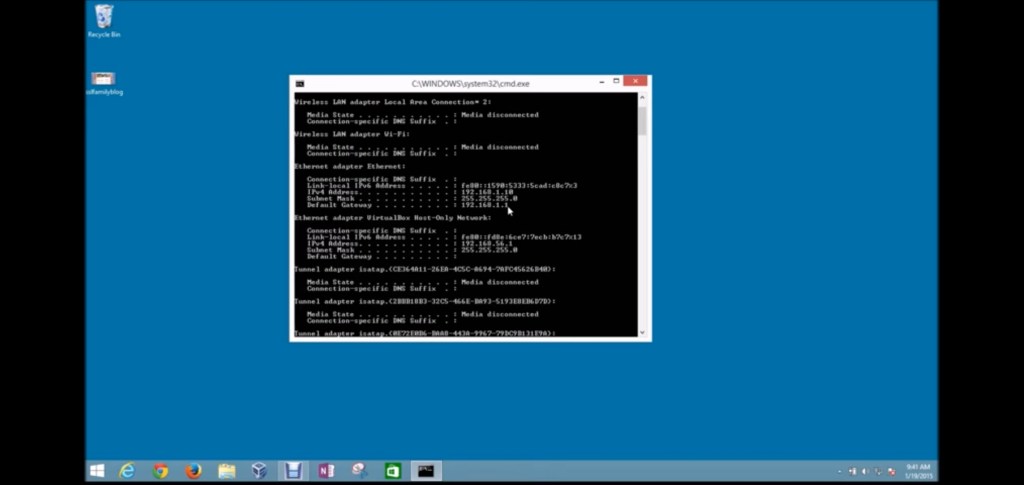
Now you need to get some preliminary information from current network that is setup in your home. First thing you need to do is just hold that window key down on your keyboard and window flag normally the bottom left hand corner of your keyboard in between Ctrl and alt. So you should hold down the windows key and then tap the letter R. This bring up a run box or run prompt. Type CMD then press enter. Now you have a command prompt. Type IP config , press enter. This pull up your some information about current network. You have to pick different IP address (150 or 220) but can’t go higher than 254 for instance 192.168.1.220.

Newly reset router log into router using default IP

Move on to the next step. You have to disconnect your laptop from other any current wireless network or any other network that is connected to do make sure that it’s not connected to internet and turn off wireless or whatever you need to do to disconnect it from your current network, power on your new reset wireless router. Just take any standard Ethernet cable and go ahead and first plug it into one of the four ports on back of your router. Plug in your Ethernet cable to the router. Router is powered on and then plug the other end of your Ethernet cable into your computer’s Ethernet port and now configure the settings in computer so that it will behave properly on your current network and act as it is just wireless extension. Press the windows keys and type R same as before. Type in CMD again and press enter. Now open a command prompt. Press IP config again and this gives same information. You need to note down default gateway IP address and close prompt command box.

Wireless network name and security configuration

Next step is to open browser. Proceed to address bar and rub out everything that’s up there. Now you have to type in that address you just notated (192.168.1.1) and press enter. Now give access directly to your router. A pop up box emerges with password and username box to log into router. Since you reset it back to factory default, there will be factory admin and factory password for the router. After filling up press ok.

DHCP is turned off

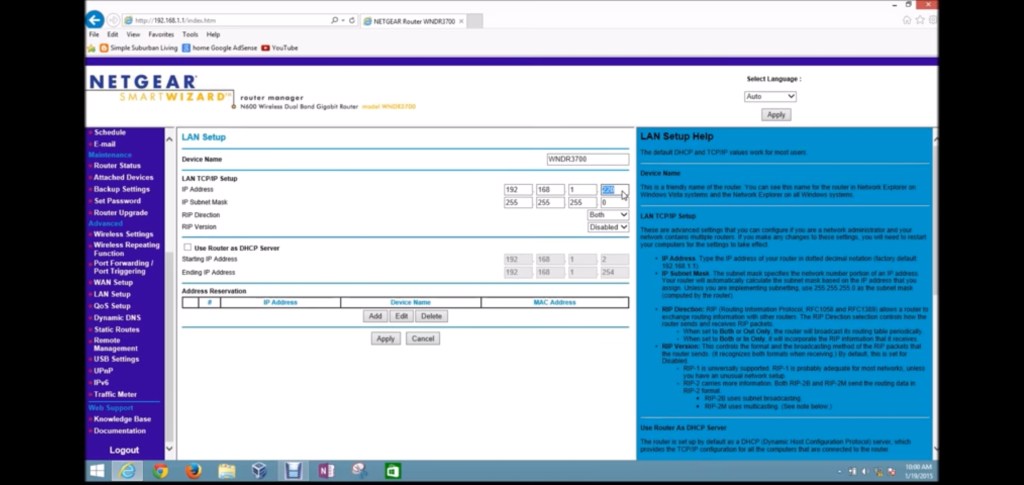
So once you are logged into your router. Just depending on brand router, you have settings and menus might be in different place but what you should look for first is your wireless settings. Click on wireless setting and this is just what you going to give name to new wireless network that you’re creating in home. You should also put security on there so no one else gets into it. If you have option select WPA 2. You’ll be asked to create a passphrase. So you’ve got your new wireless network name. You have your security type selected and you have a password selected. You need information every time you connect to this network and press apply. Now you have to select LAN setup turn off the option to use router as a DHCP server to prevent your router assigning IP address to anyone. Your main router only assign IP address. So actually it will not work as a router anymore. Now you need to change the last digital of IP address. Whenever you want to manage this access point, you’ll need to know the IP address. This acts as the IP address of wireless access point. Then hit apply button.

Router is configured to previous IP address

You have got your router all set up. It’s called access point in your home and don’t act as router. So you’ve got that all configured. Place it up on the top of desk so it’s in real high location you want to hook up wireless.

Conclusion

Strengthen throughout your house so already have Ethernet cable run up from existing router. Just put this Ethernet cable into one of the four ports on router. This is the most simple way to extend an extra wireless access point to have and turn your old router into range boosting WIFI repeater.

Female Feticide

Even after years of development and advancement misogyny still prevails in society. And this issue prevails because of the existence of social evils. Even in the 21st century, many people find girls as a burden on the family and not capable of achieving anything, but doing household chores. The stigma still exists mostly because of the dowry culture. As still having a girl child means giving hefty dowry for their marriage. Other than that, ‘preference of son over daughter as for old age security’, and the thought that ‘daughters can only be only involved in domestic work as they are ultimately going to be married off, and thus there is no need of education for them’, and more such narrow-minded thoughts exist in the society. All such thoughts and beliefs result in female feticide.

What is Female Feticide?

Female feticide the process of identifying the sex or gender of the fetus or the unborn child still in the mother’s womb, and aborting it if found out to be a girl. The sex of the fetus is determined through prenatal diagnostic tests. Sex-selective abortion results in the murder of a female fetus.

India Government’s Take on the Matter

Female foeticide hampered the child sex ratio. Some parts of India have a critically low child sex ratio. As per the 2011 census, the number of girl child in the age group of 0 – 6 years is 75,837,152 out of 158,789,287 which accumulates to 47.8%, and the number of girl child in the age group of 7 years and above is 540,772,113 which accumulates to 48.6% of the total number of children in this age group, which is 1,051,404,135. Even the literacy rate is low in girls. The literacy rate of male children stands at 80.9% whereas the literacy rate in girls stands at 64.6%, as per the 2011 census data. It is even seen that the rate of dropping out of school and higher education is more for girls.

 ‘Pre – Conception and Pre – Natal Diagnostics Techniques Act, 1994 (PC & PNDT), was enacted by the Parliament of India to put a curb on female foeticides. The act banned prenatal sex determination and regulates the pre-natal diagnostic techniques that are capable of determining the sex of the fetus, only for detecting any abnormalities.

Beti Bachao, Beti Padhao Scheme – Beti Bachao Beti Padhao Scheme (BBBP) was launched on 22nd January 2015 at Panipat, Haryana by Prime Minister Narendra Modi. An initial fund of Rs 100 crore was accumulated for the implementation of this scheme. It mainly targets Uttar Pradesh, Uttarakhand, Haryana, Bihar, Punjab, and Delhi, where the child sex ratio is critically low.

The scheme involves enforcement of ‘Pre – Conception, and Pre – Natal Diagnostics Techniques Act, 1994 (PC & PNDT) and spreading nationwide awareness and multi-sector action focused on 100 districts throughout the country in its first phase where the child sex ratio is specifically low. Pre – Conception and Pre – Natal Diagnostics Techniques Act, 1994 (PC & PNDT) was enacted to stop the practice of female feticide.

The scheme aimed at eradicating the practice of female feticide which is the reason for the declining child sex ratio (CSR) as the practice of abortion of female fetus and murder of girl child is done as the girl child is seen as a liability on the family.

Today, the world collectively talks about equality and where women are performing at par with the men; where women are stepping on the moon; marking excellence in the field of science, technology, and inventions, still is divided by a society that believes in killing a child which has not seen the world just because it is a female, and is believed to be of no good and a burden because of the social evils they created themselves.

Female feticide is a crime and also threatens the human right of ‘right to life’. It is important not just to literate but educate and aware the society about such social stigmas existing in the society.

History of vaccination in India

The world is in a pathetic situation fighting with a deadly pandemic named COVID-19. On 31st December 2019, the first case of COVID was reported in Wuhan, China, and on 30th January 2020 in India. The number of COVID cases is increasing rapidly all over the world. The world had become helpless and hopeless. The only ray of hope was the scientists trying their level best to find a vaccine for COVID. Currently, we have at least 13 different vaccines across 4 platforms. Pfizer/BioNtech comirnaty vaccine was the first successful vaccine introduced to the world, listed for WHO Emergency Use Listing (EUL) on 31 December 2020. The SII/Covishield and AstraZeneca/AZD1222 vaccines (developed by AstraZeneca/Oxford and manufactured by the State Institute of India and SK Bio respectively) were given EUL on 16 February.

The national regulator has approved two vaccines for Emergency Use Authorisation is Covid shield and Covaxin. India’s COVID vaccination drive was scheduled to start on February 16 with priority given to an estimated three crore healthcare workers and the frontline workers, said the Health Ministry. It also added that people above the age of 50 will be vaccinated, co-morbidities will be given to people below the age of 50.
Under the first formulated policy of vaccine distribution, half of the vaccines produced in India went to the federal government, and the other half to state administration and private hospitals. Although the states competed on the open market for the vaccine doses for the 18-44 age group, recipients were able to get them for free at the state government’s vaccination centers. Meanwhile, the federal government was vaccinating frontline workers and those aged above 45 years – also for free.
Under the new policy, the federal government will now buy 75% of all vaccines manufactured. It means that the state government will receive vaccines from the federal government based on the population, state of the virus, progress of the vaccine. This benefits the state authorities as they don’t have to pay high amount to the manufacturer than they offered to the federal government for vaccines. The announcement also happened just days after the previous policy attracted criticism from India’s top court, which called it “arbitrary” and “irrational”. It questioned the rationale behind making states pay more for vaccines than the federal government had to. States had to procure them on the open market, and so the financial burden on some of the poorest states such as Bihar, Jharkhand, and Uttar Pradesh significantly increased.
India’s previous record of 4.5 million doses was on April 5, followed by a sharp decline with average daily inoculation falling below 3 million. Experts have said India needs to administer 10 million doses a day to achieve its aim of inoculating 950 million adults by December. So far, India has fully vaccinated fewer than 5% with two doses. After this policy was brought to practice, India has broken its record after vaccinating 7.5 million people in a day.
“If supply remains consistent, we will be on course to innoculate most of our population by the end of the year, D N Patil, a senior health official in the country’s richest state of Maharashtra.
Government adviser Vinod Kumar Paul said on Monday that administering 10 million shots per day was not a “set goal”.
“As the ramping up takes place, speed of implementation should also ramp up and that would lead to a certain number,” Paul said in an interview with the CNBC-TV18 channel.
“There is a demonstration by the system of how much can be done on a given day, at least this is something that should become obvious by the end of the day.”
India’s vaccination drive has been a rollercoaster but sooner or later it will come back on track.

Covid-19 vaccine

“Strength does not come from physical capacity. It comes from an indomitable will.”

Mahatma Gandhi

Yes the will power should be strong and covid-19 checked it and many passed the test by accepting the lockdown situation during the crisis. The Covid-19 also known as Coronavirus is a group RNA virus which infects only mammals and birds. It causes respiratory related diseases which range from mild to lethal.This new group of viruses were named coronaviruses after their distinctive morphological appearance.Human coronavirus 229E and human coronavirus OC43 continued to be studied in subsequent decades. The coronavirus strain B814 was lost. It is not known which present human coronavirus it was.Other human coronaviruses have since been identified, including SARS-CoV in 2003, HCoV NL63 in 2003, HCoV HKU1 in 2004, MERS-CoV in 2013, and SARS-CoV-2 in 2019 which got spread worldwide, therefore named as Covid-19. This virus has made humans learn about humanity by helping others in pandemic situations. Many people lost their lives while fighting against the virus, due to lack of oxygen and treatment. The current 22nd June 2021 covid case study is total cases are 179,680,188 and deaths are 3,891,130 and the recovered ones are in no of 164,370,420. As the virus is mutating and evolving so vaccination is the key form to stop spread of this virus.

Vaccinate World

During Pandemic time it was the feeling that the whole world was a slave under coronavirus. But there were many frontline workers in the form of Freedom Fighters who fought for people and stood as a shield against deadly viruses . Many lost their lives but they fought till their last breath. Over 80 lakh frontline workers were lost in this fight. They are the doctors, nurses, the working and non-working staff of hospitals. They performed their duty without taking their own care. The only hope to stop covid-19 is Vaccine. Firstly, many researchers tested various mammals and studied its effects on them. Now the mission to Vaccinate world began. The vaccines were introduced around the world and each had a different time interval between doses. Here is the list of vaccines introduced in the world which gave hope to survive:-

1.      Pfizer–BioNTech

2.      Moderna

3.      novirus vector vaccines

4.      Oxford–AstraZeneca

5.      Sputnik V

6.      Johnson & Johnson

7.      Convidecia

8.      Sputnik Light

9.      Sinopharm (BBIBP)

10.   CoronaVac

11.   Covaxin

12.   Sinopharm (WIBP)

13.   CoviVac

14.   QazCovid-in

15.   EpiVacCorona

16.   ZF2001

Problems occurred and Faced them

We know that the world isn’t filled with only smart people, there are some people who are interested in troubling others. In this covid like situation some people became hurdle in path of the vaccinated world. Their bad deeds include selling oxygen cylinders in black, storing them in large numbers so as to sell at higher prices during shortages. They didn’t stop here, they even started a black market of vaccines. They know that poor ones are badly in need of vaccines so they take advantage of this situation and sell vaccines at 3 or 4 times higher price than the value set by the government and the poor ones have no option but to buy it. They are too helpless and no one comes to help them and they sell everything for a single dose of vaccine. But for bad people there are always punishers such as cops who made them come to the right path. The cops raided many places, seized vaccines and oxygen cylinders and arrested the gangs working behind these scams. All countries helped each other in one or other way and formed a special bond between them that is of humanity.

Spreading Awareness

Social media, which is one the best inventions, can spread awareness among people regarding the use of vaccines. This awareness is much more important because many are unaware of the importance of vaccines. There are also some people who think doing vaccination is nothing, it is a waste of time. They also spread wrong information about vaccines. This information is spread within a minute in thousands through social media. This needs to be stopped. These bad influencers need to understand that vaccines are a type of advantage for people not a disadvantage. It is an essential key against covid virus. There are many good spreaders who understand and help people digitally through social media. I would specially refer to them as “digital frontliners”. So it is a humble request to spread awareness among people as much as you can.

At last I would like to say “Stay Strong Stay Safe”

history of Psychology

Increasing community awareness of the value of psychology skills — Psych  Learning Curve

Psychology is a field in science that studies the mind. It is often identified as one of the newest fields in science but dates back much further.

Aristotle, (384BC – 322BC) a Greek philosopher, discovered the five senses – sight, hearing, touch, taste and smell. With these senses one feels pleasure or pain. He also stated that of all the living beings, only humans have the ability to think, and theorised the connection between mind and body, and mind and reason.

Hippocrates and Galen, both Greek physicians, pointed out that humans can be recognised by their behaviour.

The field developed little through passing centuries, and Johann Weyer (1515 – 88) laid out facts that the mental illnesses which were attributed to witchcraft came from natural causes. During the 18th century, philosophers gained new knowlege through anatomy of the brain and the nervous system. Immanuel Kant, a German philosopher, classified the mind into knowing, feeling and willing, which are parts of thinking process.

In the 19th century many psychological laboratories were built across Europe, which helps to analyse a person’s behaviour and their mental well-being. The old idea that mental disturbance was the result of the person’s environmental forces acting on the mind was disproved.

Corona virus as an epidemic. What are your predictions? Also point out the positive and negative impacts of the same keeping in view the importance of Indian culture.

Coronaviruses are a group of related viruses that causes diseases in mammals and birds. In humans, coronaviruses causerespiratory tract infections that can be mild, such as some cases of the common cold (among other possible causes, predominantly rhinoviruses), and others that can lethal, such as SARS, MERS and COVID-19. Symptoms in other species vary: in chickens, they cause an upper respiratory tract disease, while in cows and pigs they cause diarrhea. There are yet to be vaccines or antiviral drugs to prevent or treat human coronavirus infections. 

Coronaviruses constitute the subfamily Orthocoronavirinae. They are enveloped viruses with a positive-sense single-stranded RNA genome and a nucleocapsid of helical symmetry. The name coronavirus is derived from the Latin corona meaning crown or halo, which refers to the characteristic appearance reminiscent of a crown or a solar corona around the virions when viewedunder two-dimensional transmission electron microscopy, due to the surface covering in club-shaped protein spikes. 

Difference between epidemic and pandemic

An epidemic is an outbreak of a disease that spreads quickly and affects many individuals at the same time. An outbreak occurs when there is a sudden increase in the number of cases of a disease. It generally describes an increase that was not anticipated. An outbreak can occur in a community, geographical area or several countries. Epidemic is often usedbroadly time describe any problem that has grown out of control. During an epidemic, the disease is actively spreading. 

A pandemic is a type of epidemic that relates to geographic spread and describes a disease that affects an entire country or the whole world. Declaring a pandemic allows national and global public health agencies to respond to the situation at a higher degree. 

COVID-19 as a pandemic

COVID-19 is declared a pandemic because of the speed at which it has spread globally. The World Health Organizationdeclares it to be a controllable pandemic and continues to provide advice on precautionary practices and ways to stop the spread of the disease. 

How is COVID-19 diagnosed? 

Diagnosis may be difficult with only a physical exam because mild cases of COVID-19 may appear similar to the flu or a bad cold. A laboratory test can confirm the diagnosis. 

How is COVID-19 treated? 

As of now there is no specific treatment for the virus. People who become sick from it should be treated with supportive measures: those that relieve symptoms. For severe cases, there may be additional options for treatment, including research drugs and therapeutics. 

What are the symptoms of COVID-19? 

COVID-19 symptoms include cough, fever, shortness of breath, fatigue and respiratory issues etc… 

What is the incubation period for COVID-19? 

It appears that symptoms are showing up in people within fourteen days of exposure to the virus. 

How is COVID-19 spread? 

Recent information indicates it may be passed from person to person. Community spread is being seen, also. Community spread means people have been infected with the virus in a particular area, including some people who are not sure how or where they become infected. 

Origin of coronavirus

COVID-19 appeared in Wuhan, a city in China, in December 2019. Although health officials are still tracing the exact source of this new corona virus, early hypothesis thought it may be linked to a seafood market in Wuhan, China. Some people who visited the market developed viral pneumonia caused by the new corona virus. A study came out on Jan 25,2020 states that the individual with the first reported case became ill on December 1,2019 and had no link to the seafood market. Investigations are ongoing as tto how this virus originated and spread. 

Precautions against Corona virus

We should wash our hands frequently and thoroughly for at least twenty seconds. Use alcohol-based hand sanitizer if soap and water aren’t available. Also we should cover coughs and sneezes with a tissue. Avoid touching eyes, nose or mouth with unwashed hands. Stay home when you are sick. Clean and disinfect surfaces and objects people frequently touch. 

Effect of Corona virus on the world

Corona virus has recently affected   the world in an unexpected manner. A large number of people have already died and many more have been infected. It has badly affected the life of people in different countries all over the world especially across Europe. Rather than affecting the health of the people corona virus also have a great impact on the world economy. Markets have fallen leaving many people unemployed. Outputs have been decreased. Falling oil and stock prices is also a great crisis. 

Corona virus: Indian scenario (especially Delhi) and the various govt. measures

Over 6000 people have died globally since the outbreak of the novel coronavirus. More than 162000 have been infected. What started in China, soon spread across France, the US, Spain, Italy, South Korea and now India. India so far, has officially reported more than 110 cases and three deaths, according to the Ministry of Health. More cases are emerging every day even as states continue issuing advisories on social distancing. Delhi is one of the prone areas due to the large population in such a small area. 

The government has put stringent measures to curb the spread of the virus. Schools, colleges, theatres, offices, gyms etc.. have been closed in many states especially Kerala and Delhi. Thermal screenings are being held at airports and railway and bus stations. People coming from other places are being kept for self isolation in their houses. Isolation camps are being opened in various places. Awareness is being spread through various advertising methods. Shops are closed and various campaigns are held to make people more aware. Public meetings, weddings, religious programs etc.. are also being suspended. 

Corona virus and Indian culture and tradition

Indian culture and tradition have already taught us what we need to avoid catching deadly corona virus. We should follow our Indian values of washing our hands before everything, before eating a meal, before doing anything. We should stop shaking hands and use the Indian food of greeting namasthe, as it cuts down the chances of virus transmission. Also various traditions Indian medicines like turmeric, neem, honey etc.. can keep us immune against corona virus. 

Conclusion

Corona virus has already affected the complete world. It also keeps spreading at an alarming rate. So it necessary for us to keep calm and united to fight against this pandemic. We should take all the precautions to fight it. We should follow government instructions. Eat well and stay healthy. Let’s join our hands together in the global fight against this great epidemic that the world is currently facing.


IJR Journal – Peer Reviewed and Google Scholar Indexed Journal

IJR, a Journal of Multidisciplinary Educational Research focuses on critical and creative research. This journal seeks to promote original research and cultivate fruitful dialogues between previous and innovative thoughts.


Scope:

International Journal of Research (IJR) promotes original academic research in Humanities, Culture, Comparative Education, Social Sciences, Rural Development, Engineering and Technology, Sciences, Art, Commerce and Management. Providing an insight, to transform lives is the motto. One can utilize the opportunities and face challenges of this changing world.


Objectives:

General

The million development goal laid its emphasis on “people centered approach” to recognize human and social capital for sustainable development. These include economic strategies and many other emerging trends. Get published in IJR

  • Goal is to create sustainable improvement in the quality of life among the common people.
  • Stake holder oriented programs, to facilitate increase in per capita income of individual facilities
  • To empower people in the areas of health, economy, polity and education.

Specific

  • To publish original empirical research and theoretical studies on adult education, lifelong learning, extension, and economic relations studies.
  • To generate interest in civil society movements, studies on democracy, problems of marginalized sections, cross border terrorism, violation of human rights, ecology, environment and issues in governance at the regional and national level.

The object is simple and that is to provide a forum for scholarly dialogue on a broad range of topics significant to our times and cultures.

Send papers for publication to ijr@ijrjournal.com 

LEGEND OF THE BERMUDA TRIANGLE

The Bermuda Triangle is an imaginary area in the Atlantic Ocean bordered by Miami, Bermuda, and Puerto Rico where scores of ships and aeroplanes have vanished. Some of these incidents are shrouded in mystery, such as one in which the pilots of a squadron of US Navy bombers became disoriented while flying over the area; the planes were never discovered. Other boats and planes appear to have departed from the area in fair weather, without even transmitting distress signals. However, despite the fact that a plethora of fantastic theories have been suggested on the Bermuda Triangle, none of them establish that strange disappearances occur more frequently there than in other well-traveled areas of the ocean. In reality, individuals navigate the region without issue every day.

THE BEGINNING-The Bermuda Triangle, sometimes known as the Devil’s Triangle, covers approximately 500,000 square miles of ocean near the southeastern coast of Florida. When Christopher Columbus sailed through the area on his first voyage to the New World, he reported seeing a gigantic flame of fire fall into the water one night and a weird light arise in the distance a few weeks later. He also wrote of inconsistent compass readings, maybe because the Bermuda Triangle was one of the few sites on Planet where true north and magnetic north lined up at the time.William Shakespeare’s play “The Tempest,” which some academics believe was inspired by a real-life Bermuda disaster, may have added to the area’s mystique. Nonetheless, until the twentieth century, accounts of mysterious disappearances did not fully attract the public’s attention. The sinking of the USS Cyclops, a 542-foot-long Navy cargo ship carrying over 300 soldiers and 10,000 tonnes of manganese ore, occurred in March 1918, somewhere between Barbados and the Chesapeake Bay. Despite being able to do so, the Cyclops never sent out an SOS distress signal, and an exhaustive search turned up no wreckage. “Only God and the sea know what happened to the mighty ship,” later stated US President Woodrow Wilson. Two of the Cyclops’ sister ships vanished without a trace along nearly the same route in 1941.

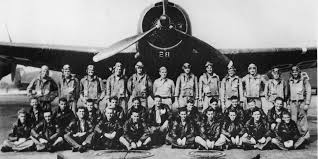
PLANE VANISHED-A pattern purportedly began to emerge in which watercraft navigating the Bermuda Triangle either vanished or were discovered abandoned. Then, in December 1945, five Navy bombers carrying 14 personnel took out from an airport in Fort Lauderdale, Florida, to practise bombing missions over local shoals. However, because his compasses appeared to be malfunctioning, the mission’s leader, known as Flight 19, became seriously lost. All five planes flew aimlessly until they ran out of fuel and had to land at sea. On the same day, a rescue plane and its 13-man crew vanished. After a large weeks-long search yielded no results, the official Navy report stated that it was “as if they had gone to Mars.”

THEORIES AND COUNTER THEORIES– By the time author Vincent Gaddis invented the moniker “Bermuda Triangle” in a 1964 magazine article, more inexplicable mishaps had occurred in the area, including three passenger flights that crashed despite sending “all is good” communications. Charles Berlitz, whose grandfather founded the Berlitz language schools, fueled the legend even further with a sensational bestseller on the subject in 1974. Since then, scores of other paranormal writers have blamed the triangle’s supposed lethality on everything from aliens, Atlantis, and sea monsters to time warps and reverse gravity fields, while more scientifically minded theorists have pointed to magnetic anomalies, waterspouts, or massive eruptions of methane gas from the ocean floor. However, there is unlikely to be a single theory that solves the mystery. Trying to find a same cause for every Bermuda Triangle disappearance, as one sceptic put it, is no more plausible than trying to find a common cause for every vehicle accident in Arizona. Furthermore, while hurricanes, reefs, and the Gulf Stream can make navigation difficult, Lloyd’s of London, the world’s largest maritime insurance company, does not consider the Bermuda Triangle to be particularly dangerous. Neither does the United States Coast Guard, which claims that “after a review of many aircraft and vessel losses in the area over the years, nothing has been revealed that would indicate that casualties were the product of anything other than physical causes.” There have never been any unusual factors discovered.”

CHILD ABUSE

Nowadays, we always hear about child abuse and there are many children being abused every year. There are many different from of abuse and many people do not realize them. They included, physical emotional, neglect and sexual abuse. Child abuse is when someone, whether through action or failing to act, causes injury, death, emotional harm, or risk of serious harm to a child.
A problem that is only beginning to come into light in India rape, sexual abuse, and sexual harassment are worldwide issues of gender violence. There is very little research done in this area in India and only a few books have been written.
Every year more than 3 million reports of child abuse are made in the United States. It’s a terrible epidemic that we at Childhelp are dedicated to put an end to. To do this, we need to first increase awareness of the issue itself.

First of all, let’s go to the physical abuse. Physical abuse of a child is when a parent or caregiver causes any non-accidental physical injury to a child. There are many signs of physical abuse.
Physical abuse includes striking, kicking, burning, biting, hair pulling, choking, throwing, shoving, whipping or any other action that injures a child. Even if the caregiver didn’t mean to cause injury, when the child is injured it is abuse. Physical discipline from a parent that does not injure or impair a child is not considered abuse; however non-violent alternatives are always available.
Physical abuse can result in:
●Bruises, blisters, burns, cuts and scratches
●Internal injuries, brain damage
●Broken bones, sprains, dislocated joints
●Emotional and psychological harm
●Lifelong injury, death.

Next, we proceed to the sexual abuse. Sexual abuse occurs when an adult uses a child for sexual purposes or involves a child in sexual acts. It also includes when a child who is older or more powerful uses another child for sexual gratification or excitement.

After that, we go to emotional abuse. When a parent or caregiver harms a child’s mental and social development, or causes severe emotional harm, it is considered emotional abuse. While a single incident may be abuse, most often emotional abuse is a pattern of behavior that causes damage over time.Child emotional abuse can be refereed to as a pattern of behavioral that impairs a child emotional development or sense of self worth. This may include constant criticism, threats or rejection as well as withholding love, support, or guidance. Emotional maltreatment is rarely manifested in physical signs. A few physical indicators of emotional maltreatment are speech disorders, lag in physical development and failure-to-thrive syndrome. The behavioral characteristics of emotional maltreatment are habit disorders, conduct disorders neurotic trait psycho-neurotic reaction behavior extremes (passive, aggressive, rigid reserved, demanding stubborn), and lag in emotional and intellectual, and attempted suicide. Four important causes emotional abuse are poverty, deficient parental control and non cordial relations within family, maltreatment faced by parents in their child hood or inter generational transmission of child maltreatment, and alcoholism of parents. A significant proportion of abusing parents were themselves abused as children
Signs of emotional abuse in parent or caregiver:
●Routinely ignores, criticizes, yells at or blames child
●Plays favorites with one sibling over another
●Poor anger management or emotional self-regulation
●Stormy relationships with other adults, disrespect for authority
●History of violence or abuse
●Untreated mental illness, alcoholism or substance abuse.

Last but not least, we proceed to neglect. Neglect is defined as a type of maltreatment that refers to the failure to provide the needed age. Neglect can be in physical and educational. Physical neglect included not providing food or clothes, appropriate medical care and not proper weather protection such as protection from rain and heat from sun. While educational neglect included failure to provide appropriate schooling or special educational needs and not allowing excessive truancies.
In sum, rape and sexual abuse of children in India is a large problem without an easy solution. Though the issue persists worldwide, India’s culture which traditionally keeps women below men, makes talk of private matters such as such unallowable, and a corrupt and weak legal system when it comes to rape makes the problems even larger. However, the situation could be improved by appropriately educating children and adults on sexual abuse, and educating police and strengthening laws. Further women’s empowerment may lead to healthy changes as well.
While child abuse and neglect is a significant public health problem, it is also a preventable one. In order to protect children from this situation, it is necessary to develop preventive programs, to raise awareness of their families-teachers-community and to make legal arrangements.
As the conclusion, prevent is better than cure. Child abuse leads to many bad effects not only for children that are being abused but also the person who abuse the children. We should prevent it from getting worse as the children today will be a leader for tomorrow.

Machine learning technology.

Machine learning is associate application of computer science (AI) that has systems the flexibility to mechanically learn and improve from expertise while not being expressly programmed.

Machine learning focuses on the event of pc programs that may access information and use it to be told for themselves.

Some Machine Learning strategies,

  • supervised machine learning algorithms
  • unattended machine learning algorithms
  • Semi-supervised machine learning algorithms
  • Reinforcement machine learning algorithms
    Supervised machine learning algorithms:
    ✓ It will apply what has been learned within the past to new information. examples:To predict future events.
    ✓ The system is ready to produce targets for any new input when comfortable coaching.
    Unsupervised machine learning algorithms:
    ✓ It used once the knowledge accustomed train is neither classified.

✓ The system doesn’t discern the correct output, however it explores the info and may draw inferences from datasets to explain hidden structures.

Semi-supervised machine learning algorithms:
✓ It fall somewhere in between supervised and unattended learning, since they use each labeled and unlabeled information for coaching.

✓ Usually, semi-supervised learning is chosen once the noninheritable labeled information needs sure-handed and relevant resources so as to coach it .

Reinforcement machine learning algorithms:
✓ it’s a learning methodology that interacts with its atmosphere by manufacturing actions and discovers errors.

✓This methodology permits machines and code agents to mechanically verify the behavior at intervals a particular context so as to maximise its performance.

Machine learning allows analysis of large quantities of knowledge. whereas it usually delivers quicker, a lot of correct ends up in order to spot profitable opportunities or dangerous risks, it should additionally need overtime and resources to coach it properly. Combining machine learning with AI and psychological feature technologies will create it even simpler in process giant volumes of data.

An Insight on Kashmir

From its snowy mountains to its calm lakes, from pashminas to its delightful apples Kashmir has captivated each and every one with its breathtaking beauty. Indeed, its beauty is unearthly rather it’s the glimpse of that heaven on the seventh sky. But to me, it’s like that extremely beautiful, innocent girl whom every eye desires, from whom all know how to take but none knows how to give. To me, Kashmir is that lovely yet helpless girl who has been captured and exploited over and over again by her cold-blooded admirers. In the end, she gets rewarded with compliments for her beauty but her pain is left uncared for.

In 1947, India achieved its Independence from the British after 200 years of their colonial rule. But the independence didn’t come easy because with it came partition. The subcontinent split into two, an Islamic Pakistan and a secular but predominantly Hindu India. While the subcontinent was in the throes of the birthing of the nations, Kashmir, a princely state was confused. Being a Hindu king with a Muslim majority state Hari Singh was not able to decide. Should he accede to one of the new nations or stay sovereign. With no decision from Maharaja, impatient Pakistan launched the operation Gulmarg through which it occupied a part of Jammu and Kashmir which today is known as Azad Kashmir in Pakistan or PoJK as called by India. As a consequence of this Kashmir acceded to India in October 1947 on the conditions of having autonomy and a promise of a plebiscite in the coming years. Fast forward, the autonomy is gone and plebiscite is yet to happen.

Kashmir is one of the most disputed places on earth. For 70 years it’s been at the centre of three wars fought between two massive armies. The land of Kashmir has come a long way travelling the paths of struggle brimming with a long history of constant militancy.

Pakistan argues that being a Muslim majority territory Kashmir rightfully belongs to them while India insists that Kashmir was handed over to them by the Hindu monarch so they double downed and added Kashmir to their constitution. But in this Indo-Pak rivalry what really at stake is the voice of Kashmiris who are caught in a vicious cycle of violence. The territorial dispute has only gifted the legacy of a constant struggle for peace to the Kashmiri people. Many live their entire lives through this conflict, born and died under a curfew.

The heart of Kashmir can be contained with two perceptions; the alleged rivalries of religious identities. One of the most tragic happenings in the history of Kashmir was the 1990 Exodus of Kashmiri Pandits. Thousands of Kashmiri Pandits became victims of communal violence and were forced to leave their homeland. According to Kashmiri Pandit Sangharsh Samiti, more than 70,000 families fled between 1990 and 1992. The flight continued till 2000. The KPSS has placed the number of Kashmir Pandits killed by militants from 1990 to 2011 at 399. Many of the Kashmiri Pandits have been living in the refugee camps of Jammu to date. The nature of the exodus has remained controversial. The Kashmiri Muslim view of the exodus is that the then governor Jagmohan encouraged Kashmiri Pandits to depart the Valley and thus gave a communal colour to what was until then a non-religious Kashmiri cause. However, the Kashmiri Pandits believe that The Kashmiri Muslims with whom they had lived amicably for centuries drove them out of their homes with vengeance. The truth, many commentators have concluded may lie somewhere in the middle. But the question you need to ask yourself is, does this tragic happening of the past justifies the human rights violations of the many Kashmiris by the Indian State till now. You can’t use the Kashmiri Pandit exodus to overshadow the collective Kashmiri struggle for identity and self-determination. The abuses range from mass killings, enforced disappearances, torture, rape and sexual abuse to political repression and suppression of freedom of speech. Thousands of Kashmiri civilians and suspected insurgents have been killed by the Indian security forces in custody, extrajudicial killings, fake encounters and enforced disappearances.

In an incident of July 18, 2020, three Kashmiri youth who were alleged to be militants were killed in an encounter. A recent investigation revealed that an Indian army captain along with two others staged the encounter of the three boys who were actually labourers to receive a reward of around $30,000. These human rights violations are said to be carried out by Indian forces under total impunity. Indian authorities use the Armed Forces Special Power Act (AFSPA) to avoid holding its security forces responsible for the deaths of civilians. Pellet guns- a weapon meant to be deployed for crowd control have been responsible for blinding, killing and traumatizing people in Kashmir.

Kashmiri women are amongst the worst sufferers of sexual abuse in the World. Due to the impact of conflict and uncertainty in the territory, many people suffer from various psychological problems and post-traumatic disorders. Kashmiri women are reportedly said to be highly prone to suicidal tendencies. The incident of Kunan-Poshpora in the Kupwara district is a descriptive account of the horrors inflicted by the armed forces on Kashmiri women. The victims still await justice. Amidst these abuses, access to justice is unlikely in Kashmir. The way justice is denied systematically and how the corporate media of India fails to cover these incidents is a critical crackdown on the democracy of Kashmir.

This is the main concern, people still engage with the institutions only to realize that the establishment, on most events, can’t provide them justice, not because they cannot but because they do not want to.

With this Kashmir remains an open-air prison, leaving people with no control over their lives. While some say Kashmir should go to India and others say Kashmir belongs to Pakistan, Kashmiris seek a democratic right to be recognized. 

The story of Kashmir has numerous narratives to it. One is of the 18-year-old boy who turns to militancy as a result of humiliation and oppression, another is of a mother who isn’t even aware if her son is dead or alive, of a wife whose husband’s disappearance leaves her as a half-widow, of a Kashmiri Pandit who hasn’t returned to his home since 30 years, of a stone pelter who believes that he isn’t throwing stones at soldiers but at the occupation of Kashmir and then comes the narrative of the arm-chair activists from India and Pakistan sitting in their comfortable sofas with their high-speed 4G internet giving opinions about something which hasn’t affected them at all.

In a world full of revenge and malice, humanity seeks forgiveness. More than a territorial dispute, Kashmir is a dispute of right and wrong, freedom and human rights. Between this tussle of right and wrong, paradise has been lost. 

Since all conflicts come from the notion of right and wrong and which is a variable notion it’s always possible for one to have an opinion and still have compassion for someone who has a different opinion. There are always different perspectives about right and wrong but at the end of the day, everyone wants one simple thing, to love and to be loved.

human resorce management

Human resource management (HRM or HR) is the strategic approach to the effective and efficient management of people in a company or organization such that they help their business gain a competitive advantage. It is designed to maximize employee performance in service of an employer’s strategic objectives.[1][need quotation to verify] Human resource management is primarily concerned with the management of people within organizations, focusing on policies and systems.[2] HR departments are responsible for overseeing employee-benefits design, employee recruitment, training and development, performance appraisal, and reward management, such as managing pay and Employee benefits benefit systems.[3] HR also concerns itself with organizational change and industrial relations, or the balancing of organizational practices with requirements arising from collective bargaining and governmental laws.[4][need quotation to verify]

The overall purpose of human resources (HR) is to ensure that the organization is able to achieve success through people.[5] HR professionals manage the human capital of an organization and focus on implementing policies and processes. They can specialize in finding, recruiting, training, and developing employees, as well as maintaining employee relations or benefits. Training and development professionals ensure that employees are trained and have continuous development. This is done through training programs, performance evaluations, and reward programs. Employee relations deals with the concerns of employees when policies are broken, such as cases involving harassment or discrimination. Managing employee benefits includes developing compensation structures, parental leave programs, discounts, and other benefits for employees. On the other side of the field are HR generalists or business partners. These HR professionals could work in all areas or be labour relations representatives working with unionized employees.

HR is a product of the human relations movement of the early 20th Century, when researchers began documenting ways of creating business value through the strategic management of the workforce.[6] It was initially dominated by transactional work, such as payroll and benefits administration, but due to globalization, company consolidation, technological advances, and further research, HR as of 2015 focuses on strategic initiatives like mergers and acquisitions, talent management, succession planning, industrial and labor relations, and diversity and inclusion. In the current global work environment, most companies focus on lowering employee turnover and on retaining the talent and knowledge held by their workforce.[citation needed] New hiring not only entails a high cost but also increases the risk of a new employee not being able to adequately replace the position of the previous employee. HR departments strive to offer benefits that will appeal to workers, thus reducing the risk of losing employee commitment and psychological ownership.