The word sustainable means able to retain at the minimum possible with best results and also helps the mother earth heal. Sustainability is a vast concept and is generally a long term process when it comes to results. Sustainable practices preached in day to day life helps one achieve long term goals.
Such is the concept of SUSTAINABLE TRANSPORTATION.The increasing pollution in day to day life is a major example of why sustainable transport should be an important goal of the people of the 21st century. The daily consumption of petrol and diesel by various vehicles, excessive carbon monoxide emissions, contribution to global warming, noise pollution are some of the reasons among so many more that deplete the earth’s natural resources and increase health problems.
The only option of change is to switch to a more healthier, quick, effective and also less resource consumption way; In the fast pacing life of people where every two among three people own a car in urban areas, it is important that sustainable alternatives not only add value to human’s time but are effective at the same time.
Here are my vision of some eco-friendly, sustainable and intelligent choice :
To start with first is TO WALK, walk for the short trip and avoid your vehicle when possible. This won’t only help nature heal but also can make one lose weight if practiced regularly, also it will make you feel closer to the greenery around and you won’t need to wait in long traffic queues or find a parking spot when you arrive.
Next on my list would be to CYCLE, if you switch a cycle from your bus, train or bike journey, this will help to reduce the emission of around hundred kilograms of greenhouse gases. It will help lose more calories in every round of your travel and the fresh air is complimentary with every trip.
If it’s not possible for you to travel without a vehicle, choose more eco-friendly ones. One of the best options can be CARPOOLING, it is a way of sharing a vehicle for a bunch of people destined for the same place. It helps save fuel and the hassle of parking. Additionally it adds company for your journey and lesser cars on the road.
The next time you are planning to go for a trip, go for some EXPLOREPLACES AROUND your residence, you never know there are so many around your place. Unplanned tripsare amazing and the best when not harming nature. It helps save fuel and energy, decreases pollution and helps one feel more close to nature and experience unknown places.
Thereare a lot other ways too and everyday there is a new find by so many humans.GREEN TRANSPORTATION is a choice and every being should choose it as a responsible citizen. Choosing these means to travel helps the earth heal at its maximum and makes the air pure. SUSTAINABLE TRANSPORTATION should be followed everywhere and by everyone as much as possible.
3D printing, also called additive manufacturing, is often defined as the construction of a three-dimensional object from a CAD model or a digital 3D model. The term “3D printing” is often explained as a spread of processes during which materials are deposited, solidified with computer control to present a three-dimensional object, with more material being added together typically layer by layer.
Looking at current scenarios 3D printing or additive manufacturing has been used widely for manufacturing, medical, industry etc. which facilitate 3D printing to become successful economical technology. The earliest application of 3D printing was on the toolroom end of the manufacturing spectrum.
HOW IT WORKS:
3D printers are available and are a neighborhood of the additive manufacturing family and use familiar methods to a standard inkjet printer- albeit in 3D. It takes a mixture of top-of-the-line software, powder-like materials and precision tools to make a three-dimensional object from scratch.
The various steps include :
3D Modeling Software:Modeling helps printers to form the merchandise come right down to the tiniest detail. The 3D modeling software ensures precision designs is why 3D printing is being hailed as a real and important changer in many industries.
Slicing the Model: Engineers are required to slice the model into layers to assist the printer to make the ultimate product. Slicing software takes scans of every layer of a model and can tell the printer the way to move so as to recreate that layer.
The 3D Printing Process: The printer acts an equivalent as a standard inkjet printer within the 3D printing , where a nozzle moves back-and-forth while dispensing a wax or plastic-like polymer layer-by-layer, expecting that layer to dry, then adding a subsequent level.
There are various types of 3D printing depending on size, shape and also time consumed in making one depends on these factors.
ADVANTAGES :
Fast Design and Production, helps design and print faster also production rate saves time.
Minimises Waste, little wastage compared to traditional methods.
Cost Effective, requires lesser products, machine cost can be saved by outsourcing the project.
Easy To Use, easily accessible by everyone.
Environmental Friendly, Fuel efficient and less wastage.
Flexible Design, helps design and print complex designs.
SCOPE :
In the construction world , 3D printing is used to create construction components or to print even entire buildings. Construction is well-accustomed to 3D printing as much of the information necessary to create an product will exist as a result of the design process, and the industry is already experienced in computer aided manufacturing.3d printing is not a new technology, followed since the 1980s. Making a three-dimensional model, or prototype, from a computer made design by adding successive layers of material is now standard practice in many industries, ranging from aerospace and architecture to medicine and high-end manufacturing.
3D printing encompasses many sorts of technologies and materials as 3D printing is getting used in most industries you’ll consider . It’s important to ascertain it as a cluster of diverse industries with a myriad of various applications. A few examples: – consumer products (eyewear, footwear, design, furniture) – industrial products (manufacturing tools, prototypes, functional end-use parts) – dental products – prosthetics – architectural scale models & maquettes – reconstructing fossils – replicating ancient artefacts – reconstructing evidence in forensic pathology – movie props
“Travelling – It leaves you speechless, then turns you into a story teller”.
-Ibn Batuta.
Traversing new lands and frontiers. Exploring people and culture has always been of significant importance for mankind. Nowadays travelling has become too mainstream with planned packages, theme parks, resorts which kind of rob the good old ‘free travel’ of its essence. Going solo, which gives you the feeling of being independent, entirely self dependent and the accomplishment of something unique has become some what of a prized adventure.
Even trekking(taken from the Afrikaans word ‘trek’ meaning to hike/travel) which has always been in the conversation of ‘free travel’ has become some what stagnant and less exciting because of it being planned down to the smallest of details. This isn’t entirely a bad thing as it’s done for the safety of travellers, but the charm is diminishing none the less.
Because of this, ‘Road less travel’, has become the ultimate toast of travelling. Going with a small group of friends or family or even alone, on journeys which are spontaneous although reserved for pragmatic changes.
As time goes by, the solo travel, synonymous with the 60s Hippie culture is on a resurgence. Our land, India, is a fertile ground for such adventures! As we see many foreign tourists travelling as if they were a local, and this is what led me to write this blog in the first place.
Do you ever look back on your decisions and think, “Why I on earth did I do that?”
We all make bad decisions.
Buying an SUV that sucks up all your cash
Starting a relationship without being in love
Saying yes to a job that you’re not passionate about
Creating products that no one needs
Shit happens (the above examples are all about me). But the funny thing is that bad decisions never seem like bad decisions at the moment.
I’ve been reading about the decision-making process of Warren Buffet and Charlie Munger, two of the most successful investors of all time.
In Alice Schroeder’s biography of Warren Buffett, I read that Buffet and Munger have a learning strategy that’s based on what you should avoid doing. They identify mistakes and do their best to avoid those mistakes. But as Charlie Munger says:
“Smart people do dumb things.”
You can never avoid making a mistake. However, you can do your best to avoid making dumb decisions.
I recently spoke to a friend who wanted to make a career move. I asked him to walk me through his thinking process:
“I like the company I work for, but my job isn’t engaging anymore. I’ve been doing this work for four years. And sure, I’ve been promoted twice, but it’s still the same work. So I’ve been looking at other companies. But what if I go somewhere else and that doesn’t work out? I’ll have to move on quick. And that won’t look good on my resume.”
I remained silent.
“Just hearing myself talk leads me to another thing: Overthinking it.”
We both laughed our asses off. I can do the same with overthinking. And I bet you’ve been there too.
When you overanalyze every single decision, you become paralyzed. Result? Nothing. Now, that’s a bad outcome!
That’s how people end up wasting their lives.
The only way you can stop overthinking is by making yourself aware of your thinking process. When I asked my friend about his thinking, he became aware of how irrational his process was.
Do This Instead: Make Small Decisions. Decide Often.
I recently read Seeking Wisdom by Peter Bevelin. It’s about the way Charlie Munger thinks. One of his decision-making strategies is to avoid mistakes. But that can be interpreted in different ways.
You can fear decisions altogether because you might make mistakes. What happens is that you don’t make decisions at all. As Munger says:
“The difference between a good business and a bad business is that good businesses throw up one easy decision after another. The bad businesses throw up painful decisions time after time.”
You can interpret that Munger quote in different ways. I interpret it as follows:
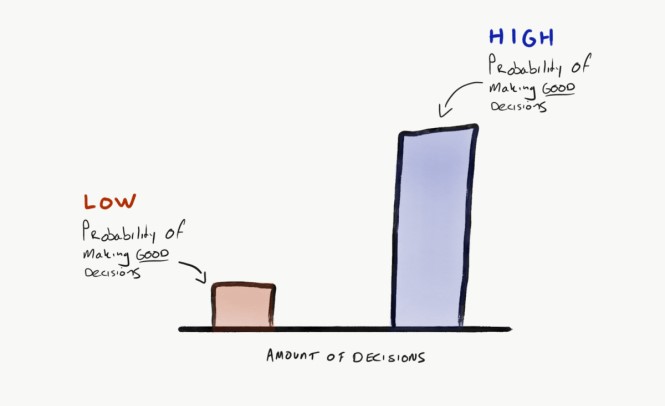
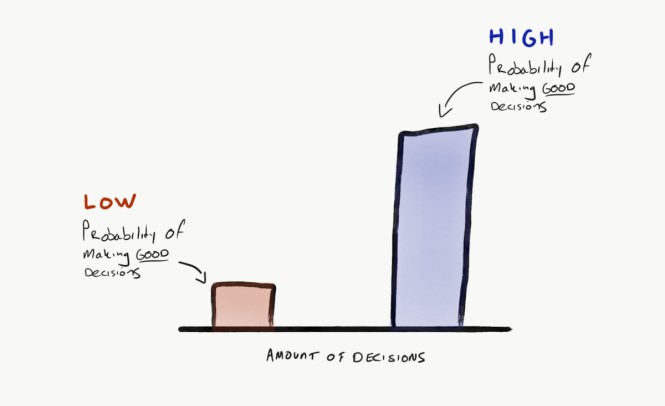
When you make small decisions early, before they become big — it’s easy. When you put off decisions, they become big — and painful.
For example, I’m not happy with the email provider I use to send out my newsletter. Their support is slow, there’s no good integration with my online courses platform, and readers have complained about not getting my newsletter.
This is something that’s on my radar for more than 1.5 years. At the time my list was less than half of the size it’s today. I also had only one online course. Now, I have three.
The hassle of moving to another provider gets bigger every day. Had I moved early, it was easy. By now, it’s a painful process.
In life, it’s exactly the same. The longer you stay in a bad relationship, the harder it gets to leave. It’s also true for your job.
Earlier Decisions Lead To Better Decisions
The earlier and more you decide, the more chance that you make better decisions.
I often say that there are no right or wrong decisions — only decisions. That’s not entirely accurate. Of course, there’s a difference in the quality of our choices. That’s the topic of another article.
But here’s the thing: NOT making a decision is also a decision. If that’s a conscious move, that’s okay. You think about something, and you decide that doing nothing is the best option.
However, I’m referring to not making a decision as in “I’ll put it off until another time.”
No matter what, you’re making decisions all the time. Instead of making fewer conscious decisions, we need to make them earlier.
Because all you need are a few good choices in your lifetime anyway. What will be your best? You only find out after, you guessed it, you’ve made a decision.
If not, it’s not uncommon. Until two years ago, I didn’t have a financial plan, whatsoever.
Even though I’ve been reading about money, finance, and investing ever since I made my first few bucks as a teenager, I never created a financial plan.
But now, I think every single working professional needs a financial strategy. How do you spend your money? How much do you save? What are your thoughts about debt? How do you invest your money? How much money do you need to retire?
This book was published in 1926 and as far as I can tell, it was the first popular book on personal finance.
Usually, I’m not into parables. But this is a great book. It’s the only parable that I’ve read that makes the message of the book even more powerful.
What it comes down to is this: Rich people are rich because they save their money, don’t get in debt, and don’t spend their money foolishly.
Clason recommends to save 10% of your income (I believe you should save 50% — more on that later). He calls saving “paying yourself first.” That’s an important mindset.
You only get rich by paying yourself. Don’t foolishly spend all your money on things you don’t need. When you do that, you pay others, not yourself.
Everyone should read The Richest Man In Babylon — the earlier the better.
What I enjoyed most about this book is that it teaches you to transform your relationship with money. This will change your life.
Money is something you trade your life energy for. Think about it. You work to earn money.
But you spend your time to work. That’s why Robin and Dominguez spend the first part of this book to make us aware that more is not better.
More money is especially not better if you have to put your own well-being on the line. It’s never worth it. Just ask the family of the bankers who committed suicide during any recession.
If you want to live a healthy and wealthy life, you must detach yourself from money. Instead of striving for more, get better at managing your money.
Save it. And don’t waste it on stuff you don’t need. Your Money Or Your Life starts out strategically and gets more practical towards the end.
One thing I don’t agree with is retiring early. I don’t want to retire and sit on a beach. That’s because my mentors, who are beyond the retirement age, still work and are very happy. I aspire to do the same.
But I also want to build enough wealth that I don’t “have” to work if I don’t want to. That’s one thing Robin and Dominguez also believe in.
I bought my first stocks when I was 20 years old. At the time, the finance sector was doing great, and I thought it would be good to invest in ING, the major Dutch bank.
Oh yeah, I should mention that this was in 2007, right before the financial crisis. I invested €1500 in ING and €500 in AEGON, a Dutch asset management firm.
It was about half of my savings at the time — a lot of money for a student. And a few months later, when Lehman Brothers collapsed, my stock portfolio was worth only a few hundred euros in total.
Man, I was so pissed off. I can’t even tell you how livid I was. But looking back, I understand that losing money is a part of investing.
And fortunately, I didn’t sell and waited until the stocks recovered. That took eight years, though.
I decided to not invest in individual stocks anymore. And The Intelligent Investor is one of the most important books that helped to realize investing in stocks is not for me.
If you already know that you don’t want to invest in individual stocks, you don’t have to read this book. However, if you are interested in finance, I highly recommend it. The commentary by Jason Zweig, a WSJ columnist, is also excellent.
P.S. I skipped the chapters about stock analysis because I’m not going to use it.
Productivity refers to the ratio between the volume of output and volume of inputs. Inputs here refer to factors of production like land, labor, capital etc. According to definitions, productivity is the residual output that is not explained by the direct contribution of input resources. It refers to goods and services produced in relation to resources used in their production. High productivity indicates that the resources are being used efficiently. If resources are economically the overall production will increase. This also decreases cost of production. It leads to higher production using minimal resources. It is an important critical indicator of economic performance. Residual output is called as Total Factor Productivity (TFP). Increase in productivity benefits the economy by making it possible to start new industrial units and generating more employment opportunities. Higher productivity is necessary for the growth of any nation.
Higher productivity helps in producing quality goods at lower cost. This will lead to lower prices increasing the standard of living. Profit maximization is possible because of higher productivity. This facilitates internal financing of expansion programmes. Factors of production can be used efficiently. This also increases income for workers. Higher productivity determines the standard of living. Lower productivity means low standard of living. GDP measures the total output. So, the total output is equal to the economy. This is the reason why American workers are richer than workers of any other developing nation. For example, let us consider Munro as an economy. He catches his own fish, grows his one vegetables, and makes his own clothes. His production and consumption can be considered as a simple economy. If he is bad at doing these things, he lives poorly. The standard of living of his economy depends on productivity. A country’s standard of living depends on its ability to produce goods and services.
The two variants of productivity are labor productivity and total factor productivity. Labour productivity measures the amount of output per worker. Total factor productivity measures the amount of output per unit of total input. Total factor productivity is total product output divided into index of all inputs like land, labor, capital etc. Output growing faster than inputs is higher productivity. Productivity increases as a result of advancement of technology, invention of new methods, newer processes etc. Increasing returns to scale, larger inputs and production will lead to higher productivity. Even with other factors remaining constant, economies of scale would contribute to productivity. If a product can be produced more efficiently when produced together than apart it creates a different kind of efficiency. It happens in the presence of economies of scope. For example, this happens in the software industry. When consumers buy software to prepare their federal income taxes the CD-ROM usually contains several other modules, including a link to a Web page, government documents, and a tax preparation manual. This shows economies of scope because the different modules can be more inexpensively produced, packaged, and used together than separately. Economics of scope are like the specialization and division of labor that increase productivity as economies become larger and more diversified. Economies of production and scope are also reasons for increasing productivity. Economies of scale and mass production have been important elements of productivity.
There are other factors that determine Robinson Crusoe’s standard of living other than productivity. From the example mentioned above we can call other determinants as physical capital, natural resources, and technological knowledge. These factors have a role in real economy.
Physical capital: physical capital per worker is important as workers will be more productive if they are provided with proper tools. Tools, equipment and structures used in the process of production of goods and services is called physical capital. The processes become easier and simpler with more tools and equipments. A worker with basic tools cannot produce more. Inputs to production are called factors of production. Physical capital is produced factor of production. Capital is an input into the production process that in the past was an output from the production process. Capital is a factor of production that is used to produce all kinds of goods.
Human capital: It includes the knowledge and skills that workers acquire through education, training and experience. The skills and experiences are a result of time spent in schools, programs, colleges, job trainings etc. It is an intangible capital. Like other determinants human capital also contributes to nation’s productivity. Human capital is a produced and completed determinant of productivity. Proper human capital which has effective and efficient workers requires proper educational facilities, teachers and institutions etc. Students are the future workers. They are the human capital that will be used in future production.
Natural Resources: Natural resource is another determinant of productivity. It includes rivers, land, minerals and other resources provided by nature. Natural resources are of two types: renewable sources and non renewable resources. Renewable resources are sources that can be created again or replaced easily. The supply is infinite. Examples include trees, fresh water, solar energy, biomass etc. Non renewable resources are sources that cannot be created again or replaced. The supply is limited. Examples include oil, gas, coal etc. Natural resource disparities are responsible for some of the differences in living standards around the globe. The historical success of USA was driven in the part by the large supply of land well suited for agriculture. Other examples are countries like Kuwait and Saudi Arabia. They are well off because of oil resources. Though natural resources are important, they are not solely responsible for higher productivity. Japan is a good example for this. Despite having low natural resources, it is one of the richest countries in the world. It imports many natural resources from other countries and exports manufactured goods to those countries.
Technological knowledge: Another important determinant of productivity is technological knowledge. It simply means using the best ways to produce goods. Technological advancements have made production process simpler. Once farming required a high input of labor to produce food for the entire population. Now, it has been made possible to produce for the entire population by employing a small proportion of the population. This has allowed labor to focus on other sectors. Technological knowledge has many forms. Common knowledge spreads to everyone after one uses it. For example, Henry Ford introduced production in assembly lines, other carmakers followed it. Rest is proprietary. Only the company that discovers or invents it knows it. Example: Coco Cola recipe. Some inventions are proprietary for short time. They become available to everyone after the patent expires. These forms of are important for the production of goods and services. Important difference between human capital and technology is technological knowledge refers to society’s understanding about how the world works. Human capital refers to the resources expended transmitting this understanding to the labor force.
Let us discuss about other determinants for better understanding of this. Other determinants of productivity are innovation, education, market efficiency and institutional infrastructure.
Innovation: Invention of new technology leads to development of high value added activities and improves the performance of existing economic activities. When we look back at the past we can know that only few countries have created new technology. They have invested heavily in research and development (R&D). Studies have revealed that creation of new technology is associated with higher TFP.
Education: There is a positive relationship between productivity and education. It is evident when we look at developing and developed countries. Studies show that the number of schooling years and completion rate of secondary and tertiary education is important in explaining the improvement of TFP for many countries.
Market efficiency: Studies have shown that market efficiency s related to variation in productivity across countries. Inefficiency in the allocation of human and physical capital is the main explanation for a low income among many countries. Estimates reveal that if capital and labor had been allocated at the same level as USA productivity in India and China could have been 1.6 times and 1.3 times higher than USA respectively.
Institutional infrastructure: Quality of governance that includes political stability, rule of law, the absence of corruption and so on is positively related to TFP and economic growth. Governance works as a channel for geographical endowments, such as temperate locations and proper growing environment for grains, to contribute to the growth of economy. Government size is also related to economic growth. It paves way for well executed government investment.
By studying productivity and its determinants we can understand the importance of productivity to an economy. Productivity ensures higher standard of living. It improves the income of labors and helps in developing the economy of a country. Determinants should be strengthened to increase productivity. Government should invest on infrastructure and education. Resources should be used properly. Higher productivity is essential for all nations.
” I have no problem with starting from scratch” – Leif Garrett
The age 20-25 is quite confusing age of our lives. Everyone will have an inner voice which is constantly interrogating us a set of questions like , ” What are my interests?” , “Which is the field I can excel on?” , “How can I bring the best out of myself?”. Never be terrified by these questions. These are questions which will make you streamline your career path.
During the pre-final year and final times , we all will start to have a fear of future and will begin to recognize the practical aspects of life. The pressure could be due to college placements, peer discussions and expectations of our families. Never make any of these external factors influence your career choice.
The first step in order to identify the career path which best suits you is to know about your interests and skillsets. Write down three important interests of yours which may or may not relate to the stream of your study. Figure out what are the skill sets you have in those interests which could fetch you a job. In case if you have no skillsets in those fields refer to the career sites and find out what are the skill expectations for those roles.
The second step is to understand the industry. In the initial days of our college, we all would have had fun unaware of a world outside which is developing at a rapid phase . Start learning about what’s happening around you. Recognize the fields which are blooming and categorize those which attract you. List down the skills which are anticipated in those fields.
The third and most important step is to write down all the fields , interests and skillsets you have figured out in steps one and two. Write down your short term and long term goals which align with your interests. Narrow down to 2 fields which allure you and make you move forward towards your long term goals.
“We cannot become what we want to be , by remaining what we are” – Max DePree
Kick start your learning phase by acquiring skills and mastering them which attribute to revamp your profile. Make sure you update your profile regularly on career sites like LinkedIn which provides you the opportunity of networking. Never be petrified by the fear of perfection during the learning phases because,
“Continuous Improvement is better than Delayed Perfection” – Mark Twain.
You do you. This is true, do not let the world tell you otherwise. Though all of us know how correct is this, often we find people who do not understand this. Those are the ones belittling you, judging you, and shaming you for your thoughts, preferences, way of life, and everything else too! Would you feel good if someone mocked you, talked about, or made negative opinions about you? The answer is pretty much a no. So if you as a person would be hurt if someone judged you, why would you want someone else to go through that pain? If you are someone who respects others for who they are and accepts them without any judgement, kudos to you. And for the others, it is never too late to be kind. You can start from today, in fact from now, and here are reasons why I think we all should stop judging others.
Judging others spreads negativity – We all know that positivity and kindness are the need of the hour. This means that we should stop doing things that are not bringing positivity to the environment. When you judge someone, that always brings down the other person, they even start associating negativity with you. That would never do any good to you, and the negativity might creep into you as well. It is difficult to stay happy and optimistic if you keep judging others. It like, always finding flaws in things, in situations, and with people. Try to find good in others, maybe appreciate how they smile, and how great it is to meet them. This would automatically infuse all the good vibes in and around your environment.
Judgement means a no to acceptability – Humans are diverse and very different from each other. From cultures to way of living, to life preferences and demands, everyone has their own choices. All of us want to be accepted in our own skin, isn’t it? Changing because someone else likes you better, is something that we all should say no to. Everyone has the right to be who they are and do what they want to do. All of this is negated when we start to judge others. A lot of people cannot stand the judgement and feel ashamed and embarrassed. This forces them to change in the way society wanted them to be, even when they did not want to. We should stop judging others to encourage acceptability and make people feel comfortable in their own skin.
You drive away happiness and contentment from your life – It is often said, judging someone does not define who they are, it defines who you are. There can be innumerable reasons why you are judging others, but a lot of times it is borne out of your own dissatisfactions and unhappiness. It sometimes might become difficult for you to see others happy when you are sad and discontent, and putting someone else down might provide a momentary satisfaction. But remember that it just makes you fall into a deeper pit of negative emotions, unhappiness, and guilt. You need to start being optimistic, accepting, and content with what comes your way. This will help you accept others as they are and spread positivity all around. Let us strive for a world wherein we all respect each other’s feelings, emotions, and thoughts so that our’s are accepted too and where all we diverse humans can live as one.
‘Save trees save life’ is a well known proverb for everyone. It is our responsibility to save forests because it would save our life. This types of forests are gets more rainfall and it helps to maintain ecosystem. It is important for the survival of life on the earth.
World Rainforest day is celebrated on June 22 every year. The name itself suggested the aim of the celebration. The day is to celebrate the existence of the rain forest and to create awareness or raise awareness among the people to preserve this type of natural resources. This day is celebrated on June 22 every year by millions of people round the world. It maintains the climatic balance and global warming.
History of World Rainforest Day
The first World Rainforest Day was observed on June 22 ,2017 which was introduced through the efforts and collaborations made by a groups called the Rainforest Partnership. The main aim of this initiative is to protect world’s Rainforests and to maintain ecosystem.
Theme of the World Rainforest Day 2021
The theme of this day has been finalized as “Protected together. Now. Forever”. On this special day people across the globe work together to preserve rainforests.
Significance of World Rainforest Day
This day is to promote methods or to preserve rainforests by many people across the globe. Due to this pandemic, no events were held in person but people are asking and willing to take part in the virtual events to highlight the importance of this day.
Two types of Rainforest:
There are two types of rain forests: tropical and temperate. Tropical forests are situated nearer to the equator where the land is hot whereas temperate forests are closer to the north or south pole where the land is cooler compared to tropical forests.
Rain forests gives us fresh water and it absorbs more carbondioxide and other harmful gases and emits oxygen which maintains the climatic balance. In these forests , we could find more valuable trees but all these trees are cutting down by people for money. There were more than 1 billion hectare from the tropical forests have been compressed due to deforestration.
Amazon rainforest alone provides 20% of oxygen and the pure water we drink. Daily there are 40 soccer lands are destroyed by the people. If this continues, 15% of carbondioxide emissions leads to climate change and global warming.
Top 3 Rainforestin the world
There are many rain forests out of which we are now looking at only the top 3 rainforests in the world
1. Amazon Rainforest
This is the world’s largest tropical rainforest located in South America with the land mass of 628 million hectares of tree covering area including 526 million hectares of primary forest and is the forest which has highest forest loss. 30 million hectares of primary forests have been deforestrated from 2002 to 2019.
2. The Congo Rainforest
It is the second largest tropican rainforest located in Congo Basin with the land mass of 288 million hectare of tree cover forest and 168 million hectares of primary forest. Due to deforestration, this forest losts over 6 million hectares of primary forest and 13.5 million hectares of tree cover forest between 2002 and 2019.
3. Australasian Realm Rainforest
This tropical rainforest is found on the island of New Guinea and also north eastern Australia with the land mass of 89 hectares of tree covering including 64 million hectares of primary forest in 2020. Due to deforestration, Indonesian part of New Guinea losts 605,000 hectares of primary forest area while PNG losts 732,000 hectares from 2002 .
This year marks 15th edition of SNDTWU’s Media Mantra. Education panel aims to gain perspective of edu-systems on how pandemic acted as catalyst in enhancing learning process with virtual shift. It reflects upon how lockdown fueled India’s EdTech platforms. The panel revolves around key game-changers like learning solutions, impact of technology, chance to upskill and institution’s crisis-response methods.
SNDTWU Extension & communication head of department Dr Mira K Desai spoke at length, upon asking how did students cope up with online education, she stated “It was challenging mainly in context of gender division of labor. Many of our students found it challenging to cope with new reality of studying with limited connectivity and manage studies while working from home.”
Media Mantra themed around ‘Unlocking Digital’, a flagship event organized by postgraduate students, since it is held virtually for the first time, Mira shared insights on her experience, “Media Mantra helps students explore their own potential and help them connect with industry. This is the first time that we have Online Media Mantra and it has gone National with panels and activities.”
Virtual event’s education panel will also comprise ‘National Survey’. On Challenges of online lectures, Mira K Desai commented,” You can join our panel to know what happened across the country.” A Voluntary Group of eleven media teachers from nine geographical locations across India got together in 2020 and decided to take up a study to understand impact of teaching-learning in online environment. Main objectives were understanding issues of reach and access of online technologies for online teaching/learning and examinations amongst students and teachers involved in media education.
Mira further added about supposed changes, “While all other processes remained unchanged, Media Mantra is an organically generated event for, of and by students. This year it’s different in terms of being online and also being ‘national’.”
She concluded what brand value Media Mantra holds, “We would like to believe that SNDTWU Media Mantra is a brand. It was launched in the year 2000 and is growing. This edition is 15th and we have 15 logos, taglines, guest lineup and reflection of Media of that time as perceived by our students.”
Influencer-based viral panel will give warm welcome to a string of millennial influencers who have carved a niche on social media platforms. Shradha Vyas, Fever FM RJ and host will overwhelm the audiences acting as moderator. List of content influencers include popular actor and digital creator Adil Feroz Khan, travel blogger Archana Singh, digital artist Diksha Rai, MTV’s former editor and video creator Nikhil Sidhwani. The edu-based panel will welcome guests such as Dr Akhil Shahani, MD of The Shahani Group and Rishabh Khanna, Cognitive Scientist and founder of the EdTech firm Suraasa which is a Teacher Education and lifestyle management portal. Dr Uma Shankar Pandey, IAMCR India Ambassador. Media mantra will be held on 26th June, courtesy of Nazrana Creation.
North Korean leader Kim Jong Un has asked his country to prepare for dialogue and confrontation with the United States. The Dictator has asked his countrymen to get ready to protect the dignity of the state but is North Korea even in the state to provoke the US. Pyongyang’s problems are on the rise, it is running out of food, it may be staring at a famine. Kim Jong Un may be unwell, there has been a lot of speculation after the North Korean dictator’s photos came out, they showed a seemingly thinner Kim.
The Hermit Kingdom is running out of food, in session at the plenary of North Korea’s ruling party all eyes are on North Korean dictator Kim Jong Un, as he walks up to the podium Kim wastes no time in addressing the food crisis, he calls it ‘tense’. Admissions like these are rare in a country that habitually rides behind a facade which also makes admissions like these very scary. Hunger and malnutrition have long coexisted with authoritarianism. The UN world food program claims that atleast 10 million North Koreans are malnourished, the country’s total population is 25 million. Most families can manage only two meals a day, many can afford just corn. As of june 2020, 40 percent of North Korea needed humanitarian aid, one year on the crisis has worsened. North Korea shut its borders with China in early 2020, China is North Korea’s primary economic partner and it accounts for 90 percent of North Korea’s trade when Pyongyang shut that door, the bilateral trade fell by 81 percent. Between june and september, North Korea was also hit by a severe flood. The result of the twin disaster looks horrible. North Korea’s GDP is 8.5 percent is estimated to have plummeted by in 2020 unlike the rest of the world, Pyongyang failed to rebound.
Earlier this year, Kim asked his countrymen to brace for an arduous march. The reference was to the famine of the mid 1990s where almost 3 million people died of starvation. This is clearly history repeating itself, North Korea has obviously run out of its imports from China. It has also refused international help and has advocated a stricter lockdown instead. North Korea has not publicly signed any vaccine deals, it has been questioning vaccine efficacy while clandestinely importing vaccine from China. Reports say vaccines are being loaded onto Chinese refrigerated vehicles and secretly moved to the North Korea city of Siniju who are they for reports say North Korean civilians have not been told about a global vaccine rollout. Vaccines from the Gavi Covax alliance are yet to land in Pyongyang. The situation in the hermit kingdom is dire to say the least. It becomes more desperate when you consider the dictator’s undisclosed health problems.
Kim has clearly lost a lot of weight, he is believed to be five foot and seven inches tall. South Korean intelligence claims Kim weighs around 140 kilos, he has been gaining six to seven kilograms in a year since ascending the throne. There is a clear BMI mismatch and his family’s health history isn’t flattering. Both Kim’s father and grandfather died of heart ailments. Kim Jong Un II disappeared for a brief while in 2020, only to return limping with a walking stick. Kim’s weight loss has triggered speculation, North Korean watchers have gone to extent of siting the difference in the length of watch strap.
Creating an app without coding language is easier and cheaper than you think. You just need to use an app builder like AppInstitute. With these tools you can have your app up and running in days or even hours.
The way of Simple steps:
1.Choose a template.
2.Brand your app.
3.Edit and add content.
4.Publish your app.
How to Create a Mobile App Without Writing a Code
To create a mobile app without coding, you need to use an app builder. These are tools that come with pre-programmed templates and features that you can edit and customize.
Because the features in app builders are pre-made, you don’t need to program them yourself. And because you can customize the look, content, and features, you can build mobile apps that are entirely your own.
AppInstitute is one of the most popular app builders. We have designed the mobile app development process to be as straightforward as possible. We believe you will be able to build an app that wows your customers, no matter your level of technical ability.
The device apps are perfect for small businesses and learning plotforms that want an app to improve their service and compete with bigger brands.
The every user currently include:
Restaurants that use their mobile apps to enable contactless ordering, takeaway, and delivery.
Coffee shops that use their app for loyalty schemes or order in advance.
Hair salons use the app to manage bookings and loyalty schemes.
Radio stations provide listeners with an easy-access radio stream.
And more.
You can quickly build both an iOS and an Android app with the app maker. This is essential, as releasing native apps on each platform ensures your entire customer base can use your product.
If you want to make an app while reading this guide, head over to this link to sign up and try out our app builder.
Step One: Choose Your Template
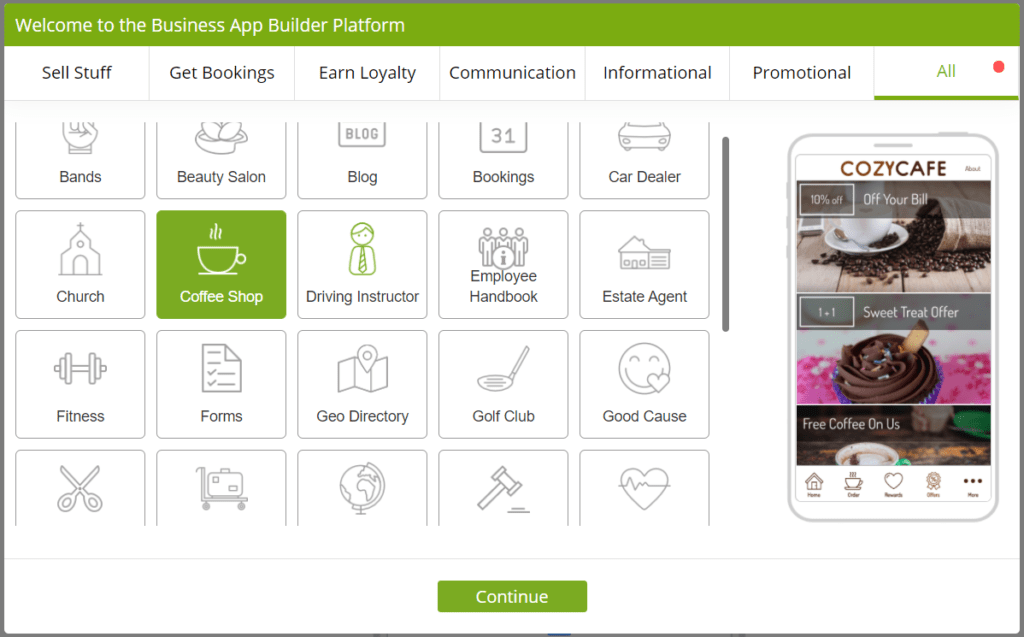
The first step in the app development process is choosing a template. We have templates available for a wide variety of business types, industries, and use cases.
Each of these templates contains the features that most benefit the people who run each type of business.
step one:App Builder
For example:
The beauty salon app template makes it easy for salons to accept bookings. It also has a gallery businesses can use to show off haircuts and styles.
The coffee shop app template contains a loyalty rewards program and the ability for customers to make orders ahead of time.
The radio station app template has features for a live stream and time schedules.
All the templates are customizable. That means if it doesn’t have all the features you want, you can easily add more in the following steps.
If your business doesn’t fit any of the existing templates, you can make an app from scratch and only add the pages and features you need. Just choose the relevant option when setting up.
Step Two: Branding
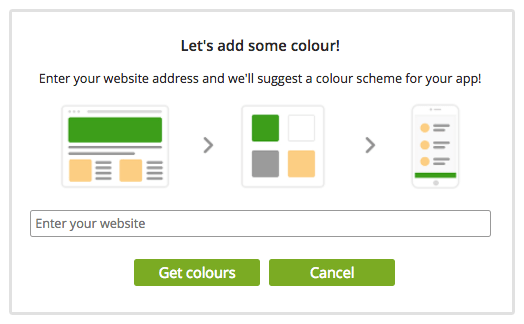
Next, select a color scheme for your template. We make this easy by letting you connect your website to the app builder. We then pull out the colors you already use and suggest a suitable palette for your app that matches your existing branding.
step two:theme
If you don’t have a website or you’d rather choose your colors, you can do so in the next step. Just click the “Skip this step” button.
At this stage, you can enter your mobile number so we can send you a preview link that lets you see how the app looks on a mobile device.
The colors you choose aren’t the only way you can brand your app. Our app builder makes it easy for you to customize your app with images that you can use on the splash screen or as a header bar image.
This makes your app instantly recognizable. Just upload the images via the relevant section.
The final step in the branding process is uploading your app icon. This is the logo that people see when they want to open your app or search for it on the App Store or Google Play. Make sure yours stands out and is instantly recognizable so people can quickly access your app.
Step Three: Content
Each app template comes with preloaded content, which you can easily edit to suit your own business. For example, you can change the text shown on the About page or add new images and descriptions to your menu.
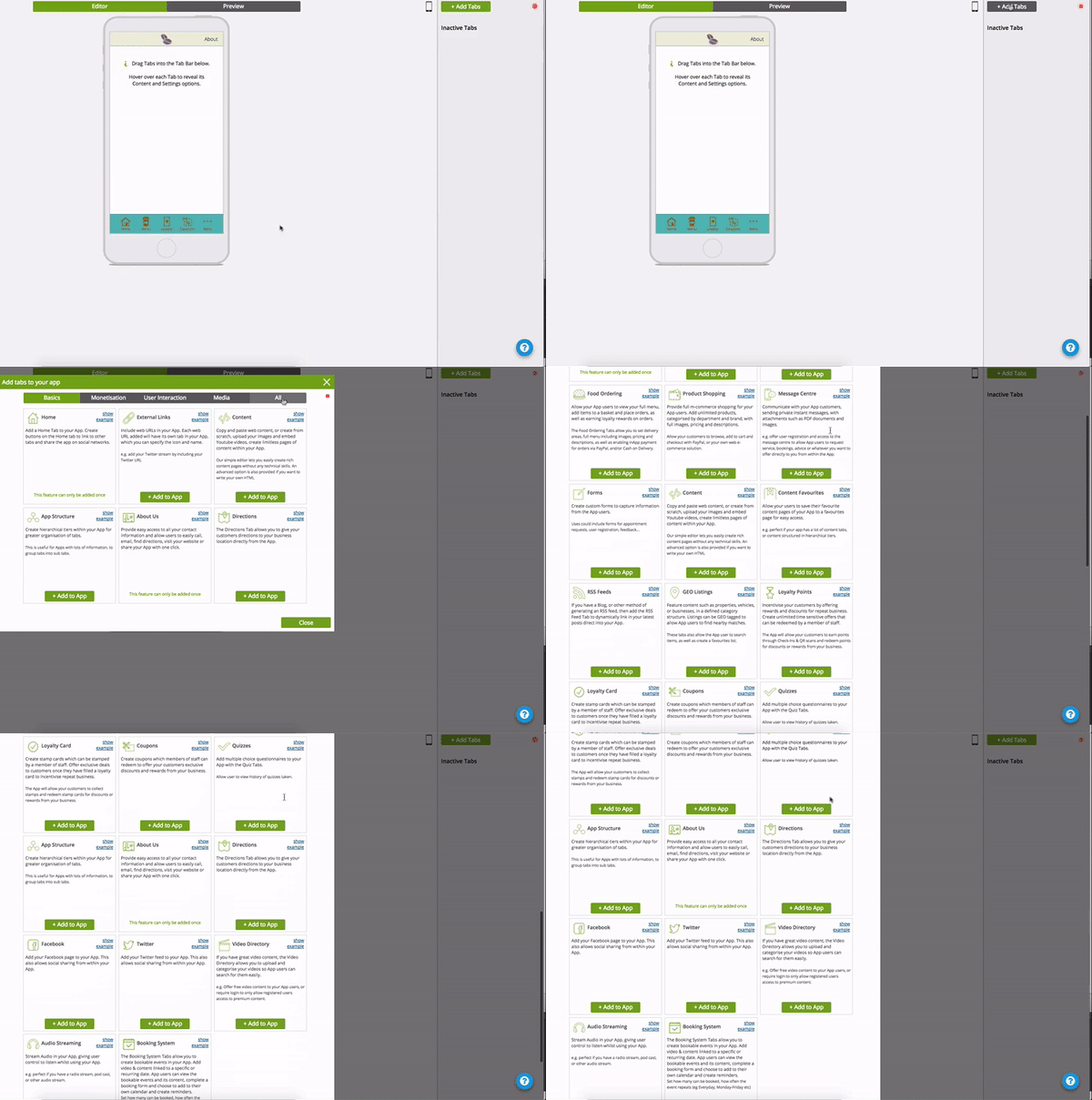
The app builder also makes it easy to add new tabs to your mobile apps.
Whether it’s an about us page with details of your company’s contact and social information, a services page that outlines all you have to offer, loyalty programs, or simple to use forms. You can customize your content to build an app suitable for any business type.
It’s also easy to remove features you don’t think will benefit your audience. If you don’t want to offer a loyalty program, for example, just delete it from the app.
This customization ensures that novices can create mobile apps unique to their business without writing a single line of code.
Once you’ve added content, you can set navigation options. Choose from a tab bar or sidebar menu that enables customers to access features in your app easily.
Setting up the back-end of the features is easy. You can adjust the settings so that you receive a notification when someone makes an order or sends you a message. It’s also possible to restrict access to certain pages to only logged-in users.
Step Four: Publish
Now you’ve worked on the design and added your content to each area of your app, you just need to publish it. Users will then be able to easily download either the iOS or Android app to their phones.
We provide all our users with an easy-to-use wizard that simplifies the publication process. Just follow the steps to set your app live on the App Store, the Google Play Store, or both.
There are several sections you will have to complete before you go live. First, you need to confirm that you don’t breach any of the content warnings from either store. Then you can fill in the details that will show up in your app store listing, including:
App Title
Icon Name
Categories
Keywords
Description
Before publishing your app, you’ll need to sign up for a Google and Apple Developers account. This is required by everyone who wants to publish an app on one of these platforms.
Top App Builder Features for Your Business
The AppInstitute app maker has features that help many types of businesses: including coffee shops, nightclubs, hair salons, driving instructors, charities, and many more.
Here are some of the available features:
Mobile Coupons
Incentivize customers to download your new app by offering exclusive discounts with mobile coupons. These redeemable coupons can have set start and end dates to suit your offer and can help drive those all-important sales. Coupons are particularly effective at driving sales during quiet periods of the year or to promote special occasions!
Food Ordering
With the rise of food ordering apps like JustEat and Deliveroo, restaurant consumers are used to ordering food with just a few clicks. Create and customize your own food ordering app and benefit from great features like one-click ordering without the substantial commission fees charged by third parties. You can use this same system to provide a contactless ordering experience at your restaurant, coffee shop, or bar.
Gallery
Promote your business with gorgeous images in a photo gallery. Hair salons can easily upload the latest photos of their stunning cuts and colors. Or ecommerce stores can showcase images of all their latest products.
Loyalty Program
Our loyalty program tab lets you create a rewards scheme that gives user a stamp whenever they buy from your business.
When the customer hits a predefined number of stamps, you provide them with a gift. The scheme is entirely customizable, so you can make it work for your business and users. It’s perfect for any business that would benefit from repeat sales.
Booking System
Connect your online booking service to your app to accept bookings. It’s perfect for hotels, salons, restaurants, or any type of business that uses bookings. Or you can create events and then accept reservations from your customers. Bars and pubs will find this tab useful, too.
Ecommerce
Connect your ecommerce provider to your app to give people a new way to order directly from your business. We can integrate with platforms including Amazon, Etsy, Magneto, and Shopify.
Audio Stream
Give your customers direct access to an audio stream from their phone or tablet. It’s a great way for radio stations to ensure listeners always have access to their stream.
Push Notifications
Keep customers engaged by sending push notifications directly to their phone. A well-timed message could be the difference between someone ordering from your takeaway on a Friday afternoon and cooking at home.
You can tailor push notifications based on different user segments or the location of the user. For example, you can show families one offer and couples another.
Directions
Add a directions tab that shows users how to find your business. The tab uses Google Maps so it is easy for customers to use.
Contact
Make it easy for customers to contact your business by including a page with a form. We offer several preset forms that allow user to register, send feedback, or send images. Or you can create your own form with the form editor. Add various types of fields including checkboxes, email addresses, and images.
You can check out the complete list of features that we have available here.
Achieving Long-Term Success
App builders make it easy to create apps without programming knowledge. But building your app from scratch and then launching is only the start of the mobile app development process. And it is certainly just the start of the journey with us at AppInstitute.
We want to help you make the most of your new tool, so supply a 30-day success plan which covers all the things you need to do in the early stages to help achieve your long-term goals.
We’ll equip you with social sharing tools to promote your app on the likes of Twitter, Facebook, Instagram, and LinkedIn.
You’ll also be able to access your app’s analytics data to view downloads, app actions, and download sales reports across customized time frames to track the success of campaigns or learn how much revenue you are bringing in.
If you wanted even more in-depth analytical information, use Google Analytics to identify the most viewed pages, where your traffic is coming from, and many more insights and reports.
Once you’ve got a captive audience, communicating with them to keep them that way is the next crucial element. Push notifications are one of the best ways to connect with user almost instantly.
Use them to promote exclusive deals and discounts, send important updates, reminders, and much more. With the addition of geofencing technology, you can use push notifications to target user when they are near your business.
Building your first Apple or Android app doesn’t have to be a scary, daunting prospect.
AppInstitute makes the process easy, stress-free, and affordable. You don’t have to write a single line of code. You get complete control over how your app looks, functions, and feels.
The plunge and delve into the world of the mobile app to take advantage of features that will blow your user away and put you ahead of the competition.
When we talk about the law, it has been so important from the primitive time and its importance will never decrease as the world needs to run peacefully and smoothly. Law as a career is a wonderful profession that can give you a plethora of career Ventures. It is the best way to conquer and explore for the students who are good in communication and are also confident about logical reasoning and can easily imbibe into the legal sphere. This is the right and apt place to develop your skills moreover it is in great demand in today’s world.
Career as a lawyer
Lawyers have always been respected and we always need lawyers to interpret law properly. The students can specialize in various areas like a:
Litigation
Corporate Council
Judicial Clerkship
Judiciary and civil service
Media and Publication
Legal process outsourcing
Academia
Social work etc.
Looking into so many streams of specialization a student may get confused but just in case you are confused it is always good to take advice, and research a little bit to the various pros and cons of every stream.
In this topic, we will be analyzing and understanding the career of a lawyer who has taken the stream of litigation as his future career.
About a career as a litigation lawyer
Litigation is a very intellectual and challenging stream as the legal practitioners provide the services by presenting their clients in the Court. a litigation lawyer is also called an attorney. One has to research the legal issues and present his case in front of the judge. He has to draft his legal documents, and there would be a lot of courtroom appearances. Litigation lawyers should have the complete information of the courtroom with the in-depth knowledge of his case.
Litigation Lawyer
Eligibility for a career as a litigation lawyer
To be eligible and practice in the court as a litigation lawyer one has to:
Complete the LLB 5 years or LLB 3 year’s course
A student who has completed his LLM is also is eligible
One cannot practice if you have done a diploma or a certificate course.
Other basic requirements are:
The student has to be good with communication skills, logical reasoning, full research in legal concepts, detailed knowledge, patience, troubleshooting, critical thinking, confidence, etc.
Few years of experience through internships in law firms will give necessary skill sets to be a professional litigation lawyer.
Pay structure of a litigation lawyer
A lawyer who is practicing in the court his pay scale differs greatly from organization and experience. Sometimes due to the intellectual capability and skill set a litigation lawyer may become very expensive due to the accurate knowledge and Court deliverance. Reputation also is a Core factor that will differ from person to person. in general, a litigation lawyer on an entry-level will draw 1,80,000 per annum and an average litigation lawyer will earn somewhere around 4,99,000 whereas a senior lawyer’s salary will be somewhere around 7 to 8 lacs per annum.
Salary of an attorney
This job is highly rewarding and also has job satisfaction. It helps you to reach Heights which are unimaginable and you can also develop your skill sets and work experience within no time. The job of a litigation lawyer has new challenges daily and is exciting as law keeps changing, hence one has to always keep updating himself. This profession is a discovery of new knowledge and learning and also gets a lot of financial rewards and sometimes even gives a sense of happiness when a genuine client gets justice because of your effort.
In a bid to contain the spike in COVID-19 cases, the UK went on lockdown in November 2020. But despite having the same lockdown measures, infections in Kent were still rising. Due to an overall drop in the number of cases, the country eventually relaxed its lockdown restrictions. What happened next was nothing short of a nightmare. The number of cases skyrocketed. Researchers realized somewhere in Kent the virus had mutated. It was a new variant, and it was more contagious and was spreading extremely fast. In the next five months, this became the most common form of the virus.
But let us back up for a bit. Why did the COVID-19 virus mutate? Why do any virus mutate at all?
From an evolutionary standpoint, mutations are necessary accessories to natural selection. Most mutations are not beneficial for the organisms. Many mutations cause organisms to leave fewer descendants over time, but once in a while, there are changes that give the virus an advantage. These advantageous mutations led to the emergence of what are now called the Variants of concern.
Viruses are basically just a shell of protein surrounding some genetic material- either DNA or RNA. That genetic material is made up of molecules that can be represented by a series of letters like this
Structure of genetic material of viruses. [ Source: Vox]
Each part of the genetic code contains instructions for how to make one specific protein that allows the virus to function. The virus has one goal- to make more copies of itself. But because they are extremely simple entities they use us to replicate. Whenever a virus infects someone, it takes over their cells to make more and more copies of themselves. This means tediously replicating the same code repeatedly. Occasionally, however, the virus makes a mistake. This is called a mutation, and it slightly changes the instructions for making the virus. This altered virus is a variant.
Coronaviruses have a specific type of proteins called the spike proteins that they use to bind with and infect the human cell. Luckily for us, this binding is not a perfect fit and the virus cannot always get past the cell’s defenses. What happened with the UK variant or the B.1.1.7 variant is that it had a mutation on the spike itself making the binding better.
The deadly second wave of Coronavirus that wreaked havoc globally, had a cataclysmic effect in India. WHO recently announced that the highly infectious virus variant which was first detected in India will be referred to as the ‘Delta variant.’ As per data, the Delta variant or the B1.617.2 was the primary cause behind India’s devastating second wave and is much more infectious than the Alpha strain (B.1.1.7), which found in the UK.
The Delta variant and its two mutations. [Source: Vox]
The Delta variant has many different mutations, two of which had been seen earlier. These mutations seem to make the virus more transmissible and confers it power to re-infect people. This means the Delta variant evolved as a response to our immune system.
The Delta plus variant, a new mutant version of the Delta strain first detected in India, has been found in 22 cases in Maharashtra, Kerala and Madhya Pradesh and is a “variant of concern”, the government said in a warning to these states this evening. Sharing preliminary details of the Delta-plus variant, researchers at CSIR-Institute of Genomics and Integrative Biology (IGIB) said that it may be linked with abilities to better escape immune response, which means the virus can potentially dodge vaccines and antibody therapies. In fact, Vinod Scaria, a scientist with IGIB, said that there is also evidence of the Delta-plus variant’s “resistance to monoclonal antibodies”, putting into question the effectivity of the monoclonal antibody cocktail that was recently okayed for the treatment of milder cases.
The tsunami we witnessed in the second wave of the pandemic, caused by the delta variant, has only started to ebb. The rise of a new mutant, merely months after the initial detection, makes the Delta plus variant a serious cause of concern, at least on paper.
The tree is a data structure that allows you to associate a parent-child relationship between various pieces of data and thus allows us to arrange our records, files, and data in a hierarchical fashion. The tree is a very popular data structure used in a wide range of applications. A tree data structure can be defined as follows… The tree is a non-linear data structure that organizes data in a hierarchical structure and this is a recursive definition. A tree data structure can also be defined as follows… The tree data structure is a collection of data (Node) that is organized in hierarchical structure, and this is a recursive definition.
In a tree data structure, we use the following terminology :
1) ROOT: In a tree data structure, the first Node is called Root Node. Every tree must have a root node. We can say that the root node is the origin of the tree data structure. In any tree, there must be only one root node. We never have multiple root nodes in a tree.
2) EDGE: In a tree data structure, the connecting link between any two nodes is called EDGE. There will be a maximum of ‘N-1′ number of edges in a tree with an’ N’ number of nodes.
3) PARENT: In a tree data structure, the Node, which is a predecessor of any node, is called as PARENT NODE. In simple words, the Node with a branch from it to any other node is called a parent node. A parent node can also be defined as “The Node which has child / children”.
4) CHILD: In a tree data structure, the Node, a descendant of any node, is called a CHILD Node. In simple words, the Node with a link from its parent node is called a child node. In a tree, any parent node can have any number of child nodes. Thus, in a tree, all the nodes except the root are child nodes.
5) SIBLINGS: In a tree data structure, nodes that belong to the same Parent are called SIBLINGS. In simple words, the nodes with the same Parent are called Sibling nodes.
6) LEAF: In a tree data structure, the Node which does not have a child is called LEAF Node. In simple words, a leaf is a node with no child. In a tree data structure, the leaf nodes are also called External Nodes. External Node is also a node with no child. In a tree, a leaf node is also called a Terminal Node.
7) INTERNAL NODES: In a tree data structure, the Node which has at least one child is called as INTERNAL NODE. In simple words, an internal node is a node with at least one child. In a tree data structure, nodes other than leaf nodes are called Internal Nodes. The root node is also an Internal Node if the tree has more than one Node. Internal nodes are also called ‘Non-Terminal’ nodes.
8) DEGREE: In a tree data structure, the total number of children of a node is called DEGREE of that Node. In simple words, the degree of a node is the total number of children it has. Therefore, the highest degree of a node among all the nodes in a tree is called the ‘Degree of Tree.’
9) LEVEL: In a tree data structure, the root node is said to be at Level 0, and the children of the root node are at Level 1, and the children of the nodes which are at Level 1 will be at Level2 and so on… In simple words, in a tree, each step from top to bottom is called as a Level and the Level count start with ‘0’ and are incremented by one at each level (Step).
10) HEIGHT: In a tree data structure, the total number of edges from the leaf node to a particular node in the longest path is called as HEIGHT of that Node. In a tree, the height of the root node is said to be the height of the tree. In a tree, the height of all leaf nodes is ‘0’.
11) DEPTH: In a tree data structure, the total number of edges from a root node to a particular node is called as DEPTH of that Node. In a tree, the total number of edges from a root node to a leaf node in the longest path is said to be the depth of the tree. In simple words, the highest depth of any leaf node in a tree is said to be the depth of that tree. Thus, in a tree, the depth of the root node is ‘0.
12) PATH: In a tree data structure, the sequence of Nodes and Edges from one Node to another node is called PATH between that two Nodes. The length of a Path is the total number of nodes in that path.















You must be logged in to post a comment.