

It is better to fix a problem when it is small than to wait and let it become a bigger problem.A Stitch in Time Saves Nine is a wise saying. This phrase refers to a hole in a cloth. This hole would certainly get bigger if not fixed in time. It means that a timely effort that will prevent more work later. It certainly means prevention is better than cure. Furthermore, this important phrase tells us procrastination is a bad habit. Hence, if a problem exists, then one must fix it immediately. If not fixed in time, then even more problems can arise.It is an idiom, which is a phrase whose symbolic or intended meaning is different from the literal meaning of the words themselves.Historians believe it first appeared in print in 1732 in Thomas Fuller’s Gnomologia, Adagies and Proverbs, Wise Sentences and Witty Sayings, Ancient and Modern, Foreign and British. Of course, if Fuller considered this saying to be a proverb in 1732, it was probably around for many years before that.In our life, it is always wise to remember that a stitch in time saves nine. This famous proverb reminds us that any task we perform in our life, if done properly will be established easily. We should be sincere and punctual in performing our tasks as planned. A small lag in any process might lead to great complications and lead to failure in nay task we take up in our life. If we work hard and execute our actions in a smart way, we can complete any task within the anticipated time. Instead of performing a task without proper planning, organized plan of any task would avoid repeating the same process again and again.
This phrase not only relates to our personal issues but also connects to the common or social problems existed in this world and we are becoming the part of these social issues in some protocols like:
In our nearby areas, many under age children are employed as child labour but we just ignore or stay away of it, sometime we employ children under age for house hold activities.Same like, at many places girls child are killed before birth which is a crucial crime and the worst part is that the guilty and the victims are one of us and we just silently watch this crime happening in our country.The third social problem of dowry system is thriving in this country among us but again we become the part of such marriages.
According to many successful individuals, time is money. This precious blessing of time is very limited. There are only 24 hours in a day. Also, the average human life expectancy probably ranges from 80 to 90 years. This certainly means that one can’t afford to waste time at all. Hence, “A Stitch in Time Saves Nine” avoids wastage of time.
Another advantage of this concept is less effort. This is due to early dealing with a problem. Dealing with a problem early requires a certain amount of effort. However, with delay the problem becomes ugly. Now to rectify this even more difficult problem means much more effort. So, following “A Stitch in Time Saves Nine” saves effort.
People use “a stitch in time saves nine” to express that it’s better to spend a little time and effort to deal with a problem right now than to wait until later, when it may get worse and take longer to deal with. Many believe procrastination — putting off doing something until later — creates more work in the long run.
Although no one knows for sure who came up with this saying or what significance stitches or the number nine have, many people believe it was started by mothers weary of mending their children’s clothing.
The phrase thus might be stated more clearly as, “One stitch, in time, saves nine stitches,” meaning that mending a tear right away would only require one stitch instead of the 10 stitches necessary later if the tear goes unfixed and worsens.
A Stitch in Time Saves Nine” has another advantage. It is better decision making. Following this concept means that a person has sufficient time to handle a problem. Therefore, a person can prepare solutions efficiently. In contrast, a person who delays problems will have a shortage of time. Consequently, this person would become stressful and nervous. Due to this, poor decision making would result.
When we do not focus on a task and just try to complete it without an objective, we end being a failure. The main essence of success lies in planning what we do before starting the task. If we do not plan our day/any task we will end up performing actions that would require repetition of the same task again and again. This reminds us of another famous saying ‘Haste Makes Waste’. We also should remember that “Time and Tide Waits for No Man”. So if we keep delaying our tasks with imperfections, we will miss to obtain the targeted results on time.Sincerity in what we do helps us focus on a task till it is completely successfully. Hard Work accompanied with smart work lets us to complete the task as planned in shorter time. Being Punctual helps us to complete our tasks on time. If we try to inculcate these habits in our day to day life, we can be successful without any hindrances in between and gain attraction in any big crowd.
So… little effort expended sooner to fix a small problem prevents it from becoming a larger problem requiring more effort to fix later.
Category: News
Comprehensive, up-to-date news coverage, aggregated from sources all over the world by EduindexNews.
Curtain Raiser
The Election Commission of India is going to organize an International Webinar on 21st September 2020, on the Theme ‘‘Issues, Challenges and Protocols for Conducting Elections during COVID-19 : Sharing Country Experiences’ on its completion of one year of Chairmanship of the Association of World Election Bodies (A-WEB).
2. The Association of World Election Bodies (A-WEB) is largest association of Election Management Bodies (EMBs) worldwide. At present A-WEB has 115 EMBs as Members & 16 Regional Associations/Organisations as Associate Members. ECI has been very closely associated with the process of formation of A-WEB since 2011-1 ECI hosted the 4th General Assembly of A-WEB on 03 Sep 2019 at Bengaluru and took over as Chair of A-WEB for 2019-2021 term.
3. In accordance with the decision taken at the Extraordinary meeting of the A-WEB Executive Board held at Bengaluru on 02 Sep 2019, an India A-WEB Centre has been established at New Delhi, for world class documentation, research and training for sharing the best practices and capacity building of officials of A-WEB members. ECI has provided all the resources for this Centre. A number of initiatives, led by Shri Sunil Arora, Hon’ble Chief Election Commissioner of India and Chairperson, A-WEB are being taken under the aegis of India A-WEB Centre.
4. This is the first Webinar being held by the India A-WEB Centre. Over 120 delegates from 45 countries across the world (viz. Angola, Argentina, Australia, Bangladesh, Bhutan, Bosnia & Herzegovina, Botswana, Brazil, Cambodia, Cameroon, Colombia, Democratic Republic of Congo, Dominica, El Salvador, Ethiopia, Fiji, Georgia, Indonesia, Jordan, Kazakhstan, Republic of Korea, Kyrgyz Republic, Liberia, Malawi, Maldives, Moldova, Mongolia, Mozambique, Nigeria, Palestine, Philippines, Romania, Russia, Sao Tome and Principe, Solomon Islands, Sierra Leone, South Africa, Sri Lanka, Suriname, Sweden, Taiwan, Tonga, Turkey, Uzbekistan and Zambia) and 4 international organizations (viz. International IDEA, International Foundation of Electoral Systems (IFES), Association of World Election Bodies (A-WEB) and European Centre for Elections) are going to participate in the Webinar.
5. The India A-WEB Centre has, in a very short period of its existence, come out with two very useful publications viz. ‘Brief Profiles of the Countries, member EMBs and Partner Organisations of A-WEB’ and ‘COVID 19 and International Election Experience’ which will be released at the Webinar for the benefit of the entire A-WEB community. The Centre is going to bring out a number of publications and documents, including a world class quarterly ‘A-WEB India Journal of Elections’. A brochure on the Journal is also being released at the Webinar.
6. At the Webinar, presentations will be made by participating EMBs and organisations. Session I which will be chaired by Shri Sushil Chandra, Hon’ble Election Commissioner will include presentations by Fiji, Republic of Korea, Mongolia and Taiwan as well as International IDEA and A-WEB where these EMBs and organisations are going to share the challenges faced as well as their experiences and perspectives for holding elections during COVID 19. Session II, which will be chaired by Shri Rajiv Kumar, Hon’ble Election Commissioner will have presentations from South Africa, Indonesia, Bangladesh, India, Malawi and IFES.
7. It is hoped that interactions and discussions at the International Webinar on 21 Sep 2020 will provide a good opportunity to all the participants to exchange ideas and learn from each others’ experience of holding and managing elections in challenging times of COVID 19 pandemic to ensure free, fair, transparent as well as safe elections.

Photo by Pixabay on Pexels.com
Key Elements of successful Contingency planning for Business
Contingency planning is not just about major natural calamities and natural crisis but it can also mean the problems such as loss of data, staffs and customers related to the company or any other business relationships. So it is very much important to conduct contingency planning a routine part in your business.
In this article, we together will explore the key elements of contingency planning in business so that there is a backup option, which your things turn out wrong. So without any further roll, let’s begin.
You must conduct a risk assessment
Contingency planning is one who response to high risk. But in some cases it may be safer and even cost-effective to tackle.
Conduct a risk assessment to avoid any kind of risk. Prepare a risk probability chart to analyse the impact of each risk. These are best way to determine the impact.
What does a contingency plan cover?
A well and good contingency plan prevent your business from ‘going under’ when any unexpected things occur. So it is must to prepare a good contingency plan.
Below are some of the key elements of contingency plans. Scroll it down to read.
- Scenarios: You should always refer to your risk assessment chart and select the most damaging scenario and you plan accordingly to recover from it. Always aim to include a broad range of scenarios like- structural problems of your business premises, absence of staffs for a long time and many more.
- Triggers: Try to figure out the exact cause you will put your contingency plan into action. One or each incident can also have multiple triggers which will initiates a different part or angle of your plans.
- Who to inform: You have to identify the people whom you need to about what is happening. These may include employees, suppliers, customers and mass media public, as it appropriate. You must be aware of your legal obligations and it must reported to the proper authority whenever needed.
- Identity your main responsibilities: You must be responsible for defining who is most responsible for each element of the contingent plan and who will in-charge at each stage and step and what you expect them to accomplish.
- Timeline: Create a your own timeline- what things you need to do first within the first hour of day, week. You must implement the plan in a proper manner. Also mention details of when you would expect regular and normal business and what will signify that your organization is prepare for it.
Developing your contingency plan for your business
Whenever you create or develop your contingency plan for your business, you must remember that your main and first objective is to maintain or restore critical business operations. So you have to keep a deep look at how these situations may affect by each scenario. Be aware of know on effects and crisis.
Keep it a simple fluid language
When you prepare your contingency plans, you must use simple and fluid language. You do not know who will read and implement it, so it is better to keep the plans for your business in a plain and lucid language. This will help to keep your plans relevant without forming any changes in personnel.
How to maintain your contingency plans for your business
The simplest and easiest way to maintain your contingency plans for your business is to review and update regularly, if you want to remain useful and credible. Keep a back- up plan, so if there any occur of problems you can check the back-ups in your convenient time.
How entrepreneurs can launch Charitable Partnerships
This pandemic COVID-19 has shed light on the importance of business and its supporting communities. Observing the success of corporate social responsibility from the beginning of lockdown session, there are many business leaders, are now trying to consider that their company should support charitable for the very first time.
Here are certain tips how entrepreneurs can launch charitable partnership which will support their company values, ethics and resonate with customers, employees, stakeholders and the media.
Read down this article to find the tips. So without further delay lets dive into the main content.
- You have to consider and communicate about your business’ ethics and values: CSR is very much increasing now-a-days and it has a deep-rooted connection of the customers’ emotions with the particular brand. There are many entrepreneurs who set up their business with a good ‘purpose’ and effectively has a good CSR policy, which helps a lot in gaining customers. These CSR campaigns can actually help you to get in touch or communicate your business’ ethics and values to mass customers and it provides you the opportunity to gain customers loyalty towards a brand. But make sure that these initiatives coincide with the corporate social values and norms and goal of your company. It increases company engagement and staff retention in a particular company.
- You cannot be one dimensional in business: To create a proper culture of giving from recruitment time to the retirement time, it is very important to keep in mind that you must involve your employees from the get-go or the very first of job. This will enable you to retain a good bonding or partnership with your staff and it will also the help the employees to connect with and they will be exited to get support throughout their job life and career. Community Grants Programme is a program which encourages housing and charity projects which actually provide support for local communities. Motivate your staffs so that there is job satisfaction among the staffs. This helps to create and maintain the future relationship with the staffs or employees.
- Know and create your business strategy: When you much focusing on the potential partnership, you must consider the importance of charities which will complement your business’ goals and outlook. If you have your business on a very large scale, you might approach your local community foundation for guidance and for your concern. It will guide you with links of different charity services. It will help to create and secure your funds and how to make use of that fund effectively.
So now you know that these are the certain steps that you must follow to launch charitable partnership. These certain small tips are really helpful to create excitement among the employees and stakeholders and your customers. Just launch an exciting CSR strategy. To avoid being side-lined, all you need to do is make the jump at the right time.
Hope you all enjoyed reading this article. Do not forget to stay connected with us for more recent updates. Till then goodbye. Have a nice day.
Blogging in 2020 : Points to know before getting started
A blog (a shortened version of “weblog”) is an online journal or informational website displaying information in the reverse chronological order, with the latest posts appearing first, at the top. It is a platform where a writer or a group of writers share their views on an individual subject. The more frequent and better your blog posts are, the higher the chances for your website to get discovered and visited by your target audience. This means that a blog is an effective lead generation tool. Add a great call to action (CTA) to your content, and it will convert your website traffic into high-quality leads. A blog also allows you to showcase your niche authority and build a brand.
As a business, you rely on consumers to keep buying your products and services. As a new business, you rely on blogging to help you get to potential consumers and grab their attention. Without blogging, your website would remain invisible, whereas running a blog makes you searchable and competitive.
If you want to create a blog, you don’t need a revolutionary idea. But your blog should be focused on something specific.
Remember that no idea, no matter how good, is truly unique.
But you have unique experiences. You have a distinct voice. And, you probably have a vibrant personality that will attract others like your family and friends.
When it comes to choosing your blog’s niche, there are 2 key questions to ask yourself.
The appearance of blogs has changed over time, and these days blogs include a wide variety of items and widgets. However, most blogs still include some standard features and structure.
Here are common features that a typical blog will include:
- Header with the menu or navigation bar.
- Main content area with highlighted or latest blog posts.
- Sidebar with social profiles, favorite content, or call-to-action.
- Footer with relevant links like a disclaimer, privacy policy, contact page, etc.
To set up your blog on a personal website, there are a few things you’ll need to sign up for as you set up your blog, so it’s good to see how they all connect before we get too deep.
- First, there’s the domain. This is the URL of the website. Think of it as the address for your business. You’ll need to buy your domain from a domain registrar. This is the company that you’ll use to buy your domain and hold it for you. They don’t host your site or anything — they just store your domain and point web traffic to your site which will be on your web host. Use Domain.com (they are my favorite) and get 25% off with coupon code “QUICKSPROUT”.
- Second, the web host. This is the company that hosts your site. Your site will be on its servers. Here is my updated list of the best web hosting companies overall and I also dive into specific WordPress focused hosting companies in more detail below. The quick answer though is for most bloggers the best choice is BlueHost
- Third, the tool to build your site. Very few sites are built by hand using raw HTML and CSS these days. Almost all of them are built using a tool. The tool handles a lot of heavy lifting and makes building a site substantially easier, especially if you have no idea how to code. This is how you’ll configure your site and publish your blog posts. For blogging, these tools are called content management systems (CMS) and the only real option is WordPress. Once you’ve installed WordPress on your host, you’ll be able to start building your site.
To recap, you’ll buy a domain using a domain registrar, install WordPress on your host, then start building your site. I’ll walk you through how to do each of these things step by step.
Bipin Chandra Pal
The Indian nationalist, journalist, orator, social reformer and movement activist Bipin Chandra Pal. The Lal Bal Pal triumvirate was one third. Pal, along with Sri Aurobindo, was one of the key Swadeshi architects. He resisted the British colonial government’s division of Bengal.
Bipin Chandra Pal was born into a Hindu Bengali Kayastha family in Poil, Habiganj, District of Sylhet, the Bengal President of British India. His dad Sylheti was a Persian scholar and tiny landowner, Ramchandra Pal. He studied and taught at the University of Calcutta Church Mission Society College. His son Niranjan Pal, one of Bombay Talkies’ creators, was his son. ICS cop, S., his son-in – law was. K. Dey, then a minister of union. His other lawyer, Ullaskar Dutta, was a freedom fighter and, after many circumstances, married Lila Dutta at her last age, he loved interest.
Pal was as innovative in politics as he was in his privacy. He married a widow and entered Brahmo Samaj after the death of his first wife.
Pal was one of India’s freedom fighters, known by the name of Revolutionary Thinking Father. Pal became the Indian National Congress’ big leader. Bipin Chandra Pal made a powerful appeal to abrogate the Weapons Act, which was discriminatoric in nature, at the Madras session of the Indian National Congress in 1887. He was a member of the “Lal, Bal, and Pal trio” that was affiliated with revolutionary activities along with Lala Lajpat Rai and Bal Gangadhar Tilak.
The chief exponents of a new nation-style movement revolving around the principles of Purna Svaraj, Swadeshi boycott and national training are Sri Aurobindo Ghosh and Pal. His curriculum included Swadeshi, boycott and education. The use of Swadeshis and the boycott of international products to eliminate poverty and unemployment was preached and promoted. He wished to eliminate social evils from the type and, by national critique, invoke feelings of nationalism. In the context of no collaboration with British colonialists, he had no confidence in mild protests. On that matter, Mahatma Gandhi was uncommon for the assertive nationalist leader. He split his business with the Congress and lived a secluded life over the last six years of his life. Sri Aurobindo named him one of nationalism’s most influential prophets. Bipin Chandra Pal did his utmost to prevent economic and social disasters. He criticised the caste system and defended the remarriage of widows. He called for a 48-hour work week and for a workers’ pay increase. He revealed his contempt for the ways in which Gandhi had become embedded in “magic,” rather than “logic” in his critique.
Pal worked for Bengal’s popular opinion, the Tribune and New India, as a journalist, spreading his nationalist name. He has written numerous papers informing India of developments in China and other geopolitical circumstances. Pal wrote the title “Our real hazard” in one of his writings explaining from what is going to be the future danger for India.
In 1919 Pal had, although originally considered moderate within the National Indian Congress, been moving closer to Bal Gangadhar Tilak, one of the leading nationalist politicians, with more radical policies. Later on, Pal joined with fellow Bengalists, resenting the personality cult of the most famous nationalist leader, Mahatma Gandhi. Pal’s overarching concern in his 1912-1920 writings was that the various regions and communities within India must be brought together. He remained a distant from domestic politics after 1920, but continued to contribute to Bengali reviews.
Diana: A Case Study
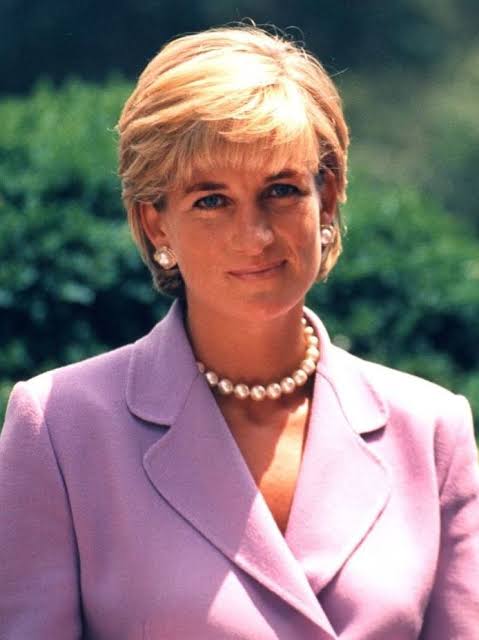
Diana (July 1, 1961, to August 31, 1997) was born to aristocratic parents who divorced when she was six. With her mother gone and her father deep in depression, she had a lonely childhood. “I’d have 20 stuffed animals… that was my family.”, remarked Diana about her childhood. She grew up to be introverted and had multiple insecurities. She was physically active and learned ballet and tap dancing. At nineteen, she was engaged to Prince Charles and that marked the beginning of her long-drawn battle with Bulimia Nervosa (Binge-eating/Purging Type). “The bulimia started the week we got engaged. My husband put a hand on my waistline and said, ‘Oh, a bit chubby, here aren’t we?’”, said Diana. Her eating disorder was inflamed by the intense media scrutiny she received, which was not always positive.
She had scar tissue and trauma from her childhood, and the onslaught of media attention magnified her insecurities, making her feel like an outsider. Her pregnancies were surrounded by speculations which plagued the lives of her children. She suffered from Postpartum Depression, which she revealed after her separation. At the peak of her popularity, cable TV news emerged. This socio-cultural development stoked the media frenzy, and many of her trusted friends and acquaintances sold information about her to the press, which led to distress and paranoia. She was attracted to suffering which motivated her to support charities for HIV, addiction and the homelessness. As a public figure, she outshone the members of the royal family, rebranding and popularising a dynasty whose approval ratings were getting dangerously low.
Her family life was fraught with difficulties. While she enjoyed a close relationship with her sons, her husband was in love with another woman. “The worst day of my life was realising that Charles had gone back to Camilla.”, said Diana. In the search for love and support, she had affairs with the likes of Barry Mannakee, James Hewitt and James Gilbey. Post the announcement of her separation, she slowly became obsessed about being viewed favourably by the public. She lived her life in the public eye, and her popularity eclipsed that of Prince Charles. Every move of hers was watched closely, and emulated by admirers from around the world.
Her death, which was caused by a car accident while she was being chased by the paparazzi, was mourned by the world on an unprecedented scale. Millions watched her funeral online, and the grieving public confronted the newly emerging tabloid culture that intruded on Diana’s life, forcing her to take extreme measures to find privacy. Her life and death serve as an admonishment to those media houses that are willing to overlook the ethics of journalism as long as their stories sell. More than twenty years after her death, when we witness the steady rise of tabloid journalism, we need to ask ourselves if we could afford to have another death weigh on our collective conscience.
“A girl given the name of the ancient goddess of hunting was in the end, the most hunted person in the modern world.”- Charles Spencer, Diana’s brother.
ONLINE LEARNING IN THE PANDEMIC: GOOD OR BAD?

Source: Google imagesCovid-19 struck us without a warning and left all educational institutions scrambling to respond to its urgencies. It has also created a need to creatively deal with such unforeseen and once-in-a-century catastrophic event that is being called the ‘new normal’.
When the lockdown was announced in the last week of March after which the country came to a sudden halt. Everything was announced to be stopped for 21days, only essentials were allowed to be sold. Under this circumstance all educational institutions had to close their campuses, students living in the hostels were sent back home if possible. Nobody had imagined that it will eventually take more than 6 months (and still counting) for the situation to normalize.
Now the education system is lagging behind its schedule, but to make the situation sufferable online classes have been started by institutions. Which can result in keeping up with the schedule of the education system, but with every new change comes both, good and bad. Today we will discuss the about the impact of these online classes extensively.
The negative impact

Source: Google images
With the online classes, neither the teacher nor the student feel the same kind of energy as in face to face learning, so it may result in less enthusiasm from both the sides which will hamper the student-teacher relation.
Students who live in villages or places where the internet connection is not good or with great speed are unable to attend the online classes. This proves to be disadvantageous because the online classes are for students which if they wont be able to attend then what’s the point in conducting them?
Many institutions have decided to take online examinations too, now what will happen to the students who have poor internet connection during the exam time. They will fail because they will not be able to connect or reconnect due to bad internet connection.
Most of India’s population belongs to lower-middle class family, they don’t earn enough money to buy their children smartphones and gadgets, as a result many of the students do not have devices, smartphones and laptops or money to keep the internet connection while also paying the school fees.
Some teachers also struggle to get to know the technology. They are expected to make PowerPoint Presentations (PPTs), record the video lectures, and take online classes through different apps and online platforms, which not all of them are able to do properly. This is more common among the teachers because most of them didn’t had to that their whole life, and to learn something that is this vast, takes plenty of time.
A major problem has emerged for the teachers who often complain about some Students doing mischievous activities for entertainment. They share links of online classes that are sent to them by their teachers. They also tend to create Zoom IDs in random, unidentifiable names and troll teachers. Some switch off their camera and call teachers by their names from these IDs, some use them to send memes to teachers.
Teachers also have to face common issues like, Bullying by students, argumentative parents who often peep into classes, and distracted children and a story that I personally heard was about a student’s relative used the link to log into the class and “see what the teacher looks like, what she teaches and how she speaks”, and I am sure many others also must have experienced something like this.
The positive impact

Source: Google imagesThere is an abundance of benefits that students and teachers will get from online learning as well few of them could be:
Online learning can be done from the comfort of one’s home, especially during COVID-19 outbreak, which definitely does not mean that you can lay down on your bed and attend your classes, what it means is that it is easier for you to stay at home safely and attend classes.
Different student has different level of understanding some can learn something new easier than the other whereas some may take some time, with the online learning you can learn the lesson on your pace, you just have to record the lectures, the PowerPoint presentations are uploaded for you by the teachers.
Unlike the classroom learning, here the lessons can be constantly updated and uploaded so that students can continue on if they have finished the previous lessons.
Many students in traditional classroom environments don’t feel comfortable speaking in front of everyone but In an online environment, it can be much easier to share thoughts with others. According to the National Institute of Mental Health, 74% of people suffer from speech anxiety, online classes will help them to improve and build their confidence.
Even if the exams are conducted online there is no harm in it on the plus side you will get your results instantly without having to wait for a long period of time.
Most importantly this swift shift to online mode of learning has resulted in less use of paper throughout the world as teachers and students both use technology to write notes or create presentations, thus protecting our environment.
Conclusion
As we saw above, that online learning has it’s good and bad aspects, so at least for now in this case of emergency, the online mode somewhat works for the students but still the government needs to come out with alternatives for the students with no gadgets or no internet connection or both.
For the future, that is after the pandemic is over online learning and the face to face traditional learning has to co-exist, because we can’t be fully dependent upon the virtual learning. Yes it does make the learning process easier but it still has to improve alot and also has to inculcate the values that the students learn while in the traditional learning system, and also has to eliminate the barriers in online learning so that no one is disadvantaged from this system.
PAPER BOOKS VS E-BOOKS.
“I have always imagined that Paradise will be a kind of library.”
― Jorge Luis Borges
Books are our best friends is what we have heard since childhood. And probably experience it. A book lover enjoys his coffee while reading a book and that is his definition of “Peace”. The smell of a new book or the excitement of starting to read a book is something different . Books prove to be the best guide for us or may be a source to feel better. Having a collection of books is a matter of pride for certain people. Some love going to the library and reading books and some create their own library.
Reading is one of the best habits one can have. When you read you go in a different zone altogether. You feel good you feel lively. One of the best ways to increase your fluency in English or even for improving your vocab is reading . Traditionally, there was only paper books available. You spend on them and then you get to read. In today’s era things have changed. Now you google the book you want to read and download it on your PC/Mobiles and read it whenever and wherever you want to. E -books have become a trend and grown over years. A lot of people have adapted this new way of reading. There are a lot of apps that offer you to read books online. Kindle is one of the most famous way of online reading.
However, the demise of printed books as a result of e-books has not materialized, but instead, the two formats have existed simultaneously. Both have their pros and cons and choosing one would be unjust.
Paper Books : You have an advantage of turning pages or underlining something you learnt or maybe folding a page to re read again. They do not affect your eyesight rather it keeps you away from technology for a span of time. You can enjoy reading the book while in a balcony at your favorite spot . You can exchange good books with your friends to read and exchange thoughts. They help you sleep better, since while going to sleep you can comfortably read your book without and eye constraint. You possibly can have a mini library that will be your mantra for peace.
Drawbacks : Physical books can be difficult to handle. You can not read paper books anywhere. If you are travelling and want to take your book along it can be difficult if it is a heavy book. The paper books are not eco-friendly since a lot of paper is involved thus increasing the cutting down of trees. Even the cost of publishing books are really high and also publishers take a lot of chance while publishing an author’s book since they do not know whether it will work or not. Buying books can at times be expensive or even out of stock thus leading you to wait for a couple of days or maybe months.
E-books : E-books have an advantage of anywhere and anytime reading .You can use your mobile phones while sitting in a cafeteria or may be in a boring house party and read your book. E books are easier to carry while travelling and also downloading an E-book is free of cost leading to less expense. The cost of publishing is low while online. Technology saves the use of paper thus eco friendly. You can share the content at any online platform in just one click. E- Books have been designed with text to speech or read aloud features. This allows people to listen to the eBooks if they are too busy to read it, for example, while driving, or while doing some chores.
Drawbacks: E-books cause strain to eyes and you feel uncomfortable while reading it before sleeping. You can flip the pages or fold or underline if you want to. You can not gift a friend an E-book on their birthday or may be a special ocassion. E-books include the cost of graphic designing. There are many people who are not tech savvy and they can not enjoy the benefits of reading an E-book. You are distracted at times since there are certain notifications that keep coming while you are on your phones and that leads to distractions.
Although both Books and E-books have their pros and cons both provide you knowledge and enhance your skills. At the end what matters is to read whether online or offline. Happy reading !
World’s longest high-altitude tunnel fully ready to open in Himachal Pradesh

Rohtang Tunnel Project: The world’s longest highway tunnel above 10,000 feet, Atal Tunnel, connecting Manali to Leh, is likely to open soon! It is being said that the ambitious infrastructure project will be inaugurated by Prime Minister in the last week of September.
The strategically important infrastructure project, the Rohtang Tunnel has been named after former PM Atal Bihari Vajpayee. It has been built at a cost of around Rs 3,200 crore. According to KP Purushothaman, Chief Engineer of the project, the estimated period for completion of the Atal Tunnel was less than six years but it was completed in 10 years, ANI reported.
The 8.8 km long, Atal Tunnel will be one of the longest road tunnels in India. Under Rohtang Pass, the strategic road tunnel project is being built at an elevation of 10,171 feet. Once the ambitious tunnel project is thrown open to the public, there will be a reduction of nearly 45 km between Manali and Lahaul- Spiti’s administrative centre Keylong.
No official confirmation has been received so far, we may get it within a couple of days, he said, adding it is also not yet clear if it would be a virtual opening due to the corona crisis or a physical one. The Atal Tunnel built at a cost of about Rs 3,500 crore is extremely significant from the defence point of view.
Apart from the strategically important Atal Tunnel, another infrastructure project is being developed as well, which is a steel super structure bridge of 100 meter length, across the river Chandra on the North Portal of the Rohtang Tunnel.
India Happiness Report 2020 😊
According to the India Happiness Report prepared by Rajesh K. Pillania, a professor of strategy at the Management Development Institute in Gurugram, Mizoram has been declared the happiest state in India. A survey was conducted during the coronavirus pandemic from March to July among the 16,950 people to find out which are the happiest states and union territories across the country. Among the other factors, the report also focused on the impact of COVID-19 on happiness. Participants were asked to rate their current standing on the impact of COVID-19 on their happiness from the worst possible to the best possible from 1 to 5.The study is based on a nationwide survey covering 16,950 people between March and July 2020 .

In overall happiness ranking of states and union territories:
- Mizoram
- Punjab
- Andaman and Nicobar Islands

Among the big states:
- Punjab
- Gujarat
- Telangana
Among smaller states:
- Mizoram
- Sikkim
- Arunachal Pradesh
Among union territories:
- Andaman and Nicobar Islands
- Puducherry
- Lakshadweep
The worst possible impact of COVID-19 on happiness:
Maharashtra, Delhi, and Haryana have shown the worst possible impact of COVID-19 on happiness, whereas Puducherry and Jammu and Kashmir are neutral and Manipur, Andaman and Nicobar Islands, and Lakshadweep have shown the best possible impact of COVID-19 on happiness.
Need for Career Counselling
Career counseling is a type of advice-giving and support provided by career counselors to their clients, to help the clients manage their journey through life, learning and work changes (career). This includes career exploration, making career choices, managing career changes, lifelong career development and dealing with other career-related issues. There is no agreed definition of career counseling worldwide, mainly due to conceptual, cultural and linguistic differences. However, the terminology of ‘career counseling’ typically denotes a professional intervention which is conducted either one-on-one or in a small group. Career counseling is related to other types of counseling (e.g. marriage or clinical counseling). What unites all types of professional counseling is the role of practitioners, who combine giving advice on their topic of expertise with counseling techniques that support clients in making complex decisions and facing difficult situations.
Counseling is a collaborative effort between the counselor and client. Professional counselors help clients identify goals and potential solutions to problems which cause emotional turmoil; seek to improve communication and coping skills; strengthen self-esteem; and promote behavior change and optimal mental health. Counseling provided by trained professionals can make a profound impact on the lives of individuals, families and communities. This service helps people navigate difficult life situations, such as the death of a loved one, divorce, natural disasters, school stress and the loss of a job. In a career counseling session, the counselor will help a person explore skills and strengths, consider education levels and give advice about continuing education, and determine interests and personality type. Counselors may also administer an IQ test or an aptitude test.
Empirical research attests the effectiveness of career counseling. Professional career counselors can support people with career-related challenges. Through their expertise in career development and labor markets, they can put a person’s qualifications, experience, strengths and weakness in a broad perspective while also considering their desired salary, personal hobbies and interests, location, job market and educational possibilities. Through their counseling and teaching abilities, career counselors can additionally support people in gaining a better understanding of what really matters for them personally, how they can plan their careers autonomously, or help them in making tough decisions and getting through times of crisis. Finally, career counselors are often capable of supporting their clients in finding suitable placements/ jobs, in working out conflicts with their employers, or finding the support of other helpful services. It is due to these various benefits of career counseling that policy makers in many countries publicly fund guidance services. For example, the European Union understands career guidance and counseling as an instrument to effectively combat social exclusion and increase citizens’ employability.
One of the major challenges associated with career counseling is encouraging participants to engage in the process. For example, in the UK 70% of people under 14 say they have had no careers advice while 45% of people over 14 have had no or very poor/limited advice. In a related issue some client groups tend to reject the interventions made by professional career counselors preferring to rely on the advice of peers or superiors within their own profession. Jackson et al. found that 44% of doctors in training felt that senior members of their own profession were best placed to give careers advice. Furthermore, it is recognised that the giving of career advice is something that is widely spread through a range of formal and informal roles. In addition to career counselors it is also common for psychologists, teachers, managers, trainers and Human Resources (HR) specialists to give formal support in career choices. Similarly it is also common for people to seek informal support from friends and family around their career choices and to bypass career professionals altogether. In the 2010s, increasingly people rely on career web portals to seek advice on resume writing and handling interviews and to do research on various professions and companies. It has also possible to get a vocational assessment done online.
Assessment tools used in career counseling to help clients make realistic career decisions. These tools generally fall into three categories: interest inventories, personality inventories, and aptitude tests.
Interest inventories are usually based on the premise that if you have similar interests to people in an occupation who like their job, you will probably like that occupation also. Thus, interest inventories may suggest occupations that the client has not thought of and which have a good chance of being something that the client will be happy with. The most common interest inventory is a measure of vocational interests across six domains: Realistic, Investigative, Artistic, Social, Enterprising, Conventional. People often report a mixture of these domains, usually with one predominant domain.
Aptitude tests can predict with good odds whether a particular person will be able to be successful in a particular occupation. For example, a student who wants to be a physicist is unlikely to succeed if he cannot do the math. An aptitude test will tell him if he is likely to do well in advanced math, which is necessary for physics. There are also aptitude tests which can predict success or failure in many different occupations.
Personality inventories are sometimes used to help people with career choice. The use of these inventories for this purpose is questionable, because in any occupation there are people with many different personalities. A popular personality inventory is the Myers-Briggs Type Indicator. It is based on Carl Jung’s theory of personality, but Jung never approved it. According to Jung most people fall in the middle of each scale, but the MBTI ignores this and puts everyone in a type category. For example, according to the MBTI, everyone is either an extrovert or an introvert. According to Jung, most people are somewhere in between, and people at the extremes are rare. The validity of the MBTI for career choice is highly questionable.
Start your own Business
Nothing beats working for yourself. Even when you love your job and think that it’s rewarding, the satisfaction you get when you are your own boss is a completely different feeling. Not only is it more meaningful but it comes with so many benefits. While it may seem alluring venturing into a new market, especially if you are a startup, it can be tricky, and let’s face it, pretty risky too—you are putting in more hours than at a 9-5 job elsewhere, and there will be moments where you may actually be sacrificing a lot more than just your time. Even then, it is absolutely worth it.
BUYING WEBSITES :
Just like stocks and property, in our interconnected world thanks to the internet, websites also have a really high value. Even as you read this, websites are constantly being purchased or sold for hefty prices. There are several factors that will affect the value of a site online, such as the domain name, the amount of traffic it receives, general popularity and profits that the site earns amongst other factors. While this business can be really lucrative, it requires an in-depth understanding of the market, however, once you understand how it works, you could potentially be sitting on a goldmine.
ONLINE COACH :
If you are passionate about something and have a big knowledge base about the topic, you could start a career as an online coach. Setting up a YouTube channel with tutorials, setting up a blog to help people understand concepts, creating online courses—there is a multitude of things that you could be doing. Online coaching can be a lucrative way of making money, however, make sure you don’t oversell yourself online or to a client as their success depends on many different things that may not entirely be under your control.
VOCATIONAL CONSULTANT :
If you are leaving behind a corporate job with a fair amount of experience to start your own venture but have no idea where to begin, this one may be for you. There are several people out there who want to learn how to ace a promotion interview or ask for a raise, or simply land a high paying job. If you have useful tips for them, you can just start your own consultancy and people will be willing to pay you good money to learn the tricks of the trade. If you aren’t ready to start up your own website or just want to test out the waters, you should look at signing up to platforms such as The Muse or Coach Me where others are looking for people like you to mentor them.
REAL ESTATE VALUATION :
Real estate valuation is a great job to have because you can decide how much you want to work, where you want to work from and these parameters will decide how much you earn. You don’t necessarily need a degree in this field but you should check if you require some kind of certification in the country or state that you want to operate in. Of course, apart from the certification, you also need to have a solid understanding of the market to be able to make a living for yourself in this field.
GRAPHIC DESIGN :
There is a huge demand for graphic designers in the market today. If you already have the existing skillset and knowledge of design platforms such as Adobe Illustrator, Photoshop or Sketch, then you can literally just sign up to Fiverr or Upwork or find remote jobs on websites such as Jobspresso. However, if you don’t have the required skills, you can always sign up to Skillshare and enroll in a graphic designing course and then practice through smaller gigs. Businesses need graphic designers to create logos, banners, social media posts, design campaigns, products and packaging and so many other smaller processes that we don’t even realize. So keep practicing and before you know it, you may be snapping up clients with the utmost of ease.
PRESENTATION DESIGN :
Believe it or not, there are entire businesses set up for people to hire someone else to create their PowerPoint presentations. For those who are not well-versed in technology or have a tough time getting around Microsoft Office, creating a presentation can be a major challenge and even a hurdle in their professional career. Familiarize yourself with different types and formats of presentations, such as Pecha Kucha or Prezi, and you can widen your customer base even more.
WEB DEVELOPMENT :
Web developers are highly valued due to their specific knowledge of a complicated subject. If you can master the basics of HTML, Python, CSS, Ruby and/or Java script, and get some experience for your portfolio, you are all set to start your own successful web development business. You can further hone your skills or learn a new language on Treehouse.
APP DEVELOPMENT :
3.8 Million apps on the Android store, 2 million apps in the iOS store and every single day more new apps are being created and released. You can find an app for nearly anything: Some are useful, while others aren’t so much. Creating an app and launching it is a tedious process with a lot of hard work going into it—from the coding and development phase to creating a beautiful interface and providing the best user-experience possible. Furthermore, you might also want to market your app on social media. If your first app is a success this may launch you into a career in app development with some great projects in the future.
ONLINE JOURNALISM :
If you have a degree in a communication field or in journalism but don’t want to work in a traditional newspaper or broadcasting atmosphere, you could look into online journalism. Build your portfolio with online companies such as HuffPost and then work your way to creating your own medium of news; be it a blog, You-tube channel, social media channel, etc. Then you can add sales funnels by looking into advertising revenue.
AFFILIATE SALES AND MARKETING :
This is a great idea if you are running a channel on YouTube and have decided that you would like to turn the views into revenue. The same can be done with a website that is generating plenty of traffic. All you have to do is join one of the big affiliate networks such as ClickBank or ShareASale and you can turn your existing content mediums into a source of passive income.
PODCASTING :
You can start your own podcast about niche topics that you have a solid knowledge base about; the more specific the topic is, the better. If you already have a podcast that you are running for free, you can crack some sponsorship deals to turn it into a source of income. All you need to be sure about is whether you are creating consistent, valuable and relevant content for your audience.
WORDPRESS WEBSITES :
Many small business owners, especially ones that are foraying into the ecommerce world, like to create a basic website, usually hosted on WordPress. If you have a working knowledge of WordPress or have the time and resources to invest in learning about the platform, you could be earning hundreds of dollars just to launch a website. Investing your time in learning about WordPress will pay off in the long run as well because it is an important skill to have these days.
OUTSOURCED CUSTOMER SERVICE :
There are several businesses out there that are looking for individuals to fulfill customer service positions. This requires a fair amount of experience, good people and management skills and should be familiar with organizational structures. Platforms like Upwork and Jobspresso provide many opportunities and the best part is that if you are good at what you do, you can even hire a team to scale your business and take on bigger clients.
BUSINESS CONSULTING :
If your friends and family are constantly turning to you for help when it comes to business advice because they know it’s solid, then it might be time to look into starting a business consultancy. The one thing about being involved in business consultancy is that you will need credentials no matter how good you are. Think about it: Would you take business advice from a random person working out of their home or garage? I don’t think so. Your credentials will add value to your knowledge and even if you don’t have them now, you can always work towards getting them! Companies are always looking for people with a great sense of business, no matter which field it is—public relations, marketing, strategies, human resources, etc.—so if you already have the required certifications then maybe you should jump onto this bandwagon.
AICTE announces scholarship for PG 2020-21
The All India Council For Technical Education (AICTE) has announced the scholarship programme for the post graduate (PG) students for the year 2020-21. The candidates of ME, MTech, MPharm, MArch with valid Graduate Aptitude Test in Engineering (GATE) or Graduate Pharmacy Aptitude Test (GPAT) score can apply for the scholarship. The eligible candidates can apply through the website- aicte-india.org.
“AICTE in order to ensure development of technical education in India awards Post Graduate Scholarship of Rs. 12,400/- per month to full-time GATE/GPAT qualified students admitted to AICTE approved post graduate programs in AICTE approved Institutions/ University Departments,” reads the official notice.
AICTE offers scholarship of Rs 12400 per month to PG students. This facility is offered to full time GATE / GPAT qualified students.
A total of 24 months scholarship is awarded during the two-year PG course. Scholarships are awarded from the month of classes commencing to the month when classes are closed.
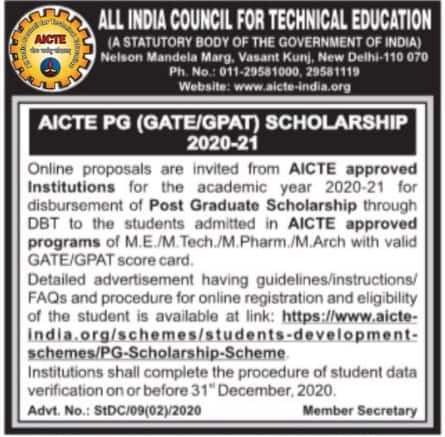
To receive the scholarship, candidates have to validate their students ID and proceed with filling the GATE PG scholarship form. All the details like Bank account number, institute permanent ID, students ID and date of birth have to filled correctly, failing which the disbursal of scholarship will be affected. After filling the form, institutes have to verify and submit the data of all candidates admitted in M.Tech/M.E./M.Arch through GATE for the academic years 2020-21.
The last date for institutes to verify and submit students data to AICTE is December 31. The scholarship will be provided from the date of commencement of classes/date of admission whichever is earlier. Students will receive the GATE scholarship 2020 amount directly in their bank account.
To receive the GATE scholarship 2020, candidates need to have a savings account in their name, same as furnished in GATE/institute admission. Candidates belonging to OBC-Creamy layer who have qualified GATE under OBC category will not be eligible for the scholarship. Candidates who qualified GATE under any reserved category (SC/ST/PwD/OBC-NCL) must have a valid category certificate without which they will not be considered for the scholarship.
Candidates who have qualified under the OBC (Creamy Layer) category are not eligible for the scholarship. However, OBC (Non-Creamy Layer) candidates will be required to submit certificates which are not more than one year old to process their applications for the programme.
Indian Economy
The economy of India is characterised as a developing market economy. It is the world’s fifth-largest economy by nominal GDP and the third-largest by purchasing power parity (PPP). According to the IMF, on a per capita income basis, India ranked 139th by GDP (nominal) and 118th by GDP (PPP) in 2018. From independence in 1947 until 1991, successive governments promoted protectionist economic policies with extensive state intervention and regulation which is characterised as Dirigism. The end of the Cold War and an acute balance of payments crisis in 1991 led to the adoption of a broad program of economic liberalisation. Since the start of the 21st century, annual average GDP growth has been 6% to 7%, and from 2014 to 2018, India was the world’s fastest growing major economy, surpassing China. Historically, India was the largest economy in the world for most of the two millennia from the 1st until 19th century.
The long-term growth perspective of the Indian economy remains positive due to its young population and corresponding low dependency ratio, healthy savings and investment rates, and is increasing integration into the global economy. The economy slowed in 2017, due to shocks of “demonetisation” in 2016 and introduction of Goods and Services Tax in 2017. Nearly 60% of India’s GDP is driven by domestic private consumption and continues to remain the world’s sixth-largest consumer market. Apart from private consumption, India’s GDP is also fueled by government spending, investment, and exports. In 2018, India was the world’s tenth-largest importer and the nineteenth-largest exporter. India has been a member of World Trade Organization since 1 January 1995. It ranks 63rd on Ease of doing business index and 68th on Global Competitiveness Report. With 520-million-workers, the Indian labour force is the world’s second-largest as of 2019. India has one of the world’s highest number of billionaires and extreme income inequality. Since India has a vast informal economy, barely 2% of Indians pay income taxes. During the 2008 global financial crisis the economy faced mild slowdown, India undertook stimulus measures (both fiscal and monetary) to boost growth and generate demand; in subsequent years economic growth revived. According to 2017 PricewaterhouseCoopers (PwC) report, India’s GDP at purchasing power parity could overtake that of the United States by 2050. According to World Bank, to achieve sustainable economic development India must focus on public sector reform, infrastructure, agricultural and rural development, removal of land and labour regulations, financial inclusion, spur private investment and exports, education and public health.
Challenges faced by Indian Economy :
Indian economy faces many challenges that include Unemployment, Poor educational standards, Poor infrastructure, Balance of payments deterioration, High levels of Private Debt, Large Budget Deficit, Rigid labor Laws, Inefficient agriculture, Poor tax collection rates, Business difficulties, Inequality within regions.
Unemployment –
The causes of high unemployment and under-employment in India are subject of intense debate among scholars. A group of scholars state that it is a consequence of “restrictive labor laws that create inflexibility in the labor market”, while organized labor unions and another group of scholars contest this proposed rationale. India has about 250 labor regulations at central and state levels, and global manufacturing companies find the Indian labor laws to be excessively complex and restrictive compared to China and other economies that encourage manufacturing jobs, according to the economist Pravakar Sahoo.
Poor Educational Standards –
Modern education in India is often criticised for being based on rote learning rather than problem solving. New Indian Express says that Indian Education system seems to be producing zombies since in most of the schools students seemed to be spending majority of their time in preparing for competitive exams rather than learning or playing. BusinessWeek criticises the Indian curriculum, saying it revolves around rote learning and Express India suggests that students are focused on cramming. Preschool for Child Rights states that almost 99% of pre-schools do not have any curriculum at all. Also creativity is not encouraged or is considered as a form of entertainment in most institutions.
Poor Infrastructure –
Poor infrastructure is among the biggest hurdles facing the Indian government’s ambitious program, called “Make in India,” which aims to improve the nation’s manufacturing capabilities and support higher growth for generating employment. We believe corporate growth and investments can be hampered if the government fails to close the infrastructure deficit, which some experts estimate costs about 4%-5% of GDP due to inefficiencies. Infrastructure development can not only help remove some of these inefficiencies contributing immediately to economic expansion but also support stronger long-term growth.
Balance of Payments Deterioration –
The balance of payments of a country is the difference between all money flowing into the country in a particular period of time and the outflow of money to the rest of the world. These financial transactions are made by individuals, firms and government bodies to compare receipts and payments arising out of trade of goods and services. The balance of payments consists of three components: the current account, the capital account and the financial account. The current account reflects a country’s net income, while the capital account reflects the net change in ownership of national assets.
Inefficient Agriculture –
The Indian food distribution system is highly inefficient. Although India has attained self-sufficiency in food staples, the productivity of its farms is below that of Brazil, the United States, France and other nations. Indian wheat farms, for example, produce about a third of the wheat per hectare per year compared to farms in France. Rice productivity in India was less than half that of China. Other staples productivity in India is similarly low. Indian total factor productivity growth remains below 2% per annum; in contrast, China’s total factor productivity growths is about 6% per annum, even though China also has smallholding farmers. Several studies suggest India could eradicate its hunger and malnutrition and be a major source of food for the world by achieving productivity comparable with other countries.
Large Budget Deficit –
A budget deficit occurs when expenses exceed revenue and indicate the financial health of a country. The government generally uses the term budget deficit when referring to spending rather than businesses or individuals. Accrued deficits form national debt. The gap between the revenue and expenditure during the same period in 2019-20 stood at 61.4% of the budgeted target, according to data on the website of the Controller General of Accounts. India’s fiscal deficit target estimated in the Union Budget 2020-21 was Rs.7.96 lakh crore, or 3.5% of the gross domestic product.
Business Difficulties –
Controls on business creation also lead to poor infrastructure development. India started having balance of payments problems in 1985, and by the end of 1990, the state of India was in a serious economic crisis. The economic impact of the 2020 coronavirus pandemic in India has been largely disruptive. According to Nomura India Business Resumption Index economic activity fell from 82.9 on 22 March to 44.7 on 26 April.


You must be logged in to post a comment.