What is a short story?

A short story may be defined as a story that can be read in a single sitting. Edgar Allan Poe considered the short story as a prose narrative ‘requiring from half an hour to one or two horse in its perusal. Thus brevity is one of the essential characteristics of a short story. However, a short story is not Merely a novel on a reduced scale. the short story has a distinct, well-marked organizational structure different from that of a novel.

Theme of a short story:

Firstly, the theme of a short story must be one that can efficiently be developed within the prescribed limits. The story should impress the reader as clear in outline and well proportioned. It should not give the impression of crowding. This does not mean that the story must necessarily be confined to a single incident. It only means that even when the story covers a wide field of time and a large sequence of events, it should give a concentration of interest. Most of the stories of Maupassant and Washington Irving’s famous story “Rip Van Winkle” illustrate this point.

Unities of short stories:

Secondly, a short story should have unity which means unity of purpose, motive, action, and impression. a short story should contain only one informing idea and it should be worked out with singleness of purpose. No scattering of attention is allowed in a short story as it may be allowed in a novel.

Opinions of various authors:

Writers and critics hold different opinions on the art of the short story. Edgar Allan Poe thought that the short story should present only a ‘slice of life’ suggestively. it should have neither a beginning nor an end. However, the modern story writer and novelist Somerset Maugham thinks that ‘a short story should be a finished product of art with the beginning, middle, and end. another critic compares the short story with the horse race in which the start and the finish count most. Such contradictory definitions are more or less reconciled in what Hugh Walpole says “a short story should be a story, a record of things happening, full of instance an accident, Swift movement, unexpected development reacting through a suspense to a climax and satisfying denouement.”

Famous works:

A short story may deal with any motive and material. Poe’s story “Gold bug” turns on a puzzle whereas Stockton’s ‘The lady and the Tiger” is contrived to give a dramatic surprise at the end. Most stories of O’ Henry are interesting because of their unexpected surprise endings. Short stories of Chekhov, Maupassant, Tolstoy, and Hemingway illustrate the wide variety of themes and motives that can be successfully employed by a short story writer. WH Hudson says “a dramatic incident or situation; a telling scene; a closely coordinated series of events; a phase of character; a bit of experience; an aspect of life; a moral problem any of these, and innumerable other motives which might be added to the list, maybe made the nucleus of a thoroughly satisfactory story.

Conclusion:

R.L Stephenson speaks of three kinds of short stories – the story of the plot, the story of character, and the story of impression. however, to most story writers, the idea of a story comes as something like an abstract thought or impression and later they work it up into the shape of a story inventing the required plot, character, and incidents.

Traits of an Epic

The social novel

Traits of an epic

An Epic is a long narrative in verse on a great and serious subject related in an elevated style. An epic tells a generally well-known story and is centered around a heroine or semi-divine figure whose actions depend on the faith or a tribe, a nation are a human race.

types of epics

Historically, there have been two types of epics the primitive a big for the epic of growth, and epic of art all literary epic.

The main traits of an epic are the following:

  1. The subject matter of an epic is heroine ok or mythical kind full stop the hero is a figure of national or even cosmic importance as an Achilles in Homer’s Iliad, Aeneas in Virgil’s Aenid, Adam or Christ in Milton Paradise Lost and Rama in Ramayana.
  2. The setting of an epic is vast and comprises several worlds. In Odyssey, the whole known word is the scene of action of Ulysses. In Virgil’s Aeneid and Dante’s Divine comedy, Earth, heaven, and hell are the scenes of action. In paradise lost also the scene of action has cosmic dimensions embracing Earth, heaven, and hell.
  3. The action in an epic involves superhuman deeds such as the deeds of Achilles or the journey of Ulysses. Paradise Lost presents The War and heaven, Satan’s journey through chaos, and his audacious attempts to outwit God by corrupting mankind. The Ramayana presents several wars and the prolonged wanderings of the hero.
  4. The action of an epic is often controlled by supernatural agents. Gods and Goddesses mingle with the humans and fight on both sides. In Homer, the Olympian gods participate in all activities and Paradise Lost devils, Angels, and God himself are involved.
  5. The Epic contains several thrilling episodes like battles, duals, wanderings, ordeals, and the like.
  6. In most Epics, there is a moral purpose. The hero represents a cause and the victory of good over evil is ensured. Sometimes characters themselves are personifications of good or evil.
  7. In the narration of an epic, certain conventions are followed. It is narrated in an ornate, ceremonial, and grand style that is deliberately distanced from ordinary speech. Epic similes, figures of speech, classical allusions and references, and repetitions are used. The characters are given set speeches. The narration usually begins with an invocation to the muse or a guiding Spirit. Both ‘Aenid’ and Paradise Lost begin with such invocations. Usually, the narrative starts in the middle of the story as in Paradise Lost which begins with the fallen angels gathering their Forces for revenge. Only later does Milton tell tells us what happened before the Fall.
  8. The Epic is usually divided into twelve books through Iliad and Odyssey have 24 books each. Spencer’s fairy Queen was planned in 12 book’s and Milton’s Paradise Lost also has 12 books.

Some of the famous Epics:

  • Milton’s “Paradise Lost”
  • Spenser’s “Faerie Queen”
  • Arnold’s “Sohrab and Rustom”
  • “Hyperion” by Keats
  • The Epic of Gilgamesh
  • The Homeric Poems – The Odyssey
  • The Mahabharata
  • Virgil – The Aeneid The Aeneid
  • Ovid – Metamorphoses
  • Firdawsi – The Shahnameh
  • Beowulf

The Epic

The Farce

Forget the results(no matter how good or bad)- Class 12

Photo by MART PRODUCTION on Pexels.com

Today, CBSE, The central board of secondary education, has released the class 12th board exam results. According to the statistics available on the internet, we have achieved an overall pass percentage of 99.37 %. That’s an incredible high score, one we aren’t going to break for years, or dare I say, decades to come. And, so unlike many of your relatives or friends or neighbours or acquaintances, I won’t ask your result but I do offer my congratulations.

The CBSE did not conduct the exam this year. And so, though many of you might argue, and rightly so, this grading system wasn’t exactly fair- to those who worked hard throughout the year and didn’t get what they were capable of and to those who didn’t work at all but manage a very decent score, to those who had no access to digital media and to those who had every gadget at their disposal, to those who gave exams last year and to those who will give theirs next.

From the toppers to those who barely made it past the line, everyone do seem to have one thing one mind though. It could have been better. But now that it isn’t, I wish to ask what would have happened with that better result. For a day or two your parents would have been happy, treated you with gifts, but then the third day you would have done something to piss them off and things would have returned to normal. Your neighbours might have praised you in the beginning, but then hey would have found some other thing to bitch about you. Your friends would have been happy or jealous depending on what kind you have but then you would have went to separate colleges and those friends would have been long forgotten. In that new college, though, no one would have given a damn about your result. And this is how the desired ‘better’ result would have made no difference in your result, whatsoever.

Now, many of you might say that a better result means a better college, better career prospects. To all those I would say that it might give you a better kickstart but it certainly cannot dictate your future. Also, it isn’t the only way to kickstart your career . We are Gen-Z. We need not always need support. If you have talent, then I am sure by now you know that you can showcase it to a very large audience, a better one in many cases if you just go on the internet. From the top bollywood musicians to national as well as international public, your music travel oceans and producers. We have all heard ‘Anuv Jain’ or ‘When chai met toast’ or seen ‘Bhuvan Bam’, ‘Tanmay Bhatt’ or ‘Zakir Khan’. Love to cook? Ever heard of ‘Kavita’s Kitchen’. Love to dance? Go see ‘Naach’. We live in the era of talent. Talent and the courage to give it a go and to keep going is all you need. From google to amazon, the top recruiters visit your Github or codechef profile. Participating in international hackathons is just a click away. So, it isn’t as if just an exam hinders our career prospects.

And, at last, this exam was just that- an exam. If you disappointed yourself or your family or your teachers or anyone anywhere, do not worry my friend for you have lived atleast 16 years of your life and you have so many more to live. You have already disappointed them more times than you could count and you will disappoint them in the future, for I don’t know- a million more times, until that one day when you won’t.

Oh! and if you didn’t this time then kindly skip the first two lines of the previous paragraph and read again. It is an infinite loop, you end up disappointing someone with almost every activity (including yourself) until the day when you don’t and then you again do. And the loop repeats. So, why worry instead of preparing for the moment that is somewhere along the path you are currently traversing? That one moment of pride holds the burden of making up for all the disappointments you met along the way and holds the strength for all those you will meet in the future. So why not reduce the load?

The Epic

Introduction:

Impersonal poetry can be divided into two groups dash the narrative and The dramatic.

Epic:

In the first group, The Epic on the heroic poem is the most important. an epic is a long narrative in verse on a great and serious subject related in an elevated style. And nothing else is generally a well-known story and is centered around the heroic or semi-divine figure whose action depends on the fate of a tribe in addition to the human race. The action in an epic is serious and there is a good deal of physical and spiritual conflict. the characters and events or boat ride in detail, elaborate descriptions of places and actions are given, figures of speech are used and usually, an elevator and ornated style are adopted. Aristotle the epic second only to tragedy. It was the norm of great poetry in sixteenth and seventeenth-century England. Dryden wrote, “A hero poem, truly such, is undoubtedly the greatest work which the soul of man is capable to perform.

Two types of epics:

Historically, there have been two types of epics:

  • The primitive epic or The epic of growth
  • The epic of art or the literary epic.

The epic of growth:

The epic of growth is not entirely the work of a single author but is evolved from pre-existing legends, folk poems, and sagas. It is the final product of a long series of accretions and synthesis shaped by the conscious intervention of some great poet. Well-known examples of this type of EPIC are Iliad and Odyssey, the English Beowulf, and the Indian epics The Ramayana and The Mahabharata. All epics of growth deal with the same subject matter – the deed of heroes. These heroes belong to the race and their exploits form the core of mythology. As such the epics of growth contain supernatural and religious elements. The style of such an epic is marked by directness and simplicity. Stylistic devices may be repeater why they are never obscure.

The epic of art:

The epic of art or the literary epic is the product of individual genius. Of this kind, the earliest was Virgil’s ‘Aenid’. It became a model for the later epic poets. In English, the supreme example of a literary epic is Milton’s Paradise Lost. Arnold’s “Sohrab and Rustom” the fragmentary epic “Hyperion” by Keats and Spencer’s “Fairy Queen” also belong to this category stop a literary epic is the result of the poet’s erudition and scholarly research through it shares several of its characteristics with the epic of growth. Most traits of the traditional epic are found in the literary epic also.

Conclusion:

The Epic is an important literary form in English literature. In the earlier period, In the English language mostly authors wrote about Historical novels and Epic novels. They described the huge events, God’s and their stories and incidents. Even now Epic is mostly used to write about mythologies and God deeds and it is popular among the readers. Nowadays, authors are writing many fictional epics also.

Book Review: 1984 by George Orwell

Two must read books by Paulo Coelho

The Sonnet

The Sonnet is the lyric in fourteen lines in iambic pentameter governed by certain prescribed rules in general and in the arrangement of The rhymes. It aims at concentrated expression, but a fairly complex development of a single theme also is possible.

Origin of sonnet:

It derives its name from the Italian “sonnetto”which means “A little song” or sound sung to the strain of music. It has only one leading thought or emotion as in Milton’s ‘On his blindness’ or Keats’s ‘On first looking into chapman’s Homer’.

Sonnets were first written in Italy in the latter half of the thirteenth century. The form of composition is associated with the name of petrarch, through the form had been used even by Dante before him.

Composition of the sonnets:

A petrarchan sonnet is composed of two parts, the octave compressing the first eight lines and the sestet compressing the last six lines. The octave two has rhymes ‘a’ and ‘b’ are arranged in the a b a b a b a b scheme. The sestet has three rhymes arranged in various forms as cde, cde or cde, dcd or cde, dce. The octave may be divided into two stanzas of four lines each called quatrains and sestet into two of three lines is called the tercets. At the end of the eight lines, there is a pause called caesura followed by a turn of thought called volta. Milton wrote some of his sonnets in this manner.

Some of the earliest writers of sonnet:

The sonnet was introduced in England by wyatt and Surrey in the 16th century. They discarded the Italian form and adapted a new rhyme sheme. Surrey wrote his sonnets in three quatrains in alternate rhymes followed by a concluding couplet.- a b a b, c d c d, e f e f, g g . This form was later used by Shakespeare with the marvelous success in his series of sonnet dedicated to Mr WH. so it came to be known as the shakespearean sonnet. romantic poets like Wordsworth and keat’s followed the shakespearean pattern. Spenser adopted a slightly altered form of the shakespearean sonnet. He used an intermixture of rhyme to connect each of the quatrains making it a b a b, b c b c, c d c d, e e.

The theme of the sonnets:

The common theme of a sonnet is love as the sonnets of Shakespeare, Philip Sidney and Elizabeth Barrett Browning. However several poets have used other themes also in their sonnets. Milton’s sonnet ‘On his blindness’, wordsworth’s sonnet addressed to Milton, Keats’s sonnet ‘On first looking into chapman’s Homer’ and Arnold’s Sonnet on Shakespeare are examples.

Some of the famous sonnets are:

  • Sir Thomas Wyatt, ‘Whoso List to Hunt’.
  • Sir Philip Sidney, Sonnet 1 from Astrophil and Stella.
  • William Shakespeare, Sonnet 29.
  • John Donne, ‘Death, Be Not Proud’.
  • William Wordsworth, ‘Composed upon Westminster Bridge’.
  • John Keats, ‘On First Looking into Chapman’s Homer’.

Conclusion:

Sonnet is one of the literary forms that used in majorly writing poems. It will contain fourteen lines and has a lot of poetical devices like, metaphor, allitration, personalification etc.

The Farce

Bookish Terms

The Farce

Introduction:

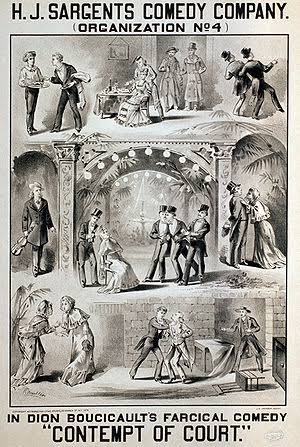
The Farce is a dramatic work designed solely to produce laughter. Originally a farce was an explanatory or additional matter introduced into the main play sometimes to increase its length. Slowly actors begin to use this as an occasion and thus it became a part of the play.

The Plot of the Farce:

In Farce no attempt is made at Fidelity to life. Its aim is merely to provide laughter. For this purpose, it employs funny incidents absurd characters, humorous situations, and witty dialogue. Farce does not aim at a realistic representation of things but provides caricature. The plot in a farce usually appears nonsensical, characters in the indulge in deception impersonations, and irrationalities. There are angry wives, helpless husbands, and funny old men indulged in the most unexpected activities. Serious and respectable people are drawn into the most undignified positions, grave and priggish persons are debunked. Most farce is centered around love affairs which themselves are caricatures. In the end, everybody comes out without any harm.

The elements of the Farce:

The elements of the farce can be seen even in the early English plays. Shakespeare’s ‘A midsummer night’s dream’ and ‘Twelfth Night’ are examples to show how farcical elements could be interspersed with comedy with great effect. Event tragedies had farcical scenes as we see in Marlowe’s Dr. Faustus.

Some Famous works of Farce:

As a separate form of entertainment, the farce came into vogue towards the close of the seventeenth century. The first popular farce was ‘The Rehearsal’ by the Duke of Buckingham. But The anti-sentimental comedy almost destroyed farce. But the anti-sentimental comedies of Sheridan and Goldsmith brought back farcical humor into English drama. Some of the scenes in Sheridan’s ‘The Rivals’ and most of the scenes in his “School for scandal” are enchantingly Farcical. Similarly in the play “She Stoops Conquer” by Goldsmith. In the Victorian period, the farce attained a sort of respectability. Farces such as ‘ The Private Secretary’ and ‘Charley’s Aunt’ were several times.

In modern times, the farce is an accepted form of dramatic entertainment. Most of the plays of Oscar Wilde and Bernard Shaw have farcical situations and dialogue. The farce requires unusual inventiveness, a craftsman, and a sense of humor on the part of the writer.

Most modern comic one-act plays tend to be farces. The purpose of such plays is only to give brief entertainment without malice and laughter without vulgarity. Modern one-act plays like ‘The Dear Departed’ are essentially farce designed to produce laughter.

Conclusion:

The Farce is a famous literary form in earlier literature. In this form, most of the scenes from the plays and characters from the novels will have some comical and entertaining content. Which boosts up the audience’s mindset. These literary forms are used to length the drama in earlier periods. But, most of the audience loved this method and they often started to use it regularly in stage dramas. Farce is used merely for the entertainment of the audience. Even now, most of the writers include some comical scenes in their works to make the plot entertaining.

Start your own business part 1

Start your own business part 2

The Do’s and Don’ts of a Group Discussion (GD)

What is a GD?

Group Discussion (GD) refers to a methodology generally used in selection processes, such as those of companies and colleges, wherein a group of individuals are brought together to interact and communicate with one another. On the basis of such interaction, many personality traits and behavioral characteristic are determined by the examiner or conductor of the GD. An individual’s interpersonal skills, leadership qualities, social traits, public speaking skills, etc. can all be judged through their performance in a group discussion. Generally, in a group discussion, a topic or problem is given to the group, and all the members are allowed to interact with one another, sharing their own knowledge, ideas and solutions to the problem. Some people might be assertive and open about their ideas, while others might be more reserved and unwilling in the sharing of theirs. All these qualities are identified and recorded, to be later used in the selection of capable individuals.

Organizations are able to determine whether particular applicants have the qualities they are seeking in prospective employees or recruits. The topics given in a group discussion vary depending on the type of GD being conducted. These include; ‘Topical’ group discussion (based on current affairs or current trends), ‘Case Studies’ (a complex situation to be interpreted is given to the group) or ‘Abstract’ group discussions (based on abstract topics without any set direction or flow). The specific qualities that might be tested in a GD include; confidence, flexibility, reasoning skills, leadership qualities, creativity, knowledge, patience, communications skills, etc.

There are certain essentials to be followed, as well as certain essentials to be avoided when taking part in a group discussion. These can be enumerated as the ‘Do’s’ and ‘Don’ts’ of a GD;

Do’s

  • Be an active listener. This involves intently listening to what other people have to say. Proper listening is arguably more important than constantly talking in a GD.
  • Be as natural as possible. There is no need to be overly formal or address everyone formally. One must speak as if he would normally speak in such a setting.
  • Be coherent and reasonable when talking. The points made should be easy for the others to understand and should also be logical such that they contribute to the topic at hand.
  • Be brief and precise. Talk on a point for a reasonable amount of time and deliver the point briefly. This retains the attention of others and makes the point simple and accurate.
  • Be polite and respect the contributions of other members. Even if there is a disagreement, this should be done in a polite manner without pointless quarrels.
  • Be as positive as possible and do not try to dominate others. Positivity implies being warm and kind with others, since it is a discussion and not a debate.
  • Be an active speaker in case knowledge of the subject is vast. This could involve initiating the discussion, providing facts and figures, or even being slightly assertive.
  • Be conscious of body language. Although it is necessary to be natural, one must also keep in mind to follow appropriate body language (making eye contact while talking, etc.) and dress appropriately.

Don’ts

  • Get angry or become too aggressive. One must keep their emotions in check while participating in a GD as anger can cloud analytical skills and rational thinking.
  • Interrupt others while they are talking. This is a sign of poor manners and will reveal certain deficiencies in character, which people will scorn at.
  • Try to initiate the discussion or be assertive while lacking knowledge of the topic at hand. The lack of knowledge and impulsiveness will become evident from the points made.
  • Make points which are irrelevant or random and do not contribute to an understanding of the topic. Such points disrupt the logical flow of the conversation.
  • Shout and argue with someone if they try to counter your point. It is not a debate, and neither is it a competition. Some mutual disagreements may occur.
  • Speak with lack of confidence or uncertainty about the point being made. When one is speaking, he should do so with confidence and surety in himself
  • Try to dominate the discussion or get personal with somebody. Maintain a calm demeanour and ensure that a sense of respect is prevalent throughout.
  • Be restless and display poor/negative body language. This will portray a lack of social etiquette, poor manners, and a sense of disrespect to all the other members in the GD.

Hence, these are some of the main do’s and don’ts of a group discussion. Following these will allow individuals to gain all the necessary skills and benefits from a GD.

5 RECREATIONAL ACTIVITIES – During COVID19

Yoga has got another level of importance during COVID19

COVID19 has made us locked in our own houses , & made us suffer boredom . People are finding recreational activities more interesting & trying many new recreational activities . RRecreation refers to all those activities that people choose to do to refresh their bodies and minds and make their leisure time more interesting and enjoyable. Examples of recreation activities are walking, swimming, meditation, reading, playing games and dancing

Ask any health expert and they will tell you that exercise is a cornerstone of a healthy lifestyle. According to the Centers for Disease Control and Prevention, getting enough physical activity could prevent one in 10 premature deaths. It can also reduce stress levels, improve sleep and leave us feeling happy.  

But when it comes to being more active, many of us don’t know where to start. While some people love lifting weights at the gym and training to run marathons, these strenuous activities aren’t for everyone. In fact, just spending time outdoors has been shown to improve overall health. 

FIVE RECREATIONAL ACTIVITIES THAT WILL HELP YOU TO SURVIVE THIS LOCKDOWN ARE :

  1. YOGA : Yoga is the basis of life .

It’s time to roll out your yoga mat and discover the combination of physical and mental exercises that for thousands of years have hooked yoga practitioners around the globe. The beauty of yoga is that you don’t have to be a yogi or yogini to reap the benefits. Whether you are young or old, overweight or fit, yoga has the power to calm the mind and strengthen the body. Don’t be intimidated by yoga terminology, fancy yoga studios and complicated poses. Yoga is for everyone . Its true , if you do regular yoga , you , your mind , your body will always remain in healthy state . It increases your flexibility , enhance your digestive system, improve you mood , keeps you relax & cheerful . For learning it , you need not to join expensive yoga classes as you can watch the videos on YouTube.

2. GARDENING : If you love planting saplings & plants around you , here is one one more enthusiastic activity for you all , that is gardening . Studies show that gardening can greatly reduce stress levels. What’s more, you can save money at the grocery store by growing your own herbs and vegetables. If you don’t have your own space to garden at home, see if your home town has a community garden. You can also spruce up a small space with window flower boxes. you cam even put saplings in bottles to reuse the , in this way you are protecting the environment in two ways , 1st by reusing plastic bottle & 2nd by planting trees .

3. ART & CRAFT : I know not every body knows how to dram but i feels everybody loves to color . it not only help you paint a beautiful painting but also teaches you patience , concentration . it fills your mind with cheerfulness , & your stress will fly in seconds Expressing creativity and emotions through the arts can be immensely satisfying. Painting and drawing can boost confidence and hand-eye coordination. Arts and crafts also have numerous health benefits: increasing memory and motor skills, stimulating the senses, boosting mood, and triggering positive memories, as well as positively contributing to overall health. Crafts such as quilting, sewing, and scrapbooking are all excellent indoor activities.

4. ONLINE CLASSES : Older adults have many opportunities to learn about almost any topic of interest. Courses are available online, on an audio disc, or DVD. Topics can range from history to music, philosophy, and anything in between. Harvard University and Stanford are offering free online courses to anyone who wishes to participate.

5. READING : A good book can transport readers to new places and create feelings of adventure. Reading provides quiet time, while also exercising the mind. Studies have proven that reading can enhance memory function, reduce stress, and promote better sleep.

Planning a book club with friends can make reading a great social activity. For those with visual impairments or those who prefer not to read, audiobooks are widely available as well.

ENGAGING CONTENT WRITING TIPS ON AFFILIATE MARKETING

People who are flourishing as an industrialist thinks of a way to grow their business. The best way is to look for an alternate income. An alternate income doesn’t mean starting a new business but, a way of finding customers and supporters.

The best way to earn money is affiliate marketing. If you don’t have an idea on affiliate marketing, have one now. With affiliate marketing, the customer buys the product, the company gets a new customer and the affiliate also gets a commission. Marketing products is an effective way to increase product sales.

So, the content you provide must be engaging that the readers can read and get clarified with their doubts. Here are some tips to write engaging content for affiliate marketing.

10 TIPS TO WRITE ENGAGING CONTENT FOR AFFILIATE MARKETING:

1. UNDERSTAND THE CONCEPT:

     Affiliate marketing is a marketing strategy that makes the product owner earn money by letting on third persons sell or promote their products. The third person is an affiliate. An affiliate promotes the products through blogs, articles, social media platforms, and other possible ways. An affiliate finds the product he likes, promoting it to others, and earns commission by selling it.

Here, this is the basic concept of affiliate marketing. Understanding the concept and using your own words to write the article. Understanding is the basic step in writing engaging content. Without understanding, you can’t write a reader-friendly article.

2. DO RESEARCH:

     For writing an article, you should do research and make notes of the key points you searched. Use advanced search options and avoid the sites with mistakes. The information you gather through research should be reliable.

     The quality of your content relies on the research make. You should do extensive research and follow the content path.

3. INVOLVE PUBLIC OPINION:

     One should know people’s feedback on a product and need to know what they feel about the product. Keep yourself in their shoes and note the pros and cons of a product. An affiliate should gain trust by making people satisfied with the product. By doing so, the people will feel the product you recommend will be trustworthy.

     A writer should include a public opinion on the product and write content based on those opinions. A reader should think the writer cleared all their doubts and queries about the product. The content you write should answer the questions which people search for.

4. ADD RELATED DATA:

     Adding data to content makes readers interested in your article and will read it. Add data and statistics related to the product. Data can be attracted more by people than a word or sentence. Data and statistics have a sight of attraction towards the people. Try to add data related to the product and make the content engaging and reader-friendly.

15 Best Affiliate Marketing Networks in India in 2021

5. USE SIMPLE KEYWORDS:

     Always remember  Search Engine Optimization (SEO) and keyword search play an important role in affiliate marketing. It is not enough just to publish your content on an affiliate website but should also increase web traffic.

You should know the basics of SEO and keyword search which help in increasing web traffic. One must know what keywords people would search for a related topic and use those keywords. Understand how the keyword you use intends the keyword search and analyze it.

For example, A person searches for “How to start a vlog” for content you want to create. A vlog means a video log or video blog where people post their short videos. What the person’s intent behind the search will induce the direction of your article. Whether the person wants to start an individual vlog? Or he wants to know the steps in the vlog? This will lead to a search accordingly.

One fine idea is to search for the keyword yourself in the search engine and get to know more about it. Use anchor phrases that are not wordy or spammy.

6. DRAFT QUALITY CONTENT:

     As we know, content marketing is one of the best ways to advertise a product. Write more simply so that people can understand your thoughts easily. The quality of the content lies in its originality. Try to use your own words to draft it. The content you provide must answer the question “how to” because people search for the sample or product review before buying it. So, your content must clear all the doubts and queries of the reader.

Focus on the main theme of the content. The content you provide must be trustworthy and should be reader-friendly. Writing the content with good English and using simple keywords can make the content engaging. The content you draft must be unique that express your company’s personality.

7. ADD PROPER AFFILIATE LINK:

     Affiliate links help in increasing the online performance of an industrialist. If you want to add some affiliate link, take some time and research it properly. Because affiliate marketing is based on the concept of sharing and publish online platforms.

The content you write must attract the target audience. Furnishing high-quality content will help you to attract the target audience which involves the adding of proper affiliate links. Provide some information about the affiliate link you provide.

For example. High ticket affiliate marketing will be the best one for a beginner affiliate. It is a program that provides commission per referral. This high ticket affiliate marketing will allow you to earn more without any effort from your side. Provide some information about the affiliate link you provide. Promoting high ticket affiliate products is one of the most profitable affiliate programs nowadays.

8. USE SIMPLE ENGLISH AND SHORT PARAGRAPH:

     The content you draft must not be too wordy.

  • Use simple English to draft the content and make it reader-friendly.
  • Avoid the use of passive voice, use active voice instead.
  • Avoid overuse of prepositions.
  • Use contradictable words or sentences.
  • Use a shorter paragraph than a longer one. Because people will like it when it’s simple and understandable. Using longer paragraphs may irritate the readers to finish it.

9. BE SINCERE:

     Be sincere while writing the content. Don’t make up a story that people will buy your product. When you are true, people will always buy the product you recommend. So, give your true research ideas and visual treat. If you find any fault in the product you recommend mention it in your article.

Give the positive as well as the negative feedback of the product. In this way, people will feel your article trustworthy. If the article only has positive views and no negative views, it will make people not trust your article. So, be true to the people and yourself.

10. PROOFREADING:

     Proofreading is a way to correct the errors in the article you drafted. The article may have grammatical errors, punctuation errors, etc. So, take proofreading seriously while writing an article. Proofreading is important because, if the article you drafted is published online and contains some errors, it will influence your career.

Proofread your content with the help of some error-checking tools such as Grammarly etc. Check your content before publishing it. It is important to produce an article without any errors in it.

These are some tips to write engaging content for affiliate marketing. However, affiliate marketing is the best way to earn money without any effort. Just follow the tips and make your content engaging. Then what are you waiting for? Start writing your content soon. Affiliate marketing is a money-making side in which its price will rise to $16 billion in 2021.

Read more;

THE HISTORICAL NOVEL

Introduction:

The Historical Novel is a work of fiction that attempts to convey the spirit manners and the social conditions of the past age with realistic details and nearly perfect fidelity to historical facts. The subject matter may compass both public and private events. The protagonist may be an actual historical figure or an invented figure. The historical novel can be The dramatic interest of plot and character with the more or less detailed picture of the varied features of the life of a particular age. The most important feature of the historical novel is its vivid reproduction of the life of a bygone age.

Even before the coming of the historical novel comer writers had used history in their novels. As a result of the impulse to word novelty during the Renaissance and after several writers made use of history. In England, Horace Walpole used a particular period in history as background to his Gothic novels.

First Historical novel:

The passing away of the feudal system created and nostalgia for the past. compared with social and economical changes caused by the French Revolution and the industrial revolution, This nostalgia created the proper climate for the emergence of the historical novel. The first great historical novel in English was Sir Walter Scott’s Waverley published in 1814. A series of novels based on Scottish history appeared. Among them, the most important is “Guy Mannering”, Kenilworth, Old Morality, and “The Heart of Midlothian”. Among the more popular of Scott’s novels are “Ivanhoe” and the Talisman dealing with the Crusades. In this novel, memory and imagination serve Scott’s creative purpose of the central narrative is supported by a strong love of humanity.

The tradition of the historical novel continued into the story and age. Charles Dicken’s “A tale of two cities” Thackeray’s “The history of Henry Esmond Esquire” George Eliot “Romola” and Charles Reade’s “The cloister and the Hearth” is important historical novels of the Victorian period. In the continent, the historical novel florist in the writings of Balzac, Dumas, and Tolstoy. It is generally agreed that Tolstoy’s “War and Peace” is the greatest among the historical novel. “Robert Grave’s I Claudius” is another historical novel of significance.

The historical novel marches on one side with the realistic novel and the other side with the national epic. Saintsbury has remarked that historical novelists give only a subordinate position to the actual historical figure and should allot a prominent position to the imaginary figure because the chief object of the novel is the interpretation of the human character.

In the Historical novel, The recreation of the spirit undertone of the bygone ages is more important than other runs to the truth. The historical novel list has to reconcile the clients of history and art.

Conclusion:

The historical novel has limitations for stop it is suffering from the weakness of both history and novel. Unless the novelist is scholarly and unprejudiced, he is likely to give you a half-digested and biased view of historical facts. It is also open to question whether the imaginative recreation of facts is preferably the fact to themselves.

The Humanitarian Movements

The Social Novel

Content Writing As A Career

Over time content writing has evolved enormously in the market. Content writing as a career provides a tremendous opportunity. In today’s world, many big firms are hiring content writers exclusively to provide content solutions to clients. 

This brings us to the question that if content writing has such potential, What do I need to become a content writer? What are the career opportunities? Salary Expectation? Well, you will find all the answers needed in this article. 

What do you need to become a content writer?

While many of the companies prefer hiring an individual who has a degree in literature or journalism & mass communication, one with excellent writing and communication skills is also welcomed by the companies. In short, anyone with good writing and communication skills can apply for it. Also, thorough knowledge of the field you are writing about is always a plus point. 

What are the career opportunities?

Looking at the demand for content writers, it can be said that the demand will stay longer in the industry. Besides taking a job in a firm one can also become a freelance writer or a full-time blogger. Mentioned below are some of the different fields of content writing:-

I) Public Relations Writing: These days, most of the corporate hire in-house writers to write their newsletters, press releases, and bulletins.

II) Technical Writing: It mostly deals with literature like user manuals and do-it-yourself kits, etc.

III) Marketing Content: In this field, a writer should be able to attract customers through catchy headlines and slugs. As a marketing content writer, one needs to be creative to attract the attention of consumers and convince them. This type of writing includes brochures, fliers, etc.

IV) Web content: As websites need to update their content to stay fresh and relevant, they hire content writers. 

V) Others: Some of the other fields of content writing includes – health, lifestyle, financial, children’s writing, academic, copywriting, and fashion.

Salary Expectation

As an experienced freelance writer one can earn up to Rs 40-50 thousand in a month. And for the content writers working for a firm, the salary varies from company to company. The average starting salary for a content writer ranges from Rs 15,000 to Rs 20,000 per month. 

If you think you are made for writing then you should give content writing a short. 

Digital literacy in India

Abstract 

Digital literacy is for a developing country like India. Digital literacy brings independence of easy accessibility of the internet among the people of urban as well as rural areas. The article discusses the need for digital literacy.

Keywords: digital literacy, need of digital literacy.

Introduction 

During the COVID-19 we all completely depended on the internet. Due to the safety of the people, the governments of different nations opposed the lockdown. Knowledge of the web world became a boon for an individual during this tough time. But we are also facing the challenges of accessibility of the internet. People are not aware or lack knowledge about using the internet. In India 26.8% of the population is not literate and they are suffering a lot due to lack of knowledge of the internet (census of 2011). Digital literacy is easy and helps every person. We all have smart phones and they consist of all the applications and are illiterate, literate and well qualified. Now we need to focus on how we can uplift digital literacy in rural as well as urban areas. 

Digital literacy:

As the word literacy implies, it involves some kind of basic knowledge or the ability to use the digital medium. However, digital literacy encompasses more than just knowledge of how to use the internet.

The ability of accessing the internet and using different applications to communicate, evaluate, create, share and deal with the information. It is not only about having knowledge about application and also the method of dealing technology with ethics.

The American Library Association’s digital-literacy task force offers this definition: “Digital literacy is the ability to use information and communication technologies to find, evaluate, create, and communicate information, requiring both cognitive and technical skills.

In India, across over 6,50,000 villages and 2,50,000 panchayats represented by 3 million panchayat members. Approx 40% population is living below poverty line, illiteracy rate is more than 25-30% and digital literacy is almost non-existent among more than 90% of India’s population.

Need of digital literacy

  • To enhance the digital skills: In India, a good number of the population lives in villages and small towns. They have technology but they don’t know how to use that technology for the betterment of their lives. Digital literacy helps to learn the access to technology efficiency.
  • To ensure security from online frauds: Sometimes people are not aware about online frauds. Especially, elderly, women and children are especially easy targets to become prey. Digital literacy helps them to learn to avoid this kind of fraud.
  • To increase the rate of using online banking: India is a developing country. Having knowledge of online banking and transition is important. India launched many applications such as BHIM and UMANG. Digital literacy helps an individual to access these applications and go cashless.
  • Education purpose: Rising invasion of digital media in the society pushes the need for digital literacy among students. So there is a great need for educating the power of the digital medium so students can play a vital role in defining their ability to succeed both in academic and personal life.
  • Digital citizenship: Digital literacy is one component of being a digital citizen – a person who is responsible for how they utilize technology to interact with the world around them.
  • Pedagogy:  It is up to us educators to decipher the best methods for teaching digital literacy and to help the students become fluent in this new type of literacy.

Opportunities of digital literacy 

  • Help in inclusion: Digital literacy helps in inclusion of people of different backgrounds. During COVID-19, the internet helps to reach the help of needy people. Digital literacy inclusive growth by enabling access to education, healthcare and government services to all the citizens of the country. People can get better advice on health services. Those who can’t afford school/ colleges can get a chance at an online education.
  • Less consumption of time: Opening accounts in banks, submitting bills and fees was a time consuming work but after digitalization the things got easier and became less time consuming.
  • It can help small businesses. People can use online tools to expand their business.
  • It can play a key role in GDP growth. According to analysts, digital India could boost GDP up to $1 trillion by 2025. According to a World Bank report a 10% increase in mobile and broadband penetration increases  in capita GDP by 0.81% and 1.31% respectively in developing countries (World bank report 2017).
  • Once the change is brought it could change the Indian education system, with all the Gram Panchayats having access to the internet will provide access to different teaching aids and materials and empower everyone and increase the literacy levels in the country.

Challenges of digital literacy

  •  Slow internet: The daily internet speed, as well as Wi-Fi hotspots, is slow as compared to other developed nations. In India the connectivity of the internet is not reachable in some places due to geographical background. 
  • Hurdle of small and medium scale industry: Most of the small and medium scale industry has to struggle a lot for adapting to the new modern technology. They are not aware about the terms and conditions of the online business or they don’t want to switch their method of trading.
  • Limited capability of entry-level smartphones for smooth internet access.
  • Unskilled labours: In India there is a lack of skilled manpower in the field of digital technology. They don’t know how to run applications and use them for their betterment.
  • Awareness about digital crime: To look for about one million cybersecurity experts to check and monitor the growing menace of digital crime.
  • Lack of user education: Users are not aware how to use technology or they are limited to Facebook and What-app. There is a need for digital literacy. It helps them to take the first step towards using technology.

Government initiatives:

  • National digital literacy mission: It was launched in 2012 by the Indian government to uplift the digital skills in rural India as well as urban areas. It is also known as the digital saksharta Abhiyan
Our Services – Reynard
  • Digital India was launched by the Prime Minister of India Narendra Modi on 1 July 2015, with an objective of connecting rural areas with high-speed Internet networks and improving digital literacy.
  • NASSCOM is working with SAP India to set up 25 new centres across the country to add to the 75 that already exist. These are the main vehicles of implementation of NDLM.

Conclusion:

Digital literacy is important for India because India is a developing country and we need to focus on sustainable development. According to a survey there is 90% digital literacy in India which is more than actual literacy that shows people are more aware about the web world. The need for digital literacy is really important. There are many challenges and opportunities. NDLM,  NASSCOM and digital India there are some schemes which help in upliftment of digital literacy. 

References 

How to Improve Concentration?

“Concentrate all your thoughts upon the work at hand. The sun’s rays do not burn until brought to a focus”

– Alexander Graham Bell

Introduction

The definition of concentration is exclusive attention to one object. Concentration means focused attention and it is very important. It helps in studying, allows faster comprehension, improves memory, helps in focusing on a task, allows to ignore unwanted thoughts. It is also helpful in meditation. It is very common to be reading a paragraph when you realize you zoned out and then having to go back and read the whole paragraph just to be zoned out again and repeating the cycle. This happens because of a lack of focus or concentration. This article aims to discuss ways to improve concentration.

Train your brain

Results from a study show that spending 15 minutes a day for 5 days a week on training your brain has a huge impact on your power of concentration. You can train your brain by playing games such as sudoku, crossword puzzles, chess, jigsaw puzzle, scrambles, and memory games. These games can also help in developing short-term memory and will also teach you problem-solving skills. In kids, even colouring improves concentration.

Get your game on

Some new research shows that playing video games can also help in boosting concentration. It says that playing video games for an hour can help in improving visual selective attention (VSA), which is the ability to focus on some tasks while ignoring distractions. Note that this research has been done on a very small level so it is not conclusive yet.

Improve sleep

Sleep is a very important part of our day as getting enough of it helps in a lot of areas of our day. Sleep deprivation easily disrupts our concentration and other functions like memory and attention. Not getting enough sleep on a regular basis can result in affecting your mood and performance at tasks, it can also slow down your reflexes. With enough sleep, you have enough energy to focus on your task without getting sleepy.

Make time for exercise

A 2018 study shows that physical activity helps in improving concentration and attention. Regular exercise has many benefits like increased concentration. In older adults, it shows that moderate physical activity for a year can help in stopping or reversing memory loss. Any type of exercise can work, the point is to get your heart rate up, it can be a walk for half an hour, a morning jog, walk to whatever place you have to go to or bike.

Spend time in nature

Getting outside in nature for even 15 to 20 minutes will help in boosting your concentration. Research from 2014 found evidence which says that including plants in office spaces has helped employees with their productivity, adding to that, it also increases the air quality. It can be any kind of exposure to nature, going for a walk in the park, or even just sitting in your backyard.

Listen to music

According to research, playing music, nature sounds, or even white noise to cover up background noise can help in improving concentration and other brain functions.

Conclusion

Having the power to focus and concentrate will make a huge change in your life. It lets you be more productive as you will be able to focus on your tasks without distractions, and when there are no distractions, things get done faster. Once you start concentrating, you will realize how much time you were wasting normally.

References

How to Increase Productivity? (For Students)

“The key is not to prioritize what’s on your schedule, but to schedule your priorities.”

– Stephen Covey

Introduction

Productivity isn’t only for working people, it is equally if not more important for students. As a student you are learning a lot of new things at the same time, it might even become overwhelming. You can be in school or college, you will still need productivity and organization. It is important to stay on track, achieve your goals, be it short-term or long-term. Life as a student can be very distracting, there are too many things begging for attention, such as sports, friends, a social life, partying. At the same time, you are absorbing a lot of new information from everywhere, and to be on top of all your work will help in not feeling overwhelmed. This article aims to discuss how to increase productivity as a student.

Make a To-Do List

Now, this might sound a little stupid but To-Do Lists help a lot, speaking from personal experience. It will be ideal to make the list before sleeping, that way you will not have to waste some time of the day in making the list, and it will also help you in understanding how much you need to get done and you will wake up prepared for it. The very basic way is to just list down the tasks you have for the day but if you want to go a level up, you can schedule your tasks by the hour, that is make a timetable for the day which will include your daily activities as well. For Example:

7:30 – Wake up

8:00 – Attend Family Law Class

10:40 – Have breakfast

11:15 – Do research for Memo

1:00 – Have lunch

Understand Your Learning Style

Everyone has a different style of learning:

Visual learning – learning things by looking at things like graphs, charts, and infographics. Learning things by looking at them.

Kinesthetic learning – learning things through a practical approach like experiments.

Auditory learning – learning things by hearing them said aloud.

Reading and Writing Learner – learning things by writing them and then revising from them.

Once you figure out your learning style, you should try to follow it as that is the best-suited one for you and will help you in understanding better and quicker.

Take Breaks

Studies show that your productivity stays intact when you take short breaks after studying for some time. This gives your brain time to stay focused and motivated. If you keep pushing your brain beyond its capability, you are creating stress and you start getting tired.

Reduce Social Media time

It is a well-known fact that social media is the biggest distraction for everyone. Asking to quit also may sound absurd but all of it depends on your self-control. Personally, I am good at staying away from it when needed so I have never had to quit it temporarily, but if you know you do not have good self-control, you should try to quit it for some time. If that sounds like too much to you, you can try to set time slots when you get to check social media and keep it away when doing a task. Remember that developing self-control is very important.

Reward Yourself

It is important to understand that the practice of rewarding yourself will only work if you have a good sense of self-control. Once you achieve your goal, you can reward yourself with little things like watching a movie, an episode of your favourite series or going out with your friend. This way you have something to look forward to after finishing your work.

Conclusion

Productivity is best accompanied by time management, they both go hand-in-hand. You can only become more productive if you have learnt to manage your time properly. These tips should help with increasing productivity but you should take efforts to increase your self-control as it is a huge part of everything in our life.

References