87 Rape Cases A Day, Crimes Against Women.

India recorded an average 87 rape cases every day in 2019 and 4,05,861 cases of crimes against women during the year — a rise of over seven per cent from 2018 — shows latest data released by the National Crime Records Bureau.

The “Crimes in India -2019” report shows that crimes against women have gone up by 7.3 per cent last year. The crime rate registered per lakh women population is 62.4 per cent in 2019, up from the 58.8 per cent figure of 2018.

The country had recorded 3,78,236 cases of crimes against women in 2018, data shows.

In 2018, 33,356 rapes were recorded across the country, up from 32,559 in 2017, according to the data from corresponding years.

“Majority of these cases under the Indian Penal Code were registered under ‘cruelty by husband or his relatives’ (30.9 per cent) followed by ‘Assault on women with intent to outrage her modesty’ (21.8 per cent), ‘kidnapping and abduction of women’ (17.9 per cent),” the NCRB data for 2019 showed.

Not only women, the figures collated by NCRB also indicate an upward trend in cases linked to crimes against children. From 2018, the crimes against children have gone up by of 4.5 per cent in 2019.A total of 1.48 lakh cases of crime against children were registered in 2019, of which 46.6 per cent were cases of kidnapping and 35.3 per cent cases were related to sexual offences.

The NCRB, which functions under the Union Home Ministry, is tasked with collecting and analysing crime data from across the country. The agency has compiled the three-volume report after collating data from 36 states and UTs and 53 Metropolitan cities

In 2012, the case of young Delhi-based woman Jyoti Singh, christened Nirbhaya (Fearless) by the media, shook the nation. She was abducted by a group of men and repeatedly raped on a moving bus. They also mutilated her body before throwing her from the bus.

Hathras Case2020: The woman died at Delhi’s Safdarjung Hospital. She had suffered multiple fractures, paralysis and a deep gash in her tongue in the assault that drew parallels to the 2012 Nirbhaya gang-rape. #JusticeforManishaValmiki

Corporal Punishment: Something That Should Not Be A Part Of Childhood

Getting physically injured is something that is scary for everyone. So, what makes it okay to cause harm to a child, just because he/she did something which is inappropriate, instead of talking and explaining to them? Nothing. Nothing justifies mistreating a child at a place where they are supposed to grow into the future of the nation.

Corporal punishment, by definition, means to cause deliberate physical pain to someone, usually by an individual who holds an authority over the other person, in order to reinforce a point. In INida, as sad as it sounds, but corporal punishment is a part and parcel of almost all the indiviuals childhood. For the more unfortunate individuals, it was/ is a daily experience. If confronted, the administrator of these punishments have replies ranging from ‘tough love’ to ‘teaching them obedience’ to ‘it is how it is’. It is to say, as if physical punishment are mandated, not even an option. Many people justify it from their childhood experience.

Another way to look at this is that it is the easy way out. Sometimes, from responsibilities to sitting down and making the child understand why something is not correct. Sometimes, from the hassle of handling a situation. ANd sometimes, it is for the long run. The perpetrators would say it is helpful in the long run for the children, but in reality, it is often helpful for them in the long run, as the punished child is effectively scared to not try his/her limits again.

The children, upto the age of 12, undergo physical growth and development. Upto this stage, some parts tend to be more susceptible to get hurt in comparison to adults. Corporal punishment often exposes the children to the rish of serious physical damages. Some they become life threatening and permanent too. And apart from that, the trauma and mental harassment that the child goes through also needs to be taken in account.

Corporal punishment in educational institutes does more harm than good. In India,  an overwhelming percentage of authoritative people indulge in corporal punishment in these educational and co curricular institutes. And sadly, their colleagues often not only don’t call them out on this, but rather even support them in many cases. Such behaviour and environment is enough to deter a child from going back to school and makes education a burden to them. This also results in negative emotional development in the child.

According the Indian law, under Right To Education Act, 2009, Section 17 declares corporal punishment (also includes mental harassment) to be illegal, and the person found guilty under this charges will face disciplinary action in accordance to the applicable service rules applicable. On the similar note, Section 323, 325, 305, 352 and 506 of the IPC are also regarding child protection. The figures of authority that can be held responsible in such cases include teachers, relatives and even the parents. 

But the sad scenario is that though in the law books, these laws are often not enforced in reality. The society, as a whole, sees corporal punishment as a part of growing, and until that attitude remains, things are not going to be better. 

What Will People Say…

Being a social animal, it becomes extremely important for humans to follow certain specific rules and societal duties. There is no person in this world who knows everything. Whoever we meet, we get to learn something from the person we meet. We must respect the attitude and viewpoint of other people in every way. We must always keep our minds open to listen to other people and understand them.

But it is not at all like we to be slaves to the reaction of others, their opinions or thoughts. Modern psychology emphasizes that one should try to establish a healthy image of himself/herself, to relate to him or her. Ask yourself – should your image be according to the choice of others.

Should it be according to what other people say? Should it be what other people expect? Will you make the rules of your life according to other people? Will other people determine what you will wear, what you will eat, how to dress? Such a life can be unbearable for any person. Many people are constantly under pressure to determine and identify their self-image.

What will the neighbours think if I go to work? What would people say if I did not give a party? What would my acquaintances say if I did not marry my daughter to a luxurious wedding? And this cycle goes on continuously. When you ask these questions what people will say, then my answer will always be that you should not be worried about what other people will say.

Let them say. But it should not be at all that anything they say bothers you. What people will say does not matter at all. It only matters what you do. You should only do your duty.

What they say, Let them just say.

Adopt, Not Shop: Why It Is The Better Way

Most of us, at one point of time or another, have dreamt of having a pet. And amongst them, dogs have a soft place in the heart of the majority. And why not? They are the sweetest creatures you can ever come across, extremely loyal and are very unique companions. Apart from being cuddly and best at making puppy eyes (no pun intended! ), that is. So, when we think of bringing a furry friend home, we often think that they come with a hefty amount. But now times are changing. People are realising the worth of adopting. And if by any chance anyone reading this is planning to get a furry friend, I’ll try to put my point forward that why we should ‘Adopt, Not Shop’.

Adopting a dog gives a chance to a good life for two dogs. One is to your pet, who might have had faced something traumatic in life, and is in need of love and understanding. In such cases, the bonding between the owner and the pet is much stronger. As for the other one, adopting one dog opens up the slot for another one. So, one more rescued dog would have better facilities, better environment to develop and will have better access to the opportunity to be adopted by another good Samaritan. It is a kind of an endless chain of goodwill and love.

Another advantage of adopting over shopping is that they are really cheap in comparison to the market prices. And at the same time, there is a full blown possibility of you finding your one true loved breed amongst the less fortunate ones. With love and care, each pup blooms out to be a gorgeous dog, adopted or otherwise. Also, all the money that was to go in purchasing the dog can be used instead for the costs of food and grooming. Maybe give your furry friend a good spa day!

Another point to note is that the pet you purchase from a breeder or from a shop is most likely to be a puppy. Now no offense to the puppy lovers, but let’s agree on one thing, it’s hard to train the younglings. A puppy is no different. With the usual care that a pet deserves, they also require extra attention and training. Not an affordable thing to do for many people. INstead, if an older dog is adopted, they already have an understanding of how things work and can also be left alone for a longer period of time (not that everyone wants to do that).

And lastly, you would be standing against an inhuman practice. Of dog breeding. Though not in the mainstream media, but in recent times, the pathetic conditions of this industry has come forward, where the female dogs are treated as nothing more than a birth machine. Often, the living and food standards are very bad. All and all, this is an inhumane way to fulfill and keep up with the market demand. The scene is the same for the specialized dog breeders. All in all, the dogs are treated more with a materialistic approach rather than considering them beings with emotions.

Adopting requires just some research and patience. That goes into the shopping way too. And at the end of the day, they all are the same lovable companion we crave and can cuddle with!

Queen of Jhansi

Lakshmi Bai, also spelled Laxmi Bai, (born c. November 19, 1835, Kashi, India—died June 17, 1858, Kotah-ki-Serai, near Gwalior), rani (queen) of Jhansi and a leader of the Indian Mutiny of 1857–58.

Brought up in the household of the peshwa (ruler) Baji Rao II, Lakshmi Bai had an unusual upbringing for a Brahman girl. Growing up with the boys in the peshwa’s court, she was trained in martial arts and became proficient in sword fighting and riding. She married the maharaja of Jhansi, Gangadhar Rao, but was widowed without bearing a surviving heir to the throne. Following established Hindu tradition, just before his death the maharaja adopted a boy as his heir. Lord Dalhousie, the British governor-general of India, refused to recognize the adopted heir and annexed Jhansi in accordance with the doctrine of lapse. An agent of the East India Company was posted in the small kingdom to look after administrative matters.

The 22-year-old queen refused to cede Jhansi to the British. Shortly after the beginning of the mutiny in 1857, which broke out in Meerut, Lakshmi Bai was proclaimed the regent of Jhansi, and she ruled on behalf of the minor heir. Joining the uprising against the British, she rapidly organized her troops and assumed charge of the rebels in the Bundelkhand region. Mutineers in the neighbouring areas headed toward Jhansi to offer her support.

Under Gen. Hugh Rose, the East India Company’s forces had begun their counteroffensive in Bundelkhand by January 1858. Advancing from Mhow, Rose captured Saugor (now Sagar) in February and then turned toward Jhansi in March. The company’s forces surrounded the fort of Jhansi, and a fierce battle raged. Offering stiff resistance to the invading forces, Lakshmi Bai did not surrender even after her troops were overwhelmed and the rescuing army of Tantia Tope, another rebel leader, was defeated at the Battle ozzf Betwa. Lakshmi Bai managed to escape from the fort with a small force of palace guards and headed eastward, where other rebels joined her.

Tantia Tope and Lakshmi Bai then mounted a successful assault on the city-fortress of Gwalior. The treasury and the arsenal were seized, and Nana Sahib, a prominent leader, was proclaimed as the peshwa (ruler). After taking Gwalior, Lakshmi Bai marched east to Morar to confront a British counterattack led by Rose. Dressed as a man, she fought a fierce battle and was killed in combat.

Jhansi Rani even after her death remained as an idol of bravery and intelligence for Indian women. Enacting as the ruler on behalf of her heir showed her will power and women empowering attitude.

Development & Displacement

Development is the slogan of the day not only in developed countries but also for the developing countries of the world now. All governmental & state organizations are now rushing for introducing & installing industries, better roads, long fly-overs & many other civilized requisites.
But proper lands are required to execute & materialize these means & ways of development. These cannot be grown in the sky. So lands are acquired to start industries, erect stalls, or make high roads & flyovers.
On many occasions, this development is executed by acquiring fertile lands of the poor farmer or the lands where many houses & homelands had been built & human habitations are displaced from their age-old shelters & professions with penury and starvation staring at them.
Thoughtless destruction of forests in Kalahandi in Orrisa & plundering them for the sake of development displaced the local inhabitants, deprived them of their livelihood, and put them to starvation, hunger & ultimate migration. The construction of the Narmada dam to provide irrigation to dry areas of Gujrat, Madhya Pradesh & Maharashtra has rendered many thousands of the local people homeless without their consent and proper compensation.  

https://in.pinterest.com/

Displacement in the name of development may sometimes be needed. Displacement is worse and undesirable. The former is the narrow way to progress, but the latter is certainly a broad road to death. There must be a balance between development and its resulting displacement. It may be done by proper preplanning and proper rehabilitation of the displacement. The potential risks of displacement involve landlessness, joblessness, homelessness, marginalization, food insecurity, increased morbidity and mortality, loss of access to common property
   This is a social problem affecting multiple levels of human organization, from tribal and village communities to well-developed urban areas. The main potential risks of displacement, landlessness, joblessness, homelessness, marginalization, food insecurity, increased morbidity and mortality & loss of access to common property. 

Charity: When It Changes From Help to Haplessness

Covid and lockdown are two major hits that the country has taken in the last half a year. And needless to say, it left the country wobbly on its knees. Everyone was affected, some more than others. Somewhere affected because of their financial status, some because of their ethnicity, some because of their profession, and some… because of their luck. Now you might ask me, why would I say so? But I have my reasons. 

I’m not someone who is on many social media platforms. Just enough to be in touch with the important people in my life. But one doesn’t have to be on all across the social web to have come across at least one picture of charity or donation. Now, many people might have this question, what’s the problem with that? Someone is doing good, so they share with the people. Cool, fair enough. But the point is not about the ones on the giving end. It’s about those  on the receiving one.

When the lockdown first started, the lives inside many houses went into mayhem. With almost no hand in cash, many people were at a loss what to do. With a lion’s share of population depending on the conventional bank and physical withdrawal system, they were stuck at a bad place when it came to financial matters. So for many people, taking the help they were extended was the only viable option. And so they did. But we as a society have a lot many flaws. One of them is looking down at those who we believe are below us. And knowing someone taking external help is a sure indicator. I remember watching a video where a middle aged man was bemoaning how just taking some ration in a donation camp, due to lack of sufficient funds at hand, left him and his family as the laughing and gossip talk of the neighbourhood. His children were asked if the man they saw on Facebook was their father. It was a very distraught experience for everyone.

No one has any rights to comment against anyone posting pictures on social media about anything they did. But people must understand, when they help someone and then post pictures with the other person, that other person gets involved, even if he/she doesn’t like to. And we don’t know what they have to face once they go back to their lives. No one should have to choose between hunger and self respect. Because nobody chooses to be in that position in the first place. Help and charity is an act for self, self satisfaction and self happiness. Not a response to prove oneself to the world. 

Problems should be known, talked about and shared. But for the sake of problems. Not for the sake of self. Not when the problem has been taken care of. If so, we need to move to the next one. We need to remember that our primary instincts have always been to help. And in the times of crisis, we need to follow that.

Paradox…

A logically self contradicting statement is a paradox. Also known as antinomy. You can say it is a sentence that runs contrary to one’s expectations. Actually it’s just a smart mess. It does have valid reasoning but leads to a self contradictory or a logically unacceptable conclusion. It might seem absurd but is kind of the ultimate truth. That’s what makes it all the more interesting.

Let’s see some of the many interesting paradoxes that exist and try to understand them.

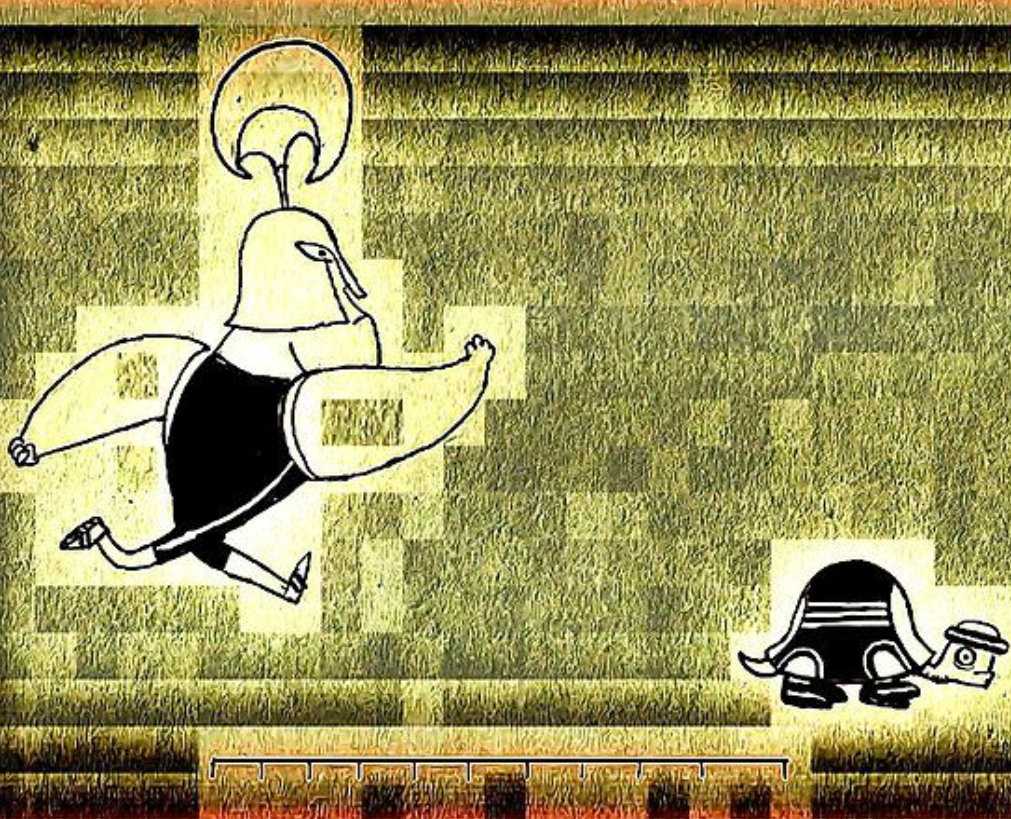
•Achilles and the tortoise 🐢🏃

One of the “greatest” there is. It was put forward by the Greek philosopher Zeno of Elea in the 5th century BC. It so happens that the great hero Achilles challenges a tortoise to a footrace. Being the hero that he is, he allows the tortoise a headstart of 500m. No doubt, when the race starts, Achilles is at a must faster speed than the tortoise such that by the time he has reached the 500m mark, the tortoise has only walked 50m further than him. When he has reached 555m mark, the tortoise has walked another 0.5m, then 0.25m, then 0.125 m and so on. It is a chain of such infinite small distances with the tortoise always moving forwards while Achilles always has to catch up. Now, logically, Achilles can never overtake the tortoise. Except, of course, intuitively he can overtake.

Don’t think of it in terms of distances and races but rather as an example of how finite value can always be divided an infinite number of times, no matter how small its divisions might become!

•Birthday paradox 🎉🎂

This is personal favourite. It is maths based by the way. Probability to be specific. You have already heard of this probably. It goes like this that in a group of 23 randomly selected people there is a 50% chance two of their birthdays match. Interesting? Wait. In a group of 367 random people there is a 100% possibility atleast two of their birthdays match. Sounds like such a small number. It counts as a paradox because we can’t handle such numbers.

•Crocodile paradox 🐊

A crocodile snatches a young boy from the riverbank. Pretty common situation right? Anyways, his mother pleads with the crocodile to return the boy. The crocodile being in a fun mood, wants the mother to guess if he will return the boy or not. Takes one guess to get the boy out safely. It looks simple – the mother guesses he will return the boy, if she is right she gets the boy, if she is wrong, the crocodile gets the boy. If she answers that the crocodile will not return him, however, we end up with a paradox!

If she is right and the crocodile never intended to return her child, then the crocodile has to return him but in doing so breaks his word and contradicts the mother’s answer. And if she is indeed wrong and the crocodile did intended to return the boy, the crocodile must then keep him even though he intended not to, thereby also breaking his word. It’s a brain twisting dilemma.

•Paradox of fiction 🎟️📕

Are you fixated with the harry potter characters? You ofcourse have a crush on the Marvel or DC comic characters. Oh or did you cry when Augustus died?

So here is the paradox. Point 1 People have emotional responses to characters, objects, events etc. which are fictitious. Point 2 In order to be emotionally moved, we must believe that these characters or events by no way exists in real. Point 3 No person who takes characters to be fictional at the same time believes that they are real. All three of these points one at a time can be true. If any two points are considered to be true then the third must be false or else produce a contradiction. There exist various proposed solutions to this paradox such as pretend theory or thought theory or illusion theory.

•The card paradox 🃏

This one is a little bit similar to the crocodile paradox. A little. So I say we have a card with us. On one side, the front side, “the sentence on the other side of this card is TRUE” written on it. You flip and “the sentence on the other side of this card is FALSE”. You take one as true and it leads to a paradox!

Thank you for reading. Have a nice day!🌼

Brain Drain – A National Crisis

https://www.shutterstock.com/search/brain+drain

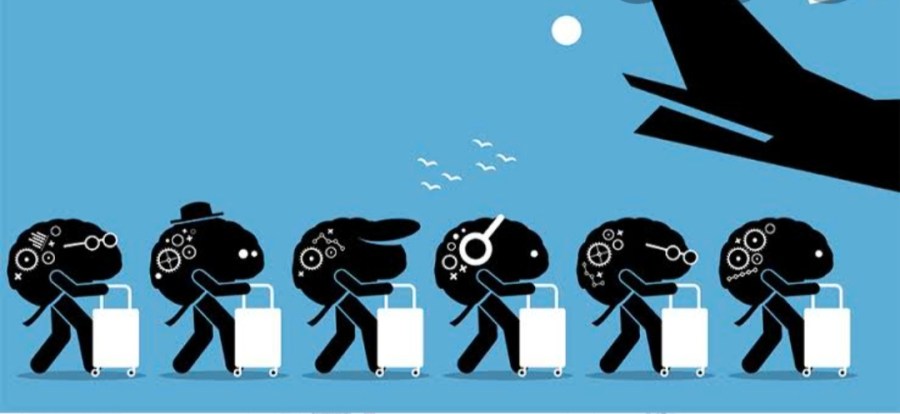
 Many problems of an acute nature stare the development of developing countries in the face of modern times. One of them is brain drain. Although this pandemic has proven to be quite a beneficial solution to put a pause in the process. Not to forget this how this lockdown has also substantially caused to improve the environmental conditions. Except for the suffering humans, everything is getting benefitted. Thus nature is healing. 

  So, the concept of brain drain is defined as the substantial emigration or migration of individuals. Generally, such child prodigy’s most of whom are trained in different crafts in technologies & different science branches tend to show rising prosperity for better financial profit & prospect. Countless trained technicians, doctors, scientists & engineers leave their motherland in the greed of getting a good life. One reason for brain drain could be turmoil within a nation. 

 Such things severely affect countries that are on the verge of development. Training up these talented students with a great cost, who ultimately face a huge loss by the end, as these students mostly migrate to the USA or UK for higher education. 

 Further discussing there happen to be 3 different categories of brain-draining as mentioned below:

 ‌Geographical Brain Drain– This refers to the emigration of individuals of high-skills and high-brilliance to other nations. This also creates a negative impact on the home country’s economic development.

 ‌Organizational Brain Drain – This refers to the departure of individuals of skill, talent, and experience from one organization to another.

 ‌Industrial Brain Drain – This type involves the migration of skillful workers from one industry to another. 

https://www.alamy.com/

 South Asia experiences a tremendous amount of emigration of talent. Furthermore, this trend is continuously rising with years passing by. Most noteworthy, there is a lot of demand for South Asian skilled, semi-skilled, and unskilled labor in the Gulf. Moreover, other favorite work locations for South Asians include Canada, United States, United Kingdom, and Australia.

  Several reasons are responsible for the cause. Just for instance lack of suitable job opportunities. Besides these developing countries are hopelessly lacking in furnishing facilities for advanced research. On the contrary, the developed countries offer sufficient channels for research & well-objectified jobs with lucrative salaries. It is the need of the hour, for students need to develop a sense of gratitude & patriotism for their homeland that spends so much for their upbringing, training & education. 

Affirmative Action in India : Across these years

Introduction of the Affirmative Action in India

The first backward classes had appeared in India in 1870’s in Madras Presidency. It was under the British they the ‘shudras’ and ‘untouchables’ grouped together as the backward classes. This lead to an increase in the number from 39 to 131 in 1920. In 1925 the depressed classes were separated from the untouchables. After independence Nehru gave them a new name the “other backward classes”, classes other than the untouchables and tribes. The constituent Assembly of that time initiated article 340 which stipulated the president to appoint a commission in charge of identifying the socially and educationally backward classes and suggest measure to improve the condition of OBC’s.

Under Article 340 the first backward commission which is known as the ‘Kaka Kalelkar Commission was appointed in 1953. It submitted it report in 1955. And they included 4 major criteria for classifying the OBC’s

  •  A degraded status
  • Lack of education
  • Under representation in the civil service
  • Under representation in the secondary and tertiary sector

But this report was rejected by the chairman saying that it went against the objective of creating a classless society. The quota system which was introduced by the British in the British India and Princely state based on caste was questioned after independence. The socialist party which was found by Ram Manohar Lohia passed a resolution in favor of reserving 60% of civil services jobs in the OBC. He is an ardent advocate of affirmative action. He called it as positive discrimination. Chaudhary Charan Singh also played a crucial role in mobilizing OBS’s in Uttar Pradesh and formed a party called as the Bharatiya Lok Dal. It had its support among the middle caste peasants and jats.

1967 elections marked the successful win of the backward classes over the congress in 8 states. Even though it won it couldn’t stay in power for a long time since the party was a coalition.

Article 341 and 342 of the constitution had listed a number of castes and tribes who were to get the affirmative policies and they are listed as the Scheduled Caste and Scheduled Tribes. As a result of this a positive discrimination such as reserving seats for these classes were done at the national and state level in university positions and public service commission. In 1979, a commission under the chairmanship of B.P.Mandal – popularly known as the Mandal Commission – was established by the ruling Janata Party under the Prime Ministership of Morarji Desai with the objective of identifying the Other Backward Classes. In 1980, it published its findings, placing a total of 3428 ‘communities’ in the OBC category, comprising 54.4 percent of the country’s population.

 The Mandal Commission recommended that there should be employment quotas in public sector organizations (including nationalized banks and private sector undertakings which received financial assistance from the government in one form or the other) and reserved places in higher educational institutions of 27 percent for OBC in addition to the 25.5 percent job quotas and seats in higher educational institutions that were already in place for SC and ST . The figure of 27 percent was arrived at as the Supreme Court limited total reservations to under 50 percent.

As a matter of fact the need for Affirmative action for the SC/ST was always accepted since the post-independence period by the congress because these people were not a threat to the dominance but this couldn’t be said in the same for OBC since they were in large numbers across the country. The constituent Assembly did not enter into debate over this. Instead it added the Article 340.

The importance of implementing affirmative action laid in its after effects. If this was successfully implemented then the lower castes and classes would be brought into the limelight and would also get the same opportunities as the rich and higher classes do. They will be having equal opportunities in the government sectors. These people who had historically faced discrimination would now be having equal opportunities. This can lead to improved lifestyles for the lower caste people. When more representation is given in the electoral sector, their voices will also be heard. This can serve justice to their unheard voices of the past years. Now with their leader in power they could also come forward.

Government under the then Prime Minister Morarji Desai. The Commission was chaired by an MP, B P Mandal. The chief mandate of the Mandal Commission was to identify the socially or educationally backward classes of Indiaand to consider reservations as a means to address caste inequality and discrimination. The Commission submitted its report to the President on 31st December 1980.

After India achieved independence, affirmative action started for the “Depressed Classes” or the Scheduled Castes and Tribes providing benefits to the most backward and socially ostracised of India’s communities. However, there were no benefits or even a list of the country’s other backward classes, which although not as politically and socially backward as the ST/SCs, but were still marginalised in society, and behind forward castes in fields of education, employment and economic development. To address this problem, the country’s first Backward Classes Commission was set up headed by Kaka Kalelkar in 1953. This was also called the Kalelkar Commission. In 1955, the commission submitted its report which stated that there were 2399 backward groups in India out of which 837 were ‘most backward’ and the major evidence of backwardness cited was caste. However, the Union Government, in its pursuit of ultimately creating a casteless society, rejected its recommendations.

Affirmative Action Policies

Various policies have been taken under Affirmative Action. Some of the important ones are as follows

  • In 1935 itself under the Government of India Act, various castes were listed deserving special treatment. And extensions in the list were made in 1990’s to the OBC’s
  • Reservations in the State and Central legislatures, in the government jobs across all the sectors and in educational institutions too.
  • Caste Disabilities Removal Act of 1850
  • Article 17 of the Indian Constitution
  • Prevention of Atrocities(against SC/ST communities)  Act of 1989.
  • 93rd amendment act provided for reservation

Success of Affirmative Policies

Over time there has been a considerable increase in the share of SCs and STs in government employment and educational institutions. Reservations in the legislature have also provided a space for SCs and STs in the executive and in the decision-making process. The formal reservation policy in the government sector, and the general developmental and empowerment measures in the private sector, have also contributed to an improvement in the human development of SCs and STs. However, during the course of the implementation of India’s reservation policy some problems have become apparent. First, the success of the policy has been uneven across sectors and departments. Second, the policy is limited to the government sector, while more than 90 percent of SC and ST workers are employed in the private sector. Finally, despite the improvement in human development among SCs and STs, disparities in attainment with non-SCs and non-STs persist even to this day. This indicates that addressing social exclusion is often a far more difficult challenge than anti-poverty policy.Reservation is accompanied by other provisions designed to increase the ability of SCs and STs to compete for government jobs. These include the relaxation of minimum age for entry into the service, relaxation in the minimum standard of suitability (subject to a required minimum qualification), the provision of pre-examination training, separate interviews for SCs and STs, and representation of people with SC or ST backgrounds on selection committees.

The Central Government has developed an administrative mechanism for regulating, monitoring and implementing the reservation policy. The main institutions involved are the Department of Personal and Training, the National Commission for SCs and STs, the Committee of Parliament on Welfare of SCs and STs, the Ministry of Social Justice and Empowerment, and the Ministry of Tribal Affairs. The DOPT regulates and monitors the reservation policy in government services. Its main function is to enforce the rules and monitor the fulfilment of the quotas. It is supported by administrative units within each Ministry and/or government supported organisation. The National Commission for SCs and STs has responsibility for investigating specific complaints received from SC or ST employees regarding appointment and promotion matters. The Commission has the power of a Civil Court, and can call employers for enquiry. It also prepares an annual report which has been discussed in the national Parliament in every year since 1950. The Ministry of Social Justice and Empowerment and the Ministry of Tribal Affairs are responsible for the all-round development of SCs and STs, and carry out various schemes related to education and economic development. The Committee of Parliament on Welfare of SCs and STs, which is comprised of the SC and ST members of parliament, is entrusted with examining progress regarding the legislative representation of SCs and STs, and also makes recommendations for effective implementation of policies and programmes.

 The number of SC and ST employees has also increased significantly in public sector undertakings, nationalised banks, and public insurance companies. There are, however, variations between different type of jobs, and quotas are much closer to being met in lower categories of jobs. Reservations in political representation are accompanied by a time limit. They were initially provided for a ten-year period, with a provision for extension every ten years (the present extension is up to 2010). By contrast, in the areas of government services and education it is left to the government to use reservations up to the point where it is considered that discrimination against SCs and STs is no longer a major problem. There is a minority view which expresses concern about the extension of reservation policies without a time limit. Nevertheless, the majority view is in favor of extension as long as discrimination and social exclusion of SCs and STs persists, and there is general support in government for

Over time there has been a considerable increase in the share of SCs and STs in government employment and educational institutions. Reservations in the legislature have also provided a space for SCs and STs in the executive and the decision-making process. The formal reservation policy in the government sector and the informal affirmative action policy in the private sector have also contributed to an improvement in the human development of SCs and STs. However, the rate of improvement has been rather slow, and disparities in human development attainment between SCs and STs on the one hand, and non-SCs and non-STs on the other, continue even today. During the course of the implementation of India’s reservation policy, some problems have become apparent. First, its success has been uneven across sectors and departments. Generally speaking, participation of SCs and STs is close to their population shares in lower categories of jobs, but much lower than their shares in high-grade positions. Due to indirect resistance, the extension and spread of reservation policy to several government sectors has also been slow. Another issue is the demand by SCs and STs to extend formal affirmative action policy to private sector employment and private educational institutions. This is currently under active consideration by the government. reservation policies without explicit time limits.

At the end of the end it is not just in the hands of the government to help them but also they should take initiatives an come into the limelight. Many backward classes people have published books detailing their experiences and so on. More or less people are treated equally but even so sometimes we can hear news of people being discriminated and so on. India has a long way to go in this matter


Cinema can be path breaker in ending Racism and colour discrimination

Over some articles in past few days, we have discussed about the problem cinema has across the country. We are learning though, but we are still taking baby steps towards this movement. Alternatively, cinema around the world has gone through same but they are gradually learning and are ending this at much faster rates then us. There have been some examples where this issue has been busted very well. Hollywood has become progressively aware of situations and social implications of movies. They have corrected themselves exponentially in addressing such issues in mean time.

Industry comparison

But that’s not limited to the Hollywood, but one part of India has shown same level of sense. Often, we quote them as south cinema, but they are actually the Malayali cinema that has implicated the breakthrough. This industry has literally shocked everyone and has emerged in terms of defining the beauty standards. It has actually worked on the qualification one need to be feature in a movie in spite of being just fair in skin tone. They have really changed the perception and glorified the cinema that makes all proudly utter that we are the consumer of such cinema.

We might not have seen much of this thing as they so generous that they don’t even feel to go Gaga over their achievement. This is the quality a real cinema is all about because we are doing good, but it is not a miracle to cheer upon it. On the other hand, our industry is still at making, because even if we get successful like this, we will definitely be preachy about this and loads of award will be showered like a god has done some special just for our country.

If you just compare the advertisement of both industry, you will find the controversies around fair and lovely brand that makes fairness creams and showcases the same old mentality while Malayali ad of same product will just mesmerize you with their vision and justification of cream and advertisement.

Contrary we are addicted to justify that you might be darker in tone but we still feel good for you where it should have been just that we feel good about you irrespective of colour. Not to make one feel about their complexion and then showing our great mentality.

Revolution

But the fresh breeze has come ultimately with people not just dismissing the concept of such thing, we actually are taking dig to it and continuously objecting such vision of faulty measures. Earlier this was the condition that anything with some glossy and grandeur setup will be accepted but this has completely changed by now.

Due to unending debate of outsiders vs insiders, audience has now started understanding the purpose of cinema and Importance of content including such great thoughts of modernisation that ends these racism and colour discrimination problems. Cinema has power of uniting the whole world on one stand just like music does. Movies and films have language, but cinema and content does not rely on the language only.

Instead, such cinema which is positively uniting and providing a real thought that might change the world is getting appreciated. You may take example of Money heist and Parasite for both yet separate scenario of good content and good ideology. The reach of good cinema has increased exponentially in lockdown as audience is realising the worth of cinema and how easily it can put a very debatable topics be it community, racism, Colour discrimination, Religion and human behaviour at most of everything.

Isolation or ‘I Have Solution’

In order to prevent the infection of corona and prevent it to a certain level, all the countrymen are following the lock-down nowadays. Due to this type of lock-down, we are imprisoned in homes. All external activities have stopped in a way. This contrasting situation has affected our psychological aspect the most. If you talk to your neighbours, friends and distant relatives, you will find that they are all going through the same mental state – fear of boredom and survival.

When I say boredom, it simply means that we have nothing new to do. This is because we are not at home of our own free will, we have to stay for a long time without any plan and only when we have nothing new, we call our mood boredom in psychological language. 

Let us understand the psychological reasons behind this. Most of us are accustomed to live life in a certain pattern. For example our daily behaviour, our jobs, our social responsibilities, shopping time and walking etc. In this way, our daily behaviour becomes the product of our fixed life pattern and whenever this pattern changes against our will, it has a direct effect on our behaviour and this is exactly the situation that we are facing right now. The second important thing is the possibility of a crisis in our existence at present. Today this apprehension has made a large population stressed. In this context, I would like to say that it seems that this virus has reached very close to our brain and the most contribution to this is the exaggerated news and analysis that we are seeing or hearing all the days and our mood accordingly is being made. We are forgetting why we are taking stress even when we are taking all precautions and are healthy. This is because we are creating this tension ourselves. 

In this context, I recall a story by the Russian writer ‘Anton Chekhov’ – ‘The Bet’. The story is based on the condition of a lawyer and a banker. As the story opens, a banker misses the opportunity for a bet he made fifteen years ago. At the party they were hosting that day, all the guests got involved in the discussion of capital punishment. The banker saw it as more humane than life imprisonment, while a young lawyer disagreed, stating that he would choose life in prison rather than death. They agreed to a condition. If the lawyer can spend fifteen years in total isolation, the banker will pay him two million rubles. The lawyer has no direct contact with any other person, but he could communicate with the outside world and note down whatever he wishes.

Confined in a guest room on the banker’s property, the lawyer first experiences loneliness and depression but eventually begins to read and study in a wide range of subjects. As he takes advantage of the solitude to be educated and amuses himself in various ways over the years, the banker’s fortunes begin to wane. He realizes that if he loses, paying by stakes will go bankrupt. In the early hours of the day when the fifteen-year period is about to expire, the banker resolves to kill the lawyer, and one night goes to kill him but a note written by the lawyer on the table shows that he has chosen to relinquish the condition, knowing that material things are transitory and have the value of divine salvation more than money. The watchman then reports that the lawyer has gone out from the window and escaped with the property at stake. To prevent the spread of rumours, the banker locked the note in his vault. 

Just today, this story can become an inspiration for us. First of all, for this time period, you need to move away from your fixed life pattern and make new work plans, such as spending personal time with parents and children. This will be a great experience for you. You can engage yourselves creatively by creating new projects for children. Every new task will fill you with a new kind of energy and yes, above all, it is time to make a harmony with nature, because at this time due to lack of human activities, nature is in its purest form, so the open air in the morning of your courtyard Go, see the beauty of the flowers of the garden. There was no time before in your fixed life pattern for this. Then your existence will never put you in crisis, but you will feel connected with your presence.

Stay Home, Stay Safe …..

Why we still lack in conquering over Colour discrimination

Recent times has been very horrifying for the world, not due to COVID-19 but because of some accidents happened based on colour discrimination. Peoples have been tortured due to their complexions. The crimes due to colour discrimination has seen a spike in recent years that too with some known personalities. Many has felt this issue at very high levels and have been vocal about this.

Black Lives Matter has been around since 2013, but there’s been a big shift in public opinion about the movement as well as broader support for recent protests. A deluge of public support from organizations like the N.F.L. and NASCAR for Black Lives Matter may have also encouraged supporters who typically would sit on the sidelines to get involved. On June 6, for example, at least 50,000 people turned out in Philadelphia, 20,000 in Chicago’s Union Park and up to 10,000 on the Golden Gate Bridge, according to estimates by Edwin Chow, an associate professor at Texas State University, and researchers at the Crowd Counting Consortium.

Setback

The problem they think is that they glorified the fair complex with another complex. But thing is not so simple. Also, problem is not with Bollywood instead this has been the impression of whole cinema across the globe. However, Things are getting simplified with better ways in other parts and countries of the world.

Recently after the incident of late George Floyd, whole world was shattered. Whole world stood united to trend and realise the fact that black lives does matters. Until now history has been suffering a lot due to such worst reasons. It is even disgusting to think the way those criminals that made them do such heinous crimes. In the 21st century, when we claim to be the most developed and progressive creature among all other species in universe.

Reasons

We have somehow been able to deal with racism and colour discrimination, but the crime rate has still not decreased. Crime has seen a surge; however general perception has definitely changed in peoples mind. There has been a notable change in the behaviour of public to such activities. Public has taken a brave step to reduce such happenings.

But the main perception still has been like #blackLivesmatter and quotes defining that they too are humans and they must be treated equally. They should get equalities in every manner all other complex peoples get.

But this idea has flaw because we have been taught to treat another complexion same as fair, but actually there should be point that colour does not matters at all. We should not just treat black peoples equally instead we should evolve to the thought of colours and complexion. We definitely have sense of that, but the idea has been restricted to give equal value. We have to stop judging the peoples on the basis of colour and also, we must realise that complex should not be criteria for anything. There should be the world where colour has no feature to be judged upon and it is person and personality that conquers everything in the world.

Dignity Of Labour

As it is truly said, ” Work is Worship.” Manual work is indeed a good physical exercise thus keeping them in shape & fit. It makes us more self-supporting & self-reliant. Also what needs to be learned is that all honest work is dignified and worthy of respect.

All great men of the labour of the world have admitted the importance of labour. By dignity of labour, one is implying for the dignity of manual labour. The society we live in cannot exist without labours. Whether intellectual or manual, it is the basis of life. So as it is rightly said, ‘An idle brain is a devil’s workshop’. When a person works with his hands his brain is also simultaneously concentrating at the work. No work can be accomplished unless both are under synchronization.

https://in.pinterest.com/

So for example, when a Mason builds a house, his intelligence rules & regulates his physical activity. Whilst if the farmer gives up tiling the land, vendors give up carrying commodities to market, sweepers refrain from sweeping, then the whole world will be at stake & human life will go on a standstill. 

Another greatest example of slavery to quote can be by mentioning the slavery of ancient Egypt. There used to be three classes of labours i.e. chattel slavery, bonded labor, and forced labor. Now, firstly the Chattel slaves were mostly captives of war and were brought over to different cities and countries to be sold as slaves. Secondly, category, being bonded labour is the form of slavery in which people sold themselves including their children sometimes. And thirdly the forced labour. Now there used to be certain slaves contracted for the purpose to serve in like military expeditions, mining and quarrying, and construction projects. And then they were paid a wage, depending on their skill level and social status for their work. So both men & women represented the Egyptian labour culture & it was difficult to mention social status based on it. By far the most prominent example, in history. 

Throughout human existence, the lower social class has involved a spectrum of variants, from slavery to caste or caste-like systems, to subtler forms of inequality. Comparably the working classes in Eu­rope and America have pushed themselves up to a position of power, influence, and comparative comfort. Manual labour is recognized today, at least in theory, as being worthy of free citizens, and no stigma attaches to a man because he works with his hands rather than his head.      

A God Who Hates Women : DR. MAJID RAFIZADEH

I had chosen to write about Dr. Majid Rafizadeh’s phenomenal novel  ‘  A God Who Hates Women’. It is a beautiful yet tragically moving story of a women caught in a patriarchal household. It takes us back to the times when women were seen as commodities sold off in markets. Choice was a word that women could not even imagine.

The story highlights the life of the authors mother, how she lived through oppression. This story forms around the background of a civil war. The novels throw light on the cruelties faced by  women in a patriarchal society. The story begins with a short background of how the authors grandmother was born. It later shows the birth of the authors mother which turned out to be a disgrace for her own mother, since she expected a baby boy. The story continues with the atrocities faced by his mother at her own home and how she was forcefully married to a man who abused her at all chances he got.  The story speaks mostly about the struggles faced by the authors mother in her journey. It shows the cruel side of patriarchy, how women carry it down more than men.

The book is set in the backdrop of a series of political tension in Syria and Iran. The author and his family have moved from Syria to Iran a couple of times and the book shows the difference in the culture in both the countries vividly. The book shows how much political leaders are influenced by religion and how they kill people cruelly who goes against them, the authors father was one such victim. Maybe the author might have also got the influence from his father, but in a much better way. The author was the founder of an organization on human rights which reported cases of human cruelty. The authors father has a very interesting character, he on one side focuses on how modern our thinking should be in various aspects of life except in the equal treatment of women. His character was rather paradoxical.

The name of the book also seems to bring out the story, about how the religion and its god were cruel to women. The people of the religion went to extreme ends to make sure that the rules of the religion are followed, sometimes inhumane practices were also used.

But one of the most important thing that the book has left out is that it hasn’t brought into consideration the larger issues faced by the people. The author has merely had an interview with the close members of his family and friends. And so we cannot really say that the book speaks about the whole of Syria. After certain parts of time in the book, it fails to show the feelings of Amira, the authors mother. How she felt about religion, her passion and how she lied to herself to live for her children. The authors life has been glossed over for most parts and it talks in the perspective of the author while the book was about his mother. More focus should have been given to her as well as the political conditions too.