Nature of Partnership

When two or more persons join hands to set up a business and share its profits and losses it is called Partnership. Section 4 of the Indian Partnership Act 1932 defines partnership as the ‘relation between persons who have agreed to share the profits of a business carried on by all or any of them acting for all’.

Partners are the persons who have entered into partnership individually with one another. Partners collectively are called ‘firm’. The essential features of the partnership are as follows:

Two or More Persons:
There should be at least two persons coming together to form the partnership for a common goal. In other words, the minimum number of partners in a partnership firm can be two.
Indian Partnership Act, 1932 has put no limitations on maximum numbers of partners in a firm. But however, Indian Companies Act, 2013 puts a limit on a number of the partners in a firm as follow:
1.For Banking Business, Partners must be less than or equal to 10.
2.For Any Other Business, Partners must be less than or equal to 20.
3.If the number of partners exceeds the limits, the partnership becomes illegal.

Agreement
The partnership is an agreement between two or more persons who decided to do business and share its profits and losses. To have a legal relationship between the partners, the partnership agreement becomes the basis. The agreement can be in written form or oral form. An oral agreement is equally valid. But, preferably the partners should have a written agreement, in order to avoid disputes in future.

Business
To carry on some business there should be an agreement. Mere co-ownership of a property does not amount to the partnership. The business must also be legal in nature, a partnership to carry out illegal business is not valid.

Mutual Agency
The business of a partnership firm may be carried on by all the partners or any of them acting for all. This statement has two important implications. First, to participate in the conduct of the affairs of its business, every partner is entitled. Second that a relationship of mutual agency between all the partners exists.
For all the other partners, each partner carrying on the business is the principal as well as the agent. He can bind other partners by his acts. And also is bound by the acts of other partners with regard to the business of the firm.

Sharing of Profit
The agreement between partners must be to share profits and losses of a business. Sharing of profits and losses is important. The partnership is not for the purpose of some charitable activity.

Liability of Partnership
Each partner is liable jointly with all the other partners. And also when is a partner, severally liable to the third party for all the acts done by the firm. Liability of the partner is not limited. This implies that for paying off the firm’s debts, his private assets can also be used.

Partnership Deed
Agreement to carry on a business between the partners, partnership comes into existence. The partnership agreement can be either oral or written. The Partnership Act does not require that the agreement must be in writing. But when the agreement is in written form, it is called ‘Partnership Deed’. Partnership deed should be duly signed by the partners, stamped & registered.

Partnership deed generally contains the following details:
1)Names and Addresses of the firm and its main business;
2)Names and Addresses of all partners;
3)A contribution of the amount of capital by each partner;
4)The accounting period of the firm;
5)The date of commencement of partnership;
6)Rules regarding an operation of Bank Accounts;
7)Profit and loss sharing ratio;
8)The rate of interest on capital, loan, drawings, etc;
9)Mode of auditor’s appointment, if any;
10)Salaries, commission, etc, if payable to any partner;
11)The rights, duties, and liabilities of each partner;
12)Treatment of loss arising out of insolvency of one or more partners;
13)Settlement of accounts on the dissolution of the firm;
14)Method of a settlement of disputes among the partners;
15)Rules to be followed in case of admission, retirement, a death of a partner; and
16)Any other matter relating to the conduct of business. Normally, all the matters affecting the relationship of partners amongst themselves are covered in partnership deed.

Termination Of Agency

Introduction

In a contract of agency, a person appoints another to act on his behalf with the third party it is called ‘Agency’. According to Section 183 of the said Act, Principal must be competent to contract. Any person may be an agent (Section 184). According to Section 185, in the contract of agency, consideration is not necessary. Termination of agency means putting an end to the legal relationship between principal and agent. Section 201 to 210 of the Indian Contract Act 1872 lay down the provision relating to the termination of Agency.

As above said termination of agency means putting end to the legal relationship between principal and agent. Section 201 to 210 of the Indian Contract Act 1872 lay down the provision relating to the termination of Agency.

Section 201, Indian Contract Act 1872 provides for termination of an agency –

An agency is terminated by the principal revoking his authority, or by the agent renouncing the business of the agency; or by the business of the agency being completed; or by either the principal or agent dying or becoming of unsound mind; or by the principal being adjudicated an insolvent under the provisions of any Act for the time being in force for the relief of insolvent debtors.

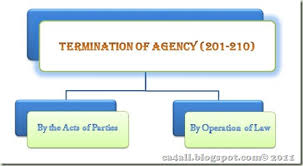
Agency may be terminated two ways –
1) By the Act of the Parties
2) By Operation of Law

1) By the act of the parties
i) By agreement – The Contract of Agency can be terminated at any time by mutual agreement between the principal and agent.
ii) By revocation of the principal – The Principal revoke agency at any time by giving notice to the agent.
iii) By Renunciation of an agent – Renunciation which means withdrawing from responsibility as Agent. Like Principal, Agent can also renounce the agency. According to Section 206 of the Indian Contract Act 1872, the agent must give to his Principal reasonable notice of renunciation. Otherwise, he will be liable to make good for the damage caused to the principal for want of such notice.

2) By operation of law
Agency can be terminated by operation of law-
i) By the completion of agency – Agency can become to an end after the completion of work for which the agency is created.
ii) By expiry of the time – Agency can also be terminated by the expiry of time. if the agency is created for the specific period, it is terminated after the expiry of the time.
iii) Death or insanity of principal or agent – Section 209 of the Indian Contract Act 1872 imposes an agent, duty to terminate the contract of agency on the death of the principal. In other words, Agency comes to an end on the death or insanity of the principal or agent.
iv) Insolvency of principal – According to Section 201 of the Indian Contract Act 1872, an insolvent or bankrupt is a person who is unable to run the business due to Excess of liabilities over assets. In this way, if the principal becomes an insolvent agency can be terminated.
v) Destruction of the subject matter – If this subject matter of the agency is destroyed agency comes to an end.
For example – Any agency is created for sale of an Airplane if the Airplane caught fire before the sale the agency comes to an end. In this contract Airplane is the subject matter.
vi) Principal becoming an alien enemy – If the Principal becomes an alien enemy the contract of agency comes to an end. vii) Dissolution of company or firm – A Firm or company may be regarded as a Principal in the contract of Agency. If the company or firm is dissolved the agency comes to an end.

Relationship between Principal agent and sub agent

Relationship between principal agent and sub-agent depends on the question whether the agent has an authority to appoint sub-agent and whether the sub-agent is properly appointed.
If then sub-agent is properly appointed:
1) The principal is bound by and responsible for the acts of a sub agent;
2) the agent is responsible to the principal for the acts of the sub-agent;
3) the sub agent is responsible for his acts to the agent, but not to the principal except in case of fraud or willful wrong.

It is of interest to observe clause (3) above. Sub-agent is responsible and accountable to the agent and not to the principal by clause (1). Principal is liable for acts of the sub-agent if he is properly appointed. Sub-agent is not responsible to the principal because there is no privity of contract between the principal and sub agent. It is case of fraud or willful wrong that the principal can proceed against the sub-agent. Principal can, however, against the agent for acts of a sub-agent. As far as the rights of a third party are concerned, he can enforce the wrongs of a sub-agent on the principal if the sub-agent is properly appointed. Principal is therefore liable for acts of the sub-agents if he is properly appointed.

If the sub-agent is not properly appointed: Where an agent has appointed a person to act as sub agent without having authority to do so, the principal shall not be deemed to be represented or responsible for the acts of the sub-agent so employed, nor is such a sub-agent responsible to the principal. The agent is responsible for the acts of such a sub- agent both to the principal and to third persons.

Sub-agent is said to be improperly appointed where agent delegates his powers without authority from the principal or where none of the circumstances stated above exist which necessitate appointment of a sub agent.

It will be observed that where a sub-agent is not properly appointed, the liability of agent is also towards third parties. As a rule, we have seen that an agent is responsible to the principal and it is the principal who is responsible for the acts of his agent to the third party. However, the section throws additional liability on the agent where he has improperly appointed a sub-agent. Agent stands liable to the third party for the acts of a sub-agent.

Termination of sub-agent’s authority: (Sec 210) Lastly it must be noted that the termination of the authority of an agent causes the termination of the authority of all sub-agents appointed by him

Liabilities of principal, agent and sub-agent: The agent is responsible to the principal for the acts of a sub-agent and the sub-agent is responsible for his acts to the agent but not the principal, except in cases of fraud and willful wrong.

Where an agent improperly appoints a sub-agent, the agent is responsible for his acts both to the principal and to third parties. The principal in such cases is not responsible for the acts of the sub-agent nor is the sub-agent responsible to the principal. But where a sub-agent is properly appointed, the principal as regards third person, is represented by the sub-agent, and is bound by and responsible for his acts, as if he were an agent originally appointed by the principal.

Where an agent under an express or implied authority has named another person to act for the principal, such a person is not a sub-agent, but an agent of the principal. There is no liability on the agent appointing him provided the agent so appointing exercises discretion as a man of ordinary prudence would exercise is his own case (Sec 194 & 195). Such an agent is called a substitute agent.


4 Most Sought After Fields in Germany

German education standards are pretty high. Germany is known for the quality of education it provides as well as its globally recognized qualifications. German universities are highly regarded worldwide, besides being among the highest-ranked in the world.

Planning to study in Germany? Here are the four most popular courses to study there!

Engineering

Every student in the world who wants to do Engineering, for them Germany is like a dream country, all of them wants to complete their Engineering in Germany.

Of course you saw this coming, didn’t you? if you didn’t, where do you think most of your luxury cars are made? Comprising nearly 25% of international students, it is one of most popular courses in Germany. Specializations include – Automobile, mechanical and electrical engineering amongst others. Technical University of Munich, RWTH Aachen University, Karlsruhe Institute of Technology, and the Technical University of Berlin are some of the most renowned universities for this course. 

It takes more or less than 4.5 or 5.5 years to complete your Engineering program in Germany including the time required for learning German and the foundation courses. According to recent statistics, Germany has the second highest number of Engineering workers among all employees in the EU. German Universities offers numerous scholarship opportunities for Engineering students, while studying Engineering in Germany you can research and collaborate with the Engineering Industry. If the student manages to secure a position in any of the public university, study in Germany is free for Indian students, just like students from other part of the world. Students just have to pay a nominal semester fee (around 250 to 500 Euros) per semester        

Humanities

Surprised to see this on the list? Well, Germany offers around 6000 courses in the field of humanities. With some of the best- ranked universities in the world for courses in the Humanities. more than 11,000 international students in Germany were seeking a degree in the humanities, in 2019 only.

A majority of the humanities degree programmes in Germany offer integrated modules which give students the opportunity to obtain the necessary practical skills, besides the theoretical ones. German universities make sure to provide students with both, theoretical and practical skills, in order to ensure that once these students graduate, they will be fully equipped to enter the job market with confidence. Humanities programmes will comprise of professionally related events, study semesters abroad, as well as research projects or internships so students understand exactly what they will encounter in the future, in their professions. Students can also choose from a variety of combinations, which further enhances the experience.  There are many best universities where you can purse your love for languages and the social sciences in Germany. Studying the humanities in Germany, in comparison to other countries, slightly more affordable.

Business and Finance

Boasting of one of the best economies in Europe, Germany is one of the best countries to earn a degree in Business and finance and gain practical knowledge. The strong German economy means a constant influx of educated workers – including many English speakers, who are highly sought in Frankfurt’s finance and business communities. The nation’s GDP has continued to grow in recent years. Economic freedom is partly responsible for why the city has become a seedbed for innovation and entrepreneurial initiative. According to Eurostat, amongst the 28 countries in the European Union more than 40% of all patents are held by Germany. Half of the cities in top-30 metropolitan areas for patents are in Germany.

Germany also has one of the lowest unemployment rates at just over 5%. Germany is a global leader in R & D investment that further assures access to top – notch training and resources.

Computer sciences and Mathematics

Due to Germany’s extremely advanced technology, disciplines intertwined with it are always in demand. Germany is an excellent place to work as a computer engineer, as it’s companies invest heavily in development and research, maintaining the country’s results as the biggest economy in Europe and the third in the world. In a 2015 OECD/PISA study, Germany ranked 16th in mathematics as well as in science.

In turn, the employability rate for careers related to these degrees is also extremely high. Once again, these aren’t restricted to these, one can explore course like Scientific computing, knowledge – Based Systems and robotics among other!

Can We Live Without Smartphones?

During the past two decades, phones have undergone a rapid transformation. We have witnessed a shift from bulky and less featured basic phones to light and compact smartphones with added functionalities. There has been the addition of several new applications and features which make smarthphones an irreplaceable aspect of our lives.

With this a term called Nomophobia – No Mobile Phobia, came into existence, which is the fear of being without mobile phone. And this modern day phobia is more prominent among the newer generation people who were brought up with this device.

A study was conducted on a group of 76 college students ranging in age from 18 to 22.They were barred from eating for three hours and had no access to their smartphones for two hours. After that, It was found out that the students were more tempted to use their smartphones instead of eating. And that definitely is shocking!

Let’s look out at some of the features which makes smartphones such a vital part of our day to day lives. Probably then we’ll be able to find out whether we can live without smartphones or not. 

The Standout Features Of A Present-Day Smartphone

MAPS


The Navigation feature at times proves to be one of the most useful features of a smartphone. No matter where you are stuck, your smartphone will be able to guide you to your destination or your home. 

SOCIAL MEDIA

The present generation has become a lot obsessed with social media/social connectivity apps like Whatsapp, Instagram, Facebook etc. People thrive on social media and it is just as important to them as food, water and shelter. Striving for the social acceptance of others, social media apps let you connect with your friends and their friends as well.

CAMERA

Social Media is incomplete without the camera thing. Had cameras not come into existence there would have been no way you could update the world about what you are doing via pictures. While some people prefer clicking pictures of people (which mostly include selfies), others prefer to try and capture the beauty in nature or everyday objects.

ONLINE SHOPPING

This is yet another popular utility of smartphones. It is lot comfortable for people to use their smartphones to shop for things and get them delivered at their doorsteps instead of going into stalls and shops to buy goods and ask for services to be rendered.

ENTERTAINMENT APPS

Smartphones are quite often used for entertainment purposes like playing games , listening to music, watching movies or web series etc.

However the people have become a lot dependent on smartphones, and sometimes the passion for smartphones leads to addiction. According to a recent study conducted in UK it was found that 77% of the 18-24 age group people felt uncomfortable after being separated from their phones even for few minutes.

There are various diverse symptoms of smartphone addiction, few of them being the feeling of being left out or cutt-off or feeling stressed or incomplete without smartphones. People develop a compulsion to check for notifications,messages etc. They start using their phones at inappropriate places and even sleep with thier smartphone. Seeing all this, it seems that nowadays we cannot live without smartphones.

So, Can We Live Without Smartphones?

Well the answer to this is Yes, We can! Even before the smartphones came into existence people used to spend their lives quite happily. And now when they have come into existence, it wouldn’t be right to completely barr oneself from it and not benefit from the utilities and features that they offer.

So instead of asking whether we can live with or without smartphones, we should probably focus on how to live with it.

Certainly there are some people who might develop addiction towards smartphone usage but the best way to curb that is not the complete avoidance of this useful technology. Instead we should figure out ways to efficiently use this technology when we want to, and not the opposite. Disabling unwanted notifications and setting a limit on not so productive applications like social media would be of great help.

We can’t completely grasp Google’s time crystal discovery since it is so large.

Forget about Fuchsia and Google Search. Researchers from Google, Stanford, Princeton and other institutions could have discovered a computer breakthrough so significant we can’t completely grasp it yet. Even Google scientists aren’t convinced whether their time crystal finding is correct. However, if the report is correct, Google may be one of the first corporations to provide the globe with a critical technical improvement in the future. Quantum computers, which can tackle difficult problems with amazing speed and power using technologies that have yet to be created, will require time crystals as a building component.

What is a quantum computer?

Google isn’t the only business working on quantum computers, and these devices continue to make headlines daily. Quantum computers won’t be able to reach your phone, and they won’t be able to play games with you. Even if they did, Nintendo’s future systems will be completely devoid of the latest computing technologies.

According to The Next Web, we intend to use quantum computers to solve difficult issues. Warp drives, for example, might allow for rapid interstellar travel. And medical technologies capable of curing almost every ailment.

Earlier this year, Google teamed up with Michael Pea for a quantum computing demonstration at I/O 2021:

Quantum computers, on the other hand, are extremely difficult to create, maintain, and even operate. That’s where Google’s time crystals may be useful. Qubits, or quantum computer bits, are now used in quantum computers. When these qubits are seen, they behave differently than when they are left alone. It’s because of this that measuring qubit states is challenging. Because of this instability, using a quantum computer is difficult. That’s when time crystals enter the picture.

Google’s time crystals

The time crystal idea, first proposed in 2012, is a new phase of matter. According to The Next Web, time crystals defy one of Sir Isaac Newton’s renowned principles. “An object at rest tends to stay at rest, and an object in motion tends to stay in motion,” according to Newton’s first law of motion.

There’s something called high entropy in our cosmos (disorder). Energy transfers constantly cause something to happen. When there are no processes, entropy is constant, but it increases when they are present. However, this is not the case with time crystals. Even when employed in a process, they can preserve entropy.

The Next Web gives a fantastic analogy with snowflakes to explain Google’s time crystals. Because the atoms are organized in precise ways, they have distinct patterns. Snow falls, melts, water evaporates, and ultimately turns back as snow. All of these processes entail energy transfers. A time crystal is analogous to a snowflake that can switch between two configurations without consuming or wasting energy. Time crystals can have their cake and eat it too, and they can do it indefinitely.

What does it mean for you and me?

The time crystals that Google uses do not belong to Google. Even the Google crew is unsure if they were developed by them. The study is only available in pre-print form while it is being peer-reviewed.

However, if Google can figure out how to build them, next-generation quantum computers may include time crystals. These computers might be built by anyone. They’d also bring quantum coherence to a region where there’s a lot of decoherence — the restless qubits we talked about before.

Even yet, the development of quantum computers based on time crystals is still in its infancy. Google may have demonstrated that time crystals aren’t simply a theory, but it hasn’t built any.

To develop warp drives or uncover “universally effective cancer therapies,” we may require decades of quantum computing research to produce quantum computers with time crystals. And it will take decades to fully comprehend quantum computers and time crystals. This is the URL to Google’s paper. Furthermore, Quanta Magazine provides a comprehensive overview of Google’s findings, replete with a time crystal animation.

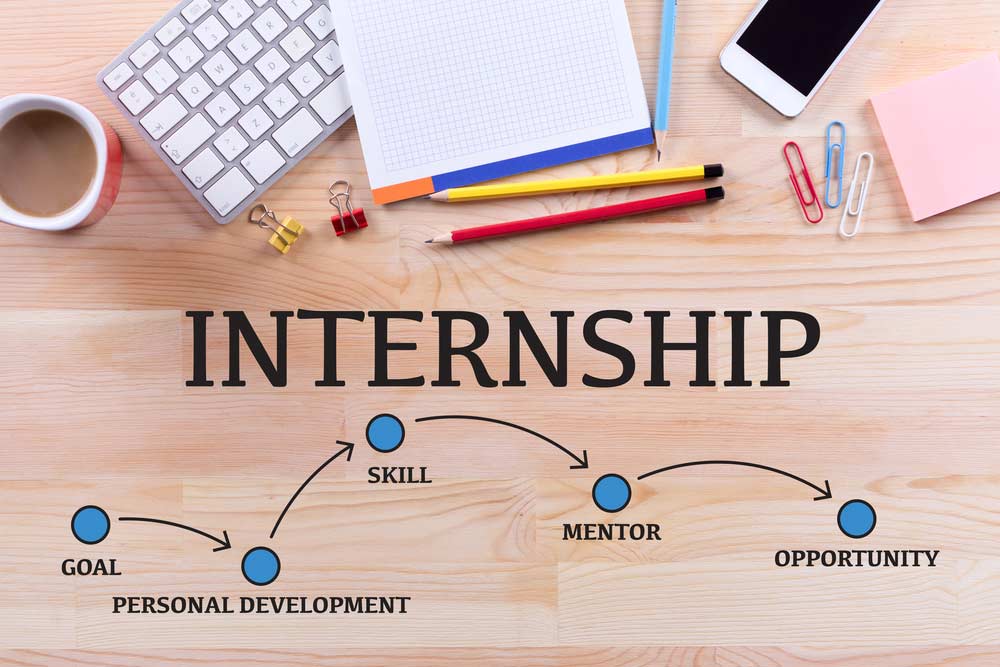
What to expect from an Internship

1. Networking

One of the most rewarding takeaways from internship is definitely Networking. It helps build professional relationship right at beginning of your professional career. Networking during an internship is really important for your career growth and social life. The power of relationships can provide you with professional opportunities in the future that you would never dreamed of. It will help you to hear tips and gain advice from others who are successful. There are so many advantage of networking, it will definitely help you to build a great future. Exchanging information on challenges, experiences and goals is a key benefit of networking because it allows you to gain new insights that you may not have otherwise thought of. Similarly, offering helpful ideas to a contact is an excellent way to build your reputation as an innovative thinker.  

In the future, these contacts could be potential references and may be also help connect you to new opportunities.


2. Soft Skills

Apart from enhancing skills in your professional domain, internships come bearing gifts in the form of soft skills. Alongside time management, teamwork and communication skills, you also learn to work with people who get on your nerves, adapt to demanding superior and long work hours and take accountability for your work. Skills like punctuality, multi-tasking, creative thinking, problem solving will help you with your full time job.

3. Working World Experience

Internship essentially serve as blueprint of how professional offices work. Regardless of the responsibilities, most internship follow a similar profile. Through an internship, you can learn more about responsibilities, hierarchies and schedules in a real time office. When students have an opportunity to experience real-world situations, it allows them to practice the skills they learn about in their books and truly understand the task at hand. Teamwork is an extremely important thing in the industry.

So if you want to try those big girl pant before buying them, an internship is your way to go!!

4. Compensation

We are gonna be loud and clear for everyone to hear, experience does not pay bills. You’ll come across internship offering ‘learning’ and ‘experience’ as compensation for your work. And often, in the rush to add a few lines to your resume you may be tempted to take up the first internship that comes your way. Trust me, there are tons of internship out there that will monetarily compensate you for your efforts and skills.

If an internship offers you all of these just grab it!!


5 Interesting things you should know about South Korea

South Korea is like a dream country for all youngsters out there!! because of “K-pop” and specially “BTS”, every teenager girl wants to move South Korea. So here are the 5 most interesting things you should know about South Korea before moving.

1. Koreans never smell bad

Korean people lack a gene which produces smelly odour due to sweat. Hence they don’t smell bad at all even if they are sweat a sea. Don’t you think it’s amazing, after working all day, you are sweating like a sea but you won’t smell bad at all!!

2. Shutter sound while taking picture

You can’t turn off the shutter sound while taking picture. If you bought a smartphone from South Korea no matter what you do or how much you try but, you can’t turn off the shutter sound while taking pictures. This is for safety reasons, if someone is taking your picture secretly or without your permission then, this shutter sound will help you to know that someone is clicking your picture.

3. Your age

In Korea you are 1 or 2 years older that your actual present age. Koreans consider a year in the womb as counting towards their age, so everyone is one year old at birth. Everyone gets one year added to their Korean age on New Year’s Day.

Formula for calculating your Korean age = Current year + 1 – Birth year

4. Safety light spots

Whenever you feel unsafe while walking alone on streets of South korea don’t panic, you just have to stand on safety light spot positions which are under cctv observation 24/7 then, no one will dare to do anything to you. These safety light spots will monitor you continuously so no one can harm you and you will be safe until you call someone for help. Don’t you think this is the most coolest thing in South Korea!!

5. Don’t wear any cleavage-baring tops

Even if there are tops or blouses with cleavage, women take extra precaution generally when sitting, bending, and bowing. But in Korea if you wore a top with cleavage, you will have to face a negative comments because it’s consider sexual or too revealing.
For girls, don’t wear low cut shirts or expose your shoulders. This is considered very provocative. But wearing short skirts consider as cute.

WATER POLLUTION

Water pollution is a global problem, affecting every continent and occurring in every type of ecosystem. It can be caused by industrial, agricultural and sewage systems, as well as by natural processes.

Water pollution does not respect political boundaries (or rivers), and can be managed at the international, national and local level. Water pollution occurs when harmful substances—often chemicals or microorganisms that contaminate a stream, river, lake, ocean, aquifer, or other body of water, degrading water quality and rendering it toxic to humans or the environment. Water pollution can come from a number of different sources. If the pollution comes from a single source, such as an oil spill, it is called point-source pollution. If the pollution comes from many sources, it is called nonpoint-source pollution. Most types of pollution affect the immediate area surrounding the source. Sometimes the pollution may affect the environment hundreds of miles away from the source, such as nuclear waste, this is called transboundary pollution.

550+ Water Pollution Pictures | Download Free Images on Unsplash

Water pollution is estimated to cause over 4 billion lost human lives per year. The global costs of water pollution exceed more than $1 trillion per year, making it the most costly environmental health hazard.Globally more than 2.5 billion people lack adequate drinking water, and another 1.8 billion lack adequate sanitation. More than 40% of the world’s population lives in water-stressed areas. The majority of this population lives in developing countries. In developing countries, water pollution is almost wholly due to point source pollution. The majority of the global burden of disease, injury, and premature mortality is estimated to be due to diseases caused by contaminated drinking water, sanitation, and unsafe sewage. Such major pollution events account for about 40 percent of the world’s total estimated disease burden.

It is well known that there are a number of ways in which water pollution can occur.

TYPES OF WATER POLLUTION

  • Industrial water pollution results when materials that are harmful to humans or the environment are dumped into water. Often industry will be negligent in ensuring that harmful wastes are managed safely.
  • Agricultural pollution derives from the discharge of chemicals to increase crop yields, or pesticides, herbicides, and fertilizers to grow food.
  • Wastewater pollution results from the discharge of human waste, sewage and industrial wastewater.
  • Nonpoint or diffuse pollution is pollution that occurs when substances diffuse into the water from a variety of sources.
  • Point source pollution is the damaging flow of a substance that originates from a single location that can be easily identified, contained or cleaned up.
Water Pollution: The Invisible Threat The World Is Ignoring

EFFECTS OF WATER POLLUTION

  • Virtually all types of water pollution are harmful to the health of humans and animals. Water pollution may not damage our health immediately but can be harmful after long term exposure.
  •  Heavy metals from industrial processes are toxic to marine life such as fish and subsequently to the humans who eat them.They can cause immune suppression, reproductive failure or acute poisoning.
  • Microbial water pollution is a major problem in the developing world, with diseases such as cholera and typhoid fever being the primary cause of infant mortality.
Water pollution - latest news, breaking stories and comment - The  Independent

These are just few effects of water pollution. If you wanna know more do research and know about it.

There are many ways to prevent water pollution and to avoid contaminating the water. Yes, there are various treatment plans to treat polluted water. For example, Sewage treatment plans, denitrification etc. The one thing we can do with the waste water is, Kitchen water can be directed to garden to save water as well as pollution. The things I said today are limited but there are many meaning in it. Hope you know more about it.

Top 6 Causes of Water Pollution and How to Reduce the Risks
SAVE WATER; SAVE LIFE

Read more;

Thunderbolt 5 might provide up to 80 Gbps of bandwidth, according to an Intel leak.

An Intel manager tweeted and then removed an image exposing some details about the Thunderbolt 5 in development, including the fact that Intel is attempting to quadruple the current Thunderbolt bandwidth limitations to 80 Gbps.

Gregory Bryant, the Intel Client Computing Group’s EVP and GM, published a tweet early Sunday that sparked discussion over Thunderbolt’s future as a communications standard. During a visit to Intel’s Israel Research and Development Center, the manager provided four photographs, but one of them was surreptitiously deleted.

Despite the fact that Thunderbolt isn’t mentioned on the poster, Bryan claims in his tweet that the lab tour was about Thunderbolt. The billboard looks to be promoting Thunderbolt 5, given the near closeness of Intel’s Thunderbolt and USB standards, which allows the Thunderbolt 3 specification to be incorporated in the USB 4 standard.

According to the poster, the connection is “designed to complement the existing USB-C ecosystem,” indicating that Intel would continue to use the USB Type-C connection.

On the poster, the use of “new PAM-3 modulation technology” is highlighted in a unique fashion.

When using NRZ coding, the data line transmits one bit at a time using an electrical signal that alternates between two states. Pulse-Amplitude Modulation 4 (PAM-4) is an option that specifies how two bits can be broadcast at the same time, with the number 4 referring to the number of possible bit pairs.

In PAM-3, a data line can be in one of three states: 0, +1, or -1. The system is informed of a three-bit group via a transmission pair, which is roughly 50% more efficient than NRZ.

Thunderbolt 5 should potentially provide consumers much of the same advantages as Thunderbolt 3, including increased power, video, Thunderbolt networking, and fast bandwidth. Thunderbolt 5’s enhanced bandwidth from 40 to 80 Gbit/s enables quicker file transfers and greater data interchange between connected devices with fewer restrictions.

Indian Education System

Education plays an important role in the development of an individual and making him a knowledgeable citizen. It is the education that makes an individual self-reliant, helps to suppress the social evils and contribute towards the development of the society and nation as a whole. Education helps in unravelling the mystery of nature. It enables us to understand and improve the working of our society. It creates conditions for a better life. Education brings out the capabilities to fight injustice happening in society. Every individual has the right to education. 

Indian Education is one of the largest and complex education systems in the world along with China. India is committed to providing basic education to its citizens, the framework of which is defined in the National Policy of Education. Elementary education is now compulsory in India. At the time of Independence, only 14% of India’s population was literate. Now after so many decades since Independence, the number of literates has increased by fivefold.

History of Education System

The history of Indian education system comes from the times of Ramayana and Mahabharata. The historic Indian education system is also called the Gurukula system. There were gurus then who are now known as teachers and shishyas who are called students now. The gurus and the shishyas lived together under one roof in Gurukula until the completion of their education. The shishyas were expected to help the guru in all the daily chores as part of their learning. The children belonging to higher strata of the society were taught all the subjects from Sanskrit to Holy Scriptures and mathematics to metaphysics by the gurus. The Gurukulas during those times focused on the practical aspects of life. The students were taught in the open classroom in the surrounding area of nature. This early system of education in India continued for many years until the modern education system came into the picture in the nineteenth century.

In the early 19th century, during the British period, the modern education system was brought into our country by Lord Thomas Babington Macaulay. The basic strength of this modernized education system was the examinations and a well-defined curriculum, which gave importance to subjects like science and mathematics and subjects like philosophy, metaphysics were given a back seat. The brick and mortar classrooms replaced the open classrooms in the Gurukulas. The essence of the guru shishya bond was taken over by a more formal relationship between the teacher and the student. To understand the progress of any student, examinations were conducted at frequent intervals. The focus of the education system shifted from learning to memorizing of the concepts to score good marks in the examinations.

Problems of Indian Education System

Over a period of time, it has been observed that there are many loopholes in the system of education in India. Instead of understanding the concepts, students started cramming and memorizing the lessons. Knowledge is given a backseat and scoring in high rankings takes importance. The modern parents have tuned their mindsets accordingly and their goal is to ensure that their children score good marks instead of acquiring knowledge right from the primary level. 

Private schools and colleges have been rapidly increasing in the country but the results produced by them are far beyond satisfactory. It has also been observed that the quality of teachers deteriorated with the passing of time. Our examination system is responsible for the wide skill gap. India is producing lakhs of engineers and professionals every year but only a fraction of this number is actually getting employed. This is because the Indian examination system focuses more on scoring good percentages rather than the actual continuous comprehensive evaluation. 

Research and development, which should be the cornerstone of our system, are given the least importance. The private schools and colleges focus on the admission of more students and are least interested in the quality of their education. This is the major reason why the faculties and the teachers lack skills and specialization. This is quite evident from the fact that a single professor is assigned to teach multiple subjects. 

How Can We Improve the Indian Education System?

First and most importantly we should improve the grading system. Rote learning should be discouraged completely. Teachers and faculties should focus more on the analytical skills of the students and grade them accordingly. There should be more focus on comprehensive evaluation instead of scoring only good marks. Workshops must be organized for teachers on a regular basis to keep them updated about the latest developments in the sector of education. At the same time, the curriculum should be reframed according to the present needs of education in India. 

The payroll structure of the teachers and the faculties especially in the government institutions should be improved. This step will help in motivating the teachers to develop their skills and they will take a keen interest in grooming or shaping up a student’s life and career. The government and other entities who are associated with the education sector, need to understand the importance of quality of education. Education should be a holistic process that must focus on the overall development of the physical, emotional, social and cognitive skills of a child. It needs to be a slow and cyclic process and must take place gradually to help the child develop into an autonomous, independent and knowledgeable individual.

Conclusion

An educated individual is an individual who should be able to contribute towards the betterment of the economic and social development of the society as well as the country. The true goal of education must exceed awarding the degrees and certificates to the students. Education is not a tool to earn livelihood but it is a way to liberate the mind and soul of an individual. 

How can online learning influences the education of a Student?

When the world has witnessed one of the most infectious diseases spreading around the globe that affects not only the physical health but also the mental health of people. It was really difficult for any educational institutions, schools, or a college to manage classes physically, But 21st-century technology made it easier and helped institutions with their breathtaking software to conduct online classes and tests.

Photo by Julia M Cameron on Pexels.com

How online education is a new way of learning?

Prior to the COVID-19 pandemic, there were people who used to study on E-platforms, but not often, there were people who didn’t go to school and studied at home. Technology made a click away to explore and learn anything a student wanted to. Now one can carry their textbooks in their pocket, one can meet up anyone face to face on a software, just a click away and one can do learn anything from the internet. After school closed as a result of the pandemic, about 1.8 billion students from 186 different countries, their education was affected, but again technology did not want the student’s life to be ruined by the physical closure of schools. 

Future of Online Education

As per some scholars and economists, it’s highly believed that the overall market for online learning can be up to US $350 Billion in 2025 or more. Parents and students now don’t have to spend extra charges for classrooms, Electricity, or for any other activities that the school asks the students to pay. Parents who used to worry about their kids in school about their bullying, consuming drugs or any other harmful activities now are totally diminished. Now parents can witness their kid’s education during their online classes. Students now can easily study as well as can upgrade their extra skills through e-learning. Many students nowadays do internships, do extra courses, learn new things as well as the technology. Now a 8 year old student knows how to operate a mobile phone or a PC. Some believe that in future online education would be easily available and students don’t have to pay more for their education. “I believe that the integration of information technology in education will be further accelerated and that online education will eventually become an integral component of school education,“ says Wang Tao, Vice President of Tencent Cloud and Vice President of Tencent Education.

As Online education can also put the students in a bad or harmful influence, there are people who don’t want the online education as a major medium of learning.

Reasons why online education can be a harmful influence for the students?

  • Nowadays, most of the school or college students don’t study and cheat on their online exams or tests. It can be a really bad impact on their future and can be the core reason for the lack of their knowledge.
  • The daily and often use of electronic devices can make a person sick and hits their mental health in a really bad way.
  • Students are well aware of the technology and now are highly active on social media networks and making online friends. One can be good, but there are high number of chances to meet a fraud one. Those frauds assault the kids and ask them to do things which a kid didn’t want to.
  • Nowadays students as well as the adults store their personal information on their electronic devices and one don’t know that there are people on the internet named as hackers, who often used to steal the random people information from their cloud and upload them in the Dark web. There is a high number of chances of a kid or high school student could be one of the victims of online frauds and assault.

Reasons why online education can be a good influence for the students?

  • Firstly, the online education can be done in massive numbers at a time, which in physical classes were not possible. A student can know a number of different answers to a same question which is really helpful for a kid to understand that how an answer could be framed for a question.
  • Question answers from textbooks were limited, but in online education one can know more about a question through exploring it on the internet.
  • Technology is our future generation and learning about it since childhood could be an advantage for a student in their future.
  • In a traditional way of learning, one has to stick by a particular teacher and had to adapt their teaching style, but in online education a student can get through a number of teachers and can stick with the one they liked the most.

Disadvantages of Online education

Schools, Colleges are one of the best moments one could live in and online education can totally dismiss it. The other activities in schools like Upgrading leadership qualities through school/college competitions, Outdoor games for physical health of a student, and more things which a student learns through offline education are not possible through online education. The major and the core problem is, not every student or kid have mobile phones or PC and the access to the internet. They all were dependent on government schools, offline classes and free books from the school for their education. Poor family conditions, Bad environment, Poor Electronic facilities could be reason in the future for a student who might lose their interest in their education through E-Learning.

In the end, the conclusion of learning through online education has more disadvantages than their benefits.

Sources:-

https://www.weforum.org/agenda/2020/04/coronavirus-education-global-covid19-online-digital-learning/

https://www.google.com/url?sa=i&url=https%3A%2F%2Fwww.insidehighered.com%2Fnews%2F2020%2F07%2F30%2Fsurvey-data-reveal-impact-covid-19-perceptions-online-education&psig=AOvVaw28oKObAFVXLJ-UO6vhxiqv&ust=1627984700132000&source=images&cd=vfe&ved=0CAwQjhxqFwoTCKCFmYeKkvICFQAAAAAdAAAAABAK

Role Of Todays Youth In Building A Self Reliant India

“Self-reliance is the key to a vigorous life.”

Self-reliant India is the vision of the Prime Minister of India Narendra Modi of making India a self-reliant nation. The first mention of this came in the form of the ‘Self-Reliant India Mission’ during the announcement of the coronavirus pandemic related economic package on 12 May 2020. This self-reliant policy does not aim to be protectionist on nature and as the Finance Minister clarified, ” Self-reliant India does not mean cutting off from rest of the world”. The largest fund in the country worth Rs. 21,000 crore was setup by the IIT Alumni Council with the aim of supporting the mission towards self-reliance.

Everybody knows, that the youth are the future of any country. But India can take lead over many other nations because about 65 percent of the country’s population is below 35 years and 50 percent is below 25 years. With huge, educated young population, India is very uniquely poised to realise the demographic potential amd reap the advantage of this vast powerhouse of human resource talent. The need of the hour is to upgrade the skill or upskill the youth to meet the emloyment needs of technology driven 21st century and accelerate the pace of self-reliance.

The uncertainity created by the pandemic is being seen by many as an opportunity to upgrade knowledge and acquire new skills that will cater to the post-corona virus job scenario. The skills required for tomorrow’s jobs will be completely different from the skill-sets youth possess today.

So, its high time now, we have to make India self-reliant and youth plays the most important role in this mission.

SCIENCE AND TECHNOLOGY

Science and Technology have now become crucial parts of our life and our life has many luxuries and we are able to utilize them because of science and technology. It has helped us to do all these in short time because of the advancement in science and technology. Every day new technologies get introduced in the field of science and technology which makes human life easier and comfortable. And now it is difficult to imagine our loves without science and technology. Because of this we are now living in modern civilization and our evolution has occurred. This development in the field of Science and Technology is present in every aspect of our life and has great contributions in it.

There have been many new inventions in the field of Science and Technology which has changed the overall perspective of humans towards life and helps in modernizing the human civilization. Hence, people get the chance to enjoy the lives more comfortably and make it more pleasurable. In other days, humans now have a simple life because of science and technology. It has now expanded its wings into the fields of medical, education, manufacturing and many other areas.

WHAT IS SCIENCE ?

Science is the consists of systematic study of the behavior and structure of physical and natural world through observation, experiment and technology with the application of scientific knowledge for practical purposes. And Like everything, Science also has a journey and it has long lasting impact on the humans. Science has large contributions in the evolution of human.

WHAT IS TECHNOLOGY ?

“Technology” is the application of this scientific knowledge for practical purposes. Thee mobile, laptop etc. have now become the essential parts of our life and make use of connectivity or communication or smart technology for doing our activities. From the machines used in industries to the robots created, all fall under technological invention. So, in simpler words we can say that technology has made our lives comfortable.

Science and Technology: India

Ever since British rule, India was famous for many things and after gaining independence, science and technology, played a great role in shaping the present and future of India. Now, it has emerged as an essential source of creative and scientific developments all over the worlds. All these advancements have led to the improvement of Indian economy and assisted development in various fields including Space Technology, Mathematics, Space Technology and many more. Some of the prominent examples of these developments are railway system, smart phones etc. Such advancements only helped in launching Chadrayaan 2 and helped India earn critical acclaim from all over the world.

In conclusion, we must admit that science and technology have led human civilization to achieve perfection in living. However, we must utilize everything in wise perspectives and to limited extents. Misuse of science and technology can produce harmful consequences. Therefore, we must monitor the use and be wise in our actions.

Advancement in science and technology has changed the modern culture and the way we live our daily life.

Computer technology, a boon or bane?

Computer is one of the biggest revolution for the human society today we cannot imagine a world without a computer. Computer is one of the major priority for todays world so lets talk about it in some detail one by one.

DISCOVERY OF COMPUTER

In the early 19th century ,an English mechanical engineer made the first mechanical computer and the name of  that person is Charles Babbage and also considered as a father of computer. He work on different engines and then finally invented a engine that fits with his idea of mechanical computer and that how the huge change in human society starts begin.

(source:https://en.m.wikipedia.org/wiki/Computer#:~:text=Charles%20Babbage%2C%20an%20English%20mechanical,in%20the%20early%2019th%20century)

TYPES OF COMPUTER

  1. Mainframe Computer : It is high capacity and costly computer. It is largely used by big organizations where many people can use it simultaneously.

2. Super Computer : This category of computer is the fastest and also very expensive. A typical supercomputer can solve up to ten trillion individual calculations per second.

3. Workstation Computer : The computer of this category is a high-end and expensive one. It is exclusively made for complex work purpose.

4.  Personal Computer (PC) : It is a low capacity computer developed for single users.

5 . Apple Macintosh (Mac) : It is a sort of personal computer manufactured by Apple company.

6. Laptop computer (notebook) : It is a handy computer that can be easily carried anywhere.

ADVANTAGES OF COMPUTER

1.Stores data in digital format: Computers can store millions of pages of information in digital format.


2.Huge storage: We can store huge information. The present day hard-disks can store 100s of Gigabytes (GB) of information. Large businesses store their marketing and sales data in their computer systems. Even sensitive data of customers are securely protected in a computerized environment.


3. Play games: When it comes to games, the choices are almost unlimited.


4. Calculations : Businesses are increasingly using spreadsheets and other software as a tool for performing mathematical calculations.


5.Prepare and store official documents : You can use a word processing software to prepare, edit and save any text document. The concept of paperless offices is finally taking its shape. excel- calculations


6.Presentations : If your office demands that you prepare presentations, you can prepare it in a Power Point.

DISADVANTAGES OF COMPUTER

1.Ever changing technology: The technology that is new today, may soon become obsolete. We need to regularly upgrade the hardware and software in a computerized environment. This involves additional time and cost.


2.Increased manpower cost: The computer needs to be operated by skilled person. This has led to an increase in manpower cost for organizations. Due to the inherent risks, huge expenditure are made ensure data security.


3.Computer stops responding: At times the operating system of the computer may stop responding or functioning. Though this problem is generally solved by restarting the computer, but sometimes you may have to take the support of the technician.


4.Viruses: The threat of virus and malware attack always remains in the computerized environment. To cope up with these risks, various anti-virus software are available in the market. If you are using a good antivirus, you are almost sure that your private information and other sensitive data are secured.

In California, Argo AI may now provide public rides in its self-driving vehicles.

Argo AI, the Ford and VW-backed autonomous vehicle technology firm, has received a permit in California that will allow it to provide free rides in its self-driving vehicles on public highways.

According to the accepted application, the California Public Utilities Commission gave the so-called Drivered AV pilot permit earlier this month. It was published on its website on Friday, a little over a week after Argo and Ford revealed plans to debut at least 1,000 self-driving cars on Lyft’s ride-hailing network in a variety of locations over the next five years, beginning with Miami and Austin.

The authorization, which is part of the state’s Autonomous Vehicle Passenger Service pilot, adds Argo to a small but increasing group of businesses looking to go beyond standard AV testing — a hint that the industry, or at least some companies, are getting ready to go commercial. Since 2019, Argo has been testing its self-driving technology in Ford cars in Palo Alto. In California, the company’s test fleet consists of around a dozen self-driving test vehicles. In addition to Miami, Austin, Washington, D.C., Pittsburgh, and Detroit, it has autonomous test cars.

Aurora, AutoX, Cruise, Deeproute, Pony.ai, Voyage, Zoox, and Waymo have all been granted licences to participate in the CPUC’s Drivered Autonomous Vehicle Passenger Service Pilot program, which necessitates the presence of a human safety operator behind the wheel. This permission does not allow companies to charge for rides.

Cruise is the only business that has obtained driverless authorization from the CPUC, allowing it to transport people in its test cars without the presence of a human safety operator.

Obtaining a Drivered authorization from the CPUC is only the first step on the road to commercialization in California. Before charging for rides in robotaxis without a human safety operator behind the wheel, the state needs firms to clear several regulatory barriers from the CPUC and the California Department of Motor Vehicles, each with its tiered system of licences.

The DMV is in charge of regulating and issuing licenses for autonomous vehicle testing on public roads. The DMW issues three types of permits, the first of which allows businesses to test autonomous vehicles on public roads with a safety driver. This basic testing authorization is held by more than 60 businesses.

The next permission allows for driverless testing, followed by a commercial deployment permit. Permits for driverless testing, in which no person is behind the wheel, have become the new benchmark and a need for firms looking to start a commercial robotaxi or delivery service in the state. The DMV has issued autonomous permits to AutoX, Baidu, Cruise, Nuro, Pony.ai, Waymo, WeRide, and Zoox.

Nuro is the only person who has gotten deployment permission from the DMV. Nuro may now deploy on a commercial basis thanks to this permission. Nuro’s trucks can only carry freight and not passengers, allowing the firm to avoid the CPUC approval procedure.

Meanwhile, in May 2018, the CPUC approved two pilot projects for autonomous vehicle passenger transportation. The Drivered Autonomous Vehicle Passenger Service Pilot program, which Argo just obtained, permits firms to run a ride-hailing service utilizing autonomous vehicles as long as they adhere to certain guidelines. Companies are not permitted to charge for rides, and a human safety driver must be present at all times. Additionally, specific data must be provided quarterly.

The second CPUC pilot will allow Cruise to launch an autonomous passenger service in June 2021.

It’s worth noting that getting to the holy grail of commercial robotaxis necessitates obtaining all of these permissions from the DMV and CPUC.