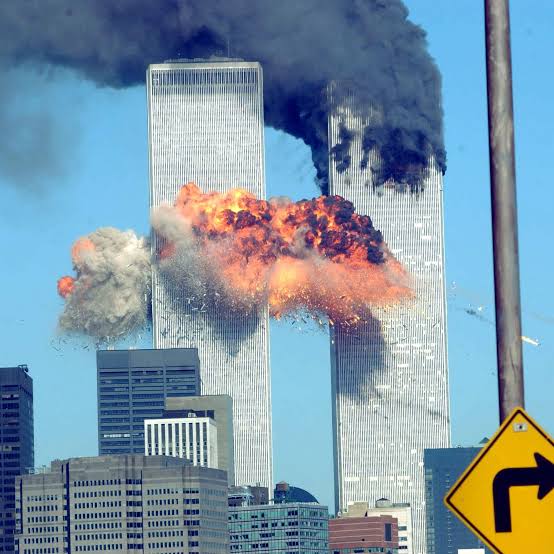
World Trade Center after being hit by two planes on 9/11
With Al-Qaedamilitants carrying out coordinated attacks on American soil,also known as 9/11 Attacks and Taliban government refusing to hand over the main culprit behind these attacks ‘Osama Bin Laden’. A war was declared by US and it’s allies against terrorism and Afghanistan was invaded in 2001.
US tried it’s best to avoid the mistakes done by British & Russia (then USSR),it gained some success by driving out the Taliban government and killing the Terrorists. This whole operation have costed US more than $800 billions and more than 2300 soldiers lives. While on the other side, Afghan civilians had been caught in between this war and have suffered at the hands of both US & Terrorists (Al-Qaeda & Taliban) .
There is a popular saying about Afghanistan – ‘The Graveyard Of Empires’ for those who have tried to conquer it. Afghanistan is tough to rule, not only because of its terrain but also of the hostilities between the different tribes present there.
US Navy seals carried out a mission code-named ‘Operation Neptune Spear’ and killed Laden on 2nd May 2011 in Pakistan. US thought that by killing Laden they had achieved their goal but they were mistaken.
India aided in the overthrow of the Taliban-led government and has been the largest regional provider of humanitarian and reconstruction aid in the country. India have provided over $3 billion in assistance and every year it continues to do so.
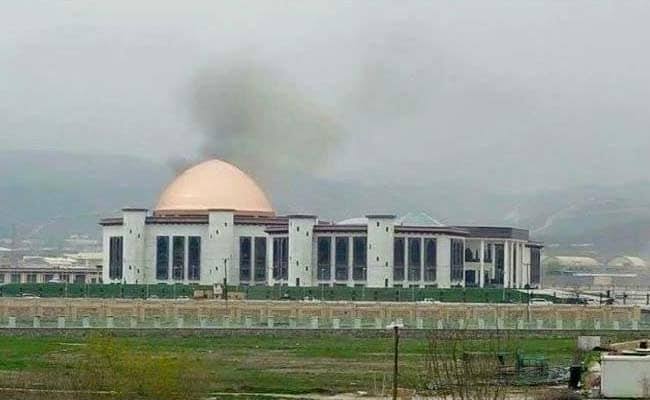
Afghan parliament constructed by India
Challenges ahead for Afghanistan and it’s neighbours
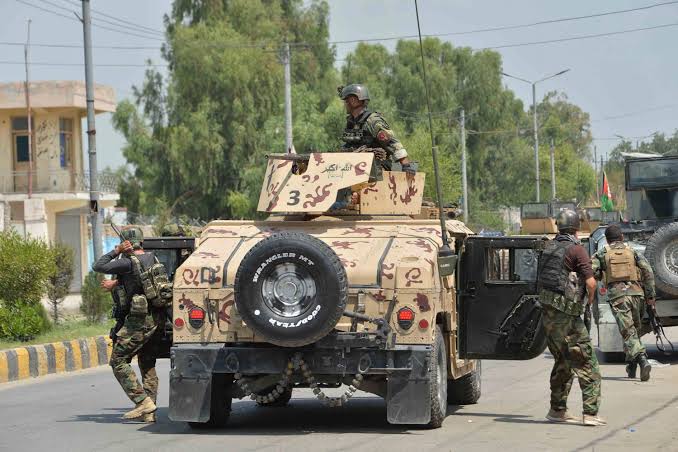
Afghan forces taking position in fight against Taliban
Taliban is slowly gaining pace and have formed alliance with other terror outfits to overthrow the present government. Civil war is not far, after US withdrawal. Fight is going on between Afghan security forces supported by civilians against the Taliban.
There’s little hope that Taliban will agree on the terms mentioned in peace talks . War-torn Afghanistan is now at the same stage before US invasion and onus now is on China,india,pakistan,Iran to maintain peace and provide stability in the Afghanistan.
On 10 April 1912, when the largest ocean liner in service at that time, RMS Titanic, started its maiden voyage from Southampton, it was a new beginning in the history. With at least 2,224 people on board, including a number of prominent personalities, the luxury ship that nicknamed as ‘Millionaire’s Special’ was en route to New York City on that day.
Designed to be the epitome of style and safety, the vessel featured many advanced luxury and safety features. Moreover, the ‘unsinkable’ RMS Titanic was commanded by a senior captain, 62-year-old Captain Edward Smith, again ensuring the safety of the vessel and its passengers.
However, the destiny of this spectacular ship was already made. On the 14th of April, the world witnessed what could easily be considered as its most deadly civilian maritime disaster – the sinking of the great Ship Titanic. On that fateful night, at around 11.40 PM Titanic struck an iceberg off the coast of Newfoundland and began to sink.
Over the course of the next few hours, people witnessed the biggest catastrophe to hit the world, and at 2.20 AM on the morning of the 15th, the biggest ship that the world had seen settled to the bottom of the North Atlantic.
The sea, the sinking of the ship and the cold weather were enough to take the lives of 1517 passengers and crew on board. Just 706 of them survived the ordeal to tell the horrific and sad tale to the world.
Why the ‘unsinkable’ Titanic sunk?
As the news of the Titanic disaster reached land, there was shock and outrage directed against several issues that possibly led to the accident. Many legends and conspiracy theories arose almost immediately after the accident on those who died and survived, and also on the reasons behind the sinking of the vessel.
How did the Titanic sink in spite of having the best technical design available at the time seemed a mystery for a long time? This was the question that baffled many scientists and engineers for days after the disaster.
Immediately after the sinking, the investigations into the matter began and in fact, two separate inquiries had been set up – one by the United States Senate and the other by the British Board of Trade.
The U.S inquiry was headed by Senator William Alden Smith and the British one by Lord Mersey. The surviving passengers and the very crew who managed to escape from the clutches of death gave their versions of the tragedy and the investigations were concluded quickly, though the initial questioning and detail gathering took more than a few months.
The results of the investigations revealed that many of the safety measures and regulations of the international maritime were outdated and required a second look. The ship itself was found short on a few of the standards
India’s transport sector is large and diverse; it caters to the needs of 1.1 billion people. In 2007, the sector contributed about 5.5 percent to the nation’s GDP, with road transportation contributing the lion’s share.
Good physical connectivity in the urban and rural areas is essential for economic growth. Since the early 1990s, India’s growing economy has witnessed a rise in demand for transport infrastructure and services.
However, the sector has not been able to keep pace with rising demand and is proving to be a drag on the economy. Major improvements in the sector are therefore required to support the country’s continued economic growth and to reduce poverty.
Roads. Roads are the dominant mode of transportation in India today. They carry almost 85 percent of the country’s passenger traffic and more than 60 percent of its freight. The density of India’s highway network — at 0.66 km of roads per square kilometer of land – is similar to that of the United States (0.65) and much greater than China’s (0.16) or Brazil’s (0.20). However, most roads in India are narrow and congested with poor surface quality, and 33 percent of India’s villages do not have access to all-weather roads.
Rural Roads-A Lifeline for Villages in India: Connecting Hinterland to Social Services and markets
Railways. Indian Railways is one of the largest railways under the single management. It carried some 19.8 million passengers and 2.4 million tonnes of freight a day in year 2009 and is one of the world’s largest employer. The railways play a leading role in carrying passengers and cargo across India’s vast territory. However, most of its major corridors have capacity constraint requiring capacity enhancement plans.
Ports. India has 13 major and 199 minor and intermediate ports along its more than 7500 km long coastline. India’s seaborne foreign trade being 95% by volume and 67% by value, the ports play a very significant role in improving foreign trade in a growing economy. These ports serve the country’s growing foreign trade in petroleum products, iron ore, and coal, as well as the increasing movement of containers. Indian ports handled cargo of 850 million tonnes and about 9.0 million TEU container traffic in year 2010. Over the last decade, the average annual growth rate of port cargo volume has been about 10%.. The future potential for port sector, particularly container ports is huge considering that the container traffic is projected to grow to 40 million TEU by 2025. Inland water transportation also remains largely undeveloped despite India’s 14,000 kilometers of navigable rivers and canals.
Aviation. India has 128 airports, including 15 international airports. Indian airports handled 142 million passengers in 2010-11 and 1.6 million tonnes of cargo in year 2009-10. The CAGR for the domestic passenger and freight growth over the last decade has been 14.2% and 7.8% respectively. The dramatic increase in air traffic for both passengers and cargo in recent years has placed a heavy strain on the country’s major airports. Passenger traffic is projected to grow more than 15% annually over 2011-13 and it is estimated that the aviation industry, currently 9th largest in the World, will require 30 billion USD investment in the next 15 years to keep pace with the growing demand.
Urban Transport. India is experiencing rapid urbanization with the present urbanization levels at 30% translating to a population of roughly 340 million living in urban areas. The number of million plus cities is presently at 42 and the urban economy accountd for roughly 60% of the GDP. Motorisation rates in India are in double digits as in most developing economies. Only about 20 cities out of 87 cities with a population in excess of 500,000 and state capitals have any kind of organized transport and only 3-4 cities could lay claim to a mass rapid transit system. The share of public transport in cities with population sizes over 4 million has declined from 69% to 38% between 1994 to 2007. Accident and fatality rates are one of the highest in the world affecting primarily the poor and vulnerable without their own means of transport.
Transport infrastructure in India is better developed in the southern and southwestern parts of the country.
The major challenges facing the sector are:
• India’s roads are congested and of poor quality. Lane capacity is low – majority of national highways are two lanes or less. A quarter of all India’s highways are congested. Many roads are of poor quality and road maintenance remains under-funded. This leads to the deterioration of roads and high transport costs for users.
• Rural areas have poor access. Roads are significant for the development of the rural areas – home to almost 70 percent of India’s population. Although the rural road network is extensive, some 33 percent of India’s villages do not have access to all-weather roads and remain cut off during the monsoon season. The problem is more acute in India’s northern and northeastern states which are poorly linked to the country’s major economic centers.
• The railways are facing severe capacity constraints. All the country’s high-density rail corridors face severe capacity constraints. Also, freight transportation costs by rail are much higher than in most countries as freight tariffs in India have been kept high to subsidize passenger traffic.
• Urban centers are severely congested. In Mumbai, Delhi and other metropolitan centers, roads are often severely congested during the rush hours. The dramatic growth in vehicle ownership during the past decade – has reduced rush hour speeds especially in the central areas of major cities.
• Ports are congested and inefficient. The average annual growth of cargo volume in the ports in the last decade was close to 10%, However, capacity utilization in some of the major ports remain as low as 58-60% Both bulk and containerized traffic is expected to grow at a much faster pace in future and by some estimate the container traffic is projected to grow to about 4.5 times of the current volume by 2025. India’s ports need to significantly ramp up their capacity and efficiency to meet this surging demand.
• Airport infrastructure is strained. . Air traffic has been growing rapidly leading to severe strain on infrastructure at major airports, especially in the Delhi and Mumbai airports which account for more than 40 percent of nation’s air traffic.
Most of the popular anime series like Naruto, dragon ball z, one piece etc. have more than 200 episodes. They are all great shows off course but watching them requires a lot of time. Due to this reason some people refrain from getting into these series. There are however, many series out there which are very good too and very short indeed. Here are some of the short but great anime series. Each of these series have utmost 13 episodes which can be watched in a day or two.
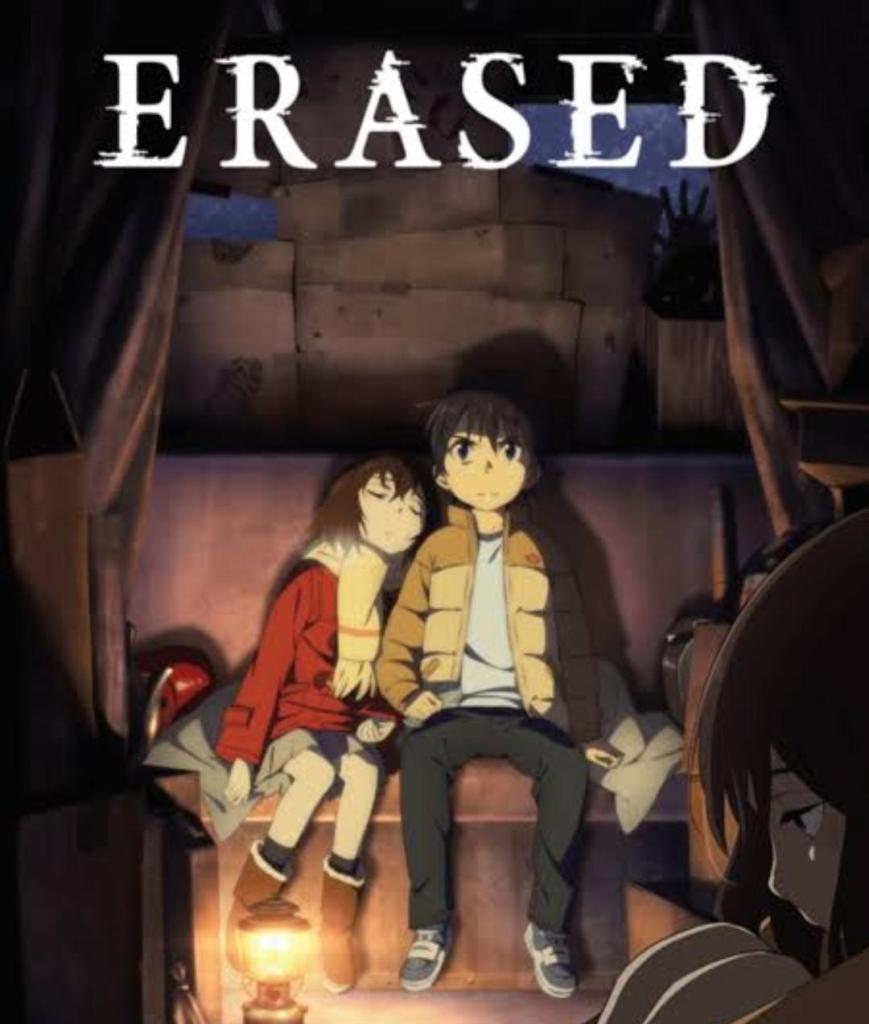
Erased is one of the best short anime series out there. It is a bliss for thrill seekers and for people who like the idea of time travel. The story revolves around a 29 year old man who is sent back in time to erase the events which lead to his mother’s death, which began with a series of kidnappings. The anime has very nice soundtrack and beautiful animation and the plot is very interesting. The characters are well written and overall the series is a must watch.
• Blue Spring Ride (2014) : Episodes: 12 Genre: coming-of-age, drama, romance
Blue spring ride or more popularly known as ao haru ride, is a very decent slice of life romance anime. It is a coming of age drama and shows how the characters grow and change over time. It depicts very well the internal conflicts characters have and is very relatable to watch. The music in this anime is used very well to emphasise the scenes. Overall it is a must watch for those who are into romance genre.
• Terror in Resonance (2014) : Episodes: 11 Genre: psychological, thriller
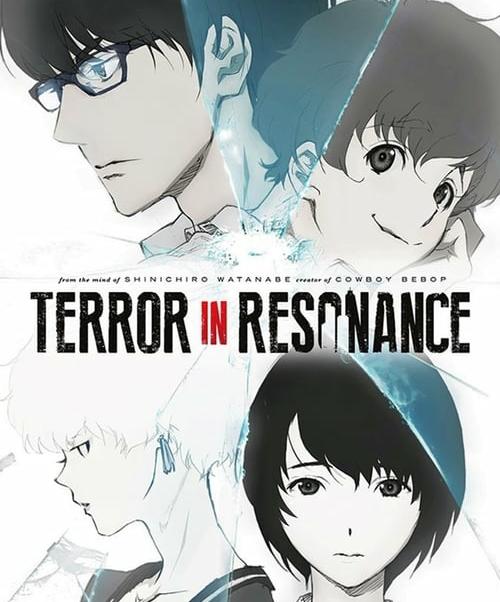
This is anime is rather underrated but nevertheless it is one of the best short anime thrillers out there. This anime serves everything in just 11 episodes. Excellent storyline, great music, top notch animation etc. It depicts terrorism very differently and deals with many of the contemporary issues. This is a must watch for everyone.
• Angel Beats! (2010) : Episodes: 13 Genre: fantasy
This anime is set in a realm of afterlife where a band of teens fight from being taken to the next level. This is a very nice series and worth your time. It has action, drama, fight sequences, tragedies, music, romance and what not. The concept of this anime is very different and it deals with overcoming the regrets of life. It is an epic journey showcased in just 13 episodes!
This is a more recent anime series. The story revolves around the post war life of an emotionally detached soldier who begins to reconnect with her feelings while searching for the meaning behind her commander’s final words. This anime is a masterpiece. The animation, music, pacing, character designs, backstories etc. all are done very well. It is very empathetic and sentimental anime. This anime is a must watch for anyone!!
Sexism is an ideology which is used by men to victimize women.
“Sexism is the ideology that one sex is superior to the other. The term is generally used to refer to male prejudice and discrimination against women.”
Barbara Bovee Polk has stated that men in their own interest to maintain power and privilege over women are practicing sex differentiation. It is indeed a power game in which men want to establish their supremacy over women.
Economic cost of sexism:
In comparison with men the economic cost to women is greater. Even though women have equal qualifications on par with men, in many business establishments they are paid less than what men in the same profession get. In fact there are legislations such as the equal remuneration act of 1976 in India which remove wage discrimination between male and female workers but in actuality this legislation is remain in majority of the instances as that letters. Studies have proved that families that rely on female breadwinners are found to be poorer than the ones which have male breadwinners.
Psychological costs of sexism:
Women are treated as second class citizens and their experience becomes passive, rather than active they tend to be treated as thoughtless objects and not subjects in the social environment. Women are forced to forego many educational, political, cultural and economic opportunities and to accept the feminine ideal -a thing of beauty and perfect housewife.
Costs of the practice of sexism on men:
Sexism has created stereotypes in the long run which has a negative impact upon men as well. Men often find it embarrassing to reveal or show too much affection for stereotypically they are expected to exercise control over women, if a husband helps his wife in the kitchen it is generally considered weird.
Hence, sexism is a practice which needs to stop as as it stands in the way of the growth and progress of women who are an equal member of the society and so it has a negative impact upon the growth and development of the society as a whole.
Sandra and Daryl Bem’s views are worth mentioning: “…. when a boy is born it is difficult to predict what he will be doing twenty-five years later we cannot say whether he will be a doctor or a college Professor because he will be permitted to develop and fulfill his own identity, but if the newborn child is a girl, we can predict with almost complete certainty how she will be spending her time twenty-five years later. Her individuality does not have to be considered, it is irrelevant.”
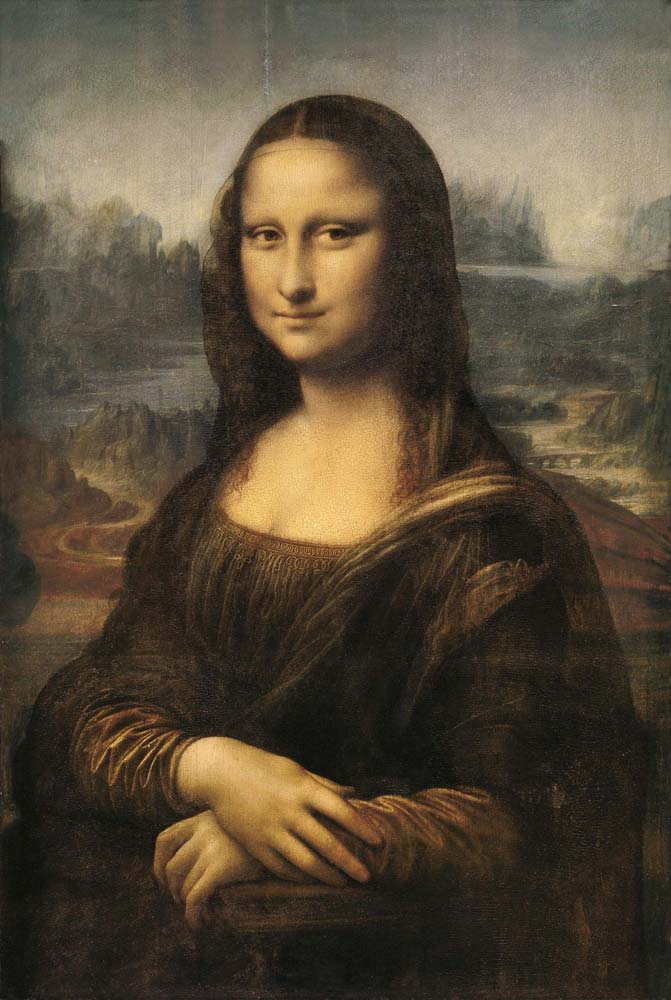
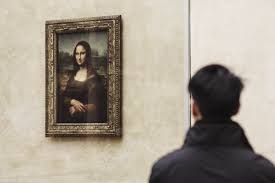
Most people feel disappointed when they see the most famous painting in the world “Mona Lisa”. Questions like ‘Why is this painting famous?’, ‘Is it worthy enough to be called a masterpiece?’, ‘What makes her unique?’ arise in the minds of hundreds. But if we ignore it all and just look at the painting, we see the greatest psychological portrait ever painted. A portrait that is much more ahead of time that we are still trying to figure out.
Leonardo da Vinci in his sixties moved to the Chateau of Amboise in France with his sketchbooks and one painting “The Mona Lisa”. Because he knows how important the painting was for him.
Leonardo is one of the greatest inquisitive minds in history, a self-made man with an unquenchable appetite for knowledge, and dedicated his life to studying anatomy, geology, and philosophy.
Leonardo da Vinci
The Painting
Mona Lisa was painted on a thin-grained piece of a poplar tree and a layer of lead white. He used glazes that have a very small amount of pigment mixed with the oil. This brought depth and luminosity as the white undercoat of lead reflects the light through the glazes. He used tiny brushstrokes applied super slowly over years. Leonardo pioneered many brushing techniques which brought the paint to life.
Mona Lisa
Clothes and Jewelry
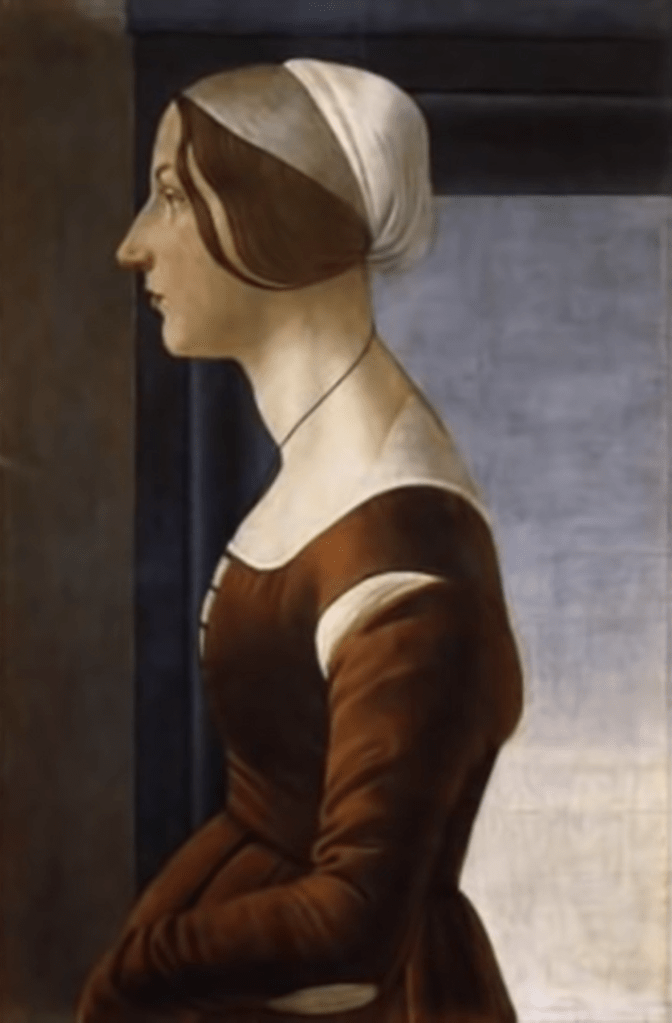
Unlike any other commissioned portraits of the aristocracy we usually see with expensive outfits, Mona Lisa is a pretty simple wealthy woman with no jewelry, clothes that are nothing special, and simple hair.
Leonardo uses the classic pyramid-shaped composition that was introduced during the renaissance. The structure provides stability and provides a central focus. In this painting, the focus is directed towards her face.
Portrait of Mona Lisa without jewelry
Portrait of Maddalena Strozzi with jewelry.
What makes her different?
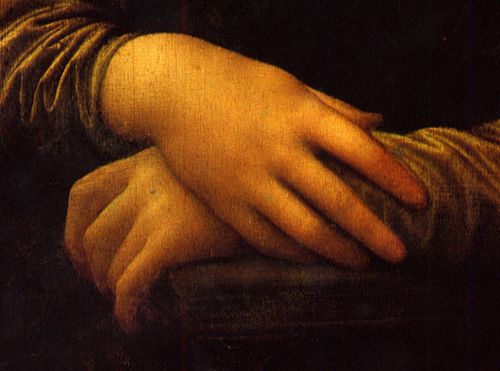
Instead of a full-length pose, Leonardo had painted Mona Lisa in a three-quarter length to cut down the distractions. Today this pose is normal but on those days it was groundbreaking. Previously the people in the portrait are erect, but Mona Lisa is relaxed with hands resting gently.
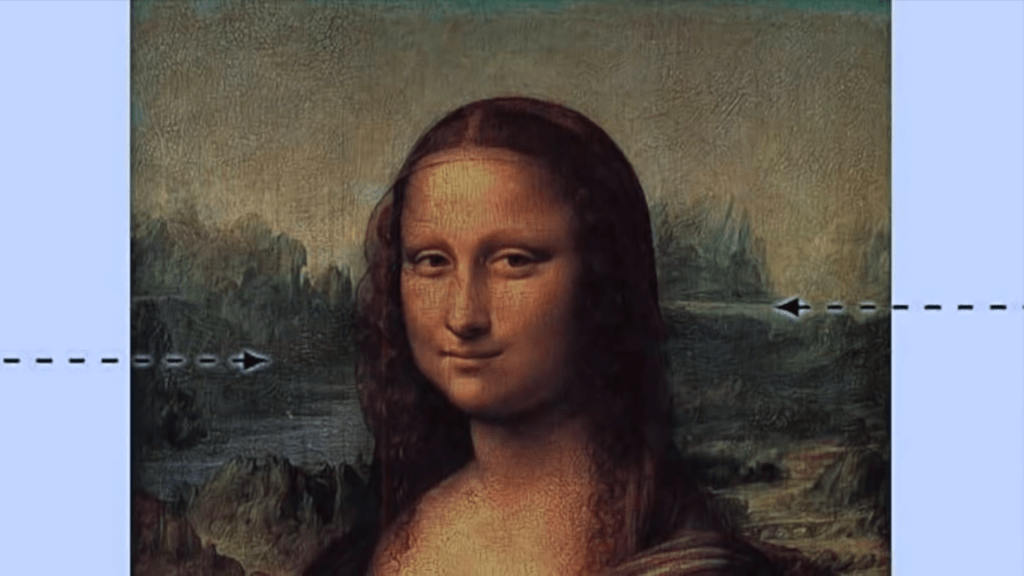
If you look at Mona Lisa’s eyes you see they are staring at you, but women in paintings never did that. The background of any other portrait has a simple background of either an open sky or a room but the background of the Mona Lisa is a complex aerial perspective of a landscape. The curves of her hair and clothing reflect the valleys and river flowing connecting humanity and nature. If you look at the background and compare the horizons on both sides you see it is not lined up. This visual trick gives an illusion of movement.
erect portrait with plane background
erect portrait with room background
level of horizons
Her eyes and smile follows you
Leonardo has used the Sfumato technique to paint Mona Lisa’s eyes. It creates a depth near the eyes of Mona Lisa which is unusual in the case of other paintings and sculptures. Leonardo has studied human anatomy, the structure of a human face, and smiles exposing the muscles and nerves. He started researching how a smile works and analyzed every possible movement of the face. Artists never painted a smiling face before, portraits are generally serious. When you look into her eyes first she smiles then she is not. The smile comes and goes as we look deep into her face. When we look away smile stays.
Leonardo from his optic studies observed that the light comes and hits the whole retina instead of hitting at one point. This was the key to her mysterious smile.
The human eye has two different regions for seeing the world one is a central area called the fovea(to read colors) and the other is the peripheral area(to see the black and white motion and shadows). When we focus on the eyes the peripheral vision is on the smile and pick up the shadows from her cheekbones. When you look at her smile directly you cannot see the shadows, and she isn’t smiling but smirking. This is not your imagination, but it is about how you see.
Her eye’s on you!Inner part of the eye
Sfumato technique
Sfumato is a blending technique for softening the transition between colors to make sure there are no sharp lines, layer by layer he blended everything in Sfumato style.
Chiaroscuro
chiaroscuro is an effect of contrasted light and shadow that gives a 3D effect.
These styles were never seen before Mona Lisa. Hence, seeing Mona Lisa for the first time must have been astonishing. How genius Leonardo da Vinci is that he understood this 500 years ago.
UNIX is a multi-user and multitasking operating system. in a multi-user environment. the computer can receive the commands from a number of end users programs, access files, and print documents simultaneously.
The host computer, which has a UNIX operating system, provides services to the terminal, such as file access services. four terminals are connected to one host computer and all the terminals are sharing resources from the host computer.
Features of UNIX
The general and additional features of UNIX operating system are :
File and Processes : file and process are two entities that are supported by UNIX. A file contains information, such as text, code or directory structure that you need to save in the computer, The file is stored in the hard disk of the computer at a particular location, which can be easily remember whereas a process is the name given to a file or a programs that is currently running . UNIX provides various tools that enable you to control a process, change the sequence of the process, and kill the process.
Multi-user system: UNIX supports multitasking system as the kernel is designed to handle multiple processes. A single user can run multiple process simultaneously. For example, an end user can print a file and edit another file simultaneously. The kernel handles the multiple processes as foreground and background process. The current process runs in the foreground and the other processes run in the background. This multitasking feature is an advantage for the programmers, as they do not have to close the editor and run the program; this can done simultaneously.
UNIX toolkit: The UNIX toolkit provides various tools that are enable you to perform different tasks in UNIX as kernel alone cannot perform every task. The tools that are included in the UNIX toolkit are:
1:- General purpose tools , such as vi editor
2:- Text manipulation utilizes filters that are used to retrieve the output from two or more commands simultaneously .
3:- Compiler and Interpreter .
4:- Network administration and system tools , such as mailx and pine.
Pattern Matching :- UNIX supports pattern matching feature that enables you to retrieve the output according to the required pattern . Pattern matching in UNIX can be implemented using a special characters , such as * known as metacharacter .
Programming Facility :- UNIX provides a programming facility known as shell that is developed specifically for programmers and not for the users .
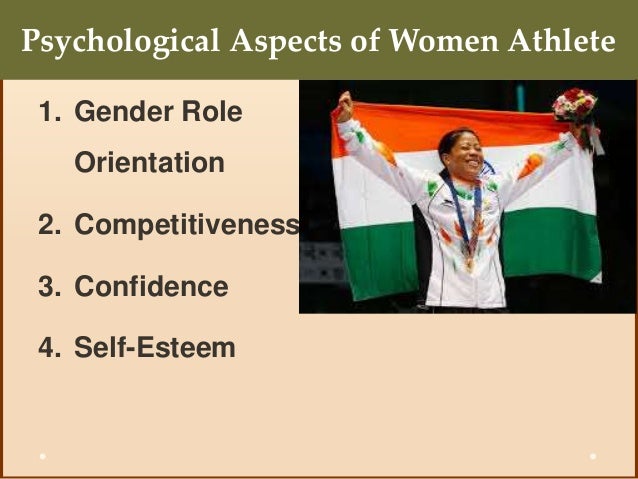
Over the past several decades , the role of women has changed drastically .However , gender beliefs and stereotypes still do exist across the world especially in sports . Most of the people in our society consider that sports are not meant for females but only for males .Social tradition , customs and cultures have great influence upon the psychology of women . In a male dominating society , males are expected to be aggressive , independent , dominating , robust and confident , whereas females are expected as well as considered to be emotional , sensitive , cooperative , sympathetic , loyal , etc. It is a well – known fact that participation of women in sports is increasing year after year .With this enhancement in female participation in sports , there is also renewed interest in the psychological characteristics of the female athletes and the effects of athletics on women . The various psychological traits of women athletes are stated below .
Gender Role Orientation : It is an established fact that there has been an increase in the level of women’s participation in the types of sports that have been traditionally limited to only males , e.g., wrestling , weightlifting , kick boxing , body building , etc . However , many sports have been still considered inappropriate for women . For a long time it was considered that women should not take part in athletics because of the potentially harmful masculinising effects of sports .
Competitiveness : It is evident that in the field of sports , both men and women are competitive in their own fields . In fact , women are more goal oriented and perform magnificently in artistic activities such as gymnastics . However , a number of research studies indicate that females who take part in sports are more competitive in comparison to the females who do not participate in sports .
Confidence : As mentioned earlier , due to social pressures , women tend to have less confidence than men . Participation in sports , competitive environment , awards and recognitions increase confidence levels of sportspersons . However , a significant difference may exist between sportswomen and non- sportswomen .
Self-esteem : Most of the research studies indicate that training plays a vital role in performance . Self -esteem improves with good performance . In the field of sports , intensive training helps in enhancing self-esteem . Research studies also show that those people who engage in sports have high self-esteem in comparison to non-participants .
Aggression : Aggression is a forceful , goal- directed action that maybe verbal or physical . Participation in sports has many positive aspects which usually involve aggressive behavior . Various studies of aggression show that athletes who participate in contact sports , i.e., football players , judos or wrestlers are more aggressive than the athletes who participate in less contact sports . However , females who participate in contact sports show more aggression in comparison to females who do not participate in sports at all.
There have been innumerous fantasy web series being launched since the 21st century dawned mainly because of the advancement of technology. With each year visual effects improved. Following are some of the most popular web series arranged according to the IMBD rating and are mainly released after 2010.
10. Chilling Adventures Of Sabrina (7.5)
Released in 2018 with 2 seasons and 36 episodes, it is a fantasy, horror, drama Netflix series. It is produced by Warner Bros Television. The leading role is played by a character named Sabrina Spellman Sabrina who is a half-human and half-witch who struggles to keep the balance between both sides.
9. The Vampire Diaries (7.7)
It was released in 2009 with 8 seasons and the 171st episode ended in 2017. With the genre of drama, supernatural, fantasy, horror it further has 2 more series interlined to some extent namely The Originals (8.2) and Legacies(7.4). It mainly consists of vampires werewolves and witches.
8. The Umbrella Academy (8)
With a perfect blend of action-adventure comedy and fantasy, it was released in 2019 has 2 seasons and 20 episodes. One peculiar 43 women gave birth at the same time and each child had a unique ability. Sir Reginald Hargreeves adopted 7 of them and formed a superhero squad named ‘The Umbrella Academy
7. Wanda Vision (8.1)
It is a recent web series launched in 2021 starred by 2 Marvel characters Wanda Maximoff and Vision. With the genre of action fantasy drama-comedy, the first few episodes are more towards comedy and with each episode, the series has more action.
6. Lucifer (8.1)
Released in 2016 with currently 5 seasons and 83 episodes, the story revolves around Lucifer Morningstar, lord of the hell who was cast out of heaven. With fantasy comedy, drama as its genre the series is set for another season.
5. The Witcher (8.2)
It is action, drama, fantasy series released in 2019 with 1 season and 8 episodes. It revolves around Geralt of Rivia, a monster hunter, who struggles to find his place in a world where humans are more wicked than beasts.
4.Supernaturals(8.4)
Released in 2005 with 15 seasons and 327 episodes the story is based on 2 brothers who hunt supernatural creatures. It is an action-adventure, drama, fantasy, horror series which finished in 2020.
3.Stranger Things (8.7)
The series premiered on Netflix on July 15, 2016, with 3 seasons and 25 episodes. It is a science fiction, horror, and drama web series. The story starts with the disappearance of a boy and the appearance of a strange girl Eleven with supernatural powers
2. Loki (8.9)
Recently premiered based on a Marvel character Loki, it has 1 season and 5 episodes so far. It is an action-adventure fantasy drama series. There are supposed to be a total of 6 episodes in the first season and the second season is in development.
1. Game of Thrones (9.3)
Released in 2011 with 8 seasons and 73 episodes, it is based on 9 families who try to control the land of Westeros. With fantasy, tragedy, drama as its genre, it is one of the most popular series up to date
Neerja Bhanot, the braveheart flight attendant was never one to run away from a crisis
Flight attendant Neerja Bhanot, an ardent Rajesh Khanna fan, often found herself dreaming up scenarios in which she played a role. For one such hypothetical situation, she asked her mother to suggest a plan of action in case of a hijack.
Her mother told her, “Agar aisa kuch hua toh bhaag jaana (If something like this ever happens, escape).”
To which a confident Neerja replied, “Mummy, tumhari jaisi maa hongi toh desh ka kya hoga? Mar jayungi lekin bhagungi nahin” (If all mothers think like you, then what will happen to the country? I’d rather die than run away).”
Those words came true on 5 September 1986 when Bhanot died while saving passengers on Pan Am Flight 73, which had been hijacked during a stopover in Karachi.
But, the ‘Heroine of the Hijack’ had seen her share of troubles already.
Born to Harish and Rama Bhanot on 7 September 1963 in Chandigarh, she was the darling of her family, which included two brothers, all of whom called her their ‘lado’. She studied in Chandigarh and later in Mumbai, which was where she became a model, endorsing brands like Binaca toothpaste, Forhans and Godrej.
At the age of 19, she was married to a marine engineer and moved to Sharjah, UAE. After two months of abuse, including starvation, verbal taunts and threats, Bhanot left her husband, returned to Mumbai and decided to become a flight attendant.
Bhanot was appointed the senior flight purser on Pan Am Flight 73 flying from Mumbai to the United States on that fateful September day.
During its stopover in Karachi, four armed Palestinian men belonging to the Abu Nidal Organisation hijacked the aircraft, which was carrying around 380 passengers and 13 crew members. Bhanot quickly alerted the cockpit crew by using the hijack code, which allowed the American pilots to escape and thus, ground the plane.
The enraged hijackers ordered her to collect the passengers’ passports. Sensing that the hijacker’s key targets were Americans, Bhanot and her crew hid those passports under the seats and in the trash chute.
Her calming presence also, it is said, kept the passengers’ and crew members’ anxieties in control for 17 hours as she served sandwiches and beverages and tried to boost their morale, even as the terrorists killed a passenger and threw him out of the plane.
When the hijackers eventually decided they had had enough and opened fire, Bhanot worked fast to evacuate as many passengers as she could via the emergency exit. She was shot dead as she shielded three American children from the terrorists.
Out of the 44 Americans on board, 42 were saved owing to Bhanot’s presence of mind. The survivors of the attack conferred the monicker ‘Heroine of the Hijack’ upon her.
Bhanot’s legacy
Bhanot’s calm courage and quick instincts led to a slew of posthumous awards, including the Ashoka Chakra — India’s highest peacetime gallantry award. She was the first woman and youngest recipient of the award. Her citation states: “Her loyalties to the passengers of the aircraft in distress will forever be a lasting tribute to the finest qualities of the human spirit.”
Her story continues to inspire young women, and in order to commemorate her courage, Bhanot’s family used the funds from Pan Am to set up the Neerja Bhanot Pan Am Trust. The trust recognises Indian women who overcome social injustice and airline crew members who go beyond the call of duty in a crisis.
Among other honours, Bhanot was conferred with the Tamgha-e-Insaniyat award by Pakistan, and in 2004, the Indian Postal Service released a stamp in her memory.
In 2016, Ram Madhvani directed a biopic starring Sonam Kapoor as Neerja. The biopic is a stylised thriller with a few lovely glimpses into Bhanot’s personal life, especially her relationship with her mother (played by Shabana Azmi). The film, too, won a number of awards, including the National Award for the Best Feature Film in Hindi.
The 2nd half 20th Century – the socio cultural movements that effected people are merging and becoming more. Post Colonial literature became popular, Ngugi wa thiongo a Kenyan thinker – Moving the Centre – The plurality of culture and literature, the shift from Eurocentric understanding of the world. Grand narratives centred around the Eurocentric understanding, and postcolonial works thus became a shift from these Grand Narratives. The way art aesthetics and literature were looking at the past and the grand narratives became problematic, because people felt a need to bring back the past, but simultaneously in every country there was this need to bring something new back. Every age becomes a response to a previous period and the previous period is a response to resistance. Literatureis not something that is just to entertain people, the position of literature is embedded in our social systems, part of your existence. To understand postmodernism, is to lie on modernism. France Fanon, Meena Kandasamy, examples of theoretical perception are taken forward with people of different discipline. Thiongo’s work becomes important for the possibility of multiple centres and multiple meanings – a product of European imperialism and internal resistance as well.
Mcluhan’s Medium as message, depending on the medium the reachability is different and the access as well is differing.
Susan Sontag – a revolt against ‘the departure from modernism can be regarded as new sensibility, a revolt against canonised modernism’s avant-guard revolution’ – Critiquing the high culture of Modern Capitalist world, against the cannon. On one hand Modernism tried critiquing the Grand narratives and on the other it cerated a canon for itself.
Modernism is adopting plurality like Postmodernism, but was lamenting fragmentation even though working through it, trying to work on a wholesome unity, they continued to believe that with lit or artistic expression we may achieve a ‘self’ while postmodernism are embracing fragmentation, praising dissent, rather celebrating fragmentation.
Arnold Toynbee – birth of postmodernism, and questioning the tradition moral values and beliefs (grand narratives); and by questioning this he’s talking about the development of cultural modernists and the different understanding of the world, a better apparatus of understanding world and culture. Grand Narratives continue to be over – aching and totalising and replace or silence other narratives around us. And how mini-narratives can replace grand narratives by promoting plurality and heterogeneity as it becomes local. [Culture in modernism – a cultural innovation – development of new meanings.] Postmodernism is branching out to different ways, questioning the requirement and the need for plurality and heterogeneity.
1922 – TS Elliot’s Wasteland & James Joyce’s Ulysses, Virginia Woolf – Jacob’s Room
1927 – Virginia Woolf – To the lighthouse.
1924 – Manifesto of the Surrealist Moment – Andre Bretel
1937 – Guernica – an anti-war painting.
1914 – Stravinsky – Rise of Spring
Before Modernist was the Victorian Period, certain set of practices that was held sacrosanct up until the 1920’s, and everything that came out post 1920’s questioned everything. Linear chronological narrative was held sacrosanct for ages, and Elliot, James Joyce, Virginia Woolf were subservient to these narrative, alongside the impressionist, and the Credo of Modernism ‘make it new’ campaign by Ezra Pound; Modernist thinkers and philosophers stood for renovation and experiments, ‘Avant Garde’ ‘Sapere Aude’ (dare to know – courage to chart new territories) – after WWI.
Theoretical justification form this break of the past ? Why ? The central image of modernism was a big large void that defined Modernism – Scepticism/disbelief/boredom/disillusionment/restrictive and that this is not ‘it’, and to replace it with something new; and everything that was held important started falling apart. The science that was to make everything better couldn’t hold, the centre was falling apart and one couldn’t make sense of it, here structuralism to poststructuralism – Derrida – meaning is differing.
1990 – Virginia Woolf – Modern Fiction – in the pre-verbal or pre-literate thought your words are not linear, because it’s happening in your mind, therefore chronological pattern never works, it’s always in a flux, therefore she suggests “stream-of-consciousness” – a randomness of a narrative – no structure, a linear mode of storytelling – Virginia Woolf’s Mrs. Dalloway.
Purist, Exclusivist/Universalist – to contain a single meaning – something that is questioned by Modernism. Meta Narratives/Grand Narratives that dictate the Euro – Centric understanding of the world, that make things/life better or easier – Marxism, Religion – Christianity – Redemption.
Single Epistemology (the theory of knowledge)
Post Colonial/Gender/Race came in complicating others.
Moving the Centre by Ngugi wa thiongo, and Afrocentrism.
This is a topic that each one of us need to address, and over the years, there is definitely been a rise in discussions on but what has predominantly tampered these discussions are the issues of finance, because skincare isn’t just for the middle class or the elites, it’s is for everyone, even if the common consensus is not for the same.
Undoubtedly, there are startups and other companies that cater to the lower side of budget scale, and even deliver a somewhat mediocre result, but it still isn’t cost effective for everyone.
Next, the complicated process that is served to us, makes us blinded towards what our needs are or what our skin needs, we are normalised to ignore the nourishments our skin needs, the lil’ TLC we deserve, rather we are fished by companies, complicating the process and many celebrities add more to this complication, just because it suits their skin, it doesn’t necessarily suit yours, and these celebrities are more often than not are paid to promote a certain product, or are using products that are capable to leave a dent on your pockets.
So what’s the best line of action? Some R&D, dig through articles, figure what skin type you have, read what could suit your skin, what could benefit you, and is good for you — ingredient wise, and one that, start filtering what suits your budget, and what is easily available to you, read more about the products and the company, their ethical practices, and its cruel-free deliverance, and once you are satisfied with your choice, go for it, trust you gut, since its about self care, start loving yourself as well.
And make sure, you always, ALWAYS, listen to your skin’s needs, they will speak to you and depending upon that go by your routine, nothing has to be rigid.
Swearing has always been a man’s thing to be manly, this doesn’t mean that woman’s don’t swear, they do, and to an extent it’s perfectly normal to use certain adjective, sometimes it’s unconsciously used in your lingo, sometimes you do it forcefully to seem cooler and more acceptable among your peers, but more often than not, the use of profanity is used to show off masculinity.
How so? Mens in their natural habitat — hanging out with their peers, start acting immaturely, and extend that immaturity into conversations and things escalate and you normalise using a very colourful vocabulary.
Is it redundant to use this same argument? Possibly for some, but the fact-of-the-matter is that while just simply talking, you don’t need to get aggressive, don’t need to raise your tone, or anything like hat to get your point across, you do.
Would you like to cutdown on it? You should, its not pleasant to have a potty mouth, nor is it flattering, and it could get you into situation within a professional set up and you would do something and can’t turn back again, thus it make a compelling argument that you need to throw off your male ego, you masculinity crutch of profanity and try being better, and if you have swearing as a crutch to feel masculine, then you have much bigger and intense problem about your identity than anything else.
What next, clean up your act! Be human, be more vocal with your certifiably tremendous vocabulary, and if anytime you feel the ‘itch’ to use such words, breathe to it and try finding suitable replacements to it.
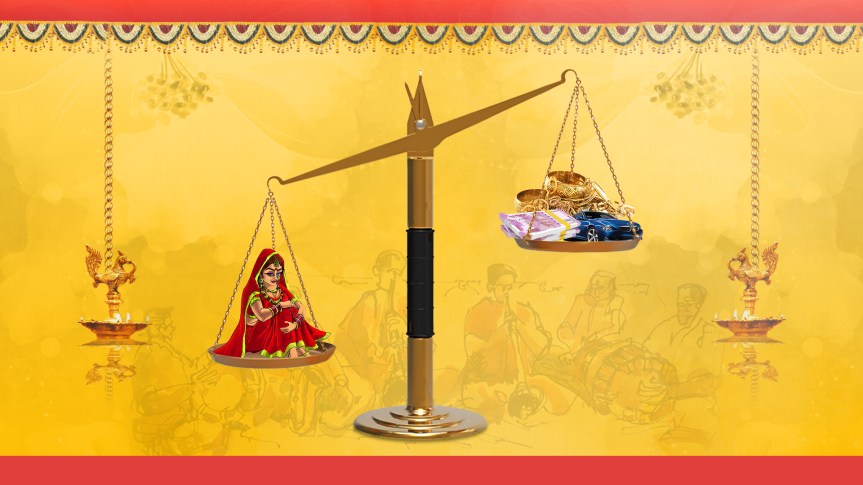
“Oh no it’s a girl child” started because of practices like dowry. When parents find out that they have to pay a huge fee in return for their daughter, no one would be happy at the birth of a girl child. We also have the society showing pity to parents of the girl child and saying things like:
“Oh you have a daughter in your family, you must have to pay a lot.”
“Thank God I am blessed with sons; money shall come my way”
Practices like dowry are what made female foeticide come to life. They check the gender of the child and undergo an abortion if it is a girl child.
Did you know that 20 women die every day due to the harassment of dowry?
You may think that practices like dowry only exists in the rural areas, but it also exists in the metropolitan cities. Well-educated families with both the men and the women working also believe in paying dowry.
Let’s talk about the concept of modern-day dowry. People no longer ask for dowry directly. They just expect “gifts.” These “gifts” make the bride’s side of the family go broke. The bride’s family spends so much money on the “gifts” and the marriage that a lot of the time they have to take a loan.
Do you think it is fair that the earnings and savings of parents are going to the groom’s family? I am sure a lot of us have heard sentences like “we need to save gold for the girl’s marriage”. Sentences like these are so normalised because the girl’s family has no option but to save money because the groom’s family needs “gifts”.
Tell me one reason why they deserve all the earnings of the girl’s family?
In old times the practice of dowry started because girls would not earn. So, parents would give the groom’s family dowry in return for taking care of their daughter’s expenses and living. But, even if the wives did not have a job they would still cook, clean, do the chores and support the groom’s family.
Now in modern society, when women do earn on their own what are we still giving the dowry for?
We as a society need to stop the practice of dowry because:
It financially drains the bride’s family: these so-called “gifts” which come as cars, gold, furniture, properties, money costs a lot and financially drains the family.
It makes the men more superior: if we pay the groom so much just because he is a man, the society is going to keep celebrating the birth of a boy child and look down upon the birth of the female child because it will cost them a lot.
It stops the women from growing: so many women are not able to study because the parents cannot afford dowry and education. Girls often sacrifice their dreams because their parents want to pay money to an unknown family.
Now, here me out. If all the bride’s family stop paying dowry or gifts to the groom’s family what will happen?
The girl won’t get married. Right?
Well, there are many countries where they don’t have to pay dowry to get married.
Shocking isn’t it?
Secondly, we all have to stop our so-called obsession with marriages. When a girl child is born why is marriage the only destination. The woman should be first encouraged to be independent on her own, have her own house, be successful without a man.
So can we all as a society stop these useless practices where we pay the groom’s family for no reason? Instead, can we start fulfilling the dreams of our daughters? The practice of dowry will only stop if all of us come together and say no to it.


















 Eduindex
You must be logged in to post a comment.