Probe Probare Aerospace Strength : Big Breaking >>>>>>>>>>>

Which is the motto of the Aeroplane & Armament Experimental Establishment at Boscombe Down in Wiltshire, where the Ministry of Defence test new military aircraft and where the Empire Test Pilots’ School is located – “To test properly”.

The BBC Radio 4 afternoon current affairs programme PM has started a new thread this past week, “Will your job be replaced by a robot?”. (Their definition of ‘robot’ is quite wide; what they actually mean is ‘Artificial Intelligence’, which can come in a number of different packages, very few of them – currently – robot-shaped.) Their overall thrust is that within twenty years, very many professional and middle-management jobs will be replaced by AI systems.

We’ve been here before. In the 1960s, the watchword was “automation”. Automated systems were not in any way ‘intelligent’, but they were beginning to replace a number of manual and skilled jobs. Big teams of workers with shovels were replaced by excavators; farm workers were replaced by specialised attachments to tractors; skilled machine workers were replaced by numerically-controlled lathes and drilling machines.

In engineering terms, this was about the advance of miniaturisation, from mechanical or electromechanical automation systems, to transistorisation, then integrated circuits (ICs), large-scale integration (LSI), very large scale integration (VLSI) and then the microprocessor revolution. In each case, the devices got smaller, faster and cheaper; and humans got ever more ingenious at identifying new situations where these devices could be applied to both systems and machines.

At some point in the late 1970s, this effect crossed over from physical activities and started to appear in knowledge and information systems. Libraries began to see the arrival of computer systems, first for complex technical searching, then for cataloguing, and finally the knowledge itself was no longer confined to the pages of books and journals.

Credit : Third Party Reference

Thinkers in what was then called ‘library science’ talked of the ‘information explosion’ and how librarians would be essential in almost every kind of organisation to help guide professionals through the jungle of printed information sources to drill down to the information they needed to run their organisations or plan their products.

So to me, a software tester is someone whose primary role is to improve software products before they go out of the door by doing a number of different things:

  • Participating in the design process by casting an experienced eye over proposed products, challenging assumptions made about users and their behaviour, and thinking about how the product should be tested;
  • Collaborating with developers and product owners during the build process in an on-going challenge process;
  • Arranging for the quality assurance of the product at various stages in its development by helping to make sure that the application works as expected; and
  • Test-driving early prototypes to see if the application does what it is supposed to, to find out the best way of using it, to critically appraise the end result, and to help those who have to write user instructions to understand what the application does, how it works and (sometimes more importantly) why it works.
  • In this last function, the tester is standing in for the end user, reviewing the product with a view to seeing if it can be improved in any way. This in turn feeds back into the design process; software goes through different versions, (hopefully) ‘upgrades’, through user feedback and the process of fixing bugs and implementing new features. At least with computer software, the old corporate mantra of “we are continually striving to improve our products” is more likely to actually be true…

Meanwhile, as the impact of computers grew in the daily life of more and more people, pundits began to debate the issue. There was a joke in the late 1980s which suggested that there was a new sort of party game. When any group of computer scientists or employment experts or economists got together, one of them would name a number – say five million – and the rest would take it in turns to explain why the new generation of microprocessor-driven computers would cause either the loss or creation of that many jobs. Oh how we laughed (or forecast doom, depending on where we were standing at the time).

At the time, of course, it was easier to see how many jobs were being destroyed by any given change – say, in mining or manufacturing. My father left his job designing and implementing signalling schemes on the railways because he was being asked to design schemes that put people

Reference- https://divyanshspacetech.wordpress.com

History of Internet…

internet is a global computer network providing a variety of information and communication facilities, consisting of interconnected networks using standardized communication protocols. It connects millions of computers together globally, forming a network in which any computer can communicate with any other computer as long as they are both connected to the Internet. the full form of the internet is  Interconnected Network, firstly the Internet has its origin in the efforts to build and interconnect computer networks that arose from research and development in the United States and involved international collaboration, particularly with researchers in the United Kingdom and France.

Fundamental theoretical work in data transmission and information theory was developed by Claude Shannon, Harry Nyquist, and Ralph Hartley in the early 20th century. Information theory, as enunciated by Shannon in 1948, provided a firm theoretical underpinning to understand the trade-offs between signal-to-noise ratio, bandwidth, and error-free transmission in the presence of noise, in telecommunications technology. With so many different network methods, something was needed to unify them. Robert E. Kahn of DARPA and ARPANET recruited Vinton Cerf of Stanford University to work with him on the problem. By 1973, they had worked out a fundamental reformulation, where the differences between network protocols were hidden by using a common internetwork protocol, and instead of the network being responsible for the reliability, as in the ARPANET, the hosts became responsible. Cerf credits Hubert Zimmermann and Louis Pouzin designer of the CYCLADES network and his graduate students Judy Estrin, Richard Karp, Yogen Dalal, and Carl Sunshine with important work on this design.

800px-Internet_map_in_February_82

During the first decade or so of the public Internet, the immense changes it would eventually enable in the 2000s were still nascent. In terms of providing context for this period, mobile cellular devices like smartphones and other cellular devices, which today provide near-universal access, were used for business and not a routine household item owned by parents and children worldwide. Social media in the modern sense had yet to come into existence, laptops were bulky and most households did not have computers. Data rates were slow and most people lacked means to video or digitize video; media storage was transitioning slowly from analog tape to digital optical discs (DVD and to an extent still, floppy disc to CD). Enabling technologies used from the early 2000s such as PHP, modern JavaScript, and Java, technologies such as AJAX, HTML 4, and various software frameworks, which enabled and simplified speed of web development, largely awaited invention and their eventual widespread adoption.

The Internet was widely used for mailing lists, emails, e-commerce and early popular online shopping (Amazon and eBay for example), online forums and bulletin boards, and personal websites and blogs, and use was growing rapidly, but by more modern standards the systems used were static and lacked widespread social engagement. It awaited a number of events in the early 2000s to change from a communications technology to gradually develop into a key part of global society’s infrastructure.

The first Internet link into low earth orbit was established on January 22, 2010, when astronaut T. J. Creamer posted the first unassisted update to his Twitter account from the International Space Station, marking the extension of the Internet into space..) This personal Web access, which NASA calls the Crew Support LAN, uses the space station’s high-speed Ku band microwave link. To surf the Web, astronauts can use a station laptop computer to control a desktop computer on Earth, and they can talk to their families and friends on Earth using Voice over IP equipment.

Communication with spacecraft beyond earth orbit has traditionally been over point-to-point links through the Deep Space Network. Each such data link must be manually scheduled and configured. In the late 1990s, NASA and Google began working on a new network protocol, Delay-tolerant networking which automates this process, allows networking of spaceborne transmission nodes, and takes the fact into account that spacecraft can temporarily lose contact because they move behind the Moon or planets, or because space weather disrupts the connection. Under such conditions, DTN retransmits data packages instead of dropping them, as the standard TCP/IP Internet Protocol does. NASA conducted the first field test of what it calls the “deep space internet” in November 2008. Testing of DTN-based communications between the International Space Station and Earth has been ongoing since March 2009 and is scheduled to continue until March 2014.

As the Internet grew through the 1980s and early 1990s, many people realized the increasing need to be able to find and organize files and information. Projects such as Archie, Gopher, WAIS, and the FTP Archive list attempted to create ways to organize distributed data. In the early 1990s, Gopher, invented by Mark P. McCahill offered a viable alternative to the World Wide Web. However, in 1993 the World Wide Web saw many advances to indexing and ease of access through search engines, which often neglected Gopher and Gopherspace. As popularity increased through the ease of use, investment incentives also grew until in the middle of 1994 the WWW’s popularity gained the upper hand. Then it became clear that Gopher and the other projects were doomed to fall short.

In recent years, it’s become very clear that the internet is key to living in the modern age. Basically, everyone is expected to have an internet connection and everyone is expected to use that internet on a daily basis. The idea of doing something as simple as finding work without the internet is alien to most Europeans. I remember entering a job center in Norway and seeing the staff completely baffled and out of ideas when I informed them I was temporarily out of the internet. I also found it near impossible to manage here without some form of daily internet access, I think everyone who has been without it for more than a day will realize how much they rely on it, not just ‘want’ it.

However, when people think, “free internet” I don’t think they mean “we should have free WiFi hotspots everywhere.” I think they instead mean that you should not have to pay for WiFi to be wired to your house, and you should not be charged by a company to provide you the internet. I agree with this fully, the internet should not be a paid commodity like it’s simply something you can go without, it simply is too important. Like water and electricity, most developed countries monitor these services consistently and try to ensure they’re as cheap as possible, otherwise, the cost of surviving is simply too high, that’s why you can often find electricity and water for rather cheap prices. Internet, however, can be damned expensive, and the packages and contracts that must be signed are sometimes akin to signing a contract with the devil. Sometimes the companies won’t even deliver your modem, or they will purposely throttle you in order to ensure you upgrade your package. Internet providers can be, and often are, thieves, it’s almost completely unchecked.

In 2015, Google started the ‘Station’ program to bring free public Wi-Fi to 400 busiest railway stations in New Delhi, India, Google has decided to gradually wind down the service globally as it believes that better data plans and improving mobile connectivity have made it “simpler and cheaper” for users to get online. Google explained that it took the decision to end the program because it was becoming difficult to scale up and to make a sustainable business. The company had worked with various partners in each market where it offered the Station service, but each had different technical and infrastructure requirements. In India, it worked with RailTel, Indian Railways, and Pune Smart City, for example, while in South Africa it worked with Think WiFi. However, Google isn’t the only company to have tried to make it easier for users in developing markets to get online. Facebook founded the Internet.org project in 2013, and in 2016 it launched Express Wi-Fi In India after its previous internet service was banned in the country.


The SuperNova, the dreamer, the photon in a double slit and the achiever,a self-made man ~ Sushant Singh Rajput 🔭

A person’s death caused so many of us to become observant about the facts related to him. Where from he started his career, where did he land, about his possessions, about his family, about his relationships, about his bucket list, about his travels, about the dreams he fulfilled, how good he was as a person, about the rejections he faced, about his abandonment, about the way he was humiliated or boycotted, his interviews and what not?

Okay so imagine, you being exceptionally wonderful in your academics, cracked the engineering entrance holding a single digit rank, you get into one of the reputed colleges of your country, you are about to get your degree and you suddenly are struck by the thought of dropping engineering and following your passion although you are not sure about how successful you will be in it or will you even be able to get into that stream where you will be attacked by Nepotism. Tough decision, ain’t it? which requires alot of courage and understanding. You need to convince yourself and most importantly your family that you will surely reach heights and will not give them any chance to point out a finger at your decision. And then imagine, your family not being that good financially but you still took that decision.
You did theatres, you danced behind those famous star kids, you got a big break through a   TV series, you made a debut through a movie, you fairly did well, you gave some hits, you rejected some movies because you wanted to do a movie of your choice, you where never called to parties, you where denied the acknowledgement by your other fellow stars, you were not awarded for the movies which made crores on boxoffice, then your where boycotted not because of your skills but because of the choices you made, the movies you signed with the directors where taken away from you, lockdown hits, you are alone at your house thinking that no one tried to see the potential you got, no one tried to figure out the hardships you went through to reach where you are and people denying that they don’t recognise you. Today people are claiming that these humiliations and rejections made him fall into depression, killed his mental health, made him emotionally weak and forced him to commit a suicide?

You seriously think so? I wrote this long paragraph so that we can analyse where we are going wrong. Rejections and humiliations are a part of life and I agree that it shatters some part of you but it will never make you step into your coffin. What actually harms you is no one being around you to discuss about your problems, what breaks you is the decision that you made. You remorse about it, you are surrounded by the thoughts of what you would have been if you continued with your academics, you see yourself in dark, you get those negative feelings of you never getting a chance for any other movie because you have no godfather, people will stand against you, no one will watch your movies and so your career is finished, you failed. You let down your family, you let down your mother who was watching you from above, you could not meet their expectations, you will be bullied for your decisions because you could not become a STAR and so you finally choose to become a ⭐. Not the rejections but the repentance brings you to a situation where you just don’t have answers for those questions in your mind,   even nobody else bought you the answers and so you just want to end up thinking, you don’t want to face the cruelty prevailing outside and you want yourself out of this trauma and put a full stop to your pain.

Acceptance and dignity is what every human being craves for. Sushant Singh Rajput was not a special case. So, if his sudden demise still does not changes you, your opinions, your mindset and your choices, then that day is not far away when few among we audiences will certainly take the same step. Start respecting you near ones decision, start appreciating their  efforts, don’t humiliate them for their mistakes, give them positivity, serve them optimism, talk to them, make sure they never feel low. Stay connected because boycotting the star kids is incomplete till you start appreciating the work of the talented ones. Make sure that the journalists realise how pathetically they had put the camera on that numbed person’s face who is yet to digest his son’s loss, who is still trying to figure out where he went wrong and who is still regretting that he could have been there for his son patting his back.

We can’t have him back but we can make sure that no one else has to use ‘.’ punctuation ever in their life.

You will be the brightest among all those stars in the sky
And we will be here, gazing at you
So that you don’t have to think again that why,
those few denied of having no clue
About you!
Rest in peace dear SSR💜

Still I can’t believe that he attempted suicide. Daily something new comes up ! I am unable to move on ! Still its a question it was a suicide or a murder ?

How to attract people in first 90 seconds- Must read!!!

These are the secrets from an amazing book called “How to Make people like you in 90 seconds or less” by Nicholas Booth Man. Likable people are always open, welcoming and friendly in nature and you can notice their sincerity, trust, and self-confidence in their behavior as well, and you can develop all these qualities in yourself by meeting other people in a regular manner. If other people do not find you interesting in first 90 seconds after meeting you, then they would want to get rid of you as soon as possible.

How to Maintain Communication and Culture as a Growing Startup ...

If you want that people like you more, then you have to invest your efforts from the very beginning, and this starts even before you speak a single word from your mouth. Any new person notices three basic things just after meeting you, these three things are your

  1. Body language
  2. Your eyes
  3. Expression on your face

Thus, it is essential that when you meet anyone, these three elements give the feeling of openness to other people. For doing this, you will have to show your interest in them, along with your body, you will have to move your brain as well toward them. This effort will show your sincerity and commitment and openness in the conversation and in them as well after this, you need to see directly in the eyes of other people, this establishes the trust and as soon as you make an eye contact with other person make sure you give a genuine smile to them before they think or assume anything else about you. Let your positive attitude shine with a broad and genuine smile with this simple action, other people will consider you as a genuine, open and sincere person with this simple effort, you already made a warm and welcoming mood for the situation, and now you need to initiate by introducing yourself. You can do that with a standard greeting, like Hi or hello and you must need to do that in a very pleasant tone. Along with that make sure you share your first name to the other person and it will encourage the other person to introduce themselves for example, you can say,….”Hello, I am Akash”. When you say this, then the other person will also share his or her name with you, and as soon as they share their name, you must need to repeat their name like wise you said… “Hello, I am Sahil” you got response… “Hi, I am Sohil” now you have to say, “Sohil, Nice to meet your Sohil.” In his famous book, “How to win friends and influence people,” Dale Carnage shared the fact that the name of any individual is the sweetest sound in the entire world for that person that is why it is essential that you repeat other person’s name in the conversation as much as possible. This method will increase your acceptance and respect, it will also make it easier for your to memorize their name. And finally, you have to lean forward slightly. Just a little leaning would be enough, just like Mr. Obama is slightly leaning forward in this photo.

How To Give A Proper Handshake - Business Insider

Image source: BusinessInsider

With your slight inclination, other people will assume you are showing interested in them, and you are listening to them carefully, also, it will give you a pleasant appearance. Just look at photo and tell who is looking more generous in both of them. Of course, it is Mr. Obama, because he is using this principle.

Studies proved that people hire those people that are similar to them and even most of the time they date people with similar people because they make them feel safe and comfortable. If you try to pay attention, you will find, you enjoy the company of those people who think like you, who behave like you and those who make you feel comfortable. You can be comfortable for them just by synching your voice with their voice. The synching of voice is a very powerful tool in communication skills for this, you need to speak at the same pace as other people are speaking that means if they talk slow, then you should not run fast and second thing, you shall try to use the same tone similar to them. If they are calm and relaxed, and you will speak loudly or with excitement, then it won’t work well for you. You need to use same volume and you need to relax while talking. With this, other people will think you are like them and they will feel more comfortable while talking to you.

photo of people doing handshakes
Photo by fauxels on Pexels.com

In 1979, Dr. Lisa Berkman did a study on 7000 people, and this study lasted for 9 years with this study, she found that people that do not have more social connections or those who do not meet other people, they get ill more often, and it increased their chances of earlier death as well and who meet other people more often, were likely to live longer. So, go and expand your social circle without having any fear, without any complications.


The Curse Of Love.

Majority of the people look back at their past relationships with regret and many say they are “unlucky in love”. The fact is that whether you find love with one person who lasts a lifetime or find it with 15 other people who were short term, it means you’re lucky in love! The problem arises when you expect a relationship to last forever, especially in today’s day and age where there are so many changing dynamics and you’re surrounded by so much opportunity and so many choices. Lots of people look at the “good old days” when marriages lasted a lifetime as exemplary, completely ignoring the fact that if many of them lasted a lifetime, it was not for positive reasons. Back then, the woman was not allowed to return to her marital home once she left. Being a divorcee was a stigma and almost always meant being an outcast and seen as “threatening” to other marriages. There was also the aspect that women were brought up to see marriage as a final destination and lacked education and the ability to earn and support themselves outside of marriage. So, they had to take whatever came their way, be it abuse, dowry demands, infidelity, lack of rights, and being treated like a slave by the family she was married into. Child brides and couples who were married off the moment they were of marriageable age never had the opportunity to find love or even look for it. They were bound by family decisions and had to live with it for a lifetime whether they liked it or not. The nature of relationships has changed dramatically in just one lifetime, and it’s incredible to see the amount of opportunity and resources available to find a compatible life partner. There is an acceptance of pre-marital sex and to be able to move on if things don’t work out. Experiencing multiple relationships doesn’t mean you’re unlucky. It means it felt right and was right for that period of time, and that you’re lucky to be able to move on from a relationship that was headed downhill. Thank it for what it did bring into your life instead of regretting it. Yes, sometimes the nature of love evolves and lasts a lifetime, but love is not a commitment for a forever, marriage is. And marriage can be a way to force someone to stay with you, but it isn’t a way to force someone to stay in love with you.

Some thoughts and their answers.

I have had a history of bad relationships. I want to break this cycle but I simply don’t know how to. Can I do it by myself or should I approach a mental health expert? I have been trying to understand why I keep making the same mistakes. time I promise myself a better future but it ends in heartache. Please guide me. ( Question by a Girl)

Please define “bad relationship”. If you feel that the people chosen weren’t right for you, ask whether they were right for that period of time and if you let them in, what void exists that they were filling. If what you want is sex and some happy times, realise it and go for it. If what you want is love, enjoy it while it exists. If you want a long term it’s about compatibility, so focus on getting to know the person and not to jump into relationships. If there is a pattern of physical abuse then it’s mostly connected with self-worth and allowing yourself to be punished and for that, it’s best to meet with a good therapist or hypnotherapist to sort out inner child issues. (The Answer)

I am in my late 20s, and wondering about whether arranged marriage as a concept is still relevant in today’s times. My parents want me to meet potential suitors, but I have my reservations about arranged marriages and the way you are rushed into things that you may not necessarily be prepared for. I don’t mind meeting people, but I don’t want to be rushed into things. How do I meet people without the sword of marriage hanging on my head? (The Question)

Whether it’s meeting someone in your orbit, finding someone on the internet, or having your parents find someone for you, the rule remains the same: Ensure you have multiple areas of compatibility and things you like to do together to keep a strong bond. Most importantly, focus on what you both don’t like and what is not acceptable as those become thorns that tear the fabric of respectful togetherness apart. Tell your parents, you’re happy to meet people but will settle down only when you feel it’s the right fit for a long haul. (The Answer)

I am a 45-year-old single woman and have been working at the same organisation since the past 20 years. I feel like I am stuck in a rut, but I also don’t have the guts to leave and look for better opportunities. I don’t know whether I should continue or take a leap of faith and quit. Please help. (The Question)

Sounds like a dead marriage. Except, in a marriage, looking for options is considered cheating, but in work, it’s acceptable for sourcing a better future. 45 is not an age to resist change, go out there… put out your applications, and follow your gut instincts when they accept as to whether it’s the right fit for you. Perhaps you can take a one month holiday and use that time to work at another company to check out the work dynamics at a new place. It might excite you to leave, or alternatively make you aware of how wonderfully comfortable you are with your current job. Both ways, a win-win eye-opener. (The answer)

House Sparrows: The Sudden Disappearance

They would be a pleasant sight to behold and the tiny creatures could bring a smile on one’s face, especially in the morning when one can spot them floating around in the balcony or courtyard and they would add beauty to a monotonous site, these petite birds are truly mesmerising to the eyes. They fill us with joy and can fill our hearts with happiness. But one can definitely notice their sudden disappearance in many areas. There are many reasons behind it.

House Sparrow Identification, All About Birds, Cornell Lab of ...
(All About Birds)

Rise in greenhouse gases-

The rise in greenhouse gases has caused an increase in pollution which is one of the main causes for the disappearance. Sparrows cannot live in a disturbing environment as it affects their lives, infertility problems and also their health.

Noise pollution-

The rise in noise pollution de the increase in vehicular traffic or even machinery from industries contributes to their decrease in urban regions. Sparrows are sensitive to loud noises and hence like living in calm atmospheres with minimal noises which they can bear.

Infrastructure and Industrialization-

Rise in Infrastructure is one of the other problems as they won’t be able to build nests, even though they are social creatures they will only be able to build nests in trees, with modern infrastructure taking over their lives are hindered, they prefer open spaces unlike pigeons who can live a luxurious life even in apartment complexes.

Declining rate of greenery (trees)-

The declining rates of greenery specifically trees and tree felling is also one of the causes behind the decline in the rate of sparrows in urban areas, trees are an essential component in any sparrow’s life, as they build their nests on them and also live in them, tress can also become one of the sources to find food for themselves and without lush greenery it’s impossible for them to survive.

Chemical Components-

Increase in chemical products like use of pesticides and fertilizers can really irritate them and hence they can displace off to new places which are more home friendly, modernization has shown its effects along with many other factors in displacing sparrows away from urban sprawls. Sparrows are nature friendly creatures and can’t adapt themselves to the modern changes of society.

Habitat wise distribution of house sparrow (Passer domesticus ...
(Imedpub)

Species | BTO - British Trust for Ornithology
(BTO)

City life is continuously changing and for sparrows who love the best of both worlds that is a bit of wild nature along with the frenzy of the urban life cannot sustain in urban areas.

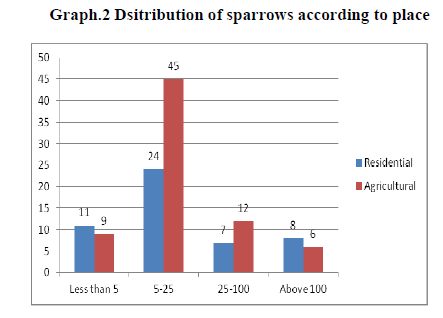
Most of us are under the impression that these species have become endangered and might be soon wiped out but according to the survey analysis certain ornithologists have concluded that’s not the case, these species have found a new place and they have displaced themselves to village areas, forests and lush green zones.

On the other hand there are many ornithologists who have concluded that their population has declined by 52% and hence they are being threatened by the changes in our surroundings. This instance of the house sparrow is a a good example of the effect which our ever changing environment has on us.

A tale of the prank that made history.

Pranks, they have been a staple in every strata of the society from a long time. The only difference being that the pranks of the so called “nobility” or the upper class tend to showcase their superiority and upper classmanship, while that of lower and middle class was viewed as “uncouth”. Usually pranks are often viewed as a fun filled frolic or by some as meddlesome and tiring, but one such prank brought forth many upsides. However, pranks no matter who plays, tend to be short lived, however today we talk about one such prank that went not for a decade or a century but rather played out till a whopping 400 years. This takes place when the Crusaders had started gaining momentum in Europe.

Photo by Pixabay on Pexels.com

In 1165, a certain letter had started circulating throughout the western Europe. To view it now, we can clearly infer that it was a hoax, however people at that time believed it to be true. The letter spoke of a realm filled with mystical features, such as the Tower of Babel, The fountain of youth, with mystical weapons and animals within their arsenal. It mentioned that the mysterious and fabled land was ruled by the letter’s mysterious author: Prester John. This prank or hoax brought about an age of exploration, inspired an intercontinental diplomatic relation and rather sadly brought forth an civil war. This letter came forth during a time Europe Crusaders were trying to find Christian allies to serve in their war against the practitioners of “blasphemous” religions, mainly the Muslims and the Jews. They were fascinated by an army that had defeated a vast Muslim army in the far east. They were referring to the Mongol warriors that consisted of some converted Christians. However like all news spread by the means of words and stories, it spread unreliably and by the time it reached Europe, the story had changed the Mongol horde to a great Christian army full of soldiers with strength of biblical proportions, with a enigmatic ruler leading them with similar goals as the crusaders of marching to Jerusalem. This was the time the forged hoax of a letter reached the hands of the crusaders and despite its obvious European origin the appeal was too great for the crusaders to ignore. Thus, began a search for the mystical realm in the east that Prester john ruled. Soon they even reached Africa in search for Prester John’s ancestors. This was the time that Portuguese reached Ethiopia and found about a Christian kingdom, and with a mix of confusion and diplomacy the Portuguese thought they had encountered the fabled kingdom of Prester John. This happened nearly 350 years after the letter had instigated the search. A decade later when the sultanate of Adal attacked Ethiopia the Portuguese came as help, and soon realized that they weren’t the fabled kingdom they had pegged them to be. Worse still the increasingly intolerant roman catholic church had deemed the sect of Christianity found in Ethiopia as heresy. This sparked a civil war between the “ideal” Christians and the “Ethiopian” Christians and in the 1630s Ethiopia cut all ties with Europe. Over the next two centuries the legend of John’s kingdom faded to oblivion.

Thus, ends the tale of the medieval version of modern click-bait.

‘It Was As if We Weren’t Humans’- Inside the Modern Slave Trade

Libya is a country in the Maghreb region in north Africa, bordered by the Mediterranean Sea. It is the fourth largest country in Africa and sixteenth largest in the world. Libya became an independent Kingdom in 1951 and was ruled by king Idris I who was overthrown by a military coup in 1969 and the ‘bloodless’ coup leader Muammar Gaddafi ruled the country from 1969 until the 2011 Libyan civil war in which he was killed.

A brief history of slavery

Slavery can be traced back to many of the world’s oldest societies, from the “emergence of civilization” in Mesopotamia to ancient Egypt, Greece and Rome, as well as the Mayan and Aztec empires.
Male prisoners of war and seized sailors became laborers; prerogative women became concubines and domestic servants; children were used as farm hands or to help around the house.The Arab slave trade flourished on the African continent.

The corridor from Africa’s most populous country to its northern Mediterranean shores has proved especially remunerative. As conflict, climate change and lack of opportunity push increasing numbers of people across borders.

A video of men in Libya being sold off for as little as $400 at an auction shocked the world and brought the much needed attention  at the plight of migrants and refugees in the north African country.

The slave trade of Libya

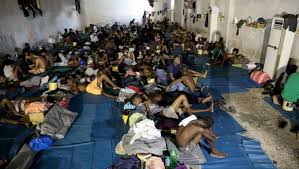
Libya is the main conveyance point for refugees and migrants trying to reach Europe through sea. According to International organization for migration, almost 150,000 people have made this dangerous journey across the sea of which 3000 people could not make it through . The Libyan Coast Guard, supported with funds from the UN and Italy cracked down on  boats smuggling refugees and migrants to Europe. With estimated 1 million people stuck in Libya, the detention centres are flooded and have ascending reports of rape, robbery and murder. The conditions in concentration camps are horrendous and make refugees vulnerable to being sold off as laborers in slave auctions.

How is Libya handling the crisis?

 The U.N.backed Libyan government has launched a formal investigation into the allegations. But Libya is largely considered a failed state. Since Muammar Gaddafi, who ran the country for four decades, was ousted in 2011, the country has descended into civil war. A transitional government failed to implement rule of law in the country, which has shattered into several factions of militias, tribes, and gangs. In lawless Libya, many see the slave trade and smuggling as a lucrative industry and tackling the country’s humanitarian crisis will require international support.

Slavery may seem like a relic of history but according to the U.N.’s International Labor Organization, there are more than three times as many people in forced serfdom today. What the ILO calls “the new slavery” takes in 25 million people in debt bondage and 15 million in forced marriage. As an illegitimate industry, it is one of the world’s most remunerative, earning criminal networks $150 billion a year, just behind drug smuggling and weapons trafficking. Modern slavery is far and way more profitable now than at any point in human history.

The trade might be most noticeable in Libya, where aid organizations and journalists have documented actual slave auctions. But now it is seeping into southern Europe too—in particular Italy, where vulnerable migrants are being forced to toil unpaid in the fields picking tomatoes, olives and citrus fruits and peddled into prostitution rings.

How many slaves are there today, and who are they?

The word “slavery” summons images of shackles and transatlantic ships – depictions that seem relegated firmly to the past but more people are enslaved today than at any other time in history. Experts have calculated that roughly 13 million people were captured and sold as slaves between the 15th and 19th centuries; today, an estimated 40.3 million people are living in some form of modern slavery, according to the latest figures published by the UN’s International Labor Organization (ILO).Women and girls comprise 71% of all modern slavery victims. Children make up 25% and account for 10 million of all the slaves worldwide.

Where is this happening?

Statistically, modern slavery is most ubiquitous in Africa, followed by Asia and the Pacific, according to the Global Slavery Index, which publishes country-by-country rankings on modern slavery figures and government responses to tackle the issues.

What’s the difference between slavery and human trafficking?

Human trafficking is just one way of subjugating someone. Whereas centuries ago it was common for a slave trader to simply buy another human being and “own” that person as their property (which does still happen), today the practice is largely more insidious.

Trafficking involves the recruitment, transfer or obtaining of an individual through coercion, abduction, fraud or force to exploit them. That exploitation can range from forced labor to forced marriage or commercial sex work – and the exploiter can be anyone, including strangers, neighbors or family members. Most people are trafficked within their own countries, although they can also be trafficked abroad; most often the individual is trafficked into forced labor.

Strategy for resistance

What’s needed is to address the root causes. Poverty alone does not explain slavery. Roughly 700 million people meet the threshold of extreme poverty, the number of slaves is estimated to be 40 million. What distinguishes these 40 million from the other 700 million very poor? Slavery usually occurs when poverty is compounded by specific risk factors.These include an inability to assert basic human rights, lack of access to essential social and economic services (especially schools, health care and credit),the failure of the rule of law and, an absence of services for slavery survivors that leads to re-enslavement.

Libya is considered a failed state. After Gaddafi, the country has been in shambles due to the civil war and hence in lawless Libya,but what is really disheartening is that there are broken people with stories of barbarity and abuse, hoping to find a way out of it, waiting for help but unaware of the reality that there are too little people who care,too little ears to hear their stories and too little hands guided their way for help.

FOOD SPOILAGE

Food is considered contaminated when unwanted microorganisms are present. Most of the time, the contamination is natural, but sometimes it can be artificial too.
NATURAL CONTAMINATION occurs when microorganisms attach themselves to foods while the foods are in growing stages.
ARTIFICIAL CONTAMINATION occurs when the food is handled or processed such as when fecal bacteria enter food through improper handling procedures.
CAUSES OF FOOD SPOILAGE:

  1. Growth and Activity of microorganisms – Bacteria, yeasts and molds are microorganisms that cause food spoilage. They produce various enzymes that decompose various constituents of food.
  2. Enzyme activity – Action of enzymes start the decomposition of various food components after death of plants and animals.
  3. Chemical reactions – These are the reactions that are not catalyzed by any enzyme. E.g. Oxidation of fats
  4. Vermin – It includes weevils, ants, rats, mice, birds, larval stage of some insects. Vermin are important due to asthetic aspect of their presence, possible transmission of pathogenic agents and consumption of food.
  5. Physical changes – These include changes caused by freezing, burning, drying, pressure etc.
    SOURCES OF FOOD CONTAMINATION. PHYSICAL SPOILAGE is due to physical damage to food during harvesting, processing or distribution. The damage increases the chance of chemical or microbial spoilage and contamination because the protective outer layer of food is broken and microorganisms can enter through it. CHEMICAL SPOILAGE in food are responsible for changes in the color and flavor of foods during processing and storage. After harvesting, chemical changes begin automatically within foods and lead to deterioration. Every living organism uses specialized proteins called enzymes to drive the chemical reactions in its cell. After death, enzymes play an important role in the decomposition of living tissues in a process called as autolysis (self-destruction) or ENZYMATIC SPOILAGE. MICROBIAL SPOILAGE is due to bacteria, yeasts or molds. They produce various enzymes that decompose various constituents of food. • Besides natural microorganisms, foods can be contaminated with different types of microbes coming from outside sources such as air, soil, sewage water, humans, food ingredients, equipments, packages, insects, etc.

The primary sources of microorganisms in food may include –

  1. Soil and Water – Soil grows agricultural produce and raise animals and birds which might contain several microorganisms. Also, these microbes can multiply in soil and their numbers can be even very high as expected. Fecal materials may also contaminate soils which can act as a source of microorganisms. Sewage water can also contaminate crops with variety of microorganisms when sewage water is used as a fertilizer. So, Sewage must be always treated before using as a fertilizer.
  2. Plants and plant products – The inside tissue of food from plant sources are essentially sterile except for few porous vegetables such as radish, onion and cabbage. Also it has been observed that some plants produce natural metabolites that can limit the presence of microorganisms in those particular foods. Fruits and vegetables contain a variety of microorganisms on their surface and their presence and number depends on various factors such as disease of the plant, storage, etc.
  3. Food utensils – Many different microorganisms can contaminate food utensils from which they can transmit to human body and make them ill if pathogenic. Proper cleansing and sanitization of food utensils is required before serving food in them.
  4. Food handlers – Food handler is a person who touches or handles food. The microorganism may be transmitted from his hand to the food and may be harmful for the person consuming that particular food. The microbes can come from animals or from the environment.
  5. Animal hides and skins – Food animals and birds normally carry various indigenous microorganisms some of which are pathogens and are responsible for food-borne diseases in humans. The number of these microorganisms is less than10/g.
  6. Air and dust – Microorganisms may be present in dust and moisture droplets in the air. The microorganisms which are present in air may be transient or variable depending on the environment. Some pathogenic microorganisms may cause air-borne diseases.

Indian Politics and the Chinese Factor

The brutal killing of 20 personnel of the Indian Army, including a colonel-level officer, by China’s People’s Liberation Army (PLA) in the Galwan Valley on the night of June 15 will reverberate across India for a long time to come. Indian security personnel — from the armed forces, paramilitary forces, and the police — have often given their lives in the quest to defend India’s territorial integrity, sovereignty and the Constitution. And as often, their contribution is forgotten.But Colonel Santosh Babu and the 19 other men killed in the line of duty will stay on in public memory for three reasons. First, this was the first time since 1975 that Indian blood was shed defending the border against China. Two, the nature of the killing was brutal — PLA, in what India has called a “pre-meditated” attack, violated norms of war. And India and China are not even officially at war. And finally, their killing has highlighted the place of Ladakh in general, and Galwan Valley in particular, as essential to India’s territorial imagination.

This, then, can make June 15 — or Ladakh 2020 — the moment when, for two generations of Indians, the security threat from China has become tangible and real. It can make it the moment when discussions about the “competitive-cooperative” relationship with China and how to navigate great power politics will move beyond the rarefied seminar circuits of elite analysts and assume a strong place in public consciousness. And it can make it the moment when China becomes an issue in Indian domestic politics, strongly tied to public opinion, partisan positions, and the idea of nationalism.

The intersection of domestic politics and foreign policy is old. Indeed, a lot of scholarship suggests that foreign policy itself is the extension of domestic politics and is shaped substantially by it.

Fathoming the Depth of Their Relationship

The tensions between China and India are real, but they will eventually prove to be aberrant. There are three good reasons for believing that: one historic, one economic, and one strategic.

First, China and India sealed their borders in modern times, but in the 2,000 years preceding the conflict of 1962, the two countries enjoyed strong economic, religious, and cultural ties. By the second century bc, the southern branch of the Silk Road—an interconnected series of ancient trade routes on land and sea—linked the cities of Xi’an in China and Pataliputra in India. Trade on the Tea and Horse Road, as the Chinese called it, was a significant factor in the growth of the Chinese and Indian civilizations. Seen in that light, the closing of the Sino–Indian border—not the border’s reopening—is the anomaly.

In fact, Buddhism traveled from India to China in 67 ad along the Silk Road. In those days, the relationship between China and India was one of mutual respect and admiration. The monk Fa-hsien (337 to 422 ad), who traveled from China to India to study Buddhism, referred to the latter as Madhyadesa (Sanskrit for “Middle Kingdom”), which is similar in meaning to Zhongguo, the word the Chinese used to describe China. In the 1930s, no less a scholar than Beijing University’s Hu Shih said that the sixth century ad marked the “Indianization of China.” Even today, visits by Chinese and Indian leaders include a trip to a Buddhist shrine in the host nation.

There was also much goodwill after the birth of the two modern states, India in 1947 and China in 1949. During the 1930s, India’s future prime minister Jawaharlal Nehru frequently wrote about how India supported the struggles of fellow Asians under the foreign yoke. He organized marches in India in support of China’s freedom, organized a boycott of Japanese goods, and in 1937 sent a medical mission to help the Chinese. India was the second non-Communist country, after Burma, to recognize the People’s Republic of China, in 1950. Five years later, India supported the idea that China should attend the Bandung Conference, in Indonesia, which led to the creation of the Non-Aligned Movement, an alliance of developing countries that supported neither the United States nor the Soviet Union. In those heady years, one slogan heard in India was Hindi Chini Bhai Bhai (“Indians and Chinese are Brothers”). The slogan hasn’t been forgotten; China’s premier, Wen Jiabao, repeated it in 2006 when he visited the Indian Institute of Technology in Delhi.

Second, economists tell us that neighbors tend to trade more than other nations do. An official committee set up to encourage commerce between China and India recently suggested that bilateral trade could touch $50 billion by 2010. Even the official numbers understate the potential, according to economists who use gravity models to estimate what the trade between two countries should be. Such models calculate potential bilateral trade as a function of the size of the nations, the physical distance between them, and other factors such as whether they share a language, a colonial past, a border, membership of a free-trade zone, and so on. Sino–Indian trade today is up to 40% less than it could be, according to those models. Moreover, Sino–Indian trade is more balanced than China’s trade with the United States and Europe; the latter countries’ large deficits cause political friction.

Third, China and India, after they cut themselves off from each other, evolved in complementary ways that reduced the competitiveness between them. What China is good at, India is not—and vice versa. China instituted sweeping economic reforms in 1978 and has steadily opened up thereafter. A balance-of-payments crisis forced India’s reforms in 1991, but because of political factors, liberalization has been slow and piecemeal there ever since. China uses top-down authority to channel entrepreneurship; in fact, the government is the entrepreneur in many cases. India revels in a private sector–led frenzy, and its government is incapable of efficiency. China struggles to control fixed asset investment, while India is constrained by scarce capital. China welcomes foreigners, shunning only those who are not part of its power structure. India shuns foreigners and mollycoddles its own. China’s capital markets are nonexistent; India’s are among the best in the emerging markets. And so on. There are no two countries more yin and yang than China and India.

Getting the Best of Both Worlds

These complementarities pose both an opportunity and a threat. It’s easy to spot the advantages of treating China and India synergistically and getting the best of both worlds. Companies can use China to make almost anything cheaply. They can turn to India to design and develop products cost-effectively; they can also hire Indian talent to market and service products. For instance, China’s Lenovo, which purchased IBM’s PC business in 2005, recently moved its global ad-management function from Shanghai to Bangalore. That’s because India has a highly creative and sophisticated advertising industry.

To be sure, Chinese and Indian companies will compete intensely with each other. That doesn’t mean that the rise of one will necessarily be at the expense of the other. For instance, as the Chinese government tries to develop a software industry, Indian companies such as Infosys, Tata Consultancy Services, and Satyam have been among the first to recruit Chinese engineers. Does that mean they are sowing the seeds of their own destruction? Not really. Most Indian companies have gone into China to provide software services to their multinational clients. Chinese firms will try to compete for those contracts, even as Indian companies fight for a share of the local Chinese market. China will gain from having a software industry, but the benefits may not come at the expense of India’s software industry.

The Current Backlash

In a hardening of stance in the backdrop of tensions at the Indo-China border, the government has decided to ask state-owned Bharat Sanchar Nigam Ltd (BSNL) not to use Chinese telecom gear in its 4G upgradation, which is being supported as part of the company revival package, according to sources. The development comes at a time when Indian and Chinese armies are engaged in a standoff in Pangong Tso, Galwan Valley, Demchok and Daulat Beg Oldie in eastern Ladakh. The standoff has stirred anti-China sentiments in India, with protesters and some trade bodies like Confederation of All India Traders calling for a boycott of Chinese products in protest to border standoff. Amid the face-off between Indian and Chinese troops in Galwan Valley, hashtags like “HindiCheeniByeBye” and “BharatVsChina” were trending on Twitter.

The Indian strategic community has long recognised China as a threat. The border dispute and Beijing’s efforts to change the facts on the ground by its consistent incursions; its claim over Arunachal Pradesh, particularly Tawang; the large trade deficit; China’s firm support to its “all-weather friend”, Pakistan, now buttressed by the China-Pakistan economic corridor; its efforts to box in India by encouraging regimes hostile to New Delhi in the neighbourhood; its moves to thwart India’s legitimate ambitions (such as permanent membership of the Security Council or entry into the Nuclear Suppliers Group); and its ambitions to establish new style imperialism through the Belt and Road Initiative have all been closely noted and are a part of the institutional memory of the government of India.

But along with this, there is also a recognition of the power asymmetry between the two countries. India’s economy is much weaker; its military and technological capabilities don’t match up to China; its State capacity is more limited; and in the maze that is international politics, China is a more significant player and India cannot rely on partnerships and external bandwagoning. Along with it, India — at this stage of its economic development — needs foreign capital and investment, and deepening economic interdependence with China has been seen as a way to both neutralise the competitive elements and aid Indian development.

The killings of June 15 have suddenly woken a large number of citizens to the fact that Pakistan is an important, but perhaps not the most important, security challenge India confronts. The Chinese willingness to assert itself abroad under President Xi Jinping, and the power differential with India, makes it a more serious adversary. The calls for boycotting Chinese goods may be populist and rooted in ignorance of economic realities but they reflect the emerging mood about China, which is going beyond suspicion to a degree of loathing.

The evolution of public opinion is bound to have an impact on political discourse. And that is why even a prime minister such as Narendra Modi — who has proudly worn the badge of nationalism and presented himself as a security hawk — had to face tough questions, not just from critics but also more independent observers, about his claim on Friday night that there is no external presence in Indian territory. The Prime Minister’s Office, on Saturday, came up with a clarification. But the response to his initial statement is instructive. Indian public opinion is not in the mood to tolerate even the hint of a territorial concession to China anymore.

This, then, will have an impact on the politics of nationalism in India. The Bharatiya Janata Party (BJP) — by disengaging with Pakistan till it acts on terror and through the surgical and air strikes under its term in office — has projected itself as a staunchly nationalist force. But now, it will have to be accountable for its actions on China too. The well-meaning advice to the Opposition not to “politicise” the national security issue may go unheeded, for if the ruling dispensation has benefited from weaponising national security for electoral ends, the Opposition will seek to emulate the same. Expect the BJP to talk about Pakistan, and expect the Opposition to counter it with China from now on. Ladakh 2020 has introduced the China factor into Indian politics. Its consequences will be long-lasting.


My groovy kind of love !

For some people, love can be used to describe almost everything. But I have one question is it necessary that love can exist between humans only?

I strongly believe that love can be for anything living or non living doesn’t matter.

For me love is the most secure feeling .Love is having a companion, best friend, and buddy through every avenue in journey of life. Perhaps you can attain all these feelings with non human entity too.

Today I am here to tell you my love for writing.

WHY I LOVE TO WRITE?

I am my characters and my characters are me, but we are very different versions of each other. I write to sink into those souls and skins and be reborn under a different, unfortunately fictional, sun. A sun that promises brighter fates and futures, I write to reborn into my fictitious realms which hold magic and everything I lack.

I am a youngster with extravagant ideas that I condense and place onto a page. I realize my poems are dark and painfully real. I realize my stories are wild and far-fetched and very unrealistic, but these are the things that develop my style. Reality is cold and unforgiving. Writing, however, is anything you want it to be. Writing is freedom, love, bravery. Writing is death, pain and sorrow. Whatever direction you want your stories to go in. Writing is a way of forming thoughts into deep, magical words that pierce the human psyche.

Writing is a way of escape. To break away from the suffocating and dreary world around me, or sometimes, to forever encase my sorrows in diary. Writing, for me, is like the emergency exit of living. I write because I know that even when nobody will listen to me and hear my voice, the paper will never reject my pen.

My words belong to me and, of course, anyone who wishes to read them. But they are still my words. I am an artist. I am a storyteller. I am a poet. I am an author. I am a writer.

The heart and soul of a writer lives in the words on the page.

This has been my mantra, my understanding, of reading and writing since long now. I believe that writing will tell you more about the writer than any words that ever come out of their mouths, whether the author wills it or not.

Writing is ultimately about expression. The expression of thoughts, ideas, and emotion. Through reading and writing, we as humans can connect on a deeper level than what can be accomplished through almost any other means. You can feel my heart, see inside and understand the essential “me.” And I you ……

I write, because I want to reach the end of my imagination and then break through it. Writing helps me lose or find myself, depending on what I need to feel, and when I need to feel it … it gives me the chance to live thousands of lives in thousands of realities, exploring every possible scenario no matter how minuscule it might be. Through the order I put my words on paper, I can create everything and look from the eyes of it all.

To me, writing is a superpower like no other; it can be art, it can be a simple instruction or it can be a weapon. I write not because it gives me the power of a god, but because it makes me feel human. I write because I should, I write because I can, because I must. I have tried not writing on purpose, and I didn’t last long; writing is an itch that can be scratched only by it. It’s a question and an answer at the same time. I write; because it helps me live, not simply exist. I love it. I hate it. I am disappointed in it, and I am also proud of it. Writing is a mental mirror, an extension of yourself that helps you communicate with the pure reflection of what your soul is.

I write because that is when I am most myself and least myself. I pick the subject from my mind and heart, I gather the words from my mind and ear, but I write from a stream that flows from beyond me or deep within me. I may hate to begin writing, I may love to have written, but I definitely live in the space between the two. I write to discover myself. The words I put down tell the tale my speech can never seem to capture.

Many people have always asked me why I write. I never really know what reason to tell them, besides the fact I simply trust my pen the most. It’s my way to escape to my own world. When I talk, awkward garbage spills out. When I write (and rewrite!) I’m elegant and precise. When I write, truths that aren’t usually heard are given a place, a face and a purpose.

All in all,

I LOVE writing because there are no expectations, no lying and doubting, no reason of giving up.

I would prefer to be in peaceful bond where I can trust for whole life!

And openly I can say “YES I AM IN A RELATIONSHIP WITH MY PEN AND I LOVE WRITING UNCONDITIONALLY”.

“A writer is a world trapped inside a person.”


Parents and their importance…

A parent is their child’s first teacher and should remain their best teacher throughout life.  Functioning as a coach, the parent exposes a child to age-appropriate challenges to encourage development as well as to experiences that allow the child to explore on their own and learn from interacting with their environment. Child Development specialists have learned that from birth children are goal-directed to experiment and learn from each experience. Child Development experts have taken the concept of scaffolding from the building trades.  Just as scaffolding is put up to support the structure of the building as it is being built and gradually taken down as the building is able to stand on its own, a parent will need to provide the necessary support for a child to allow them to safely and productively explore and learn from their environment.

As the child matures and develops mastery the scaffolding is removed or changed to allow the child to become more independent.  If the child is not quite ready, the support is reinstated and then gradually withdrawn once again. As children develop from infants to teens to mature they go through a series of developmental stages that are important to all aspects of their personhood including physical, intellectual, emotional, and social.  The proper role of the parent is to provide encouragement, support, and access to activities that enable the child to master key developmental tasks.

Parents and caregivers make sure children are healthy and safe, equip them with the skills and resources to succeed as adults, and transmit basic cultural values to them. Parents and caregivers offer their children love, acceptance, appreciation, encouragement, and guidance. They provide the most intimate context for the nurturing and protection of children as they develop their personalities and identities and also as they mature physically, cognitively, emotionally, and socially.

The role of grandparents in the rearing of healthy and happy children should not be overlooked. A recent study concluded that spending time with a grandparent is linked with better social skills and fewer behavior problems among teenagers, especially those living in single-parent or stepfamily households. This study found that children and teenagers whose parents have separated or divorced see their grandparents as confidants and sources of comfort. In fact, supportive relationships with other family members outside the immediate family may lead to better adjustment for all children and teenagers.

Here some when parents involve in child education life:

Families are the keystone that holds the educational framework together. In a research report, Southwest Educational Development Laboratory (SEDL) concluded: “When schools, families, and community groups work together to support learning, children tend to do better in school, stay in school longer, and like school more.” The synergy of these forces is infinitely more beneficial to students when parents do their part. Consider the following benefits to students who have involved parents, according to SEDL:

  1. Higher grades and test scores, enrollment in more advanced programs.
  2. Grade promotions, earn more credits.
  3. Better school attendance and homework completion rates.
  4. Improved social skills and behavior allow students to acclimate better to school environments.
  5. Higher self-esteem.
  6. High school graduation and advancement to post-secondary education.

Even parents themselves benefit when they are involved in their children’s education. By involving themselves at the school and community levels, parents:

  1. Interact with their children more and are thus more sensitive to their emotional and intellectual needs.
  2. Have more confidence in their parenting abilities.
  3. Have a better understanding of the teacher’s role and the curriculum.
  4. Use more positive reinforcement the more they know about developmental stages.
  5. They are more likely to respond to teachers’ requests for help at home when they stay apprised of what their children are learning.
  6. Have higher opinions of and feel more committed to their children’s schools.
  7. Become more active in policy-making at school and in the community.

parents-505x336

Sometimes, Considering the heavy workload at the workplace and stress, parents find it difficult to take out time for their children. They spend very little time listening to and communicating with children because of their long working hours. As a result, children avoid sharing their school life or other regular events with their parents and feel neglected. These factors form communication barriers between them, and their child gets more freedom to whatever they wont to do, and they become fearless of parents or guardians they can not choose their right way of success, so parents are one of the entities, who can control and give batter information regarding better career, sometimes a child does like their parent’s suggestions, they start to grumble but they do no think that it is life-changing steps are taken by the second face of GOD.

so, please respect parents and their suggestions and discussions.


How Surat Boy and NIT Hamirpur Graduate Shantanu Yadav cracked CAT with 99.7%ile and got into IIM Ahmedabad for MBA 2020!

Shantanu Singh Yadav, CAT 2019 topper from Surat, cracked the exam with 99.73 percentile and has converted number of top B-schools including IIM Ahmedabad. A graduate from NIT Hamirpur, Shantanu belongs to a modest service class family. While preparing for CAT exam, he earned 3 years of working experience in a fertilizer industry. Read his CAT preparation strategy and success mantra

Coming from the small town of Surat in Gujarat, Shantanu Singh Yadav cracked CAT 2019 with 99.73 percentile and has converted number of top B-schools including IIM Ahmedabad. A graduate from NIT Hamirpur, Shantanu belongs to a modest service class family. While preparing for CAT exam, he earned 3 years of working experience in a fertilizer industry.


Shantanu appeared in CAT 2018 also, and scored 95.73 percentile but decided to prepare again to get his dream B-school. He likes playing Football and his hobbies and interests include Photography, Trekking and Hiking.


MBAUniverse.com invited Shantanu to share his exam taking strategy and GD-PI experience. Read on for his views and success mantras.


Q: How did you perform in CAT 2019?

A: I scored 99.73 overall percentile in CAT 2019; 89.44 percentile in VARC section; 99.76 in DILR Section and 99.86 percentile in Quantitative Ability section. I also appeared in CAT 2018 and scored 95.73 percentile.


Q: Apart from CAT 2019, which other exams did you appear?

A: Apart from CAT 2019, I appeared in XAT 2020 and scored 99.914 percentile; appeared in IIFT 2020 and scored 98.74 percentile.


Q: Which top B-schools have offered you admission and which one you have finally chosen?

A: Apart from getting final admission offer from IIM Ahmedabad, I have converted IIM Calcutta, IIM Shillong, MDI Gurgaon, all Baby IIMs. I have finally decided to join IIM Ahmedabad


Q: What have been your academics and family back ground? Do you have some work experience as well?

A: I graduated from NIT Hamirpur with Chemical Engineering in 2017 with 82.6 percent. I scored 91.2 percent in class X; 90.2 in class XII and 82.6 in Graduation. I have 3 years of work experience in the Fertilizer Industry. I belong to a service class family. My father is in Service, Mother is a housewife and younger brother is in 11th grade.


Q: What was your overall preparation strategy for CAT?

A: CAT 2019 was my second attempt at the exam, when the first one in 2018 fetched me admits to some new and baby IIMs. I started preparing again in May’19, mostly focusing on mocks and timing my attempts effectively. I started cross-checking and analysing my wrong answers, something I never used to do earlier.


The quants section was my strength but still I devoted equal time to all the three sections with some extra effort towards DI and LR which is I believe is the most unpredictable section in the exam. You could practice a hell lot of LR sets prior to the exam but might still hassle on the D-Day. LR sets are not straightforward like Quants or DI sets. Timing my complete mocks and sectional tests along with thoroughly analysing my wrong as well as right attempts turned out to be fruitful.


Q: Please share your sectional preparation strategy for VARC in CAT

A: For Verbal and RC, I used to read articles from diverse fields to get a hold of difficulty faced to comprehend as well as retain a column when it does not belong to something you’re usually used to. Reading articles from newspapers and business magazines not only helped in VA and RC but also made a solid base to ace the current affairs during the interview and GD rounds.


Q: Please share your preparation strategy for DILR Section

A: For DILR, I focused mostly on LR and LR based DI sets, as for the past few years you rarely get to see a pure DI set in the actual exam. LR being the most unpredictable section in CAT, I followed a strategy to solve and analyse each and every set I face either during mocks or during practise from dedicated books. Try looking for practise material online on GoogleDrive and you’ll find plenty of LR sets to solve. IMS’s mocks helped a lot in DI LR section as they had questions which were closest to the ones actually faced in the CAT Exam.


Q: Please share your preparation strategy for Quant Section

A: For Quants, I thoroughly practised books by Arun Sharma with a timed approach to solve at least 25-28 questions from various topics under 60 minutes. Apart from this I also solved previous years’ CAT papers with minimal use of on screen calculator.


Q: Was there any particular section/area that you were weak at? How did you overcome this challenge?

A: I was lagging a bit in VA and LR during my initial preparation. For VA there’s only one approach and that is to read, read and read. Read from publications you’re not familiar or used to. Read foreign journals/magazines, editorials in intl. newspapers etc. For LR I solved as many sets I could get my hands on with a timed approach, trying to crack the set within 10-12 minutes was my strategy.


Q: What role did Mocks play in your success? How many mocks did you attempt before the exam?

A: Mocks are the key to better preparation as well as time management skills. I solved about 40 mocks before the actual CAT.


Q: Did you self-prepare or attend a coaching centre and why?

A: I self-prepared for the exams and took guidance from IMS Surat for the WAT-GD-PI. I also enrolled for mocks with IMS because of their well-structured and closest to CAT mocks.


Q: Please share your strategy for the CAT Day. What was your last-minute preparation? How did you plan your CAT test taking?

A: Strategy for D-Day would be to avoid any last minute preparation. Since the syllabus for CAT is so wide and even has no boundaries defined for VARC and DILR, last minute hustle mostly turns fruitless and overloads you with added stress. I appeared for one mock, a day before the exam and scored just 16 in VARC which freaked me out. It somehow affected my actual performance in CAT where I scored merely 40 marks in VARC which took my sectional percentile below 90.


Take rest and sleep well a day before the exam, not much you’ll be able to change with a day’s preparation. I spent my rest of the day watching Netflix after flunking VARC a day before CAT.


Q: How did you prepare for GD/PI/WAT. Please share your GD/WAT topics & PI questions?

A: Post the release of response sheets by IIM Kozhikode and realizing I was scoring 180+, I started my preparation for GD and PI. The first thing I did was to prepare an exhaustive write-up about myself, starting from academics, work experience, achievements, projects, interests and hobbies, short and long term goals. Current affairs for GD and PI didn’t require much preparation owing to my habit of reading newspapers and magazines religiously.


I attended a few sessions from experts along with two mock GD and PI sessions, of which one was purely focused on my IIM Ahmedabad interview, which was only my second interview in a long list of 14-15 shortlists including IIM A,C,L,S, MDI, SPJIMR, XLRI and IIFT. I also prepared a few core subjects from my engineering and also mathematics, which eventually aided me a lot during my IIM A, C & L interviews.


Q: Your final message and tips for candidates preparing for CAT 2020.

A: I want to share following four tips for the prospective candidates:


Always analyse your mocks thoroughly. It’s not at all tough to land in the top 1 percentile.

Try not to appear for a mock on the penultimate day. Relax and sleep well for the D-Day.

Try not get stressed, during the exam and also in the interviews.

Never globe in the interviews. Professors will have a laugh and you’ll walk out looking like a clown.

23 June – World Olympics Day – History…

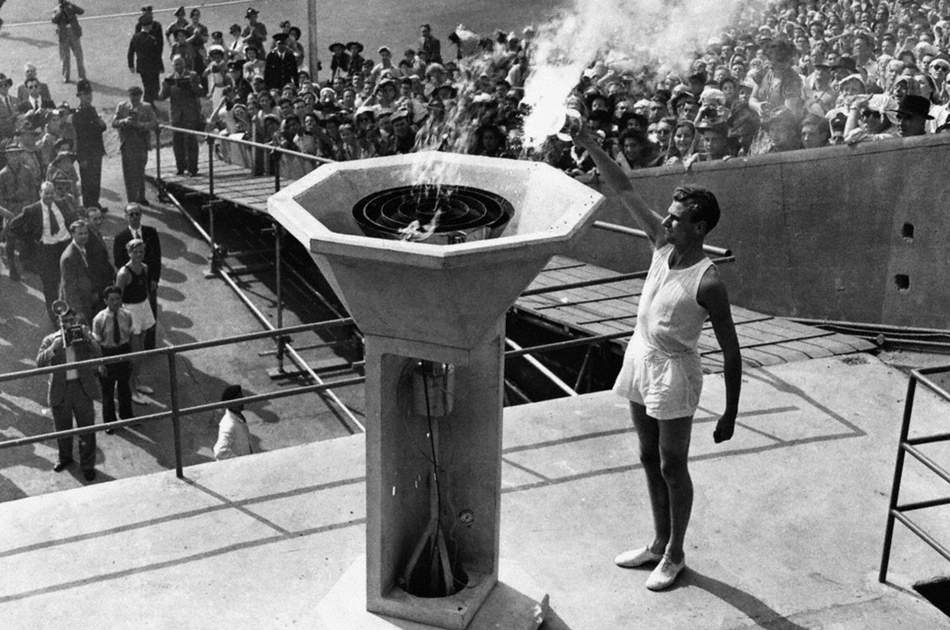
On the 23rd of June 1894 the International Olympic Committee was founded at the Sorbonne in Paris. Prior to the IOC establishment by Pierre de Coubertin the British physician Dr. William penny Brookes had set up the Wenlock Olympian games in the English market town of Much Wenlock although he always maintained that he had the idea of reviving the ancient Olympic Games for amateur athletes himself, Coubertin entered correspondence with Brooks and benefited from his connections with the Greek government Coubertin was the Secretary General of the Union of French sports associations.

A Brief Look At The Olympics History

Image source: Confidential man.com

Coubertin first proposed establishing a modern Olympic Games at his meeting on the 25th of November 1892 although his enthusiasm was met with little more than general polite applause Coubertin wasn’t deterred and commenced to get the groundwork for what was to become the primary Olympic Congress at the Sorbonne in Paris in 1894. Initially invited participants to a gathering entitled reflections on and propagation of the principles of amateurism Coubertin later changed the name to a congress on the revival of the Olympic Games seventy-nine delegates from nine countries subsequently met at the Sorbonne though Coubertin himself recognized that there was still little enthusiasm for reviving the games. Despite this a vote was held at the last word meeting of the Congress on the 23rd of June that established the International Olympic Committee Coubertin was elected to the role of general secretary with the Greek businessman and writer Demetrius Vikelas because the first president it had been further agreed that the primary modern Olympic Games would happen in Athens in 1896. The second in Paris four years later the IOC has remained liable for the Olympic Games ever since.

All About the Olympics for Kids - The History and Symbols of The ...

There are two main events there are the Winter Olympics and the Summer Olympics if you’re wondering when the winter and summer olympics take place they take place every four years when you see the Olympic logo there are five rings the reason for that is in history it has been told that a man named Baron de Coubertin saw the five rings on an ancient Greek artifact the reason we see five colors on each ring is to represent the five continents Europe, Asia, Africa, Oceania and the Americas finally with sports like track gymnastics figure skating and more each category is awarded a gold silver and bronze medal for the first second and third place winners. Hope you enjoy the Olympics.

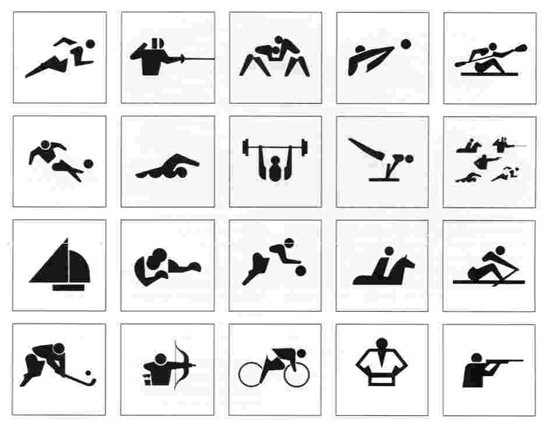
The History of the Olympic Pictograms: How Designers Hurdled the ...

Image source: Smithsonian magazine

The World’s Fastest Sport.

There are a lot of sports with a lot of quicker moments but have you ever guessed which sport might be the fastest sport in the world? BADMINTON yes, that’s right badminton is the fastest sport in the world which is played with a feather shuttlecock. One must be wondering how an object made of feather can travel so fast by the action of a human being. Below are some of the statistics for your knowledge.

  • The fastest ever smash recorded in a men’s singles competition was when Taufik Hidayat of Indonesia smashed with a speed of 305 km/h (189 mph).
  • Fu Haifeng of China has set an official world record smash during a doubles badminton match by smashing with a speed of 332 km/h (206 mph) on June 3, 2005.
  • Tan Boon Heong who belongs to Malaysia had set a new world record by smashing the shuttlecock with a speed of 493 kph in july 2013.

Now compare this to the speed of Lamborghini Gallardo or Eurostar train at its most in-service speed (186.4 mph) or perhaps a jai alai ball.

Yes, a straightforward arrangement of sixteen overlapping goose feathers connected to a rounded cork head is quicker.

As stunning because it could seem, however this is often the reality.

151 mph (243 kph) and a mere 138 mph (222 kph) for lawn tennis.

Badminton’s promoters hope the speed record may bolster the sport’s image and facilitate move it out of alternative racket sports’ shadows, notably in regions wherever lawn tennis and squash reign supreme.

Besides Guinness, I saw some books claiming the speed for shuttlecock is concerning three hundred km/h.” – Ming, Wang of Philippine court game Community, one Jan 2002.

It is a renowned undeniable fact that a shuttle slows down because it travels through the air. It is believed that the shuttle slows down by half-hour each 2 meters .

Badminton rallies last longer than that of lawn tennis and at intervals twenty seconds, it’s calculable that the player hit the shuttlecock forty to fifty times.

The on-court movements in an exceedingly game of court game are additional. It’s additionally calculable that on a mean, there area unit 2 thousand hits per match.

Throughout a match, the player will run up to four miles within the court. Nonetheless however rarely will we see the players roar whereas touch the shuttle.

The level of fitness demanded for the game should be quite obvious to you by currently. A player needs high levels of concentration, lightsomeness and fast reflexes.

He’s needed to get on his toes all the time to maneuver round the court to come the unpredictable shuttle.

The exchanges between high court game players on court area unit so testing the bounds of human ability.

A strict diet regime and regular apply of seven to eight hours (this figure goes to double digits among the Chinese) area unit of overriding importance, if you have

Saina Nehwal had to present informed her feeder ways in which to satisfy the organic process demands of the sport.

Badminton has grownup in quality by leaps and bounds within the Asian countries.

Indeed, it’s thought of jointly of the foremost watched sports throughout the athletic contest.

The quantity of Indians taking on this sport has inflated within the recent years and therefore the credit principally goes to the achievements created by our players in past years.