ISSAC NEWTON

Isaac Newton was a tiny man in real life. But he was a giant in the world of science.

Newton created the theory of gravity around 1665 or 1666. He came up with the idea that every physical object, whether it’s a person, an apple or a planet, exerts a force on other physical objects. A force is a push or pull in a certain direction. The bigger the body, the stronger the force. There are different types of forces, but this one is called gravitational.

Some say that Newton came up with his ideas about gravity after watching an apple fall. He wondered why the apple fell straight down. Why didn’t it fall sideways, or even up toward the sky?

Gravity does not just make apples fall from trees. It also holds us on the ground. Newton showed that gravity even makes the moon circle around Earth, and Earth around the sun, Martin Rees says. He was president of Britain’s Royal Society. The Royal Society is the United Kingdom’s national academy of science.

Newton Changes Science Forever

The theory of gravity was just one of Newton’s discoveries. He also loved calculus. This is a mathematical subject that studies rates. A rate is the measurement of how much something changes. Newton’s ideas in calculus are still used today.

Newton also studied optics, the science of light. He found out that white light is not just white. It is actually a mix of all the colors of the rainbow. Newton used his knowledge of light to make better telescopes.

Following his apple idea, Newton wrote three laws of motion. These laws changed all of science, and are still used by scientists today.

First Law of Motion: Inertia

An object that sits still will remain still unless a force is applied to it. An object that is moving will keep moving along a straight line unless an outside force is applied to it.

Second Law of Motion: Acceleration

An object will accelerate if force is applied to it.

Acceleration is the change of an object’s speed. The acceleration will happen in the same direction as the force.

This idea can also be written as force equals mass times acceleration, or F = ma.

Third Law of Motion: Action and Reaction

For every action there is always an equal and opposite reaction.
MOTHER TERESA

Who Was Mother Teresa?

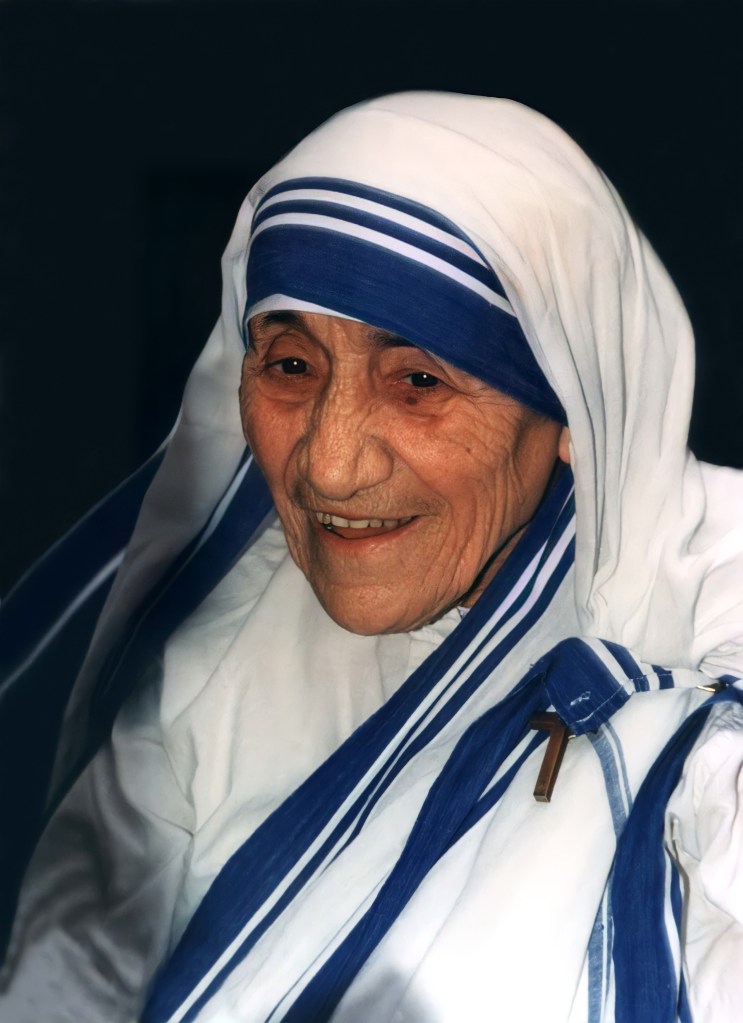
Nun and missionary Mother Teresa, known in the Catholic church as Saint Teresa of Calcutta, devoted her life to caring for the sick and poor. Born in Macedonia to parents of Albanian-descent and having taught in India for 17 years, Mother Teresa experienced her “call within a call” in 1946. Her order established a hospice; centers for the blind, aged and disabled; and a leper colony. 

In 1979, Mother Teresa received the Nobel Peace Prize for her humanitarian work. She died in September 1997 and was beatified in October 2003. In December 2015, Pope Francis recognized a second miracle attributed to Mother Teresa, clearing the way for her to be canonized on September 4, 2016.

Mother Teresa’s Family and Young Life

Mother Teresa was born on August 26, 1910, in Skopje, the current capital of the Republic of Macedonia. The following day, she was baptized as Agnes Gonxha Bojaxhiu.

Mother Teresa’s parents, Nikola and Dranafile Bojaxhiu, were of Albanian descent; her father was an entrepreneur who worked as a construction contractor and a trader of medicines and other goods. The Bojaxhius were a devoutly Catholic family, and Nikola was deeply involved in the local church as well as in city politics as a vocal proponent of Albanian independence.

In 1919, when Mother Teresa — then Agnes — was only eight years old, her father suddenly fell ill and died. While the cause of his death remains unknown, many have speculated that political enemies poisoned him.

In the aftermath of her father’s death, Agnes became extraordinarily close to her mother, a pious and compassionate woman who instilled in her daughter a deep commitment to charity. Although by no means wealthy, Drana Bojaxhiu extended an open invitation to the city’s destitute to dine with her family. “My child, never eat a single mouthful unless you are sharing it with others,” she counseled her daughter. When Agnes asked who the people eating with them were, her mother uniformly responded, “Some of them are our relations, but all of them are our people.”

Education and Nunhood

Agnes attended a convent-run primary school and then a state-run secondary school. As a girl, she sang in the local Sacred Heart choir and was often asked to sing solos. The congregation made an annual pilgrimage to the Church of the Black Madonna in Letnice, and it was on one such trip at the age of 12 that she first felt a calling to religious life. Six years later, in 1928, an 18-year-old Agnes Bojaxhiu decided to become a nun and set off for Ireland to join the Sisters of Loreto in Dublin. It was there that she took the name Sister Mary Teresa after Saint Thérèse of Lisieux.

A year later, Sister Mary Teresa traveled on to Darjeeling, India, for the novitiate period; in May 1931, she made her First Profession of Vows. Afterward, she was sent to Calcutta, where she was assigned to teach at Saint Mary’s High School for Girls, a school run by the Loreto Sisters and dedicated to teaching girls from the city’s poorest Bengali families. Sister Teresa learned to speak both Bengali and Hindi fluently as she taught geography and history and dedicated herself to alleviating the girls’ poverty through education.

Acid Rain

“The unthinkable is that we’re distorting this atmospheric balance. We’re shifting the chemical balance so that we have more poisons in the atmosphere – ozones and acid rain on ground level – while we’re also changing the thermal climate of the earth through the greenhouse effect and – get this – simultaneously causing destruction of our primary filter of ultraviolet light. It’s incredible. Talk about the national-debt crisis – we’re piling up debts in the atmosphere, and the piper will want to be paid.”

~ Michael Oppenheimer

Introduction

Acid rain, or acid deposition, is a broad term that includes any form of precipitation with acidic components, such as sulfuric or nitric acid that fall to the ground from the atmosphere in wet or dry forms. This can include rain, snow, fog, hail or even dust that is acidic.

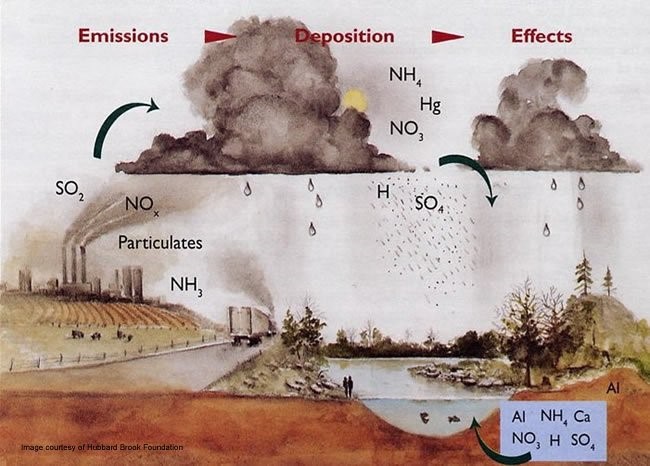
Acid rain is caused by a chemical reaction that begins when compounds like sulfur dioxide and nitrogen oxides are released into the air. These substances can rise very high into the atmosphere, where they mix and react with water, oxygen, and other chemicals to form more acidic pollutants, known as acid rain.

It can have harmful effects on plants, aquatic animals, and infrastructure.

Effects of Acid Rain

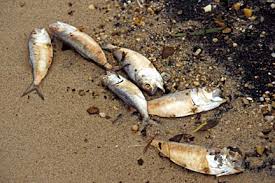
The ecological effects of acid rain are most clearly seen in aquatic environments, such as streams, lakes, and marshes where it can be harmful to fish and other wildlife. As it flows through the soil, acidic rain water can leach aluminum from soil clay particles and then flow into streams and lakes.

Acid rain has been shown to have adverse impacts on forests, freshwaters, and soils, killing insect and aquatic life-forms, causing paint to peel, corrosion of steel structures such as bridges, and weathering of stone buildings and statues as well as having impacts on human health.

Acid rain also causes the corrosion of water pipes. Which further results in leaching of heavy metals such as iron, lead and copper into drinking water.

Prevention

1. The only precaution that we can take against acid rain is having a check at the emission of oxides of nitrogen and sulphur.
2. We have so far seen the details of acid rain and its harmful effect on animals, plants and the monuments.
3. Being responsible citizens, one should be aware of the harmful effects they cause and of the industries which give out nitrogen and sulphur compound wastes unethically. 4.A great way to reduce acid rain is to produce energy without using fossil fuels. Instead, people can use renewable energy sources, such as solar and wind power. Renewable energy sources help reduce acid rain because they produce much less pollution.

Acid Rain in India

Analysis of rainwater samples from Nagpur, Mohanbari (in Assam), Allahabad, Visakhapatnam and Kodaikanal in the decade 2001-2012 showed a pH level varying from 4.77 to 5.32, indicating that these places have actually been receiving ‘acid rain’. Rainwater with pH below 5.65 is considered acidic.

As energy requirements in India will grow rapidly in tune with the economy, coal dependence is expected to increase threefold over the current level of consumption, making the clouds of acid rain heavier over many highly sensitive areas in the country – the northeast, parts of Bihar, Orissa, West Bengal ,etc ,.

The rains in the Indian Ocean and the Arabian Sea and the Bay of Bengal have become acidic. Studies show the importance to regularly monitor more places for acid rains. But the mechanism to study acid rains is at present inadequate in India. imd stations are not located in the most polluted areas in the country.

Link

Applications of Artificial Intelligence-I

What is AI?

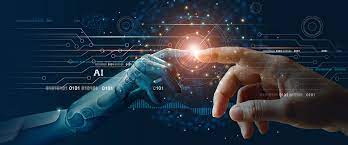
Artificial Intelligence is the intelligence exhibited by machines based on the premise that intelligence is not ‘real’ or human’. It mimics cognitive functions exhibited by humans such as learning and problem-solving.

Artificial intelligence based on Natural intelligence

What is the scope of AI?

Jobs related to AI will increase exponentially in the coming days. It helps to find smart solutions to the problems in various fields in medicine, agriculture, education, security, and so on.

Three stages of Artificial Intelligence. We are near to the second stage.

Applications of AI

  • Machine Learning includes Deep Learning- Neural network
  • Vision includes Image & pattern recognition- Facial recognition
  • Hearing includes Voice and speech recognition
  • Natural Language Processing(NLP) includes Natural Language Understanding(NLU)- Natural Language Generation(NLG)
  • Robotics
  • Expert Systems

We are currently using the following AI-based applications:

  1. Image recognition: Recognizes objects, places, people, and actions in an image.
  2. Speech recognition: Allows humans to use their voices to communicate with the software.
  3. Language translation: Translates a word or sentence from one language to another. Ensure that the translated word is culturally and linguistically correct.
  4. Product analysis: Enables companies to leverage data to reveal user engagement with products or services and tracks the activities, likes, and dislikes of the user.
  5. A/B testing: Determines the version of a webpage and compares two versions and delivers better performance.
  6. Sentiment analysis: Analyze a piece of text to determine the writer’s attitude. It can be categorized as positive, negative, or neutral.

Let’s see few examples of Artificial Intelligence

  1. SIRI: Siri is a popular personal assistant offered by Apple which uses Machine Learning and Voice recognition.
  2. COGITO: It improves the intelligence of customer services by analyzing the human voice emotion and provides real-time guidance.
  3. NETFLIX: Uses predictive technology and provides the user with movie recommendations based on the user’s likes.

Use of Artificial Intelligence in society

“AI is a huge benefit to the society as it enhances the efficiency and throughput while creating new opportunities for revenue generation, cost savings, and job creation.”

-Anand Sampat(Datmo)

‘Robots and AI will destroy jobs’ is nothing but fiction and not fact. But instead, AI creates job opportunities in the market.

“The unparallel combination of human and machine will become the new normal in the workforce of the future”

– Matthew Lieberman

The presence of Artificial intelligence enhances our lifestyles and creates efficient businesses.

“Machine allows humans to do the most interpersonal and creative aspects of work”

 -Chalmers Brown(Due company)

AI platforms will provide real-time insights combined with the explosion of computer power.

“Smart homes will reduce energy usage and provide better security for humans. Marketing will be more targeted and health care will become more effective with smart devices”.

 – Naresh Soni

Start-ups using Artificial Intelligence 

  1. NEST: Alphabet Nest uses AI to learn a home owner’s habit resulting in a reduction of energy consumption. It adjusts the house temperature according to the weather hence energy consumption can be controlled.
  2. COMFY: Comfy offers services for reducing energy consumption in office buildings.
  3. PG&E: Pacific gas and electric company(PG&E) connected 200,000 solar customers, accounting for one in every four houses with solar rooftops.

AI benefits multiple Industries and society will be benefitted from the use of facial recognition, digital content analysis, accuracy in identifying patterns.

“AI risks are real if we don’t understand the quality of the incoming data and set AI rules which are making granular trade-off decisions at increasing computing speeds”

-Mark Butler

Facial recognition: Facial recognition is a biometric technology used to identify human faces and can be used for security purposes. 

Example: Snapchat

Snapchat differentiates between images of objects, pets, sports, and food. It suggests relevant borders and stickers. Identifies your location and suggests location-based filters.

Snapchat filters use Machine Learning and image classification techniques called Convolution Neural Networks(CNN).

BIOTECHNOLOGY- FUTURE OF THE MODERN WORLD

Biotechnology branch of biology deals with the the techniques of using living organism or enzymes to produce useful product for human welfare.

European federation of biotechnology (EFB) has has given a defination of biotechnology from both traditional and modern molecular biotechnology point of view. The definition given by EFB is as follows :

The integration of natural science and organisms,cells,parts thereof, and molecular analogues for products and services”

Engineer Karl Ereky first coined the term ‘biotechnology‘ in 1919, meaning the production of products from raw materials with the aid of living organisms 

Humans have used biotechnology since the dawn of civilization. Egyptians used yeasts to bake leavened bread, the Chinese developed fermentation techniques for brewing and cheese making, and the Aztecs used Spirulina algae to make cakes. Today, when most people think of biotechnology, they probably think of recombinant DNA. Although much of modern biotechnology does deal with manipulating DNA, classical biotechnology began long before we even knew about genes or chromosomes. What began as recipes for production of food now includes technology to enhance everything from farming to pharmaceuticals.

principles of biotechnology.

Traditional biotechnology

Traditional biotechnology refers to ancient ways of using living organisms to make new products or modify existing ones. An example of traditional biotechnology is what human beings have been doing for centuries: cloning plants. Each time a little branch is cut off from a plant and placed in soil to grow a new plant, cloning occurs. Over the past 30 years, biologists have increasingly applied the methods of physics, chemistry and mathematics in order to gain  precise knowledge.

Modern biotechnology

Modern biotechnology we are not only doing the physical manipulation at the visual level but also at the molecular level. In modern molecular biotechnology, we select the desired characteristic at the molecular level and add it to the organism’s genetic makeup. Whereas traditional biotechnology exploits  the potential of processes performed by living organisms, such as fermentation, modern biotechnology manipulates the genes of organisms and inserts them into other organisms to acquire the desired trait. 

However, both traditional and modern biotechnology share the same foundation:  the use of living organisms to enhance crops, fuels, medical treatments and other tools to help humans.

Among many, the two core techniques that enabled birth of modern biotechnology are:

1. Genetic engineering : Techniques to alter the chemistry of genetic material (DNA and RNA),to introduce these into host organisms and thus change the phenotype (physical character) of the host organisms.

2.Chemical engineering : Maintance of sterile microbial contamination free ambience in chemical engineering processes to enable growth of only the desired microbe/ eukaryotic cell in large quantities for the manufacturing of biotechnological products like antibiotics, vaccines, enzymes, etc.

Stanley Cohen and Herbert Boyer in 1972 isolated the first recombinant DNA and the antibiotic resistance gene by cutting out a piece of DNA from a plasmid( autonomously replicating circular extra- chromosomal DNA) which was responsible for conferring antibiotic resistance.

The cutting of DNA at specific locations became possible with the discovery of the so- called ‘molecular scissors’ – Restriction enzymes

Biotechnology is the emerging field nowadays and in coming future it will be the important part For the development of the country. By manipulating genes we can produce more and more useful products for the human welfare.

MONSOON – BOON AND BANE

The coming of the rains signifies relief from the scorching heat of summer. Holding hands in the summer comes the rains. The rainy season begins in mid-June and lasts until September. Dark and dark skies are a common occurrence during the rainy season, indicating only the much-anticipated rainfall. Although the rains disrupt our daily routine and cause occasional interruptions, the rainy season is always welcome.

At the beginning of the rains, people were seen digging out their umbrellas, raincoats and gumboots. Pupils are seen running to school with raincoats and umbrellas and sometimes very happy to take a shower in the rain. Office travelers seem to rush to the offices so that they can arrive on time. Sometimes when there is too much rain, life stops during the rainy season. Traffic jams, flooded roads, and floodplains, as well as people and children roaming the floodwaters, are common during the monsoon season. Sometimes it is good to watch the children float paper towels in the flooded water. Best of all, the ‘rainy day’ holiday is always welcome this season.

The rainy season is a blessing for farmers across the country and for agriculture. Farmers all over the country are waiting for the floods as the monsoon rains are very important for crop growth. During the rainy season the fields, crops, trees and plants survive. The whole environment comes to life in the ‘green sea’ during the rainy season. It is important that the rains come in time or else the late rains can cause drought; farming is also affected. Apart from modern farming methods, the rainy season is a pond for the farmer and his fields, the inturn which is the source of our food. A variety of plants, vegetables and plants grow in the air. Beautiful flowers also bloom during this time. Dry rivers are flooded by torrential rains for many across the country.

Rainy season has no disadvantages. Sometimes the blessings of this season are turned into curses because of natural disasters and catastrophes. Sometimes when the rains do not arrive on time, a drought occurs. Extreme rainfall also causes severe damage to crops. River flooding causes severe flooding, damaging property, fields and crops, and loss of life. Landslides during the rainy season in the highlands cause many to lose their lives, their homes and their lives. In urban areas the people most affected by hurricanes are people who live on the streets. Poor street dwellers are losing their homes due to heavy rains and floods. Several diseases such as malaria, diarrhea, typhoid and cholera appear to occur among people during the rainy season.

In all of them the blessings of the rain pass when curses and evil abound. The entire cycle of life on earth is connected to the rains. So the arrival of the rain announces the message of creation; and the aroma of rain in the air brings us back to life after the scorching heat and the unending heat of summer.

Bio – War

Biological warfare, also known as germ warfare, is the use of biological toxins or infectious agents such as plagues, bacteria, viruses, insects, and fungi with the intent to kill, harm or incapacitate humans, animals or plants as an act of war.

Deadliest bio weapon

Bacillus Anthracis (Anthrax)

Bacillus anthracis bacteria, which causes anthrax, is one of the most deadly agents to be used as a biological weapon. It is classified by the US Centres for Disease Control and Prevention (CDC) as a Category A agent, posing a significant risk to national security.

when it is actually started ?

One of the first recorded uses of biological warfare occurred in 1347, when Mongol forces are reported to have catapulted plague-infested bodies over the walls into the Black Sea port of Caffa (now Feodosiya, Ukraine), at that time a Genoese trade centre in the Crimean Peninsula.

Biological warfare is distinct from warfare involving other types of weapons of mass destruction (WMD), including nuclear warfare, chemical warfare, and radiological warfare. None of these are considered conventional weapons, which are deployed primarily for their explosive, kinetic, or incendiary potential

Biological weapons may be employed in various ways to gain a strategic or tactical advantage over the enemy, either by threats or by actual deployments. Like some chemical weapons, biological weapons may also be useful as area denial weapons. These agents may be lethal or non-lethal, and may be targeted against a single individual, a group of people, or even an entire population. They may be developed, acquired, stockpiled or deployed by nation states or by non-national groups. In the latter case, or if a nation-state uses it clandestinely, it may also be considered bioterrorism.

With the onset of World War II, the Ministry of Supply in the United Kingdom established a biological warfare program at Porton Down, headed by the microbiologist Paul Fildes. The research was championed by Winston Churchill and soon tularemia, anthrax, brucellosis, and botulism toxins had been effectively weaponized. In particular, Gruinard Island in Scotland, was contaminated with anthrax during a series of extensive tests for the next 56 years. Although the UK never offensively used the biological weapons it developed, its program was the first to successfully weaponize a variety of deadly pathogens and bring them into industrial production. Other nations, notably France and Japan, had begun their own biological weapons programs.

How to stop bio weapon ?

Elements of preparedness include vaccinating military personnel against anthrax and other diseases caused by biological weapons; developing methods for the rapid detection of biological threat agents; developing and stockpiling vaccines and antimicrobial drugs that could be used to protect the public against diseases

When the United States entered the war, Allied resources were pooled at the request of the British, and the U.S. established a large research program and industrial complex at Fort Detrick, Maryland in 1942 under the direction of George W. Merck. The biological and chemical weapons developed during that period were tested at the Dugway Proving Grounds in Utah. Soon there were facilities for the mass production of anthrax spores, brucellosis, and botulism toxins, although the war was over before these weapons could be of much operational use.

Story – A loop of Grief

This story not only epitomizes love, friendship, and resilience but also about loss, grief, and despair. This global pandemic has caught us in an infinite loop; the number of endless cases adding up each day and with it the increasing number of deaths.

A week ago, my best friend and also a Neurosurgeon, Ram Tripathi was infected by Covid-19
and was admitted to the same hospital. The day when he was admitted, his oxygen levels were
plummeting. And as the days passed, his health worsened and we had to put him on the ventilator. Every day, I personally went to his bed for checkups. For those 2 mins, he would ask about no one but his wife and his baby girl. I can still remember the last words he said to me the day before he died – “Promise me you’ll take care of my wife and Naira (his 5-months old daughter). Meera always wanted to be a baker but… I’ll have to leave her this journey halfway” At that moment all I could do was just hold his hands and assure him that he’ll be fine.

The next day, I was asked to hurry to the hospital, there was an emergency; It was Ram taking his last breaths. We all tried our best to save him but we couldn’t. I couldn’t process all of this and was asked to call his wife and inform her about his death. Somehow, I gathered the courage to dial her number but stood quiet. She was getting anxious with every passing second and lined up questions if Ram’s doing okay and why am I not speaking up. After a min, I said her that we lost him. She screamed and wept; I could hear the baby girl crying in the background too, only if she knew that her dad won’t be back home ever again. Today, lying on
the death bed, all that’s running in my mind is the promises I made to Ram. Also how after I die, my mother would be called and informed that she lost her son to Covid-19 too, how she won’t be able to believe that all her prayers were left unanswered.
But fortunately, I lived and I feel the only reason I’m alive is that I’d to keep the promise, the one that I made to Ram. Till the day I recovered, it was time to scatter Ram’s ashes. In my absence, Meera and Naira stayed at my place with my parents. Meera had already gone into deep despair. I could see her eyes all red as if she cried herself to sleep every night and shed blood tears. She often called me Bhaiya and I took it as my responsibility to make my younger sister achieve all her dreams and also keep my promise to Ram.
Years went and she was among the best bakers in our city yet I haven’t seen her smile in all these years. As if with Ram, her smile went along. Naira was her only ray of hope and only
motivation. She wanted her to live a better life and did every possible thing that Ram would have dreamt for her daughter.


Just like millions of people lost their loved ones to this Covid-19, Meera( Ram’s wife) lost her husband, and Naira (his 5-months old daughter) lost her dad even before she could talk to him. Yet Meera didn’t lose hope and stood strong to take care of her child all by herself. She started her own bakery shop with the help of funds arranged by Mayank initially. Later, she lived her life on her own terms and would never let her daughter’s wish unfulfilled.


Like Meera, when one feels stuck in a loop of grief or despair, just remember,

“हर कठिन समय के बाद

एक खूबसूरत सुबह जरूर होती है।

समय की विशेता यही है

की यह बदलता जरूर है।”

NOVAL APPROACHES TO BUILD A STRTUP TEAM FOR AN AGILE WORLD

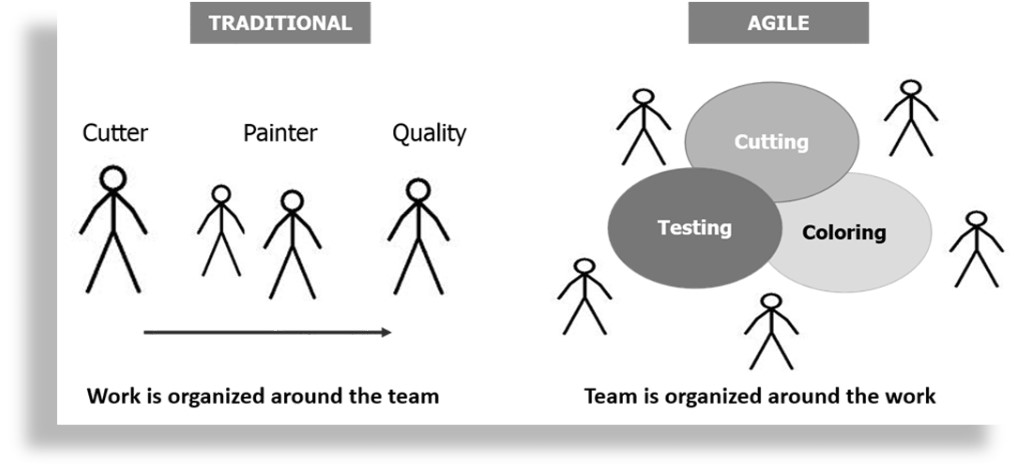
Start ups are different from large established companies .So in order to thrive in technological world the corporate culture must be changed from traditional mind set to agile mind set. So, in order to change the traditional cultures of start ups they must need a perfect team which converts the entrepreneurial ideas into reality. Corporate culture has been changing extensively from the last two decades on wards with its instinctive technology, salary package and benefit factors. In todays competitive situations every startup or an established company must have a team with agile mindset.

WHAT IS AN AGILE MINDSET?

The Agile Mindset is a movement away from traditional, which avoids the bureaucratic leadership like which can involve office politics and a “whoever is loudest is right” mentality. Instead, the agile mindset keeps ego aside from the teams and focus on what is right, instead of who is right. This agile methodology was emerged in 2001 for the development of software practices by providing more reliable workspaces and improved management but now it is a globally embraced framework and mindset which enables business to be better in almost every field with its viability of vision.

THE CHARACTERISTICS OF AGILE MINDSET ARE AS FOLLOWS:

PRINCIPLES OF VISION TO VIABILITY FOR AN AGILE TEAM ARE AS FOLLOWS:

Keeping the above picturized principles in mind which can help a start up to build a perfect team to become more open-minded to the agile mindset approach. These are the core values which helps to nurture more efficiency in teamwork.  This methodology can be used for our personal development also, in order to determine the clear goals or achievements that we want to reach. Now, let’s have an idea about ” How to build an agile team ? “

THE SEVEN MAJOR VISIONARIES TO BUILD AN AGILE TEAM IS AS FOLLOWS:

1 ATTRACT AWSOME TALENT: Try to choose every individual with complementary skills who share the excitement for the company vision. So that they give their best for growth of the company.

2 CREATE FOCUSED & ALIGNED TEAMS: Companies should create the teams which concentrate on the key initiatives to meet the desired goals and achievements of the company.

3 CREATE A LEARNING ORGANISATION: The team must posses the flexibility to manage or make some adjustments to the plan to avoid un necessary risks.

4 BUILD A COHESIVE TEAM: Building a cohesive team adds a marks to the company because this type of team celebrates the collective win over the individual gain and learns from the failure.

5 BUILD A TEAM TO EMBRACE THE DIFFICULT DECISIONS: The team must address the mistakes that has been done previously or during the running project and should change them according to needs of project growth.

6 Foster a culture into the team which can embrace flexibility and also to thrive in good time or bad time.

7 Give an allow for both GEN Y and GEN Z categories in order to tap the high performance energy and fresh thinking ability.

Finally, founders or HR’s of the start ups must cross check all the abilities in hiring a person. Try to maintain some techniques while hiring a person i.e give priority to the aptitude over the experience because fresh thinking always enhances better results and look for the passion in the candidate who want’s to join in the company. Always remember that hiring persons from different cultures can give a strong grip to the foundation of a start up because diversity creates better decisions and the most important thing in hiring process is constantly polishing the way of hiring. Try to look for the culture “FIT” and always be recruiting so that we can form the best teams than the previous once which helps in the growth of the company.

COPA América

Copa América, known until 1975 as the South American Football Championship, is the main men’s football tournament contested among national teams from south america. It is the oldest still-running international football competition, as well as the third most watched in the world.The competition determines the champions of South America. Since the 1990s, teams from North America and Asia have also been invited to compete.

The 2021 Copa América was the 47th edition of the Copa america, the international men’s football championship organised by South America’s football ruling body CONMEBOL. The tournament took place in Brazil from 13 June to 10 July 2021. The tournament was originally scheduled to take place from 12 June to 12 July 2020 in Argentina and Colombia as the 2020 Copa América. On 17 March 2020, CONMEBOL announced that due to the COVID-19 the tournament had been postponed for a year, in conjunction with UEFA’s decision to also postpon to 2021.

Hosts Brazil were the title holders, having won their ninth title in 2019, which they also hosted. Argentina won their fifteenth title after defeating Brazil 1–0 in the final, their first senior title since the 1993 of the same tournament. They also equalled Uruguay’s overall record of Copa América titles.

The trophy was Messi’s first with Argentina after a string of painful, agonizing, maddening failures, including perhaps the most demoralizing defeat of his career — against Germany in the World Cup final — inside the same stadium, Rio’s hulking Maracanã, in 2014.

When the whistle blew to end the final, Messi — his relief palpable — dropped to his knees and was immediately surrounded by his teammates. Moments later, they were lifting him above their shoulders and tossing him in the air.

Little about Jesus Christ.

The cross- symbol of God’s love to people.

Jesus Christ is the central figure of Christianity. He was born at Bethlehem; Judea in Roman empire in 4-6 B.C and his mother was Mary. The Christians traditionally believe that Jesus was born of a virgin, performed miracles and founded an independent religious movement. The majority of Christians worship Jesus as the incarnation of son of god, one of three divine persons of a trinity. A few Christian groups, however, reject trinitarianism, partly or wholly, taking it to be non- scriptural. The principal sources of information regarding Jesus are the four canonical gospels, and most critical scholars find them useful for reconstruction the life and teachings of Jesus. Some scholars believe apocryphal texts such as the gospel of Thomas and the gospel of Hebrews are also relevant.

Later on, the Bible has been divided into two parts- the Old Testament (before Christ) and the New Testament, containing the life of Jesus and principles of Christianity. In Islam, Jesus (transliterated in Arabic as Isa) is considered one of God’s prophets, and the product of a virgin birth; but do not believe that he was God incarnate.

Most of the historians agree that Jesus was a Jew regarded as a preacher and healer, and was crucified between the age of 33-36yrs in Jerusalem on the orders of the Roman Prefect of Judaea, Pontius Pilate, on charge of sedition against the Roman Empire. His date of death was 30-33 A.D.

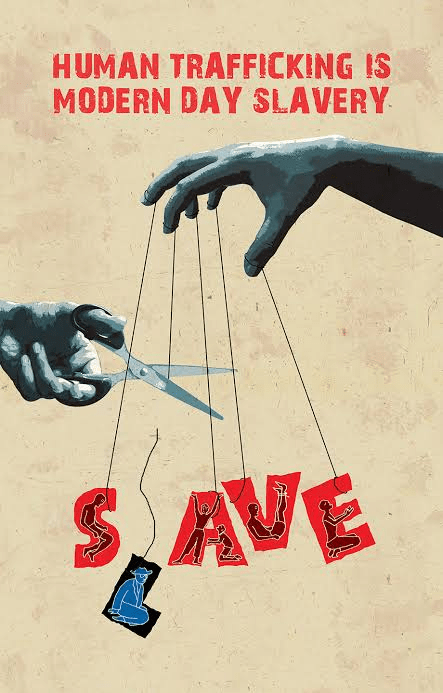
HUMAN TRAFFICKING DURING PANDEMIC

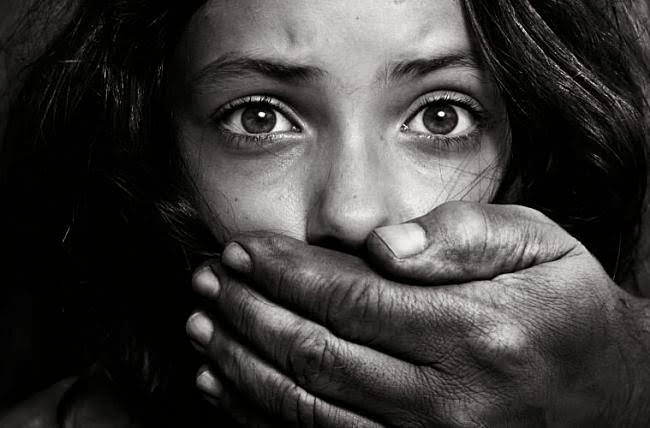
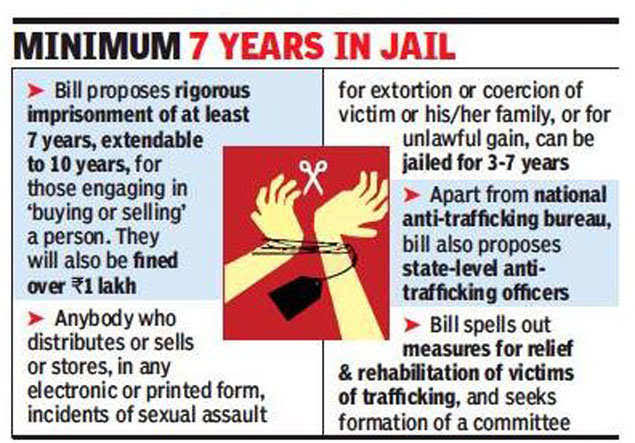
Human Trafficking is a major issue in India and Worldwide. Though, it has been there for ages, the reason for the need of immediate attention is the COVID – 19 Pandemic. The pandemic bought about various social and economical changes in India giving rise to human trafficking cases. The lockdown raised higher level of unemployment amongst daily wage earners. This further lead to effecting the economic background of such families, especially in the rural areas. Having no other source of income lead to desperation in people which made them promote human trafficking by selling their children, making them beg for money and sending their children for child labour. Moreover, the closure of schools increased human trafficking cases as there was no source of education for children. This gave the families and opportunity to use the children economically for labour and wed their girl child at an early age to save the future expenses. Absence of schools further increased the burden on families as many rural schools provided mid-day meal to their students. Absence of which made the children a further burden on the families and an additional stomach to feed. This made them give their children away in a hope for a better future for them and food for their children.


Along with such cases, many organ removal cases in the name of covid cases were found. Many physically fit people with weak financial backgrounds were falsely shown positive for corona virus and later declared dead because of the same. It was found that many traffickers removed organs from such bodies and declared them dead. Hence, this issue is important in the current times and require more attention than ever.

Yes, it’s difficult to step outside and help in this uncertain times but we individuals can start from our homes. The family domestic help, house help, workers, etc belong to rural and economically weak family backgrounds. Hence, talking to them and knowing about their lives can help us get a clear picture of their situation. We can educate them and spread awareness about the wrongs that they might be exposed to. This knowledge might help them be aware and spread the words to different people in their families and neighbourhood, that in turn might create a huge impact on the society as a whole.

Many a times people give into such situations where they willingly promote human trafficking, out of desperation and helplessness. As in case of a daily wage worker who has no other means to support his family economically might sell his child to survive. Hence, it is important to make them aware about various other way where they might get financial help without getting trapped into such rackets. There are government supports yojanas and schemes where they help such people, but in order to get help it is important to know about the availability of that help and that can only be done through awareness. It may not change the entire world scenario but one step by every citizen might make a huge impact altogether.

What is World Trade Organisation ( WTO ) ? ( History , Objectives , Principles , Structure )

The World Trade Organisation is the successor of General Agreement on Tariffs and Trades (GATT ).
The WTO Agreement is the Uruguay Round agreement where the original GATT is now part of the WTO Agreement which came into force from January 1,1995.

WTO is a multilateral organisation .It has its headquarter in Geneva , Switzerland. It is the central body that facilitates global trade .


It is the only international organization that deals with global rules of trade between nations.
It provides a framework for conduct of international trade in goods and services.


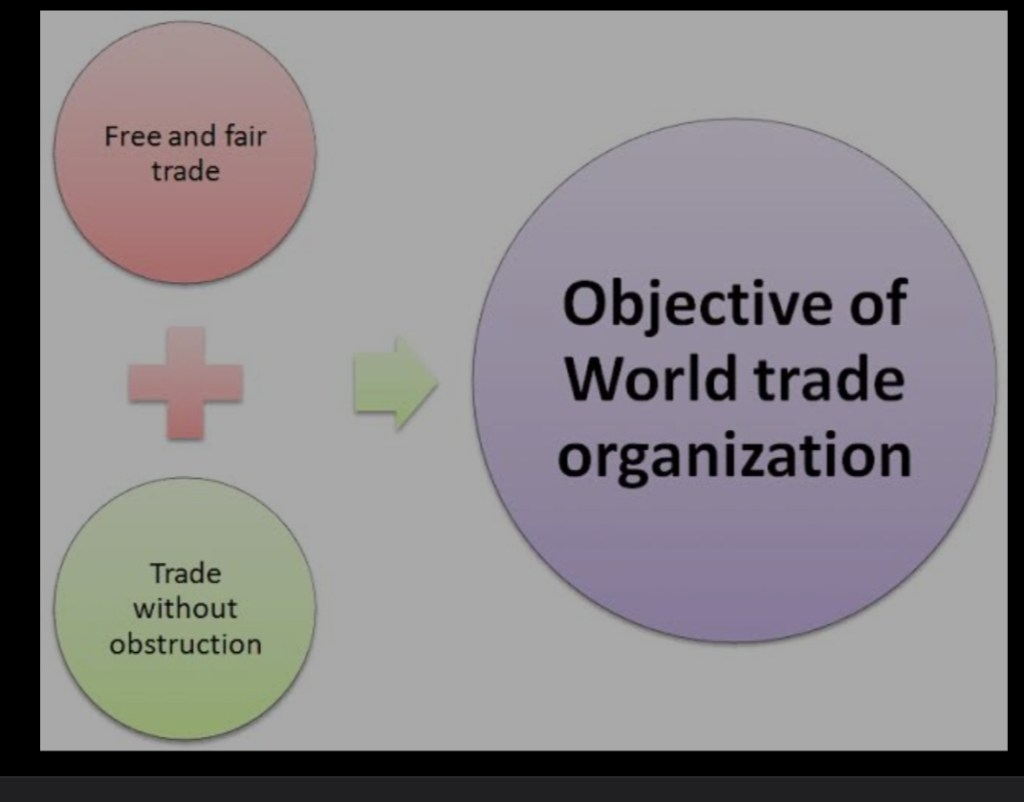
The fundamental objective of the rule-based system of international trade under the WTO is to ensure that international markets remain open and their access is not disrupted by the sudden and arbitrary imposition of import restrictions.


It lays down the rights and obligations of governments in the set of multilateral agreements.
It also covers a wide range of issues related to international trade, such as protection of intellectual property rights and dispute settlement, and prescribes disciplines for governments in formulation of rules, procedures, and practices in these areas.


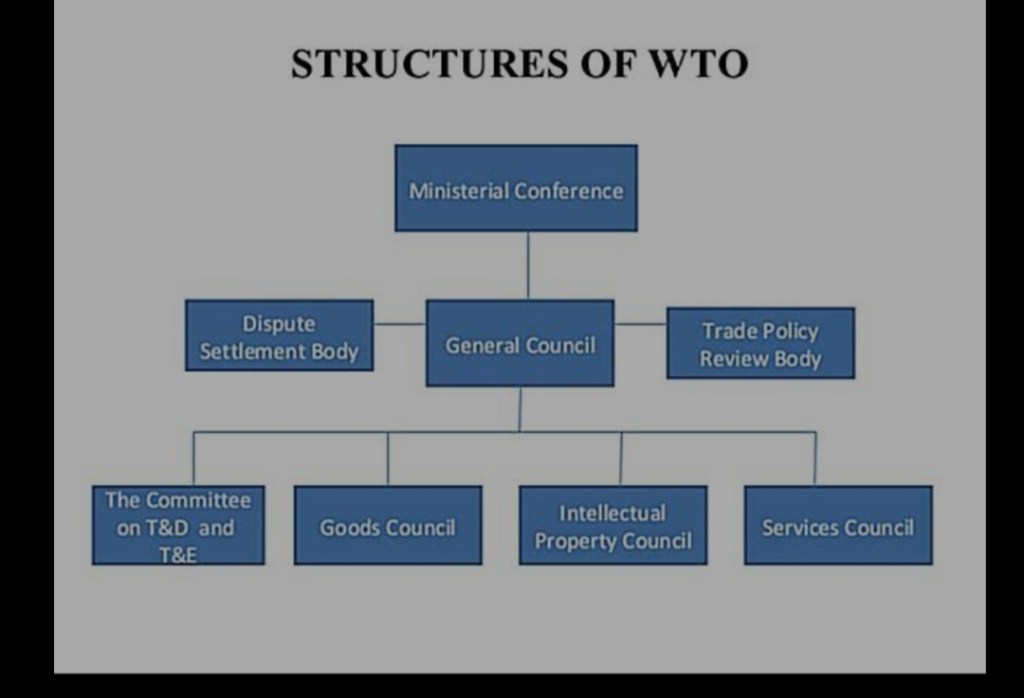
Structure of WTO

The structure of WTO is headed by the Ministerial Conference composed of representatives of all members which meet at least once every two years.
It carries out the functions of the WTO and takes actions necessary to this effect .

The Ministerial Conference is the supreme authority of the WTO .
The Ministerial Conference operations by different authority bodies.

General Council composed of representatives of all members to oversee the operation of the WTO Agreement and ministerial decisions on a regular basis. It also acts as a Dispute Settlement Body (DSB) and a trade policy review body (TPRB) ,each having its own Chairman.

The Director General , who is the secretariat head of WTO . The Ministerial Conference appoints the Director General and sets out his power duties , conditions of services and term of office. The Director General appoints the members of Staff of the Secretariat and determines their duties in accordance with the regulations adopted by the Ministerial Conference.

There is the Council of Trade in goods , The council for Trade in Services and the Council for Trade Related Aspects of Intellectual Property Right (TRIPs) which operates under the General Council .

Principle of WTO

Five important principles of WTO are :-

Non-discrimination
Reciprocity
Binding and enforceable commitments
Transparency
Safety values

___________________________________________


Objectives

The Preamble of the organisation , The Agreement establishing the WTO lays down the following objectives :-

• It’s relation in the field and economic endeavour shall be conducted with a view to raising standards of living , ensuring full employment and large and steadily growing volume of real income and effective demand and expanding the production and trade in goods and services.

• To allow for the optional use of the world’s resources in accordance with the objectives of sustainable development , to protect the environment and to enhance the means for doing so in a manner consistent with respective needs and concerns at different levels of economic development.

• To make positive efforts designed to ensure that developing countries , especially the least developed among them , secure a share in the growth in international trade commensurate with the needs of their economic development.

• To achieve these objectives by entering into reciprocal and mutually advantageous arrangements directed towards substantial reduction of tariffs and other barriers to trade and the elimination of discriminatory treatment in international trade relations.

• To develop an integrated , more viable and durable multilateral trading system encompassing the GATT , the results of past liberalisation efforts and all the results of the Uruguay Round of multilateral trade negotiations .

• To ensure linkages between trade policies , environment policies and sustainable development.

___________________________________________

Functions :-

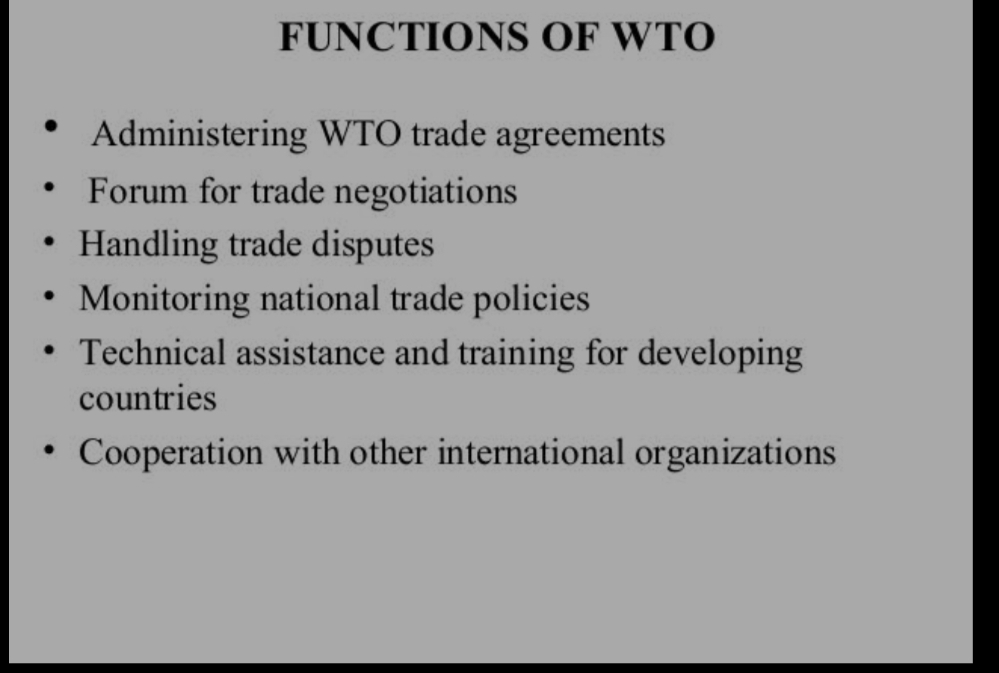
The main functions of WTO are :-

1. To facilitate implementation, administration and operations of the objectives of the Agreement and of the Ministerial Trade Agreement.

2. To provide the forum for negotiations among its members concerning their multilateral trade relations , in matters relating to the agreements .

3. To provide a framework for implementation, administration and operation of multilateral and bilateral agreements of world trade.

4. To administer the understanding of rules and Procedures governing the Settlement of dispute .

5. To ensure the optimum use of world resources.

6. To assist international organizations such as, IMF and IBRD for establishing coherence in Universal Economic Policy determination.

___________________________________________


WTO Agreements

The Agreement establishing WTO consists of the following :-

1: Multilateral Agreements on Trade in Goods :

The general agreement on trade in goods defines the GATT 1994 and includes various agreements dealing with Different aspects related to trade in goods.

• GATT Rules 1994
,•Agreement on Agriculture
•Agreement on Textiles and Clothing
•Agreement on Technical Barriers to Trade
• Agreement on Trade Related Aspects of Investment Measures ( TRIMs)
• Agreement on Anti – Dumping


2: General Agreement on Trade in Services .

This agreement covers all Internationally traded services .It also sets out special conditions relating to individual sectors .

In financial services , it establishes the right of governments to take appropriate measures for the protection of investors , depositors and policy holders to ensure integrity and stability of the financial system.

In telecommunications ,the Agreement requires a Member to establish , construct , acquires ,lease , operate or supply telecommunications transport networks and services and make it available to the public

The GATS also contains consultations and dispute settlement and the establishment of a Council on Services.


3: Agreement on Trade – Related Aspects of Intellectual Property Right ( TRIPs) .

The TRIPs covers seven categories of intellectual property –

• Copyright and Related Rights.
• Trademarks
• Geographical Indications
• Industrial Design
• Patents
• Integrated Circuits
• Trade Secrets

This agreement refers to controls of anti competitive practices for developed countries to bring their legislation and practices into conformity for the implementation of TRIPs.


4:. Understanding on Rules and Procedures governing the Settlement of Disputes.

This agreement applies to consultations and the settlement of disputes between Members concerning their rights and obligations under the provisions of the Agreement establishing the WTO .
For this, a Dispute Settlement System was established .


5: Plurilateral Trade Agreement .

This agreement consists of the Agreement on Trade in Civil Aircraft , Agreement on Government Procurement , International Dairy Agreement and International Bovine Meat Agreement . The first Agreement was made at Geneva in April 1979, as subsequently modified , rectified or amended . The latter three Agreements were done at Marrakesh on April 15,1994.


6: Trade Policy Review Mechanism.

The TPRM aims to carry out reviews of the trade policies and practices under the Multilateral Trade Agreements and the Plurilateral Trade Agreements for the smoother functioning of the multilateral trading system.To operate this purpose , Trade Policy Review Body ( TPRB) was established. For better transparency each member reports regularly to the Trade Policy Review Body about the trade policies and practices pursued by it .

__________________________________________

Entrepreneurship Development

Entrepreneurship is the ability to develop, organize and run a business enterprise, along with any of its uncertainties in order to make a profit. Entrepreneurship is basically the act of creating a business or businesses while building and scaling it to generate a profit. It’s about building a life on your own terms. No bosses. No restricting schedules. And no one holding you back.
Entrepreneurship development is a process of developing certain skills in an individual which are required to make him/her a successful entrepreneur. The success of an entrepreneur can be judged by success of his project or business. Finding a way to sell oneself before anyone believes in one or ones business, being able to explain and prove why their product or service is worth the price or investment, knowing when something is valuable, even if no one else does etc. are some of the features a successful entrepreneur possess.
Big successful companies like Microsoft, Google, Apple etc. have all attained the status they have now because of their respective entrepreneurs. Success of such start-ups not only benefits the people associated with it but also the economy as a whole. It slowly changes the world. Off course not every start up is a massive hit, some might be pretty mediocre and some might even do more losses than gains but nevertheless in the contemporary world, the need and urge for entrepreneurship development has drastically increased.
There are certain characteristics which are observed in entrepreneurs who write big success stories. These characteristics are a prerequisite for becoming a successful entrepreneur. The first and foremost skill is creativity. It means thinking out of the box. Coming up with new ideas, being open to new methodologies, creating something new etc. are some examples of being creative. Creativity gives birth to Originality. Risk taking is another characteristic of a successful entrepreneur. Without the will to explore the unknown, one cannot discover something unique. Risk-taking involves a lot of things. Using unorthodox methods is also a risk. Investing in ideas, nobody else believes in but you is a risk too. Good entrepreneurs are always ready to invest their time and money. But, they always have a backup for every risk they take.
Planning is another characteristic and probably the most important one. They say “If you fail to plan, you plan to fail.” Planning is strategizing the whole thing ahead of time. It basically sums up all the resources at hand and enables one to come up with a structure and a thought process for how to reach ones goal. It involves how to make optimum use of these resources. Facing a situation or a crisis with a plan is always better. It provides guidelines with minimum to no damage incurred to a business.
Other characteristics include passion for the work or business one choose to do, professionalism in the way the work is done, knowledge of the field of work or business, social skills including relationship building. An entrepreneur must be open minded towards learning, people and even failures.

https://www.jbcnschool.edu.in/blog/characteristics-of-an-entrepreneur/

https://www.entrepreneur.com/article/250564

The Beauty of Tierra del Fuego

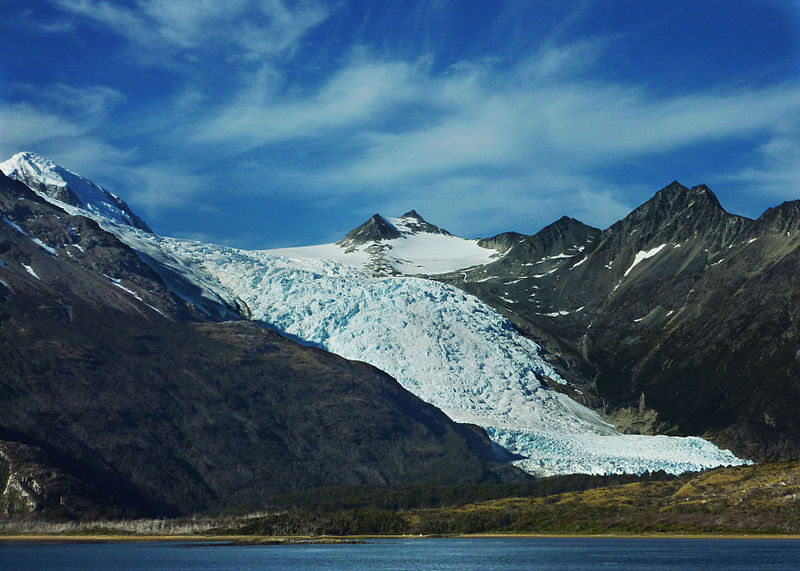
Tierra del Fuego, which stands for “Land of Fire” in Spanish, is an archipelago or a cluster of islands in the southern most tip of South America. It is located across the Strait of Magellan.  The archipelago consists of the main island, Isla Grande de Tierra del Fuego and a group of many islands, including Cape Horn and Diego Ramirez Islands. Tierra del Fuego is divided between Chile and Argentina and is located close to the perennially frozen continent of Antarctica. Tourism is a major component of the local economy.

Brief History

The History of Tierra del Fuego ranges from settlement of the region by the local Yaghan and the Selk’nam people to it’s discovery by the infamous Portuguese explorer Ferdinand Magellan on whom the strait of Magellan is named after, to Spanish European colonization and the genocide of the natives during the gold rushes in the region.

In recent history, both countries have explored the region for oil extraction and formulated their Antarctic claims. In the 1960’s and 70’s there was even a threat of military conflict looming between the two countries over a few islands which almost led to an Argentine invasion of Chile in 1978. Ths very threat of war caused the Chilean regime of Dictator Augusto Pinochet to give logistical support and information to the British during the Falklands War of 1982.

Geography

The archipelago consists of the main Isla Grande de Tierra del Fuego island. Its westernmost part belongs to Chile and the rest to Argentina. The Chilean part is the region named Magallanes y Antarctica Chilena whose capital is Punta Arenas. The village of Puerto Toro located here is probably the Southernmost village in the world.

The eastern part of the main island, and a few small islands in the Beagle Channel, belong to Argentina. They are part of the Tierra del Fuego, Antarctic territory and South Atlantic islands province. The capital is Ushuaia, whis claims the title of the southernmost city of the World.

Flora & Fauna

Only few Islands here forests which are classified as Magellanic subpolar. Trees like winter’s bark, Lenga beech, Magellan’s beech, Northofagus Antarctica etc are found here.

The most notable animals found here are Sea Gulls, Guanacos, Foxes, Kingfishers, Condors, Penguins, Owls, Austral Parakeets, North American Beavers, Sea Lion, Leopard Seals etc.

https://www.adventure-life.com/patagonia/articles/tierra-del-fuego-culture