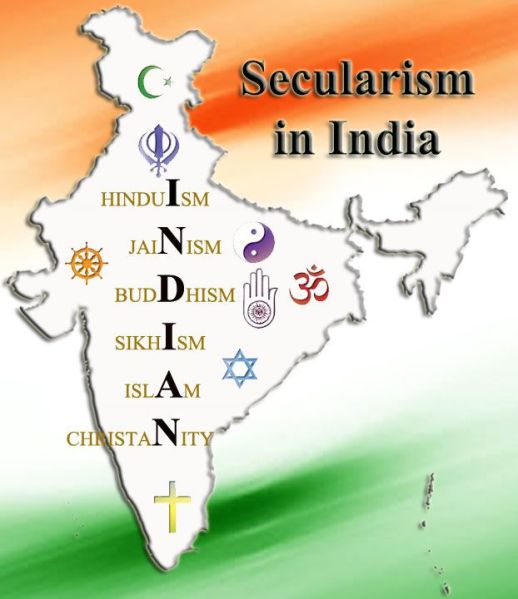
The Secular Concept in India

In India, the concept of secularism was originally born in response to the challenge to the theory of two nations. Indian nationalism proclaimed that India is a secular country and that there is no scope of differentiating between Hindus and Muslims.

Secularism in India is a positive, revolutionary and comprehensive concept which takes within its sweep all the communities in India following several religions. It is not negative in nature, it is not anti-God Or anti-religion; Indian secularism recognises the importance of religion in human life. It believes that no religion has the monopoly of philosophical wisdom. It allows all religions to discharge their function within their legitimate bonds. If citizens wants to worship their God, Indian secularism recognises the need and right for such prayer and worship. It does not prescribe the practice of any religion. Complete freedom of religion is assured in constitution.

secularism can also be non-religious, anti-religion and sceptical. Indian secularism, from this point of view is just non-religious. So long religious functions are held within its legitimate domain, Indian secularism is strictly neutral.

It is remarkable that though the words ‘secular’ and ‘secularism’ are not mentioned in our constitution, it guarantees equality of all religions before law. In that respect Indian Constitution is strictly and essentially founded on secular concept. Indian Constitution guarantees fundamental rights of religious freedom. Secular concept in India has become fully mature in the eyes of the world.

Health Ministry suggests deferment of Vaccination by three months after recovery from Corona virus infection

The Union Health Ministry has accepted the recommendations of National Expert Group on Vaccine Administration for COVID-19 or NEGVAC regarding deferment of vaccination by three months after recovery from COVID-19.

The Ministry said, the individuals having lab test proven COVID-19 illness should defer COVID-19 vaccination by three months after recovery.

Besides, the COVID-19 patients who have been given anti-SARS-2 monoclonal antibodies or convalescent plasma in that case the COVID-19 vaccination should be deferred by three months from the date of discharge from the hospital.

It was also recommended that if an individual is infected with COVID after the 1st dose then the 2nd dose should also be deferred by three months after clinical recovery from the illness.

Over 5.86 crore doses of COVID vaccines being provided free of cost by Centre to States from 1st May to 15th of June

Union Health Ministry has been providing advance information on availability of COVID vaccine doses to be supplied to the States and UTs.

It has written to the States and UTs on allocation of COVID vaccine doses during May and during first fortnight of June from the Government channel which is available free of cost.

It also provided information about availability of vaccine doses that can be procured directly by States and Private Hospitals during May and June.

This advance visibility will enable better and more effective planning by the States.

A total of 5 crore 86 lakh and 29 thousand doses is being provided free of cost by Centre to States from 1st of May to 15th of June.

In addition, a total of 4 crore, 87 lakh and 55 thousand doses will also be available till end of June for direct procurement by States and UTs.

The States and UTs have been advised to prepare a district-wise, COVID Vaccination Centre (CVC)-wise plan for administration of vaccines.

Both States Governments and Private CVCs must publish their vaccination calendar on CoWIN digital platform in advance.

They should desist from publishing single day vaccination calendar. It must be ensured that there is no overcrowding at the CVCs and process of booking appointments on CoWIN is hassle-free.

Centre hikes fertilizer subsidy by 140% to mitigate impact of rising international price rise

Union Government on Wednesday decided to hike the DAP subsidy by 140 per cent to provide the fertilizer to farmers at old rate despite international price rise.
 
The subsidy has been increased from Rs. 500 per bag to Rs. 1,200 per bag.
 
Now, despite the rise in international market prices, it will continue to available at the older price of Rs. 1,200 per bag.
 
A decision in this regard was taken during a high-level meeting chaired by Prime Minister Narendra Modi on the issue of fertilizer prices.
 
Mr Modi stressed that farmers should get fertilizers at old rates despite the international rise in prices.
 
He remarked that his government is committed to the welfare of farmers and will take all efforts to ensure that farmers do not have to face the brunt of price-rise.
 
AIR correspondent reports, recently, the international prices of phosphoric acid, ammonia and others used in DAP have gone up by 60 to 70 per cent.
 
So, the actual price of a DAP bag is currently Rs. 2,400 which could be sold by Fertilizer companies at Rs. 1,900 after considering  earlier subsidy of Rs. 500.
 
With today’s decision, the farmers will continue to get a DAP bag for Rs.  1,200.
 
The Central Government spends about Rs. 80 thousand crore on subsidies for chemical fertilizers every year.
 
With the increase in subsidy in DAP, Government of India will spend an additional Rs. 14,775 crore as subsidy in Kharif season.
 
This is the second major decision in the farmers’ interest in a week, after directly transferring Rs. 20, 667 crore in Farmers’ account under PM-KISAN.

PM Modi announces Rs. 1,000 crore relief package for cyclone-hit Gujarat

Prime Minister Narendra Modi has announced a Rs. 1000 crore relief package for the cyclone hit areas of Gujarat.

According to sources, this package has been given for the rehabilitation work in the areas devastated by the extremely severe cyclonic storm.

According to sources, the Centre will also send inter-Ministerial team to assess the loss due to cyclonic storm.

Prime Minister Modi also announced ex-gratia cash compensation of Rs. 2 lakh each to the next of the kin of those who lost their lives due to Cyclone Tauktae in all the affected States.

In a tweet message, Mr. Modi said that Rs. 50,000 would be given to injured persons affected by cyclonic storm.

Mr. Modi said, the Central government is in full solidarity with those affected due to the natural calamity and will provide them all possible support.

Mr. Modi also reviewed the situation caused by Cyclone Tauktae during a meeting in Ahmedabad.

He also took stock of the evacuation efforts and the ongoing relief work for those affected.

He said that the Centre will help in rebuilding damaged infrastructure. He said that the Central Government is working closely with all the States affected by the cyclone.

JOIN US AND PUBLISH FREE

An open access publishing platform supporting data deposition and sharing.

Publish all your findings including null results, data notes and more.
Engage with your reviewers openly and transparently.
Accelerate the impact of your research

Why you should publish with us

Benefits for Researchers

  • Enables authors, not editors, to decide what they wish to publish.
  • Authors suggest peer reviewers and control the process.
  • All types of research can be published rapidly: traditional articles, data sets, null results, protocols, case reports, incremental findings and more.

Benefits for Research

  • Aims to shift the way research and researchers are evaluated.
  • Moves away from journal-based measures towards direct assessment of individual outputs.
  • Supports research assessment based on the intrinsic value of the research, not the venue of publication.

Benefits for Society

  • Reduces the barrier to collaborative research through data sharing, transparency and attribution.
  • Reduces research waste and helps to remove the bias in our understanding of research.
  • Enables others to build upon new ideas right away, wherever and whoever they are.

An innovative open access publishing platform offering rapid publication and open peer review, whilst supporting data deposition and sharing.

How to Submit Papers

Send papers for review to ijr@ijrjournal.com

Forbidden places in the world

Considering the rate of global expansion it is impossible to imagine any place unexplored and far from the reach of humans. However, there do exist certain places around the world which are forbidden from public viewing.

>Poveglia Island, Italy

Considered one of the most haunted islands in the world Poveglia Island is rumoured to have about 50% of its soil consisting of human remains. Located in between Venice and Lido the island was used as a quarantine station for plague infected people from 1793 to 1814. Also, evidences from past have proved that the island was used by Napoleon to store weapons in early 1800s. By the year 1922, until 1968, the buildings there were converted into mental asylum for the ill. It is believed that mentally ill patients were brutally tortured and killed at the hospital. Afterwards the island was used for agricultural purpose.

>North Sentinel Island, India

Located in the Bay of Bengal, North Sentinal Island is apart of the Andaman and Nicobar Islands. It is home to the Sentinelese an indigenous tribe often known as ‘uncontacted’ people. According to the Andaman and Nicobar Islands Protection of Aboriginal Tribes Act prohibits people from outside the island to travel here. It is believed the Sentineleses have inherited the island from generations and wish to remain in no contact with the outside world. Out of respect to their voluntary isolation the island is banned for travelling.

>Tomb of Qin Shi Huang, China

The tomb of Qin Shi Huang, the first Qin emperor of China is situated in Lintong District, Xi’an, Shaanxi province of China. constructed over 38 years, from 246 to 208 BC, and is situated underneath a 76-meter-tall tomb mound shaped like a truncated pyramid. It is preserved in the respect of the late emperor.

>Bhangarh Fort, India

Built in the 16th century, Bhangarh Fort is located in Rajasthan, India. Claimed as one of the most haunted forts in India, trespassing near Bhangarh is legally prohibited between the sunset and sunrise. However, according to government claims, visiting the place after sunset is prohibited due to dense forest cover, the presence of wild animals and no street lighting facilities.

>Ilha da Queimada Grande, Brazil

Also known as Snake Island, Ilha da Queimada Grande is an island off the coast of Brazil in the Atlantic Ocean. As the name suggests, it is known for its snake population having an average of five snakes per mile. It is home to an endangered snake species, Bothrops insularis, a golden lancehead pit viper. The snakes became trapped on the island when rising sea levels covered up the land that connected it to the mainland. Considering the danger from one of the deadliest serpents in the world the Brazilian government has made it illegal for anyone to visit the island.

poverty and social life ( गरीबी और समाजिक जीवन)

 गरीबी एक व्यक्ति की वह स्थिति है जब वह अपने जीवन की मूलभूत आवश्यकताओं जैसे भोजन, वस्त्र और आवास को पूरा नहीं कर पाता है। गरीबी किसी भी व्यक्ति के बहुत गरीब होने की स्थिति है। यह एक चरम स्थिति है जब व्यक्ति जीवन को जारी रखने के लिए आवश्यक वस्तुओं जैसे आश्रय, पर्याप्त भोजन, कपड़े, दवाओं आदि की कमी महसूस करता है। गरीबी के कुछ सामान्य कारण अतिवृद्धि, घातक और महामारी रोग और प्राकृतिक आपदाएं हैं। हम गरीबी को भोजन, उचित आश्रय, कपड़े, दवाओं, शिक्षा और समान मानवाधिकारों की कमी के रूप में परिभाषित कर सकते हैं। गरीबी एक व्यक्ति को बिना आश्रय के, बिना कपड़ों, शिक्षा और उचित अधिकारों के भूखा रहने के लिए मजबूर करती है।

महामारी रोगों का प्रसार किसी भी देश में गरीबी का कारण है क्योंकि गरीब लोग अपने स्वास्थ्य की स्थिति का ध्यान नहीं रख सकते हैं। गरीबी लोगों को डॉक्टर के पास जाने, स्कूल जाने, पढ़ने, ठीक से बोलने, दिन में तीन बार भोजन करने, जरूरत के हिसाब से कपड़े पहनने, खुद का घर खरीदने, नौकरी के लिए उचित वेतन पाने आदि में असमर्थ बनाती है। गंदा पानी पीने, गंदी जगहों पर रहने और अनुचित भोजन करने से व्यक्ति बीमारी की ओर जा सकता है।
हम गरीबी को उस स्थिति के रूप में परिभाषित कर सकते हैं जहां एक परिवार की बुनियादी जरूरतें, जैसे भोजन, आश्रय, कपड़े और शिक्षा पूरी नहीं होती हैं।  यह अन्य समस्याओं जैसे खराब साक्षरता, बेरोजगारी, कुपोषण आदि को जन्म दे सकता है। एक गरीब व्यक्ति पैसे की कमी के कारण शिक्षा प्राप्त करने में सक्षम नहीं है और इसलिए बेरोजगार रहता है।  एक बेरोजगार व्यक्ति अपने परिवार और उनके स्वास्थ्य में गिरावट के लिए पर्याप्त और पौष्टिक भोजन नहीं खरीद पाता है।  एक कमजोर व्यक्ति में कार्य के लिए आवश्यक ऊर्जा की कमी होती है।  बेरोजगार व्यक्ति ही गरीब रहता है।  इस प्रकार हम कह सकते हैं कि गरीबी अन्य समस्याओं का मूल कारण है।
 देश में कम कृषि उत्पादन, रोजगार की कमी, जातिवाद, निरक्षरता, लैंगिक असमानता, पर्यावरणीय समस्याएं। देश में अर्थव्यवस्था के बदलते रुझान, उचित शिक्षा की कमी, अस्पृश्यता, लोगों के अपने अधिकारों तक सीमित या अपर्याप्त पहुंच, राजनीतिक हिंसा, संगठित अपराध, भ्रष्टाचार, प्रेरणा की कमी, आलस्य, पुरानी सामाजिक मान्यताएं आदि। भारत में गरीबी को प्रभावी समाधान के बाद कम किया जा सकता है, लेकिन सभी नागरिकों के व्यक्तिगत प्रयासों की जरूरत है।
गरीबी के प्रभाव:

गरीबी एक गरीब परिवार के जीवन को प्रभावित करती है।  एक गरीब व्यक्ति उचित भोजन और पोषण नहीं ले पाता है और उसकी काम करने की क्षमता कम हो जाती है।  काम करने की क्षमता कम होने से उसकी आय और कम हो जाती है, जिससे वह गरीब हो जाता है।  गरीब परिवार के बच्चों को कभी भी उचित स्कूली शिक्षा और उचित पोषण नहीं मिलता है।  उन्हें अपने परिवार का समर्थन करने के लिए काम करना पड़ता है और इससे उनका बचपन नष्ट हो जाता है।  उनमें से कुछ चोरी, हत्या, डकैती आदि जैसे अपराधों में भी शामिल हो सकते हैं। एक गरीब व्यक्ति अशिक्षित रहता है और मलिन बस्तियों में अस्वच्छ परिस्थितियों में रहने को मजबूर होता है।  मलिन बस्तियों में साफ-सफाई और पीने के पानी की कोई उचित व्यवस्था नहीं है और वह अक्सर बीमार रहता है और उसका स्वास्थ्य बिगड़ता जाता है।  एक गरीब व्यक्ति आमतौर पर जल्दी मर जाता है।  तो, सभी सामाजिक बुराइयों का संबंध गरीबी से है।
 निरक्षरता: गरीबी लोगों को पैसे की कमी के कारण उचित शिक्षा प्राप्त करने में असमर्थ बनाती है।
 पोषण और आहार: गरीबी आहार की अपर्याप्त उपलब्धता और अपर्याप्त पोषण की ओर ले जाती है जो कई घातक बीमारियों और कमी वाली बीमारियों को जन्म देती है।
बाल श्रम: यह निरक्षरता के एक बड़े स्तर को जन्म देता है क्योंकि देश का भविष्य कम उम्र में ही बाल श्रम में शामिल हो जाता है।
बेरोजगारी: बेरोजगारी गरीबी का कारण बनती है क्योंकि यह पैसे की कमी पैदा करती है जो लोगों के दैनिक जीवन को प्रभावित करती है।
 यह लोगों को उनकी इच्छा के विरुद्ध अधूरा जीवन जीने के लिए मजबूर करता है।
सामाजिक तनाव: यह अमीर और गरीब के बीच आय असमानता के कारण सामाजिक तनाव पैदा करता है।
आवास की समस्या: इससे लोगों का घर के बाहर फुटपाथ, सड़क मार्ग, अन्य खुली जगहों, एक कमरे में कई सदस्यों आदि पर रहने के लिए एक बुरी स्थिति पैदा होती है।
रोग: यह विभिन्न महामारी रोगों को जन्म देता है क्योंकि पैसे की कमी वाले लोग उचित स्वच्छता और स्वच्छता नहीं बनाए रख सकते हैं। इसके अलावा वे किसी भी बीमारी के समुचित इलाज के लिए डॉक्टर का खर्च नहीं उठा सकते।
 गरीबी उन्मूलन: लैंगिक असमानता के कारण गरीबी महिलाओं के जीवन को काफी हद तक प्रभावित करती है और उन्हें उचित आहार, पोषण, दवाओं और उपचार से वंचित करती है।
गरीबी के कारण:

किसी भी देश में गरीबी का मुख्य कारण बढ़ती जनसंख्या, खराब कृषि, भ्रष्टाचार, पुराने रीति-रिवाज, गरीब और अमीर लोगों के बीच एक बड़ी खाई, बेरोजगारी, अशिक्षा, महामारी रोग आदि हैं।
भारत में लोगों का एक बड़ा प्रतिशत कृषि पर निर्भर है जो कि गरीब है।खराब कृषि और बेरोजगारी के कारण लोगों को आमतौर पर भोजन की कमी का सामना करना पड़ता है।
 लगातार बढ़ती जनसंख्या भी भारत जैसे देश में गरीबी का कारण है;  अधिक जनसंख्या का अर्थ है अधिक भोजन, धन और घर।
बुनियादी सुविधाओं के अभाव में गरीबी तेजी से बढ़ती है, अतिरिक्त अमीर और अतिरिक्त गरीब बनने से अमीर और गरीब लोगों के बीच एक बड़ी खाई पैदा हो जाती है।
अमीर लोग अमीर हो रहे हैं और गरीब लोग गरीब होते जा रहे हैं जिससे आर्थिक अंतर पैदा होता है।
गरीबी के नियंत्रण के उपाय:

कुछ उपाय जो गरीबी की समस्या के समाधान में बड़ी भूमिका निभा सकते हैं, वे हैं:
किसानों को अच्छी कृषि के साथ-साथ उसे लाभदायक बनाने के लिए उचित और आवश्यक सुविधाएं मिलनी चाहिए।
जो अनपढ़ हैं उन्हें जीवन की बेहतरी के लिए आवश्यक प्रशिक्षण दिया जाना चाहिए।
बढ़ती जनसंख्या और इस प्रकार गरीबी की जाँच के लिए लोगों को परिवार नियोजन का पालन करना चाहिए।
गरीबी को कम करने के लिए दुनिया भर में भ्रष्टाचार को खत्म किया जाना चाहिए।
हर बच्चे को स्कूल जाना चाहिए और उचित शिक्षा लेनी चाहिए।
रोजगार के ऐसे अवसर होने चाहिए जहां सभी वर्ग के लोग एक साथ काम कर सकें।
निष्कर्ष:

गरीबी केवल एक व्यक्तिगत समस्या नहीं है बल्कि एक राष्ट्रीय समस्या है;  कुछ प्रभावी समाधानों को लागू करके इसे तत्काल आधार पर हल किया जाना चाहिए। गरीबी को कम करने के लिए सरकार द्वारा कई कदम उठाए गए हैं लेकिन कोई स्पष्ट परिणाम नहीं हैं। लोगों, अर्थव्यवस्था, समाज और देश के सतत और समावेशी विकास के लिए गरीबी उन्मूलन आवश्यक है। प्रत्येक व्यक्ति के संयुक्त प्रयासों से गरीबी को प्रभावी ढंग से समाप्त किया जा सकता है। 
“गरीबी हिंसा का सबसे बुरा रूप है”।  – महात्मा गांधी।

Students and Social Service

Man is a social animal. This means he cannot live alone; he lives in a society consisting not only of his own family, but also of some other families. And the peace and happiness of each individual depends to a great extent upon what he gets from the other members of his society. So they are all indebted to one another in some form or other. This arises the duty of social service—the duty of paying back a part of our debts by doing some service to the society.

The students have an important role to play in this respect. They have idealism and great energy. This is why they are the first to come forward in work of social service. In modern country, social service is a ‘must’ for the students. The common people suffer from a great number of ills—illiteracy, bad customs, ignorance of the laws of health and of their rights and duties, etc. Our students can do a lot to remove these ills by educating the people in the proper way. They may help in the construction of roads and cleaning of ponds and ditches in their localities. They may even help the authorities in their fight against illegal hoarding and rowdyism. In cases of floods and such other calamities, they should volunteer for relief work. Their words and examples, inspired by idealism, cannot but be more effective than the words of officials. But students should see that their activities are kept within proper bounds and do not degenerate into a type of rowdyism and indiscipline.

All these activities, properly directed, will not only benefit the people; they will also do a great deal of good to the students themselves. They will develop their spirit of service and power of organisation, widen their sympathy, and thus enable them to become worthy members of society.

More than 20 crore 78 lakh COVID vaccine doses provided to states, UTs so far: Govt

TheGovernment has said that more than 20 crore 78 lakh COVID vaccine doses have been provided so far to States and Union Territories. Union Health Ministry said, as part of the nationwide vaccination drive, the government has been supporting the States and Union Territories by providing them COVID Vaccines free of cost.
 
The Ministry said, more than one crore 94 lakh COVID Vaccine doses are still available with the States and Union Territories to be administered. It said, one lakh vaccine doses are in the pipeline and will be received by the States and Union Territories within the next three days.
 
In the second quarter of this month, from 18th to 31st of May, one crore 95 lakh doses will be made available free of cost by the Union Government. The Ministry said, this information has already been shared with States and Union Territories. In addition, more than 72 lakh doses will be available for direct procurement by the States and Union Territories.

PM describes aggressive testing, marking local containment zones & giving correct information to public as weapons against Covid-19

Prime Minister Narendra Modi has described aggressive testing, marking local containment zones and dissemination of complete and correct information to the public as weapons against the Covid-19 pandemic.

The Prime Minister interacted with field officials from various States and districts yesterday to converse about their experience in handling the pandemic. Speaking on the occasion, Mr. Modi termed the district officials as field commanders and said they have ensured effective local containment strategies to mitigate the effect of the pandemic.

The Prime Minister said the work of field officers which include building confidence among front line workers and also acting against hoarders of drugs and medical equipment is crucial in the fight against the pandemic.

The Prime Minister said, amidst rising cases and challenges of health infrastructure in rural areas, the district officials are entrusted with greater responsibility of reaching out to the people.. He informed that the task of setting up of Oxygen plants is being actively completed in the districts using the funds allocated from PM-CARES. The Prime Minister also called for setting up district monitoring cells in this regard for effectively bridging the gap between the supply and usage.  

Mr. Modi said, the country has undertaken the largest vaccination drive in the world. He asserted that proper usage of vaccines with minimal wastage will ensure effective and quick recovery of the nation from the pandemic.

PM Modi to visit Gujarat and Diu today to review situation & damage due to Cyclone Tauktae

Prime Minister Narendra Modi will visit Gujarat and Diu today to personally review the situation and damage due to Cyclone Tauktae. He will also hold a review meeting in Ahmedabad.
 
Mr. Modi will leave Delhi at around 9:30 am in the morning. He will also conduct an aerial survey of cyclone affected areas including Bhavnagar, Una, Diu, Jafarabad and Mahuva.

Cyber bullying (साइबरबुलिंग)

 आज के युवा पहले से कहीं अधिक इंटरनेट के उपयोग से प्रभावित हैं।  वे इंटरनेट और मोबाइल फोन सिस्टम को संचार के दो सबसे बड़े ढांचे के रूप में मानते हैं जो हमारी दैनिक गतिविधियों और पहचान के विकास में महत्वपूर्ण भूमिका निभाते हैं।

दूसरी ओर, इन तकनीकों का अक्सर नकारात्मक उपयोग किया जाता है। कई लोग इंटरनेट को लोगों को ठगी के लिए उपयोग करते हैं। साइबर बुलिंग एक व्यक्ति को धमकाने के लिए इलेक्ट्रॉनिक संचार का उपयोग है, आमतौर पर डराने या धमकी देने वाले संदेश भेजकर।  आजकल किसी के लिए साइबर बुली का शिकार होना या किसी के लिए साइबर बुली होना इतना आसान हो गया है।  ऐसे कई तरीके हैं जिनसे किसी व्यक्ति को साइबर बुली किया जा सकता है।  उदाहरण के लिए, कोई व्यक्ति नकली फेसबुक अकाउंट बनाकर ऑनलाइन किसी व्यक्ति की पहचान चुरा सकता है और ऐसी चीजें कहना और पोस्ट करना शुरू कर सकता है जो आप नहीं करेंगे या कहेंगे। 
इसके बाद, साइबरबुलिंग विभिन्न रूपों में आती है।  जरूरी नहीं कि इसका मतलब किसी की प्रोफाइल हैक करना या किसी और के होने का दिखावा करना हो।  इसमें किसी के बारे में नकारात्मक टिप्पणी पोस्ट करना या किसी को बदनाम करने के लिए अफवाहें फैलाना भी शामिल है।  जैसा कि हर कोई सोशल नेटवर्क पर पकड़ा जाता है, इससे किसी के लिए भी इस एक्सेस का दुरुपयोग करना बहुत आसान हो जाता है।
 दूसरे शब्दों में, साइबरबुलिंग आजकल बहुत आम हो गई है।  इसमें किसी भी व्यक्ति को हेरफेर करने, परेशान करने और बदनाम करने की कार्रवाई शामिल है।  ये शत्रुतापूर्ण कार्य गंभीर रूप से हानिकारक हैं और किसी को भी आसानी से और गंभीर रूप से प्रभावित कर सकते हैं।  वे सोशल मीडिया, सार्वजनिक मंचों और अन्य ऑनलाइन सूचना वेबसाइटों पर होते हैं।  एक साइबरबुली जरूरी नहीं कि एक अजनबी हो;  यह कोई आपका परिचित भी हो सकता है।
साइबर बुलिंग खतरनाक है
 साइबरबुलिंग एक बहुआयामी समस्या है।  हालाँकि, इस गतिविधि का इरादा एक ही है।  लोगों को चोट पहुँचाने और उन्हें नुकसान पहुँचाने के लिए।  साइबरबुलिंग कोई हल्की बात नहीं है।  इसे गंभीरता से लेने की जरूरत है क्योंकि पीड़ित पर इसका बहुत खतरनाक प्रभाव पड़ता है।
 इसके अलावा, यह व्यक्ति के मन की शांति को भंग करता है।  बहुत से लोग साइबरबुलिड होने के बाद अवसाद का अनुभव करने के लिए जाने जाते हैं।  इसके अलावा, वे आत्म-नुकसान में लिप्त हैं।  उनके बारे में किए गए सभी अपमानजनक कमेंट उन्हें हीन महसूस कराते हैं।
 इसके परिणामस्वरूप बहुत सारी असुरक्षाएं और जटिलताएं भी होती हैं।  उत्पीड़न के रूप में साइबरबुलिंग का शिकार होने वाली पीड़िता को आत्म-संदेह होने लगता है।  जब कोई आपकी असुरक्षा की ओर इशारा करता है, तो वे केवल वृद्धि करते हैं।  इसी तरह, पीड़ित चिंता करते हैं और अपनी आंतरिक शांति खो देते हैं।इसके अलावा साइबर बुलिंग से व्यक्ति की छवि भी खराब होती है।  यह उनके बारे में फैली झूठी अफवाहों से उनकी प्रतिष्ठा को बाधित करता है।  सोशल मीडिया पर सब कुछ जंगल की आग की तरह फैल जाता है।  इसके अलावा, लोग अक्सर विश्वसनीयता पर सवाल उठाते हैं।  इस प्रकार, एक झूठी अफवाह लोगों के जीवन को तबाह कर देती है।
साइबर बुलिंग को कैसे रोकें?
 साइबरबुलिंग की रोकथाम समय की मांग है।  इस पर नजर रखने और इसे खत्म करने की जरूरत है।  साइबरबुलिंग से निपटने के कई तरीके हैं।  हम उन्हें व्यक्तिगत स्तरों के साथ-साथ आधिकारिक स्तरों पर भी लागू कर सकते हैं।
सबसे पहले, हमेशा अपने बच्चों को व्यक्तिगत जानकारी ऑनलाइन साझा न करना सिखाएं।  उदाहरण के लिए, यदि आप अपने घर का पता या फोन नंबर वहां सूचीबद्ध करते हैं, तो यह आपको आसानी से साइबरबुलिंग का संभावित लक्ष्य बना देगा।
दूसरे, अपनी स्पष्ट तस्वीरें ऑनलाइन पोस्ट करने से बचें।  साथ ही सोशल मीडिया पर कभी भी पर्सनल मसलों पर चर्चा न करें।  दूसरे शब्दों में, जानकारी को अपने मित्रों और परिवार के समूह में सीमित रखें।
 सबसे महत्वपूर्ण बात यह है कि कभी भी अपना इंटरनेट पासवर्ड और खाता विवरण किसी के साथ साझा न करें।  यह सारी जानकारी अपने तक ही सीमित रखें।  सतर्क रहें और किसी  लिंक्स पर क्लिक न करें, वे खतरनाक हो सकते हैं।  इसके अलावा, अपने बच्चों को साइबरबुलिंग के बारे में सिखाएं और उन्हें इस बात से अवगत कराएं कि क्या गलत है और क्या सही।
अंत में, जागरूकता ऑनलाइन उत्पीड़न को रोकने की कुंजी है।  हमें बच्चों को कम उम्र से ही जागरूक करना चाहिए ताकि वे हमेशा सतर्क रहें।  इसके अलावा, माता-पिता को अपने बच्चों की ऑनलाइन गतिविधियों की निगरानी करनी चाहिए और उनके उपयोग को सीमित करना चाहिए।  सबसे महत्वपूर्ण बात यह है कि साइबरबुलिंग को बिना देर किए तुरंत सूचित किया जाना चाहिए।  इससे आगे की घटनाओं को रोका जा सकता है।