Action Plan to Conserve Rain Water

 Water being a State subject, the responsibility of formulation of action plan to save and conserve rain water primarily lies with the State Governments. Central Government supplements the efforts of States through providing technical and financial assistance. However, Ministry of Jal Shakti has been implementing “Jal Shakti Abhiyan: Catch the Rain” (JSA:CTR) -2023 campaign, the fourth in the series of JSAs, which was launched by Hon’ble President on 04.03.2023 in all districts (rural as well as urban areas) of the country for implementation during 04th March, 2023 to 30th November, 2023 with the theme “Source Sustainability for Drinking Water”. One of the focused interventions of the campaign is water conservation and rainwater harvesting. The campaign offers a major opportunity in leveraging convergence and working towards a greater vision of water conservation. 

Central Ground Water Board (CGWB) has prepared a Master Plan for Artificial Recharge to Groundwater- 2020 in consultation with States/UTs which is a macro level plan indicating various structures for the different terrain conditions of the country including estimated cost. The Master Plan has provisions for the construction of about 1.42 crore rain water harvesting and artificial recharge structures in the country to harness 185 Billion Cubic Metre (BCM) of monsoon rainfall.

Ministry of Housing & Urban Affairs has formulated guidelines for the guidance of the States for their adoption suiting to local conditions. Adequate focus has been given on requirement of rainwater harvesting and water conservation measures in Model Building Bye Laws (MBBL), 2016 and Urban and Regional Development Plan Formulation and Implementation (URDPFI) Guidelines, 2014. 

National Mission for Clean Ganga (NMCG) under Department of Water Resources, River Development & Ganga Rejuvenation, Ministry of Jal Shakti, in partnership with Indo-European Water Partnership has developed a National Framework for the reuse of treated waste water. The framework is meant to develop suitable market and business models for reuse of treated waste water. The framework identifies agriculture as a potential area where reuse of treated water can be explored. The framework envisages and promotes adoption of safer irrigation practices towards use of treated water by farmers in peri-urban and rural areas.

Central Pollution Control Board has formulated and implemented charters for major industrial sectors namely Pulp & Paper, Sugar, Distillery, Textile and Tannery located in Ganga main stem states for adoption of cleaner technology, upgradation of process technology and Effluent Treatment Plant (ETP) system resulting in reduction in specific fresh water consumption and waste water discharge through recycling and reuse of waste water in the process.

National Water Policy-2012 mandates recycle and reuse of water as general norm and advocates treatment to specified standards before reuse of waste water. It recommends properly planned tariff system to incentivize reuse of treated water in various sectors including industries and agriculture. 

In Atal Mission for Rejuvenation and Urban Transformation (AMRUT 2.0), Ministry of Housing & Urban Affairs supports treated water recycling and reuse projects for the non-drinking water needs of industries & agricultural purposes. Reuse of treated used water, tertiary treatment with end-to-end reuse plan (preferably in Public-Private Partnership mode), provision/augmentation and rehabilitation of sewerage systems with end-to-end treatment and reuse, identifying the bulk users of recycled used water and facilitating sale of used water to potential users etc. are admissible elements under AMRUT 2.0 water supply projects.

This information was given by the Minister of State for Jal ShaktiShri Bishweswar Tudu in a written reply in Rajya Sabha today.

****
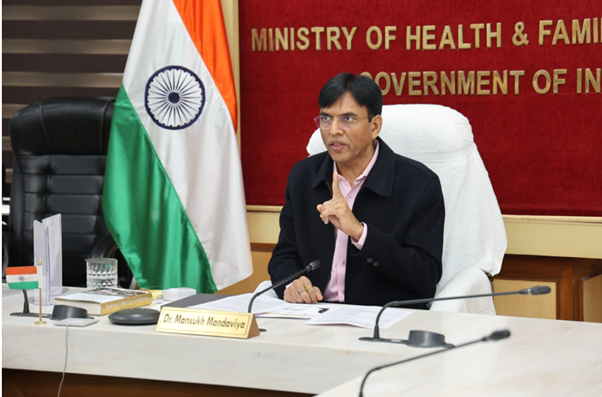
Vibrant Gujarat Pre-Summit on ‘Biotechnology: The Path of Innovation & Wellness for Viksit Bharat’

 “India’s ‘Bio Economy’ has grown eight times in the last eight years from $10 billion to $80 billion. In the coming times, biotechnology will become the biggest foundation for health treatment.” This was stated by Dr. Mansukh Mandaviya, Union Minister for Health & Family Welfare as he virtually addressed the pre-event summit “Biotechnology: The Path of Innovation & Wellness for Viksit Bharat” in the presence of Shri. Bhupendra Patel, Chief Minister, Gujarat at Vigyan Bhavan, Science City, Ahmedabad, Gujarat today. The summit is a preliminary event leading up to the 10th Vibrant Gujarat Global Summit that will take place on January 2024 at the Mahatma Gandhi Mandir, Gandhinagar under the theme of ‘Gateway to the Future’

Dr. Mandaviya noted that Indian Biotech Industry aiming to grow to $150 Billion by 2025 and $300 Billion by 2030, and India is currently among the top 12 destinations for Biotechnology in the world with approximately 3% share in the Global Biotechnology Industry. He stated “This industry will become a medium for finding solutions for complex problems in various spheres such as agriculture, environment, industrial production and many more. In light of this, in the future, the economy will become biotechnology based.” Quoting the Prime Minister, Shri Narendra Modi, Dr. Mandaviya stated “in the global biotechnology ecosystem, India will soon feature as one of the top ten nations.” Reiterating the Prime Minister’s vision of India achieving the status of a developed nation by 2047, Dr. Mandaviya cited that “this sector’s contribution will be instrumental in making India a developed nation.” 

Highlighting the growth and prowess of the industry, Dr. Mandaviya stated that the vaccination produced by India during the pandemic showcased India’s power in the field of biotechnology to the world. Underscoring the importance of this sector, the Union Minister stated “the National Biotechnology Development Strategy 2020-25 provides the government a platform to strengthen skill development, resource and innovation converging into one strong ecosystem for knowledge sharing.” He stated it further facilitates commercialization and market linkages by encouraging private-public partnership models in these sectors. 

Commending the progress of the nation and industry in this sphere, the Dr. Mandaviya praised the participation of startups, industries and industry associations, researchers and academicians across the nation for contributing to the development of this sector. The Union Health Minister lauded the efforts and contribution of Gujarat in their dedicated focus on biotechnology over two decades and its strong contribution in making India a healthcare and innovation ready country. The Union Health Minister reflected that Gujarat was the first state in the country to establish Biotech Mission 15-20 years ago. Dr. Mandaviya recalled that when Prime Minister Narendra Modi was the Chief Minister of Gujarat, he had established Biotech Mission and Biotech Park in the state. 

Acknowledging the crucial contribution of the Biotechnology sector will provide to the nation and economy Shri. Bhupendra Patel stated “aligning with the theme of ‘Gateway to the Future’ we will provide additional focus to futuristic sectors of which Biotechnology features as most important.” He further cited that “Biotechnology sector is known as the sector of hope. With its rapid growth, it will provide significant contributions to the world.” The Gujarat Chief Minister also inaugurated the ‘Start-Up Product Launch’.


The event was attended by Shri Raj Kumar, Chief Secretary, Gujarat, Ms. Mona Khandhar, Principal Secretary, Department of Science & Technology, Government of Gujarat, Dr. Rajesh Gokhale, Secretary, Department of Science & Technology, Ministry of Science and Technology, senior government officials, mission directors, as well as eminent dignitaries. 

****

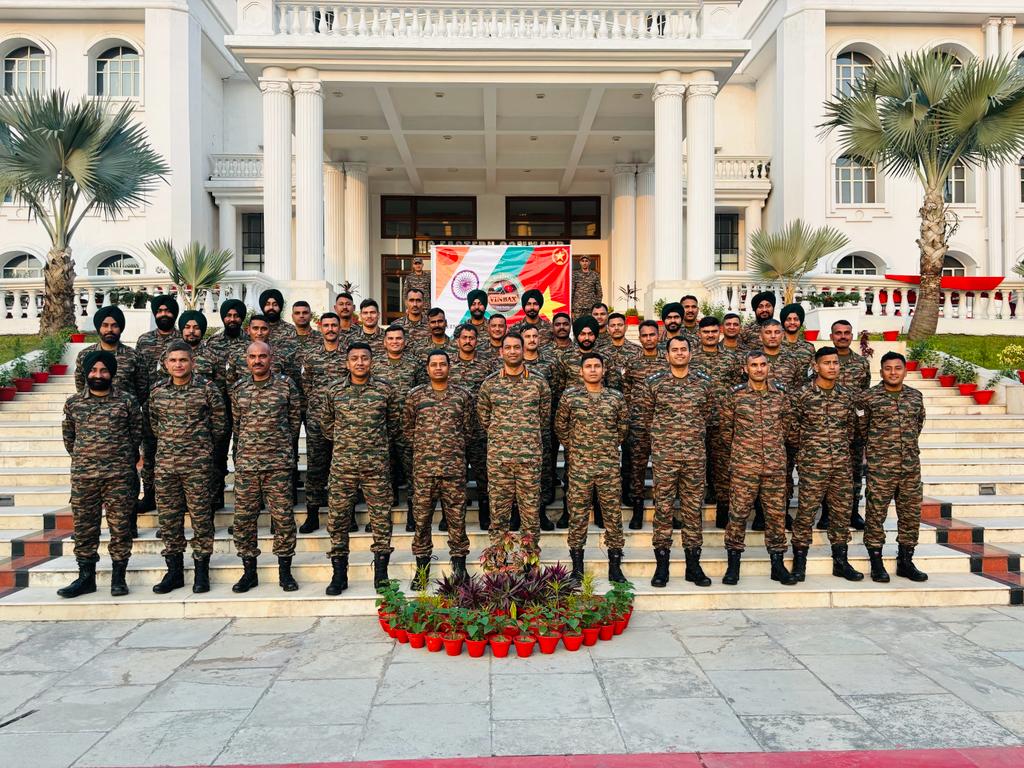
INDIAN ARMED FORCES CONTINGENT REACHES HANOI FOR JOINT MILITARY EXERCISE “VINBAX-2023”

 The Indian Armed Forces contingent comprising 45 personnel reached Hanoi, Vietnam to take part in the fourth edition of Joint Military Exercise VINBAX-2023. The exercise will be conducted at Hanoi, Vietnam from 11th to 21st December 2023. The Indian contingent comprises 39 personnel from an Engineer Regiment of Bengal Engineer Group and six personnel of Army Medical Corps. The Vietnam People’s Army contingent will also be represented by 45 personnel. 

Exercise VINBAX was instituted in 2018 and the first edition was conducted at Jabalpur, Madhya Pradesh. It is an annual training event conducted alternatively in India and Vietnam. Last edition was conducted at Chandimandir Military Station in August 2022.

Aim of the exercise is to foster collaborative partnership, promote inter- operability and share best practices between the two sides under Chapter VII of United Nations Charter on Peace Keeping Operations. The exercise will be conducted as a Command Post Exercise cum Field Training Exercise with focus on deployment and employment of an Engineer Company and a Medical Team.

The joint exercise will encourage exchange of ideas and both contingents will jointly rehearse tactics, technique and procedures. Ideas will be exchanged on modern methods to construct roads, culverts, helipads, ammunition shelter and observation posts in operational areas. In addition, rehearsals will be carried out for drills related to combat engineering and combat medical tasks.

The Exercise will culminate with a Validation Exercise, wherein standards attained by both contingents will be showcased. Both sides will conduct technical military operations in accordance with scenarios akin to worldwide deployment of United Nations’ contingents.

The joint exercise will help in promoting understanding and interoperability between the two contingents and further strengthen the defence cooperation between the friendly armies.

________________________________________________________________

SC/RKS/GKA     

Quad Achievements under the Climate Adaptation Pillar

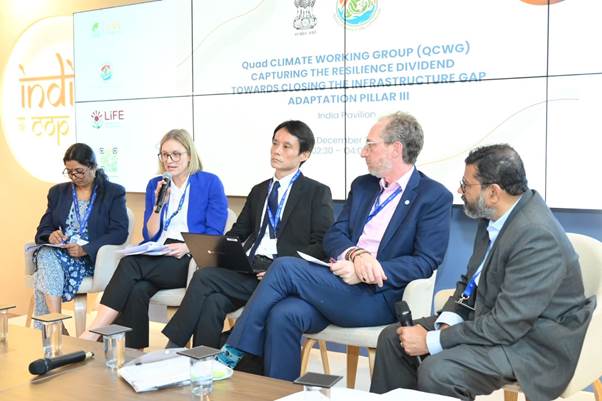
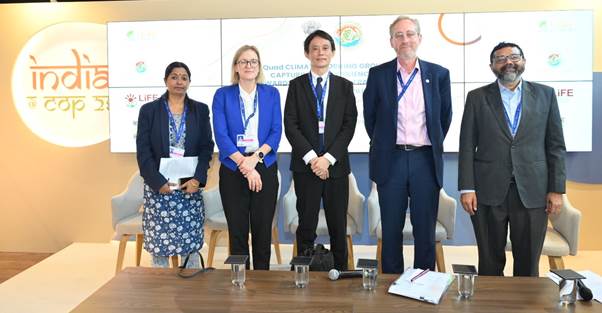
 The Ministry of Environment, Forest and Climate Change (MoEFCC), Government of India along with the Coalition for Disaster Resilient Infrastructure (CDRI) organised a side event under the Adaptation Pillar of Quad Climate Working Group (QCWG) on “Capturing the Resilience Dividend: Quad Achievements under the Climate Adaptation Pillar” on 9th December 2023 at the India Pavilion, on the sidelines of the UNFCCC COP 28 India Pavilion at Dubai. 

The panel was represented by all Quad countries in person by Environmental Management and Climate Change Group, JICA (Japan), Ms. Rajasree Ray, Economic Advisor, Ministry of Environment, Forests & Climate Change (India); Ms. Nicola Ross, Director-Climate Integration Unit, DFAT (Australia); Mr Toru Yoshida, Senior Deputy Director, and Mr. Michael Schiffer, Assistant Administrator of the Bureau for Asia, USAID (USA). The session was moderated by Mr. Krishna Vatsa, Member, National Disaster Management Authority (NDMA), India. The panel advocated on the need to measure and promote resilience dividend amongst all stakeholders. 

The panellists highlighted the need for integrating resilience into investments, policies, planning and governance to safeguard infrastructure, investments and community. They further stressed on challenges including lack of data, coordination, financing gaps and conceptual and  implementation capacity at local level in integrating adaptation. 

They also shared efforts towards resilience integration including Public-Private Partnerships (PPPs), community initiatives with nature, locally-led adaptation and resilience projects. These included climate resilient projects from Indo-Pacific region. The panel commended the Coalition for Disaster Resilient Infrastructure (CDRI), supported by all Quad partners, as an example of effective partnership amongst global stakeholders to advocate for resilience and provide support to countries for accelerating economic growth and helping achieve Sustainable Development Goals.  

****

INITIATIVES TO ENHANCE PERFORMANCE OF SAINIK SCHOOLS

 The primary aim of Sainik Schools is to prepare cadets academically, physically and mentally for entry into the National Defence Academy. Various steps are in place for ensuring the academic excellence of the cadets of 33 Sainik Schools. These include conducting of interactive training & close monitoring of progress of cadets, remedial classes for slow learners, introduction of latest pedagogical practices, in service course and training for teachers, guest lectures & motivational tours for cadets etc. 

Initially in 1961, 05 Sainik Schools were opened by the Government under the aegis of Sainik Schools Society. However, to meet the growing aspirations of the people and to attract youth from diverse socio-economic backgrounds in order to foster a sense of national integration and unity, 28 more Sainik Schools were subsequently opened across the country making it a total of 33 Sainik Schools.

Recently, in 2021, Government has approved a scheme to establish new Sainik Schools under partnership mode with Government/private schools/NGOs/Trusts etc in order to set up such schools on the pattern of existing Sainik Schools by aligning their education system with Sainik Schools ethos, value system and national pride. A total of 42 schools have been approved so far under partnership mode out of which sessions have commenced in 19 schools. 

In order to achieve gender equality and to pave way for induction of women in Armed Forces, Girl Cadets have also been inducted in all 33 Sainik Schools w.e.f. 2021-22.

The Sainik Schools have evolved over the years as a model in imparting quality education and training to cadets and prepare them to be good citizens and excel in all walks of life. 

Various initiatives have been undertaken by Sainik Schools to instill a sense of civic responsibility and leadership among cadets as indicated below:

  • Prefectorial system is followed in all Sainik Schools where cadets are assigned with specific responsibilities to develop leadership qualities. 
  • Cadets are encouraged to participate in various exchange programmes being organized among Sainik Schools and other Schools to make them understand about civic responsibilities and develop leadership qualities. 
  • Sainik Schools undertake social work and community service projects including outreach programmes. Cadets are also involved in initiatives such as tree plantations drives, cleanliness campaigns, and volunteering at local community organizations. This help in fostering a sense of responsibility towards the society.
  • Educational tours and visits are arranged to expose the cadets to diverse environments and situations. These experiences help in developing adaptability, cultural understanding, and a sense of responsibility towards the larger community.
  • NCC is compulsory for both boys and girls cadets which help to develop qualities of character, courage and discipline among the cadets.  


This information was given by Raksha Rajya Mantri Shri Ajay Bhatt in a written reply to Lt Gen (Dr) D P Vats (Retd) in Rajya Sabha today.

****

GUIDELINES FOR COMPENSATING AIR PASSENGERS DUE TO CANCELLATION AND DELAY IN FLIGHT

 The airline has to facilitate affected passengers due to cancellation & delay in flight in accordance with Directorate General of Civil Aviation (DGCA) issued Civil Aviation Requirement (CAR) Section 3, Series M, Part IV titled as “Facilities to be provided to passengers by airlines due to denied boarding, cancellation of flights and delays in flights”.

Under the provisions of said CAR, the airline has to provide following:

I.  In case of cancellation, the airlines shall either provide alternate flight or provide compensation in addition to the full refund of air ticket. Additionally, the airline shall provide meals and refreshments to the passengers who have already reported for their original flight at the airport while waiting for the alternate flight.

II. In case of delay in flight, the airline is required to provide meals and refreshments, an alternate flight/full refund of ticket to the passenger or hotel accommodation (including transfers) depending on the total flight delay.

Airline shall not be obliged to compensate in cases where the cancellation & delay is caused by a force majeure event i.e. extraordinary circumstance(s) beyond the control of the airline.

Facilities to be offered to the affected passengers in case of flight disruption are already available on public domain in form of Passenger Charter published on Ministry’s website, CARS on DGCA website & on respective airline website.

Adequate provisions to safeguard the interests of passengers are already in place.

This information was given by the Minister of State in the Ministry of Civil Aviation Gen. (Dr) V. K. Singh (Retd) in a written reply to a question in Rajya Sabha today.

***

58 AIRPORTS COVERED UNDER THE KRISHI UDAN SCHEME

 Krishi Udan Scheme was launched in August 2020 on international and national routes to assist farmers in transporting agricultural products to help improve their value realization. Krishi Udan Scheme 2.0 was announced on 27 October 2021 mainly focusing on transporting perishable food products from the hilly areas, North Eastern States and tribal areas. The scheme primarily covers 25 airports focusing on North Eastern, Hilly and Tribal region besides 33 airports in other regions/areas.

Krishi Udan Scheme is a convergence scheme where eight Ministries/Departments namely Ministry of Civil Aviation, Department of Agriculture & Farmers’ Welfare, Department of Animal Husbandry and Dairying, Department of Fisheries, Ministry of Food Processing Industries, Department of Commerce, Ministry of Tribal Affairs, Ministry of Development of North-Eastern Region would leverage their existing schemes to strengthen the logistics for transportation of Agri-produce.

In order to facilitate and incentivise movement of agri-produce by air transportation, waiver of Landing charges, Parking charges, etc. are provided under the scheme for Indian freighters by Airports Authority of India (AAI) and Ministry of Defence at selected airports under the Scheme.

The State-wise list of 58 Airports covered under the Krishi Udan Scheme is at Annexure.

Annexure

State-wise List of Airports Covered Under KrishiUdan Scheme

State/Union Territory

Airport

Andaman & Nicobar 

  1. Port Blair 

Andhra Pradesh 

  1. Visakhapatnam 

Arunachal Pradesh 

  1. Tezu

Assam 


  1. Dibrugarh
  1. Jorhat
  1. Lilabari
  1. Rupsi
  1. Silchar
  1. Tezpur

Bihar 

  1. Patna 
  1. Darbhanga

Chandigarh 

  1. Chandigarh 

Chhattisgarh 

  1. Raipur 

Goa 

  1. Goa 

Gujarat 

  1. Bhuj
  1. Jamnagar 
  1. Rajkot 

Himachal Pradesh 


  1. Bhuntar
  1. Gaggal
  1. Shimla 

Jammu & Kashmir 


  1. Jammu 
  1. Srinagar 

Jharkhand 

  1. Ranchi 

Karnataka

  1. Belagavi

Kerala 

  1. Thiruvananthapuram 

Ladakh

  1. Leh

Lakshadweep 

  1. Agatti

Madhya Pradesh 

  1. Indore 
  1. Bhopal
  1. Jabalpur

Maharashtra 

  1. Nashik
  1. Pune 

Manipur 

  1. Imphal

Meghalaya 

  1. Shillong

Mizoram 

  1. Lengpui

Nagaland 

  1. Dimapur

Odisha

  1. Jharsuguda

Punjab

  1. Adampur
  1. Amritsar 
  1. Pathankot

Rajasthan 

  1. Jaisalmer


  1. Jodhpur 

Sikkim 

  1. Pakyong

Tamil Nadu 

  1. Coimbatore 


  1. Tiruchirappalli 

Tripura 

  1. Agartala

Uttar Pradesh 

  1. Agra 


  1. Bareli 


  1. Gorakhpur 


  1. Hindon


  1. Kanpur 


  1. Prayagraj


  1. Varanasi 

Uttarakhand


  1. Dehradun 
  1. Pantnagar
  1. Pithoragarh

West Bengal 

  1. Bagdogra


  1. Kolkata 


This information was given by the Minister of State in the Ministry of Civil Aviation Gen. (Dr) V. K. Singh (Retd) in a written reply to a question in Rajya Sabha today.

***

‘Viksit Bharat @2047: Voice of Youth’

 The Prime Minister, Shri Narendra Modi launched ‘Viksit Bharat @2047: Voice of Youth’ via video conferencing today. During the program, Prime Minister Modi addressed the Vice Chancellors of Universities, Heads of Institutes and faculty members in workshops organized at Raj Bhawans across the country to mark the beginning of this initiative.

The Prime Minister began his address by extending a huge thank you to all the Governors for organizing today’s workshop for the development of Viksit Bharat and said that today is a special occasion regarding this resolution. He lauded their contributions of bringing together all the stakeholders who hold the responsibility of guiding the youth of the nation in accomplishing the goal of Viksit Bharat 2047. Prime Minister Modi highlighted the role of educational institutions in the personality development of an individual and said that a nation becomes developed only with the development of its people. Underlining the importance of personality development in the present era, the Prime Minister extended his wishes for the success of the Voice of Youth workshop.

The Prime Minister said that in the life of any nation, history provides a time period when the nation can make exponential strides in its development journey. For India, “This Amrit Kaal is ongoing” and “this is the period in the history of India when the country is going to take a quantum leap”. He gave examples of many nearby countries that took such a quantum jump in a set timeframe and turned into developed nations. “ For India, this is the time, right time (Yahi Samay hai, Sahi Samay hai)”, he said, adding that each and every moment of this Amrit Kaal should be utilized. 

The Prime Minister reiterated the glorious struggle for freedom as a source of motivation. He said each endeavour such as Satyagrah, revolutionary path, non-cooperation, swadeshi, and social and educational reforms during that time were geared towards freedom. This period saw Universities like Kashi, Lucknow, Vishwa Bharti, Gujarat Vidyapeeth, Nagpur University, Annamalai, Andhra and University of Kerala strengthen the consciousness of the nation. An entire generation of youth dedicated to the freedom of the nation came into being whose every effort was directed toward the goal of Independence. “Today, every institution and every individual should move with a resolution that every effort and act will be for Viksit Bharat. The aim of your goals, your resolutions should be only one – Developed India”. The Prime Minister emphasized that teachers and universities ponder about finding ways to make India a developed country at a faster pace and also identify specific sectors for improvement towards becoming a developed nation. 

Prime Minister Modi underlined the need to channel the energy of the students and the youth of every university towards achieving the common goal of ‘Viksit Bharat’. Noting the diversity of ideas, the Prime Minister stressed linking all the streams towards building a developed India. Shri Modi urged everyone to go beyond their limits to contribute to the vision of Viksit Bharat@2047. He suggested running special campaigns in every college and university in the country to connect more and more youth with this campaign. The Prime Minister mentioned the launch of Ideas Portal related to Viksit Bharat and informed that suggestions can be given on 5 different themes. “A prize has also been arranged for the best 10 suggestions. You can also give your suggestions on MyGov”, he added. “Idea starts with an ‘I’ just like India begins with an ‘I’”, the Prime Minister remarked as he underlined that the idea of development can only begin with the ‘I’ of the self. 

Elaborating on the exercise of seeking suggestions, the Prime Minister emphasized the need to create an Amrit generation which keeps the national interest paramount. He stressed the need to go beyond education and skills and called for alertness for the national interest and civic sense among the citizens. “When citizens,  in whatever role, start doing their duty, the country moves forward”, the Prime Minister said. He gave examples of the preservation of natural resources through water conservation, saving electricity, using fewer chemicals in farming and using public transport. He asked the educationist fraternity to suggest ways of giving new energy to Swachhta Abhiyan, combating lifestyle issues and exploration of the world beyond mobile phones by the youth. He asked them to be role models for the students. He said that social thinking is reflected in the governance too and asked the gathering to see that degree holders should have at least one vocational skill. “You should carry forward a comprehensive process of brainstorming on these topics at every cap, every institution and at the state level”, he added. 

Drawing the analogy of the period of development of ‘Viksit Bharat’ to that of an examination, the Prime Minister mentioned the confidence, preparation and dedication of the students as well as the contributions of the families in maintaining the required discipline to accomplish the goal. He remarked that the exam date has also been declared for us as citizens of the country. “We have 25 years of Amrit Kaal in front of us. We have to work 24 hours a day for the goal of Viksit Bharat. This is the environment we have to create as a family”, the Prime Minister emphasized. 

Noting that the rapidly increasing population of the country is empowered by youth, Shri Modi informed that India is going to be the leader in terms of the working-age population for the coming 25-30 years and the world recognizes this. “Youth power is both the agent of change and also the beneficiaries of change”, PM Modi said. He emphasized that the next 25 years are going to be decisive for the careers of the youth in colleges and universities of today. Noting that it is the youth who are going to create new families and a new society in the future, the Prime Minister said that it is they who have the right to decide how a developed India should be. With this spirit, the Prime Minister added, the government wants to connect every youth of the country with the action plan of a developed India. The Prime Minister stressed moulding the voice of the country’s youth into the policy strategy for building a developed India and highlighted the role of educational institutions that maintain maximum contact with the youth.

Concluding the address, the Prime Minister underlined that the roadmap of progress will not be decided by the government alone but by the nation. “Every citizen of the country will have input and active participation in it”, Shri Modi said pointing out that even the biggest resolutions can be accomplished by the mantra of Sabka Prayas, i.e. public participation. He gave examples of Swachh Bharat Abhiyan, Digital India Campaign, resilience during the Corona pandemic, and Vocal for Local highlighting the power of Sabka Prayas. “Viksit Bharat has to be built only through Sabka Prayas”, the Prime Minister said. Shri Modi reiterated the high expectations from the scholars present on the occasion as it is they who shape the vision of the country’s development and channelize the youth power. “This is a great campaign to write the future of the country”, the Prime Minister concluded and urged them to turn in their suggestions to further enhance the grandeur of Viksit Bharat.

Background

In line with the Prime Minister’s vision to actively involve the youth of the country in the formulation of national plans, priorities and goals of the country, ‘Viksit Bharat @2047: Voice of Youth’ initiative will provide a platform to the youth of the country to contribute ideas to the vision of Viksit Bharat @2047. The workshops will be a key step towards initiating the process of engaging youth to share their ideas and suggestions for Viksit Bharat @2047.

Viksit Bharat @2047 is the vision to make India a developed nation by 2047, the 100th year of independence. The vision encompasses various aspects of development, including economic growth, social progress, environmental sustainability, and good governance.


***

45TH CONVOCATION OF MAHATMA GANDHI KASHI VIDYAPITH

 The President of India, Smt Droupadi Murmu graced and addressed the 45th convocation of Mahatma Gandhi Kashi Vidyapith at Varanasi today (December 11, 2023).

Speaking on the occasion, the President said that association of two Bharat Ratna with this institution is a proof of the glorious heritage of Mahatma Gandhi Kashi Vidyapith. Bharat Ratna Dr. Bhagwan Das was the first Vice Chancellor of this Vidyapith and former Prime Minister Shri Lal Bahadur Shastri was the student of the first batch of this institution. She said that it is expected from the students of this institution that they should adopt the life values ​​of Shastri ji in their conduct.

The President stated that the journey of this Vidyapith began 26 years before the independence of our country, with the goals of self-reliance and Swaraj as envisioned by Gandhiji. This university, as an institution born out of the non-cooperation movement, is a living symbol of our great freedom struggle. She said that all students of Mahatma Gandhi Kashi Vidyapith are the flag bearers of our national ideals of the freedom struggle.

The President said that the intention behind naming the Kashi Vidyapith, as Mahatma Gandhi Kashi Vidyapith, is to express respect for the ideals of our freedom struggle. Following those ideals and making an effective contribution to the progress of the country during the Amrit Kaal will be a true tribute to the nation-building founders of the Vidyapith.

The President said that Varanasi has been the center of Indian knowledge tradition since ancient times. Even today, the institutions in this city are contributing in the promotion of modern knowledge and science. She urged students and teachers of Mahatma Gandhi Kashi Vidyapith to continue enriching the glory of their institution in keeping with the tradition of the center of knowledge.


Please click here to see the President’s Speech – 


How to Reduce your Emissions by Using Carbon Footprint Calculator

 Do you know that even the simplest of the tasks, such as, what you pick out to eat, how you choose to dispose of if you travel via road or air, and many more cause greenhouse gas emissions? In 2016, Australia was among the top 15 countries that contributed the most towards carbon emissions per person. This leaves us with no doubt that climate change is indeed an overwhelming concern down under. 

How to Reduce your Emissions by Using Carbon Footprint Calculator

Impacts Of Climate Change In Australia

Greenhouse gases like carbon dioxide, methane and water vapour can absorb the heat emitted from the earth’s surface and radiate it back to earth. This leads to an increased concentration of greenhouse gases in our atmosphere. Due to the heat getting trapped, we experience a rise in the temperature. 

In the last 50 years, the number of days that break heat records has doubled. The heatwaves are only getting intense and frequent each year. Unfortunately, it’s not just the higher temperatures that Australia is experiencing, it’s also witnessing extreme droughts, floods and fire seasons. We can never forget the horrors of the weeklong Wooroloo bushfire in February 2021.

Another important yet worrisome aftermath of greenhouse emissions has been on the oceans and seas. They have become more acidic as they tend to soak up heat along with excess carbon from the atmosphere. 

Having said that, these are just some of the consequences that Australia has observed till now and there are high chances of many that are yet to be discovered. 

What Can Be Done?

As part of a thriving civilisation and country that contributes highly towards carbon emissions, the responsibility of taking care of our planet lies in our hands. If each one of us knows how to reduce carbon footprint and does our bit, we can make our environment healthy once again. All we need to be mindful of is our carbon footprint. Now before you curve your eyebrow into a question mark thinking how you can achieve this, just sit back and keep reading – we’re here with all the answers. 

Decoding Carbon Footprint

An organisation’s carbon footprint is the total amount of its carbon dioxide emission over a period of time. Carbon is the most commonly emitted gas by humans. According to research done by Our World in Data in 2019, Australia has an average per capita footprint of 17 tonnes. This is more than 3 times higher than the global average, which was 4.8 tonnes per person in 2017.

Mostly, an individual’s carbon footprint comes from transport, housing and food. It stands true for organisations as well. Moving of goods and services from one place to another or burning of fuel at factories or preparing meals for employees on a large scale. Almost everything that requires a person’s or company’s life to propel, is contributing to the carbon footprint. It is possible for a product or service to emit greenhouse gases even after its shelf/service life has expired. So, it becomes further critical for organisations to step up and make sure that we leave a healthy world for future generations. 

Crunching Numbers

Now, you must be contemplating how to know your own or your organisation’s carbon footprint. It’s a complex science that calls for numerous permutations and combinations. But you don’t have to worry about any of that, we’ve got it all covered for you. But let’s discuss what are carbon offsetting and carbon credits before we dive any further. Sometimes, carbon offsets and carbon credits are used interchangeably. However, there is a thin line between the two. Let’s find out.

Carbon Offsetting: 

It is a dependable and reckonable way to make up for an individual’s or organisation’s carbon emissions. Those who invest in carefully chosen carbon offset projects, like renewable energy projects or tree-planting activities, extend social and economic benefits to communities along with reduced emissions. Just like a butterfly effect, amirite?

Each year, we see more organisations demanding carbon offsets voluntarily as they factor the risk of climate change into their future planning. It is essential for companies to take up the ownership of saving our climate by identifying the most efficient carbon offsetting solution and developing a tailored action plan for their business.  

Here Are Some Benefits Of Carbon Offsetting:

  • Meet emission reduction targets
  • Alignment with sustainability principles
  • Increased customer loyalty and sales
  • Build capacity to manage climate risk
  • Environmental, social & economic co-benefits and impact on communities

Carbon Credits:

To put it in a simpler way, carbon credits are like allowances for emission, usually received from the government. When an organisation buys carbon emission credits, they are permitted to generate a tonne of carbon dioxide emissions.

To calculate an individual’s or organisation’s carbon footprint, you can use this calculator. It’s transparent and accurate – a carbon footprint calculator Australia has been waiting for, fair dinkum! It also doubles as a carbon credit calculator. With such calculators, apart from determining the numbers, you can also get to know facts, tips and steps to reduce your carbon footprint that can easily be applied to your daily life. So, you can either offset your footprint or calibrate your carbon credit hassle-free. 

Once you start using a calculator, it’ll get heaps convenient to devise ways onhow to reduce the carbon footprint of your organisation or yourself. Remember that carbon footprint is calculated retrospectively as it’s based on the consumption of resources for a particular time period. So, it’s best to keep the data handy. Try to feed in as much information as you can, it helps in determining precise results. 

“Climate change is the single greatest threat to a sustainable future but, at the same time, addressing the climate challenge presents a golden opportunity to promote prosperity, security and a brighter future for all.”

-Ban Ki-Moon, Former Secretary-General of the UN

Climate change and its impacts are serious stumbling blocks. We must come together to combat this threat and use our powers for a positive change. Let’s start today and promise a better tomorrow. 

Mysteries of the Wilderness

Life is a mystery and every mystery venture requires a code or key to break through or break even and have access to all the goodies and important things in it. Such is life as no one wants to be poor or seen as poor but a wealthy rich individual having total control over all things and impacting generations. In this book, the author sorts for adventure of breaking even or making it in life in its fullest sense and details all issues associated with wilderness or deep pits in life with such adventure towards greatness and a successful life. This book details some of the possible wilderness one will find himself/herself, the different kinds of people found in the wilderness, the opportunities available towards greatness, the potentials available towards enrichment in life and the steadfastness one ought to have as he/she goes through wilderness or deep pits in life. I intended my book and research to help you, the reader to know that greatness is for all and so is Christ but how to reach heaven (greatness or riches in life) depends on you – picking up your own cross and going through the hell of a shit. And this hell of a shit will be your wilderness or deep pits in life. How to reach the final destination of greatness depends on the knowledge, experience and character you build when in the wilderness. Once everyone wants to be rich, great man/woman or wealthy in life, know that there will be wilderness or deep pits along the way and the need to prepare for it with various schools of thoughts, but with Christ the ultimate of all.


Book Details 
Book Name : Mysteries of the Wilderness
ISBN Number : 978-93-95891-95-0
Author name: Apostle Dr Isaac Odoi Danquah

Link to Buy Print Books

YOGA AND MEDITATION: 2 PILLARS OF HEALTHY LIFE

 ” Yoga is a light, which one lit, will never dim. The better you practice, the brighter is the flame. “

YOGA AND MEDITATION: 2 PILLARS OF HEALTHY LIFE, a study of balance and essentially a practice for your soul which in turn is works through the medium of your body. It is the science of well being, youthfulness and which beautifully integrates our mind, body and soul. It is very true that we can not always control what goes on outside but we can definitely take control on what goes on inside and thus we say that the nature of yoga is to shine the light of awareness into the darkest corners of the body.

Yoga gives us a safe space and time to the simplicity of breath and movement and enables us to connect ourselves. Yoga is invigoration in relaxation and cessation of the movements in the mind. We all are made up of mainly three elements which are “mind, body and soul” and to be perfect in all three elements we need to have knowledge, health and inner peace for which the yoga and meditation plays a key role in achieving it.

do check out how yoga transformed people’s life https://www.yogajournal.com/lifestyle/6-inspiring-yoga-stories-practice-changed-yogis-lives/#:~:text=A%20growing%20body%20of%20research%20shows%20that%20yoga,chronic%20stress%20and%20PTSD%29%2C%20emotional%20regulation%2C%20and%20pain.

Meditation is same like a gym in which you develop a powerful mental muscles of calm and insight. The true meditation is about feeling being fully present in the current moment. It is a best means of personal and spiritual development because we must always remember that when we inhale, we are taking the strength from god and when you are exhaling it represents the service you are giving to the outer world.

To keep the body in a very healthy condition is our duty otherwise we shall not be able to keep our mind stronger and clearer and thus one must practice the 2 pillars of healthy life with firm determination and perseverance without any mental reservation or doubts. By its constant practice, we can easily free ourselves from fear, anguish and loneliness. It greatly helps us in achieving clarity of life and self awareness, it teaches us to cure what need not to be endured and endure what can not be cured.

do check out ROLE OF YOGA IN EDUCATION: https://www.yogateacherstrainingrishikesh.com/a-role-of-yoga-in-education.html#:~:text=The%20role%20of%20yoga%20in%20education%20as%20per,enhances%20the%20self-realization%20or%20self-awareness%20within%20the%20children.

2 PILLARS OF HEALTHY LIFE: IMPACT ON HEALTH

    1. CONNECTS YOU WITH SUPPORTIVE COMMUNITY
    2. STRESS MANAGEMENT
    3. KEEPS YOU ENERGENTIC THROUGH OUT YOUR DAY
    4. IMPROVES STRENGTH, BALANCE AND FLEXIBILITY
    5. GREAT HELP IN RELIEVING BACK PAIN.


How to prepare for a technical interview | 6 Topics to prepare for your Interview


How to prepare for a technical interview

How to prepare for a technical interview which will help you to get placed? The syllabus of computer science is very vast in that case Preparation tips for Technical Interviews will definitely help you to focus on the target topics. It is impossible to cover every topic in depth especially when you have less time left for the interview. If you start covering everything little by little and with the correct strategy, you can gain what most students can lack.

Please take reference fromhttps://www.freecodecamp.org/news/interviewing-prep-tips-and-tricks/

Qualifying technical round is not tough and if done with proper planning, everything can be achieved. Let us look at the most important topics:

6 Topics to prepare for your Interview:

Interview Image

  1. C- Programming:

C-Programming is a very basic programming language to start coding.  Mostly it is taught in 1st year of your college. It can be an advantage if you have already covered this language during your schooling and then college provides you enough time to revise the topics. But if you are doing it for that first time do not worry it is still not late to get started with C programming.


Where should you start learning C programming:

I myself started learning C programming when I took admission in an engineering college, and this is how I started:

  • C programming tutorials on Naresh IT channel with instructor Shriniwas on Youtube.
  • C programming with Sourabh Shukla on Youtube.
  • Many practice question sites are better, to begin with.
  • Online portals like Sololearn, Geekforgeek are awesome with their educational material.

These resources really helped me, and I will be glad if you too can be helped with these.

C Programming Interview questions: 

  • Chances of mostly tricky questions to check how and what logic will you apply for the real-world problem.
  • Don’t forget to revise basic concepts and all the definitions, the inventor name, loop, if-else, pointers, strings, recursion, and application along with Tower of Hanoi problems.
  • Also, check for Interview Questions in C https://www.tutorialspoint.com/cprogramming/cprogramming_interview_questions.htm
  1. Data Structures:

    1. This is the most important area where you can expect a guaranteed question,
    2. Algorithms like SortingTime and Space Complexities of algorithms.
    3. Dynamic Allocation of Memoryusing malloc( ) and calloc( ) functions.
    4. Tree traversals
    5. Stacks and Queues and their operations and applications.
    6. Linked lists and their Operations performed(ex: insertion, deletion, searching).

Algorithms:

  1. Dynamic Programming and usage of it in various problem statements. (ex: Travelling salesperson,0/1 Knapsack, etc).
  2. Calculation of Time and Space Complexitiesof algorithms.
  3. Sorting
  4. Databases:

Mainly DBMS is taught in the 2nd year or after they cover C Programming & Data Structure. SQL (or Oracle) will help you to generate a large database along with queries.

What topics are important in DBMS:

  • DDL, DML, DCL, and TCL commands.
  • SQL constraints like JOIN, NOT NULL, UNIQUE, CHECK.
  • NORMALIZATION (1 NF, 2NF, 3NF, BCNF, 4NF, 5NF)
  • All the keys: primary key, candidate key, super key, and foreign key.
  • Transaction and its types i.e ACID properties.
  • Also, don’t forget to cover the basic interview question of DBMS from google and you can cover them from the trusted education websites.


  1. Computer Networks:

  • Also called Data Communications. Pure theoretical topics which discuss many networking techniques.
  • OSI model and TCP/IP models.
  • IPV4, IPV6, TCP, UDP, Routers, Modems, knowledge about.


  1. Operating Systems:

This could increase your confidence as most of the Operating system topics are theoretical and you can easily cover them all by hand in less than a week.

  • The basic definition of OS, advantages, application, types, etc.
  • All scheduling algorithms PROCESS and CPU scheduling algorithms.
  • MEMORY MANAGEMENT
  • DEADLOCK, deadlock prevention, deadlock avoidance, deadlock ignorance, and deadlock detection & recovery
  • SYSTEM CALLS


  1. Java(J2SE and J2EE):

  • Difference between C++ and Java.
  • OOPS concepts
  • Types of Overloading.
  • Exception Handling and Multi-tasking (Multiprocessing & Multi-Threading).
  • Collection framework.
  • Servlets and JSP’s.
  • Applet

Revise these all topics as mentioned also check the resources through youtube and many helpful education sites which are doing great in giving students ease to easily read the topics online without notes.


Preparation tips for Technical Interview

These tips helped me so much and I will want you to follow these steps to get well with your topics:

  • Don’t wait for last-minute study for placement rather cover the topic together with your university.
  • Make notes, this is key to success point, how you understand your handwritten notes, you can never understand the same way from any other resource.
  • Keep revising topics in your semester break that will build your concepts more and will make it easy for you in your 4th year of college.
  • If you are unclear with any topic, don’t wait for the instructor to teach you or visit many sites offering you all the materials for free. They are: Geeksforgeeks, Sololearn, Tutorialspoint, Javapoint, etc

If still you remain unclear then watch tutorials from youtube on the topic you are interested in. I hope this helps you, comment below for any further queries/doubt will be happy to help you.

All the Best!

THE POWER OF PERSEVERANCE 2 SUCCESS

 THE POWER OF PERSEVERANCE 2 SUCCESS, the journey to our dreams and great ambition are often mixed with hardships and failures and this where the true test of perseverance unfold. Perseverance is the stubbornness with a great purpose. Perseverance is to persist in anything undertaken, maintain their purpose no matter how much difficulty or obstacles may occur in their path and it is the perseverance and courage which make their difficulties magically disappear.

“THE WILL TO PERSEVERANCE IS OFTEN THE DIFFERENCE BETWEEN FAILURE AND SUCCESS”

Perseverance is the ability to go on when the things seem to be completely hopeless and the continuous effort is the key to unlock our inner potential. To achieve our great dreams there are no shortcuts and no easy way outs. Against all the odds perseverance reminds us of the highest hopes and reminds us the picture of our dreams and provokes us to forge ahead despite setbacks that threaten to undermine all efforts to succeed.

The essence of perseverance is rising every time we fail and finding a strong will to get up more intelligently and wisely even though you know you are knocked down. The goals need hard work to be accomplished and when you work hard even after you are discouraged and tired of doing the same is perseverance. The great scientist Thomas Alva Edison is the true inspiration for perseverance who failed ninety nine times and got up more wisely than before and made it happen in the hundred time so a little more effort and persistence made him achieve what seemed to be impossible.

THE POWER OF PERSEVERANCE 2 SUCCESS IN THE FLOW OF WATER

Perseverance is largely influenced by the flow of water. Water does not stop flowing rather it always keep moving. When you try stopping the flow by putting your hands into it all you feel is the water flowing. So the water beautifully tries us to explain that “if you cant go through the obstacle then go around it.” A person with perseverance and patience never admits his or her defeat as a failure rather they take it as their learning and come up more wisely.

THE POWER OF PERSEVERANCE 2 SUCCESS: HOW TO BE PERSEVERANT?

    1. Be clear with your desires
    2. Be optimistic : do checkout OPTIMISM- THE NEED OF THE HOUR
    3. Believe in yourself
    4. Don’t get easily dragged by misguiders
    5. Listen to your conscience
    6. Learn from your mistakes and never repeat them
    7. Give your health the first priority to keep your mind clear:  do checkout YOGA AND MEDITATION: 2 PILLARS OF HEALTHY LIFE

THE POWER OF PERSEVERANCE 2 SUCCESS: SUCCESS STORIES WITH PERSEVERANCE

  1. JACK MA :   He is the richest man in the entire Asia but this took him a lot of effort and perseverance as he didn’t do overnight . He faced a lot of rejections , each and every step he faced a lot of failures and handful of rejections but the best part was he NEVER GAVE UP.
  2. COLUMBUS:  He is yet another example of perseverance. He struggled a lot to reach his destination and never gave up whenever he had a low motivation . In a long run he discovered the way from Spain to America and surprised the world with a new route of communication with America              
  3. WALT DISNEY: While everyone knows the iconic brand of Disney, the story of how Walt Disney created the empire is very inspiring. At young age Walt Disney was fired from a local newspaper as his boss was not satisfied with his work. After failing in the company he was not able to pay his bills and struggled a lot but he too never gave up and went on to grow the company with amusement parks, feature films, and is known as a cultural icon.

do checkout some more stories of perseverant people: https://www.growthink.com/content/7-entrepreneurs-whose-perseverance-will-inspire-you

Man’s success stories does not depend on his achievements rather the failures which they used as a learning tool and never gave up. The key to success is action and the essential in action is perseverance.


1 SKILL 4 LIFE: PERSONALITY DEVELOPMENT

 1 SKILL 4 LIFE: PERSONALITY DEVELOPMENT, is a journey which has a great power to lift as knowing one self is the true power. Personality development is the conscious choices taken to improve one’s life to become a better person than yesterday and to grow as an individual. Life is all about growing every single day and thus it is beautifully said that the best investment one makes in life is investing on one self because it not only improves one’s own life but also improves the lives of all those people who are surrounded by you.

“PERSONALITY IS AN UNDERSTANDING OF TRUE FORM OF YOURSELF WITHOUT ANY LIMITATIONS”

Personality development is a set of qualities that makes a person distinct or unique from the rest of the crown. It is a steady journey which is highly concerned about the psychological patterns of an individual’ s thoughts, emotions and feelings. The character, attributes and the trait of the person are totally responsible for molding their personal development. It is the sum of their characteristics that constitute the mental and physical being of a person which includes their daily habit. It is the belief that you worth effort, time and energy needed to develop yourself.

Personality development is the bridge that carries you towards the goal you are yet to reach. The better we become in our personality the lesser time it takes us to achieve our goals. Thus the growth is the bench mark which is the great separator between those who succeed and those who do not. It is very easy to judge the mistakes of other people but difficult to recognize our own mistakes. We must take the personal responsibility to change our self , we can not change the circumstances under going but we can definitely change our personality.

1 SKILL 4 LIFE: PERSONALITY DEVELOPMENT BY SWAMI VIVEKANANDA

According to the Vedantic concept advocated by Swami Vivekananda the all round development of in regards with harmony and spiritual development is possible when proper attention is given to developing one’s own personality . This skill is not an overnight task it requires a sufficient amount of time and effort to groom and shape personality.

KEY FACTORS REQUIRED FOR PERSONALITY DEVELOPMENT

    • WILL POWER: It is the important key factor to develop as it needs to come from within , the will power is what drives us to develop our personality in a faster way. All the great men of the world who rose to a great height of success were men of strong will.
    • SELF CONFIDENCE: It is another important factor to succeed in life. A person with self confidence will never give him in the phase of difficulties. do check out my previous article on THE POWER OF PERSEVERANCE 2 SUCCESS. Failures and hardships never discourage a confident person
    • CONCENTRATION: This is yet another important ingredient for personality development as it helps us in bringing the hidden potential in human beings. It is the power of concentration which gives strength in the darkest moments of life. One must do yoga and meditation do attain concentration(do check out my previous article on YOGA AND MEDITATION: 2 PILLARS OF HEALTHY LIFE)
    • KEEP SMILING: A humorous person keeps one self always above the worries and spreads the cheerfulness in his surroundings.

do check out the learnings from the personality of great people 50 Inspiring & Great Personalities of India and the World! – Leverage Edu