Monument of India : The tajmahal

Tajmahal is one of the seven wonders of the world built with white marbles by mughal emperor shah jahan in the memory of his beloved wife mumtaz mahal. Mumtaz was the second wife of shah jahan, she died while giving birth to their fourteenth child. After her death, shah jahan decided to make a monument in her memory whose construction started in 1632. It is situated near the bank of river Yamuna in Agra city of Uttar Pradesh. The tomb of mumtaz was placed in the tajmahal and after the death of Shah Jahan, his tomb was also placed adjacent to his wife’s tomb.

Tajmahal construction costs around 32 million rupees at that time. It was build by approx 20000 workers. Artists were called from different places. Unique craftsmanship can be seen on this structure. Flowers are carved on marbles, plant motifs, calligraphy of Persian poems, calligraphy of Arabic ayat are detailed on walls and gates, reflective tiles, finial floor tiles are used, detailed jali are constructed. Tajmahal is covered by red sandstone walls in 3 sides and one of the side facing river Yamuna is open.

However there are many confusions regarding the construction of tajmahal that when it is built and by whom, many people and books claims that it is not built by shah Jahan and is not built in 17th century. However they are considered false by the indian government.

About 7-8 million tourists came to see the beauty of tajmahal every year. Tajmahal is considered as a symbol of love.

Calcutta HC Pulls Up State Police For Rampant Child Marriages

In a recent, remarkable and righteous decision, the Calcutta High Court just recently in ‘Court In Its Own Motion In Re: Contagion of Covid-19 Virus In Children Protection Homes (Through video conference) in W.P. 5327 (W) of 2020 while taking strict stock of flagrant child rights violations amidst the lockdown pulled up the State police on several accounts. Taking note of the affidavit of the Home Secretary, the Calcutta High Court observed that while there have been no instances of child trafficking, however, child marriages during this period in most of the districts have been rampant. This cannot be taken for granted and so the Calcutta High Court rightly took serious note of it!  

                                         To start with, we see that this latest, landmark and extremely laudable judgment delivered by a two Judge Bench of Calcutta High Court comprising of Justice Harish Tandon and Justice Soumen Sen on June 25, 2020 sets the ball rolling by first and foremost observing that, “The affidavit filed by the Additional Chief Secretary, Home Affairs Department and Home Secretary, report filed by the Secretary, Women and Child Development and Social Welfare Department and the affidavit filed by the Secretary, Health Department in Court today are taken on record.”

                                     To put things in perspective, it is then pointed out that, “In the affidavit filed by the Home Secretary, district-wise details of the cases in relation to violation of child rights of all forms till 15th June, 2020 has been disclosed. Contrary to the earlier report, this affidavit spells out in detail and to the satisfaction of this Court the nature of the violation of child rights and the steps taken by the police authorities in connection with such reported cases. Most of the reports, state that there have been no instance of child trafficking, however, child marriage during this period in most of the districts have been rampant and with the assistance of the DALSA and the police authorities many of such child marriages could be prevented.”

                                  Truth be told, the Bench then minces no words to hold that, “This alarming rise of child marriages during this lockdown period has given us a strong impression that these child marriages may be in the garb of child trafficking and we, accordingly, direct the Superintendent of Police of every districts to investigate into the cases regarding child marriage and to find out if such child marriages are for economic consideration or under the garb of child trafficking. It is needless to mention that the perpetrators of these child marriages should be dealt with in accordance with law and cases should be registered against them without any delay.”    

                                   While elaborating further, it is then pointed out in this judgment that, “The report in relation to North 24-Parganas, inter alia, has stated that cases of “other violation of child rights” are 124. We need to know the nature of such “other violation” and we direct the Home Secretary to file a report disclosing such “other violation of child rights” and the steps taken by the police against the violators.”

                                                  To be sure, it is then noted with concern by the Bench that, “We have received reports from the District Judges and the POSCO Courts that the investigating officers in most of the districts are delaying in production of the victim and/or filing application for recording of statement under Section 164 of the Criminal Procedure Code which only can enure to the benefit of the perpetrators of the crime.”

                                            As it turned out, the Bench then directed that, “We direct the Superintendent of Police of all the districts to ensure that the victims are produced immediately and not later than 48 hours before the Magistrates for recording of statement under Section 164 of the Criminal Procedure Code. All delays attributable to the prosecution should be immediately addressed and all attempts should be made so that the progress of the trial takes place without any delay.”

   While conceding the difficulties faced by the police, the Bench then states that, “We understand that during the lockdown period police officers and the public prosecutors are facing difficulty. But we find no reason for not ensuring the recording of statement of the victims under Section 164 of the Criminal Procedure Code.”
It is then also pointed out that, “We have received report from the District Judges which show that after our earlier order, in most of the cases statements under Section 164 of the Criminal Procedure Code has been recorded.” Also, it is then directed that, “The Superintendent of Police of all the districts must also ensure that there is no delay in investigation of the cases relating to child rights violation and charge-sheet are filed in time.”

                                                 Going forward, it is then pointed out that, “We have drawn attention to the learned Advocate General the report filed by the Superintendent of Police, Cooch Behar dated 22nd June, 2020 wherefrom it appears that 40 children have been recovered in the said district but apparently no FIR had been lodged against the perpetrators of the crime. Learned Advocate General has assured us that he would personally look into the matter and ensure that in all the districts immediate steps are taken for registration of FIR, once a complaint is received.”

                                                     As we see, the Bench then directs that, “We call for a report as to the steps taken by the police authorities in the district of Cooch Behar regarding the recovery of children from 1st January, 2020 till 22nd June, 2020.”  

                      More significantly, while dwelling on the deficiencies, the Bench then observes that, “In one of our earlier order dated 21st April, 2020, we have recorded that the report shared by the Visitors and Principal Magistrates of the J.J.B.s and Chairperson of the C.W.C. would show the J.J.B.s are functioning under tremendous stress and the infrastructure is extremely inadequate. We have recently received reports from the Principal Magistrates of all the J.J.B.s functioning in the State, wherefrom we find the following deficiencies:

i.                  No chamber for the Principal Magistrate and other members of the Committee,

ii.               Lack of office space,

iii.            No separate room for vulnerable child witnesses,

iv.            No separate entrance for the C.C.L. and vulnerable witnesses,

v.               No official vehicle is assigned to the Principal Magistrate,

vi.            Lack of broad-band connection and inconsistent bandwidth,

vii.         Lack of hardware and software infrastructure required for audio video linkage,

viii.      Inadequate and/or no support staff like bench clerk, lower division clerk-cum-typist, counsellor etc.,

ix.            No separate provision of wash-room for female staff/members/lady officers,

x.               No separate room for counselling for the C.C.L.s and for sitting of social worker members,

xi.            Lack of maintenance of public toilets and wash-room of Principal Magistrates.”  

  It is then clarified that the aforesaid list is only illustrative but not exhaustive.

                                              Having said this, the Bench then laments that, “We have time and again apprised the Secretary, Women and Child Development and Social Welfare Department, but it appears from the report that the situation has not improved and the J.J.B.s in almost all the districts are facing infrastructural deficiencies which certainly impedes the functioning of the J.J.B.s, as a result whereof the children are suffering.”

                                      Of course, the Bench then notes with some satisfaction that, “The learned Advocate General has assured us that he would immediately take up the issue with the Home Secretary and on the adjourned date would apprise as to the steps taken to remove such deficiencies.”

                                                     As things stand, the Bench then says that, “The report filed by the Secretary, Women and Child Welfare Department discloses few cases of follow up action by way of phone call interventions which have brought succor to the family of the child and we hope that same kind of interventions would be made as and when occasion arises for the other children to safe-guard their interest. The said report also discloses the guidelines and the nature of information sought for as a follow-up action of children restored to families since March, 2020.”

                                          What follows next is that the Bench then says that, “We would request the Secretary to submit a report afresh with regard to few cases of post-restoration follow-up of children to family on the adjourned date.”

                                         Furthermore, the Bench then hastens to add that, “The report filed by the Secretary, Department of Health and Family Welfare shows that 75 children of the migratory workers have been found to be Covid-19 positive and subsequently they were referred to designated covid hospitals, samples were collected from asymptomatic children of migratory workers and 43 of such samples were reported as positive. Those 43 children were admitted at designated covid hospitals and as of now, those children have been discharged from such hospitals after recovery. These 43 positive children were mentioned as higher referral in the earlier report. However, considering the safety of the children we would like to know if any random test was carried out of the children of the migratory workers and if so, disclose the result of such random test with specific comment as to whether anyone of them tested positive, save and except the particulars already disclosed.”

                                 What’s more, the Bench then notes seriously that, “We have recently come across a newspaper report from the Ananda Bazar Patrika wherefrom it appears that one female minor girl belonging to North 24 Parganas has been recently recovered by the Maharashtra police with the help of the N.G.O.s. The trafficking took place in the year 2018 and although complaints were made against three traffickers, but it is reported that no attempt was made by the Bagda Police Station in recovering the female child.”

                                     To say the least, the Bench then observes that, “We have shared the news item with the learned Advocate General. We call for a report to be filed with regard to the investigation of the said child trafficking case from the date of lodging of the complaint till date, together with an explanation for not being able to recover the child until intervention of the Maharashtra police.”

                                             Not stopping here, the Bench then further observes that, “We also brought it to the attention of the learned Advocate General that 13 C.C.L. boys from Dhruba Ashram Observation Special Home had escaped and was culminated in registration of FIR vide Belghoria Police Station case no. 138 of 2020 dated 8th March, 2020 under Section 363 of the Indian Penal Code. Two of such C.C.L. boys have surrendered but the fate of the 11 C.C.L. boys are still unknown.”

                                        While expressing unhappiness with the police functioning, the Bench then says in simple and straight language that, “We are not happy with the investigation. The Police has not yet been able to recover the said 11 C.C.L. boys. We call for a detailed report with regard to the said police station case and progress of the investigation, on the adjourned date.”

                                                                  Finally, it is then held that,“
 The matter stands adjourned till 2nd July, 2020 (at 2.00 P.M.). At the request of the learned Advocate General we shall take up compliance of our directions in relation to districts of Cooch behar, Darjeeling, Jalpaiguri, Kalimpong and Malda on the next date. A video conference shall be held with the Secretary (Social Welfare) under the Andaman and Nicobar Administration, Port Blair and all stake holders are directed to be present through video linkage.”

                                         To conclude, the sum and substance of this notable order till now by a two Judge Bench of Calcutta High Court even though it has yet to be finally pronounced is that child marriage has to be taken most seriously. It cannot be taken for granted. There has to be zero tolerance for child marriages which is an old social evil. Those who dare to indulge in it in any manner must be made to face the music of law under all circumstances!  This explains why the Calcutta High Court has gone so minutely into this! Very rightly so!  

  Sanjeev Sirohi, Advocate,

  s/o Col BPS Sirohi,

 A 82, Defence Enclave,

Sardhana Road, Kankerkhera,

Meerut – 250001, Uttar Pradesh.

RECRUITMENT

The term Recruitment denoted that process by which the management locates the source of supply of manpower and then traps that source and it encourages outside manpower to apply for the jobs in the organization and search for the proper person for the right type of job at the right time is the basic function of the personnel department. The selection of wrong persons for the right job can ruin the process of work. A well-planned recruitment policy ensures increased productivity, decreased costs, increased employee morale and goodwill of the organization and thus recruitment is the process of searching for prospective employees and encouraging them to apply for the jobs in an organization and it aims at securing as many qualified applicants for the jobs as possible so as to decrease the hiring ratio and before searching for applicants, an organization should consider the most likely sources of the type of employees it needs. According to Edwin Flippo “Recruitment is the process of searching for prospective employees and stimulating and encouraging them to apply for jobs in an organization”. Recruitment also includes seeking and attracting a pool of people from which qualified candidates for job vacancies can be chosen. There are various sources of recruitment of workers and the personnel manager will select a source of recruitment, keeping in view the requirements of the departments concerned, the type of persons needed and the advantages of a source of recruitment and different sources of recruitment can be tapped on different occasions for different types of persons.

INTERNAL RECRUITMENT

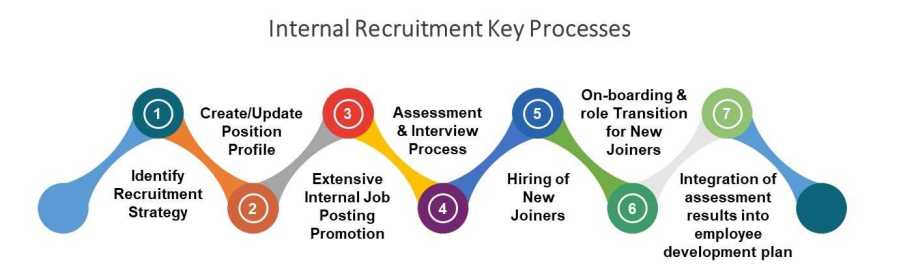
One important source of recruitment is a promotion from within and it is the best method for recruitment of high and the medium cadre of managers and many companies feel that the best practice is to fill jobs from within the organization and they feel that inside employees already know the company and its policies and presumably have proved their ability and loyalty. This keeps the employees happy contented and in good morale and they know that they will earn promotion to a higher position. A performance test is the best test to determine a person’s suitability for a job. Filling of a vacancy from an internal source is very economical and no time and money are required to spend on a new candidate and a person who is selected for a job from within an organization knowns the organizational relationships.

EXTERNAL RECRUITMENT

By the external sources of recruitment, a vast mass of skilled, semi-skilled, and unskilled people is recruited from outside the organization. By using external sources of recruitment the organization can expect to get talented candidates from outside and the selection process is characterized by competition and the prospects that the organization can pick up the best candidates and fresh talents for the job are high. External candidates are expected to be trained and be efficient in work as they join the organization they work with great vigor and put in their best efforts to achieve the objectives and this creates healthy competition and congenial work environment in the organization.

Birthday tribute to Shri P. V. Narasimha Rao ji: Great personality & Erudite Scholar

Dear Professor Chatterjee sab
I am delighted to see one after another article which are informative and thought provoking.
The present one about the Prime minister who had taken many economic reforms which lead our country to this level on par with developed countries.
I wish you would continue to write such articles for benefit of people.
Regards
B S Hiremath
Senior Consultant
Monitoring Cell
CEO office Karnataka

Indian government bigger step against china

Indian government on 29 june Monday, banned 59 chinese apps in india along with tiktok which is one of the most widely used app in india with billions of active users. Tiktok app has been removed from Google Play store too and those who already have tiktok app installed in their mobile phones can still use the app and can see this app in Play store, while it is not available for those who don’t have this app already in their phones.

This step of Indian government is due to disputes between india and China. Government claimed that these apps are not secured as they may share users private information to foreign countries.
From a very long time, revolution to boycott Chinese apps has been going on in india, in which people were hating tiktok app the most. Videos of people uninstalling tiktok from their phone was viral all over the social media and youtube a month ago. People were boycotting this chinese app. Even people who didn’t used it, gave it rating which led to decrease in it’s rating to around 2 star.

However, it was very common before this revolution, people used to insult the tiktokers for wasting their time over this app which we used to see on social media comment section and even on reality shows on T.V.

Now, this is recognised as a very big step by indian government towards boycotting the Chinese things.

Tik Tok along with 58 Chinese apps banned.

Government of India has banned 59 apps originating from China, including very popular ones like the short video platform TikTok, UC Browser, file sharing app ShareIt, and CamScanner etc.

The ban has been enforced by The Ministry of Information Technology by invoking it’s power under section 69A of the Information Technology Act and the Information Technology (Procedure and Safeguards for Blocking of Access of Information by Public) Rules 2009.

According to ministry, these Apps are engaged in activities which is prejudicial to sovereignty and integrity of India, defence of India, security of state and public order.

This action could be a warning to bigger Chinese businesses in India, and to China itself.

Is mask important during exercise in Covid-19?

Has exercise helped you deal with the lockdown? If it’s, then you’re never alone. Exercise is unlimited. Gyms might reopen and therefore the government advice suggests that folks should wear face coverings on conveyance and in places where social distancing isn’t possible. But does this reach exercise? Here’s what you would like to understand about mask important during exercise or not.

Are runners required to wear face masks?

Not really. People should wear face masks where social distancing isn’t possible always and where they can inherit contact with others. Though they are doing not normally meet, for instance on conveyance or in some shops, the mask is important. In crowded areas, this recommendation could reach runners but officially there’s no advice requiring people that are exercising during a wide-open space to wear a mask. As long as you’re doing social distancing, it shouldn’t be necessary to wear a face-covering while exercising.

However, many professionals agree that wearing a mask is more about preventing the spread of Covid-19 to others, instead of protecting yourself, particularly if you’re asymptomatic.

If you’re getting to be jogging during a highly urban area, it’d be advisable to stay a mask in your pocket and put it on as you pass any crowds of individuals.

Is wearing a mask while exercising harmful?

There’s no scientific consensus on either the advantages or the risks, of wearing a mask while exercising, primarily because little research has been done into the world.

These five things which will happen if you wear a mask and exercise:

1.Claustrophobia

Because you breathe heavily while you’re exercising, there are high chances of you getting claustrophobic because the air supply could be restricted by your mask.

2.Lower stamina and fatigue

Stamina all boils right down to the quantity of oxygen you’re inhaling while you exercise. If you’re wearing a mask then your stamina is going to be on the lower side as you won’t be taking in the maximum amount of oxygen as you want to.

3.Nausea

Lack of oxygen and breathlessness may additionally cause nausea and dizziness.

4.Excessive sweating and dehydration

When you keep it up re-breathing the air you exhale it accelerates your pulse thanks to which you sweat tons. This can result in high chances that your body might dehydrate. We should always stay hydrated during the summer is crucial.

5.Unconsciousness and irritability

Although it’s not quite common, you can’t eliminate the probabilities of it. once you exercise together with your mask on you’re rebuilding the CO2 levels in your body which may cause unconsciousness.

Right now it’s better that you simply occupy the home and do whatever exercises you would like on your premises. you’ll use your terrace rather than stepping out.

Now that even the planet Health Organisation (WHO) is saying that we’d like to find out to measure with COVID-19, we’d like to take care of the alternatives we make. So, consider before you slip away for a run together with your mask on.

However, these incidents are rare, and there have likely been underlying health conditions.

Should You Wear a Mask When Exercising Outdoors? - WSJ

What sort of mask should I wear when I’m exercising?

From floral summer prints to heavy-duty respirators, it seems there is a mask cropping up for each occasion.

Several companies are producing face masks to run in, and these are for style and using materials to stop becoming excessively damp – breathing through the mask will produce water. The mask should be clean than having several will help. the fabric must be porous.

To help us, a mask made out of sentimental, breathable fabric that’s washable, making it safe for a sweaty exercise has been introduced. Masks also provide FFP 1 grade protection.

Is Will exercising with a mask affect my performance?

Whether you’re an experienced runner or a lockdown newbie cyclist, everyone likes to perform to the simplest of their ability. If you are planning to wear a mask on your daily exercise, it can make you feel uncomfortable, in hot weather.

There’s no doubt that folks are getting to find running with a mask harder. Then you’ve needed to breathe a touch harder to urge through the barrier, which suggests your lungs are getting to get a touch more of a piece out.

A mask decreases the flow of air into your lungs, so you’ll have less oxygen in your bloodstream. This suggests you’ll fatigue quicker. It’s likely that you simply are going to be getting enough oxygen once you exercise with a mask on, but if you are doing experience unusual signs like lightheaded, dizziness, extreme shortness of breath or numbness and tingling, stop exercising, begin your mask and take an opportunity.

Conclusion

Now lockdown restrictions are starting to be lifted, it’s even more important to require extra care when exercising publicly. If you can, choose a run where you are not going to encounter many of us. If you would like to exercise with someone, run side by side with an honest gap between each of you.

Also maintains it is vital to remember of the opposite people – both runners and pedestrians – on the pavement around you. If another person is coming towards you, shout and instruct in which direction you will proceed running. This will avoid collisions.

An Unexpected Guest

Don’t you find it a bit ironic that India is a country where women have no reproductive rights yet our nation is known worldwide for the Taj Mahal, a monument breathing the story of a queen who lost her life at the altar of her childbirth?

Today, the number of teenage girls popping the easily procured abortion pills, away from the knowing and reproachful eyes of their parents, is alarming. Buried under their winter jackets, they don’t even realize that a baby is growing.

guestTeenage pregnancy usually tends to occur within marriages, more often than not, set up by the parents of adolescents. On the other hand, some cases are the result of teenagers engaging in unprotected sex simply because they were not aware of the consequences or how to deal with them.

Either way, their ignorance leads them to get an abortion in a later stage which is not the ideal scenario, either for the baby or for the mother. In many cases, the complications are such that only one of them could be saved, putting the families in a position of dilemma and jeopardizing the futures of many. Here are a few measures to make people understand the consequences of teen pregnancy.

  1. Have ‘The Talk’

It is no secret that many parents in Indian society believe that talking about sex is a hushed or taboo topic. This ends up in many teenagers getting their share of knowledge from the internet, a place where most of the facts about this are misguiding and misleading, ending up in them having unprotected sex. If you are a parent, sit down with your children and let them know about this natural process, about their bodies. Since it is coming from a trusted source, they will be encouraged to ask their doubts and share their insecurities. This will help them in making an informed choice about their future.

  1. Know your Child

A parent’s duties involve fending for their children and to provide for them until they come of a certain age. This also includes protecting them from the evils of the world. Know who are your children’s closest friends and other people in their social circle. Try to keep a healthy atmosphere in your home and have open communication with your children so that they never have to lie about their whereabouts. Parenting is a two-way relationship; understand your children’s needs and try to help them cope up with their difficulties.

  1. guest2Sex Ed Classes

School is the place where you go to learn. If they can teach you your History and Math, then why not your Biology too? There should be a special Sex Education class for adolescents where they are taught about their bodies and the role they play in reproduction in detail. Students should be taught about the consequences of having sex including the diseases and made aware of all the birth control methods available to them. Counselors should be made available to the students, aiding and guiding them in times of crisis.

After all, awareness is the key to prevention.

Image Courtesy: GOOGLE

3 Skills Business Students Should Know

Technology is ubiquitous in the business world, and it’s expected that new employees will be able to tackle certain computer-related tasks once they join the workforce.
Herzing University understands that need and includes technology as a major theme throughout most courses in the business program. One of the most important computer-related skills that students in all academic concentrations learn is proficiency in standard Microsoft Office applications. While similar applications may be used by other businesses (such as Google Docs or OpenOffice) Microsoft applications are still the de facto standard.
Let’s take a look at each one of these applications, and the types of work that a new employee may be asked to do with them:
  • Microsoft Word is the standard for word processing tasks. Employers will expect new hires to be able to use the application to complete an existing template, such as reports and forms. Employees may also be expected to generate new documents based on the needs of the company, the field and their position. Some documents may be as simple as memos, while others may be as complex as research reports or marketing flyers.
  • Microsoft Excel is used to create spreadsheets that organize data so that it can be easily interpreted and analyzed. Students should know general spreadsheet formulas and functions and understand how Excel compiles and reports data. Business students should also be able to analyze data and present it in a fashion that is easy for others to understand. This can include statistical analysis and the creation of tables and charts.
  •  Microsoft PowerPoint is a slide show presentation program that is also often used in the business world. Students should be able to use PowerPoint in a professional setting and create slides that can explain concepts, ideas and data to others. They can use different formats, templates and layouts that make the information both engaging and easy to understand.
In addition to these general applications, students should familiarize themselves with the technical skills they will need for their desired career. For example, students interested in marketing should be able to analyze data in Excel, create memos relating to marketing efforts in Word and develop engaging presentations in PowerPoint. Other applications that might be relevant to a career in marketing include those used for web-based marketing, social media campaigns or evaluating the profitability of different marketing mix options.
A student who understands the value of technology in the business world is likely more qualified job candidate and a more effective worker. At Herzing University, we ensure that students are exposed to a wide variety of software applications so that they can hone their technical skills throughout their academic program.
Learn more about our business programs here.

Does Technology Make us Feel more Alone??

We are all for the most part guilty of staring at our phone screens rather than engaging in verbal conversation. Imagine going out to eat with your friends who you haven’t seen in forever and you have been saving the date for a while now; you finally show up and begin to chat with them before there phone lights up. They excuse themselves to send a quick text before they become more invested in their phone conversation than with you. Instead of engaging face, to face you begin to give halfhearted responses to each other before you give up and relinquish yourself back to checking the same social media posts you saw a half hour before showing up. While being a bit dramatic, it still serves to demonstrate that with the overabundance of technology that has been ingrained into todays social structure, it serves as a hinderance for those who are actively seeking to be more social.

In a study done by the Cigna Health Insurance company of a survey of 20,000 Americans, 46 percent of them reported feelings of being always or sometimes lonely. However, they further documented that how long people spend online also contributes to feelings of loneliness. They say that users who access social media more than fifty times a week are three times as likely to develop feelings of social isolation than users who accessed social media platforms like Facebook and Snapchat less than nine times per week.

This is most likely due to the fact that we choose to obsess over documenting our lives rather than live in the moment. Seeing people around you have a better time than you or those who might possess more of a certain trait than you can make you feel inadequate. While most people can realize that people choose to share momentous or joyous moments of their lives to the world, low self esteem users would become trapped in the minefield of social media with triggers surrounding them.

Loneliness can be severely life-altering – even life-threatening – for those who experience it. Linked with psychological problems such as alcohol and drug abuse, eating disorders and depression, the devastating effects of loneliness cannot be overstated. There is also much evidence to suggest that loneliness causes biological problems as well as psychological ones, and can even lead to death.

According to figures published in the Independent, an analysis of 300,000 people in 148 studies found that loneliness is associated with a 50% increase in mortality from any cause. In other words, no matter the ailment a person may be suffering with, isolation makes it worse and renders it harder to recover from the condition. In these terms, the analysis concluded, loneliness may be considered comparable to smoking 15 cigarettes a day, and more dangerous than obesity.

To combat the negative impacts of loneliness, people need real, in-person interactions, the authors of the Cigna study say. However, the more we rely upon technology – both at home and in the workplace – to socialize, complete daily tasks and perform work duties, the less time we spend meeting face-to-face with our friends, family, and co-workers, leading us once again to the question: Does technology make us more alone?

While different studies reveal slightly different statistics, the overall trend is clear – we are indeed addicted to technology, and social media use, in particular, has skyrocketed over recent years. One report last year from GlobalWebIndex estimates that digital consumers are now spending an average of 2 hours and 22 minutes per day on social networks and messaging services. Young people (16-24-year-olds) spend even more time, clocking up about 3 hours per day.

A separate report reveals that when we factor in all media technology – TV, computers, radio, smartphones, tablets – US adults are spending 10-and-a-half-hours every single day consuming media. That’s 10-and-a-half hours out of every 24 zoned into a screen, not talking to anybody, not socializing, engrossed in other people’s lives instead of living our own.

But what can we do about this? Is there no possible solution for this wide epidemic of “social media attraction” to get our teens to be more effective in communicating and developing social skills that are needed for their future lives and careers? The answer is yes, there is a solution to this.

What teens and parents can do is limit the time that their children use their smartphones for. Find ways for them interact with other people and siblings, have interesting and effective talks with new people, be friendly and open-minded and be up to listening what other people have to say. Go outside and spend an afternoon playing a sport and exercising for a much healthier life. Spend sometimes outdoors with your friends playing and talking. These are some of the many solution for a better and more effective teen that will develop the skills needed in order to approach the real world.

Refrences:-

https://highschool.latimes.com

http://www.nytimes.com

Explained: How will the ban of TikTok and other Chinese apps be enforced; what will be the impact?

TikTok, other Chinese apps banned in India: The notification is expected to be followed by instructions to Internet service providers to block these apps.

Some of the banned Chinese apps are very popular among Indian users, especially TikTok which has over 100 millions active users in the country, especially in heartland India.

India on Monday banned 59 apps originating from China, including very popular ones like the short video platform TikTok, UC Browser, file sharing app ShareIt, and CamScanner, which allows iOS and Android devices to be used as image and document scanners.

What is the legal basis for India’s action?

The ban has been enforced under Section 69A of the Information Technology Act, 2000 (“Power to issue directions for blocking for public access of any information through any computer resource”): “Where the Central Government or any of its officers specially authorised by it… is satisfied that it is necessary or expedient so to do, in the interest of sovereignty and integrity of India, defence of India, security of the State, friendly relations with foreign States or public order or for preventing incitement to the commission of any cognizable offence relating to above, it may… by order, direct any agency of the Government or intermediary to block for access by the public or cause to be blocked for access by the public any information generated, transmitted, received, stored or hosted in any computer resource.

The Ministry of Information and Technology has said that it “has received many complaints from various sources including several reports about misuse of some mobile apps… for stealing and surreptitiously transmitting users’ data in an unauthorised manner to servers which have locations outside India”. Since this “ultimately impinges upon the sovereignty and integrity of India, is a matter of very deep and immediate concern which requires emergency measures”, it has said.

How will the ban be enforced?

The notification is expected to be followed by instructions to Internet service providers to block these apps. Users are likely to soon see a message saying access to the apps has been restricted on the request of the government.

However, while this will impact apps like TikTok and UC News that need a live feed to serve any purpose, users might still be able to continue using apps that don’t need an active Internet connection to be used. But further downloads of these apps, like CamScanner, are likely to be blocked on Google’s Play Store and Apple’s App Store.

India bans Chinese bans, Chinese apps banned, Chinese apps banned full list, TikTok banned, UC Browser banned, ShareIt banned, Indian ExpressqThe full list of 59 Chinese apps banned by the government.

What will be the impact of the ban?

Some apps on the banned list are very popular in India, especially TikTok, which has over 100 million active users in the country, mainly in the heartland. New social media platforms like Helo and Likee, as well as video chat app Bigo Live are immensely popular among Indians who are not comfortable in English. These users will have to look for substitutes.

Also, most of these platforms have Indian creators, for many of whom this is the only source of income. Many of these apps have offices and employees in India, and a few thousand jobs could be at stake.

Decoding LAC Conflict

How will the ban of TikTok and other Chinese apps be enforced; what will be the impact?

With stand-off at friction points continuing, expect a longer battle of nerves on Ladakh LAC

Talks will continue but military pushback also on Delhi’s table

Will the ban be permanent?

TikTok was banned in India on the order of the Madras High Court for a few days last year, but it came back soon after the court vacated the ban. This action, however, is more sweeping, impacts more apps, and has been taken in a specific strategic and national security context. It could be a warning to bigger Chinese businesses in India, and to China itself.

Sensex falls 210 pts to end at 34,962; Nifty slides 71 pts to 10,312

Domestic equity benchmarks today closed with losses of more than half a percent amid negative global cues.

Sensex at Bombay Stock Exchange declined 210 points, or 0.6 percent, to close at 34,962. Similarly, the Nifty at National Stock Exchange fell 71 points, or 0.68 percent, to settle at 10,312.

Broader indices at BSE also logged losses. Mid-cap depreciated 1.39 percent while Small-cap lost 1.23 percent.

Government announces launch of seven-year floating rate savings bonds

Government has announced the launch of seven-year Floating Rate Savings Bonds, 2020 (Taxable) scheme commencing from 1st  July.

According to an RBI notification, Floating Rate Savings Bonds will enable a person resident in India or Hindu Undivided Family to invest in a taxable bond, without any monetary ceiling.

The interest on the bonds is payable semi-annually on 1st January and 1st July every year. The coupon on 1st January 2021 shall be paid at 7.15 percent.

Over 3.21 lakh people recover from COVID-19 so far; recovery rate improves to 58.67%

The Government today said a total of 3,21,723 people affected by corona virus have been cured in the country so far.

In the past 24 hours, 12,010 people have recovered from Covid-19 and with this the recovery rate  has reached  58.67 per cent.

The Health and Family Welfare Ministry said, a total of 19,459 new cases of Covid-19 have been reported in the country within 24 hours taking the total number of cases to 5,48,318.

In a single day, 380 deaths have been reported taking the nationwide toll to 16,475.

Presently, the total number of active corona cases in the country is 2,10,120.  

The Indian Council of Medical Research, ICMR has said 1,70,560 samples were tested for corona virus by various laboratories in the country within 24 hours.

Government bans 59 mobile apps prejudicial to sovereignty and integrity of India

Government has banned 59 mobile apps which are prejudicial to sovereignty and integrity of India, defence of India, security of state and public order.

Electronics and IT Ministry said in a release that these apps were banned in view of information available they are engaged in activities which are prejudicial to sovereignty and integrity of the country, defence of the country and security of state and public order.

The banned apps include TikTok, Helo and WeChat.

Over the last few years, India has emerged as a leading innovator when it comes to technological advancements and a primary market in the digital space.

At the same time, there have been raging concerns on aspects relating to data security and safeguarding the privacy of 130 crore Indians. It has been noted recently that such concerns also pose a threat to sovereignty and security of the country.

The Ministry of Information Technology has received many complaints from various sources including several reports about misuse of some mobile apps available on Android and iOS platforms for stealing and surreptitiously transmitting users’ data in an unauthorized manner to servers which have locations outside India.

The compilation of these data, its mining and profiling by elements hostile to national security and defence of India, which ultimately impinges upon the sovereignty and integrity of India, is a matter of very deep and immediate concern which requires emergency measures.

The Indian Cyber Crime Coordination Centre, Ministry of Home Affairs has also sent an exhaustive recommendation for blocking these malicious apps.

This Ministry has also received many representations raising concerns from citizens regarding security of data and risk to privacy relating to operation of certain apps.

The Computer Emergency Response Team (CERT-IN) has also received many representations from citizens regarding security of data and breach of privacy impacting upon public order issues.

Likewise, there have been similar bipartisan concerns, flagged by various public representatives, both outside and inside the Parliament of India.

There has been a strong chorus in the public space to take strict action against Apps that harm India’s sovereignty as well as the privacy of our citizens.

On the basis of these and upon receiving recent credible inputs that such Apps pose threat to sovereignty and integrity of India, the government has decided to disallow the usage of certain Apps, used in both mobile and non-mobile Internet enabled devices.