TIPS TO STAY FOCUSED

“Always remember, your focus determines your reality.” — George Lucas

Unless you have a strong desire to learn the information or develop a skill, it can be hard to focus all of your attention in one place. If you are impatient to learn or master anything, it wouldn’t benefit you more. If you are restless, you will make more mistakes and you will be more distracted as your whole focus will be on result, not on your action.

Instead, remain calm and be devoted to your work.

A mind which is calmer helps you to concentrate better, attaining undivided focus and it makes you proactive.

Television, smart phones, social media, friends, and family can all distract you from your goal of doing well in school. Create an environment that helps you focus. Set a schedule that maximized your study time. Try different study techniques and take breaks so you don’t become too overwhelmed. Here are some of the best tricks that scientists have come up with to help you increase your focus in studying.

  1. Get rid of distractions. Choose the right spot. In order to concentrate, you must eliminate those things that you know will distract you. Put up mobile devices. Turn off the TV. Close other pages in your web browser. Sit away from people making loud noises.
  2. Play music without lyrics. Some people cannot stand silence. They need to have background noise to help keep themselves motivated. Consider playing classical music softly. For some people, music helps them concentrate. For some, it doesn’t. Try it out and see what works best for you. A little something in the background can make you forget that you’re studying instead of out having fun.
  3. Come prepared. Be sure to have all the materials needed to work. Have pencils, pens, highlighters, paper, textbooks, calculators, or whatever else will help you finish the task. Organize the area. A clean space will mean less distractions too. Your goal should be to take care of everything outside of studying before you sit down to focus. If not, you’ll just end up getting up repeatedly. Having to stop and start takes more time than continuously working.
  4. Find a place where you can “unplug”. One of the biggest complaints that teachers have about their students is their inability to concentrate on a subject. Our constant use of social media and personal devices like cell phones divides our attention and makes it more difficult to concentrate.
  5. Learn when to say no. Often times, people find it difficult to concentrate on their studies because they are overextended with other obligations. If this is you, don’t be afraid to tell people no. Just explain that you need to study and won’t have the time or energy to do so, if you help them out.

Ultimately, there’s no quick, one-size-fits-all solution to staying focused while studying. Different methods and tools will work better for some than others. However, with a little trial and error and the tools and techniques above, you can create a routine of focused studying that works best for you.

Procrastination

Have you ever put off your homework till the last minute? Or perhaps studied for the test only a day before? Maybe delayed writing an essay till the last possible hour? All of us are guilty of delaying tasks and putting off important work until a later date.  This is essentially procrastinating. It is the action of purposefully delaying any task or activity. In this procrastination essay, we will see the reasons and the solutions to this problem.

As we will see in this procrastination essay, this is not a rare phenomenon. Almost everyone is guilty of it at some point in their lives. So we ask ourselves this question – why do people procrastinate even when they are so busy most of the time? We live in the 21st century, where time is our most precious commodity. And yet, we waste this precious resource procrastinating our time away.

Procrastination Essay

Why do we Procrastinate?

The reasons for a person procrastinating can be varied. It depends on person-to-person and situation-to-situation. However, there are some universal reasons that cause people to delay their tasks and actions. One of the most important ones is the fear of failure. When a person delays doing an important task or is disinterested in finishing it, the cause could be a deep-rooted fear of failure. It is in human nature to avoid and fear failure. So by choosing to never finish the task, we can avoid the consequences as well.

Another reason is the lack of focus and determination. Feeling directionless and unfocused can often cause people to lose their wills to do their jobs. This leads to procrastination. Sometimes the lack of goals and objectives is also the reason a person loses their focus. Since they do not have an end-goal in mind, they end up wasting energy in other useless tasks.

There are other reasons a person may procrastinate. Sometimes, a person may be too much of a perfectionist. This distracts them from other tasks. And then there are other reasons like laziness, low energy levels, easy distractions, etc.

8 Ways to Stop Procrastination

How to Stop Procrastinating?

While procrastinating is a very natural fault we all share, if it gets out of hand it can get quite troublesome. Excessive procrastination can disrupt your life and cause you to lose control of your schedules and deadlines. So when the procrastination gets out of hand, you need to reign it in and get back in control.

One way to stop procrastinating is to break down the dreaded task into little steps. If the work or the task is too overwhelming, we tend to procrastinate about it. But if the job is broken down, then we can tackle one step at a time without being overwhelmed. You can also create a detailed timetable or a timeline of some sort to help you with the steps.

At other times changing your work environment may be beneficial. It can provide you with the boost necessary to stop procrastinating and finish the task. If possible get a friend or a parent to keep a check on your progress. It helps keep the motivation levels up and encourages you to finish the task on time.

The main concern is not to over-focus or blame yourself for procrastinating sometimes. We are all a victim to procrastination from time-to-time. As long as it does not derail your entire schedule, give yourself a break and just get back to work!

The Opposite of Procrastination – Association for Psychological Science –  APS

10 Ways To Stop Procrastinating

So why do I still do it? In fact, how come millions of people all over the world procrastinate even when they know they will regret it? More importantly still, is there anything that you can do to stop wasting your time, put an end to your procrastination, and get your work done? I discovered some great trick which helped me stay focused on my work, and saved me the embarrassment of missing crucial deadlines. Find out 10 tricks which helped me stop procrastinating, and can help you as well!

1. Don’t overthink it:
A plan needn’t be perfect. It should just get the work done. Spending hours, days, or even weeks planning something, is only going to cause you endless delays.

2. Don’t wait too long to start:

So you have come up with the perfect plan to do it. Great! So why aren’t you starting? Stop waiting for the perfect moment, there is no such thing. Start today. Start this very instant. You will thank yourself later.

3. Divide and conquer:
If the British could rule over half the world with this strategy, you can certainly use it to get that priority assignment done! Break it down. Start small, and just keep going. Divide, and conquer it all!

4. Stick to your deadlines:
When you set a deadline for yourself, it is somewhat easy to not follow it. Follow them anyway. Make it a habit. Self-discipline is the only way to conquer procrastination.

5. Remove all obstacles:
Whether you are studying or have an important project submission, it is easy to find things to keep you distracted. Identify what these commonly are, and eliminate them before you start work.

6. Work with others:
Teams are made for a reason. They not only reduce your overall work load, they also keep you focused. Work with other people and surround yourself with them. If you have to study, go to the library or the common room.

Say no to Procrastination. Start... - Union Bank of Nigeria | Facebook

7. Broadcast your goals:
Seek support from your friends and let them know what you are trying to do. Tell them your goals. Their positive feedback will inspire you to work harder.

8. Ask an expert:
There will be people who have already achieved what you are trying to do. Seek them out if you can and ask them for the strategy that helped them succeed.

9. Stop making your life difficult:
There is no need to complicate things. Sometimes a task can be very simple, and we just keep making it harder by delaying or not planning properly. Do yourself a favour and simplify your goals whenever you can.

10. Be sure of why you are doing it:
Setting a goal, such as Complete this assignment in 5 hours is a great start. But what is your end goal? How will you benefit? Remind yourself why you are working so hard, and it will help you stay focused.

So now you have my 10 simple ways to get work done. They helped me stop procrastinating and I hope they will help you succeed as well!

BEING YOUNG AND STUPID!

If you could go back in time and change one thing, what would you like to change?

I wouldn’t change a thing, because all the choices I made in the past, made me the person I am today. I am still a work in progress and have much to learn and grow. Who doesn’t? Therefore I’m no better than any of you. It’s when you fall is when you learn!

You mess up sometimes and that’s ok! you can learn from that mistake. You may hurt people unintentionally or intentionally and you let yourself get hurt too in the process, just so you know how it feels when you fall, and avoid it happening again. You wake up to mornings that succeeded a night you would rather forget. You wake up to mornings that succeeded a night you wish you could remember. You say words you wish you could take back after you start regretting. You wish you had said words you’ll never get the chance to say again.

Being here, in the present, you don’t want to stop believing in yourself.
You think it was worth it, right? Hey, it probably was. It’s OKAY if things don’t go as planned! It’s OKAY to cry and move on!

But is being young and stupid a good enough excuse?

So now, I would like to share an experience of my own, It was during the 12th when I and my best friend decided to go to the same college, away from home, so we became hostelites. But it was during that time, we had a minor argument and misunderstanding, so we both stopped speaking to each other. I had a really bad mental breakdown, It was during that time my dad spoke, saying I was always too dependent on your friends, and I need to let things go and live on! After all, everything happens for a good reason! but people change, when time changes and they grow. But if even after all of those misunderstandings, the person still manages to come back into your life, then he was meant to stay. Now, I and my friend laugh, thinking back as it was such an inane situation.

It was after that time, I realized I needed to be more self-dependent. I also realized communication is the key to solve most of the misunderstandings.

I have met different kinds of people who taught me lessons that changed my perspective.

Here’s a small part from,

“The Little Boy and the Old Man” by Shel Silverstein

Said the little boy, “Sometimes I drop my spoon.” Said the old man, “I do that too.” The little boy whispered, “I wet my pants.” “I do that too,” laughed the old man. Said the little boy, “I often cry.” The old man nodded, “So do I.

We probably behave stupidly because we don’t think, period! And maybe those who turn out to be wise were always full of the wisdom that we weren’t. Sounds philosophical, it’s not.

I’m a big believer in learning from mistakes. I do reflect on my past experiences that carved me into the person I am today.

Happy Independence Day

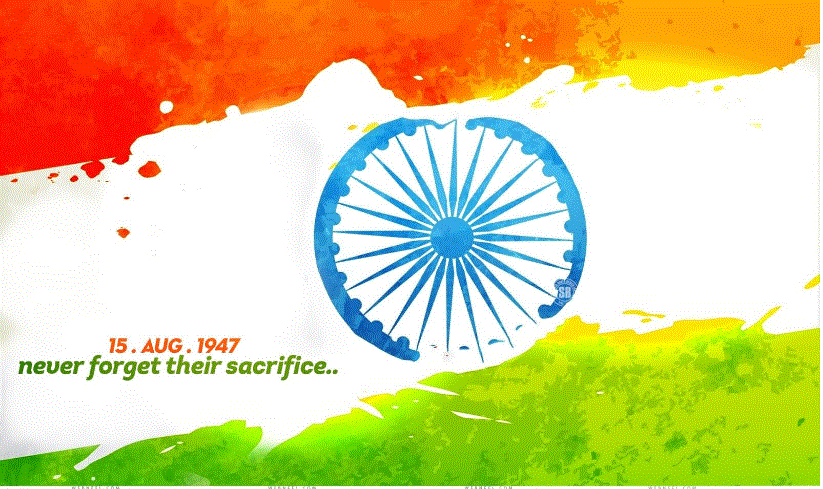
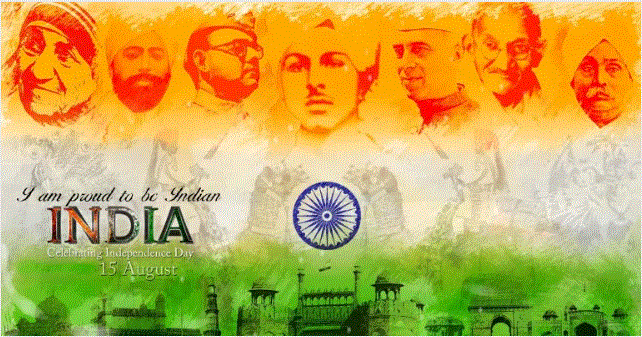
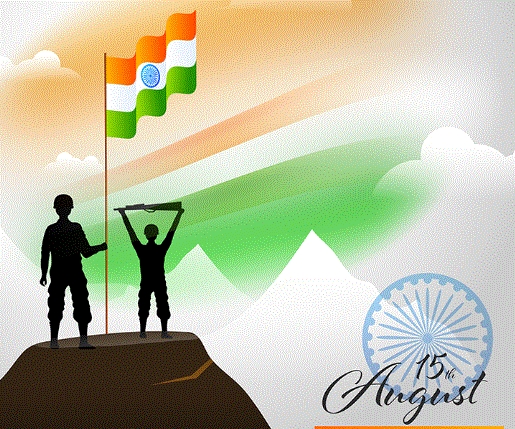
Independence day is a meaningful and one of the most important dates in history of our country. After a long and exhausting struggle India got its Independent on 15th August, 1947.

To honor this day today we will talk about some of the facts that every Indian needs to know regarding this occasion.

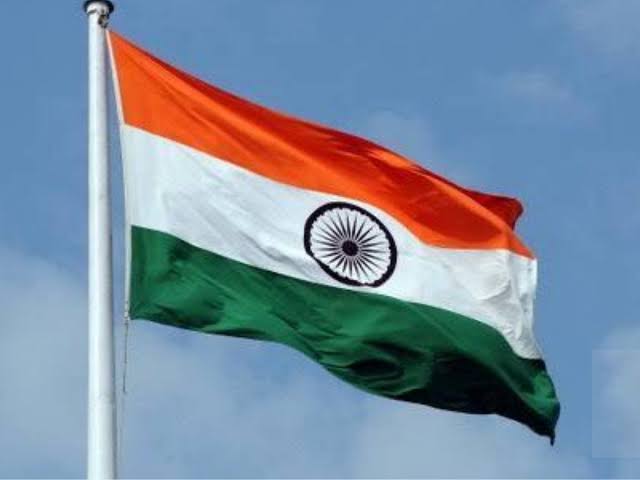
  1. Indian flag was first hosted in year 1906 in Parsee Bagan Square, Kolkata. It had three horizontal stripes of red, yellow and green. It’s first alteration was designed by Pingali Venkayya in in 1921. It is the same flag we host till date. A saffron white and green strip with 24 spokes Ashok chakra.
  2. Besides India there are five other countries who also celebrate their Independence day today. That include South Korea, North Korea, Bahrain, Republic of Congo and Lichtenstein.
  3. Goa was still under Portugal jurisdiction when the country got its independence. It was annexed to India in 1961 and became the last state to join the Indian territory.
  4. Indian flag is only manufactured and licensed by The Khadi Development Village Industries Commission. The Karnataka Khadi Gramodyog Samyukta Sangha located in Dharwad is the only manufacturer of the flag made with cotton.
  5. Our national song ‘Vande Mataram’ was part of the album ‘Anandmath’ composed by Bankim Chandra Chatterjee in 1880s. It was first sung by Tagore in 1896 and officially became the national song on 24th January, 1950.
  6. Lord Mountbatten was obliged to attend the Independence day of both countries, India and Pakistan and hence why he moved Pakistan’s Independence day to 14th August.
  7. Lord Mountbatten chose 15th August as the Independence day to honor the second anniversary of Japan’s surrender to the allied forces.
  8. Mahatma Gandhi wanted the Congress to be disband after country’s independence as the purpose of the party formation was achieved.
  9. India did not have any structural government after achieving independence. There was no president or prime minister at first. Governor general was the person with most authority at that time.
  10. The name ‘India’ originated from the name of River Indus as it was the place of first inhabitants of India.
  11. Bharat Ganarajya is the name of India in Sanskrit and hence the birth of Bharat in hindi.
  12. India hadn’t invaded any other country in last thousand centuries.
  13. Hindi is not the national language of our country but only the official language. It was declared official on 14th September, 1947 in article 343.
  14. Mahatma Gandhi did not attend the first independence day as he was participating in a hunger strike on the same day.
  15. Cyril John Radcliffe is the man behind the design of borders of Independent India despite never visiting the country once.
  16. Our first Prime minister, Jawaharlal Nehru was quite a fashion icon back in the days even making it in a Vogue issue. Nehru jacket was also named after he made it an iconic fashion piece.
  17. India had 562 princely states or kingdoms when it became independent.

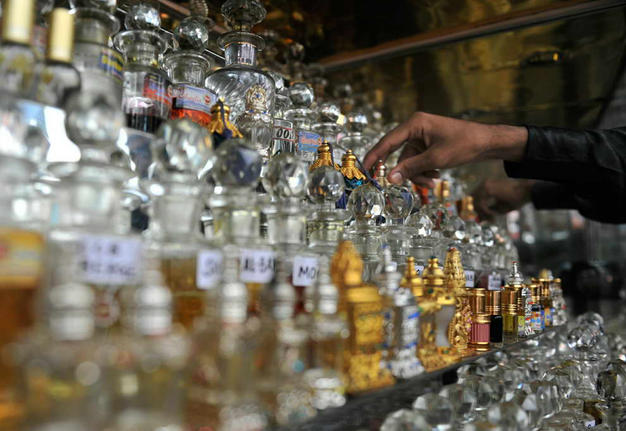
Kannauj 🌹- The Perfume Capital of India

“Kannauj is to India what Grasse is to France”

Kannauj, India’s Grasse, has been producing attar (Perfumes) for over four centuries, well over 200 years before France’s Grasse rose to prominence. In the old days, this town had over 800 perfume distilleries. Around 85,000 folks dwell in this city, with about 4,000 employed in the attar business. Ittar making is a skill that’s been passed down through generations.

Attar is an aromatic oil derived from natural sources like roses, musk, camphor, saffron, or agarwood. Except in rare cases, these natural perfumes are free of alcohol and chemicals.

Both men and women are drawn to attars. They possess rich flowery, earthy, musky, smoky, or grassy notes. Attars can be both warming (cloves, cardamom, saffron) and cooling (jasmine, vetiver, marigold) depending on the season.

Kannauj, the fascinating mitti attar, conjures the aroma of the earth after a downpour.

Shamama, a distilled blend of 40 or more flowers, herbs, and resins that takes days to prepare and months to age, is another sought-after concoction. The scent combines sweetness, spice, smoke, and dampness to create an ethereal experience for the wearer.

White jasmine blossoms and vetiver plants are used in summer varieties. The soil is utilized for monsoon varieties like Mitti ittar, which smells of damp earth, and winter varieties include Heena ittar and musk ittar.

ATTAR MAKING PROCESS

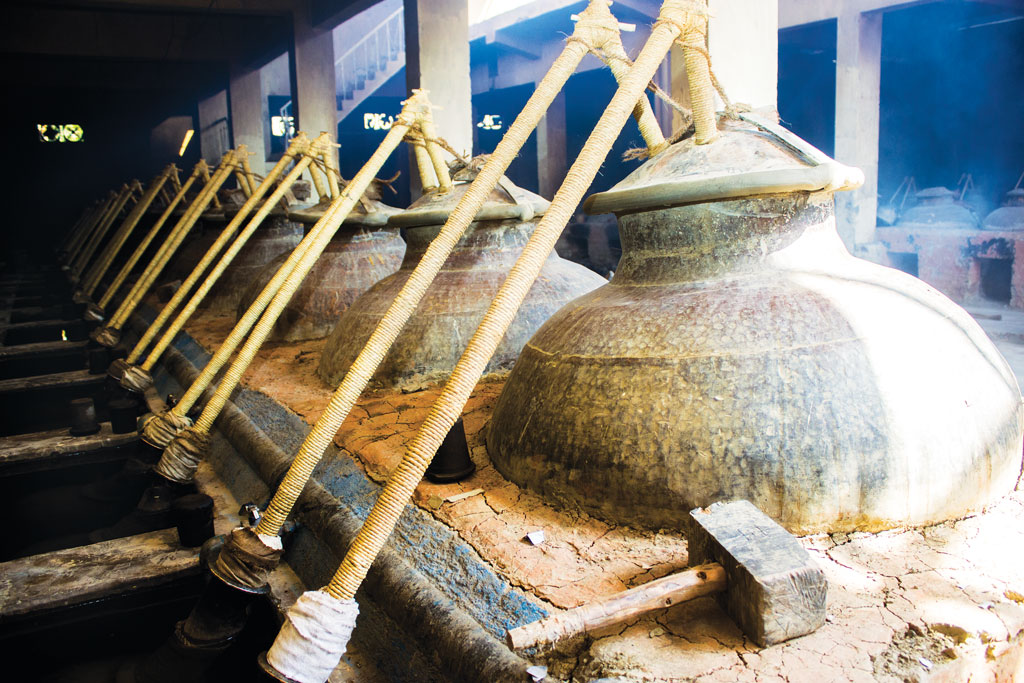
Attar is made by skilled craftsmen known as ‘dighaas‘ using a traditional steam distillation method called ‘deg and bhapka,’ which translates to ‘large pot and little pot.’

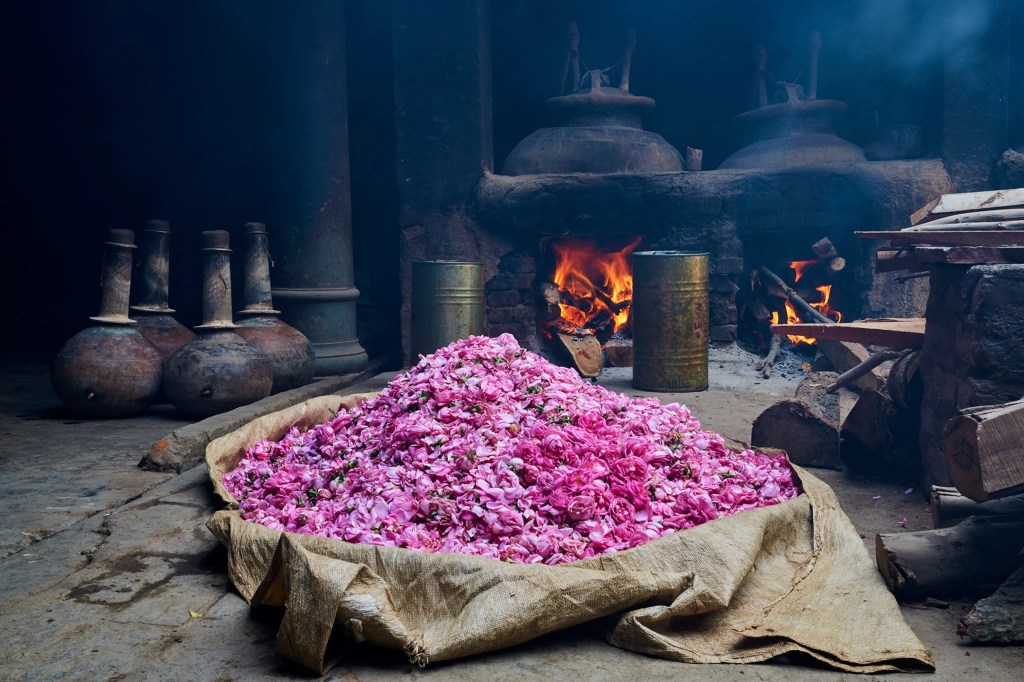
The dighaas begin by pouring the key ingredient into the deg, followed by cold water, then sealing it with a special clay. The concoction is brought to a boil by logs burning under the deg. The dighaas must ensure that the temperature remains constant during the process and that the attar doesn’t overheat or become contaminated.

Next, the steam travels from the ‘deg’ to the ‘bhapka’ (receiver) via a bamboo pipe known as the ‘chonga’. A layer of oil traps the evaporating scent molecules there, Sandalwood oil was formerly utilized for this layer, but because of its hefty price and scarcity, alternative oil-like substances are now employed instead.

Depending on the intended concentration of the final attar, the distillation process is repeated numerous times. It may take up to 25 days to complete the process.

CURRENT CRISIS

The number of perfume distilleries has dwindled from over 800 to just over 100 in recent years, as synthetic fragrances outpace attars in popularity. Kannauj is witnessing a crisis at present. Demand for attar started plummeting as power transferred to British India. Pure Mysore sandalwood was and still is expensive, but when the Indian government banned the trade of sandalwood in the late 1990s, the price of attar soared. In place of sandalwood, natural replacements such as liquid paraffin are used, and although this kind of attar is similar to the original, it falls short. At the same time, affluent Indians transferred their loyalty to imported Western fragrances and deodorants to portray themselves as modern and upper class.

Only a few people in India still purchase attars. It is crucial to resolve the issue for these historic perfume industries to sustain their uniqueness and viability.

75 years of independence of India

So the article is about entering of India into 75 th year of independence this year. As we know the independent word was not associated with India ealier as the Britishers ruled for almost 200 years in India.We were not recognized as a nation in the world. There was no existence of India as an independent country. But after so much of struggle, sacrifices, partition and much more we got independent on the midnight of 15 August 1947. The day which was written in history in golden words. Our first Prime Minister Pt. Jawahar Lal Nehru hoisted the national flag from the ramparts of the Red Fort in Delhi. This was the dawn of a new India towards progress and prosperity. The Independence Day fills every Indian with immense joy and happiness. It is known as the national festival of India. All the offices and every institution across the country celebrates the flag hoisting ceremony. This year the Prime Minister mentioned it as “Amrit Mahotsav”. The people were excited about it and everyone send their videos of singing the national anthem and that too they were played during the ceremony today. We can see a mixture of our traditions and modern resources because of the pandemic situation people could not see the ceremony by being there present as it happened earlier but by this we were a part of the ceremony.

The tricolour flag hoisted from the Red Fort makes us a more proud to be an Indian. India achieved millions of milestones in these 75 years. From earth to space , from being dependent on the world to “Skill India”. India is being known as “vishwaguru” to the world. In the pandemic situation our yoga practices and natural immunity booster were proved a boon to the world. The largest vaccination drive is an example that with proper management and resources we could perform and achieve our objectives in time to benefit people. In every field India is making achievement whether it be medical science or sports or international conferences. India is also focussing on being self dependent on every sector as this the need of the hour. We are a youth country and we have major population as youth. The government is focusing on providing multiple options for the youth. The world is looking towards India as its role model.

Hope you will like the article thank you

Happy Independence Day 🇮🇳

VARIOUS DANCE FORMS OF INDIA

Dances reflect the mood and feelings of human beings through expression and body movements. India is known for many dance forms each of which is originated from its state. However, only six classical dance forms such as Bharatanatyam, Kuchipudi, Kathak, Kathakali, Odissi, and Manipuri are nationally recognized. Apart from this, many dance forms have their origin from India. Indian dance arts are not only about body movements and gestures. It is one of the ancient ways of showing devotion to God. It shows the inseparable connectivity with the Indian culture. Here, in this article, some of the famous dance forms of India would be discussed briefly.

BHARATANATYAM

Being one of the most famous classical dances of the world, Bharatanatyam owns its origin from Tamil Nādu, one of the southern states of India. Bharatanatyam was performed for the divine Carnatic music by women in temples in the ancient period. The movements and gestures of this dance form are called mudras and the dancer uses mudras and facial expressions to show the Navarasa (9 emotions). It is one of the most honourable art and is still learned by many women in the south.

KATHAK

Kathak is an Indian dance form that has its origin from the northern state, Uttar Pradesh. The word Kathak is derived from the term ‘Katha’ which means story. This dance is performed in a way to narrate a story with the dance movements. Both male and female dancers perform together. The ankle movement is the most important one which is done by wearing the Ghungroos (Ankle bells). 

KATHAKALI

Kathakali is another traditional dance form that is related to storytelling. It is originated from The Land of Spices of India, Kerala. The tales performed are Ramayana and Shiva stories. It includes heavy makeup, costumes, and face masks that are bright and colourful. The dance depicts both evil and good through facial expressions and gestures.

KUCHIPUDI

Kuchipudi, belonging to the southern state Andhra Pradesh is said to be the toughest dance form. It includes singing along with dancing. Hence it requires more skill and dedication compared to other forms. It was performed by male dancers, especially the brahmins in temples in ancient times. However, as time flew it became common and is performed even by women nowadays.

ODISSI

Odissi is the oldest dance form from the eastern state of India, Odisha. It narrates the stories of the Gods Shiva and Surya which are given in the form of poems. These poems are played as songs and the dancers express them through more than 50 intriguing mudras. These mudras are sculpted in the Hindu temples of India. It is preserved by practicing and making its survivance till today.

MANIPURI

Manipuri stands as a symbol to represent the rich traditions of the north-eastern state, Manipur. It narrates the romantic relationship between Lord Krishna and Radha, which is called Raas Leela. It is performed to the music of classical instruments by wearing the traditional Manipuri costumes and makeup to showcase the tale of the two gods. 

Bhangra, Garba, Bihu, Mohiniyattam, Ghoomar, Lavani, Rouf, Karagattam, etc. are the other well-known dance forms of India. 

ANTIBODIES – Our Body’s Military Force!

ANTIGENS:

These are the foreign bodies that have the capability to bind with the immunogen and also induce an immune response from our body.
The majority of antigens are made up of protein. But some can also be made of carbohydrates, lipids, or nucleic acid.

ANTIBODIES/ IMMUNOGLOBULINS:

An antibody is a protein molecule that is generated in the living being by the plasma membrane of the cell. The majority of antibodies are produced in the blood, hence the name immunoglobulins.

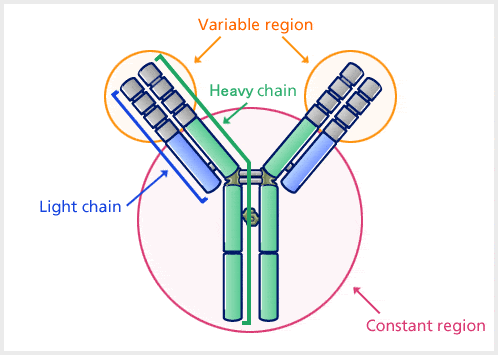
Each antibody consists of four polypeptides– two heavy chains and two light chains joined to form a “Y” shaped molecule.
The amino acid sequence in the tips of the “Y” varies greatly among different antibodies. This variable region, composed of 110-130 amino acids, gives the antibody its specificity for binding antigen.

Antibodies are divided into five major classes, IgM, IgG, Iga, IgD, and IgE, based on their constant region structure and immune functions.

IgG antibody function :

IgG provides long-term protection because it persists for months and years after the presence of the antigen that has triggered their production. IgG protects against bacteria, viruses, neutralizes bacterial toxins, triggers complement protein systems, and binds antigens to enhance the effectiveness of phagocytosis.

IgM antibody function :

IgM is involved in the ABO blood group antigens on the surface of RBCs. IgM enhances ingestions of cells by phagocytosis.

IgA antibody function :

The main function of IgA is to bind antigens on microbes before they invade tissues. It aggregates the antigens and keeps them in the secretions so when the secretion is expelled, so is the antigen. IgA is also the first defense for mucosal surfaces such as the intestines, nose, and lungs.

IgE antibody function :

IgE bind to mast cells and basophils which participate in the immune response. Some scientists think that IgE’s purpose is to stop parasites.

IgD antibody function :

IgD plays a role in the induction of antibody production.

IMMUNE SYSTEM IN OUR BODY:

The main role of the immune system is to recognize the pathogen, respond to the foreign antigens, and memorize them.

LYMPHOID ORGANS:

These are further divided into two types:
1) Primary lymphoid organs: This comprises of bone marrow and thymus, where T-lymphocytes and the B-lymphocytes mature and acquire their antigen-specific receptors.
2) Secondary lymphoid organs: It comprises of lymph nodes, spleen, and Mucosa Associated Lymphoid Tissue (MALT). After maturation of the T- lymphocyte and the B-lymphocyte, they migrate here via blood vascular and lymphatic system, where they undergo differentiation.

VACCINISATION OR IMMUNISATION:

A vaccine is generally a half-killed or weakened disease-causing pathogen that is then given to the healthy individual through injection or drops, which has the ability to generate an immune response but not cause any disease or doesn’t have the ability to spread in the body. This causes acquired immunity against the disease-causing pathogen. This is called as vaccination or immunization.
The concept of vaccination is based on the ‘memory’ of the immune system. Our immune system has the ability to recognize the pathogen if it has once been already spotted and antibodies have been created by our body.
So when the same pathogen enters our body, it is immediately spotted by the lymphocytes, and the antibodies are produced almost instantly given a quick response.

ORGAN TRANSPLANTATION:

It is the process of replacement of diseased tissue with healthier ones. Various factors are involved in transplanting an organ from a donor to a recipient such as tissue matching, immunosuppression, the immune response generated in the recipient. T-cells play a major role in the process of rejection.

CONCLUSION:

Antigens are the substance majority made of protein that has the capability to stimulate the production of antibodies. Antibodies are protein molecule that inactivates the antigen. They are also called immunoglobulins. Lymphoid organs are the place where the maturation of lymphocytes takes place. Vaccine is introduced into our body to prepare antibodies against certain pathogens. While organ transplant has its own pros and cons.

What do we think about Independence Day,But are we independent??

Happy Independence Day to all of you.On this day this year, India is celebrating its 75th Independence Day.India got independence on this day on 15 August 1947, ending almost 200 years of British rule.The Indian independence movement began during the First World War and was led by Mohandas Karamchand Gandhi.The Indian Independence Bill was introduced in the British House of Commons on 4 July 1947 and was passed within a fortnight. It provided for the end of British rule in India on August 15, 1947. After that, India became an independent country after the partition of India and Pakistan.

Though we all know that we will have many memories of Independence Day by now, childhood memories of school.And there is a lot of enthusiasm especially among the children about Independence Day because they get a chance to participate in the cultural programs of the school. Especially children also like to participate in drama on this day. Some play the role of Shaheed Bhagat Singh, some of the Rani of Jhansi and some of Mahatma Gandhi. Everyone has their own favorite character.However, like last year, this year also due to Corona virus, this day is not being celebrated on a big scale or with fanfare, but still it was celebrated keeping in mind the safety. Keeping in mind the safety of all of you in your homes with your children and family
Can celebrate Independence Day.And parents should tell their children the importance of this day because parents are the first teachers of their children and if you will not tell them about such a special day related to your country, then how will they know the importance of this day. By understanding this one will be able to become a responsible citizen.

Due to Corona virus, many people have lost their loved ones in our country.But when our soldiers did not give up for the sake of the country, then why should we give up on this disease.We have to face this disease with complete safety, happily with our loved ones without any fear.We were not defeated at the time of independence of the country, so even now we will not lose from this corona, the day will come when India will be free from corona and this time our fight is with corona.So by taking care of everything with complete safety, we will avoid this disease and our own will also be safe and we will be free from corona one day.

Our country became independent in 1947 itself, but even today the war continues every day.And this war is not necessary, it is with our outsiders, this war is happening with our loved ones.Some people keep cheating their own country.But people forget that freedom fighter had given his life to liberate the country, he fought for the country till his last breath because our countrymen should live happily in their country with their loved ones, their respect.We should not be hungry, we should lead a good life, so they fought that battle, we should not forget theair sacrifice.We should not forget that even today soldiers are standing on the border of the country to protect us.And so many soldiers lost their lives for the country because we were well protected at our home.

If our Freedom Fighters had known that after their country was liberated In our country where women are given respect in the form of worship of Durga Maa and on the other hand by raping the woman,The country where there is brotherhood on one side and on the other side only its own people want to kill their loved ones.Where there is a lot of food, money in a house and on the one hand they do not have money or even food grains.If our freedom fighters come to know that India, the country they fought with the British to save them from being looted, some of their own people are defaming the same country by looting them.The leaders of this country quarrel among themselves and loot their own country, so I don’t think we would have been free today.This country of India belongs to those who have loved selflessly without thinking about themselves, from their country to their countrymen.

This country of India is the place where Hindus, Muslims, Christians, Sikhs, Buddhists, Jains, Ayyavalis, Jews, Parsis, Ahmadis and Bahais live together.India is the country where only 22 languages ​​are recognized in the Indian Constitution. But according to 2011 data, there are 121 such languages ​​spoken and understood in India by people who speak more than 10,000 such languages.India is a country where our culture is given a lot of respect to our civilization.India is a country where if one was in trouble, everyone used to come to support him.Please let India be the way freedom fighters wanted our India to be.Please women, poor should get their rights and respect. Nothing should be wrong with women or men, poor or anyone.No woman should be raped. No innocent should be punished. Let no one sleep hungry. Everyone should be respected.We should respect those who have sacrificed so much for our country of India.Remembering his sacrifice, we should remain loyal to our country and should be loyal to our loved ones.India is the country which has made even outside peoples as its own.

My India is great, I am proud that I am the daughter of this country.I am proud that I am the daughter of the country where Rani Lakshmi bai, Mahatma Gandhi, Jawaharlal Nehru, Sardar Vallabhbhai Patel, Bhagat Singh, Chandra Shekhar Azad, Subhash Chandra Bose, and many other freedom fighters were born.I am proud that I am Indian.

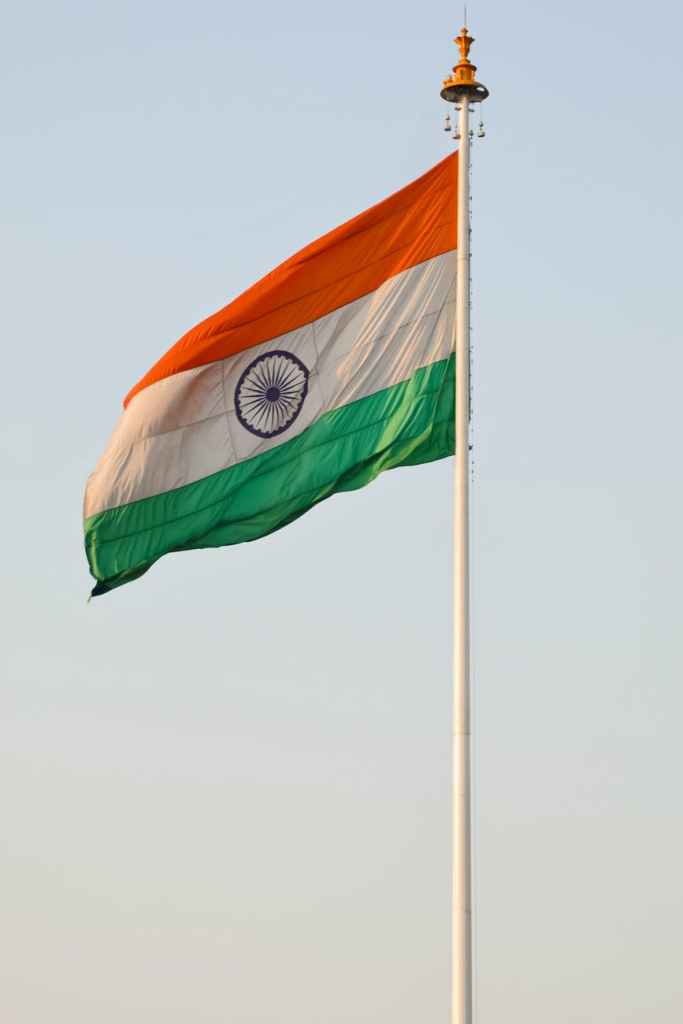
The Indian Tricolour Flag

On August 15, 2021, India will commemorate its 75th anniversary of independence. As we get closer to the big day, it’s only natural to look back at the history of the tricolour, or tiranga. Did you realise that our flag’s colours of saffron, green, and white have no communal significance? In this essay, we’ll look at the history of the tricolour, its evolution, and the meaning of the Chakra and the three colours of the flag to learn more about these facts.

Photo by Still Pixels on Pexels.com

The flag of a country is a sign of its independence. The Indian National Flag in its current form was adopted just days before the country declared independence from British rule on August 15, 1947. The decision was made on July 22, 1947, during a meeting of the Constituent Assembly. Between August 15, 1947, and January 2, 1950, it was the national flag of the Dominion of India, and then the Republic of India.

India’s current tricolour flag was adopted after the country gained independence. The old flag’s colour and meaning were retained, but the Dharma Charkha of Emperor Asoka was replaced as the flag’s insignia in favour of the spinning wheel.

The colours of the Indian flag

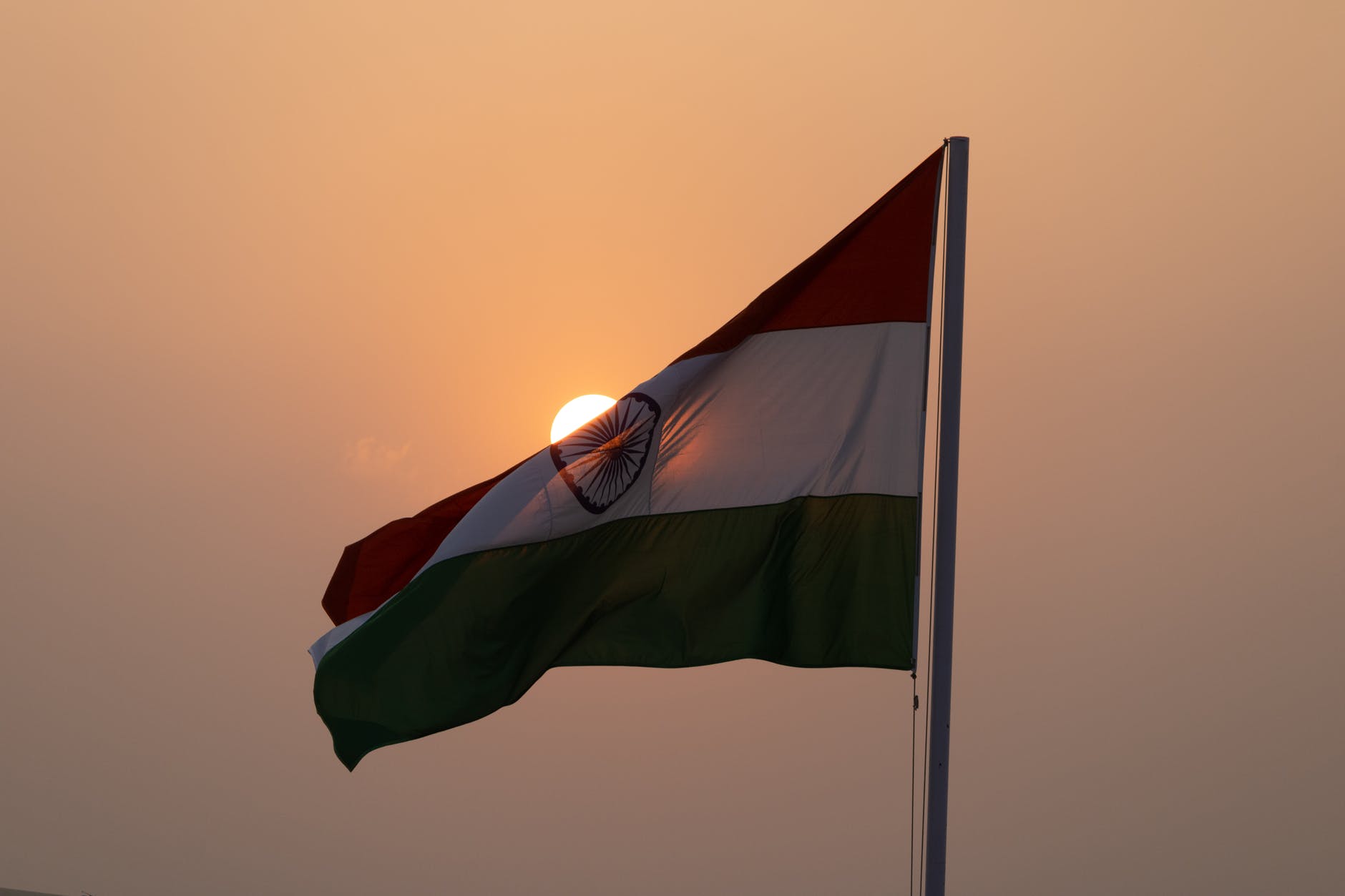
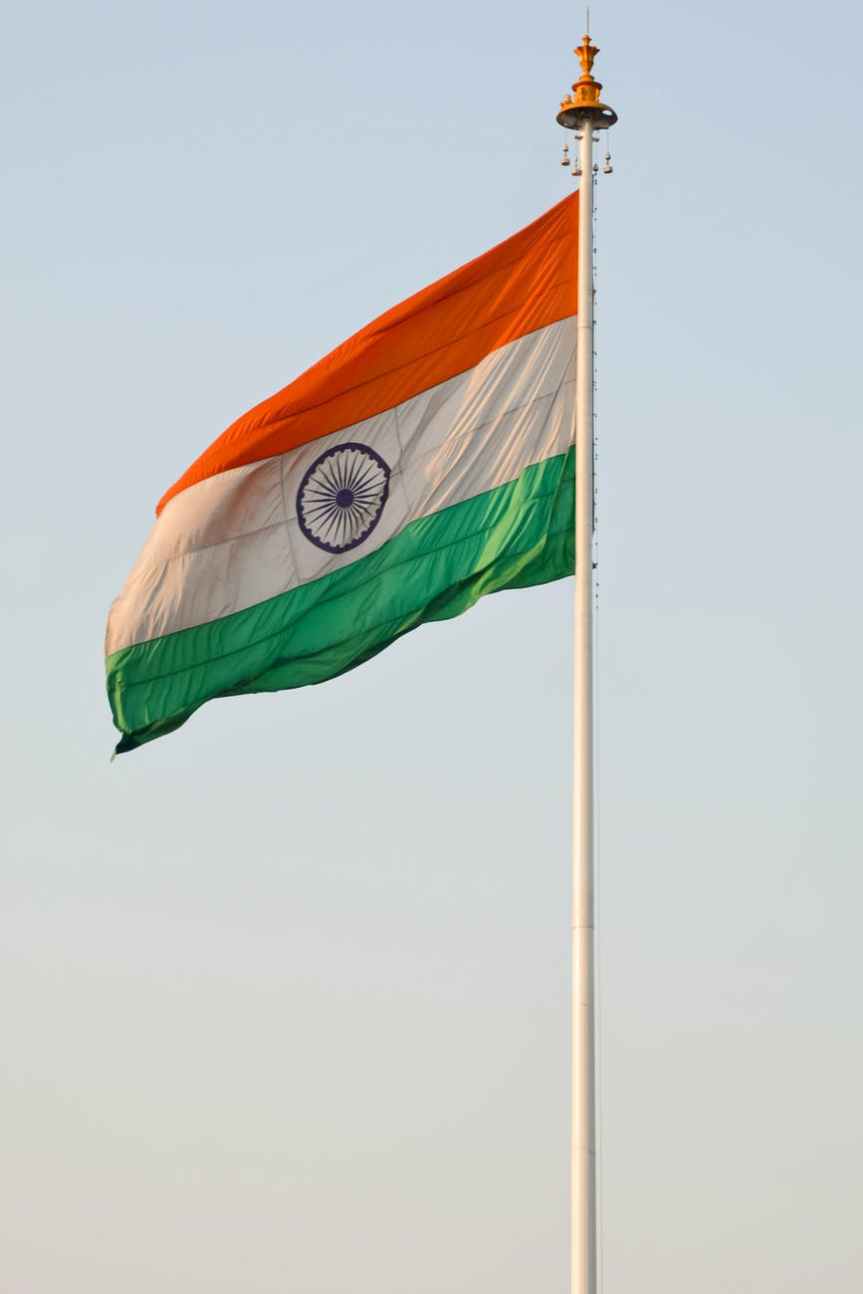
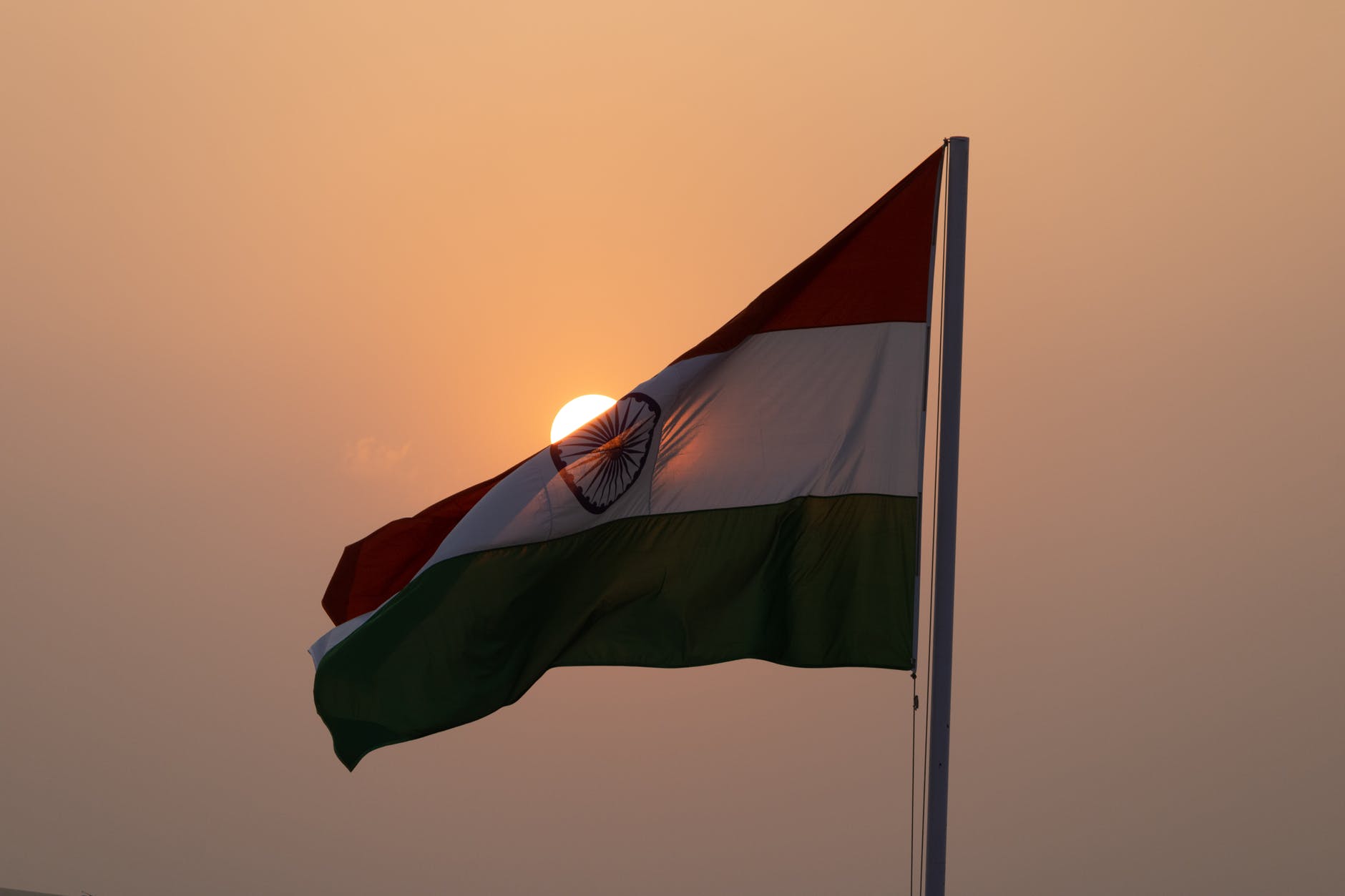
India’s national flag is a horizontal tricolour with a deep saffron top, white in the middle, and dark green at the bottom. The chakra is represented by a navy blue wheel in the midst of the white ring.

The colour saffron represents the country’s power and bravery. The colour white represents peace and truth. Our land’s fertility, growth, and auspiciousness are symbolized by the green belt.

The “wheel of the law” is shown by Dharma Chakra at the Sarnath Lion Capital, which was built by Mauryan Emperor Ashoka in the 3rd century BC. It meant that life is found in movement and death is found in immobility.

Flag Code

The Indian flag code was changed on January 26, 2002, and inhabitants of India were now allowed to hoist the Indian flag above their homes, offices, and factories on any day, not only national holidays, as was previously the case. Indians can now proudly display the national flag anywhere and whenever they want, as long as the Flag Code is rigorously obeyed to avoid any disrespect to the tricolour. The Flag Code of India, 2002, has been broken into three parts for your convenience. The National Flag is described in general in Part I of the Code. The display of the National Flag by members of the public, private organisations, educational institutions, and other entities is addressed in Part II of the Code. The National Flag is displayed by the Central and State governments, as well as their organisations and agencies, according to Part III of the Code.

Based on law passed on January 26, 2002, there are some guidelines for flying the flag. The following are some of them:

Do’s:

– To promote respect for the Flag, the National Flag may be flown in educational institutions (schools, colleges, sports camps, scout camps, and so on). The flag flying in schools now includes an oath of allegiance.

– On all days and occasions, ceremonial or otherwise consistent with the dignity and honour of the National Flag, a member of the public, a private group, or an educational institution may hoist/display the National Flag.

– Section 2 of the new code recognises that all private persons have the right to fly the flag on their property.

Don’ts:

– The flag may not be used for communal purposes, draperies, or clothing. It should be flown as much as possible from sunrise to sunset, regardless of the weather.

– The flag cannot be permitted to contact the ground, the floor, or the water’s surface. Vehicles, trains, boats, and aircraft cannot have it draped over the hood, top, sides, or back.

– There can be no other flag or bunting higher than the flag. Also, no object can be placed on or above the flag, including flowers, garlands, or symbols. A tricolour festoon, rosette, or bunting cannot be used.

HOW COSTLY IS IT TO SAY A “NO” IN TODAY’S WORLD?

In the modern era, people frequently deny performing certain things that might be either good or bad. Sensible decisions should be carried out as to when a NO should be uttered. A small scope of denial can cause you to pay a hefty price. You assist others presuming that what if you turn them down. But that’s not the case. You love to help others because you love to. Lending a helping hand always can cost you a lot too. Think wisely as to where you want to invest your time. It’s not at all bad to think for yourself.

Never feel ashamed to adamantly deny. If that one word NO is being beneficial to you, then don’t hesitate to do so. It’s impossible to say YES to everything. Prioritize the decisions you make as to whom you have to tell a YES and to whom a NO. This world is filled with greedy people too who wholly want their work to be done. They remember you when they need a favor, else you are like a non-existing creature. People who genuinely care for you and need your help will ask for it, respect it and convey they will always be available for you. Never overlook such people in your life.

It is important to know some things related to denial-

  1. Once a NO is not a NO forever :
  • You deny once doesn’t announce you are denying forever.
  • There might seem to be reasons for your denial. Maybe you are busy with your own work, or are not in a mood to help anyone. 

2. NO need not always be direct :

  • Valid reasons can be voiced out for the reason of your denial.
  • Some people think what if he/she feels bad.
  • Telling a NO may surely not hurt until it is conveyed in a positive way.

3. Happy and Peaceful Environment :

  • When you deny someone, you are reducing the effort and time you are investing there.
  • You have a chance to relax you, not to withstand stress about it.

4. Constant Connection :

  • As said, once a denial doesn’t always mean denial.
  • Continue to establish a connection with that person after you deny.
  • This attitude will surely make the person feel that you don’t have any problem in helping, but the situation makes you do so.
  • It urges him/her to believe that you don’t have any hard feelings for him/her.

5. Devote time yourself :

  • Some people go out of the way to help out others that they don’t give time to themselves.
  • No one is stopping that person from helping others. But the fact to understand is giving importance to you and value you.

Denying for doing something wrong is not at all bad. You should maintain a strong stand and be firm, that the decision that you have taken against the wrong is absolutely correct. Whoever approaches you to change your mind shouldn’t be in a stage to overrule the accurate decisions you have made.

Situations arise where you are being betrayed. The person who did so will try his/her best to prove himself/herself innocent, you should voice out exclaiming a NO, it’s inappropriate. Never be afraid to tell a NO when you aren’t comfortable in doing so. You shouldn’t be forced to do the favor asked. You aren’t hindered at gunpoint to do the favor asked.

In present times, you definitely have a price to pay for everything. It’s left up to you to see where your profit lies. NO can be costly when you do something that you aren’t willing to. You help people when they need you, but are they available to you when you need them the most? Give it a thought.

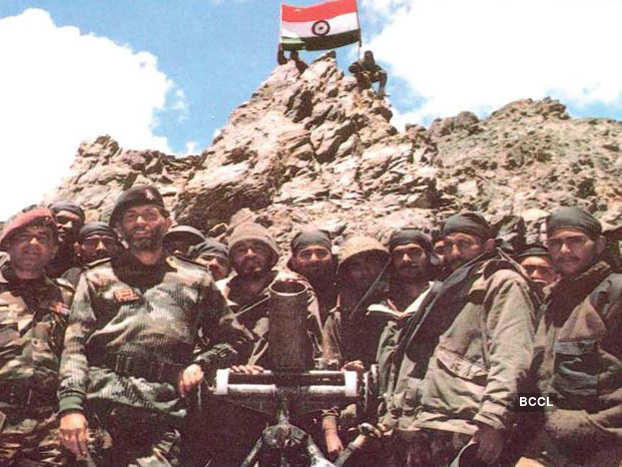
Kargil War: What did Pakistan gain from this war?

Many books have been written on the Kargil war between India and Pakistan, in which those aspects are mentioned, which are not known to the common people.

Pakistani journalist Naseem Zahra’s book “From Kargil to the Cop: Events that Shook Pakistan” is one of them. On 20 years of the war, BBC correspondent Shumaila Jaffrey spoke to Naseem Zahra about his book and some of the developments mentioned in it. Today, 22 years of Kargil war have been completed.

Naseem Zahra said that initially Pakistan’s plan was to capture some mountain peaks in Indian-administered Kashmir and then close the Srinagar-Leh highway. Closing this road was one of Pakistan’s major strategies as it was the only way India used to send military weapons to the soldiers stationed in Kashmir.

According to Naseem, Pakistani generals planning the Kargil attack believed that the situation would worsen and India would be forced to negotiate on the Kashmir dispute, but the way Pakistani soldiers were fighting, they were no less than the eighth wonder of the world.

She says that “the interesting thing about Kargil is that Pakistanis can be proud of it and sad too. The way the young soldiers were sent there (Kargil), the cold winter they reached there and The circumstances in which he fought valiantly is a reason for pride, but the question also arises that why was he sent there?”

Naseem Zahra says that “Pakistan Army initially inflicted heavy losses on Indian forces. Indian Army didn’t even know what happened. And Indian generals were saying that they would give them (Pakistani soldiers) a few hours or something.” Will throw you out of your area in days.”

According to Naseem Zahra, initially the Pakistani army and fighters had the advantage that they were sitting on the tops of the mountains and it was very easy to attack the Indian soldiers from above, but later the situation changed. However, there has been no response from Pakistani military officials on these claims of Naseem Zahra.

Big Mistake : 

Naseem Zahra says that when the Indian Army gradually realized what had happened, it called for Bofors artillery, which are not usually used in such operations. “If you ask what changed the Kargil war, it is the Bofors guns. Indian soldiers stationed them on the same Srinagar-Leh highway that Pakistan wanted to block. Broken into pieces and the Indian Air Force was continuously bombarding from above. This fact has been confirmed by both the countries.

Naseem Zahra said that even after coming down from the Kargil hills, Pakistan had to suffer heavy losses. “There were no roads or vehicular routes for them to return, nor were they returning in a friendly environment. It was very difficult to return from the altitude of 16 to 18 thousand feet of mountains. Many trenches had to be crossed and up It was very cold. When Indians got an opportunity, they took advantage of it and retaliated fiercely. The war was for a very short time but it was fought in a fierce manner.”

Naseem Zahra says that India used its air force well in Kargil, but Pakistani delayed it. She says that it is not yet clear how many people were killed in Kargil. “Some people say that three hundred were killed, some call it two thousand, but the number of soldiers in the number of two thousand probably did not go there. When I talked to the army people about this they said that such a big Not many people were killed. It was a big mistake.” 

Kargil – Siachen issue :

Naseem Zahra also says that the plan of Kargil was under consideration for many years, but it was completed in 1999. “This plan was presented by General Pervez Musharraf to Benazir Bhutto. He refused it. It was discussed earlier also during the time of General Ziaul Haq.” According to Naseem Zahra, the Kashmir issue was the main reason for the Kargil operation. Apart from this, the issue of Siachen was also one of the main reasons. 

Four generals executed the war :

Naseem Zahra says that the Kargil war was carried out by four generals of Pakistan. According to him, the four generals included the then Army Chief General Pervez Musharraf, Major General Javed Hasan, General Aziz Khan and General Mahmood Ahmed. The top leadership of the army was unaware of this operation.

According to Naseem Zahra, the four generals were stationed on the Line of Control. He was passionate about the Kashmir issue. They believe that for the Kargil war, these four generals had executed it without formal permission from the elected government. It was a kind of violation of the rules. In February 1999, an agreement was signed between Nawaz Sharif and Atal Bihari Vajpayee in Lahore, according to which both the countries had shown commitment to start a new relationship through talks.

‘Be the winner of Kashmir’ : 

According to Naseem Zahra, the then Prime Minister Nawaz Sharif learned about the Kargil operation during a briefing held on May 17, 1999, weeks after the troops crossed the Line of Control. Naseem Zahra says, “The then Foreign Minister Sartaj Aziz understood the situation that some soldiers of our army had crossed the Line of Control. He told the PM about this and said that Prime Minister we are talking to India. Were.”

She says, “These things were happening after the Lahore summit.” But according to Naseem Zahra, initially Nawaz Sharif really believed that the army could be successful in resolving the Kashmir issue with this operation. “Sartaj Aziz explained that international forces, especially the United Nations will not accept this and America will always support India. To which Nawaz Sharif said that no Sartaj sir, we can never achieve Kashmir by meeting and exchanging files. can do.”

“Then General Aziz Khan told Nawaz Sharif that Quaid-Azam Muhammad Ali Jinnah created Pakistan, now is your chance, you become the conqueror of Kashmir.”

Relations between the countries were getting better but….

Naseem Zahra says that relations between India and Pakistan were getting better, but at the same time General Pervez Musharraf carried out the Kargil war. “Vajpayee had come to Pakistan and Pakistan had given a warm welcome to the Prime Minister of India, he had come to hold talks and it was going on. Later, General Musharraf requested India several times for talks. To bring India to the negotiating table. For that he had to go to India on his knees.

Naseem considers them wrong, those who say that this war has benefited Pakistan in the matter of Kashmir.” Facts do not support this. According to the facts, it was such a wrong move that Pakistan had to go through the process of talks for years. Had to try to start again. Even though India did 1971 and Siachen but Pakistan’s decision of Kargil war was very irresponsible. It damaged the image of Pakistan.

However, Naseem Zahra believes that no loss or gain is permanent. Countries get an opportunity to review their policies. 

Project Pegasus: Unfolding The Cyber Spy

Project Pegasus has been in news for quite some time. Project Pegasus is an investigation about the Software Pegasus, in which 16 Media Institutes participated to expose the truth behind Pegasus. India is also one of the country whose name came out during the investigation. So What is Pegasus?

Pegasus is a spying software developed by an Israeli Technology Firm, NSO. According to NSO, the software is used to hack into the phones of their target and keep an eye on their every step. The data collected through this process can be sold to the government of a country and not to any individual or firm.

Pegasus recently became a hot topic not only in India but all around the world. It is not the first time Pegasus has came in news. But why is it highlighted now in India along with the whole world?  

Pegasus came in news after an investigation was done by 16 Media institutions from all around the world. This was initiated by a Not Profit Organisation from Paris along with Amnesty International. The project is called Project Pegasus.

Pegasus is known to infect the phone and can capture every single thing around the subject. It takes control over the phone and collects data about every single thing done by the subject. This software can be really useful to track down criminals and can be helpful to stop them. But is it really used for that?

The investigation in Project Pegasus revealed something else. The investigation revealed OVER 50,000 names that were either being tracked or were people of interest for any future assignment. In India, a list of 300 people was released. The list contains names of more than 40 journalists, 3 opposition Leaders, and two serving ministers. Former and Current Head of Security Organisation is also on this list. It is also said that the phone that was registered in the name of a serving Judge of the Supreme Court is also on the list.

 There has been no statement by the Indian Government on the issue and this can problematic. It is yet not clear if all the numbers in the list are hacked or not. It is concerning regarding privacy and the fundamentals of democracy.

It can be clearly termed as misuse of power and can have a bad effect on citizens. it is really important to take strict actions against it.