“Life is what happens when your cell phone is charging.”

A mobile phone ( also known as a wireless phone,cell phone, or cellular telephone) is a small portable radio telephone.

The mobile phone can be used to communicate over long distances without wires. It works by communicating with a nearby base station (“also called a cell site”) which connects it to the main phone network. When moving, if the mobile phone gets too far away from the cell it is connected to, that cell sends a message to another cell to tell the new cell to take over the call. This is called a “hand off,” and the call continues with the new cell the phone is connected to.

The hand off is done so well and carefully that the user will usually never even know that the call was transferred to another cell.

USE OF MOBILE PHONE

Mobile phones are used for a variety of purposes, such as keeping in touch with family members, for conducting business, and in order to have access to a telephone in the event of an emergency. Some people carry more than one mobile phone for different purposes, such as business and personal use.

Multiple SIM cards may be used to take advantage of the benefits of different calling plans. For example, a particular plan might provide for cheaper local calls, long distance calls, international calls, or roaming.

The mobile phone has been used in a variety of diverse contexts in society. For example:

* A study by Motorola found that one in ten mobile phone subscribes have a second phone that is often kept secret from other family members.

* Some organization assist victims of domestic violence by providing mobile phones for use I’m emergencies. These are often refurbished phones.

* Mobile telephony also facilities activism and citizen journalism.

* The advent of widespread text messaging has resulted in the cell phone novel, the first literary genre to emerge from the cellular age, via text messaging to a website that collects the novels as a whole.

* The TV industry has recently started using mobile phones to drive live TV viewing through mobile apps, advertising, social TV and mobile TV. It is estimated that 86% of Americans use their mobile phone while watching TV.

Personal Values: How to Know Who You Really Are

Throughout the previous few years, I’ve had a thought for an ironical self improvement article called, “The Productivity Secrets of Adolf Hitler.” The article would include all the famous self improvement sayings—objectives, perceptions, morning schedules—aside from communicated through the adventures of Hitler.

“Hitler begins his day at 5 AM every morning with a fast round of yoga and five minutes of journaling. With these methodologies, he’s ready to zero in his psyche on his exceptionally yearning objectives.”

“Hitler found his life reason in a lager corridor in his 20s and has since followed it persistently, hence imbuing his existence with energy and rousing great many others such as himself.”

“Adolf is a severe veggie lover, and makes a point to figure out time in his bustling timetable of massacre and global control to investigate his inventive side: he saves a couple of hours every week to pay attention to drama and paint his #1 scenes.”

I realize that I would discover the article clever. However, that is on the grounds that I’m a wiped out, contorted fuck. In any case, eventually, I’ve never fully gathered the mental fortitude to compose the thing, for clear and clear reasons.

I’ve been doing this long enough to realize that a) a lot of individuals would get outraged and give themselves totally to destroying my week with irritating messages and web-based media tirades, b) the parody would fly right by a lot of people and they’d feel that I was really a Nazi, and c) some dreadful distribution some place would run the feature, “Smash hit writer outs himself as far right neo-Nazi” or some poop and my vocation would be finished.

Thus, I’ve never composed the article. Consider me a weakling. Be that as it may, it stays unwritten.

This bugs me a tad since I think parodying Hitler’s extraordinary efficiency and impact consummately encapsulates a point I’ve since quite a while ago made about the self improvement world: making progress in life isn’t close to as significant as our meaning of accomplishment. On the off chance that our meaning of achievement is awful—like, say, global control and butchering millions—then, at that point working more enthusiastically, laying out and accomplishing objectives, and training our brains all become something awful.

In the event that you eliminate the ethical abhorrences from Hitler, on paper, he’s perhaps the best independent individuals in world history. He went from being a poor, bombed craftsman, to laying hold of a whole nation and the most remarkable military on the planet in merely twenty years. He activated and propelled millions. He was resolute and smart and strongly centered around his objectives. He ostensibly impacted world history as much as any individual who has at any point lived.

In any case, the entirety of that work went toward psychotic, dangerous points. What’s more, a huge number of individuals kicked the bucket terribly because of his turned, misinformed values.

Individual qualities are the gauges by which we figure out what is an effective and significant life.

At the point when someone says, “I need to be acceptable,” that meaning of what is “acceptable” is an impression of what they esteem. Some will see “being acceptable” as achieving cash. Others will consider it to be building a family. Others will consider it to be having a great deal of energizing encounters. Whatever it will be, it is controlled by our own qualities.

Along these lines, you can’t discuss personal growth without likewise discussing values. It’s insufficient to just “develop” and become a “superior individual.” You should characterize what a superior individual is. You should choose in which course you wish to develop. Since, supposing that you don’t, indeed, we may all be in a bad way.

A many individuals don’t understand this. A many individuals fanatically center around being cheerful and feeling great constantly—not understanding that if their qualities suck, feeling kindness hurt them more than help them. In the event that your greatest worth on the planet is grunting Vicodin through a swirly straw, indeed, then, at that point feeling better is simply going to aggravate your life.

At the point when I composed my book, The Subtle Art of Not Giving a F*ck, practically the whole book was truly a slippery method to get individuals to consider their qualities all the more plainly. There are 1,000,000 self improvement guides out there that show you how to more readily accomplish your objectives, however few really question what objectives you ought to have in any case. My point was to compose a book that did exactly that.

In the book, I purposefully tried not to get excessively profound into what benefit/bad qualities are—what they resemble, and why they work or don’t work—part of the way since I would not like to push my own qualities onto the peruser. All things considered, the general purpose of your qualities is that you embrace them yourself, not on the grounds that some buddy with a repulsive orange book cover advised you to. However, truth be told, I additionally didn’t get excessively profound into characterizing values since it’s an extraordinarily troublesome point to expound on well.

Thus, this article is my endeavor to at last do that. To discuss values. What’s more, what they are as well as why they are. Why we discover certain things significant, what the results of that significance are, and how we can approach finding and changing what we find significant. It’s anything but a basic subject. Also, the article is very long. So enough of me gabbing, how about we continue ahead with it.

You Do What You Value

Each snapshot of consistently, if you understand it, you are settling on a choice of how to invest your time, of what to focus on, of where to coordinate your energy.

The present moment, you are deciding to peruse this article. There are a limitless number of things you could be doing, however this moment, you are deciding to be here. Perhaps in a moment, you choose you need to pee. Or on the other hand perhaps somebody messages you and you quit perusing. At the point when those things occur, you are making a basic, esteem loaded choice: your telephone (or your latrine) is more significant to you than this article. What’s more, your conduct follows that valuation appropriately.

Our qualities are continually reflected in the manner we decide to act.

This is basically significant—on the grounds that we as a whole have a couple of things that we think and say we esteem, however we never back them up with our activities. I can tell individuals (and myself) for what might seem like forever that I care about environmental change or the risks of online media, yet on the off chance that I go through my days cruising all over in an inefficient SUV, continually invigorating my newsfeeds, then, at that point my practices, my activities recount an alternate story.

Individual Values – individuals strolling

Activities don’t lie. We accept we need to land that position, yet all things considered, we’re generally sort of calmed that nobody got back to us so we can withdraw to our computer games once more. We advise our better half we truly need to see her, yet the moment our person companions call, our timetable mysteriously appears to open up like screwing Moses separating the Red Sea.

The Great Value Disconnect

A large number of us state esteems we wish we had as an approach to conceal the qualities we really have. Along these lines, yearning can regularly turn into another type of aversion. Rather than confronting who we truly are, we lose ourselves in who we wish to turn into.

Find Your Personal Values

I have a 50-page PDF guide clarifying individual qualities and how to create your own. It’s free. Simply fly in your email underneath to get it.

Email

Put another way: we lie to ourselves since we don’t care for our very own portion esteems, and we, along these lines, don’t care for a piece of ourselves. We would prefer not to concede we have certain qualities and that we wish we had different qualities, and it’s this inconsistency between self-insight and reality that typically gets us into a wide difficult situation.

That is on the grounds that our qualities are expansions of ourselves. They are what characterize us. When something great happens to a person or thing you esteem, you feel better. At the point when your mother gets another vehicle or your significant other gets a raise or your #1 matches group dominates a title, you feel better—like these things happened to yourself.

The inverse is valid too. On the off chance that you don’t esteem something, you will feel great when something terrible happens to it. Individuals rampaged cheering when Osama Bin Laden was killed. Individuals arranged a gathering outside the jail where the chronic executioner Ted Bundy was executed. The annihilation of somebody saw as malevolent felt like some incredible good triumph in the hearts of millions.1

Thus, when we are separated from our own qualities—we esteem playing computer games the entire day yet accept we esteem aspiration and difficult work—our convictions and thoughts get detached from our activities and feelings. Furthermore, to connect that distinction, we should become silly, about both ourselves and about the world.2,3

Discretionary Gray Box of Doom: Why People Who Hate Themselves Hurt Themselves

Similarly as we either worth or debase anything in our lives, we can esteem or degrade ourselves. Also, similar as individuals celebrating when Ted Bundy got seared, in the event that we disdain ourselves however much individuals despised Ted Bundy, we will commend our own annihilation.

This is the thing that individuals who don’t detest themselves don’t comprehend about individuals who do: that implosion feels great in some profound, dull way. The individual who despises themselves feels that they are ethically mediocre, that they merit some dreadful thing to make up for their own awfulness. Furthermore, regardless of whether it’s through medications or liquor or self-hurt or in any event, hurting others, there’s a revolting piece of themselves that searches out this annihilation to legitimize the entirety of the torment and wretchedness they have felt.

A large part of crafted by the confidence development during the 70s and 80s was to take individuals from self-hatred to self-cherishing. Individuals who love themselves don’t get any fulfillment from hurting themselves. Maybe, they get fulfillment from dealing with themselves and working on themselves.

This adoration for self is urgently important.4 But it is additionally not adequate all by itself. Since, supposing that we just love ourselves, then, at that point we become self-ingested cunts and apathetic regarding the misery or issues of others.

Eventually, we as a whole need to esteem ourselves yet in addition something above ourselves.5 Whether it’s God or Allah or some ethical code or cause, we need to esteem something above ourselves to make our lives fe


The new price efficient Samsung Galaxy Chromebook Go.

The Galaxy Chromebook Go launched on Samsung’s website last month as a new cheap Chromebook from the company. There were still a lot of unknown facts regarding the 14-inch tablet, other than a few specifications and pictures. The notebook is now official and may be purchased.

While just the Wi-Fi variant will be available on Thursday, Samsung plans to release an LTE version in the following weeks, which could be a great bonus for on-the-go web browsing.

Galaxy Chromebook Go.

The low pricing of the Galaxy Chromebook Go appears to be reflected in its features. It has a 14-inch 1366 x 768 HD display, which is a significant downgrade from the Galaxy Chromebook 2’s 4K OLED panel. It also has an Intel Celeron N4500 CPU and 4GB of RAM, which won’t set the world on fire but should suffice for everyday Chrome use.

Two USB Type-C connectors, a USB 3.0 port, and a headphone-out/microphone-in combination port are included on the Galaxy Chromebook Go. The Chromebook boasts a military-grade construction and weighs only 3.2 pounds, according to Samsung (1.45kg). The island-style keyboard is spillproof and can withstand the odd drop. There are two 1.5W speakers included, as well as Wi-Fi 6 which is significantly quicker.

Samsung says that the Galaxy Chromebook Go’s 5480mAh battery would last 12 hours on a single charge, which is impressive compared to the Chromebook 2’s seven-hour battery life (in our tests) but is likely due to the changes in display and CPUs.
The Galaxy Chromebook Go is already available for purchase on Samsung’s website for $299. You may get it for as little as $129.99 if you have a device that can be traded in. An LTE version will be available shortly, according to Samsung.

Health care system in India

• NITI Aayog document – ‘Investment Opportunities in India’s Healthcare Sector’

 Promotes further privatisation of health care
 Explores the pandemic as business opportunity for the health “industry” to grow.
• Author – Importance of public health and an enhanced government role in
health delivery services.
• Story of 2 states (model) Kerala and Maharashtra comparison
 Both are big states – comparable state GDPs
 Kerala COVID mortality – 0.48%
 Maharashtra COVID mortality – 2%.
 Reasons
 Huge differences in the effectiveness of public health systems
 Kerala has more government doctors compared to Maharashtra
 Kerala also has a higher proportion of government hospital beds
 Kerala allocates over one and half times higher funds on public health every year in per capita terms compared to Maharashtra.
 Weak public health system has proved to be a critical deficiency
 Clear message: a neglect of public health systems means large-scale, avoidable losses of lives.

Lacunae in the health care system

  1. Resource allocation
  2. • Central vista project – ₹20,000 crores
  3. • Could be utilised for setting up oxygen plants,
    numerous lives would have been saved.
  4. • Paltry allocation for National Urban health
  5. • Last time allocation – Rs. 1000 crores (amounts to Rs 2 per individual per month)
  6. • Parliamentary Standing Committee – Suggested
    allocating ₹1.6 lakh crores for public health during the current year (almost doubling of the present central health Budget)

2.To regulate the private players in health sector

• High Pricing
 COVID-19 care often costs ₹1 lakh to ₹3 lakh per week in large private hospitals
 Massive hospital bills – untold distress even among the middle class.

• Unregulated drug use
 Eg. Drug Remidesvir was used in COVID patients without valid evidence on
efficacy
 Indiscriminate use of steroids culminated

  • Mucormycosis infections

• Effective implementation of Clinical Establishments (Registration and Regulation)
Act
 Only 11 states have implemented it
 Not effectively implemented due to a major
delay in notification of central minimum
standards, and failure to develop the central framework for regulation of rates.

• In essence : Need to regulate the private
hospitals. And invest more in the public health

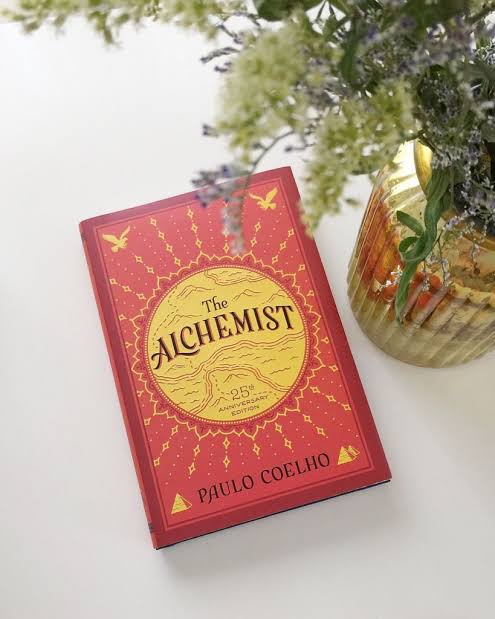
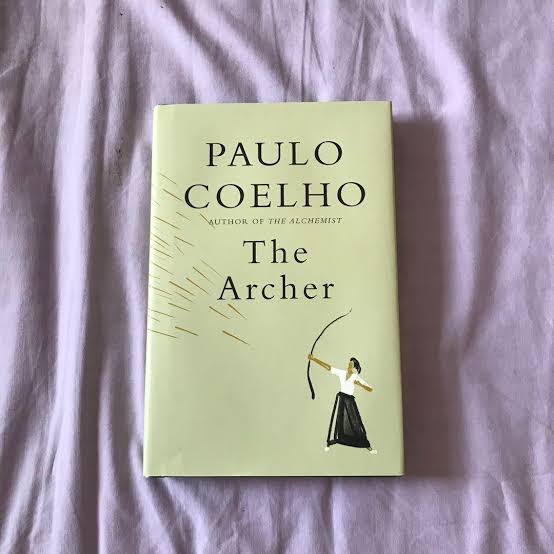
Two must-read books of Paulo Coelho

Book: The Alchemist

Book Plot:

A Sheppard boy who wandered most of the places in Andalusia with his flock of sheep. Once he was sleeping in an abandoned church, he dreamed of going to the pyramid. He already had that dream once before. So in a place Tarifa he accidentally met a gypsy lady and she told that there in Egypt he will find his treasure. The followed story is about the adventure taken by the Sheppard boy to reach his Destiny.

About the Book:

  • Through this book, the author motivates us to listen to our hearts while we pursue our dreams. a philosophical fiction and Paulo Coelho gave him at best.
  • The Sheppard boy’s name is Santiago. But, the author never mentions his name except in the first line of the story. We must learn that trick from Paulo Coelho.
  • Paulo Coelho always concentrates on his story. No puns, no scribbles, no long narrations, no heroic entries, and especially no circumlocution. Just a plot and beautiful words to make it a novel. That’s why he is one of my favorite authors.

Quotes:

It is not what enters men’s evil mouths that’s evil… It is what comes out of their mouth that is.

There is only one thing that makes a dream impossible to achieve: the fear of failure.

There is only one thing that makes a dream impossible to achieve: the fear of failure.

when you want something, all the universe conspires in helping you to achieve it.

Tell your heart that the fear of suffering is worse than the suffering itself

Book: The Archer

Book Plot:

Tetsuya, a man once famous for his prodigious gift with a bow and arrow but retired from public life. The boy who comes searching for him wants him to teach the way of the bow, and the archer illustrates the way of the bow and the tenets of life.

Quotes:

What is a master? I would say that he is not someone who teaches something, but someone who inspires the student to do his best to discover the knowledge he already has in his soul.

The bow is life: the source of all energy. The arrow will leave one day. The target is a long way off. But the bow will stay with you, and you must know how to look after it.

Elegance is not the most comfortable of postures, but it is the best posture if the shot is to be perfect.

Why you must read these books:

  • Paulo Coelho is an inspirational person who never disappoints us through his books, he suffered a lot and searched the way out of his hell through philosophy, religion, and faith.
  • I don’t know why Paulo Coelho’s books come under the genre of fiction? For real, it is a self-motivational book. His words are simple his books are the only books that I read in a single sitting.
  • If you are a person who fears failure, rejection, and humiliation… You must read these books. After reading these books you will do something you love to do or you will at least think about what do you love to do.

DEMOCRACY

Meaning of Democracy

Democracy is a system of government in which the supreme power is vested in the people of a country and people elect their representatives either directly or indirectly through fair and free elections, which are usually held periodically.

Definition

According to Mahatma Gandhi, “True democracy cannot be worked by twenty men sitting at the centre. It has to be worked from below by the people of every village”.

Salient Features of Democracy

✓Elected representatives of people and final decision-making power to the representatives.
✓Free and fair elections.
✓Voting right is with equal value to those who have attained the age of 18.
✓Fundamental rights and protection of individual freedom.

Evolution of Democracy

Democracy began 2,500 years ago in some of the city-states of ancient Greece. It is important to know that democratic institutions existed in India as early as the Vedic period. Chanakya’s Arthashastra tells us that in ancient India, an autonomous village community was the basic unit of the local government. During the later chola period ancient Tamil Nadu, Kudavolai system was a very notable and unique feature of the village administration of the Cholas. The evolution towards a democracy is represented by the following values: freedom, equality, fraternity, accountability, transparency and trust.

Forms of Democratic government

Types of Democracy

There are two types of democracies
✓Direct democracy
✓Indirect (representative) democracy

Direct Democracy

When the people themselves directly express their will on public affairs, the type of government is called pure or direct democracy.
Example: Ancient Greek city-states, Switzerland

Indirect Democracy

When the people express their will on public affairs, through their elected representatives, the type of government is called Indirect or representative democracy.

Democracy in India

India has a parliamentary form of democracy. The Indian Parliament comprises the elected representatives of people and makes the laws for the country. The participation of people in the decision making and the consent of citizens are the two important elements of the parliamentary form of government in India.

India is the largest democratic country in the world. Democracy in India works on five basic principles. These are sovereign, socialist, secular, democratic, republic.

Election in India

India has a quasi-federal government, with elected representatives at the federal, state and local levels. The general elections are conducted by the Election Commission of India. At the national level, the president of India, appoints the Prime Minister, who enjoys majority in the Lok Sabha, the lower house of the Parliament of India.

The First Elections in Democratic India

General elections to the first Lok Sabha since independence were held in India between 25 October 1951 and 21 February 1952. The Indian National Congress emerged victorious by winning 364 of the 489 seats. Jawaharlal Nehru became the first democratically elected Prime Minister of the country.

WHAT MAKES 18 JULY A SIGNIFICANT DAY ?

18th July marks the birth of an iconic figure who vanquished South Africa’s apartheid system. The great personality who fought for human rights and was an international peacemaker. This person who played a very vital role in shaping the society and conserving the human rights was Nelson Rolihlahla Mandela.

 “It is easy to break down and destroy.
The heroes are those who make peace and build.” 

 – Nelson Mandela

ABOUT NELSON MANDELA

Nelson Rolihlahla Mandela (18 July 1918 – 5 December 2013) was a South African anti-apartheid revolutionary, who served as President of South Africa from 1994 to 1999. The main focus of his government was on knocking down the apartheid regime by fostering racial reconciliation and tackling institutionalized racism. Nelson Mandela is an iconic figure who was an human rights lawyer, a prisoner of conscience and an international peacemaker. He is that great personality who vanquished South Africa’s apartheid system and was the first democratically elected president of free South Africa. Nelson Mandela was born Nelson Rolihlahla Mandela in Transkei, South Africa on 18 July, 1918. His strategy was to bring change through Legal Revolution but not through actual violence. He began his journey towards by following the path of non-violence, later embracing violence, and then adopting a non-violent approach for negotiation and reconciliation.

ABOUT NELSON MANDELA INTERNATIONAL DAY

Nelson Mandela International Day (or Mandela Day) is celebrated in honor of Nelson Mandela, the former South African President, on his birthday, that is on 18 July. This day was declared officially by the United Nations in November 2009 and the first Mandela Day was thus held on 18 July 2010. There are many other groups who celebrated this day before 2010 also, that is from 18 July 2009.

The UN General Assembly (UNGA) declared 18th July as “Nelson Mandela International Day” for paying tribute and for recognizing his contributions for achieving and promoting peace and freedom. Mandela Day reminds us that “Each individual has the potential and power to bring a positive change, transform and ability to make an impact.”

MESSAGE OF MANDELA DAY CAMPAIGN

Nelson Mandela fought for peace and harmony. He fought for bringing social justice for over 67 years. This day urges the people of Mother Earth to fight poverty and promote peace, reconciliation and cultural diversity.

While establishing this international day, UNGA recognized the values and dedication of Nelson Mandela for serving the humanity. He constantly fought for democracy and for promoting cultural peace throughout the world. Some other values for which he fought are:

  1. Conflict Resolution
  2. Race Relations
  3. Promotion and Protection of Human Rights
  4. Reconciliation
  5. Gender Equality
  6. Rights of Children and other vulnerable groups
  7. Fight against Poverty
  8. Promotion of Social Justice

The contribution of Nelson Mandela to the society can never be measured and his works remind us that “Everyone has the ability and the responsibility to change the world for the better!” Mandela Day is one such occasion which urges all to take action and inspire change.

WHY DO WE CELEBRATE NELSON MANDELA DAY ?

Nelson Mandela International Day is celebrated every year to remember the legacy of a man who shaped the present with his fight for 67 years and provided a better world and society for the future generation. Nelson Mandela changed the 20th century and helped shape the 21st century and future of the world. This day exhorts us to renew the values and principles of Nelson Mandela and to take actions for building a better society.

FREEDOM FIGHTER RANI

Meetali soni


Rani Lakshmibai or Jhansi ki Rani, the queen of Jhansi. The birth anniversary of Rani Lakshmibai is 19 november 1828 in Manikarnika Tambe in Varanasi. It is is celebrated as Martyr’s Day in Jhansi. Rani Lakshmibai,is one of the famous warriors of India’s struggle for Independence. Rani Lakshmi Bai was a brave queen who fought battle with English people to save her country. She saved her name in battle field. she is a great symbol of strength of females of India. She was the wife of Maharaja Gangadhar Rao . He is the king of jhasi . She was one of the leading figures of the Indian Rebellion of 1857 and became a symbol of resistance to the British Raj for Indian nationalists. She died in the Rebellion, wounded and killed in a battle. She died on 18 June 1858. The Rebellion was suppressed by November that year. She was named Manikarnika Tambe and was nicknamed Manu. Her father was Moropant Tambe and her mother Bhagirathi Sapre (Bhagirathi Bai). Her parents came from Maharashtra. Her mother died when she was only four years old. Her father was the Commander of the war of Kalyanpranth. Her father worked for Peshwa Baji Rao II of Bithoor district. She was educated at home. She was able to read and write, She was more independent in her childhood than others of her age, her studies included shooting, horsemanship, archery. Rani Lakshmibai was very much interested to riding on horseback between the palace and the temple, sometimes she was carried in a palanquin. Her palace, the Rani Mahal, has now been converted into a museum. It houses a collection of archaeological remains of the period between the 9th and 12th centuries AD. Growing up with the boys in the peshwa’s court, she was trained in martial arts and became proficient in sword fighting and riding. She was widowed without bearing a surviving heir to the throne. She was widowed without bearing a surviving heir to the throne. Following established Hindu tradition, just before his death the maharaja adopted a boy as his heir. The 22-year-old queen refused to cede Jhansi to the British. Shortly after the beginning of the mutiny in 1857, which broke out in Meerut, Lakshmi Bai was proclaimed the regent of Jhansi, and she ruled on behalf of the minor heir. Joining the uprising against the British, she rapidly organized her troops and assumed charge of the rebels in the Bundelkhand region. In 1842, Lakshmi bai got married and got the name of Rani Lakshmibai. Few years after marriage, Manikarnika gave birth to a boy but he couldn’t survive and died after four months. Lakshmibai gave a great fight to the British as the siege of Jhansi lasted for about two weeks. After a the war, when the British army entered Jhansi, Rani Lakshmibai, tied her son Damodar Rao to her back and fought bravely using two swords in both her hands. She escaped to Kalpi and was accompanied by other rebellions. She then departed to Gwalior and a fierce battle was fought between the British and Lakshmibai’s army. Her body was cremated as per her wish, as she didn’t want it to be captured by the British.

The Marie Effect

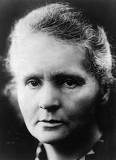
Maria Salomea Sktodowska was born on 7 November 1867 in Warsaw , Poland. She was the 5th child born to father Vladislav and Mother Bronislava sklodowska , who were both teachers. Because of bad investments, the family lost its savings and had to move to a private school where her mother taught.

Maria started her schooling in 1874, and she was the youngest and the smartest in her class. During that time, Warsaw was under Russian rule which banned polish dictums. Russian government forbade any polish women to attend university of Warsaw. So Marie and her older sister Bronya ,would pool their finances so that first her older sister ( Bronya ) could complete her education, and then Marie could attend University of Paris. Manya ( as Maria was also called) spent 6 years as governess and taught peasant children how to read and write.

She also attended secret meetings of “Floating University ” where they read scientific studies. By 1891,she had collected enough money to continue her studies in Paris. She moved there and lived with her sister and her husband and changed her name to Marie. She attended the Sorbonne University and then later moved to the student area , a tiny attic sized housing. In 1893,she earned her master’s degree in Physics, and then studied Mathematics on a scholarship.During this, she also got a job to study magnetism properties of various types of steel for French company.

She later met Pierre Curie and they got married in 1895 , and gave birth to daughter Irene the following year.

Later she decided to make French physicist Henri Becquerel and his discovery of mysterious Uranium rays in 1896 as her topic of physics doctorate. She began studying Uranium type rays radiated from other elements and found that Thorium also gave out such rays. Most of Uranium type rays given off by rocks called pitchblende- gave more radiation than she expected.

She announced in July,1898 that she found a new element and named it POLONIUM , after Poland and also invented the word ‘ radioactive ‘ , and later she also founded Radium.

To prove that she had indeed found those new elements, she had to produce pure radium. And finally on 21 july 1902 she reported the weight of 1 radium atom. In 1903, she became the first woman in Europe to receive doctorate in science. Radium began to be used for treating cancer cells, and the new treatment began to be called ‘ Curie treatment’. Marie and Pierre were awarded the Humphry Davy medal ; England’s highest award in chemistry.

The same year , she and her husband ,along with Henri Becquerel , were awarded the Nobel Prize in Physics .In 1906, Pierre died by falling off horse drawn wagon.

In 1911, Marie won Nobel Prize in chemistry for her work in radioactivity.

She died in 1934 of aplastic anaemia due to prolonged exposure to radiation .

Later, in 1935,Irene and her husband Fredrick, were awarded the Nobel Prize in chemistry .

Five feet apart

Introduction:
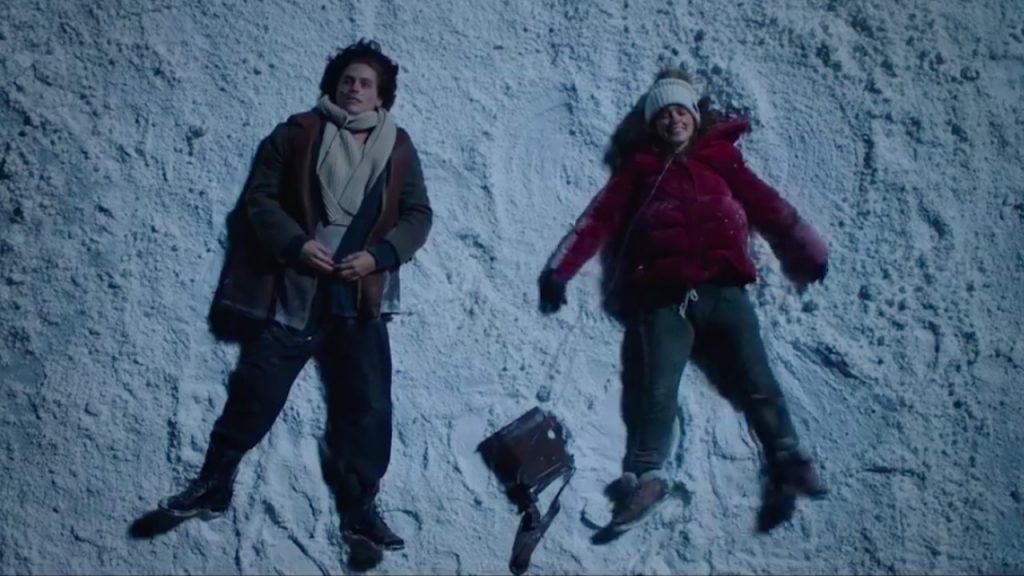
Five feet apart is directed by Justin Baldoni and written by Mikki Daughtry, Tobias Iaconis. This genre of drama and romance was released in 2019.
Stella Grant (Haley Lu Richardson) is a seventeen year old who is diagnosed with cystic fibrosis whose life is full of restrictions and boundaries but she doesn’t fail to amaze us with her lively nature and her love for life and all of her restrictions are put to test when she meets Will Newman ( Cole Sprouse) a handsome young man who is also a CF patient and therefore they’re supposed to be a safe distance from each other.


Their connection grows stronger which makes them want to break all the rules and be together. Will is a kind of person who doesn’t like following rules but after meeting Stella he is inspired to live life to the fullest and embrace every moment.
Eventually they fall in love and will realises that in order for Stella to be safe he needs to be away from her and therefore he is determined to leave her even though he loves her and Stella is only left with his memories.


Themes:
This movie explores the themes of life and death, being rebellious and love. These are the main themes as throughout the movie, we get to witness how they fought bravely for their lives, they even sacrificed themselves for each other and how they didn’t let their illness be a reason for them to be apart and tried to love each other and themselves even more each day and how they made each others life more meaningful and beautiful.
This entire movie was beautifully directed and the actors complemented each other. At, first when they meet, they realize that they’re of opposite personalities and there are misunderstandings but as time passes, they get to know each others circumstances and grow to understand and like one another. When they realize that they really are attracted to each other and even fall in love, it’s the distance they have to maintain but they still don’t give in to it as they truly love each other and thinking that even if they have very little time to be with eachother, they need to spend it wholeheartedly and by enjoying each others company. But that put their lives in danger.
The background musics are a good touch to the movie as they add to the emotions of the movie and they enhance our experience which gives it a sad but dramatic effect.


Conclusion:
This is a very good movie according to me as we get to see what people can do to save their loved ones and how sacrifice also plays an important role in love. This also shows us how having that one person by your side helps you to be stronger and happier.
This movie was “one of a kind” and I really enjoyed and appreciated all the themes and motifs of this movie. It was a very emotional and thoughtful movie, according to me. As I really enjoyed watching this, I’d rate it a 9/10.

SYMPATHY VS EMPATHY

What is sympathy?


Empathy is the key because you acknowledge the person’s feelings or circumstances. Empathy is often conveyed in negative contexts to express sorrow and pity, for example, when someone has passed away.

Compassion is about saying, “I feel it. I understand and appreciate how you feel. ”It is about looking at and accepting what a person is going through. Empathy can also be “compassionate” for a person. He is sensitive to “feeling with” instead of deeply sympathetic, so there is a natural encounter from this situation.

What is empathy?


Compassion and empathy are a broad, profound way of reacting emotionally to a person’s situation. Compassion involves tender regard for someone or something else. The big difference between empathy and empathy is that empathy is when you think you are in someone else’s shoes, and empathy is sad about the loss of someone. While empathy, you experience a fraction of their feelings and emotions after seeing things through their perspective. Empathy listens attentively, asks questions and comes up with solutions.

Is empathy better than compassion?


Whether a person feels compassion or empathy for a situation depends on the person, his personality, his background and his own experience. As you go through the same or struggles with the same situation, the potential for empathy for people experiencing similar experiences is much higher.

Compassion is often expressed in negative feelings or remorse for another person. Empathy is deeper and deeper than empathy. It’s about accepting one’s feelings and thinking honestly and trying to feel what it’s like to be in someone else’s shoes. You empathize with the other person, share the emotional burden with the person affected, come up with solutions and help him or her. For example, empathy may suggest that a person who has lost a loved one in death is moved to show compassion. Empathy will deepen – listen to the person, share their grief and spend time with them to help them cope. Empathy does something about it instead of just feeling it.

Therefore, empathy can be viewed as better than sympathy. Most people tend to choose when others feel sorry for them rather than just feel sorry for them, but both factors are important to have. Both are acceptable responses depending on the situation. Empathy is very hard to do. It comes naturally to some people, but it is usually a matter of empathy.

What if someone lacks empathy and compassion?


It may be that someone lacks empathy and compassion. This may be due to traumatic problems or mental disorders. Lack of empathy and empathy can lead to problems in personal and professional life. Such people find it difficult to maintain a relationship. People who lack empathy and compassion may have a higher chance of being harmed spiritually or physically or committing crimes.

Studies have shown that empathy and empathy are factors that can be improved. There are steps that people can take to recognize their prejudices and shortcomings and to see things from a different perspective. Some of these steps include active listening, talking to people, and curiosity. Talking to people from different walks of life, different cultures, upbringing, etc. It can help develop empathy and empathy. A person can also seek help from family, friends, counselors or psychologists to help them understand and see things clearly. Some people can become more empathetic and empathetic after experiencing certain experiences in their lives.

TOP 5 ALTERNATIVES OF Soccertv

ABOUT Soccertv :-

If you are a soccer enthusiast or soccer lover then there is n need to explain anything about Soccertv. Soccertv is one of the pioneer website when it comes to streaming of live soccer matches. It gives all the A to Z information about the soccer sport. It gives complete information about all the official live streaming, live soccer scores, upcoming fixtures, results, latest news, highlights of previously streamed soccer matches.
The user-friendly interface of it stands it apart from its other competitors and a popular buzzing name among all the soccer lovers. It also gives a short description of all the upcoming and live streaming soccer matches. The in-depth coverage of soccer matches is a feature that is liked by many users.
But like other websites it also has its certain drawbacks. The major drawback is that as it provides free content which is possible only when it provides illegal and pirated content. Due to this, it has faced several restrictions in many countries around the world and it is also shut down in many countries. To overcome this issue and enjoy all your favorite soccer matches it is deeply recommended to have some alternatives of Soccertv in your bag.

TOP ALTERNATIVES OF Soccertv :-

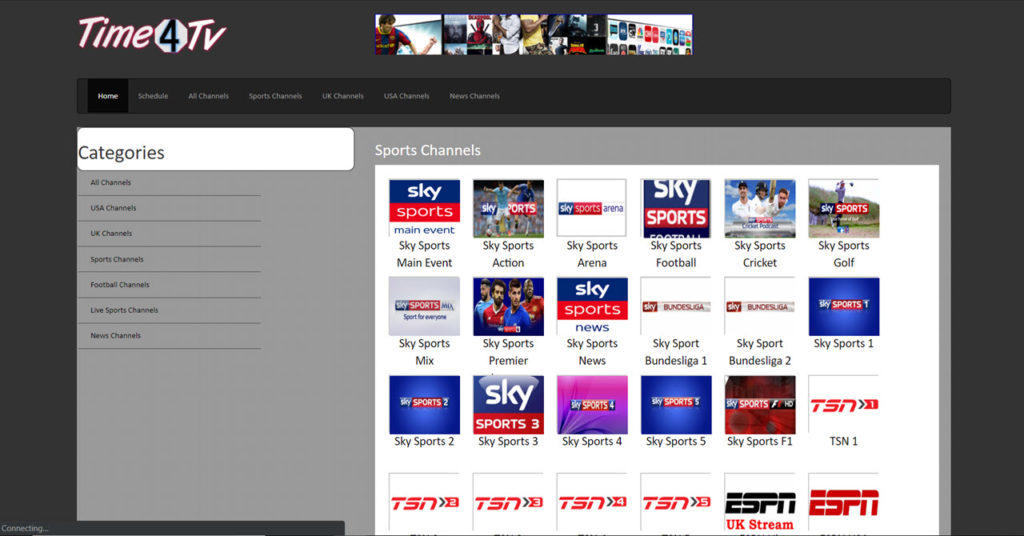
  • Time4tv.com – Time4tv.com as the name suggests is a website which provides the users with live TV streams that too without spending a single penny. Users can schedule their favorite events as per their convenience. It has a huge variety of stuff in its bouquet for the users to choose from. The stream is provided in premium resolution. All the above features of it surely indicates that it will always be a recommended alternative of Soccertv.
  • Wizwig.com – WizWig.com is one of the leading website in this field of providing online soccer entertainment for its users from the comfort of their home. Not only soccer but if you are fan of other sports then also this website is surely a gift for you.
  • VIPLeague.se – VIPLeague.se is one such website that is gathering a lot of popularity. From EPL, UEFA Europa League, Bundesliga to LA LIGA, it provides streaming of all the major events from all over the world.
    The website works smoothly on smartphones, PCs and laptops which are connected with a stable internet connection. Over and all it has all the features of becoming a pioneer in coming near future.
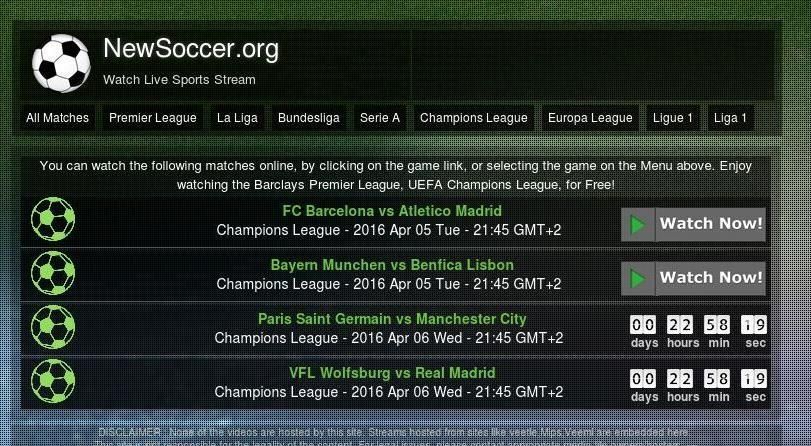
  • Newsoccer.org – Newsoccer.org is a website that can be considered as one of the most dedicated website for the soccer lovers. This website provides link to all the games in the homepage or otherwise users can manually search their interested games in the Menu option. From Bundesliga, La Liga, Serie A to Premier League, it has everything for sports enthusiasts.
  • Livetv.sx – Livetv.sx provides all the latest news, live scores, video broadcasts, video highlights, results and much more for the users. The deep analysis of every game on it is much liked by many users. It has both the limited version and full version of it available for the users. But the full version is available and work smoothly on the desktop only.

THE CONCLUSION :-
Every sports event broadcasting rights are given to a particular company by taking hefty amount of money from them. These companies generate this huge amount from their customers which buy subscription for watching live streaming of sports events. But some websites provides pirated content in order to increase their users by giving them lollipop of free access to exclusive content. It causes a huge loss to the company who buys official rights for broadcasting live events. But still if you are getting something for free then who will not be excited to grab this opportunity. This list provides some of these type of websites.

Our Nation! Our Identity!!

Ever wondered what is common between you and a person in a different state having different background and ideologies?

It is “INDIA”. It is our country and a sense of patriotism and brotherhood which unites two people in two different parts of India having different background and ideologies. It is this Pride of being an INDIAN which keeps us together and fills our heart with Pride when we hear the name of our country “INDIA”.

India is one of the oldest civilizations in the world with a kaleidoscopic variety and rich cultural heritage. It has achieved all-round socio-economic progress since Independence. As the 7th largest country in the world, India stands apart from the rest of Asia, marked off as it is by mountains and the sea, which give the country a distinct geographical entity. Bounded by the Great Himalayas in the north, it stretches southwards and at the Tropic of Cancer, tapers off into the Indian Ocean between the Bay of Bengal on the east and the Arabian Sea on the west.

Here the National Identity Elements of our country INDIA

National Flag

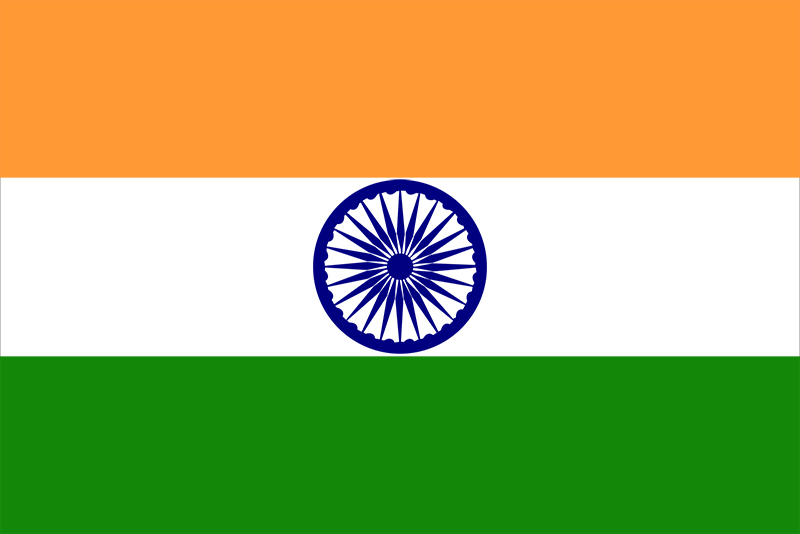
The National Flag is a horizontal tricolour of India saffron (kesaria) at the top, white in the middle and India green at the bottom in equal proportion. The ratio of width of the flag to its length is two to three. In the centre of the white band is a navy-blue wheel which represents the chakra.

The top saffron colour, indicates the strength and courage of the country. The white middle band indicates peace and truth with Dharma Chakra. The green shows the fertility, growth and auspiciousness of the land.

Its design is that of the wheel which appears on the abacus of the Sarnath Lion Capital of Ashoka. Its diameter approximates to the width of the white band and it has 24 spokes. The design of the National Flag was adopted by the Constituent Assembly of India on 22 July 1947.

National Bird

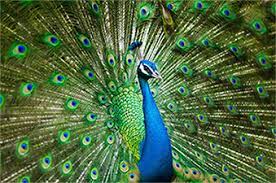
The Indian peacock, Pavo cristatus, the national bird of India, is a colourful, with a fan-shaped crest of feathers, a white patch under the eye and a long, slender neck. A bird with a glistening blue breast and neck and a spectacular bronze-green tail of around 200 elongated feathers. The elaborate courtship dance of the bird, fanning out the tail and preening its feathers is a gorgeous sight.

National Flower

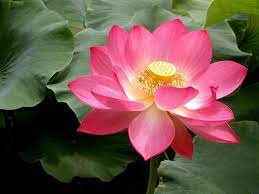
Lotus (Nelumbo Nucifera Gaertn) is the National Flower of India. It is a sacred flower and occupies a unique position in the art and mythology of ancient India and has been an auspicious symbol of Indian culture since time immemorial.

India is rich in flora. Currently available data places India in the tenth position in the world and fourth in Asia in plant diversity. From about 70 per cent geographical area surveyed so far, 47,000 species of plants have been described by the Botanical Survey of India (BSI).

National Tree

Indian fig tree, Ficus bengalensis, whose branches root themselves like new trees over a large area. The roots then give rise to more trunks and branches. Because of this characteristic and its longevity, this tree is considered immortal and is an integral part of the myths and legends of India. Even today, the banyan tree is the focal point of village life and the village council meets under the shade of this tree.

National Anthem

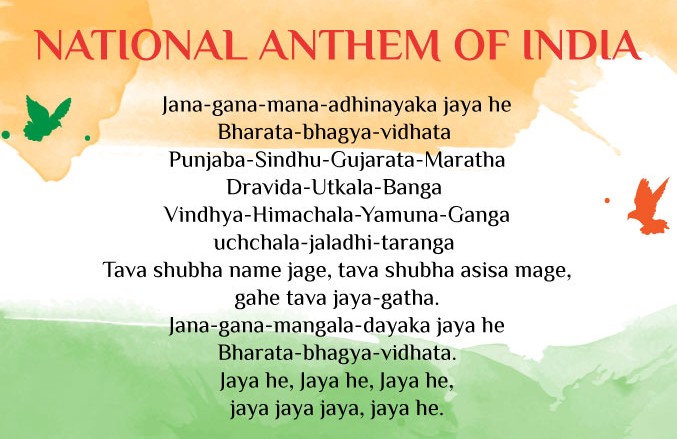
The “National Anthem of India” is played or song on various occasions. It represents the rich cultural heritage, geography, History, the courage and bravery of Indians.

Jana-gana-mana-adhinayaka jaya he
Bharata-bhagya-vidhata
Punjaba-Sindhu-Gujarata-Maratha
Dravida-Utkala-Banga
Vindhya-Himachala-Yamuna-Ganga
uchchala-jaladhi-taranga
Tava shubha name jage, tava shubha asisa mage,
gahe tava jaya-gatha.
Jana-gana-mangala-dayaka jaya he
Bharata-bhagya-vidhata.
Jaya he, Jaya he, Jaya he,
jaya jaya jaya, jaya he.

State Emblem

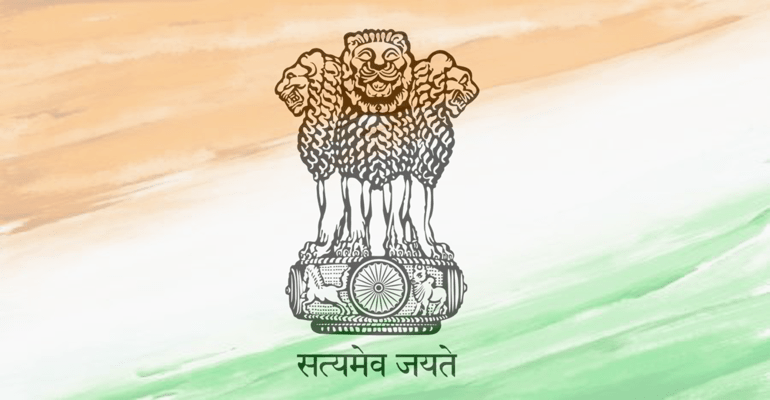
The state emblem is an adaptation from the Sarnath Lion Capital of Ashoka. In the original, there are four lions, standing back to back, mounted on an abacus with a frieze carrying sculptures in high relief of an elephant, a galloping horse, a bull and a lion separated by intervening wheels over a bell-shaped lotus. Carved out of a single block of polished sandstone, the Capital is crowned by the Wheel of the Law (Dharma Chakra)

In the state emblem, adopted by the Government of India on 26 January 1950, only three lions are visible, the fourth being hidden from view. The wheel appears in relief in the centre of the abacus with a bull on right and a horse on left and the outlines of other wheels on extreme right and left. The bell-shaped lotus has been omitted. The words Satyameva Jayate from Mundaka Upanishad, meaning ‘Truth Alone Triumphs‘, are inscribed below the abacus in Devanagari script.

National Animal

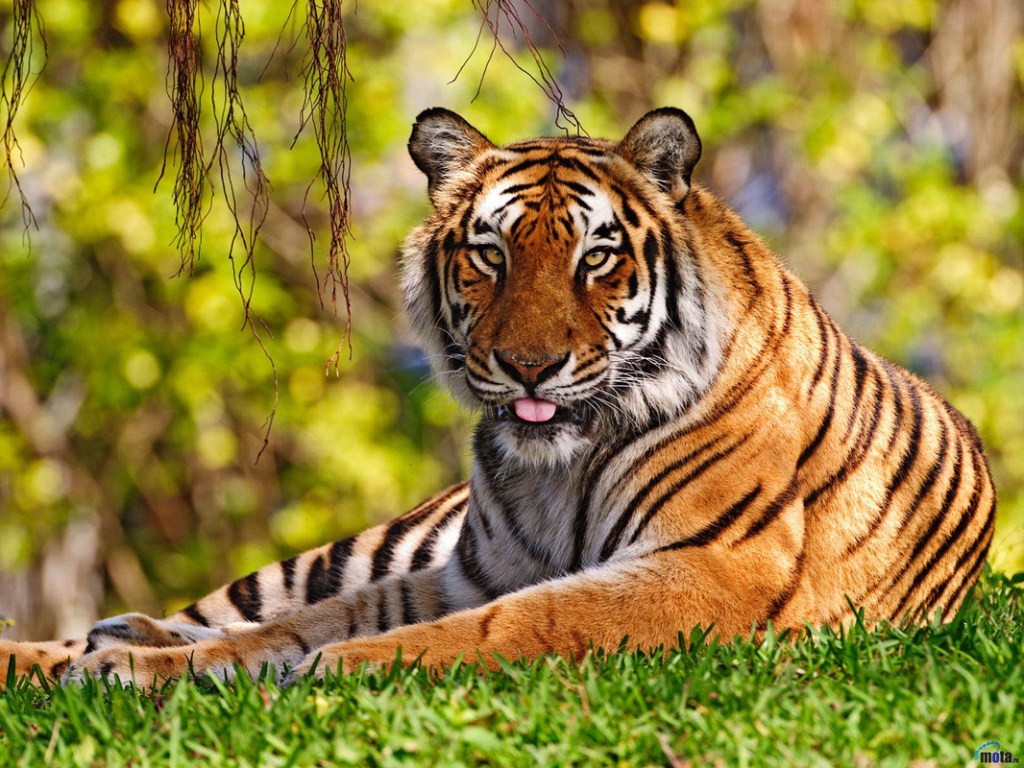
The magnificent tiger, Panthera tigris is a striped animal. It has a thick yellow coat of fur with dark stripes. The combination of grace, strength, agility and enormous power has earned the tiger its pride of place as the national animal of India. Out of eight races of the species known, the Indian race, the Royal Bengal Tiger, is found throughout the country except in the north-western region and also in the neighbouring countries, Nepal, Bhutan and Bangladesh.

Currency Symbol

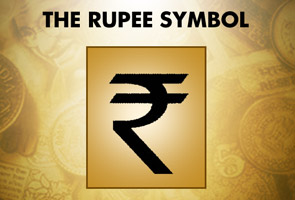
The symbol of Indian Rupee typifies India’s international identity for money transactions and economic strength. The Indian Rupee sign is an allegory of Indian ethos. The symbol is an amalgam of Devanagari “Ra” and the Roman Capital “R” with two parallel horizontal stripes running at the top representing the national flag and also the “equal to” sign. The Indian Rupee sign was adopted by the Government of India on 15th July, 2010.

The symbol, conceptualised and designed by Udaya Kumar, a post graduate in Design from Indian Institute of Technology Bombay.

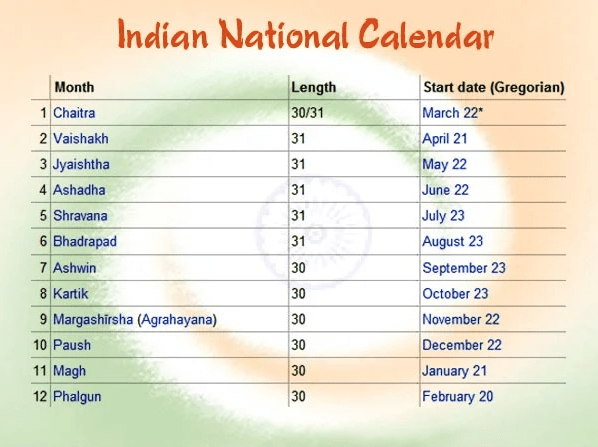
National Calendar

The national calendar based on the Saka Era, with Chaitra as its first month and a normal year of 365 days was adopted from 22 March 1957 along with the Gregorian calendar for the following official purposes:

  1. Gazette of India.
  2. News broadcast by All India Radio.
  3. Calendars issued by the Government of India.
  4. Government communications addressed to the members of the public.

Dates of the national calendar have a permanent correspondence with dates of the Gregorian calendar, 1 Chaitra falling on 22 March normally and on 21 March in leap year.

The National Symbols of India fill a sense of pride in our heart! It is very important that we give atmost respect to our National Identity Symbols! Jai Hind

References:

Know India – This is an official website of India, used and can be used to get authentic information.

Wikipedia

https://www.india.gov.in/

TOP 5 PLACES TO VISIT IN RAJASTHAN

OVERVIEW OF RAJASTHAN :-

Rajasthan is the largest state of India. It is located in the North-Western part of India covering an area of 132, 139 square miles. It is world renowned for its diverse culture and languages. The climatic conditions of Rajasthan is sharply in contrast with each other. The eastern part of Rajasthan is rich in biodiversity and receives plenty of rainfall. In contrast to it, the western part is quite dry and sand dunes are easily visible. Let us look at some of the best places to visit in Rajasthan.

TOP PLACES TO VISIT :-

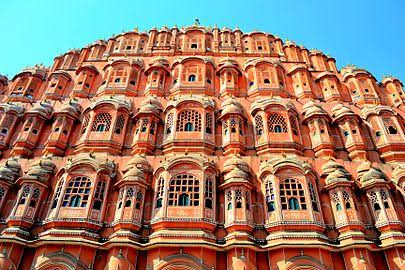
  • Hawa Mahal – It is located in Jaipur, the state capital of Rajasthan. It is well connected by roads with Jaipur and public transport is easily available to reach here.
    It was built by Maharaja Sawai Pratap Singh who was the grandson of Maharaja Sawai Jai Singh. It was completed in the year 1799. It is built on the theme of Hindu Rajput architecture. It is built using red and pink sandstones as it is located in the pink city Jaipur.
    It is about 50 feet tall and has 953 “Jharokas” to facilitate the women living in it at that time. It is maintained and preserved by Government of Rajasthan’s Archaeological Department. Lakhs of tourists visit here every year to admire its beauty.
HAWA MAHAL
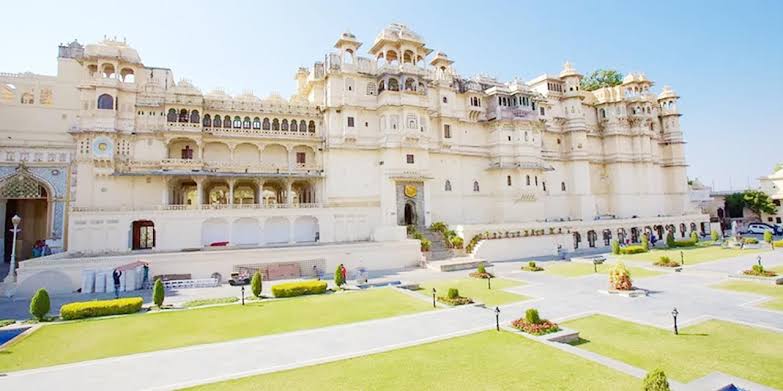
  • City Palace, Udaipur – Standing from the last more than 400 years, City Palace is a magnificent architecture of all times. Its construction was started in the year 1559 by Maharana Udai Singh ll. He was the king of Mewar kingdom. It is well connected by roads and other public transport with rest parts of India.
    The building is constructed using marble and masonry architecture. It stands at a height of 1,962 feet. The interior of the City Palace is also very well designed and furnished with mirrors, wall paintings and marble work. The Lake Pichola is also a main attraction of tourists visiting the City Palace.
    Every year more than a million tourists visit here.
CITY PALACE, UDAIPUR
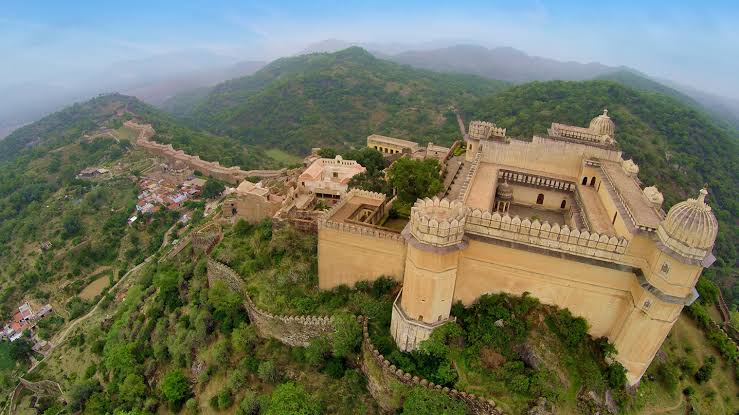
  • Kumbhalgarh Fort – It is situated in the Rajsamand district of Rajasthan. It got its name from Rana Kumbha who built it during his regime in the 15th century. Its periphery is spread in a whopping 662 acres. It is built on a hill top to protect it from enemies. It has seven main entrance gates. More than 700 Hindu and Jain Temples are built inside the fort. In the year 2013, it was declared as UNESCO World Heritage Site. Every year a “Mela” is organised here in which thousands of local and other tourists take part in various programmes. It is a major attraction for tourists visiting Rajasthan.
KUMBHALGARH FORT
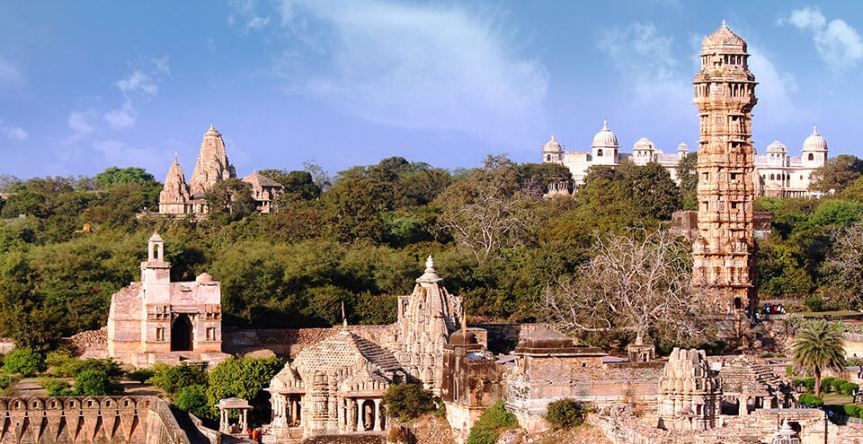
  • Chittor Fort – It is located in the Chittaurgarh district of Rajasthan. It is built on a hill top and served as the main place from where Mewar Kings used to run their administration. It is spread in an area of 692 acres. It has seen many ferocious war between Mewar Kings and Mughals.
    The major attractions here are Vijaya Stambha, Kirti Stambha, Rana Kumbha Palace, Gaumukh Reservoir and Rani Padmini’s Palace. It is declared as a UNESCO World Heritage Site in the year 2013.
CHITTOR FORT
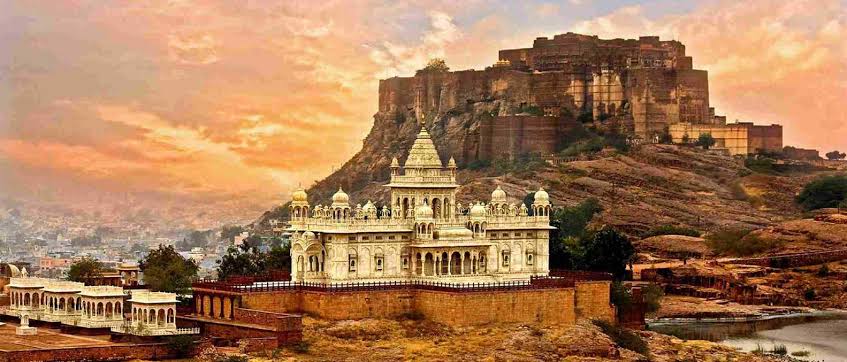
  • Mehrangarh Fort – It is located in the Jodhpur district of Rajasthan. It covers an area of 1,200 acres. It was constructed by King Rao Jodha in the year 1459.
    National Geological Monument, The Chamunda Mataji Temple, Rao Jodha Desert Rock Park and various galleries in Mehrangarh Museum are major attractions for tourists.
MEHRANGARH FORT

Links :-

http://www.tourism.rajasthan.gov.in/

Udagamandalam – the Queen of Hill Stations

Udagamandalam is located in the Western Ghats zone at an altitude of 2240 m. It is the headquarters of the Nilgiri District, where the two mountain ranges meet. Udagamandalam, popularly called Ooty by the tourist, is the Queen of Hill Stations, Centuries ago this was also called as Oththai-Kai[single stone] Mandu [ Mund is a name of Toda Village]. The British started calling it as Ootacamund. Coffee and Tea plantations and trees like Conifers, Eucalyptus, Pine and Wattle dot the hill side in Udagamandalam and its environs. Summer temperature is maximum of 25°C and a minimum of 10°C. During the winter it is a maximum of 21°C and a minimum of 5°C .This area was inhabited by the tribals called Toda long before anybody ventured into this region . Curiously enough, this slice of paradise remained unknown even during the periods of the great Southern Dynasties. It was the British who ventured into the region during early nineteenth century. In search of copier climates development and modernization took place after their arrival . This was the summer Capital of the Madras Presidency during the British Rule. It is the pride of the Blue Hills and center of attraction. This was formed by Mr.John Sullivan, the then Collector of Coimbatore in the year 1824. This is located in an area of 65 acres. Fishing was the major activity in this place. In the year 1973, Tourism Development Corporation, Government of Tamilnadu, on behalf of the Tourism Department took possession of this place for Boating activity , which provides another thrilling entertainment for the tourists.