Taxation System and Reform of Taxation Policy

Source: thenews.com.pk

Attribution of compulsory taxes by government is main characteristic of financial system. Taxes are levies in every country to generate revenue. Rudimentarily to raise revenue for government expenditure, and for other purposes as well. Without taxes, government would be unable to meet demands of the societal needs. Taxes are crucial because government collect the revenue and use it to finance social projects.

Tax system based on equality module that rich in the society will pay more than the poor. According to Adam Smith’s four principle in his famous book ‘Wealth of Nations’. Adam Smith stated that taxes should be proportional to income, that is everybody should pay the same rate or percentage of his income as tax.

Another important principle of a accurate tax system as per Adam Smith laid a good deal of stress in his cannon theory of certainty. The tax which each individual is bound to pay ought to be certain and not arbitrary. The time of payment, method of payment, the quantity to be paid ought all to be clear and plain to the contributor and to every other person.

 A successful function of an economy requires that the people, especially business class, must be certain about the sum of tax that they have to pay on their income from work or investment. The sum, the time payments of tax should not be certain but the time and manner of it’s payment should also be convenient to the contributor.

The Government has to spend money on collecting taxes levied by it’s collection costs of taxes and nothing to the national product, they should be minimised as  far as possible. If the collection costs of a tax are more than the total revenue yielded by it, it is not worth while to levy tax.

 Productivity of taxes when levied to generate sufficient revenue from the government. If few taxes imposed yield a sufficient funds for the state, they should be preferred over a large number of small taxes which are expensive in collection. Fair elasticity at any the government need of more funds, it should increase it’s financial resources without incurring any additional cost of collection.

Simplicity of tax system must be simple, plain and intelligible to tax payer. System of taxation should include a large number of taxes that is economical. The government should collect revenue from it’s subjects by levying direct and indirect taxes.

 Reforms in Taxation Policy

Source: canarahbsc.life

Tax Policy in India has evolved as an important component of fiscal Policy which had to play core role in the planned development strategy. Taxation Policy cannot be same always it keep on changing with changes in economic scope of the country. To structure and strengthen in taxation Policy various reforms we’re implemented and many are in stream like recent change was good and services tax was country’s biggest reform.

The taxation enquiry commission 1953 was the first comprehensive attempt to review the tax system, it design to structure. Holist tax system for the country; covered central and state also local taxes. In 1985, Government of India introduced long term fiscal policy; this policy led to Modified System of Value Added Tax (MODVAT) in 1986.

Economic crisis of 1991, tax reforms we’re initiated as a part of structural reform process. Tax reform committee recommend major reforms to stabilize economic turbulence in the country. Changes are Reflection of custom duty, Rationalize the capital gain tax and wealth tax, Reduce excise duty, bring the service sector in the VAT tax system, Improving quality of tax Administration, reduction of corporate taxes and reduce the cost of imported inputs.

Reform of Direct Taxes

The government brought consolidated direct taxes. The income tax act was passed in 1961. Direct Taxes Enquiry Committee was constituted to look into affair of direct taxes, tax reform committee (1991) has recommended various point to consolidated direct taxes and task force on tax Policy and administration gave explained path to reform direct taxes in country. National Securities Depository Limited (NSDL) established tax information network to moderate the collection, and monitoring accounting.

Reform of Indirect Tax

The indirect tax Enquiry report in 1977 recommended valuable reform in indirect tax regime. Initiated modified value added tax (MODVAT) for commodities in 1986 to replay the central excise duty, extend to all commodities through Central Value Added Tax (CENVAT). State replace sale tax and have Value added tax.

Gig Economy

What Is the Gig Economy?

In a gig economy, temporary, flexible jobs are commonplace and companies tend to hire independent contractors and freelancers  instead of full-time employees. A gig economy undermines the traditional economy of full-time workers who often focus on their career development.

Understanding the Gig Economy

In a gig economy, large numbers of people work in part-time or temporary positions or as independent contractors. The result of a gig economy is cheaper, more efficient services, such as Uber or Airbnb, for those willing to use them. People who don’t use technological services such as the Internet may be left behind by the benefits of the gig economy. Cities tend to have the most highly developed services and are the most entrenched in the gig economy. A wide variety of positions fall into the category of a gig. The work can range from driving for Lyft or delivering food to writing code or freelance articles. Adjunct and part-time professors, for example, are contracted employees as opposed to tenure-track or tenured professors. Colleges and universities can cut costs and match professors to their academic needs by hiring more adjunct and part-time professors.

The Factors Behind a Gig Economy

America is well on its way to establishing a gig economy, and estimates show as much as a third of the working population is already in some gig capacity. Experts expect this working number to rise, as these types of positions facilitate independent contracting work, with many of them not requiring a freelancer to come into an office. Gig workers are much more likely to be part-time workers and to work from home. Employers also have a wider range of applicants to choose from because they don’t have to hire someone based on their proximity. Additionally, computers have developed to the point that they can either take the place of the jobs people previously had or allow people to work just as efficiently from home as they could in person.

Economic reasons also factor into the development of a gig economy. Employers who cannot afford to hire full-time employees to do all the work that needs to be done will often hire part-time or temporary employees to take care of busier times or specific projects. On the employee’s side of the equation, people often find they need to move or take multiple positions to afford the lifestyle they want. It’s also common to change careers many times throughout a lifetime, so the gig economy can be viewed as a reflection of this occurring on a large scale.

During the coronavirus pandemic of 2020, the gig economy has experienced significant increases as gig workers have delivered necessities to home-bound consumers, and those whose jobs have been eliminated have turned to part-time and contract work for income. Employers will need to plan for changes to the world of work, including the gig economy, when the pandemic has ended.

Criticisms of the Gig Economy

Despite its benefits, there are some downsides to the gig economy. While not all employers are inclined to hire contracted employees, the gig economy trend can make it harder for full-time employees to develop in their careers since temporary employees are often cheaper to hire and more flexible in their availability. Workers who prefer a traditional career path and the stability and security that come with it are being crowded out in some industries.

For some workers, the flexibility of working gigs can actually disrupt the work-life balance, sleep patterns, and activities of daily life. Flexibility in a gig economy often means that workers have to make themselves available any time gigs come up, regardless of their other needs, and must always be on the hunt for the next gig. Competition for gigs has increased during the pandemic, too. And unemployment insurance usually doesn’t cover gig workers who can’t find employment.

In effect, workers in a gig economy are more like entrepreneurs than traditional workers. While this may mean greater freedom of choice for the individual worker, it also means that the security of a steady job with regular pay, benefits—including a retirement account—and a daily routine that has characterized work for generations are rapidly becoming a thing of the past.

Lastly, because of the fluid nature of gig economy transactions and relationships, long-term relationships between workers, employers, clients, and vendors can erode. This can eliminate the benefits that flow from building long-term trust, customary practice, and familiarity with clients and employers. It could also discourage investment in relationship-specific assets that would otherwise be profitable to pursue since no party has an incentive to invest significantly in a relationship that only lasts until the next gig comes along.

Ways to Manage Stress

Stress is part of being human, and it can help motivate you to get things done. Even high stress from serious illness, job loss, a death in the family, or a painful life event can be a natural part of life. You may feel down or anxious, and that’s normal too for a while. Talk to your doctor if you feel down or anxious for more than several weeks or if it starts to interfere with your home or work life. Therapy, medication, and other stategies help. In the meantime, there are things you can learn to manage stress before it gets to be too much. Consider these suggestions:

Exercise

To start with, physical activity can help improve your sleep. And better sleep means better stress management. Doctors don’t yet know exactly why, but people who exercise more tend to get better deep “slow wave” sleep that helps renew the brain and body. Just take care not to exercise too close to bedtime, which disrupts sleep for some people. Exercise also seems to help mood. Part of the reason may be that it stimulates your body to release a number of hormones like endorphins and endocannabinoids that help block pain, improve sleep, and sedate you. Some of them (endocannabinoids) may be responsible for the euphoric feeling, or “runner’s high,” that some people report after long runs.

People who exercise also tend to feel less anxious and more positive about themselves. When your body feels good, your mind often follows. Get a dose of stress relief with these exercises:

Applications

Property Rights

What Are Property Rights?

Property rights define the theoretical and legal ownership of resources and how they can be used. These resources can be both tangible or intangible and can be owned by individuals, businesses, and governments. In many countries, including the United States, individuals generally exercise private property rights or the rights of private persons to accumulate, hold, delegate, rent, or sell their property. In economics property rights form the basis for all market exchange, and the allocation of property rights in a society affects the efficiency of resource use.

Understanding Property Rights

Property is secured by laws that are clearly defined and enforced by the state. These laws define ownership and any associated benefits that come with holding the property. The term property is very expansive, though the legal protection for certain kinds of property varies between jurisdictions.Property is generally owned by individuals or a small group of people. The rights of property ownership can be extended by using patents and copyrights to protect:

  • Scarce physical resources such as houses, cars, books, and cellphones
  • Non-human creatures like dogs, cats, horses or birds
  • Intellectual property such as inventions, ideas, or words

Other types of property, such as communal or government property, are legally owned by well-defined groups. These are typically deemed public property. Ownership is enforced by individuals in positions of political or cultural power. Property rights give the owner or right holder the ability to do with the property what they choose. That includes holding on to it, selling or renting it out for profit, or transferring it to another party.

Acquiring Rights to a Property

Individuals in a private property rights regime acquire and transfer in mutually agreed-upon transfers, or else through homesteading. Mutual transfers include rents, sales, voluntary sharing, inheritances, gambling, and charity. Homesteading is the unique case; an individual may acquire a previously unowned resource by mixing his labor with the resource over a period of time. Examples of homesteading acts include plowing a field, carving stone, and domesticating a wild animal. In areas where property rights don’t exist, the ownership and use of resources are allocated by force, normally by the government. That means these resources are allocated by political ends rather than economic ones. Such governments determine who may interact with, can be excluded from, or may benefit from the use of the property.

Private Property Rights

Private property rights are one of the pillars of capitalist economies, as well as many legal systems, and moral philosophies. Within a private property rights regime, individuals need the ability to exclude others from the uses and benefits of their property. All privately owned resources are rivalrous, meaning only a single user may possess the title and legal claim to the property. Private property owners also have the exclusive right to use and benefit from the services or products. Private property owners may exchange the resource on a voluntary basis.

Private Property Rights and Market Prices

Every market price in a voluntary, capitalist society originates through transfers of private property. Each transaction takes place between one property owner and someone interested in acquiring the property. The value at which the property exchanges depends on how valuable it is to each party. Suppose an investor purchases $1,000 in shares of stock in Apple. In this case, Apple values owning the $1,000 more than the stock. The investor has the opposite preference, and values ownership of Apple stock more than $1,000.

Financial Literacy

What Is Financial Literacy?

Financial literacy is the ability to understand and effectively use various financial skills, including personal financial management, budgeting, and investing. Financial literacy is the foundation of your relationship with money, and it is a lifelong journey of learning. The earlier you start, the better off you will be, because education is the key to success when it comes to money.

Read on to discover how you can become financially literate and able to navigate the challenging but critical waters of personal finance. And when you have educated yourself, try to pass your knowledge on to your family and friends. Many people find money matters intimidating, but they don’t have to be, so spread the news by example.

Understanding Financial Literacy

In recent decades financial products and services have become increasingly widespread throughout society. Whereas earlier generations of Americans may have purchased goods primarily in cash, today various credit products are popular, such as credit and debit cards and electronic transfers. Indeed, a 2019 survey from the Federal Reserve Bank of San Francisco showed that consumers preferred cash payments in only 22% of transactions, favoring debit cards for 42% and credit cards for 29%.

Other products, such as mortgages, student loans, health insurance, and self-directed accounts, have also grown in importance. This has made it even more imperative for individuals to understand how to use them responsibly. Although there are many skills that might fall under the umbrella of financial literacy, popular examples include household budgeting, learning how to manage and pay off debts, and evaluating the tradeoffs between different credit and investment products. These skills often require at least a working knowledge of key financial concepts, such as compound interest and the time value of money. Given the importance of finance in modern society, lacking financial literacy can be very damaging to an individual’s long-term financial success.

Being financially illiterate can lead to a number of pitfalls, such as being more likely to accumulate unsustainable debt burdens, either through poor spending decisions or a lack of long-term preparation. This in turn can lead to poor credit, bankruptcy, housing foreclosure, and other negative consequences. Thankfully, there are now more resources than ever for those wishing to educate themselves about the world of finance. One such example is the government-sponsored Financial Literacy and Education Commission, which offers a range of free learning resources.

Strategies to Improve Your Financial Literacy Skills

Developing financial literacy to improve your personal finances involves learning and practicing a variety of skills related to budgeting, managing and paying off debts, and understanding credit and investment products. Here are several practical strategies to consider.

Create a Budget—Track how much money you receive each month against how much you spend in an Excel sheet, on paper, or with a budgeting app. Your budget should include income (paychecks, investments, alimony), fixed expenses (rent/mortgage payments, utilities, loan payments), discretionary spending (nonessentials such as eating out, shopping, and travel), and savings.

Pay Yourself First—To build savings, this reverse budgeting strategy involves choosing a savings goal (say, a down payment for a home), deciding how much you want to contribute toward it each month, and setting that amount aside before you divvy up the rest of your expenses.

Pay Bills Promptly—Stay on top of monthly bills, making sure that payments consistently arrive on time. Consider taking advantage of automatic debits from a checking account or bill-pay apps and sign up for payment reminders (by email, phone, or text).

Unemployment

Unemployment has become one of the biggest problems around the world. When an individual is an implied, he or she will know very less about the mankind. It is so difficult to face situation and handle situations when the individual is unemployed. Unemployment leads to many silly mistakes. And an unemployed person cannot take over the family and lead the family as well. There is a huge competition in highly populated countries like India. In order to be employed, the only method is to study hard and improve the skills and score better. Basically, the students are not showing good amount of interest towards the studies. Let us now see how to motivate them.

Covid crisis has made many people unemployed. It has taken away the basic need of living. Many people are left with the unfilled stomachs. Some people are dead about by not finding a way to live.

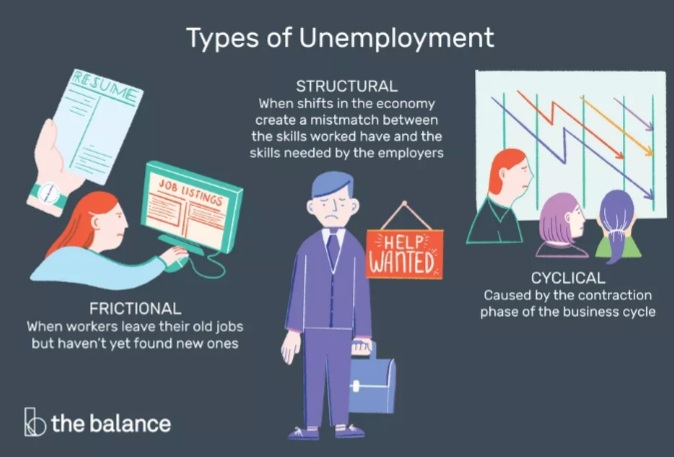
Types of unemployment :

There are four main types of unemployment in an economy frictional, structural, cyclical, and seasonal and each has a different cause.

1. Frictional unemployment :

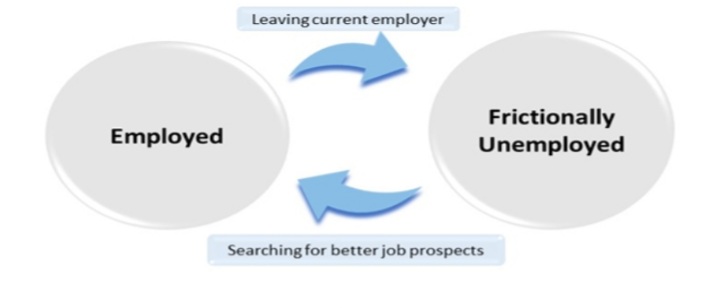
Frictional unemployment is caused by temporary transitions in workers lives, such as when a worker moves to a new city and has to find a new job. Frictional unemployment also includes people just entering the labor force, such as freshly graduated college students. It is the most common cause of unemployment, and it is always in effect in an economy.

2. Structural unemployment :

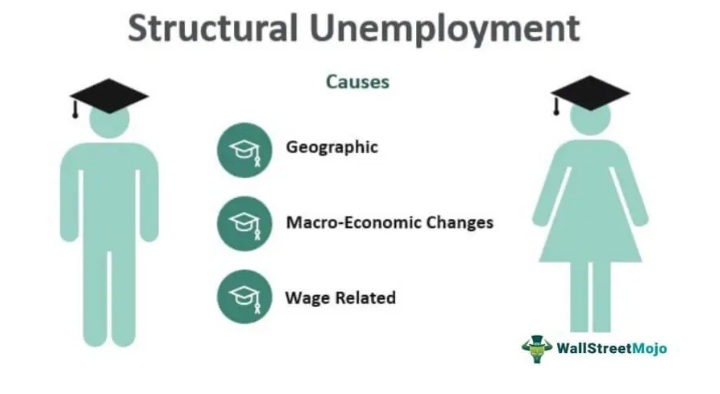
Structural unemployment is caused by a mismatch in the demographics of workers and the types of jobs available, either when there are jobs available that workers don’t have the skills for, or when there are workers availabes but no jobs to fill. Structural unemployment is most obvious in industries undergoing technological advancements.

3. Cyclical unemployment :

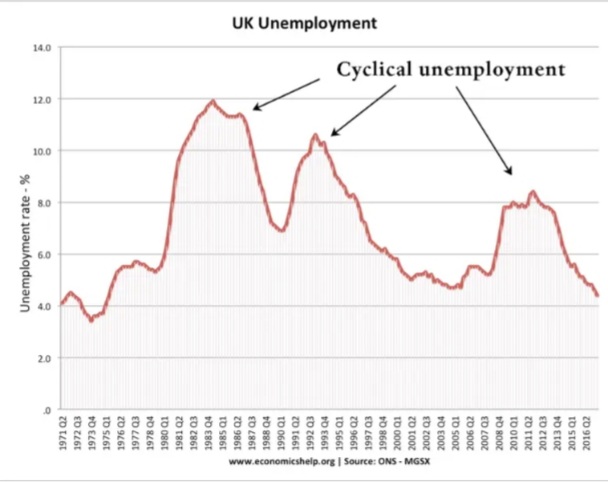
Cyclical unemployment is caused by declining demand. When there is not enough demand in an economy for goods and services, businesses cannot offer jobs . According to keynesian economics , cyclical unemployment is a natural result of the business cycle in times of recession: if all consumers become fearful at once, consumers will attempt to increase their saving at the same time, which means there will be a decrease in spending, and businesses will not be able to employ all employable workers.

4. Seasonal unemployment :

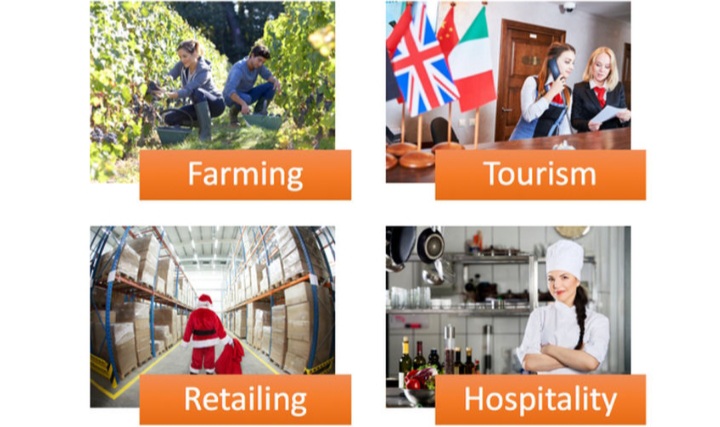
Seasonal unemployment is caused by different industries or parts of the labor market being available during different seasons. Fot instance, unemployment goes up in the winter months, because many agricultural jobs end oncr crops are have harvested in the fall, and those wotkers are left to find new jobs.

Consequences of unemployment in an Economy :

Low unemployment is key to economic stability High and long- term unemployment can cause significant stress on a nation in three key areas.

* Individuals :

Unemployed people have no ability to fulfill their financial obligations and can become mentally stressed, ill, and even homeless.

* Economic efficiency :

During times of high unemployment many job seekers will accept new jobs below their skill level, a situation called “underemployment ” which translates to a loss of human capital for an economys labor market. Unemployed workers will also significantly decreases their consumer spending, which is one of the driving forces of economic growth. Without consumer spending, the economy will slow dramatically.

* socio- political stability :

If unemployment remains high, citizen dissatisfaction can rise to the point of widespread civil unrest.

Possible solutions for Unemployment :

Solving unemployment is a hotly debated topic, and no economists agree on one simple way to do it. However, in the U.S ,if unemployment rises noticeably, the government usually steps in with specific policies designed to lower the total number of unemployed people.

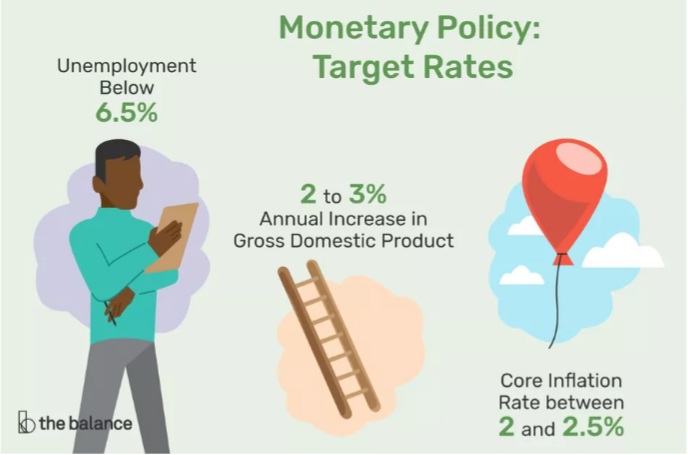
1. Monetary policy :

Monetary policy is financial influence implemented by a central bank . Monetary policies usually come in the form of lower interest rates, which increase the total money supply within an economy by allowing banks and businesses more access to loans and therefore, more accessible spending power.

2. Fiscal policy :

If expansionary monetary policy doesn’t adequately lower the unemployment rate government agencies will turn to fiscal policy. Fiscal policy is fiscal stimulus implemented by the national government and fiscal policies include spending on infrastructure, proposingtax cuts , increasing the minimum wage, or implementing unemployment benefits. These methods are designed to inject more demand into private economy and strengthen economic activity.

Let us now see some of the ways to motivate the students to study and get employeed.

Make things easier :

Showing the things easier and explaining them with clarity helps the students to show better interest on the subject and makes them to pay more attention on what the teacher is trying to convey. When the topics are shown easier for the students, they start learning them and they feel achieved and they pay more attention to study. When a student learns a particular topic or a question, he/she feels comfortable and happy for getting it. Once if they start reading, they develop the interest in them and they continue to read more and more.

Tell the importance :

The students must be motivated with good number of words to understand the need of studying and what happens if they don’t study. A student is like a bird without the wings when they don’t study. So, it is very important to motivate students to study and to make them understand the need of the situation. Motivation brings the right change in the students who are not interested in learning. It develops the interest in them to study.

It seems good if the government provides good number of jobs.

Acid Rain

“The unthinkable is that we’re distorting this atmospheric balance. We’re shifting the chemical balance so that we have more poisons in the atmosphere – ozones and acid rain on ground level – while we’re also changing the thermal climate of the earth through the greenhouse effect and – get this – simultaneously causing destruction of our primary filter of ultraviolet light. It’s incredible. Talk about the national-debt crisis – we’re piling up debts in the atmosphere, and the piper will want to be paid.”

~ Michael Oppenheimer

Introduction

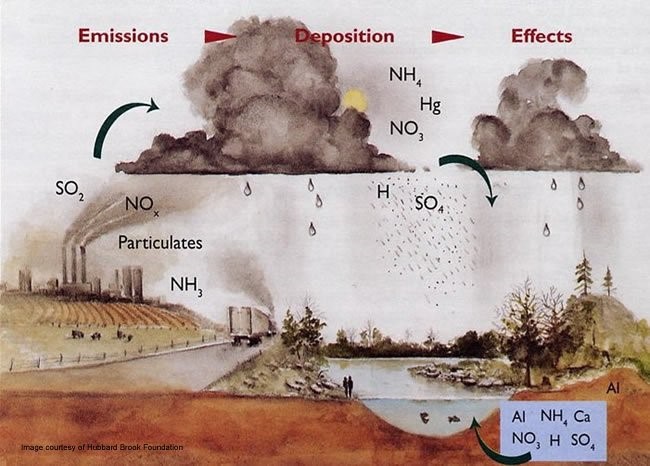
Acid rain, or acid deposition, is a broad term that includes any form of precipitation with acidic components, such as sulfuric or nitric acid that fall to the ground from the atmosphere in wet or dry forms. This can include rain, snow, fog, hail or even dust that is acidic.

Acid rain is caused by a chemical reaction that begins when compounds like sulfur dioxide and nitrogen oxides are released into the air. These substances can rise very high into the atmosphere, where they mix and react with water, oxygen, and other chemicals to form more acidic pollutants, known as acid rain.

It can have harmful effects on plants, aquatic animals, and infrastructure.

Effects of Acid Rain

The ecological effects of acid rain are most clearly seen in aquatic environments, such as streams, lakes, and marshes where it can be harmful to fish and other wildlife. As it flows through the soil, acidic rain water can leach aluminum from soil clay particles and then flow into streams and lakes.

Acid rain has been shown to have adverse impacts on forests, freshwaters, and soils, killing insect and aquatic life-forms, causing paint to peel, corrosion of steel structures such as bridges, and weathering of stone buildings and statues as well as having impacts on human health.

Acid rain also causes the corrosion of water pipes. Which further results in leaching of heavy metals such as iron, lead and copper into drinking water.

Prevention

1. The only precaution that we can take against acid rain is having a check at the emission of oxides of nitrogen and sulphur.
2. We have so far seen the details of acid rain and its harmful effect on animals, plants and the monuments.
3. Being responsible citizens, one should be aware of the harmful effects they cause and of the industries which give out nitrogen and sulphur compound wastes unethically. 4.A great way to reduce acid rain is to produce energy without using fossil fuels. Instead, people can use renewable energy sources, such as solar and wind power. Renewable energy sources help reduce acid rain because they produce much less pollution.

Acid Rain in India

Analysis of rainwater samples from Nagpur, Mohanbari (in Assam), Allahabad, Visakhapatnam and Kodaikanal in the decade 2001-2012 showed a pH level varying from 4.77 to 5.32, indicating that these places have actually been receiving ‘acid rain’. Rainwater with pH below 5.65 is considered acidic.

As energy requirements in India will grow rapidly in tune with the economy, coal dependence is expected to increase threefold over the current level of consumption, making the clouds of acid rain heavier over many highly sensitive areas in the country – the northeast, parts of Bihar, Orissa, West Bengal ,etc ,.

The rains in the Indian Ocean and the Arabian Sea and the Bay of Bengal have become acidic. Studies show the importance to regularly monitor more places for acid rains. But the mechanism to study acid rains is at present inadequate in India. imd stations are not located in the most polluted areas in the country.

Link

Greed vs Generosity: Which Gives a Better Competitive Advantage?

Many people think that in the professional world, selfishness and greed are the characteristics that pay dividends. But the truth is, excepting win-lose situations, that the most successful people in the medium and long term are those who are the most generous in their business and personal lives.

Ambition is a desire to take on more than you can realistically accomplish, to constantly strive for improvement, to grow both personally and professionally, and, of course, the desire to generate more income. However there comes a time when ambition crosses a line, and when that happens it becomes greed. Greed is the desire to chew more than you can eat, a desire that distracts you from realistically possible goals. Greed is wanting to get more than what you have actually earned, obtaining maximum profit at minimum cost, or as an old adage has it: “Grasp all, lose all.”

Today there is an abundance of courses and books on finance, limitless knowledge on hand with a simple click. But to know what is right, to subdue the pirates of greed and to follow your trading plan- this is another story. People who look for easy money invariably find that there is no such thing, paying a heavy price for this lesson. Ego, vanity, and revenge play a part, causing people to fail on their trading accounts. This is one of the factors that explains why people might not fall into the exclusive 10% that ‘win’, and find themselves one of the 90% that lose.

Literature and film are full of greedy and stingy characters, and the moral of films like ‘A Christmas Carol’ or ‘The Wolf of Wall Street’ is always the same: the fate of the greedy is heartbreaking. Their addiction to work means that they live a lonely life, and their search for wealth means that at the end of their lives, they have only the sober memory of their friends from the Stock Exchange.

GIVE AND TAKE

People do not realize that giving without expecting something in return could be a competitive advantage, as well as making ones outlook more positive. Studies have shown that the most successful people are generous. At least this is the affirmation of Adam Grant, a psychologist and professor at Wharton and author of “Give and Take”.

A generous person builds bigger and stronger networks, improves communication with their existing contacts, and also finds it easier to interact with people outside of their core network- this gives them access to new contacts and valuable sources of information. Generous people inspire in others a predisposition, or positive receptivity, to reconnect with them, as well as a greater willingness to collaborate.

Moreover, being a giver encourages persistence because givers are able to enthusiastically motivate people, inspiring confidence, because they are liberal with praise. They create a generally positive environment. Talent is important, but the most important factor in success is persistence. And what’s even more interesting is that being a giver has an energizing effect that increases levels of happiness.

According to Bill Williams, famous trader and writer of “Trading Chaos”, people with a ‘giving’ mindset enjoy more happiness and success. For example, later in his career Bill always traded two accounts, one for himself and one for his charities. The charity account always made more money, even though he traded using the same method with both accounts. In the charity account he never veered from his strategy, while in his own account he would sometimes take a trade based on a “feel”, or get in a trade before the actual signal. This shows us the importance of sticking to a plan, but also the importance of being a ‘giver’.

Giving distracts us from our problems, adds meaning to our lives and helps us feel valued by others. This explains why avidity and egoism are the trader’s worst enemy. Having a benevolent mindset while trading helps the trader to increase performance. Happy people earn more money on average, score higher yields, make better decisions and contribute more to their organizations. Furthermore, traders who are givers are at the top of the most successful trading operations.

THE GREED EFFECT

Focusing only on money results in the ‘greedy effect’, something that all professional traders know. In fact, one of the most common pieces of (rarely followed) advice that newbies receive is to shift their focus from trade results to the trading process, analyzing and following the rules of their trading system. Another suggestion is to start reasoning in pips and ticks instead of dollars. This reduces the greedy mindset and develops a more reliable attitude.

However we can make a further effort to improve our performance by shifting our focus to be more generous. One example is trading for charitable purposes like the aforementioned Bill Williams, another could be simply committing a small part of your monthly or annual profit to microcredits, which promote a world of stability and self-sufficiency, key to overcoming poverty.

Material things can be recovered, but feelings of guilt, helplessness and loneliness cannot be solved with money. If humans would be more understanding of and generous to others, the world would be a very different place. And that is why those who practice generosity, making it part of their daily lives, experience an uplifting of their mental and emotional state, and are generally filled with more satisfaction in their professional and personal lives.

In conclusion, we see that generous people are the most successful in their daily trading performance for the reasons described above. Having a giving mindset helps professionals become part of that exclusive group, the 10% of winners.

Asymmetric information

Asymmetric information, also known as “information failure,” occurs when one party to an economic transaction possesses greater material knowledge than the other party. This typically manifests when the seller of a good possesses greater knowledge than the buyer; however, the reverse dynamic is also possible. Almost all economic transactions involve information asymmetries. Asymmetric information can also be viewed as the specialization and division of knowledge, as applied to any economic trade. Asymmetric information examples are everywhere. In the financial world, consider a situation where a lending firms enters into an agreement with a borrower. The lender establishes the terms and agreements that the borrower must stipulate to, and, usually, background checks are done.

Moral hazard is a situation in which one party gets involved in a risky event knowing that it is protected against the risk and the other party will incur the cost. It arises when both the parties have incomplete information about each other.

In a financial market, there is a risk that the borrower might engage in activities that are undesirable from the lender’s point of view because they make him less likely to pay back a loan. It occurs when the borrower knows that someone else will pay for the mistake he makes. This in turn gives him the incentive to act in a riskier way. This economic concept is known as moral hazard.

Adverse Selection describes a situation in which one party in a deal has more accurate and different information than the other party. The party with less information is at a disadvantage to the party with more information. This asymmetry causes a lack of efficiency in the price and the number of goods and services provided. Most information in a market economy is transferred through prices, which means that adverse selection tends to result from ineffective price signals.

Transportation in India.

India’s transport sector is large and diverse; it caters to the needs of 1.1 billion people. In 2007, the sector contributed about 5.5 percent to the nation’s GDP, with road transportation contributing the lion’s share.

Good physical connectivity in the urban and rural areas is essential for economic growth. Since the early 1990s, India’s growing economy has witnessed a rise in demand for transport infrastructure and services.

However, the sector has not been able to keep pace with rising demand and is proving to be a drag on the economy. Major improvements in the sector are therefore required to support the country’s continued economic growth and to reduce poverty.

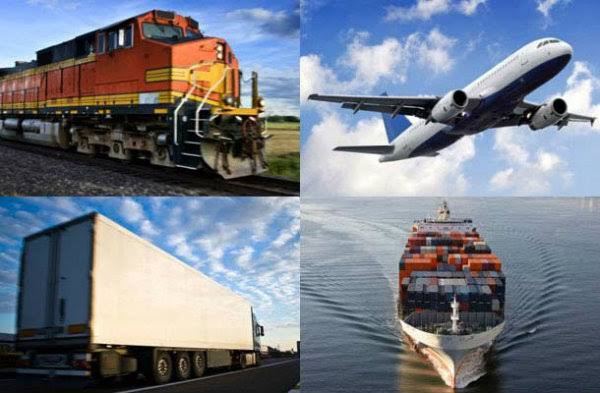
Roads. Roads are the dominant mode of transportation in India today. They carry almost 85 percent of the country’s passenger traffic and more than 60 percent of its freight. The density of India’s highway network — at 0.66 km of roads per square kilometer of land – is similar to that of the United States (0.65) and much greater than China’s (0.16) or Brazil’s (0.20). However, most roads in India are narrow and congested with poor surface quality, and 33 percent of India’s villages do not have access to all-weather roads.

Rural Roads-A Lifeline for Villages in India: Connecting Hinterland to Social Services and markets

Railways. Indian Railways is one of the largest railways under the single management. It carried some 19.8 million passengers and 2.4 million tonnes of freight a day in year 2009 and is one of the world’s largest employer. The railways play a leading role in carrying passengers and cargo across India’s vast territory. However, most of its major corridors have capacity constraint requiring capacity enhancement plans.

Ports. India has 13 major and 199 minor and intermediate ports along its more than 7500 km long coastline. India’s seaborne foreign trade being 95% by volume and 67% by value, the ports play a very significant role in improving foreign trade in a growing economy. These ports serve the country’s growing foreign trade in petroleum products, iron ore, and coal, as well as the increasing movement of containers. Indian ports handled cargo of 850 million tonnes and about 9.0 million TEU container traffic in year 2010. Over the last decade, the average annual growth rate of port cargo volume has been about 10%.. The future potential for port sector, particularly container ports is huge considering that the container traffic is projected to grow to 40 million TEU by 2025. Inland water transportation also remains largely undeveloped despite India’s 14,000 kilometers of navigable rivers and canals.

Aviation. India has 128 airports, including 15 international airports. Indian airports handled 142 million passengers in 2010-11 and 1.6 million tonnes of cargo in year 2009-10. The CAGR for the domestic passenger and freight growth over the last decade has been 14.2% and 7.8% respectively. The dramatic increase in air traffic for both passengers and cargo in recent years has placed a heavy strain on the country’s major airports. Passenger traffic is projected to grow more than 15% annually over 2011-13 and it is estimated that the aviation industry, currently 9th largest in the World, will require 30 billion USD investment in the next 15 years to keep pace with the growing demand.

Urban Transport. India is experiencing rapid urbanization with the present urbanization levels at 30% translating to a population of roughly 340 million living in urban areas. The number of million plus cities is presently at 42 and the urban economy accountd for roughly 60% of the GDP. Motorisation rates in India are in double digits as in most developing economies. Only about 20 cities out of 87 cities with a population in excess of 500,000 and state capitals have any kind of organized transport and only 3-4 cities could lay claim to a mass rapid transit system. The share of public transport in cities with population sizes over 4 million has declined from 69% to 38% between 1994 to 2007. Accident and fatality rates are one of the highest in the world affecting primarily the poor and vulnerable without their own means of transport.

Transport infrastructure in India is better developed in the southern and southwestern parts of the country.

The major challenges facing the sector are:

• India’s roads are congested and of poor quality. Lane capacity is low – majority of national highways are two lanes or less. A quarter of all India’s highways are congested. Many roads are of poor quality and road maintenance remains under-funded. This leads to the deterioration of roads and high transport costs for users.

• Rural areas have poor access. Roads are significant for the development of the rural areas – home to almost 70 percent of India’s population. Although the rural road network is extensive, some 33 percent of India’s villages do not have access to all-weather roads and remain cut off during the monsoon season. The problem is more acute in India’s northern and northeastern states which are poorly linked to the country’s major economic centers.

• The railways are facing severe capacity constraints. All the country’s high-density rail corridors face severe capacity constraints. Also, freight transportation costs by rail are much higher than in most countries as freight tariffs in India have been kept high to subsidize passenger traffic.

• Urban centers are severely congested. In Mumbai, Delhi and other metropolitan centers, roads are often severely congested during the rush hours. The dramatic growth in vehicle ownership during the past decade – has reduced rush hour speeds especially in the central areas of major cities.

• Ports are congested and inefficient. The average annual growth of cargo volume in the ports in the last decade was close to 10%, However, capacity utilization in some of the major ports remain as low as 58-60% Both bulk and containerized traffic is expected to grow at a much faster pace in future and by some estimate the container traffic is projected to grow to about 4.5 times of the current volume by 2025. India’s ports need to significantly ramp up their capacity and efficiency to meet this surging demand.

• Airport infrastructure is strained. . Air traffic has been growing rapidly leading to severe strain on infrastructure at major airports, especially in the Delhi and Mumbai airports which account for more than 40 percent of nation’s air traffic.

Use of MS Excel in today’s world.

Excel is typically used to organize data and perform financial analysis. It is used across all business functions and at companies from small to large. The main uses of Excel include: Data entry.

Excel is a software program created by Microsoft that uses spreadsheets to organize numbers and data with formulas and functions. Excel analysis is ubiquitous around the world and used by businesses of all sizes to perform financial analysis.

The main uses of Excel include:

1 Data entry
2 Data management
3 Accounting
4 Financial analysis
5 Charting and graphing
6 Programming
7 Time management
8 Task management
9 Financial modeling
10 Customer relationship management (CRM)
** Almost anything that needs to be organized!

Excel is used extensively in finance and accounting functions. In fact, many organizations run their entire budgeting, forecasting, and accounting functions entirely out of Excel spreadsheets.

While Excel is defined as a “data” management tool, the data that is most commonly managed is financial. At CFI, we would define Excel as the ultimate financial software. While there are other pieces of financial software that are tailored toward performing specific tasks, the strongest point about Excel is its robustness and openness. Excel models are as powerful as the analyst wishes them to be.

Accountants, investment bankers, analysts, and people in all types of financial career paths rely on excel to perform their daily job functions.

And one should know how to use MS Excel. Its on of the most important skill in today’s corporate world.

The World of Nepotism

Welcome to the anti-meritocratic world, this world. What are you going to do about it? Will you stand back and watch while cronyism, nepotism, the old school tie, the private club, the right university, the right accent, the right background, the right secret society, the right religion, the right family, destroy merit so that their chosen ones can prosper at your expense. It’s time to smash the conspiracy. Break up all the mechanisms that allow privileged groups within society to rig the system in their favour and penalise anyone who doesn’t belong to their insidious cliques.

Michael Faust, The Meritocracy Party

Well , Its a very complicated questions . In the world, where one’s knowledge didn’t get recognition .

What would you do , when you get acknowledged not on the basis of your knowledge but on the basis of your relation with the owner ?

What would you do , if you don’t get promoted because you are not his /her relative ?

Do you ignore the fact that you are not the one , whom your boss approves?

Well , if you think it’s favouritism than you are absolutely correct . You may also come accross the word NEPOTISM and if you don’t than start reading the passage . (I did as well )

This 8 letter word is destroying everyone in today’s world. And who is responsible for creating such a hypocrite. We the people have to repose this curse and make sure to control it with our coming generations, else it will destroy the whole world. And there’ll be no humanity left in this world” –

Ikramul Hannah.

Introduction

Nepotism is a the practice among those with power or influence of favouring relatives or friends, especially by giving them jobs.

Nepotism is generally defined as “the bestowal of patronage by public officers in appointing others to positions because of blood or marital relationship”.

Nepotism is found in almost all the fields but it is practiced most in business, politics, sports and entertainment sectors. It has been in practice since time immemorial, but some special cases have made it to the limelight in the past few decades.

Nepotism in India :

India has it’s fair share in the field of NEPOTISM . Well , have you ever expected that . I say , YES . Because being one of the largest country , people might become more thirsty for power . “When constantly reaching out for more, you forget what you have” Christine Szymanski.

Nepotism can be characterized as ‘the demonstration of utilizing force or impact to get out of line preferences for individuals from one’s family’.

You must be conflicted , why does nepotism exist even today ? We are living in 21st century , than why we have such orthodox thinking ? Who says no one can define what is going on in one’s mind ( well I say , isn’t is obvious ) .

From the politics to the Entertainment , from the owner to the customer, from the Bollywood to the Judiciary ; Nepotism is everywhere .

Like in OJO -MOJO , After the submission of writing competition , OJO’s class teacher asked him who wrote better . Is it MOJO or OLLY , what do you think whom he would choose . MOJO thinks OJO will choose OLLY because he likes her . But when the result announced MOJO was astounded because OJO choose MOJO’s writing . So , what do you think is it nepotism or not . Think and you will know the answer .

Bias has become the first qualification to join a party, and extreme bias the virtue to become a leader.

Link

The Principle Of Maximum Social Advantage. ( Meaning , Assumptions , Explanation , Theories , Limitations )


“The Principle of Public Finance means the fundamental rule by which the financial policy of the state is determined.
This fundamental rule of principle of public finance is called “The Principle of Maximum Social Advantage “

The credit for the implementation of this principle goes to Prof. Pigou and Prof. Dalton .
Just like an individual seeks to maximize his satisfaction or welfare by the use of his resources ,the state ought to maximize social advantages or benefit from the resources at its command .

According to Dalton , principle lies “at the root of public finance “.
The principles of maximum social advantage are applied to determine whether the tax or the expenditure has proved to be the optimum benefit .

He stated “The best system of public finance is that which secures the maximum social advantage from the operation which it conducts “
This principle is also called as ” Principle of Maximum Social Benefits “

Prof Pigou called this principle ” The Principle of Maximum Aggregate Welfare


Significance of the principle :-

Public revenue and public finance are two important financial operations of the state. These operations should be performed on fundamental principles so as to obtain maximum social benefit .

Prof. Hugh Dalton and Prof. Pigou were two famous economists who implemented the principle of Maximum Social Advantage to give the fundamental basis of the function performed by the state to earn revenue and to spend the revenue in the best possible way to Maximum benefit incrementation in the welfare of the public .


Prof. Dalton has expressed it in these words ,
As a result of operations of public finance ,the nature and quantity of money produced and between the categories and different persons there are many changes in the distribution of that money . The question is do these changes ; leave a profitable impact on society ? If it is so then it will be considered that the operations of public finance are justified , otherwise not .The best system of public finance is that can obtain maximum social profit by the operation organised by them .”

Therefore , the Principle of Maximum Social Advantage is the principle that guides the operation of financial activities of the government to obtain economic welfare of the society .

According to Dalton , attainment of the principle requires :-

• Public expenditure and taxation should be carried out up to certain limits i.e where marginal utility received by the Government expenditure must be equal to marginal disutility due to taxation ( government income ).

• Public expenditure should be utilised among the various uses in an optimum manner

• The different sources of taxation should be so trapped that the aggregate sacrifice entailed is the minimum .


Assumptions :-

• The public revenue consists of only taxes ( and not gifts , loans , fees ,etc.,) and the state has no surplus or deficit budgets.

•Public expenditure is subject to diminishing marginal social benefits and the taxes are subject to increasing marginal cost or disutility .


Principle Of Maximum Social Advantage:-

The Principle states that :-

The state should collect revenue and spend the money so as to maximize the welfare of the people. When the state imposes taxes, some disutility is created. On the
On the other hand, when the state spends some money, there is a gain in utility. The state should so adjust revenue and
expenditure that surplus of utility is maximised and disutility is minimised.”

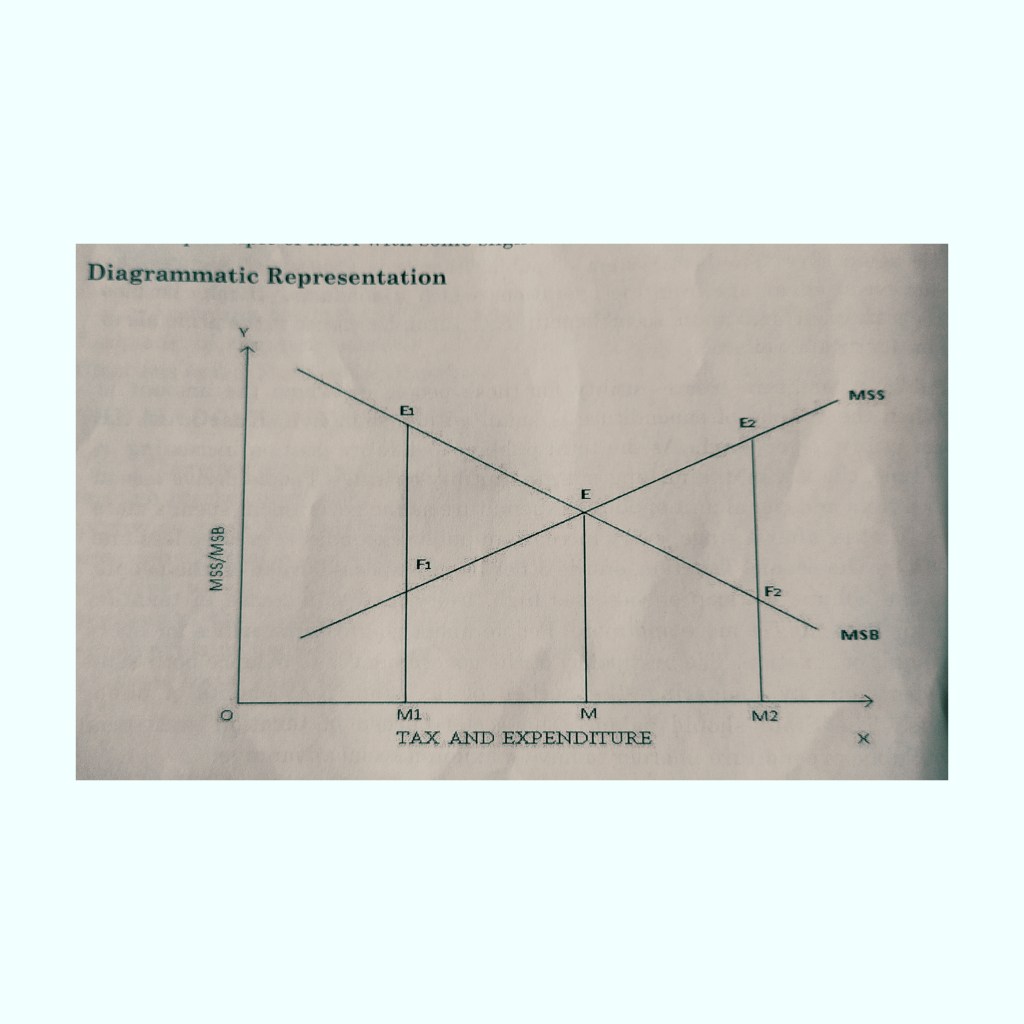
According to Dalton , “ maximum social advantage is at a point where the Marginal Social Sacrifice of Taxation ( MSS) and Marginal Social Benefit ( MSB) are equal .
The point of equality between MSS and MSB is referred to as the point of maximum social advantage or least aggregate social sacrifice .


Maximum social sacrifice of taxation :-

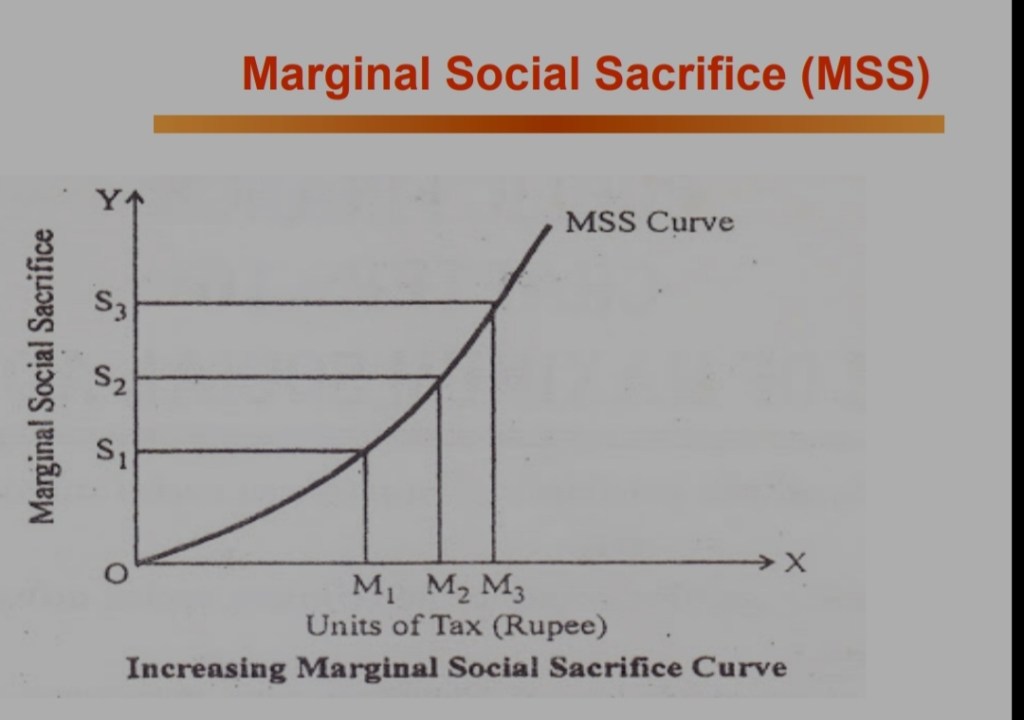
The amount of social sacrifice undergone by the public due to the imposition of an additional unit of tax is called Maximum Social Sacrifice of taxation .
Every unit of tax imposed by the government taxes result in loss of utility.

According to Dalton ,
“The additional burden (marginal sacrifice) resulting from additional units of taxation goes on increasing. Every additional unit of taxation creates greater amount of sacrifice on the society”


The Marginal Social Sacrifice (MSS) curve rises upwards from left to right. This indicates that with each additional unit of taxation, the level of sacrifice also increases.


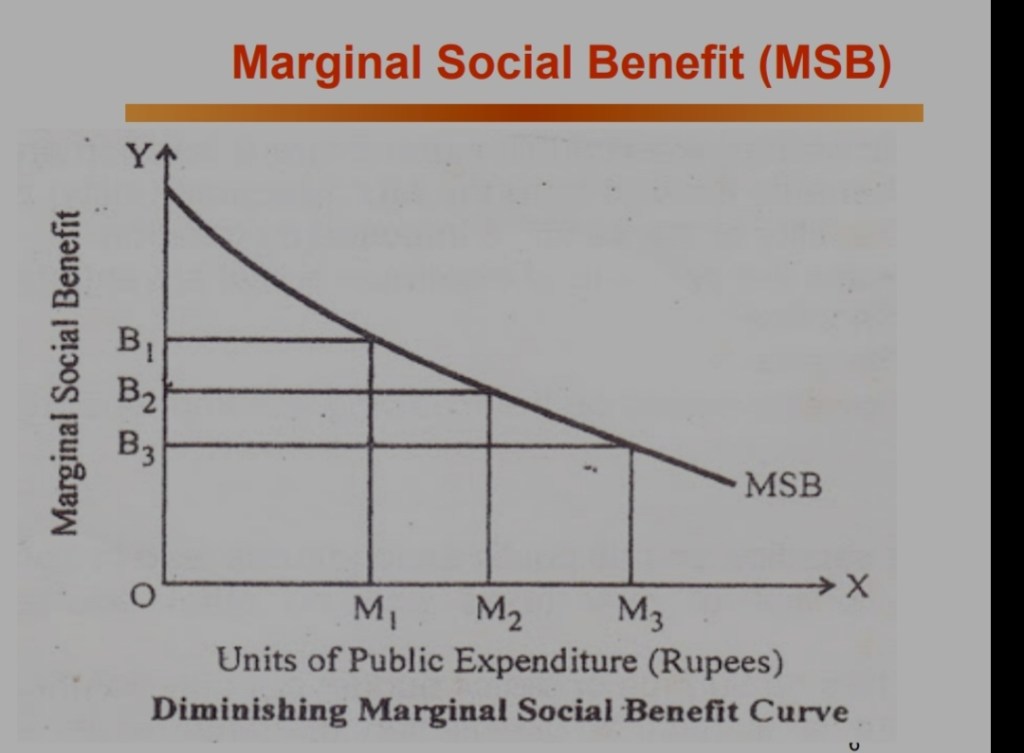
•. Marginal Social Benefit :

The benefit conferred on the society, by an additional unit of public expenditure is called the Marginal Social Benefit curve .

The social benefit from each additional unit of public expenditure declines as more and more units of public expenditure are spent. The marginal utility from commodity to a consumer declines as more and more units of the commodity are made available to him .


MSB curve slopes downward from left to right. This indicates that the social benefit derived out of public expenditure is reducing at a diminishing rate.


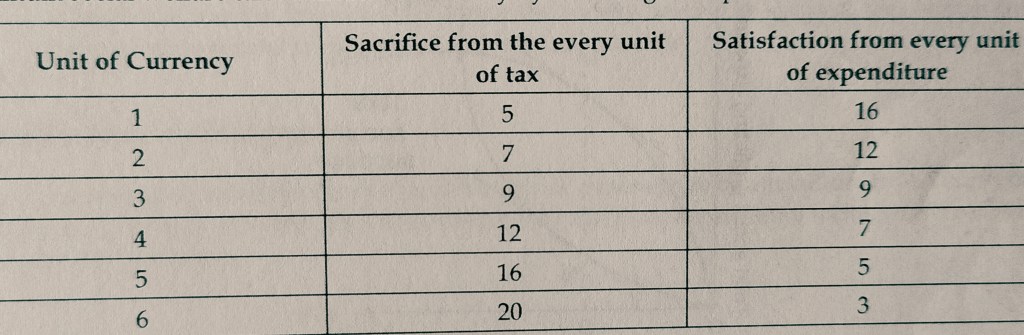
Maximum social welfare can be understood by the following example :-


Table

It can be seen in the above table that marginal sacrifice is increasing due to the increase in every unit weight of tax on society.
Inversely , from every additional unit of Government expenditure ,its utilities diminish .

On the third unit of currency , marginal social sacrifice is equal to marginal social advantage ( 9 units ) . At this point the tax and public expenditure will be fixed .

In the above given figure ,
MSS represent marginal social sacrifice of the taxation curve , slopes upward since taxation increases resulting in Increasing of MSS,.
and MSB represents the marginal social benefit of the public expenditure curve , slopes downwards showing that public benefit goes on declining with every unit increase in public expenditure.

The point E where the MSS curve intersects MSB curve , is the ideal point of financial operations where the government collects OM taxation from the society and uses it for public expenditure .


According to Dalton ,
“Public expenditure in every direction should be carried just so far that the advantage to the community of a further small increase in any direction is just counterbalanced by the disadvantage of a corresponding increase in taxation or in receipts from any other source of public income . This gives the ideal public expenditure and income.”


Musgrave’s View :-

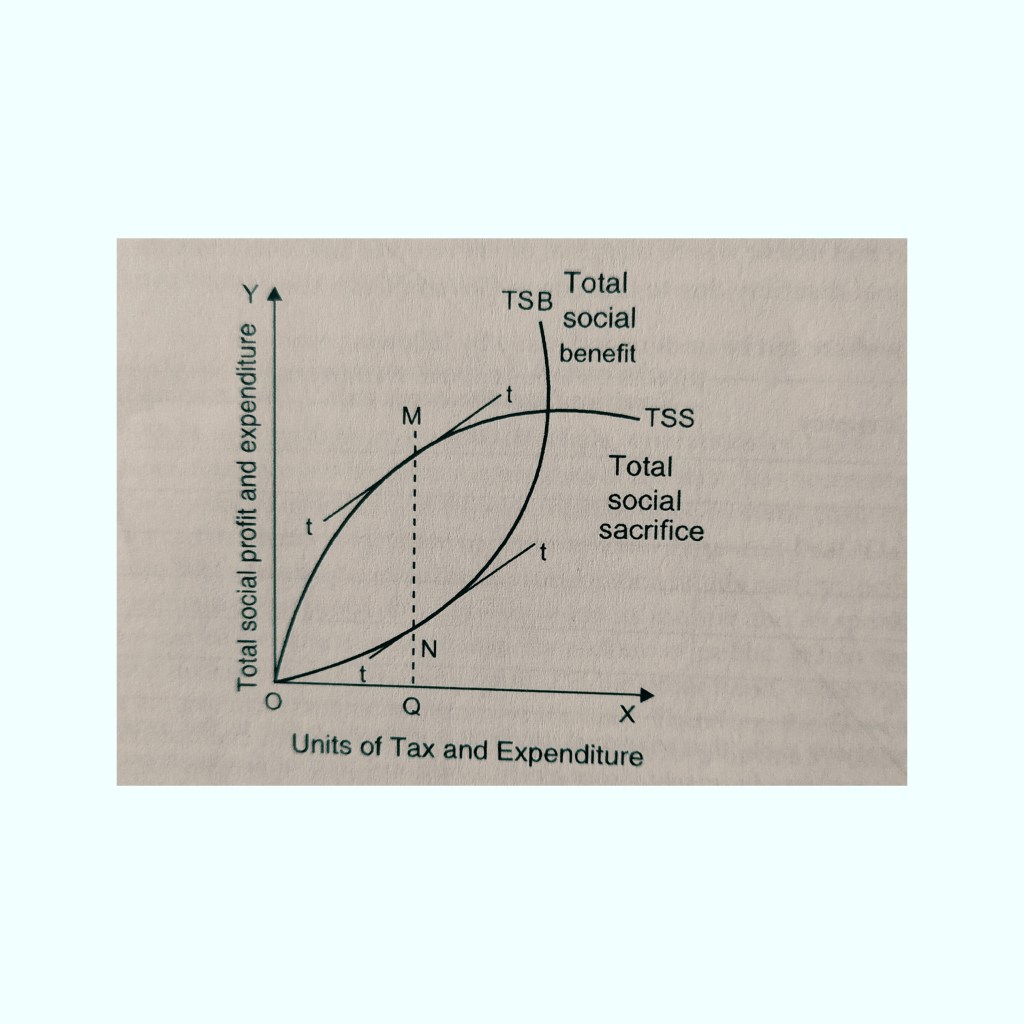
The Principle of maximum social advantage can be explained using total sacrifice and total benefit curve as well .

Musgrave called Dalton ‘s principle as
“Maximum Welfare Principle Of Budget Determination “
According to him , the difference between total social benefit and total social sacrifice is the net social benefit where maximum social benefit is obtainable .

The TSB curve represents total social benefit received from public expenditure which slopes upward but decreases after some time , showing that as public expenditure increases total social benefit increases .
The TSS curve represents total social sacrifice produced due to tax showing that as total social sacrifice increases with increase in amount of tax but rapidly .

Maximum social benefit will be achieved at a point where the difference between total social benefit and total social sacrifice is maximum .
MN denotes the difference between TSB and TSS showing net social benefit.


Objective Tests Of Social Advantage :-

Dalton has given the following three objective Tests which can lead to Maximum Social Advantage :-

• To preserve the Community :-
According to Dalton , the first test is the need to preserve the community against internal disorders and external attacks. The financial operations of the state to preserve the society in this manner leads to maximum social advantage .

• To increase Economic Welfare :-
Increasing the economic welfare of the community leads to maximum social advantage . According to Dalton ,this can be achieved by improvements in production and improvements in the distribution of national product ( or income ) through state’s financial operations .

• To provide for Future Generation :-
According to Dalton , the financial operations of the state should provide for the future generation . The state should prefer a larger social advantage in the future to a smaller one in the present .


Limitations of Maximum Social Advantage :-

In spite being guiding principle of financial operations of the state , the principle of maximum social advantage possesses the following limitations :-

Vague and Abstract :- The terms “benefit ” and “sacrifice ” are vague and abstract concepts. It is not possible to quantify them and find out their exact implications.


Different Areas :-
It is not possible to compare the marginal benefits accruing to people in one area from a given public expenditure with marginal sacrifice undergone by persons who are taxed in some other areas .

Lack of Divisibility :-
In order to equate the marginal benefit from public expenditure with the marginal sacrifice from taxation , the resources are required to be divided into smaller units . But it is not possible because of the lack of Divisibility of public expenditure and taxes in small units .

Ignores Non- Tax Revenues:
This principle takes into consideration the sacrifice on the part of direct tax payers and ignores Non- tax revenues like fines , fees ,market borrowing , profits of public undertaking ,etc., are equally important sources of revenue and in the effects on social benefit are as important as those of taxes.

Maintaining Balance :-
It is a difficult task for the state to maintain balance between disutility and utility produced due to imposing tax and utility obtained by people from the Government expenditure as the government is not a single person but different servants at different places in different departments .

Simultaneous Calculation not Possible :-
This principle requires simultaneous calculations and equating marginal social benefits from public expenditure and sacrifices from taxation which is not easy .
As put by Prof. Buchana , ” To match them is a function for the’ fiscal brain ”and ‘computers ‘. “

According it Dalton , despite these limitations ,the principle of maximum social advantage is “the best system of public finance “.