Why should I choose an engineering stream?

<!–
/* Style Definitions */
p.MsoNormal, li.MsoNormal, div.MsoNormal
{mso-style-unhide:no;
mso-style-qformat:yes;
mso-style-parent:””;
margin-top:0cm;
margin-right:0cm;
margin-bottom:10.0pt;
margin-left:0cm;
line-height:115%;
mso-pagination:widow-orphan;
font-size:11.0pt;
font-family:”Calibri”,sans-serif;
mso-ascii-font-family:Calibri;
mso-ascii-theme-font:minor-latin;
mso-fareast-font-family:Calibri;
mso-fareast-theme-font:minor-latin;
mso-hansi-font-family:Calibri;
mso-hansi-theme-font:minor-latin;
mso-bidi-font-family:”Times New Roman”;
mso-bidi-theme-font:minor-bidi;
mso-ansi-language:EN-US;
mso-fareast-language:EN-US;}
p
{mso-style-priority:99;
mso-margin-top-alt:auto;
margin-right:0cm;
mso-margin-bottom-alt:auto;
margin-left:0cm;
mso-pagination:widow-orphan;
font-size:12.0pt;
font-family:”Times New Roman”,serif;
mso-fareast-font-family:”Times New Roman”;
mso-ansi-language:EN-US;
mso-fareast-language:EN-US;}
p.MsoListParagraph, li.MsoListParagraph, div.MsoListParagraph
{mso-style-priority:34;
mso-style-unhide:no;
mso-style-qformat:yes;
margin-top:0cm;
margin-right:0cm;
margin-bottom:10.0pt;
margin-left:36.0pt;
mso-add-space:auto;
line-height:115%;
mso-pagination:widow-orphan;
font-size:11.0pt;
font-family:”Calibri”,sans-serif;
mso-ascii-font-family:Calibri;
mso-ascii-theme-font:minor-latin;
mso-fareast-font-family:Calibri;
mso-fareast-theme-font:minor-latin;
mso-hansi-font-family:Calibri;
mso-hansi-theme-font:minor-latin;
mso-bidi-font-family:”Times New Roman”;
mso-bidi-theme-font:minor-bidi;
mso-ansi-language:EN-US;
mso-fareast-language:EN-US;}
p.MsoListParagraphCxSpFirst, li.MsoListParagraphCxSpFirst, div.MsoListParagraphCxSpFirst
{mso-style-priority:34;
mso-style-unhide:no;
mso-style-qformat:yes;
mso-style-type:export-only;
margin-top:0cm;
margin-right:0cm;
margin-bottom:0cm;
margin-left:36.0pt;
mso-add-space:auto;
line-height:115%;
mso-pagination:widow-orphan;
font-size:11.0pt;
font-family:”Calibri”,sans-serif;
mso-ascii-font-family:Calibri;
mso-ascii-theme-font:minor-latin;
mso-fareast-font-family:Calibri;
mso-fareast-theme-font:minor-latin;
mso-hansi-font-family:Calibri;
mso-hansi-theme-font:minor-latin;
mso-bidi-font-family:”Times New Roman”;
mso-bidi-theme-font:minor-bidi;
mso-ansi-language:EN-US;
mso-fareast-language:EN-US;}
p.MsoListParagraphCxSpMiddle, li.MsoListParagraphCxSpMiddle, div.MsoListParagraphCxSpMiddle
{mso-style-priority:34;
mso-style-unhide:no;
mso-style-qformat:yes;
mso-style-type:export-only;
margin-top:0cm;
margin-right:0cm;
margin-bottom:0cm;
margin-left:36.0pt;
mso-add-space:auto;
line-height:115%;
mso-pagination:widow-orphan;
font-size:11.0pt;
font-family:”Calibri”,sans-serif;
mso-ascii-font-family:Calibri;
mso-ascii-theme-font:minor-latin;
mso-fareast-font-family:Calibri;
mso-fareast-theme-font:minor-latin;
mso-hansi-font-family:Calibri;
mso-hansi-theme-font:minor-latin;
mso-bidi-font-family:”Times New Roman”;
mso-bidi-theme-font:minor-bidi;
mso-ansi-language:EN-US;
mso-fareast-language:EN-US;}
p.MsoListParagraphCxSpLast, li.MsoListParagraphCxSpLast, div.MsoListParagraphCxSpLast
{mso-style-priority:34;
mso-style-unhide:no;
mso-style-qformat:yes;
mso-style-type:export-only;
margin-top:0cm;
margin-right:0cm;
margin-bottom:10.0pt;
margin-left:36.0pt;
mso-add-space:auto;
line-height:115%;
mso-pagination:widow-orphan;
font-size:11.0pt;
font-family:”Calibri”,sans-serif;
mso-ascii-font-family:Calibri;
mso-ascii-theme-font:minor-latin;
mso-fareast-font-family:Calibri;
mso-fareast-theme-font:minor-latin;
mso-hansi-font-family:Calibri;
mso-hansi-theme-font:minor-latin;
mso-bidi-font-family:”Times New Roman”;
mso-bidi-theme-font:minor-bidi;
mso-ansi-language:EN-US;
mso-fareast-language:EN-US;}
.MsoChpDefault
{mso-style-type:export-only;
mso-default-props:yes;
font-size:11.0pt;
mso-ansi-font-size:11.0pt;
mso-bidi-font-size:11.0pt;
font-family:”Calibri”,sans-serif;
mso-ascii-font-family:Calibri;
mso-ascii-theme-font:minor-latin;
mso-fareast-font-family:Calibri;
mso-fareast-theme-font:minor-latin;
mso-hansi-font-family:Calibri;
mso-hansi-theme-font:minor-latin;
mso-bidi-font-family:”Times New Roman”;
mso-bidi-theme-font:minor-bidi;
mso-ansi-language:EN-US;
mso-fareast-language:EN-US;}
.MsoPapDefault
{mso-style-type:export-only;
margin-bottom:10.0pt;
line-height:115%;}
@page WordSection1
{size:612.0pt 792.0pt;
margin:72.0pt 72.0pt 72.0pt 72.0pt;
mso-header-margin:36.0pt;
mso-footer-margin:36.0pt;
mso-paper-source:0;}
div.WordSection1
{page:WordSection1;}
/* List Definitions */
@list l0
{mso-list-id:1025138763;
mso-list-type:hybrid;
mso-list-template-ids:-710637844 67698697 67698691 67698693 67698689 67698691 67698693 67698689 67698691 67698693;}
@list l0:level1
{mso-level-number-format:bullet;
mso-level-text:;
mso-level-tab-stop:none;
mso-level-number-position:left;
margin-left:39.75pt;
text-indent:-18.0pt;
font-family:Wingdings;}
@list l0:level2
{mso-level-number-format:bullet;
mso-level-text:o;
mso-level-tab-stop:none;
mso-level-number-position:left;
margin-left:75.75pt;
text-indent:-18.0pt;
font-family:”Courier New”;}
@list l0:level3
{mso-level-number-format:bullet;
mso-level-text:;
mso-level-tab-stop:none;
mso-level-number-position:left;
margin-left:111.75pt;
text-indent:-18.0pt;
font-family:Wingdings;}
@list l0:level4
{mso-level-number-format:bullet;
mso-level-text:;
mso-level-tab-stop:none;
mso-level-number-position:left;
margin-left:147.75pt;
text-indent:-18.0pt;
font-family:Symbol;}
@list l0:level5
{mso-level-number-format:bullet;
mso-level-text:o;
mso-level-tab-stop:none;
mso-level-number-position:left;
margin-left:183.75pt;
text-indent:-18.0pt;
font-family:”Courier New”;}
@list l0:level6
{mso-level-number-format:bullet;
mso-level-text:;
mso-level-tab-stop:none;
mso-level-number-position:left;
margin-left:219.75pt;
text-indent:-18.0pt;
font-family:Wingdings;}
@list l0:level7
{mso-level-number-format:bullet;
mso-level-text:;
mso-level-tab-stop:none;
mso-level-number-position:left;
margin-left:255.75pt;
text-indent:-18.0pt;
font-family:Symbol;}
@list l0:level8
{mso-level-number-format:bullet;
mso-level-text:o;
mso-level-tab-stop:none;
mso-level-number-position:left;
margin-left:291.75pt;
text-indent:-18.0pt;
font-family:”Courier New”;}
@list l0:level9
{mso-level-number-format:bullet;
mso-level-text:;
mso-level-tab-stop:none;
mso-level-number-position:left;
margin-left:327.75pt;
text-indent:-18.0pt;
font-family:Wingdings;}
@list l1
{mso-list-id:1418016799;
mso-list-type:hybrid;
mso-list-template-ids:-1155604928 67698699 67698691 67698693 67698689 67698691 67698693 67698689 67698691 67698693;}
@list l1:level1
{mso-level-number-format:bullet;
mso-level-text:;
mso-level-tab-stop:none;
mso-level-number-position:left;
margin-left:44.75pt;
text-indent:-18.0pt;
font-family:Wingdings;}
@list l1:level2
{mso-level-number-format:bullet;
mso-level-text:o;
mso-level-tab-stop:none;
mso-level-number-position:left;
margin-left:80.75pt;
text-indent:-18.0pt;
font-family:”Courier New”;}
@list l1:level3
{mso-level-number-format:bullet;
mso-level-text:;
mso-level-tab-stop:none;
mso-level-number-position:left;
margin-left:116.75pt;
text-indent:-18.0pt;
font-family:Wingdings;}
@list l1:level4
{mso-level-number-format:bullet;
mso-level-text:;
mso-level-tab-stop:none;
mso-level-number-position:left;
margin-left:152.75pt;
text-indent:-18.0pt;
font-family:Symbol;}
@list l1:level5
{mso-level-number-format:bullet;
mso-level-text:o;
mso-level-tab-stop:none;
mso-level-number-position:left;
margin-left:188.75pt;
text-indent:-18.0pt;
font-family:”Courier New”;}
@list l1:level6
{mso-level-number-format:bullet;
mso-level-text:;
mso-level-tab-stop:none;
mso-level-number-position:left;
margin-left:224.75pt;
text-indent:-18.0pt;
font-family:Wingdings;}
@list l1:level7
{mso-level-number-format:bullet;
mso-level-text:;
mso-level-tab-stop:none;
mso-level-number-position:left;
margin-left:260.75pt;
text-indent:-18.0pt;
font-family:Symbol;}
@list l1:level8
{mso-level-number-format:bullet;
mso-level-text:o;
mso-level-tab-stop:none;
mso-level-number-position:left;
margin-left:296.75pt;
text-indent:-18.0pt;
font-family:”Courier New”;}
@list l1:level9
{mso-level-number-format:bullet;
mso-level-text:;
mso-level-tab-stop:none;
mso-level-number-position:left;
margin-left:332.75pt;
text-indent:-18.0pt;
font-family:Wingdings;}

–>

Engineering is a popular and one of the most sought after courses for students who have completed Class 12, especially for students from the Science stream
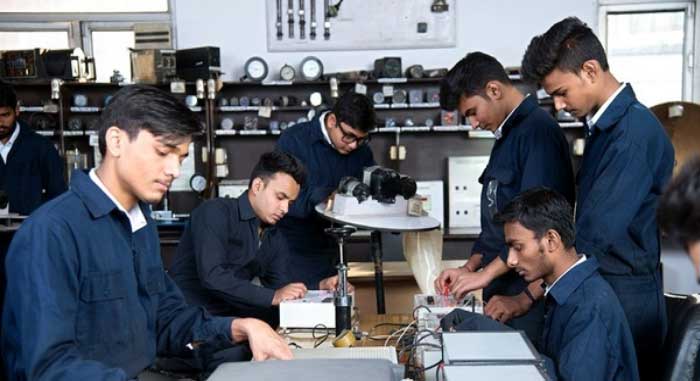
 

  The various streams of engineering can be broadly classified into 6 major branches, namely: Mechanical, Chemical, Civil, Electrical, Management, and Geotechnical.

What is the role of engineering in society?

                  Engineers are in every field. There is an engineer behind every beautiful and wonderful building. The technology we are using today, automobiles, machines, spaceships, communication system and many are built by an engineer. Engineers make human day to day life easier and efficient. An engineer is someone who solve problem and continue learning and help many people.

              Engineering gives skills you can apply everywhere. If you’re an engineer you can work for an MNC or an IT company or you can start a business, or to be consultant in a legal company. It gives an option to switch a career if you want to. 


vSome of the points to look in an engineering college before joining a engineering college             

Ø Infrastructure of the college: – check the basic need like classrooms, labs playground, etc.

Ø Choosing a right stream as per your interest: – There are different types of stream like Mechanical, civil, Chemical, etc.  Choose a right stream as your taste.

Ø Placements and Internships provided by college: – Before joining engineering colleges check whether college provides internships /placements.  It is important to start doing internships since the beginning of college. This gives practical learning along with theoretical learning.  

Ø Fee structure: the fee structure depends on the college whether its government, private or semi government. You should also look whether the college provides scholarships.

Ø Extra- curricular activities: – look whether the college has extra-curricular activities. Extra-curricular activities like indoor or outdoor game which are good for mental and physical health.

Ø Entrance exam:-Check whether the college conducts any entrance exam.

Also look minimum marks to join the college. 

The Roots of STEM Talent of India

Credit: Dreamstime

Introduction

The Information Technology sector in India has built its reputation by providing cost-effective solutions and providing employment to millions of people in the process. However, the full-time research workforce in India was estimated to be just 2,00,000 in 2015 by UNESCO. Are we, as a nation, adequately promoting careers in Science, Technology, Engineering, and Mathematics (STEM) subjects, and are we even able to generate enough talent for our own demand? Are we losing some of our best minds to other countries because of a lack of support and opportunities?

What is STEM?

STEM, in full science, technology, engineering, and mathematics, field, and curriculum centered on education in the disciplines of science, technology, engineering, and mathematics (STEM). The STEM acronym was introduced in 2001 by scientific administrators at the U.S. National Science Foundation (NSF). The organization previously used the acronym SMET when referring to the career fields in those disciplines or a curriculum that integrated knowledge and skills from those fields. In 2001, however, American biologist Judith Ramaley, then assistant director of education and human resources at NSF, rearranged the words to form the STEM acronym.

Women in STEM

Under-representation of women and gender pay gaps are well-recognized global challenges in STEM sectors. While Indian Technology firms can still boast of a relatively better female-to-male ratio, according to UNESCO estimates, only 14 percent of the researchers in India are women. Even engineering colleges have skewed gender ratio in favor of male students, and according to a Kelly Global Workforce Insights (KGWI) survey, 81 percent of the women in STEM fields in India have perceived a gender bias during performance evaluation.  The annual ‘Girls in Tech’ MasterCard research indicates that while interest in STEM careers is increasing gradually, women are still less likely than men to pursue a STEM career and less likely to remain in the field for their entire career owing to male dominance in the fields. 

STEM Sector in India

The focus on building the scientific prowess of the masses, and bet on specialized educational institutions to do the same, institutions like the Indian Institute of Technology (IIT), Indian Institute of Science (IISc), and All India Institute of Medical Science (AIIMS) was founded and promoted to develop the country’s scientific and technical manpower, and in the process help the society and economy prosper. However, with time, these institutes have largely been reduced to stepping stones for a well-paying career. Especially in the last two decades, the relentless quest of students, and their parents, to ensure admission to such premier institutes has given rise to an astronomical coaching classes industry as well. A particular blow to STEM education came when the All India Council for Technical Education (AICTE) liberally allowed the setting up of engineering institutes across the country a few years ago. The move was undertaken in anticipation of a huge demand for engineering studies. However, this not only eroded the value conferred on an engineering degree but also compromised the quality of education and training provided on a fundamental level.

Making STEM a Priority

The first step towards fixing what’s broken is the identification and acknowledgment of the present challenges and understanding the context in which they arise. In other words, the government and the private education sector must make a genuine attempt at understanding their shortcomings, and reflect on why so few Indian institutes are recognized for quality STEM education and training. Establishing global partnerships with countries that have built sophisticated STEM expertise is critical to paving the way for knowledge exchange and skill development. While American and European universities are known for their focus on STEM education, countries in the networks of BRICS and ASEAN could also prove to be beneficial partners. This also needs to be backed by healthy funding to develop independent institutes that focus on research, pure sciences, and other derivatives of STEM subjects. The Indeed survey showed that job seekers in the age group of 21-25 were 12 percent more inclined towards jobs in STEM sectors than in others. Inculcating innovation and creativity in young minds and encouraging them to pursue dedicated courses right from the moment they stepped into the formal education system is essential. However, in the present system, STEM studies might simply be added as an additional layer to the existing curriculum and would increase pressure on students and teachers alike.

References

How Traditional Publication and Self Publication Differs

The business world is continuously evolving, with competition increasing each day. Advancements in technology trigger market change more frequently than ever. This results in milestone evolutions of business strategies. Most companies spend a huge amount of funds on staying updated with these changes.  

Source: https://pixabay.com/it/photos/libro-business-college-concept-4966982/

But what about unconventional businesses like a mystery room Bangalore or a luxury thrift shop in LA? How do they prosper and expand their circles without the backing of huge investments? Finding out the right marketing channels for unconventional businesses can often be quite challenging. But provided companies can figure out suitable strategies, spreading their business globally is no longer a fool’s dream.  

Similarly, while publishing your books, you must also opt for the right kind of publication to cater to a global audience. The two main modes of publishing, traditional publication, and self-publication, come with their own set of pros and cons. 

So, to make it easy for you to make the right choice, this article is here for you. Make sure to read this article till the very end to gather a comprehensive understanding of how traditional publication and self-publication differ from one another.   

What are the basic steps of traditional publication?  

The basic steps of the traditional publication are as follows: 

  • Make a query with a suitable agent who you think will publish your book 
  • The agent needs to accept your book and agree to take it to a suitable publishing house  
  • The publishing house works on selling your book 
  • As the writer, you are paid an upfront price as advance 
  • Often, you might have to pay back your advance based on your book sales to equate the money before you finally start to make a new income 
  • As the writer, you have the right to rewrite, write or edit your already published book 
  • The publishing house reserves all rights to your book 
  • The publishing house will create an appropriate cover to go with your book and edit it using professionals  
  • Your book might be formatted in all versions 
  • As the writer, you are paid 10% – 12.5% as royalties  

What are the basic steps of self-publishing?  

The basic steps concerning self-publishing are as follows: 

  • As a self-publishing author, you can publish your book any time you want! 
  • You have to pay for designing the cover of your book as per your desires 
  • You have to pay to get a professional to edit your book 
  • You have to pay for formatting your book 
  • You have to upload and publish your book 
  • As a self-publishing author, you get full royalties  
  • You reserve all the rights to your book 
  • You can update, modify, edit or republish your book whenever you want to 
  • As per your desires, you can publish as many numbers of books as you want, even as quickly as you want! 
  • With self-publishing, you can even write and publish your book in 90 days if you desire it! 


If you are still at loggerheads thinking which of these two modes of publishing would be beneficial for you, read on.   

What should I consider before choosing between traditional publishing and self-publishing? 

The following factors can probably help you decide which model of publishing would be the most suitable for your cause: 

1. Distribution  

i. Traditional Publishing: Traditional publishing has the upper hand over self-publishing when it comes to distributing your book. Book stores are spread all across the world, wherein your book can be easily circulated by the publishing house. Thus, in this way, your book can easily reach far and wide across the globe. Other than distributing via physical stores, your book can also be sold in various online bookstores! 


ii. Self-Publishing: You can still avail all the online book distribution options that you had with traditional publishing. All you have to do is decide on which of the online book distribution portals you want to sell your book. Although, there is no doubt that in the case of self-publishing, the chances of circulating your book are lower.   

2. Royalty Rates 

i. Traditional Publishing: Most newbie traditionally publishing authors tend to secure approximately 10% per book sold as their income till the advance is paid out. After that, the payment can increase up to approximately 12.5% per book sold.  


ii. Self-Publishing: Considering the rates of Amazon as the standard, you get a 60% of your book’s retail rate minus the MRP as royalty. Thus, there is no doubt that in terms of royalty rates, self-publishing authors can secure more income in one go.    

3. Cost of publishing 

i. Traditional Publishing: As a traditionally published author, you have to entail zero cost of production, for it is the publishing house itself that takes care of this. 


ii. Self-Publishing: Being a self-publishing author, there is a huge bill that you need to pay. It starts from editing and formatting to even cover design; there are several factors that you need to spend your money on.    

4. Time required 

i. Traditional Publishing: To get your book published in the traditional book can take an unprecedented amount of time, considering it takes longer to find a suitable agent. Even if you do find a good agent, it might still take a couple of years before your book is published in the market. 


ii. Self-Publishing: As soon as you are done with the process of editing, formatting, and customizing your book cover, you are ready to publish it!  


To sum up, the idea of self-publishing vis-à-vis traditional publishing, let us now understand the advantages and disadvantages of each comprehensively: 

Pros of Self-Publishing:  

Own full ownership rights of your book 

Possess the right to completely customize your book 

Exercise complete control over marketing your book 

Exercise and control the creativity over your book 

Possess a higher profit potential   

Cons of Self-Publishing:  

You alone have to ensure whether your book is professional and good in every way 

It’s a lengthy and time-consuming process to do all by yourself 

Hiring professionals to ease the process can be expensive   

Pros of Traditional Publishing:  

You receive financial advances even before your book is published   

The publishing house invests their money to get your book published 

High chance of book distribution in various stores 

High potential of media coverage   

Cons of Traditional Publishing:  

It is very tough to find the right agent who is ready to take up your book 

A lot of time is required before your book is published 

You exercise no control in the marketing or creativity 

You have no ownership over your book. The publishing house owns your book 

Conclusion

This detailed understanding of traditional publishing as against self-publishing should now be sufficient for you to make your choice. So, what are you waiting for? Don’t let your manuscript gather any more dust as it sits idly on your desk. Publish it today, and let the world step into a universe you created!  


<

p dir=”ltr” style=”line-height: 1.38;margin-bottom: 0pt;margin-top: 0pt;text-align: justify”> 

Action plan for inclusive and equitable quality education

 The National Education Policy 2020 envisages an inclusive and structural change in the educational system. It focuses on ‘Equitable and Inclusive Education’ which reverberates the idea that no child should be left behind in terms of educational opportunity because of their background and socio-cultural identities. It has taken into account the concerns of the Socio-Economically Disadvantaged Groups (SEDGs) which includes female and transgender individuals, Scheduled Castes, Scheduled Tribes, OBCs, minorities and other categories. This policy aims at bridging the social category gaps in access, participation, and learning outcomes in school education.

Department of School Education and Literacy (DoSEL), Ministry of Education is implementing Samagra Shiksha scheme, effective from 2018-19. Bridging gender and social category gaps at all levels of school education is one of the major objectives of the scheme. The  Scheme reaches  out  to  girls,  and  children  belonging  to  SC,  ST,  Minority  communities  and transgender.  The Scheme also focuses on the identified Special Focus Districts (SFDs) on the basis of adverse performance on various indicators of enrolment, retention, and gender parity, as well as concentration of SC, ST and minority communities.

Under Samagra Shiksha, there is a provision of Kasturba Gandhi Balika Vidyalayas (KGBVs). KGBVs are residential schools from class VI to XII for girls belonging to disadvantaged groups such as SC, ST, OBC, Minority and Below Poverty Line (BPL).  The KGBVs are set up in Educationally Backward Blocks. The objective behind establishing KGBVs is to ensure access and quality education to girls from disadvantaged groups by setting up residential schools and to reduce gender gaps at all levels of school education. 

Currently there are 5627 sanctioned KGBVs across the country in which 6,65,130 girl students belonging to various disadvantaged groups are enrolled.

The Scheme also covers Children with Special Needs (CwSN) from pre-primary to senior secondary level across the country. There is a dedicated Inclusive Education component for the education of CwSN as an integral part of Samagra Shiksha. In keeping with the principle of inclusion, CWSN are provided support through specific student oriented interventions i.e. aids and appliances, teaching aids, assistive devices, identification and assessment camps, teaching and learning materials, orientation program for the parents, education administrators, community, sports events, world disability day, braille books/kits, corrective surgeries, transportation allowances, escort allowances, uniforms (under RTE), stipend for girls, training of general teachers, financial assistance for special educators, use of ICT etc.

Under Student Oriented Component assistance is provided to States/Union Territories @ Rs. 3500/- per Child with Special Needs for both school going and children who cannot attend school (home based education) pertaining to the severity of the disability.

Girls with disabilities receive special focus and efforts under the scheme to help them gain access to schools, as also to provide motivation and guidance for developing their potential. An amount of Rs. 200 per month for 10 months ( Rs.2000/- PA), through Direct Benefit Transfer, is given to girls as stipend to encourage them to come to school.

In the year 2021-22, girls’ stipend is provided to 6.12 lakhs girls with special needs. The total outlay approved was Rs.122.57 Crores.


Access to education during lockdown

 Education is in the concurrent list of the Constitution and majority of the schools are under the domain of respective State and UT Governments. However, in order to ensure that every student of the country gets continued access to education, a multi-pronged approach has been adopted. Regarding school education, to facilitate the online learning by all students a comprehensive initiative called PM eVIDYA has been initiated as part of AtmaNirbhar Bharat Abhiyaan on 17th May, 2020, which unifies all efforts related to digital/online/on-air education to enable multi-mode access to education. The initiative includes:

  • DIKSHA the nation’s digital infrastructure for providing quality e-content for school education in states/UTs:  and QR coded Energized Textbooks for all grades (one nation, one digital platform)
  • One earmarked SwayamPrabha TV channel per class from 1 to 12 (one class, one channel)
  • Extensive use of Radio, Community radio and CBSE Podcast- Shiksha Vani
  • Special e-content for visually and hearing impaired developed on Digitally Accessible Information System (DAISY) and in sign language on NIOS website/ YouTube


Further, an Alternate Academic Calendar has been prepared for providing learning solutions for grade 1 to 12 and ‘Students’ Learning Enhancement Guidelines’ prepared by NCERT suggest models for the following three types of scenarios to ensure that no child is deprived of reach of education:

a)         Learning Enhancement during COVID-19 for students without digital devices;

b)         Learning Enhancement during COVID-19 for students with limited accessibility to digital devices &

c)         Learning Enhancement during COVID-19 for students with digital devices.


Also, PRAGYATA guidelines issued to States/UTs to facilitate continued education through various modes. The guidelines inter-alia includes situations where internet connectivity is not available or available with very less bandwidth where resources are shared through various platforms like television, radio etc that do not depend on internet.

Where the digital facility (mobile device/ DTH television) is not available, Ministry of Education has taken many initiatives like Community Radio Stations and a podcast called Shiksha Vani of CBSE, Textbooks, worksheet supplied to residence of learners, Handbook on 21st Century Skills and community/mohalla classes are organized. Innovation Funds of the Department are used to set up mobile school, virtual studios, virtual class rooms in schools, Continuous Learning Plan (CLP) for States/UTs has been initiated in all States/UTs, pre-loaded tablets in various states and UTs are effectively used in remote/rural areas where online classes are difficult.

Under the BharatNetprogramme, the CSC e-Governance Services India Ltd (CSC-SPV) of MeitY has been assigned the task of providing Fibre to the Home (FTTH) connectivity to the Government Institutions, including schools.

Due to the COVID pandemic, since schools were closed, all enrolled children are eligible for Food Security Allowance comprising of food grains and cooking cost. Some States/UTs have provided food grains alongwith payment of cooking cost into the beneficiary’s bank accounts/through cash while other States/UTs provided food grains and dry ration like pulses etc equivalent to cooking cost since 2020-21. About 11.80 crore children are benefited under the scheme studying in 11.20 lakh school during this period.

Additional classes and opportunities for students

 Education is in the concurrent list of the Constitution and majority of the schools are under the domain of respective State and UT Governments. Schools were closed as a precautionary measure to protect the students from Novel COVID-19 (Corona) virus across the world. This has interrupted the learning of students from pre- school to grade 12. During the pandemic, Ministry of Education has held several consultations with the States and UTs to assess the various aspects of the COVID-19 pandemic. After discussion with the States and UTs, a multi-pronged approach has been adopted to enable multi-mode access to education. Based on the UDISE Plus report 2019-20, 22% schools had access to internet. The Government has taken various steps to provide education amidst COVID-19 pandemic. These include PRAGYATA Guidelines on various modes of digital education including online mode that depends more on availability of internet, partially online mode that utilizes the blended approach of digital technology and other offline activities, partial and offline mode that utilizes television and radio as a major medium of instruction of education. The guidelines can be accessed at:

https://www.education.gov.in/sites/upload_files/mhrd/files/pragyata-guidelines_0.pdf


The State governments have been asked to act based on the situation prevailing at every place to meet the demands of all students for providing them with the digital access required for learning digitally. In order to enable online education benefit to the children of every category and teachers, Learning Enhancement Guidelines have been issued. The guidelines can be accessed at:

https://www.mhrd.gov.in/sites/upload_filehs/mhrd/files/Learning_Enhancement_0.pdf


With a view of addressing the issues related to gaps and/or loss of learning among students, during and after the lockdown, National Council of Education Research & Training (NCERT) has prepared ‘Alternative Academic Calendar’ which is a Week-wise plan for grades 1 to 12 and has been developed. It consists of interesting activities and challenges related to topics/themes in the syllabus. It maps the topics/themes with the learning outcomes & facilitates teachers/parents to assess the progress in students’ learning in a variety of ways. NCERT has also developed bridge course for children including lots of activities which are helpful for bridging the learning gaps across classes 1-8 and the States/UTs have also been requested to prepare and implement School Readiness Module/Bridge Course in classrooms for initial one or two months for each grade. When  school reopens, the grade related syllabus should be undertaken only after the bridge course is completed, so that students can adjust to the changed school environment and do not feel the stress or being left out, especially students who did not have access to alternate means of education. Further, Vidya Pravesh has been launched for class 1st students. This is a play preparation 3 months program which prepare students for school through playschools. This scheme aims at spreading the concept of playschools to the remotest parts of the country. It aims to ensure that no student is deprived of education.  


Increasing enrolment of girls in school

 Department of School Education and Literacy (DoSEL), Ministry of Education is implementing the scheme of Samagra Shiksha, effective from 2018-19 to support States and UTs in implementation of the RTE Act, 2009. Ensuring equity and inclusion at all levels of school education is one of the major objectives of Samagra Shiksha.

As per the data available on Unified District Information System for Education (UDISE) / UDISE+, Gross Enrolment Ratio (GER) of girls for 2018-19 and 2019-20 shows an increase in the enrolment of girls at all levels of school education, details of which are as under:

Year

Primary

Upper Primary

Secondary

Higher Secondary

2018-19

101.78

88.54

76.93

50.84

2019-20

103.69

90.46

77.83

52.40

(Source: UDISE/UDISE+)

Bridging gender and social category gaps at all levels of school education is one of the major objectives of the Samagra Shiksha. Under Samagra Shiksha, to ensure greater participation of girls in education, including in the state of Uttar Pradesh, various interventions have been targeted which include opening of schools in the neighbourhood to make access easier for girls, free uniform and text-books to girls up to Class VIII,  additional teachers and residential quarters for teachers inremote/hilly areas, appointment of additional teachers including women teachers, Stipend to CWSN girls from class I to class XII, separate toilets for girls, teachers’ sensitization programmes to promote girls participation, gender-sensitive teaching-learning materials including text books etc.

To reduce gender gaps at all levels of school education, there is a provision of Kasturba Gandhi Balika Vidyalayas (KGBVs) under Samagra Shiksha. KGBVs are residential schools from class VI to XII for girls belonging to disadvantaged groups such as SC, ST, OBC, Minority and Below Poverty Line (BPL). A total of 5627 KGBVs have been sanctioned under Samagra Shiksha as on 28.02.2022, in which 665130 girls have been enrolled. 

In the state of Uttar Pradesh 760 KGBVs are operational having an enrolment of 78820 girls.

Best Friend – Books

Books are indeed best friends for many book readers and book lovers. Some may feel like there is time wastage in reading books and thought of spending that time in something else. But only the book readers know the true value of the Book. Sometimes it gives happiness, sometimes sad, sometimes anger, and sometimes the combinations of all. A book cannot be categorized in any order unless the full depth and till the last page is read. This article will either involve you in the line of book readers or it will be a tribute to all the wonderful books read by book lovers.

Photo by rikka ameboshi on Pexels.com

Advantages of Reading Books

  1. Reduces Stress : Books are a great way of reducing stress because there are no such thing like happy books and sad books. Books fed readers with the plethora of emotions like Happiness, Sad, Anger, Excitement,Interesting and many more. Just like spices, each book has its individual flavor and content.
  2. Environment : Book reading sometimes seperates us from the real world and makes us wander in that virtual book world. It keeps our mind and body calm and stress free. There is no need of carrying the real world stress while going through the great books.
  3. Increases Vocabulary : Words used in books are not always common and same words. By reading books, we can learn many new words. It increases our vocabulary and knowledge.
  4. Motivational : Books of freedom fighters , scientists , doctors etc.. are motivational books that can give immense amount of happiness and motivations. People who are stressful and who are facing down time can use the books as a key to their life. It will inspire us and will instill creativity in our minds.
  5. Improves Memory : Daily habit of reading books improves and increases our mental ability to learn new things. The consistency will help us learn new skill in short span of time with greater memory power.
  6. Perspective of Life : Each book has a seperate content, seperate meaning and seperate emotions. Each will gives us a different perspective of life and it will gives us tricks and tips to lead our life. The more we learn, the easier we can lead our life.
  7. Improves Sleep : Reading books instruct our brain to calm down. Since it is a stress-buster , it will greatly helps us in getting good sleep with calmer brain.

Induce the habit of Book reading

  1. Daily goals : Schedule a short goal for everyday to read some pages daily.
  2. Eliminate Distractions : Keep your environment and room as clean as possible. Clean environment gives our brain the feeling of calmness. Keep the devices like Phone, laptop, tablet etc.. away from the place.
  3. Plan a time : Schedule a time for reading . Read the book either during sunrise or sunset to keep us fresh and as well as for having a good start for the day.
  4. Keep the book always with you : By doing it, we automatically want to read the book even during a ten minute break.

Books are a uniquely portable Magic.

Stephen King

Online Vs Offline Education

This is one of the most common topics nowadays on all social media like Facebook, WhatsApp, Twitter, Instagram, and also in newspapers, articles, etc… While some opt for online education and others opt for offline education. There are certain advantages to both. Let’s see some of them.

Photo by Pixabay on Pexels.com

Online Education

Online education is not something that was established just after covid. It has existed before the coronavirus too, but the need for online education is not there. It was a highly considered method during this pandemic due to the inability due to spread the contagious virus. The classes which were conducted with board and chalk are replaced with PowerPoint presentations and mouse cursors. It was a bane to some, while it was a boon to others.

Advantages of Offline education

  1. Environment : May it be a school, college or work place the most important factor is the environment surrounding it. It is the environment that gives us the exposure and the needed opportunities and chances to fall and raise again. Even if we fall, we will definitely will have someone to pull up again and there are will be some who will share their experiences on the current field.
  2. Doubt Solving : In Offline, anyone can ask doubts to teachers and professors at any time. There is no need of waiting for the right place and the right time. Either as a school student or a college student , we can ask doubts at the period at that time itself.
  3. Guidance : We can always ask our doubts to our seniors who had experienced similar situations. There will be no barrier between them and us.
  4. Discipline : Discipline is one of the core principles of life and it will be taught only in offine education. Everyone will be regular to their respective places , maintaining obedience and discipline. The value of discipline is not realised until the 20’s. It will make us reach heights of life even we wouldn’t have dreamed about it.
  5. Consistency : Consistency comes together with people who are disciplined. Consistency is the way to learn any skill and be talented in that. It will not be a problem for disciplined people since they follow it everyday and keeps their day productive as possible.

Advantages of Online education

  1. Recorded Sessions : The main advantage of online education is the videos can be seen any number of times at any place. If some doubt sarises, we can refer the videos. Most of the online classes nowadays are recorded to provide the students this wonderful facility to clear doubts.
  2. Time Saving : Online classes saves a lot of time such as travelling time. Students can use this time to upskill themselves and to be productive.

Disadvantages of Online education

  1. Non-availability of Phone : Even though online education is a convenient,flexible and cost efective method of education, not everyone can afford smart devices like Phone, Laptop, Tablet etc… This disadvantages is mainly for people who face difficulty in even afford daily expenses. This was quite proven in many places during this pandemic.
  2. Network facilities : After Smart devices, internet facility is another important thing to see online classes.
  3. Lack of Discipline
  4. Lazyness
  5. Losing the ability to think
  6. Increased usage of devices

Conclusion

Each has its own advantages and disadvantages. If we think and follow online classes just like offline classes, the productivity will be maximum and there will be no issue .

THE CURSE OF DEPRESSION

For some people, depression may mean showing a sad face all the time, not responding to anyone, sitting in a room all day, and more. Depression is not always a combination of all these symptoms, some people are depressed but still, show happy faces. We must clearly understand what it actually means and must get out of it before it is too late.

Photo by Fredrick Eankels on Pexels.com

Common Symptoms of Depression

  1. Trouble in Concentrating : People with depression may feel difficulty or trouble in concentrating on their jobs. They even feel extremely hard to even take simple decisions due to lack of concentration.
  2. Insomnia : Insomnia is one of the most common symptoms of depression. They either sleep for long number of hours or never sleep at all. It varies with person to person. Even sometimes they wake at early morning without knowing.
  3. Guilty Feeling : Depressed state can also happen due to inability or failure to do an important job. It starts with feeling guilty all the time thinking about the work and stressing themselves too much. It makes them feel helpless and alone all the time even they are always being surrounded by friends , family or relatives.
  4. Lose of Interest : People start to lose interest over things that are once their favourite one. It may be hobbies like drawing, dancing, singing or even visiting places that are their favourite ones initially.
  5. Restlessness : Inability to relax or inability to make your mind calm and peace is called Restlessness. It happens due to over stress, thinking about something all the time and excess usage of devices like Mobile Phones, Laptop and television etc.
  6. Overeating/ Appetite Loss : It happens in two ways , either feeling of hunger at all times or feeling full at all time. It is also a symptom of depression which most people fail to address it at early stages of their life.
  7. Unbalanced feelings : Sometimes they feel too happy, sometimes too sad, sometimes too anxious with no meaning, sometimes too angry without knowing. Their feelings become unpredictable and meaningless during their depressed state of mind.
  8. Digestive problems : Even stomach ache for a long period of time , without reacting to medicines is a symptom of depression.

Most of these symptoms are the common ones, the failure to address them for a long period may lead to suicidal thoughts or suicidal attempts.

Ways to overcome depression

  1. Surround yourself with motivation
  2. Do yoga and meditation
  3. Always ask for help without hesitation.
  4. Go out to new places for refreshment.
  5. Take breaks during job to avoid stress.
  6. Eat healthy food like fresh fruits and vegetables.
  7. Create new hobbies
  8. Do activities that keeps both our mind and body calm.
  9. Focus on people who will be there for you during both good and bad times.
  10. Always get minimum six hours of sleep daily.
  11. It’s okay to say ‘no’ to works which is either stressful or not possible.

“Don’t let life discourage you everyone who got where he is had to begin where he was.”

Richard L. Evans

Analyzing Mid-day Meal: India’s School Lunch System

Official Logo of Mid-day Meal Scheme

Introduction

Food is a basic need of life.  And Education is important to make the life affluent. A hungry stomach cannot grasp the teachings of Education at school, there to provide better Education, schools all around the world, offer lunch to the students. In India, the system of school lunch is referred to as Mid-day Meal. In today’s editorial, we’re going to share insights about the system of Mid-day Meal in India.

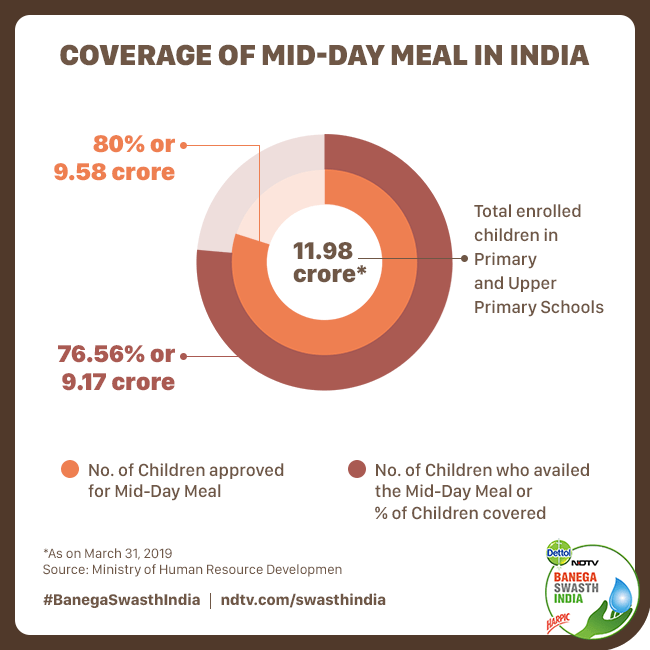
Coverage of Mid-day Meal Scheme in India

Brief Idea of What Mid-day Meal Is

The Midday Meal Scheme, launched in 1995  by former Prime Minister of India, P.V. Narsimha Rao, under the Ministry of Education, is a school meal programme in India designed to better the nutritional  standing of school-age children nationwide. The programme supplies free lunches on working days for children in primary and upper primary classes in government, government aided, local body, Education Guarantee Scheme, and alternate innovative education centres, Madarsa  and Maqtabs  supported under Sarva Shiksha Abhiyan , and National Child Labour Project schools run by the Ministry of Labour. Serving 120 million children in over 1.27 million schools and Education Guarantee Scheme centres, the Midday Meal Scheme is the largest of its kind in the world.

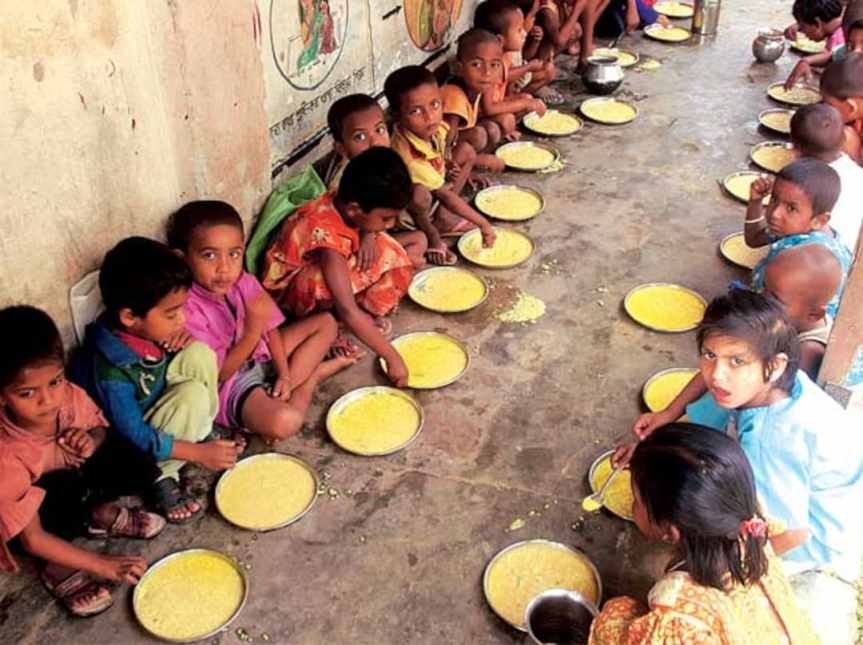
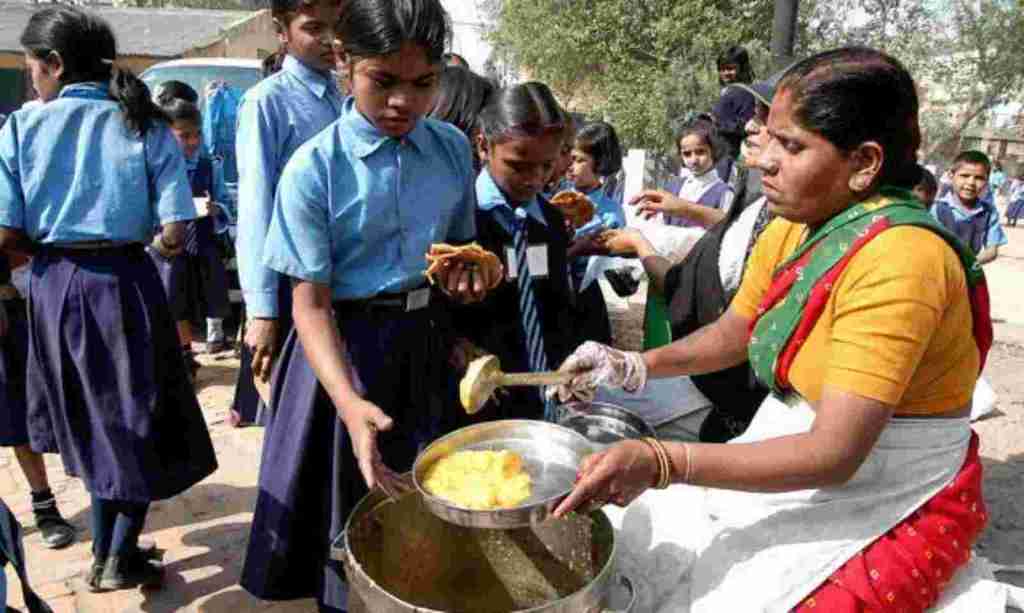
Students having Mid-day Meal at a School in India

Objectives of Mid-day Meal Scheme

  • To increase the enrolment in the schools of children who belong to disadvantaged sections of the society .
  • To increase attendance of students in Government and Government aided schools.
  • To retain the children studying in class I to VIII.
  • To give nutritional support to the children studying in the elementary level, specially in drought-prone areas.
  • To address hunger and malnutrition and increase socialization among the castes.
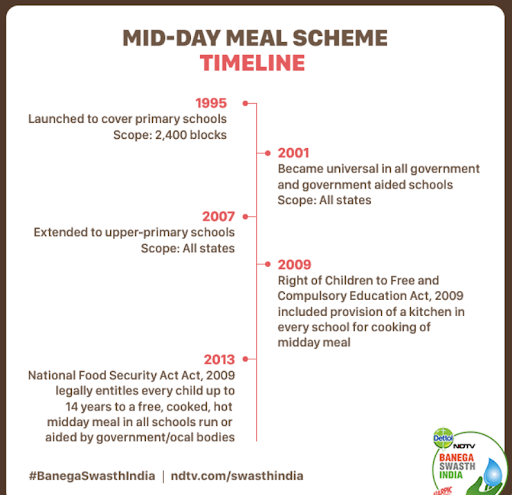
Mid-day Meal Scheme Timeline in India

Features of Mid-day Meal Scheme

  • It is one of the world’s largest school meal programs intended to achieve the goal of universalization of primary education.
  • For the implementation of the scheme, the Ministry of Human Resources and Development is the authorized body to implement the scheme.
  • It is a centre-sponsored scheme, so, the cost is shared between the states and the centre. Where the share of the centre is 60 percent.
  • The first state to implement the midday meal scheme was Kerala in 1984.
  • Till 2002, the scheme is designed especially for the government, government-aided and local body schools. But later on, the benefit of the mid-day meal scheme is extended to those children who were studying in educational guaranteed scheme centres or Alternative & Educational Centres.
  • In 2004, the scheme is again revised, and central assistance is offered for the cooking cost.  Apart from that, the transport subsidy included for all states, maximum of Rs 100 per quintal is provided to the special category states and Rs 75 per quintal for other states.
  • The provision of serving mid-day meals during summer vacation to the children in drought-affected areas was also added.
  • In 2006, the cooking cost was enhanced to Rs 1.80 per child/ school day for states in North Eastern Region and Rs 1.50 per child/ school day for other states and UTs.
  • In 2007, the scheme benefit is also extended to the children studying in the educationally Backwards Blocks.
  • Apart from the calories and food intake, for micronutrients (tablets and deworming medicines), each child is entitled to receive the amount provided for in the school health program of the National Rural Health Mission.
  • Meals provided under the Mid-day Meal Scheme
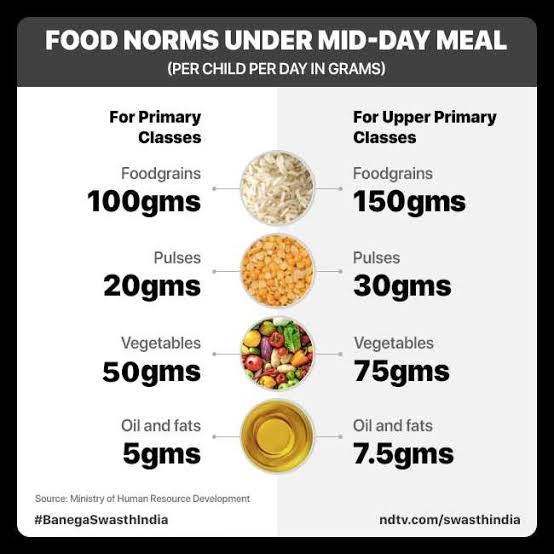
Food Norms under Mid-day Meal Scheme
  • The quantity of food items provided under this scheme per child per school day is as follows:
Food itemsPrimary level (Class I-V)Upper level (Class VI-VIII)
Food Grains100 gms150 gms
Pulses20 gms30 gms
Vegetables (leafy also)50 gms75 gms
Oil & fat5 gms7.5 gms
Salt & condimentsAs per needAs per need
Calories IntakePrimaryUpper Primary
Energy450 calories700 calories
Protein12 grams20 grams
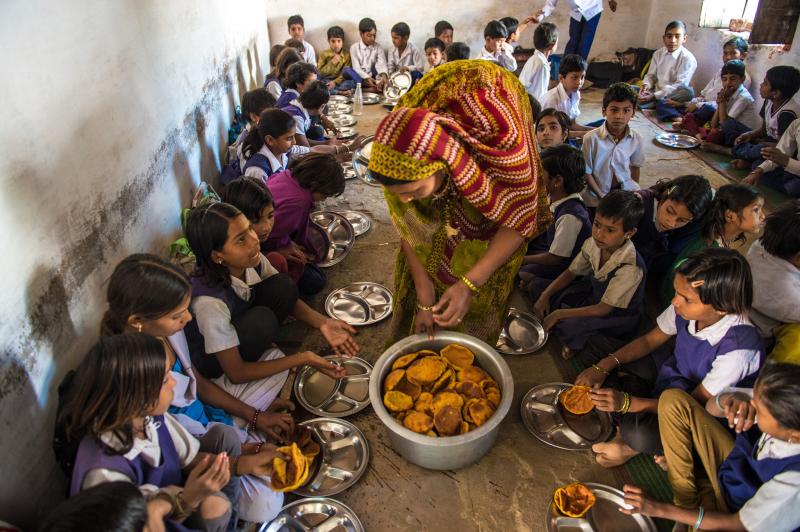
Serving of Mid-day Meal

Advantages of Mid-day Meal

  • It satisfies the hunger of many children.
  • Supplying nutrition to children of the poor section helps them in concentrating on their studies better.
  • Students come to government schools daily and won’t be asked to do labour work.
  • Addresses the issue of malnutrition.
PM POSHAN SHAKTI NIRMAN

Recent Improvisation of Mid-day Meal Scheme

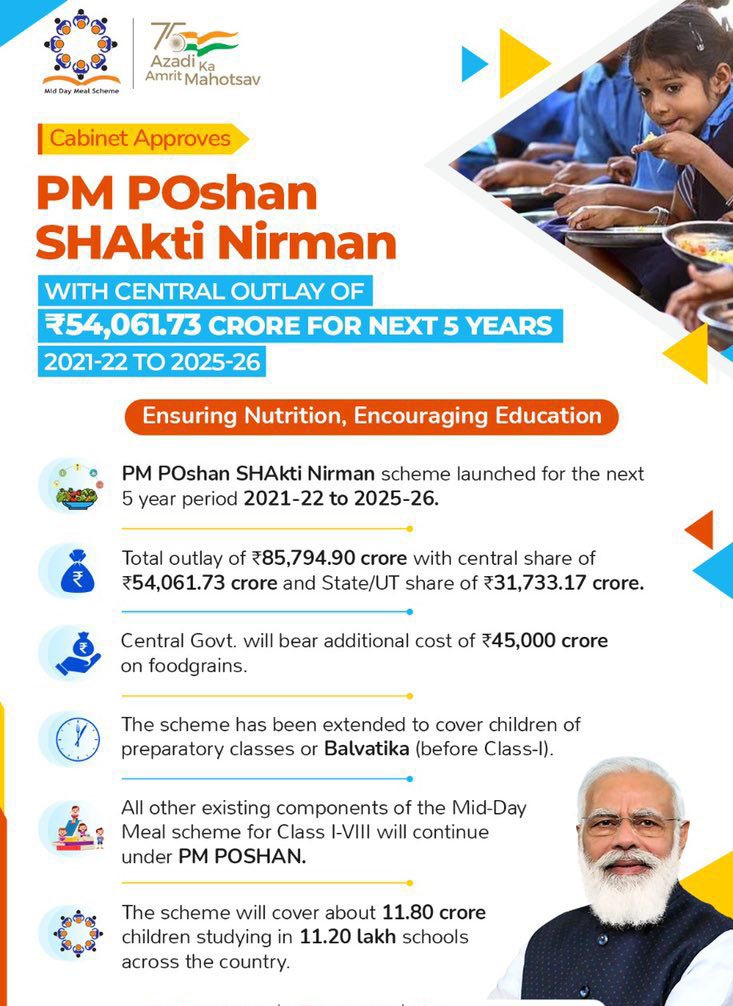
During the celebration of India’s 75th Independence Day as Azadi Ka Amrit Mahotsav, the Cabinet approved for the implementation of PM POSHAN SHAKTI NIRMAN for next 5 years i.e. 2021-22 to 2025-26.

Conclusion

There is no doubt that school is the only place that contributes to the socio-economic development of society. Here children from various backgrounds come together for promoting the culture of unity and brotherhood. The education they receive at school prepares them to achieve their goals and lead a successful life. When we talk about government schools, here children mostly come from economically challenged backgrounds. So, even though education schemes like Sarva Shiksha Abhiyaan are being implemented, the difficult financial conditions force these children to skip school and go on work. In such kind of circumstances,  the real potential of mid-day meal surfaces. Mid-day meal acts as an attractive incentive for parents to send their children to school with the sole hope that the young ones will receive at least one plate full of the meal for the day. 

Time and Tide wait for none

The first thought that comes to our mind when thinking about time is it can’t be changed. But we are not trying to understand the wastage of time in our day-to-day life. We know the benefits of it, but we don’t realize its importance in our life. The reasons we gave to waste time are infinity.

Photo by Taryn Elliott on Pexels.com

There are many reasons for wasting time we would have come across in our daily routine. Some of them are :

  1. Addiction over small tasks : This type of time wastage occurs when we get addicted to small tasks that surrounding us neglecting the big tasks that are important and urgent. It is caused due to the need of perfection in our simple task, but the cost of this addiction is realised later.
  2. Procrastination : It happens every time when we lost our focus on the current work and started thinking about something else without knowing. It is the most common and dangerous reason that finally leads to jeopardise our job.
  3. Wrong priorities : We must prioritise our works correctly before involving in it. The more time we give to priorities our works, the more jobs we can finish. Wrong prioritising of jobs leads to losing of important and urgent work.
  4. Multitasking : The tendency to do everything at once is the way to finishing none at last. Initially it may look like doing all at once and saving time. But eventually it makes our easy jobs more complex and atlast completing no tasks. The amount of time we take to do all simultaneously is more than the cumulation of time taken to do all jobs each at a time.
  5. Disorganised : The surrounding of our work bench also influence our time. If it were too clumsy, the time to find something important is also comes under time wastage. The place we work must be clean and organised to make our jobs easier.

METHODS TO SAVE TIME

  1. Eliminate Distractions : There must be no distractions during our work time. It must be eliminated as far as possible to finish the task quickly. Distractions took large amount of time and it results in postponing of jobs.
  2. Creating a To-Do List : A To-Do list can help us prioritise our jobs and it is a easy way to work on our tasks in an proper order. To-Do List must be created either during day before night or early morning. The important point in creating a To-Do list is it must be minimum and must be possible schedule.
  3. Take a Break : A small break between task keeps us productive during the task and motivate us to do other jobs as well. The best way to schedule breaks is pomodoro technique. Pomodoro is a technique which involves 25 minute work – 5 minute break. This break time must be used for our hobbies and favourite tasks instead of using smart phones and televisions.
  4. Reduce social media Time : The time spend in social media must also be scheduled otherwise it will consume large amount of time. It can be used for some time and must be thrown away. Sometimes logging out of social media might help, since the next time we go to social media the lazyness of logging in again may tempt us to see it afterwards.

The more productive we are, the more achievements we can we do in our life.
Stay productive!!

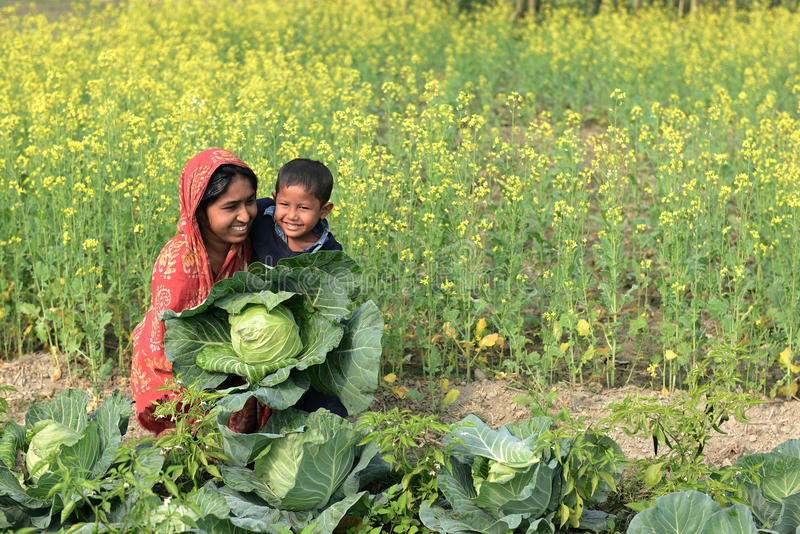
Organic Farming in India: The Future of Sustainable Agriculture

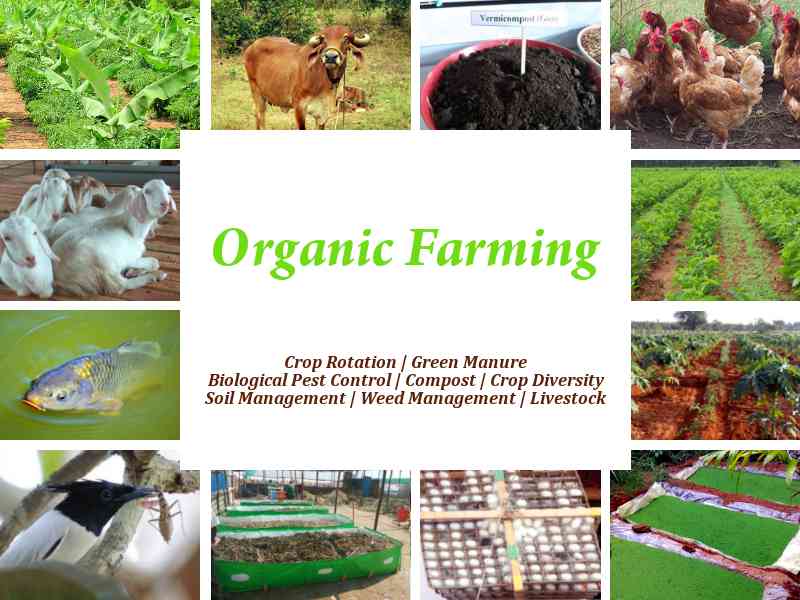
Organic Farming Produce

Introduction

The term ‘organic’ was first coined by Northbourne, in 1940, in his book entitled ‘Look to the Land’. In recent years, organic farming as a cultivation process is gaining increasing popularity . Organically grown foods have become one of the best choices for both consumers and farmers. Organically grown foods are part of go green lifestyle.

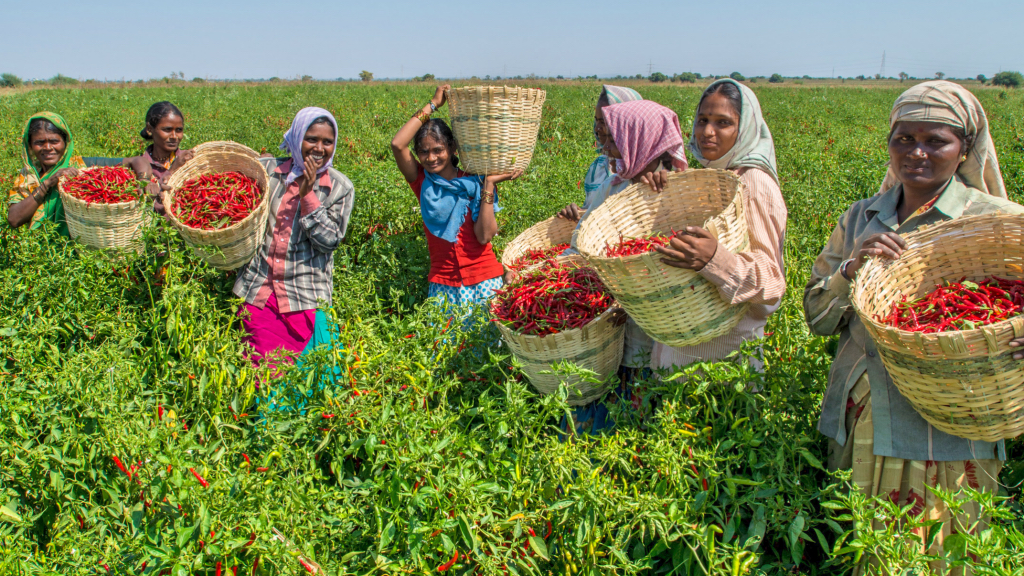
Farmers showing their Organic Harvest

Why Being Preferred These Days: The Importance of Organic Farming

Food quality and safety are two vital factors that have attained constant attention in common people. Growing environmental awareness and several food hazards (e.g. dioxins, bovine spongiform encephalopathy, and bacterial contamination) have substantially decreased the consumer’s trust towards food quality in the last decades. Intensive conventional farming can add contamination to the food chain. For these reasons, consumers are quested for safer and better foods that are produced through more ecologically and authentically by local systems. Organically grown food and food products are believed to meet these demands.

Organic Farming Processes

Organic Farming Process

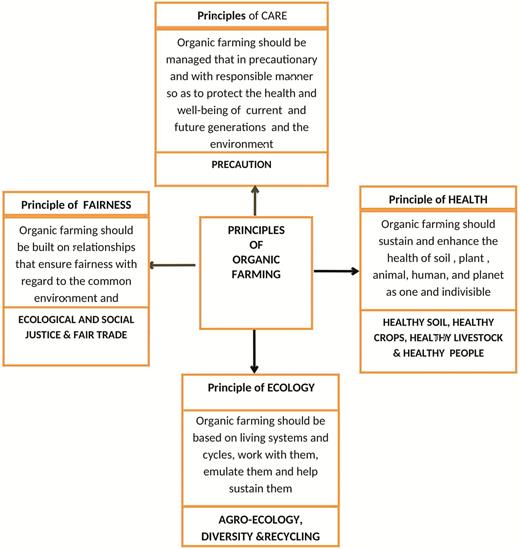
Organic farming and food processing practices are wide-ranging and necessitate the development of socially, ecologically, and economically sustainable food production system. The International Federation of Organic Agriculture Movements (IFOAM) has suggested the basic four principles of organic farming, i.e. the principle of health, ecology, fairness, and care . The main principles and practices of organic food production are to inspire and enhance biological cycles in the farming system, keep and enhance deep-rooted soil fertility, reduce all types of pollution, evade the application of pesticides and synthetic fertilizers, conserve genetic diversity in food, consider the vast socio-ecological impact of food production, and produce high-quality food in sufficient quantity.

Principles of Organic Farming  

According to the National Organic Programme implemented by USDA Organic Food Production Act (OFPA, 1990), agriculture needs specific prerequisites for both crop cultivation and animal husbandry. To be acceptable as organic, crops should be cultivated in lands without any synthetic pesticides, chemical fertilizers, and herbicides for 3 years before harvesting with enough buffer zone to lower contamination from the adjacent farms. Genetically engineered products, sewage sludge, and ionizing radiation are strictly prohibited. Fertility and nutrient content of soil are managed primarily by farming practices, with crop rotation, and using cover crops that are boosted with animal and plant waste manures. Pests, diseases, and weeds are mainly controlled with the adaptation of physical and biological control systems without using herbicides and synthetic pesticides. Organic livestock should be reared devoid of scheduled application of growth hormones or antibiotics and they should be provided with enough access to the outdoor. Preventive health practices such as routine vaccination, vitamins and minerals supplementation are also needed.

Principles of Organic Farming

Types of Organic Farming

Organic Farming are of two types. Here are the two types of Organic Farming being performed in India.

(a) Pure Organic Farming – pure organic farming, there is avoiding every unnatural chemical. In the process of pure farming, fertilizer and pesticides obtain from natural sources. It is called a pure form of organic farming. Pure organic farming is the best for high productivity. 

(b) Integrated Organic Farming – Integrated organic farming consists of integrated nutrients management and integrated pest management.

Organic Farming in India

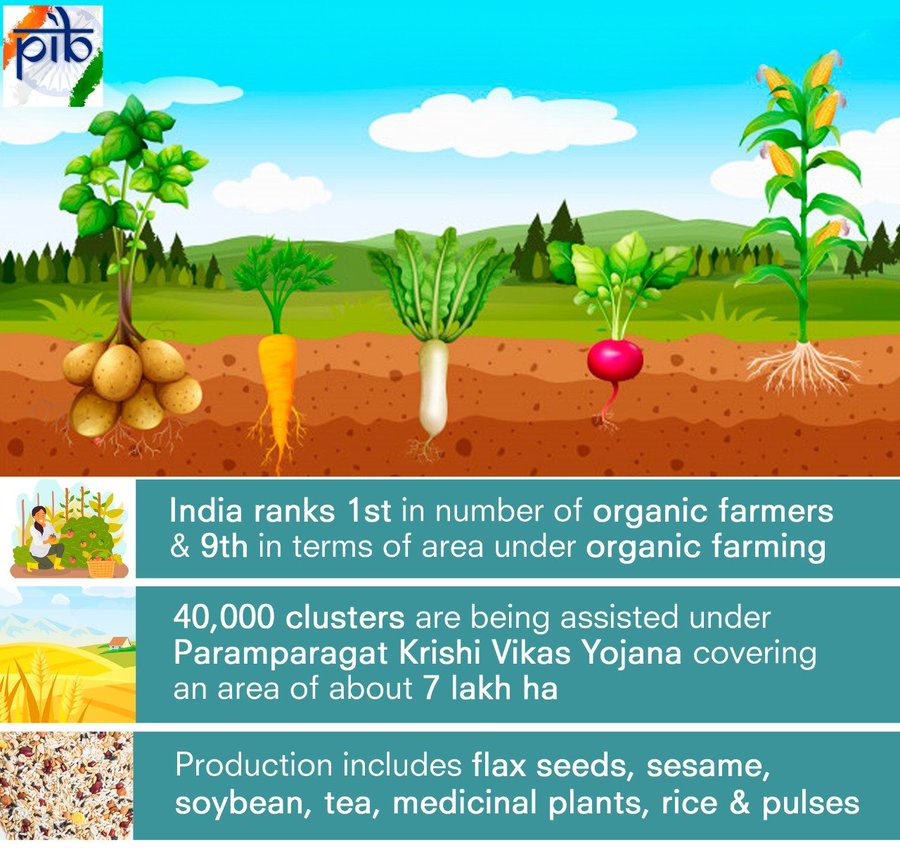
Organic farming is in a nascent stage in India. About 2.78 million hectare of farmland was under organic cultivation as of March 2020, according to the Union Ministry of Agriculture and Farmers’ Welfare. This is two per cent of the 140.1 million net sown area in the country. A few states have taken the lead in improving organic farming coverage, as a major part of this area is concentrated only in a handful of states. Madhya Pradesh tops the list with 0.76 million of area under organic cultivation — that is over 27 per cent of India’s total organic cultivation area. The top three states — Madhya Pradesh, Rajasthan and Maharashtra — account for about half the area under organic cultivation. The top 10 states account for about 80 per cent of the total area under organic cultivation. Sikkim is the only Indian state to have become fully organic so far. Even though India has very small organic area under cultivation, in terms of number of organic farmers it is being ranked first. India has over 1.9 million farmers as of March 2020, which is 1.3 per cent of 146 million agricultural landholders.

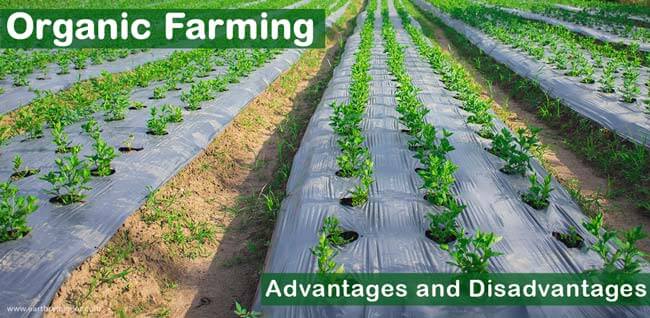
Advantages and Disadvantages of Organic Farming

Advantages of Organic Farming

Organic farming in India is very economical, it uses no expensive fertilizers, pesticides, HYV seeds for the plantation of crops. It has no expenses. 

With the use of cheaper and local inputs, a farmer can earn a good return on investment. This is one of the most important benefits of organic farming in India. 

There is a huge demand for organic products in India and worldwide and can earn more income through export.

Organic products are more nutritional, tasty, and good for health to chemical and fertilizer utilized products. 

Organic farming in India is very environment friendly, it does not use fertilizers and chemicals. 

Disadvantages of Organic Farming

Organic farming in India has fewer choices, and off-season crops are limited.

Organic agricultural products are low in the early years. Farmers find it difficult to accommodate mass production.

The main disadvantage of organic farming is the lack of marketing of the products and Inadequate infrastructure.

Organic Farming in India

Future of Organic Farming in India

India is an agriculture-based country with 67% of its population and 55% of manpower depending on farming and related activities. Agriculture fulfils the basic needs of India’s fastest-growing population accounted for 30% of total income. Organic farming has been found to be an indigenous practice of India that practised in countless rural and farming communities over the millennium. The arrival of modern techniques and increased burden of population led to a propensity towards conventional farming that involves the use of synthetic fertilizer, chemical pesticides, application of genetic modification techniques, etc.

Organic Farming leads to Sustainability and Holistic Growth

Even in developing countries like India, the demand for organically grown produce is more as people are more aware now about the safety and quality of food, and the organic process has a massive influence on soil health, which devoid of chemical pesticides. Organic cultivation has an immense prospect of income generation too. The soil in India is bestowed with various types of naturally available organic nutrient resources that aid in organic farming.

As per data collected from Government of India

Conclusion

India is a country with a concrete traditional farming system, ingenious farmers, extensive drylands, and nominal use of chemical fertilizers and pesticides. Moreover, adequate rainfall in north-east hilly regions of the country where few negligible chemicals are employed for a long period of time, come to fruition as naturally organic lands. Organic farming yields more nutritious and safe food. The popularity of organic food is growing dramatically as consumer seeks the organic foods that are thought to be healthier and safer. Thus, organic food perhaps ensures food safety from farm to plate. The organic farming process is more eco-friendly than conventional farming. Organic farming keeps soil healthy and maintains environment integrity thereby, promoting the health of consumers. Moreover, the organic produce market is now the fastest growing market all over the world including India. Organic agriculture promotes the health of consumers of a nation, the ecological health of a nation, and the economic growth of a nation by income generation holistically. India, at present, is the world’s largest organic producers and with this vision, we can conclude that encouraging organic farming in India can build a nutritionally, ecologically, and economically healthy nation in near future.

Women in the Field of Science

When we talk about women’s empowerment, gaining formal education, a career or some form of a stable means of livelihood forms an important part. From not allowing girls entry into schools and colleges to witnessing women make pioneering discoveries in the fields of science, technology, medicine, and space, the world has come a long way.

However, let us also not forget the fact that only 33% of researchers globally are women (UN Women 2022). They are also provided fewer funds than men and promoted less. According to a study conducted by The Times of India in 2018, women made up only about 25% of the scientific faculty of universities and institutions. While they form a significant fraction of science teachers in both government and private schools and colleges, the number of women sitting in top positions and with successful careers in these fields is quite small. This is mostly because women more often than not face the pressure of balancing their careers with their families. There remains an inherent belief among many that maintaining the family is primarily the women’s responsibility and cannot be compromised because of their job. A portion of female students enrolled in PG courses and female Ph.D. researchers end up unable to complete their courses due to family pressure regarding marriage. More than 50% of female graduates end up choosing a teaching career, rather than working as professionals in physics, mathematics, and engineering.

Then there are also the numerous complaints of harassment and biased and discriminatory behavior reported in such institutions. The representation of women in the overall field of science is small because people generally see science as a profession for men.

Despite all this, there have been many women visionaries in India who have made significant contributions in the field of science. Here are some of the well-known females in India’s scientific field:

  • Kamala Sohonie {1912-1998} was the first female student of C.V. Raman and was the first woman to obtain a Ph.D. degree in a scientific discipline. She discovered that every cell in a plant tissue contained the ‘cytochrome c’ enzyme which was involved in the oxidation of all plant cells.
  • Anandibai Gopalrao Joshi (1865-1887) was the first Indian woman to have graduated with a degree in western medicine in the U.S and went on to become the first woman physician in India.
  • Janaki Ammal (1897-1984) was a talented botanist who worked on developing different varieties of homegrown sugarcane and eggplant. She received the Padma Shri award in 1977 and was also appointed the Director-General of the Botanical Survey of India.
  • Asima Chatterjee (1917-2006) was a chemist well-known for her contribution in the fields of organic chemistry and phytochemistry.
  • Tessy Thomas (1963-) is the Director-General of Aeronautical Systems of DRDO. She is also the first woman scientist to head a missile project in India. 
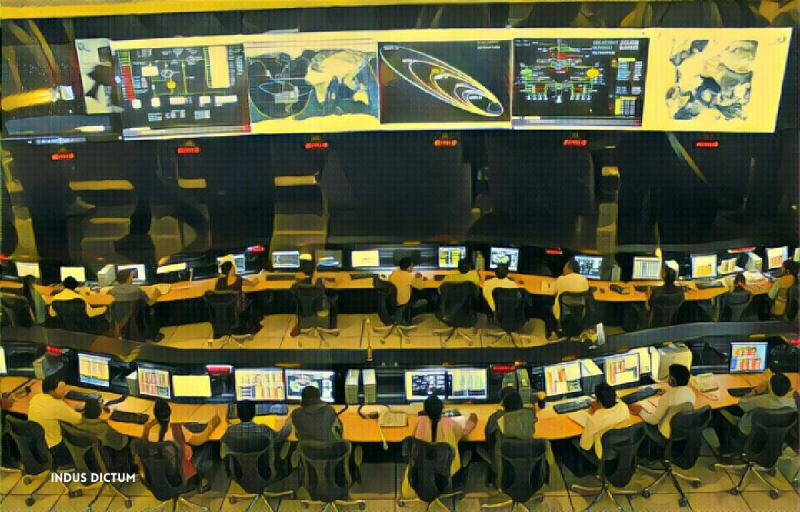
  • Major women scientists of ISRO, like Ritu Karidhal, T.K. Anuradha, Nandini Harinath, and V.R. Lalithambika among many others have received widespread praise and recognition for their work on various successful space missions like Mangalyaan, Chandrayaan, etc.

All of this goes to show us that science is not just a men’s field of play. It is as much a woman’s subject as it is a man’s and this is definitely not the last we will see of women in the field of science.

STARS project signed between DEA and World Bank

 Agreement for the financial support of the implementation of Strengthening Teaching-Learning and Results for States (STARS) project of Ministry of Education was signed between Department of Economic Affairs (DEA) and World Bank along with Ministry of Education. The total project cost of STARS project is Rs 5718 crore with the financial support of World Bank amounting to US $ 500 million (approximately Rs. 3700 crore) and rest coming as State share from the participating States, over a period of 5 years.

STARS project would be implemented as a new Centrally Sponsored Scheme under Department of School Education and Literacy (DoSEL), MOE. Earlier Union Cabinet has approved the proposal of STARS project on 14th Oct 2020. The project covers 6 States viz Himachal Pradesh, Rajasthan, Maharashtra, Madhya Pradesh, Kerala and Odisha. The identified States will be supported for various interventions for improving the quality of education.

The Program envisions improving the overall monitoring and measurement activities in the Indian school education system through interventions in selected states. STARS will draw on existing structure under Samagra Shiksha with the DoSEL, MoE as the main implementing agency at the national level. At the State level, the project will be implemented through the integrated State Implementation Society (SIS) for Samagra Shiksha.

The proposed World Bank support under STARS is primarily in the form of a results-based financing instrument called Program for Results (PforR). This will ensure major reforms at the State level through a set of disbursement-linked indicators (DLIs). A State Incentive Grant (SIG) will be used to encourage States to meet desired project outcomes. The SIG matrix has been aligned with the intermediate outcome indicators as per the requirement of PforR instrument. An independent Verification agency (IVA) will verify each result before disbursement of funds.

STARS project will be instrumental in the implementation of various recommendations of National Education Policy 2020 i.e. Strengthening Early Childhood Education and Foundational Learning, Improving Learning Assessment System, ICT-enabled approaches in education, Teachers Development and Vocational education etc.

                                                               ******