“This study highlights how the spirit of scientific discovery brings people together, even in times of hardship.”
First described in 1881, the yellow things were originally classified under the genus Zooxanthella by scientist Karl Brandt. Brandt also coined the term zooxanthellae, which is used colloquially to this day.
However, another scientist – a Scotsman called Patrick Geddes – was investigating these yellow cells at the same time. In 1882, without having seen Brandt’s work, Geddes discovered that not only were the cells separate from the animals they were within (something Brandt had also established), but that they were beneficial, acting as mutualistic symbiotes.
The genus Geddes established to categorize these cells was Philozoon, from the Greek words for ‘to love as a friend’ and ‘animal’. Unfortunately, Brandt came first, so the Philozoon genus was never used; Geddes switched to work in urban planning, and the newly named genus was largely forgotten.null
We are now well aware that these odd microorganisms Geddes and Brandt worked on back in the day are photosynthetic dinoflagellates – single-celled algae found in symbiosis with other marine life, such as corals – under the family Symbiodiniaceae.
In the new study, researchers took a closer look at these yellow cells, using genetic data, geographical data and morphology to analyze where exactly they should sit in the genetic tree.
And after determining that these creatures need to be put into a new genus, the team pulled the genus Philozoonout of retirement for two old species and six new ones.
“Each symbiont species exhibits high host fidelity for particular species of sea anemone, soft coral, stony coral and a rhizostome jellyfish.”
The team wrote that Philozoon are found in shallow, temperate marine habitats around the world, including the Mediterranean Sea, eastern Australia, New Zealand, and Chile.
“Since most of the algae in the family Symbiodiniaceae have been thought to be mostly tropical where they are critical to the formation of coral reefs, finding and describing these new species in cold waters highlights the capacity of these symbioses to evolve and live under a broad range of environmental conditions,” explains LaJeunesse.
What does an Engineer do? Engineers design machinery, build skyscrapers, and oversee public works, but they address society’s needs and problems on so many other levels as well. At a molecular level, they work on drug delivery systems that work inside cells. At a macro level, they look at the particle flow of pollutants through soil to clean up oil spills, abandoned industrial sites and other biohazards. At a galactic level, they design spacecraft for other-planet exploration. At an atomic level, they develop data storage that focuses on the spin of electrons in atoms. Clean drinking water, safe food storage, and the protection of our environment are also under the engineering umbrella.
What is Mechanical Engineering?
Mechanical engineering is the branch of engineering which deals with the design, manufacturing, maintenance and testing of machines. It is also considered as one of the most diverse and versatile disciplines of engineering. Mechanical engineering also includes the application of mechanics, material science, applied mathematics and physics.
With the rise of modern technology, mechanical engineering has witnessed newfound importance with more and more students opting to learn less explored domains of robotics, mechatronics, nanotechnology, etc.
New trends and future scope:
The scope of mechanical engineering no longer remains limited to just manufacturing and testing of huge machinery and equipment. With technology making new advancements, there are several new domains in mechanical engineering which are being taken up by passionate engineers. These domains include robotics, new materials, nanotechnology, computer-aided design, geomechanics, etc. The two highly pursued domains are robotics and mechatronics, both of which combine the knowledge of mechanical engineering with other streams to deliver state of the art products.
Robotics
Robotics is an interdisciplinary stream of engineering that combines mechanical engineering, electrical engineering and computer science with an aim to design and develop robotic systems along with computer systems to control them. With the AI revolution already started, Robotics as a stream has been on the rise and is expected to grow in both reach and demand in the coming decade.
Mechatronics
Mechatronics too, is an interdisciplinary branch of engineering which usually combines mechanical engineering, electrical engineering and Information technology. A mechatronic engineer is responsible for designing complex engineering systems, can assist in process automation and also test the systems in use in the processes.
From automobiles to heavy-duty lifting machines and even the modern aircrafts that defy speed barriers, a variety of modern systems are being designed under the supervision of expert mechanical engineers. You will not find mechanical engineers limiting themselves to the manufacturing industry anymore. Mechanical engineers are being welcomed in various industries with open arms and high compensation packages, provided that the candidates are skilled and proficient.
The current market scenario and scope:
According to the portal payscale.com, the average salary of mechanical engineers falls below Rs. 3.4 lakhs per annum. A few skills are able to add value to this compensation package. For example, knowledge of robotics or robotics process automation and a sound understanding of electrical systems can make a recruiting firm provide you with a better pay package, as per their need. Even though the pay package is lower in certain sectors as compared to computer science engineering, mechanical engineer with IT skills are very high in demand and the pay package is higher than CS engineers.
The most crucial engineering and medical entrance exams JEE Main and NEET UG have also been postponed due to the coronavirus outbreak.The February and March sessions of engineering entrance exam JEE Main 2021 were held while the April and May exams were postponed.
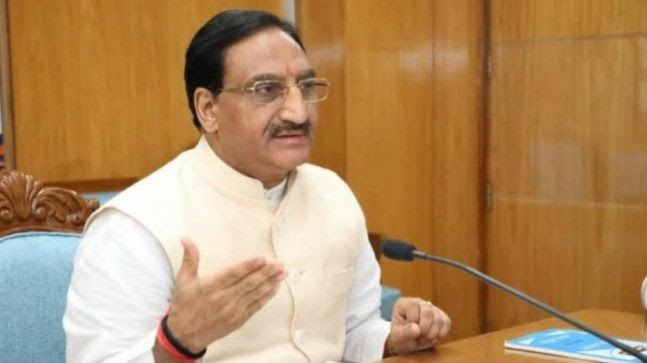
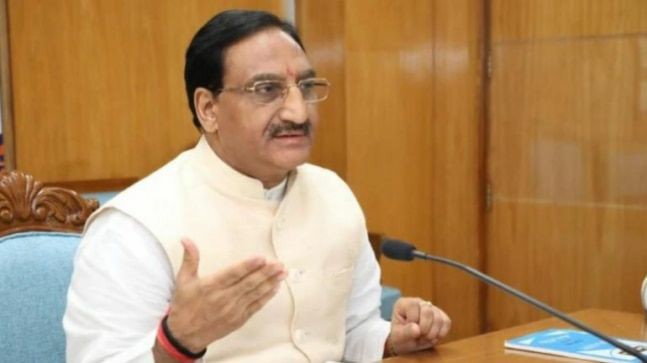
Indian education minister Mr Ramesh Pokhriyal
Education Minister Ramesh Pokhriyal has announced the exam schedule for JEE Main (April / May) sessions 2021 today. The minister made the announcement through a live session. The third session of JEE Main 2021 (April session) will be conducted from July 20-25. The fourth and last session of JEE Main 2021 (May session) will be conducted from July 27-August 2.Candidates can apply at jeemain.nta.nic.in. Those who wish to apply for the April session will be able to apply from tonight to July 8. JEE Main (May) session registrations will be open from July 9-12. Candidates will also be able to change their exam centres. Even to ensure social distancing amid the pandemic, the NTA has also increased the number of test centres for JEE Main (April and May) sessions. Earlier, the total number of test centres was 660. The test centres have now been increased to 828.
Just within two hours of date announcement , the news started Trending over various social media plateform. On twitter the #jeemains2021reached in top ten trend within two hours only. Most of the people are making memes on the surprising announcement of exam date , while some are demanding for postponement of the exam .
— Shiv Kumar Choudhary (@ShivKum02236224) July 6, 2021
What about jee advanced date announcement?
In this context, one thing has to be noted that the JEE Advanced 2021 Exam which was scheduled to take place July 3, 2021, also had to be postponed due to the COVID-19 situation in the country. However, recently, on June 25, 2021, IIT Kharagpur, the organising institute for JEE Advanced 2021 Exam has released the information brochure and list of documents that will be required for JEE Advanced 2021 Exam on the official website of JEE Advanced at jeeadv.ac.in. On the website, it is also mentioned that a new date for JEE Advanced 2021 Exam will be announced soon.
HOW TO BECOME AN ESTABLISHED CONTENT WRITER Content writing is considered the most growing and existing job in India. Content writing offers knowledge, experience and money at the same time. Content writing companies help one to develop good vocabulary and lingual skills that make it more beneficial for the writers and for their futures as well.Content writers in India have experienced a lot of things in the market which has helped them in growing their skills and experience.According to the demands there are a lot of hurdles that hamper a person from being a content writer in India. But here are a few tips which may help.
Create a portfolio– Portfolio is considered as your first impression, one portfolio can do wonders for you. If you are a new content writer then there are fewer chances to win the trust of people. You have to be individual and certain to win their trust in any way you can. So by creating a portfolio you’re representing yourself in front of them, make sure it’s as per the requirement of the clients.
Blogging– Blogging is becoming a truly popular choice among youngsters. It can be a great start if you are planning something in the field of content writing. Follow some easy tips and tricks like – plan your blog post by choosing the topic, creating an outline, conducting research and check facts. Use images to enhance your post, improve its flow and explain complex topics.
Certification – Many online portals provide you with a chance to showcase your skills and get a certification for the same. Flaunted by taking certification assessments. Share some level of expertise in various domains then go for a skill certificate. You can even attend workshops and short term courses. To content writing comes with practice and imagination so, practice will fuel your writing skills.
Internships – You can do an internship as early as possible, one must consider the internship option very actively. You can do a part time internship because a full time internship can be a pain while studying. There are plenty of online internship opportunities that pay you on an hourly basis. Hence, you can flexibly work according to your college schedule. See, one is required to curate wide-ranging content while taking up a content writing role.
Qualifications– Freshers who ponder on how to become a content writer must know the qualification. Skills like editing ,language skill, flexible writing skill ,awareness about social media. These are some qualifications and skills which are helpful for content writers to create amazing content. These skills will help you to stand out from the crowd.
Conclusion– My biggest advice to all aspiring content writers would be to keep experimenting until you satisfy your own creative urges. The written word is a strong medium of expression of your thoughts, ideas, opinions and by extension your own self. So, if you see your future in content writing , don’t be afraid to take the leap.
The Vedas are the oldest religious texts of the Hindus. Vedas are regarded as the world’s oldest piece of literature. It is believed that the Veda have composed several thousands of years ago. They were written down by several seers known as “Rishis” in the Hindu tradition. The Vedas were composed in Sanskrit and contain hymns describing the glories of God. They include material, religious, and spiritual knowledge.
The term veda means “knowledge” in that they are thought to contain the fundamental knowledge relating to the underlying cause of, function of, and personal response to existence. They are considered among the oldest, religious works in the world. They are commonly referred to as “scripture”, which is accurate in that they can be defined as holy writ concerning the nature of the Divine.
Unlike the scriptures of other religions, however, the Vedas are not thought to have been revealed to a certain person or persons at a specific historical moment; they are believed to have always existed and were apprehended by sages in deep meditative states at some point prior to c. 1500 BCE but precisely when is unknown. The Vedas existed in oral form and were passed down from master to student for generations until they were committed to writing between c. 1500 – c. 500 BCE (the so-called Vedic Period) in India. They were carefully preserved orally as masters would have students memorize them forwards and backwards with emphasis on exact pronunciation in order to keep what was originally heard intact.
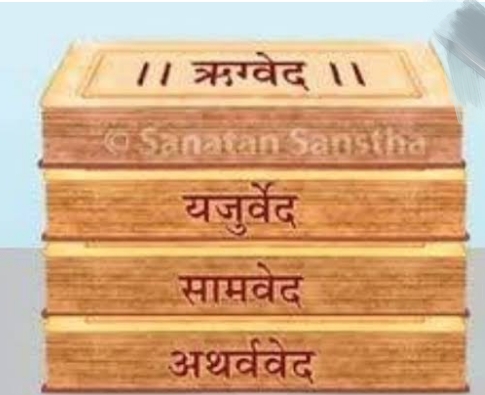
The Vedas are therefore regarded as Shruti in Hinduism meaning “what is heard” as contrasted with other texts designated Smritis (“what is remembered”), accounts of great heroes and their struggles in works such as the Mahabharat, Ramayan, and Bhagvat Gita (although some sects of Hinduism regard the Bhagavat Gita as Shruti). The texts which make up the Four Vedas are:
1. Rig Veda 2.Yajur Veda 3.Sama Veda 4.Atharva Veda
The Rig Veda is the oldest and the Sama Veda and Yajur Veda draw from it directly while the Atharva Veda takes a different course. All four, however, maintain the same vision, and the Upanishads for each of these address the themes and concepts expressed.
Each of these is further divided into types of text included within them:
Aranyakas – rituals, observances
Brahmanas – commentaries on said rituals
Samhitas – benedictions, prayers, mantras
Upanishads – philosophical narratives and dialogues
The Upanishads are an assortment of texts central to Hinduism that are recorded from oral traditions. They contain information regarding the philosophical principles and concepts of Hinduism, including karma (right action), brahman (ultimate reality), the atman (true Self or soul), moksha (liberation from the cycle of reincarnation) and Vedic doctrines that explain Self-realization through yoga and meditation practices. Upanishad is a Sanskrit word that translates in English to mean “sitting at the feet of” or “sitting down near.” This illustrates the position of receiving wisdom and guidance humbly from a teacher or guru.
The Upanishads are the best known and most often read of the Vedas because their discourse is presented in dialogue/narrative form and they were the first to be translated into other languages. The four Vedas, conversely, are considered the literal sounds of the Divine which, when recited or sung, recreate the primal vibrations of the universe. Accordingly, they are actually impossible to translate and what one reads in a translation should be understood as a paraphrase at best.
The word Upanishad is usually interpreted as “sitting down beside.” This Sanskrit word can be broken down into three parts and translated as “upa” meaning near, “ni” as down and “shad” as to sit.
The 13 Upanishads are:
Brhadaranyaka Upanishad
Chandogya Upanishad
Taittiriya Upanishad
Aitereya Upanishad
Kausitaki Upanishad
Kena Upanishad
Katha Upanishad
Isha Upanishad
Svetasvatara Upanishad
Mundaka Upanishad
Prashna Upanishad
Maitri Upanishad
Mandukya Upanishad
Their origin and dating are considered unknown by some schools of thought but, generally, their composition is dated to between c. 800 – c. 500 BCE for the first six (Brhadaranyaka to Kena) with later dates for the last seven (Katha to Mandukya).
In these sacred texts, we see an internalization of the sacrifice and worship extolled in the Vedas and a deeper understanding and exploration of the internal world of mind and spirit. Composed over several centuries and in many volumes, the Upanishads reflect a strong need to express and communicate the deep mystical states and spiritual contemplations that the ancient yogis experienced.
According to tradition, there were over two hundred Upanishads, but there are only eleven “principal” Upanishads, as commented on by the ancient sage Shankara. The texts are written in a passionate poetic verse describing mystical states and spiritual concepts or in descriptive short stories and dialogues between historical figures.
The teachings of the Upanishads revolve around four primary spiritual themes. These four philosophical concepts are described in many different ways as they can be difficult to grasp. These main teachings are repeatedly reinforced in the texts of the eleven principal Upanishads.
The first and most important is the realization that the ultimate, formless, and inconceivable Brahman (Godhead) is the same as Atman, as our internal soul. Brahman represents the entire universe, and the Atman is a little piece of that divine oneness that we contain inside us. This philosophical idea is summed up in the mantra Tat Tvam Asi (That Art Thou).
The idea that the Atman is eternal, and becomes reborn over and over again is central to the concept of reincarnation that is taught in the Upanishads.
This concept of rebirth is highly tied to the teachings of Karma: the future consequences of one’s current intentions, thoughts, behaviors, and actions.
It is the accumulation of Karma that binds us to Samsara, the cycle of death and rebirth. To escape the endless cycle of Samsara requires one to attain enlightenment through the realization of Atman/Brahman. It is this state of Self realization that the majority of the Upanishads attempt to describe and encourage us to achieve through the yoga practices of meditation, mental discrimination, and mantra recitation.
Spiritual concepts have exerted a profound influence on the development of Yoga, Hindu, and Indian philosophy. While the yogic practices taught in the Upanishads were primarily mediation based, these philosophical teachings will remain the core beliefs for all of the future developments in the many paths and practices of yoga.
BYJU’s is an Indian multinational educational company which was founded in 2011 by BYJU Raveendran and Divya Gokulnath. Today, it’s the most valuable unicorn in India and world’s most valuable technological educational company.
History of BYJU’S
In 2011, Mr. Raveendran and Ms. Divya Gokulnath founded an educational company with the help of their students which provided online video based learning programmes for students of kindergarten to Grade 12th.
In 2015, with the help of Think and Learn Ltd., the business firm launched its first ever app named BYJU’s: The learning app. After that, in 2017, BYJU launched its second app for mathematics for kids and subsequently they also launched another app for parents to help them track their child’s learning course.
Rose to fame: BYJU’s
By 2018, BYJU’s had more than 15 million users and 9 hundred thousand paid users. In 2019, BYJU’s won sponsorship rights for Indian Cricket Team jersey. Popular Indian actors Mohanlal and Shah Rukh Khan are the brand ambassadors for Byju.
Major Services provided by BYJU.
Initially, educational content was only made for students from classes kindergarten to 12. But now BYJU also trains students for Indian competitive examinations like IIT-JEE, NEET, CAT, UPSC and it also trains students for international exams like GMAT and GRE.
In 2019, the company announced that it would soon start providing classes to students in their respective regional languages in India. The same year it also announced the commencement of an international app for students living in countries outside of India.
Byju’s also launched its Future School which is a Kids Coding Platform where kids are taught to code online by experts.
The video tutorials in the app are about 12-20 minutes long and they’re digital animation videos for classes 4th to 12th and hence this makes it easy for students to grasp and learn.
Road to most valued start up!
BYJU’s has raised 350 million dollars from UBS, private equity Equity Giant Blackstone and also from Abu Dhabi state fund ADQ, Phoenix Rising and Zoom.
Byju’s has raised over 1.5 billion dollars in last eighteen months because of the increase in online learning and teaching due to the COVID-19 pandemic.
Byju’s has also acquired several other small business in the recent past like White Hat Jr, Scholr, Osmo and Toppr. In fact, it’s latest fundraising comes from popular educational chain, The Akash Educational Services, estimated at about 950 million dollars.
According to Mr. Raveendran, the 21st century illiterates are not those who can’t read and write, but those who can’t learn, unlearn and relearn.
India is the one of best and largest place for education systems in the world.
India is the country with over 1,000 universities and 50,000 colleges and institutions. The impact of covid 19 is observed in every sector around the world. The education sectors of India as well as world are badly affected by this.
Due to this pandemic, around 32 crore learners stopped to move schools/ colleges, all educational institutions are halted in India. COVID-19 made all the institutions to grow and opt for platforms , techniques, that are not used before. All the classes suspended and all the examinations, entrance tests are postponed.
This pandemic completely destroyed all the schedules of every student. COVID-19 Impact on education is also leads a great damage on country economy at present and in future.
COVID-19 has created many opportunities and challenges for educational institutions to strengthen their technological knowledge and infrastructure.
The lockdown made the entire education online, the teachers are teaching and assigning works through online by using some apps like zoom, Google meet, teams, YouTube, Facebook, skype .,etc.
India is not fully equipped to make education reach every corner of the country through online process. The students those who are not having access to internet will suffer a lot due to the present choice of digital platforms.
Universities and the government of India are relentlessly trying to come up with a solution to this problem.
“I had a job insurance at an insurance company once, and the lady said, ‘Where do you see yourself in five years?’ I said, ‘Celebrating the fifth year anniversary of you asking me this question.”
Mitch Hedberg
When we say ‘a job’, do we only refer to a task that procures income? If you harbour such a myopic perspective, then it would be difficult for you to ace that interview which almost every individual fears. Sitting on that chair, surrounded by one or more interviewers and then confidently framing creative answers to their easy questions which seem difficult due to our nervousness seems so perilous! The thought of not being selected leaves us confused, nervous, and petrified which is why we cock things up and our tongues start shaking! However, what if I tell you that a job is actually an experience to make you smarter, bolder, and strategic with regards to business which should help you have your very own business in the future? What if instead of fearing the loss of one job, you accept the ideology that there are many fish in the sea and there would be other recruiters who would definitely discern your talent, if not the current ones? Don’t shy away. Show your true self to the interviewers. Be honest and confident. Speak what comes to your mind without worrying about vocabulary! Job interviews see ones capability of handling complex situations creatively which is why, they may whack your nerve and create an intimidating atmosphere. But it is you and your hope in the end that everything happens for good! Perhaps you aren’t hired here because some greater opportunity is awaiting you- this method of thinking will automatically create a confident interviewee and your fear or nervousness would die down. Gradually, those interviewers would seem like friends to you and your tone would embrace honesty! However, there can be a negative part to this thought. Just because you know that other good jobs await you doesn’t mean you would completely lose interest in the current interview and recruiters. This thought is only meant to calm an individual down and encourage him to perform his very best without worrying rejection!
So, what exactly is a job? It is the way you handle people. It is an experience of working amazingly under pressure because mostly, people tend to screw themselves under strict deadlines which isn’t the accurate method of having your own business either. You don’t want your customers to wait for a long long time just because working under pressure isn’t your thing! Thus, a job is not a duty that provides income but an experience that helps one become independent. Yes, urgent need for income may be the reason for that former definition of a job but instead of working for money, one must work for work to get efficient results that bear fruit. Money is a sidelined concept that would keep pouring in with the fantabulous consequences of your efforts!
Reason 1
Now that you are working in that company of your choice after practically nailing the interview with the above given thoughts and creative actions, you suddenly receive a new opportunity that sits incredibly with your qualifications and area of interest. It is the spot where you wouldn’t just work for money. However, doing two jobs simultaneously wouldn’t be possible due to clash in timings which means you may have to give up on the current one. You decide to submit the resignation here and wonder why you ever felt nervous for job interviews in the first place. Jobs keep changing and so do your preferences. However there is yet another interview, that final rendezvous with your boss to explain him the reason behind your resignation. You can’t bluntly state that this job doesn’t fulfill your expectations and area of interest anymore which means creating a suitable excuse that seems appealing and digesting to the recruiter.
You approach his cabin, formally greet him, and ask for a seat to discuss something important. Of course, you don’t begin directly with that departing statement because you want the situation to be under control. Firstly, you give a brief speech regarding your experience with the company and its colleagues, how much you enjoyed and how well your boss behaved. You thank your boss for his co-operation all along and also, for trusting and hiring you. Slowly but steadily, you ask for resignation. However, you don’t reveal directly but gradually that a new job is already out there awaiting you. So, all you say is:
“Firstly, I would like to thank you for hiring and trusting me with this job. I don’t know whether I have worked as per your expectations or not, but I surely have gained profound experience under your guidance. Not to mention, I am lucky to have such co-operative colleagues too who helped me grow. However, I feel that multiple experiences with several other types of people helps one blossom professionally which is why I have decided to look for another job offer wherein a new experience with new set of people would lay new standards to the usual ones in my life. I feel that doing one job offers a single experience which ends up creating a comfort zone from where one refuses to move out, later on. Thus, I want to splash my feet and hands to keep swimming in the pool of jobs! I hope you understand. Thank you once again for the amazing asset of experience! I bade my heartiest farewell and a sincere apology for this sudden decision.”
Reason 2
However, what if the new job offer you received, not only fulfills your area of interest but also provides a higher salary than the one you currently are in? The reason to leave should be as follows:
‘Thank you for trusting and hiring me sir. I have worked very hard for this company considering it close to my heart. I have also gained immense experience in this field with your support. However, I feel that with time, the difficulty level of work must increase to check on the capability of an individual and to escalate his adeptness in handling complex situations which is why, I have applied for a harder job in the same sector making me bid adieu to this company. I say this with a heavy heart but I really want to thank you for giving me a platform to showcase my talents. Of course, this isn’t a beginner’s job in the absolute sense but I definitely accrued considerable experience with you to work with my dream sector that demands more services and experiences. Thanking you once again along with a heartfelt apology.” (Handing the resignation letter)
Reason 3
What if there are certain personal reasons like your close one’s terminal illness? Here, you can reveal the reason directly since you aren’t disregarding the company with a genuine misery which anybody would understand. Reason could be as follows:
“Hello sir, I would like to thank you for hiring and trusting me with this job. This has always been my dream job and I definitely am enjoying it here. However, due to my mother’s sudden terminal illness I am forced to leave this job since handling the house chores and other responsibilities isn’t quite easy for my dad and aging grandma. If work from home would be possible, then I am eager to continue with this job. Thank you once again for your respect, admiration, and jaw dropping co-operation which really helped me improve.”
Reason 4
What if the travelling expense is huge due to the working distance? Frame a reason as follows:
“Working here has been a fantastic experience. Everyone’s a family here encouraging the other to bloom. I find myself grateful to have worked with this company. However, I helplessly am forced to take the decision of leaving this precious job though I would love to keep working here forever! Due to the working distance, I had been staying at a rented apartment right opposite to this building. But relations with the landlord have unfortunately deteriorated which meant me, evacuating that house. There are no other rental apartments near the office, neither am I ready to live as a paying guest. Thus, I have to return home and the travelling distance daily wouldn’t be affordable. Thus with a heavy heart and a genuine apology, I bade farewell. I remain thankful to you for showering me with loads of precious experiences and memories.”
Reason 5
You were working efficiently in a company until the pandemic arrived and made work from home a priority. You are happy working at home too but someone from your family is inflicted by the virus which is making it difficult for you to concentrate on your work since your loved one and his life matters the most. Thus, you decide to resign because one can’t possibly ask for a month’s leave! Since the use of online medium becomes mandatory now, you don’t directly message your boss on Whatsapp to seem casual. Instead, prefer emailing to do the same. Compose a formal email even if you are on friendly terms with your boss because one can’t ignore that employer-employee relationship which demands a decorum. You give the reason as follows:
“Greetings,
Thank you for hiring and trusting me with the responsibilities of this company. Working can’t be more exciting here. However, a jolting situation is forcing me to give up. One of our family members has been inflicted by the deadly virus thereby creating a chaotic situation at home. Of course, I am mentally disturbed with trauma and aren’t able to concentrate on the tasks provided. I don’t wish to compromise with the efficiency and quality of my work and have thus, arrived at the conclusion of demanding a resignation. I understand it to be a harsh move but my mind just wouldn’t remain stable and the responsibilities at home are being shared by all with the absence of one important member. Acknowledging the current situation, I thus want to bid farewell not without thanking you and providing a genuine apology! Below, you will find attached the resignation letter.
Regards,
XYZ”
Reason 6
There are certain other cases though where the boss doesn’t seem motivating or berates, demeans, and pressurizes you into working more than usual. Thus one fine day, the pressure cooker bursts and you decide to quit once and for all because as stated earlier, you don’t have to face sheer domination when there are plenty of fish in the sea. Work with dignity and respect because employees are assets without whom no company can touch the acme of success. You, as an employee are special and must therefore have the courage to free yourself from such demonic clutches and choose the ones who value you. If you are highly talented then there is no stepping back. You don’t have to adjust with the current working environments because your creative determination would definitely fetch you a new platform. This was just a brief note for all the employees who feel that they wouldn’t find a new job and keep tolerating the worst working conditions. Please believe and value yourself. Don’t surrender your honour to a cruel boss and then blame yourself to have a cruel fate. You design your fate so make sure, you choose the right people in it!
Getting back to what reason you would cite to get rid of such a menacing and mentally abusing job. Of course, this too can’t be revealed directly. You have to strategically plan your way out. Most of the people in such situations use any possible excuse, be it a lie. Of course, it has to be a professional lie so that your evil boss falls for it. But if you choose honesty, then your answer needs to be creative and persuasive. One may frame it as follows:
“Hello sir. I have been working since quite a long time and have enjoyed the job. However, I feel demotivated and am experiencing mental trauma because of which I wish to resign. I don’t want to compromise with the efficiency of my work and infuriate you later. In short, I need a break to gather myself. I need some family love to overcome mental instability. If need be, I might visit a psychiatrist to maintain sanity. Of course, you wouldn’t want a sick employee tarnishing your reputation because of stupid errors coming up in major projects. Before you fire me because of company losses, I choose to back off. Thank you for this opportunity and I apologize for this sudden breakdown.”
In short, make sure you include the company losses he would incur with your illness to convince him into expelling you because the meanest of bosses would never want their company to shatter.
Reason 7
At times, people end up quitting due to colleague discomfort. Some colleagues are jealous and thus, try creating hurdles in your work and at a point, you have had enough of it. You decide to give up and look for a comfortable spot that shares a friendly environment. Also, some colleagues are dominant and force you to work for them or perhaps, you are lonely and not a single colleague has extended the hand of friendship towards you which has really made work an uphill task for you. Good colleagues, happy environment, understanding boss, a motivating bond between the staff, and punctual paychecks are essential aspects that inspire you to work harder. But if a certain company is making you compromise with either of these aspects then it will be best to look for other options! Though you may not get that perfect environment everywhere, look for happy atmosphere with a successful group of friends who actuate and act as role models to help you flourish.
What reason would you cite to leave? Create it as follows:
“Greetings sir. I have always appreciated your versatile manner of handling important projects effectively. You have inspired me to put in not just massive but quality efforts that guarantee fruit. However, I’m afraid I don’t find the same inspiration from my colleagues. I feel that for employees to succeed, a correct set of co-workers is necessary along with an understanding boss because colleagues have the opportunity to learn from each other’s mistakes which can be considered a step towards excellence. Sadly, the atmosphere here doesn’t seem boosting but gloomy because no employee wants to share their views with the other. Friendships are few and far between and the colleagues are almost always like robots burying their heads in laptops. Though the job is quite interesting and has been my deep rooted preference, I am not receiving that amiable nudge to keep going. I don’t receive a few feedbacks from my colleagues neither do they ask for any. This isn’t accurate and would only limit us to single or absolute perspectives hindering our growth. You may say that co-workers don’t matter but they do, with regards to learning something new since every new individual carries some unique perspective which may trigger an amazing idea in the other. In short, sparse interaction between colleagues is making me arrive at the only available option- resignation! Thank you once again for being an amazing boss. I sincerely apologize for this harsh decision but I really need a happy environment to maintain sanity and fetch better results. Please accept my resignation.”
To summarize, the only way to ask for resignations is to emphasize the philosophical aspects as to why you are uncomfortable with that particular environment. Secondly, you highlight the losses that the company would suffer because of your instability and of course, you end on a happy note stating that you enjoyed the work and due to that particular cause are ‘forced’ to take such a step or that you need a ‘break’ so that your boss doesn’t feel offended. You must remember to formally converse with your boss because somewhere in the core of your heart, you’ve got to respect him for hiring you in the first place, even if he is evil. After all, you have definitely been paid and trusted. Taking such points into consideration, you should frame formal speeches.
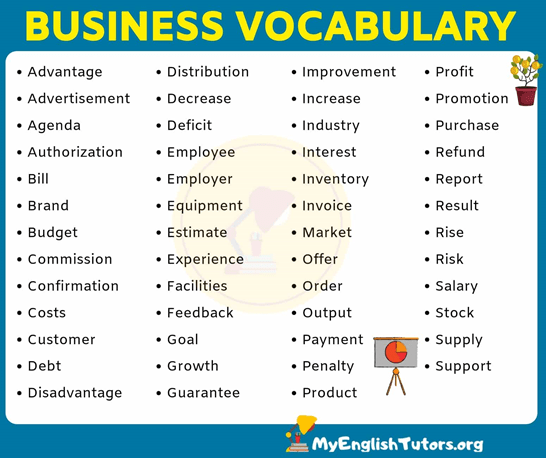
Also, using business words is essential to sound professional because you aren’t speaking to a friend! For instance, there is a huge difference between the words ‘Resignation’ and ‘Leave’ in business dictionary. ‘Resignation’ means to leave permanently while ‘a Leave’ means to temporarily cease work due to personal reasons. Thus, business English can be complex and isn’t the same as normal English. Thus, when you speak to interviewers for the first time, ensure that you have completed a course in Business English communication skills to sound impressive. As seen in the responses above, I have made use of professional and mature reasons to seem convincing.
If you choose to speak as, “Hi sir. My mom is sick and I have to tend to her. Thus, I am quitting urgently.” This not only makes you sound unprofessional but also as a liar even though you are genuine. That’s exactly why, the choice of words matters a lot. The way you interact, the serious expression you pull, and the creative philosophical reasons you provide make you look professional and genuine. Thus, one must focus on creating a grand impression on the CEO with words, sounding sweet as honey but camouflaging the harsh reality thereby cooling the situation down.
Quick Reference that could help
Thus, I would conclude stating that resignations need to be extremely formal because you don’t want to upset your boss by directly asking for it. That’s exactly why, you begin with a few consoling words to form a brief speech to engage your boss, then cite the problems you have been encountering, and gradually move towards the resignation part. During such a process, there is a possibility of receiving some solutions from your boss who could help eliminate them and if that’s the case, you wouldn’t want to quit. Be professional, be respectful, think about others, frame a formal speech, and reflect deeply over your choice of words!
Addiction is just a way of trying to get at something else. Something bigger. Call it transcendence if you want, but it’s a rat in a maze. We all want the same thing. We all have this hole. The thing you want offers relief, but it’s a trap.
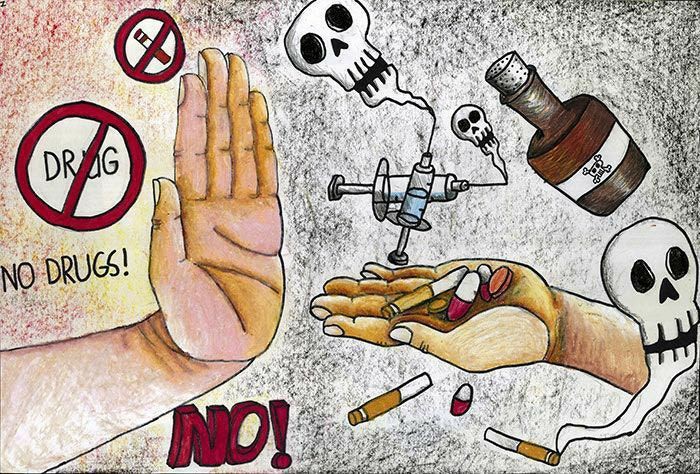
“ DRUGS ” A five letter word that is destroying human race. A word that could get you to the cloud nine and than kick you from the top.
What do you think it is ?
Is it a pleasure or a pain ?
Some says ‘it gives you wings ‘, others says ‘it makes you insane ‘ . What would you do , if someone is taking drugs ? Well , I would fly (its a joke ).
Ok , Let’s just get over with the topic .
Introduction
All the suffering, stress, and addiction comes from not realizing you already are what you are looking for.
– Jon Kabat-Zinn
Drugs are substances that change a person’s mental or physical state. They can affect the way your brain works, how you feel and behave, your understanding and your senses. This makes them unpredictable and dangerous, especially for young people.
Drug addiction is a chronic brain disease. It causes a person to take drugs repeatedly, despite the harm they cause. Repeated drug use can change the brain and lead to addiction. That can destroy one’s life .
Signs that shows someone has a drug problem
Changing friends a lot .
Spending a lot of time alone.
Losing interest in favorite things.
Not taking care of themselves – for example, not taking showers, changing clothes, or brushing their teeth.
Being really tired and sad.
Eating more or eating less than usual.
Being very energetic, talking fast, or saying things that don’t make sense.
Being in a bad mood.
Quickly changing between feeling bad and feeling good.
Sleeping at strange hours.
Missing important appointments.
Having problems at work or at school.
Having problems in personal or family relationships.
If a person shows these signs than he / she is using drugs . But it’s not , it’s a probability . The person may or may not be using drugs . For the assurance you have to ask the person (well they can lie ) . Take them for the blood test . It will show if the person is taking drugs or not . It’s a simple procedure .
Why can’t people stop using drugs on their own?
Repeated drug use changes the brain, including parts of the brain that give a person self-control. These and other changes can be seen clearly in brain imaging studies of people with a drug addiction. These brain changes explain why quitting is so difficult, even when an addicted person feels ready.
Many people are compelled to enter treatment by the pressure of their family, friends, or a court system. People of all ages with substance use disorders live in fear of what will happen if their drugs are taken away.
Due to the addiction , they experience a variety of physical and emotional withdrawal symptoms, including depression, anxiety, and other mood disorders; restlessness, and sleeplessness . It may lead you to the death bed .
Treatment :
Counseling and other behavioral therapies are the most commonly used forms of treatment. Medications are often an important part of treatment, especially when combined with behavioral therapies. Treatment plans must be reviewed often and modified to fit the patient’s changing needs.
Rational Emotive Behavior Therapy.
Cognitive Behavioral Therapy.
Detoxification.
Treatment with Medication.
12-Step Facilitation.
One of the hardest things was learning that I was worth recovery.
Marxism, also referred to as communism, is a political ideology,philosophy and a body of doctrine which was developed by Karl Marx and Freidrich Engels. Major contributor to the philosophy of Marxism, Karl Marx, was born in Trier, Rhine province, Prussia in 1818. He was born to a Jewish family, which later converted to Christianity. Marx was awarded a Doctorate of Philosophy for his essay on materialism of the Epicurus, a famous Greek Philosopher. He joined as an Assistant Editor at the Rhenish Times and was promoted to the position of Chief Editor. He left this job due to differences between him and the owner. In 1843, he moved to France. He became the editor of the Franco-German Yearbook and continued until it went out of business. Here, he became acquainted to French and German extremists like Proudhon, Mazzini, and Engels. The Communist Manifesto was jointly released by Karl Marx and Friedrich Engels in 1848. Marx published the first volume of Das Capital in 1867 and the remaining volumes were published posthumously by his friend Friedrich Engels. He spent his final years in exile and poverty in London
Marxism uses historical materialism to explain class relations and social conflict. The philosophy of Marxism was greatly influenced by Friedrich Engels who was an idealist. This led to the the concept of dialectical materialism. According to dialectical materialism, the prominent ideas that originate in the human mind at a particular point in time are called the thesis. Certain ideas, then, emerge as a response to these prominent ideas which are called as the anti-thesis. Ultimately, there is a conflict between thesis and anti-thesis, which leads to the formation of the synthesis. For example, the synthesis of the thesis of importance of capital and anti-thesis of importance of labour is class war.
According to materialistic interpretation of History, throughout history a man pursues his material needs, which in turn creates history, and only after fulfilling his material needs he shifts his focus to higher goals. Using this interpretation, Marx classifies history into four stages based on modes of production. The first one is the Primitive Communist Stage. In this stage, the factors of production were meagre and were shared among the people of the community. The next stage is the ancient stage. The class structures had developed during this period. Slaves were owned by certain masters and these people controlled the factors of production. Being the master, their needs were fulfilled and possessed a surplus and denied benefits to workers. In a similar manner, the feudal lords exploited the landless serfs in the feudal stage and capitalist exploit the workers in the industrial stage.
Another important principle of Marxism is the theory of surplus value. According to this theory, the value of a commodity is equated to the wages paid to the labourer. Any value above the commodity value is regarded as surplus value, which is both needless and exploitative. According to this philosophy, the surplus value results in the exploitation of the labourer as the producer extracts illegitimate profits. The next principle is the theory of class war. According to Marx, two classes of people exist in all stages of history – the bourgeoise and the proletariat. The bourgeoise refers to people who are in control of the factors of production and pay for the labour of other people. The proletariat refers to people who are workers and do not own any or control any factors of production. History is nothing but a clash between these two classes where the former has always exploited the latter – master-slave, landlord-serf, capitalist-worker. The interests of these two classes are, au fond, in conflict with each other. This results in a continuous conflict called class war.
By exploiting the labour of the proletariat, the rich manage to build vast amounts of wealth. The concentration of wealth in their hands increases and the poor become poorer. This enlarges the gulf between the rich and the poor. Only a few people end up controlling most of the resources. This is called concentration of capital. The continuous exploitation of the proletariat by the bourgeoise forces them to rebel against the controllers of production. Therefore, revolution by the proletariat against the bourgeoise becomes inevitable.
According to Marx, after the revolution by the proletariat, the capitalists will be removed from the position of power and the dictatorship of the proletariat will be established. The proletariats after the revolution will wipe out the capitalists. This is the dictatorship of the proletariat. This will lead to the formation of a classless society where there is no conflict between people. In a classless society, there is no more any need for the state to maintain order and harmony amongst people. This is the end goal of communism. According to Karl Marx, religion is the opium of the people. It makes people sway to sentiments and is used as a tool of exploitation by the capitalists. However, Karl Marx did not advocate the abolition of religion. Socialism, which is considered peaceful and evolutionary, was a prelude to Marxism, which is violent and revolutionary. Marxism took hold of Russia during the World War 11. After the fall of the Soviet Union, the popularity and influence of Marxism has waned.
The Legal Practitioner’s (Women) Act was passed in the year 1923. it was only in 1846 that all duly qualified irrespective of nationality or religion were able to enter into the legal profession. Women were still excluded from the profession at this stage, to be thereafter admitted through the Legal Practitioner’s (Women) Act, III of 1923. The act regarding practising law profession still excluded women from entering the profession as it did not make any reference to women in the act. The Legal Practitioner’s (Women) Act formally allowed women entry into the profession. It abolished the bar on women from practising law. The Indian women were granted the right to choose legal profession and practice as Advocates in the Courts of Law. This fight was pioneered by Cornelia Sorabji. Prior to this, women due to their illiteracy and ignorance were easily duped by the legal people or their touts. Their reserve nature was inculcated and strengthened by customs and culture. They were not able to exercise their right over their own properties. Though initially only a handful of women joined the profession as Advocates this reformative measure ignited the spirit of pleading for the cause of another before the Courts. That the laws could be utilised for obtaining social justice and repressive laws could be overthrown for further development, and that women could do it for themselves and others as well was an eye-opener to the Indian society of pre-independence times.
The challenge before women to enter into legal profession was significant and made a case for their entry to heal Indian women. They wanted to represent the Indian women. In many cases, judges opined that women were not ‘persons’ for the purpose of entering the legal profession. Regina Guha’s case was the first woman’s case. After obtaining a Bachelor of Law degree, Guha applied for admission to be enrolled as pleader in the Alipore district court. The application was examined by the court. Regina contended that since under the General Clauses Act, “words importing the masculine gender shall be taken to include female”, the rules under the Legal Practitioners Act, although referring in terms to men, would include women.In response, barrister Eardley Norton, a civil rights advocate, the bench responded that at the time the Legal Practitioners Act was passed, “there had never been a case of a lady being allowed to practice in the Indian courts”. The Legal Practitioners Act made no reference to women. In another case, Hazra applied to Calcutta University, seeking permission to appear as a private candidate in the preliminary examination of law. Calcutta University transferred her application to Patna University. Her application was refused on the ground that she had not attended regular law lectures.Calcutta University finally granted her permission to appear as a private candidate in the preliminary law examination. In 1921, after obtaining a Bachelor of Law degree from Calcutta University, she applied to be enrolled as a pleader in the Patna district court. The Patna high court judges delivered upholding the position in Regina Guha that in spite of the provisions of the General Clauses Act of 1868 and 1897, a woman, although fully qualified, was not entitled to a certificate under the Legal Practitioners’ Act to act as a pleader because of her sex. She was not a ‘person’.
By this time, the Sex Disqualification (Removal) Act 1919 was passed in England that allowed women to enter the legal profession. At the same time, the Allahabad high court allowed Cornelia Sorabji to be enrolled as a vakil. With the Patna high court judgment, a concerted campaign to amend the Legal Practitioners’ Act began. In 1922, Narayan Malhar Joshi moved a resolution proposing amendment of the Legislative Assembly Electoral Rules to remove sex disqualification in the matter of registration on the electoral roll, Gour introduced a resolution to remove sex-based disqualification in the legal profession as an amendment to Joshi’s resolution.The Legal Practitioners (Women) Act was finally passed in 1923, removing the disqualification affirming that “no woman shall, by reason only of her sex, be disqualified from being admitted or enrolled as a legal practitioner or from practising as such”.
There are many circumstances of children around the world who experience a lack of education, resulting in them having a below average level of knowledge. Lack of education is a significant barrier for underprivileged children around the world.
Today, education remains an inaccessible right for millions of children around the world. More than 72 million children of primary education age are not in school and 759 million adults are illiterate and do not have the awareness necessary to improve both their living conditions and those of their children.
What Is Lack of Education?
A lack of education can be described by a state where people have lower than average common knowledge and basic skills to support them in their daily life.
This includes the ability to read, write, spell, speak, and do simple math.
What Causes Lack of Education?
A lack of education is a significant concern due to lack of funding for education, having untrained teachers, limited or no classroom space, limited resources (e.g., paper, pencil, etc.), living far away from school, and living in countries of conflict.
This concern is a leading issue in underdeveloped countries as an education system is highly dependent on region’s economic status.
People Who Are Less Likely To Receive Education
Females
Girls are commonly left uneducated because many countries believe there is more value in educating boys in comparison to girls.
Additionally, girls are forced to marry as early as eighteen years old which prevent them for continuing their education.
Children With Disabilities
Children with disabilities most regularly do not regularly receive education because teachers do not receive adequate training to work with these kids.
In addition, these children face a lot of discrimination in terms of accessibility to a safe learning environment, as well as communication with their surroundings.
Outcomes From a Lack of Education
Lack of education can prevent a person from having a sound voice in society, as they face communication barriers and are looked down upon
Not having enough education is a leading cause of unemployment, as many industries require well informed and educated individuals to step into an employment position
Being uneducated puts people at a higher risk of falling into the poverty trap, which is defined by being unable to escape poverty due to a lack of resources. This is because education provides people with the means to make a sustainable living; however, without it, the chances of having a sufficient income is low
Lacking education promotes exploitation, as many people without a proper education take on unsafe positions. Some of these positions include becoming a prostitute, sweatshop laborer, and can even result in child marriages.
Prevalence Rates
34.3 million girls around the world do not attend primary school.
97.4 million girls around the world do not attend secondary school.
In countries of conflict, girls are twice as likely to receive education in comparison to countries without conflict.
In developing countries, up to 95% of disabled children are not enrolled in school.
51% of the uneducated population comes from South Asia.
Excel is typically used to organize data and perform financial analysis. It is used across all business functions and at companies from small to large. The main uses of Excel include: Data entry.
Excel is a software program created by Microsoft that uses spreadsheets to organize numbers and data with formulas and functions. Excel analysis is ubiquitous around the world and used by businesses of all sizes to perform financial analysis.
The main uses of Excel include:
1 Data entry 2 Data management 3 Accounting 4 Financial analysis 5 Charting and graphing 6 Programming 7 Time management 8 Task management 9 Financial modeling 10 Customer relationship management (CRM) ** Almost anything that needs to be organized!
Excel is used extensively in finance and accounting functions. In fact, many organizations run their entire budgeting, forecasting, and accounting functions entirely out of Excel spreadsheets.
While Excel is defined as a “data” management tool, the data that is most commonly managed is financial. At CFI, we would define Excel as the ultimate financial software. While there are other pieces of financial software that are tailored toward performing specific tasks, the strongest point about Excel is its robustness and openness. Excel models are as powerful as the analyst wishes them to be.
Accountants, investment bankers, analysts, and people in all types of financial career paths rely on excel to perform their daily job functions.
And one should know how to use MS Excel. Its on of the most important skill in today’s corporate world.
Have you forgotten the definition of fearlessness, only for memorizing the phrasal verbs of English grammar, the scientific names of Biology, The periodic table of Chemistry or the pages after pages of memorable dates of History?
Yes, if it so, then keep it in mind that your next stop is in your death!!
Be brave, Be strong in your personal life (Pic Source: Google)
14 billion years ago some accident made the universe bang into existence. Another mysterious accident sprang to life on Earth . Even when the 1st cell is divided into two, Life has always struggled to survive. Even though death gives life its meaning, death is meaningless without a proper life. So will you be sure that you bravely utilized your life before you become the sustenance for insects?
Well, when India is celebrating her independence with a lot of propaganda, parades , songs & anthem, One question arises: Are you really free as an individual, neither as a resident of any state/ Metropolitan city nor as a proud citizen of an almost self-sufficient India?
So let’s not just sing songs and watch parades, rather ratify your own constitution for your own individuality ( so that the nuisance of hundreds of fears inside your heart temple cannot throw you out).
Stop planning: Too much planning makes us fearful – if the planning doesn’t come implemented, how will I manage? – This fear Kills the cells of our courage.
Go back to Basics: While life intends to be happy in every step, the suggestion here goes like – Simplicity is the key to Happiness & fearlessness. Whenever & wherever you do something simple things, that comprises your creativity and that originality provides smile to your lips every time and you feel yourself out of fear in your own world.
Release Control & Allow Yourself to make mistakes: Most of us fear not the ghosts or the scorpions; rather we fear to make mistakes — So allow yourself to make mistakes after all, that’s where learning and growth really happens. Learning comes from failures and that needs to release control. Your mistakes won’t make your head down, so make mistakes as much as you want & as long as you can.
Learn to Love: Yes, you don’t know the definition of love at all. You think, love means love to any one sweetheart — No, not like that; as Nachiketa rightly pointed out —
The unconditional love will destroy the handcuffs of giant fear.
5. Jerk out your ego: Once I heard one conversation of two friends : 1st one is asking the 2nd one, “why haven’t you wished Moonal (their mutual friend ) Happy Birthday?” Then the 2nd friend replied, “why would I ? She haven’t wished me on my birthday.”
This is ego he hasn’t done. So I won’t do it. This Type of little little egoistic behavior will make us more unfree from the core of our hearts & that will carefully construct your fearful entity !So Get your ego out through your very breathing.
6. Stare at fearless people: Feel your brain with images of what you want it your tomorrow self to look like. Pick up your role models and contact them as you can weather in person through a book or online. That will serve the source to combat your fear.
7. Be aware of fear in your life: Before you begin overcoming fear you have to admit that you have it and besides you have to keep it in mind that fear is your normal site of being.
So take 10 minutes and write down some aspects of your life, where you feel fear. Get them down on paper and throw the script wherever you want that will plant a seed of fearlessness in your tender Heart.
8. Visualize your future situation without fear: Imagine yourself in a scary situation without fear. Think about the worst situation your life may pass through. What people do things fearlessly that will normally freak you out. Visualize yourself as that person and think what you would have done if it happened to you.
9.Be stupid, out of stereotypes: Remember once you are willing to risk the emotional pain of making mistakes, you will successfully Shed more fear than you ever imagined. The works that are stupid to others will help you obtain information by which you will invent your creativity.
Keep in mind that if you copy something/ some Attitude from anywhere, there fear that will kill you every moment to lose the same; but what your creation it’s extremely yours and has no fear to be lost, rather your creativity will gradually possess the area that previously your fear possessed.
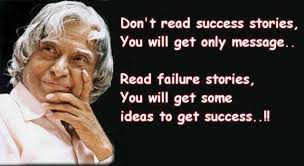
10. Read books: A lot of intellectuals will recommend you to read the books on how to succeed in life, but please refrain from obeying this advice as well as them! Read whatever you want with fearlessness. Read the books of failure. As followed by APJ Abdul Kalam,
The causes of being feared is rightly scripted in the song sung by Srikanto Acharya —
“না রে, সাহস করে স্বপ্ন তো কেউ দেখছে না,
না রে, সত্যি কথা মুখ ফুটে কেউ বলছে না”
from “Bristi Tomake Dilam” album of Sikanto Acharya
So don’t delay, don’t cheat your life, do try in new adventurous activity, dare to experience the world in a different way. You are not sure if the alarm clock will be able to wake you up tomorrow, so wherever you face hindrance today, just pat your chest and say,
“195 percent rise in sudden deaths within 5 days”, “toll tops 800”, “On Tuesday, June 29, 2021 Lytton recorded a blistering temperature of 121.1 degrees” “the hottest moment ever seen anywhere in Canada since record-keeping began”. … Well, these headings are spread across the news channels currently; akin to the heat wave that has spread it’s wings over Canada. Let’s spread more light about the basics of the Heat wave.
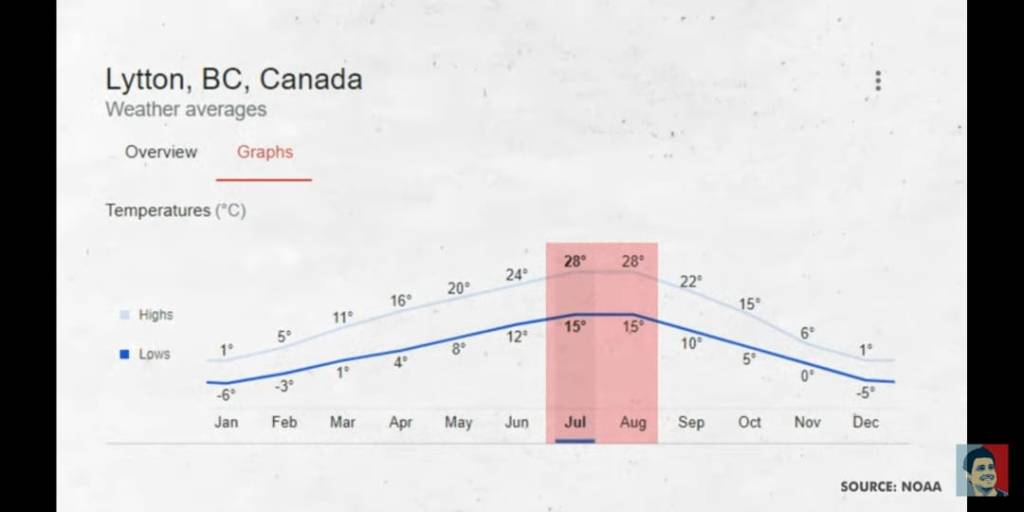
The town of Lytton has just a few hundred residents and is known for being one of the hottest locales in Canada because of its dry climate and low elevation. But during the epic heatwave that has swept western North America this month, Lytton’s previous high temperature records have been absolutely shattered by nearly ten degrees Fahrenheit.
Lytton and nearby Lillooet share the second highest temperature ever recorded in Canada. In July 1941, temperature reached a record of 44.4°C. On August 14, 2004, tempaerature again reached around 41°C. The minimum temperature the mercury touched was 31°C.
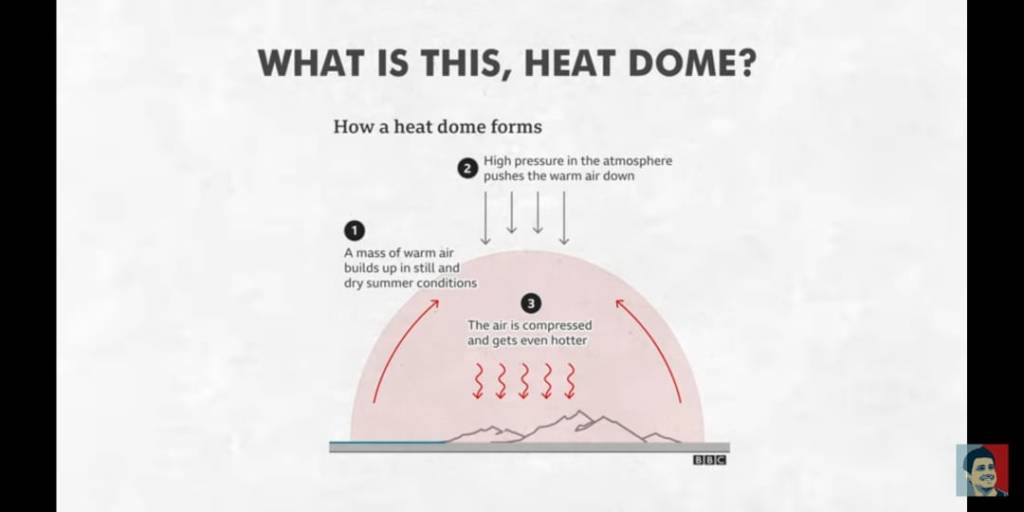
Climate change is being said the root cause. In technical terms, the condition is called Heat Dome. The warm air generally rises up but the high pressure in atmosphere from above, pushes down towards land. The pushed down air becomes even hotter. Extreme weather conditions are escalated with climate change.
West Pacific area has seen significant rise in heat as compare to the East Pacific. The strong change in ocean temperature from west to east is believed to be the core reason of heat dome. Hot air is trapped by the high pressure fronts and as it is pushed to the ground it heats up even more. The condition also prevents formation of clouds thereby giving sun more space to radiate heat on the ground.
The condition of heat dome produces heat wave. Heat wave is a period of abnormally high temperatures which lasts more than 2 days.
Effects of heat dome
Temperature becomes unbelievably high leading to catastrophic deaths, crop damage, droughts. The rising temperature will demand high energy which will in turn increase the rate of electricity. Forest fires are no exceptions. In fact, the current situation is that half of the Lytton village is charred.
Fact
The temperature of Earth has already risen by 1° (totally a bad omen). The rise resultantly increases the chances of natural disasters exponentially. The studies show climate change can affect high-altitude regions at a faster rate. In the past 20 years, temperatures above 13,000 feet have warmed 75% faster than at altitudes below 2,000 metres (credits: Rutgers Today).
Possible Solutions
On an individual level, climate change cannot be solved anymore. Only government policy changes can prove most effective. Subsidies on fossil fuels should be removed, electric cars must be promoted, carbon tax to be imposed, more and more awareness to be raised on individual level.























 Eduindex News

You must be logged in to post a comment.