In business, many examples of the 80/20 Principle have been validated. 20 per cent of products usually account for about 80 per cent of dollar sales value; so do 20 per cent of customers. 20 per cent of products or customers usually also account for about 80 per cent of an organization’s profits.
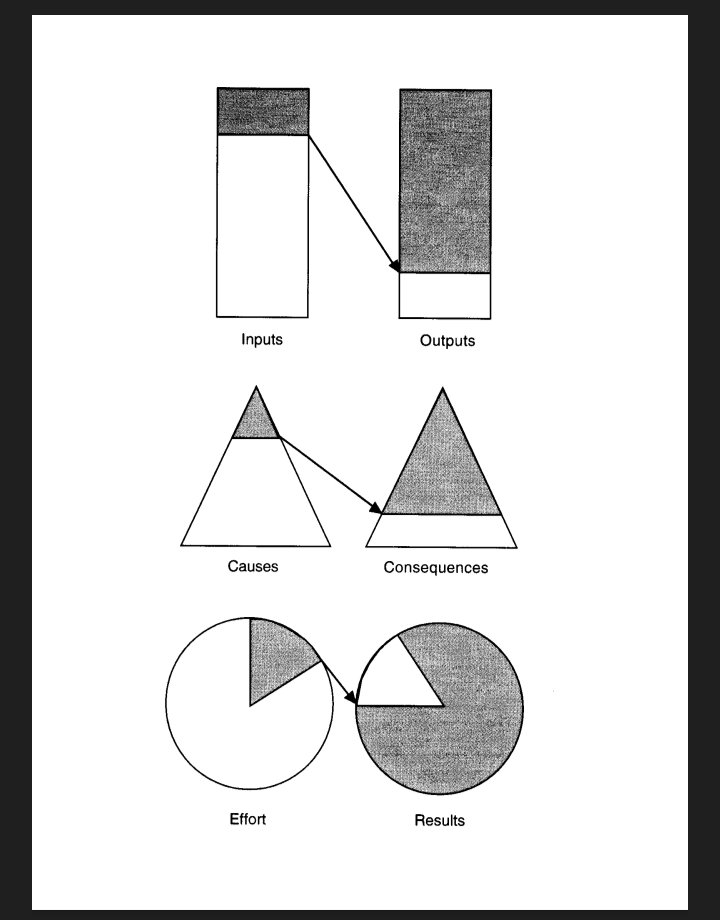
The 80/20 Principle asserts that a minority of causes, inputs or effort usually lead to a majority of the results, outputs or rewards. Taken literally, this means that, for example, 80 per cent of what you achieve in your job comes from 20 per cent of the time spent. Thus for all practical purposes, four- fifths of the effort—a dominant part of it—is largely irrelevant. This is contrary to what people normally expect. So the 80/20 Principle states that there is an inbuilt imbalance between causes and results, inputs and outputs, and effort and reward.
The pattern underlying the 80/20 Principle was discovered in 1897, exactly 100 years ago, by Italian economist Vilfredo Pareto (1848–1923). His discovery has since been called many names, including the Pareto Principle, the Pareto Law, the 80/20 Rule, the Principle of Least Effort and the Principle of Imbalance; throughout this book we will call it the 80/20 Principle.
By a subterranean process of influence on many important achievers, especially business people, computer enthusiasts and quality engineers, the 80/20 Principle has helped to shape the modern world. Yet it has remained one of the great secrets of our time—and even the select band of cognoscenti who know and use the 80/20 Principle only exploit a tiny proportion of its power.
So what did Vilfredo Pareto discover? He happened to be looking at patterns of wealth and income in nineteenth-century England. He found that most income and wealth went to a minority of the people in his samples. Perhaps there was nothing very surprising in this. But he also discovered two other facts that he thought highly significant. One was that there was a consistent mathematical relationship between the proportion of people (as a percentage of the total relevant population) and the amount of income or wealth that this group enjoyed.4 To simplify, if 20 per cent of the population enjoyed 80 per cent of the wealth,5 then you could reliably predict that 10 per cent would have, say, 65 per cent of the wealth, and 5 per cent would have 50 per cent. The key point is not the percentages, but the fact that the distribution of wealth across the population was predictably unbalanced.
There is no definition of beauty, but when you can see someone’s spirit coming through, something unexplainable, that’s beautiful to me. …
Let us live for the beauty of our own reality.
One difficulty for understanding beauty is due to the fact that it has both objective and subjective aspects: it is seen as a property of things but also as depending on the emotional response of observers. Because of its subjective side, beauty is said to be “in the eye of the beholder”.
It has been argued that the ability on the side of the subject needed to perceive and judge beauty, sometimes referred to as the “sense of taste”, can be trained and that the verdicts of experts coincide in the long run.
This would suggest that the standards of validity of judgments of beauty are intersubjective, i.e. dependent on a group of judges, rather than fully subjective or fully objective.
Conceptions of beauty aim to capture what is essential to all beautiful things. Classical conceptions define beauty in terms of the relation between the beautiful object as a whole and its parts: the parts should stand in the right proportion to each other and thus compose an integrated harmonious whole. Hedonist conceptions see a necessary connection between pleasure and beauty, e.g. that for an object to be beautiful is for it to cause disinterested pleasure. Other conceptions include defining beautiful objects in terms of their value, of a loving attitude towards them or of their function.
An honor killing or shame killing is the murder of an individual, either an outsider or a member of a family, by someone seeking to protect what they see as the dignity and honour of their family.
Honor killings are often connected to religion, caste and other forms of hierarchical social stratification, or to sexuality, and those killed will often be more liberal than the murderer rather than genuinely “dishonourable”. Most often, it involves the murder of a woman or girl by male family members, due to the perpetrators’ belief that the victim has brought dishonor or shame upon the family name, reputation or prestige.
Honor killings are often associated with rural and tribal areas, but they occur in urban areas too.
Though both men and women commit and are victims of honor killings, in many communities conformity to moral standards implies different behavior for men and women, including stricter standards for chastity for women. In many families, the honor motive is used by men as a pretext to restrict the rights of women.
Although such crimes are widely suspected to be underreported, the United Nations Population Fund estimates that as many as 5,000 women are killed annually for reasons of honor. These crimes take place throughout the world and are not limited to one specific religion or faith. However, they have rather significantly and consistently occurred in various parts of the Middle East and South Asia, with nearly half of all honor killings occurring in India and Pakistan.
Although such crimes are widely suspected to be underreported, the United Nations Population Fund estimates that as many as 5,000 women are killed annually for reasons of honor. These crimes take place throughout the world and are not limited to one specific religion or faith. However, they have rather significantly and consistently occurred in various parts of the Middle East and South Asia, with nearly half of all honor killings occurring in India and Pakistan.null
In the 21st century, there was an increased international awareness of honor killing, however, some countries remained reluctant to take the necessary steps to effectively criminalize it. In the relatively uncommon event that a man was prosecuted for the killing, the subsequent trial would often focus on the woman’s alleged behaviour, rather than the violence committed against her. When a man was found guilty, the defendant could claim that the crime had been committed to restore sullied family honor and petition the court for a reduced sentence. In India, for example, the government enacted strict penalties for violence against women during the 1980s. However, honor killings based on intercaste and interreligious marriages continued to take place in rural areas, where they were largely unreported to police because of direct or indirect support among village residents. Such murders were often ruled as accidents when reported. A woman beaten, burned, strangled, shot, or stabbed to death could be ruled a suicide, even if there were multiple wounds and there was no possibility the woman could have killed herself.
It’s will amuse you to know that you can sell your body parts and People will pay hundreds, and sometimes thousands, of dollars for certain body parts.
Note that “selling” a body part isn’t the same as putting your futon up for sale on Craigslist. Except for selling ad space on your skin, most forms of giving body parts are technically donations, but it’s common practice to be compensated in cash.
Being compensated for all of the parts listed below is legal, but we don’t necessarily recommend it. There are other — more conventional — ways to supplement your income.
1. Hair up to $1,000
Like blood, hair is easy enough to donate to a good cause (like Locks of Love). But it’s also entirely possible to sell it at a pretty sweet price point.
The trick is to keep it as long and “virginal” as possible. That means no harmful hair dyes or other chemical treatments that could damage the quality. Buyers are likely looking to make wigs, and they’re not going to be interested in your split ends.
According to Wisebread, one woman made as much as $1,000 on her locks in just a week by posting an ad on TheHairTrader.org.
You can survive with bad credit, but it’s not always easy and not cheap. Establishing a good credit score will help you save money and make your financial life much easier. If you’re looking for reasons to maintain your good credit, here are some great benefits to having a good credit score.
Low Interest Rates on Credit Cards and Loans
The interest rate is one of the costs you pay for borrowing money and, often, the interest rate you get is directly tied to your credit score. If you have a good credit score, you’ll almost always qualify for the best interest rates, and you’ll pay lower finance charges on credit card balances and loans. The less money you pay in interest, the faster you’ll pay off the debt and the more money you have for other expenses.
“Money” is a medium of economic exchange in which prices and values are expressed. It is very important to live a life. Just like the three basic units of life- “food, cloth and shelter”. Money is also can be said to be the basic unit as we can but food, cloth and shelter with money only. So its management is also important. “Money Management” means budgeting, saving, investing, earning, spending money in the best way possible. Spending money to satisfy cravings/needs is a natural human phenomenon. The idea of managing money has been developed to reduce the amount of money that is spend on items that add no significant value to one’s living standards. In a nut shell money management means spending money carefully on the needs rather than on wants and wishes and also saving it for the better future.
In Indian Society, if we take a look, we can see that indian society people/groups were divided into different categories on the basis of their earning and living standards. People are divided on assets and income/expenditure. Based on these parameters there are broadly three categories (sub categories are also there) i.e., rich/upper class people, middle class people and poor/lower class people.
Rich/upper class refers to a group of individuals have highest place and status in society. These people are considered the wealthiest, lying above the poor and middle class in the social hierarchy. Middle class people fall between the poor class and upper class. They are neither poor nor rich. These people have a simple living and their earning are mostly equal or less than their expenditure resulting to short debts. Poor/lower class people are those who live under poverty. They are homeless, living on roads and slums, don’t have food to eat, usually dependent on begging and daily wage activities.
People ending up in the same category in which they are born, it is very less likely that a poor class person becomes a middle class one in this life span. There are chances that a rich person becomes a middle class one due to many reason but the chances of upgradation in class is very less.
The reason for such situations- “Wrong money management” and less/no knowledge of managing money. Rich people become more rich and poor become more poor and middle class reamains in debt, the reason behind this phenomenon is that knowledge of money management is not being taught in school and if we talk about poor class children dont even go to school. They don’t even know how to read and write. Money management is taught at home rather than in school. Many of us usually learn about money from our parents.
Talking about poor people, how can you say that they can teach their children about money when they themselves don’t have money to fill their stomach. Poor people just teach their children to go school and work hard. It might happen that the child will pass with excellent grades in his/her academic career but even after this their economic status and mindset remain poor and they keep running in the vicious cycle of poverty like a rat.
Children of upper class are given exposure and knowledge of money management from their childhood. As their parents have more than enough money and seeing their parents earning and managing money they also learn and their intellectual development happens in the same matter but it is not possible in the case of middle and lower class as they themselves don’t have enough money so how can they teach their children about the importance of the same.
Money management should be a topic of concern as it is an important aspect of one’s life which determines his/her status and standard of living. Money management be taught from school level only then children can understand the importance of it. Both government and private schools should organise lecture and seminars on the topic “money management”. If they can manage then parents should also be invited to attend such seminars and lectures. Parents should also give opportunities to their child to learn about the money, its expenditures, saving and management. Parents should send their children to the nearby shops to purchase small goods.
Tips for Money Management
1.Every child should be given the opportunity to go to schools. 2.Budgeting should be done to save money. 3.One should create a realistic monthly budget. 4.Everyone must track their spending. 5.One should build up their savings 6.Must pay your bills on time. 7.Have an investment plan. 8.Know your money priorities. 9.Differentiate between needs and wants.
Money is important to live a good life so as its management also. Money management is a skill that everyone must know to have a good present and better future. Children should be taught about money management at school from the very beginning. It is effectively must to manage money to have a good lifestyle. So don’t waste your time and manage your money now to have a healthy, happy and wealthy lifestyle.
Property rights define the theoretical and legal ownership of resources and how they can be used. These resources can be both tangible or intangible and can be owned by individuals, businesses, and governments. In many countries, including the United States, individuals generally exercise private property rights or the rights of private persons to accumulate, hold, delegate, rent, or sell their property. In economics property rights form the basis for all market exchange, and the allocation of property rights in a society affects the efficiency of resource use.
Understanding Property Rights
Property is secured by laws that are clearly defined and enforced by the state. These laws define ownership and any associated benefits that come with holding the property. The term property is very expansive, though the legal protection for certain kinds of property varies between jurisdictions.Property is generally owned by individuals or a small group of people. The rights of property ownership can be extended by using patents and copyrights to protect:
Scarce physical resources such as houses, cars, books, and cellphones
Non-human creatures like dogs, cats, horses or birds
Intellectual property such as inventions, ideas, or words
Other types of property, such as communal or government property, are legally owned by well-defined groups. These are typically deemed public property. Ownership is enforced by individuals in positions of political or cultural power. Property rights give the owner or right holder the ability to do with the property what they choose. That includes holding on to it, selling or renting it out for profit, or transferring it to another party.
Acquiring Rights to a Property
Individuals in a private property rights regime acquire and transfer in mutually agreed-upon transfers, or else through homesteading. Mutual transfers include rents, sales, voluntary sharing, inheritances, gambling, and charity. Homesteading is the unique case; an individual may acquire a previously unowned resource by mixing his labor with the resource over a period of time. Examples of homesteading acts include plowing a field, carving stone, and domesticating a wild animal. In areas where property rights don’t exist, the ownership and use of resources are allocated by force, normally by the government. That means these resources are allocated by political ends rather than economic ones. Such governments determine who may interact with, can be excluded from, or may benefit from the use of the property.
Private Property Rights
Private property rights are one of the pillars of capitalist economies, as well as many legal systems, and moral philosophies. Within a private property rights regime, individuals need the ability to exclude others from the uses and benefits of their property. All privately owned resources are rivalrous, meaning only a single user may possess the title and legal claim to the property. Private property owners also have the exclusive right to use and benefit from the services or products. Private property owners may exchange the resource on a voluntary basis.
Private Property Rights and Market Prices
Every market price in a voluntary, capitalist society originates through transfers of private property. Each transaction takes place between one property owner and someone interested in acquiring the property. The value at which the property exchanges depends on how valuable it is to each party. Suppose an investor purchases $1,000 in shares of stock in Apple. In this case, Apple values owning the $1,000 more than the stock. The investor has the opposite preference, and values ownership of Apple stock more than $1,000.
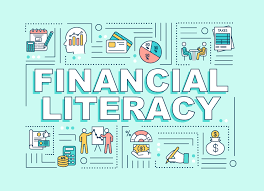
Financial literacy is the ability to understand and effectively use various financial skills, including personal financial management, budgeting, and investing. Financial literacy is the foundation of your relationship with money, and it is a lifelong journey of learning. The earlier you start, the better off you will be, because education is the key to success when it comes to money.
Read on to discover how you can become financially literate and able to navigate the challenging but critical waters of personal finance. And when you have educated yourself, try to pass your knowledge on to your family and friends. Many people find money matters intimidating, but they don’t have to be, so spread the news by example.
Understanding Financial Literacy
In recent decades financial products and services have become increasingly widespread throughout society. Whereas earlier generations of Americans may have purchased goods primarily in cash, today various credit products are popular, such as credit and debit cards and electronic transfers. Indeed, a 2019 survey from the Federal Reserve Bank of San Francisco showed that consumers preferred cash payments in only 22% of transactions, favoring debit cards for 42% and credit cards for 29%.
Other products, such as mortgages, student loans, health insurance, and self-directed accounts, have also grown in importance. This has made it even more imperative for individuals to understand how to use them responsibly. Although there are many skills that might fall under the umbrella of financial literacy, popular examples include household budgeting, learning how to manage and pay off debts, and evaluating the tradeoffs between different credit and investment products. These skills often require at least a working knowledge of key financial concepts, such as compound interest and the time value of money. Given the importance of finance in modern society, lacking financial literacy can be very damaging to an individual’s long-term financial success.
Being financially illiterate can lead to a number of pitfalls, such as being more likely to accumulate unsustainable debt burdens, either through poor spending decisions or a lack of long-term preparation. This in turn can lead to poor credit, bankruptcy, housing foreclosure, and other negative consequences. Thankfully, there are now more resources than ever for those wishing to educate themselves about the world of finance. One such example is the government-sponsored Financial Literacy and Education Commission, which offers a range of free learning resources.
Strategies to Improve Your Financial Literacy Skills
Developing financial literacy to improve your personal finances involves learning and practicing a variety of skills related to budgeting, managing and paying off debts, and understanding credit and investment products. Here are several practical strategies to consider.
Create a Budget—Track how much money you receive each month against how much you spend in an Excel sheet, on paper, or with a budgeting app. Your budget should include income (paychecks, investments, alimony), fixed expenses (rent/mortgage payments, utilities, loan payments), discretionary spending (nonessentials such as eating out, shopping, and travel), and savings.
Pay Yourself First—To build savings, this reverse budgeting strategy involves choosing a savings goal (say, a down payment for a home), deciding how much you want to contribute toward it each month, and setting that amount aside before you divvy up the rest of your expenses.
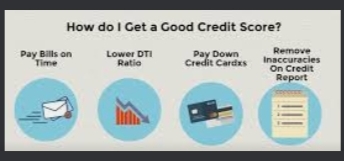
Pay Bills Promptly—Stay on top of monthly bills, making sure that payments consistently arrive on time. Consider taking advantage of automatic debits from a checking account or bill-pay apps and sign up for payment reminders (by email, phone, or text).
As the UP Election are on the way all the political parties are on their way to lure the public towards them to getthe votes and to win the elections. Therefore a lot interviews and rallies have started taken place. India has just came out of the second wave of Covid-19 and somehow there were many political rallies lead to the boost in cases at some places.
Sadly the same thing is happening again and the rallies and political gatherings have started again. No one knows what can be the result of all this but as there are a chances of having a third wave of Covid-19 around October it is not something that leaders should be focusing on.
Among all this the role of media has became limited to promoting the government and several products only. The major news channels are not talking about the problems that may arise as the result of the actions taken by Government. Upon having a chance to interview they only end up asking silly questions like a 5 year old fro, prime minister and from chief minister as well.
The role of media is to ask questions on behalf of the public but it seems to do everything except that only.
what do you think about current media and what do you think about the government. please share your thoughts in the comments below.
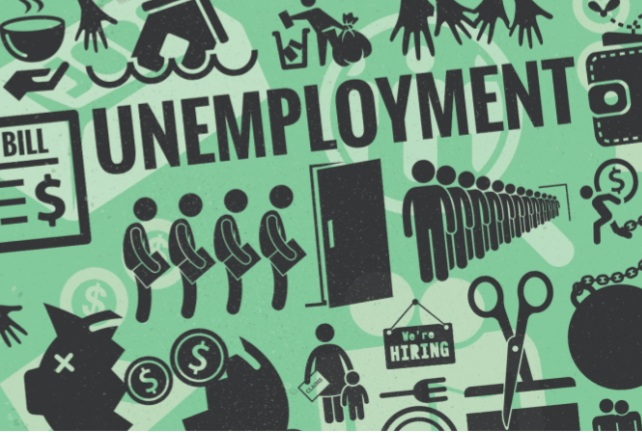
Unemployment has become one of the biggest problems around the world. When an individual is an implied, he or she will know very less about the mankind. It is so difficult to face situation and handle situations when the individual is unemployed. Unemployment leads to many silly mistakes. And an unemployed person cannot take over the family and lead the family as well. There is a huge competition in highly populated countries like India. In order to be employed, the only method is to study hard and improve the skills and score better. Basically, the students are not showing good amount of interest towards the studies. Let us now see how to motivate them.
Covid crisis has made many people unemployed. It has taken away the basic need of living. Many people are left with the unfilled stomachs. Some people are dead about by not finding a way to live.
Types of unemployment :
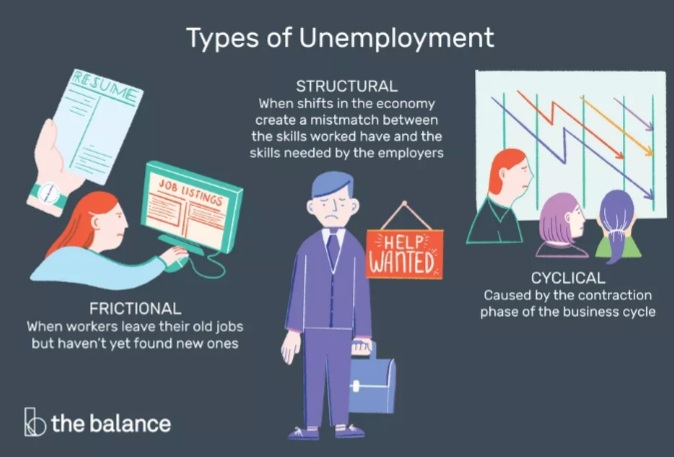
There are four main types of unemployment in an economy frictional, structural, cyclical, and seasonal and each has a different cause.
1. Frictional unemployment :
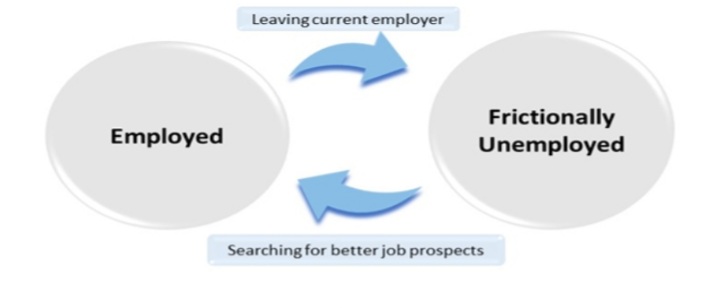
Frictional unemployment is caused by temporary transitions in workers lives, such as when a worker moves to a new city and has to find a new job. Frictional unemployment also includes people just entering the labor force, such as freshly graduated college students. It is the most common cause of unemployment, and it is always in effect in an economy.
2. Structural unemployment :
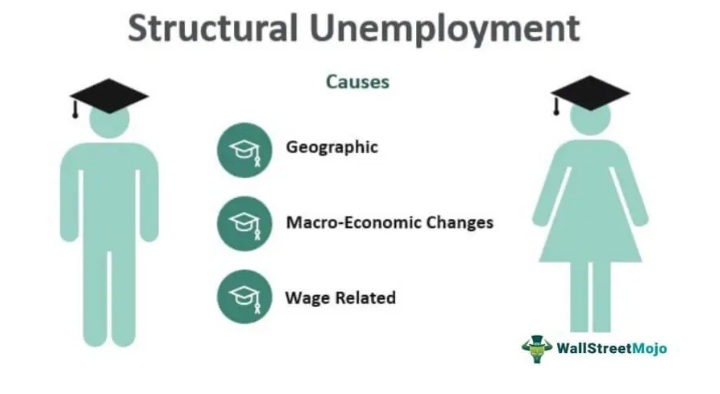
Structural unemployment is caused by a mismatch in the demographics of workers and the types of jobs available, either when there are jobs available that workers don’t have the skills for, or when there are workers availabes but no jobs to fill. Structural unemployment is most obvious in industries undergoing technological advancements.
3. Cyclical unemployment :
Cyclical unemployment is caused by declining demand. When there is not enough demand in an economy for goods and services, businesses cannot offer jobs . According to keynesian economics , cyclical unemployment is a natural result of the business cycle in times of recession: if all consumers become fearful at once, consumers will attempt to increase their saving at the same time, which means there will be a decrease in spending, and businesses will not be able to employ all employable workers.
4. Seasonal unemployment :
Seasonal unemployment is caused by different industries or parts of the labor market being available during different seasons. Fot instance, unemployment goes up in the winter months, because many agricultural jobs end oncr crops are have harvested in the fall, and those wotkers are left to find new jobs.
Consequences of unemployment in an Economy :
Low unemployment is key to economic stability High and long- term unemployment can cause significant stress on a nation in three key areas.
* Individuals :
Unemployed people have no ability to fulfill their financial obligations and can become mentally stressed, ill, and even homeless.
* Economic efficiency :
During times of high unemployment many job seekers will accept new jobs below their skill level, a situation called “underemployment ” which translates to a loss of human capital for an economys labor market. Unemployed workers will also significantly decreases their consumer spending, which is one of the driving forces of economic growth. Without consumer spending, the economy will slow dramatically.
* socio- political stability :
If unemployment remains high, citizen dissatisfaction can rise to the point of widespread civil unrest.
Possible solutions for Unemployment :
Solving unemployment is a hotly debated topic, and no economists agree on one simple way to do it. However, in the U.S ,if unemployment rises noticeably, the government usually steps in with specific policies designed to lower the total number of unemployed people.
1. Monetary policy :
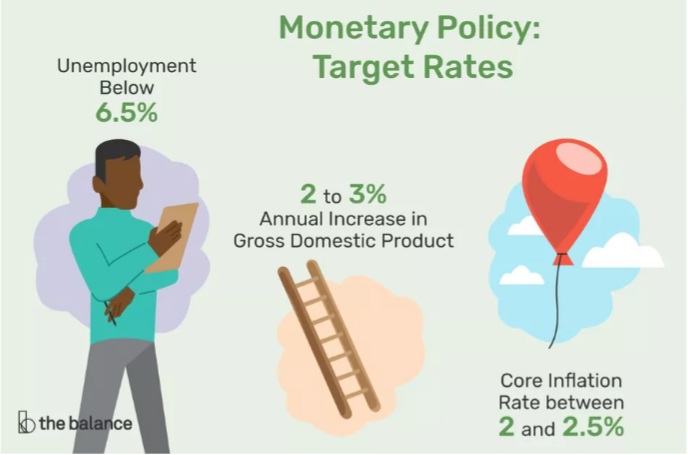
Monetary policy is financial influence implemented by a central bank . Monetary policies usually come in the form of lower interest rates, which increase the total money supply within an economy by allowing banks and businesses more access to loans and therefore, more accessible spending power.
2. Fiscal policy :
If expansionary monetary policy doesn’t adequately lower the unemployment rate government agencies will turn to fiscal policy. Fiscal policy is fiscal stimulus implemented by the national government and fiscal policies include spending on infrastructure, proposingtax cuts , increasing the minimum wage, or implementing unemployment benefits. These methods are designed to inject more demand into private economy and strengthen economic activity.
Let us now see some of the ways to motivate the students to study and get employeed.
• Make things easier :
Showing the things easier and explaining them with clarity helps the students to show better interest on the subject and makes them to pay more attention on what the teacher is trying to convey. When the topics are shown easier for the students, they start learning them and they feel achieved and they pay more attention to study. When a student learns a particular topic or a question, he/she feels comfortable and happy for getting it. Once if they start reading, they develop the interest in them and they continue to read more and more.
• Tell the importance :
The students must be motivated with good number of words to understand the need of studying and what happens if they don’t study. A student is like a bird without the wings when they don’t study. So, it is very important to motivate students to study and to make them understand the need of the situation. Motivation brings the right change in the students who are not interested in learning. It develops the interest in them to study.
It seems good if the government provides good number of jobs.
Over the years, Amul, one of the most beloved brands of our country, has become the taste of India, just as its tagline claims. Every Indian millennial has grown up listening to the jingles of its many dairy products, and the Amul girl, the brand’s mascot in the polka-dotted dress, has become a nostalgia-evoking symbol. Amul has truly come a long way since its founding in 1946.
The beginning
Amul was formed as a part of a cooperative movement against Polson Dairy in Anand, Gujarat, which procured milk from local farmers of Kaira District at very low rates and sold it to the then Bombay government. Everyone except the farmers benefited from this trade. The farmers took their plea to Sardar Patel, who had advocated farmers’ cooperatives since 1942. The result was the formation of the Kaira District Co-operative Milk Producers’ Union Limited in Anand.
The union started pasteurising milk produced by a handful of farmers for the Bombay Milk Scheme and grew to 432 farmers by the end of 1948. The rapid growth led to problems including excess production that the Bombay Milk Scheme couldn’t accommodate. To solve this issue, a plant was set up to process all that extra milk into products such as milk powder and butter.
Amul is born
The late Dr. Verghese Kurien, rightly called the Milkman of India, was Amul’s true architect. His journey at Amul began in 1949 when he arrived in Anand to manage a dairy as a government employee. He went from helping farmers repair machinery to revolutionising India’s dairy industry with the White Revolution (or Operation Flood), the largest dairy development programme in the world.
The new dairy with the milk processing plant was ready for operation in October 1955, the year that also saw a breakthrough in dairy technology —buffalo milk was processed to make products for the first time in the world. The word ‘Amul’, derived from ‘Amulya’, which means ‘precious’ or ‘priceless’ in Sanskrit, was used to market the range of milk products developed by the Kaira Union. It is also an acronym for Anand Milk Union Ltd.
Dr Kurien had a vision. He wanted to offer small-scale dairy farmers quality-control units and centralised marketing, which were missing at the time in the dairy economy. Thus, the Gujarat Cooperative Milk Marketing Federation (GCMMF) was created in 1973 to market milk and all milk products produced by six district cooperative unions in Gujarat. GCMMF is the largest exporter of dairy products in India and Amul is the umbrella for all of its products.
Awards, accolades, and a global presence
Over the years, Amul, together with GCMMF, has won numerous awards. Some of these include the Rajiv Gandhi National Quality Award, 1999; the Golden Trophy for Outstanding Export Performance, 2009-10; Best Marketing Campaign, 2014; and World Dairy Innovation Award, among many others. Amul earned recognition all over the world when GCMMF introduced it on the Global Dairy Trade (GDT) platform, where only the six top dairy players across the world sell their products.
More than a mere slogan
Amul’s famous slogan, which is now a part of its logo, was created in 1994 by Shri Kanon Krishna of a Mumbai-based advertising agency called Advertising and Sales Promotion (ASP). According to Amul, the Taste of India slogan is more than just corporate positioning or advertising jargon. This slogan lends meaning to the brand’s never-ending commitment to taking quality food and products to the rural man, which he otherwise couldn’t have afforded.
The Butter Girl
Amul did not always have the round-eyed moppet as its mascot. The Butter Girl was born in 1966 when Sylvester daCunha, the then MD of the advertising agency handling Amul butter’s account, created her for its campaign. It was a pleasant change from the dull, corporate ads that the previous agency had come up with. Being a seasoned marketer himself, Dr Kurien gave daCunha complete creative freedom to create and release the ads without taking the company’s permission. 30 years later, the Utterly Butterly Girl still wins hearts wherever she is, whether on a billboard or on the packet of butter.
Amul is not just a brand; it is also a movement that represents farmers’ economic freedom. The name is now a household term that is here to stay, and the chubby-cheeked Amul girl will continue to cast a spell on the public.
The origin of biriyani in India is uncertain. Many theories are put forward in the origin of Biriyani in our country. The delicacy is considered as a food pride of our country. According to historian LizzieCollingham, the modern biryani developed in the royal kitchens of the Mughal Empire (1526–1857) and is a mix of the native spicy rice dishes of India and the Persian pilaf.Indian restaurateur Kris Dhillon believes that the dish originated in Persia, and was brought to India by the Mughals. Pratibha Karan the author of the book “Biriyani” says that it is derived from a South origin dish called pilaf . She speculates that the pulao was an army dish in medieval India. Armies would prepare a one-pot dish of rice with whichever meat was available. Over time, the dish became biryani due to different methods of cooking, with the distinction between “pulao” and “biryani” being arbitrary.
Biriyani ❤️
INGREDIENTS
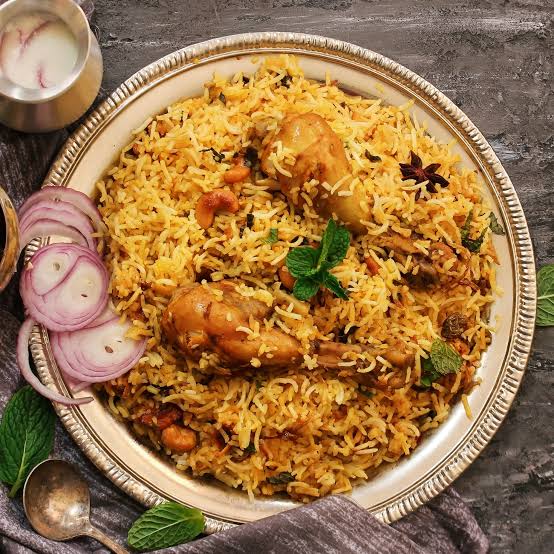
The spices and condiments used in biryani may include ghee (clarified butter), nutmeg, mace,pepper, cloves, cardamom, cinnamon, bay leaves, coriander, mint leaves, ginger, onions, tomatoes, green chilies, and garlic. The premium varieties include saffron.
The main ingredient that usually accompanies the spices is chicken or goat meat; special varieties might use beef or seafood instead. The dish may be served with dahi chutney or raita, korma, curry, a sour dish of aubergine (brinjal), boiled egg, and salad.
The taste of India
VARIETIES OF BIRIYANI
There are many types of biryani, whose names are often based on their region of origin. For example, Sindhi biryani developed in the Sindh region of what is now Pakistan, and Hyderabadi biryani developed in the city of Hyderabad in South India.
Some have taken the name of the shop that sells it, for example: Haji Biriyani, Haji Nanna Biriyani in Old Dhaka, Fakhruddin Biriyani in Dhaka, Students biryani in Karachi, Lucky biryani in Bandra, Mumbai and Baghdadi biryani in Colaba, Mumbai. Biryanis are often specific to the Muslim communities where they originate; they are usually the defining dishes of those communities.
KOLKATA BIRIYANI
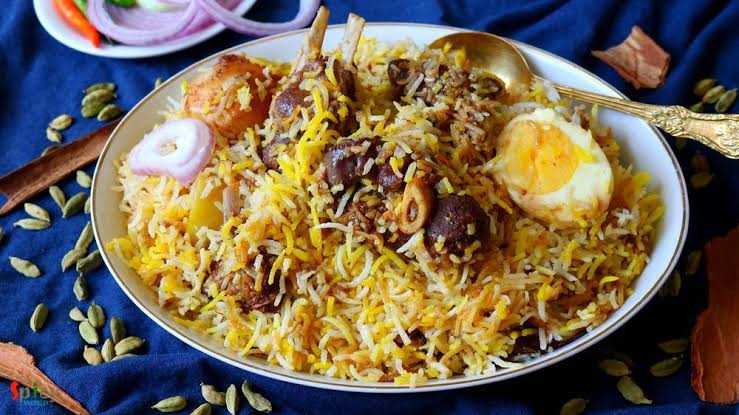
Calcutta or Kolkata biryani evolved from the Lucknow style, when Awadh’s last Nawab Wajid Ali Shah was exiled in 1856 to the Kolkata suburb of Metiabruz. Shah brought his personal chef with him. The Kolkata biriyani is characterized by the unique presence of potato in it, along with meat. It is said that the Nawab, having is lost his kingdom, could not afford meat, so his chefs tried to compensate by adding potato.
Kolkata biriyani
Biriyani is a dish which brings pride to our food culture
      Anuj Das
Many people think that in the professional world, selfishness and greed are the characteristics that pay dividends. But the truth is, excepting win-lose situations, that the most successful people in the medium and long term are those who are the most generous in their business and personal lives.
Ambition is a desire to take on more than you can realistically accomplish, to constantly strive for improvement, to grow both personally and professionally, and, of course, the desire to generate more income. However there comes a time when ambition crosses a line, and when that happens it becomes greed. Greed is the desire to chew more than you can eat, a desire that distracts you from realistically possible goals. Greed is wanting to get more than what you have actually earned, obtaining maximum profit at minimum cost, or as an old adage has it: “Grasp all, lose all.”
Today there is an abundance of courses and books on finance, limitless knowledge on hand with a simple click. But to know what is right, to subdue the pirates of greed and to follow your trading plan- this is another story. People who look for easy money invariably find that there is no such thing, paying a heavy price for this lesson. Ego, vanity, and revenge play a part, causing people to fail on their trading accounts. This is one of the factors that explains why people might not fall into the exclusive 10% that ‘win’, and find themselves one of the 90% that lose.
Literature and film are full of greedy and stingy characters, and the moral of films like ‘A Christmas Carol’ or ‘The Wolf of Wall Street’ is always the same: the fate of the greedy is heartbreaking. Their addiction to work means that they live a lonely life, and their search for wealth means that at the end of their lives, they have only the sober memory of their friends from the Stock Exchange.
GIVE AND TAKE
People do not realize that giving without expecting something in return could be a competitive advantage, as well as making ones outlook more positive. Studies have shown that the most successful people are generous. At least this is the affirmation of Adam Grant, a psychologist and professor at Wharton and author of “Give and Take”.
A generous person builds bigger and stronger networks, improves communication with their existing contacts, and also finds it easier to interact with people outside of their core network- this gives them access to new contacts and valuable sources of information. Generous people inspire in others a predisposition, or positive receptivity, to reconnect with them, as well as a greater willingness to collaborate.
Moreover, being a giver encourages persistence because givers are able to enthusiastically motivate people, inspiring confidence, because they are liberal with praise. They create a generally positive environment. Talent is important, but the most important factor in success is persistence. And what’s even more interesting is that being a giver has an energizing effect that increases levels of happiness.
According to Bill Williams, famous trader and writer of “Trading Chaos”, people with a ‘giving’ mindset enjoy more happiness and success. For example, later in his career Bill always traded two accounts, one for himself and one for his charities. The charity account always made more money, even though he traded using the same method with both accounts. In the charity account he never veered from his strategy, while in his own account he would sometimes take a trade based on a “feel”, or get in a trade before the actual signal. This shows us the importance of sticking to a plan, but also the importance of being a ‘giver’.
Giving distracts us from our problems, adds meaning to our lives and helps us feel valued by others. This explains why avidity and egoism are the trader’s worst enemy. Having a benevolent mindset while trading helps the trader to increase performance. Happy people earn more money on average, score higher yields, make better decisions and contribute more to their organizations. Furthermore, traders who are givers are at the top of the most successful trading operations.
THE GREED EFFECT
Focusing only on money results in the ‘greedy effect’, something that all professional traders know. In fact, one of the most common pieces of (rarely followed) advice that newbies receive is to shift their focus from trade results to the trading process, analyzing and following the rules of their trading system. Another suggestion is to start reasoning in pips and ticks instead of dollars. This reduces the greedy mindset and develops a more reliable attitude.
However we can make a further effort to improve our performance by shifting our focus to be more generous. One example is trading for charitable purposes like the aforementioned Bill Williams, another could be simply committing a small part of your monthly or annual profit to microcredits, which promote a world of stability and self-sufficiency, key to overcoming poverty.
Material things can be recovered, but feelings of guilt, helplessness and loneliness cannot be solved with money. If humans would be more understanding of and generous to others, the world would be a very different place. And that is why those who practice generosity, making it part of their daily lives, experience an uplifting of their mental and emotional state, and are generally filled with more satisfaction in their professional and personal lives.
In conclusion, we see that generous people are the most successful in their daily trading performance for the reasons described above. Having a giving mindset helps professionals become part of that exclusive group, the 10% of winners.
An assertion like ‘Had you invested in the stock markets in 2011, your investments would have doubled by now’ triggers an urgent rush to invest in the market, bringing in the feel good hormones in most people. But often times, it is extremely misleading and the results could be catastrophic.
A stock market bubble is when the prices of assets rise exponentially, often not justifying their actual value.
Investors in 2020 faced a similar conundrum. With the pandemic induced lock-downs causing normal life and businesses to go haywire, the general investor felt it was better if they pulled their money out of the market. This led to the leading market index NIFTY50 dropping to 7,500 levels,a 40% decline from its value in January 2020(NSE india). As a result, the market became almost risk free and the only way ahead was up.
Investments started pouring in as the Covid-19 cases eased by August and significant institutional and foreign investors started pouring in money into the Indian stock markets because of their abnormally low levels. The domestic average investor soon followed suit and the markets saw a revival. In fact they rose to record highs( From record lows just a few months ago!) and the expectation of ‘winning’ a trade led to impulsive buys.
Perception versus Reality
Investors are not always sensible or rationale in their investing decisions and can be prone to various types of ‘bias’. These phenomena can explain the prevailing overtly optimistic market sentiments even when the macro-economic indicators are lacking behind.
Even with parameters like the G.D.P and inflation on the wrong side of desirable, and unemployment rate sky rocketing in 2021, the profits that the top 50 companies made in India in the last fiscal year has increased. This resulted in a lot of investors ignoring those macro-economic trends and could be the reason as to why the stock market segment is rising irrespective of it.
Hence the ever increasing corporate profits and the ‘feel good’ hormones can attribute to the ascend of the stock market levels from the previous years ruins but the question remains, ‘How long can this last’? Established wisdom suggests that corporates cannot sustain a contacting economy for long and that it is bound to catch up with it sooner rather than later. Caution is advised to investors with a majority of their money in these instruments. A bubble burst is in the realm of recurrent reality and cannot be ignored as a figment of the imagination.
A bear market is when a market experiences prolonged price declines. It typically describes a condition in which securities prices fall 20% or more from recent highs amid widespread pessimism and negative investor sentiment.
Bear markets are often associated with declines in an overall market, but individual securities or commodities can also be considered to be in a bear market if they experience a decline of 20% or more over a sustained period of time—typically two months or more. Bear markets also may accompany general economic downturns such as a recession. Bear markets may be contrasted with upward-trending bull markets.
Understanding Bear Markets
Stock prices generally reflect future expectations of cash flows and profits from companies. As growth prospects wane, and expectations are dashed, prices of stocks can decline. Herd behavior, fear, and a rush to protect downside losses can lead to prolonged periods of depressed asset prices.
One definition of a bear market says markets are in bear territory when stocks, on average, fall at least 20% off their high. But 20% is an arbitrary number, just as a 10% decline is an arbitrary benchmark for a correction. Another definition of a bear market is when investors are more risk-averse than risk-seeking. This kind of bear market can last for months or years as investors shun speculation in favor of boring, sure bets.
The causes of a bear market often vary, but in general, a weak or slowing or sluggish economy will bring with it a bear market. The signs of a weak or slowing economy are typically low employment, low disposable income, weak productivity, and a drop in business profits. In addition, any intervention by the government in the economy can also trigger a bear market.
For example, changes in the tax rate or in the federal funds rate can lead to a bear market. Similarly, a drop in investor confidence may also signal the onset of a bear market. When investors believe something is about to happen, they will take action—in this case, selling off shares to avoid losses.
Bear markets can last for multiple years or just several weeks. A secular bear market can last anywhere from 10 to 20 years and is characterized by below-average returns on a sustained basis. There may be rallies within secular bear markets where stocks or indexes rally for a period, but the gains are not sustained, and prices revert to lower levels. A cyclical bear market, on the other hand, can last anywhere from a few weeks to several months.
The U.S. major market indexes were close to bear market territory on December 24, 2018, falling just shy of a 20% drawdown. More recently, major indexes including the S&P 500 and Dow Jones Industrial Average fell sharply into bear market territory between March 11 and March 12, 2020. Prior to that, the last prolonged bear market in the United States occurred between 2007 and 2009 during the Financial crisis and lasted for roughly 17 months. The S&P 500 lost 50% of its value during that time.
In February 2020, global stocks entered a sudden bear market in the wake of the global coronavirus pandemic, sending the DJIA down 38% from its all-time high on February 12 (29,568.77) to a low on March 23 (18,213.65) in just over one month. However, both the S&P 500 and the Nasdaq 100 made new highs by August 2020.





















 Eduindex
You must be logged in to post a comment.