Introduction to SEO

Introduction to SEO

Search Engine Optimization, more commonly referred to as SEO, is one of the most crucial aspects of marketing. As such, if you’re working to market your blog or your business, you need to know what SEO means and what the rules and ways of SEO success are. While a successful SEO strategy isn’t an exact science, and its practice has been challenged on many fronts throughout the years, knowing the basics is still important to an effective marketing campaign.


What is SEO?

SEO refers to the process of making a website more visible on a search engine’s results page. To clarify, a great SEO strategy will put a company’s website at the top of the list on a Google search page, therefore increasing the likelihood that people will visit the site. Search engines strive to provide the most relevant results for a person conducting a search, so that when a person runs an internet search for “cupcakes,” the first thing to appear isn’t a cookie shop, but a bakery that specializes in cupcakes as well as a definition of the dessert. In other words, SEO helps to make a search relevant to the user and can be critical in driving traffic to your site.


Search engines work by searching the Internet to find text that meets certain criteria. This text is known as keywords and refers to the most important theme(s) of the website, company, or product. Scouring the online world to find keywords are why, as in the example above, a search for “cupcakes” yields a result of multiple pages about cupcakes, not cookies. Other important things that a search engine uses to rank a website include titles, headings, and links that make up the content of a website’s pages. Search engines also employ search engine indexing to find, digest, and store the content of a website. A search engine index refers to the set of data that’s used to base a final search result on.

The Importance of Keyword Research

Another important part of an SEO introduction is understanding the significance of keywords. We explained above that keywords are the specific words or set of words that best describe the theme or overall concept of an idea, website, business, or product. Keywords are the words that people use when conducting a search, and should be words that are included in the content of your webpage. Choosing the right keywords can help to drive traffic to your site, attract potential customers, and greatly improve your SEO ranking.

When deciding what keywords you should include in your text, you should consider things such as the relevancy of the keyword(s) to your website and company, as well as the competitors that are using the same keyword(s) (you can check this by running a quick Google search of chosen keywords yourself, and seeing what sites appear at the top of the list). To discover the value of your keywords, you can buy a sample campaign from Google AdWords, which will allow you to test the traffic generated by your chosen keywords. If all three things are in check—the keywords are relevant to your website, competitors are experiencing success with similar keywords, and a sample campaign yields high traffic—you should feel confident in moving forward with the keywords.

SEO Tools and Services

Although an SEO introduction is a fantastic place to start, as your marketing initiatives develop, you might want to think about acquiring additional SEO products and services. These resources are frequently made available by the search engines themselves, including Google’s Google Analytics, Google Webmaster Tools, Google AdWords Keywords Tool, Google Alerts, Google Trends, DoubleClick Ad Planner, Google Page Speed, Google Site Map, and others.


In addition to the tools offered by Google, you may also investigate additional internet tools or even employ a business that specializes in SEO marketing to build and optimize your website.

A phase we all think is development

It wonderful how Facebook goes on even receiving such huge Slashs, and having such a negative impact on society.

It’s not new such accusations have been made on Facebook or Mark Zuckerberg. His network Facebook, instagram and whatsapp have been biggest giants in social networking among people of all age.

Mark Zuckerberg has been sued for privacy, Hate speech promotion and affiliation, interface in democratic elections in recent years. Now these are some serious offences and how is it he’s never been asked to shut off the company.

Agreed to employment generation, social networking,and benefits from facebook

But is leverage of having by postive impact  is it good . These postive outcome does not beat the negatives influence from the social media. It’s not good leverage,not proffeetriing compared to times of no social media. The negatives will ultimately consume the idea that there was ever a positive impact on us.

The misinformation spread by Facebook and whatsapp has cost many lives. People consume medication from there, believe in government policy, and spread religious misbelief.

It’s also had negative effects on the young generation like obesity, mental health issues, misinformation, narrow agenda seeping unknowingly to young minds, emphasis of unknown profile leading to harassment and online bullying, building crimes such as blackmail and piracy. It has created an unhealthy environment for growing innovative minds. They do have a platform to share their talent,but how often does that plane take off?

Is it good to weigh over good policy over negative retirement we get. Humans find there good things that happen to them in one way or another, while having let negative effects grow to fulfill positive effects. Is that really necessary.These networks have proven unnecessary and unethical more times than they have proven useful. Then how do people continue to use such platform. How government allow such network to exist. How the company themselves call ethical and helpful to society?

Neutrogena Deep Clean face wash

Neutrogena Deep Clean Facial Cleanser For Normal To Oily Skin, 200ml https://www.amazon.in/dp/B006LXDQRY/ref=cm_sw_r_apan_glt_fabc_dl_0F1YKXWWE1NGE0KQYS20

 Neutrogena is notable for making face fens for fulsome, acne-prone skin. This is your most solid option in the event that you have fulsome, and acne-prone skin. Delicate on your skin yet extreme on skin inflammation, the specific canvas-free equation tenderly purifies your skin from deep out. This face fen for fulsome skin contains Salicylic acid which is known to dispose of skin break out and reduces coming bunks.

World of Social Media

Social media a word which is is now probably used by everyone. Social media maybe your WhatsApp, Instagram, snapchat, Facebook etc. These are some of the name of the apps which helps us to interact with whole world.

The power of social media in today’s world cannot be neglected, as there are many examples present where a small startup has grown into big business firm and because of a small post once put on some of the social media apps.

It not only help businesses to grow but it also helps your ideas to reach too many people around the world. It provides you a platform to give voice to your ideas and thoughts. Some of the other social media platforms like LinkedIn helps to create professional relationship.

It has helped each individual to showcase the talent. Earlier days the people who want to actually act in front of the audience were only limited to the film industry but, now even the common people can post their videos in any of the social media platforms like YouTube, Instagram, Facebook etc.

As we know everything has two sides so, it is also having its Dark Side as well. Today’s youth has now started misusing the social media platform for just waste of time. Day spend a lot of their valuable time just watching wasteful videos for chats. By this I don’t mean that you should not watch videos to refresh your mind you should watch but there should be a time fix for it.

We should always look at the positive thing in life to go ahead, so it similarly applies to the social media too. We should focus on using it positively so that it brings about a change in society in good manner and as well as in yourself as a person by gaining knowledge from other people.

Instagram Rolling New Features to Curb Online Abuse

Instagram is declaring a set of unused highlights that are pointed to assist secure individuals from mishandle on its stage. The Facebook-owned social media stage will allow its clients the capacity to constrain comments and coordinate messages (DM) amid spikes of expanded consideration. It’ll too donate more grounded notices when people try to post hostile dialect. Instagram is additionally rolling out its Covered up Words highlight that squares out injurious DM demands. The unused highlights ought to be unmistakable to all clients soon. The unused highlights for Instargram were reported through a post in its web journal.

The picture sharing stage is presenting a modern highlight called Limits that will naturally cover up comments and DM demands from individuals who do not take after the client or who have as of late begun taking after the client. Inquire about by Instagram appears “a part of pessimism towards open figures comes from individuals who do not really take after them, or who have as it were as of late taken after them, and who essentially heap on within the minute.

Instagram Reels Video Length Restrain Extended to 60 Seconds Instagram as of now appears a caution when somebody tries to post a possibly hostile or damaging comment on a user’s post. Prior a more grounded message was appeared after the moment or third hostile comment but the social media stage notices in its most recent web journal post that it’ll begin appearing more grounded messages right from the get-go. The stage as of late announced a channel to assist control abhor discourse online.

The modern Covered up Words highlight permits clients to naturally channel hostile words, expressions, and emojis into a covered up envelope. This highlight too channels DM demands that are likely to be “spammy or low-quality.” Instagram says this include will be accessible universally by the conclusion of this month. It has too extended the list of hostile words, expressions, and emojis to consequently channel out abhor discourse. There’s a unused opt-in choice to Cover up More Comments that “will be possibly destructive, indeed on the off chance that they may not break our rules.”

Afghanistan-Taliban Crisis for Social Media giants

The Taliban’s fast takeover of Afghanistan postures a unused challenge for huge US tech companies on dealing with substance made by a bunch considered to be fear mongers by a few world governments.

Social media monster Facebook affirmed on Monday that it assigns the Taliban a fear based oppressor bunch and bans it and substance supporting it from its platforms. But Taliban individuals have allegedly kept on utilize Facebook’s end-to-end scrambled informing benefit WhatsApp to communicate straightforwardly with Afghanis in spite of the company forbidding it beneath rules against unsafe associations.

A Facebook representative said the company was closely observing the circumstance within the nation which WhatsApp would take activity on any accounts found to be connected with endorsed associations in Afghanistan, which might incorporate account removal. On Twitter, Taliban representatives with hundreds of thousands of supporters have tweeted overhauls amid the country’s takeover. Asked around the Taliban’s utilize of the stage, the company pointed to its approaches against rough associations and derisive conduct but did not reply Reuters questions almost how it makes its classifications. Twitter’s rules say it does not permit bunches who advance fear mongering or savagery against civilians.

The Taliban’s return has raised fears it’ll split down on opportunity of discourse and human rights, especially women’s rights, which the nation may ended up a sanctuary once once more for worldwide terrorism. Taliban authorities have issued articulations saying they need tranquil worldwide relations and have guaranteed to secure Afghans. Major social media firms this year made high-profile choices on dealing with sitting world pioneers and bunches in power. These incorporate disputable pieces of previous US President Donald Trump for affecting savagery around the January 6 Capitol revolt and bans on Myanmar’s military in the midst of a upset within the country. Facebook, which was long scrutinized for coming up short to combat abhor discourse in Myanmar, said the overthrow raised dangers of offline hurt and its history of human rights infringement contributed to the boycott on the administering military or Tatmadaw.

The companies, which have come beneath fire from worldwide officials and controllers for their outsized political and financial impact, frequently depend on state assignments or official worldwide acknowledgments to decide who is permitted on their sites. These too offer assistance decide who can be confirmed, permitted official state accounts or may get uncommon treatment for rule-breaking discourse due to newsworthiness or open intrigued loopholes. However, the contrasts among the tech companies’ positions propose the approach isn’t uniform. Alphabet’s YouTube, inquired whether it contains a boycott or limitations on the Taliban, declined to comment but said the video-sharing benefit depends on governments to characterize “Outside Fear based oppressor Organizations” (FTO) to direct the site’s requirement of its rules against savage criminal bunches

YouTube pointed to the US State Department’s list of FTO’s of which the Taliban isn’t a part. The US instep classifies the Taliban as a “Extraordinarily Assigned Worldwide Fear monger,” which solidifies the US resources of those boycotted and bars Americans from working with them. Complicating things encourage, in spite of the fact that most nations appear small sign they will perceive the gather carefully, the Taliban’s position on the world arrange may however move as they cement control. “The Taliban is to some degree an acknowledged player at an worldwide relations level,” said Mohammed Sinan Siyech, a analyst on security in South Asia and doctoral candidate at the College of Edinburgh, indicating to talks China and the Joined together States have held with the group. “If that acknowledgment comes in, at that point for a company like Twitter or Facebook to create a subjective decision that this gather is awful and we’ll not have them postures complications.

Tinder ID to verified for all

Online dating app Tinder will before long be making its ID Confirmation alternative accessible to all clients around the world. Tinder said on Monday that it’ll make its ID Confirmation highlight accessible to all individuals around the world “within the coming quarters.” The highlight which has as of now been live in Japan since 2019, will permit clients to confirm their personalities by uploading official documentation including a international id or permit. Be that as it may, which will change from nation to nation.

The dating app company, through an official articulation, had said that it’ll take into “thought proposals from specialists and input from Tinder individuals approximately which archives would be utilized in each nation as well as nearby directions and laws whereas it rolls out the feature.” Tinder had also stated that it’ll utilize the feedback from the same to guarantee the method is “privacy-friendly.” Rory Kozoll, head of believe and security item at Tinder, said that the company is taking a “test-and-learn” approach to the ID confirmation dispatch.

We know one of the foremost profitable things Tinder can do to create individuals feel secure is to grant them more certainty that their matches are true and more control over who they associated with,” Kozoll said in a statement. The company’s agents are moreover recognizing the truth that a few clients might not need to share their personalities online. Taking after this, the ID confirmation handle will be at first kept intentional but as required by nearby law. Tracey Breeden, bad habit president of security and social promotion at Tinder parent company Coordinate Bunch said, “We know that in numerous parts of the world and inside customarily minimized communities, individuals might have compelling reasons that they can’t or don’t need to share their real-world character with a web stage.”

She included, “Making a genuinely evenhanded arrangement for ID Confirmation may be a challenging, but basic security venture and we are looking to our communities as well as experts to assist illuminate our approach.” This isn’t the primary time that the dating app has thought of including safety-focused highlights to the stage; final year it included a photo confirmation framework that includes a blue tick to users” dating profiles.

How Facebook become Powerful & Giant Company

 Hi everybody, We all know Facebook as the giant, powerful company that it is today but very few of us know that when Facebook actually came out in the market it was neither the first social media product in the market nor was it the best social media website in the market. In fact, when Facebook came out, there was already another social media website that had about 1 million users. And it was already one of the most visited websites on the Internet. But somehow, within the next four years Facebook made history by overtaking this huge company and went onto become one of the most powerful companies on the planet. 

And the reason why this happened has got some very very important business learnings for each one of us because more often than not, we all must have had a brilliant idea but then after doing a little bit of research, we tend to realize that there is already a giant company as our competitors doing the exact same thing as we planned to do. And that could be demotivating. But guys, what if I told you that instead, you should be super happy to build a business if there is already a giant competition in the market. And the fact that it will actually provide you a golden opportunity to build a business. The question is- How is it even possible and how can you go on to build a business to compete with a billion dollar company. The answer to this question lies in a story that dates back to 2004.

 This is when a social media website called Myspace had arrived on the Internet. It was just like the modern day Facebook which allowed people to form connections and helped them find new friends on the Internet. And within just one year Myspace became a sensation in the making with more than 1 million users signing up within the first month itself. And by the end of the year, Myspace had 5 million users. This is when in 2005, it got purchased by a gigantic media company called News Corp for $580 milllion. Because somehow, News Corp was one of those few organisations that actually realized the potential of social media ads, back in 2005. And the day this purchase happened it marked the beginning of the capitalistic Internet era. During this time, Facebook was just a college student website which was open to only Ivy League students in the US. But on the other side, from 2005 to 2008 Myspace became the most visited social networking site in the world. And in 2006, it even surpassed Google to becoming the most visited website in the world. 

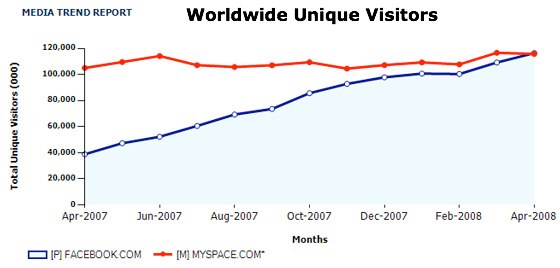
But something happened in the next 4 years because of which the same Myspace had 115 million users while on the other side Facebook, the college community website had more than 1 billion users. The question is What exactly happened and how did two companies inspite of being in the exact same space, doing the exact same thing have such a vast difference in their success. The first reason is based on the fundamental concept of social network and human psychology which is known as the triadic closure property. And this is something that was suggested by a german sociologists named Georg Simmel in 1908. In simple words what it means is if there are three people: Shyam, Baburao and Raju If Raju knows Babu and Babu knows Shyam then automatically, Raju will form a connection with Shyam and Raju will be more inclined to trust Shyam. So, basically, if A knows B, and B knows C then A is more inclined to form a connection with C eventually leading to speed of trust. And you must have observed this while you used Facebook or Instagram, that is when you get a request from a person who has 200 mutual friends you easily tend to accept their request. 

At the same time if you get a request from a person whom you possibly know but has got zero mutual friends there’s a little bit of skepticism that pops in. This is how the triadic closure property plays out. In case of Myspace and Facebook, the major drawback with Myspace was that it did not allow users to use their real names as their usernames and because of this, although you could meet new people on the Internet through similar interests you couldn’t really tell who exactly are you chatting with. So, this kinda turned into a fine mix of privacy and creepiness. But on the other hand Facebook insisted on getting people to use their real names as their usernames. Why? Because as legend has it, Facebook was meant to stalk girls and if you didn’t know the names of those girls stalking wouldn’t be user-friendly right? Will do anything for girls Just kidding guys! It was meant to be that way because Mark Zuckerberg believed in helping people build authentic connections through digital technology. 

And regardless of the truth behind this statement the strategy of using real names turned out to be Facebook’s X factor because of which apart from connecting with people in their own respective social circle users actually started to expand their network to form second and third connections. And this is where the mutual friend feature came in handy and because of this, the networks on Facebook became far more deep rooted and helped people expand their connections beyond their social circle. And this is the reason why in 2006, when Facebook opened itself to the general public people flocked to create a Facebook account inspite of having a Myspace account already. Now, this begs the question If this was just this simple feature of using real usernames that distinguished Facebook from Myspace then why didn’t Myspace incorporate that feature and kill Facebook altogether? In fact, this is what Facebook did with Snapchat right? By introducing Instagram stories. In fact, the Myspace team even had the backing of a large corporation like News Corp, right? Then why couldn’t they incorporate this feature? Well, as it turns out, this is exactly why they couldn’t incorporate the feature in their website. Because News corp turned Myspace into a proper corporate organisation which had to follow protocols and procedures And more than the ideas and the execution, the focus went to register quarterly profits, yearly profits and all the other corporate procedures. 

In fact, even if the Myspace team came out with a brilliant idea. It first used to get scrutinized by the lawyers, then by so-called experts and then a series of meetings used to be held and then a series of emails to be sent and it just kept going back and forth. And in the process, things got so slow that the ideas just got lost into bureaucracy and even something as simple as adding a feature also took forever to be executed. While on the other side, Facebook was being run by a bunch of college students who could add, change, modify and delete features overnight. And make major modifications to the website without any formalities. And unfortunately finally when Myspace incorporated the option of real usernames it was already 2008 and Facebook had already surged way ahead.

 So, to put that straight, while Myspace became a rigid organisation that was focused on procedures and protocols. And was constantly debating about who is right and who is not. Facebook was obsessively focused on what is right and executed ideas with agility. And this became the second reason for the fall of Myspace and the rise of Facebook. And the story didn’t end here the rigid corporate structure of Myspace also lead to another huge setback that literally became the golden recipe for Facebook to surge way ahead of Myspace. And this recipe also became a game changer for Amazon, Google and Apple. And this was the idea of third party integration wherein Facebook practically tranformed from a product to becoming a platform. 

On 24th of May 2007, Facebook launched the Facebook platform to provide a framework for software developers to create applications that could interact with core features of Facebook. For example, Spotify could use Facebook API to allow users to share music directly within the Spotify application itself. Candy Crush used Facebook for instant login and I’m sure most of you must have used it. And thirdly, Nike run club used Facebook API to enable its users to share their achievements of their run with their friends by posting directly to the Facebook’s news feed. So, this way Facebook allowed developers and gave them the freedom to use their technology and build products and services of their own.

 Whereas on the other hand, Myspace was set to be a notoriously closed system and Myspace even used to block contents from potential competitors. And for some reason it also ended up blocking Photobucket which was at that time the most popular photo sharing website. And this is the third reason why Facebook became an incredible platform not just for consumers and advertisers but also for developers. And by the way, this concept of going from a product to a platform is also the reason for the unprecedented success of Apple because back then even Steve Jobs was skeptical about allowing third party developers. But when Apple started providing its platform to developers the iconic App Store was born and that changed Apple forever. 

Even Android did the same with Play Store. But If you look at Nokia Nokia acted like Myspace and made it very difficult for developers to operate because the symbianOS was too rigid for third party apps to be built upon. And fast forward to 2006, Amazon launched its own version of third party integration by allowing third party sellers to use this technology to sell their products. And guess what? In 2020 alone, Amazon generated $80.46 billion dollars in third-party seller services revenue which is more than the revenue generated by its own sellers. This was the insane revenue stream that Myspace passed on and turned Facebook into the billion dollar company that it is today.

Now, let’s talk about the 3 important lessons from this case study. Lesson number one, Every entrepreneur and a leader needs to realize that the fundamental purpose of an organisational structure is not just to help you make strategic decisions but to enable you to make those strategic decisions before its too late. And the day you realize that these protocols are making the execution of ideas tedious you need to kill those protocols straightaway or else those very same protocols will end up killing your organisation. 

Lesson 2, regardless of how marvelous your technology is if you’re building a business to consumer product human centred design must always be taken into consideration because if you see, in this case, it was the simple feature of mutual friends that actually got Facebook the same amount of popularity as Myspace. Because knowingly or unknowingly it abided by the triadic closure property. 

And last and most importantly, even if you’re not the first mover in the industry it’s completely fine guys. In fact, it is great because regardless of how big a company is if they are venturing into a new space, they will make mistakes. And if you carefully learn from those mistakes you can save yourself a lot of time, a lot of money and a lot of efforts. And more importantly, merely by learning from those mistakes you will have the opportunity to race ahead of the game Because afterall, wisdom is that attribute that often separates a few legendary entrepreneurs from the many good ones.


How Facebook become Powerful & Giant Company

 Hi everybody, We all know Facebook as the giant, powerful company that it is today but very few of us know that when Facebook actually came out in the market it was neither the first social media product in the market nor was it the best social media website in the market. In fact, when Facebook came out, there was already another social media website that had about 1 million users. And it was already one of the most visited websites on the Internet. But somehow, within the next four years Facebook made history by overtaking this huge company and went onto become one of the most powerful companies on the planet. 

And the reason why this happened has got some very very important business learnings for each one of us because more often than not, we all must have had a brilliant idea but then after doing a little bit of research, we tend to realize that there is already a giant company as our competitors doing the exact same thing as we planned to do. And that could be demotivating. But guys, what if I told you that instead, you should be super happy to build a business if there is already a giant competition in the market. And the fact that it will actually provide you a golden opportunity to build a business. The question is- How is it even possible and how can you go on to build a business to compete with a billion dollar company. The answer to this question lies in a story that dates back to 2004.

 This is when a social media website called Myspace had arrived on the Internet. It was just like the modern day Facebook which allowed people to form connections and helped them find new friends on the Internet. And within just one year Myspace became a sensation in the making with more than 1 million users signing up within the first month itself. And by the end of the year, Myspace had 5 million users. This is when in 2005, it got purchased by a gigantic media company called News Corp for $580 milllion. Because somehow, News Corp was one of those few organisations that actually realized the potential of social media ads, back in 2005. And the day this purchase happened it marked the beginning of the capitalistic Internet era. During this time, Facebook was just a college student website which was open to only Ivy League students in the US. But on the other side, from 2005 to 2008 Myspace became the most visited social networking site in the world. And in 2006, it even surpassed Google to becoming the most visited website in the world. 

But something happened in the next 4 years because of which the same Myspace had 115 million users while on the other side Facebook, the college community website had more than 1 billion users. The question is What exactly happened and how did two companies inspite of being in the exact same space, doing the exact same thing have such a vast difference in their success. The first reason is based on the fundamental concept of social network and human psychology which is known as the triadic closure property. And this is something that was suggested by a german sociologists named Georg Simmel in 1908. In simple words what it means is if there are three people: Shyam, Baburao and Raju If Raju knows Babu and Babu knows Shyam then automatically, Raju will form a connection with Shyam and Raju will be more inclined to trust Shyam. So, basically, if A knows B, and B knows C then A is more inclined to form a connection with C eventually leading to speed of trust. And you must have observed this while you used Facebook or Instagram, that is when you get a request from a person who has 200 mutual friends you easily tend to accept their request. 

At the same time if you get a request from a person whom you possibly know but has got zero mutual friends there’s a little bit of skepticism that pops in. This is how the triadic closure property plays out. In case of Myspace and Facebook, the major drawback with Myspace was that it did not allow users to use their real names as their usernames and because of this, although you could meet new people on the Internet through similar interests you couldn’t really tell who exactly are you chatting with. So, this kinda turned into a fine mix of privacy and creepiness. But on the other hand Facebook insisted on getting people to use their real names as their usernames. Why? Because as legend has it, Facebook was meant to stalk girls and if you didn’t know the names of those girls stalking wouldn’t be user-friendly right? Will do anything for girls Just kidding guys! It was meant to be that way because Mark Zuckerberg believed in helping people build authentic connections through digital technology. 

And regardless of the truth behind this statement the strategy of using real names turned out to be Facebook’s X factor because of which apart from connecting with people in their own respective social circle users actually started to expand their network to form second and third connections. And this is where the mutual friend feature came in handy and because of this, the networks on Facebook became far more deep rooted and helped people expand their connections beyond their social circle. And this is the reason why in 2006, when Facebook opened itself to the general public people flocked to create a Facebook account inspite of having a Myspace account already. Now, this begs the question If this was just this simple feature of using real usernames that distinguished Facebook from Myspace then why didn’t Myspace incorporate that feature and kill Facebook altogether? In fact, this is what Facebook did with Snapchat right? By introducing Instagram stories. In fact, the Myspace team even had the backing of a large corporation like News Corp, right? Then why couldn’t they incorporate this feature? Well, as it turns out, this is exactly why they couldn’t incorporate the feature in their website. Because News corp turned Myspace into a proper corporate organisation which had to follow protocols and procedures And more than the ideas and the execution, the focus went to register quarterly profits, yearly profits and all the other corporate procedures. 

In fact, even if the Myspace team came out with a brilliant idea. It first used to get scrutinized by the lawyers, then by so-called experts and then a series of meetings used to be held and then a series of emails to be sent and it just kept going back and forth. And in the process, things got so slow that the ideas just got lost into bureaucracy and even something as simple as adding a feature also took forever to be executed. While on the other side, Facebook was being run by a bunch of college students who could add, change, modify and delete features overnight. And make major modifications to the website without any formalities. And unfortunately finally when Myspace incorporated the option of real usernames it was already 2008 and Facebook had already surged way ahead.

 So, to put that straight, while Myspace became a rigid organisation that was focused on procedures and protocols. And was constantly debating about who is right and who is not. Facebook was obsessively focused on what is right and executed ideas with agility. And this became the second reason for the fall of Myspace and the rise of Facebook. And the story didn’t end here the rigid corporate structure of Myspace also lead to another huge setback that literally became the golden recipe for Facebook to surge way ahead of Myspace. And this recipe also became a game changer for Amazon, Google and Apple. And this was the idea of third party integration wherein Facebook practically tranformed from a product to becoming a platform. 

On 24th of May 2007, Facebook launched the Facebook platform to provide a framework for software developers to create applications that could interact with core features of Facebook. For example, Spotify could use Facebook API to allow users to share music directly within the Spotify application itself. Candy Crush used Facebook for instant login and I’m sure most of you must have used it. And thirdly, Nike run club used Facebook API to enable its users to share their achievements of their run with their friends by posting directly to the Facebook’s news feed. So, this way Facebook allowed developers and gave them the freedom to use their technology and build products and services of their own.

 Whereas on the other hand, Myspace was set to be a notoriously closed system and Myspace even used to block contents from potential competitors. And for some reason it also ended up blocking Photobucket which was at that time the most popular photo sharing website. And this is the third reason why Facebook became an incredible platform not just for consumers and advertisers but also for developers. And by the way, this concept of going from a product to a platform is also the reason for the unprecedented success of Apple because back then even Steve Jobs was skeptical about allowing third party developers. But when Apple started providing its platform to developers the iconic App Store was born and that changed Apple forever. 

Even Android did the same with Play Store. But If you look at Nokia Nokia acted like Myspace and made it very difficult for developers to operate because the symbianOS was too rigid for third party apps to be built upon. And fast forward to 2006, Amazon launched its own version of third party integration by allowing third party sellers to use this technology to sell their products. And guess what? In 2020 alone, Amazon generated $80.46 billion dollars in third-party seller services revenue which is more than the revenue generated by its own sellers. This was the insane revenue stream that Myspace passed on and turned Facebook into the billion dollar company that it is today.

Now, let’s talk about the 3 important lessons from this case study. Lesson number one, Every entrepreneur and a leader needs to realize that the fundamental purpose of an organisational structure is not just to help you make strategic decisions but to enable you to make those strategic decisions before its too late. And the day you realize that these protocols are making the execution of ideas tedious you need to kill those protocols straightaway or else those very same protocols will end up killing your organisation. 

Lesson 2, regardless of how marvelous your technology is if you’re building a business to consumer product human centred design must always be taken into consideration because if you see, in this case, it was the simple feature of mutual friends that actually got Facebook the same amount of popularity as Myspace. Because knowingly or unknowingly it abided by the triadic closure property. 

And last and most importantly, even if you’re not the first mover in the industry it’s completely fine guys. In fact, it is great because regardless of how big a company is if they are venturing into a new space, they will make mistakes. And if you carefully learn from those mistakes you can save yourself a lot of time, a lot of money and a lot of efforts. And more importantly, merely by learning from those mistakes you will have the opportunity to race ahead of the game Because afterall, wisdom is that attribute that often separates a few legendary entrepreneurs from the many good ones.

How Facebook become Powerful & Giant Company

 Hi everybody, We all know Facebook as the giant, powerful company that it is today but very few of us know that when Facebook actually came out in the market it was neither the first social media product in the market nor was it the best social media website in the market. In fact, when Facebook came out, there was already another social media website that had about 1 million users. And it was already one of the most visited websites on the Internet. But somehow, within the next four years Facebook made history by overtaking this huge company and went onto become one of the most powerful companies on the planet. 

And the reason why this happened has got some very very important business learnings for each one of us because more often than not, we all must have had a brilliant idea but then after doing a little bit of research, we tend to realize that there is already a giant company as our competitors doing the exact same thing as we planned to do. And that could be demotivating. But guys, what if I told you that instead, you should be super happy to build a business if there is already a giant competition in the market. And the fact that it will actually provide you a golden opportunity to build a business. The question is- How is it even possible and how can you go on to build a business to compete with a billion dollar company. The answer to this question lies in a story that dates back to 2004.

 This is when a social media website called Myspace had arrived on the Internet. It was just like the modern day Facebook which allowed people to form connections and helped them find new friends on the Internet. And within just one year Myspace became a sensation in the making with more than 1 million users signing up within the first month itself. And by the end of the year, Myspace had 5 million users. This is when in 2005, it got purchased by a gigantic media company called News Corp for $580 milllion. Because somehow, News Corp was one of those few organisations that actually realized the potential of social media ads, back in 2005. And the day this purchase happened it marked the beginning of the capitalistic Internet era. During this time, Facebook was just a college student website which was open to only Ivy League students in the US. But on the other side, from 2005 to 2008 Myspace became the most visited social networking site in the world. And in 2006, it even surpassed Google to becoming the most visited website in the world. 

But something happened in the next 4 years because of which the same Myspace had 115 million users while on the other side Facebook, the college community website had more than 1 billion users. The question is What exactly happened and how did two companies inspite of being in the exact same space, doing the exact same thing have such a vast difference in their success. The first reason is based on the fundamental concept of social network and human psychology which is known as the triadic closure property. And this is something that was suggested by a german sociologists named Georg Simmel in 1908. In simple words what it means is if there are three people: Shyam, Baburao and Raju If Raju knows Babu and Babu knows Shyam then automatically, Raju will form a connection with Shyam and Raju will be more inclined to trust Shyam. So, basically, if A knows B, and B knows C then A is more inclined to form a connection with C eventually leading to speed of trust. And you must have observed this while you used Facebook or Instagram, that is when you get a request from a person who has 200 mutual friends you easily tend to accept their request. 

At the same time if you get a request from a person whom you possibly know but has got zero mutual friends there’s a little bit of skepticism that pops in. This is how the triadic closure property plays out. In case of Myspace and Facebook, the major drawback with Myspace was that it did not allow users to use their real names as their usernames and because of this, although you could meet new people on the Internet through similar interests you couldn’t really tell who exactly are you chatting with. So, this kinda turned into a fine mix of privacy and creepiness. But on the other hand Facebook insisted on getting people to use their real names as their usernames. Why? Because as legend has it, Facebook was meant to stalk girls and if you didn’t know the names of those girls stalking wouldn’t be user-friendly right? Will do anything for girls Just kidding guys! It was meant to be that way because Mark Zuckerberg believed in helping people build authentic connections through digital technology. 

And regardless of the truth behind this statement the strategy of using real names turned out to be Facebook’s X factor because of which apart from connecting with people in their own respective social circle users actually started to expand their network to form second and third connections. And this is where the mutual friend feature came in handy and because of this, the networks on Facebook became far more deep rooted and helped people expand their connections beyond their social circle. And this is the reason why in 2006, when Facebook opened itself to the general public people flocked to create a Facebook account inspite of having a Myspace account already. Now, this begs the question If this was just this simple feature of using real usernames that distinguished Facebook from Myspace then why didn’t Myspace incorporate that feature and kill Facebook altogether? In fact, this is what Facebook did with Snapchat right? By introducing Instagram stories. In fact, the Myspace team even had the backing of a large corporation like News Corp, right? Then why couldn’t they incorporate this feature? Well, as it turns out, this is exactly why they couldn’t incorporate the feature in their website. Because News corp turned Myspace into a proper corporate organisation which had to follow protocols and procedures And more than the ideas and the execution, the focus went to register quarterly profits, yearly profits and all the other corporate procedures. 

In fact, even if the Myspace team came out with a brilliant idea. It first used to get scrutinized by the lawyers, then by so-called experts and then a series of meetings used to be held and then a series of emails to be sent and it just kept going back and forth. And in the process, things got so slow that the ideas just got lost into bureaucracy and even something as simple as adding a feature also took forever to be executed. While on the other side, Facebook was being run by a bunch of college students who could add, change, modify and delete features overnight. And make major modifications to the website without any formalities. And unfortunately finally when Myspace incorporated the option of real usernames it was already 2008 and Facebook had already surged way ahead.

 So, to put that straight, while Myspace became a rigid organisation that was focused on procedures and protocols. And was constantly debating about who is right and who is not. Facebook was obsessively focused on what is right and executed ideas with agility. And this became the second reason for the fall of Myspace and the rise of Facebook. And the story didn’t end here the rigid corporate structure of Myspace also lead to another huge setback that literally became the golden recipe for Facebook to surge way ahead of Myspace. And this recipe also became a game changer for Amazon, Google and Apple. And this was the idea of third party integration wherein Facebook practically tranformed from a product to becoming a platform. 

On 24th of May 2007, Facebook launched the Facebook platform to provide a framework for software developers to create applications that could interact with core features of Facebook. For example, Spotify could use Facebook API to allow users to share music directly within the Spotify application itself. Candy Crush used Facebook for instant login and I’m sure most of you must have used it. And thirdly, Nike run club used Facebook API to enable its users to share their achievements of their run with their friends by posting directly to the Facebook’s news feed. So, this way Facebook allowed developers and gave them the freedom to use their technology and build products and services of their own.

 Whereas on the other hand, Myspace was set to be a notoriously closed system and Myspace even used to block contents from potential competitors. And for some reason it also ended up blocking Photobucket which was at that time the most popular photo sharing website. And this is the third reason why Facebook became an incredible platform not just for consumers and advertisers but also for developers. And by the way, this concept of going from a product to a platform is also the reason for the unprecedented success of Apple because back then even Steve Jobs was skeptical about allowing third party developers. But when Apple started providing its platform to developers the iconic App Store was born and that changed Apple forever. 

Even Android did the same with Play Store. But If you look at Nokia Nokia acted like Myspace and made it very difficult for developers to operate because the symbianOS was too rigid for third party apps to be built upon. And fast forward to 2006, Amazon launched its own version of third party integration by allowing third party sellers to use this technology to sell their products. And guess what? In 2020 alone, Amazon generated $80.46 billion dollars in third-party seller services revenue which is more than the revenue generated by its own sellers. This was the insane revenue stream that Myspace passed on and turned Facebook into the billion dollar company that it is today.

Now, let’s talk about the 3 important lessons from this case study. Lesson number one, Every entrepreneur and a leader needs to realize that the fundamental purpose of an organisational structure is not just to help you make strategic decisions but to enable you to make those strategic decisions before its too late. And the day you realize that these protocols are making the execution of ideas tedious you need to kill those protocols straightaway or else those very same protocols will end up killing your organisation. 

Lesson 2, regardless of how marvelous your technology is if you’re building a business to consumer product human centred design must always be taken into consideration because if you see, in this case, it was the simple feature of mutual friends that actually got Facebook the same amount of popularity as Myspace. Because knowingly or unknowingly it abided by the triadic closure property. 

And last and most importantly, even if you’re not the first mover in the industry it’s completely fine guys. In fact, it is great because regardless of how big a company is if they are venturing into a new space, they will make mistakes. And if you carefully learn from those mistakes you can save yourself a lot of time, a lot of money and a lot of efforts. And more importantly, merely by learning from those mistakes you will have the opportunity to race ahead of the game Because afterall, wisdom is that attribute that often separates a few legendary entrepreneurs from the many good ones.

Why should we care about our privacy?

Privacy in general terms is the right to be left alone or freedom from interference or intrusion. In terms of the internet, privacy is the right to have some control over how your personal information is collected and used.

More technical innovation gives way to more efficient and advanced technologies. In recent years the information has become the most important component to cultivate this innovation. As many new people are coming on the internet and the amount of information being shared is increased manifold. Every organization or individual is entering the realm of the digital world and data is the entity of this world. Data is also very essential to understand a user or a customer or a client but sometimes there is no limit to the amount of data that an internet corporation is willing to extract. Somewhere there has to be a line that needs to be drawn. In recent years there have been many issues regarding the privacy policy of many tech corporations. Facebook has been in controversy much time. Recently Whatsapp’s privacy policy also raised many questions, then in an ironic move Whatsapp raised the question of privacy by suing the government regarding the new Information technology rules. But this is just the tip of the iceberg and numerous other aspects get overlooked. First, we will need to understand what this privacy means for us as individuals. Only then we can clearly determine the relevance of these rapidly changing developments in this subject.  

“Arguing that you don’t care about the right to privacy because you have nothing to hide is no different than saying you don’t care about free speech because you have nothing to say.”

-Edward Snowden

It’s not that privacy means that there is something to hide; rather privacy is having things you don’t want to show. For instance, people would not like to post their Bank account online or Bank statements. People would also not like to have a public camera inside their homes. Similarly, there are some things that an individual would not like to share online. Privacy can provide secrecy, but there is more to it. Privacy also provides autonomy and therefore freedom to an individual. Well, there is even more to privacy than the freedom that many people do not realize which is that when we think we’re being watched, we make behavior choices that we believe other people want us to make.  Humans intrinsically like to avoid societal condemnation and perception of whether or not we are in private changes the way we behave. This indicates the benefit that a state can have with surveillance and can lead to a conformist population.

As it is stated by many that data is the oil and for many tech organizations it truly is. We can witness this with the various technological corporations that rely upon user data including Facebook, Google, Amazon etc. But Even Smartphone manufacturers like Xiaomi have realized the lucrative benefits of collecting and selling user data. For these companies, our data is money and they earn billions of dollars with this data. Both the private tech giants have clauses in their privacy policy that allows government agencies and third parties to access the data. The data that gets uploaded on the internet never gets deleted and stays there forever. What we have to realize is that even if the information seems futile today, it may have an importance tomorrow. In conclusion, privacy is not a trivial issue and people will have to understand its importance until it’s too late.

References:

Should Employers Check Social Media Accounts of Potential Employees?

In today’s world everyone has at least one social media account. This shows how much social media has gained popularity especially among youth. With this rise, an increasing number of companies are utilizing it to screen job prospects which means they check their potential employee’s social media account. So, make sure your social media profiles are appropriate for work because it could possibly have negative impact on your work life. It has the potential to cost you your present work as well as future career chances. According to a poll conducted by career builder in 2018, the result depicted that 70% of employers use social media to evaluate candidates throughout the recruiting process, while 43% use it to check on current employees.

Employers examine social media accounts for a variety of reasons, but the most common one is to ensure that a candidate is a good match for their firm. they do so because social media accounts allow them to get a look of a person’s personality outside of their resume, which aids them in finding the best candidate for their company.

However, Before relying on any information obtained from social networking sites such as Facebook, Twitter, Instagram, or LinkedIn, it’s vital to understand that there are several flaws to be wary of. When checking a candidate’s social media history, employers and HR professionals should be cautious. A social media history should only be evaluated as part of a comprehensive background check on job applicants. A criminal history record, as well as academic and job verifications, should all be included in a background check that can easily be done by hiring a third-party who is good in running background checks on applicants. 

Everyone who is seeking for a job or will be applying in the future should examine their social media profiles and not entirely delete their online presence. Because as per statistics 47% Employers do not call  people for interviews if they can’t locate them online. More than a quarter of employers say they like to acquire more information before phoning a candidate, and 20% say they expect candidates to have an online presence. so, deleting a social media account out of fear of shame is a no-no. you can simple keep it clean anyway. 

Now, the question of privacy comes into play. So, Employers are perfectly legal to examine public social media platforms, but anything beyond public accounts is a murky area. As long as the employer has access to public information that everyone can see, there should be no privacy concerns.  But a major pitfall is that A social media search, on the other hand, cannot provide a check on the authenticity or veracity of the material. As with any other background or reference check, the information obtained through social media must be checked for accuracy because a person’s whole career is dependent on that 1 job. Employers should use extreme caution when using social media searches to gather information about job candidates. At the absolute least, companies should consult their attorneys before obtaining information for employment reasons via social media. 

As per the data collected, following are the types of posts and behaviors that left a negative impression on employers. It is essential to know this because more than half of the employers i.e. 57% polled claimed that they discovered something through their social screenings that caused them to reject a candidate. 

Provocative or improper photos, videos, or information were shared by a job candidate: 40%
job applicants disclosed details regarding their drinking or drug use: 36%
Discriminatory remarks on color, gender, religion, and other factors were made by a job candidate: 31%
The following job contender was related to illegal activity: 30%
An applicant for a job lied about their qualifications: 27%
Candidate’s communication abilities were poor: 27%
A job seeker slandered their prior employer or coworkers: 25% 
The screen name of a job seeker was unprofessional: 22%
Former employers’ private information was disclosed by a job candidate:  20% 
Candidate for a job lied about an absence: 16%
Candidate postings are very frequent: 12%

Professionals should not take any shortcuts when it comes to establishing a positive internet presence once they have landed a job. According to the survey, 48% of companies visit social networking sites to do background checks on existing employees and as per sources they had fired them too. So one seeking job or an employee should keep his/her social media accounts clean in order to secure their jobs. 

WHAT IF SOCIAL MEDIA DIE TOMORROW?

No social media for 2 years: Allahabad HC's bail condition | SabrangIndia
Image Source: google.com

Social media is a necessary piece for everyone. For many, lives without social media are unimaginable. But to the rest, it’s completely okay because they never managed to create an account on any social media platform. Social media like Instagram, Facebook, Snapchat etc are becoming popular day by day. Whether we know it or not, it is of no doubt that social media has a significant role in our life. Everybody spends an astounding amount of time on social media. It really paves a way to showcase your talent. Social media platforms like Twitter, Facebook, WhatsApp, and more help to connect people in a squint of an eye.

A ton of things can be expected if social media die tomorrow. It will help individuals to reconnect with the present reality. They will have more time to call, chat, examine numerous things, and so on. You don’t have to constantly compare yourself with people who only post things that they want others to see. They only post their happy moments on social media. So it unknowingly creates a sense of comparison in us. This is known as ‘upward social comparison’ in psychology. Bully/harassment is another common thing on social media. Getting bullied is truly horrendous, no matter if it is in person or via social media. If social media kicked the bucket tomorrow, you can be glad that you are no more a victim of online bullying.

 A few people behind their cover actually post unpleasant remarks, despite the fact that they know about the repercussions. It is much easier to unfriend or block in social media but not in actuality. Some people use social media to get to know people better. Whenever we want to know about the person, we surf through their social media profiles. It is true to an extent that what is portrayed on social media may not be completely real. But you can still get a glimpse of that person. So, without social media, you will only be able to know about them with your experience with them.

As an outcome, you may feel plenty of changes like pressure or tension to start with. We are so much concerned about what is there in our feed than about our peace of mind. However, it will just keep going for a couple of days.

You can face this beautifully. You can begin to live in the moment without bothering many unwanted things. You don’t have to worry about how you look, what you wear, or compare yourself with others. You will get a lot of time. So, you can contribute to many things. Yes, make better usage of time.

Social media has evolved communication to new heights. It can also affect your health in many ways like an obsession, stress, or emotional associations. It may also lead to depression for some. As there are two sides to anything, so does social media. But it all depends on the user at the end.

Social Media : A Social Dilemma

Recently a Netflix documentary has stirred up a lot of controversies on the usage of social media. I believe that some certain parts of our childhood went as an experiment into the growing of the technology. There was this certain period of time when all our answers were found in the libraries and not in the e- resource lab. Our minds have changed in alternative way, changing the way we think and respond.  And most importantly Concentration gap has considerably decreased for most of the teenagers due to their constant usage of phone. It has all turned us time some creature who no longer uses their brain, but just their fingertips.

Media, especially social media has turned around the way our minds work, we are no longer owners of our brain but we are its prisoners. Our minds have turned against ourselves. Sometimes we find ourselves in situations we cannot explain or relate too. It has passively affected the way our minds work. It got into our system and rewired our brain. Quitting can come up as an easy solution but for long will you quit, give up on something that connects you to everyone.

One of the major problems of using internet is that we forget to rely on ourselves sometimes. Assignments, projects are now all googled up and copy pasted and submitted, the student no longer reads a book. Even if someone attempts too, their concentration span has gone down so low that they wont be able to focus for more than 20 minutes.  Are we on the path to self-destruction? That was a constantly asked question around the world. The technology that we build is now turning against us.  The worst part of this is that we do not even realize how much of it has affected us and our mind.

A major impact social media has on teenagers is that it has wired our brains to believe that our potential lies in getting likes or comments from certain posts. Our brain functions in a way where it becomes happy with the mere likes we get on social media and it can turn into depression and a feeling of inferiority when we do not get likes. Social media creates a segregation between the rich and poor. It has become a platform where people show off what they have, this inflicts a sense of disappointment for the ones who do not own a luxury.

What makes human beings so much more different from other creatures on earth is the fact that they have a very capable and efficient brain.  Across these years from the time of humanity, human beings have grown in lot of possible different ways. Human beings had made life smooth with various inventions, it has become so easy that we sometimes simply not use our brains anymore. Life had become so easy with the push of a button that we forget the entire process that had existed once before.

A major reason why we don’t get sleep is because of the tiny screens. We spend so much time using that we no longer become aware of the time. It can cause sleeping disorders as well as eye problems too.

Usage of phones have so much impact on our lives that we sometimes cannot give it up. We can simply never quit from this technological advancement, all we can do is adjust ourselves in a way that it doesn’t become an addiction.  

Amazon in talks to buy 9.9% stake in Reliance retail arm

Amazon Inc is in talks to buy a 9.9% stake in the retail arm of Indian conglomerate Reliance Industries Ltd.

Amazon wants a preferred, strategic stake in Reliance Retail for JioMart, according to various sources.

Jio Mart, the E-commerce venture of Reliance’s retail arm, was launched in May and poses a formidable challenge to Amazon.com’s local unit and Walmart Inc’s Flipkart.

Earlier this year, Amazon India launched a program to add small local shops on its platform after India went into a lockdown to curb the spread of the corona virus outbreak.

Reliance, controlled by Asia’s richest man, Mukesh Ambani, has raised around $20 billion since late April for its digital arm, including from Alphabet Inc’s Google and Facebook Inc.

Earlier Google has become the latest high-profile firm to back India’s Reliance Jio Platforms. The search giant is investing $4.5 billion for a 7.73% stake in the top Indian telecom network.

Facebook invested $5.7 billion in Reliance Jio Platforms, which has amassed more than 400 million subscribers in less than four years of its existence, in April this year for a 9.99% stake in it. Facebook is the largest minority stakeholder in Jio Platforms.