ROLE OF QUAD IN SOUTH CHINA SEA

BY DAKSHITA NAITHANI

The Quadrilateral Dialogue was established in 2007 when four countries—the United States, India, Japan, and Australia—joined forces. However, it did not take off at first due to a variety of factors, and it was resurrected in 2017 after almost a decade due to factors such as growing country convergence, the expanding importance of the Indo-Pacific area, and rising threat sentiments toward China, amongst many others.

The origins of QUAD may be traced back to the Malabar Exercise. Malabar began as a modest Passage Exercise named PASSEX between the Indian and US Navies in 1992, but was halted after India’s nuclear testing in Pokhran in 1998. It was later restarted in 2002. Since its inception in 2002, QUAD has become an annual event. With the addition of Japan in 2015, it has become a trilateral practice.

The Quad’s goal remains intact: to promote the economic and security objectives of those nations with genuine and essential interests, to devise a new approach for keeping the Indo-key Pacific’s maritime lanes free of foreign influence. It has become necessary in view of the increased need for information exchange in the maritime sector. With the growing presence of the Chinese Navy in the Indian Ocean, awareness is a key subject for the Navy. After 2008, China increased its presence in the Region under the pretext of anti-piracy operations, even deploying submarines for the objective. In 2017, China formally established its first overseas facility near Djibouti, in the Horn of Africa.

What are the underlying challenges?

The environment in which QUAD has been resurrected, as well as subsequent engagements like as Malabar Exercise 2020, are regarded as governed by a counter-China narrative. There are several features that may not constitute sites of convergence, despite how they appear.

China’s influence: China has significant economic links with Quad partners, particularly Australia, which is what it may use to compel or sway nations to its side. This might prove to be an issue for India.

Maritime orientation: Quad is a marine rather than a land-based organisation because of its strong concentration on the Indo-Pacific. This raises some important concerns about the basis of collaboration with Asia-Pacific and Eurasian countries.

Differing perspectives. There are conflicting viewpoints on certain situations, such as the Myanmar crisis as seen through the eyes of the United States and India. India has remained silent in the face of Japan’s expressed worry that China is attempting to alter the status quo in the East and South China Seas.

Advantages in Space- When QUAD representatives join forces in space, they have significant benefits and are able to fight China. This includes (a) lowering the extremely high expenses of building a dock in order to promote the development of interplanetary vehicles (IPVs). (b) One member state has benefits that will compliment each other and will lead to a successful Mars exploration and the construction of support facilities that will be necessary for effective asteroid belt mining. (c) All member countries bring a high degree of convergence in space applications, for example, the United States has the advanced technological base required for advanced avionics, which will form the backbone for both the construction of a space dock and the construction of IPVs; India has a highly educated and inexpensive working population, which will lower the cost of space; and Australia has the natural resources required for exploration.

The Quad met in Tokyo on October 6, 2020, for the second time since the organisation revived in November 2017. It was the second such gathering, following the inaugural virtual meeting in June, and the first high-level Quad meeting since the 2019 foreign ministers’ meeting in New York on the margins of the UN General Assembly meeting. Furthermore, given mounting worries about Beijing’s hostile conduct and growing suspicions about China’s management of the COVID-19 outbreak in Wuhan, the meeting’s timing and circumstances added to its relevance.

China’s ‘incremental encroachment strategy’ in the South China Sea (SCS) is a source of worry not only for the countries currently affected by the loss of influence over the Exclusive Economic Zone (EEZ), but also for the rest of the world, as China may be able to exercise a monopoly over SCS Sea Lines of Communication (SLOC). Affected nations lack the necessary power to stand up to China, and so will be forced to accept a one-sided agreement such as the China-driven “Code of Conduct” (COC).

As a result, Chinese adventurism must be restrained by other major maritime countries in the global interest. The fact that China could establish a military facility in the SCS despite the existence of the US Navy shows that worldwide criticism and more effort are required to prevent the SCS from becoming “China’s lake.”

Quad may not have the fangs it needs right now, but there is no other option than to establish a prospective structure like this involving likeminded maritime countries with shared strategic objectives in the Indo-Pacific. Various perspectives on the Quad’s role, viability, and prospects have been expressed on several occasions. Because Quad is a security conversation platform rather than a military alliance, aspirations from it must be suitably limited for the time being. 

In the Indo-Pacific, each Quad member sees a distinct threat. While three of the Quad’s warships (Australia, the United States, and Japan) operate under the NATO military alliance structure, India is not a member of any military alliance, while being a reliable ally of two of them. Without India, the trilateral conversation between the three NATO partners has been since 2002. Because India is the only Quad member with an unresolved land boundary with China, it will take a different strategy to dealing with China.

The Quad has emphasised the importance of ASEAN in the Indo-Pacific; nevertheless, their membership in it is a contentious topic owing to Chinese influence. In reaction to China’s claim to the nine-dash line in the SCS, there are divisions within the ASEAN grouping. Some of the ASEAN nations that have been harmed had previously raised a faint voice opposing Chinese aggressiveness, expecting international powers to rein in China’s antics.

Quad’s shared goal of putting its vision of a free and open Indo-Pacific on a “rules-based” legal framework to ensure freedom of passage in the global SLOC requires some reflection and strengthening. The United Nations Convention on the Law of the Sea (UNCLOS III) has been ratified by Australia, India, and Japan, but the United States has yet to do so. This ratification will be required in order to maintain a high moral ground when implementing the agreement.

China is relatively certain that the US and any other country would not employ military action against it, given the current world geopolitical situation. Beijing is also beefing up its naval capabilities. Quad aims to upgrade beyond its Malabar workouts in this situation.

In the Indo-Pacific, Quad members must maintain freedom of navigation exercises and military posture as China continues to do so. Chinese expansion must continue to be condemned by the international community. Quad may not be powerful enough to stop Chinese adventurism in its current form, but it has the potential to become one of the most effective instruments if the afflicted nations and the international community band together to address their mutual concerns.

The navies of Australia, India, Japan, and the United States conducted their largest naval drills this month, sending warships, submarines, and aircraft to the Indian Ocean, signalling the four countries’ seriousness in countering China’s military and political influence in the Indo-Pacific region, according to analysts. Officials in Beijing were silent, but Chinese state media denounced the Malabar naval manoeuvres, calling them a threat to regional stability, according to the Global Times newspaper.

Conclusion

The Quad is developing as one of the major multilateral which is committed to increased security collaboration in the post–COVID-19 international order, given the rising pace and scope of the group’s work. Furthermore, having an active Quad dispels the long-held belief that the Indo-Pacific is mainly inert. With the stakes higher than ever, each of the Quad’s four members must play a larger role in balancing the Indo-threats Pacific’s and power moves. Every step made by the Quad will make it more difficult for Beijing to realise its great-power goals. As a result, China will be unnerved by the Quad’s emergence as a united front championing a free and open Indo-Pacific. Furthermore, if China continues to push the security boundaries and put the Quad members to the test, the organisation will morph into the anti-China squad Beijing fears.


THE ROLE OF COMMUNAL HARMONY FOR SUSTAINABLE DEVELOPMENT OF THE INDIAN SOCIETY

BY DAKSHITA NAITHANI

India is a huge country with the second largest population on earth. It is a hub of various religious and the very nature of culture is diversified and composite. We gained independence in 1947 and keeping the diverse nature of our country, our fore fathers prepared our constitution and dreamed of a secular country where every religion will be respected and given equal weightage. They realised very early that unless we had ’unity in diversity’ there will be no development for the Indian society. India is a emerging economy where the small businesses and agriculture are the two main providers to the job industry. Unfortunately during communal violence the shopkeepers and various other small scale industry entrepreneurs and daily wagers are the ones who are the most hit and are prone to loss and damages. Violence usually resulting in loss of income and property are not recovered in any sorts of insurances and people are left to face the economic burdens afterwards.

In most of the typical Indian homes where the male is the sole earner for the family and females are designated to the household chores are amongst the worst sufferers which leads to disintegration of homes as well as community as a whole. Many children as a result of these broken homes usually end up missing a good education and a hope of good growth in life which in turn nullifies their future contribution to the society and economic growth of the country.

Communal violence leads to generations of suffering and spoiling the economic prospect of a country

The very famous Godhra riots which is also known as 2002 Gujarat riots was a three-day period of inter-communal violence in the western Indian state of Gujarat. Following the initial incident, there were further outbreaks of violence in Ahmedabad for three months; statewide, there were further outbreaks of violence against the minority Muslim population for the next year. The burning of a train in Godhra on 27 February 2002, which caused the deaths of 58 Hindu pilgrims karsevaks returning from Ayodhya, is cited as having instigated the violence.

According to official figures, the riots ended with 1,044 dead, 223 missing, and 2,500 injured. Of the dead, 790 were Muslim and 254 Hindu. The Concerned Citizens Tribunal Report, estimated that as many as 1,926 may have been killed. Other sources estimated death tolls in excess of 2,000. Many brutal killings and rapes were reported on as well as widespread looting and destruction of property. There was widespread destruction of property. 273 dargahs, 241 mosques, 19 temples, and 3 churches were either destroyed or damaged. It is estimated that Muslim property losses were “100,000 houses, 1,100 hotels, 15,000 businesses, 3,000 handcarts and 5,000 vehicles.” Overall, 27,780 people were arrested. Of them, 11,167 were arrested for criminal behavior (3,269 Muslim, 7,896 Hindu) and 16,615 were arrested as a preventive measure (2,811 Muslim, 13,804 Hindu). Thus destroying many lives and causing fear amongst people from one another On 23 May 2008, the Union Government announced a 3.2 billion rupee (US$80 million) relief package for the victims of the riots. In contrast, Amnesty International’s annual report on India in 2003 claimed the “Gujarat government did not actively fulfill its duty to provide appropriate relief and rehabilitation to the survivors”. The Gujarat government initially offered compensation payments of 200,000 rupees to the families of those who died in the Godhra train fire and 100,000 rupees to the families of those who died in the subsequent riots, which local Muslims took to be discriminatory.  Thus creating more hate between the two community

The recent riots in Delhi’s Chand Bagh Bhajanpiura and surrounding areas were one such example the violence led to huge losses both emotional as well economic . Around 42 people lost their lives. About 92 houses, 57 shops, 500 vehicles, 6 godowns , 2 schools,4factories and 4 religious places were burnt and taken down . The riots led to property and business losses of over 1000 cr. However long term economic loss, production loss, employment losses as well emotional losses cannot be quantified. These riots led to large scale migration of people to other states thus uprooting people who have been flourishing there for decades successful businesses were destroyed and demolished overnight dreams were shattered and the already stressed farm and agriculture was further stressed to support and feed the additional mouths.

The Delhi government was forced to announce compensation and financial support to the people who were affected running into crores of rupees. The precious funds which could have been used for development of schools, hospitals, betterment of the NCT and upliftment of the poor and needy were exhausted to support the riot victims. The immeasurable loss to the image of country and subsequent losses in share markets due to foreign funds pulling out their funds were a huge blow to India’s economic progress leaving it behind others. India is now being looked upon as an unsafe destination for Investments and travel. The travel tourism industry of India which provides employment to over 42 million people in India suffered huge losses in cancelled bookings. The Industry which was projected to grow at the rate of 4 per cent in 2020 is now looking at a bleak future.

India is a developing country and the vision of our leaders to make India a developed nation and an economic powerhouse cannot materialize unless the internal security of the nation, particularly communal harmony is intact. Maintenance of communal peace and tranquillity occupies a lot of government energy and valuable resources which could be used in nation building.

In case peace prevails, an ambience of trust will develop between various communities, leading the nation on the path of development and economic advancements.

Power of chair

We all want to see ourselves strong. Often there comes a time when we think that I wish we could do this, I wish we had this power. One such power is the strength of the chair but it is the most special. Getting it can change the fate of generations, but somewhere we are all afraid of it, all the battles of the world have been done for it. All the freedom struggles have happened just to bring the power of the chair to the people.

Often the power of the chair is considered to be the power of the politicians, but it’s the strength of every person who has any position. A H.R. have the power of the H.R.s chair. Simply we can put it as, every person who has any position or responsibility has that chair of power.

There is a famous quote “With great power comes great responsibility”. Once everyone start treating it as responsibility rather than as a power world will have no fights.

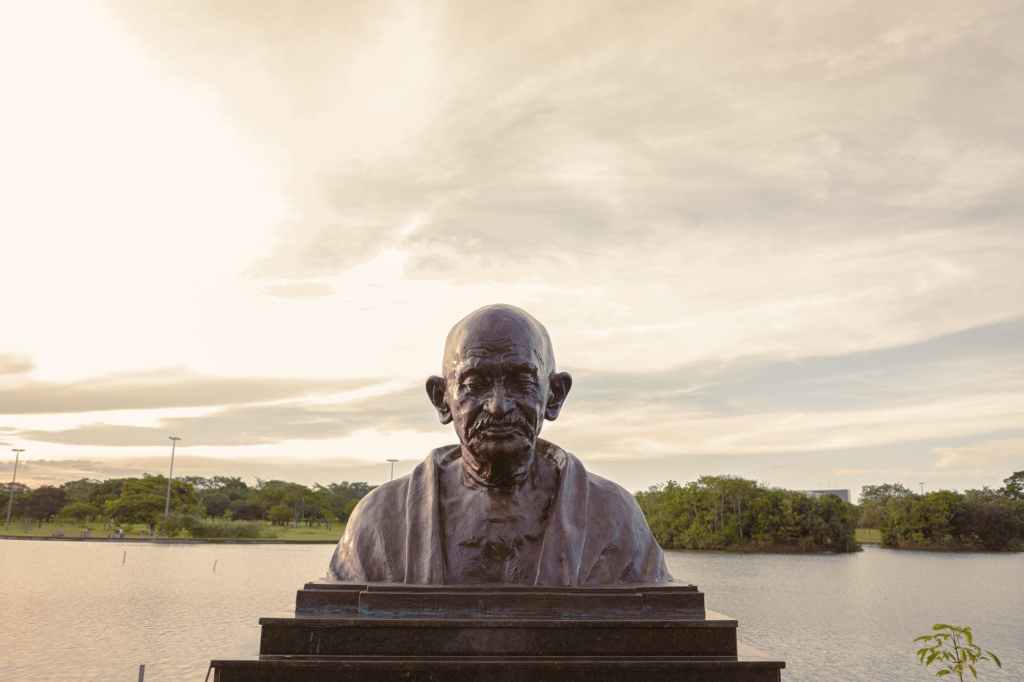
Was Gandhi wrong

Ok, so let me make it clear, I’m writing it because I know his autobiography and some other literature of that time.

Many say Gandhi was Racist about Africans and didn’t fight for black people.
When he reached Africa Indian merchants had a far better life there(compared to native Africans) and in that colonial time it was nearly impossible to make govt give some good rights, so he had to play small first. He fought for little rights of Indians couse there they have education and money to make pressure and start changes many others were fighting like him so it was a good start and solving in pieces is how he gave freedom to India(it’s not like India got freedom from one movement it was succession of events, movements, rights that made Britishers slowly give rights to Indian).
And for all the documentation and stuff of that time sorry but all wise guy knows about propaganda, narratives that time every resource of information was controlled by whites even if they try acting well you know deep down they are just harshly judging(I know this point will be hard to clear for some.).

Treated women and low cast badly.
He had done lots of good things to remove discrimination(this is more hard topic then second one) when you are between people who have lots of discrimination in mind and you want to correct them you have to start small not like give education and abuse your wife but he respected his wife from whole heart but for others, he made like educate them later treat with respect too.
Also even if he seems great like Budha or written characters like Optimus, superman(where I believe his morals are far stronger than our most moral fictional characters even now. He has given all his life rechecking his ideas improving himself morally so it’s really hard our fictional characters can reach that height.)

I’m not saying to worship him or idealize him just be as hard critique as you can but remember that all info was recorded by those who were deep inside biased or willing to spread propaganda.

Serverless does it have servers?

Serverless does it have servers?

Or it has something more exciting.

For those who know about cloud or are interested about it must have heard this word once “serverless”. As confusing as it sounds it has created a lots of myths around this like

Is serverless actually server less?

Is serverless and FaaS really same?

If you are curious about this or just wanna know serverless let’s find out together. Also we will be taking some important questions like why you should learn/know serverless, does your enterprise actually need serverless? Let’s find out together.

The first thing is what is serverless-

According to cloudflare- serverless computing is a method of providing back-end services on an as-used basis.¹

Also serverless framework is free opensource framework build for developing lambda a serverless computing platform of amazon. So what serverless basically means is rather than managing your server together with application you let the server provider manage it. This way you can focus more on application you are writing. You give them the code and they will imply this on server and will charge you based on traffic and services. so serverless doesn’t means having no server but means having no hussle of servers.

Many times FaaS and serverless are taken as replaceable words but are they same? 

While serverless is a broad term Serverless computing can be divided in two types

BaaS(back-end as a service)

FaaS(function as a service)

so FaaS is a type of serverless computing.

Now why should you learn/know serverless? It’s simple as it’s a growing field if you want to use it in firm, in your career or if you just want to feed your curiosity you should learn/know it.

Does you enterprise or you need it?

The big part of you decision depends on

Time- if you have time to manage back-end issue or you love doing it you can leave serverless

Money- It also depends on how well you can manage finances.

Knowledge- Also you should know you or the  human resource you hold how well they have knowledge about back-end or functions or will it be better leaving on serverless.

Hope this feeds your queries.

NATIONAL EDUCATION POLICY 2021- SALIENT FEATURES

BY DAKSHITA NAITHANI

Who created NEP (National Education Policy)?

The challenges that would occur in the Indian education system – from school to college to work – were examined by a panel of experts chaired by former ISRO chairman K Kasturirangan. 

NEP- National Education Policy

The “New Education Policy 2020-2021” was recently adopted by the Central Government Cabinet Committee. 2 crore schoolchildren would be reintegrated into the mainstream under the NEP 2020. With 12 years of schooling and 3 years of Anganwadi/Preschool, a new 5 + 3 + 3 + 4 curriculum was launched.

Anganwadi will provide pre-school education to children for the first three years. The students will then be educated in first and second grades for the following two years. First five years of study will be completed by a new curriculum which will be developed. Activity-based learning will be the main focus. It will be available to youngsters aged three to eight. 

Preparatory stage – Classes three through five will be covered at this time. Children will be taught science, mathematics, the arts, and other subjects through experiments during this period. Children between the ages of 8 to 11 will be covered.

 Middle Stage – These subject-based workshops will include grades 6-8, as well as students aged 11-14. Courses in skill development will begin in sixth grade.

The secondary stage- From ninth through twelfth grade, students will be divided into two groups for intense study of the topics. There will also be the option of picking and choosing subjects. Previously, this system did not exist in government pre-schools. From first grade through tenth grade, there was a general education programme. 

With no clear distinction between academic streams, schools will focus a greater emphasis on extracurricular activities, professional development, reading, and numeracy. In accordance with the new policy 2020, vocational education will begin in the sixth grade. It will be mandatory to teach in the mother tongue / regional language till the fifth grade. Improvement of evaluation and tracking progress of students to accomplish learning goals, among other things, is covered with a full 360-degree progress card.

Other important changes in school education – Salient Features of #NEP2020

According to Dr. Kasturirangan, vocational education, led the committee created to approve the new education policy, and now the kid will get vocational education and skills beginning in the sixth grade. Internships will be available on a local level as well. Vocational education and skill development will be prioritised.

There will be no job losses as a result of the new education approach. The youngsters will receive the essential education in school for professional environment. The 10th and 12th grade Board examinations will be straightforward. The Board examinations for classes 10th and 12th will undergo modifications.

Exams conducted by the council will be undervalued. There are a lot of good ideas in this article. Exams, for example, should be given twice a year and divided into two portions, one objective and the other explanatory. When it comes to council examinations, students are always under pressure and rely on training to improve their grades. According to the education strategy, various councils will create a realistic model for board exams in the near future. Exams and units at the yearly and quarterly levels, for instance.

Changes will be made to children’s report cards, which will be used to evaluate their school achievement and performance. They will be graded on three different levels. The first will be a student, the second will be a classmate, and the third will be his teacher.

In 2019, the rough draft of NEP was introduced, and it received much praise as well as harsh criticism. The idea to declare Hindi one of the essential languages was quickly shot down. After that, the document was made public, and individuals and other stakeholders were asked to submit policy ideas for improvement.

Changes Made in Higher Education

50% Increase in GER

By 2035, the NEP intends to raise the existing GER (Gross Enrolment Ratio) from 26.3 – 50 percent. 3.5 Crore additional places in higher education would be added.

Interdisciplinary general education

The strategy aims to provide a complete, multidisciplinary, and broad-based college education with flexible plans, additional topic options, a greater emphasis on vocational education, and the ability to enrol and exit the programme with a recognised degree. For example, Certificate after 1 year, Advanced Diploma after 2 years, Degree after 3 years, License for research after 4 years.

India’s educational system is at a critical crossroads. On the one hand, it is expected to replace an out-of-date paradigm with the NEP 2020. New digital learning platforms and creative teaching approaches, on the other hand, are driving it to global standards and setting new milestones.

Any country’s education is judged by the quality of its human capital. A well-educated population with a high literacy rate is better prepared to take on social, economic, and political responsibilities responsibly while maintaining a broad understanding of global concerns. This is the goal embodied in the NEP 2020, which, if implemented well, would make education more comprehensive and enjoyable.

With the announcement to qualitatively improve 15,000 schools across India to adopt NEP in the Union Budget 2021-22 and these will act as role models for other schools to emulate. To maximise the benefits of the NEP, the education sector must harness the powers of technology in the future. This will result in a rising curve in the standard of education in India.

As we emerge from the coronavirus epidemic and begin a new academic year, it is critical to recognise the potential for change in Indian education as a consequence of these 3 forces: the National Education Policy (NEP) and the accompanying new platforms and teaching and learning methodologies.

.

NEW TEHRI: UTTARAKHAND

NEW TEHRI
New Tehri is a modern town spread over an altitude from 1,550 mts. to 1,950 mts. above sea level, overlooking the gigantic lake and the Tehri Dam. The ruins of Old Tehri lie under water today. The newly established township is the district headquarters of Tehri Garhwal, a modern and well planned town, only 11 kms. from Chamba & 24 kms from Old Tehri.
SIGHTSEEING

TEHRI DAM
Tehri Dam is one of the world’s largest hydro electric projects harnessing waters of two important rivers of the Himalayas namely Bhagirathi and Bhilangana
DEVPRAYAG
Situated at the confluence of the Alaknanda and the Bhagirathi rivers, the town of Devprayag lies at an altitude of 472 ints, and about 64 kms away from New Tehri. Near the town there are two suspension bridges one over the Bhagirathi and the other over the Alaknanda. Devprayag is one of the five sacred Prayags (confluences) of the Alaknanda. Tradition has it that the town is named after Deosharma, a sage, which led a life of penance here and succeeded in having a glimpse of God.
CHAMBA
Chamba happens to be a focal point, being located at the junction of roads leading from Mussoorie, Rishikesh, Tehri and New Tehri, 60 kms. from Mussoorie and 48 kms. from Narendra Nagar on the road to Gangotri. Chamba is a township lying high at an altitude of 1676 mts., offering a splendid view of the snow capped Himalayas and the serene Bhagirathi valley. The Chamba-Mussoorie fruit belt is also famous for its delicious apples.
KANATAL
Kanatal is a hamlet built around numerous hills, a locale which personifies the romantic aura of Tehri district located on the Chamba-Mussoorie highway 35 kms from Tehri Garhwal. With a spectacular view of the snow-covered hills and green forests, Kanatal is situated nearly 300 kms. from Delhi at an altitude of over 8500 feet (2590 metres). The natural beauty of Kanatal allures many tourists every year.
SURKANDA DEVI
Surkanda Devi is a Hindu temple situated close to the small resort hamlet of Dhanaulti in Tehri District. It lies at an altitude of about 2,757 meters, or 9976 ft. and is close to nearby hill stations of Dhanaulti (8 kms) and Chamba (22 kms.) and walking distance of approx 3 kms. from Kaddukhal, the place where vehicles are parked. It is surrounded by dense forests and affords a scenic view of the surrounding region including the Himalayas to the North. The Ganga Dussehra festival is celebrated every year between May and June and attracts many tourists.
CHANDRABADNI
Chandrabadni is a mountain (2.277 ents. above sea level). On the border of Devprayag and Pratapnagar is the well known temple of Chandrabadni Devi, at the top of the mountain about 10 kms. north of Kandi Khal (on the Devprayag Kirti Nagar road). The legend says that the torso of Sati fell here and her weapons got scattered all around the place. Thus, even today a huge number of iron Trishuls (Tridents) and some old statues can be seen lying around the revered temple of Chandrabadni.
Chandrabadni commands a beautiful view of the Sirkanda, Kedarnath and Badrinath peaks. The temple is very small and contains a Shri-Yantra carved out on a flat stone instead of an idol. Traditionally, a cloth canopy is tied to the ceiling over this Shri-Yantra once a year by a Brahmin priest who is blindfolded. Road distance from Tehri Dam to Maa Chandrabadni Temple is 86 kms.

ALSO VISIT: Narender Nagar, Sem Mukhem, Budha Kedar and Kunjapuri.

WHY DIAMONDS ARE SO EXPENSIVE ?

Diamonds are allotropes of carbon like graphite. But, the difference between them is tremendous. What makes diamonds so costly ? Well some might say that the extraordinariness, challenges in mining, toughness, cut, clearness, shading, and carat of diamonds make them costly and popular. Gold and silver are likewise uncommon, mining them is additionally troublesome however why just diamond is so costly ? Why people give diamond ring when they propose one another ?

Why Are Diamonds So Expensive? – EVEVIC JEWELRY

A few years ago it was not a trend to give diamond rings while proposing. There are many stones rarer than diamonds. They are costly as a result of a company called De Beers. Each diamond you find in this world comes from this company not because diamonds are very rare to find. There are numerous diamond mines in this world however this organization don’t let those diamonds to arrive at the market.

At the point when supply of a specific item is less however demand is high, this outcomes in making that item more costly. This company made the stock of diamonds exceptionally less. But, how ? Few years back diamonds were found only in India and Brazil. But then it was also found in Africa and that too in very large quantity. De beers was also one of the company which found a lot of diamonds in Africa. But the other mines company started selling diamonds because the supply of diamonds were increasing which can make them less expensive. They were in loss. De beers would have also done that but instead it started buying those diamonds by taking loans and because of that it became the owner of all mines in Africa. It became a monopoly and a monopoly does what it wants. Soon when other mines company discovered diamonds in Serbia and other countries De beers bought all of them. It became owner of all the diamonds in the world.

Yet, De beers never let people to realize that they have diamonds in exceptionally huge amount because then people won’t buy it. They restricted the stock of diamonds which made them uncommon. They further began promoting diamonds by giving statements like “A diamond is forever”. Because of this, the interest of people towards diamonds increased and they became expensive.

RESOURCES:

2. https://francisalukkas.com/why-are-diamonds-so-expensive-5-reasons/

HAVE WE FORGOTTON OUR SHEROES ?

Women have made landmark contributions encompassing various fields.Its time we sing joys of celebration for our sheroes too like we do for men.They have suffered various setbacks in life but emerged powerful as pointed out by Swami Vivekanand ,“Woman has suffered for eons, and that has given her infinite patience and infinite perseverance”.

For celebration we need to know about the milestones they have crossed and the hinderances they’ve overcome.

Their benefactions can be categorized Two folds .First theEducational Sector.

Second the Political and the Social Sector.

In Education:-

When discussing about Economy we cannot rule out the role education.The first female graduates Kadimbini Ganguly and Chandramukhi Bose long broke the stereotypes of Male centric education system.There have been other historic Educationists of India like Ayyalasomayajula Lalitha who became the first Engineer of India back in 1943.

Anandibai Gopalrao Joshi was the first female doctor of India.

SavitriBai Phule along with Mahatma Jyotiba Phule led a movement for education of Girls.

They faced social ostracization and societal pressures but did not stop.In the end, SavitriBai Died while serving the victims of plague.In the field of law which was highly patriarchic Cornelia Sorabji broke all shakles and became India’s first female lawyer.                                                           Durgabai Deshmukh an early lawyer and political activist said-“I had then decided to take up the study of law so that I could give women free legal aid and assist them to defend themselves.”

These woman are not mere inspirations or role models,theybecame game changers and paved the way for education for the upcoming generation.

Polity:-

Politics despite being male dominated ,some Strong Female leaders have made immense contributions to freedom struggle. Going back to the the Delhi Sultanate,Razia Sultan became the first and last Female to ever became sultan in 1236.

After that there were different princely states in which women lead their dynasties. Rani Laxmibai became an epitome of strength along with JhalkariBai giving a strong fight to British.

Uda Devi a ‘Dalit Virangana’ fought the British Bravely in 1857 Battle.

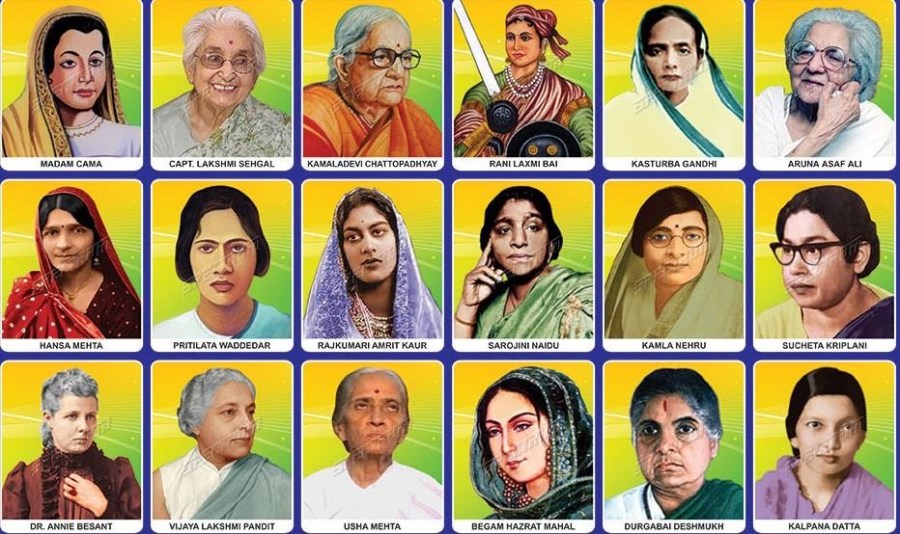
Rani Gaidinliu of Manipur,was imprisoned at a young age of 13 because of her Anti-British Stand.During the 1857 Revolt the participation of Begum Hazrat Mahal of Lucknow is unmatched.AhalyaBai Holkar of Malwa Kingdom is still remembered as one of the Finest Leaders of India.In the modern era of freedom struggle Female Leaders like Sarojini Naidu,Annie Besant,Vijay Laxmi Pandit(First Female President of UNGA),Aruna Asif Ali(Grand Old Lady of Independence) etc fought against the British.        

Be it Anti partition movement of 1906 or Non Co-operation Movement or Civil Disobedient Movement, Women have added by large,the amplitude of struggle.

Revolutionaries like Capt.Laxmi Sehgal lead the Jhasi rani regiment of INA Army made by Subhash Chandra Bose.AlsoPritilata Waddedar,Kalpana Datta took up arms against the British.

Post-Independence Rajkumari Amrit Kaur became the first woman Health Minister of India.

Indira Gandhi not just became India’s First Prime Minister but also was the first female Finance Minister(1970-71),to present a budget.Sucheta Kriplani became the first female to become a Chief Minister of UP,also Sarojini Naidu became the first ever female Governor in UP.

The list of contributions made by our early Women is never ending. Such zeal and sacrifices, on par with those of Men, despite miniscule opportunities, simply motivates us.

It would be appropriate to agree with Mohammad Ali Jinnah when he quoted,

There are two powers in the world; one is the sword and the other is the pen. There is a great competition and rivalry between the two. There is a third power stronger than both, that of the women”.

Mohd Ali Jinnah

HOW TO KNOW THAT YOU’RE ON THE RIGHT PATH ?

We all try really hard to become successful and for that we need to know our right path. We think about the situation if we not become successful in future. The fear of failure haunts everyone. We all are in a blind race of success and sometimes we forget our genuine subjects of interest in this rat race.

Pin on LDS Quotes

You all might have heard stories of people in which, initially they were involved in other professions like engineer or management but now they are in different profession maybe actor or fashion designer. There could be many explanations for it, one of them could be they didn’t have a clue about their right path, their inclinations.

The signs which tell that you are on the right path are:

1.You’re not doing things that make you feel uncomfortable.

2.You’re not making statements you later apologize for.

3.You don’t want to think twice about the Big Deal Stuff.

4.You feel your feeling of significant worth or worth and see it reflected back by your current circumstance.

5.You’re certain about your decisions and life.

The signs which tell that you are on the wrong path are:

1.The current situation is costing you your force.

2.You feel depleted. Getting tired is fine. Depleted means drained.

3.You feel ridiculously befuddled about where your life is going.

4.You are particularly on some unacceptable way when you feel as you are “losing yourself” to a specific circumstance.

5.In the event that you wind up saying “I can’t resist the urge to feel like I lost myself,” then, at that point you’ve presumably sold out yourself somehow or another.

If you ever feel like you are on the wrong path and need to escape the present situation then you ought to ask yourself questions like “What do I really want ?“. If you feel you are too afraid to get out of circumstance thinking it would make it only worse, then you should know that it is your life. You reserve an option to live your life in your own particular manner. You don’t have to compromise with your interests. Individuals who are in contact with their inward aides can all the more likely explore life’s hindrances. They quit jobs as they know aren’t ideal for them. They cut off relationships that aren’t satisfying. They settle on extreme decisions, since they know they’re taking the right decisions.

It’s hard to know the correct way for yourself however not impossible. The primary thing you need is to trust yourself, realize that you’re picking a right way for yourself and no one knows you better than you. Decide your objective and achieve it everyday, every week and every month. Don’t be hard on yourself. Relax and think with peaceful mind.

RESOURCES:

  1. https://everydaypower.com/signs-youre-on-the-right-path/

2. https://www.mindbodygreen.com/0-11308/how-do-you-know-if-youre-on-the-right-path.html

THE YOUTH OPPORTUNITY

BETWEEN THE NECESSITY THERE LIES THE OPPORTUNITY

India is a country where we have nearly 28% of the youth population in contrast to 37 in China and 45 in Western Europe. This says about the enormous growth opportunity that India will have as the highest number of people in the workforce. In some other words, we could say that the India’s non working population would be out numbered by the working population leading to the demographic dividend which is to be in favour.

Climatic effects

The increased use of non-degradable plastics, bio-medical waste have created climatic deterioration. The pandemic had paved the way for the increased use of plastics and also we have no other go to end up without being safe. This effects leads to the increased landfilling which would cost fisheries, tourism and maritime transport and service industries with an additional billion dollars according to the report given by the UN Environmental Program.

The changes

Though the population of youth in India with the high level of unemployment is high, still there is chance of silver line beyond it. By concentrating on the demographic dividend, this leads to the increase in labour force, which in turn leads to the productive outcome. This accelerates the industrial growth. As the purchasing power of the population is high, there is no doubt in the increased domestic growth and increasing opportunities. By analyzing all these factors into the current situation, India will become the third largest country by 2030.

The younger the people the more conscious they are. They are much more of the climatic changes and impact of the land population which affects the sustainability of their growth. The natural disasters and less number of natural resources are even known to the children as it affects climate badly. The UN report also tells us that nearly half a million of the youth generation are taking action against the polluted lands through small initiatives they can make around their schools, colleges, surroundings and other communities.

The future

Sustainable future, socio-economic progress with the flourishing economies need a gradual vibrant to be empowered for the best future of the great version. India’s youth are interested in the green job as they have a great belief that healing the environment is the sustainable way to move forward. India is often in the forefront of bringing the change but there are issues like inequality which still goes in the Environment. Though the Union Government has rolled out various employment schemes, the dominance of the informal economy makes it still difficult to reap the benefits.

The rising youth young population provides India with a great opportunity for growth. The labour intensive sectors needed to more skillful for the better job creation. Ensuring the components of the life skills along with the technical skills makes one to get the better satisfaction in the life.

IF KNOWLEDGE IS POWER, WHY IGNORANCE IS BLISS ?

Knowledge means understanding of something such as facts, information, description and skills. It is the source of power to man and this distinguishes him from other creatures of the universe. However man is genuinely more vulnerable than numerous creatures, for he can’t see similar to a bird, nor can lift heavy weights as certain creatures. In any case he is the most remarkable animal on earth. This power essentially comes to him from information not from actual strength. ‘Knowledge is power’ implies that a man has instruction and a full oversight on his life by utilizing the strength of information. This means a person has the resources to express his views dynamically and make intelligent decisions based on his every day situations, awareness and understanding.

Kim Harrison Quote: “Knowledge is Power. Ignorance is Bliss. But curiosity  – even if it had killed

Ignorance, nonetheless, is “an absence of information, instruction, or mindfulness”. Knowledge is amazing, indeed, however a few people think it is incredible to pick when you need to know and proficient in something. This is the reason ignorance is bliss for some individuals. While knowledge is something you can decide to have, ignorance is picking whether you need to have a specific information. In any case, having an “ignorance is bliss” mindset is like people who love to procrastinate. They realize they have a forthcoming cutoff time, yet they fear the possibility of managing it, thus they delay it until they can no longer do so. Ultimately, they’ll encounter the cutoff time. Is ignorance truly euphoria? You can decide to not know something, however sooner or later, whatever information you’re attempting to keep away from will introduce itself to you. Knowledge is genuinely power, as you have control.

In any case, we can’t deny the way that sometimes “ignorance is bliss”. For instance, imagine a situation wherein an exceptionally giant meteor will hit earth. Having the information on this you will attempt each conceivable thing to save earth. You will attempt to change the predetermination. Eventually, you will either be successful or not. Notwithstanding, in case you were totally ignorant about this reality you would have proceeded with your life or would have attended parties, not realizing the end is near. The person that have the knowledge about the incoming meteorite may have the power to change something but he or she can never experience happiness or bliss at that kind of situation knowing their impending demise. He may get miserable or cry over the way that world is reaching a end.

Gambling laws in India

Introduction

Gambling is defined as betting, gaming, or participating in an activity that is based on luck not on the skills to win a huge amount of money or any other prize by wagering some amount of money. To control gambling across the country legislation was passed in the year 1867, the Public Gaming Act of 1867, and is the most important legislation that regulates gambling in India.

Under the gambling legislation, the meaning of the act of wagering or betting for money or money worth is understood in the 2006 “jay video games and electrical v. State of Gujarat’’  case.

So here we discussed about the gambling, why it has become a more sensible topic in India and other countries, how it has come in scenario where their strict laws are must needed, why gaming skills are excluded from gambling or why Indian law classifies the games into two broad categories i.e. game of chance and game of skills. What are those games where gambling is not a big deal?

Legality

As per the status of the legality of Gambling in India, there is no unified law regarding any activities of gambling as it comes under the State list of the 7th schedule of the Constitution. So the gambling is a state subject, so the state has only the rights to regulate the law for the gambling activities in their respective territory. The state legislatures, under the Constitution of India, have been entrusted with significant regulatory flexibility to form state-specific gambling laws. 

The Gambling Act is the central enactment that has been adopted by certain states in India and other states have enacted their own legislation to regulate and govern gambling activities within their territory. So some states have allowed or some have banned gambling in their state. For example, casinos are banned in the other states except for Sikkim, Goa and Daman.

 As per Section 12 of the Public Gaming Act 1867, any game of mere skill will not be treated as gambling, but games of chances will be treated as gambling. 

The Public Gambling Act of 1867 is a central law that prohibits running or being in charge of a public gambling house. The penalty for breach of this law is a fine of Rs. 200 or imprisonment of up to 3 months. Additionally, this Act prohibits visiting gambling houses. A fine of Rs.100 or imprisonment of up to one month is the penalty. 

There is always a doubt regarding which games are covered under gambling because poker in India has very unclear significance in Indian law because it could never figure out whether it is a game of skills or a game of chance. It’s very interesting that games, such as wagering on cricket, are prohibited and while Rummy is permitted as observed by the court under  Mahalakshmi  Cultural Association v. The Director, Inspector General of Police, State of Tamil Nadu in 2012. Gone are the times of Matka betting and the preferences in India. These days, you can just wager on a couple of sports, that too in some states. As of now, betting on horse racing, online poker in states like Goa and Sikkim, online rummy, lottery, and a couple of gambling clubs are legal in India in accordance with the case of K .R Lakshmanan v. state of Tamil Nadu in 1996. 

Not only wagering on games is illegal, visiting or working in those places is also unlawful or illegal under section 4 of the  Public Gaming Act. It is likewise unlawful to visit such a place. The main problem is that the exact meaning of betting is not adequate in the legislation. As per the Act, it states Gaming as betting or wagering of money on a game which is a game of chance and not of skill except Horse Racing.

Laws on online-based betting

In the Public Gaming Act of,1867 there were no provisions related to online-based betting. There is in addition to this Act another act that could be considered to identify with web-based wagering and gaming i.e. The Information Technology Act of 2000. From this Act, it is very easy to identify the offences with online gambling and gives the government ability to check and search if required. However, this Act also does not mention online-based gambling like Public Gaming Act, 1867 does. 

The laws for online gambling are enacted by several states also like Sikkim. The state of Sikkim enacted the Sikkim Online Gambling (Regulation) Act,2008, which was passed on 28th  June 2008 by the Sikkim Legislative Assembly with the object of controlling and regulating through electronic and non-electronic ways in online gaming. And imposes Tax also on online gaming within its territory.

Game of chance or game of skills

Gambling is understood both under its traditional form as well as modern avatar. The traditional gambling is understood in the context of physical space, brick and mortar format, whereas modern gambling consists of computers connected offline or online, mobile phones, internet, etc. the Gambling legislations exclude the “game of skills” from the statute of gambling and hence doesn’t attract the penal provisions.

A game of chance is a game where the result is leveraged by a random number creator in which the participant may choose to bet money for that result. While in a game of skill, A person bet on the result which comes out of the skills of person or person requires them to have a degree of mental expertise to succeed, for example, Betting on Horse racing. However, in games like Poker and Rummy, many times the courts got confused about whether these are Game of Chance or Game of Skill. 

Penalties

Under the Public Gaming Act,1867 any person is found playing games for money, wager, stake or something else with cards, dice, counters, shall be liable to imprisonment for any term not exceeding one month and fine not exceeding one hundred rupees. As per the section 45 of the Indian Penal code 1860.  

Any person found in such gaming rooms during any gaming or playing there shall be presumed, until proven, to have been there for gaming purposes.  

Conclusion

Whereas there are various legislations in India, even every state has its own legislation for gambling as legal and regulated in the most appropriate ways. There is a need for a section or portion which would provide which type of gambling is legal and which is not. Apart from this, there is a need for central laws for online Gambling, we see that few States like Goa, Sikkim, and Nagaland are the only states that permit online gambling. Also, such a type of thing showed that there are no possible ways to stop or curb. At least something could be done to regulate this.

The Government, being a welfare State, acts in a manner to promote the economic and social well-being of its citizens, and therefore, it is necessary for the State to protect the sensitive sections of the society. About gambling, they can at least form a committee to survey the need for gambling and improvisation on the current legislation based on that survey. Thus, there is a need for aggressiveness to be taken from the side of the executives as well as the parliament to provide such norms which would codify the system of gambling in India. 

PROS AND CONS OF PRIVATIZATION OF BANKS

The word ‘Bank’ does not need any kind of introduction. Everyone, now a day, is familiar to what Bank is. It is a financial institution that works according to the structure of the economy and helps to promote it. Banks have proved to be very helpful in connecting the people directly to the economy of the nation. Banks are mainly authorized to receive the deposits of the people and also provide them loans easily and according to their need. Banks are the key to drive the economy smoothly and efficiently.

History of Banks in India

The Bank of Hindostan”, established in 1770, was the first Bank of India which ran for about 60 years and soon failed. The modern day “State Bank of India” was established in 1806 and was first named “Bank of Calcutta”. It was later renamed as the “Bank of Bengal” by the British Government. Soon this bank merged with “Bank of Madras” and “Bank of Bombay” and formed a new bank called “Imperial Bank of India”. “Reserve Bank of India (RBI)” which is the central banking institution in India, was established on 1st April 1935 with the RBI act 1934. In succeeding years, India got many other private banks working well with the economy. The Government of India took a step to nationalize the 14 major banks of India in 1964 after independence. After the 6 years, 6 more banks were nationalized in 1970 and thus we got 20 nationalized banks in India but soon “The New Bank of India” merged with the “Punjab National Bank” and now we have all over 19 nationalized banks in India.

Functions of Bank

The basic functions of all the banks are to deposit the savings of the customers through opening their Bank accounts and also providing them loans. These are the functions that every bank in India works on. Apart from these two basic operations, the modern day Banks also work on many other financial activities. The functions of a bank are as follows:

  1. Deposit Savings
  2. Providing loans
  3. Insurance
  4. Mutual fund
  5. Providing lockers
  6. Conducting social welfare programs
  7. Transferring funds
  8. Collecting cheques

As it will not be wrong to say that The Banks absorb the excess capital from the economy stopping them from being circulated and use them in the right direction properly to increase the productivity and the growth of the nation.

Public Sector and Private Sector Banks

A public sector bank is a bank in which the majority of its stake is held by the Government. In other words, we can say that a public sector bank is such a bank which has its majority of shares under the hand of the Government. The Public Sector Banks are classified into two groups as:

  1. Nationalized Banks
  2. State Bank and Associates

In the other hands, a private sector bank is a bank in which the majority of the shares of the bank are under the control of its share holders. There are currently 22 Private Sector Banks working in India.

PRIVATIZATION OF PUBLIC SECTOR BANKS IN INDIA

The privatization of any institution is the process of transferring the ownership from the government to the private hands. As we all know that India has 19 Nationalized Banks which act under The Reserve Bank of India and Indian Government.

PROS OF PRIVATIZATION OF BANKS

Many Organisations in India conducted surveys and found that the privatization of the Banks will result quite positive outcomes. It led the Indian Government to think about the privatization of all the Banks. Let’s see why privatization of Indian Banks has become indispensable for the Government of India:

  1. It is found that the Private sector banks are more advanced than Public sector Banks and are also working more efficiently.
  2. The foreign investors prefer to invest in private sector banks rather than the public sector banks.
  3. The private sector banks are much strict against loans and frauds.
  4. Public Sector banks are usually less competitive than the private sector banks.
  5. Private sector banks are obedient and quite serious towards their work and responsibility which lacks in the most of the Public sector banks.
  6. The private sector banks follow the concept of lowest risk.
  7. Privatization will also help to reduce the burden of the Government of India.

CONS OF PRIVATIZATION OF BANKS

No doubt the private sector banks are very efficient but they also fail somewhere. Privatization of the banks leads to several undesirable situations. Some of these are:

  1. The privatized banks will focus on maximizing their benefit and it will put an adverse effect on the middle class and poor people of the society.
  2. Every organisation, whether government sector or private sector, has some issues within its structure. It is not necessary that a private sector bank will never go with any fraud.
  3. The people in present India mostly believe on Public Sector Banks and don’t prefer to deposit their savings in private sector Banks.
  4. The public sector banks usually work on social welfare while the motive of private sector banks is generation of profit.
  5. Many government schemes like “Jan-Dhan Yojna” and “Pension Yojna” worked well and also became successful only because they were applied in Public Sector Banks.
  6. Another disadvantage of privatization is the excess use of nepotism which will affect the banking services.

IMPACT OF PRIVATIZATION OF BANKS IN INDIA

Privatization of Banks will definitely have some positive and also some adverse effect directly on society and indirectly on economy. Privatization of banks will be helpful in getting a better customer service. It will also affect the economy and helps in growth. It may be said that the privatization of Indian Banks will remove irregularity and bring punctuality and will led to accountability in the service. It is obviously seen that the private institutions provide incentives to the employees according to their work so Privatization of Banks will definitely increase the productivity of the employees. One of the most adverse affect of privatization will be the widespread economic gap. It will support the rich people of the society leaving poor behind. This concept will make poor poorer. Also the Privatized banks will mainly focus on urban areas and it will slowly diminish in rural areas of the nation.

CONCLUSION

As we all know that the Banks are the backbone of the economy. The Indian Constitution says “Every economic activity in the nation should be centred at the welfare of the people” but, in my view, privatization will violate this concept because it is obvious that the Private Bank will be aimed at maximizing their own profit. Where there are some bad aspects of privatization of banks there are also some good aspects of it. We must examine on our own and decided whether Privatization of Banks should be supported or opposed.

Best and Cheapest Medical Colleges in the World

                                                                  (Photo: Jeduka.com)

Are you an MBBS aspirant looking for Best and Cheapest MBBS in the World? You must drop your research work right here!

 In the world, there has been significant growth in the field of medicine and healthcare. No doubt it’s been the most essential and satisfying profession. Doctors are equated to God. A selfless job of curing illness. Listening to words of gratitude is a treasure for doctors. How to become a doctor? questions lingering around the mind of MBBS aspirants.

You should know about the role of doctors, their duties inside and outside the hospital. A doctor’s duty is to treat and cure sick people. In this profession one must have an intention of serving humanity. This is one of the professions which earn too much respect in society. Unlike many other professions, a doctor treats people belonging to different religions, castes and creeds. He never discriminates among his patients nor ever he lets patient feel their religion, caste or creed.

Beyond the numerous advantages and desire to acquire the medical qualification of Bachelor of Medicine and Bachelor of Surgery MBBS, we also understand that the financial implication of taking on studies in this field of medicine can be discouraging due to the lack of cheapest MBBS universities and colleges in the world.

See the list of the best and cheapest medical colleges and universities in the world below.

1.     AIIMS, Delhi

All India Institute of Medical Sciences (AIIMS) Delhi is a medical college and medical research public university based in New Delhi, India. The Institute was established in 1956 and operates autonomously under the Ministry of Health and Family Welfare. The Institute has comprehensive facilities for teaching, research and patient-care. Teaching and research here are conducted in 42 disciplines. AIIMS offers various best-in-class medical graduation and post-graduation courses and awards degrees under its own name. AIIMS has been consistently ranked the top medical college in India. The total fee paid is INR 8,140 for the 5-year MBBS programme.

2.     Maulana Azad Medical College, Delhi

Maulana Azad Medical College, New Delhi was established in 1958. It is also known as MAMC. It is a medical college in New Delhi affiliated to the University of Delhi. Maulana Azad Medical College offers various undergraduate, postgraduate and super speciality courses in different streams that include Medicine and Allied Sciences, Pharmacy, and Sciences. The college has various departments that are  Anatomy, Anesthesiology, Biochemistry, Community Medicine, Dermatology, STD and Leprosy, ENT, Forensic Medicine, General Medicine, General Surgery, Medical Education, Microbiology, Neonatology and many more. The total fee paid is INR 13,820 for MBBS programme.

3. R.G Kar Medical College and Hospital, Kolkata

Established as the Calcutta School of Medicine in 1886, this institution is alleged to be one of Asia’s oldest private colleges. The college is affiliated with the University of Health Science of West Bengal and ranked 11th on India Today’s (2017) list of the best medical colleges in the country. The total fee paid is INR 66,520 for the 5-year MBBS programme.

4.  Bangalore Medical College and Research Institute, Bangalore

BMCRI, affiliated with the Rajiv Gandhi University of Health Sciences, was brought up in the AIIMS league under a centrally sponsored scheme. The college is one of the few offering hands-on microsurgery training and is ranked 12th in India Today’s and Outlook India’s list of the best medical schools. It has also been ranked 10th on The Week’s list of the best medical schools. The total fee paid is INR 72,670 for the 5-year MBBS programme.

5. Bukovinian State Medical University, Ukraine

The University was founded in 1944. Bukovinian State Medical University has 7 faculties of which there are four medical faculties, stomatological, pharmaceutical, and the faculty of post-graduate training. The University consists of 47 departments. It is Chernivtsi’s oldest and largest university. This university is modern and it is recognized by WHO and NMC. The annual fee of MBBS programme is INR 2,73,000.

6. Kyiv Medical University of UAFM, Kiev

The University was established in 1992 by Dr. Pokanevich Valeriy. It is the best medical university of Ukraine. Ecological problems, development, and applications of medical in life are the fields of work of the university. Among the top medical universities in Ukraine, ‘Kyiv Medical University of UAFM’ officially ranks 3rd. Practical programs which this university provides make students study deeply. It is the only university which send its students to practice in Poland or Germany. The annual fee for MBBS programme is INR 2,45,000.

One of the important decisions of your life after completing high school is to select a University. The brutal truth, in India there are very few limited seats for medical aspirants. Many Indian medical aspirants choose MBBS in Abroad after facing rejection from Indian Medical Colleges. So, the other option is studying in abroad. Research about the College or University up to an extent. Make sure the University has a good reputation in the market. Research must include the departments of the college, laboratories, and other facilities. Choose a country where the fees and lifestyle are affordable. Your first and foremost priority should be education.

Go step by step for taking admission not just jump into a Low Fee college. The most important factors to choose University is to look for reputation, overall students experience and finances related to Colleges and Living Abroad. Applying this method of selecting a college, thousands of options will be narrowed down to one single option.