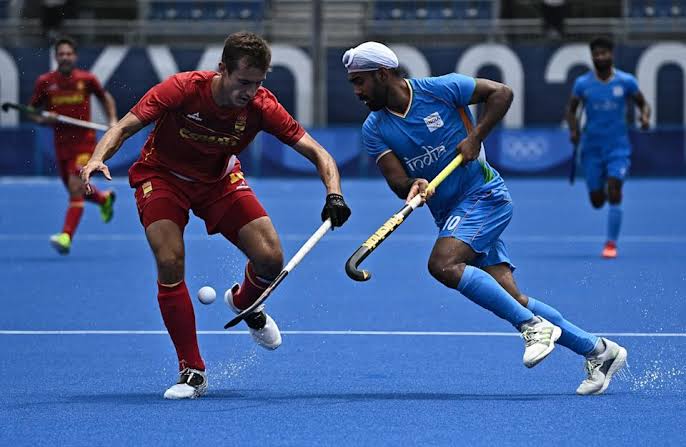
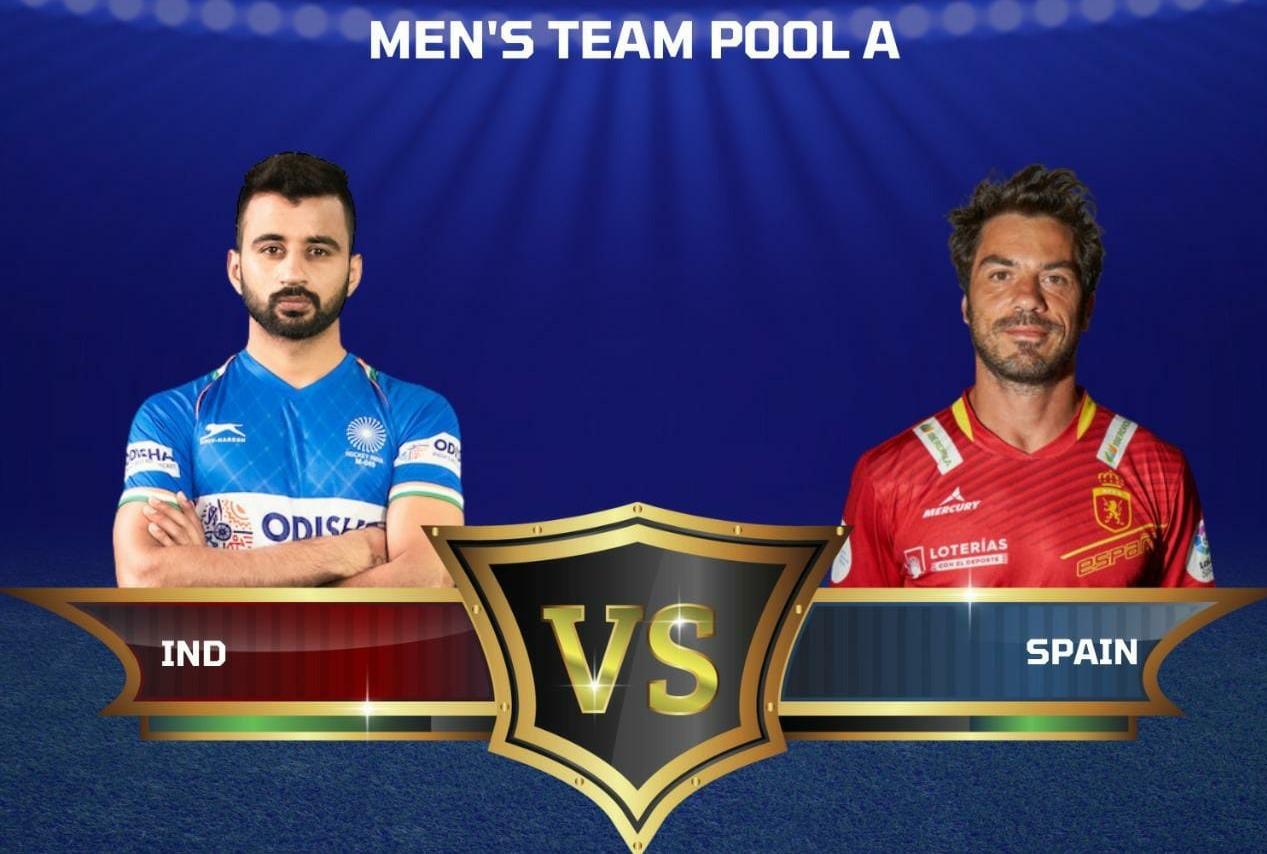
In Pool A today,Spanish side lead by Miguel Delas locked horns with the Indian side lead by Manpreet Singh.
Spain in their first match leveled 1-1 against defending champions Argentina. In their next match they lost 4-3 to New Zealand. They conceded 2 goals in the last quarter and eventually lost their lead and match too.
India on the other hand started their campaign with defeating New Zealand 3-2, vice-captain Harmanpreet singh scored 2 goals and Rupinder pal singh scored 1 goal. In their next match, India encountered the number 1 team Australia. Australia defeated India by a margin of 7-1 and it’s one of the worst defeat for the Indian Hockey team in Olympics.
Rupinder pal and simranjeet singh handed Spain a 3-0 defeat
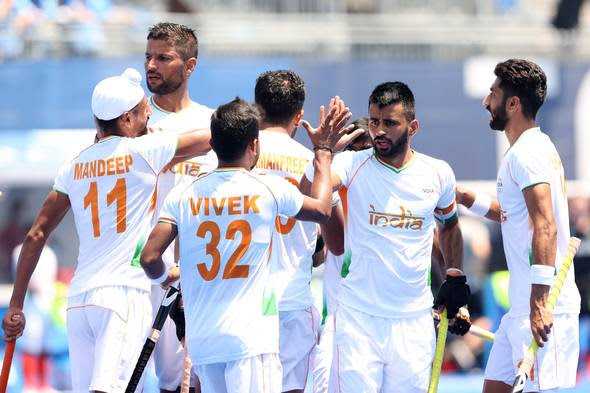
Today morning in OI Hockey Stadium, India and Spain locked horns and India dominated throughout the game and handed Spain a 3-0 defeat.
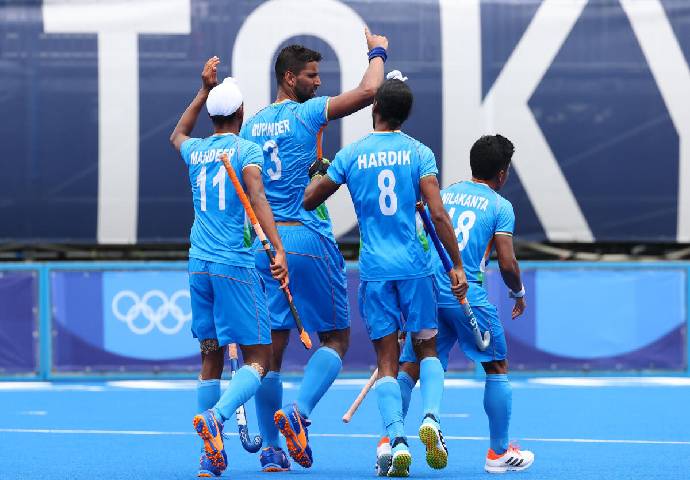
India’s Rupinder Pal Singh celebrates after scoring against Spain
Simranjeet Singh scored in 14th minute and Rupinder Pal Singh was hero of the match and he striked twice in 15th and 51st minute.
Spain side got many chances but they failed to convert them into goals. With this win India have inched closer to a quarterfinal berth. India have moved to the second spot in Pool A of the Tokyo Olympics. India will face Olympic champion Argentina on Thursday. Spain are yet to register their first win.
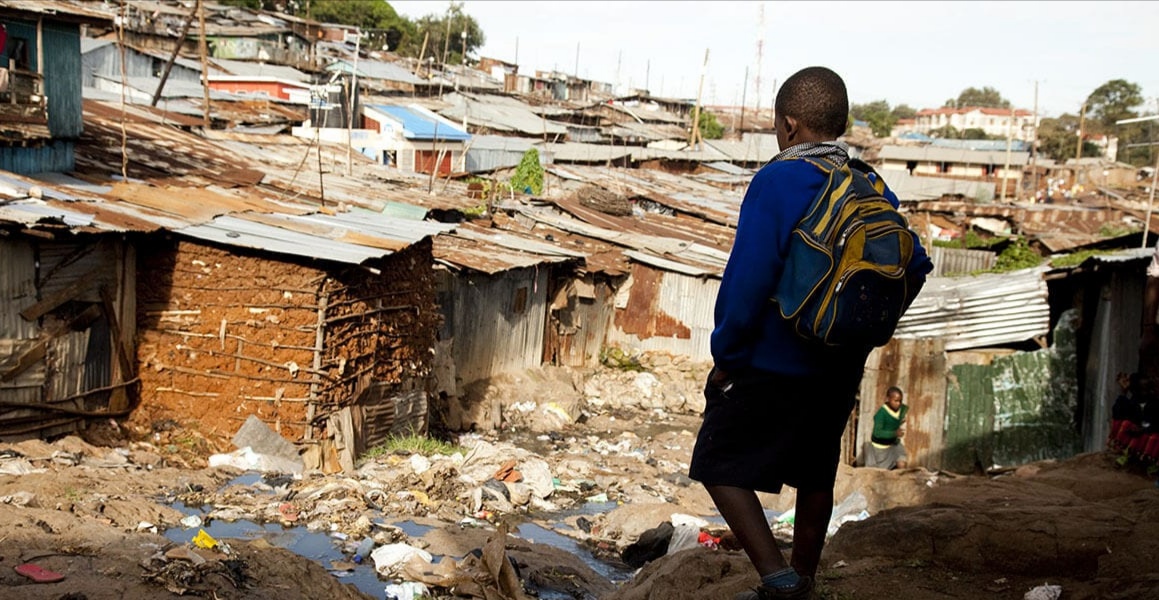
Poverty one of the major problem in India. India is the second most populous country after China with 1.2 billion people and it is the seventh largest country in the world in terms of area.
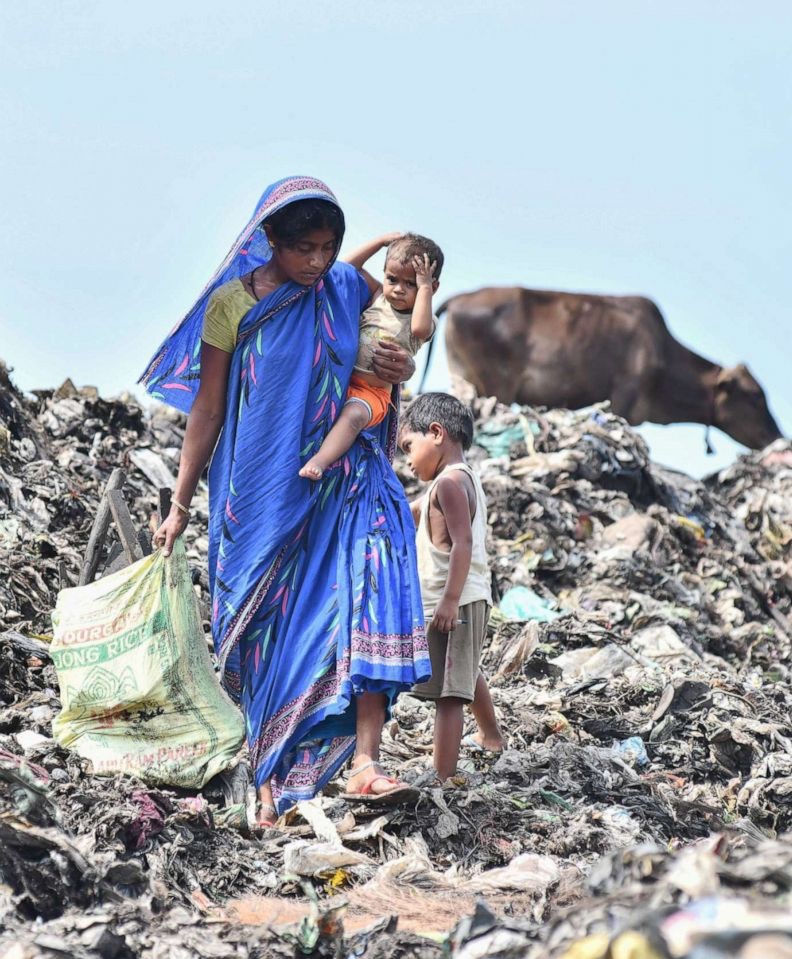
Around ⅔rd of people in India live in poverty in which 68.9 % of Indian population lives on less than 2 dollar a day and over 30% even have less than 1.25 dollar per day. And thus they are considered extremely poor.
India subcontinent is one of the poorest country in the world.
The most poor section of our country is children and Womens. They are considered as the weakest member of Indian society and that’s why they suffer the most.
In India womens are not considered as the strongest member of the society because of a patriarchy.
Education and job for womens are not considered important in our society.
By preventing education for Childrens and womens leads to the poverty and poverty is also preventing children from getting an education
Poverty in India impacts children and families in a variety of different ways:-
High infant mortality
Child labour
Malnutrition
Lack of education
Child marriage
High infant mortality rate
India is one of the country with highest child mortality rate.
Around 1.4 million children die each year in India their fifth birthday.
Major causes of death are due to pneumonia, malaria, diarrhoeal diseases as well as chronic Malnutrition.
Child labour
Child labour for children under the age of 14 in India is prohibited by law.
According to official figures 12.5 nilganj children between the age of 5 to 14 are working.
It is believed that Indian children’s contribute to the living wood of their poor family.
Children’s work in the field in factories, in quarries, private households .
Malnutrition
India is one of the world’s top countries when it comes to Malnutrition.
7.8 infants were found to have birth weight less than 2.5Kg
More than 200 million people don’t have sufficient access food.
Lack of Education
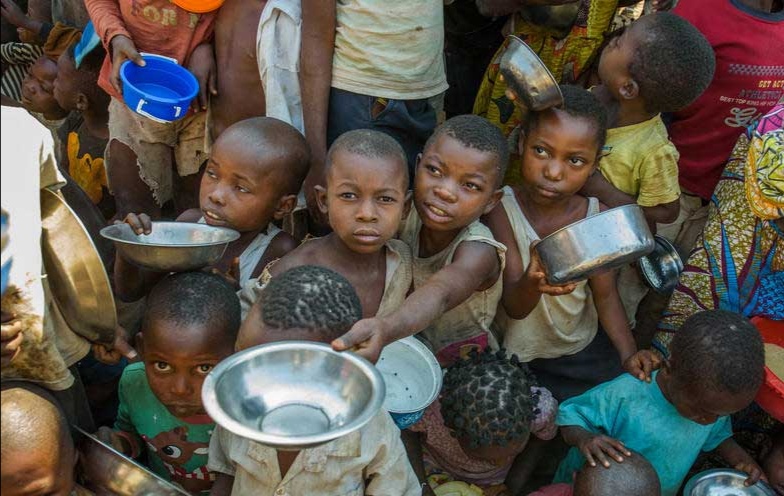
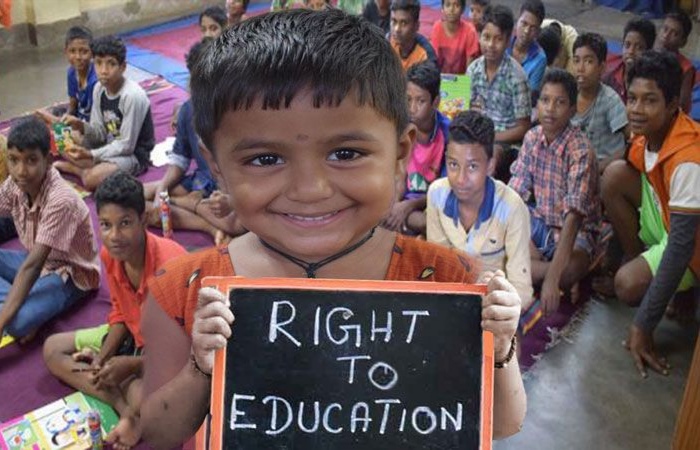
Most of childrens have no access to education in India.
Girls are excluded from the school in higher numbers with respect to boys.
We should have to treat them equally but it is believed to be inferior on lower caste.
Without education, chances of finding living from employment in India is impossible.
If educated peoples start teaching childrens at free of cost then it also be very useful in making a better world.
Like If 30 college students are studying in 1 course and they start teaching poor childrens only 1 day per month then the childrens study 1 month at free of costs.
We also have to put some efforts in making better world not for others, but for ourselves as well.
Child marriage
As we know Child marriage is crime according to Child marriage Restraint Act, 1929.
But it is still widespread in many regions of India.
Poverty is also the main reason behind this.
Overpopulation
Overpopulation leads to high competition in every aspects of life.
We see lack of job opportunities, education.
Food production is not as much to fulfill the need of this higher population.
Due to overpopulation, and not doing work after having such high population in India is main reason behind poverty.
If we utilise this overpopulation as the opportunity to increase country’s financial condition then it actually going to worth it.
The logistics sector has seen a growth of about 59% during the lockdown period. Primary reasons attributing to the growth of the sector is the order of essential services online to avoid the covid spread. While we were staying safe behind the doors, the logistics sector worked relentlessly to fulfill our needs. Ever wonder what’s happening in the logistics sector? There are certain hard challenges faced by the logistics sector. There were delays in the delivery and sometimes tracking of goods seem to be even more difficult. This is because of a lack of networking with the driver communities, following the superannuated process of tracking and competitive market.
Vahak is a startup that has developed an online community wherein a customer can easily interact with the drivers, book a lorry or a truck and thus transport their goods from point A to B. The app can be beneficial for both sides. The customer can get his booking done in no time with minimal calls and can place bids for the same. The drivers on the other hand can get the details in prior, have regular jobs, and assured payments. Sounds like a win-win situation right? Of course, it is. To add adornment to the user experience, vahak has made the service at zero commission. Their website design seems to be simple and appealing.
VAHAK – A SNEAK PEEK
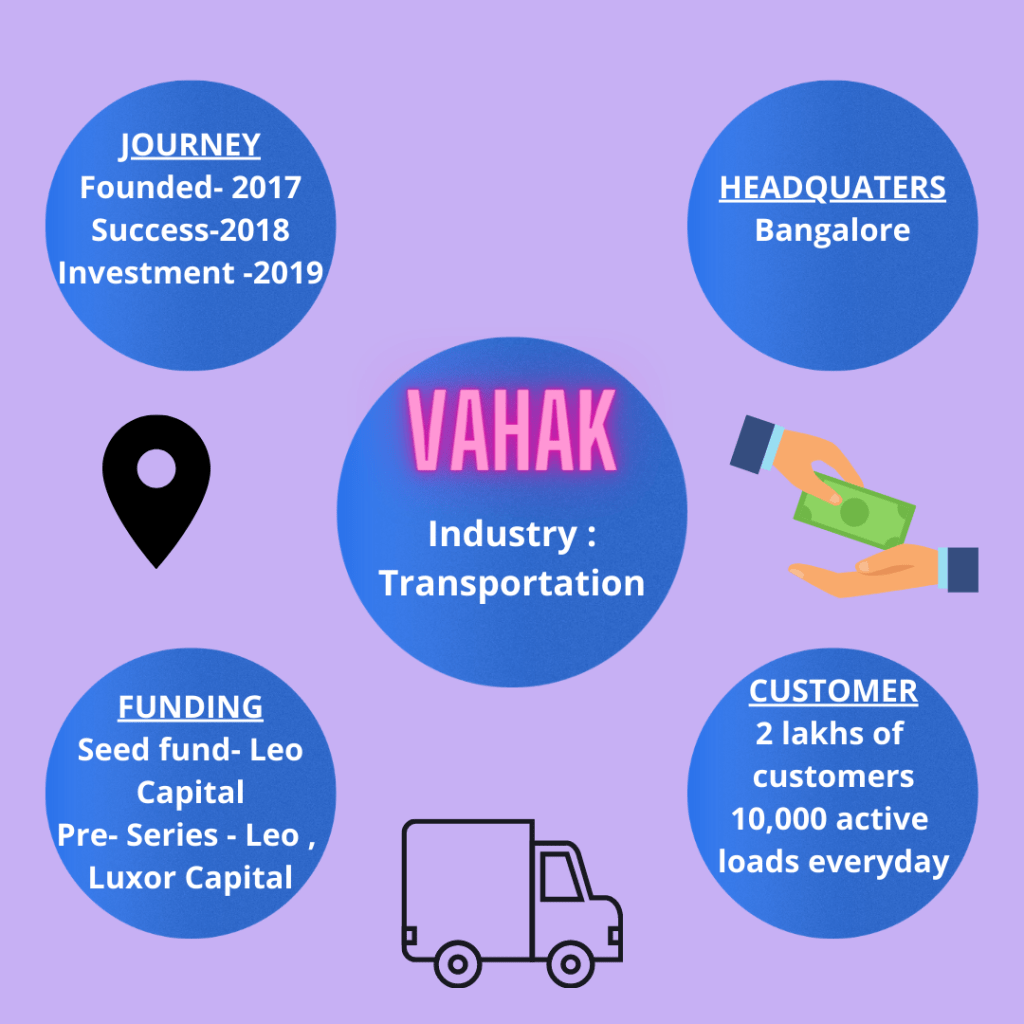
Vahak was founded in 2017 has seen steady growth in both sales and finance since then. Adoption of new technology and addressing an issue prevailing in the market over the years would be salient in attracting investors. Vahak is never an exception in such a case. They have raised their initial round of seed funding from Leo capital venture. Recently they created a buzz in the market by raising a fund of about 5 million dollars in their pre-series A funding by Luxor Capital and its existing fund venture Leo capital.
Team members of vahak said in an interview that “ the platform has around 10,000 active loads every day”.
They are serving 3000+cities in and around India and they are aiming to develop their platform significantly in the near future. The fund would be utilized in a way that the network expands and henceforth the business flourishes.
It sounded pretty weird when we thought about attending school from our bed back in 2019, but now when we look at it, it has become a new normal.
THE NEW NORMAL
It started back in March 2020, when the complete lockdown was imposed by the Prime Minister of India due to increasing cases of Covid-19, and all the educational institutions along with everything else was shut down. The mode of classes was switched to online and all the students were directed to cope with the teachers in the online lectures.
As time passed by and the situation grew even worse, and the mode of online education became normal like any traditional method of education. Online classes didn’t even mold the schedule of students but gave them a better chance to interact with teachers. It’s not that there aren’t any drawbacks to it, they’re present in almost everything like students finding a distraction during the time of classes and a rush to be highly self-motivated, which often leads to students getting misguided and wasting their time.
TRADITIONAL VS ONLINE CLASSES
Both traditional and online classes have their own pros and cons- it’s up to the students how they utilize the opportunities provided to them.
FLEXIBILITY:Where traditional classes have fixed schedules and demand the particular time of the student, on the other hand, online classes provide students flexibility and a schedule that they can fix on their own. It lets students stay focused and give suitable time to their other commitments.
SELF DISCIPLINE AND MOTIVATION:When it comes to discipline and motivation traditional classes do have an advantage for it holds a structured schedule and provides students on-campus interactive sessions, whereas in online classes students need to stay motivated and save themselves from distractions that might disrupt their schedule.
SOCIAL INTERACTION:The interaction in the online classes is so much more efficient than those in traditional because not only provides scheduled doubt lectures but gives access to students of recorded lectures that help them deal with their queries, while the traditional classes fail to thrive because of the lack in regularity due to distance and several other factors.
BLENDED EDUCATION
The curriculum is designed in such a way that it can be studied through both- online and in-person learning. It’s up to the individual on how they take the medium and learn to be productive by any means.
There might be a minimal difference between the two- likewise timing, accessibility, and place, but both the sources implement the best of themselves for the education of students and hence it’s up to the students to decide what they want in the future, as per the present circumstances there might be a day where students will have to choose between the two options of education, that is- online and traditional.
CONCLUSION
Most of it comes to personal preferences of how one learns more efficiently, hence there ain’t no right or wrong in traditional versus online school. These learning methods can be very effective or of no use at all, all that depends on that particular individual for they take apply it on their personal style of learning.
Born near the Dhing town ,Assam, Hima Das is nicknamed as Dhing express. This young sprinter is inspiration for many youth, she was born on 9 January 2000.
She is the first Indian athlete to secure gold medal at the IAAF World U20 championships. Her career as a sprinter began when she participated in the 2018 Commonwealth Games at Gold Coast, Australia, in the 400 metres and 4×400 metres relay. She is famous for securing 5 gold medals back to back in a single month. She obtained her first gold of the month at Pozhan Athletics Grand Pix, Poland, second medal at Keetno Athletics Meet, Poland, third medal at Kladno Athletics Meets, Czech Republic, fourth gold at Tabor Athletics Meets, Czech Republic and fifth gold at Atlecticky Mitink, Czech Republic.
She is also appointed as a civil servant post of Deputy Superintendent of Police of Assam Service , without giving any competitive exam but through direct entry. She also currently holds the Indian National, recorded in 400 metres with a timing of 50.79s that she clocked at the 2018 Asian Games in Jakarta, Indonesia. She is also conferred with Arjuna Award .
As a kid she was always interested in playing football . She also played football with the boys at her JNV school . She wanted to carry on football as her career but did not see any prospects for herself in women’s football scene in India. Later on , she was advised by physical education teacher at JNV to opt for sprint running.
“All’s well that end’s well” this proverb suits so well in the case of this 21 year old sprinter. We don’t know what would have happened if she had taken football as her career but as a sprinter ,she is pride of India
It is very saddening and disheartening to know that she did not qualify for Tokyo Olympics 2020. It should be noted that she suffered with hamstring injury before giving her qualification test.
Born in the family of farmers Hima Das was never a privileged kid , but through her firm will she stated clearly that achievement comes only through pure hard work and dedication.
Saikhom Mirabai Chanu paved a path for India at Olympics by securing Silver in weightlifting.
Krishan Vikas, Sutirtha Mukherjee and Manika Batra, Arvind Singh and Arjun Lal Jat, S. Nagal and more players at Olympics today, 24 July 202. Updates.
25 July 2021: P.V. Sindhu, Sania Mirza, P. Nayak, Mary Kom, M. Kaushik, Arvind Singh and Arjun Lal Jat, Nethra Kumanan, Maana Patel, Manika Batra.
26 July 2021: Manika Batra, C.A. Bhavani Devi, S. Rankireddy + C. Shetty, Ashish Kumar, Sharath Kamal Achanta, Sutirtha Mukherjee,Sajan Prakash, P.V. Sindhu, Sajan Prakash.
27th July 2021: Sharath Achanta, Indian hockey team, Lovlina Borgohain(Boxing), C. Shetty and Rankireddy, Sumit Nagal, Sailing.
28th July 2021: Pravin Jadhav (Archery), Tarundeep Rai (Archery), Deepika Kumari (Archery), P.V. Sindhu (Badminton), Pooja Rani(Boxing), Arvind Singh and Arjun Lal Jat (Rowing).
29th July 2021: P.V. Sindhu (Badminton), Manu Bhaker (Shooting), Mary Kom (Boxing), Arvind Singh and Arjun Lal Jat (Rowing), Atanu Das (Archery), Satish Kumar (Boxing).
Saikhom Mirabai Chanu lifted a total of 202Kg in four successful attempts. 87Kg in snatch, 115 Kg in clean and jerk.
Z.H. Hou from China secured Gold medal by lifting a total of 210Kg.
W.C. Aisah from Indonesia secured Bronze medal by lifting a total of 194Kg.
Shooting
Women’s 25m pistol
Manu Bhaker secured 5th Position in the qualifications.
Men’s 10m air pistol
J. Foroughi from Iran secured Gold medal with 244.8 points. Likewise, D. Mikec from Serbia and w. Pang from China secured Silver medal respectively.
C. Saurabh from India secured 7th position with 137.4 points
Table Tennis singles
Sutirtha Mukherjee and Manika Batra have passed Round 1 with flying colors. Both have advanced to second round in Table tennis Women’s single.
— Manika Batra knocks out second room and moves on confidently.
Women’s singles
Sutirtha Mukherjee lost to Fu Yu in the second round.
Polcanova Sofia defeated Manika Batra in the 3rd round.
Men’s singles
Sharath Achanta won against Tiago Apolónia, Portugal, in the second round
Sharath Achanta lost to Ma Long, china in 3rd Round,
Table Tennis mixed doubles
Sharath Kamal Achanta and Manika Batra lost to Yun Ju Lin and Ching Cheng of Chinese Taipei straight games in Table Tennis mixed doubles round of 16 match.
Hockey
The Indian men’s hockey team defeated New Zealand in their first match with scores 3-2 respectively at pool matches.
—–Australia defeats India with a margin of 7-1 in their next match.
In, Men’s tournament, India defeats Spain with scores 3-0
India won against Argentina 3-1. (29th July) ———————
Woman’s tournament
The Indian women’s hockey team have their match scheduled at 5:15 pm against Netherlands.
They lost to Netherlands with a margin of 5-1
India vs Germany today at 5:45pm. (26th July) Germany won 2-0
India lost to Great Britain with margin 4-1 (28th July)
Boxing
Men’s Welterweight
We have Indian boxer Krishan Vikas against OKAZAWA Sewonrets Quincy Mensah at 19:24 (Japan), i.e. here in India the match will be shown at 15:24 (3:24)
Krishan Vikas gave his best but lost to OKAZAWA.
Men’s lightweight
Luke McCormack defeated M. Kaushik with scores as Luke McCormack
Women’s flyweight
Our eternal boxer, Mary kom won her first match against Miguelina Hernandez, Dominican Republic — 4-1—
Mary Kom vs Ingrit Valencia, Colombia at 3:36pm. (29th July )
Women’s welterweight
Lovlina Borgohain, India defeated Nadine Apetz of Germany with score 4-3 in round 16.
Men’s Middleweight
Tuoheta Erbieke from China vs Ashish Kumar today (26th July) at 3:06pm
Women’s Middleweight
Pooja Rani defeated Ichrak Chaib from Algeria
Men’s super heavyweight
Satish Kumar defeated Ricardo Brown in Round 16. ———————
Badminton
Men’s Doubles Group Play Stage – Group A
C. Shetty and Rankireddy won their opening match in Group A. Their next match is on 26th Jul.
Indonesia Defeated them in the next stage with scores 21-13, 21-12.
C. Shetty and Rankireddy defeated S. VendyB. Lane of Great Britain at Group play stage with scores 21-17 and 21-19. ——————– 27th July 2021
Women’s singles (Group play stage)
P.V. Sindhu gloriously won her first match with scores as 21-7 and 21-10.
P.V. Sindhu defeats N.Y. Cheung from Hong king with scores 21-9 and 21-16. (28th July)
P.V. Sindhu wins Round 16 by defeating Mia Blichfeldt, Denmark with scores 21-15 and 21-13. ————————–
Rowing (Men’s lightweight double sculls)
India’s pair of Arvind Singh and Arjun Lal Jat finished fifth and eventually qualified for the repechage round.
They secured 3rd Position at Repechage 2 today(25 July).
They secured 6th Position at semifinals. (28th July)
Arvind Singh and Arjun Lal Jat took 5th Place in the Final B (29th July) ———————–
Tennis
Sumit Nagal passed the first round of Men’s singles defeating D. Istomin from Uzbekistan. Next match on 26 July.
Daniil Medvedev defeated Sumit Nagal in the second round. ——————————
Women’s doubles
L. KichenokN. Kichenok defeated S. Mirza, A. Raina
Swimming
Women’s 100m backstroke
Maana Patel finished second in Heat 2.
Men’s 100m and 200m BUtterfly
Sajan Prakash will be competing in men’s 200m and 100m butterfly today.
Sailing
Laser Radial / Laser
Nethra Kumanan secured 27th Position and 33rd Position resp.
49er
India secured 18th position qualifying for race 2
India secured 18th position again in race 4
Archery
Men’s team
India defeated Kazakhstan to qualify for Quarterfinals
But, in Quarter-finals India lost to South-Korea with margin as 6-0
Men’s individual
Pravin Jadhav defeated Galsan Bazarzhapov from ROC (Russua) in 1/32 Eliminations.
Pravin Jadhav continues to shine after he defeated Brandy Ellison from US in 1/16 Eliminations.
Tarundeep Rai won in 1/32 eliminations but lost in the next round.
Atanu Das defeated Oh Shin-Hyek from South Korea with scores 6-5 in 1/16 Eliminations. ———————-
Women’s individual
Deepika Kumari won both 1/32 and 1/16 Eliminations today (28 July)
Fencing
Women’s individual sabre
C. A. Bhavani Devi defeated N. Ben Azizi from Tunisia with score of 15-3 in her first match.
SHE BECAME THE FIRST FENCING INDIAN PLAYER TO WIN A MATCH. ————————-
But, she lost against Manon Brunet, a world top 3 player, in the second round.
Covid-19 worldwide pandemic was one of the 2020’s defining events and it still is. It has changed everything even the e-commerce world. The internet and e-commerce industries have grown amid the COVID-19 issue and experienced extraordinary and unexpected development.
Many restaurants, pubs, movie theatres, and gyms are closing in major cities. Meanwhile, many office workers are encountering new problems as they transition to full-time remote employment. However, People are adjusting to the reality of our interconnected society and the difficulty of briefly separating oneself from others. It would be an understatement to suggest that we are living in extraordinary times. In these times, lockdowns became the latest trend therefore, companies and customers progressively “went digital,” and started delivering and purchasing more products and services over the internet which in turn boosted e-share commerce’s of global retail trade from 14% in 2019 to almost 17% in 2020 as per the statistics. The epidemic has sped up the transition from physical to digital purchasing by around five years.
Customers are avoiding public locations, and non-essential enterprises are being forced to close in these trying times due to covid-19 situation where cities are going under lockdowns. Shopping for only the bare necessities is becoming the new normal. So, To satisfy shifting requirements, brands are adapting and becoming adaptable by consumers.
Millions of individuals turned to e-commerce platforms this year, not only in metropolitan area but also in tier III and beyond, due to the need for social distance and prioritizing safety during the epidemic, according to companies like Amazon and Flipkart as well as industry analysts. It is expected that the coronavirus pandemic influence will increase e-commerce business by 84% to $111 billion by 2024. Mobile shopping will fuel India’s e-commerce sector, which is expected to increase at a rate of 21% annually over the next four years. The most common payment methods online in 2020 were digital wallets, credit cards, and debit cards. As well all know that Physical retail has merged with the digital world and e commerce capacity is no longer restricted to traditional websites. Consumers are becoming habitual with this e-commerce world and want the same hassle-free and convenient shopping experience whether they purchase via an app, through their social feeds, or in person in near future.
However, despite several governments’ attempts during the COVID-19 crisis to promote e-commerce, persisting digital inequalities mean that not everyone has been able to participate. Furthermore, in the event of growing universal sales models or novel modes of delivery, rules that are not suited to e-commerce might create hurdles for businesses. While many of these issues existed before to COVID-19, the present crisis, as well as the growing role of e-commerce for consumers and businesses, has increased the need for governmental intervention.
Systemic issues in connection, financial inclusion, skills, and trust (for instance- digital security, privacy, and consumer protection) have been brought to the forefront for consumers. To solve this issue, governments may provide rural and underdeveloped areas with inexpensive and high-quality internet, improve financial inclusion, and encourage trust and the development of skills needed to participate in e-commerce.
Governments must also maintain fair system in the context of online platforms. It’s also critical to provide enough competition in the retail sector and a well-functioning enabling environment for e-commerce, which includes communication services, logistics, and trade.
A brace from Harmanpreet Singh, both off penalty corners, and a Rupinder Pal Singh penalty-stroke conversion cancelled out Kane Russell’s opening goal for New Zealand as India took a 3-1 lead in the 33rd minute.
MATCH HIGHLIGHTS:
AND THE GAME IS OVER! INDIA BEATS NEW ZEALAND 3-2!!!
60′ PC FOR NEW ZEALAND! A brilliant run from Hugo Inglis gives NZL a chance to make it 3-3. But the Indian defence stands strong to keep the score 3-2 in their favour.
59′ NZL REFERRAL! This one is just out of pure desperation. The New Zealand players think they can win a penalty corner here. However, they end up empty handed.
58′ SREEJESH YOU BEAUTY! Kane Russell hit a stunning shot towards the top left corner of the post off a penalty corner. Indian goalie PR Sreejesh executed a full-stretch dive to his right to deny New Zealand the equaliser. Moments later, he pulled off another remarkable save in open play.
57′ BACK-TO-BACK PCs FOR NEW ZEALAND! After a long referral, NZL is eventually given the penalty corner. And, surprise, surprise! the team has won one more.
55′ Harmanpreet Singh has been the standout player on the field here. He’s put in a very good defensive shift and has converted two penalty corners. The substitute Birendra Lakra has been excellent since coming on as well.
52′ New Zealand has a slight edge when it comes to possession (52-48) today. However, the team has been a bit wasteful up front (1/5 PCs with a shooting efficiency of 25%), and that’s why India has the lead.
49′ After three consecutive successful referrals, India has a failed one in an attempt to win a penalty corner. New Zealand regains possession.
47′ Amit Rohidas and Lalit Upadhyay come up with a decent move on the left flank for India. The New Zealand defence stays compact to avert the danger.
THE FOURTH QUARTER BEGINS!
We are heading towards a thrilling final 15 minutes as India leads New Zealand 3-2 in men’s hockey on day two of the Tokyo Olympics.
THE THIRD QUARTER IS DONE AND DUSTED!
43′ GOOOOAAAAALLLLL!!!!!!! NEW ZEALAND PULLS A GOAL BACK!!!! A major lapse in concentration for the Indian defence and NZL capitalises on it. Nick Wilson receives a pass on the right flank, dribbles past Birendra Lakra and sets up Stephen Jenness, who scores past Sreejesh with ease.
40′ UPDATE: Australia beats Japan 5-3 to register the first points in Hockey at the Tokyo Olympics. The Aussies are in the same group (Pool A) as India and New Zealand.
38′ The Indian forwards are pressurising the New Zealand defence big time here. Sreejesh has had absolutely nothing to deal with at the other end this quarter.
36′ ANOTHER INDIAN PENALTY CORNER! Harmanpreet almost completed his hat-trick with the shot on target. But NZL keeper Hayward made a good save.
33′ GOAAALLLLLLLL!!!!! INDIA TAKE A 3-1 LEAD NOW!!! Another Indian penalty corner, another Harmanpreet goal. New Zealand looks extremely rusty in the middle since conceding the second goal.
32′ EARLY CHANCES FOR INDIA! Mandeep Singh has been a menace up front. He’s been supported well by Dilpreet Singh on the right. Another Indian goal looks likely.
THE THIRD QUARTER IS UNDERWAY!
Indian athletes are also in action in various other sports at the Tokyo 2020 Olympics today. Follow them through the links provided below.
SHOOTING BLOG | Read more
ARCHERY BLOG | Read more
THE SECOND QUARTER IS OVER!
29′ New Zealand enjoyed a long period of dominance in this quarter but India scored against the run of play. Nick Wilson’s missed chance could come back to haunt NZL.
26′ GOOOOAAAALLLL!!!!! INDIA TAKES THE 2-1 LEAD!! A penalty-corner innovation from the Indians and Harmanpreet Singh finds the back of the net. Rupinder Pal, the usual PC converter, slipped the ball towards Harmanpreet on his left to trick the New Zealand players.
24′ VERY CLOSE! Vivek Sagar Prasad had a wonderful chance to score. But the New Zealand defence gets the better of him close to goal.
22′ JAPAN 3 – 3 AUSTRALIA! In the other Olympic men’s hockey game happening now, the host nation and the 2004 gold medalist from Athens are involved in an exciting clash, which is in the third quarter.
19′ WHAT A CHANCE FOR INDIA! The captain Manpreet received a long pass from substitute Lalit. He was one-on-one with the NZL goalie. However, his lob attempt was saved by Hayward.
17′ New Zealand is dominating possession against India right now. The Indians are losing the ball cheaply in midfield quite too often.
THE SECOND QUARTER BEGINS!
A penalty-stroke goal from Rupinder Pal Singh cancelled out a penalty-corner strike from Kane Russell as India and New Zealand are tied 1-1 after the opening 15 minutes.
THE FIRST QUARTER COMES TO AN END!
15′ INDIAN COUNTER-ATTACK! The substitute Gurjant Singh rushes forward with the ball. But the New Zealand defence tracks back in time to avert the danger.
13′ FOUR CONSECUTIVE PCS FOR NEW ZEALAND! The Indian defence is struggling to get the ball away here. Sreejesh pulled off a brilliant save for India just moments ago. NZL messes up another penalty corner.
10′ GOOOOAAAAALLLL!!!!!! INDIA EQUALISES!!! Rupinder Pal won a penalty stroke from a penalty corner and he sent NZL keeper Leon Hayward the wrong way from close range.
9′ The experienced duo of Birendra Lakra and Lalit Upadhyay haven’t started in the first quarter. The youngster Vivek Sagar Prasad is also on the bench.
6′ GOOOOAAAALLLL!!!! NEW ZEALAND TAKES THE 1-0 LEAD!! NZL won its first penalty corner and Kane Russell converts it with precision.
5′ FOUL! Indian skipper Manpreet Singh hits New Zealand defender Nic Woods on the face with his stick, unintentionally. Woods is being treated on the field.
3′ PENALTY CORNER FOR INDIA! Mandeep Singh won this one after receiving a pass from Nilakanta Sharma. HITS THE POST! Rupinder Pal Singh misses the target by a whisker.
1′ Good early pressure from India here. Dilpreet Singh moves forward with pace on the right flank but isn’t able to create a clear-cut chance.
AND THE MATCH BEGINS!
The team lineups are out!
INDIA XI: PR Sreejesh (GK), Rupinder Pal Singh, Surender Kumar, Harmanpreet Singh, Amit Rohidas, Manpreet Singh (C), Hardik Singh, Nilakanta Sharma, Dilpreet Singh, Mandeep Singh, Shamser Singh.
COACH – Graham Reid.
NEW ZEALAND XI: Leon Hayward (G), Dane Lett, Nic Woods, Kane Russell, Blair Tarrant (C), Shea McAleese, Nick Ross, Hugo Inglis, Sam Lane, Stephen Jenness, Nick Wilson.
COACH – Darren Smith.
The world’s best coaches and scientific training have given Indian hockey a refreshingly new identity, Moscow Olympics gold medallist MM Somaya writes ahead of the country’s hockey teams’ opening games at the Tokyo Olympics.
READ MORE | Read more
He was marked out for greatness as a player and a leader even before he became a constant in the national side. Having led the Indian team at the Junior World Cup, Manpreet Singh has always had confidence in abundance but it has been tempered with a sense of responsibility as captain.
Ahead of his third Olympics, the Indian skipper shared his plans, disappointments and determination to succeed at Tokyo.
FULL STORY | Read more
MATCH PREVIEW:
It has been over 40 years since the Indian men claimed the most recent of their incredible eight Olympic hockey gold medals, which arrived at Moscow 1980.
However, their superb form in recent times makes them serious contenders to claim a ninth title at the upcoming event in Tokyo.
The team has claimed victories against nearly all the top teams in world hockey over the past few years, with Australia-born head coach Graham Reid, a former international with the Kookaburras, getting the best out of a talented and exceptionally fit collection of athletes.
India had booked its ticket to Tokyo with two victories over Russia in the 2019 FIH Hockey Olympic Qualifiers, winning 4-2 and 7-1 in Bhubaneswar.
“It has not been an easy process to make the final selection of 16 players as there is a lot of quality and ambition in this group of players,” Reid said ahead of the 2021 Tokyo Olympic Games.
RELATED | Read more
“The performance levels of all athletes are at an optimum level and more importantly they work well together. They know what it means to represent the country at the Olympics. We’re now focused on training with the same intensity and our goal is to put forward our best performance as a collective unit in Tokyo,” he added.
Meanwhile, coached by former Black Sticks midfielder Darren Smith, New Zealand – which shocked the world by becoming Olympic champion at Montreal 1976 – is renowned for its tireless work ethic as a team but is also blessed with some exceptional individuals.
Stephen Jenness and Hugo Inglis are both wonderful attacking talents, while veteran defender Shea McAleese and penalty corner expert Kane Russell are consistently excellent performers.
New Zealand reached Tokyo with two victories over Korea in the 2019 FIH Hockey Olympic Qualifiers, winning 3-2 and 3-0 in Stratford.
“It’s a pretty experienced group but it’s also the first pinnacle event for players like Sam Lane who have previously missed out through injury or Jacob Smith and Nick Ross who have been rewarded for their perseverance. They’ve shown they’re really determined to be there,” said coach Smith.
New Zealand – Leon Hayward, Blair Tarrant, Hugo Inglis, Steve Edwards, Sean Findlay, Stephen Jenness, Sam Lane, Dane Lett, Shea McAleese, Jared Panchia, Nick Ross, Kane Russell, Jacob Smith, Dylan Thomas, Nick Wilson, Nic Woods.
Sony TEN 3 HD/SD will telecast India events with Hindi commentary while Sony TEN 1 HD/SD and Sony TEN 2 HD/SD will have English commentary.
Live streaming of the events will be available on the SonyLIV and JioTV apps.
Civilization began with agriculture, and though humanity has changed significantly, agriculture still remains very important. In certain countries, its significance is more obvious, but the reality is that every country in the world depends on agriculture for one thing or another. Here are ten reasons why agriculture is important:#1. It’s the main source of raw materialsMany raw materials, whether it’s cotton, sugar, wood, or palm oil, come from agriculture. These materials are essential to major industries in ways many people aren’t even aware of, such as the manufacturing of pharmaceuticals, diesel fuel, plastic, and more. In fact, raw materials are so important in production that the economic health of a country strongly depends on how many raw materials it possesses.#2. It’s important to international tradeRaw materials from agriculture make up a huge portion of what’s traded internationally. Countries with plenty of those supplies export them and trade for materials they don’t have. If a country’s agriculture suffers for some reason, prices can go up and it disrupts the flow of trade. Currently, the EU is the first trader of agricultural products in the world, both for imports and exports.#3. It plays a big role in a nation’s revenueSpeaking of trade, developing countries still get most of their national income from agricultural exports. While developed countries don’t depend on agriculture as much as they used to, their economies would definitely take a hit if all exports suddenly stopped. #4. It provides employmentThe agricultural industry is still one of the biggest sources of employment and in many areas, it’s actually booming. Whether it’s working as a farmer, harvester, technician for farm equipment, scientist, and so on, there are plenty of jobs available in this field. In developing countries, agricultural jobs help reduce high rates of unemployment. When it comes to reducing poverty, evidence shows that focusing on agriculture is significantly more effective than investing in other areas.#5. It’s crucial to a country’s developmentEconomic development is tied to a country’s agriculture sector. When trade, national revenue, and employment are combined in a positive way, a country enjoys reduced poverty and boosted economic growth. Because strong agriculture results in benefits fairly quickly, focusing on it is one of the best ways to speed up development and improve a country’s standing in the world.#6. It can help heal the environment Agriculture possesses the power to harm or heal. When farmers prioritize biodiversity on their land, it benefits the earth. Having more biodiversity results in healthier soil, less erosion, better water conservation, and healthier pollinators. This is all good news for the environment as a whole, making agriculture an important part of the cycle of life. #7. It goes hand-in-hand with warAgriculture is such an important part of a country’s infrastructure, it makes sense it would impact conflicts and war. Throughout history, the need for land to grow food fueled many conflicts. In more modern times, specifically WWI, America’s farming industry boomed because they needed to supply Europe with agricultural products. For countries who don’t have assistance, war can break down the agricultural sector, affecting people for decades to come. When discussing agriculture, it’s impossible to not at least mention its connection to conflict.#8. It’s the source of our food supplyArguably the most important aspect of agriculture is that it’s the source of the world’s food supply. No matter where or what you are eating, the ingredients in your meals came from somewhere. All roads lead to agriculture. In countries dealing with food insecurity and severe malnourishment, it’s because their agriculture sectors are suffering. When agriculture thrives, fewer people go hungry.#9. It drives innovation in technologyBecause healthy agriculture is so essential to a country’s well-being, it’s been the setting of some of the most exciting innovations in technology. Through artificial intelligence, blockchain software, gene manipulation, and more, scientists and farmers have been figuring out ways to increase crop productivity, use less water, and reduce negative impacts on the environment. For scientists and tech companies, agribusiness is one of the most fascinating and productive fields to work in. #10. The state of agriculture reflects our futureWhen it comes to pollution and climate change, the environment and agriculture suffer the quickest and with the most clear consequences. If effective changes aren’t made, climate change’s impact on agriculture will decimate a country’s economy and eventually wipe out the food supply. To get a better idea about where humanity is going to end up, look at agriculture. What’s being done to adapt to a rapidly-changing climate? What will our food supply look like? The state of agriculture is a good litmus test of what we can expect the future to look like.
We don’t need occasion to celebrate heroes and Bhagat Singh is one of the greatest hero India has ever seen. He was born in 1907 in the family of freedom fighters . His almost all the family members were active in politics. From his grandfather Arjun Singh to his uncles Ajit Singh and Swaran Singh, all had served the country once in their lifetime. Thus, the spirit of freedom was embedded in his heart from very childhood.
Bhagat Singh was not a great supporter of non violence , yet, he was also not a firm believer of violence. He took the path of violence out of helplessness and to protect his homeland. Just as the former Prime Minister Pandit Jawaharlal Nehru wrote about him ,”Bhagat Singh did not become popular because of his act of terrorism but because he seemed to vindicate for the moment, the honour of Lala Lajpat Rai, and through him of the nation , he became a symbol ; his act was forgotten , the symbol remained , and within a few months each town and village of the Punjab and to lesser extent in the rest of Northern India, resounded with his name .”
Bhagat Singh at the age of 12 went to Jallianwala Bagh hours after thousands of unarmed people gathered at the public meeting and had been killed. At the age of 14 he was amongst the villagers who welcomed protesters against the killing of a large number of unarmed people at Gurudwara Nankana Singh on 20 February 1921. He stated the act of bravery from the very young age but his real struggle of freedom began when he joined Young Revolutionary Movement.
He joined National College in Lahore in 1923. In 1926 he founded Indian Socialist Youth Organization ” Naujawan Bharat Sabha”. He also joined the Hindustan Republic Association in 1924.
He was so devoted to the freedom that he ran away from his home when his father arranged his marriage. He wrote in a letter — “My life has been dedicated to the noblest cause, that of the freedom of the country. Therefore , there is no rest or worldly desire that can lure me now”.
In December 1928 Bhagat Singh along with his companion Shivaram Rajguru, shot British officer, John Saunders . They had mistaken Saunders for James Scott, whom they had originally planned to assassinate. They were agitated due to the death of Lala Lajpat Rai and believed that James Scott was responsible for it. They fled away from the crime scene and were not caught for many months
In April 1929 Bhagat Singh and Batukeshwar Dutt was arrested for bombing Central Legislative Assembly in Delhi. It was during this trial that Saunders’ case reopened.The police found some evidence regarding Saunders and thus Bhagat Singh was convicted and hanged in March 1931, at the mere age of 23 ( Many that believes that Bhagat Singh was not given a fair trial, thus, it is suggested to read “The Trial of Bhagt Singh” by AG Noorani, as it gives the detailed account of the case)
The life of Bhagat Singh inspires many till now. He fought for what was right. He became famous not for his violent act but for his strong opinion regarding justice and freedom. He was brave and courageous man who prioritised freedom above anything else.
India never invaded any country in her last 100000 years of history.
When many cultures were only nomadic forest dwellers over 5000 years ago, Indians established Harappan culture in Sindhu Valley (Indus Valley Civilization)
The name ‘India’ is derived from the River Indus, the valleys around which were the home of the early settlers. The Aryan worshippers referred to the river Indus as the Sindhu.
The Persian invaders converted it into Hindu. The name ‘Hindustan’ combines Sindhu and Hindu and thus refers to the land of the Hindus.
Chess was invented in India.
Algebra, Trigonometry and Calculus are studies, which originated in India.
The ‘Place Value System’ and the ‘Decimal System’ were developed in India in 100 B.C.
The World’s First Granite Temple is the Brihadeswara Temple at Tanjavur, Tamil Nadu. The shikhara of the temple is made from a single 80-tonne piece of granite. This magnificent temple was built in just five years, (between 1004 AD and 1009 AD) during the reign of Rajaraja Chola.
India is the largest democracy in the world, the 7th largest Country in the world, and one of the ancient civilizations.
The game of Snakes & Ladders was created by the 13th century poet saint Gyandev. It was originally called ‘Mokshapat’. The ladders in the game represented virtues and the snakes indicated vices. The game was played with cowrie shells and dices. In time, the game underwent several modifications, but its meaning remained the same, i.e. good deeds take people to heaven and evil to a cycle of re-births.
The world’s highest cricket ground is in Chail, Himachal Pradesh. Built in 1893 after leveling a hilltop, this cricket pitch is 2444 meters above sea level.
India has the largest number of Post Offices in the world. And world’s only floating post office.
The largest employer in India is the Indian Railways, employing over a million people.
The world’s first university was established in Takshila in 700 BC. More than 10,500 students from all over the world studied more than 60 subjects. The University of Nalanda built in the 4th century was one of the greatest achievements of ancient India in the field of education.
Ayurveda is the earliest school of medicine known to mankind. The Father of Medicine, Charaka, consolidated Ayurveda 2500 years ago.
India was one of the richest countries till the time of British rule in the early 17th Century. Christopher Columbus, attracted by India’s wealth, had come looking for a sea route to India when he discovered America by mistake.
The Art of Navigation & Navigating was born in the river Sindh over 6000 years ago. The very word Navigation is derived from the Sanskrit word ‘NAVGATIH’. The word navy is also derived from the Sanskrit word ‘Nou’.
Bhaskaracharya rightly calculated the time taken by the earth to orbit the Sun hundreds of years before the astronomer Smart. According to his calculation, the time taken by the Earth to orbit the Sun was 365.258756484 days.
The value of “pi” was first calculated by the Indian Mathematician Budhayana, and he explained the concept of what is known as the Pythagorean Theorem. He discovered this in the 6th century, long before the European mathematicians.
Algebra, Trigonometry and Calculus also originated in India. Quadratic Equations were used by Sridharacharya in the 11th century. The largest numbers the Greeks and the Romans used were 106 whereas Hindus used numbers as big as 10*53 (i.e. 10 to the power of 53) with specific names as early as 5000 B.C. during the Vedic period. Even today, the largest used number is Terra: 10*12(10 to the power of 12).
Until 1896, India was the only source of diamonds in the world (Source: Gemological Institute of America).
The Baily Bridge is the highest bridge in the world. It is located in the Ladakh valley between the Dras and Suru rivers in the Himalayan mountains. It was built by the Indian Army in August 1982.
Sushruta is regarded as the Father of Surgery. Over 2600 years ago Sushrata & his team conducted complicated surgeries like cataract, artificial limbs, cesareans, fractures, urinary stones, plastic surgery and brain surgeries.
Usage of anaesthesia was well known in ancient Indian medicine. Detailed knowledge of anatomy, embryology, digestion, metabolism,physiology, etiology, genetics and immunity is also found in many ancient Indian texts.
The four religions born in India – Hinduism, Buddhism, Jainism, and Sikhism, are followed by 25% of the world’s population.
Jainism and Buddhism were founded in India in 600 B.C. and 500 B.C. respectively.
Indian Constitution is the longest constitution till date.
Islam is India’s and the world’s second largest religion.
The oldest European church and synagogue in India are in the city of Cochin. They were built in 1503 and 1568 respectively.
Jews and Christians have lived continuously in India since 200 B.C. and 52 A.D. respectively.
Varanasi, also known as Benaras, was called “the Ancient City” when Lord Buddha visited it in 500 B.C., and is the oldest, continuously inhabited city in the world today.
His Holiness, the Dalai Lama, the exiled spiritual leader of Tibetan Buddhists, runs his government in exile from Dharmashala in northern India.
Martial Arts were first created in India, and later spread to Asia by Buddhist missionaries.
Yoga has its origins in India and has existed for over 5,000 years.
The Mumbai 2008 attack a.k.a 26/11 was a chain of terrorist attack that took place in November in the year of 2008. There were 10 members of Lashkar-e-Taiba, it was an Islamist terrorist organization from India’s biggest enemy country, Pakistan. They successfully achieved 12 synchronized bomb attacks and firing that lasted 4 days in the Mumbai. This attack withdrew the attention of everyone all over the world. The attack lasted for 4 days, began on Wednesday, 25 November 2011 and continued till Saturday, 29 November 2011.
174 people died in this attack, including 9 terrorist and more than 300 people were injured. Chhatrapati Shivaji Terminus, Mumbai Chabad House, The Oberoi Trident, the Taj Palace & Tower was attacked 8 times. There was also a massive explosion in Mazagaon. On 28 November, in the early morning except Taj Hotel all the sites were secured by Mumbai Police and security force. Operation Black Tornado was conducted by Indian’s National Security Guard to wash out the left-over attackers, this winded up with death of remaining attacker in Taj Hotel and ended the strike. Pakistan dined the attack. Ajmal Kasab was the only attacker who survived the strike. He revealed that he and other 9 were the members of terrorist group named Lashkar-e-Taiba. Soon later the Indian Government declared that the attackers were from Pakistan, and they were controlled from there itself only. After this Pakistan confirmed that the sole survivor of the attack was a citizen of Pakistan. On 19 April 2015, the major person Zakiur Rehman Lakhvi who initiated the attack was prison free on bail and got vanished. He was then again caught and arrested in Lahore on 2 January 2021.
THE BACKGROUND
Mumbai has faced many terrorists attack since the 13 interrelated bomb explosions in which 257 were killed and 700 were injured. In the year 1993 an attack was carried out with the feeling of taking revenge in earlier religious breakdown for peace that killed many Muslims. In the year 2006 on 6th of December, a blast in a Ghatkopar station killed two people and 28 were injured. The bomb explosion took place on the 10th anniversary of the destruction of the Babri Mosque in Ayodhya. In January 2003, the Prime Minister of Indian, Atal Bihari Vajpayee visited the city, and a day before that a bicycle bomb explode near the Vile Parle station in Mumbai, in which one person died and 25 were injured. On 25 August in the year 2003, two bombs were dropped in South Mumbai, one near the Gateway of India and the other at Zaveri Bazaar situated in Kalbadevi, 44 people were killed and 150 were serious due to this attack. On the Suburban Railway in Mumbai seven bomb were exploded within 11 minutes on 11th of July 2006,which killed 209 people, 22 foreigners were also included in this and more than 700 injured. According to the Mumbai Police, the bombings were carried out by Laskhar-e-Taiba group of terrorists.
With due respect I salute Mumbai police the real life heroes who were standing still and showed enough bravery to fight against the group of terrorists not once but many times and made all the people of Mumbai to feel safe and secure.
When it comes to tourism, India always founded as an attractive place to visit. From different types of people to different types of culture and traditions, the country has everything that one is looking for. But why India? Because it costs very cheap and very little amount of money to travel the most beautiful places around the region. The Country has the most beautiful beaches, Mountains, deserts, Forests, Rivers and the old historical temples that one should visit.
Here are the TOP 6 tourist places in India that a traveler Should Visit.
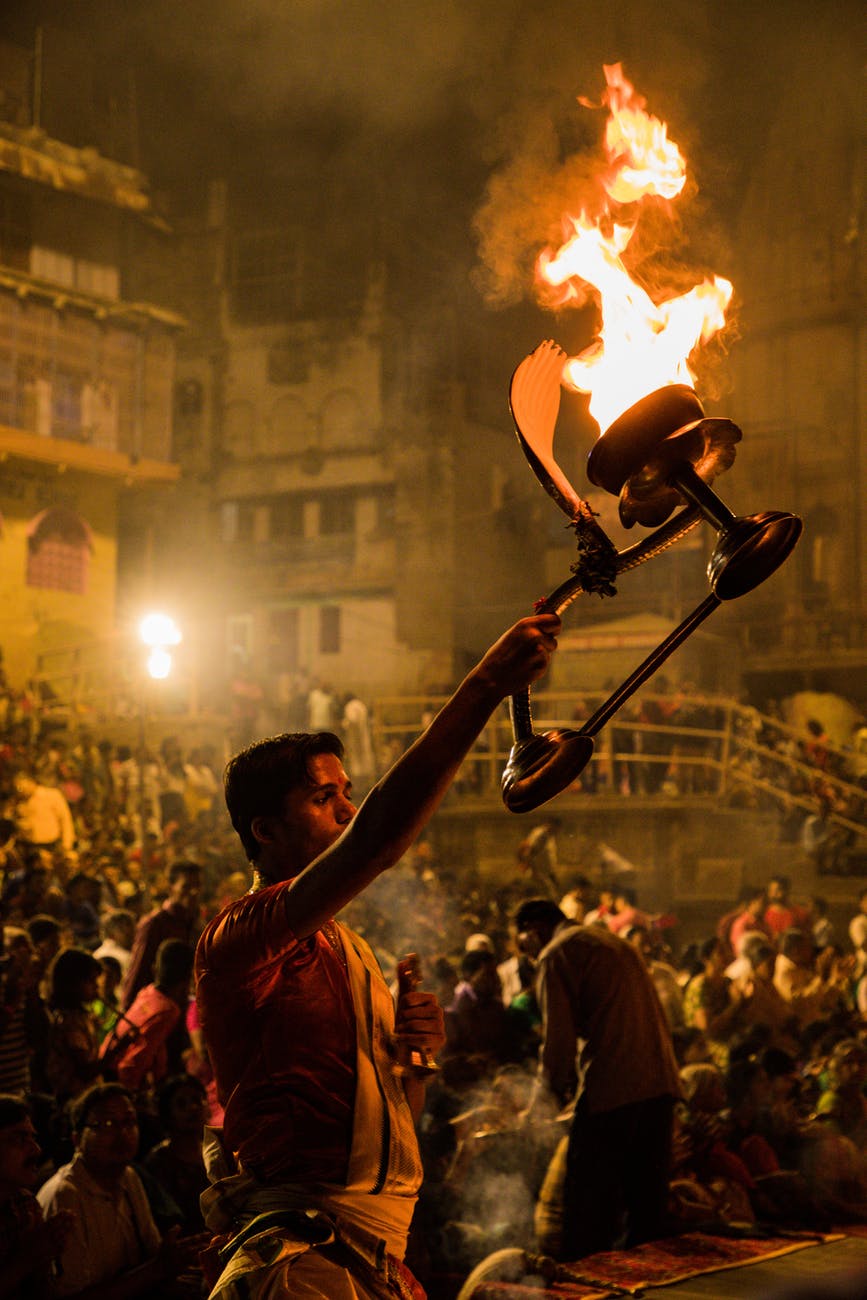
If one wants to travel every corner of the country, then they should start with this place and set it up at the of the priority list. Visiting the place where you can smell the Hindu culture everywhere. One should see the night near the river Ganga, where Hundreds and thousands of people come together and performs rituals and prayers. It is one of the most famous place in all over India. Starting a journey with the blessing of God is a best way to start. You can try a number of different food style around the street of Varanasi.
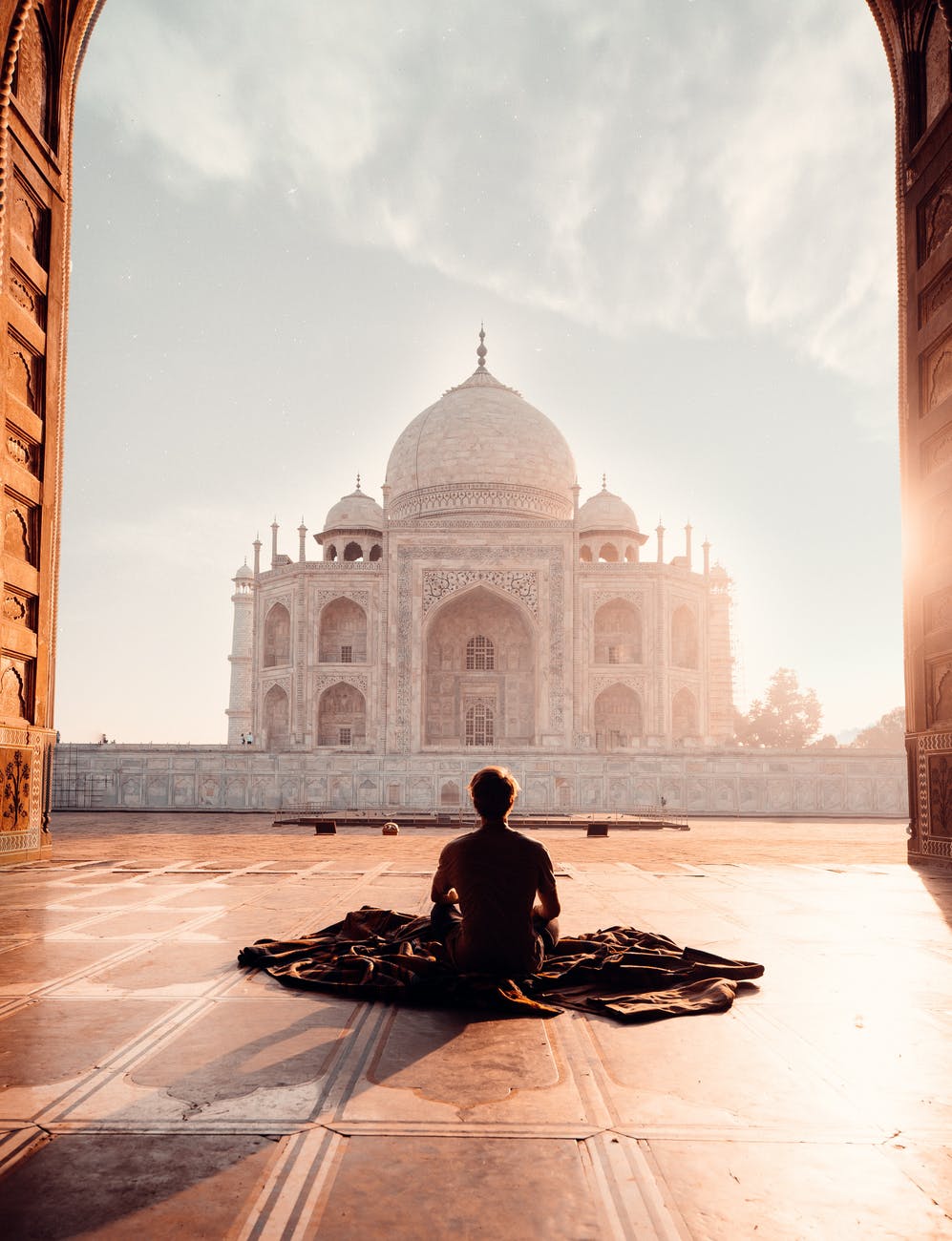
Taj Mahal is one of the examples of the most beautiful Monuments that one could ever visit. Taj Mahal is a wonder out of total 7 In the world. It was built around 1648 and was started in 1631 after the death of Mumtaj Mahal, the wife of Shah Jahan. It has a beautiful story of love and most famous in the world. It was decorated with diamonds, mother of pearls, Jade and was constructed with white marble.
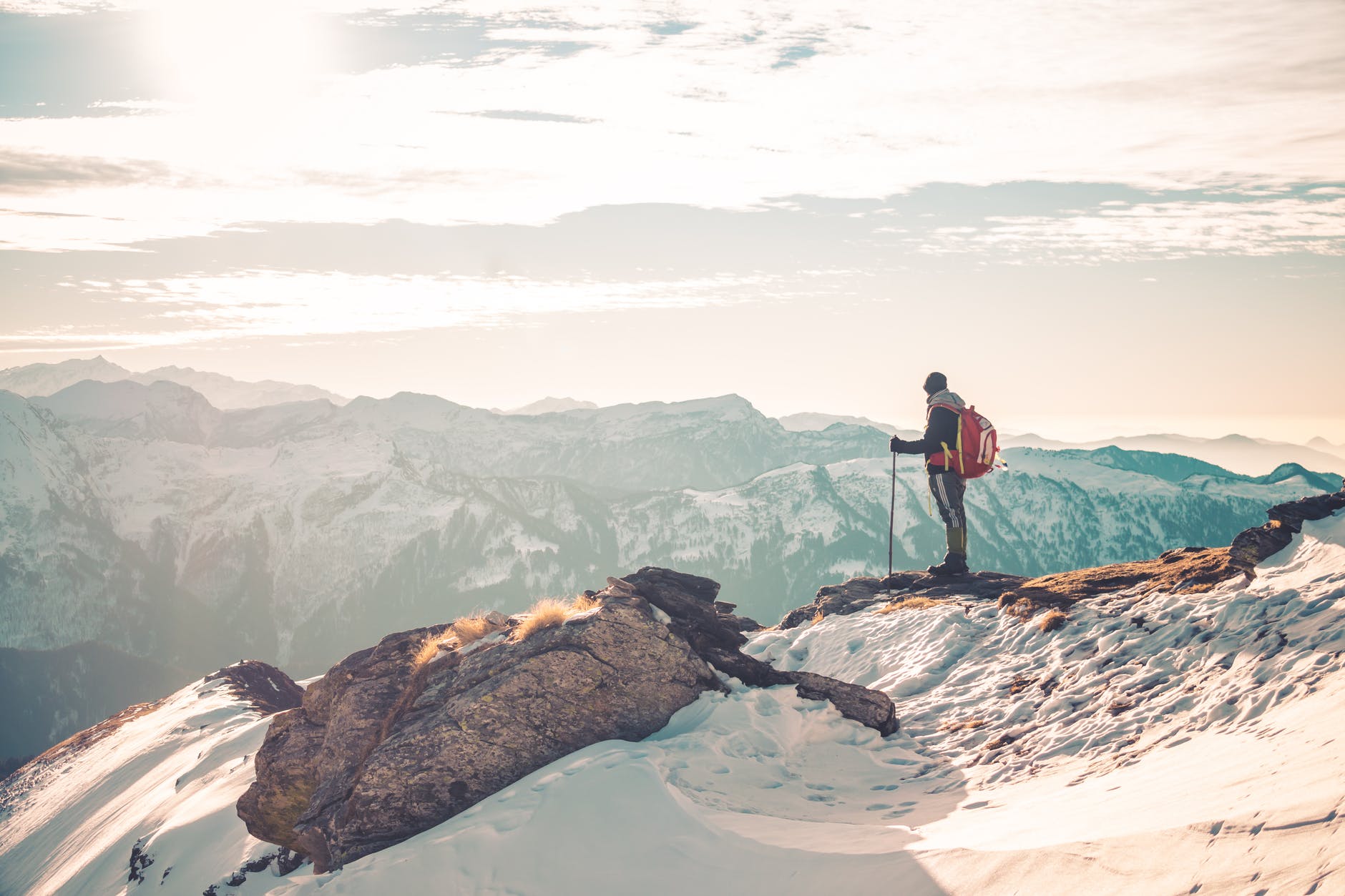
Feel the cold wind at the top of the hill around the Himalayas, a relaxation to your eyes while watching the beauty of nature. One of the finest pieces of nature that one could ever see in Shimla. The place costs quite less than the others. There’s a town hall at the center of the town and number of hill stations around the place. If one loves to visit the nature, then this place needs to be visited.
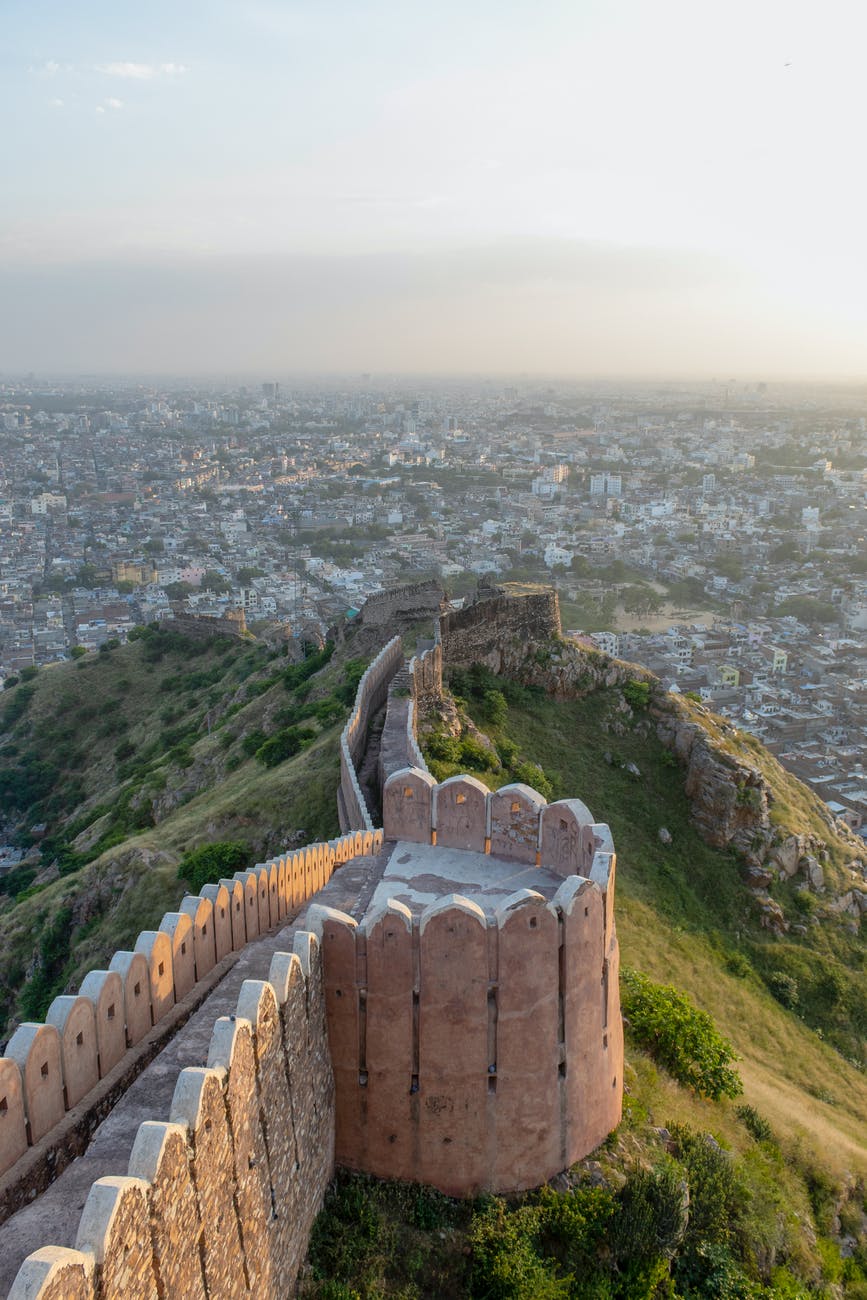
One could experience the old rich culture in this place. From the old tradition of shopping to Visiting the finest pieces of architecture, this place brings everything you need. Jaipur is the capital city of Rajasthan State and also known as “Pink City”. There are most famous places around the city which needed to be visited and they are, Hawa Mahal, Jantar Mantar, Amber Fort, and City Palace.
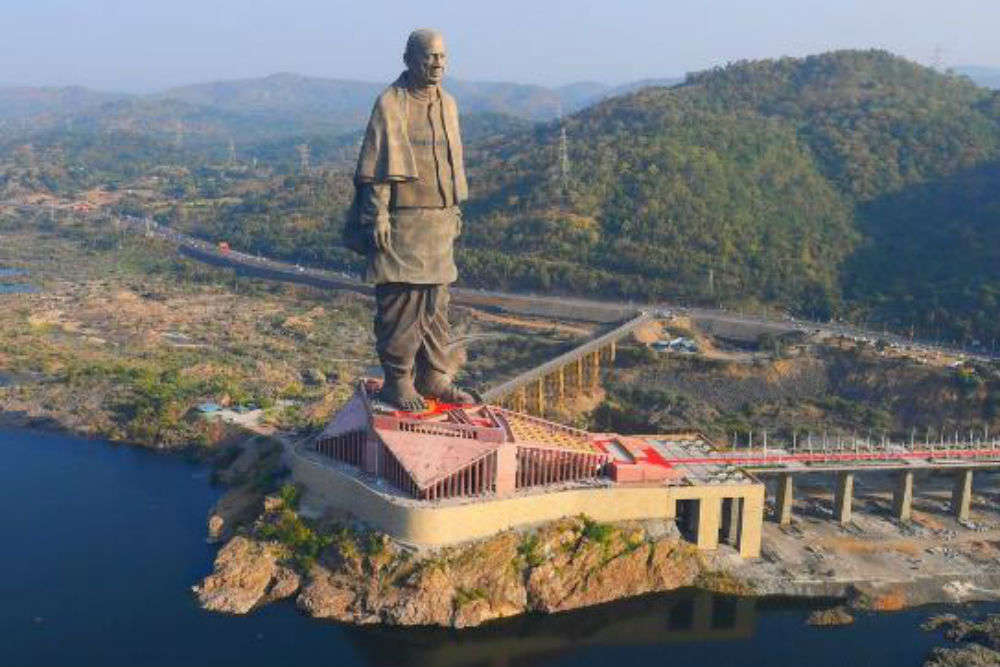
Recently, India had built the World’s Tallest State in the Name of One of the Country’s Freedom Fighter and also Known As an Iron Man of India, Shree ” Sardar Vallabhbhai Patel”, a former Deputy Prime Minister Of India. The statue is 180 meters Tall and Located near the Sardar Sarovar Dam. It serves the major tourist Attraction as well as it is a symbol of India’s integrity and resolve.
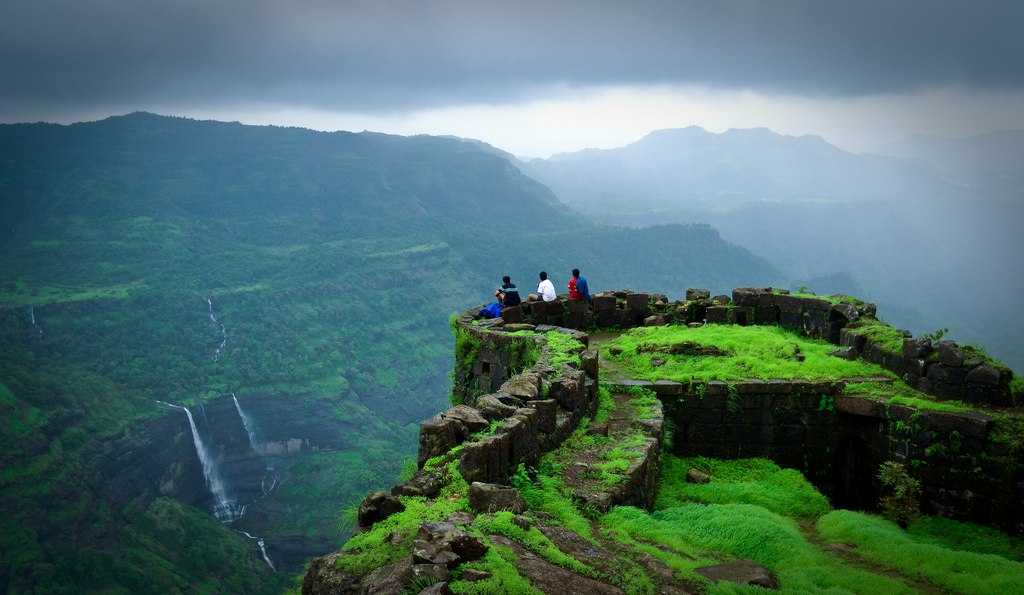
1. Rajmachi, Maharashtra
If one Love trekking then this place must needed to be visited. It is situated near a small village and has 2 two fortified peaks Shrivardhan and Manaranjan forts, located near two famous hills of Lonavala and Khandala. One can trek Upto 3 to 4 hours to reach the destination or one can easily drive to the other route and can trek for just 20 to 40 Minutes to reach the hill.
There are plenty of Places In India, which must be Visited by a traveler and above were one of those places.
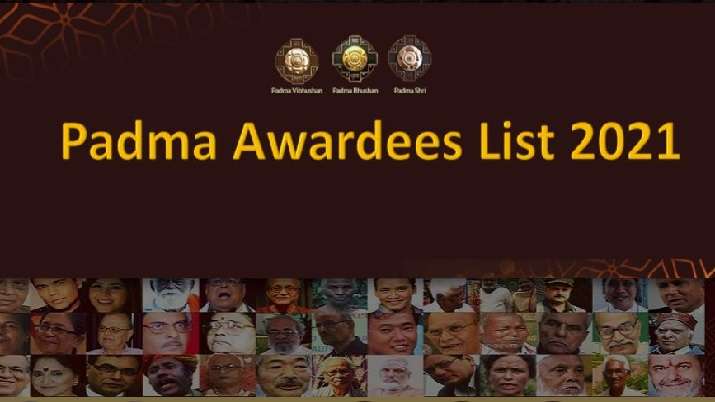
The Padma Awards are one of India’s highest civilian accolades, given out on the eve of Republic Day every year. The three categories of awards are as follows:-
Padma Vibhushan which is given for extraordinary and distinguished service
Padma Bhushan for distinguished service of higher level
Padma Shri for distinguished service in any field
The award is intended to reward accomplishments in all professions or disciplines where public service is a factor. The profession may include art, sports, trade, and industry etc. They are given out based on the recommendations of the Padma Awards Committee, which is formed every year by the Prime Minister. The public is invited to participate in the nomination process. Even one can nominate oneself. These honors are open to everyone, regardless of ethnicity, occupation, status, or gender. Government employees, including those who work for PSUs, are not eligible for these awards, with the exception of physicians and scientists.
The President has authorized the conferment of 119 Padma Awards this year, including one dual case in which the Award is considered as one. There are seven Padma Vibhushan awards, ten Padma Bhushan awards, and 102 Padma Shri awards on the list. There are 29 women among the honorees, as well as 10 foreigners, NRIs, PIOs, and OCIs, 16 posthumous awards, and one transgender awardee. The list is as follows:-
PADMA VIBUSHAN (7)
NAME
DISCIPLINE/FIELD
STATE/COUNTRY
1 Shri Shinzo Abe
Public affairs
Japan
2.Shri S P Balasubramanian(posthumous)
Art
Tamil Nadu
3.Dr. Belle Monapo Hedge
Medicine
Karnataka
4. Shri Narinder Singh Kapany (Posthumous)
Science and engineering
United states of America
5. Maulana Wahiduddin Khan
Others-spiritualism
Delhi
6. Shri B. B. Lal
Others-Archeology
Delhi
7. Shri Sudarshan Sahoo
Art
Odisha
PADMA BHUSHAN(10)
NAME
DISCIPLINE/FIELD
STATE/COUNTRY
1.Ms. Krishnan Nair Shantakumari Chithra
Art
Kerala
2.Shri Tarun Gogoi (Posthumous)
Public affairs
Assam
3.Shri Keshubhai Patel(Posthumous)
Public affairs
Gujrat
4.Shri Chandrashekhar Kambara
Literature and Education
Karnataka
5.Ms. Sumitra Mahajan
Public Affairs
Madhya Pradesh
6.Shri Nripendra Misra
Civil service
Uttar Pradesh
7.Shri Kalbe Sadiq (Posthumous)
Others-spiritualism
Uttar pradesh
8. Shri Tarlochan Singh
Public affairs
Haryana
9.Shri Rajnikant Devidas Shroff
Trade and industry
Maharashtra
10.Shri Ram Vilas Paswan (posthumous)
Public Affairs
Bihar
PADMA SHRI(102)
NAME
DISCIPLINE/FIELD
STATE/COUNTRY
Gulfam Ahmed
Art
Uttar Pradesh
P. Anitha
Sports
Tamil Nadu
Rama Swamy Annavarapu
Art
Andhra Pradesh
Subbu Arumugam
Art
Tamil Nadu
Prakasarao Asavadi
Literature and Education
Andhra Pradesh
Bhuri Bai
Art
Madhya Pradesh
Radhe Shyam Barle
Art
Chhattisgarh
Dharma Narayan Barma
Literature and Education
West Bengal
Lakhimi Baruah
Social Work
Assam
Biren Kumar Basak
Art
West Bengal
Rajni Bector
Trade and Industry
Punjab
Peter Brook
Art
United Kingdom
Sangkhumi Bualchhuak
Social Work
Mizoram
Gopiram Bargayn Burabhakat
Art
Assam
Bijoya Chakravarty
Public Affairs
Assam
Sujit Chattipadhyay
Literature and Education
West Bengal
Jagdish Chaudhary (Posthumous)
Social Work
Uttar Pradesh
Tsultrim Chonjor
Social Work
Ladakh
Mouma Das
Sports
West Bengal
Srikant Datar
Literature and Education
The U.S.A.
Narayan Debnath
Art
West Bengal
Chutni Devi
Social Work
Jharkhand
Dulari Devi
Art
Bihar
Radhe Devi
Art
Manipur
Shanti Devi
Social Work
Odisha
Wayan Dibia
Art
Indonesia
Dadudan Gadhavi
Literature and Education
Gujarat
Parshuram Atmaram Gangavane
Art
Maharashtra
Jai Bhagwan Goyal
Literature and Education
Haryana
Jagdish Chandra Halder
Literature and Education
West Bengal
Mangal Singh Hazowary
Literature and Education
Assam
Anshu Jamsenpa
Sports
Arunachal Pradesh
Purnamasi Jani
Art
Odisha
Matha B. Manjamma Jogati
Art
Karnataka
Damodaran Kaithapram
Art
Kerala
Namdeo C. Kamble
Literature and Education
Maharashtra
Maheshbhai and Nareshbhai Kanodia (Duo) (Posthumous)
Destinations such as Maldives, Croatia, South Africa, Switzerland, Russia, Lebanon, Germany, Ukraine, UAE, Turkey and Iceland have started allowing non-essential travel, subject to vaccination or other conditions.
India’s biggest online travel portal, MakeMyTrip, has seen a 35% jump in searches for international leisure packages in July compared to that in the previous month, with the Maldives and Russia ranking high on the list of preferred destinations.
“As positivity rates drop, we hope it encourages more countries to open their borders to Indian travellers,” said Vinay Malhotra, regional group chief operating officer, South Asia, Middle East and North Africa and Americas at visa processing firm VFS Global.
Aloke Bajpai, group CEO at Ixigo, said search enquiries on the company’s platform for travel to overseas destinations have seen 80-85% increase in July as compared to last month. “With several countries easing travel restrictions, interest in leisure international travel to countries such as the Maldives, Switzerland, Germany, Qatar and Turkey is rising,” he said.
Some countries such as Qatar and Switzerland require a full vaccination certificate (Covishield) from Indian travellers. Iceland has given an option to travellers to either submit a full vaccination certificate or a Covid-19 recovery certificate. Unvaccinated travellers can travel to countries such as the Maldives, Russia, Germany, Turkey, Nepal and Ukraine by providing a negative RT-PCR report issued within 72 hours of departure.
To cash in on the increasing interest, SOTC Travel has introduced a range of offers such as ‘Buy One Get One Free – Get your Companion’s Holiday Free’ for overseas destinations. Daniel D’souza, country head for leisure at the company, said the most popular destinations in terms of enquiries include Dubai, the Maldives, Russia and Switzerland. The company has seen a 35-40% increase week-on-week in enquiries, he said.
Kanika TTekriwal, CEO, JetSetGo Aviation, said travellers are still conscious about the high likelihood of contracting the virus via regular flights. As a result, her private jet and helicopter services company has been seeing 10-12 booking queries each day since air travel suspension was lifted for the Maldives and some European countries.







 Eduindex
You must be logged in to post a comment.