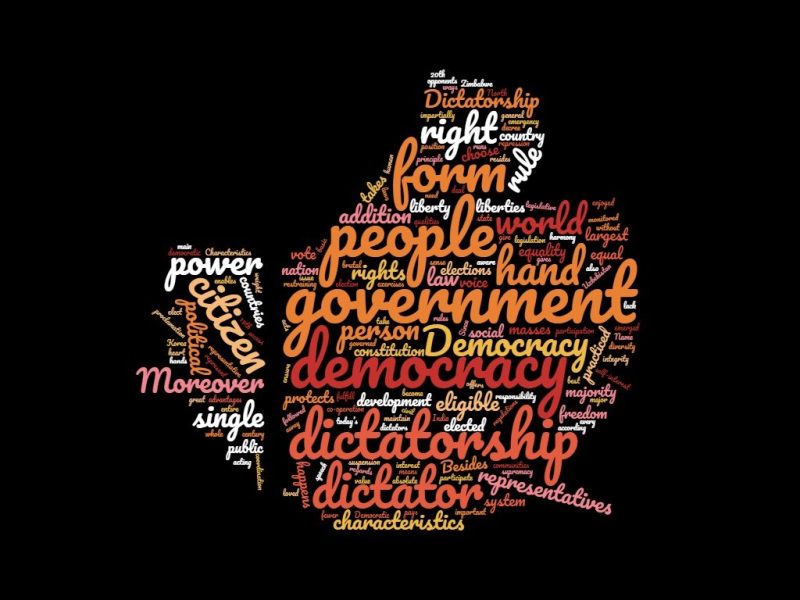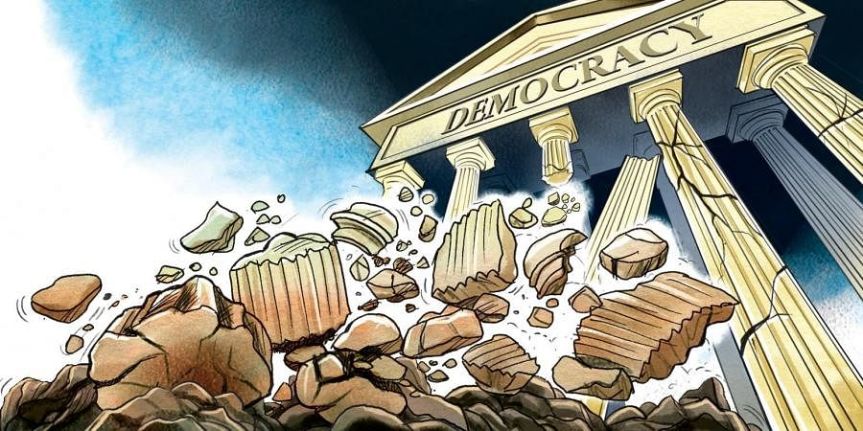
Has Democracy Expired?

Democracy, or rule by the people, has always been a complex concept. There have been freedom struggles, revolutions, and even wars to protect it. But nothing is permanent. Humankind has often taken democracy for granted and overestimated its permanence. As J.S Mill put it, “The fatal tendency of mankind to leave off thinking about a thing when it is no longer doubtful, is the cause of half their errors”. It wouldn’t be the first time an ostensibly powerful institution ended after years of dominance. When thinking about the end of a monarchy, guillotines and cake are few images that come to mind. 

Critiques of democracy note that voter ignorance and slow decision making often cause problems in a democracy. Furthermore, A democratically elected government earns its legitimacy because a majority of people, not all people, vote for it. Thus, it reflects the will of the majority and not everybody. This creates the possibility of the “tyranny of the majority”. Plato went so far as to assert that democracy is the science of manipulating people and it leads to the rule of tyrants. 

India’s “democratic experiment”, which began after we gained independence, has been anything but a smooth journey. Nevertheless, despite attacks on our democracy, such as the National Emergency of 1975, democracy has always protected our people. But now, democracy itself is in danger. 

We often make the mistake of ennobling free and fair elections as the only necessary criteria for a successful democracy. This is far from the truth. This article is not an attempt to undermine the fact that the current government was democratically elected, instead, it intends to showcase the harm a government elected by 38% of the population and a rising resentment of democracy amongst the people can cause. As we shall see, India’s democratic nature has been conspicuously declining for a while. 

Freedom House, an American Think Tank, gave India a score of 67/100 in its 2021 report and characterized India as a “partly free” country. A score of 34/40 in the political rights section confirms the purity 0f our elections. However, a score of 33/60 in the civil liberties section emblazons the potency of this government’s attack on democracy. According to the report, events such as the violence during the CAA protests, the misuse of sedition laws, the significant hardships that migrant workers had to endure during the lockdown, the baseless scapegoating of Muslims as super-spreaders of Covid-19, and the Babri Masjid Verdict contributed to this score. India was considered a “free” country as recently as 2020, with a score of 71/100. The 2021 score is also lower than those of 2019 (75/100) and 2018 (77/100), showing that the strength of our democracy is depleting. The last time the Freedom House considered India as partly free was in 1997, possibly because of the instability in Parliament at that time. 

Another report by the V-Dem Institute in Sweden described India as an “electoral autocracy”. According to the report, India belonged to the “EA+” category, signifying that it could also belong to the “closed autocracy” category. The reasons for this score include the curtailment of freedom of media, academia, and civil society; an increase in censorship; the misuse of sedition, defamation, and counter-terrorism laws, especially the Unlawful Activities Prevention Act (UAPA) to harass, intimidate, and imprison critics and opponents; the Citizenship Amendment Act (CAA); and the use the Foreign Contributions Regulation Act (FCRA) to restrict the entry, exit and functioning of Civil Society Organisations (CSO) and constrain the use of foreign contributions to NGOs within India. The V-Dem Institute reports have described India as an “electoral democracy” in the 2020, 2019, and 2018 reports. 

Sadly, the government’s response to these reports has been vituperative. They decided to deny the validity of these reports instead of countering their assertions. This approach to criticism and dissidence is not limited to foreign entities. Indian dissenters, whether they are farmers, students, members of opposition parties, or even ordinary citizens, are punitively called “anti-nationals” and even terrorists for criticizing the government. In an increasingly globalized world, it is accepted that opinions may be formed on issues beyond one’s national borders. The government’s disrespect and disregard for reputable news agencies, such as The New York Times and The Australian, is appalling. The government prefers listening to fraudulent news agencies, such as The Daily Guardian and The Australia Today, that were made by staunch sycophants. The government must remember that “You measure a democracy by the freedom it gives its dissidents, not the freedom it gives its assimilated conformists.” (Abbie Hoffman)

The symbol of our democracy, the parliament, has also witnessed numerous attempts to undermine our democracy. The Question Hour, which is a tool used to hold the ruling party accountable, was removed for the Monsoon session of Parliament. Considering that this was the first session of parliament since the pandemic began, the removal of this accountability mechanism is untenable. The ruling party used this session to push through the contentious farm bills. If these bills were truly what the entire nation needed, the government should have adhered to the democratic process and allowed a division vote when members of the opposition repeatedly requested for one. A voice vote may be quicker, but it undermines the voice of the opposition, which is a pillar of democracy. 

These farm bills join a larger list of controversial bills, including the bill that abrogated Jammu and Kashmir’s special status, the Citizenship Amendment Bill, and amendments to the Unlawful Activities (Prevention) Act, that did not pass motions to be sent to select committees for further parliamentary scrutiny. These committees provide a forum for feedback from various stakeholders and act as a consensus-building platform across political parties. In the 16th Lok Sabha (2014-19), 25% of the Bills were referred to these committees, which was much lower than the 71% and 60% during the UPA II and UPA I regimes respectively. Since 2020 began, out of the 44 bills introduced in parliament, no bill has been referred to the select committee. Unlike the GST Council, these standing committees weren’t allowed to meet virtually during the pandemic, despite numerous requests from opposition parties. 

From the exploitation of anti-defection laws; the misuse of ordinances; the creation of the opaque PM-CARES Fund; the oligarchical capture of democratic institutions such as the Central Information Commission, Reserve Bank of India, and even the Election Commission and finally to the recent Information Technology (Intermediary Guidelines and Digital Media Ethics Code) Rules, 2021 that could undermine free expression and privacy for internet users in India, the recent attacks to our democracy have been terrifying. Criticism, accountability, and independent institutions have all been seriously diminished. The Covid-19 pandemic appears to have derailed all democratic processes, except elections. 

At this time we must ask ourselves, do we still value our democracy? And most importantly, are we willing to fight for it together? I fear that the answer to both these questions is no and it has been for a long time. 

In 2017, two well-reputed political science scholars, Roberto Foa and Yascha Mounk published a paper titled “The Signs of Deconsolidation” that showed that over 70% of Indian respondents wished for a “strong leader who does not have to bother with elections”. This is a higher percentage than that of the USA (30%), Nigeria (45%), Turkey (58%), and even Pakistan (62%). This indicates that Indians are more willing to express support for authoritarian alternatives to democracy. 

This preference for the undemocratisation of India is further highlighted by recent studies conducted by the Pew Research Centre. Their 2017 report on democracy showed that 55% of Indian respondents felt that “a system in which a strong leader can make decisions without interference from parliament or the courts” would be a “totally good” way of governing this country. Conversely, only 17% of respondents felt that this would be “very bad” and 28% of them felt that this would be “totally bad”. Moreover, their 2020 report showed that 70% of Indian respondents were satisfied with the way that democracy worked in India. This is a significant rise compared to the 54% of respondents that were satisfied with it as per the 2019 report. The 2020 report also showed that 26% were dissatisfied with it, which is lower than the 33% in 2019. 

Undoubtedly, concluding that democracy has no place in our future would be incongruously prescient, but a growing intolerance for democracy is indubitable. People prefer quick decision making over the slow democratic process that requires consensus and deliberation. People would rather see tangible changes made by decree than wait for the democratic process. While the subversion of the democratic process may seem harmless to the current ruling party and those who espouse their ideology, permanent harm to our democracy ought to be denounced. The ubiquity of democracy should not depend on any political party’s ideology. The end of democracy would bring about the epoch of a procrustean India and end the plurality, secularism, and diversity that we have considered primordial for decades. At the rate our democracy is eroding, impassivity could mean that we’re the last generation of Indians to live in a true liberal democracy. 

The next opportunity for voters to actively resist this attack on our democracy may seem too far away. However, the 2024 general elections are preceded by elections in 16 states. My hope is that the control, division, and hatred promulgated by our current leaders, will ultimately consume them. Any reduction in their mandate will benefit our democracy. And if there is one thing that authoritarians cannot handle, it is the feeling of losing control. 

Democracy is not a plant that grows everywhere but hopefully, it can re-grow in our great nation. 
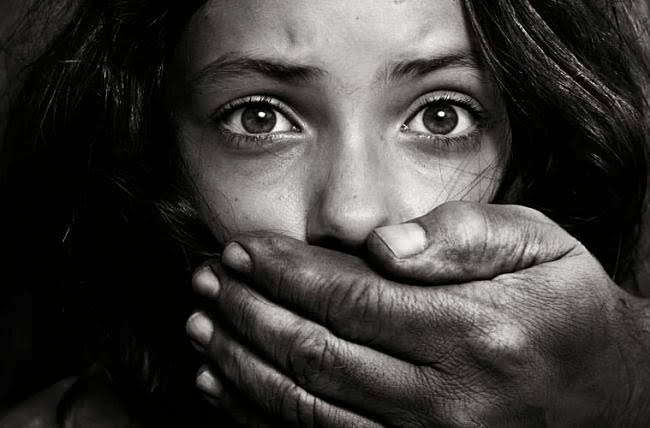
WHAT IS INDIAN MEDIA DOING?

The purpose of media in a nation is to provide information and knowledge to the people of the country. Media is regarded to be the most reliable means of information for the masses. There is no uncertainty about it that media plays an essential part in broadcasting information and facts, it keeps us informed regarding the happening across the world. The media acts as a link within the residents and the administration of the nation act as a third eye to the government, it draws clarity between the people and the state. News media is the fourth pillar of the democracy, be it a print media or television/ radio its main objective is to spread information with unbiased news without any modification or restriction, because people believe what they know, see and hear from these media platforms and manage to develop views and beliefs based on the data they are perceiving.


Indian media has been known for its reliable and substantial influence on the social, economical and political aspects of the country. In recent years the practice of funded news and increase in TRP has destroyed the faith across the media drastically, and because of this, the biggest victim turns out to be the Indian constitutionalism. The system of exerting money and supports from the corporate houses, politicians, administration, and big organizations, so that the media could show beneficial news concerning them has become a general practice in the press and is ruining the integrity of a journalist. Even if some of the media organizations or reporters want to present the right information to the people, they are always shut by the warning or threatening calls .


From the past two months where Indian TV channels mainly national ones have developed a fascination for one particular section of news – the demise of Bollywood star Sushant Singh Rajput. No matter however trivial or impossible, the Indian news media has left no stone unturned while broadcasting on Rajput’s death while there is other news like continuous rapes in Uttar Pradesh, the aftermath of floods in Assam, Ladakh issues, etc.


Most of the TV-news channels undividedly feed the desires of their political leaders and build the narratives to promote their political publicity. Paid news is dropping moral norms of journalism and day by day, the trust of the people on media platforms is disintegrating. The news commentators sitting on the ease of their AC studios and involving in undesirable discourse upon particular splinter group are accused of the current position of crisis in the nation. The Indian media now bears a severe crisis of reliability. If it does not improve itself, it will find its greatest asset going quickly depreciated and ultimately disappearing. Stripped of authenticity, sincerity, and trustworthiness, the media will desist to value to huge numbers of people lacking as a source of shoddy entertainment. Its high time now and we should stop this inconsistency before it causes more damage to the nation. Simply debar these news channels as we don’t need the help of news channels for biased opinions.

World War III, would it be Democracy Vs Dictatorship?

The current scenario of world order is disturbed and tightly stressed in the midst of on-going epidemic, Corona Virus. A virus that originated in China has spread across the globe reaching almost every country. Many countries are pointing fingers at Communist Party of China (CPC) for delaying information regarding deadly virus outbreak. Some accusations even suggest that this particular virus had been intentionally developed by the Chinese in the wuhan laboratory of virology to rupture the global economy. All this has led to tensioned strings between China and the rest of the world, with only few countries in support of china. Nations among these few allies of china are North Korea, Pakistan, Turkey, Iran etc. The most important aspect drawing attention is that all of China’s allies are either dictatorship or partially democratic.

This leads to our conclusion for the title, world war 3 would definitely be a war between dictatorship and the democracy.

India’s Military Up-gradation

India has decided to order 12 more Su30MKI fighter jets that will be made at Nasik by HAL under Russian licence. This new order will add to the 272 fighters of the type already ordered by the Indian Air Force. The Su30MKI fleet is now the backbone of IAF and will continue to be so for the coming years. The Chinese air force, too, operates the Su30 fighters.

With more than 260 fighters in service, Su30MKI forms the bulk of IAF. Additional jets are still being manufactured by HAL at Nasik and production will continue for next 2-3 years. The Indian versions are different from other Su30s as they are tailored to the needs of IAF. The designated MKI for India, the India’s modified Su30MKI have advanced Israeli avionics and an electronic warfare system, making them different from the standard Su30. The Indian fighter Aircrafts also demonstrates Brahmos firing capabilities.While they all have standard Russian origin R73/77 missiles, the Indian version will now be equipped with the longer-range Astra, the beyond visual range air-to-air missile developed by India’s DRDO (Defence Research & Development Organisation). This adds an advanced new capability to the aircraft that has till now been hampered by limited range to take down air targets, compared to the western platforms. Though it’s beyond visual range combat ability is limited, at close quarters it has unbeatable capabilities. China operates two variants of Su30 but these aren’t as capable as the Indian versions. The restrictions on the use of Israeli and western subsystems is one of the major reasons. China had ordered 73 of the older MKK version and later added 24 of the MK2 version for its Navy. However, unlike the MKI, the Chinese version does not have thrust vectoring engines, making them less manoeuvrable and nimble than the Indian fighters. China did not manufacture Su30s domestically, but it copied the design to make two indigenous versions called J11 and J16. The J11, which is based on Su27 platform, is the backbone of PLAAF, with 346 of the type ordered. The more advanced version J16 is based on the Su30 platform and are at least 128 in the service. China has fitted the aircraft with indigenous weapons, including PL12 and PL15 air-to-air missiles.

Both India and China are engaged in setting up their armies at the Indo-China borders, more aggressively after the galwan, Ladakh incident of clash between PLA (people liberation of China) and Indian army. It is also observed that most of the world leaders are upset with China’s response and careless behaviour towards the spread of covid-19. If at any point war breaks between India & China, the world would divide into allies and enemies. Diplomatically the India’s relationship with the rest of the world, would leave China helpless during war.

How India’s Democracy is Like No Other Nation

Indian democracy though not the oldest but still the largest of all democracies around the globe. It has its own sets of merits and demerits to which we would like to shed some lights on. The Indian political diaspora is unlike any other political system being quite complex with its 100s of national and state wise political parties. A system so diverse, that would always have some room for new political parties making it extreme difficult to choose from, for the citizens with voting rights. Political groups mostly based on caste or creed, religions or regions, are spread across the nation with dedicated voters who would never turn them down.

Now this can’t be concluded that Indian democracy is a bucket of flaws, it’s just that it has too much flexibility and has scope for all measures. A ferocious criminal would have equal citizen rights just as an innocent law abiding citizen would have. The Indian judiciary never sees any accused with public or news media’s perspective; everyone would go through same court trial. The Indian judiciary says “Doesn’t matter how many culprits are left unpunished but under no circumstances an innocent be punished”.

The many political party system on one hand obstructs the formation of decisive actions for the betterment of nation, it basically slows the overall process of national development but on the other hand it also ensures that no such bill/law to be passed that is unacceptable even to the super minorities of the country. Multiple party systems also ensure that representative of all castes or creeds, religions or races are present in the law forming parliament house. A good opposition is equally responsible for national growth as like a good running government.

A good democracy also ensures that no military gets above the political power and this situation remains likewise forever. We have many examples of failed/ collapsed nations who had military power above the political will, these countries being Syria, Lebanon, Iraq, Yemen and Pakistan. These countries had been victims of military hijack, where its citizens lost all their fundamental rights and political system could not do anything. In ministry of defence, Governors, President poses all political and decision making rights above all security forces, be it Army, Air Force, Navy or Police.

An army’s general would seek indirect permissions from the Prime Minister of India and not the President alone. Political leaders elected directly by the common crowd of India possess much more power than any government official or a representative further elected by the elected members.

This basically protects the idea of free India, a place for all and a place where every opinion matters. We do understand that Indian democracy is designed such that it would take greater time to incorporate changes, because when you have to bring together a crowd of 1.4 Billion with their agreeable opinions, it will take time.

Indian democracy isn’t just the largest, it has room for all. As mentioned earlier in this article, it takes time to initiate changes for the good but the good stays forever and for a law abiding citizen would be able to protect his dream for the better and safe tomorrow.

Why economy of India is slowing down???

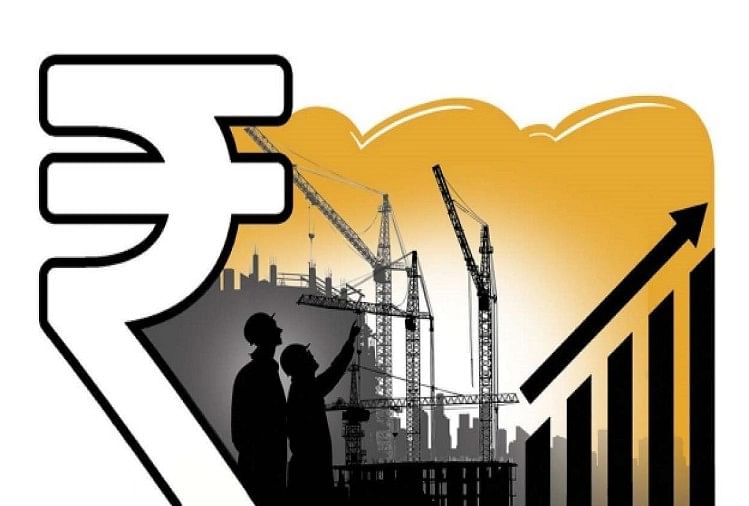
India is one among the world’s fasting growing economies. It had been touted as an economic and geopolitical counterweight to China. But recently its growth fell to its slowest pace in six years. Investment has weakened, and unemployment has risen. So what’s causing the slowdown, and how can it be reversed? Since the turn of the century, India’s economy has grown at a rapid rate, helping transform the country. Between 2006 and 2016, rising incomes lifted 271 million people out of poverty, meaning the proportion of Indians still living in poverty has fallen dramatically, from around 55% to twenty-eight . Access to electricity has also improved. In 2007 just 70% of the population had access to power. By 2017, that grew to nearly 93%.

India's economic growth likely to remain subdued in near future ...
More recently, the Indian government constructed around 110 million toilets — a huge step towards better sanitation designed to prevent the practice of open defecation. It’s a signature program of Prime Minister Narendra Modi, known as Swachh Bharat, or Clean India. All this development has been supported by a booming economy, but as lately , that expansion has begun to run out of steam. In the third quarter of 2019, India’s economic output grew by 4.5% – making it the primary time the country’s growth dipped below 5% since 2013. For context, 4.5% growth remains much above that of developed economies just like the U.S., But with 12 million Indians entering the workforce per annum , economists say the country needs annual growth rates to remain above nine percent to make sure there are enough jobs. So, what’s causing this recent slowdown? Well, officialdom argue turbulence in international financial markets is guilty.

Economy News, Latest economy news India, Indian Economy features ...
Political uncertainty and U.S.-China trade tensions mean confidence levels among investors and consumers everywhere have sunk. The United Nations has even warned that a global recession in 2020 is now a “clear and present danger”. But back to India – many economists say the country’s growth problems are literally self-inflicted. One obvious culprit is the shadow banking sector. During the 2000s, India saw an investment boom. It was fuelled by state banks dispensing a load of loans for giant infrastructure projects. But some of the companies taking advantage of these loans couldn’t keep up with the repayments. That meant the state banks weren’t getting paid back and therefore struggled to give out new loans. To keep business moving, shadow banks stepped in. These financial institutions, which operate like ordinary commercial banks but don’t follow traditional banking rules, eventually made up an estimated third of all new loans nationwide. The loans played a pivotal role for the millions of small businesses and consumers who would otherwise have no access to credit. But in 2018, shadow banking giant Infrastructure Leasing & Financial Services, defaulted on its debt repayments. Its collapse sent shockwaves through the economy and shook up more traditional banks that had supported the world.
It became harder for people to shop for expensive items like cars. That hurt India’s automotive industry, which is one among the country’s biggest. It employs about 35 million people and makes up about 7% of India’s GDP. Last summer, the industry suffered its worst sales performance in nearly 19 years, and reports suggest tens of thousands of workers are laid off. The agriculture and construction sectors have also been hurting, with small and medium businesses being hit the hardest. The country’s percentage has been on an overall upward trend since July 2017, rising several percentage points to 7.7%. Higher unemployment means consumers are buying less, resulting in the unfortunate cycle of slower manufacturing, production, investment and job creation.

Indian Economy Will Face Adverse Affects Of Coronavirus Gdp To ...
A survey from the Reserve Bank of India found consumer confidence has fallen to its lowest level in five years. But Indians still have a positive outlook for the longer term , with most consumers expecting to feel more optimistic during a year. However, if things don’t improve, debt could become another issue. Expecting better days ahead, many households have continued to spend, by taking out loans and dipping into savings. Household savings as a proportion of GDP has fallen from 23.6% to 17.2%. Meanwhile, household debt has surged to 10.9% during the same period. Critics say the govt in New Delhi has did not spot these risks and hasn’t done enough to urge the economy moving again. The Reserve Bank of India’s former governor Raghuram Rajan recently blamed the lack of significant reforms and a slowdown in investments since the global financial crisis. Even the country’s chief economic advisor recently admitted reforms are needed to form India more friendly to investors.
India has cut its corporate rate , but labor and land laws are still extremely strict. He also says the country must become pro-market, instead of just pro-business, to avoid costly government bailouts of failing sectors. But not all reforms have been good to the economy. In 2016, Prime Minister Modi tried to crack down on corruption, counterfeits and evasion by banning high value bank notes. In one night, the cash ban made 86% of all cash invalid. Three years later, many analysts say the policy disrupted the economy and did not achieve many of its original goals. In 2017, a replacement nuisance tax placed small businesses struggling and a few of them were forced to shut . In mid-2019, India’s government introduced a controversial new tax on foreign investors. Consequently, India’s stock exchange suffered its worst July performance in 17 years. Just one month later, the measure was scrapped.
The government has now refocused its efforts on international trade and investment, and thus the recent changes to the corporate rate could indeed help attract businesses and investors to India. But if the country wants to be a part of the world’s largest supply chains, it’ll need low and consistent tariff levels to encourage outsiders to take a position for the long term.

The country’s shifting export policy has harmed several of its largest industries, particularly clothing. India’s share of the worldwide apparel market has increased only slightly within the past 20 years. And though the Indian workforce is vast, both Bangladesh and Vietnam now export more. On top of that, the country’s import tariffs on the average are much above the world’s biggest economies. They’re also among the highest of the world’s emerging economies. Even U.S. President Donald Trump has called for the country to bring down its duties.

Has India’s growth actually slowed the maximum amount as we think? The government’s former chief economic advisor Arvind Subramanian caused a good little bit of controversy in June 2019, when he claimed the country’s official stats probably overstated GDP growth by 2.5% from 2011-2012 to 2016-2017. He says the bottom line is that India never recovered from the global financial crisis. The government denies this. But none of this has hurt Prime Minister Modi at the polls – he won by a landslide in the most recent election. So how will he keep his promise and double the dimensions of the economy by 2025? Many economists insist a well-explained economic vision would help. As would more long-term investment, better skilled workers and enhancements to infrastructure. It may not matter who or what’s responsible for India’s recent economic challenges, but bottom line – India’s economic process must recover , and fast.

Explained: How will the ban of TikTok and other Chinese apps be enforced; what will be the impact?

TikTok, other Chinese apps banned in India: The notification is expected to be followed by instructions to Internet service providers to block these apps.

Some of the banned Chinese apps are very popular among Indian users, especially TikTok which has over 100 millions active users in the country, especially in heartland India.

India on Monday banned 59 apps originating from China, including very popular ones like the short video platform TikTok, UC Browser, file sharing app ShareIt, and CamScanner, which allows iOS and Android devices to be used as image and document scanners.

What is the legal basis for India’s action?

The ban has been enforced under Section 69A of the Information Technology Act, 2000 (“Power to issue directions for blocking for public access of any information through any computer resource”): “Where the Central Government or any of its officers specially authorised by it… is satisfied that it is necessary or expedient so to do, in the interest of sovereignty and integrity of India, defence of India, security of the State, friendly relations with foreign States or public order or for preventing incitement to the commission of any cognizable offence relating to above, it may… by order, direct any agency of the Government or intermediary to block for access by the public or cause to be blocked for access by the public any information generated, transmitted, received, stored or hosted in any computer resource.

The Ministry of Information and Technology has said that it “has received many complaints from various sources including several reports about misuse of some mobile apps… for stealing and surreptitiously transmitting users’ data in an unauthorised manner to servers which have locations outside India”. Since this “ultimately impinges upon the sovereignty and integrity of India, is a matter of very deep and immediate concern which requires emergency measures”, it has said.

How will the ban be enforced?

The notification is expected to be followed by instructions to Internet service providers to block these apps. Users are likely to soon see a message saying access to the apps has been restricted on the request of the government.

However, while this will impact apps like TikTok and UC News that need a live feed to serve any purpose, users might still be able to continue using apps that don’t need an active Internet connection to be used. But further downloads of these apps, like CamScanner, are likely to be blocked on Google’s Play Store and Apple’s App Store.

India bans Chinese bans, Chinese apps banned, Chinese apps banned full list, TikTok banned, UC Browser banned, ShareIt banned, Indian ExpressqThe full list of 59 Chinese apps banned by the government.

What will be the impact of the ban?

Some apps on the banned list are very popular in India, especially TikTok, which has over 100 million active users in the country, mainly in the heartland. New social media platforms like Helo and Likee, as well as video chat app Bigo Live are immensely popular among Indians who are not comfortable in English. These users will have to look for substitutes.

Also, most of these platforms have Indian creators, for many of whom this is the only source of income. Many of these apps have offices and employees in India, and a few thousand jobs could be at stake.

Decoding LAC Conflict

How will the ban of TikTok and other Chinese apps be enforced; what will be the impact?

With stand-off at friction points continuing, expect a longer battle of nerves on Ladakh LAC

Talks will continue but military pushback also on Delhi’s table

Will the ban be permanent?

TikTok was banned in India on the order of the Madras High Court for a few days last year, but it came back soon after the court vacated the ban. This action, however, is more sweeping, impacts more apps, and has been taken in a specific strategic and national security context. It could be a warning to bigger Chinese businesses in India, and to China itself.

Hon’ble Prime Minister’s Letter

My fellow Indian,

PM Narendra Modi
PM Narendra Modi

This day last year began a golden chapter in the history of Indian democracy. It was after several decades that the people of the country voted back a full term government with a full majority.

Once again, I bow to the 130 crore people of India and the democratic ethos of our nation.

During normal times, I would have been in your midst. However, the present circumstances do not permit that. That is why, I seek your blessings through this letter.

Your affection, goodwill and active cooperation have given new energy, and inspiration. The way you have showcased the collective strength of democracy is a guiding light for the whole world.

Back in 2014, the people of the country voted for a substantive transformation. In the last five years, the nation saw how the administrative apparatus broke itself free of status quo and from the swamp of corruption as well as misgovernance. True to the spirit of ‘Antyodaya’ the lives of millions have been transformed.

From 2014 to 2019, India’s stature rose significantly. The dignity of the poor was enhanced. The nation achieved financial inclusion, free gas and electricity connections, total sanitation coverage, and made progress towards ensuring ‘Housing for All.’

India demonstrated its mettle through the surgical strike and air strike. At the same time, decades old demands such as OROP, One Nation One Tax- GST, better MSP for farmers were fulfilled.

In 2019, the people of India voted not merely for continuity but also with a dream- of taking India to new heights. A dream of making India a global leader. The decisions taken in the last one year are directed at fulfilling this dream.

Today, 130 crore people feel involved and integrated in the development trajectory of the nation.The light of ‘Jan Shakti’ and ‘Rashtra Shakti’ has ignited the entire nation. Powered by the Mantra of ‘Sabka Saath, Sabka Vikas, Sabka Vishwas’ India is marching forward in all spheres.

My fellow Indian,

In the last one year, some of the decisions were widely discussed and remain etched in public discourse.

The decision on Article 370 furthered the spirit of national unity and integration. The Ram Mandir judgment, delivered unanimously by the Honourable Supreme Court of India, brought an amicable end to a debate persisting for centuries. The barbaric practice of Triple Talaq has been confined to the dustbin of history. Amendment to the Citizenship Act was an expression of India’s compassion and spirit of inclusiveness.

But there have been many other decisions that have added momentum to the nation’s development trajectory.

The creation of the post of the Chief of Defence Staff  was a long pending reform that has improved coordination among the armed forces. At the same time, India has stepped up preparations for Mission Gaganyaan.

Empowering the poor, farmers, women and youth has remained our priority.

PM Kisan Samman Nidhi now includes all farmers. In just one year, more than Rupees 72,000 crore has been deposited in the accounts of over 9 crore 50 lakh farmers.

The Jal Jeevan Mission will ensure supply of potable drinking water through piped connections to over 15 crore rural households.

A huge campaign of free vaccination is being conducted for better health of our 50 crore livestock.

For the first time in our country’s history, farmers, farm labourers, small shopkeepers and workers in unorganised sector are assured the provision of regular monthly pension of Rs. 3000 after the age of 60 years.

Besides the facility of availing bank loans, a separate department has also been created for fishermen. Several other decisions have been taken to strengthen the fisheries sector. This will boost the blue economy.

Similarly, it has been decided to constitute a Vyapari Kalyan Board for timely resolution of the problems of the traders. Higher quantum of financial assistance is being provided to more than 7 crore women attached to self help groups. Recently the loans without guarantee for self help groups has been doubled to 20 lakh from the earlier 10 lakh.

Keeping in mind the education of tribal children, we have begun the construction of more than 400 new Ekalavya Model Residential Schools.

Several people friendly laws have been ushered in during the last year. Our Parliament has broken the decades-old record in terms of productivity. As a result, whether it be the Consumer Protection Act, the amendment to Chit Fund Law or laws to provide more protection to women, children and Divyang, their passage in the Parliament was expedited.

As a result of the policies and decisions of the government, the rural-urban gap is shrinking. For the first time, the number of rural Indians using internet is 10% more than the number of urban Indians.

The list of such historic actions and decisions taken in national interest would be too long to detail in this letter. But I must say that every day of this year, my government has worked round the clock with full vigour, taking and implementing these decisions.

My fellow Indian,

As we were moving ahead at fast pace in the fulfilment of hopes and aspirations of our countrymen, the Coronavirus global pandemic engulfed our country as well.

While on one hand are powers with great economic resources and state-of-the-art healthcare systems, on the other hand is our country besieged with problems amidst a vast population and limited resources.

Many feared that India will become a problem for the world when Corona hits India. But today, through sheer confidence and resilience, you have transformed the way the world looks at us. You have proven that the collective strength and potential of Indians is unparalleled compared even to the powerful and prosperous countries of the world. Be it clapping and lighting a lamp to the honouring of Corona Warriors by India’s armed forces, Janta curfew or by faithful adherence to rules during the nationwide lockdown, on every occasion you have shown that Ek Bharat is the guarantee for ShresthaBharat.

In a crisis of this magnitude, it can certainly not be claimed that no one suffered any inconvenience or discomfort. Our labourers, migrant workers, artisans & craftsmen in small scale industries, hawkers and such fellow countrymen have undergone tremendous suffering.We are working in a united and determined way to alleviate their troubles.

However, we have to take care to ensure that inconveniences that we are facing do not turn into disasters. Hence, it is very important for every Indian to follow all rules and guidelines. We have displayed patience so far and we should continue to do so. This is one of the important reasons for India being safer and in a better state than many other countries. This is a long battle but we have started traversing on the path of victory, and victory is our collective resolve.

In the last few days, a super cyclone has wreaked havoc in parts of West Bengal and Odisha. Here too, the resilience of the people of these states is noteworthy. Their courage inspires the people of India.

Dear friends,

At such a time, there is also a widespread debate on how the economies of various countries, including India’s, will recover. However, given the way India has surprised the world with its unity and resolve in the fight against Coronavirus, there is a firm belief that we will also set an example in economic revival. In the economic domain, through their strength, 130 crore Indians can not only surprise the world but also inspire it.

It is the need of the hour that we must become self-reliant. We have to move forward based on our own abilities, in our own way, and there is only one way to do it – Aatmanirbhar Bharat or Self-reliant India.

The recent Rs 20 lakh crore package given for Aatmanirbhar Bharat Abhiyan is a major step in this direction.

This initiative will usher in a new era of opportunities for every Indian, be it our farmers, workers, small entrepreneurs or youth associated with start ups.

The fragrance of Indian soil along with the sweat, hard work and talent of our workers will create products that will reduce India’s dependence on imports and will move towards self-reliance.

Dear friends,

In this journey of the last six years, you have continuously showered me with love and blessings.

It is the strength of your blessings that has made the nation take historic decisions and progress rapidly in the last one year. However, I am also aware that there is a lot that needs to be done. There are many challenges and problems that our country faces. I am working day and night. There could be deficiencies in me but there is nothing that our country lacks. So, I believe in you, your strength and your abilities even more than I believe in myself.

The source of strength for my resolve is you, your support, blessings and affection.

Due to the global pandemic this is certainly a time of crisis but for us Indians this is also a time for a firm resolve.

We must always remember that the present and future of 130 crore Indians will never be dictated by an adversity.

We will decide our present and our future.

We will move ahead on the path of progress and victory will be ours.

It is said that- कृतम्मेदक्षिणेहस्ते, जयोमेसव्यआहितः

This means, if we have action and duty on one hand, then success is assured in the other hand.

With prayers for our country’s success, I bow to you once again.

My heartiest wishes to you and your family.

Stay healthy, stay safe!!!

Stay aware, stay informed!!!

Your Pradhan Sevak

Narendra Modi