How Can Fiction Be Written? Featuring Barbie!

“Imagination and Fiction make up more than three quarters of our life.”

  • Simone Weil

Today’s article discusses an essential factor when it comes to writing fiction I.e how to write it? Barbie aka Barbara Milicent Roberts is our chief guest for today’s discussion.

“Hello Barbie! Warm Welcome Aboard. We are so glad to have you here with us.”

“Thank you for inviting me. I’m pleased to be a part of this discussion as well.”

“So, would you like to tell us the ways of writing fiction? (That for which you are here)”

“Definitely! Fiction is an interesting genre when you come to look at it. It also, comes with a wide range of interesting sub – genres which have been discussed in the earlier article. It can be written insensibly by taking almost any entity that you prefer or make one for yourself by amalgamating two or more entities. There are mostly no constraints in fiction and that is why, writing or working upon this genre doesn’t actually seem a hard task. Yes! I agree that imagining certain factors is a hard task, but we mustn’t overlook the fact that almost everything comes with its own set of hard work! Here, however I am not considering contemporary fiction or that which pertains to reality. I shall be emphasizing on how fiction (fantasy and other related genres) can be written.

Now, let us learn how exactly to write fiction through a step by step approach.

Brainstorm Over The Fictitious Topic You Intend To Choose!

Brainstorming is a process that requires time. So, first and foremost, the thing to be done, is to sit down on your favourite couch and ponder over the best fictitious topic that would definitely seem great if sketched on paper. However, don’t forget to get yourself in the reader’s shoes as stated in our earlier articles. Consider what your readers would love and write in accordance to that.

Think Of The Characters You Wish To Involve!

This is a quintessential factor that makes a story interesting. The characters make a story. However, framing of characters also depends on the sub – genre you choose. If you choose contemporary fiction, then you would definitely make use of real life characters. In such cases, you could ignore this second step and only consider the first. This step is for people who wish to work with the fantasy sub – genre because framing fictitious characters requires certain amount of deep thought processes.

In Case Of Writer’s Block, Approach The Outside World!

  Certain people experience writer’s block while writing fiction because they seem to fall short of ideas. In such cases, it is advisable to approach the outside world as inspiration to your thought processes. Some incident will definitely inspire you to write about it.

Create Strong Characters!

Make sure that the fictitious characters you create are strong enough so that the readers love them. Like, a certain character should show strong traits in personality and not physical strength 😉 Make the characters take risks throughout the story and later help them succeed. This will also deliver a good message and inspire people to take risks! Thus, all that we mean here is, that try creating characters that would also impart a message to the readers. Also, mostly it is advisable to create Round characters. Round characters are those whose traits or personalities throughout the story aren’t easily decipherable. These characters would arouse the interest factor and enhance your write up.

Create Unique Characters!

By this we mean, that when you choose to create fictitious characters, make sure that you don’t use the same repeated mythological supernatural entities revolving around mermaids, aliens and robots. These are widely known and won’t make your story that interesting. You could always create a new character for yourself by amalgamating existent entities, as stated in the earlier article.

Read Other Fiction Books For Ideas!

This is the basic step that would definitely help you to frame your own story easily. Read more and more fiction books by widely renowned authors for amazing techniques of writing a fiction book easily.

Try Fictionalizing Your Daily Life!

This means, fictionalizing your daily chores and duties in an imaginative and creative way. For instance, you are working in the kitchen and see a ladle, now you could create your own fictitious character named Mr. Ladle who could speak throughout the story. He could also be an antagonist or maybe even a protagonist if you decide to create an animated fictitious story.

Be Alert And Aware Of Your Surroundings For Inspiration!

This is extremely important because developing a fictitious story requires complete imagination. So, you need to be alert when you come across such objects which could make your story interesting. After all, if you aren’t alert then that inspiration wouldn’t be accessible to you and would pass you directly, without you acknowledging it. So, remain alert and vigilant.

“These were such essential points to be noted. We heartily thank you for your precious time! Hoping to have you again to speak on such interesting topics in the near future!”

“Please don’t mention it. I’m touched by this honourable gesture of being a chief guest on such an important discussion. Looking forward to yet another invite in the future for sure!”

Thank You So Much Barbie!

OLIGOPOLY MARKET

Oligopoly is a market situation in which there are a few firms selling homogeneous or differenti­ated products. It is difficult to pinpoint the number of firms in ‘competition among the few.’ With only a few firms in the market, the action of one firm is likely to affect the others. An oligopoly industry produces either a homogeneous product or heterogeneous products.

The former is called pure or per­fect oligopoly and the latter is called imperfect or differentiated oligopoly. Pure oligopoly is found primarily among producers of such industrial products as aluminium, cement, copper, steel, zinc, etc. Imperfect oligopoly is found among producers of such consumer goods as automobiles, cigarettes, soaps and detergents, TVs, rubber tyres, refrigerators, typewriters, etc.

CHARACTERISTICS OF OLIGOPOLY

  • Interdependence

There is recognised interdependence among the sellers in the oligopolistic market. Each oligopolist firm knows that changes in its price, advertising, product characteristics, etc. may lead to counter-moves by rivals. When the sellers are a few, each produces a considerable fraction of the total output of the industry and can have a noticeable effect on market conditions.He can reduce or increase the price for the whole oligopolist market by selling more quantity or less and affect the profits of the other sellers. It implies that each seller is aware of the price-moves of the other sellers and their impact on his profit and of the influence of his price-move on the actions of rivals.

Thus there is complete interdependence among the sellers with regard to their price-output policies. Each seller has direct and ascertainable influences upon every other seller in the industry. Thus, every move by one seller leads to counter-moves by the others.

  • Advertisement

The main reason for this mutual interdependence in decision making is that one producer’s fortunes are dependent on the policies and fortunes of the other producers in the indus­try. It is for this reason that oligopolist firms spend much on advertisement and customer services.As pointed out by Prof. Baumol, “Under oligopoly advertising can become a life-and-death matter.” For example, if all oligopolists continue to spend a lot on advertising their products and one seller does not match up with them he will find his customers gradually going in for his rival’s product. If, on the other hand, one oligopolist advertises his product, others have to follow him to keep up their sales.

  • Competition

This leads to another feature of the oligopolistic market, the presence of com­petition. Since under oligopoly, there are a few sellers, a move by one seller immediately affects the rivals. So each seller is always on the alert and keeps a close watch over the moves of its rivals in order to have a counter-move. This is true competition.

  • Barriers to Entry of Firms

As there is keen competition in an oligopolistic industry, there are no barriers to entry into or exit from it. However, in the long run, there are some types of barriers to entry which tend to restraint new firms from entering the industry.

They may be:

(a) Economies of scale enjoyed by a few large firms

 (b) control over essential and specialised inputs

(c) high capital requirements due to plant costs, advertising costs, etc.

 (d) exclusive patents and licenses; and

(e) the existence of unused capacity which makes the industry unattractive. When entry is restricted or blocked by such natural and artificial barriers, the oligopolistic industry can earn long-run super normal profits.

  • Lack of Uniformity

Another feature of oligopoly market is the lack of uniformity in the size of firms. Finns differ considerably in size. Some may be small, others very large. Such a situation is asymmetrical. This is very common in the American economy. A symmetrical situation with firms of a uniform size is rare.

  • Demand Curve

It is not easy to trace the demand curve for the product of an oligopolist. Since under oligopoly the exact behaviour pattern of a producer cannot be ascertained with certainty, his demand curve cannot be drawn accurately, and with definiteness. How does an individual seller s de­mand curve look like in oligopoly is most uncertain because a seller’s price or output moves lead to unpredictable reactions on price-output policies of his rivals, which may have further repercussions on his price and output.The chain of action reaction as a result of an initial change in price or output, is all a guess-work. Thus a complex system of crossed conjectures emerges as a result of the interdependence­ among the rival oligopolists which is the main cause of the indeterminateness of the demand curve.

  • No Unique Pattern of Pricing Behaviour

The rivalry arising from interdependence among the oligopolists leads to two conflicting motives. Each wants to remain independent and to get the maximum possible profit. Towards this end, they act and react on the price-output movements of one another in a continuous element of uncertainty.On the other hand, again motivated by profit maximisation each seller wishes to cooperate with his rivals to reduce or eliminate the element of uncertainty. All rivals enter into a tacit or formal agreement with regard to price-output changes. It leads to a sort of monopoly within oligopoly.They may even recognise one seller as a leader at whose initiative all the other sellers raise or lower the price. In this case, the individual seller’s demand curve is a part of the industry demand curve, having the elasticity of the latter. Given these conflicting attitudes, it is not possible to predict any unique pattern of pricing behaviour in oligopoly markets.

Major problems faced in India.

Every country in the world have some other the problems, like that India also have some problems. In this blog, we are going to discuss, some major problems in India like the , education system, unemployment, poverty, basic sanitation, and pollution.

EDUCATION SYSTEM

Every education system will have both theoretical and practical knowledge. Both theoretical and practical knowledge are important. In India’s education system consist of 90 percent theoretical knowledge and 10 percent practical knowledge. Every student needs practical and skilled knowledge, because they are the one who help student to live in the real world. Every sector whether it is agriculture or IT needs skilled workers not theoretical workers. Students in India often study to score marks not knowledge.

UNEMPLOYMENT

According to a survey, 6.9 percent of people in India are unemployed. Nowadays, unemployment become common among youngsters. Unemployment is the state at which person who is able to work but fails to get one. Why there is unemployment in India? The unemployment rate is high in India because there are more job seekers than the job requirement. Due to covid-19 pandemic many people lost there jobs because of the national wide lock down and shut down of some companies. There is high competition for every job in India because of the high population. India stands at 86th position in unemployment in the world. The government of India must take the necessary steps to eradicate unemployment. This is very serious problem in the society.

POVERTY

Poverty is another major problem for a country. As of now, 13.7 percent of people in India live below the poverty line. People who earn less than 1060 rupees in rural and 1286 rupees per month in urban comes under the poverty line. 80 percent of the poor people live in villages only. 43 percent of the people belongs to Scheduled Caste(SC) and Scheduled Tribes(ST). The maximum people living below the poverty line are found in Bihar, Madhya pradesh, Uttar pradesh and rajasthan only. People under the poverty line declined from 37 percent in to 13.7 percent in 2021. Experts suggest that it will decline by 5 percent in 2025.

POLLUTION

Pollution is the serious problem for all countries in the world. As of now, India stands 5th position in world’s most polluted countries. Delhi is the most polluted city in India, Breathing air in Dehli is like breathing 35 cigarettes at a time. There are many types of pollution such as water pollution, air pollution, land pollution and noise pollution. sewage water is main reason for water pollution in India. Ganga and yamuna are the most polluted rivers in India. Vehicle horns and construction sounds are main reason for noise pollution. Government needs to take care of these following problems.

BASIC SANITATION

Sanitation is another big problem in India. According to a survey, more than 700 million people don’t have the access to toilets at there home. In slums people don’t have a toilet at all. Many rural schools don’t have toilet facilities because of that parents don’t send there daughter to school. We should be thankful government because under the Swach Bharat Abhiyan government built 12 million toilets for the people.

That’s all from my side. I hope you like it.

The utterly butterly delicious story of Amul

Over the years, Amul, one of the most beloved brands of our country, has become the taste of India, just as its tagline claims. Every Indian millennial has grown up listening to the jingles of its many dairy products, and the Amul girl, the brand’s mascot in the polka-dotted dress, has become a nostalgia-evoking symbol. Amul has truly come a long way since its founding in 1946.

The beginning

Amul was formed as a part of a cooperative movement against Polson Dairy in Anand, Gujarat, which procured milk from local farmers of Kaira District at very low rates and sold it to the then Bombay government. Everyone except the farmers benefited from this trade. The farmers took their plea to Sardar Patel, who had advocated farmers’ cooperatives since 1942. The result was the formation of the Kaira District Co-operative Milk Producers’ Union Limited in Anand.

The union started pasteurising milk produced by a handful of farmers for the Bombay Milk Scheme and grew to 432 farmers by the end of 1948. The rapid growth led to problems including excess production that the Bombay Milk Scheme couldn’t accommodate. To solve this issue, a plant was set up to process all that extra milk into products such as milk powder and butter.

Amul is born

The late Dr. Verghese Kurien, rightly called the Milkman of India, was Amul’s true architect. His journey at Amul began in 1949 when he arrived in Anand to manage a dairy as a government employee. He went from helping farmers repair machinery to revolutionising India’s dairy industry with the White Revolution (or Operation Flood), the largest dairy development programme in the world.

The new dairy with the milk processing plant was ready for operation in October 1955, the year that also saw a breakthrough in dairy technology —buffalo milk was processed to make products for the first time in the world. The word ‘Amul’, derived from ‘Amulya’, which means ‘precious’ or ‘priceless’ in Sanskrit, was used to market the range of milk products developed by the Kaira Union. It is also an acronym for Anand Milk Union Ltd.

Dr Kurien had a vision. He wanted to offer small-scale dairy farmers quality-control units and centralised marketing, which were missing at the time in the dairy economy. Thus, the Gujarat Cooperative Milk Marketing Federation (GCMMF) was created in 1973 to market milk and all milk products produced by six district cooperative unions in Gujarat. GCMMF is the largest exporter of dairy products in India and Amul is the umbrella for all of its products.

Awards, accolades, and a global presence

Over the years, Amul, together with GCMMF, has won numerous awards. Some of these include the Rajiv Gandhi National Quality Award, 1999; the Golden Trophy for Outstanding Export Performance, 2009-10; Best Marketing Campaign, 2014; and World Dairy Innovation Award, among many others. Amul earned recognition all over the world when GCMMF  introduced it on the Global Dairy Trade (GDT) platform, where only the six top dairy players across the world sell their products.

More than a mere slogan

Amul’s famous slogan, which is now a part of its logo, was created in 1994 by Shri Kanon Krishna of a Mumbai-based advertising agency called Advertising and Sales Promotion (ASP). According to Amul, the Taste of India slogan is more than just corporate positioning or advertising jargon. This slogan lends meaning to the brand’s never-ending commitment to taking quality food and products to the rural man, which he otherwise couldn’t have afforded.

The Butter Girl

Amul did not always have the round-eyed moppet as its mascot. The Butter Girl was born in 1966 when Sylvester daCunha, the then MD of the advertising agency handling Amul butter’s account, created her for its campaign. It was a pleasant change from the dull, corporate ads that the previous agency had come up with. Being a seasoned marketer himself, Dr Kurien gave daCunha complete creative freedom to create and release the ads without taking the company’s permission. 30 years later, the Utterly Butterly Girl still wins hearts wherever she is, whether on a billboard or on the packet of butter.

Amul is not just a brand; it is also a movement that represents farmers’ economic freedom. The name is now a household term that is here to stay, and the chubby-cheeked Amul girl will continue to cast a spell on the public.

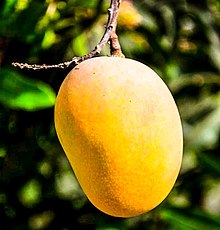
Bahrain Receives Consignment of GI Certified Fazil Mango Variety from West Bengal

Mango - Wikipedia
  • The commerce ministry declared that a consignment of GI certified Fazil mango variety sourced from the Malda area of West Bengal was shipped to Bahrain. The GI tag ensures that growers receive a premium price for their product so that no other company may use the name to sell similar products.

What is a GI Tag?

  • A geographical indication (GI) tag is applied to an agricultural, natural, or manufactured product (handicrafts and industrial items) that originates from a certain geographic area. Generally, a name like this offers a sense of quality and uniqueness, which is largely due to its place of origin.
  • In India, registered GIs products include Darjeeling tea, Tirupathi laddu, Kangra paintings, Nagpur orange, and Kashmir pashmina.
  •  A week-long Indian mango promotion program was held in Bahrain in June 2021, with 16 kinds of the fruit on display, including three GI certified Khirsapatin and Lakshmanbhog (West Bengal) and Zardalu (Bihar).
  • APEDA, in collaboration with Farmer Producer Organizations (FPOs), traders, exporters, agricultural scientists, the Uttar Pradesh government, and other institutions, had organized a meet to promote agricultural crop exports and adherence to global practices.

India’s first Covid patient again tested positive

She was a student from Kerala’s Thrissur enrolled at a medical college in China, who was the first Indian to test positive for Covid-19 in January 2020 after returning to India following the outbreak of the pandemic, has been infected again, a health official said on Tuesday.

Thrissur district medical officer K J Reena said” she has been she tested positive and under quarantine at her home. None of the family members have tested positive so far”.

The student was found to have been reinfected after she was retested as she planned to travel to Delhi. Her family said she is showing no visible symptoms and that she has also been administered the first Covid-19 vaccine dose.

The student, who has been unable to return to China as Beijing is yet to allow Indian students back into the country because of the pandemic, spent almost a month in hospital while undergoing treatment for Covid-19 in 2020. Her friends also tested positive who was travelled with her from Wuhan.

She spent 24 days at an isolated ward from January 27 to February 20, wearing personal protective equipment. She said her medical background helped her overcome the trauma.

East Timor: Brief analysis of its history & independence.

East Timor or Timor-Leste is a tiny island country in Southeast Asia nestled between Australia and Indonesia.

For more than 300 years the territory of East Timor was ruled by Colonial Portugal (Portuguese Timor). They set up both commercial outposts and catholic missions. On 28 November 1975, Portugal withdrew from the island territory when the Revolutionary Front for an Independent East Timor had declared the territory’s independence. But this exit from East Timor was not at all smooth and this enraged bitter rivalry between various local groups. Just nine days later in December 1975 East Timor was invaded and occupied by the Indonesian military. Suharto, the Indonesian president at that time didn’t receive much resistance from the western countries due to the left-leaning stance of East Timor at that time (Cold war).  The Indonesian occupation was a brutal and violent period in East Timor’s history with various suppression tactics many people lost their lives during that period.

The following decades were highly violent with many conflicts between the separatist groups known as Fretilin and the Indonesian military. The military fought a continuous guerilla war with the rebels in the island’s interior mountains. There were numerous rights violations and over 100,000 people died under the occupations of Indonesia.

One of the most defining instances happened on November 12, 1991, when the Indonesian military shot and killed over 250 people who had come for the memorial procession in honor of Sebastio Gomez, a pro-independence supporter killed by the Indonesian military. The events occurred in the Santa Cruz Cemetery in Dili, East Timor’s capital. This tragedy is known as the Santa Cruz Massacre. The event gained international media attention. Although the Indonesian occupation did not cede until eight years later in 1999, the Santa Cruz massacre was a defining moment in the island nation’s quest for independence.

In 1998 president Suharto resigned from his position after more than 30 years in power due to growing pressure and protests against him from within the country. His replacement was open towards more open towards the autonomy of East Timor. International pressure for East Timor grew in 1998. During the downfall of the New Order government, as part of Reformasi, a referendum was held in East Timor to ask whether they wished to remain in Indonesia with increased autonomy or become independent. On August 30, 1999, about 78% of the population of East Timorese chose to remain independent.

Following the referendum, violence again erupted in East Timor as Indonesian-backed militias increased their activities across the country. In September UN peacekeeping let by Australia force took control of the situation but a lot of damage was already done. In 2002 Xanana Gusmão was elected as the first president after three years of transitional governance by the UN.

As of today, the country has been relatively stable but the economic conditions have not been improved. Indonesia’s Timor has fared comparatively better than East Timor. It was also discovered that Australia, a country that East Timor considered as their ally had spied on East Timor to gain leverage over negotiations on the exploitation of natural resources in the Timor Sea. On a positive note, the country has comparatively good relations with Indonesia now.

References:

Juggernaut was borrowed from Jagannath; Rath Yatra 12/07/2021

EVENTS

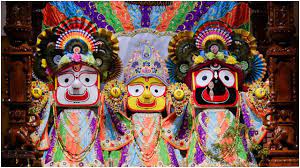
The Puri Rath Yatra begins on the Dwitiya Tithi in Ashadha, Shukla Paksha. This year, Ratha Yatra is being celebrated on July 12, 2021. The festival of Puri Rath Yatra is devoted to Lord Jagannath who is believed to be one of the incarnations of Lord Vishnu. Jagannath Rath Yatra is a nine-day festivity marked by various rituals and traditions. On this day, Lord Jagannath, Balbhadra and Subhadra proceed towards the Gundicha temple (a monument built in the memory of the Queen of Indradyumna) from the Puri shrine on their giant wooden chariots. It is believed that in order to pay their respects to Queen Gundicha, wife of the legendary King Indradyumna, who built the Puri Jagannatha temple, Lord Jagannatha along with brother Balabhadra and sister Subhadra leave their regular abode from the main temple and spend some time in this temple built by Gundicha in their honour. Lord Jagannatha, after resting for eight days in Gundicha temple, returns to his main abode. This day is known as Bahuda Yatra or Return Yatra. It is observed on the eighth day after Ratha Yatra on Dashami Tithi.

During Bahuda Yatra, the Lord makes a short stoppage at Mausi Maa temple, which is dedicated to Goddess Ardhashini. Remember, Lord Jagannatha, returns to his main abode just before Devshayani Ekadashi, when Lord Jagannatha goes to sleep for four months.

The rituals of Ratha Yatra start much ahead of Ratha Yatra day. Approximately 18 days before Ratha Yatra, Lord Jagannatha, his brother Balabhadra and his sister Devi Subhadra are given a famous ceremonial bath which is known as Snana Yatra. Snana Yatra day is observed on Purnima Tithi in Jyeshtha month, which is popularly known as Jyestha Purnima.

On the occasion of Puri Ratha Yatra, having a mere sight of Lord Jagannath on his chariot is considered very auspicious. Three chariots are made for the three respective deities.

Name of the three chariots

The names and important characteristics of the three raths (Chariots) belonging to the three deities are:

Lord Jagannath: Nandighosa

NANDIGHOSA
  • Lord Jagannath’s chariot is made of approximately 16 wheels
  • Lord Jagannath’s chariot is about 45 ft. high
  • Red and yellow canopy

Lord Balabhadra: Taladhwaja

TALDHWAJA
  • Lord Balabhadra chariot is made of 14 wheels
  • Lord Balabhadra chariot is 45.6 feet high
  • Red and bluish green canopy

Goddess Subhadra: Darpadalana

DARPADALANA
  • Goddess Subhadra’s chariot is made with 12 wheels
  • Goddess Subhadra’s chariot is 44.6 feet high.
  • Red and black canopy

Jagannatha literally means Lord of the Universe. It is believed that, if a person participates with full devotion in the Rath Yatra will be free from the cycle of birth and death. Rath Yatra symbolises harmony, brotherhood and unity. Thousands of devotees come here from different corners of the country to take part in this yatra and get good luck by pulling the chariot of the Lord. However in accord with the Covid 19 regulations, devotees were not allowed in the procession. Only the priests and workers with negative reports were allowed.

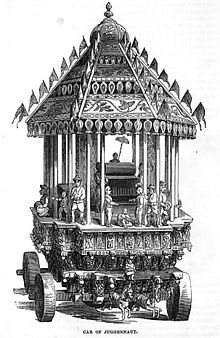
Car of Juggernaut as depicted in 1851. Source: Wikipedia

  Lord Jagannath is one of the avatars of Lord Krishna. It is said that Rath Yatra is equal to hundred sacrifices. If a devotee takes part in this Rath Yatra and pulls the chariot of God, then he gets god’s blessings. Jagannath Rath Yatra is a ten-day festival. The preparations for the yatra begin with the construction of the chariots on the day of Akshaya Tritiya. According to religious beliefs, just by watching this Rath Yatra one gets freedom from all kinds of sins and salvation is attained after death.

ETYMOLOGY OF JUGGERNAUT

Jagannath is also the etymological origin of the English word ‘Juggernaut’. When the British first observed the Rath Yatra in the 18th century, they were so amazed that they sent home shocking descriptions which gave rise to the term ‘juggernaut’, meaning “destructive force”. They misunderstood that people sacrificed themselves infront of the chariot. However these were accidents which often occur during commotion in pulling of chariot. As a matter of fact sacrificial rituals are banned in Jagannath temple.

Virgin Galactic

Virgin Galactic is a spaceflight company that was founded in 2004 by British businessman Richard Branson. It is the first commercial spaceline company in the world and are developing new spacecraft designs to make space travel accessible to everyone. Their mission is to use space for good while delivering an immaculate customer experience. They believe that space exploration is the ultimate expression of the human desire to push desires and is the pinnacle of acheivements for the human species. Fewer than 600 humans have had the golden opportunity to visit space and there are millions of people who would do anything to go to space. This is what inspired Branson to create Galactic.

The new space age has just begun and Virgin Galactic is pioneering the next generation of reusable spacecrafts. They also are building basic space infrastructure that will enable scientitsts and engineers to conduct space research that would be vital for future life on other planets. Initially, they aim to give safe space experiences to non-professionals in micro gravity environments. Eventually, they expect to operate multiple spacecrafts from various locations to transport passengers to Earth orbiting hotels and science labs. Virgin Galactic is striving to open up space and change the world for the better.

On July 11th 2021, the VSS Unity, Virgin’s commercial spacecraft reached 53 miles beyond the boundary of space and touched down safely. It was launched from Spaceport America in New Mexico and the journey went as smooth as it could go. Onboard were 6 crewmates, including Richard Branson and they went far enough to experience weightlessness and the beautiful view of the Earth’s curvature. The launch of the VSS Unity passenger rocket plane marked Galactic’s 22nd test flight of its SpaceShipTwo system and its fourth crewed mission beyond Earth’s atmosphere. It was also the first to carry a full complement of space travellers – two pilots and four mission specialists.

These commercial space tickets are currently selling for over $250,000 each and the market for space flights is extremely limited, atleast for now. But demand is seemingly quite high as seen from the number of reservations. Virgin has said it plans for at least two more test flights of the spacecraft in the months ahead before beginning regular commercial operations in 2022. By 2030, the value of the space tourism market is said to reach $3 billion. With everything said and done, commercial space travel is still a long way from being viable and accessible to the masses.

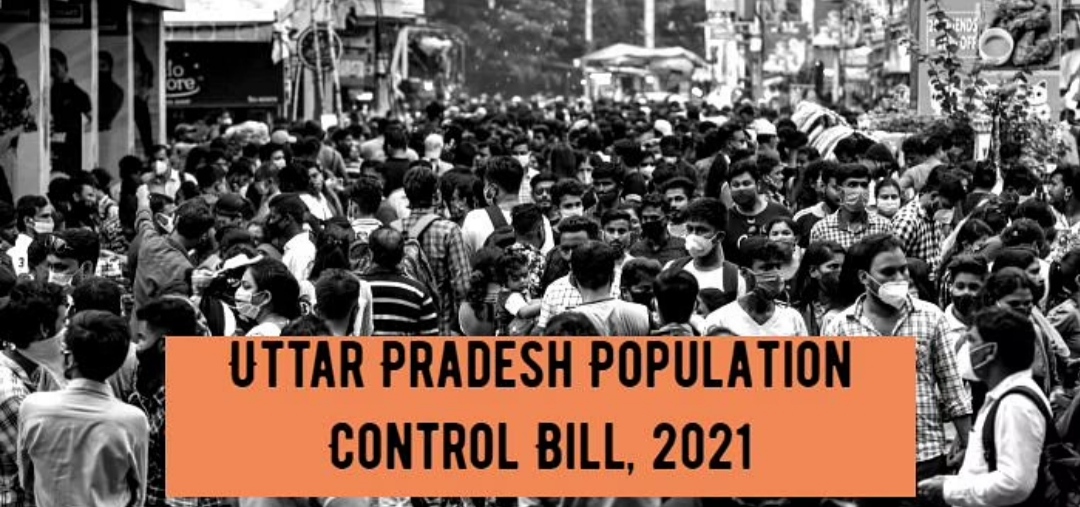
Population control bill in uttarpradesh

On World Population Day, Uttar Pradesh government announced a new population policy for 2021-2030 on Sunday. The new policy gives incentives to those who help in population control.

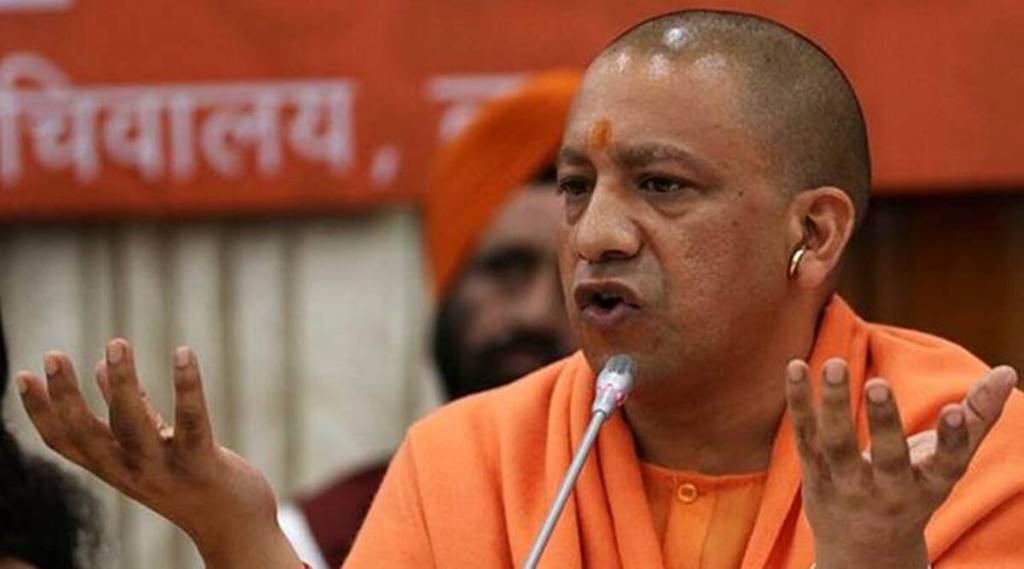
Chief Minister Yogi Adityanath wishes for a community-centric approach to be adopted for population control in uttarpradesh. So that better facilities can be made available to citizens and the state can be developed properly.

“Poverty and illiteracy are major factors for population expansion. There is also a lack of awareness about population in certain communities and we therefore need community-centric awareness efforts,” yogi Adityanath said in a statement.

Uttar Pradesh’s total fertility rate is 2.7 percent currently, it ideally should be less than 2.1 percent. Most states have achieved the ideal total fertility rate, except Uttar Pradesh and Bihar.

With this policy, the government has come up with different strategies to work towards a convergence of existing schemes for population control and improvement in health of citizens.

New population policy is to reduce the newborns’ and maternal mortality rate.Care of the elderly, and better management of education, health, and nutrition of adolescents between 11 to 19 years has also been ensured in the policy, according to the state government.

The Uttar Pradesh government will give promotions, increments, concessions in housing schemes and others perks to employees who adhere to population control norms, and have two or less children. If people won’t obey this policy then they will not get any benefits from government, like jobs,ration,etc.

Petrol, diesel prices hiked again

The petrol price has been increased by 35 paise in Delhi, while diesel saw an increase of 26 paise. This was the seventh hike of this month, according to price notification by the oil retailers.

Bhopal became the first city where petrol prices touched Rs. 100, thereafter cities like Jaipur, Mumbai, Hyderabad, and Bengaluru also sold petrol for Rs.100. In the country’s national capital, petrol prices scaled to Rs. 100 on July 7,2021.

Petrol now costs over Rs.100 in 18 states and UT’s – Rajasthan, Maharashtra, Karnataka, Odisha, Ladakh, Punjab, Sikkim, Delhi, West Bengal, Nagaland, Jammu and Kashmir and Telangana.

The central and taxes make up for 60% of the retail selling price of petrol and over 54% of diesel. Centre levies Rs. 32.90 per litre of excise duty on petrol and Rs. 31.80 a litre on diesel. The difference in prices in states occurs on account of local taxes like VAT or freight charges.

Rajasthan levies the highest VAT on petrol and diesel in the country, followed by Madhya Pradesh, Maharashtra, Andhra Pradesh, and Telangana.

Here are the list of petrol and diesel prices in the states of India:

Delhi: Petrol prices – Rs. 100.91 per litre; diesel prices – Rs. 89.88 per litre

Kolkata: Petrol prices – Rs. 101.01 per litre; diesel prices – Rs.92.97 per litre

Mumbai: Petrol prices – Rs. 106.93 per litre; diesel prices – Rs. 97.46 per litre

Bengaluru: Petrol prices – Rs. 104.29 per litre; diesel prices – Rs. 95.26 per litre

Chennai: Petrol prices – Rs. 101.67 per litre; diesel prices – Rs. 94.39 per litre

Hyderabad: Petrol prices – Rs. 104.86 per litre; diesel prices – Rs. 97.96 per litre

Jaipur: Petrol prices – Rs. 107.74 per litre; diesel prices – Rs. 99.02 per litre

Thiruvananthapuram: Petrol prices – Rs. 102.89 per litre; diesel prices – Rs. 96.47 per litre

Patna: Petrol prices – Rs. 103.18 per litre; diesel prices – Rs. 95.46 per litre

Bhopal: Petrol prices – Rs. 109.24 per litre; diesel prices – Rs. 98.67 per litre

Chandigarh: Petrol prices – Rs. 97.04 per litre; diesel prices – Rs. 89.51 per litre

Bhubaneswar: Petrol prices – Rs. 101.37 per litre,

diesel prices – Rs. 97.67 per litre

Srinagar: Petrol prices – Rs. 103.77 per litre, diesel prices – Rs. 93.49 per litre

This was the 39th hike in fuel prices since 4th May. The price of petrol has risen by Rs. 10.51 per litre and diesel by Rs. 9.09 per litre.

UP Draft Population Control Bill 2021

With the aim to provide stabilization in population growth and welfare to public, the Uttar Pradesh government has come up with draft of “Population Control Bill 2021”. The Uttar Pradesh Population (Control, Stabilisation, and Welfare) Bill, 2021 invites suggestions on it. The suggestions have been invited to improve the bill and have to be sent through e-mail – statelawcommission2018@gmail.com or by post, latest by July 19, 2021.

According to state census 2011, Uttar Pradesh is the most populous state with a population of 19.96 crores. The least populated state is Sikkim with a population of 6,07,688.

BPL couple with single child, who undergoes voluntary sterilization shall be benefited with one-time-lump sum amount of 80,000 if it is a boy and 1 lakh if it is a girl.
Whosoever procreates after the commencement of the Act shall be ineligible to contest in elections.
If the child is born at the time of enactment of the law, necessary applications must be undertaken within an year of commencement of Act.
It shall be the duty of government to inroduce a compulsary subject relating to population control in the state schools.

Measures in Mizoram

In contrary to this bill, recently the Mizoram minister had announced that he would reward a living man or woman having the largest number of offspring within his Aizawl East-2 assembly constituency with a cash incentive of ₹1 lakh. According to the minister, the infertility rate and the decreasing growth rate of the Mizo population have become a serious concern. Mizoram’s population was 1,091,014, according to the 2011 census.

“Mizoram is far below the optimum number of people to attain development in various fields because of the gradual decline in its population. The low population is a serious issue and hurdle for small communities or tribes like Mizos to survive and progress,”

Royte

Criticism

It is a good step towards population control. However the process of sterilization of BPL couple shall be done with great care because there have been reports of infections and death post operation.

Oneplus 9 series has been banned from Geekbench.

OnePlus latest series i.e., Oneplus 9 and Oneplus 9 Pro were found to be manipulating the benchmark results. And now has been delisted from Geekbench. Oneplus has a name in the market, and right now many of you must be questioning it. So, let’s have a look into the case. 

Both the devices run on the latest Qualcomm chipset 888 and it makes it obvious for the devices to give you top-notch performance. But it turns out the devices are not performing as their benchmark results demonstrated. It is found that both the devices tend to run at full speed only while using benchmark apps such as Geekbench and Antutu. In this way, Oneplus was manipulating benchmark scores that were not applicable in real-world usage. Since this news was out Geekbench has banned Oneplus 9 and Oneplus 9 Pro from its platform.  

But, how Oneplus was able to manipulate?

It seems Oneplus was blacklisting popular apps for their faster cores, which resulted in slowing down the workloads such as web and social media browsing. It is also been found that Geekbench and Antutu were getting full performance while the other apps were not getting it.  

After it has been found that Oneplus is manipulating benchmark scores. Geekbench stated on Twitter, “It’s disappointing to see OnePlus handsets making performance decisions based on application identifiers rather than application behavior. We view this as a form of benchmark manipulation. We’ve delisted the OnePlus 9 and OnePlus 9 Pro from our Android Benchmark chart. We will also test the other OnePlus handsets in our performance lab to see if these handsets also manipulate performance in the same way.  If they do, we will delist them from the Android Benchmark chart,” it seems from the statement that other Oneplus devices are also at risk of being delisted. 

Oneplus also passed a statement saying, “Our top priority is always delivering a great user experience with our products, based in part on acting quickly on important user feedback. Following the launch of the OnePlus 9 and 9 Pro in March, some users told us about some areas where we could improve the devices’ battery life and heat management. As a result of this feedback, our R&D team has been working over the past few months to optimize the devices’ performance when using many of the most popular apps, including Chrome, by matching the app’s processor requirements with the most appropriate power. This has helped to provide a smooth experience while reducing power consumption. While this may impact the devices’ performance in some benchmarking apps, our focus as always is to do what we can to improve the performance of the device for our users.”

Although all this has created doubts regarding Oneplus among tech geeks and some buyers. Let’s see if Geekbench and Oneplus come together to resolve this issue or like the Oneplus 9 or Oneplus 9 Pro other Oneplus devices will be delisted too


CABINET RESHUFFLE 2021

Before starting with building, it’s important to have the base strong. Similarly, before diving into the sea of ministers, let us look into our parliamentary system.

Indian system of Parliament is based on British constitution. It is a bicarmel legilature composed of the President of India and the two houses: the Rajya Sabha (Council of States/ Upper House) and the Lok Sabha (House of the People/ Lower House.). The Lok Sabha members are chosen by the people as Member of Parliament. There are 543 members in the Lok Sabha currently. Out of these members, the party in majority choses the Prime Minister. Prime Minister holds the power to chose his ministers who help to run the country. This group of ministers is called Council of Ministers. Articles 74 and 75 deal with the council of ministers. Article 352 defines the cabinet as “The council consisting of Prime Minister and other ministers of cabinet rank appointed under Article 75. The council helps and advises president for any decision to be taken.

The part of council of ministers who holds important portfolios is called cabinet. The Ministers in this position are called Cabinet ministers. Some cabinet ministries are Minister of Defence, Finance, Home Affairs, External Affairs, Education, etc. The decisions of the cabinet are important for PM to take into consideration. Unlike the council, cabinet ministers have frequent meetings to formulate policies. Council is a wider body consisting up to 60-70 ministers and Cabinet is a smaller body with 15-20 ministers. However, the word cabinet was never mentioned in the constitution. It came into use in the 44th Constitutional Amendment Act, 1978.

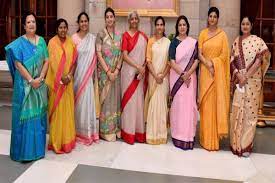
Prime Minister Narendra Modi’s Council of Ministers has been realigned recently. Many new faces have been appointed with an eye on next year’s assembly polls. A total of 43 political leaders have been sworn-in as union ministers, and some have been promoted. Council of Ministers now includes a wide range of youth and experienced leaders from across the board. Interestingly, the Union Cabinet has taken the number of women a notch up, inducting seven fresh faces to add to the existing scanty list. A diversity in terms of representation of caste, religion and gender was kept in mind. The Union Cabinet now consists a total of 11 women ministers.

Cabinet Ministers

Union ministers Harsh Vardhan (Health), Ravi Shankar Prasad (Law/IT), Prakash Javadekar (Environment/I&B), Ramesh Pokhriyal (Education), Santosh Gangwar (Labour) and Sadananda Gowda (Chemicals & Fertilizers) etc. resingned from their posts. BJP leaders who were sworn in as Union ministers include Jyotiraditya Scindia (Aviation), Narayan Rane, Sarbananda Sonowal and Ashwini Vaishnaw(Railay) among the 43. The oath-taking ceremony was held at the Rashtrapati Bhavan in New Delhi.

7 new women MPs of PM Modi’s Council of Ministers:

Anupriya Singh Patel, Sushri Shobha Karandlaje, Darshana Vikram Jardosh, Meenakshi Lekhi, Annpurna Devi, Sushri Pratima Bhoumik, Bharati Pravin Pawar

Criticism

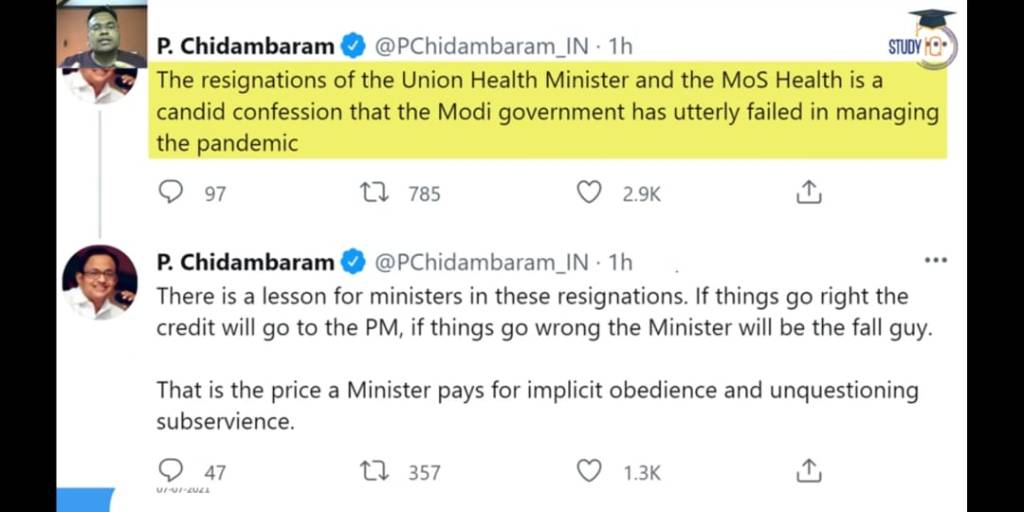
Opposition party has clearly stated the step as Modi government’s failure in managing the situation. Also that the ministers are blamed solely whenever there is a collective error. Many also consider the political agenda as the reason- to attract people support in upcoming elections by selecting ministers from that particular state

Source SudyIQ


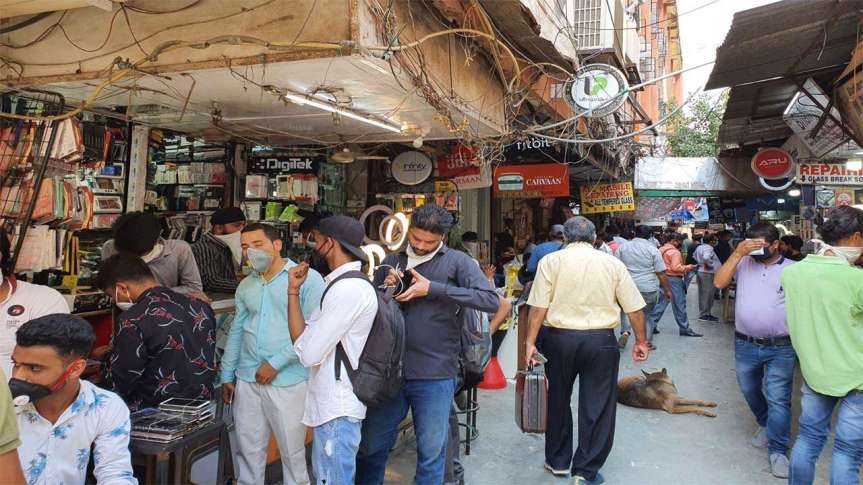
Two markets shut in karol bagh due to violation of coronavirus protocol

Due to violation of coronavirus protocols Gaffar Market and Naiwala Market of Karol Bagh will remain closed from 10pm today till 10pm on 11 july.

“market shopkeepers, thiyawallahs/vendors, and general public in Gaffar market and Naiwala, Karol Bagh are not following the Covid-appropriate behavior. Due to large footfall, market association and shopkeepers are not able to ensure Covid protocols in the markets in last three days.

“The guidelines/directions of Covid Protocol are being contravened in the Gaffar Market and Naiwala market which may cause super spreading of the coronavirus,” the order said.

The order also stated that the market welfare association of Gaffar Market and Naiwala Market have “failed to ensure the strict compliance of the guidelines of COVID-19”.

The order for closure of markets in Karol Bagh also noted that it is “necessary to take an immediate and stringent action to curtail the spread of the virus and not to let develop any such place as super spreader in larger interest of public”.

Due to flouting Covid norms, Lajpat Nagar, Laxmi Nagar market, Kamla Nagar, Sarojini Nagar and parts of Sadar Bazar were among those shut in recent weeks by the

Delhi Disaster Management Authority(DDMA).

The infection rate, which had reached to 36 percent in the last week of April, has come down to below 0.15 percent now.

Despite fall in daily cases in the last several days, Kejriwal had recently cautioned that the chances of the third wave of COVID-19 pandemic were quite real, while he asserted that his government was preparing on a “war-footing” to combat it.

However, the number of cases have shown a downward trend and the positivity rate too has been shrinking in the last several days. The number of deaths per day, has also been showing a decline in the last couple of days.

Kejriwal earlier said “that the virus is reducing in Delhi slowly and steadily, and I hope it diminishes completely and does not rise again. However, we are not going to become negligent in anyway”, while sounding a tone of caution.