How Much Does India Invest In Olympic Athletes?

Postponed by a year due to the pandemic, the Tokyo Olympics is now less than a month away. Last week, the Union Sports Minister Kiren Rijiju urged the people to extend their support to India’s Olympic-bound athletes, the same way they back India’s cricketers. However, India’s abysmal performances at the Olympics is in striking contrast to India’s immense success at cricket. The model of sports governance and financial irregularities are often blamed for the lack of competitive edge in sports other than cricket. So, the most obvious question that comes to our mind is, how much does India invest in the Olympics?

Money allocated for Sports

In the 2020-21 annual budget, the Government of India allocated Rs 2826.92 crore for sports, which meant an increase of mere ₹ 50 crore from the revised estimates of the financial year 2019-20. The Modi government’s flagship sports programme ‘Khelo India’ received a substantial hike of ₹ 312.42 crore and was allocated ₹ 890.42 crore compared to ₹578 crore in 2019-20. On the other hand, the National Sports Development Fund saw a reduction of ₹ 27.15 crore from ₹77.15 crore in 2019-20 to ₹ 50 crore in 2020-21. National Sports Federations saw the highest decrease after Finance Minister allocated ₹ 245 crore, ₹ 55 crore less than the previous financial year, according to The Wire. Even the budget for meritorious sportspersons saw a 40% reduction from the last financial year. It is important to note that the 2020-21 annual budget was presented in January 2020, when the government had no idea of the coming pandemic. It was also supposed to be the year of the Tokyo Olympics.

Target Olympic Podium Scheme

While these are the broad schemes under which Indian sportspersons are funded, the Target Olympic Podium Scheme (TOPS) provides financial assistance to potential Olympic medal winners. Launched in 2014, TOPS is the flagship programme of the Sports Ministry of India. The top-up funding scheme considers the performance of Indian athletes in the past three years. They are provided with personal coaches and other staff fees, cost of travel during competitions, purchase of equipment, and pocket allowance.

Looking Back At The Last Olympics

In the 2016 Rio Olympic, India spent ₹ 36.85 crore under TOPS, as per Financial Express. Nearly half of that amount was spent on shooting, which was India’s most successful Olympic sport in the previous three games. Shooting is also very expensive, which requires importing equipment from other countries. But shooting failed to bring any medal. Athletics received the second-highest funding of ₹ 7.80 crore in 2016, but India failed to make a mark in the sport. Unfortunately, out of the ₹ 36.85 crore, ₹30.49 crore had gone to disciplines that fell short of goals. Only 1.66 per cent of the total TOPS fund went to the fields that brought India two medals – PV Sindhu in Badminton and Sakshi Malik in wrestling.

Comparison With Other Countries

The United Kingdom allocated close to Rs 9000 crore on sports infrastructure and training in the annual sports budget, whereas India spent only one-third of the UK, Rs 3,200 crore, on youth affairs and sports, before 2016. The UK won 67 medals against India’s two at the Rio Games 2016. Abhinav Bindra had also tweeted back in 2016 that a medal cost UK 5.5 million pounds, and that is the kind of investment India needs to make. Otherwise, we cannot expect much. In the USA, a large number of athletes are privately funded. Individual athletes had started their own funding portal for donations from the general public. Therefore, only 10% of the US Olympic Committee’s finance was spent on athletes in Rio 2016, and the USA finished first. China, on the other hand, is known for its aggressive state-sponsored promotion of sports.

Private Investment In India

Before the 2016 Olympics, Indian Olympic Association (IOA) received donations from Reliance Jio, Amul, Tata Salt, Edelweiss Financial Services, Herbalife, Li Ning, and SBJ. Sakshi Malik had also thanked JSW Sport, a foundation funded by the OP Jindal group, after becoming India’s first medal winner in Rio Games, as reported by Hindustan Times.

However, unlike NSDF, where the contributions and sponsorships are open and documented, private funding to individual athletes is not. And most recently, the JSW Group has come on board to be the official sponsor of Team India in the Tokyo Olympics and has agreed to pledge sponsorship support of ₹ 1 crore to IOA. In 2018, the Sports Ministry earmarked ₹ 100 crore for funding of the athletes for the preparation of Tokyo Olympics 2020, which will take place this year. While the number of medals won cannot be equated to the investments made, since medals are not the only measure of success, India nonetheless needs to invest more and put in a new model of sports governance in action. A
DOPING

To continue the fight against doping - Fondazione Gianni Benzi Onlus

Doping is not new to the people . In ancient Greece, there were specialists who used to offer athletes nutritional ingredients in order to enhance their physical performance. Those specialists may be compared to the current sports medicine specialists . During the Olympic Games in the third century BC, the athletes tried to increase their sports performance by taking mushrooms and opium . In the Ist centaury AD, the Greek runners used to drink a herbal beverage to increase their strength and become capable to run long distance races. Gladiators are also reported to use various substances for enhancing strength . In the modern era , the use of performance enhancing substances and techniques by the top sportspersons across the world has been a presistent issue in the world of sports for nearly four decades. Since the beginning of the 21st century, many athletes have been engaged in taking such substances. Some of them have been tested positive such as Tim Montgomery, Marion Jones, swimmer Phelps, etc.

Concept of Doping

‘Doping’ is the word, which is used in the field of sports, to refer to the situation when athletes use prohibited substances or methods to unfairly improve their sporting performance. In general terms, doping is the use of performance enhancing substances or methods by athletes to gain an advantage over their competitors . In fact , some athletes take illegal substances to enhance their performance . This activity is known as ‘doping’ . Doping in sports is the deliberate or inadvertent use by an athlete of a substance or method banned by the International Olympic Committee. In fact, the ban or prohibition on such substances is necessary to protect the athletes from the unfair advantage which may be gained by those athletes who use prohibited substances or methods to enhance their performance and also from the possible harmful side effects which these substances or methods can produce. The following definitions of doping may help in understanding its exact meaning:

According to International Olympic Committee, ‘‘Doping is the use of any method or substance that might harm the athlete, in a quest to gain an unfair advantage, over his/her fellow competitors”. In fact, doping is the use of prohibited substances or methods designed to enhance an athlete’s physical or mental abilities or to mask the use of such substances or methods during preparation for or participation in a sports competition .

According to World Anti-Doping Agency (WADA) ,” Doping is defined as the occurrence of one or more of the anti-doping rule violations set forth in Article 2.1 through Article 2.8 of the code.”

PSYCHOLOGICAL ASPECTS OF WOMEN ATHLETE

Lesson 6 women and sports

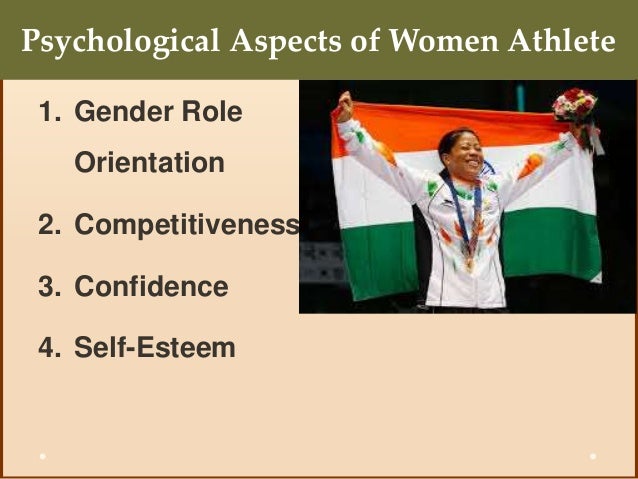
Over the past several decades , the role of women has changed drastically .However , gender beliefs and stereotypes still do exist across the world especially in sports . Most of the people in our society consider that sports are not meant for females but only for males .Social tradition , customs and cultures have great influence upon the psychology of women . In a male dominating society , males are expected to be aggressive , independent , dominating , robust and confident , whereas females are expected as well as considered to be emotional , sensitive , cooperative , sympathetic , loyal , etc. It is a well – known fact that participation of women in sports is increasing year after year .With this enhancement in female participation in sports , there is also renewed interest in the psychological characteristics of the female athletes and the effects of athletics on women . The various psychological traits of women athletes are stated below .

  1. Gender Role Orientation : It is an established fact that there has been an increase in the level of women’s participation in the types of sports that have been traditionally limited to only males , e.g., wrestling , weightlifting , kick boxing , body building , etc . However , many sports have been still considered inappropriate for women . For a long time it was considered that women should not take part in athletics because of the potentially harmful masculinising effects of sports .
  2. Competitiveness : It is evident that in the field of sports , both men and women are competitive in their own fields . In fact , women are more goal oriented and perform magnificently in artistic activities such as gymnastics . However , a number of research studies indicate that females who take part in sports are more competitive in comparison to the females who do not participate in sports .
  3. Confidence : As mentioned earlier , due to social pressures , women tend to have less confidence than men . Participation in sports , competitive environment , awards and recognitions increase confidence levels of sportspersons . However , a significant difference may exist between sportswomen and non- sportswomen .
  4. Self-esteem : Most of the research studies indicate that training plays a vital role in performance . Self -esteem improves with good performance . In the field of sports , intensive training helps in enhancing self-esteem . Research studies also show that those people who engage in sports have high self-esteem in comparison to non-participants .
  5. Aggression : Aggression is a forceful , goal- directed action that maybe verbal or physical . Participation in sports has many positive aspects which usually involve aggressive behavior . Various studies of aggression show that athletes who participate in contact sports , i.e., football players , judos or wrestlers are more aggressive than the athletes who participate in less contact sports . However , females who participate in contact sports show more aggression in comparison to females who do not participate in sports at all.

World Sports Journalist Day: a tribute to those who make Sports beautiful!

Sports be it soccer, cricket or baseball or any other has some or the other time played a role in some of our lives. But sometimes we just overlook those who make our sports look more spicy and enthusiastic before us.

Significance:

In 1994, International Sports Press Association established July 2 as “World Sports Journalist Day” as the organisation was found on July 2, 1924 and this was an effort made to honour sports journalists all over the world.

Sports Journalists do a lot of work before, dyeing and after sports matches, all of which are often overlooked. They’ve always played an integral part in transferring the information pertaining to sports to their ever loving audiences.

History of Sports Journalism.

Sports Journalism started in early 1800s when sports was beginning to get itself presented as a separate section in Western Newspapers. In early 1800s only elites could afford newspapers and as a result information relating to sports were restricted to horse riding or boxing , that is, the sports that were typically meant for elites.

In 20th century, New York Herald and New York World were two of the world’s first newspapers to cover sports journalism separately and have a complete full time sports department.

Slowly, the need and love for sports started to increase among the masses and that is why there was the demand for all together separate sports channels in television like ESPN and sports magazines like Sports Illustrated.

Digital Era and Sports Journalism.

Online Sports Journalism started when ESPN created its first ever sports website in the world in 1995. During initial years, only broad topics relating to sports were covered in Digital Sports but as internet expanded all over the world, many big and small bloggers, internet channels, web portals began covering all single and minutest topics relating to sports.

A majority of big and small websites are completely dedicated to sports and they also at times charge subscription fee from their readers. Search Engines like Google or Bing also provide information relating to sports during those days which are important for a particular sport.

Issues faced by Sports Journalists.

1) Deadline Pressures:

Sports journalists face deadline pressures than any other beat reporters as sports matches generally happen in late noon or in the evening and as a result reporters who’re covering sports or writers who’re into sports have to manage completion of work in shortest time possible.

2) Political Pressures

There has been an interlinking of sports and politics in the past. And if this is so, how can the media be kept away? Sports Journalists face lots of threats by certain sports associations that expect the journalists to cover sport matches in their own way and they also expect journalists to shape the public opinion.

3) Accusations of low objectivity:

Sports Journalists have also been accused of favouring or promoting their own favourite teams or players in the past. Some have also been accused of giving more preference to their home teams and this is one more challenge they face in the sports world.

In any way, Sports Journalists do a lot for their audiences to make the sport matches more interesting and entertainment their viewers or readers throughout and even after the matches. It’s important for us to celebrate them and honour them genuinely.