72 MoUs between DEPwD with various startups and private organizations across multiple disability sectors to bring tangible benefits to Divyangjans

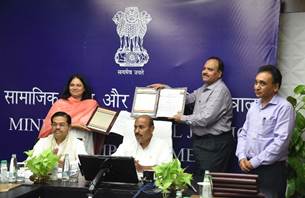
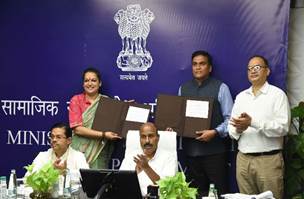
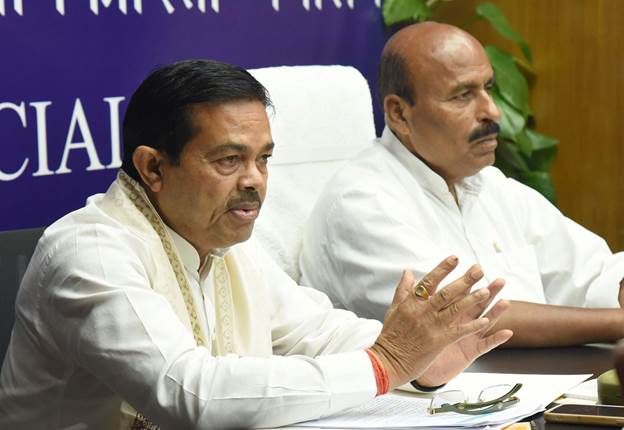
 As part of the ongoing efforts of the Department of Empowerment of Persons with Disabilities (DEPwD) to empower persons with disabilities socially, educationally and economically, various National Institutions and Composite Regional Centres (CRCs) under the department signed 72 MoUs with private institutions and start-ups. Union Minister of Social Justice and Empowerment, Dr. Virendra Kumar presided over the ceremony as Chief Guest, in New Delhi today. Minister of State in the Ministry, Shri B.L. Verma, also graced the occasion with his esteemed presence.
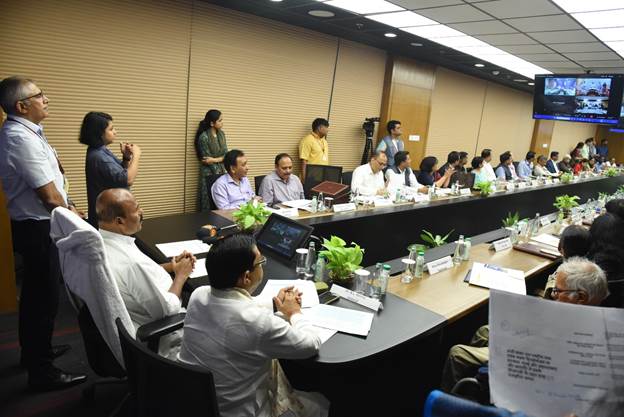
In today’s era of technological advancement, numerous initiatives and cutting-edge products are being developed in the private sector to enhance the lives of persons with disabilities and foster an inclusive society. In April and May 2024, the department organized six Purple Talks sessions/workshops. Purple Talks focused on engaging with Indian start-ups, companies, academic institutions, and organizations that have developed innovative, technology-based products and programmes to empower persons with disabilities. Over 100 organizations participated, presenting their products, innovations, and technologies in areas such as physical disabilities, intellectual disabilities, visual impairments, hearing impairments, education and skill development, and employment and entrepreneurship for persons with disabilities. Consequently, national institutions and CRCs were instructed to sign MoUs with these start-ups and organizations to expand the department’s scope and meet the needs of persons with disabilities.
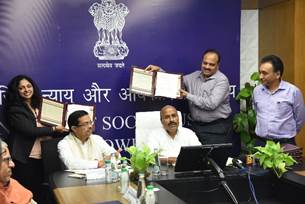
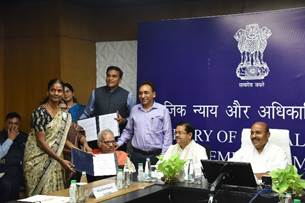


On this occasion, Dr. Virendra Kumar stated that under Prime Minister Shri Narendra Modi’s leadership over the past decade, the DEPwD has consistently played a significant role in the social, economic, and educational empowerment of persons with disabilities. He noted that under Prime Minister’s vision of a self-reliant India, many institutions are manufacturing useful devices within the country at low costs to make the lives of persons with disabilities easier. In addition to governmental efforts, the cooperation of various social organizations is crucial for the empowerment and employment of persons with disabilities. They are an essential part of our society and need our continuous efforts. Effective collaboration between the government and various organizations is vital in this endeavor. The work done by the organizations present here in the field of disability is highly commendable. Our government and department have always been keen to work with organizations that strive for positive change and create an inclusive environment, he emphasized.
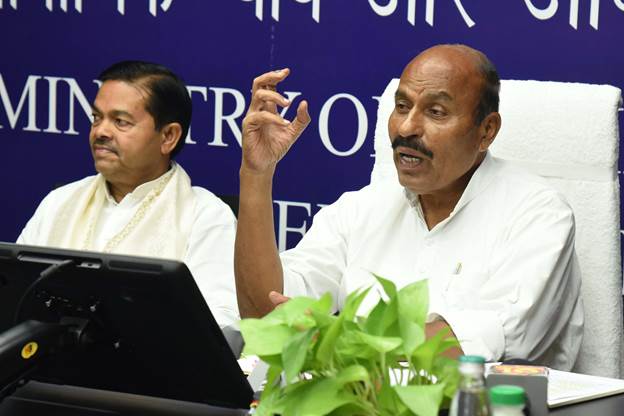
Addressing the programme, Minister of State Shri B.L. Verma, highlighted that the MoUs signed today demonstrate our commitment to persons with disabilities. He stated that the persons with disabilities possess immense potential, the only thing they only need are opportunities. Their indomitable will to work serves as an inspiration to the general public. The MoUs signed today by the national institutions and CRCs with various organizations will provide them with this platform.
Secretary (DEPwD) Shri Rajesh Aggarwal remarked that there is a significant shift in society’s perspective towards persons with disabilities. Many private institutions present at this event have been working extensively to provide employment to persons with disabilities, which is a commendable initiative towards positive change. He noted that while the government is creating excellent policies, it is also helping to scale up efforts in collaboration with private organizations.
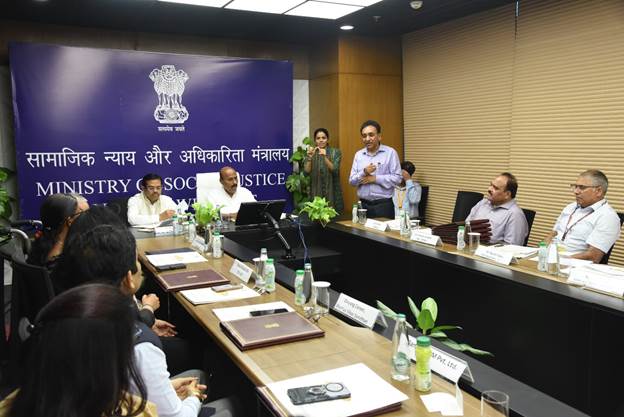
The MoUs will promote the creation of innovative, technology-based products aimed at empowering families of persons with disabilities, raising awareness about disabilities, preventing and treating clubfoot, and building the capacity of trainers and teachers. Various companies and start-ups from across the country, including Zomato, IIT Madras, EnAble India, Neo Motion, Cure India, Assam Rifles, and Radio Udaan, participated in the program. The event was attended by senior officials of the Ministry, Directors of national institutions, and representatives from participating companies.

*****
AIM– NITI Aayog launches new accelerator to support Australian and Indian circular economy startups to rise


Startups and small to mid-sized enterprises(SMEs) in India and Australia working on circular economy technologies and solutions will benefit from a new accelerator program designed to open new doors to explore opportunities between the two countries.

AIM, NITI Aayog today launched a new accelerator called Rapid Innovation and Startup Expansion (RISE) to support Australian and Indian circular economy startups.

The India Australia RISE Accelerator is delivered in partnership between CSIRO, Australia’s national science agency, and Atal Innovation Mission (AIM), the Government of India’s flagship initiative to promote a culture of innovation and entrepreneurship.

Mr Manpreet Vohra, High Commissioner of India to Australia said, “In the dynamic landscape of international relations, the strategic partnership between India and Australia stands as a testament to our shared values, economic interests, and geopolitical objectives that bind the two nations together. The RISE Accelerator will not only strengthen diplomatic ties but also paved the way for collaborative efforts across various domains”

Dr Chintan Vaishnav, Mission Director – Atal Innovation Mission – NITI Aayog said, “RISE Accelerator stands as a pioneering multi-year bilateral program, uniquely crafted between India and Australia, dedicated to addressing the shared challenges of both economies. Focused on the overarching theme of environment and climate technology, RISE provides a platform for startups to innovate solutions that transcend global challenges.”

Tamara Ogilvie,CSIRO’s RISE Accelerator program director said the program focusses on startups and SMEs that have mature technologies and a desire to expand between India and Australia.

“Over the nine-month RISE Accelerator program, we’ll help startups navigate early steps in a new region, fast-track connections to the right partners, customers and talent, and build credibility to succeed in international markets,” Ms Ogilvie said.

“For the first round of RISE Accelerator, we’re calling for startups and SMEs developing innovative business models, technologies, and or resource ingenuity to support India’s and Australia’s transition to a circular economy.”

Pramit Dash, AIM’s RISE Accelerator lead said the Australian and Indian startups would be well supported to validate and adapt their technology and research overseas.

“This is a real opportunity for startups from Australia and India to work with industry and researchers in their target market,” Mr Dash said.

“As well as developing cultural literacy,participants will develop meaningful bilateral industry and research collaborations.”

The first round of the program aligns with CSIRO’s Circular Economy for Missions initiative, which is focused on creating a sustainable future built on waste innovation.

Heinz Schandl, CSIRO’s Circular Economy for MissionsLead said that we need to design materials and products with a zero-waste mindset.

“A circular economy means products are designed in such a way that they can be used again, or even multiple times, to maximise their value,” Dr Schandl said.

“We hope this program will help to accelerate technologies and solutions to grow economies, create jobs and reduce waste.”

There is no charge for startups to participate in the program, which will be delivered virtually, with a number of opportunities to travel between Australia and India. Participating startups may also be eligible for up to INR 40,00,000 in non-equity grants.

Applications for the RISE Accelerator program are open now, and will close Saturday 7 January 2024.

For more information, and to apply, visit https://riseaccelerator.org/


***

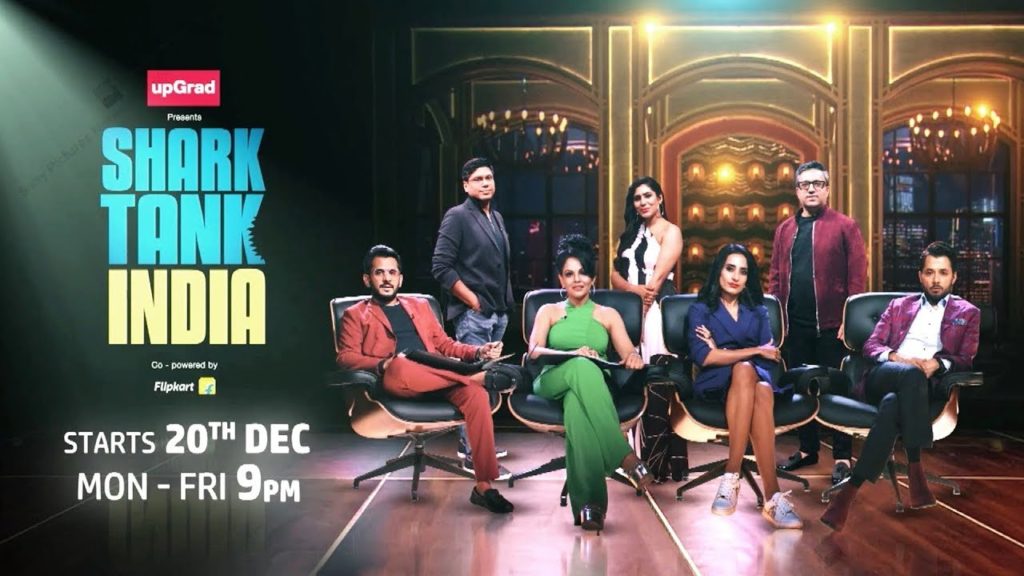
Shark Tank: India

A one of a kind business reality TV series that has got India hooked is Shark Tank, India. Shark Tank is a series were aspiring entrepreneurs pitch in their business models to a panel of investors whom they refer to as Sharks, and persuade them to invest in their ideas. Shark tanks provides budding entrepreneurs the opportunity to secure the deals that would make them successful businesses.

This reality show is the Indian franchise of the American business reality show of the same name, which first aired in 2009. The Indian version is broadcasted on Sony Entertainment Television (SET), and is available online on its respected OTT platform and YouTube.

About the Sharks

The Indian version has seven panellist on board. All the panellists are giants in their respective area of business and hence, Sharks. The list includes:

  • Ashneer Grover- founder and Co-founder of BharatPe
  • Anupam Mittal- founder and CEO of People Group Shaddi.com
  • Aman Gupta- Co-founder and CMO of boat
  • Vineeta Singh- Co-founder and CEO of Sugar Cosmetics
  • Namita Thapar- Executive Director of Emcure Pharmaceuticals
  • Ghazal Alagh- Co-founder and CIO of Mama Earth
  • Peyush Bansal-  Founder and CEO of Lenskart

All the Sharks brought on the table their area of expertise to help the entrepreneurs with their venture along with investment for a reasonable percentage of equity.

The investments

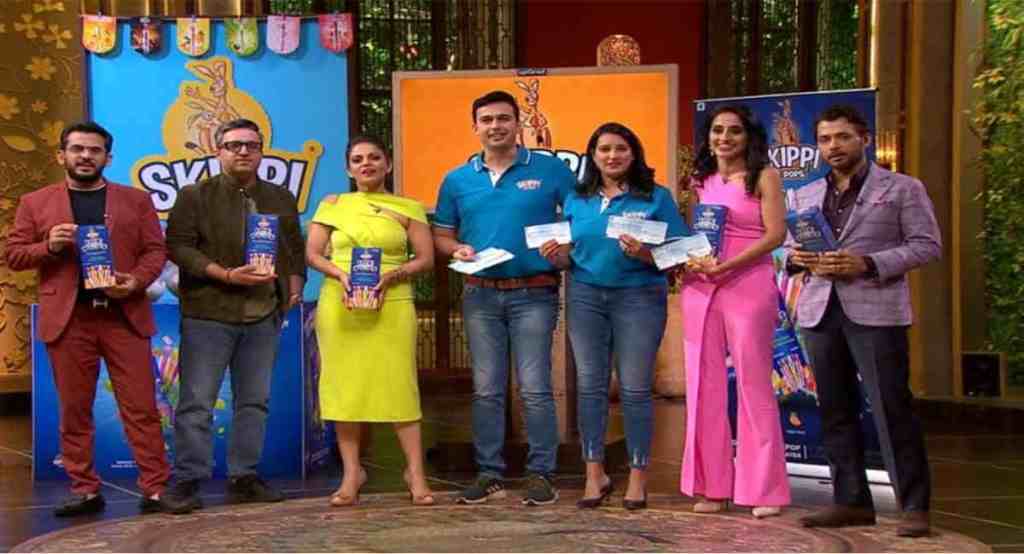
The show helped 67 start-ups bag funding for their venture which is estimated to be at 41.98 crores in total. The highest investments were made for 1 crore to 10 start-ups. The start-ups that bagged the investment were genuine problem solvers whose product or service could help the nation along with generating enough revenue and profit.

The investments ranged from ice popsicles, sugar free ice creams, Ed tech apps, textiles, braille literacy device, canned cocktail, lounge wears, and more. The Sharks invested in a wide variety of start ups in exchange for reasonable, and sometimes negotiable equity.

However, there were instances were participants had to head back with no investment, nevertheless the participants received constructive criticism from the Sharks for their start up, and to further establish it.

Success of the Show

The show has been a massive success and there are possible rumours of a second season. The show has 9 point rating on IMDB, and a substantially good TRP ratings. The show first aired from 21st December 2021, and has 35 episodes.

There were 50,000 plus applicants out of which 198 candidates for selected for the show. And after the massive success of the first season, the application number is only expected to increase in the possible next season.

The presence and popularity of the show was also felt on social media, as feeds  and homepages were flooded with relevant and funny memes made from Shark Tank India. This is one of the reason the show gained a massive audience, and helped connect with the youth on a closer level and inspired more entrepreneurs to follow their entrepreneurial venture.

                     Shark Thank India not only entertained but also provided crucial business advice to entrepreneurs both on the show and the ones outside who just started with their entrepreneurial journey. Such reality shows truly justify entertainment with a purpose.

MoE, AICTE and DPIIT organises ‘National Innovation Week’ from 10th – 16th January, 2022

 To commemorate 75th years of progressive India ‘Azadi Ka Amrit Mahotsav’, Ministry of Education (MoE), AICTE and Ministry of Commerce& Industry (DPIIT) are jointly organising ‘National Innovation Week’ from 10th – 16th Jan 2022. The innovation week is also the iconic week of Ministry of Education. This Innovation week will highlight various initiatives undertaken by these agencies to spread awareness to promote innovation and entrepreneurship in India. Renowned personalities gracing the occasion with there presence are Shri Sridhar Vembu, Founder, ZOHO Corporation, Dr. K. Radhakrishnan, Ex-Chairman, ISRO, Shri Ankit Agarwal, Founder & CEO, Phool, Smt. Arundhati Bhattacharya, Chairperson & CEO, Salesforce, Smt. Sri devi Pankajam, MD, Commonwealth Bank of Australia, Shri C V Raman, Chief Technology Officer, Maruti and many more

A 2 days long e- Symposium on ‘Building Innovation Ecosystem in Educational Institutions’ will be held on 11th and 12th January 2022 by the Ministry of Education. E-Symposium will be inaugurated by Shri Rajkumar Ranjan Singh Minister of State for Education on 11th Jan 2022 at 10.30 AM. Program will be held virtually and it will see huge participation from academic institutions, schools, industry, Start-up and investor community. 

From 10th January onwards, 75 innovative technologies selected from various programs such as National Innovation Contest, Smart India Hackathon, YUKTI2.0 and Toycathon conducted by the Ministry of Education will participate in e-exhibition and demonstrate their innovations. Alongside exhibition, there are full day activities scheduled for 11th and 12th Jan comprising of multiple key note sessions and panel discussions on emerging areas related to innovation and entrepreneurship in HEIs and schools.

Prof Anil D Sahasrabudhe, Chairman, All India Council for Technical Education (AICTE) said the Innovation week will inspire young innovators to solve the problems faced by society through constructive ideas and address upcoming challenges. Proposed symposium highlights key aspects for building innovation system like investment, mentoring etc. and we believe that this symposium will further encourage our educational institutes to focus on building innovation eco-system within their campuses. As India is witnessing an exponential growth in terms of number of Start-ups, concerted efforts to create holistic innovation culture will pave the way for making Atmanirbhar Bharat and a 5 trillion-dollar economy as envisioned by Prime Minister Shri Narendra Modi, he added.

Dr. Abhay Jere, Chief Innovation Officer, Innovation Cell, Ministry of Education said that the Innovation Week is an opportunity for all innovators to showcase their work and inspire the young minds to take their entrepreneurial journey more seriously so that India can emerge as a global Innovation and Start-ups hub. As Innovation Cell, we are under taking multiple Innovation, Entrepreneurship related initiative and through this symposium we would like to encourage our educational institutions to work closely with us so that a sustainable ecosystem is establish within the campus, he added.

Eminent industry leaders, emerging unicorn founder, investors and policy practitioners will join as key note speakers and panellists to share their views and perspective on different aspects of innovation and start-up. Special panel sessions consisting of panellists from early stage start-up founders, and student innovators will be held to motivate school kids and young minds to pursue innovation and entrepreneurship as career choice.

The program is aiming to sensitize and orient the stakeholders as part of innovation and Start-up ecosystem in academic institutions. 

*****


GENERATION OF JOBS BY STARTUPS

 The number of jobs generated in last three years in the country, as reported by startups recognized by DPIIT, is as follows:

Year

Jobs Reported by Recognized Startups (as on 08th December 2021)

2018

93527

2019

142646

2020

169724

2021 

(till 08th December)

192427

Total

598324


There is no centralized compilation of information on year-wise contribution made by startups in the Gross Domestic Production of the country.


Government of India as part of Startup India initiative has implemented Fund of Funds for Startups (FFS) Scheme and Startup India Seed Fund Scheme (SISFS) across all States/UTs to promote private investment in the Startups through Alternative Investment Funds (AIFs) and incubators.

Under FFS, a corpus of Rs. 10,000 crore has been sanctioned, spread over 14th and 15th Finance Commission cycles. Small Industries Development Bank of India (SIDBI) is the nodal bank under this Scheme. The FFS Scheme does not directly provide financial assistance to startups, instead supports SEBI- registered Alternative Investment Funds (AIFs), who in turn invest money in growing Indian startups through equity and equity-linked instruments.

Under the Startup India Seed Fund Scheme (SISFS), Rs. 945 crore has been sanctioned for period of 4 years starting from 2021-22. The funds are released to Startups through approved Incubators.

Further, 49 key regulatory changes to enhance ease of doing business, raising capital and reducing compliance burden have been undertaken. This includes insurers, EPFO, non-government provident funds, superannuation, and gratuity funds to invest in AIFs, thereby enabling billions of dollars’ worth of domestic capital being made available for the Indian startup ecosystem. 

Furthermore, requirement of prior turnover and experience has been relaxed to encourage startups to participate for tenders. Startups have been exempted from requirement of earnest money deposit. ‘GeM Startup Runway’ has been launched with dedicated corner for startups to sell products and services to Government. As on 3rd October, 2021, 11,386 startups had been on boarded on GeM, with 93,908 orders from public entities.

National Single Window System (NSWS) – a one-stop for regulatory approvals

 I.          Introduction

  • The year 2020 witnessed turmoil due to COVID-19 pandemic which emerged as the biggest threat to economic growth. Indian economy has witnessed a sharp contraction of 24.4 per cent in Q1 and 7.3 per cent in Q2 of FY 2020-21.
  • To convert COVID pandemic related challenges into opportunity, a series of measures have been taken by the Government to improve the economic situation including inter-alia announcement of the Atmanirbhar package amounting to Rs.29.87 Lakh Crore. Targeted interventions were made to support the economy and livelihood. Moreover, the pace of structural reforms was expedited. 
  • The major reforms undertaken under Atmanirbhar package include Credit guarantee for MSME loans, sectoral structural reforms, policy on strategic disinvestment of CPSEs, reforms in public procurement, setting up of Empowered Group of Secretaries and Project Development Cells for facilitating investment, reduction in compliance burden and single window system for clearances. 
  • These measures, in addition to structural reforms taken up, have assisted the economy in its early revival. India, which was not producing N-95, PPE Kits, ventilators, etc. prior to Corona pandemic has started producing the same and even catering to world markets and became self-reliant. Government has started vaccination drive in January, 2021 and indigenously developed Covaxin vaccine in its fight against Covid pandemic. As on date more than 143 crore Covid doses have already been administered in India. This has not only saved the lives of people but also set momentum for early recovery of the economy.
  • Economy has started showing sign of recovery with GDP growth rebounding to 20.1 per cent in Q1 and 8.4 percent in Q2 of 2021-22. Several high frequency indicators like E-way bills, rail freight, port traffic, GST collections and power consumption have demonstrated a V-shaped recovery in the economy. 

II.        Industrial Performance

  • Industrial sector performance during 2020-21 declined considerably, by -8.4%, mainly due to nationwide closure of industries by the Government to limit the impact caused by Covid-19 pandemic on public health from March 2020 onwards. The Mining & Manufacturing sectors were majorly impacted as they declined by -7.8% & -9.6% respectively, whereas Electricity generation sector declined by -0.5%. 
  • The cumulative Index of Industrial Production for April-October, 2020 declined by 17.3 percent. However, various measures undertaken by the Government including vaccination & the structural reforms and resilience of the Indian industry have helped early revival of the economy, which led to surge in IIP for same period in 2021 by 20.0 per cent. Similarly, the Mining, Manufacturing, and Electricity sector have registered growth of 20.4 percent, 21.2 percent, and 11.4 percent respectively during the same period.

III.       Trends in Growth of Eight Core Industries

  • The Index of Eight Core Industries (ICI) measures the performance of eight core industries i.e. Coal, Crude Oil, Natural Gas, Petroleum Refinery Products, Fertilizers, Steel, Cement and Electricity. The industries included in the ICI comprise 40.27 per cent weight in the Index of Industrial Production (IIP).


  • During 2020-21, the ICI growth rate was -6.4 per cent compared to average growth rate of 3.0 per cent during last 3 years i.e. 2017-18 to 2019-20. The rate of growth has been robust during the current financial year (April to October, 2021-22) i.e. 15.1%. Out of Eight Core sectors, six of them have shown double digit growth with Cement and Steel sectors leading the pack with growth rates of 33.6% & 28.6% respectively. Whereas, Crude Oil & Fertilizers sector growth remain muted in the same period i.e. (April to October, 2021-22). These shows the revival of core industries.


IV.       DPIIT has been spearheading a number of initiatives in this area, ‘To Make in India for the World’. The key steps taken in this regard are as follows: 

1.         Production Linked Incentive Scheme:  

  • Keeping in view India’s vision of becoming ‘Atmanirbhar’ and to enhance India’s Manufacturing capabilities and Exports, an outlay of INR 1.97 lakh crore (US$ 26 billion) has been announced in Union Budget 2021-22 for PLI schemes for 14 key sectors of manufacturing starting from fiscal year (FY) 2021-22. These 14 sectors are namely:  (i) Automobiles and Auto Components, (ii) Pharmaceuticals Drugs, (iii) Specialty Steel, (iv) Telecom & Networking Products, (v) Electronic/Technology Products, (vi) White Goods (ACs and LED Lights), (vii) Food Products, (viii) Textile Products: MMF segment and technical textiles, (ix) High efficiency solar PV modules, and (x) Advanced Chemistry Cell (ACC) Battery (xi) Medical devices (xii) Large scale electronics manufacturing  including mobile phones (xiii)  Critical Key Starting materials /Drug intermediaries and API; and (xiv) Drones and Drone Components.
  • The guidelines for all PLI schemes have already been issued and applications have also been received under a majority of the schemes.
  • While DPIIT is doing the overall coordination for PLI Schemes, it is the nodal Department for PLI scheme for White Goods (Air Conditioners and LED lights), which has an outlay of an outlay of Rs. 6238 Crore. The Scheme Guidelines was published on 4th June 2021. 42 applicants with committed investment of Rs 4,614 crore have been provisionally selected as beneficiaries under this PLI scheme. The selected applicants include 26 for Air Conditioner manufacturing with committed investments of Rs. 3,898 crore and 16 for LED Lights manufacturing with committed investments of Rs. 716 crore.

2.         PM GatiShakti National Master Plan (NMP):

  • The Prime Minister launched Gati Shakti, a National Master Plan for Infrastructure Development, on 13th October, 2021. Gati Shakti is a digital platform which will bring 16 Ministries including Railways and Roadways together for integrated planning and coordinated implementation of infrastructure connectivity projects.
  • PM Gati Shakti aims to address the past issues through institutionalizing holistic planning for stakeholders for major infrastructure projects. Instead of planning & designing separately in silos, the projects will be designed and executed with a common vision. It will incorporate the infrastructure schemes of various Ministries and State Governments like Bharatmala, Sagarmala, inland waterways, dry/land ports, UDAN etc. Economic Zones like textile clusters, pharmaceutical clusters, defence corridors, electronic parks, industrial corridors, fishing clusters, agri zones will be covered to improve connectivity & make Indian businesses more competitive. It will also leverage technology extensively including spatial planning tools with ISRO imagery developed by BiSAG-N (Bhaskaracharya National Institute for Space Applications and Geoinformatics).

3.         Start-up India Programme: 

· The Start-up India initiative was launched by the Prime Minister on 16th January 2016 as a flagship initiative of Government of India. The initiative was intended to build a stronger ecosystem for nurturing India’s start-up culture that would further drive our economic growth, support entrepreneurship, and enable large-scale employment opportunities. With over 60,000 recognized start-ups, India has transformed into the third largest start-up ecosystemsupplementing employability as well as enhancing our self-reliance. Start-up India’s role has been vital in nurturing entrepreneurship beyond Tier 1 cities. The regional growth through the efforts of States and Union Territories (UTs) has created a national ecosystem to thrust our economic goals. While 55% of the recognised start-ups are from Tier-1 cities and 45% of the start-ups are from Tier-2 and Tier-3 cities respectively, 45% of start-ups are represented by women entrepreneurs. This shows the roots of startups have grown deep in the country.

· Recognized start-ups have made deep inroads into Tier-II and Tier-III cities. Startups are now spread across 633 districts with a total of 30 States and UTs with Startup Policies in place. DPIIT recognised start-ups have reported creation of close to 2 lakh jobs in 2021, the highest in four years. Cumulatively, more than 6.5 lakhs jobs have been generated since the launch of Start-up India initiative.

· Under the Fund of Funds for Start-ups (FFS), Rs. 6,495 crore has been committed to 80 Alternative Investment Funds (AIFs) and Rs. 8,085 crore have been invested by supported AIFs in 540 startups. For Start-up India Seed Fund Scheme (SISFS), 58 incubators have been selected and Rs. 232.75 crore have been approved as grant under the Scheme

4.         Investment Promotion 

  1. Investment Clearance Cell

While presenting Budget 2020-21, Union Finance Minister announced plans to set up an Investment Clearance Cell (ICC) that will provide “end to end” facilitation and support to investors, including pre-investment advisory, provide information related to land banks and facilitate clearances at Centre and State level. The cell was proposed to operate through an online digital portal.

Subsequently, DPIIT along with Invest India initiated the process of developing the portal as a National Single Window System (NSWS). Envisioned as a one-stop for taking all the regulatory approvals and services in the country, NSWS [www.nsws.gov.in], was soft-launched on 22nd September 2021 by the Commerce & Industries Minister, Shri Piyush Goyal.

This national portal integrates the existing clearance systems of the various Ministries/ Departments of Govt. of India and State Governments without disruption to the existing IT portals of Ministries/ Departments. Approvals of 18 Ministries/ Departments and 10 States Single Window Systems have been on-boarded in Phase I. Complete on-boarding of 32 Central Departments and 14 States would be in next phases, all remaining States will be on-boarded in a phase manner.

  1. Ease of Doing Business:

DPIIT is continuously making efforts to improve ease of doing business in the country through the three major initiatives being pursued, focusing on – World Bank’s Ease of Doing Business, State & District Reform Action Plan and systematic approach to reduce regulatory compliance burden on businesses. As a result, India’s rank as per World Bank’s EoDB Report improved from 142 in 2014 to 63 in 2020. 

In order to monitor large database of compliances across Central Ministries/Departments and States/UTs, DPIIT has launched the Regulatory Compliance Portal on 1st January, 2021 (https://eodbrcp.dpiit.gov.in/). Based on data uploaded on Regulatory Compliance Portal, more than 25,000 compliances have been reduced by Central Ministries/Departments and States/UTs combined. 

DPIIT had identified 194 compliances for reductions pertaining to PESO, Boiler, IPR, NEIDS, Industrial Licensing. Out of these, 134 compliances have been ‘Reduced”, 31 are ‘under review’ and 29 have been ‘Retained’.  Types of compliance reduced are: (i) Certificate, License and Permission (ii) Filings (iii) Inspection, Examination and Audits (iv) Registers and Records, (v) Display Requirements, (vi) Redundancy (vii) Decriminalization (viii) Technology and (ix) others.

  1. Project Development Cells: 

Project Development Cells (PDCs) have been set up in 29 Ministries/Departments to fast track investment in coordination between the Central Government and State Governments and thereby enhance the pipeline of investible projects in India and in turn increase domestic investment and FDI inflows.

  1. India Industrial Land Bank (IILB)

The IILB is a GIS based portal developed by DPIIT as a one stop repository of all industrial infrastructure related information – connectivity, infra, natural resources & terrain, plot level information on vacant plots, line of activity and contact details. Currently, the IILB has approximately 4500 industrial parks mapped across an area of 5.11 lakh hectare of land serving as a decision support system for investors scouting for land remotely. The system has been integrated with industry-based GIS systems of 24 States/UTs namely Andhra Pradesh, Assam, Bihar, Chhattisgarh, Dadar & Nagar Haveli and Daman & Diu, Goa, Gujarat, Haryana, Himachal Pradesh, Jharkhand, Karnataka, Kerala, Maharashtra, Madhya Pradesh, Odisha, Punjab, Puducherry, Sikkim, Tamil Nadu, Tripura, Telangana, Uttarakhand, UP and have details of 2113 GIS enabled parks on a real-time basis. A mobile application (wherein login is not required) of IILB is also available on Android and iOS stores for the ease of investor.

6.         Foreign Direct Investment

  • FDI policy provisions have been progressively liberalized and simplified across various sectors in the recent past to make India an attractive investment destination. Measures taken by the Government on FDI Policy reforms have resulted in increased FDI inflows in the country, which year after year is setting up new records. FDI inflows in India stood at US $ 45.15 billion in 2014-2015 and have continuously increased since then. FDI inflows increased to US $ 55.56 billion in 2015-2016, US $ 60.22 billion in 2016-2017, US $ 60.97 billion in 2017-2018, US $ 62.00 billion in the year 2018-19, US$ 74.39 billion in the year 2019-20 and India registered its highest ever annual FDI inflow of US$ 81.97 billion (provisional figures) in the financial year 2020-21. These trends in India’s FDI are an endorsement of its status as a preferred investment destination amongst global investors. 

FDI policy reforms during 2021:

  • Insurance Sector: Government issued Press Note 2(2021) dated 14.06.2021 to raise the permissible FDI limit from 49% to 74% in Insurance Companies under the automatic route and allow foreign ownership and control with safeguards. This will facilitate an increased flow of long-term capital, global technology, processes and international best practices, which will support the growth of India’s insurance sector.
  • Petroleum & Natural Gas sector: Press Note 3 (2021) dated 29.07.2021 has been issued to permit foreign investment up to 100% under the automatic route in cases where the Government has accorded an ‘in-principle’ approval for strategic disinvestment of a Public Sector Undertaking (PSU) engaged in the Petroleum and Natural Gas Sector.
  • Telecom sector: Press Note 4 (2021) dated 06.10.2021 has been issued to permit foreign investment up to 100% under automatic route in Telecom services sector.

7.         Intellectual Property Rights (IPR): Framework to attract foreign investors, disseminate creativity and encourage local innovators

  • An effective IPR framework is indispensable to attract foreign investors, disseminate creativity and encourage local innovators to invest in their own ideas. In this context, DPIIT is committed towards strengthening of the IP ecosystem in India. Major initiatives and steps taken during 2021 in this regard are given below:
  • Design (Amendment) Rules, 2021 notified in the Gazette of India on 25.01.2021 incentivize start-ups and small entities to seek protection of their designs and promote design filings, fees have been reduced on similar lines as under Patent and Trademark Rules.
  • Copyright (Amendment) Rules, 2021 notified on 30.03.2021, with the objective of bringing the existing rules in parity with other relevant legislations. It introduces a mandatory annual transparency report to be issued by Copyright Societies. It aims to ensure smooth and flawless compliance in the light of the technological advancement in digital era by adopting electronic means as primary mode of communication and working in the Copyright Office.
  • Patent (Amendment) Rules, 2021: Patent fees for educational institutions have been reduced by 80 percent by way of the Patents (Amendment) Rules, 2021, which came into effect on 21st September 2021. The amendment will provide the same level of support to educational institutions as MSMEs and start-ups and further ensure greater participation of the education institutions in IP ecosystem.

Since the adoption of the National IPR Policy, IP filing in India has witnessed a considerable amount of increase in filing. Despite the adverse Covid situation in India, no negative impact has been seen in the filing of the IPs. Further, the filing of application of Trademark and GI have drastically increased over the years.

8.         One District One Product (ODOP)

  • Government of India is working on a transformational initiative to foster balanced regional development across all districts of the country. This is called the One District One Product (ODOP) initiative, with the objective of identifying and promoting the production of unique products in each district in India that can be globally marketed. This will help realise the true potential of a district, fueling economic growth, generating employment and rural entrepreneurship. ODOP initiative is operationally merged with the ‘Districts as Export Hub’ initiative being implemented by DGFT, Department of Commerce with DPIIT as a major stakeholder to synergize the work undertaken by DGFT. The major activities that are being facilitated by DPIIT with Invest India under ODOP initiative are manufacturing, marketing, branding, internal trade and e-commerce.
  • Ongoing expansion exercise entailing expansion of list from Phase-1 that consisted of 106 products from 103 districts to current Phase-2 that would consist of 739+ products covering 739 districts. Considerable success has been achieved for boosting exports under ODOP initiative.

11.       Swachhata Campaign

  • During this special campaign, 49,686 files have been reviewed in DPIIT and its sub-organizations. Out of the reviewed files, 49,449 files have been weeded outDue to weeding of files, 2222 sq ft area has been vacated/freed in DPIIT and its sub organizations. Due to disposal of redundant/obsolete items, 3277 sq feet of area has been vacated, which has improved cleanliness and hygiene conditions. Besides, revenue of Rs 5,60,000 has been generated.
  • The Department achieved 100% target in respect of public grievances by disposing of all 31 public grievances and 3 public grievances appeals. Further, out of 48 VIP reference, 29 cases have been disposed off. The Department had identified 194 rules/regulation for simplification under “Ease of Doing Business”. Out of these, 134 rules have been simplified.
  • Digitization of old files/records: Even before the special campaign, as per directions of the CIM digitization of old files/ records was undertaken on a priority basis. During the period, scanning/digitization of 12,387 files containing 19,53,666 pages have been completed and all the scanned files have been migrated to e-office for future reference. 
  • Increasing Efficiency decision making in the Government on direction of Cabinet Secretary and advice of DARPG, with the approval of the Competent Authority, DPIIT has revised the Channel of Submission & Level of disposal, for increasing efficiency in decision making and reducing the level up to 4 (maximum).  This will speed up the disposal of cases and improve decision making. 
  • Review by CIM: CIM has reviewed the special drive continuously during the campaign period. After completion of the Special Drive on 31.10.2021, CIM is reviewing progress of the Cleanliness Campaign on weekly basis. CIM is also undertaking frequent rounds of Udyog Bhawan to review the cleanliness of the premises. 

12.       Events organised by DPIIT during India’s presidency of BRICS in 2021:

  • The 13th BRICS Summit was held under India’s Chairship in 2021. It was the third time that India hosted the BRICS Summit after 2012 and 2016. The theme for India’s Chairship was ‘BRICS @ 15: Intra-BRICS Cooperation for Continuity, Consolidation and Consensus’. During India’s presidency of BRICS, 4 events were organized by DPIIT on industry related issues namely- Industry Ministers Meeting, PartNIR Meeting (Partnership on New Industrial Revolution) to promote investment, industrialization, innovation, inclusiveness and digitization, 13th HIPO (Head of Intellectual Property Offices) meeting and Round Table of an interaction among the Trade and Investment agencies of BRICS. 

13        DPIIT has organised following events under Azadi ka Amrit Mahotsav (AKAM):   

  • Ministry of Commerce and Industry was allocated the week from 20.09.2021 to 26.09.2021. Accordingly, DPIIT has held various events during the ‘Udyog Saptah’ i.e. from 20th -26th September, 2021which was widely published by different platforms. Some of the events organized by DPIIT were: 
  1. Press Briefing addressed by Additional Secretary, DPIIT held on 21st September, 2021 on measures to ensure industrial safety in petroleum and explosives Sector as well as reducing cost of doing business and creating an enabling ecosystem for domestic as well as international investors.
  2. Soft launch of National Single Window System on 22nd September, 2021 by Shri Piyush Goyal, for providing end-to-end facilitation, support, including pre-investment advisory, information related to land banks and facilitating clearances at Central and State levels and bring Transparency, Accountability & Responsiveness in the ecosystem and all information will be available on a single dashboard. 
  3. Startup India had coordinated with various States/UTs to organize/participate in startup events consisting of diverse programs, launch of key initiatives, inaugural of startup summits, and launch of startup policies, etc during 21.09.2021 to 26.09.2021 with the aim to foster entrepreneurship on the ground. 
  1. Northeast Business Roundtable held on 23th September, 2021 in the presence of Minister of State Shri Som Parkash to showcase the business and investment opportunities and deliberations on the reforms implemented in the region. 
  1. National Workshop on Reducing Compliance Burden held on 28th September, 2021 in the presence of Hon’ble Union Minister Shri Piyush Goyal, Minister of State Shri Som Parkash and Smt. Anupriya Patel. More than 25,000 compliances have been reduced by Union Ministries, States & UTs so far. 
  1. Industrial Park Rating System Report 2.0 was launched by MoS (Commerce and Industry), Shri Som Parkash on 5th October, 2021. 
  1. PM Gati Shaki launched by Prime Minister Shri Narendra Modi on 13th October, 2021 for multi-modal connectivity.
  • Good Governance Week during 20-25th December, 2021: DPIIT has organized a National Workshop on the “Next Phase of Reforms for Reducing Compliance Burden” on 22nd December, 2021 to realize the nation’s goals of improving “Ease of living” and “Ease of doing business”. Hon’ble Commerce and Industry Minister Shri Piyush Goyal addressed the workshop. 
  • DPIIT will also be organising Innovation Ecosystem week (10th – 16th January, 2022): In the proposed event DPIIT will showcase efforts taken up for promotion of Unicorns and Start-ups. Event will be led by M/o Education.


*****

NYKAA Business Model | How Nykaa Earns? | Case Study

 Hello Friends , we are going to talk about NYKAA If you are a girl or if you have a girlfriend or if you have a sister, You may have heard about this NYKAA is an ecommerce store Who provides cosmetics Cream, shampoo, lipstick They provide stuff like these If you are a female, then do tell me in the comments Whether you order things from NYKAA or not If you are male then also comment if you have ever used it You must be aware that cosmetic market is a profitable market. After a lot of research You get a 30-70% discount on normal products. Means this much commission Now they are dealing with high end products. Like MAC Whose foundation cream is worth 3k So in this, they may get More commission in this But right since childhood I’ve hearing this that margin is high in cosmetics And they brought it online Means you don’t need to go to stores You can order online. 

Brands like MAC etc If i am not pronouncing their names well I am punjabi, understand it :p When you go to their stores You can imagine the amount of money they spend on infrastructure. So if you want to spend this much money And people get free makeup from there Like come and try this lipstick It’s a part of your expenses. And this was the problem they catered. So it’s a nice business model. NYKAA was started by Falguni in 2012 She was an investment banker Means investment work and after that she started NYKAA and after 5 years, she reached Break even Means No profit No loss Means before that she was in loss In starting, it took 1000 to acquire one customer. Means Online marketing If you have heard about them, then it’s from their online campaign .

They don’t advertise much on tv. They give sponsorship in femina Means 1000 for one customer. Which is reduced to 200-300 And the cart size of this industry Means the amount people add is between 1250-1500 Which is upto US standard You can imagine the high exclusive audience. They like expensive makeup and are switching towards NYKAA> They don’t have time to go to stores To buy a lipstick They can order online easily and delivery is fast They have a fast delivery system Why because they have an inventory model Means you already have all the products in bulk and they can directly send the product from their warehouse directly And delivery process is fast. If you’ll visit their website. their monthly traffic is around 10M and according to their CEO 50% customers are repeated Repeat customer means Now they don’t need to spend much on acquisition.

 Those 50% customers will buy things without any ads And other 50% customers. We need to show them ads via social media. Affliate They have to spend on those 50% and one more thing If you want to open an ecommerce store You should have an advantage, their advantage is They are buying directly from the brands and don’t offer discounts on their own. Unless Until brands offers it. Whenever you see a discount on their site. Those discounts are from brands itself. If you receive a gift from them, it’s from brand not from NYKAA> So it’s an advantage, Now they have started their own product line. Every ecommerce department is doing it. Here you already had a marketplace and an audience who likes buying a lot of products. You have shown them your products. 

And they tried your products. If your product quality turned out to be good. You created a new set of audience. You want to buy your products in the inventory model. and earlier company was giving you commission BUt here profit is yours They are opening their own stores. Their idea is to open 30 stores till 2020 They may open more than 30 stores because recently they received funding and have reached break even. If you ask them about IPO She was an investment banker means she knew about IPO But according to her, unless until her profit reaches 200 crore. They won’t launch IPO talking about their revenue. Their revenue in last year was 214 crore. and now have increased to 570 crore You can imagine their growth And have already reached break even meanns profit!!!! Expenses are less.

Whether salary cost or maintaince cost or in marketing. NOw that they have reached break even, profitablility is high Let’s talk about financial stats They have received funding in 6 rounds. From 9 investors and they have received 69 Million dollar funding and it’s a maharashtra based company that’s it. If you need more info, you can check on crunchbase about their financial stats. One more thing, in starting .

They faced a lot of issues in order to convince brands. Imagine They are selling nivea to a high end product If they are shown together SO they faced issues in the starting. then after some time Brand understood their pitch They want to create a platform where every audience get their desired products. Their biggest competitor is SEPHORA What do they do They only sell high end products. NYKAA on the other side sells both type of products. and we’ll target all the audience. so according to me, business model is profitable You tell me in the comments about their business model.

Freelancing hits success

In the modernized world, many hang back from working under anyone for a long term and wish to create their work independently and just offer their potentials to an entity. They are the freelancers who are always self employed and not necessarily committed to a particular employer long time. Freelancer is an independent worker who earn money on a per job or per task basis for a short term work. This has become a well known career choice for a lot of people these times. Freelancing professionals work in a wide area of fields across many industries and companies. Although there are plentiful opportunities available for freelancing, the most popular fields are content writing, designing, sales & marketing, branding, recruiting, web development, teaching, copywriting, photography, SEO, social media. The prominent fact is that you should possess the requisite skills for the job/project and make a good income out of it.

Perks of freelancing and success rate

Where many other jobs demand constraints for time and work places, Freelancers can work anytime and from anywhere with the freedom to set your own pace, take projects for several companies, so freelancing offers many flexibilities which helps to maintain a good work-life balance. The benefit of being a freelancer is that you are not restricted to a specific 9 to 5 schedule and choose work in line with your preferences and choose clients/ companies you want to work with, which allows you to pursue in your own interests and passion. According to a payoneer’s data, the average freelancer worked 36 hours a week at a rate of $21per hour, for an annual pretax salary of more than $39,000. This was significantly higher than the average salary for non-freelancers in most of the countries in the survey.

The money you make is utterly dependent upon the quality of work and how much effectually you work. While people argue that freelancing can impact a person’s financial security and long term career goals, freelances find their work to be obliging in making their lives less stressful. They have the authority to decide and demand for the the wages to be charged on their projects. Many freelancers are paid on hourly basis, so if they work long hours they will be able to make more finances. Employees tend to leave the jobs due to the the discontentment with the management, but in freelancing you work with freedom without anybody to constantly keep breathing down on your neck. With people searching out for an enduring job to obtain more income they spend half their life, freelancing makes it more accessible for people to gain good income by investing your potentials and skills in a short time. It may takes years for some people to get promoted to a higher level and have a hike in their salary but freelancing makes you get closer to the income you dreamt of in a short time with your quality work.

On the other side this may seem unstable for some without any steady income over the years. You may perceive a fluctuation in the workload, where you’ll be swamped with work one month but not the same the next month like a feast- famine cycle. It carries an unpredictable nature of work and wages with no paid time off or medical leave. Many people are susceptible to turn away from this because of such drawbacks. If you really staunch and determined about being a freelancer you should be disciplined, consistent and organized. You should engage yourself in multiple projects, never become distracted or unstable in the field. Keep a track of your work and manage them efficiently. However the work may be unsteady you should be able to market yourself. There is a just fine line between the advantages and snags, here the perks of freelancing greatly outweigh the drawbacks. If you are good at a job sky is the limit to how much you can sprout your business.

“STARTUP INDIA SEED FUND SCHEME” an initiative by govt for startups

SISFS , was launched by shri Piyush Goyal minister of Commerce & Industry, Consumer Affairs & Food & Public Distribution and Textiles

We all are know to India’s journey of giving opportunity to startups . Though we have may startups firms in India , but they don’t survive in long run , one of the main reason behind this is Indian startup ecosystem suffers from capital inadequacy in the seed and ‘Proof of Concept’ development stage. The capital required at this stage often presents a make or break situation for startups with good business ideas. Many innovative business ideas fail to take off due to the absence of this critical capital required at an early stage. The problem starts with seed funding , here is a short note on what is seed funding :

Seed funding : For growing a tree we need seed , so as to grow our business we need capital , and that is too at an early stage , Seed funding, or seed capital, is a relatively small amount of money that is used to start a business, fund research, or develop a product. The term’s reference to a “seed” is quite fitting. A tiny seed can someday grow into a lush forest. A tiny investment can help a struggling startup grow into a successful enterprise.

About the SISF Scheme: The Startup India Seed Fund Scheme aims to provide financial assistance to startups for proof of concept, prototype development, product trials, market entry and commercialization. On February 5, 2021, the Government of India made an official announcement about the approval of SISFS. It has been approved for a period of four years and was implemented with effect from April 1, 2021. Under the guidance of our honorable prime minister , Shri Narender Modi ji & Shri Piyush Goyal , minister of commerce & industry , this scheme was launched.

  • The Scheme aims to provide financial assistance to startups at the very initial stage of their project
  • It has been approved for a time period of four years, starting from 2021-22
  • Rs. 945 Crore corpus will be divided over the next 4 years for providing seed funding to eligible startups through eligible incubators across India
  • It is expected that the Startup India Seed Fund Scheme shall help over 3600 startups in the country
  • This scheme is in line with the Atmanirbhar Bharat Campaign launched in May 2020
  • Seed Fund to an eligible startup by the incubator shall be disbursed as follows:
    • Up to Rs. 20 Lakhs as a grant for validation of Proof of Concept, or prototype development, or product trials
    • Up to Rs. 50 Lakhs of investment for market entry, commercialization, or scaling up through convertible debentures or debt or debt-linked instruments

Who are eligible for SISFS ?

The eligibility criteria for a startup to apply under the Startup India Seed Fund Scheme shall be as follows:

  • The startup must be recognised by the Department for Promotion of Industry and Internal Trade (DPIIT)
  • It must have incorporated not more than 2 years ago at the time of application
  • Preference would be given to startups creating innovative solutions in sectors such as social impact, waste management, water management, financial inclusion, education, agriculture, food processing, biotechnology, healthcare, energy, mobility, defense, space, railways, oil and gas, textiles, etc.
  • The startup should not have received more than Rs 10 lakh of monetary support under any other Central or State Government scheme
  • Shareholding by Indian promoters in the startup should be at least 51% at the time of application to the incubator for the scheme

How will SISFS work ?

1. Department for Promotion of Industry and Internal Trade

The Seed Fund will be disbursed to eligible startups through eligible incubators across India DPIIT

Nodal Department EAC

2. Experts Advisory Committee

Government Representatives & Industry Experts Incubators

3. Govt assisted/Not-Govt assisted Incubators

Operational for at least 2-3 years Startups

4. DPIIT-recognized Startups

Incorporated less than 2 years ago

Crowdfunding and How it works?

Crowd Funding dates back to 1713 when Alexander Pope united his subscribers to find the translation of Homer’s Iliad into English. He had promised to include the 750 donors’ names in the book in exchange for two gold guineas.

The Internet has modernized crowdfunding by connecting people in search of funds with the general public. Crowd funding is generally defined as the collective – ‘Crowd pooling funds’ to support a specific project or an organization. Crowd fund serves as an alternative source of capital to support a wide range of ideas and ventures. Crowd funding can also be a great way to fund ideas and it can also be a great way for new businesses to get some funding in the initial stages.

An entity or individual raising funds through crowd funding typically seeks small individual contributions from a large number of people. Crowdfunding campaigns have a specified target amount to be raised. It can also be a goal and an identified use of those goals.

The entrepreneur of the company usually offers donors non monetary goods in return for their donation. The reward is personal satisfaction. This makes crowd funding a very efficient and cost effective method to raise money. Some of the most popular platforms for crowdfunding are Kickstarter and Indiegogo.

But we also have to realize that not all the companies or entrepreneurs are successful in funding their campaign. The majority of the campaigns fail. They usually fail to hit their financial targets. Kickstarter’s success rate sits around 38%.

The ways to Endure a successful campaign

One of the ways to ensure a successful crowdfunding is when the entrepreneur defines the objective of their campaign. They also need to factor in how much money is being spent, thus consideration of the costs is also very critical. The entrepreneur also has to be content creator and talk with experts to improve upon the product or the idea. Wise use Networking is also very important to increase the reach of the campaign.

The different types of crowdfunding are:

Donation based crowdfunding

Donation based crowdfunding involves amassing high amounts of donations without needing to provide the investors with anything in return. It is usually used for charities and NGOs.

Rewards based crowdfunding

Rewards-based might seem similar to Donation based crowdfunding but there are key differences that make it one of the most popular forms of crowdfunding. This form of crowd funding is also the most feasible to startups to utilize. One of the main differences is that investors are provided with different tiers of rewards which directly correspond with the numerous wage pledges.

Equity based crowdfunding

This form of crowd funding is increasingly getting very popular among startups. One of the primary reasons is that startups are usually short of money and by providing investors with shares in their company can be a great way to raise funds rapidly.

Royalty based crowdfunding

It is a type of crowd funding that gives its backers a smaller percentage of the revenue that’s gained once the venture or project becomes successful and starts to generate money. One big difference between Equity based funding and this one is that backers will only get royalties based on sales that are made from the product they invested in.

Loan or debt based crowdfunding

This form of crowd funding is beneficial for the owners of the company because they do not need to give shares and royalty. Instead this is more similar to a typical loan where the project initiator has to repay the amount within a certain period of time. It can also be used to raise a comparatively large amount of money.

References:

Some successful entrepreneurs of recent time

Developing and Managing a business is called Entrepreneurship. The goal of the business is to gain profit. The entrepreneur should be innovative enough to make his/her business become a success. He/She should be having qualities of a good leader to execute the team work efficiently. This journey also comes with many risks.

Entrepreneurship includes start-ups and small business. Entrepreneurship creates jobs and helps in developing economy. Entrepreneurship does not have a specific path to follow. The path differs to for every aspiring entrepreneur according to their goals and their present conditions.

India has seen many of such successful entrepreneurs from a very long period. Here are some of the entrepreneurs of the recent times who managed to swim through the ocean and grab the trophy of success:

  1. RITESH AGARWAL (OYO ROOMS) : Ritesh Agarwal, founder of OYO Rooms was born in Odisha. He qualified the Thiel fellowship which was for entrepreneurs of age below 20. Ritesh founded OYO-On your own hotels and homes in 2013 and at the age of 22 he became a millionaire. The concept of OYO was inspired by Airbnb, a US based company. OYO headquarters is in Gurugram and the company has expanded to Malaysia and USA and 80 other countries.
  2. SHRADHA SHARMA ( YOUR STORY) : Your story was started in 2008 by Shradha Sharma. She Used to work at CNBC TV18 as a journalist before she decided to take this venture of start-up. Your story publishes stories of success of different people through their blog. The blog is published in 12 Indian languages. Now the net worth of the company is estimated to be $678K. More than 40,000 success stories have been published in the blog and has more than 10 million readers per month.
  3. BHAVISH AGARWAL ( OLA CABS) : Bhavish Agarwal was born in Punjab. He was a student of IIT Bombay and started his career by working in Microsoft. A Bad experience during one of his rented drive, gave him Idea of starting the car renting company. Ola cabs stared partnering with taxi drivers. They gave the comfort of booking the cars through mobile phones through the app to the customer. They also started partnering with auto drivers as well. Now the Net worth of the company is estimated to be $6.5 billion. Now Ola is renting e-bikes which aims bring revolution.
  4. KUNAL SHAH ( CRED) : CRED was started in 2018 by Kunal shah, Who is also known for starting the company freecharge. CRED is a app mostly for mobiles which helps the members to manage their credit cards in one place. Kunal Shah is a founder of tech company without engineering background . The company got funding before its execution. And it has a huge market as now.

The opportunities for an entrepreneur in India is very high and still growing. India is considered as a good investment destination. A report from pricwwaterhouseCoppers says that 2219 multinational companies emerge from India till 2024. A favorable environment for the business persons is developing in India. Along with government programs, private funds are also increasing in India and hopes to see much more successful entrepreneurs in future.

The utterly butterly delicious story of Amul

Over the years, Amul, one of the most beloved brands of our country, has become the taste of India, just as its tagline claims. Every Indian millennial has grown up listening to the jingles of its many dairy products, and the Amul girl, the brand’s mascot in the polka-dotted dress, has become a nostalgia-evoking symbol. Amul has truly come a long way since its founding in 1946.

The beginning

Amul was formed as a part of a cooperative movement against Polson Dairy in Anand, Gujarat, which procured milk from local farmers of Kaira District at very low rates and sold it to the then Bombay government. Everyone except the farmers benefited from this trade. The farmers took their plea to Sardar Patel, who had advocated farmers’ cooperatives since 1942. The result was the formation of the Kaira District Co-operative Milk Producers’ Union Limited in Anand.

The union started pasteurising milk produced by a handful of farmers for the Bombay Milk Scheme and grew to 432 farmers by the end of 1948. The rapid growth led to problems including excess production that the Bombay Milk Scheme couldn’t accommodate. To solve this issue, a plant was set up to process all that extra milk into products such as milk powder and butter.

Amul is born

The late Dr. Verghese Kurien, rightly called the Milkman of India, was Amul’s true architect. His journey at Amul began in 1949 when he arrived in Anand to manage a dairy as a government employee. He went from helping farmers repair machinery to revolutionising India’s dairy industry with the White Revolution (or Operation Flood), the largest dairy development programme in the world.

The new dairy with the milk processing plant was ready for operation in October 1955, the year that also saw a breakthrough in dairy technology —buffalo milk was processed to make products for the first time in the world. The word ‘Amul’, derived from ‘Amulya’, which means ‘precious’ or ‘priceless’ in Sanskrit, was used to market the range of milk products developed by the Kaira Union. It is also an acronym for Anand Milk Union Ltd.

Dr Kurien had a vision. He wanted to offer small-scale dairy farmers quality-control units and centralised marketing, which were missing at the time in the dairy economy. Thus, the Gujarat Cooperative Milk Marketing Federation (GCMMF) was created in 1973 to market milk and all milk products produced by six district cooperative unions in Gujarat. GCMMF is the largest exporter of dairy products in India and Amul is the umbrella for all of its products.

Awards, accolades, and a global presence

Over the years, Amul, together with GCMMF, has won numerous awards. Some of these include the Rajiv Gandhi National Quality Award, 1999; the Golden Trophy for Outstanding Export Performance, 2009-10; Best Marketing Campaign, 2014; and World Dairy Innovation Award, among many others. Amul earned recognition all over the world when GCMMF  introduced it on the Global Dairy Trade (GDT) platform, where only the six top dairy players across the world sell their products.

More than a mere slogan

Amul’s famous slogan, which is now a part of its logo, was created in 1994 by Shri Kanon Krishna of a Mumbai-based advertising agency called Advertising and Sales Promotion (ASP). According to Amul, the Taste of India slogan is more than just corporate positioning or advertising jargon. This slogan lends meaning to the brand’s never-ending commitment to taking quality food and products to the rural man, which he otherwise couldn’t have afforded.

The Butter Girl

Amul did not always have the round-eyed moppet as its mascot. The Butter Girl was born in 1966 when Sylvester daCunha, the then MD of the advertising agency handling Amul butter’s account, created her for its campaign. It was a pleasant change from the dull, corporate ads that the previous agency had come up with. Being a seasoned marketer himself, Dr Kurien gave daCunha complete creative freedom to create and release the ads without taking the company’s permission. 30 years later, the Utterly Butterly Girl still wins hearts wherever she is, whether on a billboard or on the packet of butter.

Amul is not just a brand; it is also a movement that represents farmers’ economic freedom. The name is now a household term that is here to stay, and the chubby-cheeked Amul girl will continue to cast a spell on the public.

Budding entrepreneurship amidst the youth

For many the word entrepreneurship sounds like an intricate term, which we think that are associated only with people doing large businesses, world wide. But it is the concept of developing, managing and promoting a business platform which could be relevant to the field of interest that one has in line to gain profit. There is a major misconception that a business investment deals with more money. But the young entrepreneurs come up with impalpable investments which can remarkably attribute to the growth of a business like innovation, skills, creative thinking, time management, energy and of course monetary sources also take an integral part but not a major part. Especially in this pandemic many of the young people have made their venture into businesses through the digital platform which turned into a good of source of income for many. Youth entrepreneurship has a huge impact on the social and economic progress of the society. It is regarded as a promising alternative and help sustain growing economies and lead to a viable development. At one point, every individual after the completion of their studies would be striving hard discovering for opportunities to get a job in the government or a corporate sector thinking that their life would be settled and if they don’t acquire so, they would be distressed about their career. So one of the major challenges faced by most of the countries is unemployment. But now the tables have turned and individuals pursuing their studies on one hand have also started framing opportunities for themselves in accordance with the field that fascinates them, which could be on a small scale. Working towards Youth Entrepreneurship programs can aid solving problems that are currently challenged by the countries and could pave way for a better future.

In the mean time the hobbies have evolved into professions. For instance if a person is good at artistic works and drawing portraits he gets into the sphere of vending personalized gifts through online platform. The teenage girls who have been doing henna designs for their set of family for various get togethers are now online providing their work for many brides out for marriages. There are many blooming fashion designers who have been just designing costumes for themselves before, but then through the help of digital platforms and social media have started their own clothing line. Blogging, publishing own books, teaching online courses, launching podcasts, handmade goods, thrift stores, freelancing, web development, baking & selling pastry items and we can just bundle up examples about the several establishments of the budding young entrepreneurs.

Inspiration has nothing to do with the age factor. People who do quality and consistent work can inspire many and here are such inspirational young entrepreneurs who have given rise to very successful and engrossing start ups .

Ritesh Agarwal is a smart young man behind the OYO rooms and he is the founder and the CEO of the same. He is the world’s second youngest billionaire in 2021.

Sreelakshmi Suresh is a web designer holding the titles of World’s Youngest CEO and World’s youngest web designer. She started meddling with computers at the age of 3, started designing at 4, and came up with her first website at the age of 6.

Tilak Mehta , a 15 year old boy founder of Paper n Parcel is the World’s Youngest entrepreneur who made Digital Courier company with the help of ‘Mumbai Dabbawala’ and he was awarded Global Child Prodigy 2020.

Trishneet Arora is the founder and CEO of TAC security, a cyber security company. He has written books on cyber security, ethical hacking and web defence. He started his own company at the age of 19.

Akhilendra Sahu is a young serial entrepreneur form India. He is the founder and CEO of ASTNT technologies Pvt Ltd., He was 17 years old when he started his career as a freelancer. He ranked on India’s top 10 young Indian entrepreneur $ top 10 young digital influencers.

Aditi Gupta is an Indian author and co-founder of Menstrupedia Comic. Menstrupedia provides a user-friendly guide to menstruation, hygiene and puberty and break myths associated to them.

Entrepreneurs are the cluster of individuals who are reluctant to be one among all and frames out some innovative roadmaps to stand out form others, who defy to stick to the conservative thinking and wants to be out of the box. The three important keys that a budding entrepreneur should know are, PROMOTE NEW IDEAS, ACCELERATE ENTREPRENEURSHIP AND INVEST IN STARTUPS USING YOUR INGENUITY. Technology has enabled progress in all fields. The digital platform plays a very pivotal role in the upliftment of the young entrepreneurs and boosts the inner entrepreneurship in us. The world is been swamped with countless possibilities and opportunities. When you become certain about what you need you get a step closer to success and cling on to both hard work and smart work. To become a successful entrepreneur be hungry and ambitious on your goals. To persist in the same domain willpower, assertiveness and perseverance are very vital because every field is indulged with risks. Never halt in the career with the same mindset you started with, evolve with time. Aspire to inspire people!!!

Start your own Business

Nothing beats working for yourself. Even when you love your job and think that it’s rewarding, the satisfaction you get when you are your own boss is a completely different feeling. Not only is it more meaningful but it comes with so many benefits. While it may seem alluring venturing into a new market, especially if you are a startup, it can be tricky, and let’s face it, pretty risky too—you are putting in more hours than at a 9-5 job elsewhere, and there will be moments where you may actually be sacrificing a lot more than just your time. Even then, it is absolutely worth it.

BUYING WEBSITES :

Just like stocks and property, in our interconnected world thanks to the internet, websites also have a really high value. Even as you read this, websites are constantly being purchased or sold for hefty prices. There are several factors that will affect the value of a site online, such as the domain name, the amount of traffic it receives, general popularity and profits that the site earns amongst other factors. While this business can be really lucrative, it requires an in-depth understanding of the market, however, once you understand how it works, you could potentially be sitting on a goldmine.

ONLINE COACH :

If you are passionate about something and have a big knowledge base about the topic, you could start a career as an online coach. Setting up a YouTube channel with tutorials, setting up a blog to help people understand concepts, creating online courses—there is a multitude of things that you could be doing. Online coaching can be a lucrative way of making money, however, make sure you don’t oversell yourself online or to a client as their success depends on many different things that may not entirely be under your control.

VOCATIONAL CONSULTANT :

If you are leaving behind a corporate job with a fair amount of experience to start your own venture but have no idea where to begin, this one may be for you. There are several people out there who want to learn how to ace a promotion interview or ask for a raise, or simply land a high paying job. If you have useful tips for them, you can just start your own consultancy and people will be willing to pay you good money to learn the tricks of the trade. If you aren’t ready to start up your own website or just want to test out the waters, you should look at signing up to platforms such as The Muse or Coach Me where others are looking for people like you to mentor them.

REAL ESTATE VALUATION :

Real estate valuation is a great job to have because you can decide how much you want to work, where you want to work from and these parameters will decide how much you earn. You don’t necessarily need a degree in this field but you should check if you require some kind of certification in the country or state that you want to operate in. Of course, apart from the certification, you also need to have a solid understanding of the market to be able to make a living for yourself in this field.

GRAPHIC DESIGN :

There is a huge demand for graphic designers in the market today. If you already have the existing skillset and knowledge of design platforms such as Adobe Illustrator, Photoshop or Sketch, then you can literally just sign up to Fiverr or Upwork or find remote jobs on websites such as Jobspresso. However, if you don’t have the required skills, you can always sign up to Skillshare and enroll in a graphic designing course and then practice through smaller gigs. Businesses need graphic designers to create logos, banners, social media posts, design campaigns, products and packaging and so many other smaller processes that we don’t even realize. So keep practicing and before you know it, you may be snapping up clients with the utmost of ease.

PRESENTATION DESIGN :

Believe it or not, there are entire businesses set up for people to hire someone else to create their PowerPoint presentations. For those who are not well-versed in technology or have a tough time getting around Microsoft Office, creating a presentation can be a major challenge and even a hurdle in their professional career. Familiarize yourself with different types and formats of presentations, such as Pecha Kucha or Prezi, and you can widen your customer base even more.

WEB DEVELOPMENT :

Web developers are highly valued due to their specific knowledge of a complicated subject. If you can master the basics of HTML, Python, CSS, Ruby and/or Java script, and get some experience for your portfolio, you are all set to start your own successful web development business. You can further hone your skills or learn a new language on Treehouse.

APP DEVELOPMENT :

3.8 Million apps on the Android store, 2 million apps in the iOS store and every single day more new apps are being created and released. You can find an app for nearly anything: Some are useful, while others aren’t so much. Creating an app and launching it is a tedious process with a lot of hard work going into it—from the coding and development phase to creating a beautiful interface and providing the best user-experience possible. Furthermore, you might also want to market your app on social media. If your first app is a success this may launch you into a career in app development with some great projects in the future.

ONLINE JOURNALISM :

If you have a degree in a communication field or in journalism but don’t want to work in a traditional newspaper or broadcasting atmosphere, you could look into online journalism. Build your portfolio with online companies such as HuffPost and then work your way to creating your own medium of news; be it a blog, You-tube channel, social media channel, etc. Then you can add sales funnels by looking into advertising revenue.

AFFILIATE SALES AND MARKETING :

This is a great idea if you are running a channel on YouTube and have decided that you would like to turn the views into revenue. The same can be done with a website that is generating plenty of traffic. All you have to do is join one of the big affiliate networks such as ClickBank or ShareASale and you can turn your existing content mediums into a source of passive income.

PODCASTING :

You can start your own podcast about niche topics that you have a solid knowledge base about; the more specific the topic is, the better. If you already have a podcast that you are running for free, you can crack some sponsorship deals to turn it into a source of income. All you need to be sure about is whether you are creating consistent, valuable and relevant content for your audience.

WORDPRESS WEBSITES :

Many small business owners, especially ones that are foraying into the ecommerce world, like to create a basic website, usually hosted on WordPress. If you have a working knowledge of WordPress or have the time and resources to invest in learning about the platform, you could be earning hundreds of dollars just to launch a website. Investing your time in learning about WordPress will pay off in the long run as well because it is an important skill to have these days.

OUTSOURCED CUSTOMER SERVICE :

There are several businesses out there that are looking for individuals to fulfill customer service positions. This requires a fair amount of experience, good people and management skills and should be familiar with organizational structures. Platforms like Upwork and Jobspresso provide many opportunities and the best part is that if you are good at what you do, you can even hire a team to scale your business and take on bigger clients.

BUSINESS CONSULTING :

If your friends and family are constantly turning to you for help when it comes to business advice because they know it’s solid, then it might be time to look into starting a business consultancy. The one thing about being involved in business consultancy is that you will need credentials no matter how good you are. Think about it: Would you take business advice from a random person working out of their home or garage? I don’t think so. Your credentials will add value to your knowledge and even if you don’t have them now, you can always work towards getting them! Companies are always looking for people with a great sense of business, no matter which field it is—public relations, marketing, strategies, human resources, etc.—so if you already have the required certifications then maybe you should jump onto this bandwagon.