Birth of solar system! New theory

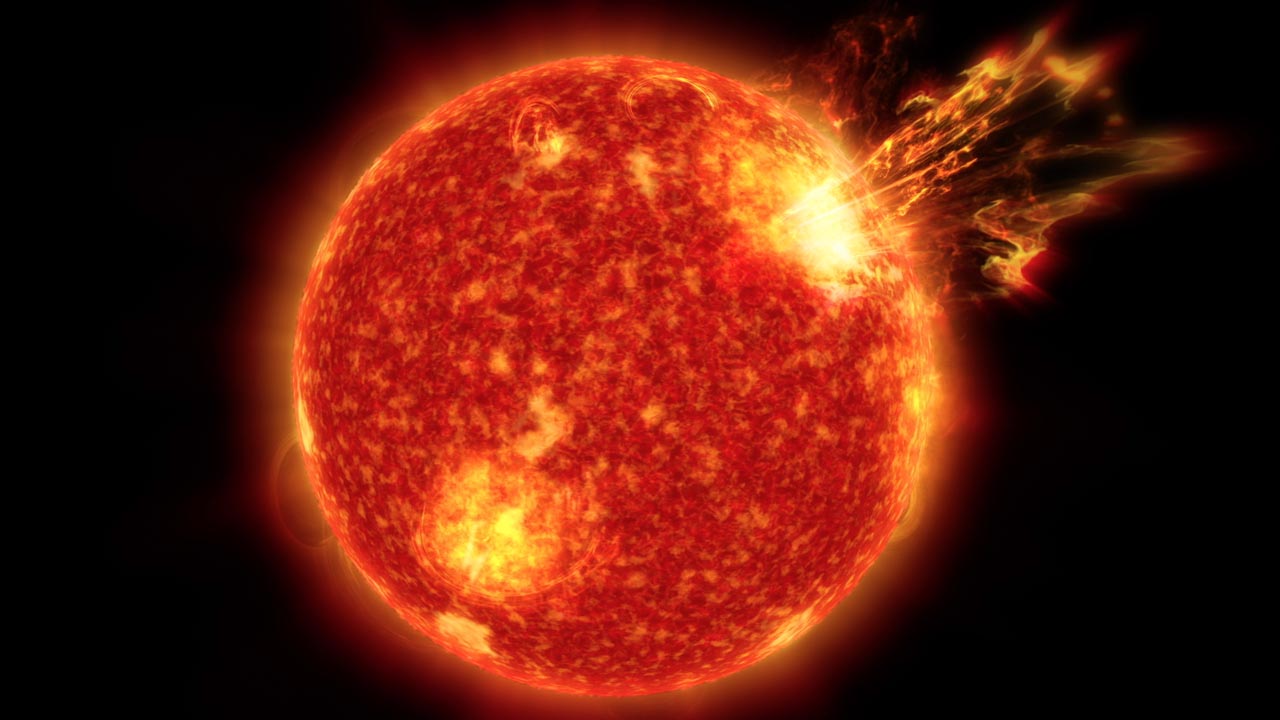
A consider of the Ophiuchus star-forming complex has advertised unused experiences into the conditions in which our possess sun based framework was born.

The discoveries of the ponder were distributed within the diary Nature Astronomy. A locale of active star arrangement within the group of stars Ophiuchus is giving stargazers modern bits of knowledge into the conditions in which our possess sun oriented framework was born

In specific, the ponder appeared how our sun based framework may have ended up improved with short-lived radioactive elements. Evidence of this enhancement prepare has been around since the 1970s when researchers considering certain mineral incorporations in shooting stars concluded that they were flawless remainders of the newborn child sun based framework and contained the rot items of short-lived radionuclides. These radioactive components seem have been blown onto the early sun powered framework by a adjacent detonating star (a supernova) or by the solid stellar winds from a sort of gigantic star known as a Wolf-Rayet star.

The creators of the unused ponder utilized multi-wavelength perceptions of the Ophiuchus star-forming locale, counting marvelous unused infrared information, to uncover intelligent between the clouds of star-forming gas and radionuclides delivered in a adjacent cluster of youthful stars. Their discoveries shown that supernovas within the star cluster are the foremost likely source of short-lived radionuclides within the star-forming clouds. “Our solar framework was most likely shaped in a mammoth atomic cloud along with a youthful stellar cluster, and one or more supernova occasions from a few enormous stars in this cluster sullied the gas which turned into the sun and its planetary system,” said co-author Douglas N. C. Lin, teacher emeritus of space science and astronomy at UC Santa Cruz. “Although this scenario has been recommended within the past, the quality of this paper is to utilize multi-wavelength perceptions and a modern factual examination to infer a quantitative estimation of the model’s probability,”

To begin with creator John Forbes at the Flatiron Institute’s Center for Computational Astronomy said information from space-based gamma-ray telescopes empower the discovery of gamma beams transmitted by the short-lived radionuclide aluminum-26. “These are challenging perceptions. Ready to only convincingly identify it in two star-forming districts, and the finest information are from the Ophiuchus complex,” he said. The Ophiuchus cloud complex contains numerous thick protostellar cores in different stages of star arrangement and protoplanetary disk improvement, speaking to the most punctual stages within the arrangement of a planetary system. By combining imaging information in wavelengths extending from millimeters to gamma beams, the analysts were able to picture a stream of aluminum-26 from the adjacent star cluster toward the Ophiuchus star-forming locale.

The enhancement handle we’re seeing in Ophiuchus is steady with what happened amid the arrangement of the sun based framework 5 billion a long time back,” Forbes said. “Once we saw this decent case of how the method might happen, we set almost attempting to demonstrate the adjacent star cluster that created the radionuclides we see nowadays in gamma beams,” he added. Forbes created a demonstrate that accounts for each enormous star that may have existed in this locale, counting its mass, age, and likelihood of detonating as a supernova, and joins the potential yields of aluminum-26 from stellar winds and supernovas. The show empowered him to decide the probabilities of distinctive scenarios for the generation of the aluminum-26 watched today. “We now have sufficient data to say that there’s a 59 per cent chance it is due to supernovas and a 68 per cent chance that it’s from numerous sources and not fair one supernova,” Forbes said.

This sort of factual investigation allots probabilities to scenarios that cosmologists have been debating for the past 50 a long time, Lin noted. “This is the modern heading for cosmology, to measure the probability,” he added. The unused discoveries moreover appeared that the sum of short-lived radionuclides consolidated into recently shaping star frameworks can shift widely. “Many unused star frameworks will be born with aluminum-26 plenitudes in line with our sun powered framework, but the variety is tremendous – a few orders of greatness,” Forbes said. “This things for the early advancement of planetary frameworks since aluminum-26 is the most early warming source. More aluminum-26 likely implies drier planets,” he added. The infrared information, which empowered the group to peer through dusty clouds into the heart of the star-forming complex, was gotten by coauthor Joao Alves at the College of Vienna as portion of the European Southern Observatory’s VISION overview of adjacent stellar nurseries utilizing the VISTA telescope in Chile

There’s nothing uncommon almost Ophiuchus as a star arrangement locale,” Alves said. “It is fair a normal setup of gas and youthful enormous stars, so our comes about ought to be agent of the improvement of short-lived radioactive components in star and planet arrangement over the Smooth Way,” he concluded. The group moreover utilized information from the European Space Agency’s (ESA) Herschel Space Observatory, the ESA’s Planck adj., and NASA’s Compton Gamma Beam Observatory.
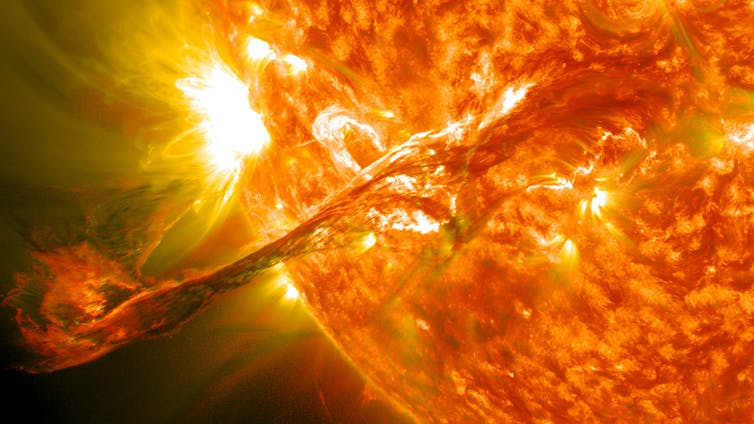
The sun won’t die for 5 billion years

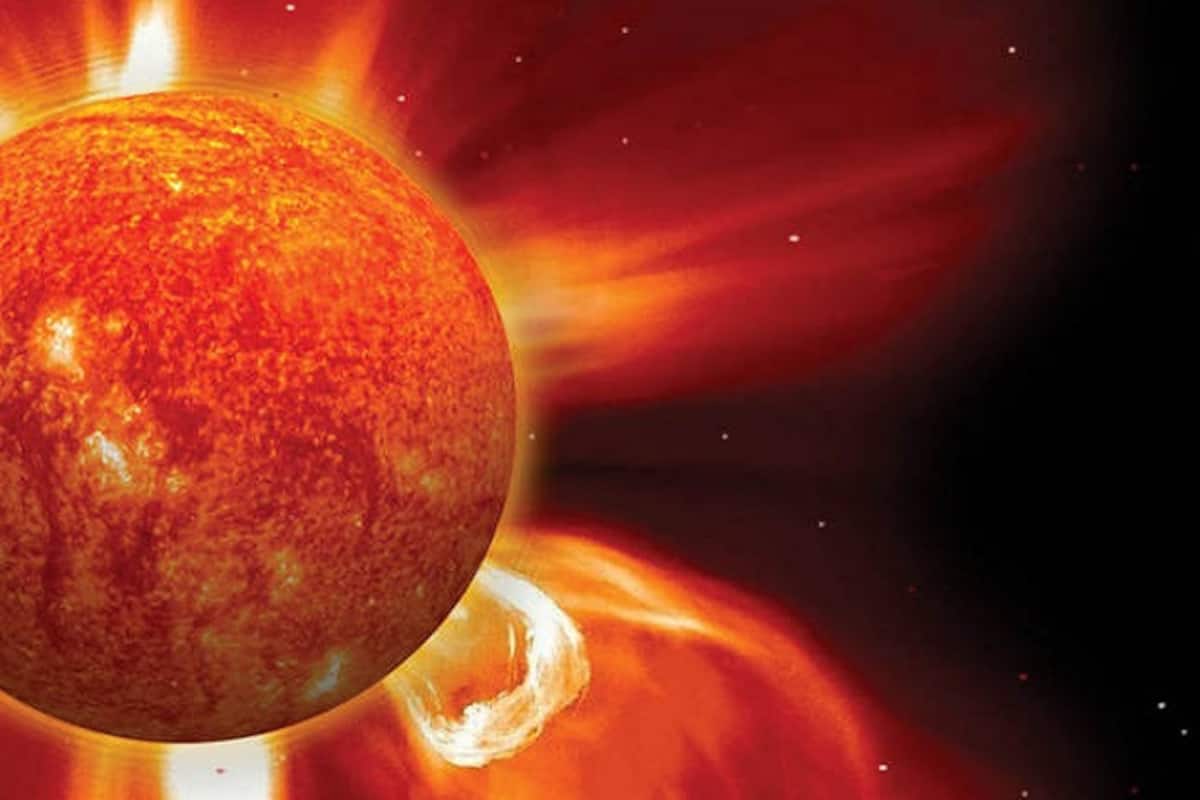
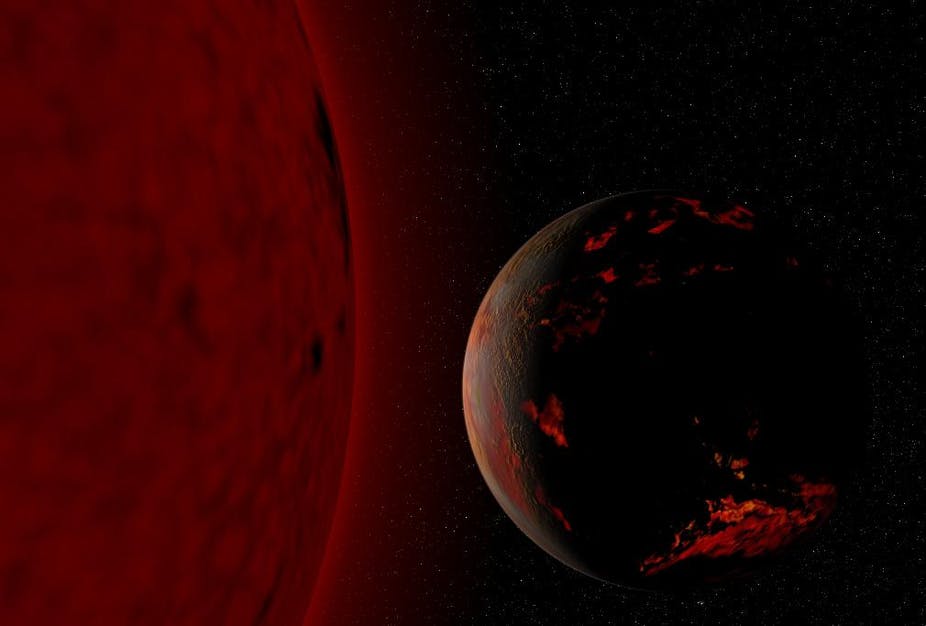
In a few billion years, the sun will become a red giant so large that it will engulf our planet. But the Earth will become uninhabitable much sooner than that. After about a billion years the sun will become hot enough to boil our oceans.

The sun is currently classified as a “main sequence” star. This means that it is in the most stable part of its life, converting the hydrogen present in its core into helium. For a star the size of ours, this phase lasts a little over 8 billion years. Our solar system is just over 4.5 billion years old, so the sun is slightly more than halfway through its stable lifetime.

After 8 billion years of happily burning hydrogen into helium are over, the sun’s life gets a little more interesting. Things change because the sun will have run out of hydrogen in its core – all that’s left is the helium. The trouble is that the sun’s core is not hot or dense enough to burn helium.

In a star, gravitational force pulls all the gases towards the centre. When the star has hydrogen to burn, the creation of helium produces enough outward pressure to balance out the gravitational pull. But when the star has nothing left in the core to burn, gravitational forces take over.

Eventually that force compresses the centre of the star to such a degree that it will start burning hydrogen in a small shell around the dead core, which is still full of helium. As soon as the sun begins to burn more hydrogen, it would be considered a “red giant”.

The process of compression in the centre allows the outer regions of the star to expand outwards. The burning hydrogen in the shell around the core significantly increases the brightness of the sun. Because the size of the star has expanded, the surface cools down and goes from white-hot to red-hot. Because the star is brighter, redder and physically larger than before, we dub these stars “red giants”.

Earth’s fiery demise

It is widely understood that the Earth as a planet will not survive the sun’s expansion into a full-blown red giant star. The surface of the sun will probably reach the current orbit of Mars – and, while the Earth’s orbit may also have expanded outwards slightly, it won’t be enough to save it from being dragged into the surface of the sun, whereupon our planet will rapidly disintegrate.

Life on the planet will run into trouble well before the planet itself disintegrates. Even before the sun finishes burning hydrogen, it will have changed from its present state. The sun has been increasing its brightness by about 10% every billion years it spends burning hydrogen. Increased brightness means an increase in the amount of heat our planet receives. As the planet heats up, the water on the surface of our planet will begin to evaporate.

An increase of the sun’s luminosity by 10% over the current level doesn’t sound like a whole lot, but this small change in our star’s brightness will be pretty catastrophic for our planet. This change is a sufficient increase in energy to change the location of the habitable zone around our star. The habitable zone is defined as the range of distances away from any given star where liquid water can be stable on the surface of a planet.

With a 10% increase of brightness from our star, the Earth will no longer be within the habitable zone. This will mark the beginning of the evaporation of our oceans. By the time the sun stops burning hydrogen in its core, Mars will be in the habitable zone, and the Earth will be much too hot to maintain water on its surface.

Uncertain models

This 10% increase in the sun’s brightness, triggering the evaporation of our oceans, will occur over the next billion years or so. Predictions of exactly how rapidly this process will unfold depend on who you talk to. Most models suggest that as the oceans evaporate, more and more water will be present in the atmosphere instead of on the surface. This will act as a greenhouse gas, trapping even more heat and causing more and more of the oceans to evaporate, until the ground is mostly dry and the atmosphere holds the water, but at an extremely high temperature.

As the atmosphere saturates with water, the water held in the highest parts of our atmosphere will be bombarded by high energy light from the sun, which will split apart the molecules and allow the water to escape as hydrogen and oxygen, eventually bleeding the Earth dry of water.

Where the models differ is on the speed with which the earth reaches this point of no return. Some suggest that the Earth will become inhospitable before the 1 billion year mark, since the interactions between the heating planet and the rocks, oceans, and plate tectonics will dry out the planet even faster. Others suggest that life may be able to hold on a little longer than 1 billion years, due to the different requirements of different life forms and periodic releases of critical chemicals by plate tectonics.

The Earth is a complex system – and no model is perfect. However, it seems likely that we have no more than a billion years left for life to thrive on our planet.

LARGE SOLAR STORM APPROACHING EARTH – BLACKOUT

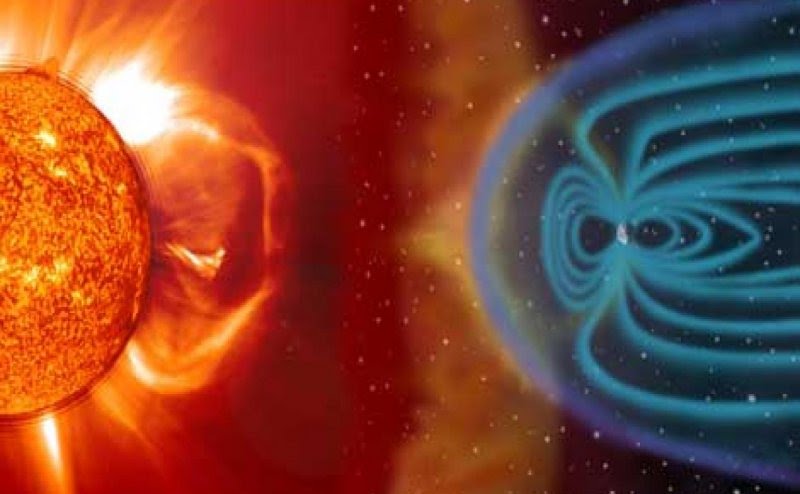
Huge charged particles ejected from the sun is called solar storm.

According to website Spaceweather.com, the storm that originated from the Sun’s atmosphere and can have a significant impact on a region of space dominated by Earth’s magnetic field.

A powerful solar storm is approaching the Earth at a speed of 1.6 million kilometers and this storm will hit the Earth either on Sunday or Monday.

According to the US space agency NASA, the solar storm is moving towards the Earth at a speed of about 1.6 million kilometers per hour and maybe its speed will increase further. NASA said that satellite signals can be interrupted by solar storms.

Scientists have feared that this great solar storm may hit our Earth in two days pic.twitter.com/MlWUeZ56aw

Effect of solar storm

The outer atmosphere of the Earth can be heated which can have a direct effect on satellites.

This can cause interference with GPS navigation, mobile phone signal and satellite TV. The current in power lines can be high, which can also blow transformers

Power lines can carry a lot of currents, which can blow transformers

There is also a possibility of blackout of HF (high frequency) radio communication that is dependent upon current X-ray Flux intensity. According to the latest prediction, the flare can cause a wide area blackout of HF (high frequency) radio communication for about an hour.

Due to the solar storm, there will be a view of beautiful celestial lighting for the people living at the North or South Pole. The people living closer to these areas can expect to see beautiful aurora at night.

JOURNEY TO SANITY – SUNSHINE 🌤️

Sun is something we have seen almost everyday of our lives, yet many of us aren’t aware of it’s health benefits except for the fact that it provides Vitamin D to the body.
We all know that Earth revolves around the Sun, but little do we know that so does our mood. A healthy amount of sunlight is considered to promote the production of a hormone called serotonin in the kidney and liver that helps to boost one’s mood, providing more peace and focus. A healthy dose of serotonin helps to balance the amount of a hormone called melatonin that promotes sleep at night and helps one in maintaining a balanced routine. It also helps to promote the metabolism process and even prevent weight gain.

Scientifically speaking, a 15-30mins of sun exposure between 7 a.m. – 9 a.m. few times a week helps to promote enough melatonin to boost one’s mood and reduce the effects of Depression and Anxiety. This form of exercise is called light therapy or phototherapy in clinical terms.
The UV-B rays in the Sunlight are responsible for the production of Vitamin D in a human body. Vitamin D is beneficial for a healthy eye sight and promoting strong bone health. It is Scientifically proven that Sun Radiations helps in fighting certain Cancer cells and cures various skin diseases like eczema, acne, etc. However, the effects might differ from body to body so it’s advisable to consult with a dermatologist.
Just like the universe, our body work on the law of balance. Excess of anything might do more harm than good. Similarly, excess of sun exposure might have harmful eyes on the eyes, skin and even lead to cancer at times.

Do not forget to read more from the series :

JOURNEY TO SANITY – ACCEPTANCE

JOURNEY TO SANITY – MINDFULNESS

JOURNEY TO SANITY -JOURNALING

International day of Tropics

The serenity of the lulling ocean is a wondrous thing to behold..more precious than the gems coveted and covered in platinum or gold…

Oksana Rus

Introduction

International day of Tropics is observed every year on June 29th . This day is celebrated to highlight the different challenges and opportunities faced by the nation as well as by the people who lived in tropical areas .

Firstly , you want to know about things like :

What are tropics ?

Why we celebrate international day of Tropics ?

Or

Is it worth it to talk about these things and is it really important ?

Well hold your horses and try to calm .

What is tropic day and why we celebrate it ?

Well a tropic day is celebrated to highlight the importance of Tropics , it signifies extraordinary and astounding diversity of tropical nations .

The Tropic defined as a area /region between tropic of Cancer and tropic of Capricorn . The day aim at promoting tropical regions and awareness to the people about the diversity of these regions .

While these regions go through little seasonal changes on day to day basis because of some factors like tomography , climatic variation that causes changes in temperature and make these regions warm.

This day introduced to the world when in June 29th , 2014 twelve leading tropical research institutes come together and collaborate. The inaugural state of the Tropics report was launched . The report offers some unique perspective for the increasing the importance of these regions .

United Nations General Assembly adopted resolution A/RES/70/267 in 2016, which declared that 29 June of each year is to be observed as the International Day of the Tropics.

The International day of Tropics briefly explained the issues affecting the tropical zone’s all over the world. To raise awareness and important role the countries played to Sustainable goals .

International day of Tropics 2021

As per the state tropics report the theme of this year is “ THE DIGITAL DIVIDE IN THE TROPICS ”

With the record of sustainable development goals as well as developmental scope . The biodiversity of these regions are maximum and its loss is also greater there. Tropical regions comprise 98% world’s mangrove forests, and around 99% mangrove species.

Due to the subpolar zone the Sun is directly overhead which is one of the region of extinction of flora and fauna in the Tropics. The region is subjected to myriad and need immediate attention to ensure sustainable development.

More than 50% of renewable water resource could be founded their. But the threat lies which causes eviction of lives in the Tropics.

Importance :

Due to the problems it’s our duty as a human being to spread awareness about the implications in climate changes , deforestation , urbanization , global warming effect the biodiversity and lives in Tropics.

The International day of Tropics organize many events in which people share their stories , events and lives in these areas and formulate strategies to ensure the development of such regions .

You who sacrifice fortunes to see the luxuriance of the tropics or the polar lights of the arctic, must pay more dearly to see the One for whom the luxuriance of the tropics is poverty and the polar lights are a tallow candle.

Nikolaj Velimirović, Prayers by the Lake

Link:

Living With A Star- The Sun

We have our own star- the mighty Sun. The Sun is the biggest source of heat and light in our solar system. It is one of the several trillion stars in the Milky Way Galaxy. Though it is massive, it is classified as a yellow dwarf star. Without it, life might not exist, and that makes it very important to us. 

To ancient people, the Sun was something to worship. Various religions around the world venerated the Sun as a god with various names. 

Image result for Sun. Size: 160 x 160. Source: www.physics.upenn.edu

Solar Physics

Our sun is very special to us and the solar system. So, we have a separate branch of physics specially for our dear Sun.Solar physicists seek to explain how the sun works and how it affects the rest of the solar system They take  measurements of the temperature and have assigned it a stellar ‘type’ based on their measurements. They figure out its structure. Their studies help us to know more about the other stars.

Structure of the sun

The Sun is basically a big sphere of superheated gas. It has an outer solar atmosphere, which is called the corona (not the virus of course).  It’s an incredibly thin layer of superheated gas having over a million degrees temperature. Below that lies the chromosphere. It’s a thin, reddish-hued layer of gases and its temperature changes from 3500℃ at the base to 35000℃  where it transitions up to the corona. Next is the photosphere, where temperatures range from 4000°C to 5700℃ . When you look at the sun, the photosphere is actually what you see. The sun is actually white(believe me), but it appears yellowish because its light travels through our atmosphere, which removes blue and red wavelengths from the incoming light. After the photosphere, we have the convective zone. It contains bubbles, which are currents moving through the Sun. The next layer is the radiative zone. This region truly does radiate heat from the center of the Sun up to the convective zone. The final layer is the solar core. This is a huge nuclear furnace where nuclear fusion happens. The temperature here is 15million degrees celsius. The rest of the Sun pressing down on it provides a pressure 340 billion times the earth’s atmospheric pressure at sea level (the poor core has a lot of pressure indeed!). The Sun fuses about 620 metric tons of hydrogen to helium each second, and that’s what gives out all that heat.

Heliopause

The solar wind from the sun extends out about 100 astronomical units, and creates a bubble that surrounds the solar system. The bubble’s inner edge is called the heliopause. 

Sun spots

The surface of the sun is dotted with dark regions called sun. Look who has acne problems! Well, these are not really acne. These are areas threaded with magnetic fields and look dark because they are cooler than the surrounding regions. Sunspots appear in eleven year cycles.  As the Sun reaches solar minimum and solar maximum through the solar cycle, the spots change darkness. These sunspots are related to solar activity.

https://en.wikipedia.org/wiki/Sun
https://solarsystem.nasa.gov/solar-system/sun/in-depth/

BLACK HOLES – The great void

WHAT ARE BLACK HOLES ?

BLACK HOLES are points in space that are so dense they create deep gravity sinks. Beyond a certain region, not even light can escape the powerful tug of a black hole’s gravity. Because no light can get out, people can’t see black holes. They are invisible. Space telescopes with special tools can help find black holes. The special tools can see how stars that are very close to black holes act differently than other stars.

HOW ARE THEY FORMED ?

The most well-understood black holes are created when a massive star reaches the end of its life and implodes, collapsing in on itself.In their final stages, enormous stars go out with a bang in massive explosions known as supernovae. Such a burst flings star matter out into space but leaves behind the stellar core. when there are no longer forces to oppose that gravity, so the star core begins to collapse in on itself.

If its mass collapses into an infinitely small point, a black hole is born. Packing all of that bulk—many times the mass of our own sun—into such a tiny point gives black holes their powerful gravitational pull.

BLACK HOLES SWIRLING WITH STARS

Researchers have long estimated that the Milky Way is home to hundreds of millions of black holes, extremely dense objects whose gravitational fields are so intense, not even light can escape. But finding these dark objects has proven extremely difficult and majority of black holes in our galaxy are invisible, so the only way to find them is by observing their gravitational effects on surrounding objects.

After decades of black holes being known only as theoretical objects, the first physical black hole ever discovered was spotted in 1971. Then, in 2019 the Event Horizon Telescope (EHT) collaboration released the first image ever recorded of a black hole.

Using the Event Horizon Telescope, scientists obtained an image of the black hole at the center of galaxy M87

TYPES OF BLACK HOLES

The most common types of black holes are the stellar-mass and supermassive black holes. Stellar-mass black holes are created when massive stars explode, leaving behind a black hole with the mass of just a few suns. Supermassive black holes exist in the hearts of galaxies and usually contain the mass equivalent of millions of suns.

SUPERMASSIVE BLACK HOLES- BIRTH TO GIANTS

Small black holes populate the universe, but their cousins, supermassive black holes, dominate. These enormous black holes are millions or even billions of times as massive as the sun, but are about the same size in diameter. Such black holes are thought to lie at the center of pretty much every galaxy, including the Milky Way.Almost every galaxy, including our Milky Way, has a supermassive black hole at its heart, with masses of millions to billions of times the mass of the Sun. 

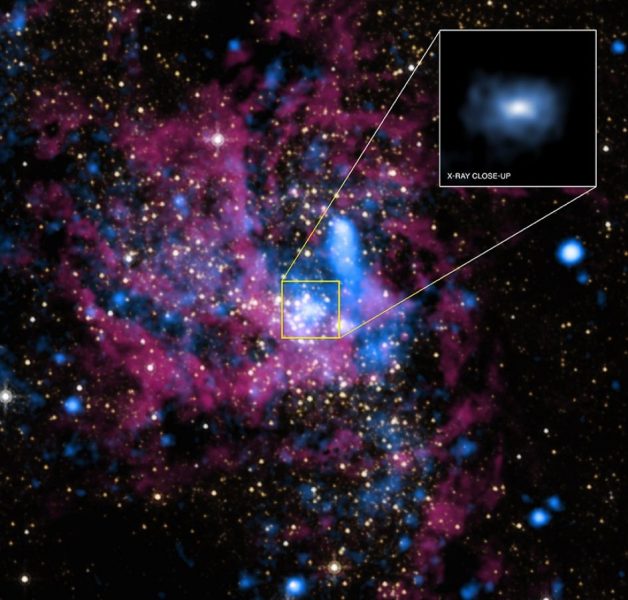
The supermassive black hole that lurks at the center of our galaxy, called Sgr A*, has a mass of about 4 million times that of our Sun. A black hole is a place in space where gravity is so strong that neither particles or light can escape from it. Surrounding Sgr A* is a dense cluster of stars. It is 26,000 light-years from the Solar System

On January 5, 2015, NASA reported observing an X-ray flare 400 times brighter than usual, a record-breaker, from Sagittarius A*. The unusual event may have been caused by the breaking apart of an asteroid falling into the black hole or by the entanglement of magnetic field lines within gas flowing into Sagittarius A*.

Sagittarius A* is the black hole at the center of the Milky Way galaxy. Credits: X-ray: NASA

FAMOUS BLACK HOLES

Cygnus X-1: a stellar-mass black hole and x-ray source that lies some 6,500 light-years away. It is a binary system that contains a blue supergiant variable star and the x-ray source thought to be the black hole.

Sagittarius A*: the supermassive black hole at the heart of the Milky Way Galaxy. It lies in the direction of the constellation Sagittarius. This black hole contains the mass of about 4 million suns.

M87: this elliptical galaxy has a 3.5 billion solar-mass black hole at its heart. The black hole is surrounded by a disk of super heated material and has a jet of super heated material streaming away from the black hole that extends across 5,000 light-years from the galaxy’s core.

Centaurus A: this galaxy, which lies in the direction of the constellation Centaurus, is a giant spiral galaxy with an incredibly active nucleus. It contains a 55 million solar-mass black hole at its heart, with two jets of material that stream away from the galaxy at about half the speed of light across a million light-years of space.

Amazing Facts :

1. Black holes will spaghettify you and everything else.

Black holes have this incredible ability to literally stretch you into a long spaghetti-like strand. Appropriately, this phenomenon is called ‘spaghettification’

2.Einstein didn’t discover black holes.

Einstein didn’t discover the existence of black holes – though his theory of relativity does predict their formation. Instead, Karl Schwarzschild was the first to use Einstein’s revolutionary equations and show that black holes could indeed form.

3. Black holes are the ultimate energy factories.

Black holes can generate energy more efficiently than our Sun.

4.Black holes slow down time

To understand why, think back on the twin experiment that is often used to explain how time and space work together in Einstein’s theory of general relativity: One twin stays on Earth while the other one zooms out into space at the speed of light, turns around, and returns home. The twin that travelled through space is significantly younger because the faster you move, the slower time passes for you. As you reach the event horizon, you are moving at such high speeds due to the strong gravitational force from the black hole, that time will slow down

5.Anything can become a black hole, in theory.

The only difference between a black hole and our Sun is that the centre of a black hole is made of extremely dense material, which gives the black hole a strong gravitational field. It’s that gravitational field that can trap everything, including light, which is why we can’t see black holes. You could theoretically turn anything into a black hole.

PRESERVATION OF FOOD USING DRYING METHOD

Drying or dehydration can be defined as the removal of water from the food by controlled processes, which can be achieved by either of 3 ways –

  1. Evaporation due to heating of the food product
  2. Osmotic dehydration
  3. Sublimation, or freeze drying

Drying can be explained as a 2 stage process in which in the first stage, the surface water removal takes place which totally depends on the state of air surrounding that food particle such as its temperature, relative humidity, and speed. On the other hand in the second stage of the drying, the moisture which is present within the food particle is allowed to move onto the surface which can be then again removed by the process of the first stage.
The rate of drying basically depends on the time that moisture takes to come onto the surface of the food from its inside. Heating of any particle accelerated its time of drying. The shortest time period has been noted in starchy foods.
There are 5 basic methods of drying –

  1. TUNNEL DRYING –
    Many years ago, for the purpose of preservation of agricultural products by the means of drying, a solar tunnel dryer was developed. It is an amazing device which can be used for the hygienic preservation of food and also acts as a good alternative for the seasonal agricultural surplus. Also the foods which are dried using this process are more hygienic and superior rather than other methods.
  2. SOLAR DRYING –
    I t is also known as sun drying and is a method of drying any substance using natural sunlight. This drying technique offers faster drying rates and greater protection of the product. There are several problems or limitations which are associated which this type of drying technique, such as the drying areas must be free of dust and whenever there are chances of a dust storm or rain, the drying process cannot be continued.
    There is also a process known as shade drying which can be carried out for the product which can easily lose their color and turn brown if kept in sunlight i.e. they are non-photosynthetic.
  3. SPRAY DRYING –
    This is a unique technique which ultimately transforms the substrate from a liquid to dried form by spraying the feed into a hot drying medium. It is a continuous process and takes time. The dried products which are ultimately obtained can be in the form of powders, granules or agglomerates. It is a multi-step process.
  4. VACUUM DRYING –
    Since evaporation of water takes place more easily and effectively at lower pressures, so vacuum drying was developed which is faster than the process of evaporation. This is an expensive method and is used for some specific products.
  5. FREEZE DRYING –
    This method uses the process of sublimation, which is a process which directly converts solid particles to their gaseous state, without first melting them. It is a technique which is very used in preserving food at low temperatures because at less temperature, chemical reactions occur very rarely and food is rarely attacked by pathogens. It is also a multi-step process which includes freezing, vacuuming, heating and finally condensation of the product.

Solar Eclipse- Everything you need to know!!!

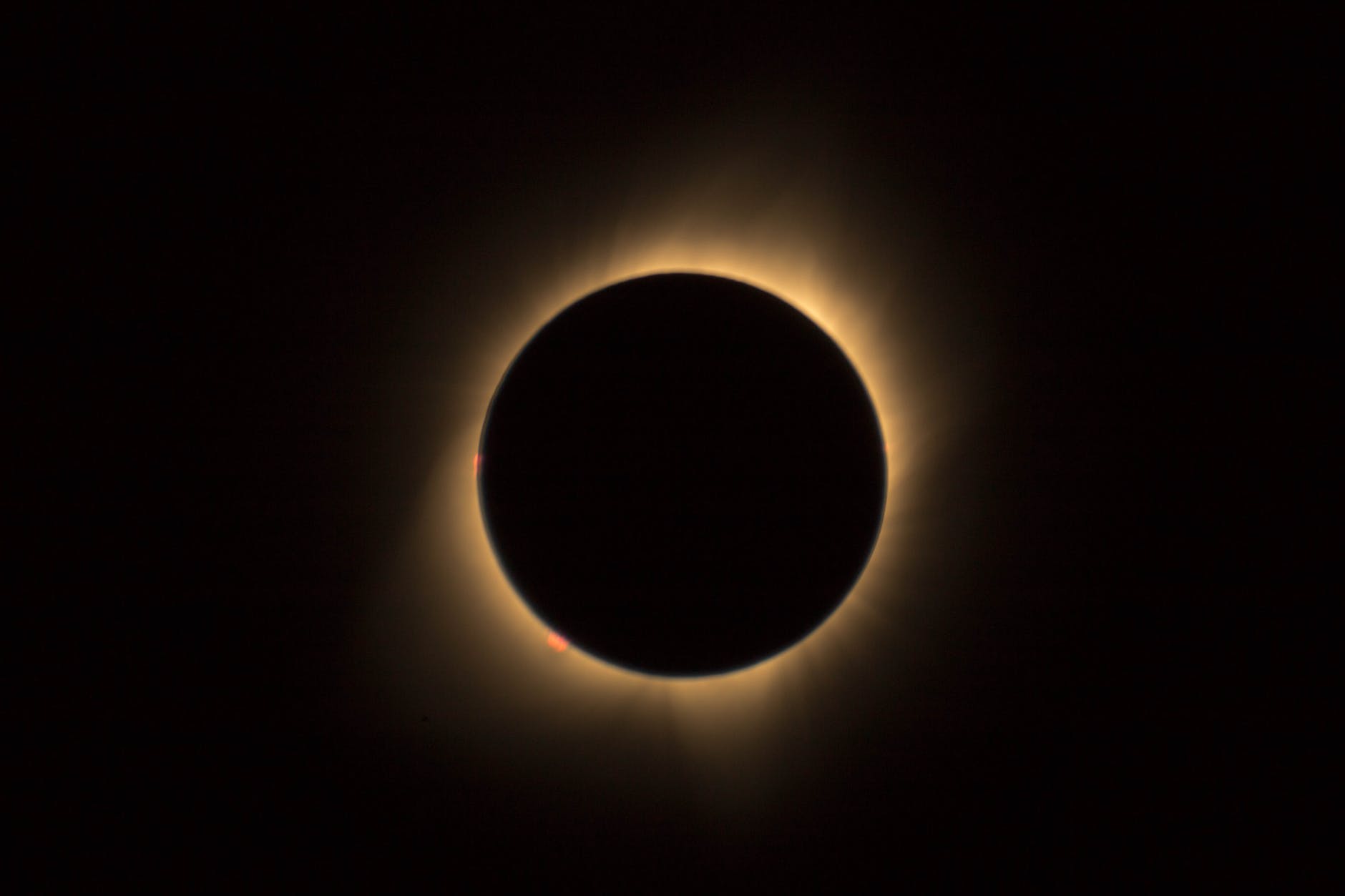
Solar Eclipse a sight is rarely seen on earth. On this day the sun will look like a shining ring. This will be neither partial eclipse nor complete. The shadow of the Moon will cover  almost 99% of the Sun rays. Which will cause the side of the sun remain illuminated and the middle part of the sun will be completely covered by the shadow of the moon.

astronomy circle dark eclipse
Photo by Drew Rae on Pexels.com

Solar eclipse will be addressed on 21st June 2020 from 10:20 AM  to  1:49 PM which will be visible in India and according to astrology this day will be impressive as many planets and constellations will be matching which did not match from past 500 years! Sutak period will start from 10:17 AM on 21 June it self. This solar eclipse will be in Mrigashira, Ardra, Nakshatra and Gemini. During this eclipse, 6 planets i.e. Jupiter, Saturn, Mars, Venus, Rahu and Ketu will be in retrograde state; Rahu and Ketu are always retrograde. Such position of planets will make solar eclipse impressive. According to astrology, eclipses can become a factor of natural disasters, which may cause disaster like earthquake, typhoon or storm.

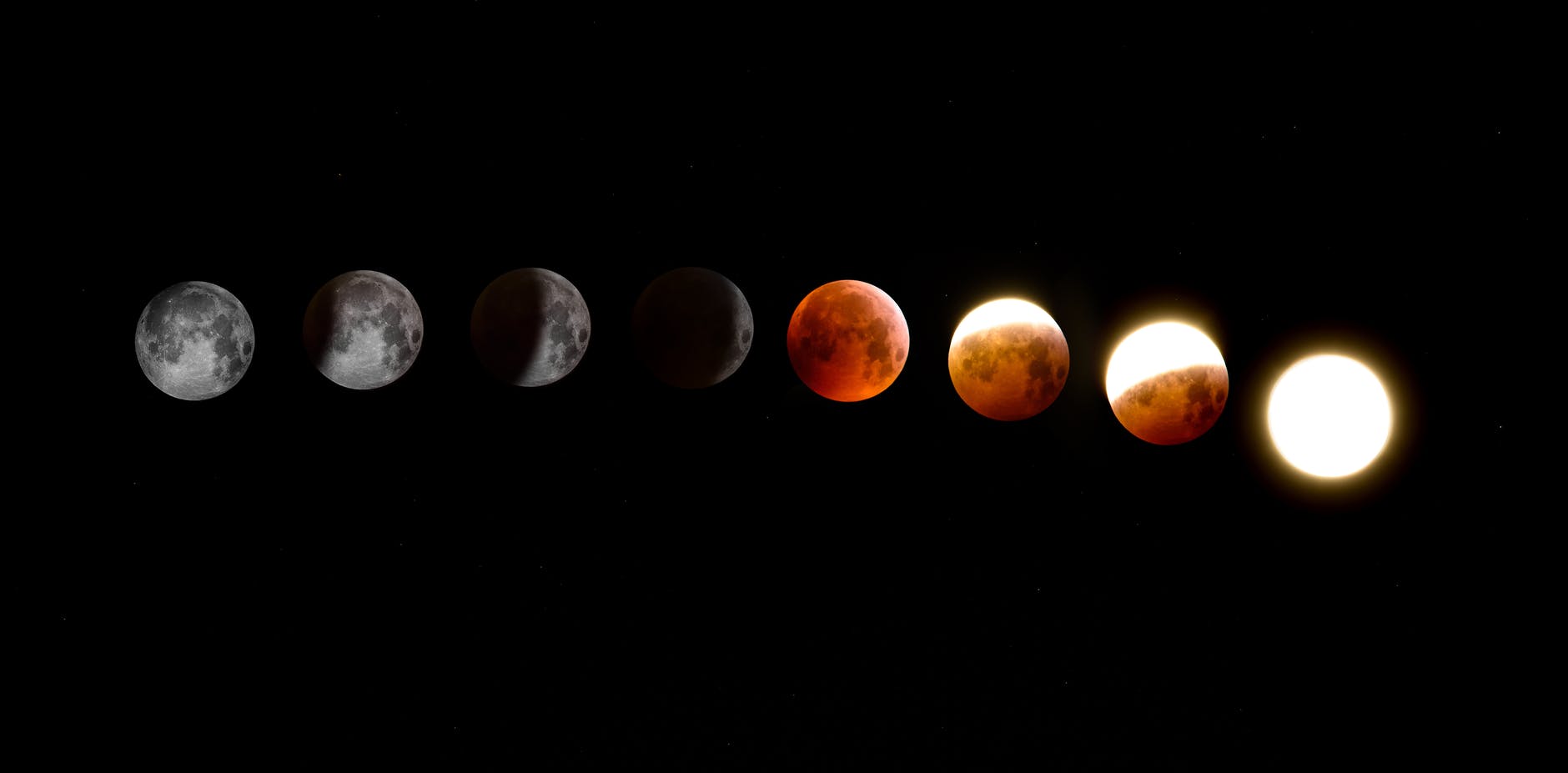
phases of the moon
Photo by Alex Andrews on Pexels.com

Precautions should be taken during the solar eclipse every time like; Solar eclipse should not be viewed with naked eyes. During this time the rays emanating from the sun are vary harmful and hence can damage the eyes. Therefore, to see this, special types of equipment should be used like Welding glasses, X-ray sheet keep a not that your face and body should be covered fully as the rays may damage the skin. According to religious beliefs, do not do any auspicious work at the time of eclipse. At the time of the eclipse, neither should you eat or drink anything. It is believed that before eclipse, basil leaves should be put in food and drink to make it safer. In the eclipse period, remembering the Lord, do puja, chanting, charity etc. religious work which will be good for family and ourself too. As soon as the eclipse of the eclipse begins, cover the place of worship in the house during the eclipse. After the eclipse, take a bath and clean the place of worship and sprinkle Ganga water. Pregnant women should be very careful and stay away from the sun full day as it may affect the infant.

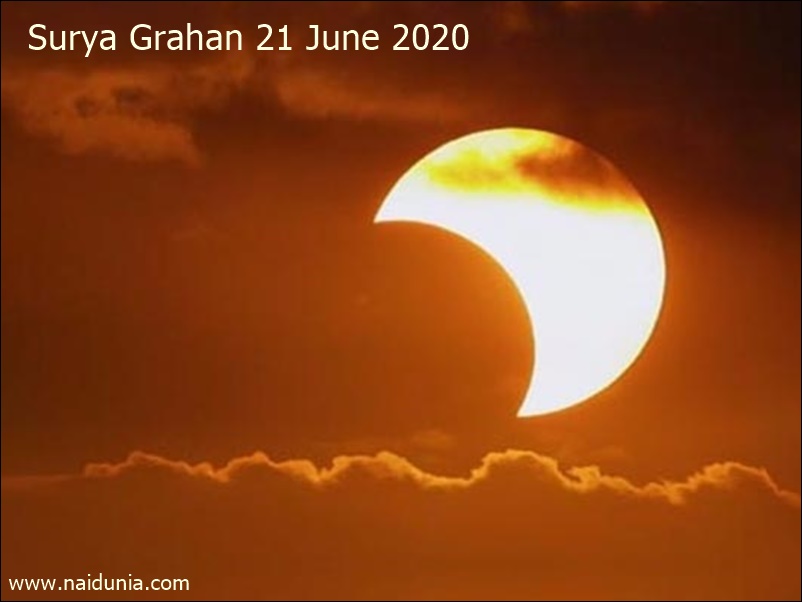
Surya Grahan Time: 12 घंटे पहले से लग जाएगा सूर्य ग्रहण का सूतक, यह होगा समय

Image Source: Naidunia.com