Unusual jobs we never knew existed

If the usual nine to five jobs sound boring to you, there are a plenty of unusual, interesting and never heard before jobs- jobs which don’t involve in office time at all.

Let’s have a look at the most unusual yet interesting professions.

>Iceberg mover

The idea came up after the tragedy of Titanic in 1912. Professionals and specialists are hired to tow icebergs out of the path of ships and oil rigs. Iceberg movers earn an estimated amount of $19,000 to $52,000 per year.

>Panda nanny

As a part of China Giant Panda Protection, the research centre in China is on hunt for specialised nannies for panda cubs. Those who wish to partake will be provided free meals, transit and accommodations along with an estimated pay of 200,000 Yuan ($32,000) a year.

>Ash artist

We must have heard of sand artists. Ash artist is somewhat similar to it. The only difference being the art piece is made of passed ones’ ashes. Though it might sound creepy but the art made out of the ashes looks beautiful and has a connection since it was made of a person you knew. The estimated pay is $225-$500 per commission.

>Professional mermaid

Though having seen a mermaid for real is not possible but a professional mermaid is definitely a real, though self made, job. There are no schools or institutions providing training in mermaid work. One has to be self motivated and comfortable in practicing and wearing a fish tail like mermaid and swimming like one. Professional mermaid job gets an estimate of $300/hour.

>Professional foreigner

Never thought being a foreign could be a profession? Here is a chance to work as a professional foreigner especially in China. It’s a big business in China where they hire foreigners to attend real estate events and meetings. Professional foreigners earn an approximate of $1,000/week.

>Fortune cookie writer

As the name suggests, those little notes we get in our cookies are usually written by professionals. Companies hire freelancers to make those little slips with sweet messages. Such freelancers get paid $40,000 to $80,000 annually.

China Issues Total Ban On Synthetic Cannabinoids

China will proudly become the world’s first nation to ban all synthetic cannabinoid substances, the country’s National Narcotics Control Commission declared. This endeavour is liable to come into effect on July 1. It echoes China’s continued efforts to crack down on new psychoactive substances. Xi Jinping, existing President of China, aims to advance China to its glory through his grand strategy of “National Rejuvenation”. 

 According to Chinese councils, more than eight thousand variations of synthetic cannabinoids are manufactured worldwide. While some are being produced domestically, others are being smuggled from abroad. As it is becoming one of the most abused new psychoactive substances it spawns severe health risks. It is also highly cloaked and camouflaged. Some are detected in e-cigarette oil and some in cut tobacco formulated from leaves, flower petals etc. The former U.S. President Trump irritatedly criticised China for shipping synthetic opioids into the U.S. Cannabinoid substances stance a severe threat to society and its use and abuse increased alarmingly in the last few years. Hence, it is arising as a public health problem. Many of these drugs create enormous threats for abuse, addiction or overdose than the remaining drugs of abuse that they replace. One of the primary concerns about the widespread usage of these dopes is that their properties are unpredictable, hence the degree of threat they pose is unlikely. 

Synthetic cannabinoids represent the largest group of drugs detected and reported worldwide to the United Nations Office on Drugs and Crime. Sprayed on natural herb mixtures, it is often sold as “herbal smoking blends” or “herbal scent” under several brand names. Synthetic cannabinoids have been linked with deaths and acute intoxications in Europe and many other areas. In addition to being more powerful than natural cannabis, it may also have long half-lives, dangerously leading to a prolonged psychoactive effect. These are human-made chemicals and it alters your mind too. These chemicals are labelled cannabinoids because of their similarity to marijuana plant chemicals. Because of this resemblance, synthetic cannabinoids are often misleadingly titled synthetic marijuana or fake weed. Hence they are traded as safe and legal. In fact, they are not at all safe and may harm the brain much more intensely than marijuana and in some cases, it may even be life-threatening.


Health effects of synthetic cannabinoids

• Violent behaviour 

• Heightened moods

• Severe anxiety

• Confusion

• Paranoia

• Hallucinations

• Rapid heart rates

• Vomiting

• Gloomy thoughts

How do people take synthetic cannabinoids
The most common way of using this synthetic cannabinoid is by smoking the dried plant material. Users also buy synthetic cannabinoid products as liquids to try them in e-cigarettes.
Its overdose may result in kidney damage and seizures.


Thus, China added synthetic cannabinoids to its list of banned drugs. It is the second time that the Chinese government imposed a class-wide ban on a substance after it controlled all fentanyl-related drugs in 2019. The changes may take effect on July 1. It is a new situation and a new challenge for China. China knows and they stood up for themselves, creating a new world, new life for its people. They are saving their people from the nightmares of chemical slavery. Let us all hope for the best.


Digital Citizenship | Digital literacy

Digital Citizenship

Digital citizenship is responsibly using the technology by anyone who uses computers, the Internet, and digital devices to engage with people on any level. Digital citizenship includes appropriate online etiquette, literacy in how digital technologies work and how to use them, an understanding of ethics and related law, knowing how to stay safe online, and advice on related health and safety issues such as predators and the permanence of data. It is about confidence and positive engagement with digital technologies.

With the increase in technologies, everyone is becoming more dependent on the internet for daily activities like checking bank account, purchasing something online, or talking to someone; especially at present, many people are using the internet daily as a result of social distancing due to the COVID-19 pandemic.

Digital Citizenship

Due to this increase in dependency on technology, there’s a difference between good digital citizenship and bad digital citizenship.

Good digital citizenship engages people and shows them how to connect with one other, empathize with each other whereas Bad digital citizenship, on the other hand, includes cyberbullying and irresponsible social media usage.

By educating people especially students about digital citizenship, they can develop an understanding of concepts like

  • Digital and information literacy
  • Privacy and Security
  • Cyberbullying
  • Practicing digital literacy
  • Practicing digital wellness
  • Acknowledging the digital divide
  • Understanding User Data

Online etiquettes are also one of the aspects of being a good digital citizen i.e communicating kindly with others. It’s important for people to understand that their written words have just as powerful an effect on the recipient as they would if spoken aloud.

Digital literacy:

World over years has taken a huge turn with the advanced technology we have therefore it is very essential to teach citizens about the basic understanding of using devices in an effective and useful way.

Example: Finding your query on search engines like google, shopping online, learning how to pay online, etc.

Digital literacy is the practice of reading information online and understanding what it means, where it originated, and whether it’s accurate. Digital literacy requires a lot of planning and review to ensure what one needs to know about the digital world.

Digital Literacy can be summarized as:

  1. Clickbait:

Clickbait refers to any text, headline, video title, etc. that’s deliberately written to pique someone’s interest and get them to click.

     2. Fake News:

Fake news is a relatively new phenomenon in 2019. It refers to any media outlet publishing severely biased or intentionally false information.

     3. Empathy:

Empathy is actually a big part of digital literacy and digital citizenship because digital literacy requires students to think beneath the face-value text that they’re reading online, they need empathy to truly understand the information they’re absorbing.

Digital Divide is the disparity between those who have access to modern digital tools (like computers and the Internet) and those who don’t. By acknowledging the digital divide one can mean to find the information one needs.

Digital wellness is the practice of refraining from indulging in the Internet and digital media for unreasonable amounts of time.

  • Practicing Digital Wellness is using a combination of health information, psychology, neurology, and current events to illustrate why it’s important to take time away from devices.
  • It is encouraged not to legally download contents that are not relevant or has an age restriction, accessing illegal material may lead to disrespect to digital property and if found guilty can cause severe punishment by the authority.
  • It is advised to avoid hateful speech and harassment which may hurt others.
  • Maintain good digital communication, in today’s circumstances almost everything is online for students from attending classes to making friends, let us teach them how they can do the safe and mannered talk and explain to them about the tactics of digital citizenship.

Lastly, Securing Digital Devices includes a few things like safety from viruses, keeping our devices password-protected, spam, etc.


GLORIFYING ANCIENT INDIAN SCIENTIFIC DEVELOPMENTS

Today whatever the advancement that is taking place worldwide, whether in technology, medicine, cosmic, and health all the praises are sung for the westerners.

However, India on the other side was one of the most renowned and developed nations in the world, contributing 32.00% of the world GDP(3rd BCE-13th CE).

“Many of the advances in the sciences that we consider today to have been made in Europe were in fact made in India centuries ago”.

– Grant Duff (British Historian)
And no other way this could be said more clearly.

Astonishingly, many Indians do not know about their own country’s past and history.
We need to recognize and learn our accomplishments of the past and glorify them.
India, the land of sages and seer, is not just a country of multiple, colorful cultures but the land that gave the world all those that are fundamental blocks of today’s great advancements.

TECHNOLOGICAL DEVELOPMENTS:


Galileo Galilei, Pythagoras, Aristotle, Newton are some of the great scientists and scholars of the west that are credited for all major discoveries and inventions.

However, ancient Indian scientists like Aryabhatt, Patanjali, Charaka are a few of the gems of the ancient technological world.

The invention of zero-


The invention of “zero” by Aryabhatt in the fifth century is the greatest invention of all time. With the integration of zero in the place value system, the world is now able to write numbers no matter how long.
Lancelot Hogben said:
“There has been no more revolutionary contribution than the one which the Hindus (Indians) made when they invented ZERO”.

Gravitational force-


We remember the Theory of Gravitational Force to be the contribution of Sir Isaac Newton, but in 400-500AD India this was already discovered.
In Surya Siddhanta, Indian astronomer, Bhaskaracharya stated-” All objects fall due to a force of attraction. That is why earth, planets, moon, sun are all in their orbits due to this attraction force”.

The atomic theory was discovered thousand years ago in India

To the world, a 19th century English chemist John Dalton is the father of atomic theory. However, few people know that ancient Indian scientist Acharya Kanada talked about atoms or “paramanu” in his book Kanada Sutras, or Aphorisms of Kanada.https://en.wikipedia.org/wiki/Kanada_(philosopher)#The_concept_of_anu_(atom)

Kanada opined, “paramanu is the indestructible particle of a matter”.

He also mentioned that atoms combine in a specific manner to form dvyanuka (diatomic molecules) and tryanuka (triatomic molecules).

WOOTZ STEEL:


The Discovery of wootz steel is one of the greatest discoveries in the metallurgical sector. It originated in South India, in present-day Tamil Nadu.
“Wootz steel is a crucible steel characterized by a pattern of bands and high carbon conten. The method was to heat black magnetite ore in the presence of carbon in a sealed clay crucible inside a charcoal furnace to completely remove slag”. as per Wikipedia.https://en.wikipedia.org/wiki/Wootz_steel

MEDICAL INNOVATIONS:

Plastic surgery-


Sushruta Samhita is the most important treatise on surgery written by Susruta. It describes the surgical training, instruments, and procedures practiced in modern surgery.
The treatise also deals with diseases and their prevention and cure, following with the number of bones in a human body.
It also thoroughly describes 700 medicinal herbs.n.wikipedia.org/wiki/Sushruta_Samhita#Prevention_versus_cure

Cataract Surgery-

Sushruta, an ancient Indian physician pioneered the first cataract surgery in the sixth century BC.
To remove the cataract he used a sharp needle called Jabamukhi Salaka, to loosen the lens and push the cataract out of the vision. Then the eye is bandaged till the time it gets healed.

Yoga

Acharya Patanjali is the Father of Yoga. He introduced the Yoga Sūtra of Patañjali in the 2nd century BC which became a very renowned contribution to the world. Through this field of discipline, one can discover his true self and its 84 yogic posture has proved efficient for the proper functioning of different systems, i.e. endocrine, nervous, respiratory, circulatory, etc. The different breathing patterns taught in this discipline aids in calming down the mind, body, and soul and allows them to work in unison.

SANSKRIT SHLOKA SAYS-
yogaścittavṛttinirodhaḥ

                                          MEANING:

Yoga is restraining the mind-stuff (Chitta) from taking various forms (Vrttis).​

These were few of the many achievements of our ancient scientists.

At last, the contribution of Ancient Indian scientists to scientific technology is worth dignifying.
To India, the cradle of the eminent leading light, Mark Twain honours-
“India is the cradle of the human race, the birthplace of human speech, the mother of history, the grandmother of legend, and great grandmother of tradition”


Home Workout | Get desired body shape at home

Home Workout

In this pandemic, many people are suffering loss and struggle to earn living. Lockdown has made it difficult to shop, travel, etc.  But most importantly people are unable to do their work-out as gyms are closed. This is one of the most important factors that are necessary for a person’s day-to-day life. But in this pandemic, we can’t expect our gym to get open again.


Get desired body shape at home

Yes absolutely! We have ways to keep you fit without a gym in this pandemic. In the gym, we get weights, machines as equipment like dumbbells, barbells, back rowing machines,s and many more. The basic principle of bodybuilding is resistance. We’ve got the best resistance with us i.e. our own body. We can do any body-weight workouts at home so as to fulfill the resistance requirements.

Home Workout


A brief description of muscle building:

The basic principle of muscle building is to generate stress while compressing our muscles. When we create stress/tension on the desired muscle, the muscle fibers break resulting in muscle building. At home, we use our body to generate that resistance to break muscle fibers.

Below are some important points that will help you to train your muscles, they are as follows:


Muscles that need to be trained:

We should train our every muscle but it is not possible if gyms are closed. Still, we’ll try to cover almost every muscle. So the basic muscles on which we’ll concentrate are:

  • Chest
  • Back
  • Quadriceps
  • Biceps and Triceps
  • Abdomen
  • Shoulders


Bodyweight workout for targeted muscles:

  1. Chest:

The most important and most do exercise for the chest is push-ups I.e., to push your body away from the ground. Push-ups can be of three types and those are inclined declined and flat push-ups. Just doing 2 to 3 sets of each type of push-up can be good training for our chest.

  1. Back:

The most effective back exercise is pull-ups i.e., to pull your body away from the ground. This can be done using a pull-up bar or even any rack in your house. This exercise targets our rhomboids and lats and gives our back a perfect V-shape. Other exercises are low, high plank, bridge hold, superman hold, etc.

  1. Quadriceps:

A quadriceps are a group of muscles that are located in the front of the thigh. One of the best workouts for quadriceps is bodyweight squats in which you have to push your hips backward while standing without bending your knees in the front and slowly come down then go back to your initial position. Other workouts are walking lunge, step-up, etc.

  1. Biceps and Triceps:

These two muscles together occupy a major part of our arm. Their main workouts are Diamond Push-ups, Reverse Grip push-ups, chin-ups, bench dips, close grip push-ups, parallel bar dips, etc. These workouts can make our arms defined and ripped if we do 10 reps of each exercise and 3 sets of min.

  1. Abdomen:

The abdomen or abs are the core of our body and these are the muscles that reside just below our chest. The main abs workout comprises L-sit, L-hold, V-sit, Sit-ups, leg raises, bicycle kicks, Planche holds, etc. These workouts are pretty tough but very effective if kept in regular practice.

  1. Shoulders:

Shoulders are also an important muscle of our body as all the body strength depends on them. Some of the most effective shoulder workouts are plank raise tap crunch, Archer push-ups, typewriter push-ups, etc. Shoulders define our upper body and are responsible for the broadness of our arms. One should do shoulder training at least twice a week to get big bulky shoulders!

Hope this gives you a brief understanding of how we can actually work out giving extra efforts to get the desired body shape at home without even joining the gym.


Musical Instruments | 3 Types of Musical Instruments

Musical Instruments

We all have a hectic life. We work 24×7 to earn money, to work on our skills, to keep up with our family responsibilities, and many more. Due to this, our mind goes into a state where we face frustration, stress, anxiety and this can further cause depression. What our mind needs is a little deviation from real life. So that we can regain our mental strength to work further. To do something other than work for our pleasure in our leisure time is known as a hobby. It has been observed that the most common hobby of the majority of people is Music.

Music is the integration of vocal and instrumental sounds that are combined to produce a kind of soothing and relaxing sound which is known as melody.

music

What are Musical Instruments?

There are two types of people

  • Music listeners
  • Music makers

Music listeners are those who only listen and feel the music. These people relate their life to the type of music they are listening to. On the other hand, come Music makers. These are people who use some equipment and devices to generate music. They relate music to their life. The equipment and devices they use to generate music are known as Musical instruments. These instruments act as an interface between a person’s mind and the music he wants. If a person wants to make happy music, he will play happy tones on the instrument and then that instrument will give the output as per requirements. There is a wide range of musical instruments in the world. We will discuss the most popular in all-region.


Types of musical instruments

In general, music instruments are categorized into 3 types:

  • String instruments
  • Wind instruments
  • Percussion instruments


String Instruments

These are also known as chordophones; they produce sound through the vibrating strings when the musician plays the string in a particular manner. These instruments make a sound when the strings are plucked by a ‘plectrum’ or my fingers, others are played by hitting the strings with a light wooden hammer or by rubbing the strings with a bow.

The most common example of these is guitar, piano, string sections (violin, viola, cello, and double bass), harp and much more. In primitive times, strings have been made out of the animal gut. But early in the 20th century, string began to make up of steel at first solid and then roped.


Wind instruments

Wind instruments are those which produce sound by blowing air in them. These are the instruments that contain a resonator tube in which a column of air is set into vibration by the player blowing into it. The performer blows into a mouthpiece set near the resonator some examples of wind instruments are flute, accordion, harmonica, clarinet, trumpet, and many more. In primitive days piece of hollow cane or dried fruit was used as a wind instrument

Percussion instruments

Percussion instruments are those which produce sound when struck by a beater. Also, they produce sound when scraped or rubbed by hand or struck against another similar instrument. Examples are Djembe, snare, Drums, Cymbal, etc.

The first type of percussion instrument was simply anything hit together to produce sound. Drums evolved from this and are known to have existed from around 6000 BC. They were used by all major civilizations throughout the world.


These are all types of musical instruments that are played in the modern era and were played in ancient times also. These instruments when played together in order create a beautiful fusion of chords and harmonies which are so pleased that a person can feel the message that musicians trying to convey to their audience.


Egyptian Mummification.

               A mummy is the body of a person (or an animal) that has been preserved after death. They were any Egyptian who could afford to pay for the expensive process of preserving their bodies for the afterlife.Aren’t you excited about the mummies?
Why the ancient Egyptians preserved the dead?
               Do you think they fear death?May be because Egyptians were always thinking about the “so-called full stop” of earthly life and attaining the afterlife where they could live forever. In their religion, the body was needed in order for the “ba” (soul) of the person to unite with the “ka” of the person in the afterlife. So they consider this mummification as a away to their afterlife journey. When the mummified body acted as a homebase, it also was a link to the tomb, to the living and to the offerings that the living would bring. They also believe that these offerings by the living are set for their afterlife.
               Osiris was an ancient Egyptian God who was the first recorded one in mythology to die and then reborn into the afterlife. When he died, his wife the goddess Isis had prepared and restored his body along with the help of her sisters. once Osiris body was repaired and wrapped up like a Mummy, he could become the eternal king of the afterlife. Osiris was the model for ancient egyptians. So they believed that if they imitated the process which undergone by Osiris ,they could also be reborn in the afterlife like him.
Facts:
               The main process of mummification is to take out all the moisture from the body in order to preserve it from decay. During this process they remove all the internal organs through a long incision on the left side of the body except heart done by the priest known as “slicer”. because for them heart is the centre of intelligence. Brain- hooks were used to remove the brain through the nostrils after the person had died.The ancient Egyptians believed that in order for a person’s soul to survive in the afterlife ,it would need to have food and water. The mummies’ mouth kept open on the basis of the thought that the person who died could eat and drink again in the afterlife!
               Recently the researches in Poland discover the world’s first known pregnant Egyptian mummy ,at the time the mummy was thought to have been a male priest.As reported by Associated Press, the pregnant mummy’s age has been estimated to be between 20 and 30 years old with 26 to 28 weeks baby in her womb.“Our first surprise was that it has no penis, but instead it has breasts and long hair, and then we found out that it’s a pregnant woman. When we saw the little foot and then the little hand (of the fetus), we were really shocked,” said Marzena Ozarek-Szilke, an anthropologist and archaeologist. According to their beliefs,mummies are preserved for their afterlife. So in this case,will the baby in the womb of the the woman also get the afterlife?

Zombie Apocalypse | What are zombies?

Zombie Apocalypse

What are zombies?

To know about the zombie apocalypse, first of all, we need to know what are zombies? They have many definitions one of them is that they are corpses said to be revived by witchcraft, especially in certain African and Caribbean religions. Others say that these are humans whose brain is totally damaged except for a small part which helps them to control their limbs. Presently, zombies are fictional but as we can see many harmful viruses are affecting the world, maybe zombies would also come into existence.

zombie


What is a zombie apocalypse?

Apocalypse is the complete destruction of the world. The zombie apocalypse is a genre of fiction in which civilization collapses due to the overwhelming swarms of zombies. Typically, only a few individuals or small bands of survivors are left living. It is something that is the worst of all kinds of the apocalypse. Zombie virus can be something that can’t be destroyed because it can make us the most violent biological weapon!


Origin of zombies:

In movies, shows, and literature zombies are often depicted as being created by an infectious virus, which is passed on via bites and contact with bodily fluids. The Zombie Survival Guide identifies the cause of zombies as a virus called solanum. Other zombie origins shown in films include radiation from a destroyed NASA Venus probe (as in Night of the Living Dead), as well as mutations of existing conditions such as prions, mad-cow disease, measles, and rabies. Movies like World war Z, The Walking Dead, Resident Evil, and many more movies introduced us to zombies.

How to survive a zombie apocalypse?

To survive in such a situation, first of all, we should have an emergency kit in our houses including food, drink, and other supplies that will keep you alive for the first couple of days, until you find some zombie refugee camps to protect yourself.


Items in your emergency kit:

  • Water (1 gallon per person per day)
  • Food
  • Medications
  • Tools and Supplies (utility knife, Radio/Mobile Phone)
  • Sanitation and hygiene (Soap, towels, shampoo, etc.)
  • Clothing and bedding
  • Important documents (Driving License and other id proofs)
  • First-aid supplies


After preparing an emergency kit, next, your need to do is make is a surviving plan. Some possible ideas could be:

  • Identify the types of emergencies that are possible in your area.
  • Pick a meeting place for your family to regroup in case of zombies invade your home
  • Identify your emergency contacts. Make a list of local contacts like the police, fire department, and your local zombie response team.
  • Plan your evacuation route. When zombies are hungry, they won’t stop until they get food (i.e., brains), which means you need to get out of town fast!

Plans of CDC for the zombie apocalypse:

The centers for disease control and prevention (CDC) are already prepared for dealing with the Zombie apocalypse. If zombies start attacking in the streets, CDC would conduct an investigation and will try to investigate the number of zombies and their types. They will also provide technical assistance to cities, states, or international partners. This assistance might include consultation, lab testing and analysis, patient management and care, tracking of contacts, and infection control (including isolation and quarantine).

How can we prevent the occurrence of Zombie apocalypse:

As per the theories mentioned above, there are many measures that we can take to prevent the occurrence of this Apocalypse. The very first measure is to quarantine (remain isolated) the infected person until the discovery of the vaccine. Even the addiction to drugs can harm our brain’s nervous system causing the behavior of humans like a ZOMBIE so beware of drugs.

STAY HAPPY STAY SAFE!

How Global Warming has affected coral reef assemblages

Extreme weather occurrences are the result of human activity, and they pose a hazard to all ecosystems. The occurrence of mass bleaching on coral reefs is triggered by marine heat waves caused mostly by these activities. A coral reef is an undersea ecosystem made up of hundreds of polyps that secrete calcium carbonate. They are heterotrophic and stationary in nature. Corals and zooxanthellae show a mutualistic interaction in most cases. The disruption of the symbiosis between corals and zooxanthellae causes mass bleaching, causing reefs to turn pale and become physiologically and nutritionally impaired. A short period of abnormally high temperatures in a sea or ocean is known as a marine heat wave.

Great Barrier Reef (GBR), spanning 2300 kms in length was affected majorly due to the record breaking marine heat wave caused in 2016. GBR is divided into three segments- North, Central and South. 2016 marine heat wave majorly affected the North GBR and a bit of Central GBR. It was observed via satellites that different corals die at different rates of heat exposure. Intensity of coral-die off is measured in Degree Heating Weeks (DHW), unit being °C weeks.

Between March and November 2016, the North GBR, which covers 700 kilometres, lost 50.3 percent of its coral reefs, while the South GBR only lost 30%. Many coral reefs died in March because they were unable to reclaim their symbionts. When the heatwave intensity was 4-8°C weeks for the first few months, the median loss was 15.6 percent, rising to 27 percent as the intensity increased. With a 4°C week intensity, total coral reef loss was 44 percent, rising to 66 percent and 80 percent when the intensity reached 8°C weeks and more than 9°C weeks, respectively. While the reefs that experienced less than 25% of bleaching recovered in 8 months.

The response of coral assemblages on reefs exposed to a broad range of heat stress, ranging from 0 to 10°C-weeks, was strikingly nonlinear, establishing a winner versus loser relationship between them. According to a non-metric multi-dimensional scaling (nMDS) analysis, post-bleaching mortality disproportionately changed the assemblage structure and functional diversity of corals on reefs that suffered significant levels of bleaching. On these extensively bleached reefs, the abundances of all types of corals declined to varied degrees. Fast-growing, three-dimensional species such as tabular and staghorn Acropora, Seriatopora hystrix, and Stylophora pistillata, which dominate many shallow Indo-Pacific reefs, all dropped by more than 75%.

According to satellite-derived DHW data, during the 2016 bleaching episode, 28.6% of the 3,863 reefs that make up the Great Barrier Reef were exposed to thermal exposures of more than 6°C-weeks, and 20.7 percent (800 reefs) were exposed to more than 8°C-weeks. The abrupt, regional-scale shift in coral assemblages has also radically reduced the abundance and diversity of species traits that facilitate key ecological functions. In most cases, reefs have transitioned away from fast-growing, branching, and tabular species, which are essential suppliers of three-dimensional habitat, and toward a depauperate assemblage dominated by taxa with simpler morphological traits and slower growth rates. Substantial mortality occurred on the Great Barrier Reef in 2016 well below 6 °C-weeks, beginning instead at 3–4 °C-weeks, and with typical losses exceeding 50% at 4–5 °C-weeks. Identified threshold for breakdown of assemblage structure was approximately 6 °C-weeks.Because many of the surviving coral colonies continue to die slowly even after their algae symbionts have recovered due to tissue loss, the chances of a full recovery to pre-bleaching coral assemblages are slim. Also, larval recruitment to replace deceased corals and subsequent colony expansion will take at least a decade.

As the severity of global warming continues to rise, the 2016 marine heat wave has begun the first step of that transition on the northern, most pristine part of the Great Barrier Reef, irreversibly transforming it. This necessitates emphasising the need for risk assessments of ecosystem collapse, particularly if global climate action fails to keep warming to 1.5–2 °C above pre-industrial levels.

Top places to visit in Bhopal | Upper Lake

Top places to visit in Bhopal


“BHOPAL” the city of lakes also known as “Nawabon ka Sheher” as its name symbolizes, the city is famous for the beauty of lakes. But lakes are not the only center of attraction of this city. There are much more places to explore other than jheels. So grab your bag along with your DSLR and lots of snacks and LET’S START OUR RIDE!


Upper Lake:

It is obvious to mention it in the first place in this list. Lakes are the main identity of this city.  It is situated on the western side of the city. The primarily upper lake was known as Bhojtal as it was made under the Kingship of Raja Bhoj. It is a beautiful place to visit and even the path to reach there i.e. VIP road also carries Raja Bhoj Setu on it which is one of the best roads of Bhopal.


Van Vihar National Park:

One of the beautiful places in Bhopal is Van Vihar National Park. The architecture of this place is the most fascinating thing to observe. One side of the National Park is a jungle and the other side is the lake which symbolizes the unity among aquatic and terrestrial living beings. This is a must-visit place and I would strongly recommend you to visit there.


Lakshmi Narayan Temple / Birla Mandir:

This temple is one of the oldest temples of Bhopal. It is situated at the top of area hills. Also, it is situated at the highest point of Bhopal. This temple provides us not only a spiritual environment but also a landscape scenario of the city from the peak point. Tourists from all over the world visit this temple to experience our religion.


Manuabhan Tekri:

This temple is situated near Bairagarh road almost 7km away from Bhopal on the top of a hill. There is a Jain Temple on this Tekri where people go either rope-way or by their vehicle. If you love heights and you are in Bhopal, then do visit this place for sure.

Kerwa Resort :

If you are a hardcore biker and want a smooth and empty road to ride, then the way to Kerwa resort is the best for you. This place is my personal favorite in the city. The road to Kerwa resort is surrounded by dense forest on both sides. You’ll get a great display of flora and fauna while reaching the resort. And the resort itself is a paradise. This resort is situated on the heights you can see the beautiful waterfall from the balcony of your room. The best part is, you can even go down the hill to do the trekking in the jungle of Kerwa dam.


Sair Sapata:

Sair Sapata is amusement in Bhopal. It is located in the Banks of the Upper Lake. It is a good place to spend your eve time whether with your friends, family or couple. Evening time will be better because the light effect in Sair Sapata looks very beautiful and you can definitely have your photo session done. There are many rides and a tiny train that takes a whole round covering the entire Sair Sapata. Boat rides are also available. This is an open place and has many trees and a big beautiful center bridge

So, these are some of the amazing places to visit in the city. If you ever come to Bhopal, don’t forget to include these places in your bucket list. There are still more places to visit but I’ll keep that secret. You have to visit our beautiful city and explore with us to discover more exciting places.

What is Hostel life | 8 Reasons Why Hostel Life is Best

The life of the hostel is different from life at home.

Before getting into hostel life stuff, let’s get into that what actually is Hostel Life.

WHAT IS HOSTEL LIFE?

Hostel life is where an individual (mainly students) from different regions, having different culture, with a different way of living, and also mainly with different experiences comes together and live, it can be having an individual room or living while sharing your room which may differ having 2, 3,4, or more together in one room.

hostellife

                            My Hostel Life Experience

My hostel life started from KOTA, exactly the hub of IIT-JEE and MEDICAL, it is obvious heaven getting full freedom and privacy, no one judge you what you do ( as all are just concern about their studies and future), no one asks you where you go and what you do, you started doing what you like, make friends to whom you actually want to talk to, spend money and eat whatever you like with no restrictions (as generally, your parents used to stop you from doing). You sleep when you want to, your choice whether to become an early riser or a night owl (oh! yes it depends on you) apart from this being alone in a new city surrounded with different people, it is obvious to take care of you, having a balanced and a healthy diet, choice of friends should also be done carefully as for me personally KOTA was full of strangers and people smarter than me(as being a new person), with the experience I got with friends who were thieves, some indulged in shitty relationship stuff and with no concern of future, some people were involved in intoxication (drinks, smoke, consuming hookah or cigarettes), but anyways being with everyone it’s your decision to do, and think what is better for you without concerning what others do. Now me being an engineering student in Indore, I live in my hostel, yes it’s probably a Lil different from hostel life in Kota but anyways hostel life is hostel life no matter where you go, only new faces changed, this time I was experienced as I just completed one of my hostel journey in previous years. But I must say at present I’m in love with this life, living for my future, working for it, your routine, your lifestyle and yes in love with myself. I didn’t know the way how I look myself now that’s what I always mention love yourself, so moving apart(haha!! my inner soul speaks too much). People are familiar and with no doubt are honest and lovable souls. We sleep late at nights completing our test syllabus with one-night preparation, making coffee for each other, in colds we used to just go to the terrace and sit so that we can be far from our beds and make our mindset not sleep, and just study cause the next day is the exam, for keeping awake, we start singing and telling past stories of each other experiences till late hours and suddenly after hours we realize that tomorrow is the exam, and we all laugh realizing what will happen the next day and during this gossip interval we forget about the coffee and at last it turns cold coffee and here battle starts that who is gonna heat the coffee.

8 Reasons Why Hostel Life is Best

  •  As you live with people with different backgrounds and cultures, as I am from M.P and went to Rajasthan so in the same way there were people from Andhra Pradesh, Gujarat, Chandigarh, Punjab even students from different countries, it’s with no doubt an amazing experience living together and sharing thoughts.
  • The vibe of hostel life is really different, which in the end turns out to be a small family.
  • All together have their meals with their groups or individually, it was always the favorite thing for me having a meal with friends, what we used to do is we were a group of 3, we always took one Thaali and all food according to 3 of us and then sit down and eat lots and lots sharing what did happen all day to each other, in this way we always shared our experience.
  • Oh! yes, how can I forget about the hostel’s breakfast which generally is limited and surprisingly you find it so yummy and want an extra one and certainly you already know that in anyway warden or the cook is not gonna provide you with one more of the dish, and here I always used to remember my mum, but still in this time we used to make plans of how one of us will divert the warden from one side and then the other one will take the extra plate with extra sauce packets.
  • The Game nights were always my most favorite experience of hostel life, where you play many games getting all hostelers together, mainly we used to play truth and dare, and knowing the truths was really gossip material.
  • We used to become ghosts wearing a white dress, or bedsheets, making holes for eyes, applying dark lipstick and Kajal flowing all to your bottom of your eyes, making it sound horrible and then moving everywhere in hostel making ghost sounds, or hiding back of any door and get ready to make your friend jump out of fear and rush fast to your rooms as you can.
  • The Sunday special food was always an exciting thing of the hostel, how beautiful that feeling is when you wait all week for just having that one-day special food from all that boring food taken 6 days which included Dosa, idli-sambhar, uttapam, Daal-Pakwan, chole-Bhature, etc
  • The shakes in the summer season were awesome which included lassi, Thandai, orange juice, flavored juice, a cup of ice cream, etc(all depends on your hostel)

MAJOR MISSING 

  1. Ahhhh!! The missing of home food, as it is for sure you can not get the home taste anywhere, in this case, you need to adjust anywhere living out from your home, either you need to cook yourself to get desired taste, or order food from restaurants, Dhabas, dominos, etc.
  2. Yes, the worst thing is ragging from your seniors or bullying from your own friends, teasing you saying you are too fat or too lean, giving you their works to do, laughing in groups, and the topic is on you, asking you to do their projects and works, which in all way waste your time too.
  3. Missing your home a lot cause phone calls do not complete all satisfaction.
  4. The major problem comes when there is no money left with you, and during that time you eagerly wait for your parents to come and fulfill all your demands (respect for mamma- papa who always neglect their requirements to complete ours)

THINGS TO KEEP IN MIND-

Don’t worry pals, if you are gonna start with your HOSTEL LIFE, just keep these things in mind

  • Carry some extra money, in case you need it urgently, the best way will be to carry your ATM card.
  • Take some homemade Dry food items like Namkeen, dry fruits, Ladoos, pickle, some cloves, anise, some homemade spices (in case if you have an open kitchen or mess).
  • Don’t forget to carry a small Vessel with you to cook something in case if you need to make quick recipes any day you feel like maggie, bread, and milk & I’ll totally suggest you have a Coffee MUG 
  • Carry some regular Medicines which you use like for fever, cough-cold, headache, stomachache, etc.
  • collect all your basic things in one packet like your toothpaste, toothbrush, a mirror, face cream, body lotion, Sanitary napkins, and other Basic cosmetics you use.
  • Having an alarm clock is a good idea, you can carry iron to keep yourself look smart and proper.
  • Carry an extra pair of bed sheets, pillow cover, socks, a dusting cloth, basic tees, and your lowers.
  • Put all the Stationary all together like- scissor, glue, newspapers, cutter, stapler, sticky notes
  •  Also, a family photo that will always remind your loved ones.


Anyways there’s nothing to panic about just be confident, Be aware, Be safe and protective, be in a good friend circle and remember the above points, there’s a lot more to experience in life, we never know where one will live after getting into jobs, maybe in a foreign country, a different city or state,  But Remember to do something really big in your life you need to go out from your families, your loved ones and promise them that one day this step of being far from them will change their life into a good happening and there will be happy and prosperous among all,

All the best, wish you a happy journey in your Hostel life.

4 Different Types of Workouts to Stay Fit

In today’s sedentary lifestyle people are becoming more lethargic and less active. Nobody is really focusing on their health which is important. Considering today’s situation where everyone is stuck at home, people aren’t physically active and that’s leading to numerous health problems. Here are 4 different types of  highly effective workouts that don’t require a gym.

  1. Pilates


It’s a low-imapct flexibility emphasizing on postural alignment, core strength and training of muscles. It consist of repetitive exercises performed on the mat or other equipments.

Benefits of  Pilates:

  • Increases flexibility and muscle strength
  • Eases back pain
  • Strengthens your core
  • Improves posture


2.  HIIT ( High Intensity Interval Training)


The HIIT List: Five Reasons To Try a HIIT Workout – Les Mills


These workouts include different intense workouts with shorter rest period. HIIT workouts can be combined with any cardio workout.

Benefits of HIIT:

  • No equipment required
  • Increases your metabolism
  • Improves cardio vascular fitness
  • Burns more fat in less time


3.  Walking


Forget the gym: Why a brisk walk is a really great workout | ACTIVE


Probably the most effective exercise  and easiest way to get more active which can be performed by any age group. 30 minutes of walking per day can help your body in so many ways.

Benefits of walking:

  • Helps to maintain a healthy weight
  • Helps to lower blood sugar levels
  • Improves mood
  • Boosts your energy
  • Strengthens the heart


4. Zumba


Learn about Zumba Fitness | Zumba Classes


A fitness program which combines latin and international music with easy dance moves. It’s pretty much fun- enjoy dancing to your favorite songs and side by side helps you to stay fit.

Benefits of Zumba:

  • Helps to burn calories
  • Tones your entire body
  • Greater mobility
  • Proven to be a stress buster


Overcoming Covid-19 Anxiety

Covid-19 cases have surged in India and we are all under lockdown again. While the phrase “Stay Home, Stay Safe” is a real need for the hour, not being able to meet our friends and family can leave us feeling isolated. This in turn affects our attitude, feelings, and motivation levels. Increased cases of covid anxiety and mental health problems have been reported since the outbreak began. The fear of getting infected, the isolation, and the frustration of not being able to accept the “new normal” make us feel threatened and anxious all the time. While we all hope to get out of this situation very soon, we need a lot of mental strength and energy to deal with this situation. If you are reading this, I want you to believe that you have the strength to surpass this tough time. And if you are struggling, feeling anxious, or overwhelmed then listed below are a few ways in which you can overcome your anxiety and feel better.

Understand and accept your feelings: You need to understand that feeling anxious in this state of unpredictability and panic is normal. Acknowledge what you feel and do not shy away from your thoughts thinking you cannot feel a certain way. Accept your feelings and make sure to let yourself know that there is a silver lining and stay positive. Fighting with yourself to not feel a specific way would only make it worse. 

Practice breathing – Deep breathing exercises help a lot when your mind feels stuck making you nervous and worried. Breathing calms you down and decreases stress levels. Fun fact, Inculcating daily breathing habits also increases immunity – which is the need of the hour!

Fix a routine – Whether it’s online classes or working at home, we all seem to be stuck online, surrounded by our smartphones and devices. You can overcome this by adjusting your schedule. Get up on time as you were used to doing when you had to go to classes or work. Shower and ready for the day’s work in the specified work corner at home. This also helps with work-life balance and makes you more productive.

Maintain a journal – Maintain a notebook and journal your feelings and activities of the day. If you’re feeling overwhelmed with emotions, be it sadness or happiness, writing them down will help you vent out your feelings to yourself. This self-talk works wonders in reducing stress and anxiety levels and helping you sleep better.

Exercise and Working out – Exercising each day not only has numerous health benefits but is also essential for our mental wellbeing. Even a short brisk walk for 10 mins increases your mental alertness, energy, and positive mood. Practicing regular physical activities will keep you active be it exercising, yoga, or even taking a walk. This will increase your self-esteem and can reduce stress and anxiety. 

Make a Self-care routine– Formulate a self-care routine for yourself, be it skincare, haircare, or even taking a soothing hot water shower. Taking care of yourself helps you relax and makes you feel good about yourself. Self-care makes a difference in your well-being making you feel confident, which in turn drives negative feelings away. 

Pursue a hobby and/or a favourite pastime– Picking up a hobby or a favourite pastime be it learning to play an instrument, picking up a new language, dance or fitness classes, gardening, etc can keep you satisfied and busy. Doing things you love would keep anxiety and negative emotions at bay. Spending time with nature like walking on your balcony or garden can lower anxiety and increase emotional well-being. 

Talk to family and friends – Talking to the people close to us be it family or friends or even both, helps us feel better instantly. Sharing how you feel, getting tips on what we can do to feel better from the people who know us – what can be better than that. Having people in our life who love and care for us during this hard time is a blessing and we should not shy away from seeking help from them.

Practicing gratitude – Being grateful is a powerful tool to battle anxiety. Start by preparing a list of the things you’re grateful for. Remind yourself that you are here, breathing, have a roof above your head, and food on your plate and these are a few of the many things that you can be grateful for. Feeling thankful for having the adequate resources to battle this pandemic and close ones to share your feelings with, these little things can also be a part of this list. A simple heartfelt thank you can mean a lot to your family and friends too and this way we all can help each other get through this tough time. 

Know when you need professional help– If your anxiety is overwhelming, and you are not able to sleep, eat or it’s hindering your normal day-to-day activities – get help. Do not shy away from therapy or seeking help from a mental health professional. Therapy is perfectly normal and it can improve the symptoms of many mental health conditions.

Sagrada de Familia: The controversial church

We humans always have an impeccable liking for controversies. They give us something to put the gray cells of our brain to work. Let’s exercise them today by taking a look into the world’s tallest church(basilica), Sagrada de Familia, constructed by the famous architect Antoni Gaudi(1852-1926). The God’s architect, started the construction of Sagrada de Familia in the year 1882. Be prepared for this statement. The basilica is still under construction and will not be completed until 2026! That’s a whooping 135 years of construction! If it is a famous church, which can be funded abundantly, why is it still under construction after over a century?

Sagrada de Familia and its private funding

The construction of the basilica has been carried out with the help of private funding and donations and is not funded by any government or church. Now you may ask why a church has shortage of funds. The answer to this is the beginning of the controversy. Before divulging into it, it is important to note that it isn’t a church, but rather a basilica. It was originally designated as a cathedral but then in 2010, Pope Benedict XVI declared it a basilica. What’s the difference between a basilica and a church?

Antoni Gaudi drew inspiration from nature

Before answering the question of why it is considered controversial, let me give you a brief tour of the basilica. The basilica is to have eighteen spires out of which only eight has been constructed as of now. These spires symbolize the Twelve Apostles, Virgin Mary, Four Evangelists, and Jesus Christ. They also differ in their heights accordingly to denote the hierarchy, with Jesus Christ’s spire the tallest of all at an astounding 560 feet.

Antoni Gaudi was an admirer of nature. He often finds inspiration for his works from mother nature herself.

The great book, always open and which we should make an effort to read, is that of Nature.

-Antoni Gaudi

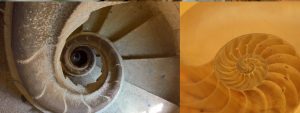
This can be reflected in his basilica too. To showcase it to you, let me show you a staircase inside the Sagrada Familia. You will notice that the staircase spirals, not ordinarily, but rather ‘scientifically’. The spirals represent the famous Fibonacci spiral. The Fibonacci spiral is a logarithmic spiral whose growth factor is φ, the golden ratio 1.69, which is the ratio which is found almost everywhere. In flowers, sea shells and even the human body. You may now understand Gaudi’s love for nature.

Spiral Staircase
Spiral staircase(Left), a sea shell on the right.

Also, the basilica incorporates curved lines rather than straight ones. This can be observed in the pillars of the basilica, curved and giving the illusion of many trees huddled together to form a forest. According to Gaudi, nature did not give us straight lines. So it is to do justice to nature by incorporating curved lines in his temple.

The straight line belongs to men. The curved one to God.

-Antoni Gaudi

Not only in this basilica, Gaudi’s work reflects nature in many of his other art works and buildings.

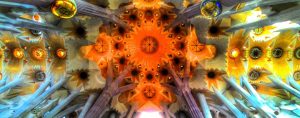
Ceiling of Sagrada Familia
Ceiling of Sagrada Familia, resembling trees in a forest

Freemasonist?

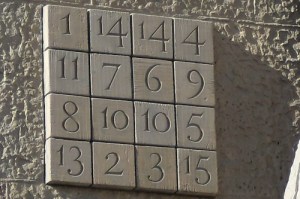
magic square
The magic square in the passion façade.

His fascination for nature is co-walked by his fascination for something strange too. Interesting right? Next to the passion façade, near his tomb(yes, Gaudi is buried inside the basilica)there lies a 4×4 magic square with 15 numbers inscribed on it. Even bizarre. These numbers are positioned in such a way that when you add the numbers horizontally, vertically or diagonally, they add up to the number 33!

Now, 33 is not any number. There is symbology in play here. 33 is said to be the highest rank that a freemasonist can go. There exists a controversy that Gaudi was a masonist and that he achieved the 33rd rank. But 33 maybe a coincidence, you may think. But note that his other work Parque Guëll, has staircase whose steps sum to 33 too. Now this is far too real to be ignored as a mere coincidence. One more thing, Gaudi’s friend Eduard was a freemasonist and his patron Guëll was also a freemasonist. These facts make it difficult to ignore ’33’.

Addressing the elephant of the room

So what does all this have to do with the controversy. Gaudi’s nature inspired works were frowned upon during his days. The basilica had undergone many attacks, also a reason for its delayed construction. George Owens, in his novel Homage to Catalonia, wrote:

I went to have a look at the cathedral—a modern cathedral and one of the most hideous buildings in the world. Unlike most of the churches in Barcelona it was not damaged during the revolution—it was spared because of its ‘artistic value,’ people said. I think the Anarchists showed bad taste in not blowing it up when they had the chance.

Alongside this, there was the freemasonist theory. Christianism and freemasonry were not exactly the friendly combo. In 1983, the Church issued a new code of canon law, which stated: ‘A person who joins an association which plots against the Church is to be punished with a just penalty; one who promotes or takes office in such an association is to be punished with an interdict‘.

Such was the heat between these two groups. And having said that Gaudi may have been a masonist, poses no doubt in churches denying funding to Sagrada de Familia. Even though it is addressed a basilica, by now you can be sure that it isn’t seen as one by many Catholics. This can be contradicting and confusing. Like an oxymoron, propagating absolutely different ideas: Science and Religion. These two have always been like oil and water. No matter how hard you try to mix, they will stand separated.

Thus, I leave you all with questions lingering in your minds. May your quest begin!

Note: More information regarding the intertwining of science and religion symbolism can be read in the book ‘Origin’ by Dan Brown. Meanwhile, you can check another article which revolves around the ideas of the book here.


MAN’S GREATEST CREATION: MUSIC

“SOMETIMES A DEEP MEANINGFUL MUSIC IS ENOUGH,TO COMPLETELY CHANGE ONE’S  PERSPECTIVE TOWARDS LIFE”


Man’s greatest creation: music, the language of spirit opening up the secret of life by bringing peace and abolishing the strife far and wide. It is the incredible trait of music in its ability to have infinite sounds , emotions, instruments, beats, genres which greatly influences us to connect with the people on such a massive level that even the power of words fail to reach such a level.


It is an explosive expression of humanity which helps us to express our innermost feeling in the most powerful manner because it is something we all are touched by. It touches our soul and strikes a chord in our heart. Music is often said that when language fails the best resort is music. Believe in the power of music and you will be able to express the innermost feeling with much more clarity and effectively with lot of magnitude.

Music greatly helps in spreading happiness and joy in life of a person, gives us the soul for our life and immense peace of mind. It creates a vibrant pattern that it evokes and stirs up the feelings and emotions in the listener’s heart and creates a sense of joy. It is an organized melodious sound in succession which helps in creating a composition of music in unity, continuity and harmony. Music is an art of combining tones to form expressive and rhythmic sequence of pleasing sounds.

MAN’S GREATEST CREATION LINKED WITH NATURE

Throughout our musical history, we have sought to connect with nature on a deep and emotional level. This internal connection we seek with the nature is rooted in our human ancestry and evolution having been entirely immersed in nature. The beautiful bird’s chirping, the water running, tree leaves resting and wind blowing are all realistic rhythm of unnoticed music which is greatest blessing from the god. Moreover our primitive forms of communication, emotional expression and social connection were all through musical sounds that originally stemmed from the natural world surrounded us.

Clearly, we have strong internal connection with both the nature and music, but these two essential components to human life go hand in hand in our evolutionary history and in our human-nature as naturally we use music to express our emotion which has been both emphasized and reinforced by composers and musicians who have sought to nature through their music and strengthen our essential connection with music and in the deepest roots of nature.

MAN’S GREATEST CREATION IN UNITING THE WORLD

   The sublime power of music that breaks all the geographical boundaries and helps people to connect together regardless of their diverse social, political, geographical and cultural background. It is the inevitable force which that knows no religion and no discrimination on the basis of caste and creed. It gives equal delight to all and helps us to connect with god by transporting our soul to another world. Thus is greatly helps us in establishing peace and promoting internal brotherhood.

Plato, a great Greek philosopher once said that music should be an indispensable part of education. In his scheme of education he greatly emphasized on three forms of disciplines they are:

    1. Mathematics for the development and training of our brain.
    2. Gymnastics for the development and training of our body.
    3. last but not the least MUSIC for feeding our soul

Through musical instruments and voice it helps people to reach a sublime state such as “SUFI MUSIC“. It is such a delight for our ears to hear this form of music. We can produce music with the help of various instruments.

do check out on how music has beautifully healed people:

http://Personal Stories about Music Therapy | Personal Stories | American Music Therapy Association (AMTA)

Music gives us a permanent solution to wipe off boredom from our life. It gives us the flight to the imagination and let’s us to paint the life’s unforgettable memories in silence. Thus it is well said that “Life is like the keys of piano has both white and black keys but we must never forget that black keys too makes music.”