

What is Talent Management?

Talent management practices have evolved over the years to cater to people-specific trends much like all other aspects of work, and have changed in fast strides over the last few years. Strategic talent management is a necessity in today’s hyper-change environment. Global trends in talent and human capital management have led to a renaissance of the work-worker-workplace equation.

What is Talent Management?

Talent management is defined as the methodically organized, strategic process of getting the right talent onboard and helping them grow to their optimal capabilities keeping organizational objectives in mind. 

The process thus involves identifying talent gaps and vacant positions, sourcing for and onboarding the suitable candidates, growing them within the system and developing needed skills, training for expertise with a future-focus and effectively engaging, retaining and motivating them to achieve long-term business goals. The definition brings to light the overarching nature of talent management – how it permeates all aspects pertaining to the human resources at work while ensuring that the organization attains its objectives. It is thus the process of getting the right people onboard and enabling them to enable the business at large.

Under the umbrella of talent management, there are a string of elements and sub-processes that need to work in unison to ensure the success of the organization. For example, analyzing the right talent gaps for the present and the future, identifying the right talent pools and best-fit candidates, getting them to join and then optimizing their existing skills and strengths while helping them grow are touch-points that are all equally important. They support each other and the whole structure would crumble even if one sub-process fell out of sync.

Talent Management Process

While often cyclical rather than a generic linear progression of events, the process of talent management could be considered, to begin with acknowledging the need for talent and leads to filling that gap and ultimately growing and optimizing the skills, traits, and expertise of employees, new and old.

The following image depicts the key points of the talent management process:

Let’s get into these key steps in the process of managing talent effectively:

1. Planning: Like in any process with a set outcome, planning is the first step in the process of talent management. It involves the following identifying where the gaps lie – the human capital requirement, formulating job descriptions for the necessary key roles to help guide sourcing and selection and developing a workforce plan for recruitment initiatives.

2. Attracting: Based on the plan, the natural next step is to decide whether the talent requirements should be filled in from within the organization or from external sources. Either way, the process would involve attracting a healthy flow of applicants. The usual external sources include job portals, social network, and referrals. The talent pools that need to be tapped into must be identified in advance to keep the process as smooth and efficient as possible. This is where the kind of employer brand that the organization has built for itself, comes into play because that decides the quality of applications that come in.

3. Selecting: This involves using a string of tests and checks to find the right match for the job – the ideal person-organization fit. Written tests, interviews, group discussions and psychometric testing along with an in-depth analysis of all available information on the candidate on public access platforms help in gauging an all-rounded picture of the person. Today there are software and AI-enabled solutions that recruiters can use to skim through a vast population of CVs to focus on the most suitable options and to find the ideal match.

4. Developing: Quite a few organizations today operate on the idea of hiring for attitude and training for skills. This makes sense because while you would want a predisposition to certain skill-sets, it is the person that you are hiring and not the CV. Developing employees to help them grow with the organization and training them for the expertise needed to contribute to business success also builds loyalty and improves employee engagement. This begins with an effective onboarding program to help the employee settle into the new role, followed by providing ample opportunities for enhancing the skills, aptitude and proficiency while also enabling growth through counseling, coaching, mentoring and job-rotation schemes.

5Retaining: For any organization to be truly successful, sustainably, talent needs to be retained effectively. Most organizations try to retain their best talent through promotions and increments, offering opportunities for growth, encouraging involvement in special projects and decision-making, training for more evolved roles and rewards and recognition programs.

5Retaining: For any organization to be truly successful, sustainably, talent needs to be retained effectively. Most organizations try to retain their best talent through promotions and increments, offering opportunities for growth, encouraging involvement in special projects and decision-making, training for more evolved roles and rewards and recognition programs.

6. Transitioning: Effective talent management focuses on a collective transformation and evolution of the organization through the growth of individual employees. This involves making each employee feel that they are a part of a bigger whole. Providing retirement benefits, conducting exit interviews and effective succession planning might seem like unrelated career points but they are all transition tools that enable the shared journey

Talent Management Model

Over the years, there have been multiple models made for talent management that have been created b organization who have felt that they have finally cracked the code on the perfect model. The thing with talent management, however, is that it needs to morph to suit the latest talent trends, digital disruptions, and employee expectations.

The following diagram is that of the integrated talent management model which appears to be the most relevant one today.

The primary components of the model are:

  • Acquire – Employer branding, recruitment, onboarding
  • Assess – Talent analytics, succession planning and assessments
  • Develop – Workforce planning, culture at work, engagement and retention practices
  • Deploy – Goal alignment, career-path planning, learning and development, and performance management


This structure of components is cyclical and goes on in a sustained loop while taking onto consideration the internal climate within the organization and the external environment in which it operates.

How can an organization ensure that this model is put to the best use?

The point to be kept in mind here is that no model of something as dynamic as talent management is writ in stone. It needs to be able to adapt to the changing needs of the organization the evolving talent expectations and the pace set by changes within the industry.

How will 2020 shape 2021 ?

In the year 2020, the whole world is fighting with a virus, which changed the way we live and work at least temporarily. COVID-19 took many lives and made many people jobless. The impact this pandemic created will be there at least for the next few years. No one knows when this pandemic will end, but it is evident that the year 2021 will be different because of the year 2020.

“Sometimes even to live is an act of courage.” Those words are as true today as when they were written two millennia ago by the Roman Stoic philosopher, Seneca. The coronavirus pandemic is affecting millions and it is imperative to understand the unprecedented shockwave it has created – shattering social structures and disrupting economies and markets, with the ripples felt by almost every individual, business and nation.  

The Covid-19 outbreak in India has severely impacted the economy in myriad ways, with the lockdown halting the entire nation. It came at a time when the Indian economy was already slowing due to weaknesses in the financial sector and falling consumer demand for goods. Sectors already suffering, including logistics, aviation, transport, and tourism, are struggling to absorb the impact on the economy of the coronavirus pandemic.  

There are parallels between the emerging economic crisis and the financial crash of 2008. Like then, investment institutions and banks, including the IMF and Goldman Sachs, as well as the global rating’s agencies, such as Moody’s and S&P, have slashed growth projections, with India and other countries forecast to enter a ‘deep recession’. But the scale of the 2020 downturn is likely to be far greater than what followed 2008.

Efforts by the Indian government to flatten the virus curve through stringent lockdown measures will result in a steep economic contraction. In its April 2020 policy review, the Reserve Bank of India, warned: “The macroeconomic and financial landscape has deteriorated, precipitously in some areas.” 

Like other countries around the world, India too is grappling with the conundrum of reopening the economy – protecting and restoring activity this year to help shape a return to growth in 2021 – while containing the spread of the virus, and potentially further lockdowns.

The effect of 2020 on 2021:

  • During COVID-19 pandemic, imports and exports were affected adversely. And it affected many countries. For example, the Automobile industry in India imports components from China. When China was fighting with coronavirus, factories were shut down and as a result, India’s automobile industry had to halt the production. Not just India, but many countries are depending on the imports for many products such as electronics, pharmaceutical ingredients etc. So, in the year 2021, companies will work on diversifying supply chains and countries will work on achieving self-sufficiency. This may lead to protectionist tendencies.
  • COVID-19 came when the world is least expecting it. No country is fully ready to face it. Many developing countries have a shortage of healthcare professionals and medical equipment. Even developed countries have a shortage of medicines. So, in 2021, countries may work to fill this gap.
  • As coronavirus forced people to sit at homes, the demand for telemedicine facilities increased drastically. In 2021, hospitals and governments may work to make telemedicine facilities more accessible.
  • 2021 may bring more work from home jobs, as more and more companies are thinking of it as a win-win situation for them and for the employees.
  • Virtual meetings will become more common. In 2021, people may not travel on flights just to attend official meetings. This will result in less carbon emissions.
  • We have been fighting with climate change for a long time. United Nations member countries started working on the common goal of making affordable and clean energy accessible to all. But coronavirus pandemic affected the world economy badly, and every country is working a lot to uplift the economy. So, the transition to clean energy may take a backseat in 2021.
  • As many people are now scared to eat out and are preferring healthy food to boost immunity, restaurants and food delivery apps may continue to struggle in 2021 as well. There will be more investments in the companies the manufactures hygiene-related products and raw foods.
  • There will be more e-learning opportunities.
  • People may save more money by avoiding unnecessary expenses because COVID-19 pandemic taught people that anything can happen at any time and so savings are important to protect ourselves in tough times.
  • We have witnessed people stuck in other countries or in other states within the country due to lockdown throughout the world. After going through difficult times in 2020, people may want to stay close to their families. If it happens, it will alter the demography of many regions.
  • As people may not be ready to go to theatres at least for the next few months, OTT (Over-the-top media services ) platforms such as Netflix & Amazon Prime may take over the traditional film industry in 2021.
  • With an increase in work from home jobs, 2021 may see an increase in cybersecurity threats.

How will 2020 impact 2021?  

The pandemic is undoubtedly redrawing the landscape, but it is difficult to develop an economic blueprint for the post Covid-19 future because we have never before experienced the measures put in place to stem the spread, such as suspended transport, inoperative plants and stalled projects. Effects will differ to some extent across the Indian states as they follow specific economic strategies. Tourism has been severely hit, and will continue to suffer, no more so than in Goa where tourism is the mainstay of the state’s economic development strategy. The consequences for small firms, labour and for investment in tourist and transport infrastructure will be harsh. 

Even the high-performing districts in India have been badly impacted by the lockdown – 130 districts classified as red zones account for 41% of national economic activity, 38% of industrial output and are the most industrialised regions. Lower economic activity in these areas has spread to suppliers and revenues have slumped. The collective consequence of disruptions to supply chains, operations and travel are reverberating across almost all sectors of the economy, leading to:

Higher unemployment – further reducing demand and impacting production and capacity utilisation, and damaging corporate results 

Shortage of labour – migrant labourers have suffered greatly during the lockdown. The Government of India has increased the money going into the Mahatma Gandhi National Rural Employment Guarantee Scheme, which provides livelihood security in rural areas through 100 days of paid employment for adults who volunteer to do unskilled manual work. Under Covid-19 migrant labour obviously feels safer working closer to home rather than moving across states, but this will reduce the availability of workers for other sectors and regions. 

Severe liquidity crunch – working capital issues/solvency risk for sustained periods could lead to defaults on loans and may increase stranded assets in the banking sector.

Potential losses will vary by sector, but some industries that are suffering, such as airlines, hotels, automotive, construction and real estate, are likely to continue to bear the brunt into 2021. 

Covid-19 is unprecedented, so it is difficult to accurately make projections for economic growth, but it is possible to highlight some of the issues that will have an impact on Indian economy going forward.   

It will take months, possibly years for migrant labours to return to work in other states, so the financial stress on rural households will increase, and will be exacerbated by a weak job market.  

Demand has fallen significantly since the introduction of the lockdown. AIIMS Director Randeep Guleria has said cases of Covid-19 in India will peak in June and July, though others say this may not happen until September. This will impact tourism, aviation, retail and many other economic activities, leading to job losses that will further reduce demand. Given the uncertainties, it is unlikely we will see a return to full-scale operations in many sectors this year. This will impact the financial health of many enterprises and many will reduce Capital investment in 2021.   

Remittances to India are projected to fall due to travel restrictions. The World Bank estimates these could decline by as much as 23%.  

Rising unemployment, falling corporate revenue and profit is bound to impact tax revenues. Already the government has announced a series of support measures. Falling tax income and rising expenditure to support many social and employment schemes will increase the government’s fiscal deficit in 2021.  

There are glimmers of hope, however. The Indian economy may benefit from falling fuel oil prices, potentially halving the import bill if current crude oil prices hold, and many foreign firms are looking at India as alternate manufacturing destinations in many sectors, such as pharmaceuticals, chemicals and electronic component manufacturing. India needs to capitalise on this potential opportunity and provide all necessary policy assistance to attract foreign investment in 2021. 

Covid-19 has adversely impacted the entire global economy and India is not spared. Looking at the current trend India is expected to enter recession. Recovery should focus on creating a more sustainable and resilience economy, pursuing opportunities to build back better and improve the life chances of all Indians.

Conclusion:

Coronavirus pandemic affected everyone and changed our daily lives. The world will create 2021 based on these changes and also with the lessons we learned while fighting with the pandemic.

A Safe Guide to Abortions

“Why is abortion abnormal, but police brutality, hate crime, suicide abetment just the way of life? I choose not to bring a life into this world, that I am not ready to care for. I am protecting my unborn by keeping it away from this patriarchal world.”

Anonymous

What is ABORTION?

Abortion refers to the termination of pregnancy by the removal or expulsion of an embryo or fetus. It is also referred to as termination of pregnancy.

Why is it Important to Have a Safe and Informed Abortion?

Each year 6.4 million fetuses are aborted, 3.4 million of which are unsafely performed using unsanitary methods. Each day, approximately 13 women die as a result and thousands more suffer severe reproductive health issues. 

Unsafe Abortions are the 3rd most leading cause of mortality amongst women. 

Further, a huge chunk of our population are unaware of the legality of abortions and opt for unsanitary alternatives. 

Not every General Practitioner, Gynaecologist, nor Obstetrician is legally allowed to carry out abortions nor prescribe medications.

Safe abortions don’t limit to just the procedure. Abortions have a huge impact on a woman’s body and frequent check-us are vital. Carrying out proper treatment is the only way to avoid other medical conditions. 

Reasons for Abortion:

There are multiple reasons why women might want to abort. A few reasons include:

  • When the parent(s) is financially unprepared
  • Unplanned/Accidental
  • Bad/Abusive Partner
  • Conception by Rape, Incest, or any other sexual assault 
  • Teen/Early Pregnancy
  • Health Issues
  • Dependent and/or Unprepared
  • Addiction
  • No longer want kids
  • Delaying Parenthood
  • Unwilling to be a parent
  • Not ready to have a kid
  • Pregnancy interfering with Education, Work, Promotion.
  • Any other unique reason a woman wants to terminate her pregnancy.

When is a Pregnancy Unsafe?

There are many situations where medical complications harm or might harm the mother and baby. Some situations might end in abortion because of unsafe pregnancies.

It is important to routinely have check-ups, take prenatal vitamins and other prescribed medications, and avoid taking any stress or straining yourself physically.

A few warning signs and complications of unsafe pregnancy: 

(NOTE: these warning signs don’t always lead to abortion, but please contact your doctor immediately)

  • Heavy bleeding and abdominal pain
  • Severe Nausea
    • Nausea is common in pregnancy, many women have morning sickness. 
    • Uncontrollable vomiting and not eating and drinking properly can make you dehydrated and harm you and the baby
  • Significant Decline in Baby’s activity
  • Contractions early in the 3rd trimester
  • When your water breaks early
  • Gestational Diabetes
  • Macrosomia
    • The baby is much larger than normal
    • When the mother’s blood had too much glucose, the pancreas of the fetus converts the extra glucose into fat
  • Flu-Like symptoms
  • Amniotic Fluid Complications
    • Too much or too little amniotic fluid in the sac
    • Difficulty in breathing 
    • Prenatal diabetes
  • Ectopic Pregnancy
    • The development of the fetus outside of the uterus. 
  • Placental Complications
    • Placental Abruption – detached placenta from the uterine wall
    • Placental Previa – the condition in which the placenta is attached too close to the cervix. 
  • Preeclampsia or Eclampsia
    • Pregnancy-induced high blood pressure
    • Can lead to seizures, coma, and death

Who is Allowed to get an Abortion in India?

Medical Termination of Pregnancy (MTP) Act legalized the termination of pregnancy (still not using the word abortion) with several conditions up to 20 weeks (from the first day of the last menstrual period). The conditions are:

  • “When continuation of pregnancy is a risk to the life of a pregnant woman or could cause grave injury to her physical or mental health;
  • When there is substantial risk that the child, if born or dead would be seriously handicapped due to physical or mental abnormalities;
  • When pregnancy is caused due to rape (presumed to cause grave injury to the mental health of the woman);
  • When pregnancy is caused due to failure of contraceptives used by a married woman or her husband (presumed to constitute grave injury to mental health of the woman).”

The Indian Abortion Laws are not liberal and do not permit women to terminate a pregnancy because they are not ready or unprepared. More information on the legal details of abortion in India can be found here.

Who is allowed to Perform an Abortion in India?

The MTP Act also specifies who is legally allowed to terminated a pregnancy, a practitioner who 

  • “has a recognized medical qualification under the Indian Medical Council Act, 
  • whose name is entered in the State Medical Register, and 
  • who has experience or training in gynecology and obstetrics.”

Not every Gynaecologist and/or Obstetrician is legally allowed to perform abortions. Be sure to check their license and get a safe and secure abortion if and when needed.

Consent for Abortion?

In India, an adult woman does not need consent from her husband, father nor the father of her unborn child until 20 weeks of gestation. Minors, however, require a legal adult’s consent. 

Once the pregnancy crosses 20 weeks, a woman needs special permission from the courts and two other people’s consent to be able to terminate her pregnancy.

To get an abortion, there are a legal-forms one needs to fill and sign. It is important to be aware of what documents you are signing and the terms you are agreeing to. 

The Price for abortions is fixed, a first-trimester abortion is approximately, Rs.500-1000 while a second-trimester abortion cost around, Rs.2000-3000. 

It is important to know your rights and pay only the correct rate. If a doctor charges more, you are entitled to report them. 

Many doctors are known to charge Rs,10,000, and more.

Procedural Blueprint:

Courtesy of Vardaan Hospital, Delhi.

There is a procedure that mot doctors follow. You are entitled to find out the procedure before-hand and report anyone for misbehavior.

There are two methods, oral and surgical. 

Oral Method Procedure:

If the pregnancy is less than 6 weeks, a mother can opt for the oral method

  • Ultrasound – to check for the duration of pregnancy or to see if it is a tubal pregnancy
  • Medication is prescribed 
  • Blood tests are done
  • 2 doses are given 48hrs apart.

Surgical Method Procedure:

  • Ultrasounds and Blood tests
  • Depending on the duration of the pregnancy, medication is prescribed to dilute the uterus.

One of the below

  • Vacuum Aspiration.
  • Dilation and Evacuation.
  • Dilation and Curettage.
  • Suction evacuation.

Follow Up:

Courtesy of Vardaan Hospital, Delhi.

Oral Method:

  • Bleeding is common in the 24-48 hours whole taking the dose and lasts for a week
  • Tissue might retain in some cases which leads to incomplete abortion. Suctional evacuation is important.
  • Confirmation of a complete abortion is done by another ultrasound.

Surgical Method:

  • The pain during and after the process varies for each woman.

General:

  • Maintain a proper diet
  • Take proper medications on time
  • Avoid exercising and moving around a lot
  • Counseling is important to recover
  • Avoid tampons during the menstrual cycle
  • No sexual contact for at least a month.

When is Abortion not Safe?

Abortion is unsafe if a woman:

  • Is more than 70 days pregnant (counted from the first day of the last menstrual period)
  • Has bleeding problems or is taking blood-thinning medication
  • Has chronic adrenal failure or is taking certain steroid medications
  • Cannot attend the medical visits necessary to ensure the abortion is completed
  • Does not have access to emergency care
  • Has uncontrolled seizure disorder (for misoprostol)
  • Has acute inflammatory bowel disease (for misoprostol)

Risks of Abortions:

Abortion has serious effects on a woman’s body. The following are a few risks associated with abortion:

  • Heavy bleeding
  • Infections
  • Incomplete abortions
  • Damage to the cervix
  • Scarring of the uterine lining 
  • Perforation of the uterus
  • Damage to internal organs
  • Miscarriages in future pregnancies
  • Death
  • Eating Disorders
  • Suicidal thoughts
  • Guilt
  • Relationship problems
  • Depression
  • Sexual dysfunction
  • Prone to addiction

When to Call your Doctor?

It is normal to contact your doctor after an abortion with any queries. 

These are the signs of complications where calling your doctor is important:

  • Excessive Bleeding
    • Bleeding is normal, but excessive bleeding is not.
  • No bleeding in the first 24 hours.
  • Signs of infection
    • Headache
    • Muscle aches
    • Dizziness
    • Fever
  • Severe abdominal pain
  • Fever that lasts for more than 4 hours
  • Vomiting for more than 4-6hours
  • Sudden belly swelling
  • Rapid heart rate
  • Smelly vaginal discharge
  • Pain, redness, and swelling in the genital area
  • Any other unexplainable symptoms

After a surgical abortion, follow up with one or more of these medical exams:

  • A physical exam of the cervix and uterus
  • A lab test to check your hCG levels
  • Blood test for anemia

Timeline of India’s Prime Minister’s

Prime Minister of India is the head of the government. He is appointed by the Indian President after the political party wins a general election and nominates a candidate for the post. The leader of that political party is thereafter appointed as the Prime Minister of India.

Jawaharlal Nehru (15 August 1947 – 27 May 1964)

Jawaharlal Nehru referred as the Constructor of Modern India. He was the Longest serving prime minister of India (17 Years) and also he was the first prime minister to died in office. 

Gulzarilal Nanda (Acting) (27 May 1964 – 9 June 1964)

Gulzarilal Nanda is the First Acting Prime Minister of India. He was the shortest serving Prime Minister of India. 

Lal Bahudur Sastri (9 June 1964 – 11 January 1966)

Lal Bahadur Sastri was PM after sudden death of the Jawaharlal Nehru. He was given the famous slogan Called “Jai Jawan Jai Kisan”. He was the only Prime minister to die in abroad.

Gulzarilal Nanda (Acting) (11 January 1966 – 24 January 1966)

Gulzarilal Nanda is second Acting Prime Minister too of India.

Indira Gandhi (24 January 1966 – 24 March 1977)

Smt Indira Gandhi was the first female Prime Minister of the India. She was famous for her remarkable financial and foreign inclusions like Nationalization of Banks and divide East and West Pakistan in 1971 War.

Morarji Desai (24 March 1977 – 28 July 1979)

Morarji Desai was the Oldest Prime Minister of India. He was also first Prime Minister to resign from Office. He was the only the Prime Minister to celebrate his birthday for every 5 years since his birthday is on 29 February.

Charan Singh (28 July 1979 – 14 January 1980)

He was the first Prime Minister Who did not attend the single session of parliament. He was well known for his remarkable steps towards welfare of the Farmers.

Indira Gandhi (14 January 1980 – 31 October 1984)

Indira Gandhi was the First Prime to get assassinated and First Prime Minister to lost her seat in a General Elections. 

Rajiv Gandhi (31 October 1984 – 2 December 1989)

Rajiv Gandhi was the Youngest prime minister of the India. In his reign Anti-Defection was proposed and came into existence. 

V.P Singh (2 December 1989 – 10 November 1990) 

His full name is Viswanath pratap Singh. He was referred as the pioneer of the Reservation System for Employment and Education system in India.

Chandra Shekhar (10 November 1990 – 21 June 1991)

He was the Second least serving Prime Minister of India after the Charan Singh.

P.V Narasimha Rao (21 June 1991 – 16 May 1996)

P.V Narasimha Rao was referred as the father of Modern Economic Reforms. He was well known for his tax system in India with help of his Cabinet Finance Minister Dr Manmohan Singh. He was the first Prime minister from southern India.

Atal Bihari Vajpayee (16 May 1996 – 1 June 1996)

Atal Bihari Vajpayee was the 14 days Primebecause his government was collapsed the after Jayalalitha Led AIADMK withdrawn its support from coalition. 

H.D Deve Gowda (1 June 1996 – 21 April 1997)

Before becoming a Prime minister of India he was the Chief Minister of Karnataka.

I.K Gujral (21 April 1997 – 19 March 1998)

Inder Kumar Gujral was the one of the well educated Prime Ministers of India. He was served as Cabinet Minister for different portfolios like Ministry of Planning, Tele-communications, Minister of Information and Technology.

Atal Bihari Vajpayee (19 March 1998 – 22 May 2004)

This was the Second term for him as the Prime Minister. He was well known for his remarkable achievements in Nuclear Tests. 

Manmohan Singh (22 May 2004 – 26 May 2014)

Manmohan singh was the first Sikh PrimeMinister. He was worked as both FinanceMinister, RBI Governor. He was the FinanceMinister one who introduced the Service Taxsystem In India in 1993-94 Budget session. 

Narendra Modi (26 May 2014- Till date)

His full name is Narendra Damodar Das Modi. In his reign BJP Could get the full majority both in 2014 and 2019 General Election (Loksabha Elections) to form the Government without help of the other Parties. He was the most influent Prime Minister in India. He known as tough guy who takes tough decisions like demonetization, Gst, etc.

Unique identification number for every Indian

The Unique Identification Authority of India (UIDAI) is a statutory authority established under the provisions of the Aadhaar (Targeted Delivery of Financial and Other Subsidies, Benefits and Services) Act, 2016 (“Aadhaar Act 2016”) on 12 July 2016 by the Government of India, under the Ministry of Electronics and Information Technology (MeitY). The Aadhaar Act 2016 has been amended by the Aadhaar and Other Laws (Amendment) Act, 2019 (14 of 2019) w.e.f. 25.07.2019.

Prior to its establishment as a statutory authority, UIDAI was functioning as an attached office of the then Planning Commission (now NITI Aayog) vide its Gazette Notification No.-A-43011/02/2009-Admn.I) dated 28th January, 2009. Later, on 12 September 2015, the Government revised the Allocation of Business Rules to attach the UIDAI to the Department of Electronics & Information Technology (DEIT) of the then Ministry of Communications and Information Technology.

UIDAI was created with the objective to issue Unique Identification numbers (UID), named as “Aadhaar”, to all residents of India. The UID had to be (a) robust enough to eliminate duplicate and fake identities, and (b) verifiable and authenticable in an easy, cost-effective way. The first UID number was issued on 29 September 2010 to a resident of Nandurbar, Maharashtra. The Authority has so far issued more than 124 crore Aadhaar numbers to the residents of India.

Under the Aadhaar Act 2016, UIDAI is responsible for Aadhaar enrolment and authentication, including operation and management of all stages of Aadhaar life cycle, developing the policy, procedure and system for issuing Aadhaar numbers to individuals and perform authentication and the security of identity information and authentication records of individuals.

  • The idea behind the unique identification number was to assign each individual a unique 12 digit number which will help to identify the individual uniquely.
  • The objective was to attach all the biometric and demographic data of an individual with a 12-digit unique identity number called Aadhaar. The biometric and demographic data of individual will be stored in a centralized database.
  • The act related to Aadhaar was initially introduced as a money bill in the parliament of India on 3rd March 2016.
  • The bill was passed in the Lok Sabha on 11th March 2016 and on 26th March 2016, this bill became an Act.
  • The process of issuing the unique number and collection, maintenance and updating of biometric and demographic data related to each individual is done by the ‘Unique Identification Authority of India (UIDAI)‘, which is a central government agency of India.
  • With the issuance of Aadhaar card, India has entered the group of countries which has national identity cards for its native residents.
  • Even though Aadhaar was initially started to eliminate leakages, with time it became a basic identity document.

Reasons for this move:-

  • This process of attaching all the legal data of an individual with a unique number is an attempt of India to develop a secure system of identification and will have a long term impact.
  • The first recommendation of any such identity number was after the 1999 Kargil war by the Kargil Review Committee to then Prime Minister of India, for the security and authenticity reasons.
  • With the centralized database of each individual, it became possible for security agencies to access information of each citizen under a certain emergency situation in the interest of the national cause.
  • By considering the population of India, it was necessary to have such a secure identification system for controlling illegal migration and anti-national activities.
  • By connecting the Aadhaar number with the banking system, the Indian government has created a proper and secure channel through which beneficiaries receive all the subsidies directly to their bank account.
  • It has eliminated the role of middleman and agents thus helping the poor and the Indian Economy. Thereby Aadhaar empowers marginalised sections and ensures dignity.
  • With the help of UID, it became possible to identify the native Indians and illegal migrants and thus helps to ensure that only the Indian citizens and the legal migrants get benefits of government schemes and also employment.
  • As all the biometric and demographic data of an individual is linked to Aadhaar, it helps to identify the families that really belongs to BPL (Below Poverty Level) and hence providing them employment under NREGA (National Rural Employment Guarantee Act) and also easy and prompt payment to the actual workers.
  • Another big issue which can be addressed through UID is the real number of voters. Rural to urban migration is highly prevalent in India. Thus they enrol their names in the voter list of both places and politicians take an ill advantage of such a situation. But by the implementation of UID, it will not be possible for any individual to possess more than one voter identity card.
  • Government of India could save 15000 crores till 2016 by linking bank accounts with aadhaar for the LPG cylinder subsidies. Aadhaar will eliminate fake accounts.
  • Aadhaar based biometric attendance will make a good impact in government offices where most people try to escape from their work.
  • UID will also help indirectly in controlling corruption.

Challenges:-

  • For a nation like India with such a large population, it becomes a matter of security risk to handle such a large data of individual associated with their UID.
  • As almost all the details are associated with Aadhaar, it poses a threat to ‘right to privacy’. The data is susceptible to commercial exploitation by private parties and also to surveillance by the government.
  • No effective implementation of law and punishments in case of any misuse such as the leakage of personal information of citizens.
  • Assigning UID to such a huge population with authenticity is also a big challenge as no prior documents asked for it.

Conclusion:-

UID for every Indian is a very good system for eliminating agents and commission culture from India. It will help the poor to get their benefits directly to their accounts. It will also help in eliminating the illegal migrants from India and thus controlling the anti-national activities. But the implementation and execution must be done in a proper and prompt manner. And there must some guidelines related to risks associated with the system.

Film is notable among youngsters

Film influences adolescents in various sort of ways. One reason for the prevalence of the film is that it engages various types or individuals, youthful and old, educated and ignorant. The greater part of the young people watching films are for relaxations. Some of the time, they feel pressure, with the goal that adolescents investing their energy in watching motion pictures in film. To start with, film impact youth adversely and decidedly. This is on the grounds that; young people will mirror their preferred on-screen character and entertainer to follow precisely their styles, for example, dressing styles, hairdo, character of the on-screen character or on-screen character act in the film, language, etc. Motion pictures influence young people in their disposition. Young people observe an excess of motion pictures and its impact their disposition change. They may appreciate the character, their contemplations, or idea’s. They choose to do likewise as them.

Additionally, film impact in adolescents culture? The greater part of the individuals concur for this inquiry. This is on the grounds that, young people watch film and tail others, for example, remote culture. They disregard their own way of life and the significant of the way of life. Young people will follow precisely remote culture, for example, wear ring at eyebrow, tongue, mouth, etc. They thought it’s lovely and classy however it’s extremely perilous for wellbeing.

Plus, viciousness in the film influences young people’s brains? In light of my study, some “concur” and some of them answer is “impartial”. Viciousness in the film influences youngsters to do likewise. This is on the grounds that, normally in film, they will do criminal operations, for example, pirating, burglary, drinking, smoking, consuming medications, etc. In a film, they act yet it looks precisely genuine. So youngsters get intrigue and include in negative exercises.

Movies and there impact on shaping mind

Movies impact on shaping mind as well as on society. That is primarily on the grounds that individuals become lethargic and need to make associations by watching them.

In any case, individuals are so sluggish when they are watching movies. Study has demonstrated individuals who watch movies or TV at any rate four hours in seven days tend not to practice so frequently. To keep solid, individuals need to practice well. Obviously individuals sit for quite a while and don’t move at all during watching movies. Also, individuals are uninvolved while they watch films. Individuals don’t need to communicate anything, so they don’t will in general consider anything.

Besides, individuals manufacture connections to impart their insight about laborers. After individuals delighted in films and TV, they are anxious to impart their insight. On account of present day innovation, individuals can impart their insight past the distinction of nation and ages. They can have numerous chances to contact with individuals.

How can water availability be fostered?

Better access to clean and pure water, best sanitation services creates tremendous impact in the growth of economic development. Water is linked to many economic activities and there are many complex channels through which water affects the overall economic growth. Some African countries like Kenya, Zambia installed water kiosk (booths for the sale of tap water) in order to improve the water supply and sanitation for poor rural areas, which provided some sort of income to water kiosk vendors and to public toilet caretakers. There are myriads of multinational companies like food companies, irrigation related corporations, for which water has been the main and unavoidable component. The presence of water ranges from small family farms to big companies. Thus it can be said that water plays an important role the socio economic development of a country. If the importance of water is neglected by the people and government, it can eventually collapse the world. Business ranging from small family farms to major corporations encounter multiple problems without water. So it is important to preserve water for the future generation. Here are some of the ways that can be done to conserve water and improve sanitation;

  • Recycle water

This is one of the effective and basic ways to control the usage of water. There are many plenty of technologies that are available to recycle rainwater and other water. The recycled water can be reused for many other purpose such as irrigation, gardening or in agricultural fields. This method allows us to use less amount of water for many purposes.

  • Educate the masses

There are still a lot of people who are unaware about the importance of water and the impact it has on our existence. These masses need to be educated about how to use water consciously. Awareness classes and social campaigns can be arranged in order to make people aware about the significance of water.

  • Improve sewage system

Fresh drinking water comes with a clean sewage system. Water in an area can get easily polluted without proper sanitation. This may lead to many water-borne diseases. Thus improving the sewage system can lead to a hygienic environment and also lead to get fresh drinking water.

  • Rainwater harvesting

Rainwater harvesting also called harvesting is a method of collecting rainwater from the surface on which the rain falls, filtering it and finally storing it for multiple purposes. One of the main advantages of this method is that, its costs are relatively modest.

WHY ONLINE MEDIA CREATES HUGE IMPACT ON TRADITIONAL MEDIA


It is the common tendency of human beings to get attracted to something new. Man never gets tired of inventing new things, instead always would love to update himself. He is never satisfied with the present possessions he has, but always crave for more. This is what caused the origin of new media. But unlike other inventions, this one hooked man in such a manner that he is now completely immersed into it. The advantages provided by the new media makes people forget about the traditional media. Some of the advantages that social media provides are;

  • TWO WAY COMMUNICATION

The communication process is said to be completed only when the listener’s feedback is received by the speaker. New media makes this possible. It helps to create, maintain and sustain two way conversation with the public. Unlike, traditional media like television and radio, social media are able to know the viewpoints of the public. Even though, mediums like newspaper and television reach a mass audience, the feedback from the audience is limited.

  • IMMEDIACY

New media has the unique ability to publish information as soon as they happens. Traditional media, especially newspaper cannot inform every information instantly. Television and radio can have immediacy compared to newspaper. But it cannot be matched with online media. Today, any event happened in any part of the globe can be viewed live by everyone.

  • MULTI MEDIUM

The incorporation of multimedia elements is another advantage of online media. Unlike radio, magazines and newspapers, this new media comprises of text, images, video, audio, pictographs, charts and symbols. This wide variety of tools help in effective and essential communication.

  • WIDE REACH

Almost all the traditional media including television, newspaper, radio and magazines share information and messages only under a specific geographical area. The coverage of these media are limited within a particular area. But new media has coverage over worldwide. Once any information or message is uploaded in the online media, it is accessible to everyone in the globe irrespective of their place.

  • COST EFFECTIVE

The production cost is very expensive in the case of traditional media, especially television. Too many crew members are involved in the making of advertisements and other videos in television. It is very costly to run a newspaper either. Collection of paper, production of newspaper and distribution takes lot of effort and money. Social media/new media is very cost effective compared to these. It doesn’t require any raw materials and manual efforts. Everything is done virtually. Hence, this medium can be considered as cost effective.

  • SEARCH BASED INFORMATION

People are not interested any every information that surrounds them. Television and newspapers provide every information. It is very hard for the audience to find what he wants to read. He will be bombarded with too many information. But new media gives the option to get a specific area of interest. People can simply search about the information that he/she would like to read. The new media also provides links and hyperlinks which help the audience to know more about that particular content.

E-learning – Pros & Challenges

The global COVID-19 pandemic has triggered new ways of conducting the teaching-learning process online. For some this has been a small move but for others, this is a completely new way of education. Most nations have already initiated e-learning in their schools. Many schools in India have also adapted to the new normal of e-learning with varying degrees of success. Many progressive schools had already done a lot for the adoption of technology in their schools, which helped in quickly transitioning to a completely online delivery of teaching during the current crisis and with significant success. A recent survey conducted by us showed that more than 92% of students and parents were happy with the online delivery of lessons.

With the advent of Covid19, e-learning seems to be one of the safest and easiest ways to impart education for acquiring new skills, explore new career options, or for that matter new hobby development. E-learning is now applicable not only to learn academics but also to conduct extra-curricular activities for students, informative online sessions, online conferences, and webinars. The demand for e-learning has risen significantly and will continue doing so as society starts adapting to ‘social distancing’ post this pandemic. 

Information and communication tools (ICT), Web2.0 applications, and the impact these resources are having on education are rapidly creating new challenges for instructor and learners faced with learning online. Teaching and learning in an e-learning environment happens differently than in the traditional classroom and can present new challenges to instructors and learners participating in this online learning environment. There is a need in e-learning to identify the challenges and consider best practice solutions to ensure instructor and learner success in this new learning environment.

As with most teaching methods, e-learning also has its positives and negatives. Understanding these will help in creating strategies for more efficient delivery of the lessons and measuring its effectiveness.

Here are some, and in no way exhaustive, key pros and cons – 

Advantages:

  • Efficiency – E-learning offers a very efficient way to deliver lessons. Use of videos, sharing of resource links, serving assessment tests can all be done at the click of a button. Additionally, the lectures can be recorded and shared for reference with a wide range of audiences. It also allows for a much larger set of children to be taught. 
  • Affordability – E-learning is far more affordable as compared to physical learning. E-learning primarily eliminates 2 major cost points – real estate and transportation. The course or study material is all available online and you can access it as many times as you want.
  • Less absenteeism – There are fewer chances of students missing out on classes, as they can access easily anytime from the comfort of their home. 
  • Increased Access & Reach – E-learning can happen in any place, as long as there is a device and connectivity. A physical class requires the student to come to school but in this mode, the student can access lessons sitting anywhere in the world. 
  • Encourages shy kids – We have seen that many children who are usually withdrawn in a class environment, open up in the online classes. They are far more forthcoming with their questions and participation. This could be because of a comfortable home environment. 

Challenges:

  • Not appropriate for all – It is a well-known fact that students have a dominant learning style. Some a visual, some auditory, some kinesthetic, etc. E-learning which requires a child to sit in front of a device and understand the lesson, may not be suited to all learning styles.  
  • Focus Deficit – Some students tend to lose focus for a longer period during virtual lectures. Boredom occurs easily as there is a lack of face to face interaction. It becomes imperative for the teachers to keep their online sessions crisp and interactive enough to help students grasp everything.
  • Technology issues – While internet penetration has grown over the past 12 months in India, the current infrastructure, especially in smaller towns, can pose a problem. Any break in the data connectivity can cause a lack of continuity in the learning for the child, which can be detrimental. Additionally, if a child is technophobic, he may face difficulties in learning. 
  • Lack of social interaction – Human beings learn a lot by simply being around other human beings. Unfortunately, e-learning takes away all physical interactions that students and teachers might have on the school premises. It’s always better for students to be around other students to talk or discuss ideas, which is an essential part of learning. Peer learning certainly takes a hit. 
  • Teacher training – E-learning demands the teachers to be technology-friendly, which, unfortunately, is not the case always. Teachers need to invest more time in aligning themselves with the latest technology updates to ensure they can conduct their online classes seamlessly. 
  • Manage Screen time – health hazards of staring at a screen continuously for hours 

While all modes of learning have their benefits and drawbacks, after the current crisis, it is clear that some form of blended learning will evolve with e-learning forming a crucial part of the overall teaching-learning process.

e-Learning : Solutions

In order to understand the challenges associated with an e-learning environment it is important to define what the term e-learning means. Clark and Mayer help define e-learning as instruction delivered by any technological mode intended to promote learning (2011). Teaching and learning in an e-learning environment happens differently than in the traditional classroom and can present new challenges to instructors and learners participating in this online learning environment. Technology-assisted learning tools is quickly changing the face of education, transitioning the classroom only learning environment to an online only or blended online learning experience.

The possible challenges instructors and learners face in an e-learning environment must be considered in order to ensure learner success. Therefore, there are two roles in e-learning that must be considered when discussing ways to improve these challenges. The first is the instructor’s role and the second, the student’s role. Both roles include a transition away from traditional teacher-student relationships, roles, and responsibilities, to virtual space roles. However, it is the instructor’s primary roles within the learning environment, which will help overcome challenges, support, and sustain student success.

The New Digital Divide

In education, the digital divide is most commonly defined as the gap between those students who have, do not have, and know how to use the internet and the information technologies that are currently transforming education (Bernard, 2011; Hall, 2013). According to Warschauer (2003), the “digital divide is marked not only by physical access to computers and connectivity but also by access to the additional resources that allow people to use technology well” (p. 6). Due to the affordability of many information technologies today the current meaning of digital divide is changing from having access, to knowing how to use the technologies (Bernard, 2011). In this way the digital divide still acts as a challenge for education and more specifically e-learning environments. In education the digital divide has, most recently, become more about closing the gap between using the resources appropriately to obtain quality educational outcomes than not having access to the technology (Warschauer, 2003; Bernard, 2011). The quality of learning outcomes, and more importantly the successful use of the expected technology resources, all hinge on the amount of experience and comfort level each learner has with these specific resource technologies (Warschauer, 2003).

One solution to this challenge is for the instructor to implement a learning environment that encourages collaboration. Providing learners with the opportunity to collaborate, share, and create will increase the learner’s use of various technologies, enhance their e-learning experience, and support self-directed and ongoing learning (Clark & Mayer, 2011; Li & Irby, 2008). During this time the instructor must consider the learner’s technological incompetence’s and accept various ability levels; willing to allow learners choice with the expected performance objectives given it results in the appropriate learning outcomes (Bernard, 2011). The learner should ask questions, seek additional information from credible sources, reflect often, and interact with other learners in academic discourse related to the online learning objectives. Having an online community where learners can collaborate in a safe and respected learning environment will help close the gap of the new digital divide, and in doing so helps to create a culture of digital natives conducive to effective e-learning (Warschauer, 2003; Li & Irby, 2008; Clark & Mayer, 2011).

Student Motivation

Although student motivation can only truly happen intrinsically, creating the right online environment where students want to learn and feel successful is the primary the responsibility of the instructor or course designer. According to Martin, in today’s online environments there is a lack of teacher presence, face-to-face (f2f) interaction, and tech support (2009). The most well planned and explicitly laid out online instructional environment is not enough to sustain learner interest or support intrinsic motivation. On the other hand learners new to an online learning environment typically lack the level of metacognition awareness, time management skills, and self-directed learning needed to be successful (Martin, 2009).

To promote student motivation the primary role falls to the teacher to anticipate and prevent motivational challenges unique to e-learning. One way this can be done is by increasing f2f interactions through a variety of technological modes (Martin, 2009). Online learning does not have to be isolated to merely email communication and web based only classroom interactions. Learners often have anxiety about learning online and need to feel connected, reassured, and safe to contribute in their new learning environments (Terry & Leppa, 2009; Hastie, Hung, Chen, & Kinshuk (2010). E-learning environments often lack a variety of communication options creating an unwelcoming online learning atmosphere (Terry & Leppa, 2009; Martin, 2009; Hastie et al., 2010), which only the instructor can control. To help alleviate student anxiety e-mentors should provide various and alternative ways of interacting and communicate through the use of such applications like Skype, chat forums, or discussion boards.

Course Design

Insufficient time spent on course development and design can be a huge contributing factor to poorly developed online learning experiences and a major challenge for e-learning instructors. According to Leanna Archambault (2010), the amount of time needed to design and implement a well design lesson, online, is an important consideration. Archambault indicated that instructors reported an increase in the amount of time they spent creating e-learning courses because of new content, new technologies, and new ways of engaging online learners.

One way to overcome the challenge of time developing an online course is for instructors to collaborate often within their e-learning professional communities. Collaborating with other instructors should be spent sharing, developing, and creating (Terry & Leppa, 2009; Hastie et al., 2010). This collaboration and discourse helps minimize the time spent planning and designing. A way to overcome the challenge of a well-developed overall course design should be addressed with the learner in mind and should include these overall course characteristics: (a) opportunities for learners to collaborate, (b) a well-established protocol for communicating, (c) clear performance expectations, and (d) opportunities for learners to chose the mode in which assignments are created and presented (Hastie et al., 2010).  In order for instructors and learners to be successful these characteristics are essential to the overall course design and e-learning environment.

Conclusion

With so many different ways to define e-learning and the educational approaches that can be taken in these learning environments, it is the conclusion of this author that e-learning is an innovative approach to learning. It is a holistic way of teaching and learning that meets the needs of today’s digital natives.  It is an environment made up of collaboration, choice, and an array of technological resources that supports a successful online learning experience. However, in order for learners to be successful in this learning environment the challenges to e-learning must be overcome with support and a best practice solutions. Instructors and learners must embrace the shift away from traditional classroom practices to an e-learning approach to education. Despite the fact that today’s learners are digital natives, the use of technology for e-learning can be overwhelming and provide student motivation challenges however, with the proper supports from instructors, learners can be successful within these e-learning environments. Finally, and probably the most important challenge for the instructor is to focus on the overall elements of a well-developed course. Developing a purposeful and well-defined online course, which supports the instructor and learner, means devoting the appropriate time and embedding the applicable course elements into the e-learning environment.

What is Ethnographic study?

Ethnographic study is a field study technique, where the researcher gets completely immersed in the lifestyle of the area or situation they are studying. It is nothing but a detailed study of a particular cultural group. The study was originally developed by anthropologists in order to study a society, group or culture in detail. Ethnographic research is also known as qualitative research. Ethnography proposes a study through direct natural observations of users in a natural environment rather than in a science laboratory. The main purpose of this study is to understand what is happening naturally in a particular setting. It provides the researcher an idea how the selected subjects view the outside world and how they interact with everything that surrounds them. Researcher collects data from a natural setting which includes a wide variety of variables. No attempt is made to regulate or control the variables in the selected setting as this can destroy or alter the phenomenon being studied. The length of the study is depended on the topic of the research which is being conducted. It can range from a couple of hours of observations to a several set of months.

The word ‘ethnography’ derived from the Greek words; ‘ethnos’ and ‘graphein’. Ethnos stands for people and graphein called writing. That is why ethnography is also called as ‘culture writing’. This study is one of the most distinctive features of anthropology (Scientific study of human, human behavior and societies in the past and present. Socio cultural anthropologists who conduct ethnographies are named as ethnographers. The important instrument used to gather information is the researcher itself. 

While conducting the study, these researchers live in that particular culture. They get engaged in the daily lifestyle of the people to be studied and observe the culture in detail. Information can be collected observations, interviews, questionnaires and document analysis. Thus, validity of this study is completely depended on the skill and quality of the researchers. Ethnographic studies can be expensive and time consuming at times as the researchers are stepping out from the comfortable laboratories to the field of process. One of the main benefits of ethnographic study is that, it helps to identify and analyze unexpected problems and issues. This is because, the researcher is completely immersed in the lives of people and their culture which is to be studied. Malinowski’s six years’ field work among the native people of Trobriand Island, published in 1922, Margaret Mead’s coming of age in Samoa were some of the famous ethnographic studies ever. Many journals publish ethnographic studies on a wide variety of topics. The Journal of Royal Anthropological Institute is one of the oldest among them, which has been publishing anthropological works since more than 150 years.

DEFINING NEW MEDIA

It is an irrefutable fact that the media that is used for communication have undergone myriads of changes and its ability in improvement never tends to end. The world has witnessed drastic changes in the development of media over the years. According to these drastic changes, the media can be categorized as traditional and new media. Traditional media also refers to the old media that incorporates linear model of communication. Even though this media is meant for a mass audience, it leaves less chance for interaction and feedback. New media are the ones that try to fix the drawbacks of traditional media.

            Digital media, online media, social media are some of the terms that are associated with New media. Basically these are the channels that uses internet to disseminate information and ideas. Digital media comprises of photos, videos, audios, text, graphs, charts, pictographs, animations, and links. Thus it can also be referred as ‘multimedia’. This wide variety of tools help in essential and effective communication. It began to establish when the text were put on to the internet instead of piled on paper as it was previously. Images were also taking its place soon after the text. Thus, the growth of new media happened in a short period of time. Today, it provides everything that a person needs to know. The information is transmitted virtually in these media. It seems magical to realize that the new media needs no physical effort to pass or transmit the information from one place to another. Everything is possible through the virtual world. It also incorporates multidimensional flow of communication. Unlike television or radio, new media not only provides required information but also give the users a chance to respond. New media provides free flow of information where a person is free to express his opinions or ideas. The only thing he/she needs is accessibility to internet. But there is a slight difference between digital and new media when it is observed deeply. Even though all these terms are similar in nature, the definition of new media can be explained in a different way. New media refers to the digital media where any individual has the freedom to access and edit the content. Thus new media can be called as an extension of digital media where any person can act as creator or a part of the content. Wikipedia can be considered as an example for new media. It is a famous website which is edited by common internet users.

            New media thus give the opportunity to not just access information digitally but also to actively participate in the content. It allows anyone, irrespective of their levels of education, to be the creator of digital content. Many social media such as youTube, Instagram, Facebook etc. can be considered as new media because they give the power to create content and edit the already existing content. New media do not include television programs, films, or paper based publications until they contain technologies that enable digital interactivity. One of the main benefits of new media is that, it is very much cost effective. Unlike traditional media, it doesn’t require much time and money for the production. Media like television radio and newspaper includes production, distribution, circulation which all are expensive. But in new media everything is done virtually. Another advantage of new media is the immediacy. With the improvement in technologies, people don’t have to wait to access the information he/she requires. It also help the people to find the data easily without any delay. The users can simply type the keywords about the topic that he/she wants to read. Unlike television and radio, the new media provides links and hyperlinks which help the users to know more about that particular content. Thus finding related articles has been way too simple in new media.

It is true that new media has changed the way a person receives the information. In the past decades, television, radio, newspapers were the only media used for receiving content. The number of channels were limited. Sharing information was also considered as a difficult task. Only the people who were experts in the media field were the main source of information. People do not participate in the creation of the programs. But today, the whole concept has been changed. With the arrival of new media, everyone became worthy to create and share information and ideas. People don’t even need to be educated about the topic. They are free to create content and share information on internet whether it is true or not. This freedom has badly affected the credibility of people on new media. Information perceived from new media are less likely to believe by the users compared to the traditional media since there is no control in the flow of communication in new media.

Interpersonal relations in an Organisation- Pros & Cons

Firstly lets understand what is interpersonal relationship.An interpersonal relationship can develop between any of the following:

  • Individuals working together in the same organization.
  • People working in the same team.
  • Relationship between a man and a woman (Love, Marriage).
  • Relationship with immediate family members and relatives.
  • Relationship of a child with his parents.
  • Relationship between friends.

Relationship can also develop in a group (Relationship of students with their teacher, relationship of a religious guru with his disciples and so on)

Must have in an Interpersonal Relationship

  • Individuals in an interpersonal relationship must share common goals and objectives. They should have more or less similar interests and think on the same lines. It is always better if individuals come from similar backgrounds.
  • Individuals in an interpersonal relationship must respect each other’s views and opinions. A sense of trust is important.
  • Individuals must be attached to each other for a healthy interpersonal relationship.
  • Transparency plays a pivotal role in interpersonal relationship. It is important for an individual to be honest and transparent.

Lets look at the importance of interpersonal relations at the work place:

Be irrational, celebrate Pi day

Pi Approximation Day - 22 July

Mathematics is the branch of science that deals with the logic of shape, quantity and arrangement. Math is all around us, in everything we do.The founder of mathematics is considered to be as Pythagoras who gave the triangular concept or theorem. In the ancient 6th century B.C, the Greeks started the subject of mathematics only by the Pythagoras concepts. Later, Archimedes, a Greek mathematician, developed it and so he became the FATHER OF MATHEMATICS. Beginning in the 6th century BC with the Pythagoreans, the Ancient Greeks began a systematic study of mathematics as a subject in its own right with Greek mathematics. Around 300 BC, Euclid introduced the axiomatic method still used in mathematics today, consisting of definition, axiom, theorem and proof. The symbol for Pi has been in use for over 250 years. The symbol was introduced by William Jones, a Welsh mathematician, in 1706. The symbol was made popular by the mathematician Leonhard Euler.


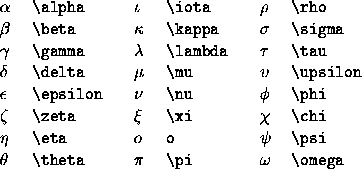
Greek Letters
source: math.tcd.ie

Pi (π) is the 16th letter of the Greek alphabet, and is used to represent the most widely known mathematical constant. By definition, pi is the ratio of the circumference of a circle to its diameter. The Egyptians calculated the area of a circle by a formula that gave the approximate value of 3.1605 for π. The first calculation of π was done by Archimedes of Syracuse (287–212 BC), one of the greatest mathematicians of the ancient world. We might not use it yourself every day, but Pi is used in most calculations for building and construction, quantum physics, communications, music theory, medical procedures, air travel, and space flight.

Pi Approximation Day is observed on July 22 (22/7 in the day/month format), since the fraction ​22⁄7 is a common approximation of π, which is accurate to two decimal places and dates from Archimedes.Throughout the history of mathematics, one of the most enduring challenges has been the calculation of the ratio between a circle’s circumference and diameter, which has come to be known by the Greek letter pi. From ancient Babylonia to the Middle Ages in Europe to the present day of supercomputers, mathematicians have been striving to calculate the mysterious number. They have searched for exact fractions, formulas, and, more recently, patterns in the long string of numbers starting with 3.14159 2653…, which is generally shortened to 3.14. Since the exact value of pi can never be calculated, we can never find the accurate area or circumference of a circle.

Some interesting facts about pi:

 1. Pi is an irrational number that is it is not possible to calculate Pi by dividing an integer by any other number.
2. Pi is a never-ending and never-repeating number.
3. The symbol of Pi has been in use for about 250 years.
4. As the value of Pi is never-ending so we can’t find the true circumference or area of a circle.
5. In Greek alphabets, Pi is the sixteenth letter and in English also p is the sixteenth letter.
6. Pi is the ratio of a circle’s circumference to its diameter.
7. In the 19th century, William Shanks calculated the first 707 digits of Pi by hand but unfortunately, he made a mistake after 527th place.
8. A Japanese scientist, breaking all the previous records, with the help of Hitachi SR 8000 which is a powerful computer found 1.24 trillion digits of Pi.
9. Pi is mentioned in the Bible.– In ancient times, Archimedes is the first person who studied about Pi.
10. Albert Einstein was born on Pi Day.
11. There are no zeros in the first 31 digits of Pi.
What Is Pi Day? Definition and Ways to Celebrate

City vs Village

City Life :-

City derives from a French word meaning citizenry. A city is a large or important town. In the United States, cities are incorporated municipalities with local governments. In Great Britain, a borough with a bishop’s seat is called a city. As with the words village and town, city can also refer to the its inhabitants. It’s like watching Paris from an express caboose heading in the opposite direction—every second the city gets smaller and smaller, only you feel it’s really you getting smaller and smaller and lonelier and lonelier, rushing away from all those lights and excitement at about a million miles an hour.

City Expressions

Many interesting uses of the word city exist in English. For example, imagine you see a place with a lot of stray dogs. You might call it “dog city” to indicate that it is full of or indicative of dogs. A city slicker is someone who doesn’t know much about country life. If you say that you can’t fight city hall, you are saying there’s no way you will win in a battle against bureaucracy.

Advantages of City Life:-

  • City life has an advanced and well-equipped environment. People migrate to cities because of better job opportunities, stability and a decent income which is a lack in villages.
  • Cities have a huge number of schools, colleges or universities established. Hence, the city folks get proper quality education which is a primary factor for standard living.
  • Recreation and entertainment are plenty in the cities. People also get adequate opportunities to establish and showcase their talents here.
  • City life provides commercialization, banking systems, and entrepreneurial businesses. This attracts more people from townships to settle in cities.
  • Better transportation, sanitation, availability of water and drainage systems are seen in cities. The drainage of polluted water goes through treatment before getting dumped in lakes or rivers. This keeps a small check on pollution too.
  • Medical help is at fingertips when required. There are a number of hospitals and clinics and well-equipped doctors and nurses for people in need.
  • Anonymity in cities helps in escaping from the judgements of people.

Disadvantages of city life:-

  • Urbanization is increasing at a rapid pace, and currently, about 30-33% of Indians lives in cities. This rate tends to be around 40% by 2030. With the high population density, the quality of life in cities is expected to degrade and become unfit for living.
  • City life is a very busy one, developing every second to a better version of itself. This results in a loss of cultural qualities and flavours.
  • High demand for city life has resulted in congestion. Human population has increased a lot in city areas.
  • The city’s population increases day by day. This leads to an environment with polluted air, smog, unclean water supplies, noise pollution
  • It follows from the previous point that an increase in pollution rates in the cities brings in more health issues. People tend to fall sick more in cities due to the polluted environment which is unfit for living.
  • Unfair competition among businesses, an increase in crime rates and immorality of the people is more in the cities.
  • Increase in costs and expenditure is a vital problem for city dwellers. This creates a reason for more competition for gaining wealth and hence increases stress and crimes too.

Village Life

The word village comes from a French term referring to a group of buildings. That’s exactly what a village is—a small community in a rural area. Sometimes, larger towns incorporate the houses of a village as a municipality. Village can also refer to inhabitants of a village and is even applied to groups of animal dwellings.

Advantages of village life:-

  • A pollution-free environment is available in the rural/village areas only.
  • Scenic beauty and greenery of rural areas are prominent. This also attracts tourists from around the globe.
  • Rural areas have a scope for socio-economic benefits like reduction in prices of agricultural and consumer products, access to markets, public transport, employment opportunities, and better education and healthcare facilities.
  • The essence of folk and culture is prominent in these areas. This defines the rural areas uniquely.

Disadvantages of village life:-

  • Lack of higher education is a backlog for rural lives. This creates the main hurdle for better standards of living.
  • Rural areas have poor road connectivity. Over 40 per cent of India’s rural population remains outside the rural road network. According to the Planning Commission’s Working Group on Rural Roads, there are over 3.3 lakh rural habitations with no road connection.
  • Limited medical help persists in these areas. A counted number of hospitals and even lesser doctors are available. Hence at times, people are bound to move to city areas for sustaining life.
  • Rural life is difficult for women more because of lack of proper sanitation and toilets. The primary reason for this has to be the lack of educational opportunities.

Conclusion:-

  • Though the city life has many disadvantages, people flock there more for its advantages.
  • Improper road connectivity is one of the main reasons for stopping growth in rural areas. But the government is making situations better for rural India. The Pradhan Mantri Gram Sadak Yojana (PMGSY) is a step towards improving road connectivity in rural parts of the country.
  • Hence, the reduction of pollution in cities and the development of roads and infrastructure in rural areas will bring a balance between the two.