If you want to build an indepebdent free lance career right away then here is the solution, the book Pyjama profit is a free lancing guide, it has the answers of all the questions wandering in your mind whenever you think of this one word ‘freelancing’ grab your copy and start doing what you love to do and get paid for it.
So here is a short and concise review of the book.
The millennial’s guide to a sustainable freelance career, it is the tagline of one of the best selling books on Amazon, ‘PYJAMA PROFIT’ the authors of the book are Varun Mayya and Abhinav Chhikara. The books is all about their journeys from the freelancing to a successful and stable business, the co author of the book Varun Mayya says “Tommorow, if you put me in a strange country without any resources, all I need is a laptop and an internet connection and I know I’ll build myself an awesome life fairly quick.”
Pyjama profit is a modern guide to free lancing. The book talks about the in demand online skills, the different paths one can take to become an expert in specific fields and the freedom that freelancing allows to hone further skills, taking on bigger assignments. A stable income from freelancing was the bedrock that allowed the authors – Varun and Abhinav to pursue their dreams and passions. Now, they have shared their stories of what worked for them and how anyone, anywhere can thrive without being tied to a 9 to 5 job. The book is a perfect fit in today’s time as the freelance economy grows and so do the aspiration among millennials to find a work they love, and not just something that pays their bills.
Every year on July 20, International Chess Day is celebrated to honour the founding of the Federation Internationale des Echecs, also known as FIDES, in the year 1924. Since ancient times Chess has been a popular game and has been played around the world. ‘With the time Chess game and its rules are evolving. As per reports, Chess became a game of class and only upper class were able to afford this game in a long way. However, the merchandise class later went on to introduce this game to the rest of the people while travelling around the world.
World Chess Day history:
In the fifth century, chess was invented in India. It was called “Chaturanga” at the time. Chess is one of the most ancient games of the period. This game was then spread to Persia. When the Arabs invaded Persia, Chess became an important part of the Muslim population’s life and from there it spread to Southern Europe. Chess evolved in its current form in Europe during the 15th century. And by the late 15th century, it took the shape of a modern game. And beginning on July 20, 1966, the International Chess Day began to celebrate FIDE’s establishment.
CELEBRATION:
World Chess Day, celebrated around the world, is now also recognised by the United Nations. According to reports, UNESCO proposed the idea to celebrate this day as the International Chess Day, and it has been marked as such since 1966 after it was established by FIDE. However, plenty of professional chess players around the world already celebrate the day. A survey published on FIDE reveals that a surprisingly stable 70% of the adult population has played chess at some point during their lives. In countries as diverse as the US, UK, Germany, Russia and India, this number holds approximately the same amount.
CHESS RULES:
The ultimate aim in the chess game is to deliver a checkmate – trapping your opponent´s king. The term checkmate is an alteration of the Persian phrase “Shah Mat”, meaning literally, “the King is ambushed”, and not “the King is dead”, that is a common misconception.
The chessboard is made up of eight rows and eight columns for a total of 64 squares of alternating colors. Each square of the chessboard is identified with a unique pair of a letter and a number. The vertical files are labeled a through h, from White´s left (i.e. the queen side) to White´s right. Similarly, the horizontal ranks are numbered from 1 to 8, starting from the one nearest White´s side of the board. Each square of the board, then, is uniquely identified by its file letter and rank number. In the initial position setup, the light queen is positioned on a light square and the dark queen is situated on a dark square. The diagram below shows how the pieces should be initially situated.
Chess moves:
King can move exactly one square horizontally, vertically, or diagonally. At most once in every game, each king is allowed to make a special move, known as castling.
Queen can move any number of vacant squares diagonally, horizontally, or vertically.
Rook can move any number of vacant squares vertically or horizontally. It also is moved while castling.
Bishop can move any number of vacant squares in any diagonal direction.
Knight can move one square along any rank or file and then at an angle. The knight´s movement can also be viewed as an “L” or “7″ laid out at any horizontal or vertical angle.
Pawns can move forward one square, if that square is unoccupied. If it has not yet moved, the pawn has the option of moving two squares forward provided both squares in front of the pawn are unoccupied. A pawn cannot move backward. Pawns are the only pieces that capture differently from how they move. They can capture an enemy piece on either of the two spaces adjacent to the space in front of them (i.e., the two squares diagonally in front of them) but cannot move to these spaces if they are vacant. The pawn is also involved in the two special moves en passant and promotion.
Castling:
Castling is the only time in the chess game when more than one piece moves during a turn. This chess move has been invented in the 1500´s to help speeding up the game and improving balance of the offense and defense. During the castling, the king moves two squares towards the rook he intends to castle with, and the rook moves to the square through which the king passed.
Castling is only permissible if all of the following conditions hold:
Neither king nor rook involved in castling may have moved from the original position
There must be no pieces between the king and the rook
The king may not currently be in check, nor may the king pass through or end up in a square that is under attack by an enemy piece (though the rook is permitted to be under attack and to pass over an attacked square)
En Passant:
En Passant may only occur when a pawn is moved two squares on its initial movement. When this happens, the opposing player has the option to take the moved pawn “en passant” as if it had only moved one square. This option, though, only stays open for one move. The En Passant move was developed after pawns were allowed to move more than one square on their initial move. The idea behind this rule was to retain restrictions imposed by slow movement, while at the same time speeding up the game.
Pawn promotion:
If a pawn reaches the opponent´s edge of the table, it will be promoted – the pawn may be converted to a queen, rook, bishop or knight, as the player desires. The choice is not limited to previously captured pieces. Thus its´ theoretically possible having up to nine queens or up to ten rooks, bishops, or knights if all pawns are promoted.
First of all, One of the oldest games that is still in existence and is very popular so it tells how humans used to think back then and what’s the difference now.Earlier it was used to make war strategies . Now it enhances your problem solving capabilities. Nowadays whatever we do, whatever place we work in, the most important thing required to grow is the problem solving skills.
Chess improves the logical part of the brain. Every time you learn a new move, a new neuron is developed in your brain, which increases the size and capability of your brain’s neural network thus making your brain fast. So, in simple terms a person playing chess from his childhood will be grown up into a smarted person who will be good with logic, remembering stuffs and numbers.
COMPANY COMPLIANCES DURING THE COVID-19 ERA: AN INTRODUCTION
The global outbreak of the novel coronavirus has taken the world by storm. While the issue pertaining to the public health is the talk of the town, the impact of COVID-19 on businesses and corporates seems to be least talked about.
Day to day business of the corporates is being affected due to decreased inflow of the human resource and a decrease in the workflow. While technologies have provided a relief to the human resource for physical attendances and conferences, there seemed to be unsettled trouble regarding legal compliances that required various filings and physical meetings.
Pursuant to the ongoing global COVID-19 pandemic and the Finance Minister, Ms. Nirmala Sitharaman’s announcements on March 24, 2020, the Ministry of Corporate Affairs (“MCA”) has issued various circulars to provide relief to companies from certain compliances under the Companies Act, 2013 (“Act”) and associated rules. This has been done as a measure to reduce the compliance burden on entities during the unprecedented health and economic situation caused by COVID-19. Following are the measures:-
1. Company Affirmation of Readiness towards COVID-19
Social distancing has gained its importance as a way to contain the spread, morbidity, and mortality of COVID-19. Government of India (“GOI”), responsible for the public welfare at large, has realised that social distancing can be achieved in its true sense only if the employers of the Indian public make the same application in their respective premises.
Considering that major employers of the nation belong to the companies or limited liability partnership (“LLP”) type entity, GOI as part of disaster management have advised all companies/LLPs to put in place an immediate plan to implement the “work from home” policy as a temporary measure up till March 31, 2020.
Further, in case of a requirement of physical visits of the essential staff to such offices by the employers, staggered timings may be followed in order to minimize physical interactions of all kinds.
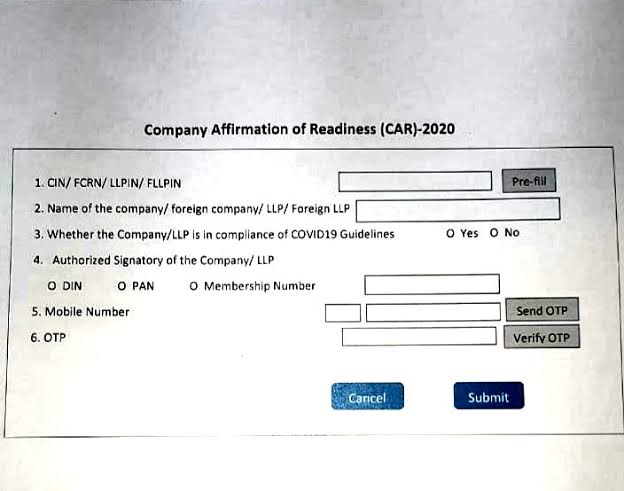
A simple webform for companies/LLP shall be deployed by MCA on March 23, 2020, in order to confirm the readiness of the employers to deal with COVID-19 threat. The webform shall be called CAR (Company Affirmation of Readiness towards COVID-19) and would be required to be signed and submitted by the authorised signatory of the company/LLP.
Therefore, it shall be expected by each company/LLP to ensure reporting of the compliance through CAR instantly from the date of its deployment.
2. Companies Fresh Start Scheme 2020
The MCA issued a circular on March 30, 2020, introducing the Companies Fresh Start Scheme, 2020 which, inter alia, grants a one-time opportunity to defaulting companies to complete all belated filings, including, without limitation, annual filings and filings required under IEPFA (Accounting, Audit, Transfer and Refund) Rules, 2016 in relation to transfer of money remaining unpaid or unclaimed for a period of seven years under Section 124(5) of the Act and transfer of relevant shares in the name of the ‘Investor Education and Protection Fund’ under Section 124(6) of the Act, with the MCA21 registry, without incurring additional fees on account of any delay.
This scheme came into force on April 1, 2020, and is valid till September 30, 2020. The application for seeking immunity for belated filings under this scheme should be made within a period of six months from September 30, 2020, through Form CFSS-2020. Thereafter, an immunity certificate will be provided by the designated authority on the basis of the declarations made in such form.
However, no immunity shall be provided under the scheme in a matter where (i) an appeal or management dispute is pending before any court or tribunal, or (ii) a court has ordered a conviction, or the adjudicating authority under the Act has imposed a penalty, and in respect of such orders, no appeal has been filed prior to the scheme coming into force.
Further, the scheme shall not apply: (i) where an application has been filed or an action for final notice for striking off the name of the company has already been initiated; (ii) where the company has been amalgamated; (iii) when application of obtaining dormant status has been filed; (iv) to vanishing companies; and/or (v) where charge related documents or an increase in authorised capital is involved.
3. CSR Spending
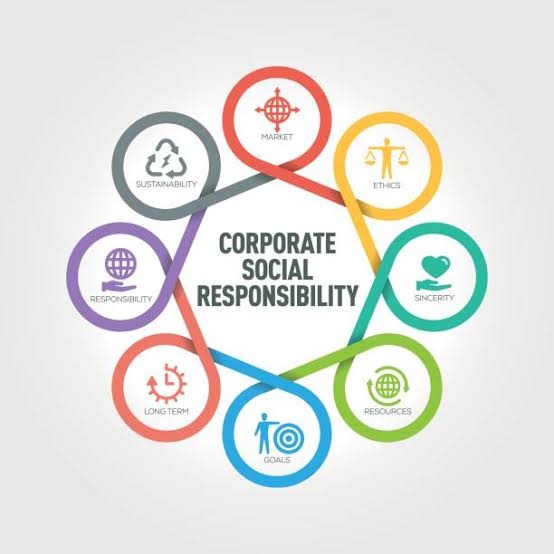
The MCA has by way of circular dated March 23, 2020 and the office memorandum dated March 28, 2020, clarified that the spending of CSR funds by companies in relation to COVID-19, including by way of contribution to the PM CARES Fund, is an eligible CSR expenditure under the Act.
The MCA has further clarified by way of FAQs dated April 10, 2020 that contributions made to the State Disaster Management Authority will also be eligible CSR activity, but contributions towards (a) ‘Chief Minister’s Relief Fund’ or ‘State Relief Fund for COVID-19’; and (b) payment of salary/ wages to employees and workers (including contract labour/ temporary/ casual/ daily wage workers) during the lockdown period will not be considered as eligible CSR expenditure.
However, ex-gratia payment over and above the disbursement of wages to temporary/ casual workers/ daily wage workers, specifically for the purpose of fighting COVID-19, will be admissible towards CSR expenditure, provided there is an explicit declaration to that effect by the board of the company, which is duly certified by the statutory auditor.
4. Meetings of Board and the Shareholders
The Companies (Meetings of Board and its Powers) Rules, 2014 were amended by a notification dated March 19, 2020, to enable companies to hold board meetings on the following matters (which earlier had to be necessarily held at a physical meeting) through video-conferencing or other audio-visual means (collectively “VCC”) till June 30, 2020: (i) approval of annual financial statements and board’s report; (ii) approval of prospectus; (iii) audit committee meetings for consideration of financial statements; and (iv) approval of amalgamation, merger, demerger, acquisition and takeover.
MCA has, by way of a general circular dated April 8, 2020, requested companies to pass all decisions of an urgent nature requiring shareholder approval, other than those of ordinary business or business where any person has right to be heard, through postal ballot/ e-voting in accordance with the relevant statutory provisions without holding a physical general meeting. However, in cases where holding an extraordinary general meeting (“EEGM”) is unavoidable, these have now been permitted to be held through VC until June 30, 2020. The circular further lays down certain conditions to be met for conducting an EGM through VC and the key conditions, inter alia, include: (i) attendance of at least one independent director (where a company is required to appoint one) and auditor (or his authorised representative who is qualified to be the auditor); (ii) maintenance of recorded transcripts of the EGM and, in case of a public company, such transcripts to be uploaded on the company website (if any); and (iii) e-voting facility being available. All other provisions relating to general meetings under the Act (and relevant rules) will continue to apply.
Due to difficulties faced by various stakeholders in serving and receiving notices/responses by post on account of COVID-19, the MCA, on April 13, 2020, provided that notice of EGMs to be held through VC (and for passing shareholder resolutions through postal ballot/ e-voting) may now be given to shareholders only through email addresses of the shareholders registered with the company or with the depository participant/ depository. This circular also specifies various conditions which companies must comply with while sending email notices to shareholders.
CONCLUSION
Business entities in India are requested and expected to keep an eye on the major government websites to ensure timely compliance with all such immediate requirements and mandates issued by GOI as need of the hour from time to time.
WEBSITES REFERRED:-
1) MCA General Circular No. 10/20 dated March 23, 2020 on Clarification on spending of CSR for COVID-19.
2) MCA General Circular No. 12/20 dated March 30, 2020 on Companies Fresh Start Scheme, 2020
3) MCA Notification dated March 19, 2020 on Companies (Meetings of Board and its Powers) Amendment Rules, 2020
4) MCA General Circular No. 14/2020 dated April 8, 2020 on Clarification on passing of ordinary or special resolutions by companies under the Companies Act, 2013 and rules made thereunder on account of threat posed by Covid-19.
5) MCA General Circular No. 17/20 dated April 13, 2020 on clarification on passing ordinary and special resolutions by companies under the Companies Act, 2013 and rules made thereunder on account of threat posed by COVID-19.
The Electricity Act, 2003 (the “Electricity Act“) was enacted to consolidate the electricity laws in India. The Electricity Act, 2003 (hereinafter “Act”) has been the statutory paradigm which has governed the laws regarding the generation, distribution, transmission, trading and use of electricity, keeping in mind the interests of the state and central departments, producers and consumers of electricity, setting rules and regulations and regulatory authorities to govern a major component of the power sector.
n order to address some recurring issues, and to promote further commercial incentive for private players to enter the market in the generation, distribution and transmission of electricity, with some policy modifications, the Electricity (Amendment) Bill, 2020 has been introduced by the Ministry of Power on April 17, 2020 (“Amendment”). Following are major changes that this Amendment proposes to introduce in the Electricity Act, 2003:
Need for new amendment:
Some of the provisions of the Act have become dated and archaic and needs an update.
Policy modifications are needed to address some recurring issues and to promote further commercial incentive for private players to enter the market in the generation, distribution and transmission of electricity.
Measures need to be augmented to ease the financial crunch of the Discoms.
It is necessary to promote a legal and administrative ecosystem which harbours special attention to renewable energy.
Though the ministry had brought the first draft in 2014 which had an option to consumers to change their service providers like they do for their mobile phone service, the bill lapsed after dissolution of the Lok Sabha.
The 2nd and 3rd draft bills were brought in 2018 and 2019.
Important features of the draft:
The Union power ministry has come out with the draft of Electricity (Amendment) Bill, 2020.
It seeks to set up an Electricity Contract Enforcement Authority (ECEA) having power of a civil court to settle disputes related to power purchase agreements between discoms and power generation companies (gencos).
The ECEA will have sole authority to adjudicate matters related to specific performance of contracts related to purchase or sale of power, between gencos and discoms.
The decision of the ECEA can be challenged at the Appellate Tribunal For Electricity (APTEL) and subsequently, at the Supreme Court.
The draft provides that the cross (power) border trade shall cover import or export of electricity from India and any other country. The transaction related to passage of electricity through India would be treated as transit between two other countries.
The draft law provides for introduction of power distribution sub-licensee or franchisee, which would not require a separate licence from state commission.
It calls for creating a National Renewable Energy Policy by the central government in consultation with state governments.
The bill says that there would be no schedule or dispatch of electricity unless there is adequate security of payment as per the contract.
The bill enables state as well as central power regulators to specify transmission charges under open access (earlier both functions were with the central commission).
The Electricity Act would be applicable to the entire country, including the Union Territories of Jammu and Kashmir and Ladakh.
Private Defence is a enjoyed by every citizen of this country. It is enumerated in chapter IV, Sections 96 to 106 of Indian Penal Code 1860. This right exempts the person for taking law in his hands for the safety of himself or his property or to the protection of other person or that person’s property.
The right is based upon the two general maxim
1) ‘‘necessity knows no law’’ and
(2)‘‘it is the primary duty of a man to first help himself.’’
In the words of famous jurist Jeremy Bentham, ‘‘The Right of Private Defense is absolutely necessary for the protection of one’s life, liberty and property.
Interpretation by the Supreme Court
In a verdict delivered on March 7, 2019,Supreme Court of India expanded the scope of self defence. The bench of Justices A.M. Sapre and R. Subhash Reddy turned down the sentence given by the trial court to the Tamil Nadu forest ranger who shot dead a sandalwood “smuggler” in the the dharmapuri forest area in 1988, and acquitted him. The trial court had sentenced ranger Sukumaran to life in prison for murder. The Madras High Court reduced the term to five years. In appeal, the SC concluded that Sukumaran had shot the “smuggler” under threat to his own life and that of his driver. The bench of the apex court said that, ‘‘A mere reasonable apprehension is enough to put the right of self defence into operation.’’ The Court also observed that ‘‘the right to private defence of one’s own body against any offense affecting the human body but also to defend the boy of any other person. The Right also embraces the protection of property, whether one’s own or another person’s against certain specified offences, namely, theft, robbery, mischief, and criminal trespass.’’
Detailed understanding
Now let’s understand the sections of private defence given in the Indian Penal Code in detail. Section 96: Things done in private defence: Right of private defence is not revenge. This section explains that the right in no case extends to the inflicting of more harm than it is necessary for the purpose of defence. Section 97: Right of Private defence of the body and of property: This Section of IPC divides the right of private defence into two parts. a) The right of private defence of person, b) The right of private defence of property. According to this section, this right extends not only to the defence of one’s own body or property but also to defend the body and property of any other person. Even a stranger can defend the person or property of another person and vice versa. Section 98: Right of Private defence against the act of a person of unsound mind, etc. : This section mentions that the right to private defence from its very nature admits no exception since it is the right of preservation of one’s life and property as also another’s life and property against the world at large. The right of defence of the body exists against all attackers, with or without mens rea. Section 99 : Acts against there is no right of Private defence : there are four acts is mention where no right of private defence can be used as an excuse. These are as following: i) against the acts of a public servant acting in good faith. ii) against the acts of the those acting under the authority or direction of a public servant. iii) where there is sufficient time for recourse to public authorities. iv) the quantum of harm of that may be caused shall in no case be in excesses. Section 100: When the right of private defence of the body extends to causing death: Section 100 is very important to understand as it states that one can even kill the other person in his defence. But to invoke this section following four conditions must exist. i) The person exercising the right of private defence must be free from fault in bringing about encounter. ii) There must be present, an impending peril to life or of great bodily harm, rape, unnatural lust, kidnapping or abduction, wrongful confinement etc. iii) There must be no safe or reasonable mode of escape by retreat, and iv) There must have been a necessity for taking the life.
Section 101,when the right extends to causing harm other than death: This Section provides that, if the offence be not of any of the description enumerated in Section 100; the right of private defence of the body does not extend to the voluntary causing of death to the assailant, but does extend to the voluntary causing to the assailant of any harm other than death. Section 102,Commencement and continuance of the right of private defence of the body: Section 102 deals with two very important aspects of the right of private defence of body – a) the right commences at that point of time when a reasonable apprehension of danger to the body arises either from an attempt to commit an offence on the body or from a threat to commit such offence even though in either of these cases the offence itself may not have been committed. b) the right continues till such apprehension of danger to the body continues. Section 103, when the right of private defence of property extends to causing Death : The right of private defence of property extends under the restrictions mentioned in section 99, to the voluntary causing of death or of any other harm to the wrong-doer, if the offence, the committing of which, or the attempting to commit which, occasions the exercise of the right, be an offence of any of the descriptions hereinafter enumerated, namely, Robbery ; House-breaking by night; Mischief by fire committed on any building, tent or vessel, which is being used as a human dwelling, or as a place for the custody of property; Theft, mischief, or house-trespass, under such circumstances as may reasonably cause apprehension that death or grievous hurt will be the consequence, if such right of private defence is not exercised. Section 104, when such rights extends to causing any harm other than death”: This section is correlated to the section 103. It says that where the offence of theft, mischief or criminal trespass has been committed or attempted but the description are different from those enumerated in section 103 of the Code; the right of private defence of property extends only up to the extent to voluntary causing of any other harm than death. Section 105, commencement and continuance of the right of private defence of property: This section is comparable to Section 102, and indicates when the right of defence of property commences and till that period it continues. In case of theft the right of private defence of property is put to an end by the successful retreat of the thief, if the thief is running away with the property, he cannot be said to have retreated. It is only when he reaches his final destination that he can be said to have retreated. The question whether or not there was enough time for the injured party to have recourse to the protection of the public authorities is always a question of fact depending on the circumstances of each case. Section 106: right of private defence against deadly assaultwhen there is risk of harm to innocent person: The section says that in case of an assault, reasonably causing an apprehension of death, if the defender is faced with such a situation where there exists risk of harm to an innocent person, there is no restriction on him to exercise his right of defence and he is entitled to run that risk.
Burden of Proof
The burden of proof in cases of where the plea of private defence is taken rests on the Accused. It is for him to prove the innocence and define that he acted out of necessity, he actually left with no other way but to use his right of defence.
Conclusion This right is based on the natural law that,the self protection is the primary duty of every living being. The one who cannot help himself, no law will be able to protect him. The right to defence is a very powerful weapon so it should be used only in the necessity.
In the last few years, science has helped a lot in the development of India. Science has contributed to all the sectors. Science has improved the global economy, increased employment opportunities, saved millions of lives and has played a major role in a lot of industries. Science is very important for the growth and development of India. It even plays a key role in our daily lives. Every country should invest as much as possible in research and development for scientific technologies. In this essay on the role of science in making India we will see how science has helped India to grow in different sectors.
How Indian Scientists have Helped India Grow?
When it comes to Indian Scientists, the first name comes to my mind is CV Raman. CV Raman was the first Asian who won the Nobel Prize. His work was related to light and sound. He investigated that when light passes through a transparent material, some of the deflected light waves see the change in its amplitude and wavelength.
APJ Abdul Kalam is the second name that comes in my mind in Indian Scientists. APJ Abdul Kalam worked as an Aerospace engineer with ISRO and DRDO. He was also president of India from 2002 to 2007. Abdul Kalam contributed a lot to Aerospace. One of the contributions is deploying Rohini Satellite near Earth’s orbit. A few more names are Homi Bhabha, Visvesvaraya, V Radhakrishnan, Satyendra Nath Bose and many more…
How has Science Increased Employment Opportunities?
Whenever any new technology is discovered it leads to new industries. For example, if any new scientific device is invented it will require eligible professionals to control the device. Such inventions help in increasing employment opportunities. This also helps in growth in many businesses which in turn develops the Indian economy.
Curing Diseases and Saving Lives
In the last few years, medical science has evolved so much and saved billions of lives. New technologies like wireless brain sensors, artificial organs, smart inhalers, robotic surgery, virtual reality are making work easier for thousands of doctors around the world. And also these technologies are saving millions of lives and curing diseases.
Role in Agriculture Sector
Science has played a very major role in the Agriculture sector. Food is one of the basic needs of our lives. And science has now invented so many new agriculture techniques which have increased production drastically. The old mundane techniques farmers used to follow was very slow, expensive, and required too much effort. Science has made everything a lot easier for farmers. Improved facilities in irrigation, modern fertilizers, advanced equipment, and pesticides are all helping farmers to work faster, and save more money.
Science has helped us a lot in many ways and it will keep helping. Everyone should not only invest as much as possible in science and technology but also should stay aware of all new technologies developed around the world.
2020 has been driving at the highest paces as every person in the country is finding themselves locked more often than not. Amidst all the negativity, India has specifically positive things to look forward as it celebrates the 100th-year anniversary of the Malabar uprising next year i.e in the year 2021.
The Rebellion is not much talked about except locally. The Malabar rebellion, is also commonly known as the Moplah rebellion. This rebellion by the Mappila Muslims of Kerala was one of a kind as it was an armed revolt staged against their Hindu landlords and the British authorities in 1921. The duration of the revolt says a lot of their efforts and neglect as India pauses to salute the six-month long movement. Despite being one of the first cases of nationalist uprisings in Southern India, it was actually occurred within the broader spectrum of the Non-cooperation movement led by Mahatma Gandhi, which is also popularly called as the Khilafat movement.
Moplahs or the so called Mappilas were of two known cultures. One being the Muslim tenants also called as Kanamdars and the other were the cultivators, locally called as Verumpattamdars. These two cultures resided in the Malabar region, a place where most of the landlords were upper caste Hindus. The majority having a say is particularly evident today as well as which gives us the idea on how the dominance could have been unprecedented then and totally shrilling. The Moplahs however, had gained some prominence when Hyder Ali and Tipu Sultan invaded Mysore. But the domination of the Hindu landlords was re-established soon following the 3rd Anglo-Mysore war, also around time after British occupation of Malabar in 1792. And in no time, the Mappilas found themselves at the mercy and under the shackles of their Hindu landlords who ultimately served as British agents and were sustained by them.
The history of feudal conflicts in the Malabar region was nothing but the years of pressured ostracizing as it particularly stands as one of the causes of the revolt. The tenant-landlord relations were historically strained. A total 32 uprisings between 1836 and 1919 were evidently organized by the Moplahs against their high caste Hindu landlords, the relatives of the landlords and also against the assistants of British officials.
The economic condition of Mappila tenants had deteriorated overtime which brought in Agrarian discontent among them. It was caused by the oppressions on them by the draconian British policies which had increased taxation, unsecured their tenancy, racked the renting, forced numerous evictions etc. This had also given rise to anti-feudal and anti-British sentiments among the Moplahs.
The Congress, specifically Gandhi, had tried to reached out to the Mappila cultivators to mobilize support and encourage them for independence through the non-cooperation movement. This led to the formation of Khilafat in Malabar in June 1920, which with time became increasingly active. Consequently, in August 1920, Gandhi along with Shaukat Ali, the leader of the Khilafat movement in India, visited Calicut with an aim to spread the idea of Khilafat and message of non-cooperation among the residents of Malabar. By January of 1921, the Mappilas under the shed of Mahadum Tanga, their religious head, had pledged to support the proposed movement.
But it was only under the leadership of Variyamkunnath Kunjahammed Haji that the Mappilas took up arms in August 1921 after the arrest of their Khilafat leader Ali Musaliyar. The immediate cause was led by a widespread rumour that the prominent mosque in Thirurangadi was raided.
The course of the rebellion largely took the shape of guerrilla-type attacks on the police, troops and janmis. The symbols of the colonial state including the stations, telegraph lines, courts, offices etc. alongwith the houses of the landlords were attacked.
The rebellion spread across the Malabar district so much that the British officers and the local police officers had to escape leaving the huge territory under the control of the rebels.
The territory was then declared an ‘independent state’ under the ruling of Haji in August 1921. The territory headquartered in Nilambur and also had its own separate currency, system of taxation and passport for nearly six months. The Khilafat regime was run parallelly along with the state affairs. The local tenants were granted the power over their lands in which they cultivated and grew along with tax incentives.
Although the movement started off explicitly as a protest against British authorities, it had acquired the sights of communal implications that later culminated into communal violence. The independency did not last long as the British suppressions of the revolt led to the British government responding largely to the movement with much more aggression. They returned to bring in Gurkha regiment with the aim to suppress it. They succeeded and had imposed martial law.
Approximately 60 Mappila residents were sent on their way to a prison and suffocated to death in a closed railway goods wagon from which the movement is also referred to have given birth to the ‘Wagon Tragedy’. By January 1922, the British had taken back all the areas which were held by the rebels by capturing all the key Mappilan leaders. In this process, Haji was also arrested to be sentenced to death.
The ending in this particular rebellion is not celebratory but the struggles of the ancestors have certainly been. The courage, the revolts and the first uprisings which eventually led to India’s Independency is undoubtedly the kind of happy forward motivation the residents need as we are fighting the small little struggles of our own against as deadly a pandemic as Covid-19. So, with open arms, the 100th year of Malabar Rebellion is all welcome!
Talent management is defined as the methodically organized, strategic process of getting the right talent onboard and helping them grow to their optimal capabilities keeping organizational objectives in mind.
The process thus involves identifying talent gaps and vacant positions, sourcing for and onboarding the suitable candidates, growing them within the system and developing needed skills, training for expertise with a future-focus and effectively engaging, retaining and motivating them to achieve long-term business goals. The definition brings to light the overarching nature of talent management – how it permeates all aspects pertaining to the human resources at work while ensuring that the organization attains its objectives. It is thus the process of getting the right people onboard and enabling them to enable the business at large.
Under the umbrella of talent management, there are a string of elements and sub-processes that need to work in unison to ensure the success of the organization. For example, analyzing the right talent gaps for the present and the future, identifying the right talent pools and best-fit candidates, getting them to join and then optimizing their existing skills and strengths while helping them grow are touch-points that are all equally important. They support each other and the whole structure would crumble even if one sub-process fell out of sync.
Talent Management Process
While often cyclical rather than a generic linear progression of events, the process of talent management could be considered, to begin with acknowledging the need for talent and leads to filling that gap and ultimately growing and optimizing the skills, traits, and expertise of employees, new and old.
The following image depicts the key points of the talent management process:
Let’s get into these key steps in the process of managing talent effectively:
1. Planning: Like in any process with a set outcome, planning is the first step in the process of talent management. It involves the following identifying where the gaps lie – the human capital requirement, formulating job descriptions for the necessary key roles to help guide sourcing and selection and developing a workforce plan for recruitment initiatives
2. Attracting: Based on the plan, the natural next step is to decide whether the talent requirements should be filled in from within the organization or from external sources. Either way, the process would involve attracting a healthy flow of applicants. The usual external sources include job portals, social network, and referrals. The talent pools that need to be tapped into must be identified in advance to keep the process as smooth and efficient as possible. This is where the kind of employer brand that the organization has built for itself, comes into play because that decides the quality of applications that com
3. Selecting: This involves using a string of tests and checks to find the right match for the job – the ideal person-organization fit. Written tests, interviews, group discussions and psychometric testing along with an in-depth analysis of all available information on the candidate on public access platforms help in gauging an all-rounded picture of the person. Today there are software and AI-enabled solutions that recruiters can use to skim through a vast population of CVs to focus on the most suitable options and to find the ideal mat
4.Developing: Quite a few organizations today operate on the idea of hiring for attitude and training for skills. This makes sense because while you would want a predisposition to certain skill-sets, it is the person that you are hiring and not the CV. Developing employees to help them grow with the organization and training them for the expertise needed to contribute to business success also builds loyalty and improves employee engagement. This begins with an effective onboarding program to help the employee settle into the new role, followed by providing ample opportunities for enhancing the skills, aptitude and proficiency while also enabling growth through counseling, coaching, mentoring and job-rotation schem
5. Retaining: For any organization to be truly successful, sustainably, talent needs to be retained effectively. Most organizations try to retain their best talent through promotions and increments, offering opportunities for growth, encouraging involvement in special projects and decision-making, training for more evolved roles and rewards and recognition program
6. Transitioning: Effective talent management focuses on a collective transformation and evolution of the organization through the growth of individual employees. This involves making each employee feel that they are a part of a bigger whole. Providing retirement benefits, conducting exit interviews and effective succession planning might seem like unrelated career points but they are all transition tools that enable the shared journey.
Talent Management Model
Over the years, there have been multiple models made for talent management that have been created b organization who have felt that they have finally cracked the code on the perfect model. The thing with talent management, however, is that it needs to morph to suit the latest talent trends, digital disruptions, and employee expectations.
The following diagram is that of the integrated talent management model which appears to be the most relevant one today.
Assess – Talent analytics, succession planning and assessments
Develop – Workforce planning, culture at work, engagement and retention practices
Deploy – Goal alignment, career-path planning, learning and development, and performance management
This structure of components is cyclical and goes on in a sustained loop while taking onto consideration the internal climate within the organization and the external environment in which it operates.
How can an organization ensure that this model is put to the best use? The following graphic enumerates the facets that need to be kept in mind.
The point to be kept in mind here is that no model of something as dynamic as talent management is writ in stone. It needs to be able to adapt to the changing needs of the organization the evolving talent expectations and the pace set by changes within the industry.
Talent Management Strategy
Talent management is not a mere checklist of requirements that need to be sufficed – it is a strategy that needs careful implementation, regular checks, and continual improvement. The following are the six primary talent management strategies that serve as the pillars of people functions.
1. Detailed job descriptions
A well-informed, detailed job description helps the sourcer, the sourcing software, and the candidate understand the job-role better. Generic job descriptions only serve to confuse all parties involved in the talent acquisition process and lead to a wave of irrelevant applications. Information that must be a part of the job description includes the following:
Job title and location
Overall duties
Skills required
Reporting lines
Tools and equipment used
Salary and benefits
With these, candidates can make an informed decision on whether to apply or not and sourcers get CVs that fit the bill better.
2. Person-organization fit
An employee that does not fit into the organizational culture can neither be the happiest employee nor the most sustainably productive one. While the culture can be difficult to define in words, it is prevalent in actions and quite easy to understand whether a candidate would be a good fit or not. Personal and organizational values need to have a certain degree of overlap for any employee to feel at home within the organization. Without a comfortable person-organization fit, the most amount of time, effort and energy would go into attempts at adjustment. Hiring candidate with the right P-O fit (or PE fit) thus greatly improves the chances of better employee engagement, higher employee satisfaction, and usually better performance.
3. Collaborate-coach-evolve
An important strategy to make talent management more effective involves creating a culture of coaching, mentoring (even reverse mentoring) and collaboration. Constructive feedback goes a long way when it comes to helping employees evolve and develop their skills and expertise. Managing talent is thus also about preparing them for the future of the organization – to be ready for changes down the path and to be able to rely on each other.
4. Reward and recognize right
The process of rewards and recognition forms an important part of the strategy to motivate, engage and manage employees better. This goes beyond financial rewards and bonus packages. Studies point towards the fact that employees often want R&R schemes that motivate them with “prizes” that are most relevant to them as individuals. This is a great opportunity for organizations to show their employees how much they care for them as persons and as integral aspects of the organizational machinery.
5.Opportunities for continuous improvement
Managing talent needs to be put in the context of the future that the organization has envisioned for itself. Thus, employees need to be equipped with the right tools to be able to maximize their own potential. For the continuous improvement of the organization, there needs to be the scope and opportunities for the continuous development of its employees. Moreover, this ensures that the cumulative skills within the organization is updated, upgraded and upscaled.
Talent management involves strategically planning career paths that make sense for every employee. We all tend to work better we know where we are headed and what the next stop is for our careers. This does not entail making empty promises of promotions but rather creating a career map in discussion with the employee, making sure that they relate to it and feel that it is realistic while also providing them with all the necessary tools to make the map a reality. Having a map to follow also improves retention scores since employees then know what they have to look forward to and work towards and can then collaborate effectively to achieve it.
Minority Affairs Minister Mukhtar Abbas Naqvi has said that reform is not only a regulation, but it is a resolution for betterment of the country and human beings. He was addressing a seminar on ‘Role of Journalism, Media and Cinema in Nation and Generation Building’ during the inaugural session of Centre for Professional Development in Higher Education, Delhi University today.
Mr Naqvi said that the government, politics, cinema and media are connected with each other with a sensitive thread of the society and courage, commitment and caution are tested, evaluated and essential Mantra to strengthen these relations. He said, in the time of crisis, the government, society, cinema and media act as one soul and four bodies.
The Minister said, the history is a witness to the fact that whenever there is a crisis in the country, before or after Independence, all these four sections have together performed their responsibilities with complete honesty in national interest and human welfare.
Mr Naqvi said that the entire world is facing such a crisis in the form Corona pandemic. He said, many generations have not seen such a challenge, still, we have left no stone unturned to play the role of a mature society, government, cinema and media and especially in India, all these four sections became a part of solution to the problem.
Mr Naqvi said that there have been revolutionary changes in work culture, character and commitment of the establishment, society, cinema and media during the last six months. He said, reforms don’t take place due to only regulations, they take place due to resolution.
The Minister said, media has a more important role to play in nation building in comparison to any Constitutional institution. He said, today, the print, electronic and digital media have a reach to about 80 per cent of the country’s population.
Newspapers, television, radio, digital platforms have played a laudable role in spreading the information to the remotest parts of the country from towns to villages. Digital media has also made a space for itself in our life. Mr Naqvi said that the media not only creates awareness among the people through news and various information, it also makes the government system cautious through constructive criticism.
In order to strengthen the Government of India’s efforts to reduce COVID-19 mortality, AIIMS, New Delhi has started a video-consultation programme with ICU doctors across the country called e-ICU. The programme aims at holding case-management discussions among doctors who are at the frontline in treating COVID-19 patients in hospitals and COVID facilities around the country.
Physicians who manage COVID-19 patients including those in the ICUs can raise queries, present their experience and share knowledge with other physicians and experts from AIIMS, New Delhi on this video platform. Forty three big hospitals in 11 states so far have been covered.
The primary objective of these discussions is to reduce mortality from COVID-19 by learning from shared experience and strengthening best practices among hospitals. AIR correspondent reports that 1,000 beds including isolation beds, oxygen supported and ICU beds in hospitals are covered under this programme.
Each of these sessions conducted through video conference span nearly two hours. The discussions have covered the entire range of issues related to management of COVID-19 patients.
In Assam, the flood situation in the state is improving as there was no heavy downpour during the last 24 hours. The death toll due to flood has gone up to 85.
Official sources said that 25 lakh people have been affected in 24 districts. State and National Disaster Response Force teams are carrying out relief and rescue works. In all, 1.21 lakh hectare crop areas are submerged due to flood.
Chief Minister Sarbananda Sonowal along with state BJP President Ranjeet Kumar Dass are visiting flood affected Barpeta and Nalbari districts. Mr. Sonowal said that the Prime Minister has assured all help to the state government to face the situation.
The Rajasthan High Court resumed the hearing today on the petition of rebel Congress MLAs of Rajasthan. Congress-rebel Sachin Pilot and 18 other rebel MLAs of Congress have filed a petition seeking dismissal of the disqualification notices served to sacked Deputy Chief Minister Sachin Pilot and 18 other MLAs. The court had postponed the hearing on Friday.
The Assembly’s Secretariat had issued notices to these MLAs on a petition submitted by the Chief Whip Mahesh Joshi who sought to initiate proceedings related to disqualifying to Former Deputy Chief Minister Sachin Pilot and other 18 MLAs for violating the party’s whip.
AIR correspondent reports that the future of the State Government now rests on the outcome of the legal battle going on several fronts.
Many legal fronts have been opened in the state in the game of check and mete. Notices have been issued to the 19 rebel MLAs of the Congress in the disqualification matter. These notices have been challenged in the double bench of the Rajasthan High Court, where the hearing continues.
On the other hand, three cases have been registered by the SOG and one by the ACB for alleged conspiracy against the government and horse-trading of legislators. Some persons are in the lens of both agencies including two rebel MLAs of Congress.
All the MLAs supporting the government are camping in a hotel near Jaipur for the last eight days. In view of the situation, the possibility of ending the political crisis in the state soon is very less.
The Income Tax Department is all set to start an e-Campaign on voluntary compliance of Income Tax for the convenience of the taxpayers from today. The 11-day campaign will focus on the assessees or taxpayers who are either non-filers or have discrepancies in their returns for the financial year 2018-19.
The objective of the e-campaign is to facilitate taxpayers to online validate their tax and financial transaction information available with the I-T Department and promote voluntary compliance, especially for the assessees for 2018-19 so that they do not need to get into notice and scrutiny process.
This e-campaign is being run for the benefit of the taxpayers. Under this e-campaign the Income Tax Department will send email and SMS to identified taxpayers to verify their financial transactions related information received by the I-T department from various sources such as Statement of Financial Transactions, Tax Deduction at Source, Tax Collection at Source and Foreign Remittances.
Data analysis has identified certain taxpayers with high value transactions who have not filed returns for Assessment Year 2019-20. In addition to the non-filers, another set of return filers have also been identified wherein the high value transactions do not appear to be in line with their Income Tax Return.
Under the e-campaign the taxpayers will be able to access details of their high value transaction related information on the designated portal. There would be no need to visit any Income Tax office, as the response has to be submitted online. The last date for filing as well as revising the Income Tax Return for Assessment Year 2019-20 is 31st of this month.
“No woman can call herself free until she can choose consciously whether she will or will not be a mother.”
Margaret Sanger
What is ABORTION?
Abortion refers to the termination of pregnancy by the removal or expulsion of an embryo or fetus. It is also referred to as termination of pregnancy.
What is PRO-CHOICE?
Pro-Choice refers to the argument that the mother has the choice to decide to either carry-out the pregnancy or terminate the fetus. A woman alone has the right to her body and no one holds the authority to decide on her behalf. The choice is about who gets to make the decision, WOMEN do.
What is PRO-LIFE?
Pro-Life is the argument that a fetus, no matter how small, is entitled to basic Human Right to life. From the moment a pregnancy is conceived, a fetus is considered a human.
What is PRO-ABORTION?
Pro-Abortion refers to the possibility for a woman to get an abortion, just to delay parenthood or because she doesn’t want a baby. Pro-abortion is vital for a mother and child’s health. Pro-Abortion is different than Pro-Choice, in the sense that Pro-Life is for when a woman who contemplates whether or not to terminate the pregnancy, but Pro-Abortion is for women who know for sure they want to terminate the pregnancy.
India’s Abortion Laws History:
Until 1971, Abortion was a criminal offence under Section 312 of the Indian Penal Code, 1860. The IPC didn’t (still doesn’t) include the word abortion, and instead referring to it as “intentionally causing miscarriage.” This had to be as a result of centuries of patriarchy. Except for in cases where abortions were carried out to save the mother’s life, it was a crime. Women have been denied basic rights including freedom of speech, education, and freedom to choose anything for themselves. Denying women reproductive rights is one more pillar of patriarchy.
In 1960, 15 countries legalized abortion, and as a result, debates around the abortion laws started in India. In 1964, the Ministry of Health and Family Welfare (MoHFW) and the Government of India set up a committee led by Shantilal Shah to make a better decision. The committee carried out an extensive review of the socio-cultural, legal, and medical aspects of abortion and found that 6.5 million abortions took place each year, most unsafe and unsanitary.
In 1971, the Medical Termination of Pregnancy (MTP) Act legalized the termination of pregnancy (still not using the word abortion) with several conditions up to 20 weeks (from the first day of the last menstrual period). The conditions are:
“When continuation of pregnancy is a risk to the life of a pregnant woman or could cause grave injury to her physical or mental health;
When there is substantial risk that the child, if born or dead would be seriously handicapped due to physical or mental abnormalities;
When pregnancy is caused due to rape (presumed to cause grave injury to the mental health of the woman);
When pregnancy is caused due to failure of contraceptives used by a married woman or her husband (presumed to constitute grave injury to mental health of the woman).”
The MTP Act specifies who can terminate a pregnancy, till when a pregnancy can be terminated, where a pregnancy can be terminated.
The MTP Act also specifies who is legally allowed to terminated a pregnancy, a practitioner who, “has a recognized medical qualification under the Indian Medical Council Act, whose name is entered in the State Medical Register, and who has experience or training in gynaecology and obstetrics.”
India’s Abortion Laws:
Abortion in India is only legal when performed on various grounds until 20 weeks of pregnancy. In exceptional cases (rape, incest, medical emergency), any Indian court may allow the termination after 20 weeks.
While India’s abortion laws seem liberal, they are far from it. India’s abortion laws, although legal, are neither pro-choice, pro-life nor pro-abortion.
The MTP Act doesn’t allow women to terminate their pregnancy to delay parenthood or because they don’t want to be a mother. Unless a woman’s life is at substantial risk or if her pregnancy is causing her physical, emotional, and psychological distress, she isn’t allowed to abort.
Instances Where the Indian Abortion Laws have been Problematic
Savita Sachin vs Union of India
Indian court rejected the request to terminate a 27-week pregnancy on the base that there was no physical harm to the mother
The fetus, however, had several physical anomalies.
Alakh Alok Srivastava vs Union of India
A 10-year-old rape victim was denied permission to abort her 32-week pregnancy
The court felt responsible for the fetus’s life.
May 2017
Patna High Court denied an abortion for a 26-week pregnant, HIV-positive rape victim because the court felt responsible to keep the child alive.
Why do Women decide to ABORT?
There are multiple reasons why women might want to abort. A few reasons include:
When the parent(s) is financially unprepared
Unplanned/Accidental
Bad/Abusive Partner
Conception by Rape, Incest, or any other sexual assault
Teen/Early Pregnancy
Health Issues
Dependent and/or Unprepared
Addiction
No longer want kids
Delaying Parenthood
Unwilling to be a parent
Not ready to have a kid
Pregnancy interfering with Education, Work, Promotion.
Any other unique reason a woman wants to terminate her pregnancy.
Why is this discussion important?
Each year millions of women, terminate their pregnancies. 56% of whom have unsafe abortions, resulting in death and other serious physical, reproductive, and psychological problems.
Most of India’s rural population is unaware of the legality of abortions and even more, have to travel 20-30kms to get an abortion. Those who know, are unaware of the legalities and terms attached.
Furthermore, a woman is the one carrying a child and has many medical implications during pregnancy and after childbirth. Apart from the physical strain on the body, many women go through postpartum depression. She holds the sole right to choose to either carry or terminate her pregnancy. Unfortunately, many countries, including India do not give that right to women.
Until a woman has the right to make that decision herself, women will never be truly free from this Patriarchal prison.
Further, a fetus is considered human by many pro-life activists. What they fail to understand is a fetus comes into this world and becomes a child. If an unwilling mother births a child and neglects them, then a child is traumatized for years to come. Millions of children are orphans and in the foster system. A mother’s responsibility doesn’t end at childbirth. It carries on for the rest of the child’s life. If a person unwilling to take on that kind of responsibility, it is better to terminate that pregnancy than to birth a kid who’d have to suffer later in life.
The world population is also another factor in support of Pro-Choice and Pro-Abortion. Willing Partners (who don’t want kids) can adopt kids and provide them a loving and safe environment.
How does Pro-Choice vs Pro-Life affect others?
Abortion was introduced first by the Roman Law, performed only on the biological father’s consideration. For centuries, women who had an abortion without consent from their partners were exiled or sentenced to death.
Many Asian and Middle-Eastern countries still permit abortion only after consent from the biological father. A mother who aborts without consent can be sued by the father, but a father who gets the mother to abort the fetus without the mother’s consent cannot take any legal action. The double standard that exists even in the 21st Century is outrageous.
Abortion is a serious and important decision. While it is the woman who carries the child, the partner has a right to the baby as well. Both partners need to discuss because abortion affects men as well.
Fathers do not hold any rights over their unborn child. It is a hard fact that most times when a mother doesn’t want to carry out a pregnancy, the father might want. A child, however, still, in this day and age is more a mother’s responsibility. The father provides and the mother cares for the child and house. Despite the ongoing patriarchy, many women are standing strong with full-blown careers and don’t want to settle down with a kid.
Men with kids have a career advantage, they are paid more and are considered trustworthy. Women with children are considered a liability and are affected by the Motherhood Penalty.
While it is true that men too are humans and form an attachment with their unborn children, the repercussions of childbirth are more severe on women than men.
Armin Bortt said, “A woman can legally deprive a man of his right to become a parent or force him to become one against his will.” While Armin Brott is right, he forgets that this works both ways. A man too legally deprives a woman of her right to become a parent or forces her to become one against her will. Parenthood should include two consenting parents who want a child.
AIIMS, Delhi has started the registration process for conducting the human trials of COVAXIN, today.
Principal Investigator for conducting these trials at one of the top medical institutes in the country, AIIMS Delhi , Dr. Sanjay Rai has said that the response for registration has been overwhelming.
Speaking exclusively to AIR News, Dr. Rai said that the first dose of the vaccine is likely to be administered to the volunteers on this Thursday.









You must be logged in to post a comment.