

Mutual fund

 Mutual Funds

What is mutual funds ?

A mutual fund is a company that pools money from many investors and invests the money in securities such as stocks, bonds, and short-term debt. The combined holdings of the mutual fund are known as its portfolio. Investors buy shares in mutual funds. Each share represents an investor’s part ownership in the fund and the income it generates.
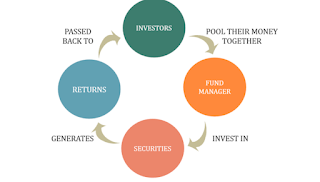
Types of mutual funds 

1. Money market funds – 

Money market funds have relatively low risks. By law, they can invest only in certain high-quality, short-term investments issued by U.S. corporations, and federal, state and local governments.

2. Bond funds –

Bond funds have higher risks than money market funds because they typically aim to produce higher returns. Because there are many different types of bonds, the risks and rewards of bond funds can vary dramatically.

3. Stock funds – 

Stock funds invest in corporate stocks. Not all stock funds are the same. Some examples are:
1 . Growth funds focus on stocks that may not pay a regular dividend but have potential for above-average financial gains.
2. Income funds invest in stocks that pay regular dividends.
3. Index funds track a particular market index such as the Standard & Poor’s 500 Index.
4. Sector funds specialize in a particular industry segment.

4. Target date funds 

Target date funds hold a mix of stocks, bonds, and other investments. Over time, the mix gradually shifts according to the fund’s strategy. Target date funds, sometimes known as lifecycle funds, are designed for individuals with particular retirement dates in mind.

Benefits of mutual funds 

 1. Professional Management –           Investors may not have the time or the required knowledge and resources to conduct their research and purchase individual stocks or bonds. A mutual fund is managed by full-time, professional money managers who have the expertise, experience and resources to actively buy, sell, and monitor investments. A fund manager continuously monitors investments and rebalances the portfolio accordingly to meet the scheme’s objectives. Portfolio management by professional fund managers is one of the most important advantages of a mutual fund.
2. Risk Diversification —                            Buying shares in a mutual fund is an easy way to diversify your investments across many securities and asset categories such as equity, debt and gold, which helps in spreading the risk – so you won’t have all your eggs in one basket. This proves to be beneficial when an underlying security of a given mutual fund scheme experiences market headwinds. With diversification, the risk associated with one asset class is countered by the others. Even if one investment in the portfolio decreases in value, other investments may not be impacted and may even increase in value. In other words, you don’t lose out on the entire value of your investment if a particular component of your portfolio goes through a turbulent period. Thus, risk diversification is one of the most prominent advantages of investing in mutual funds.
3. Affordability & Convenience (Invest Small Amounts) —                                                      For many investors, it could be more costly to directly purchase all of the individual securities held by a single mutual fund. By contrast, the minimum initial investments for most mutual funds are more affordable.
4. Liquidity —                                                   You can easily redeem (liquidate) units of open ended mutual fund schemes to meet your financial needs on any business day (when the stock markets and/or banks are open), so you have easy access to your money. Upon redemption, the redemption amount is credited in your bank account within one day to 3-4 days, depending upon the type of scheme e.g., in respect of Liquid Funds and Overnight Funds, the redemption amount is paid out the next business day.
However, please note that units of close-ended mutual fund schemes can be redeemed only on maturity. Likewise, units of ELSS have a 3-year lock-in period and can be liquidated only thereafter.
5. Low Cost —                                                    An important advantage of mutual funds is their low cost. Due to huge economies of scale, mutual funds schemes have a low expense ratio. Expense ratio represents the annual fund operating expenses of a scheme, expressed as a percentage of the fund’s daily net assets. Operating expenses of a scheme are administration, management, advertising related expenses, etc. The limits of expense ratio for various types of schemes has been specified under Regulation 52 of SEBI Mutual Fund Regulations, 1996.
6. Well-Regulated —                                 Mutual Funds are regulated by the capital markets regulator, Securities and Exchange Board of India (SEBI) under SEBI (Mutual Funds) Regulations, 1996. SEBI has laid down stringent rules and regulations keeping investor protection, transparency with appropriate risk mitigation framework and fair valuation principles.
7. Tax Benefits —                                  Investment in ELSS upto ₹1,50,000 qualifies for tax benefit under section 80C of the Income Tax Act, 1961. Mutual Fund investments when held for a longer term are tax efficient.

Mutual Fund

 Mutual Funds

A mutual fund is a financial intermediary that allows a group of investors to pool their money together with a predetermined investment objective. An Asset Management Company (AMC) pools money from investors and invests it in portfolio on behalf of investors. The money pooled is “mutual fund” which is invested in various asset classes like equity, debenture, commercial paper and government securities. An Mutual Fund managers responsible for investing pooled money into specific securities. The team tracks and researches different financial instruments and manages the fund. Mutual funds are set up to buy many stocks. Mutual funds are regulated with SEBI(Stock Exchange Board of India) and are highly regulated. Investors are assured about a trusted monitoring of their money.

Different Types of Mutual Funds

1.Equity Fund(EF) – It invests a major part of shares. The returns are directly linked to the performance of the stock market. An equity fund carries comparatively higher risk.

2. Diversified fund – It invest in companies that is spread across sectors. If one sector doesn’t do well then another sector would bail the fund out.

3. Sector fund – It is invested mainly in equity shares of the company in a particular business sector or industry.

4.Index fund – It replicates the portfolio of particular bench mark index. The value of Index fund varies in proportion to the bench mark index.

5. Debt or Income fund – It is invested in instruments like bonds, debentures, government securities, commercial paper. The fund aims to provide a regular and steady income to investor.

6. Liquid fund or money market fund – It aims at providing easy liquidity , safety of capital and gives returns. It is invested in highly liquid short term instruments like commercial paper and treasury bills. The period of investment could be short.

7. Balanced fund – It is invested in both equity shares and fixed income bearing instruments in some proportion. It provide safety and steadiness of debt market, capitalizing on high returns earned from equity markets.

Nobel Prize

  Nobel Prize

The Nobel Prize is awarded in fields of peace, literature, physics, chemistry, physiology or medicine and economics. The first award was presented in 1901. The Prize is named after the Swedish scientist , Alfred Nobel. He created a will and specified that the trust would use this money to establish the Nobel Prize. Nobel declared that “prizes to those who during the preceding year, shall have conferred the greatest benefit to mankind.” 

On 5th anniversary of Nobel’s death on Dec 10th, 1901 the first Nobel Prize was awarded. The Nobel Prize for Economics was instituted by Bank of Sweden in 1968. The Nobel Prize for literature is decided by Swedish Academy. Only Nobel Peace Prize is awarded by non Swedish body, it is awarded by Parliament of Norway. Peace Prize can be awarded to both institutions and individuals. Each prizes can be given to a maximum of three persons per year. The prize winner is given a medal, a diploma ( citation) and cash. The Nobel commemorative medal was designed by Rune Karlzon.

Nobel Prize are presented to the winners at the Stockholm Concert Hall, Stockholm. Winners accept their gold medal and diploma from King Carl XVI Gustaf, of Sweden. The Peace Prize is awarded at the Oslo City Hall in the Norwegian capital. 

The International Committee of the Red Cross (ICRC) has won the most Nobel prizes. The youngest Laureate is Malala Yousafzai received Nobel Prize for Peace in 2014. The oldest laureate is John.B.Goodenough the winner of 2019 Nobel Prize in Chemistry.

Nobel prize for Physics 2021 shared by 3, Syukuro Manabe and Klaus Hasselmann “for the physical modelling of Earth’s climate, quantifying variability and reliably predicting global warming”.  Giorgio Parisi“for the discovery of the interplay of disorder and fluctuations in physical systems from atomic to planetary scales”

David W.C. MacMillan “for the development of asymmetric organocatalysis” and Benjamin List “for the development of asymmetric organocatalysis won Nobel prize for Chemistry 2021.

Nobel prize for Literature 2021,  Abdulrazak Gurnah “for his uncompromising and compassionate penetration of the effects of colonialism and the fate of the refugee in the gulf between cultures and continents”

Covid – 19 Pandemic

Covid – 19

Covid – 19 or coronavirus is a disease which is spread through the air when we talk or sneeze. The first coronavirus case have been identified in Wuhan, China in December 2019. After that, it spread all over China and after that, it spread all over the world. It has been declared a pandemic. From March 2020. The lockdown has been imposed by the government in India and many countries in the world. All the schools, colleges, offices, markets, shopping malls and everything has closed except hospitals. Millions of people have died from this disease and many of them lost their jobs which led to unemployment again. Many small children have lost their parents and family and many problems have bee arrived at that time because no one can help each other at that time. Teenagers and youngsters were in depression due to their loss of studies, some have lost their and many more.

The main symptoms of covid – 19 are –

1. Cough
2. Fever
3. Loss of smell and taste
4. Headache
5. Body pain
Whenever someone has tested positive for covid-19 they suffer a lot because they can’t eat properly due to loss of smell and taste. Their body and fever are high. They have to regular medicines and should check their oxygen level in an oximeter. Those who have suffered from covid – 19 they can feel what happen to their body at that particular time.

Precaution for covid -19 

1. We should regularly wash our hands before eating or giving something to others.
2. We should use sanitiser
3. Wearing a mask when you go out
4. Maintain proper hygiene
5. Clean our house and surroundings
6. Avoid going out unnecessarily
Vaccines have been invented and arrived in the whole world and 99% of people have taken their vaccination but taking vaccines is not the solution to get away from that disease. Now also we have to take precautions for covid – 19 then only we can stay safe. 
This pandemic has changed a lot in everyone’s life. We can thank God for helping out and we can pray to God that never such a pandemic comes into our life.

Need for National Sports Day

 National Sports Day

The National sports day in India is celebrated on 29th August. This day we commemorate the birth anniversary of Major Dhyan Chand, great Indian hockey legend. He is known as “the magician “and “hockey wizard”. He played a very significant role in helping India complete their first hat-trick of Olympic gold medals with victories at the 1928, 1932 and 1936 Summer Olympics. The first National sports day was celebrated on August 29, 2012. Sports day is also known as Rashtriya Khel Divas.

He was born in Allahabad on 29th August 1905. He leaded the Indian hockey team in Olympics in Los Angeles 1932 and seized gold. He was top scorer with 14 goals in five matches. During 1936 Olympics in Berlin the Indian hockey team scored 38 goals in the competition and bagged gold medal. Major Dyan Chand was awarded Padma Bhushan, which is the third highest civilian award in India. He became chief coach of National Institute of Sports( NIS), Patiala. The National stadium in Delhi is named after this great legend.

Sports day is celebrated in schools and colleges by hosting sports day and athletic meets. Sports encourage and empower youth, increase talent and skill of students. Teachers also take part in sports celebrations. Sports improve physical fitness, empower and enlighten mind and abilities of students. 

Sustainable Development

 Substainable Development 

What is Substainable Development

Sustainable development can be defined as an approach to the economic development of a country without compromising with the quality of the environment for future generations. In the name of economic development, the price of environmental damage is paid in the form of land degradation, soil erosion, air and water pollution, deforestation, etc. This damage may surpass the advantages of having more quality output of goods and services.

Examples of Sustainable Development 

1. Wind energy

2. Solar energy

3. Crop rotation

4. Sustainable construction

5. Efficient water fixtures

6. Green space

7. Sustainable forestry

The concept of ‘needs’, in particular, the essential needs of the world’s poor, to which overriding priority should be given; and


Types of sustainable development 

The three types of sustainable development are:

1. Economic viability
2. Environmental protection
3. Social equity

1. Economic viability –

Economic sustainability refers to practices that support long-term economic growth without negatively impacting social, environmental, and cultural aspects of the community.

2. Environmental protection –

Environmental protection is aimed at maintaining (and recovering when necessary) a healthy natural environment. Sustainable development embraces environmental, social and economic objectives, to deliver long-term equitable growth which benefits current and future generations.

3. Social equity –

Social equity is the orphaned element of sustainable development. The President’s Council on Sustainable Development (1996) defined social equity as “equal opportunity, in a safe and healthy environment.” Social equity is the least defined and least understood element of the triad that is sustainable development yet is integral in creating sustainability—balancing economic, environmental, and social equity. 

Sustainable development goals

According to the UN, The Sustainable Development Goals (SDGs) are the world’s shared plan to end severe poverty, reduce inequality, and protect the planet by 2030.
1. Eliminate Poverty
2. Erase Hunger
3. Establish Good Health and Well-Being
4. Provide Quality Education
5. Enforce Gender Equality
6. Improve Clean Water and Sanitation
7. Grow Affordable and Clean Energy
8. Create Decent Work and Economic Growth
9. Increase Industry, Innovation, and Infrastructure
10. Reduce Inequality
11. Mobilize Sustainable Cities and Communities
12. Influence Responsible Consumption and Production
13. Organize Climate Action
14. Develop Life below Water
15. Advance Life on Land
16. Guarantee Peace, Justice, and Strong Institutions
17. Build Partnerships for the Goals

Objectives of sustainable development –

The four objectives of sustainable development are :

• Stable economic growth- The eradication of poverty and hunger to ensuring a healthy life.

• Conservation of natural resources – Achieve universal access to basic services such as water, sanitation, and sustainable energy.

• Social progress and equality – Reduce inequalities in the world, especially gender inequalities. Supporting the generation by the development of opportunities through inclusive education and decent work. Foster innovation and resilient infrastructures by creating communities and cities capable of producing and consuming sustainably.

• Environmental protection – Caring for the environment by combating climate change and protecting oceans and terrestrial ecosystems.


National sports day

 National Sports Day ( 29 August) 

 It is great day for sportspersons of India . Every child who is interested in sports surely proud on this day . Dhyan Chand, an Indian Hockey player who always makes India proud.

National Sports Day is celebrated every year in India on August 29. This day is celebrated to commemorate the birth anniversary of an Indian hockey player, Major Dhyan Chand. Various programs and seminars are held across the country to celebrate this day and pay a tribute to Major Dhyan Chand.


Major Dhyan Chand was a legendary Indian hockey player who had a massive role in getting India their first hat-trick of Olympic gold medals in the years 1928, 1932 and 1936 Summer Olympics respectively.

Major Dhyan Chand has been an inspiration for many young sports athletics. He started playing hockey with the regimental team of the British Indian Army. It is claimed by various sources that he used to practice playing hockey even in the night under the moonlight after completing his regimental duties during the day. Hence, he got the name Dhyan ‘Chand’.


National Sports Day was first celebrated in the year 2012 on August 29. Since then it is celebrated to honour the legacy of Major Dhyan Chand and raise awareness on the importance of sports in our lives. This day is special to increase awareness around physical activities and their benefits.

Various awards like Rajiv Gandhi Khel Ratna, Arjuna Award, Dhyan Chand Award and the Dronacharya Award are bestowed to sporting legends to honour their contribution to sports.

National Sports Day

 India celebrates National Sports Day on August 29, the birth anniversary of hockey hero Major Dhyan Chand. In 2012, the day was declared India’s National Sports Day. Major Dhyan Chand was a legend in Indian and international hockey. With victories at the Summer Olympics in 1928, 1932, and 1936, he was instrumental in helping India complete their first hat-trick of Olympic gold medals. Dhyan was so dedicated to his art that he used to practice hockey at night after his regular daytime tasks were over, earning him the nickname Dhyan ‘Chand.’

Major Dhyan Chand, a field hockey player, is recognized by many to be the greatest field hockey player ever. Dhyan Chand was born on August 29, 1905, in Allahabad, India, to a Kushwaha Rajput family. He was the son of Sharadha and Rameshwar Singh. Dhyan Chand had two brothers — Mool Singh and Roop Singh. The latter, also a hockey player, was a member of the Indian field hockey team, which won gold medals for India at the Olympic Games in 1932 and 1936. Chand’s father served in the British Indian Army, where he was a member of the hockey team. Chand was well-known for his superb ball control and goal-scoring abilities. India won the field hockey event in seven of the eight Olympics from 1928 through 1964, demonstrating his influence beyond these successes.

According to his memoirs, Chand played internationally from 1926 until 1949, scoring 570 goals in 185 matches during his home and international career. In 1956 he retired from the army with the rank of major, and in the same year, the Indian government awarded him the Padma Bhushan, the country’s third-highest civilian honor.

To mark his birthday, India established National Sports Day in 2012. The purpose of the celebration is to honor the sporting legend and create awareness about the importance of sporting activities in everyday life, with a focus on fitness and health. The President of India bestows key honors on this day, including the Khel Ratna, Arjuna Awards, Dronacharya Awards, and Dhyan Chand Awards, to famous sports luminaries. Dhyan Chand passed away on December 3, 1979.

NATIONAL SPORTS DAY TIMELINE

1925
Inter-Provincial Tournament

Chand is picked to represent the United Provinces (U.P.) in the Inter-Provincial Tournament in 1925, where his deft stick-work drew everyone’s notice.

1934
India’s Hockey Team Captain

In December 1934, he is named India’s captain after an extraordinary run with Indian hockey, which included two Olympic gold medals.

1956
Padma Bhushan Award

Chand receives the Padma Bhushan award in 1956, India’s third-highest civilian honor.

2012
National Sports Day

To commemorate the birthday of Dhyan Chand, India establishes National Sports Day in 2012.

NATIONAL SPORTS DAY ACTIVITIES

  1. Form your own team

    Bring your buddies together to cheer on your favorite team. You can even go outside and form your own team. It will be worth it to enjoy the challenge and physical activity, regardless of your skill level.

  2. Read about Dhyan Chand

    Dhyan Chand is one of the greatest hockey players of all time. Read about his upbringing, his forays into several fields, and his numerous accomplishments.

  3. Share pictures of your team jersey

    Share a group pic of you wearing your favorite sports shirts with your friends and family. Include the hashtag #NationalSportsDay in your images as well.

Government policies for Education

 Government Policies regarding Education 

The Central Advisory Board of Education (CABE) during pre- independence time played great role in the evolution and monitoring of educational policies and programs. The most important were National Policy on Education (NPE) in 1986 and Program of Action(POA) 1992 put forward that free and compulsory Education of satisfactory quality should be provided up to 14 years (Elementary education). As the result enrollment of students in primary and upper primary schools increased steadily. More enrollment of girls and backward sections of society in Education improved. The central and state governments took strategies to improve drop out rates which include :

Creating parental awareness and community mobilisation, providing incentives, improvement in content and schooling process and National Programme for nutritional support for primary education (mid day meal schemes). Right to elementary education is fundamental right and fundamental duty. 

The Minimum level of learning was introduced and it led development of better textbooks and workbooks, supplementary reading materials, teachers handbook and development in pupil evaluation. The Central Government gave funds for expenditure on elementary education. 

NON FORMAL EDUCATION

Department of Education started programme of Non- formal education (NFE) for children who remain outside formal system due to different reasons such as drop outs from schools, working children and those who perform domestic chores. The scheme covers urban slums ,hills, desert and tribal areas.

The National Bal Bhavan it is a Autonomous institution under Education department and it help to enhance and improve creativity among children from weaker strata of the society. The programs are designed to bring out the inner potential of a child. The national bal bhavan provides general guidelines and transfer of information, training facility to State and District Bal bhavans.

Promotion of languages – Government encourages in development of all Indian languages including classical, modern and tribal languages and help in production of university level textbooks to facilitate media. Financial assistance given to individuals and voluntary organizations to bring out publications for development of modern Indian languages. 

Sarv Shiksha Abhiyan

It is an Indian government program aimed at universalisation of elementary education ” in atime bound manner” . The program was initiated by former Indian prime Minister Atal Bihari Vajpayee. It’s motto is education for all.

Adult Education 

The National Literacy Mission(NLM) dominant strategies are literacy campaigns are area specific, time bound , cost effective, volunteer based and outcome oriented. It is aimed at eradication of illiteracy. Learner makes a transition from guided learning to self learning and it also help in skill upgradation. It helps in creation of learning society through ongoing educational programs. Rural libraries are established to improve reading habits among people.

Indira Gandhi Open University (IGNOU)

It was established by the Act of Parliament in September 1985. It is responsible for introduction and promotion of distance education and open university. The main objectives include widening access to higher education to mass audience, organize programs that help people to continue education. IGNOU provide university level education, it is flexible and open. 

Top 7 women entrepreneurs in India

 Top 7 women entrepreneurs in India

As we know there are less women entrepreneurs than man . There are many reasons for less women entrepreneurs some are like economy problem, government are not eagerly to help female , they face many problems regarding loans as well as there are many family problems also .
So here are list of 10 successful women entrepreneurs.

1. Falguni Nayar

Falguni Nayar (born 19 February 1963) is an Indian billionaire businesswoman who is the founder and CEO of the beauty and lifestyle retail company Nykaa. Nayar is one of two self-made female, Indian billionaires.
Falguni Nayar

Born

19 February 1963 (age 59)
Mumbai, Maharashtra, India

Nationality

Indian

Education

MBA Finance
Alma mater
Sydenham College of Commerce and Economics, Mumbai
Indian Institute of Management Ahmedabad

Occupation

Founder & CEO of Nykaa

Years active

1963–present

Spouse(s)

Sanjay Nayar ​

2. Radhika Aggarwal 

Radhika Ghai Aggarwal is an Internet entrepreneur and India’s first woman to enter the Unicorn Club. She is the co-founder of online marketplace ShopClues established in 2011 in silicon valley. Currently, she serves as the Chief Business Officer of the company.

3. Aditi Gupta 

Aditi Gupta is an Indian author and co-founder of Menstrupedia Comic. She and her husband, both National Institute of Design Alumni, co-founded Menstrupedia Comic in 2012.  In 2014, she was named in the Forbes India 30 Under 30 2014 list.
Aditi Gupta

Born

Garhwa, Jharkhand, India

Occupation

Author and co-founder of Menstrupedia Comic

Nationality

Indian

Alma mater

National Institute of Design

Genre

Menstrupedia Comic

Spouse

Tuhin Paul

4. Suchi Mukherjee 

Limeroad is an Indian online marketplace, owned by A. M. Marketplaces Pvt Ltd. The company is based in Gurugram, Haryana.
Limeroad

Type of business

Privately held company

Type of site

E-commerce
(E-commerce shopping)

Available in

Hindi, English

Area served

India

Founder(s)

Suchi Mukherjee, Ankush Mehra

CEO

Suchi Mukherjee

Parent

A M Marketplaces Pvt Ltd

Commercial

no

Registration

Required

Launched

2012

Current status

Active

5. Vani Kola 

Vani Kola is an Indian venture capitalist. She is the founder and managing director of Kalaari Capital, an Indian early stage venture capital firm. She was listed as one of the most powerful women in Indian business by Fortune India in 2014. 
Vani Kola
Vani Kola – Indian Venture Capitalist.
Kola in 2020

Born

1963 or 1964 (age 58–59)
Hyderabad , Andhra Pradesh (now Telangana)

Education

Osmania University (B.Eng.)
Arizona State University (M.Eng.)

Occupation

venture capitalist

Known for

Venture capital in India

6. Roshini Nadar Malhotra 

Roshni Nadar Malhotra (born 1980/81) is an Indian billionaire industrialist and the chairperson of HCL Technologies and the first woman to lead a listed IT company in India. She is the only child of HCL founder and billionaire industrialist Shiv Nadar. In 2019, she is ranked 54th on the Forbes World’s 100 Most Powerful Women list.  According to IIFL Wealth Hurun India Rich List (2019), Roshni is the richest woman in India. In 2020, she is ranked 55th on the Forbes World’s 100 Most Powerful Women. She is also the CEO of HCL Corporation, the holding company of all HCL Group entities.
Roshni Nadar

Born

1980/1981 (age 40–41)

Education

Northwestern University
Kellogg School of Management

Occupation

Chairperson, HCL Technologies

Years active

2008-present

Spouse(s)

Shikhar Malhotra

Children

2

Parent(s)

Shiv Nadar
Kiran Nadar

7. Kiran Mazumdar Shaw

Kiran Mazumdar-Shaw (born 23 March 1953) is an Indian billionaire entrepreneur. She is the executive chairperson and founder of Biocon Limited and Biocon Biologics Limited, a biotechnology company based in Bangalore, India and the former chairperson of Indian Institute of Management, Bangalore.  In 2014, she was awarded the Othmer Gold Medal for outstanding contributions to the progress of science and chemistry. She was on the Financial Times 2011 top 50 women in business list. In 2019, she was listed as the 68th most powerful woman in the world by Forbes.  She was named EY World Entrepreneur Of The Year 2020. She is married to John Shaw.
Kiran Mazumdar-Shaw

Born

Kiran Mazumdar
23 March 1953 (age 69)
Bangalore, Karnataka, India

Alma mater

Bangalore University (B.S.)
Melbourne University (M.S.)

Occupation

Founder & chairperson of Biocon

Spouse(s)

John Shaw

Awards

Othmer Gold Medal (2014)

Aiswarya B H

 Articles by Aiswarya B H 


1)History of Red Fort

2)HIV : Transmission, Symptoms and Prevention

3)Major crops of India

4)Irrigation and it’s types

5)Nutrition and it’s types

6)Oil spills : Causes and it’s effect

7)Cancer : Causes and Treatment

8)Poverty and Hunger

9)History of Akbar

10)History of Brihadeshwara temple

11)Psychology : Application and it’s Importance

12)Diversity of India

13)Microbiology and it’s branches

14)History of Zeus

15)History of Helen of Troy

16)Aquaculture

17)Disaster and Disaster management

18)Indian Constitution

19)Population and it’s exploitation

20)Economic Development

21)Salient features of Indian society

22)Environmental Pollution

23)Global warming

24) Land Reforms of India

25)History of Taj Mahal

26)Security Breach of NASA

27)Origin and Development of Agriculture

28)Insurance

29)Indian National Movement

30)Marine ecosystem