WANT TO KNOW HOW TO NEGOTIATE EFFICIENTLY?

1.Put Yourself in Their Shoe:-

It’s not wrong to stick to your ground but the negotiator should try to keep himself/herself in the place of other parties involved in negotiation. He/she should visualize the situation from another’s perspective and should understand that the other parties also have some restrictions that are acting as a barrier in making the deal successful.

Empathy Marketing: Connecting With Customers By Providing Value | CleverTap

2.Justify Your Position:-

The Negotiator should not just walk into negotiation. He/she should have full knowledge that depicts that the negotiator has researched and is committed to the deal. This helps the negotiator to justify his/her position that provides an upper edge for the negotiator to make the deal in his/her favor.

3.Know Their Interest:-

The negotiator should try to analyse what is compelling the party to make that deal and how he/she can be convinced to conclude the deal in favor of the negotiator.

4.Remove the Emotions:-

One should ensure that the emotions don’t act as a barrier for the deal. It may negatively affect the negotiation. Negotiator may get caught up and be swayed by his/her personal feelings ending up the deal in favor of the other party.

Emotion and Web Design: The Keys to an Affective Ecommerce Websites –  Digital Agency Sydney | TWMG Blog

5.Know when to Stop:-

The negotiator should know beforehand when he/she will walk away. There is no use trying to get the other party to see where the negotiator stands if the talks aren’t moving forward.

How to Politely Leave a Meeting Room Before the Meeting Ends – D-Organice  Function Room | Seminar Room | Event Place

WANT TO KNOW HOW BILL GATES NEGOTIATES ?

1. Be Less Emotional:-

Once Gates told he is successful in negotiations when the other party is emotional because he is “kind of less emotional.” The fact that Gates said he is less emotional rather than unemotional reveals an important distinction. “He obviously knows that feelings are important when dealing with other people, especially in a negotiation

How to Improve Your Emotional Intelligence for Business

2. Listen, then give your  perspective:-

Gates is known for his negotiation skills , which years ago he showed off during a tense encounter with Apple Founder Steve Jobs. Just before launching Windows, Jobs and Gates were butting heads. Jobs claimed Windows was a copy of Apple’s operating system. The wrinkle though was that Apple had “liberally borrowed” programming from Xerox.

The two founders needed to come to an understanding about the provenance of their competing operating systems. Gates went to Apple’s headquarters and Jobs lambasted him in front of Apple executives. In one of his infamous emotional outbursts, Jobs yelled, “You’re ripping us off. I trusted you, and now you’re stealing from us!”

That’s when Gates grabbed the upper hand. Instead of screaming back at Jobs, Gates gave his perspective in a tranquil manner: “I think it’s more like we both had this rich neighbor named Xerox, and I broke into his house to steal the TV set and found out you had already stolen it,” he said.

Gates tapped into a key tenet of emotional intelligence: He stayed poised in a high pressure situation. His calm demeanour helped to placate Jobs, and the two men hashed things out.

NEGOTIATION AND HOW IT ACTS BENEFICIAL

What is Negotiation

Negotiation is a very wide term which is essential everywhere.

It is not restricted within the boundaries of an organisation but is important and can be seen in our daily life.

It is a mode by which people resolve their differences.

It is a method by which adjustment or compromise is reached while avoiding quarrel or conflict.

Negotiation refers to an activity of discussing and convincing an individual, a party or a group of people to reach a state of mutual acceptance to decide or agree something.

How is Negotiation Fruitful

· Avoids disputes or arguments

· Gives a brief about strengths, weaknesses and mindset of parties involved.

· All the parties agree to compromise

· Mutual acceptance among parties

· Concludes reaching some form of settlement

· Results in best possible deals

Digital Marketing

Digital marketing is the use of the Internet, mobile devices, social media, search engines, and other channels to reach consumers. Some marketing experts consider digital marketing to be an entirely new endeavor that requires a new way of approaching customers and new ways of understanding how customers behave compared to traditional marketing.

Understanding Digital Marketing

Digital marketing targets a specific segment of the customer base and is interactive. Digital marketing is on the rise and includes search result ads, email ads, and promoted tweets – anything that incorporates marketing with customer feedback or a two-way interaction between the company and customer.

In the parlance of digital marketing, advertisers are commonly referred to as sources, while members of the targeted ads are commonly called receivers. Sources frequently target highly specific, well-defined receivers.

Digital Marketing Channels

  • Website Marketing

A website is the centerpiece of all digital marketing activities. Alone, it is a very powerful channel, but it’s also the medium needed to execute a variety of online marketing campaigns. A website should represent a brand, product, and service in a clear and memorable way. It should be fast, mobile-friendly, and easy to use.

  • Pay-Per-Click (PPC) Advertising

PPC advertising enables marketers to reach Internet users on a number of digital platforms through paid ads. Marketers can set up PPC campaigns on Google, Bing, LinkedIn, Twitter, Pinterest, or Facebook and show their ads to people searching for terms related to the products or services. PPC campaigns can segment users based on their demographic characteristics (such as by age or gender), or even target their particular interests or location. The most popular PPC platforms are Google Ads and Facebook Ads.

  • Content Marketing

The goal of content marketing is to reach potential customers through the use of content. Content is usually published on a website and then promoted through social media, email marketing, SEO, or even PPC campaigns. The tools of content marketing include blogs, ebooks, online courses, infographics, podcasts, and webinars.

  • Email Marketing

Email marketing is still one of the most effective digital marketing channels. Many people confuse email marketing with spam email messages, but that’s not what email marketing is all about. Email marketing is the medium to get in touch with your potential customers or the people interested in your brand. Many digital marketers use all other digital marketing channels to add leads to their email lists and then, through email marketing, they create customer acquisition funnels to turn those leads into customers.

  • Social Media Marketing

The primary goal of a social media marketing campaign is brand awareness and establishing social trust. As you go deeper into social media marketing, you can use it to get leads or even as a direct sales channel.

  • Affiliate Marketing

Affiliate marketing is one of the oldest forms of marketing, and the Internet has brought new life to this old standby. With affiliate marketing, influencers promote other people’s products and get a commission every time a sale is made or a lead is introduced. Many well-known companies like Amazon have affiliate programs that pay out millions of dollars per month to websites that sell their products.

  • Video Marketing

YouTube has become the second most popular search engine and a lot of users are turning to YouTube before they make a buying decision, to learn something, read a review, or just to relax. There are several video marketing platforms, including Facebook Videos, Instagram, or even TikTok to use to run a video marketing campaign. Companies find the most success with video by integrating it with SEO, content marketing, and broader social media marketing campaigns.

  • SMS Messaging

Companies and nonprofit organizations also use SMS or text messages to send information about their latest promotions or giving opportunities to willing customers. Political candidates running for office also use SMS message campaigns to spread positive information about their own platforms. As technology has advanced, many text-to-give campaigns also allow customers to directly pay or give via a simple text message.

Digital marketing challenges

1. Not getting lost in the volume

The digital world is booming, and almost every business out there has taken its products/services online to reach out to the masses. According to a report by Experian, most marketers are now facing the challenge of making their brand stand out in the volumes available on the internet. This eventually leads to the difficulty of running a brand awareness campaign or acquiring new customers.

What can you do?

While it is a fact that at least some of your products/services might be similar to what another business has to offer, there is a minor aspect that is unique to you. Discover the USP of your product/service and find ways to convey the same. Conduct surveys on your existing customers and your target audience to better understand what they are looking for and identify which needs your brand can fulfill.

2. Driving relevant traffic to the website

Continuing on the point above, marketers today are consistently facing a challenge in spreading brand awareness in the right target market. This also makes it harder for them to drive the ideal traffic to their business websites. Therefore, understanding which channel to tap into and driving the relevant audience to your website to turn them into customers is becoming an ongoing challenge for marketers.

What can you do?

Conduct an audit of your online activity. Identify what tactics you are opting to reach out to your audience. Consider the content you’re producing, the channels you’re presenting it on, your social presence, and the paid/unpaid campaigns you are running. Use robust analytics to know which of them work the best for you and optimize your efforts simultaneously. But it is essential to measure your analytics at modest intervals of time to give each of your efforts enough span to work over.

3. Targeting the right audience effectively

The first and foremost thing that an effective marketer would do is identify their target audience in the market. With the number of internet users increasing by the day and their needs changing almost every second, targeting the right audience has become one of the biggest challenges for marketers.

Keeping in mind what your business has to offer and what kind of problems it would solve when put to use, create your value proposition. This will help you identify who or what demographics would resonate with it the most when targeted.

What can you do?

Look at the general demographics of the market that you want to reach out to. Identify their needs and create customer personas taking into consideration their online behavior and possible future needs. In this case, companies like Wigzo equip you with machine learning and predictive analytics tools to enable better persona creation.

4. Lead generation using social media

When it comes to the various social channels, most businesses and marketers don’t know how to remain consistent. Most of them feel that it is all about the paid campaigns they are supposed to run for brand awareness and lead generation. Although, both of them is a constant challenge with the ever-increasing market competition.

Even though considerable marketing budgets are set aside by businesses, most marketers cannot run their engagement into revenue. But you mustn’t just build your social following – you need to get conversions that add up to the overall business goal.

What can you do?

The most effective way to leverage social media is to integrate your marketing and sales efforts. Sharing behavioral data and interaction levels with leads on social media can help the sales team define a custom, personalized customer journey for them – which they are more likely to convert on.

5. Optimizing marketing budgets and ROI

With the increase of digital channels and advanced analytics tools, marketers are now expected to optimize the marketing budgets and the ROI to best suit the business’s needs. He is expected to measure each effort and its value to achieve the end goal – the number of leads generated or the revenue raised.

What can you do?

Tap into the power of machine learning and robust analytics regularly. An effective marketer can gauge the value of every single lead generated from a marketing effort. Understand the impact of each digital campaign on lead generation, test different variants and approaches of reaching out to your target audience to optimize your campaigns for much better results.

While you measure the digital inbound results, ensure that you consider the outbound efforts being made by your business and what kind of results it is yielding.

6. Keeping up with the changing trends

The digital market and marketing techniques have changed drastically over the last few years. And it continues to change even today to cater to the modern-day addressable market needs. Hence, marketers need to stay up-to-date with all these changes.

Be it the launch of a new social media platform or a technology that would make a marketing effort more robust, marketers need to remain on top of things to ensure their business does not lose out on possible conversions.

What can you do?

Consistently engage with your target audience on platforms that they are most active on. The most effective way of doing so is to leverage social listening using tools like Hootsuite. They help you understand what people are saying about you and your product/service, what they expect – allowing you to become a part of their conversation.

7. A Check on Increased Security Risks

We have come across cases wherein online security has been compromised.  The news and media keep it afresh. Since more information is shared online, hackers get more incentives to find ways to get through security. Shopping, bill payment, application submission, order copies, certificates, and other essential documents, and so much more are stored online for easy access – making these spaces a treasure trove for hackers and thieves. Venturing into digital marketing sure comes with its cost of security getting compromised as most of the work remains online. Security comes as a challenge.

What can you do?

You may already have a good firewall, HTTPS encryption, and maybe a good antivirus program. But that’s not enough. You will need more. Sit out and work with an authentic security team and identify your website’s weak spots and apps to create measures to reduce risk.

8. Lesser Focus on Keywords

Keywords were the bread and butter of SEO sometime in the immediate past. You just needed to find the right keywords and use them right, and your site could shoot up to the top in the search results—helping you with more exposure and traffic.

Now Google has changed algorithms making the keywords less critical. However, they are still to be used but are not the focus. Instead, it has become a topical approach rather than seeking and finding one, meaning that Google first gets an overall scope of your website.

What can you do?

First, you need to use search phrases instead of keywords and build content around topics rather than coming up with content for each keyword you want to target. Make your website a resource for the phase or question you need to target and see the changes.


HOW TO FILL NEFT/RTGS FORM

Step 1:- Fill the Branch Code and Branch Name where service is being availed.

Step 2:- Mention Date and Time

Note:- Non Bank Customer/ Walk in Customer or Indo-Nepali NEFT Remittance can also avail the facility of NEFT and can transfer an amount up to Rs. 50,000 by vising a Bank Branch.

Step 3:- Tick the type of transfer required i.e. NEFT or RTGS.

Note:- If the amount is Rs. 2,00,000 or above, then tick RTGS otherwise tick NEFT.

Step 4:- If using a cheque for transfer, then fill the details like cheque number and amount

Note:- Sender need to write “Bank Name- NEFT” in Pay Column on Cheque in case of NEFT transaction and “Bank Name- RTGS” in Pay Column in case of RTGS transaction

Step 5:- Fill Beneficiary Details i.e. the person to whose account the amount is to be transferred.

NEFT vs IMPS vs RTGS: Which One Should You Opt To Make Fund Transfer? -  informalnewz

Beneficiary Details include:-

Beneficiary Name as per Bank Records

Beneficiary Account Number

Beneficiary Address

Beneficiary Bank Name and Branch

Beneficiary Bank IFSC Code

Account Type i.e. Resident/ Non Resident

Amount to be Credited ( In Figures)

Amount To be Credited (In Words)

This image has an empty alt attribute; its file name is image-276.png

Step 6:- Fill Remitter/Sender Details i.e. the person from whose account the amount is to be transferred.

Sender/ Remitter Details

• Remitter Name as per Bank Records

• Remitter Account Number

• Cash Deposited ( For Non Bank Customer)

• Mobile/ Phone Number of Remitter

• E-Mail Id

• Address of Remitter

• Remarks

Immediate Payment Service - IMPS Payment & Fund Transfer | Instant Money  Transfer

Step 7:- Read the terms and Conditions

Step 8:- Attest the authorised Signature

Note:- All the account Holders need to attest their signature in case of Joint Account

Note:- If the transaction is done using a Current Account, then the Company Stamp is mandatory to be attested.

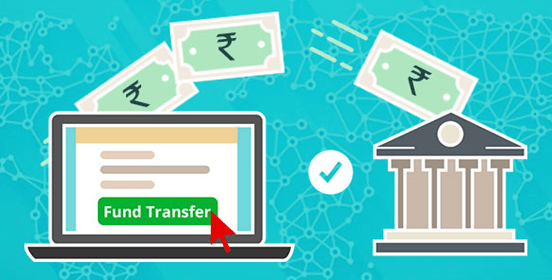
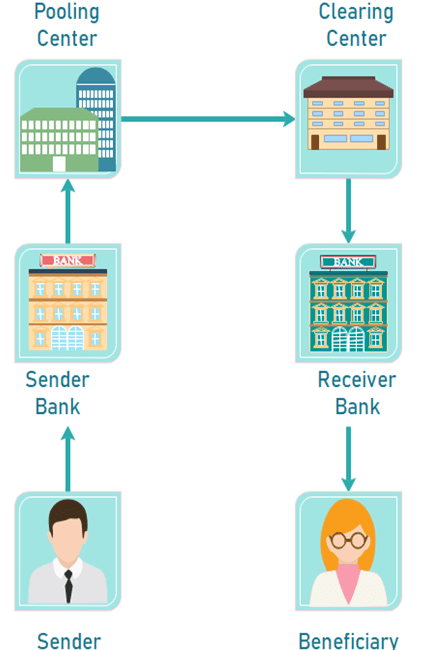
After verification of details, the transaction will be processed and conducted. The amount will be debited from Remitter’s Account and will be credited to the Beneficiary Account .

The Journalism and mass media

The Journalism and mass media is the  graduates work nationwide and worldwide at newspapers and magazines and in advertising, branding, broadcast news, social media, marketing, media research, photojournalism, publication design, public relations, radio, and other areas.

The Journalism is the activity of gathering, assessing, creating, and presenting news and information. It is also the product of these activities. Journalism can be distinguished from other activities and products by certain identifiable characteristics and practices.

There are five types,

  • investigative,
  • news,
  • reviews,
  • columns,
  • feature-writing.

The Rules Of Journalism

: Ask questions.

The  journalist’s greatest assets is their natural curiosity. Start with the famed five W’s (and one H), then ask some more. Asking “why?” is what gets you the good stuff.

: Dig for the story.

If you think you’ve got the whole story, dig around some more. The most fascinating parts of the story are often just under the surface.

: Master the language.

As a journalist, language is your main tool. Read as much as you can and as often as you can, research odd words and archaic sayings, look at what’s behind etymology. Learn the patterns behind language and how to use them.

: Spelling matters.

Double-check if you aren’t sure about spelling or style (especially in the case of names), and read through messages and articles thoroughly before sending either.

#5: Know thy publication.

Before you pitch, know a publication’s style, editorial staff and content. Publications are usually more than happy to provide back-issues. If you can’t find writer’s guidelines, send a short introductory email requesting them.

#6: Contacts are your career.

Contacts (and your reputation with said contacts) are your entire career. Editors, sources and interviewees are all vital parts of the journalistic process. Without them, you’d be screwed.

#7: Once it’s off the record, keep it that way.

Trusted sources will tell you all sorts of juicy, fascinating, scandalous and personal things in your career as a journalist, often off the record. Shut up about it.

#8: Three is a golden number.

Mind the rule of threes: Have at least three reliable, corroborating sources for every fact; three interviewees for every article; and read through a piece at least three times before you sit down to change a comma – that’s at least.

#9: Rejection is opportunity.

Getting a story rejected means you’ve just opened up a line of communication with a new editor – congratulations. Pitch again. Rejection also gives you a chance to sell the story elsewhere: Sometimes rejection just means it’s not right for them

#10: Editors are teachers.

You can learn a hell of a lot from the experience of your editors, and when given the chance you should. They braved the journalistic battlefield before you, so you can trust their edits and advice. Usually, they’re right.

: Mind the word count.

Yes, you can do that in the assigned word count, and the editor will either make you add or cut if you don’t. Here, they always know better. (Remember this piece of key-advice from The Elements of Style and repeat it as your daily editing mantra: Omit unnecessary words.)

: Deadlines are holy.

Deadlines exist for a reason: Never skip out on a deadline unless you are incapacitated or dead. If you have to, let your editor know beforehand and have a damn good reason. Then, don’t do it again. Compare deadlines to menstrual cycles: If you skip one, you might just be stressed. If you skip several, you’re in trouble.

#13: Know the law.

Journalism can take you to some strange places. Make sure you know the law and what side of it you’re standing on at all times.

#14: Always do your research.

Make sure that your research is flawless and that you can always match which source gave which fact. Cross-reference, find first-hand information and do your background research before requesting, planning or conducting an interview.

#15: Have it outlined.

Have the skeleton of your idea outlined and ready by the time you pitch the idea. That way you have all the information ready, and it makes your job – and theirs – easier. Your outline should include the article’s proposed headline, the article’s sub-headers and sections (you can write down facts as key-words here) and who you will interview.

#16: Keep and file everything.

Keep prior notes, interviews, sources, tapes, the lot: You never know when you’ll need it, and you probably will.

#17: Guard your vices.

Many great journalists have been crippled or completely destroyed by their vices – and it can be almost anything: Overworking, coffee, manic exercising, painkillers or heavier drugs. Whatever yours is, keep it in check or risk your job.

#18: Burnout is a rabid, fanged monkey.

Burnout is a myth, until you’re there. It’s a mental and physical size of your writing engine, and if you don’t find your way to unwind you’ll get there a lot quicker.

The Mass media refers to a diverse array of media technologies that reach a large audience via mass communication. … Broadcast media transmit information electronically via media such as films, radio, recorded music, or television.

The types of mass media include Newspapers, Radio, Television, Internet, Magazines and more,

  • What is Mass Media?
  • Journalism.
  • Social Media.
  • Films.
  • Television.
  • Radio.
  • Advertising.
  • Public Relations.
  • Books, Magazines, Newspapers and Journals.

RULES OF MASS MEDIA

  • The Privacy Act works to guarantee privacy to individuals and controls how personal information is used. Defamation in the written form (libel) or the spoken form (slander) is illegal in the United States.
  • Section 315 (Equal Time Rule) ensures that broadcast media cannot favor any one candidate over another by granting one more time than another. The Fairness Doctrine ensured that radio stations offered equal time to opposing viewpoints.
  • The Freedom of Information Act grants the public, including the news media, access to many government documents. The Digital Millennium Copyright Act, established in 1998, extended existing copyright laws to encompass and protect information online.

AnterPrerna

“Anterprerna” or the internal feelings of an individual is a precious asset for growth and development of an individual. An individual will only be able to follow his/her AnterPrerna if he/she possess a faith and belief on his/her decisions.

He/she can find his/her true Anterprerna by taking to internal self that is by self introspecting and finding out the weakness and strength to create a rational opportunity for growth. Anterprerna helps in boosting the confidence on the decision and acts fruitful in improving performance and output of an individual.

Top 3 Market Opportunities in 2020 | Tradimo News

One should have a crystal clear vision in mind and should never let the flame low recalling,

“If others can do this, why can’t I and If others can’t do it, I have to definitely do it” and everything will become possible.

Self motivation

Remember

Everything has a solution, the only need is a different approach

Transportation in India.

India’s transport sector is large and diverse; it caters to the needs of 1.1 billion people. In 2007, the sector contributed about 5.5 percent to the nation’s GDP, with road transportation contributing the lion’s share.

Good physical connectivity in the urban and rural areas is essential for economic growth. Since the early 1990s, India’s growing economy has witnessed a rise in demand for transport infrastructure and services.

However, the sector has not been able to keep pace with rising demand and is proving to be a drag on the economy. Major improvements in the sector are therefore required to support the country’s continued economic growth and to reduce poverty.

Roads. Roads are the dominant mode of transportation in India today. They carry almost 85 percent of the country’s passenger traffic and more than 60 percent of its freight. The density of India’s highway network — at 0.66 km of roads per square kilometer of land – is similar to that of the United States (0.65) and much greater than China’s (0.16) or Brazil’s (0.20). However, most roads in India are narrow and congested with poor surface quality, and 33 percent of India’s villages do not have access to all-weather roads.

Rural Roads-A Lifeline for Villages in India: Connecting Hinterland to Social Services and markets

Railways. Indian Railways is one of the largest railways under the single management. It carried some 19.8 million passengers and 2.4 million tonnes of freight a day in year 2009 and is one of the world’s largest employer. The railways play a leading role in carrying passengers and cargo across India’s vast territory. However, most of its major corridors have capacity constraint requiring capacity enhancement plans.

Ports. India has 13 major and 199 minor and intermediate ports along its more than 7500 km long coastline. India’s seaborne foreign trade being 95% by volume and 67% by value, the ports play a very significant role in improving foreign trade in a growing economy. These ports serve the country’s growing foreign trade in petroleum products, iron ore, and coal, as well as the increasing movement of containers. Indian ports handled cargo of 850 million tonnes and about 9.0 million TEU container traffic in year 2010. Over the last decade, the average annual growth rate of port cargo volume has been about 10%.. The future potential for port sector, particularly container ports is huge considering that the container traffic is projected to grow to 40 million TEU by 2025. Inland water transportation also remains largely undeveloped despite India’s 14,000 kilometers of navigable rivers and canals.

Aviation. India has 128 airports, including 15 international airports. Indian airports handled 142 million passengers in 2010-11 and 1.6 million tonnes of cargo in year 2009-10. The CAGR for the domestic passenger and freight growth over the last decade has been 14.2% and 7.8% respectively. The dramatic increase in air traffic for both passengers and cargo in recent years has placed a heavy strain on the country’s major airports. Passenger traffic is projected to grow more than 15% annually over 2011-13 and it is estimated that the aviation industry, currently 9th largest in the World, will require 30 billion USD investment in the next 15 years to keep pace with the growing demand.

Urban Transport. India is experiencing rapid urbanization with the present urbanization levels at 30% translating to a population of roughly 340 million living in urban areas. The number of million plus cities is presently at 42 and the urban economy accountd for roughly 60% of the GDP. Motorisation rates in India are in double digits as in most developing economies. Only about 20 cities out of 87 cities with a population in excess of 500,000 and state capitals have any kind of organized transport and only 3-4 cities could lay claim to a mass rapid transit system. The share of public transport in cities with population sizes over 4 million has declined from 69% to 38% between 1994 to 2007. Accident and fatality rates are one of the highest in the world affecting primarily the poor and vulnerable without their own means of transport.

Transport infrastructure in India is better developed in the southern and southwestern parts of the country.

The major challenges facing the sector are:

• India’s roads are congested and of poor quality. Lane capacity is low – majority of national highways are two lanes or less. A quarter of all India’s highways are congested. Many roads are of poor quality and road maintenance remains under-funded. This leads to the deterioration of roads and high transport costs for users.

• Rural areas have poor access. Roads are significant for the development of the rural areas – home to almost 70 percent of India’s population. Although the rural road network is extensive, some 33 percent of India’s villages do not have access to all-weather roads and remain cut off during the monsoon season. The problem is more acute in India’s northern and northeastern states which are poorly linked to the country’s major economic centers.

• The railways are facing severe capacity constraints. All the country’s high-density rail corridors face severe capacity constraints. Also, freight transportation costs by rail are much higher than in most countries as freight tariffs in India have been kept high to subsidize passenger traffic.

• Urban centers are severely congested. In Mumbai, Delhi and other metropolitan centers, roads are often severely congested during the rush hours. The dramatic growth in vehicle ownership during the past decade – has reduced rush hour speeds especially in the central areas of major cities.

• Ports are congested and inefficient. The average annual growth of cargo volume in the ports in the last decade was close to 10%, However, capacity utilization in some of the major ports remain as low as 58-60% Both bulk and containerized traffic is expected to grow at a much faster pace in future and by some estimate the container traffic is projected to grow to about 4.5 times of the current volume by 2025. India’s ports need to significantly ramp up their capacity and efficiency to meet this surging demand.

• Airport infrastructure is strained. . Air traffic has been growing rapidly leading to severe strain on infrastructure at major airports, especially in the Delhi and Mumbai airports which account for more than 40 percent of nation’s air traffic.

Longest running light bulb since 1901: The case of Planned Obsolescence

Centennial Light is the longest-running electric light bulb on record. It has been running continuously since 1901 and it has never been switched off. It is located in Fire Station 6 in Livermore, California. The ordinary dim light bulb looks like any other bulb and there is also a camera that live-streams the light bulb onto the internet.

Link for the official website and live webcam of the light bulb.

http://www.centennialbulb.org/photos.htm

It was manufactured in the late 1890s by the Shelby Electric Company, of Ohio, using a design by the French-American inventor Adolphe Chaillet. It has operated for over 100 years with very few interruptions. In 2011, it passed a milestone: One million hours of near-continuous operation. In 2015 it was recognized by Guinness World Records as the world’s longest-burning bulb.

The 60-watt bulb uses a carbon filament. One of the reasons for its longevity is that it seems to have an incredibly durable vacuum seal. There have been some researches done on bulbs manufactured by Shelby Electric Company of that era. But no one really exactly knows how these eternal bulbs were made as they were experimenting with various but the company was experimenting with a variety of designs at the time.

The electric model was quite different when first homes in The U.S had electricity. The servicing was the responsibility of the electric companies and customers would purchase entire electrical systems manufactured by a regional electricity supplier. The companies would also take care of the installation and servicing of any burned out electric bulbs would be replaced for free.

It made more logic for the suppliers to manufacture bulbs that would last longer and would burn out as least as possible. But this business model was later replaced and homeowners were responsible to change the light bulbs. It was soon realized that it would be more profitable to make cheaper bulbs that burned out faster. Since the mid-1900s goods were manufactured with a pre-determined expiry date aimed at forcing consumers into repeat purchases. This phenomenon has only been exacerbated in recent years. This can also be called planned obsolescence.

In 1924, the life span of the light bulbs was at least 2,500 hours. Phoebus cartel was formed in 1925 in Geneva. It comprised of the major incandescent light bulbs manufacturers at that time: Osram, General Electric, Associated Electrical Industries, and Philips. The cartel had directed their engineers to cut the life of the bulbs to 1,000 hours, which the engineers did by adjusting voltage and current. The cartel was intended to operate for 30 years but it was starting to fall apart in the early 1930s after General Electric patents expired and as the cartel faced competition from non-member manufactures from other regions. The cartel ceased its operations after the outbreak of World War II in 1939.

Planned obsolescence is a very critical area it does not only decrease the lifespan of the good but as a consequence, it is also wasteful. It is not sustainable for the environment and the main focus of this practice is to maximize profits. It also reminds us that technological innovations are often not accessible in favor of corporate greed.

References:

MIS in Airline Industry

Management Information System is the use of information technology, people, and business processes to record, store and process data to produce information that decision makers can use to make day to day decisions.

With advancements in technology, we can observe use of MIS in every industry and business whether it’s to simply keep a record, collect data or process and analyse it to make decisions. In this article, we’ll be understanding how it contributes to a smooth flow of process in the airline industry.

Need for MIS in the Airline industry

Airlines exist to connect people to distant locations very efficiently and safely while making profit for the shareholders. There has to be a trade-off between the three aspects. Thus, the designing of information system is very essential and its management helps them reach the organization’s purpose.
The 4 basic factors that the airline industry has to carefully tackle are: Safety, Comfort, Speed, Efficiency. Hence, the
importance of the technology of integrated systems has become clearer and unavoidable in the airlines for the future
as well.

Airline companies use cutting edge IT Infrastructure and application to support services including employee transition, data centre operations, help desk support and storage operations, internet security services, network management, airport operations, direct distribution and frequent flier programs and various other operating systems.

A good information system in practice can ensure that the operation is able to run efficiently with clear focus on
customers.
By incorporating better and better technology systems, airline companies can reach out to demands of
more customers and also strengthen vital features like security, avoiding delays, reducing the cost of travel.

Role of MIS in the Airline Industry

  • To store basic data like passenger information, flight details, traffic flow between towns and cities, record of add-on services and fares, flight schedules etc. (Flight Operation System)
  • To maintain and interpret important data like market share and profit margins to make decision making process easier. (Pricing and Revenue Management System)
  • To have records of revenues and cost to compare performance with the competitors or with past years performance and find deviations. (Pricing and Revenue Management System)
  • To have records of all flights and their schedules for effective air traffic controlling. (Flight Communication System)
  • To have a record of all the employees (pilots, air hostesses, transport and luggage, security guards etc). (HR management System)
  • To keep track of luggage and belongings of the customers flying with the airline. (Baggage Handling Systems)
  • To keep track of boarding, check ins and landing of each customer in each flight and coordinating the same to give maximum customer satisfaction. (Airport Management System)
  • To maintain all records of recent fares and discounts allowed to come up with marketing and pricing strategies to survive in the competitive industry with strong competitors. (CRM System)
  • To keep a record of all the funds and their sources and their allocation and ensure optimum utilization. (Finance System)
  • To keep a track of expenses and ensure availability of resources like fuel, food, water, life jackets etc whenever needed. (Flight Operation System).

To conclude, in the airline industry, MIS is not only used in the basic departments like Marketing, Finance, Sales and HR like every organisation but also makes the operations flow smoothly in the different stages of the service like airport checking in, baggage handling, flight operations, flight communication etc to ensure that everything is coordinated and the all stages and parts of the process are carried out smoothly and on time.

CSR: TYPES OF CORPORATE SOCIAL RESPONSIBILITY

CSR is the process by which an organisation thinks about and evolves its relationship with stakeholders for common goods and demonstrate its commitment in their regard by adoption of appropriate business process and strategies.

CSR is no charity or mere donations but is a way of conducting business, by which corporate entities visibly contribute to social good. Socially responsible companies use CSR to integrate economic, environmental and social objectives with companies operations and growth.

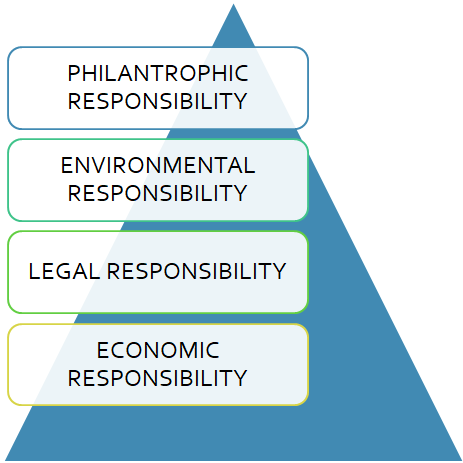
TYPES OF CORPORATE SOCIAL RESPONSIBILITY

1.Philanthropic Responsibility

At the top of the pyramid, occupying the smallest space is Philanthropic Responsibility. Businesses have long been criticized for their carbon footprint, their part in pollution and exploitation of natural resources. To counterbalance these negatives a business stands a responsibility to “give back” to the community they take from.

Philanthropic responsibility include things such as:-

i) Funding educational programs

ii) Supporting health initiatives

iii) Donating to causes

iv) Supporting community beautification projects

2. Environmental Responsibility

Environmental CSR aims to reduce any damaging effects on the environment from operations of business.

 It may focus on:

1. Energy use

2. Water use

3. Waste Management

4. Recycling

5. Emissions

6. Eco-friendly office and business travel policies

Advantages of Environmental CSR

1. Green CSR can reduce business risk

2. Improve reputation

3. Provide opportunities for cost savings

Even the simplest energy efficiency measures can generate savings and make a difference for firm.

3. Legal Responsibility

Legal responsibilities are not only liable to the individuals in the society but also to the businesses in the society. As business is an entity itself, it must also follow laws and rules.

Every business has a responsibility to operate within the boundaries set by the various commissions and agencies at every level of the Government. These rules and regulations are set for maintaining balance and the greater good of the society.

A law-abiding enterprise is a socially responsible enterprise as well. The business is free to do business however it wants but only within the boundaries of regulations of various laws 

Some Laws are as follow:-

1. Labour Law

2. Environmental Law

3. Criminal Law

For example, it’s a business’s duty to pay taxes to the government and keep its account books clean as it helps the government to track the economic state of the company.

4. Economic Responsibility

The first and most important responsibility of a business is to be profitable. It is the foundation and base on which all other responsibilities rest. Without profit, the company would not be able to pay their workers, employees will lose their jobs even before the company starts CSR activities.

Being profitable is the only way for a company to be able to survive long term, and benefit society. Additionally, this also means that it is a company’s duty to produce goods and services that are needed/wanted by the customers, at a reasonable price.

Economic responsibility is an interconnected field that focuses to strike a balance between business, environmental, and philanthropic practices.

Performing this responsibility companies try to find out a solution that can facilitate their business growth and generate profits by benefiting the community and society.

SWOT ANALYSIS OF UDAAN

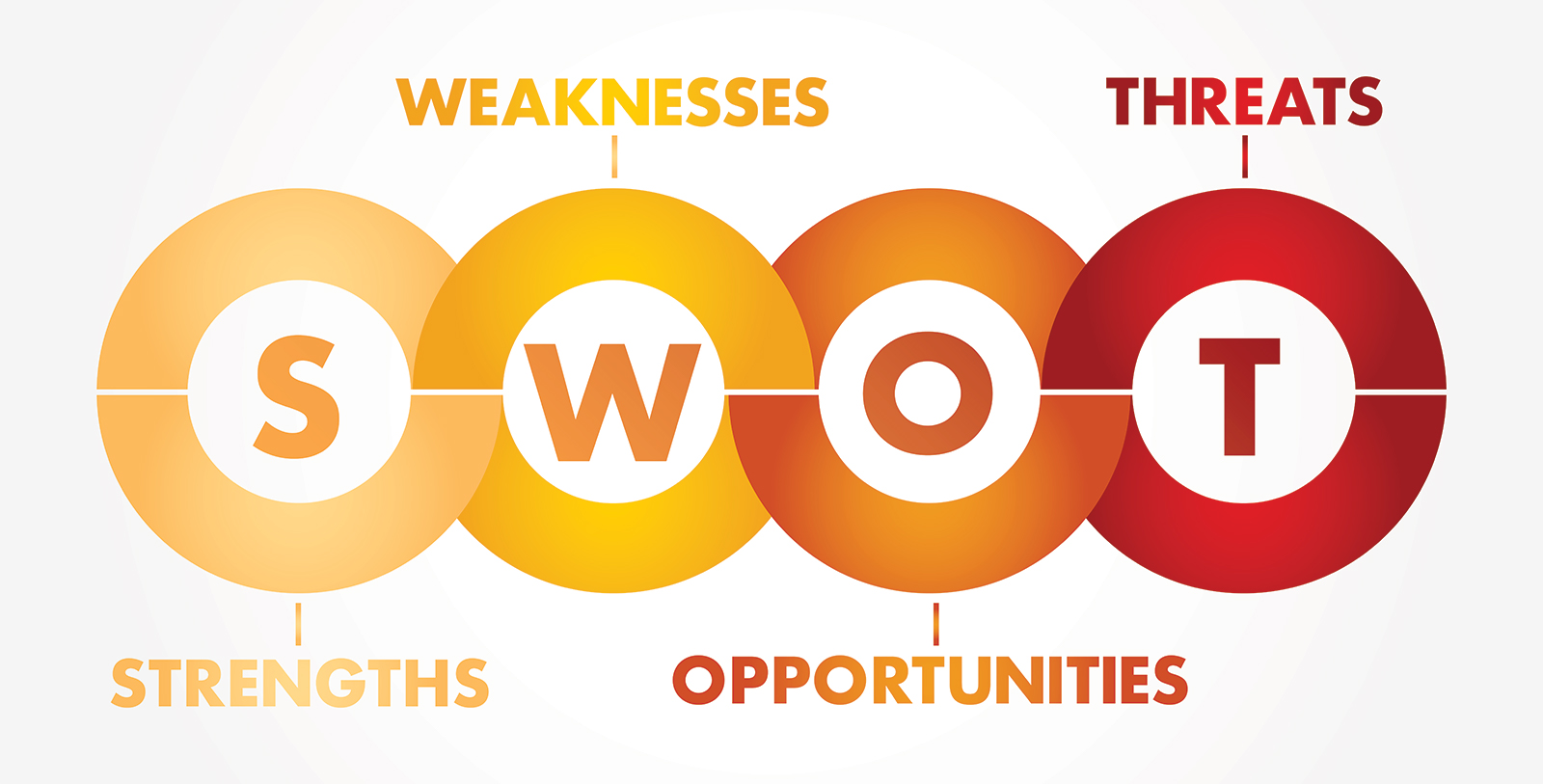
SWOT Analysis is a framework used to evaluate a company’s competitive position and to develop strategic planning. It helps in assessing internal and external factors, as well as current and future potential.

A SWOT analysis is designed to facilitate a realistic, fact-based, data-driven look at the strengths and weaknesses of an organization, initiatives, or within its industry. The organization needs to keep the analysis accurate by avoiding pre-conceived beliefs or gray areas and instead focusing on real-life contexts. Companies should use it as a guide and not necessarily as a prescription.

Meaning of SWOT

Strengths- S stands for Strength. It refers to the areas of expertise or any other unique factor that can act as a asset in growth of an organization and provides with an upper edge over its competitors.

Weaknesses- W stands for Weaknesses. It refers to the drawbacks and areas in which an organization needs to work upon to face the competition in the market.

Opportunities- O stands for Opportunities. It refers to the favorable conditions or occasions that can act beneficial in growth of the organization.

Threats- T stands for Threats. These are the unexpected and unfavorable conditions or occasions that can act as a barrier in growth and working of an organization

Why you need to conduct a personal SWOT analysis | Marriage-Stanley &  Associates %

STRENGTHS OF UDAAN

1.Strong Foundation Team:- The founding members of the company already had the required knowledge and experience after working at Flipkart. Due to this, many other Flipkart employees also joined the startup, which helped them in increasing their efficiency and productivity. It enabled the engineers to work on their creativity, which is encouraged at Udaan.

2.Innovative Idea:- The company emerged with a new idea of providing online services to retailers and wholesalers. It provided with a platform for B2B Commerce that can help them in effectively competing with the big retailers and the big branded stores and websites. This helped them to enlarge their customer base.

3.Large and Satisfied Customer Base:- The company has around 1,50,000 sellers on its platform that is increasing each day with increase in downloads and website visits.

WEAKNESS OF UDAAN

1.Unable to manage its Expenses- The expenditures of the company increases with increase in revenue amount but the hike in expenditure is more than the proportion of revenue

2.Supply Chain Issues- The company often struggles in finding potential suppliers to meet the requirements in different geographical areas and deliver the product on time.

3.Requirement of Internet- There are still some areas that don’t have internet facility. These people stay deprived acting as a barrier in covering all geographical areas.

OPPORTUNITIES FOR UDAAN

1.B2C – The company should develop a platform that deals B2C i.e. Business to Customers along with its current department. This will help in increasing the customer base and revenue sources of the organisation.

2.Management Consulting- The company should consult a consultant. This will help the company to manage their resources in a better manner.

3.Setting up of Outlets- The company is currently dealing through online platform. Investing in setting up offline outlets in different geographic area can help in boosting customer base.

THREATS FOR UDAAN

1.Cost:- In an ecosystem where company has to face a lot of competition to survive in the market. Many a times the company has to offer its products and services at a higher price as compared to market due to high amount of cost incurred in the process that can compel its customers to switch to another company.

2.Economic Factors:- The company has invested a handsome amount of money as capital. A small change in economic factors can have a huge impact on the company.

3.Decreasing Profits:- The company though increasing its revenue each year is not able to boost the profits too. The profits are decreasing each year which is a major threat and needs a quick action.

What Is Creativity In Business?

“Your smile is your logo. Your personality is your business card. How you leave others feeling after an experience with you is your trademark.”

Jay Danzie

Salut! Let us first discuss the evolution of a perfect company. It starts with the owner’s hard earned money (through different sources of course 😉 ) singlehandedly. With growth in sales, the owner feels the need to have assistants to help him out which encourages him to hire a few eligible ones. They are so eligible and proficient that the company keeps experiencing surplus which fetches high amount of customers until it becomes a reputed brand to generate regular customers. However, the owner realizes that apart from his regular customers, the new ones weren’t bothering to choose his brand. Then, he shapes his services in a way that distinguished his company from the competitors. What do you think did he do?

He used ‘Creativity’ which is so essential in business if you wish have an edge over the others. He creatively increased the convenience in his services thereby attracting larger audience.

KFC or Kentucky Fried Chicken for instance, originally dealt with the sale of chicken and now surprisingly includes burgers, softies, cold drinks, and other finger licking attractions. Why do you think did they need to evolve? KFC originally was started by Colonel Harland Sanders on a small scale but as his popularity increased, he transformed to a brand which is so high in demand today. Customers make a brand. However, to get a variety of customers apart from the regular chicken friendly ones, they decided to assign variations into their services which includes burgers, soft drinks, softies, mousses and what not!

Creativity in business demands cooking up interesting services from the existing ones. In short, coming up with variety from a single theme! For instance, the above example where an eatery for chicken evolved into multiple scrummylicious items!

Convenient services avail more benefits for customers. That is where creativity comes into the picture. How well can you craft convenience in your services without imitating your competitor? How well can you observe the convenience policy and services of your competitors and frame an entirely unique service which could fetch great surplus? Which services would have a greater demand and how will it be unique from the competition? If you master the above questions by coming up with a suitable answer, then your business is fully secured and benefits are awaiting you!

Why do you need to be unique though when people are more attracted to the common services? People normally think that common services send Express posts to customers thereby inviting them faster than usual but they fail to contemplate over the fact that they aren’t alone in the market and that their competitors are like sharks who won’t let them survive!

That’s exactly why, we yearn for creativity. Everybody wants to go for a unique idea that would have no competitors because attacking or imitating the services of your competitors will only damage relations and may make matters worse! In a fit of rage, your competitors may not allow customers to reach out to you and may act as hitchhikers in the way by showing your customers directions towards their company instead of yours! They may badmouth your services and show your weak side to the mob. The extent of enmity can’t be predicted because nobody likes a “Copy Cat”.

Thus, one can conclude stating that Creativity is all about understanding the changing desires of the mob or the market trends and to subtly begin including a variety in your services or fine tune the existing ones with amazing facilities that offer whole lot of conveniences!

Thank You For Reading!

UDAAN: A LEADING B2B STARTUP

Udaan is a Private start-up run by Hiveloop Technology Pvt. Ltd based in Bengaluru that was able to secure its space in unicorn club i.e. a Privately Held start-up valued at $1 billion or more. It is a B2B i.e. a Business to Business marketplace.

It was founded in 2017 after analyzing the market by using Beta App that was launched in November 2016 by Former Flipkart employees Amod Malviya, Sujeet Kumar and Vaibhav Gupta.

While Malviya was Chief Technology Officer at Flipkart, Kumar was the Senior Operations Executive and Gupta was Senior Vice-President of Business Finance and Analytics Department at Flipkart.

Udaan is a B2B marketplace which connects traders, wholesalers, retailers and manufacturers on a single platform via a mobile app.

Udaan helps businesses discover customers, suppliers and products across categories and connect them in order to get the best deal. The platform also facilitates secure payments and gives logistics support.

There are around 1,50,000 sellers on Udaan platform across India offering products such as apparels, electronics, staples and fast-moving consumer goods (FMCG) to wholesale buyers.

Udaan has so far secured a total funding amount of $ 1.2 Billion over 6 rounds.

Its first capital infusion came in November 2016, when it raised $10 million from Lightspeed Venture Partners.

Their latest funding was raised on Jan 6, 2021 from a Series D round.

The start-up offers an employment to more than 5,000 employees working as a valuable asset for the organisation.

 The organisation was able to achieve 6,286 downloads in last 30 days showcasing the success path.

It has 8,16,978 website visitors in last 30 days including visitors from India and abroad.

startups: 5 startup trends to watch-out for in 2020 - The Economic Times


STARTUP: A NEED OF HOUR

A startup is a young company founded by one or more entrepreneurs to develop a unique product or service, bring it to market and make it irresistible and irreplaceable for customers.

Startups are rooted in innovation, addressing the deficiencies of existing products or creating entirely new categories of goods and services, thereby disrupting entrenched ways of thinking and doing business for entire industries.

FACTORS THAT BOOST THE SUCCESS OF A STARTUP

Expertise of Founder in Domain An organisation is an artificial person and the founder is the one who determines whether it will survive or not. The founder needs to ensure that he/she has acquired adequate skills and knowledge about the domain and should not just step into it without any prior experience in the specific field. The more experience is held by its founder, more are the chances of its success.

Passionate and Supporting Team An organisation needs support of its members. A leader or a manager is nothing without his/her followers or sub-ordinates respectively. They need the support to create wonders. If an organisation is able to find such passionate and supporting employees, then the startup will definitely be able to crate a goodwill in no time.

Committed and Hard Working Employees Employee is that asset of an organisation that converts other assets into money. Capital is of use without Human Capital. Committed and Hard working employees don’t work for money but work for the belonging towards organisation. They give their best for success of organisation.

Innovation A market where the demand and requirements of consumers changes drastically, a new business needs to bring something new and out of the box that leaves a favorable impact on mind of customers to create a customer base.

Not letting go even a small opportunity of Growth A new organisation should grab each opportunity to show its uniqueness. Every opportunity have only two results either success or a learning that can act as a base for future success.