Civilisation, and the study of humanities associates lots of things with him, someone people keep talking about, amused by his theories, pass a lot of judgement, he’s a “crazy” man himself – belief. Freud can be or has been debunked now, his theories insightful, but not necessarily useful. The most influential western thinkers – timeline of publications 20th Century(?) – The clinical days when Lacan and Freud worked are important, both were medics. Human Nature/Sexuality/Dream/Children/Conflict/Desires – Freud Works his insights was controversial. Psychoanalytic’s a framework based on originated in Clinical Observation Freud made in his work. Freud often associated as an originator of these theoretical idea, he’s not the only Psychoanalysts [Jung and Freud didn’t see eye to eye on occasions & Lacan revisited Freud – reconceptualising aspects of theory.].
Psychoanalysis — Method of treating mental disorder and mental illness; a treatment approach – treats mental disorder. The therapeutic aspects that help distressed people, to use psychoanalytic tool to try and make them feel better.Its a theory of human psyche – attempts to explain how human mind works. Psychoanalytic to interpret culture, mass media and more, the understanding of psychoanalysis that people have offered is broad not just therapeutic but more. The potential the theory has to applicate in the cultural understanding of Psychoanalysis.
Freud came along and created ripples amongst people which made them squeamish – actions controlled by areas of human mind where we have limited or no control which control our actions; human mind as ice berg, what we see is just the tip, the wight, the bulk, density is what we aren’t aware of. Freud about the unconscious and human actions — people found in uncomfortable because people believed human beings as rational and cognisant to their choice, and thus man was different from other animals, but Freud, that most rational of people are controlled by their unconscious. [Infantile Sexuality] We are obligated to assume the effects of the unconscious – way of affecting our behaviour/actions/what we say and conduct our selves making us assume the condition of our unconscious — you don’t know that when your behaviour/actions being impacted. Freudian Slip – Humour and the unconscious.
Expend the considerable amount pf energy – the material from the unconscious will appear in the conscious mind, no certainty — the preconscious and unconscious, the union; that domain that it may not change or if it does, great difficulty is followed. This is a premise that the idea that most of the individual mental process is unconscious; Carl Jung and Alfred Adler, did not agree with this premise, that all human behaviour is motivated by Sexuality – Libido; & all human behaviour is greatly motivated by this. There are social taboos created and attached with these sexual practices, and thus many of our desires are Repressed not allowed to take any form in conscious awareness.
Why and what infatuates someone with the subject of psychology and its importance and acceptance to human existence.
What was it that got me curious about the idea of psychoanalysis, is the part where you tap into someone’s psyche or at least lear about the process and what could it unravel. The idea of psychopathology and beyond what society perceives psycho therapy lies an abundance of resources one must always find a way to study or understand that. The notion of psychoanalysis needs to adapted as a common practice, too, since it gives everyone a more peacefully aware and woke outlook towards life and people they engage with.
The generation now is pretty invested in Psychology, just based on the prejudices they have over the subject, their prejudice seemingly creates a very systemic fascination and it helps in understanding a group or an individual alike.
But beyond this is works in clinical psychology or behavioural psychology that has interested scholars and led many thesis work.
But why is such curiosity in people to take on this subject? Is it to better understand your s/o, that seems almost like a common consensus, but is it that people feel allured to analyse someone? Mostly to justify their actions, no matter how absurd, such analysis help cover their wrongs, to help them get better, perhaps. The motif seems sufficient but we aren’t here to cure everyone, we are to push them, or to give them impetus toward a direction that would help them for a better way forward, and that’s what Psychoanalysis is, it is a way — a scientific way — to have a better action plan, call it therapy, but the stigma around that word has created a wave that has saddened people, but we in lieu of respecting psychoanalysis and all that it entail, we need to create a purer atmosphere for us, our peers and one way to do so it having a open approach to this field of study.
Freud, Lacan and many more enable us with tools to understand a fraction of this field but make no mistake that the field is broader and intense and relieving if we take up the patience and understanding of it.
In these pandemic situation there no offline meetings and interviews. Video conference is daily habited in these time , we are using lot of application for video conference like Google meet, zoom meet, Microsoft teams , Skype and jio meet
Most of people facing problems while hosting and interviews times ,our laptops and PC doesn’t have good quality of video
Then , is there any way to optimise for good quality of video . yes there is a way for that problem
In these day every one have mobile phones , by those mobile phone we can as a webcam
Are you thinking I am joking , then just follow my instruction you will be find my word are no joke..
I have research many application but ,I recommended an application Droidcam that can be download by our favourite app stores
Now you connect your PC or a Laptop over the same Wi-Fi network or with the help of a USB cable. If you downloaded the DroidCam app on your phone from the app store, then download the DroidCam Client on your Windows laptop or PC
There are two ways :
Using wi-fi
Using cable
using Browser
Using Wi-Fi
Open the DroidCam app on your phone and click on the ‘Wireless’ option.
Then next screen should display the ‘WiFi IP’ and ‘DroidCam Port’ . If your ‘WiFi IP’ appears 0.0.0.0, then you are not connected to the Wi-Fi.
Open the DroidCam Client on your PC or laptop and enter the ‘WiFi IP’ and ‘DroidCam Port’ as displayed on your mobile phone. Click on the ‘Start’ button.
Now start the video conferencing app and check the webcam by clicking on the ‘Webcam’ or ‘Video’ settings.
Using cable
Connect your mobile phone to your PC or Laptop with USB cable.
We have remember to note is that you need iTunes downloaded on your PC to connect using USB cable. If you do not have iTunes, you can download it . Once you login to iTunes, it will automatically detect your mobile Phone.
Start the DroidCam Client, select the ‘USB’ option and tap on ‘Start’.
using Browser
DroidCam mobile phone application also connect to the camera using a web browser.
Then you have to connect your phone to a Wi-Fi and open DroidCam application.
Lunch Chrome on your Laptop or PC and enter the ‘Browser IP Cam Access’ data then ‘http://192.168……./video’ and click on enter.
If you have wish to specify the resolution of the video in the URL by using the path including ‘force’. example – http://192.168…./video.force?1280×720.
The application DroidCam Wireless Webcam we used was the free ver . You canl also find the paid ver of this app, called the DroidCamX Wireless Webcam Pro in the Google Play Store. The paid version application supports HD video streaming with out ads
there is one more application I recommends i.e Xsplit connect
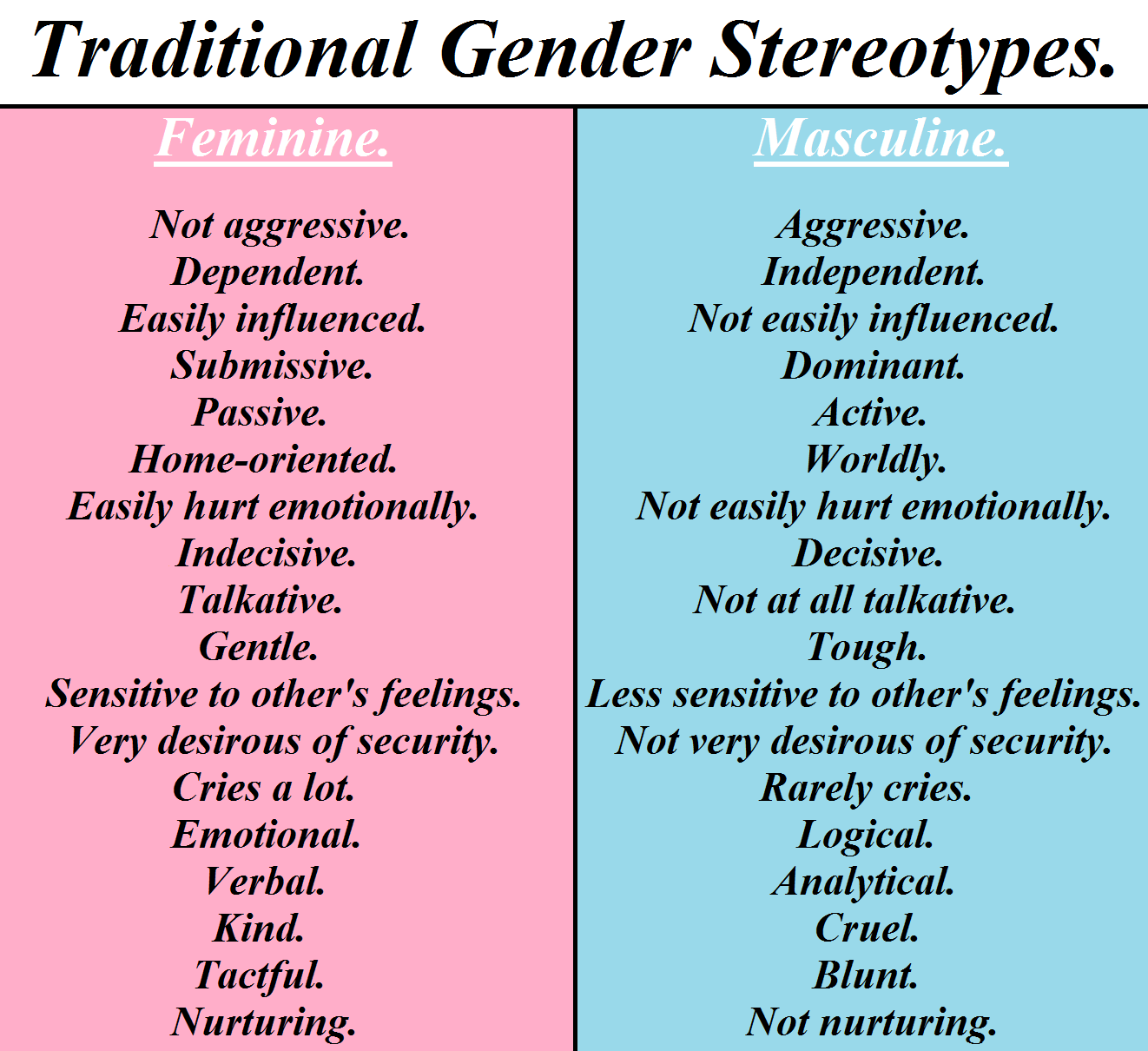
Gender in contrast to sex is a social construct. It is an established set of characteristics of society according to which people are categorized into males or females. Gender roles vary from society to society. There are many agencies present in society that facilitate the social construction of gender. Family is one such agency.
In this article, I will try to show the various processes through which gender identity is established in children by their families.
As a child grows the gender identity is established through four processes namely:
Reinforcement or moulding-Parents at home treat their children differently depending on their sex. Boys are normally given more freedom than girls while girls are treated more protectively. Any ‘effeminate’ behaviour on the part of the boy is highly discouraged and if such tendencies continue they are regarded as ‘psychological disturbances.’As a result of this training, children learn their sex roles effectively and quickly.
Opportunities-Opportunities go a long way in determining gender roles. While boys are encouraged to take up technical jobs girls are discouraged . Girls are encouraged to go along the ‘the feminine way’ and boys are expected to develop themselves along ‘the masculine way’.Boys are given cars, building blocks etc to play with while girls are given kitchen set, dolls to play with. The boys are expected to help their fathers and girls are expected to help their mothers.
Role modelling-It is a major mechanism of gender socialisation. By the age of three, nearly all children know whether they are male or female and by the age of four, they have very definite ideas of what masculinity and femininity must involve. A male child usually identifies with his father and a female child with her mother. The boys considering their father as a role model emulates them and the same is the case with girls who look up to their mothers. Role modelling is more effective when the child has a strong and warm relationship with the role model.
Explicit verbal instruction-Certain instructions also determine gender identity.” Boys don’t cry like girls”,” Pink is the colour of girls”,” You are a girl you should know how to cook” etc are some very common instructions. Hearing the same everywhere and on daily basis influences the mind of an individual and determines the gender identity.
Hence, families give the earliest reinforcement for acting appropriately according to one’s gender, and the environment continues to teach what is acceptable for men and women.
It is said , Little of man’s behaviour is instinctive , rather his behaviour is ‘ learnt ‘.
At birth the human child possesses the potentialities of becoming human .
The human child comes into the world as a biological organism and becomes a social being by learning social ways of acting .
The child becomes a man or a person
( Purush) through various experiences .
Socialist referred it as “socialised person “
Every society has its own way of making a biological organism into a socialised being .
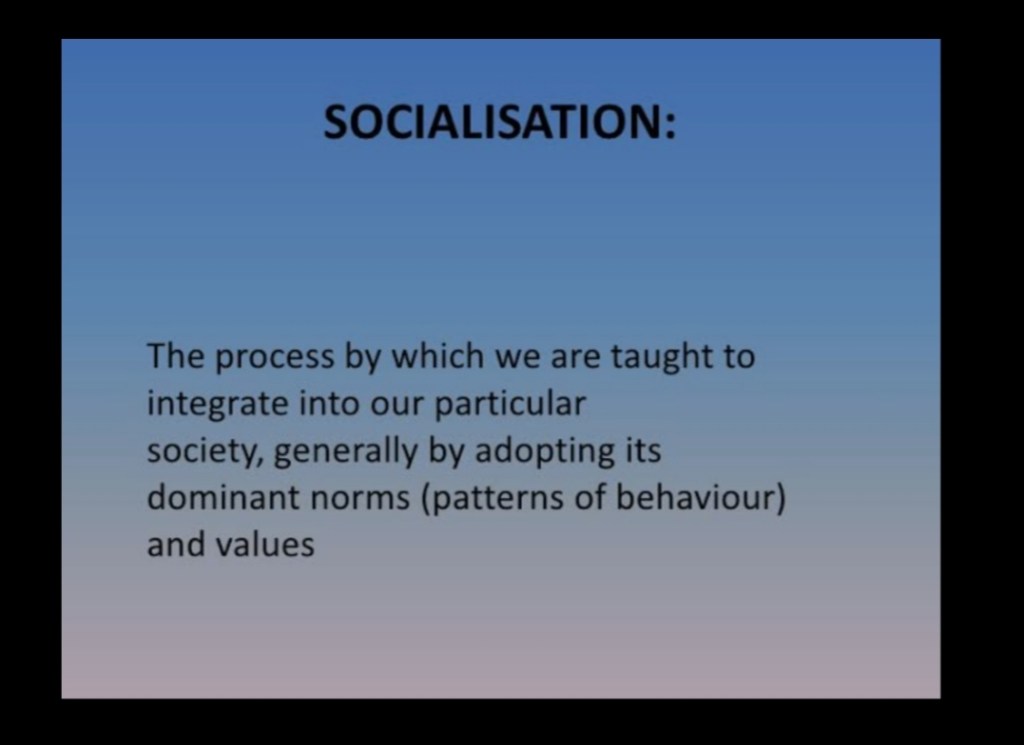
This social training is called “Socialisation “
Hence , the process of moulding and shaping the personality of a human infant is called “Socialisation “.
Sociologists have often referred to socialisation as “transmission of culture “.
A man is not only social but also a cultural being .
Cultural learning is the process by which the individual learns the fundamental culture pattern of the society in which he lives or will live . Culture includes not only its living members but also members of past generations and those yet unborn . Culture defines social conditions for us like what we eat , drink , wear , God we worship , our beliefs etc.
Still cultural learning does not completely define socialisation .
Socialisation is an aspect of all activities within human societies and are socialised in the course of the activities.
Socialisation is the process of adjustment of an individual to conditions of his social environment . There are some relevant internal forces that direct or limit socialisation like instinct , urges , capabilities , education , reflexes , etc .In the process of socialisation an individual learns culturally approved habits , ideas ,. beliefs . He is taught his rights and duties ,his position and responsibilities. The culture rules are so completely internalised that they become part of individual personality .
Definitions :-
Lundberg says that socialisation consists of the ” complex processes of interaction through which the individual learns the habits , beliefs ,skills and standards of judgement that are necessary for his effective participation in social groups and communities . “
Peter Worsley explains socialisation as the process of “transmitted culture, the process whereby men learn the rules and practice of social groups “.
Socialisation is the process of working together ,of developing group responsibility or being guided by the welfare needs of others ”
– Bogardus
W.F. Ogburn defines Socialisation as “, the process by which the individual learns to conform to the norms of the group “.
Hence , Socialisation is a process of transforming the human animal into human being ,of converting the biological being into social being .
Characteristics of Socialisation :-
• It is a continuous process .
• Socialisation is also referred to as ” transmission of culture “.
• Socialisation is social learning .
• Socialisation can be informally or formally conducted
• Socialisation means internalisation of norms .
• The process of Socialisation emerges from the development of “self “.
• Timing is an important concept of Socialisation .
Types of Socialisation
Ian Robertson in his book “Sociology “( 1977) described four types of Socialisation . According to him , an individual undergoes four types of socialisation in his lifetime .
1:
Primary Socialisation :-
Many Sociologists like Sigmund Freud, George Herbert Mead, Charles Cooley, Jean Piaget and Talcott Parsons , have contributed to the theory of primary socialization.
Primary Socialisation is the most essential and fundamental type of socialisation. Period early in a person’s life during which they initially learn and build themselves through experiences and interactions around them is the period of primary socialisation.
It takes place in the early years of life of a newborn individual .It includes teaching of language and cognitive skills , internalisation of culture and norms , developing a perspective , emotional ties etc.
Primary socialization starts with the family teaching children how to bond, create relationships, and understand important concepts including love, trust, and togetherness.
“Internalisation of norms ” is the most important aspect of primary socialisation . It is a process where the norms of the society become a part of an individual .
Several agents reinforce an individual’s learning of norms , the right and wrong behaviour .
2:
Secondary Socialisation:
Secondary socialisation generally refers to the social training received by the child in institutional or formal settings and continues throughout the rest of his life.The process can be seen at work outside the immediate family, in the ‘peer group’. The growing child learns very important lessons in social conduct from his peers. He also learns lessons in school. Hence, socialisation continues beyond and outside the family environment.
3:
Anticipatory Socialisation :-
According to Merton , the process whereby men socialise themselves into the culture of groups with the anticipation of joining that group .
Men learn not only the culture of the group which they belong to but also about the group they don’t. An individual may socialise into groups of which they are already members or into groups to which they wish to become attached.
For instance , a person starts doing his physical exercises and learns to become tough mentally and physically if he intends to join the military.
Socialisation is not a process that takes place merely in early childhood but also at different times and places throughout life .
4:
Developmental Socialisation and Resocialisation :-
According to Ian Robertson ,
“It builds on already acquired skills and knowledge as the adult progresses through new situations such as marriage or new jobs . These require new expectations , obligations and roles . New learning is added to and blended with old in a relatively smooth and continuous process of development “.
Developmental Socialisation is based on learning on the achievements of primary socialisation. A person learns more developed beliefs, values and norms through which he learns how to act in his new role.
Re- Socialisation fundamentally means ” stripping away of the learned patterns and substitution you f new ones “
Re- Socialisation takes place mostly when a social role is radically changed during periods of rapid mobility .
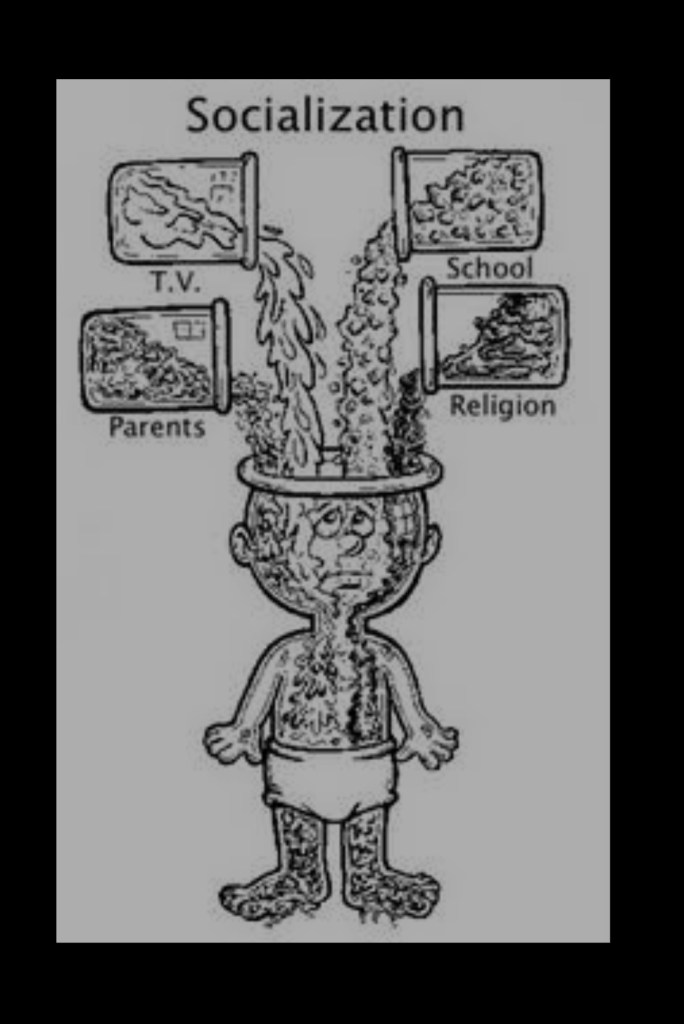
Agents of Socialisation
Socialisation includes moulding and shaping the personality of an individual . The continuous process of socialisation includes some agents who help an individual human being to become a social being .
• Family and Parents :-
The first stage of socialisation starts from the foetal form , where the mother plays an important role . The process of socialisation begins with parental , particularly maternal influence on an individual.
Parents are the first to introduce the child to the society system and culture of his group.
The family acts as the fundamental agent in internalisation of roles for an individual.
• Peers :-
As the child grows he starts associating with other individuals outside his family . He learns from these individuals in school or in the playground or on the street .
The peers group forms perspective on several important topics .
In modern society the peer group has surpassed the importance of the parental group. An individual has more communication understanding with his peers than his own family.
The child maintains an egalitarian relationship with those who are of the same age or gender .
It’s with the peers group that an individual learn more information regarding culture , manners , fashion , styles , gender etc.
• Teachers :-
School is the most influencing place where an individual learns how to behave and form an independent personality . Teachers are major agents of socialisation. School is a formal conduct in the process of socialisation . Teachers help an individual to be responsible and mature .
• Literature and Mass of Communication :-
Entertainment media , mass.media , literature , plays an important Agent I’m socialising . The different opinions or perspectives on several important topics like political , economical , social , etc are highly influenced by these agents.
The attitudes and ideologies ,the words written by someone impact a person in guiding and forming a perspective in a new light .
Stages of Socialisation
Socialisation is a continuous process of learning. AC children are taught about social life in various stages . The form of socialisation begins with ‘ simplicity to complexity’ as the social world gets wider and wider and the child is confronted with several things to learn and adjust .
At each stage of socialisation the child internalises a ‘ system ‘ of roles .
Socialisation consists of four stages from infancy to adulthood .
The first stage –
The Oral Stage :- Oral Stage begins with the birth of the child . It lasts till the child completes his one year .In the foetal form the child feels the comfort of his mother’s womb .
In this stage the child establishes his oral dependency by whimpering or bawling for everything .
Sigmund Freud ,an Australian Psychiatrist ,called this stage as primary identification as a child tries to internalise his and his mother’s role .
2:
The Second stage
The Anal Stage :- The next stage in socialisation is the Anal Stage which begins just after the completion of the oral stage . In this stage the child is taught to do some fundamental tasks such as eating , Cleaning , toileting , etc .
In the first stage the oral dependency starts to fade and the child learns that he cannot depend completely on his mother .
In this stage the child’s mother is the socialising agent .The child in this stage separates his and his mother’s role and understands the social system to a larger extent than in the first stage .
3:
The Third stage
The Oedipal Stage :-
The thirst stage starts from the fourth year of the child and lasts till puberty i.e 12-13 years .
The third stage the child establishes his role on the basis of his sex .
The boys and girls learn about their roles in the society and identify themselves as part of the social system and starts internalising according to their sex , the role of others and their identities on the basis of their gender .
4
The Fourth Stage :-
The Stage of Adolescence :- The fourth is the stage where the child becomes free from their parental control and establishes independence . Parents play an important role in a child’s life at all stages . Despite the freedom from parental control ,they help the child to make some very important decisions in his life . They encourage and help them to take new roles during this period of Adolescence . They expect the child to learn new responsibilities and new roles that are assigned to them .
In modern society ,the parents intend to give more freedom than traditional societies where parents take mostly all the important life decisions of the child .
This stage is the most important stage in socialisation as the child’s behaviour and personality depends on the kind of learning he / she learns and the decision he/ she takes that affects the society . During adolescence the child goes through several physiology and psychological changes ,which affects mentally and emotionally and hence establishes more new experiences than any other stages .
Socialisation makes an individual a social being who transmits cultural ideas , beliefs , languages , skills etc from generation to generation, learns rules and practices of social groups and contributes to forming a society .
“Photography is the story I fail to put into words.”
– Destin Sparks
What is photography ?
Photography is the art, application, and practice of creating durable images by recording … Other names: Science or art of creating durable images
The art or process of producing images by the action of radiant energy and especially light on a sensitive surface (such as film or an optical sensor)
Concepts of photography –
Aperture, shutter speed, ISO speed, exposure. Photography is all about light. You use aperture and shutter speed to achieve the proper exposure, while taking into account some important side-effects you should be aware about.
Principles of photography –
The seven principles of art and design in photography; balance, rhythm, pattern, emphasis, contrast, unity and movement, form the foundation of visual arts. Using the seven principles allows you to take greater control of your photographic practice. This will lead to better photos and more photographic opportunities.
Elements used in photography –
Patterns, texture, symmetry, asymmetry, depth of field, lines, curves, frames, contrast, color, viewpoint, depth, negative space, filled space, foreground, background, visual tension, shapes. We use one or more of these elements to create a composition that works for our image.
There are many elements in photography that come together to make an image be considered “good”. Elements like lighting, the rule of thirds, lines, shapes, texture, patterns, and color all work well together to add interest and a great deal of composition in photographs.
A good photographer must have a very keen eye for detail to ensure that all elements within the photo , the lighting , the composition , the subject , and everything else in between to work together harmoniously to convey the right vision or message. Even the tiniest detail can make or break a photograph.
” Photography is a way of feeling, of touching, of loving. What you have caught on film is captured forever… It remembers little things, long after you have forgotten everything.”
– Aaron Siskind
A picture is a poem without words.
The art or process of producing images of objects on photosensitive surfaces. Photography is the art, practice or occupation of taking pictures with a camera. An example of photography is someone taking pictures for a magazine.
Photography in career –
Photography is a good career if you have an excellent skill set, good creative ability, composition, and technical expertise. Good photography skills come with a lot of practice and hard work. This career can be rewarding if you love to take challenges and are eager to live your life through the eye of the camera.
Photographer skills –
Photographer skills are those skills needed to create high-quality pictures, including artistic vision and technical knowledge of camera equipment and the art of photography
“There is one thing the photo must contain – the humanity of the moment.”
–Robert Frank
“Photography is the story I fail to put into words.”
– Destin Sparks
What is photography ?
Photography is the art, application, and practice of creating durable images by recording … Other names: Science or art of creating durable images
The art or process of producing images by the action of radiant energy and especially light on a sensitive surface (such as film or an optical sensor)
Concepts of photography –
Aperture, shutter speed, ISO speed, exposure. Photography is all about light. You use aperture and shutter speed to achieve the proper exposure, while taking into account some important side-effects you should be aware about.
Principles of photography –
The seven principles of art and design in photography; balance, rhythm, pattern, emphasis, contrast, unity and movement, form the foundation of visual arts. Using the seven principles allows you to take greater control of your photographic practice. This will lead to better photos and more photographic opportunities.
Elements used in photography –
Patterns, texture, symmetry, asymmetry, depth of field, lines, curves, frames, contrast, color, viewpoint, depth, negative space, filled space, foreground, background, visual tension, shapes. We use one or more of these elements to create a composition that works for our image.
There are many elements in photography that come together to make an image be considered “good”. Elements like lighting, the rule of thirds, lines, shapes, texture, patterns, and color all work well together to add interest and a great deal of composition in photographs.
A good photographer must have a very keen eye for detail to ensure that all elements within the photo , the lighting , the composition , the subject , and everything else in between to work together harmoniously to convey the right vision or message. Even the tiniest detail can make or break a photograph.
” Photography is a way of feeling, of touching, of loving. What you have caught on film is captured forever… It remembers little things, long after you have forgotten everything.”
– Aaron Siskind
The art or process of producing images of objects on photosensitive surfaces. Photography is the art, practice or occupation of taking pictures with a camera. An example of photography is someone taking pictures for a magazine.
Photography in career –
Photography is a good career if you have an excellent skill set, good creative ability, composition, and technical expertise. Good photography skills come with a lot of practice and hard work. This career can be rewarding if you love to take challenges and are eager to live your life through the eye of the camera.
Photographer skills –
Photographer skills are those skills needed to create high-quality pictures, including artistic vision and technical knowledge of camera equipment and the art of photography
“There is one thing the photo must contain – the humanity of the moment.”
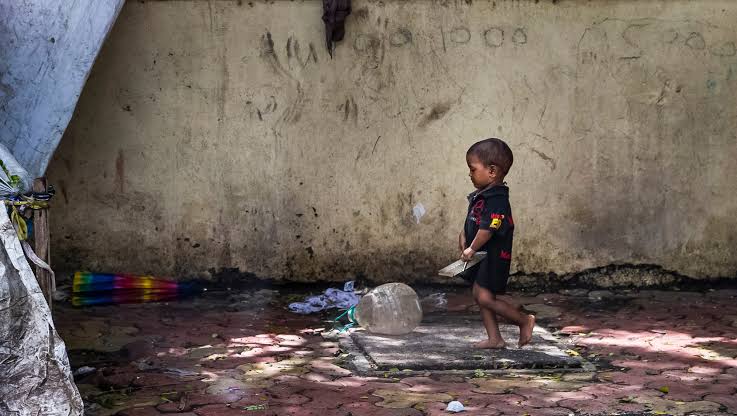
In India child trafficking is a very serious issue. This is happening because there are a number of people who fall under the poverty level category and it is usually this demographic that is subject to child trafficking. The majority of the country’s trafficking problem is internal. This means that usually the most unprivileged families and disadvantaged people of the countries like the Dalits, religious minorities, tribal community members, and girls from different minority groups etc have to face this. Due to poor socio-economic situations, people take advantage of the poor parents and thereby leaving their children into such trafficking rings. The parents from these poor backgrounds assume that the children are going to live in better conditions but in reality, the children are kidnapped and taken advantage of.
What is child trafficking
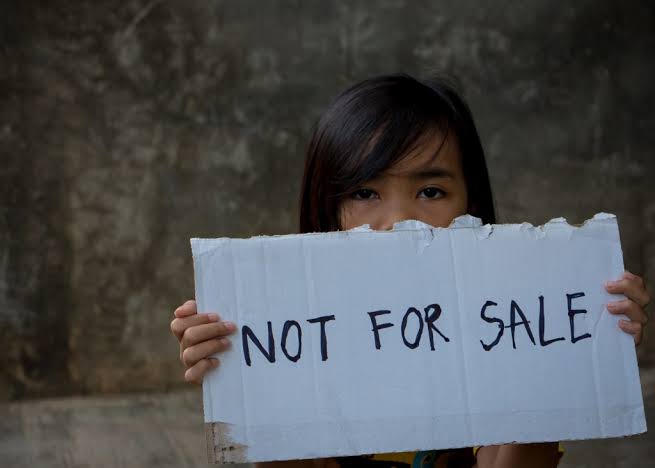
Child trafficking is a practice where children are taken away from their family and later they are forced to beg on streets, do some form of work, used for sex or simply sold.
Child trafficking is linked to demand for cheap labour, especially where the working conditions are poor. Children are forced to do many dangerous stunts and also in illegal situations. Such works include slavery, domestic labour, sexual exploitation or prostitution, drug couriering and being turned into child soldiers. Those children are exposed to many dangerous situations like working in hazardous environments. Many are also denied the chance to reach their full potential because they don’t get an education or have the freedom to make their own choices. Children become separated from their families. They are left without protection and are easy prey for traffickers to exploit either by force or with false promises.
How many children are affected by child trafficking?
It is estimated that almost 21 million people are trapped in forced labour or slavery among which one in every four people are under the age of 18.
Almost 5.5 million children are victims of child trafficking around the world. They suffer violence, exploitation and abuse – ending up in work, forced marriage, prostitution, begging and armed recruitment.
Causes of child trafficking
Poverty Poverty is one of the main causes of child trafficking. Poor parents were sometimes forced to abandon their children in the hands of traffickers assuming that they would lead a happy life.
Humanitarian Crises Child trafficking is particularly prominent in areas struck by natural disasters.The countries where human rights are violated have a higher rate of child trafficking.
Lack of Education Illiteracy and the lack of education make families more vulnerable to traffickers.
Absence of Birth Registration The children whose births were never registered are the most threatened.
Lucrative Activity Child trafficking is extremely lucrative.
International Adoption International adoption is very common among infertile couples. Traffickers and dishonest adoption agencies take these advantages and they don’t get much trouble finding potential clients.
Use of Children Children are sold for the purposes of sexual exploitation, begging, soliciting, or for forced marriages. Their life comes to risk while doing construction work, working in factories, or are employed as domestic servants. Children are given a substantial sum of money to parents waiting to adopt.The sale of child organs is also a very infamous practice done by the traffickers. To earn a good living, many children agree to sell one of their kidneys for money.
Prevention of child trafficking
1. Foster the spread of education. 2. Spread awareness among parents and communities. … 3. Strict laws in place to prevent child trafficking. … 4. Encouraging business to not use child labour. … 5. We must support NGOs like Save the Children in the fight against trafficking.
Machine learning is the study of computer algorithms that improve automatically through experience and by the use of data. It is seen as a part of artificial intelligence.
Machine learning is a subfield of artificial intelligence, which is broadly defined as the capability of a machine to imitate intelligent human behavior. Artificial intelligence systems are used to perform complex tasks in a way that is similar to how humans solve problems
Machine learning allows the user to feed a computer algorithm an immense amount of data and have the computer analyze and make data-driven recommendations and decisions based on only the input data.
Machine learning (ML) is a type of artificial intelligence (AI) that allows software applications to become more accurate at predicting outcomes without being explicitly programmed to do so. Machine learning algorithms use historical data as input to predict new output values.
For example, medical diagnosis, image processing, prediction, classification, learning association, regression etc. The intelligent systems built on machine learning algorithms have the capability to learn from past experience or historical data.
Common machine learning problems
1) Understanding Which Processes Need Automation.
2) Lack of Quality Data.
3) Inadequate Infrastructure.
4) Implementation.
5) Lack of Skilled Resources
These are three types of machine learning: supervised learning, unsupervised learning, and reinforcement learning.
“Machine learning will automate jobs that most people thought could only be done by people.”
If you are pass out (higher secondary) from science stream aka biology stream. This is article to tell you which course you can choose for higher education.
MBBS
BAMS
BHMS
BNYS
BPT
BUMS
BDS
Bvs ah
Bsc nursing
Bsc diary technology
ry technology
Bsc biotechnology
bsc home science
BOT
BMLT
Bcom
Bba
Bsc nutrition and dietician
Bsc forensic science
Bsc bioinformatics
Bsc clinical psychology
B pharmacy
Mbbs is acronym for Bachelor of Medicine, Bachelor of Surgery is a 5 year-long undergraduate program which is undertaken by students aspiring to be doctors in the near future. It can be done through NEET.
BDS is a dental course through neet.
BAMS is a ayurvdic course through neet.
Bhms and bnys , bums all have admissions through neet.
Veterinary also had same criteria .
If you are looking for course apart from the medical or science stream. You can apply for bachelor in business administration or bachelor in commerce. You can also opt for integrated courses here.
If you have interest in medicine join B pharamcy. After wards you can go for M. Pharmacy too.
Apart from it there are some bsc courses. You can look at those. Like bsc in radiology,botony, zoology.
Artificial intelligence (AI) is the simulation of human intelligence processes by machines, especially computer systems. Specific applications of AI include expert systems, natural language processing (NLP), speech recognition and machine vision.
Artificial Intelligence (AI) is the branch of computer sciences that emphasizes the development of intelligence machines, thinking and working like humans. For example, speech recognition, problem-solving, learning and planning.
The Four Types of AI
• Reactive Machines. Reactive machines are the simplest level of robot.
• Limited Memory. A limited memory machine, as the name might suggest, is able to retain some information learned from observing previous events or data.
• Theory of Mind.
• Self-awareness
The basic objective of AI ( machine intelligence) is to enable computers to perform such intellectual tasks as decision making, problem solving, perception, understanding human communication (in any language, and translate among them).
Artificial intelligence is impacting the future of virtually every industry and every human being. Artificial intelligence has acted as the main driver of emerging technologies like big data, robotics and IoT, and it will continue to act as a technological innovator for the foreseeable future.
Artificial Intelligence enhances the speed, precision and effectiveness of human efforts. In financial institutions, AI techniques can be used to identify which transactions are likely to be fraudulent, adopt fast and accurate credit scoring, as well as automate manually intense data management tasks.
“As more and more artificial intelligence is entering into the world, more and more emotional intelligence must enter into leadership.”
-Amit Ray, Famous AI Scientist, Author of Compassionate Artificial Intelligence
Complexities and complications in life makes us who we are today. If it isn’t for the experience’s and complex situations that we had undergone we wouldn’t have become who we are today. This essay focuses on how these complexities make our life beautiful. I would like guide you down to a very different lane of thoughts about life. These complex thoughts can only be learned and understood with examples and real-life situation in order for us to comprehend it. Referring to the idea of addressing the twisted and complicated side of globalization, Manfred B Steger made us understand some of these complexities.
Sometimes we find ourselves at crosswords with different situations which are hard to simplify. An example of this is how Cameron Russell talks about how she if living a life most of us would want to grab at the first chance we get yet how unhappy she is with it. These are the complex situations where we stop to think of how happy we are and content with our lives even when we have no wealth or fame. Happiness instead of becoming a choice then become an unattainable option.
‘Is google making us stupid’ is an article by Nicholas Carrwhich focuses on how complex the system of google working is, there are two sides to the story. One, where we completely rely on google to learn while the other google making us stupid. It is pretty paradoxical if I put it that way but it is quite true too. I would like to unravel such complex thoughts in my essay.
The Paradox in Life
Our lives aren’t compromised of simplicities nor they want to be easily defined. From the flip side of romanticizing sadness to people actually being able to relate to it, we have come across some complex dimensions a human brain can adapt too. We are social beings kept locked away in our homes for the past 8 months, imagine the irony. People learn new thoughts and possibilities and eventually life only through socialization but what happens when they are cut off from the world completely. They forget to live life as it was before. They forget about how beautiful life was before this pandemic struck. How we all loved the little complex moments and shared the joy in it.
The word ‘Love’ has different pronunciations and spellings in different places yet it shares the same feelings wherever it is expressed. Love cannot be limited to just your partners affection, love is also when your mother buys you, your favorite dress or when your father cooks your favorite dish. Love cannot be reduced to a specific section of people because love is omnipresent. And if shared brings a lot of joy. But this cannot be said about the way humans treat each other.
People aren’t always filled with love and happiness but also emotions like anger, sadness, regret, guilt and jealousy. They are sometimes driven by these complex emotions which sometimes can result in unpredicted circumstances and we learn from them. We learn from our mistakes every time we commit one, everyday we are learning, evolving, changing into a better version of ourselves because of these complexities.
In Steger’s text on globalization we had come across a very twisted side of how the interconnectedness of the world has resulted in many tragedies rather than the advantages. The world has become so progressed yet it has not let go of its secular roots and stereotypes. One of the after product of this globalization is the internet. People make use of the most popular search engine ‘Google’. Yes, google makes us look smart and earns us good grades but at the same time it makes us lose the ability to concentrate and read, it reduces our concentration span and it makes us reduce the amount of knowledge we could have acquired through reading a book. So, think about it? Are we really becoming smart?
These thoughts I have put forward were for you to realize how complexities that stay out of our normal thinking could easily make us know the world in another perspective. Looking at things from one point of view is quite biased and subjective. Learning to view through the objectivize path requires wide reading as said by Ann Morgan. She had set on a voyage for reading a book from all the countries across the world. It is a beautiful yet complex mission which if attained can make her quite a knowledgeable person. Someone with wide reading capabilities know how important it is to acknowledge the little things in life and live in the moment.
Writing conclusions for an essay with such a variety perspective is quite a challenge, because it isn’t about a specific topic nor about an unchanging entity. It is about the situations and experiences where we learn to be a better person and it is no easy challenge. My examples of how I see the world can be very different from yours but it does not make it any smaller. We all are part of something as huge as the milky way. We have yet to find out so many things in the world, but we should always learn to embrace the complex moments and the beauty in our lives.
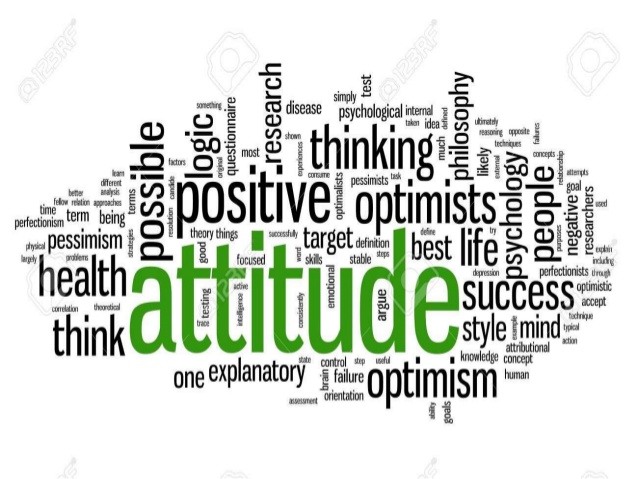
We all have our own opinions about people, situations, issues or life. These opinions are formed over time with experience and are an example of attitude. An attitude is basically a state of mind or a set of views regarding some topic. It is accompanied with a tendency to act in a particular way with regard to attitude object. Attitude are not a behaviour in itself but rather it represents the tendency to behave in a certain way. Attitudes have an evaluative feature i.e. they are either positive or negative. Attitudes are formed through interaction and changes throughout our lives through experiences. Some attitudes however, remain fairly constant. Such attitudes get incorporated in our lives as a part of our belief system and moral values. Beliefs and values differ for every individual. For some they may change over time while for others they may never change. In general, attitudes are learned. This learning can take place through association, observation, exposure, culture etc. In early age group, attitudes are learnt by being rewarded or punished. For example, praising(rewarding) a child every time he does his share of chores will lead to a positive attitude formation towards doing chores. Most of the attitudes are formed by modelling or observation. During pre teen years or even teenage in that matter, important attitudes about life and related matters are formed by observation of living environments. Social norms also shape our attitudes. Social norms are exclusive to their cultures and become a part of our social cognition. Family and school environment especially during the early years play a significant role in shaping the attitude of an individual. Most of the attitudes are formed through direct personal experiences which bring about a drastic change in our opinions towards people and our own life. Over the years, media has become an important source and factor for attitude formation. It provides an exposure to vast amount of information, both positive and negative. Internet is also a very powerful factor for attitude formation. Change in the attitude depends on it’s existing nature. Nature of attitude includes it’s positivity or negativity, simplicity or complexity and centrality. Generally speaking, positive attitudes are easier to change. Extreme attitudes and central attitudes are rather difficult to change. Attitude may change in the same direction as the existing one, or it may change in the opposite direction. It has been observed that attitude changes when message comes from a highly credible source. A message in the information that is presented to change the attitude. Whether the message contains a rational or emotional appeal also makes a difference. People who have a more open and flexible personality change more easily then those who are less open. People with low self esteem and low confidence also tend to change their attitudes more easily than those with high self esteem and confidence. People with strong prejudices do not easily change their attitudes. More intelligent people change their attitude less easily but sometimes they change it more willingly than others.
Online learning is rapidly becoming one of the most cost-effective ways to educate the world’s rapidly expanding workforce.”
– Jack Messman
Introduction
Virtual classes are becoming a new word in the dictionary of 21st century. It was introduced to the country before but it came to the popularity when people become prisoners in their homes.
Due to the pandemic , virtual world widely came into connect with different countries and one of them was our’s.
Virtual classes become an virtual space where one can ensure to be a keen learner .
How does it work ?
Is it safe to learn online and using different apps for classes ?
How can you assure it cannot harm our privacy ?
Well for the answers you have to read this editorial.
Virtual classes
If you want to teach people a new way of thinking, don’t bother trying to teach them. Instead, give them a tool, the use of which will lead to new ways of thinking.”
– R. Buckminster
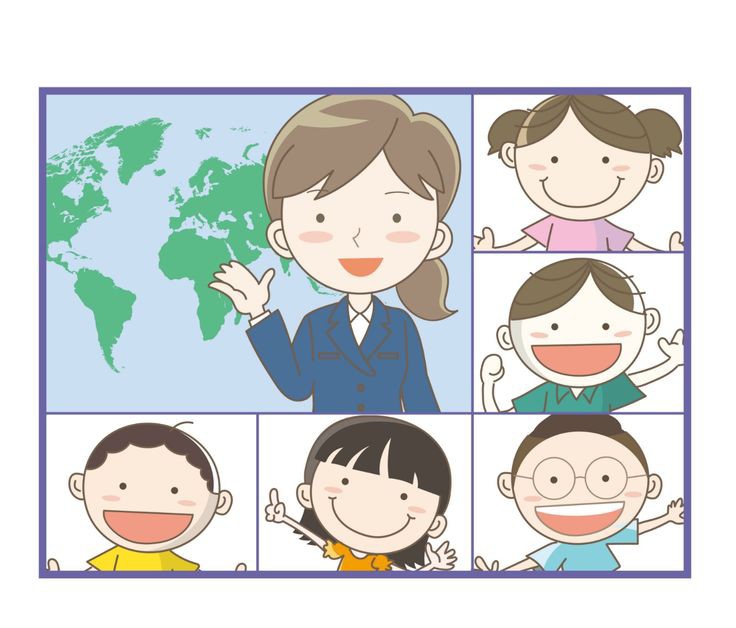
A virtual classroom is a learning and online space where teachers and learners can come together to learn , engage and interact with one another, and work in groups .
The main aim of virtual classes is to provide teacher and learner a platform where they can interact with each other.
It provides an environment to share the learning and thought of the learner and the mentor through video conferencing , Google meetings and others .
How it works
To learn about the virtual classes first you need to know how it works . Their are different portals where we can join virtual classes like zoom , Google meet , WebEx and others . They enable high connectivity , effective communication , simple usage with less internet .
Don’t you think it’s getting to much conceptual . Like OJO -MOJO , I also used some apps for virtual classes and what happened next is the story for me to know and you to explore .
Well , we were at the train station and waiting for a bus , I know I can do standup comedy very well .
Let’s rewrite the statement we were talking about virtual classes . For that we need the most important thing that cannot always be there . Guess what it’s Internet connectivity.
Than we need to login and join from the link that our teachers send in the group .
Want to know a secret , most of the time the link was invisible and students started to create fuss in the group and when it’s time to join the class there were more than 200 messages from where I have to dig the grave , I mean find the link. See how hard I have to work.
Today’s world
Develop a passion for learning. If you do, you will never cease to grow.
– Anthony J. D’Angelo
As the COVID resulted the shut-down of schools and colleges all over the world. More than 1.2 billion children had stoped learning.
And the result , we all know education system changed dramatically with the new e-learning in the digital platform.
Census shows that online learning showing retention of information and take less time. With the increase of online learning many platform providing free learning like BYJU’s , Coursera , Edx , etc,.
Some believe that due to the dramatically changes it was hard to use such platforms and others believe that integration of learning Internet technology education will help to accelerate the learning with diversity.
Choose the sides and make your choice.
If you want to teach people a new way of thinking, don’t bother trying to teach them. Instead, give them a tool, the use of which will lead to new ways of thinking.”
IVF or In Vitro Fertilization is one of the famous fertility treatment where eggs from a woman’s ovaries are is retrieved and fertilized in vitro that is in laboratories with the sperm to produce embryo. This embryo can be stored by freezing or can be transferred to woman’s uterus. This technique became a boon to couples who were facing infertilely or pregnancy related issues.
SOME OF THE INFERTILITY ISSUES:
Chances of fertility is reduced in woman over 40 years of age.
There may be damages in the fallopian tube of the female which may be causing infertility.
Reduction in the function of the ovaries due to various reasons.
Endometriosis– Where the tissue that normally grows inside the uterus, lining it, will grow outside it.
Before IVF women undergoes ovarian reserve testing which involves tests for the level of follicle stimulating hormone in blood. Examination of the uterus usually by doing ultrasound to know the health of the uterus. Men will have sperm testing which is done by taking semen sample and analyzing for the sperm size, number and shape. If the sperms are weak or damaged, intracytoplasmic sperm injection (ICSI) is performed where sperm is directly injected to the egg by the technician. Otherwise sperms are left to fertilize the egg in incubation.
EMBRYO
HOW IVF IS PERFORMED
Stimulation: IVF requires multiple eggs to make sure that viable embryos are produced. A woman produces only one egg during one menstrual cycle. So drugs are injected into female body to stimulate the production of multiple eggs. The doctor will perform multiple blood tests to monitor the production of eggs and to decide when to retrieve them.
Egg retrieval: It is a surgical process. Doctor uses an ultrasound wand to direct a needle into the ovaries through vagina to an egg containing follicle. This needle takes out the eggs through suction.
Insemination: Semen sample is taken by the male partner. Technician will mix the sperm with the eggs in a petri dish. If it did not work they may go for ICSI.
Transfer: Normally after 3-5 days after insemination, when embryos become big enough, they are implanted into the uterus. A catheter is introduced into vagina past the cervix into uterus. Embryo is released. Then embryo implants itself to the uterine wall. A blood test will determine if the female is pregnant or not.
POSSIBLE COMPLICATIONS
There can be multiple pregnancy which can result in low birth weight.
There is a risk of miscarriage.
Embryos can be implanted outside the uterus leading to ectopic pregnancy.
IVF can be done at any age: This is not true. As the age of women increases she may not be able to produce many eggs and that time IVF can not be done.
Fertility drugs cause cancer: The drugs used to stimulate egg production are safe. No studies have shown increased risk of cancer.
IVF babies have risk of birth defects and malformations: Not true. Even though there is slight increase in the malformation as compared to normal births, but the risk remains low as studies say.
IVF is dangerous: IVF is not dangerous. Only 1-2% patients become unwell.
IVF is for rich people: This is little bit costly but less expensive compared to other surgical treatments.
LEGAL ASPECT OF IVF
IVF is legal in India. But there is no specific law regarding the aspect. But IVF has gained public attention and needs a good law to monitor.
GST is a destination-based tax on consumption of goods and services. It is proposed to be levied at all stages right from manufacture up to final consumption with credit of taxes paid at previous stages available as set off. In a nutshell, only value addition will be taxed and the burden of tax is to be borne by the final consumer.
A few important points of consideration are given below:
The tax would accrue to the taxing authority, which has jurisdiction over the place of consumption which is also termed as place of supply.
1. The Existing Taxes that are proposed to be Subsumed under GST-
The GST would replace the following taxes:
(i) Taxes currently levied and collected by the Centre:
a. Central Excise duty
b. Duties of Excise (Medicinal and Toilet Preparations)
c. Additional Duties of Excise (Goods of Special Importance)
d. Additional Duties of Excise (Textiles and Textile Products)
e. Additional Duties of Customs (commonly known as CVD)
f. Special Additional Duty of Customs (SAD)
g. Service Tax
h. Central Surcharges and Cesses so far as they relate to supply of goods and services
(ii) State taxes that would be subsumed under the GST are:
a. State VAT b. Central Sales Tax
c. Luxury Tax
d. Entry Tax (all forms)
e. Entertainment and Amusement Tax (except when levied by the local bodies)
f. Taxes on advertisements
g. Purchase Tax
h. Taxes on lotteries, betting and gambling i. State Surcharges and Cesses so far as they relate to supply of goods and services.
The GST Council shall make recommendations to the Union and States on the taxes, cesses and surcharges levied by the Centre, the States and the local bodies which may be subsumed in the GST.
2. The Status of Tobacco and Tobacco Products under the GST Regime-
Tobacco and tobacco products would be subject to GST. In addition, the Centre would have the power to levy Central Excise duty on these products.
3.Type of GST proposed to be Implemented-
It would be a dual GST with the Centre and States simultaneously levying it on a common tax base. The GST to be levied by the Centre on intra-State supply of goods and /or services would be called the Central GST (CGST) and that to be levied by the States would be called the State GST (SGST). Similarly, Integrated GST (IGST) will be levied and administered by the Centre on every inter-state supply of goods and services.
4. Need for Dual GST- India is a federal country where both the Centre and the States have been assigned the powers to levy and collect taxes through appropriate legislation. Both the levels of Government have distinct responsibilities to perform according to the division of powers prescribed in the Constitution for which they need to raise resources. A dual GST will, therefore, be in keeping with the Constitutional requirement of fiscal federalism.
5. Authority to Levy and Administer GST- Centre will levy and administer CGST and IGST, while states will levy and administer SGST.
6. Benefits from GST- Introduction of GST would be a very significant step in the field of indirect tax reforms in India. By amalgamating a large number of Central and State taxes into a single tax and allowing set-off of prior-stage taxes, it would mitigate the ill effects of cascading and pave the way for a common national market. For the consumers, the biggest gain would be in terms of a reduction in the overall tax burden on goods, which is currently estimated at 25%-30%. Introduction of GST would also make our products competitive in the domestic and international markets. Studies show that this would instantly spur economic growth. There may also be revenue gain for the Centre and the States due to widening of the tax base, increase in trade volumes and improved tax compliance. Last but not the least, this tax, because of its transparent character, would be easier to administer.
7. Concept of IGST- Under the GST regime, an Integrated GST (IGST) would be levied and collected by the Centre on inter-State supply of goods and services. Under Article 269A of the Constitution, the GST on supplies in the course of inter-State trade or commerce shall be levied and collected by the Government of India and such tax shall be apportioned between the Union and the States in the manner as may be provided by Parliament by law on the recommendations of the Goods and Services Tax Council.
8. Deciding Authority for levy of GST- The CGST and SGST would be levied at rates to be jointly decided by the Centre and States. The rates would be notified on the recommendations of the GST Council.
Tax reforms must be implemented. To improve revenue performance factors like globalization, large informal sectors and policies of neighboring countries must be considered.

















 Eduindex
You must be logged in to post a comment.