Plant Growth Promoting Rhizobacteria or PGPR is a group of bacteria that can be found in the rhizosphere or it can be said that bacteria that colonize the roots of the plants that enhance plant growth. It is observed that the rhizosphere is the zone of maximum microbial activity. It is the rhizosphere region of the plant from where most of the essential mico and macro- nutrients are extracted. The different species of Bacteria, Fungi, Actinomycetes, Protozoa, and Algae can be found in the rhizosphere region, Bacteria being the most abundant. The term PGPR was introduced by Kloepper and Schroth. They concluded that PGPR are not only associated with the roots to exert beneficial effects on plant development but also have positive effects on controlling phytopathogenic microbes. Therefore, PGPR is one of the active ingredients in biofertilizer. Based on the interactions , PGPRs are of 2 different types :
SYMBIOTIC or INTRACELLULAR BACTERIA (iPGPR) live inside plants and exchange metabolites directly by biofertilization, stimulation of plant growth, rhizoremediation, and plant stress control. While performing direct growth promotion, they behave as Biofertilizers.
FREE – LIVING or EXTRACELLULAR BACTERIA (ePGPR) live outside plant cells and indirectly increases plant growth by reducing the impact of disease, by Antibiosis, induction of systemic resistance, and competition for nutrients and niches. While performing indirect plant growth promotion, they behave as Biopesticide.
PGPR shows an important role in sustainable agriculture industry. Undoubtedly, there is an increased demand of crop production now-a-days and also a significant reduction of synthetic chemical pesticides and fertilizers which is a big challenge. So, the use of PGPR has been proven to be one of the best ways of increasing crop yields by facilitating plant growth. PGPR show synergistic and antagonistic interactions with microorganisms within the rhizosphere and in bulk soil, which indirectly boosts the plant growth rate. PGPR also works as a biofertilizer for agricultural sustainability. Agriculture is one of the human activities which leads to the increasing amount of chemical pollutants with the excessive and continuous use of chemical fertilizers and pesticides. This causes further environmental damage causing a serious risk for human health. For e.g. N2O is excessively released by continuous use of nitrogen fertilizers which causes Greenhouse effect and finally Global Warming. Farmers apply a high concentration of nitrogen fertilizers in the form of ammonium nitrate to increase crop yield but continuous use of nitrogen fertilizers decreases the Biological Nitrogen Fixation in soil.
For Sustainable Agriculture fulfillment, crops which are produced must be grown with disease resistance, salt tolerance, drought tolerance, heavy metal stress tolerance, and better nutritional value. Also, the use of soil microorganisms is the one possible way. Soil microbes increase the nutrient uptake capacity and water use efficiency in the soil. Among these soil microorganisms, PGPRs are mostly used which are capable of performing all the activities without environmental contamination. PGPR include the species of Pseudomonas, Bacillus, Enterobacter, Klebsiella, Azobacter, Variovorax, Azosprillum and Serratia. But it is found that agricultural industries worldwide still not use the concept of PGPRs. This is due to the inconsistent properties of inoculated PGPR which can greatly influence the crop production.
A PGPR must :
Possess its survival in soil by tolerating several environmental factors.
Be compatible with the crops on which it is inoculated.
Be interactive with the already existing microflora in soil.
Have a broad spectrum of action.
Be safe for the environment.
Enhance plant growth. Another challenge is that all Rhizobacteria do not possess the same mechanisms which is a major disadvantage for the environment therefore, PGPR still are not used as a biofertilizer in global agricultural productivity.
“Glory to Allah, who created in pairs all things that the earth produces, as well as their own(human) kind and (other) things of which they have no knowledge.”
-The Holy Quran [36:36]
No element on the life sustaining earth exists without its complement. For example, the complement of zero is one; solids and voids; light and dark; if one did not exist, the other would lose its meaning. This refers to both in terms of the one who sustains as well as the energies sustaining them. The balance among the elements of the entire universe is maintained through the various visible as well as invisible energies which in turn exist in pairs. The energy could be classified as the ones within the human who sustain the energies of the earth and the other being the natural forces of the universe that aids the universal equilibrium which further keeps the physical and psychic activity in balance. The harmony of the earth is controlled by the physical as well as the metaphysical energy forces of the cosmic energy. The energy takes part in influencing all the occurrences on the earth be it at architecturally large scale element like a city or a small scale architectural structure as a home. Both would be classified into the microcosmic level of the energy.
“Space is nothing, yet we have a kind of vague faith in it.”
-Robert Smithson
The existence of energy occurs in the place of nothingness. Voids hold the highest sources of energy. The architectural design is nothing but a technique of designing voids to show a flow of spaces making a way for the flow of energy among the various spatial arrangements. Most of the people in the Indian Society prefer Vastu Vidya to be incorporated while designing a space. The major reason being the energies that is considered to be flowing through the designed spaces and to create the balance between the concrete mass and the natural elements. Humans occupy the voids yet they fail to understand the meaning of the unseen energy forces that is felt through the experiences they encounter while inhabiting that particular personalized void that is the physical manifestation of the memories and imagination of their own. The metaphysical aspect of architecture lies within the fact that it influences the user experiences of their inhabited voids in the line of time. It connects the past to present and brings about a psychological and emotional connection.
An environology master, David Koh, stated, “When people built the house, the energy inside the house is static. Once the people live in, the energy inside the house is dynamic. People may affect the building, and the building may affect the people. And it’s not positive thinking that the people need, but it’s energy that makes people think positively.” The energy flowing through the various spaces creates an imbalance due to the dynamism of the humans living in. This in turn, creates a flux within the dialects of energy within the physical, emotional and psychic connectivity of the people. Architecture is a living tapestry and a constantly changing phenomena. The connection of the energy within the human body and outside, impacts not only buildings but other elements too that together builds the abstract and hypothetical whole. The spatial fabrication of the concrete masses and the multiplicity of the same in diverse alignments as a whole builds the city fabric. A city is a spatial and temporal dimensions of architecture on a vast scale. The physicality that a city comprises is, districts, landmarks, streets, edges and nodes. The streets become the prominent defining thread of the city, connecting the different entities through its networks. They show a directional shift in motion of spaces with respect to different frames of reference exploring more than what is comprehended by the senses with the metaphysical lens to look behind the abstraction.
To represent the extraordinary within the ordinary, the light is put forth to a street in Kolkata, Topsia, recognized by the number ‘90’, has not yet been identified as one of the most alive streets of the city of joy yet they have the metaphysical fundamentalism. The street is particularly a connectivity to one of the Muslim populated locality of the place. The majority of the population living in the locality belongs to the middle class strata of society. They adapt themselves to the concept of ‘less is more’3 and seek the intangible aspects of the spaces that they use. Considering the theories relating to the energy sources, streets becomes the most dynamic element that could be considered as the life of the whole city. They deal with more than the vehicular and pedestrian movement. The streets deal with the dialects of dynamics of metaphysical consequences.
Figure 1: Layout of Streets of Kolkata; source: author.
Within and outside the realms of architecture, streets pave the way at the microcosmic level for the energy distribution network similarly to the way it functions for the crowd and vehicular activity. The metaphysical lens from different frames of reference gives an opportunity to analyze the impact of the metaphysical link and how it is evoked with the crowd in context to the existing surrounding. Different users feel a variety of different emotions in consideration to one particular space.
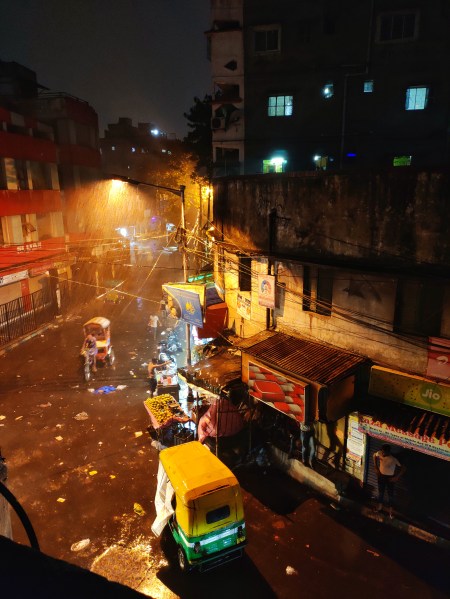
Figure 2: The Street ‘90’ on 12th June, 2019; source: author.
A resident of the place when asked about her experiences with the place said, “We have been staying here for about 15-18 years now. It has an essence of familiarity and home. The existing buildings, the shopkeepers, the vendors, and when I say vendors I really mean it. They are accurate with their location of stalls and wouldn’t trade it with anyone. Ive seen a lot of changes in the place. The building in red and white was built after demolition of an old 3-storey building for commercial purpose yet the upper floors still remain untouched after being built for so many years. The chaos is the essence of this place and without it, this street will lose its essence and identity.”
Considering the quantitative aspect of the street, it is about ten meters in width, with two meters of it occupied by the street vendors. An analysis of the street was done in three different phases of the day. When the morning struck, the silence is disturbed only by the daily activities of parents dropping off their half-dozed children to schools either by private or public convenience, which here is the auto rickshaws, who typically place themselves along the edge of the building as shown in Figure 2. Slowly and gradually as the time transcends the vegetable and fruit vendors take the edge of the street as their potential business spot. The traffic becomes evident by the noon with children coming back from school, having there go at the Sharbet waalas. As soon as the sun goes down, the street has an overwhelming response by the users creating itself in a chaotic mess of disoriented vehicles and people trying to make way to get out. Simultaneously, the sequence of functioning of the streets inflects thrrough its natural course. The female crowd encircles the ‘puchka waale bhaiya’, drooling over the smell of the tamarind water. A few steps towards the east would bring us to a smellscape of a multi-cuisine food corner with a large hot plate with parathas being fried, a traditional clay barbeque for the kebabs being cooked upon the coals, another man assorting the shelves with momos, fried crispy chicken and another struggling with delivering the order to the respective customers superimposing each other tones in a competitive streak to get their order first. The edges of the streets are defined by the utilities of all kind such as a pharmacy, general stores, grocery shops, food kiosks and corners, markets within a radius of a hundred meters, a shopping complex built few years back, occupied only the ground floor of the building structure. A fruit vendor defined the street as, “It is a metaphor of how our life is, always moving and moving in the forward direction. Despite the chaos we love our life so do we love this place.”
Figure 3: The Feeling Mapping of the Street (red-chaos, green- rejuvenation, orange-action, blue-contentment); source: author
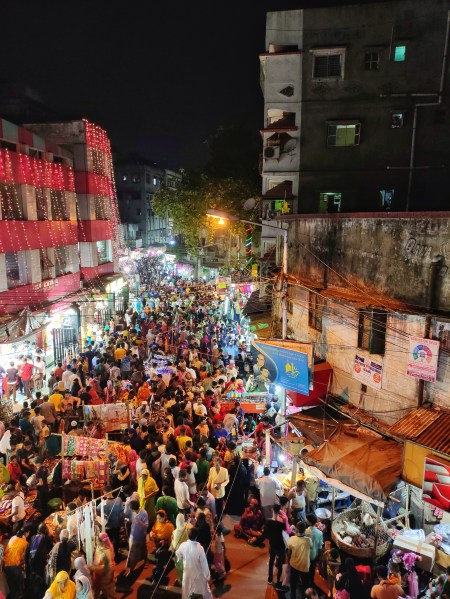
The rhythm of the basic functioning of the street is inflected during the festivities, such as the two Eids and Muharram. The zeal within the crowd becomes evident and the streets stop serving as a vehicular access instead it becomes a hub of utilities as shown in Figure 4.
Figure 4: The Street ‘90’ on 4th June, 2019 (On the Eve of Eid); source: author
In terms of architectural analysis, the flaws couldn’t remain unseen, but what the architects couldn’t see is the intrinsic experiences that the users have with the place. The elegance of the street is a culture of contentment and containment. It depicts the unification of the users belonging to all strata of the society interacting with each other whatever the purpose may be. The dynamics of the streets and the humans represent a whole of the community be it the rich or the poor. In a simple world, the whole of the world can be explored. The local architectural vocabulary of the streets shows motions and emotions of all colours. It depicts joy as well as sorrow. The chaos and the peace, all the comedies and tragedies. The energy drained is rejuvenated with the constant flow of energy on the street. The essence of the chaos in itself shows the intrinsic connection between the built and the unbuilt. The street evokes the intangible aspects of the userrs. The user activity is the result of the concentrated energy source at the micro cosmic level connecting humans with the space at a deeper level. Configuration of the whole of the city is determined by the streets that becomes the highest sources of energy flowing throughout. The built is to exist what the unbuilt is to life. The boundaries defined by the concrete is a personalized space to exist in harmony, but to co-exist, an undefined yet the key that holds the city together. A street has a potential to turn itself into anything it wants. The street is an induced public space. The street has evolved through the line of time of urbanization inflecting the course of its motion. Due to the increasing number of concrete massing, the spatial contraction of the streets are taking place in localities like Topsia in Kolkata whereas due to the urbanization, the expansion of streets also take place with putting an end to the life of the city creating it in a block of monotony and regularity only used as an access not as a space for creating an interaction between the built and the unbuilt, the known and the unknown. Spatial expansion and contraction taking place to accommodate structures. Street is one part to the whole that encapsulates the built and the user. People have a tendency to experience voids hence, they hold human sentiments. We are dehumanizing the streets by making it lose its existence by the loss of depiction of culture and tradition. It is a lost element with the thoughts drowned in hues of grey unaware of how to survive in the chaos. The task of an architect is to blend imagination with practicality by balancing ideas and reviving the true nature of the streets in context to human activities.
REFERENCES
1. The Holy Quran
2. Mustofa, 2011. According to Dr. R Tatang Santanu Adikara, the Head of Bioenergy Research Centre in Surabaya, human gets energy from two sources: inside the human body and outside the human body.
3. Metaphysical Approach for Design Functionality in Malay-Islamic Architecture, article in procedia-social and behavioral sciences-aug 2015
My connections often ask me how to get an internship?What preparations do we need to do to get an internship? How you prepared that you got so much internships? So, i thought of publishing an article that might help you all in getting your answers.
A Guide to Starting Your Career Off Right
Consider Your Qualifications
One of the most common misconceptions that students have about how to get an internship is that they must apply to every position that catches their eye to increase their odds. But this is a sure-fire recipe for radio silence from recruiters and hiring managers. Instead, think about the skills and experience you currently possess, and which positions you might be a good fit for based on that information. A few ways to narrow down which internships are right for you:
Think about your degree
Look up common career fields and job titles for people with your major.Consider your experience: Think about your previous work experience, and which roles it might prepare you for. A student working at a campus newspaper might consider a journalism internship, while a student who tutors for a statistics class may want to look at data science internships.
Identify transferable skills
Skills that help you succeed in school or in the student organisations you participate in — such as organisation, critical thinking and time management — will all be useful in the working world. Some quick research should reveal which jobs require these skills.
Explore your interests
With how much time you spend at work, you want to make sure you enjoy it! Write down a few career fields that interest you, and search internships in those areas.
Start small
Don’t feel pressured to get your dream internships right away, especially if you have no prior work experience. Start by exploring small local organisations, groups affiliated with your school or volunteer work in order to bolster your resume.
Know Where to Look
Once you have a more concrete idea of which internships would be the right fit, it’s time to see what’s out there! Here’s how you can do that.
Visit Job Sites
Websites like LinkedIn , Internshala have millions of job listings, so you’re bound to find something that’s right for you. You can search for the internship titles you’re interested in, and narrow results down by location, size, industry, company ratings and more.
Leverage Your Network
Getting a personal recommendation can make all the difference in your internship search, so make sure to reach out to friends, family, colleagues, classmates, professors and alumni to see if they know anyone hiring.
Prepare Your Application Materials
No matter what job you apply to, there are a few key materials you’re going to want to have on hand. Here are the most common ones, and how to perfect them before you apply.
Resume
Resumes are brief documents that showcase your skills, education and professional background. Typically, resumes will contain your name and contact info, education, professional summary, work experience, skills and additional experience.
Social Media Profiles
Many recruiters use social medias to recruit— some may even require a link to your social media profiles. So, if you haven’t already, you may want to create a professional social media profile, especially on a networking site like LinkedIn.
A few best practices to follow as you polish your social media presence:
Choose a professional headshot for your profile picture.
Add relevant work experience as applicable.
Keep it appropriate — delete any suggestive references or pictures.
Share and engage with relevant industry content.
Hope, this will help you all in getting your dream internship.
Current laws and license agreements in India which allow for surveillance entail a significant potential for abuse, since the country lacks sufficient privacy safeguards . A privacy law is deemed necessary to ensure that data is not retained indefinitely, that data is not shared and disclosed to unauthorised third parties and that unauthorised parties do not have access to collected and intercepted data. In a democratic regime, surveillance should be targeted and carried out under a judicial warrant and the absence of privacy legislation deprives individuals from necessary safeguards. While the Information Technology Act and its Rules do entail some provisions for data protection and regulate certain types of surveillance, they appear to be inadequate. This is partly due to the fact that there is currently no law in India which establishes the right to privacy and as Security Practices and Procedures and Sensitive Personal Data or Information) Rules, 2011, represent a decisive step in creating a legal regime in India for data protection, but nonetheless appear inadequate in addressing issues relating to the collection of, access to, sharing of, disclosure and retention of data5 . Furthermore, they do not ensure the establishment of an independent body, such as a Privacy Commission, to oversee the handling of personal data and to address potential cases of breach.
Justice AP Shah Privacy Principles The Planning Commission of the Government of India held meetings of the Group of Experts on Privacy Issues throughout 2012, which was chaired by Justice AP Shah, the former chief justice of the Delhi High Court . The CIS participated in these meetings and helped draft the Report of the Group of Experts on Privacy by the Justice AP Shah committee . This report entails a list of recommended national privacy principles, which should be followed in the creation of a privacy law. According to the report, the national privacy principles of India should be the following:
• Principle of Notice • Principle of Choice and Consent • Principle of Collection Limitation • Principle of Purpose Limitation • Principle of Access and Correction • Principle of Security • Principle of Openness • Principle of Accountability
The first principle of notice states that the data collector should notify all individuals of its information practices, before any personal information is collected about them. Additionally, this principle also requires data controllers to notify individuals when their personal data has been breached, when such data has been legally accessed by third parties and when the data controller’s privacy policy changes. The second principle of choice and consent states that the data controller should provide individuals the choice to opt-in or opt-out with regards to the provision of their personal data, as well as that individual consent should only be taken by the data controller after providing. The third principle of collection limitation states that the data controller shall only collect personal information from data subjects as is necessary for the purposes identified for such collection, regarding which notice has been provided and consent from the individual taken. The fourth principle of purpose limitation states that personal data collected and processed by data collectors should be adequate and relevant to the purposes for which they are processed. In other words, a data controller should only collect, process, disclose, make available or otherwise use personal data for the purpose as stated in the notice after taking consent from individuals. The fifth principle of access and correction applies to individuals. In particular, this principle states that individuals should have the right to access their personal information which is being held by a data controller and to make corrections or to delete information when it is inaccurate .
The sixth principle of disclosure of information prohibits the data controller from disclosing personal data to third parties, unless informed consent has been provided by the individual for such disclosure. This principle also states that disclosure of information for law enforcement purposes must be in accordance with the laws in force. The seventh principle of security states that data controllers should be responsible for ensuring the security of all personal data that they have collected or which is in their custody.. The eighth principle of openness requires data controllers to take all necessary steps to implement practices, procedures, policies and systems in a manner proportional to the scale, scope and sensitivity to the data they collect, in order to ensure compliance with the privacy principles, information regarding which shall be made in an intelligible form, using clear and plain language, available to all individuals. Finally, the ninth principle of accountability states that the data controller should be accountable for complying with measures which give effect to the privacy principles.
Such measures should include mechanisms to implement privacy policies, including tools, training, education, as well as external and internal audits. In the report, the Group of Experts on Privacy recommended that such national privacy principles are applied to the cases of interception of communications, access to data and audio and video recording. In particular, it is emphasized that, with regards to the interception of communications and access to data in India, the principles of notice, choice and consent, and access and correction should be applied. With regards to audio and video recording in India, the application of the same principles, additionally including the principle of collection limitation, is recommended. Furthermore, the Group of Experts on Privacy also recommended the enactment of a privacy law in India which would include the establishment of Privacy Commissioners, as well as of self-regulating organisation (SROs) and co-regulation, which would supplement the role played by the Privacy Commissioners to ensure the implementation and enforcement of policies for a wide range of sectors and industries. Additionally, the Group of Experts recommended the establishment of a system of complaints which would include Alternative Dispute Resolution Mechanisms (ADRs), as well as the inclusion of offenses, penalties and remedies in the Privacy Act.
It’s to remind us all of one of the painful horrors which still lurks in the world, it is observed all over the world (12 June) and is celebrated every year by UN is a sanctioned holiday by ILO (International Labour Organization).
Child labour is a horrific crime, many a times it’s forced upon naïve lives and children take up jobs at an early age so that they can also become a bread winner for their family due to financial woes. It’s a vile practice which still exists today in remote areas and many a times goes unnoticed.
Most of the third world countries have the largest number of child labourers’ eg.-South Africa, Afghanistan, Pakistan and Myanmar and also in many parts of India. It’s a phenomenon which most of us are aware about and many a time we try our best to contribute to eradicating this heinous practice from our world.
Economic factors is just one of the reasons which compels children to work, especially due to inflation, children tend to take up jobs at small hotels or shops where informal labour exists, due to this they can easily work around but are also misused by their superiors.
Due to child labour one’s freedom is curtailed along with the banishment of their own carrier and also they are unable to have access to many opportunities which life has to offer. One is unable to focus on self-growth and ones’ goals in life have to be forgotten. The child is put into a whirlpool of reeling pain and is trapped in the wrong sphere at such a young age and also exposes himself to other horrors.
In most of the third world countries family sizes can be huge and just one bread winner’s income won’t suffice the whole family, hence many children are encouraged by their parents to take up jobs in the informal sector and to earn money so that they can satisfy their basic needs. Many factories used to employ children between the age of eleven to thirteen as workers luckily this practice has almost vanished away due to child labour laws.
Many students in developing countries lose interest in studying it could be family problems, financial woes or lack of interest and take up trifling jobs so that they can start earning, this not only ruins their carrier but also can expose them to adverse snarls of the world at a young age.
One of the biggest reasons of child labour is financial problems, most of the children who commit themselves to working as a child labourer are people belonging to BPL (below poverty line), and one of the only ways to work out things in their life is by working and earning at a young age, it could be the nearest tea stall near your house where you see small boys lending their energy or even the newspaper delivery boy who comes on his worn out bicycle. Most of them even end up working as construction labourers, risking their innocent lives.
One of the other reasons for increase in child labour is improper enforcement of laws and irregular checks by the government. As citizens of this country and as humans of the world we can do our bit by educating ourselves on this trivial topics. To contact legislators if we come in contact and come across child labourers in our neighbourhood. Also to not shriek away from giving your domestic workers their fair share of income so that we can break the cycle of child labour. And to buy from local grocery stores and not bargain with small sellers are just a few of the things we can do to improve this disturbing situation.
In the world full of competitors to be successful student/businessman etc. should have a different approach. They need do things which have already less participants. It would be best if none of the competitors are present, it doesn’t mean you have to do very odd thing. Everyone needs a better lifestyle and a proper career so that they can live luxurious life with the family, for that we have to start at early as possible and gain the maximum experience. There are many of the websites nationally and internationally that provide work to college students as in the name of freelancers some of the popular sites are:
1- Internshala
2- LetsINTERN
3- LinkedIN
4- GlassDoor
5- Hello Intern
6- Twenty19
7- AngelList
8- Indian Internships
9- Oyster Connect
10- Interlelo
The above listed Internship site are the popular one yet there are many more to be listed.
Internships not only make a student financial independent at college life but it plays a very important role as while on last year of college it boost the CV and the chances of selection in your dream company gets increased by 10 folds.
Internship help a student start to build a professional network that can be a resource for the student.
Internship also help student to decide a second option of career and also can make it as a part-time works on his professional job.
Many companies are in search of students who have already completed an internship related to professional job which will also help student to do the work which is of his choice and already experienced on it.
Internships provide a great impact on confidence of the student which will help a lot in the actual job.
Students gain knowledge and get aware on how to talk with superior person, how to keep conversation on and most importantly how to influence anybody with the power of the words.
Students also get hands on to manage the task assigned. They also get to know to give a separate time table to each task and mange the workflow while studying.
They get the professional guidance even if they fail to mange the task as the internship provider cannot force any student and they encourage the student on compilation of task.
This are the most benifits of the Internship…Hope it will be helpful.
If you are in college and not having any internship, than go for it…It will prove helpful in the future.
How interesting would it be to watch the highlights of a cricket match? Everyone will have a chance to have a choice and definitely will not prefer to watch an uninterested match or the match whose result has been known. In a similar way, people will not respond to recorded session unless it has a good response.” Viewers will hear in recorded sessions and listen in online sessions”.
Live sessions will have a life and makes the dead participants to be alive and make them to participate actively. Participants in live sessions will also have a choice to listen the video in recorded session but they prefer not to because they know the advantage of online sessions. People will not listen in order to listen because there is no way to forward it. The only way to end it is to end it. One can clarify the doubts in the live chat and will save the time rather than searching for the possibility of your doubt to appear in comments. Live sessions will increase the patience level in the participants. There is no need to concentrate on concentrating because you will be busy in concentrating. Recorded sessions will not break the records. “Participants try to end the session in order to complete the session”.
The major disadvantage of recorded session is having a choice to forward it or to watch it in required speed. Viewers prefer to listen the video in low quality and high speed simultaneously reading the comments which makes them to concentrate more on more other things and make less available for the video. There will be too many things to handle at the same time and makes you to do nothing. Your intention to handle many things at a time doesn’t make you to handle at least one of the thing in because there will be more solution which in turn reduces concentration.
Advantage of live session is mainly due to the disadvantage of recorded session.” Leave the recorded session and Live in live session”. Experiencing the live will expertise your life. Watching recorded videos is like thinking about past. So, leave your past and live in present like experiencing the live sessions. Remember that recorded sessions should also be recorded in live.
Saying you’re sorry is called apologizing. When we apologize, we’re telling someone that we’re sorry for the hurt you caused, even if we didn’t do it on purpose. People who are apologizing might also say that they will try to do better. They might promise to fix or replace what was broken or take back a mean thing they said. The apology comes to English from the Greek roots of apo– (“away from, off”) and logia (from logos, meaning “speech”).
The earliest published use of apology we have evidence of comes from the title of a work by Sir Thomas More, the Catholic humanist and social philosopher of Henry VIII’s court. The word appears in his 1533 work Apologye of Syr Thomas More, Knyght. However, the first published use of a word is not necessarily the same thing as the first actual use of it, and there has recently been discovered earlier, hand-written evidence of apology in correspondence between members of the British court; a letter addressed to Cardinal Thomas Wolsey in 1526 contains the line “Here are apologies made for the defense of the French King.
Nowadays, we use sorry more in our conversion while talking with office bosses, parents, relationship partners, and unknown people. However, When you say sorry, it is not because you are weak, you just show that you wont to calm down yourself and display self-ego is stronger than your ego. When we say sorry, it is not just for the mistakes which we have done, it is also for yourself to cultivate a healthier spirit, furthermore, when someone says sorry, it does not direct the mistake, which he/she did, but it may not mean that they have done wrong. You do it because, it is an important skill to learn in life, and you can only do so through deliberate practice.
Here is research regarding apologies, According to a 2015 poll from research firm YouGov, there are approximately 15 British “sorries” for every 10 American ones (for situations like if they sneezed, stood in someone’s way or corrected someone who is wrong). The survey, which polled 1,600 British people and 1,000 Americans, showed a few similarities: 73% of British people would apologize for interrupting someone, compared to the 71% of Americans. And when doing a favor for someone but getting it wrong, 60% of British people said they’d apologize, compared to the 58% of Americans.
Many famous and renowned people always told, Over-apologizing for things you have little control over can make people think less of you. A few examples of things you don’t need to apologize for include sneezing, standing in someone’s way, getting bumped into by someone else, being interrupted, and so on. whenever we say more sorry this thing happened with us lose respect for you, It lessens the impact of future apologies, and It can lower your self-esteem.
sometimes, by saying sorry does not fix everything like, a heartfelt “I’m sorry” fixes everything right away. Other times, it might take a while for someone to feel friendly after you apologize. You might need to give the other person some time. Even after you say you’re sorry, you might still feel bad about what you said or did, but you can feel good about apologizing and about making up your mind to do better.
Sometimes people don’t say sorry because,
When you apologize, you admit that you may be wrong, which is a threat to our ego and our pride.
Some people see an apology as a confirmation of guilt and, as a result, of responsibility for the conflict.
The apology is viewed as a means to draw attention to the mistake.
The person might see an apology as a way of dwelling on the past when they just want to move on.
Some people assume that apologizing is a sign of weakness, but actually, it is a hallmark of strength.
By considering, all points which I narrated above we have to say sorry, whenever we need bet don’t be over-apologized.
As we already know that Covid-19 has become a global pandemic and it is here to stay for quite a while. As this pandemic has caused a sense of chaos among the global companies and made them think and also change the ways on how they used to execute their business strategies.
Coming across the results, majority of the company owners have not succeeded in planning out some new strategy to balance out the chaos created by the pandemic.
It seems that that they are unable to the accept the fact that their previous strategies or the way they used to work may not work now. They will have to adapt to the current situation and make changes accordingly to survive this pandemic.
Some of the organizations which used to work hand in hand have now adopted Digital Marketing as a part of their survival plan.
Some of the company owners have not only embraced the pandemic but are willing to face the temporary economic downfall and then try to recover from it later on as quickly as possible.
Major impacts of Covid-19 on Business companies.
As we know that there’s no such business that’s not been affected by the corona virus but the companies that are suffering the most are the startups which do not have a large capital to keep their company alive and even the companies which highly rely on meeting and face to face interactions like hair salons, gyms, sporting complexes and clothing stores.
Some of the companies which usually had unbelievable amount of growth by the customer referrals are now experiencing such major revenue loss that their reaction to this problem is to cut the marketing costs instead of heading and thinking about the solution.
On the other hand the unusual reactions from the people have caused a lot of harm to the larger B2B companies that serve these smaller businesses.
Digital marketing can help all sorts of business ideas or strategies irrespective of the company’s net worth. The customers are still in need of the products that they used to purchase before the pandemic so the company just has to change the ways in which they reach their audience.
How to take your business online.
If we talk about the time when there was no corona virus, People knew where the best pizza was sold or the best quality beauty products.
But now as there is a complete shutdown and the companies are no where to be seen, People wonder which ones are still in business and where they can spend their money to buy the essentials.
It’s a great opportunity to the businesses which have been highly affected by the deadly virus. With the help of digital marketing they can get in touch with the customers and start boosting their brand on their website or social media platform.
Communicating with the customers.
The first step involves the interaction between the business and the customers. The companies which were never socially or digitally active will now have to change their ways and build strong connections online for the scope of their survival.
The companies which are affected by the corona virus should take the initiative and contact their customers via email or sms and explain them how the services have changed and how they can still avail the services.
Make an advertisement go viral on a newsletter on how the company have managed to keep up with the crisis and what are the necessary changes made which should be known by the people.
The power of social media cannot be neglected here, a simple public post on Facebook or Instagram can be used as a source to reach out the customers.
Charging up the company website.
It is a fine opportunity for the global companies to invest in longer term channels only if the marketing budget allows.
The world has become unstable and the people are not certain on what to do, here alot of external tactics can be used to for internal success as creating a blog for the company or enabling the sales of the materials.
Let’s look up to some of the examples :
Sharing vital information on the web site’s homepage regarding the business queries and letting the audience know that the business is still ongoing.
Updating the service pages with some catchy new photos and descriptions would do the job and if possible add certain discounts which would catch the eye of a lot of audience.
E-commerce system would help the company in taking online orders so it should be a top priority. Some of the platforms which can be uself for such agendas are Shopify or even Paypal.
Building the company’s social media presence.
With isolation and social distancing in hand people are spending most of their time online, this is a great opportunity to take your business on social media and start interacting with more and more people.
There is a huge increase in the time spent by the people of Italy on Facebook and when it comes to Instagram the people of USA are no further left behind they top the chart by 43.1% active users in isolation.
This is a one time opportunity for all the business leads to get on social media and set a goal to build a large set of online following.
Let’s see how the companies can do that –
Updating or sharing various sets of things such as contents or blogs related to the company or related to the social aspects.
Humor is something that is loved by the audience and the posts or videos regarding humor would catch a lot of audience.
Get in touch with an influenceer and start working with him as a lot of influencers are left set open due to the coronavirus outbreak and are available for a reasonable price.
By making these kind of certian and easy changes with less amount of money involved a company could benefit even after the lockdown is over and normalcy is availed.
With the resources present on the web , it’s very easy to urge started with programming. If you’ve got a laptop/desktop and a reliable Internet connection, you’ll start your coding journey immediately . Follow this roadmap to begin without any confusion.
Object Oriented Programming Language( OOP ) Start your coding journey with an OOP Language like C++. Learn the nitty gritties of it and master the important libraries such as STL. For a detailed strategy to learn C++, check this article. It is equally important to solve different programming problems. This tests if you’ll actually convert an algorithm into working code. Hackerrank is a good source for covering the basics and solving challenging problems.
Mastering Data Structures and Algorithms You should develop the ability to tackle different programming questions by implementing the correct algorithm. This is also crucial for software developer roles, as every company tests the knowledge of algorithms and data structures. Competitive programming websites such as Codechef, Codeforces are some of the recommended sources to begin with.
Building Software Start developing your own applications. Simple projects like web scrapers, document searchers are an honest start line . Learn Python which may be used for developing several web applications. You can also start learning android and web development. You can also build your own portfolio after this.
Delve Deeper Software engineering is a huge field. Increase the complexity of projects gradually such as using the web scraper to fetch data from a website and adding classification by using ML. You can try to build applications powered by databases( apps such as Quora or a small social network application that can group users by their common interests and engage them accordingly. )
Specialized Skills Try to gain skills which can be leveraged massively. Start with Machine Learning from Andrew Ng’s Coursera course. Join Kaggle and participate within the ir contests in order that you’ll understand the implementation of ML in the world . Often the practical use of different ML algorithms is more essential than understanding the theory fully. You can also explore areas such as Cryptography, Network Security depending on your interests.
IMPORTANT TIPS TO LEARN CODING FASTER When learning how to code, it is important to know the right way to learn. Otherwise even after spending a huge amount of your time , it can happen that you simply aren’t actually good in coding and there are gaps in your learning.
Practice coding Only seeing tutorials for coding would not help. Often students are satisfied in watching videos and that they feel that the training is over. This is not how it works in real world and is certainly not coding. Unless you are stuck at problems, you do not know your weaknesses. Writing code is the deal. And you have to get things executed. Practice problems from sites like Hackerrank to urge started. There are elaborate editorials for problems and you’ll understand from there if you’re stuck. For running Python programs, you’ll also use Google Colaboratory. You have the power of Google data centres at your disposition and there is no additional need to install anything else. The notebooks are present in the Google Drive connected to your account. Try Google Colaboratory.
Googling Google things on how to do it. Stackoverflow has many solutions to very frequently occurring errors. There are blog posts available for it. Use the main keywords and not unnecessary grammar. Googling in itself is a great skill. You need not remember each and each syntax of each programing language . Be smart to take the help of the resources.
Patience Writing code by yourself by following the logic requires patience and it’s okay to struggle initially . You can understand the essential syntax of a language at one go but that’s not enough. For understanding the subtleties within the various problems, you would like to spend longer time with the precise questions. If you’re stuck in writing a program, follow the 2nd step, read the code, the relevant material and execute step 1. Once you recognize the way to do these stuff, you’ll be learning things quickly.
The world is almost ruled by powerful countries like USA, China, Japan, Russia etc. and its none of the wonder that developed countries are helping as well as exploiting the developing countries. Developing countries like India, Pakistan, Srilanka and many more… are mostly dependent on the developed countries, but the biggest question arises will India be list of the superpower countries by 2050. The answer would be yes, but unfortunately due to pandemic situation that number will rise to 2055-2060 because India faced a major setback due to this and also India build a strong relation with other countries with help of our respected Prime Minister sir. Let us look out which factors are going to help to build a nation with superpowers:
1- Economic growth
Chinese economy is based on foreign investment, while India is growing based on a more local economic sector. So if we look in future i.e. after 30-40 India will overtake as it is very slow process. We know very well that many MNCs have begun to invest tremendously in India and has started to rely on Indian engineers for their next generation products. Companies like GM, Boeing, Motorola and many others have begun to build their Research and Development facilities and Asian headquarters in India. They see more potential on Indian market. If India is able to maintain this steady growth, it can definitely become 2nd largest economy by 2050.
India stands on 4th rank in terms of defense with the budget of 54 billion $ and 13L+ army man. India has a total of 2,102 aircrafts and a naval strength of 295 and is ready to tackle any military emergency. India is gaining new technology and ideas from world and also our DRDO is working very efficient like wise India adopted 5th generation fighter plane from Russia and Defense Drone technology from USA and other technology too from Israel. Therefore if India increases the defense budget in next 3-4 decades, specially in Air force and cyber and New technology than India definitely can handle any worse situation.
Image source: economictimes.com
3- Diplomacy and international relations
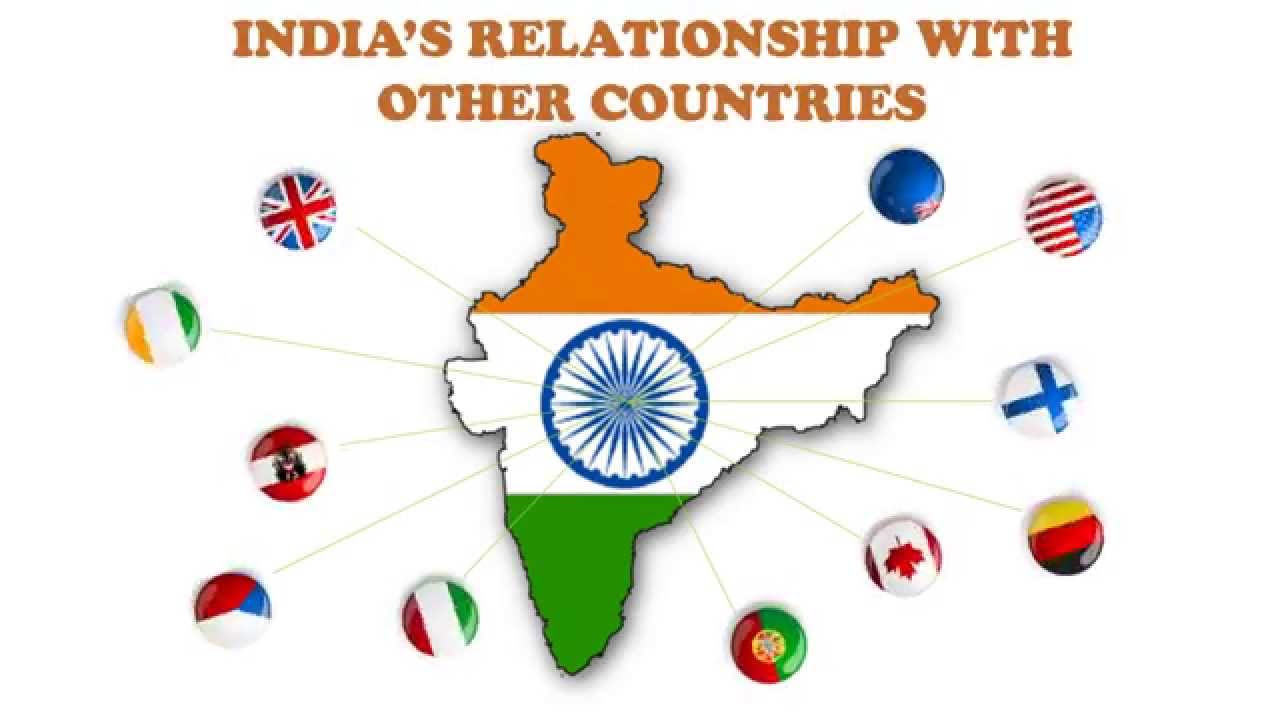
India’s Diplomacy is standing at a good potions no matter still there are many internal disputes but in the eyes of world India is at a better place. India is able to maintain relation with foreign countries in a stable and steady manner which will ultimately help the people of India. In the coming years India will be able to maintain permanent seat in UN Security Council which will be biggest achievement in diplomatic point of view.
Image source: Kosha group
4) Population
India has highest number of fresh minds, they are handled correctly with innovative and interesting education system than none of the country can stop India to be listed in top 5 countries. Youth is the biggest asset of India and no other country has this much amount of youth in their population. In the coming years, some of the strong nations of the world will face problem of decrease in populations and this will lead to, a decline in workforce, India will face no such problem.
India’s education system need to be modified a bit and student instead of memorizing theories, they should be taught to learn and understand the concept. The subject related to entrepreneurship should be added at early age so that they get knowledge of business at early age which would help them and ultimately help the nation.
Image source: Indiannewsonweb.com
5- Science and Technology
India has greatest potential yet to be showed to the world in the field of science and technology. New and new startups are evolving around us day by day and that will help a lot. Our scientist proved that India can even complete the mission on a budget of bollywood movie. India is also 4th country to land on the moon. India is emerging slowly in the field of software and will create a great impact in the near future.
Progress of India towards self-reliance is governed by certain pressing issues and their timely solution to achieve self-reliance. India has succeeded in keeping the rate of spread of Coronavirus which has caused a lot of injury to the social and emotional status of the society and created obstacles for India in achieving the aim of becoming self-reliant and seek self-sustenance.
If we look back to the days when economic reforms were introduced in the 1990s that gradually brought improved result in bringing the economy on the right track and resulted in improvement in the living standards of the people. However, we could have put in more thrust on technological and related advancements. This lacuna surfaced because of the trade policy on import and export of the goods.
The Central Government is now focusing more on development of infrastructure, usage of technology to optimum, upliftment of human resources. This is the right time when India can revive the economy by bringing about some major changes in the usage of available resources with the help of penning down new methodologies.
Issues that have caused hindrance for India’s progress towards self-reliance are; keeping away from full open markets that aligned with globalization, rate of production and manufacture, China playing an indispensable role in the Indian economy, Centre-State face off in concurrent sectors particularly agriculture.
If we shift our focus towards the solutions available to us viz. the availability of trained and skilled workforce for self-sustenance, shifting the dependence of manufacturing from China to India. India has a considerable young population strength that can be trained to attract new investments from global manufacturing giants. Optimum utilization of Indian human resource can set a new trend in the global economy. India is a ground for development and also a market with a huge potential for finished goods.
India possesses relevant aspects for generating the demand and consumption of the supply which can boost Indian self-sustenance. At the same time, while striking the balance between opening more areas for investment, India needs to seek healthy competition among the local and regional level. An opportunity to recognize the scattered local expertise of the Indian people in creating hand made useful things.
Policies can be framed to give more inclination towards local innovative crafts and skills so that they survive capitalism. Increasing control over agricultural products, defence sector, public health system and developing an indigenous chain of supply will enhance the self-sustenance. Increasing transparency in government purchase system adopting global procurement standards can enhance the rate of provision of material for expecting real-time growth.
India can focus on areas where it can shoulder the leadership and invite the investors. Usage of technology for the growth of Indian subcontinent is still underexplored. The world has turned virtual and advancement towards artificial intelligence and automation is the need of the hour. Hence, it can be summed up that framing real-time policies that focus more on meeting the results and adequate pumping of resources for proper development of education sector, health sector and catering for training the human resources will take India a step closer to achieve self-reliance.
Ideas, commerce, science, culture, productivity thrive at cities. More than half of the world’s population lives in urban areas. By 2020 two thirds of the world’s population (6.5 billion) will be urban. The increasing shift of rural to urban population because of various factors like job opportunities is called as urbanization.[1] However the development of cities comes with its own share of challenges. Cities which occupy only 2-3 % of earths land accounts for earths land account for around 60 -80 percent of energy consumption. The increasing number of slums has become a significant feature of urbanization. Over 1 billion people currently live in slums, with the number of slum dwellers only expected to grow in the coming decades. The less developed countries or developing which have grater rates of urbanization are host to majority of the slums.[2] The growth rate of urban areas in the developing countries are 2 % while it is 0.5 % in the developing countries.[3] Most of these countries however has failed to develop adequate infrastructure for these growing urban population. The number of slum dwellers is projected to increase to 2 billion by 2030 and to 3 billion by 2050 if current trends persist (UN-Habitat, 2010).[4] The presence of slums has regional and global implications, impacting areas such as education, health and child mortality, and political and social exclusion, among many other things.[5] This necessitates efficient urban planning and management and culturally inspiring cities and inclusive green cities for future. There is a need for a rapid shift to a sustainable way in the process of creation of our urban spaces. Jobs and opportunities should be created without burdening available land and resources.
The UN explains:” The challenges cities face can be overcome in ways that allow them to continue to thrive and grow, while improving resource use and reducing pollution and poverty. The future we want includes cities of opportunities for all, with access to basic services, energy, housing, transportation and more.”
SDG 11 in Indian Context
India, which will be third largest economy just behind china and U.S.A by 2025 is one of the fastest growing economies of the world.[6] India has witnessed a very high increase in its urban population. According to 2011 census, the urban population in India is around 31 % while it was at 11% according to 1911 census. Various statistics points to the fact Indians urban population has increased by 91 million between 2001 and 2011. Most of the Indian cities like Delhi and Mumbai faces the problem of congestion. Also this goals holds great importance in Indian context as Mumbai is home to one the world’s largest slum, Dharavi which expands over an area of 2.1 square kilometers and has a population of about 700,000. 17% percent of urban population in India lives in slums, Delhi being the most polluted capital of the world again this year again and more alarmingly India is home to 21 of the of the 30 cities in the world, there are repeated instances of floods in Chennai .Further there are numerous cases of repeated prosecution of Bangladeshi immigrants in Kolkata.
Migrants who come to cities from villages looking for better jobs and opportunities end up homeless due to various reasons like financial problems, unemployment, natural calamities etc. They end up living in small huts made of straws, plastic, polythene etc. Majority of them live in very deplorable conditions without even basic necessities like toilet food and clothes.[7] 13 % percent of the urban households doesn’t even have basic sanitary toilets.[8]
Efficient management of slums is essential towards this SDG as growth of slums has harmful ramifications on both humans and environment which are interlinked and not severable. Slum dwellers are vulnerable to threats like natural calamities and manmade disaster and these have direct impact on them[9].Their weak economic status makes it nearly impossible or extremely difficult for them to recover from the natural calamities. On the other hand, slum residents themselves can impact their environment due to lack of basic services, which results in contaminated soil and polluted air and waterways. This results in a perpetuated cycle of decline for both slum dwellers and the environment.[10]
This can be ascribed to the fact that the capacity of slum dwellers to recover from disasters are very low compared to formal communities.[11] Hence, increase in number of slums can be a serious challenge to sustainable development and we need efficient urban governance to combat this.
Conclusion
The challenge and responsibilities of achieving the Sustainable Development Goal 11 are domineering in India. Urbanization must usher in a process of inclusive economic growth and counter the trends in inter and intra-urban inequalities that have grown at an alarming rate. It is expected that the Goal will be achieved through an urban development strategy, which allows all stakeholders, especially the currently marginalized and excluded sections to participate actively in social and economic life. Govt’s policies, programmes and schemes need to ensure that there is universal access to safe and affordable housing, basic amenities and open green spaces. The strategy must include components aimed at upgradation of slums, improvements in urban planning and management practices to make them participatory and inclusive, safeguarding the heritage and protecting the citizenry against natural disasters.
Despite the fact that India has done well on many sustainable development goals and climate goals, much is yet desired to achieve sustainable development in the real sense. First and foremost is the need for a clear road map to implement the policies to achieve with identified roles for the state governments, and a monitoring mechanism to measure progress. It also needs to draw up a quick plan to overcome the want for quality data. Public education and awareness are second to none in terms invoking agency of people in achievement of sustainable cities and communities. The goal is more complex than to be achieved by the policies and government programmes alone. We thus need to harness energy, understand and involve participation of all stakeholders including the NGOs to make sustainable development a reality.
[8] McGranahan, Gordon, and David Satterthwaite. Urbanisation Concepts and Trends. International Institute for Environment and Development, 2014, http://www.jstor.org/stable/resrep01297. Accessed 7 Apr. 2020.
Microbiology is the study of microbes i.e. the organisms which we can’t see with the naked eyes. Although many microorganisms are beneficial for the human use, some are pathogenic also which causes diseases. Clinical Microbiological Laboratory is concerned with finding of those infectious, pathogenic microbes.
MATERIALS USED IN MICROBIOLOGY LAB Laminar flow hood, Incubator, Autoclave, Refrigerator, Bunsen Burner, Wire loop, Petri plates, Glass slides, Weighing balance, Media plates, Sensitivity disks, Staining rack, Microscope, Bio safety Cabinet, Centrifuge etc.
INTRODUCTION TO DIFFERENT MEDIA Some of the media used in the microbiology lab are :
MacCONKEY AGAR : It is the selective and differential media used for the isolation of Gram-negative Bacteria. This media can be used for differentiating Lactose fermenting and Non-lactose fermenting bacteria.
BLOOD AGAR : It is the enriched media for the growth of bacteria such as streptococci.
CHOCOLATE AGAR : It is the lysed Blood Agar. The only difference in blood agar and chocolate agar is that in blood agar RBCs are lysed. This enriched media is suitable for the growth of bacteria that are unable to grow on Blood Agar.
THIOSULFATE CITRATE BILE SALT AGAR (TCBS) : It is the selective as well as differential media for the growth of vibrio cholerae , a causative organism for cholera.
GRAM STAINING Gram staining is the process for differentiating Gram positive and Gram negative bacteria. When the whole procedure of gram stain is followed and the slide is observed under the microscope, Gram positive bacteria appear Violet in color and Gram negative bacteria appear Pink in color. For the gram staining we need Glass slide, Normal Saline, Inoculating loop, Bunsen burner, Crystal Violet, Gram’s Iodine, Acetone, Safranine.
PROCESS :
The isolated colony of the microorganism is taken and in the drop of normal saline on the glass slide the colony is mixed with the help of inoculating loop to make a smear. The prepared smear is heat fixed.
A staining rack is taken and on the smear, Crystal Violet is added. After 1 minute, the stain was removed by washing the slide in running water.
After that, Gram’s Iodine is added on the smear as a decolorizing agent which is again washed after 1 minute under the running tap water.
The next step is to add Acetone on the smear which is added in the hand to hand process.
After the decolorisation is done, Safranine is added on the smear which is also washed after 1 minute.
The glass slide is then air dried and observed under the microscope.
RESULTS : It was observed under the microscope that the Gram positive bacteria appear Violet in color due to Crystal Violet stain whereas Gram negative bacteria appear Pink in color due to safranine.
TESTS ANALYZED The tests analyzed in the microbiology section of the laboratory are basically the culture and sensitivities tests of urine, stool, sputum, pus swab etc. The basic procedure of performing all the tests are :
First of all, all the tests are performed inside the laminar flow hood.
The samples collected from the patients and the media plates are kept inside the laminar flow.
The inoculating wire loop is heat sterilized and with the help of it, the samples are cultured or streaked on the media plates.
After inoculation, the cultured media plates are incubated for 24 hours (48 hours if necessary) for allowing the growth of bacteria.
After the growth, staining is done or sensitivities are checked according to the requirement by the doctor.
First of all, what is the blog, everyone knows the blog, but here is the question of what is the technical turn and where is the origin of the blog? well, I tell you, the blog started out as a mix of what was happening in a person’s life and what was happening on the Web, a kind of hybrid diary/news site, and a person who has knowledge of how to post any news or new thing they begin their life with small blogs and they continue to word the success. furthermore, look about the origin of The word “blog” is a shortened version of weblogs or weblogs. Besides being shorter and catchier, “blog” seems less likely to cause confusion, as “weblog” can also mean a server’s log files. in the past, not many people aware of the posting blogs, and there were not many facilities provided on the internet to post a blog, but in the last 10 or 15 years the trend of posting blogs is growing like a rocket.
people post many kinds of blogs like technology, photography, lifestyle, cooking, daily knowledge, general knowledge, news regarding pollution and Government, and many more. by sharing the post, people can share their experience and they can also pass their time if they do not have work to do. Nowadays, many companies and organizations like EDUindec.com and other NGOs higher the writer and give access to write something and post on their website or share on their social media and get the popularity, many organization also provide the education on these and how to bring more people on the site by getting this education on can easily understand the process of SEO (search engine optimization). there are some websites and domains, which provide free workspaces to write or promote social media handles.
However, many online e-commerce sites also on the trading and they start there platform by sharing the information on the blogs and through they share the product on their blog like clothes, accessories, computer parts, cooking books, and more. there are some famous bloggers Amit Agarwal, who is a Google Developer Expert, Amit Bhawani, who is also a famous tech blogger and he also has own youtube channels, so he starts to build his future by posting technology-related blogs, and in last, Srinivas Tamada he also famous Indian blogger post blog regarding the SQL databases and new database software for those people who wont to know about the databases of companies.
Here some advantages of having and writing blogs:
Instant Marketing and Publicity: Now as people read, they learn about your work, your life, and/or your interest. You are on-air as long as your website is up. For about 10 to 30 minutes a day depending on how much effort you place, you are to impart something different to your readers, it might be knowledge or entertainment but as long as they get something, they finish your article with you leaving a mark in them at that moment. And that’s what’s important, ’cause when you do, you just got yourself a tribe.
Increase in Search Ranking: Compared to a static portfolio, a blog counterpart is much friendlier to search engines because of the fresh content it offers once in a while. The friendlier you are, the better chances of you being searched for. And in case you haven’t thought about it, your blog can also include your portfolio which can be easily update-able rather than tinkering with your.html code just to insert another work.
You gain additional income: Some of the successful people in the blogging industry choose to have additional income by placing some ads beside their website. In some cases, their website becomes a marketing tool for other companies because of market specifics they cover. Other companies don’t like to make blogs for the heck of it, so in turn, they use other bloggers to market their services or product, and guess what? They pay for it!, For other online ad-companies, a mere browse through is enough to add to your piggybank, for others, you need clicks and to some, you need sales. But whichever the case is, you are earning passively for writing about things you love.











 Eduindex
You must be logged in to post a comment.