BASICS OF TURNING HOBBIES INTO CAREER

I have already enlightened you about why having hobbies are important. In case you have missed it out then do read it by clicking on the link below.

We all have hobbies. It might be writing, painting, Youtubing, dancing, and whatnot. We all love to follow our hobbies because they are interesting and make us happy. And any work done happily and enjoyably brings spectacular success. Even Maya Angelou says so.

“You can only become truly accomplished at something you love. Don’t make money your goal. Instead, pursue the things you love doing and then do them so well that people can’t take their eyes off of you.”
– Maya Angelou

Now many of you might think, is it possible to transform a hobby into a full-time career? Yes, you can definitely do so. All you need to do is prepare a rock-solid strategy and plan.
In the following lines, I will point out some of the areas which you need to consider why preparing your strategy.

MADE WITH CANVA

CLEAR YOUR MIND:

So, first things first. List down the hobbies/passions you love and then prioritize what you are most inclined to. Make sure to write things short and clear. Once you choose your hobby, ask yourself certain questions.
Like, why do you want to make this your career? What are your goals? Answering these questions will bring clarity to your mind. You would be more serious and driven towards your decision.

DO MARKET RESEARCH:

After you have decided on your path, do full market research. Read about your target market and its trend. The potential customer’s demands and the type of product and service you would provide. Collect data on all of these dominions. Write down your full research on paper and accordingly chalk out your plan. Make sure you consult your plan and strategy with wise counsel.

DO IN-FIELD PRACTICAL:

Once your plan’s blueprint is ready, take it out to the customer. The best way to know the quality of your plan is to do an in-field practical. Take up your plan to a potential customer and ask him about their view on your project. What product/ service they would want to get? Or what are their demand from this field? These analyses would help you get ample knowledge about your project, the opinion of the customers, and its scope in the market.

LEARN MARKETING BASICS:

After you have done the research and began the production, start learning about the ways to advertise your product. For reaching out to the customers and interacting with them, you need to know the marketing basics. Nowadays, Digital Marketing is heightening. Learn how you can connect with your customers online. The initial step in this would be to start your website and a social media handle. You can even run digital ads on Google Search, Facebook, or Instagram. These are some low-cost advertisement platforms, where you can create a wide customer base.

BE CONSISTENT:

Out of all these steps, the one thing that matters most is being consistent. You might not be able to attract a generous number of customers, or your product might not stand out in the market. Whatever the situation might be, you do not have to lose hope. Just be consistent in your work. Accept the defects and shortcomings and work upon them. But, never let your energy and enthusiasm fade even a little.

Dwayne Johnson, a Hollywood actor says,
“Success isn’t always about greatness. It’s about consistency. Consistent hard work leads to success. Greatness will come.”

Keep these basics in mind and follow these steps and one day you would definitely shine bright.

Influence of Western Cuisine on Indians

Burgers, fries, pizza, turkey, hot dogs, wraps, sandwiches, pasta and shakes. Yum, right? While dreaming of delicious food, our mind often wanders to the foods offered by Western cuisine. We cannot deny the irresistible appeal of Western food even though we have pretty good choices of hot and spicy veggies and curry on our Indian menu.

The fast-food chains such as McDonald’s, Burger King, KFC, etc., influenced by western food, are rampant across every part of the world. Western cuisine is gaining rapid popularity everywhere to provide for guests from different nationalities because of tourism.

Do you even remember the last time you ate with your hands? Spoons, forks and chopsticks have invaded our traditional way of consuming food. When we eat with our hands, we become more conscious of the taste, flavours and aroma, leading us to relish and enjoy our food more. Right from the way of eating to what we eat, everything has changed due to westernization.

The staple diet of western people revolves around meat. They have bread as a supplement or an appetizer. They tend to eat fried foods over others and include artificially developed products and processed ingredients. They prefer minimal spices in their food too. But we Indians, on the other hand, love the mix of spices such as cloves, cinnamon, cardamom, saffron and many more. Our staple diet is rice and vegetables. We have unlimited and wide varieties of options to choose from for breakfast, lunch and dinner. We are more inclined towards fresh and homemade food.

We have established that Indian cuisine has aromas, spices and all the tasty whatnots. But still, we prefer Western cuisine. There are many reasons behind it. One chief deduction is that we have always had an inferiority complex that made us hold the Western culture in high regard. In doing so, we began to imitate their lifestyle to become equals to them. The other equally significant reason is that globalization has caused Western foods to crawl into Indian kitchens.

There are two sides to a coin. Sure they look appetizing, taste phenomenal and takes little to cook, making it a convenient choice. What more can we ask for, right? Anyhow, did we ever stop to wonder whether these types of food are suitable for us? They may tickle our taste buds at the moment, but they leave a profound mark on our long-term health.

Western food increases the risks of high blood pressure, diabetes and heart attack. Due to the lack of variety, it focuses higher on sugar and fats. It causes a threat to our biological system, leading to a rise in diabetes patients in our country.

The abundance of fat in fried foods is the main culprit provoking unhealthy weight gain and digestive troubles. Forget about maintaining your thin waistline and toned abs if you are not ready to give up chicken nuggets and salty dips. But, sacrificing them and switching to roasted and baked foods would prevent the adverse effects later in your life.

Despite the ease of preparation, Western dietary habits are disastrous to our health. If we do not establish a stop system to shut down the onset of the growing fast food industry, obesity and lifestyle risk factors will become more prevalent in India.

All that has been lost in the pandemic

We are almost over with the second wave, but we humans as a community have lost so much to the pandemic. It almost feels like the silence after the storm, when all the buildings, trees have collapsed but you are standing there helpless, staring at the damage and destruction that has been caused by this storm named pandemic. We still haven’t recovered from the scars of the 2 waves of covid and there is another wave lurking around the corner, and who knows the devastation it may bring about, although I hope it does not cause any more loss.

The second wave saw deaths at a larger rate than the previous wave, there was not a single night where there was no sound of an ambulance wheezing to save a single life.

The sad part is that many of the people who their lives might have been healthy if not for covid, they might not have had any health complications but still lost their life. Young people, too, have lost their lives in this pandemic.

We will eventually come out of this pandemic but at what cost? For many of us, it won’t even matter if the pandemic ends, after losing loved ones. But this where we should try to understand that now, after losing a life which was so dear to you might feel like “does it matter now that the cases are coming down, that deaths are occurring less and less day by day?” But still, we must realize that there are many more lives that need to be kept safe. The pain of losing a dear one will not pass away easily and when your kids will be reading about the pandemic, in the future, in their books, that memory will come alive again.

Many other things have also been lost, many people have lost their jobs, they have not been able to feed their family and themselves. Many students who were looking for employment lost their chances due to this pandemic. We have lost our normal routines, it feels like a lifetime when we went out for dinners and movies, we now miss even a regular day at schools and colleges.

But the bottom line is, life will go on no matter what, people will eventually forget that you had lost someone during the pandemic, they will move on. You will have to deal with this yourself, and we cannot blame them because everybody has to get on with their lives, so take time your time, sit back and reflect. Let the grief enter your mind and heart, feel it completely, cry, and when you let it sink in completely, then maybe you will be able to detach yourself from that feeling, although you can never forget it, it may help you. This detachment theory was something I read in the book “Tuesdays with Morrie”. We all must hope that the third wave does not bring with it any more destruction or better it does not come at all.

SNDT WOMEN’S UNIVERSITY’S MEDIA MANTRA ROPES IN HIGHLY ANTICIPATED GUESTS FOR TWO QUIRKY PANELS. SNEAK-PEAK INSIDE!

This year marks 15th edition of SNDTWU’s Media Mantra. Education panel aims to gain perspective of edu-systems on how pandemic acted as catalyst in enhancing learning process with virtual shift. It reflects upon how lockdown fueled India’s EdTech platforms. The panel revolves around key game-changers like learning solutions, impact of technology, chance to upskill and institution’s crisis-response methods.

SNDTWU Extension & communication head of department Dr Mira K Desai spoke at length, upon asking how did students cope up with online education, she stated “It was challenging mainly in context of gender division of labor. Many of our students found it challenging to cope with new reality of studying with limited connectivity and manage studies while working from home.”

Media Mantra themed around ‘Unlocking Digital’, a flagship event organized by postgraduate students, since it is held virtually for the first time, Mira shared insights on her experience, “Media Mantra helps students explore their own potential and help them connect with industry. This is the first time that we have Online Media Mantra and it has gone National with panels and activities.”

Virtual event’s education panel will also comprise ‘National Survey’. On Challenges of online lectures, Mira K Desai commented,” You can join our panel to know what happened across the country.” A Voluntary Group of eleven media teachers from nine geographical locations across India got together in 2020 and decided to take up a study to understand impact of teaching-learning in online environment. Main objectives were understanding issues of reach and access of online technologies for online teaching/learning and examinations amongst students and teachers involved in media education.

Mira further added about supposed changes, “While all other processes remained unchanged, Media Mantra is an organically generated event for, of and by students. This year it’s different in terms of being online and also being ‘national’.” 

She concluded what brand value Media Mantra holds, “We would like to believe that SNDTWU Media Mantra is a brand. It was launched in the year 2000 and is growing. This edition is 15th and we have 15 logos, taglines, guest lineup and reflection of Media of that time as perceived by our students.”

Influencer-based viral panel will give warm welcome to a string of millennial influencers who have carved a niche on social media platforms. Shradha Vyas, Fever FM RJ and host will overwhelm the audiences acting as moderator. List of content influencers include popular actor and digital creator Adil Feroz Khan, travel blogger Archana Singh, digital artist Diksha Rai, MTV’s former editor and video creator Nikhil Sidhwani. The edu-based panel will welcome guests such as  Dr Akhil Shahani, MD of The Shahani Group and Rishabh Khanna, Cognitive Scientist and founder of the EdTech firm Suraasa which is a Teacher Education and lifestyle management portal. Dr Uma Shankar Pandey, IAMCR India Ambassador. Media mantra will be held on 26th June, courtesy of Nazrana Creation. 

INDIA’S ECONOMIC EXPLOITATION UNDER BRITISH RULE

SOURCE- PINTEREST

The very first Hindi word to be added in the English dictionary was “loot” which refers to the spoils of war pillaged from an enemy. This first addition was made when the British ruled India and filled their bags with Indian riches.

Before the British established their stronghold in India, our country was known all around the world as “Golden Bird” or “Sone ki Chidiya”.

The disintegration of the Mughal Empire in the 18th CE brought both political and economic fragmentation of the country. It was during this time that the British made their cunning move and eventually began to colonize the country. It was this colonial rule that not only devastated the political and social fabric but also drew out the riches.


A company’s official John Sullivan observed in 1840,
‘Englishmen flourishes, acts like a sponge, drawing up riches from the banks of Ganges and squeezing them down upon the banks of Thames’.

Before the British came, India’s share of the world’s GDP was very significant.
Angus Maddison, a British economic historian observes that the contribution of India to world GDP declined from 24.4% to just 4.2% between 1700-1950. This is really a very dwindling figure.

SOURCE- PINTEREST

It was not that the Indians during the colonial times did not understand it. It was apparent to everyone. The greatest contribution in making the common people realize the economic exploitation goes to Dadabhai Naoroji. He put forward the “Drain of Wealth” theory.
He described the drain of wealth as the major cause of Indian poverty. He said that the British were “bleeding India White”.

“By the end of the nineteenth century, India was Britain’s biggest source of revenue, the world’s biggest purchaser of British exports, and the source of highly paid employment for British civil servants and soldiers all at India’s own expense. Indians literally paid for their own oppression.”
― Shashi Tharoor, Inglorious Empire: What the British Did to India

And now the figures of how much the British drained our country would certainly blow everyone’s mind.
Writing in 1859, George Wingate estimated the drain at £4 million per annum for 17 years between 1835-1851.
V.I. Pavlov, professor of Economics at Moscow State University, estimated that in the 1930’s the British squeezed India of £130 million- £140 million in pure tribute.
He remarks that -“With this amount, India could annually construct 3 plants of Bhilai type each of which would exceed in capacity the country’s iron and steel industry in British period”.

Thus, it can be concluded that the exploitation of Britishers is beyond reparation. The Englishmen understood that India was the bird that could lay golden eggs for them. So, they drained our country so excessively that when they left in 1947, they left behind an economically impoverished country, suffering for centuries from poverty and exploitation.

The Art of Rogan Painting

India is a diverse country, rich in age-old traditions and culture. Throughout its history, India has witnessed the emergence of many exotic art forms and craftsmanship. However, with the rise of cutting-edge technology of industrial textiles, many traditional craft forms have taken a massive hit. Rogan painting is a classic example of an enthralling yet sadly dying art. 

What is Rogan Painting?

Rogan painting is a 400-year old inherited traditional textile craft of Gujarat. It is considered to be the oldest and most challenging printing art in the history of textile. The word Rogan means oil in PersiaWith origins in Persia, it was brought to India around 300 years ago, even though there is not enough historical evidence to support the statement. 

Preparation of the Ingredients

The chief ingredients required for Rogan painting are castor oil, wood, kerosene oil and dyes. The first step in the painting is the preparation of Rogan paste. 

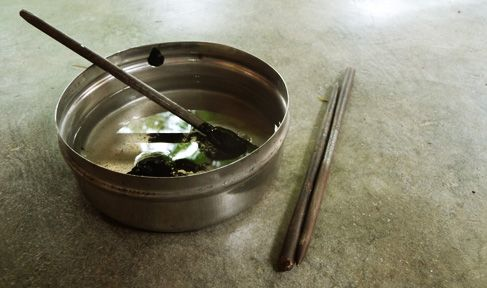
After preparing a furnace and selecting a suitable aluminium container, the local craftsmen boil a litre of castor oil for a minimum of four hours. The time required for boiling may vary depending upon the quantity of the oil taken. Then, they continuously stir the oil until it is time to remove the container from the furnace to let it cool down. While boiling, the castor oil may catch fire, after which it is immediately taken out and covered with a lid. During this, the impurities present in the oil gets thrown out in the form of fumes. This process is repeated several times until the oil forms a thick, gelatin-like consistency and turns yellowish. 

Traditionally, the dyes used in Rogan painting were derived from organic, natural sources such as stones and plants. But today, synthetic dyes are used too. Red, yellow, blue, white, green, and brown are the primary colours used in the painting. 

A manual stone grinder was used to mix naphthol dyes and white chalk powder and prepare the colour paste. With the gradual addition of water, the required consistency of the paste is reached. The Rogan paste is added to the colour paste and ground until it forms the desired soft, smooth, gelatinous dye paste. 

Process of Rogan Painting

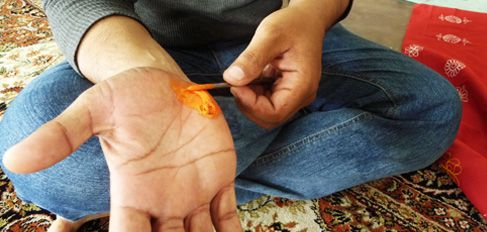
The process of painting is a very tedious and cumbersome task. Initially, the craftsmen lay the fabric to be painted on the floor. Next, they take a lump of the dye paste and put it on the palm of one hand. They hold a suya rod or a metal stylus in the other hand and mix the thick paste till it stretches into a thread-like structure. 

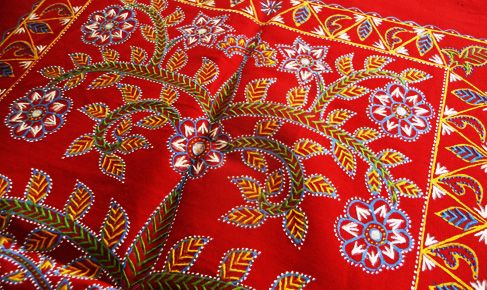
They carefully twist the rod to create beautiful motifs and patterns across the fabric without the rod touching the cloth. After that, they fold the fabric and press it evenly to obtain an identical impression on the other half of the fabric. Lastly, the fabric is left out in the sunlight for about six to seven hours to let it dry.

The intricate motifs that embellish the fabric, such as geometric flowers, peacocks, the tree of life, etc., are inspired by the history and folk culture of the Kutch region of Gujarat.

Originally, the Rogan Art was used to adorn the trousseau of a bride. But due to the limited resources, meeting the market demand has become a challenge. From almost becoming a dying art to gaining worldwide recognition, Rogan Art sure has come a long way.

How has the Pandemic affected the Education Sector?

The pandemic has brought with it nothing else but devastation and destruction. This destruction is not temporary, it will have an effect on the growth of our country in the upcoming years. One of the reasons would be the hardest hit education sector in our country.

The virtual mode of classes has gained the limelight but it has been very difficult for many children in rural areas to continue their studies without hurdles.

These virtual classes require an uninterrupted data connection and a gadget to attend classes on. They do not have access to these things, they might have sufficient data to access information from the web but to attend classes without network disturbance is not possible for them

Some of the government schools are not even holding virtual classes because they don’t have the resources and the teachers and students aren’t well equipped. The loss of these two academic years could have an adverse effect on the country’s future.

Teachers had to be trained to teach virtually and they tried their best to learn so that the studies do not get hampered but these teachers and students who have been teaching and learning in the physical mode for years can not suddenly transition to the digital mode. Children are better at adapting to new technologies but the teachers have had a hard time getting used to the digital mode and even then, the techniques and methods with which these experienced teachers used to teach couldn’t be implemented effectively through the screens.

The other problem faced by many school children is the lack of midday meal which was provided to them at their schools.Those children who benefitted from the Midday Meal Scheme are now deprived of nutrition although the government has now promised to give Rs.100 to each student of classes 1st to 8th who used to get the Midday meal but this is surely not enough to compensate the malnutrition faced by the students in the last year.

The unemployment rates have shot up and they have never been this bad. During the pandemic, many students are facing difficulties in getting placed into companies because many of them have initiated a hiring freeze for some time.

The fee has been a major issue during the lockdown period. Many schools and colleges are demanding the same amount of fees as during the regular classes but parents/guardians are not able to pay the fee of these educational institutions because many of them have lost their jobs. But it’s a loop because these educational institutions have also suffered due to the unpaid fees and hence considered lay off of teachers as an option.

All these issues have further increased the digital divide in our country. While many students are able to attend classes and continue the preparations for their exams, some of them are still struggling to get the uninterrupted data connection and many are devoid of online classes since the last year.

WhatsApp Versus Indian Government

The whole nation is in turmoil due to the provisions of the new Information Technology Rules, 2021. To understand the situation better, we will see what the rules are and why they are causing conflicts with the Government. 

New IT rules that undermine the power of social media

The proposed new rules will cover social media companies like Facebook and Twitter, OTT platforms such as Netflix, Amazon Prime, Hotstar, and digital news publishers like The News Minute, Scroll, Quint, The Wire, Newslaundry, The Cue. 

Indian Government revealed the new social media rules on February 25, 2021. As per the new rules, social media intermediaries will now come under a three-tier regulatory regime. In this context, “social media intermediary” refers to an intermediary which primarily enables interaction between two or more users and allows them to create, upload, share, disseminate, modify or access information using its services. 

  • The First Tier

The first tier follows a self-regulating mechanism. The social media intermediary is required to appoint a resident Chief Compliant Officer, nodal contact person, and a resident Grievance Officer. The Chief Compliant Officer shall ensure compliance with the Act and the rules thereunder. The nodal officers shall coordinate with the law enforcement agencies to ensure compliance with their orders. The Grievance Officer shall acknowledge the complaint of a user within 24 hours and dispose of such complaint within a period of fifteen days from the date of its receipt. 

  • The Second Tier

The second tier is self-regulated by a self-regulating body. This body consists of a retired judge or an eminent person from the department of media, entertainment, or any relevant field. It has the power to censure, modify or delete any content it deems a cognizable offense.

  • The Third Tier

The third tier follows an oversight mechanism. It establishes an Inter-Departmental Committee that mainly performs the functions of the self-regulatory bodies. 

Some of the chief issues that worry the social media companies

  • Privacy concerns

One of the provisions of the new rules requires that the social media intermediaries disclose the identity of the “first originator” of the information that threatens the sovereignty and integrity of India, the security of the state, or public order.

  • Usage of AI

The Indian Government also requires the social media intermediaries to deploy technology-based measures to identify information that depicts any act or simulation in any form depicting rape, child sexual abuse, or conduct, whether explicit or implicit. 

Reactions to the imposed IT rules:

Obtaining the identification of the first originator would break the end-to-end encryption. By breaking the encryption, users cannot safely exchange chats, photos, or information on social media platforms without them being open to access not just by bureaucrats and government bodies but also by hackers.

While it is necessary to deploy Artificial Intelligence (AI) to monitor objectionable content, there are certain limitations to implementing it. With the number of users increasing, it is laborious to moderate the amount of content generated every day. 

WhatsApp’s stand against the Government

While Facebook has complied with the new rules and Twitter has remained a silent bystander, WhatsApp has filed a lawsuit in India which seeks to block the new digital ethics code from coming into force. For WhatsApp to identify the first originator of even one message, it has to restructure the entire platform. This feature compromises the privacy of billions of people who communicate digitally. The other concern is that freedom of speech and any form of expression of dissent would be hampered. 

IT Minister Ravi Shankar Prasad has stated, “It is WhatsApp’s responsibility to find a technical solution, whether through encryption or otherwise.” It will be interesting to witness how far India would go to press WhatsApp to comply with the new rule.

Countries where Indians can travel without visa

There are several countries where Indians are not required to have a visa to travel. A total of 58 countries allow you a visa-free travel with your Indian passport.

>Indonesia

Indians travelling to Indonesia can go visa-free for 30 days. If the duration of travel is more than 30 days Indians can apply for visa after their arrival in Indonesia.

>Ecuador

Citizens of India don’t need a visa in advance to travel to Ecuador. The facility of visa-free stay here for Indians is of duration of 90 days. The travelers, though, need to carry their financial documents and passport with a validity of 6 months along with their return ticket and travel insurance.

>Serbia

Indian citizens can stay upto 30 days visa-free in Serbia from the date of entry within a year. A stay exceeding the mentioned duration would require a temporary residence permit.

>Montserrat

Indian citizens can travel visa-free for 30 days in Montserrat without a tourist visa.

>Macau

Indians can stay visa-free in Macau given the stay should not exceed 30 days. Visitors are required to ensure their passport validity upto 6 months from the date of visit.

>Svalbard

You don’t need a visa to travel, work and reside permanently in Svalbard.

>Nepal

Indians don’t need to have a visa to stay in Nepal. However, it is important to register to the Indian Embassy in Kathmandu after a stay of 6 months.

>Haiti

Haiti doesn’t ask for a tourist visa to Indian travelers who can live upto 90 days there. All non-Haitian traveler are, though, required to pay a tourist fee of 10USD on arrival and validate their passports of 6 months validity from the date of arrival.

>Turks and Caicos 

A tourist visa is not needed to travel to Turks and Caicos. All you need is a valid visa for entry and exit. 

>Jamaica

Indian visitors can travel to Jamaica visa-free for upto 30 days. A stamp on the passport by the immigration officer on arrival acts as a tourist visa for Indians.

Mizoram- the happiest Indian state

In the recently released India Happiness Report 2020 Mizoram has been announced as the happiest Indian state followed by Andaman and Nicobar Islands and Punjab among the top three. It was the first time that all the union territories were surveyed along with the states.

The Happiness Survey was conducted between March and July 2020. The parameters of happiness index were:

>Personal relationships- family and friends

>Work related issues- income level, work pressure and growth

>Physical and mental health

>Social issues

>Impact of COVID-19

Further, it was observed that the above mentioned parameters are positively related to happiness.

Contributing factors

>care for others

>preservation of culture

>belief in nature

>respect for tradition

How to plan career after 12th

Once class 12th results are out and the school is over, it is time to make the strategies for higher education and think over what to do next. With numerous options available today, students often get confused in choosing a relevant career path for them. Many of the students might have already had plans for their future in place but for some the confusion still persists.

Here are some tips to keep in mind while choosing the most relevant career path.

>Know your interests

Before jumping on to look for the available options in the science, commerce or humanities stream, it is extremely important to consider your interests. If you don’t want to spend your time at job/work counting your days then look for the career which best suits and aligns with your interests and abilities. Deciding out of peer pressure or family pressure might not turn out to be beneficial in long run.

>Choose the right course

These days there are a number of ways to pursue the same course such as degree course, diploma course, correspondence mode, online mode and distance mode of education. By getting to know about the course structure, syllabus and methodology of teaching you can pick up the course which suits your needs.

>Look out for future scope and opportunities

It might happen that your interests direct you to your preferred career path but not a viable career. In order to overcome this major hurdle, you need to search for and know about the future scope and opportunities available for that particular field in your country and abroad.

>Maintain a balance between college preference and course of study

A college preference might be as important as the preferred course but a balance between the two is more important. A good college offering your preferred course is a steal deal. However, if things don’t go as per your will, consider the course above the college brand. Because it is only the course that is going to decide your future prospects and not the college’s brand value.

>Have a plan B

Just in case you doubt losing the opportunity to grab your preference of course or college always have a plan B. It would not only save your time from being wasted but also let you to explore other options. Who knows the unexplored opportunities come with hidden but favourable outcomes for you.

Indian Indie

This article is my appreciation for the Indian Indie artist and their music which has healing powers like no other. Great lyrics are the main asset in these songs, these lyrics have a deeper meaning and so you have to listen to them carefully to get the most surreal experience. The music might only contain a guitar or a ukulele or a piano at a time instead of the whole group of musicians but once you hear the songs you would surely listen to them on loop because it soothes your soul and calms your mind.

As these artists work independently, they are free to be as creative with their art as they want and so their art reflects their creativity which sometimes can get suppressed in Bollywood music

Here are a few songs I’d want everybody to listen. (There are many other great songs of the same caliber that I could not mention in this list.)

  • Yahaan Koi Nahi (Punit Singh):  If you’re an introvert you should give this song a listen. This song has a major feel-good vibe but you must listen to the lyrics carefully because that’s where the essence of the song is. After listening to this song you would be assured that you are not the only one who feels lonely.
  • Khud Se (Osho Jain): This song will pluck the strings of your heart one by one. This song will make you realize that maybe it’s you who does not love yourself enough and that is why you think that others do not love you.
  • Waqt ki Baatein (Dream Note): Dream Note has done marvelous work to get you through the hard phase of your life, it gives you hope that everything will get better if you give it time, time heals every wound.
  • Musafir (Arjit Anand): Musafir is a song that asks you to take a pause and enjoy the present moment and the little joys of life. The voice and the music are soulful and soothing.                                                                  
  • Shaayad (Taba Chake): This song will lift your mood instantly. His voice and the music work their ways through your heart and for 3 minutes you will believe that no setback can stop you from achieving your goals.
  • Tum Jab Paas (Prateek Kuhad): There are many beautiful songs by Kuhad but this one transfers you into Utopia with your loved one. Imagine camping, bonfire, fairy lights, this is where you’ll be mentally while listening to this song.
  • Dil Mere (The Local Train): This Hindi Rock Band has released great songs and this is one of them. Dil Mere has great music and vocals and one could instantly fall in love with this song.

Indian Indie artists and their music should get much more appreciation than it gets now because these artists have the ability to connect with their audience emotionally. Listen to these songs and explore others like them, listening to these songs could have a therapeutic effect on your mind.

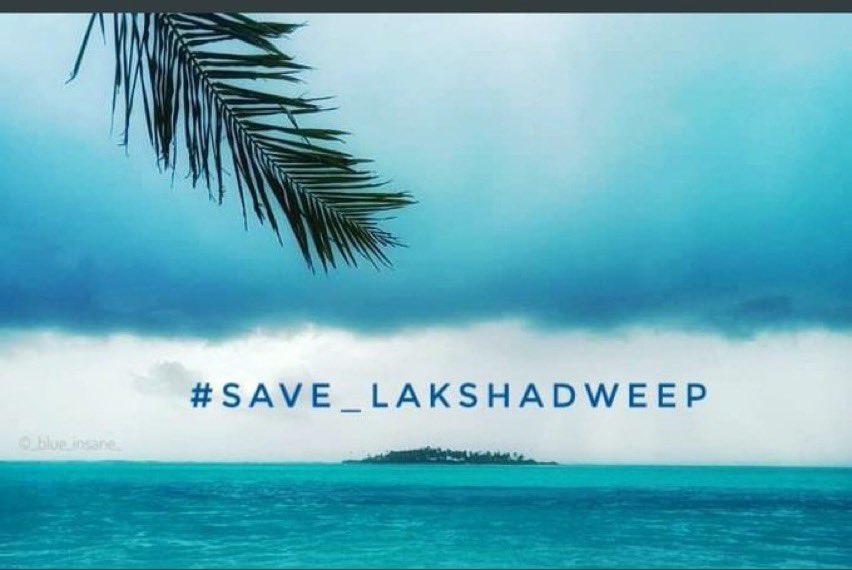
Protest’s surfacing in Lakshadweep after new Govt.laws

Located in the Arabian sea, Lakshadweep Island is the only part of India where nature has been existing in its purest form, with no traces of exploitation.
The archipelago is a collection of 36 islands, of which 10 are inhabited. Located on the southwestern coast of the Indian peninsula the island has just a population of 65,000 people, thus being the smallest among Union Territories(UT).

Amid the beautiful wilderness, harmony among the people, and well-balanced ecology, resentments among the people due to the introduction of new laws have been surfacing lately.
Protests of the hashtag “Save Lakshadweep” are echoing on social media.

A Brief Backdrop:


Lakshadweep politically has no Legislative Assembly or a Chief Minister. The entire administration of the island is divided into 3 levels-
* Lok Sabha has 1 Member of Parliament
* Local self-government: Panchayats
* The President of India appoints an Administrator for governance.

The administrators of Lakshadweep have always been bureaucrats. In 2020, it was Dineshwar Sharma, an IPS officer.
Unfortunately, on 4 December 2020, he passed away.
This was the time when entanglement started in the affairs.
After the death of Dineshwar Sharma, no bureaucrat was appointed as the administrator, rather the strings of the governance were passed to the hands of a politician. This person was Praful Khoda Patel, a right-wing politician of the running Bharatiya Janata Party (BJP) government.

The Resentment:


Since the new administrator came to the seat, Patel put forward a maverick set of laws without consulting the locally elected representatives of this Muslim-majority island. These laws have shattered the tranquility of the island and immersed it under protests and chaos.
The new algorithm of laws is being widely agitated upon. People claim that these laws endanger their livelihoods, land ownership, culture, and even the biodiversity of the tropical islands.

Typically the administrators of the island maintain their relationships with the local leaders for smooth governance. However, in the past few months, the people have raised voices against this new authoritarian administrator.

The Authoritarian approaches of Praful Khoda Patel:

Land Grab-


The administrator Praful Khoda Patel introduced the Lakshadweep Development Authority Regulation 2021, where the government is empowered to take over the lands from the residents for constructing highways, railways, or infrastructure.
The islanders view this as a land grab by giant corporates. This would also put a huge strain on the ecology and biodiversity of the area.

Weakened the democratic voting rights-


It is an old dream of the Lakshadweep inhabitants to have statehood and a Chief Minister like Goa.
They even do not have the right to elect their administrator.
keeping these besides, the poor islanders just have the shaky right to elect their MP and officials only at the Panchayat level.

Things do not stop here, the new administration under Praful Khoda Patel intruded in the local government and drained powers of the Panchayat from 5 different areas, namely- education, healthcare, agriculture, animal husbandry, and fisheries.

Further, Panchayat election regulation has been introduced declaring people having more than 2 children ineligible to contest elections.

Covid threat:


When the country was struggling hard from the Covid spell, Lakshadweep was the only Union Territory to be free of Covid. This was because until December Standard Operating Procedure to prevent COVID-19 was being strictly followed. Under this SOP, people coming from outside were mandated to have a negative RT-PCR test followed by a 14-day quarantine. People supported it and that is why Lakshadweep was Covid free.
Unfortunately, the first Covid case was reported on 18 January, 8 days after the SOP was removed by the new administrator.
The cases skyrocketed due to the island’s small area and dense population along with a not-so-modern healthcare system.

Unjustified laws:


Patel’s Anti-Social Activities Regulation Bill 2021 or Goonda Act further created discontentment among the inhabitants. This act empowers to detain anyone without public disclosure for up to a year.

This law would not be a fight against criminals because Lakshadweep already has the lowest crime rate in India. Rather it is the clear manifestation of authoritarian rule and sharply against the law of natural justice.
The application of this unjust law would be used to brand anyone who protested as a criminal.
The islanders allege that this law would be used by their administrator against those who criticize his decisions and protest his rule.

Liquor permit and beef ban:


Liquor and alcohol were banned in the inhabited resorts of Lakshadweep for a long time due to the Muslim majority and was allowed only at resorts on the uninhabited island. Praful K. Patel reversed the situation. He lifted the ban and permitted opening bars and shops, claiming this will boost tourism on the island.

Lakshadweep Animal Preservation and Regulation 2021 further aggravated people’s anger.
Praful K. Patel imposed a strict ban on the sale, or buy of beef or beef products in any form anywhere in the Muslim-majority islands. Anyone found violating the law would be imprisoned for up to 10 years.

The people of the island are Muslim majority and have a Malayali culture where beef consumption is followed traditionally and imposing something opposite of their culture is an intrusion.

Neighbouring Kerala state’s Chief Minister Pinarayi Vijayan and KC Venugopal, a Congress member of parliament, have also opposed Patel’s decisions. Vijayan says “Patel’s actions pose a grave threat to the life and culture of the people of Lakshadweep”.

Twitter blames government for threatening free speech

Twitter started putting allegations on government for threatening free speech, Government counters it is defying Indian laws: On Thursday, amid the tensions between social media platform and government due to new guidelines, Twitter putted some serious allegations on government of “dangerous overreach that is inconsistent with open, democratic principles, ” and further also said that it is being forced to withhold portions of “legitimate free speech” over fears around the employees safety and some threats of financial penalties.

Sources are indicating that these were majorly related to the government’s request to pull down tweets related to farmer protests, as it was believed that these were peddling an anti-India sentiment and was an attempt to ruin India’s image globally and initiate some riots, as well as it is also related due to incidents during corona pandemic. The B1.617.2 variant which was initially found in India was being labelled as Indian variant in this social media platform and this was also ruining image of India globally.

A spokesperson of this giant social media platform gave an statement that, “We maintain that the content reported in the original order constitutes protected, legitimate free speech, under Indian and international law, and we have formally communicated this to the government… Yet, due to the law’s limited scope under Section 69A (of the IT Act) which gives limited room to an intermediary to defend the content, we have been compelled to withhold (block in India) in response to a non-compliance notice. Not doing so poses penal consequences with many risks for Twitter employees.

However, the spokesperson also added and defended himself that Twitter does not take any action on any verified accounts that consist of news media entities, journalists, activists, and politicians in keeping with our principles of defending protected speech and freedom of expression . The statement given by him came one day after the social media platform was deemed to be non-compliant with the new social media intermediary norms under which it is now required to appoint some designated officers to deal with the grievances and compliance apart from having a mechanism for pulling down content where there are maligned individuals or there is any sexually explicit matter.

Twitter said that there were some concerns over “intimidation tactics” by police and was bit critical of the new IT rules. The big social media platform also expressed its displeasure over the new rules taking which according to them is weakening the immunity of social media platforms such as Twitter, Facebook, and Instagram over third-party content. It is making them liable for criminal and civil action.

Just after few hours of allegations imposed by Twitter on Indian government the government replied charging the company with deliberately subverting the law of the land and also trying to “dictate” its terms even while using the term “opaque policies” to “arbitrarily” suspend user accounts and delete tweets without any proper explanation. The government asked the American company to stop beating around the bush and said that “the only instance of scuttling free speech on Twitter is Twitter itself and its opaque policies, as a result of which people’s accounts are suspended and tweets deleted arbitrarily without recourse“. The government further added that “law-making and policy formulation is the sole prerogative of the sovereign and Twitter is just a social media platform, and it has no locus in dictating what should India’s legal policy framework should be” and thus slammed Twitter.


Covid-19: impact on Small Scale Industries

It has been over a year since the Covid-19 pandemic came to India and caused widespread havoc. The virus got noxious day by day even after the implementation of a nationwide lockdown.

This catastrophe was and is still so devastating that it has latched itself on to the economy of the country like a deadly sting of a bee. Though no sector has been left untouched by the pandemic’s spell, the small-scale industries have been hit very hard.

Indian small-scale industries play a key role in India’s export business. 45% to 50% of the Indian export is being contributed by Small Scale Industry sector. Unfortunately, this key business sector has been blown severely by the situation.

More than 80% of the small-scale businesses have suffered a negative impact due to Covid-19 and 70% expect that would take a year for their demands to recover to the pre-pandemic times, as observed by the survey of Dun & Bradstreet, a provider of commercial data, for businesses.

The survey also found out that 60% of the small business would require more support including initiatives by the government to stand up to the ill effects of the pandemic.
It further pointed out the 3 top challenges that might hinder these small businesses to expand, which are- market access (42%), improving the overall productivity (37%), and having access to more finance (34%).

During this time digitization in various sectors and even small businesses have earned them cost reduction and productivity. Small scale businesses have cut their costs by 54% during the time.
The Managing Director of Dun & Bradstreet India says “globally, digital adoption has been accelerated by 7 years due to the covid-19 crisis”.

The pandemic has aggravated the problems of credit facility, market support, and technological advancement that already persisted in pre-covid times.
“Given the intensity and duration of Covid-19, these problems will continue to exist in near future,” says Arun Singh, Global Chief Economist, Dun & Bradstreet, India.

STEPS TO TACKLE THE SITUATION:

  1. Government should allocate funds to these small businesses through financial institutions. These institutions must provide loans at low rates.
    2. These banks must provide loans after obtaining minimum security.
    3.The gap between the customer and producer must be bridged through effective marketing, by organizing fairs and exhibitions.
    4.The licensing procedure must be simple and at ease.
    5.Technological support must be provided to these businesses for their modernization.
    6.Training must be provided to entrepreneurs in technological, managerial, financial, and marketing areas.

We as the citizens of our country and potential customers of the small businesses must also contribute to uplifting them.
After all, what is more, heartwarming than lighting someone’s home and life?

WHAT WE CAN DO FROM OUR SIDE?

There are many small small steps that we can take, for instance,
instead of buying packed flour, we can purchase grains and get them ground from the small local mills.
We can privately fund small incense stick manufacturers and help them in their progress.
We can buy dry snacks from local bakery shops.
Likewise, we can support many other small businesses in our everyday life and bring a difference to them.

After all, helping others is not just a responsibility but it gives real meaning to our lives.