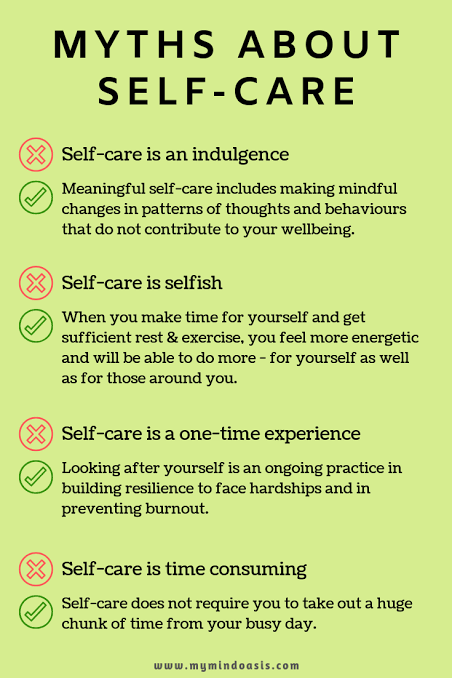
Imagine human mind as a bank account. In order to withdraw money from an account, we need a basic primary balance and we need to deposit from time to time in order to make future withdrawals. Similarly, human mind and body needs equal deposits of self-love, care and compassion in order to reflect that upon others. You cannot pour water from an empty pot. So, it is necessary to fill your pot before you pour it out.
The Social – Media and Magazine definition of self includes Hair-Care, Skin-Care, Spa sessions, etc but we often forget the most important part of our body that requires equal care and nurturing. Yes, our Mind. Our mind works 24/7 unlike our body, hence this calls for a special day to celebrate it’s success and hard work. Self-care is a broad term. It involves any and everything that makes you happy. Be it having an ice cream, putting on a good hair mask or dancing in your bedroom to silly item numbers. The best part about itisthat it doesn’t have to make sense to others.
It is okay to take a day off just to sit with yourself and do nothing. It is okay to binge watch the new show you always wanted to see but never got enough time to do so. It is okay to avoid social gatherings if it’s getting too much for you. It is okay to sleep early and miss out on parties and night-life. It is completely okay to avoid that person, phone call or that text to maintain the sanity of your mind. It is okay to not be okay all the time
But what’s not okay, is to not listen to your heart and letting others decide what you do with your life. Self-care involves standing up to your beliefs unapologetically and living on your terms. It might not always be right but its worth a try. After all life’s too short to not live and sadly most of us are working on auto-pilot mode. So, get up with the sun. Eat your favourite breakfast, binge on your most awaited show, go for long walks and dance to your favourite song till you sleep.
There is a fountain of youth. It is your mind, your talents, the creativity you bring to your life and the lives of the people you love.” – Sophia Loren.
Youth is the spring of human life. This is the phase of life where we live with our dreams and discoveries. Youth is the greatest strength and wealth of any nation. Empowering youth leads to nation pride.
The primitive humans were driven by instinct, just like animals. As we evolved, the faculty of intellect and higher thoughts developed in our brain. We started conditioning nature rather than obeying it. We developed rational thinking and understood the way we can support our thoughts with empirical data. We learned to make hypothesises and test them. We discovered science, as a faculty of knowledge and applied it meticulously and thus started dominating the world. A single example is how we made fire by friction, then came the match box and now sleek lighters. Today we have understood the science of nuclear energy so deeply that we have the power to even turn a big city into ashes within seconds.
Albert Einstein once said: “The most incomprehensible thing about the world is that it is comprehensible”. The comprehensibility of world comes through understanding science.
For couple of decades, we saw a trend that the youth of India was mesmerised to opt for Engineering or Medicine naturally due to career prospects. However due to various initiatives and funding for science research of-late we are seeing a trend that the present-day youth started preferring science as a career. Science research is no doubt time consuming and quick result and career is not easy to achieve.
Progress is the result of self-sacrifice not self-interest. There are many good and sincere scientists in India whose interests are not motivated by awards and recognition. These people have served and will continue to serve as mentors to future generations of Indian scientists. Science is the result of the efforts of these people. Let each one of us act as a catalyst to the advancement of science in India which will certainly make our country very powerful among the other nations in the world.
To conclude, youth are the backbone of our nation. They are full of energy. They should channel their energies for constructive purposes, develop scientific temper and thus bring their own progress and on turn the progress and prosperity of our nation.
Injuries to areas of the body that is usually protected /covered.
Delay in seeking medical attention for a child
Is violent to animals or other children
Tries to hide bruises or other injuries
May be extremely withdrawn or extremely aggressive
Is wary of adults or of a particular individual
Cannot recall how the injuries occurred or gives inconsistent explanations
Emotional Abuse
It occurs when a child’s emotional, psychological or social well-being and sense of worth is continually battered. It can include a pattern of criticizing, rejecting, discriminating, degrading, ignoring, isolating, corrupting, exploiting and terrorizing a child.
Indicator in child
Bed-wetting or bed soiling that has no medical cause
Frequent Headaches, nausea, abdominal pains
Has not attained significant developmental milestones
Displays attention seeking behaviours or displays extreme inhibition in play
When at play, behaviour may model or copy negative behaviour and language used at home
Suffers from severe developmental gaps
Indicator in adults
Constantly labels the child or publicly humiliates the child
Continually threatens the child with physical harm or forces the child to witness physical harm inflicted on a loved one
Has unrealistic expectations of the child
Sexual Abuse
Sexual abuse includes acts where an adult uses a child for a sexual purpose. While it may involve a stranger.
Indicator in child
Torn, stained or bloody underclothing
Bruises, lacerations, redness, swelling or bleeding in genital, vaginal or anal area
Blood in urine or faeces
Unusual or excessive itching or pain in the genital or anal area
Difficulty in sitting and/or walking
Signs of sexually transmitted disease Indicators in a child’s behaviour
Outburst of anger
Self-harm (cutting, burning or other harmful activities)
Age-inappropriate sexual play with toys, self, others
Sophisticated or unusual sexual knowledge
Nightmares, sleeping problems
Becoming withdrawn or very clingy
Becoming unusually secretive
Sudden unexplained personality changes, mood swings and seeming insecure
Regressing to younger behaviours, e.g. bedwetting
Fear of certain places or persons e.g. bedroom or bathroom, friend-uncle
Indicators in adult behaviour
Insist on physical affection such as kissing, hugging or wrestling even when the child clearly does not want it.
Insist on time alone with a child with no interruptions.
Spend most of their spare time with children and have little interest in spending time with people their own age.
Frequently walk in on children/ teenagers in the bathroom.
Treat a particular child as a favourite, making them feel ‘special’ compared with others in the family.
Regularly offer to baby-sit children for free or take children on overnight outings alone.
Buy children expensive gifts or give them money for no apparent reason.
What to do??
Learn to recognize the signs
Provide a listening ear
Offer help
Give helpful information
Explain that violence is not OK
Look for community systemic support for the family
Can contact Childline (1098) to talk over your concerns confidentially with a trained social worker.
Take following steps on Emergency
Step-1: Immediately contact parents if child is not abused by parents and if child can give information of his/her parents.
Step-2: Contact any one of the following agencies to provide required support to parents and child: DCPU, SJPU, Childline, CPCs, Police or CWC. You can also take help from credible NGOs working on Child Rights in your area.
Step-3: Provide emergency support such as medical aid, clothing, food and transportation to safe places. Make sure that you handover this child to responsible adults from above mentioned list only.
Step-4: Help authorities with whatever information and evidence you have as regards abuse of the child to make sure that the abuser is punished. If possible give written information.
Step-5: Maintain privacy to ensure that the name of the child is not disclosed to media or public in any ways.
Prevention
Create Safe places for children in community, neighbourhood and society.
Create Structures and Systems where children can express their feelings and emotions freely without any inhibitions.
Create Structures and Systems to ensure safety and to ensure that children are supervised.
Educate children about safety measures. Provide information about the emergency contact numbers.
Create awareness: About child protection systems and networks. Keep this information handy.
Build network of concern individuals and groups to help children. Develop support systems for children.
The urbanization level of cities is increasing and with this the population and critical infrastructures in the city also increases, thereby increasing the exposure and vulnerability of cities to acute stresses and long terms shocks like cyclones, floods, pandemics etc. Currently the cities are battling with the greatest challenge to mankind since second world war and most dangerous health calamity, i.e. COVID 19. Cities are the areas having maximum concentration of population and are the nodes of development, hence there’s a need to combat the effects of COVID – 19 and it is important to find a way by which the cities can be developed more sustainably, with more resilience and livability.
WHAT IS COVID 19 ?
The name COVID – 19, originates from ‘Corona’ for CO, ‘ VI’ for Virus and ‘D’ for Disease and ’19’ represents t=its year of occurrence. The pandemic started from the Wuhan city of City in December 19 and within couple of months it became the global health emergency. The pandemic has not only affected the public health but also demobilized the global economy, impacts on environment and governance as well.
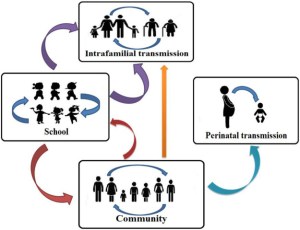
Image showing the different modes by which COVID 19 can be transmitted
WHAT IS RESILIENCE ?
Generally, Resilience is defined as the capability to recover from difficulties. In context of city, Resilience can be defined as the ability of an city to Prepare for, Respond to and Recover from any acute stress or long term shock. While dealing with the resilience of a city, the opportunities and threats provided by the difficulty is analyzed and initiatives are taken accordingly. In order to reduce the vulnerability of cities from getting affected by the disaster or hazard, pandemics or any other threat, the city’s capability to resist and recover from these risks is mandatory.
NEED OF RESILIENCE
For ensuring and increasing the safety and well being of the citizens and the environment, cities need to be made more resilient and prepared for addressing shocks and stresses.
There are many ways by which the resilience of cities can be enhanced and these w2ays can be determined by comparing the COVID 19 with other such health risks and various ways in which problems were caused can be determined. With the help of this the different interventions and recommendations pertaining to specific ways can be decided and the resilience can be enhanced.
Resilience plays a major role in shaping governance as well because it provides way for trustworthy leadership, responsive community organizations and also neighborhood design which can facilitate social connections. Resilience enhances physical and social infrastructures that helps the people to protect themselves and the society.
CONCLUSION
Resilience is all about learning from previous experiences and generalizing them those lessons to solve new problems. COVID 19 has provided many experiences for the people by altering the entire living schedule of humans and the experiences learned from this pandemic can be used while preparing for the future pandemics and other health, social and economic threats. In some way or other, COVID 19 has been following the previous pandemics and hence required months of restrictions in travel and isolations, which created and is still creating numerous social, economic and domestic problems for citizens, households, businesses and communities. To answer all these issues and to combat such pandemics the cities need to be resilient. To improve resilience, the communities need to be aware before hand , emergency response programs are required and proper initiatives for contagion control is also a mandatory step. Along with such measures, adequate housing for all citizens and physical and mental support to the sufferers and isolated people is also necessary. In case of designing aspect, the homes and quarantine centers can be designed in such a way that they could reduce the stress with the help of adequate space and proper lighting and ventilation. Along with all such initiative, global threats are needed to tackled with proper international cooperation and by learning from the best practices and approaches for handling such situations.
When we hear the word Sexual Harassment what we picture in our mind a girl or a woman getting harassed by a man! But sexual harassment is not a narrow term which we can use only with respect to girls or women. It is a broader term which includes harassment on all the gender.
What is the meaning of Sexual harassment?
The word sexual harassment means any form of unwelcome sexual behavior which is offensive, humiliating and intimidating. According to EEOC (Equal Employment Opportunity Commission) sexual harassment is defined as : Unwelcome sexual advances, requests for sexual favors, and other verbal or physical conduct of a sexual nature when
Submission to such conducts is made either explicitly or implicitly a term or condition of individual’s employment,
Submission to or rejection of such conduct by an individual is used as a basis for employment decisions affecting such individual, or
Such conduct has the purpose os effect of unreasonably interfering with an individual’s work performance or creating an intimidating, hostile, or offensive working environment.
Here, unwelcome does not mean “involuntary.” A victim may consent or agree to certain conduct and actively participate in it even though it is offensive and objectionable. Therefore, sexual conduct is unwelcome whenever the person subjected to it considers it unwelcome. Whether the person in fact welcomed a request for a date, sex-oriented comment, or joke depends on all the circumstances. Source: Preventing Sexual Harassment (BNA Communications, Inc.) SDC IP .73 1992 manual
Types of Sexual Harassment
Verbal or Written
Non-verbal or Visual
Physical
Verbal or Written
Here in the sense of sexual harassment verbal or written means saying, commenting, joking, or writing about someone in vulgar manner. We have often see on the road boys are shouting out to girls using words like doll, babe etc. Yes, this is also sexual harassing and that’s why it is called verbal. Following are some more examples:-
Referring someone using inappropriate or vulgar language.
Whistling at someone in an unwanted manner.
Making sexual comments on someone’s body
Making kissing sounds.
Repeatedly asking out someone who is not interested.
Spreading rumors about a person’s personal life.
Texting someone offensive joke.
Early these were very trivial matter on the roads and now-a-days it can be widely and easily seen on social media.
Non-verbal or visual
Well, this is the most trivial and probably the hardest to spot because it’s most subjective and one have to put in the shoes of the other person. For example:-
Looking a person with elevator eyes (up & down).
Staring at someone.
Following someone.
Making sexual gestures with hands or trough body movements.
Making facial expressions such as winking, throwing kisses etc.
Physical
It seems that this is very easy to recognize but it is also too complex. Many time people get confused about physical touch. Here are some examples:-
Touching someone sexually around other people.
Hugging, kissing , stroking.
Actual or attempted rape.
Touching someone’s clothing, hair, or bodily assault.
Now-a-days sexual harassment is very common in workplaces and even in educational institutions. Cases about these things can be seen frequently. For example recently in Calicut University an Mphil student leveled sexual harassment charges against an assistant professor, Haris Kodampuzha from English department. As per complaint, he used to send sensual message to the student and for this he was suspended.
There are laws all over world which protects people from sexual harassment. In there is “The Sexual Harassment of Women at Workplace (Prevention, Prohibition and Redressal ) Act, 2013” that seeks to protect women from sexual harassment at their place of work. The Act came into force from 9 December 2013. In India, the legislations talk only about sexual harassment and rape of women. Then the question is who will protect men from harassments. There is no law to shield males from the bloodthirsty act of harassment and rape. Under Indian law, there is only one section 377 of Indian Penal Code which talks about “sodomy”.377. it is written that “Unnatural offences: Whoever voluntarily has carnal intercourse against the order of nature with any man, woman or animal, shall be punished with imprisonment for life, or with imprisonment of either description for a term which may extend to ten years, and shall also be liable to fine.” Explanation: Penetration is sufficient to constitute the carnal intercourse necessary to the offence described in this section. Except this all other laws and sections are meant only for females.
While the sexual harassment of females has consistently declined in the past few years as government has made some very effective legislations in India. But sexual harassment of men is increasing day by day. Hence it is important to demand equal accesses to justice for both males as well as females. For this the legislation of government has to make laws which protect the male from various kinds of harassments and assaults at different areas. There is also a need to educate and aware people especially children and students about sexual harassment. So if they suffer from any such act then they will be able to approach to any authority or any elder person rather than suffering.
Rate this:
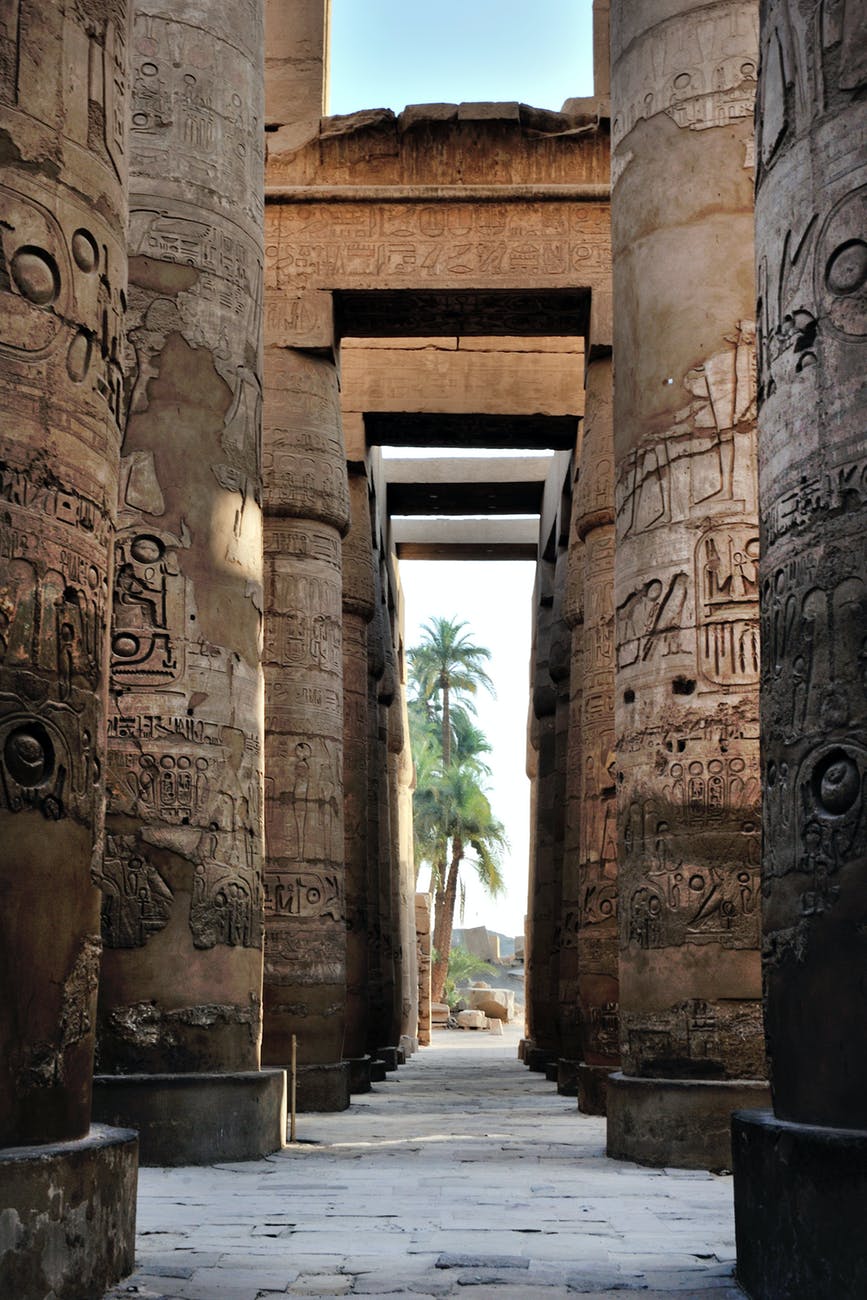
5 Must Read Books on AncientEgyptian History :
Glory of Ancient Egypt
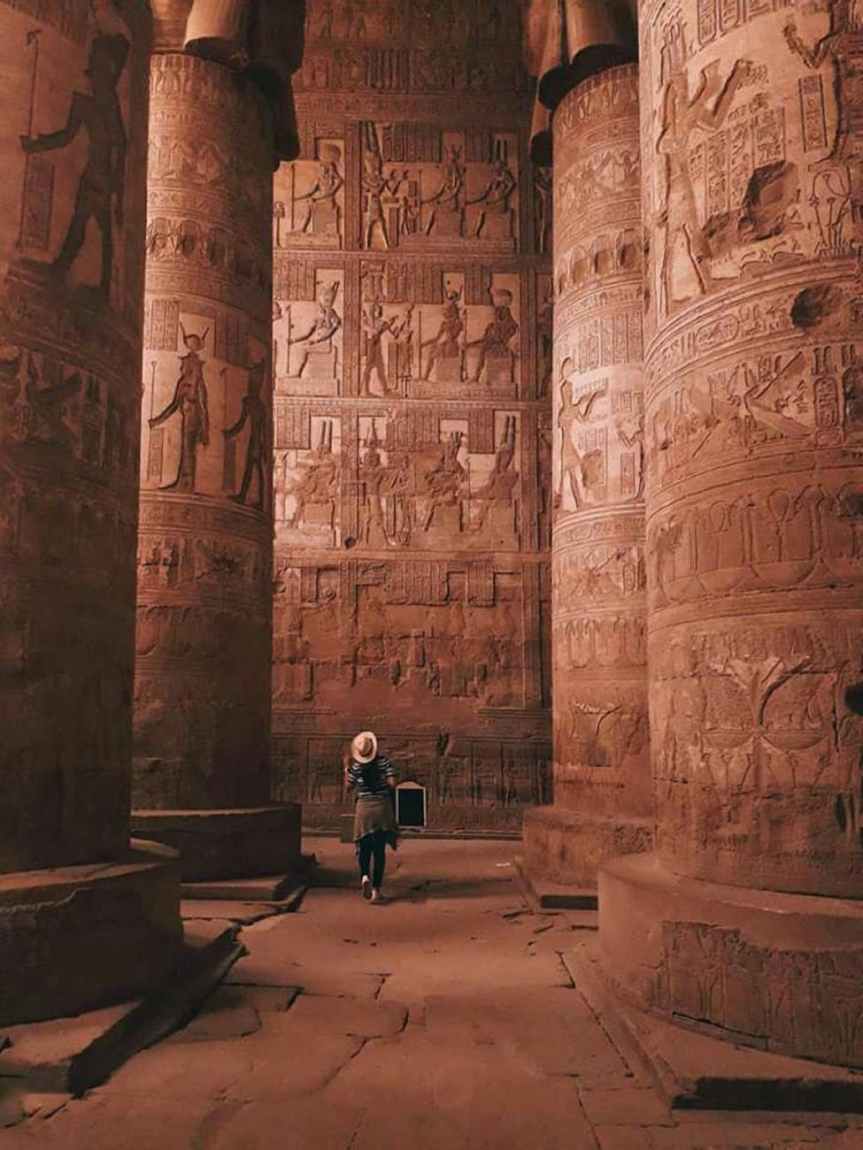
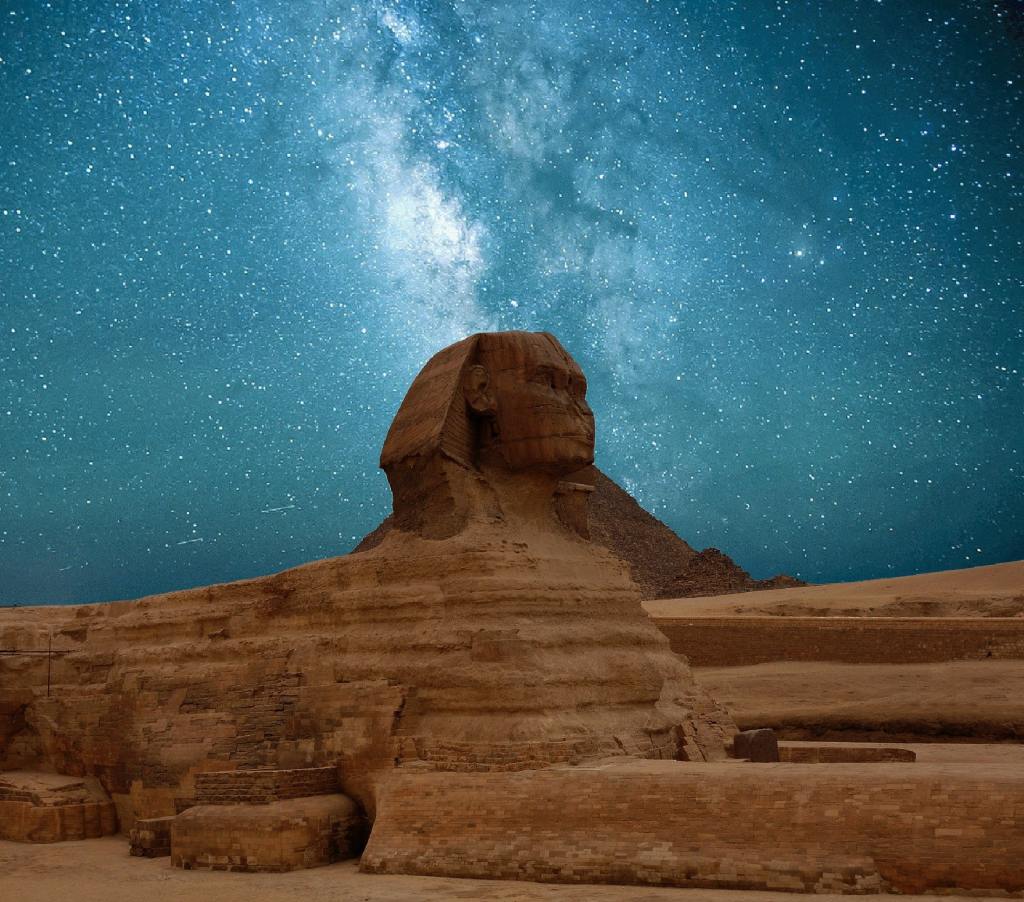
Once a French novelist , Gustave Flaubert said , “ (Egypt) is a great place of contrast ; splendid things gleams in the dust “. Egypt is one of the great civilizations with its flourishing & mysterious historical significances. Their history make you wonder ,mysteries will make you interested & their story will make you addict .If you are a history lover then you must be a curious knowledge gainer about various aspects of ancient Egypt .Here are some recommended books for you to read & help you to know the Egypt in a new light .These book will take you to their time & experience you the glory of ancient Egypt at that time .
1.The Complete Gods and Goddesses of Ancient Egypt –– This book is written by famous archaeologist Richard H. Wilkinson , which is published in 2003 . This is one of the great book on Egyptology . This books talks about the mythology of ancient Egypt in great view . Worshiped gods & goddesses , their myth , beliefs of ancient Egyptians all of those are recorded in this book very prominent way . It is a very detailed book . This book is available on Amazon .
2.The Cultural Atlas of Ancient Egypt — This book is written by two renowned Egyptologist of United Kingdom , John Baines & Jaromir Malek which is published on 31st October in 2000. This the most favoured book of ancient history for almost last 23 years in the whole world , As it’s name it has indeed lots of geographical photographic pictures , maps, table presentations , charts about ancient history . This book talks about the civilization of Egypt in ancient time. It includes architectural works ,social daily life , artistic sides of Egyptian people in detailed & analyzing manner. This is a very favourite book for history lover specially for Egyptology fans .
3.The Pharaohs of Ancient Egypt — This book is written by Elizabeth Payne which was published in 1964 & an still now it has it’s glory in the field of Egyptian history . It is a type of landmark book which obviously gives a geographical presentation on ancient Egypt’s great architectures with times . This book has a detailed information about every individual Pharaohs ,lifestyle at the time of their ruling period , their grat works which is engraved in history . It also give away an idea about the works a of archaeologists behind these discoveries.
4.Pyramid — This renowned book is written by an British-American writer & illustrator Davis Macaulay which was published on 26th April, 1982 .This is a highly recommended book for interested readers . This book focuses on the pyramids of Egypt .The black & white illustrations give a detailed knowledge about how pyramids built , what is the ingredients used ,their engineering & archeological signification , the land chosen for pyramid , what is founded inside them , The reason to built & Egyptian myth related to it . If you want to know abot pyramids of Egypt then it is a must read book .
5.Ancient Egypt & Her Neighbor — This book is written by Lorene Lambert , which is published in 2013 . It is a one of the great book great book on ancient history lovers . This book depicts a clear picture on Egyptian culture , their civilization of that time through some story-telling .This books also focuses on the relation between ancient Egypt & their neighboring countries , historical facts of those country & connect the big historical events with ancient Egyptian historical time & geography of ancient Egypt . This book is understandable & knowledgeable for kids also.
There are only 5 books are mentioned above but apart from them there are so many fundamental books about Egyptian history –‘The Rise & Fall of Ancient Egypt’ written By Toby Wilkinson ,’The Oxford History of Ancient Egypt written by Ian Shaw’ ,’The Complete Gods and Goddesses of Ancient Egypt’ written by Richard H. Wilkinson , ‘Tutankhamun’s Armies’ written by John Coleman Darnell and Colleen Manassa , ‘Egyptian Art in the Age of the Pyramids (Metropolitan Museum of Art Publications)’ written by Dorothea Arnold etc. There are hundrades & millions of books on this interesting subject just you have to browse it .
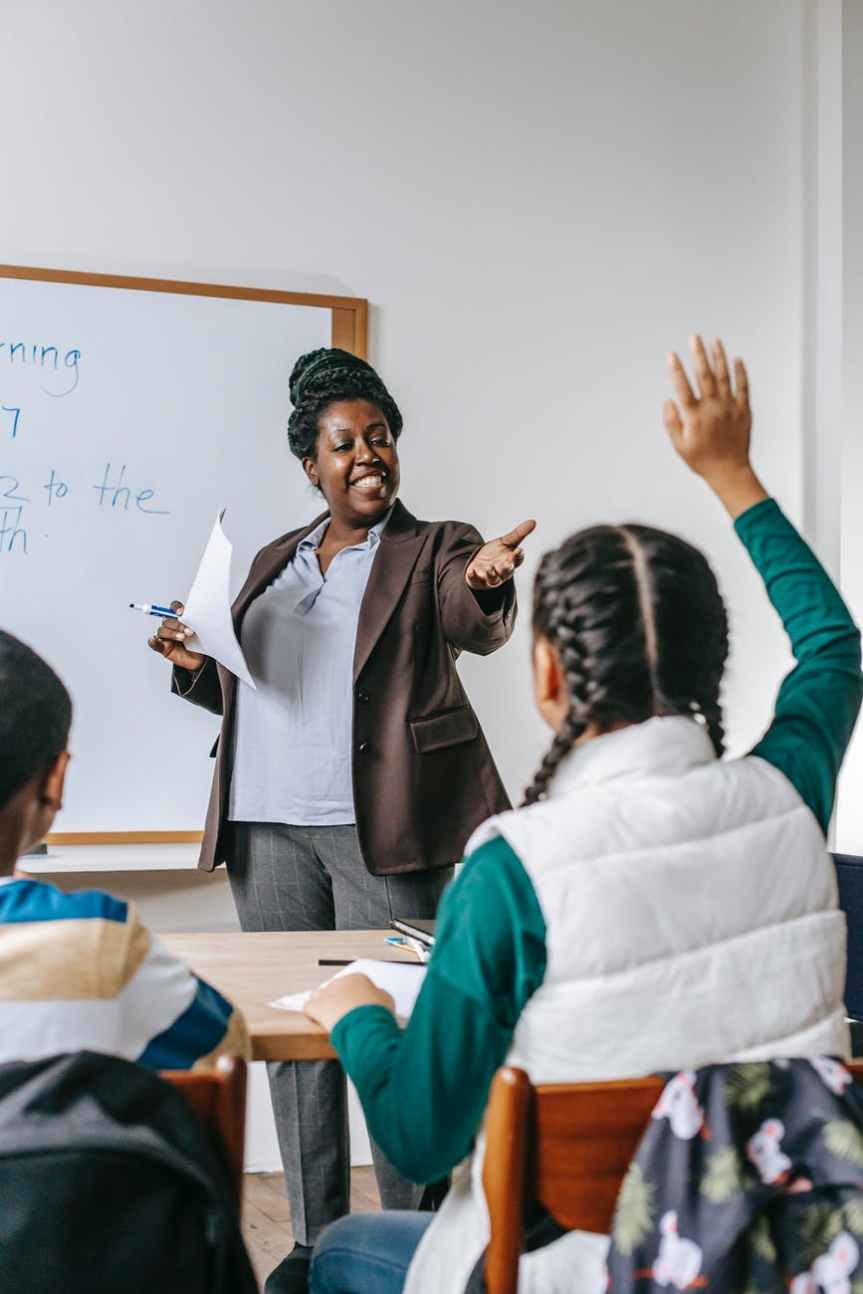
Teacher‘s are a blessing for us. They help us in a myriad of ways throughout our life, & help us in achieving different milestone of success. In their honour, we have the teachers day on 5th September, every year. Teacher’s Day is celebrated in many countries around the world. including India. It falls on different days in different countries. In China it is celebrated on 28 September, which is the birthday of the great thinker, Confucius; in India it is celebrated on 5th September, the birthday of Dr Sarvapalli Radhakrishnan, a highly respected teacher who became the President of India.
The story behind it’s origin in India:
The story goes that when Dr Radhakrishnan became the country’s President in 1962, some of his students and friends went to him and requested him to allow them to celebrate his birthday. Dr Radhakrishnan replied, Instead of celebrating my birthday separately, it would be my proud privilege if 5th September is celebrated as Teachers’ Day.’ In our school, we start preparing for Teachers’ Day about a week before 5th September. Since we put up a variety entertainment for our teachers on that day, we first get together to decide what exactly we will do.
This day is celebrated with great Rejoicment throughout the world. We put up a variety entertainment for our teachers on that day. Every year there were songs, dances, skits, mimicry, and recitation. year It is the duty of the School Captain to prepare a speech in praise of our teachers. This year’s Captain used a quote that has stuck in my memory: ‘to teach is to touch lives forever.’ Then there is the important matter of choosing Teachers’ Day greeting cards. I check the words in my cards very carefully, to make sure they are suited to the teachers for whom they are meant. There is no point in giving a very funny card to a very serious teacher, is there? We pool our money to buy our class teacher a very special present. For our ‘subject teachers’ we buy smaller presents.
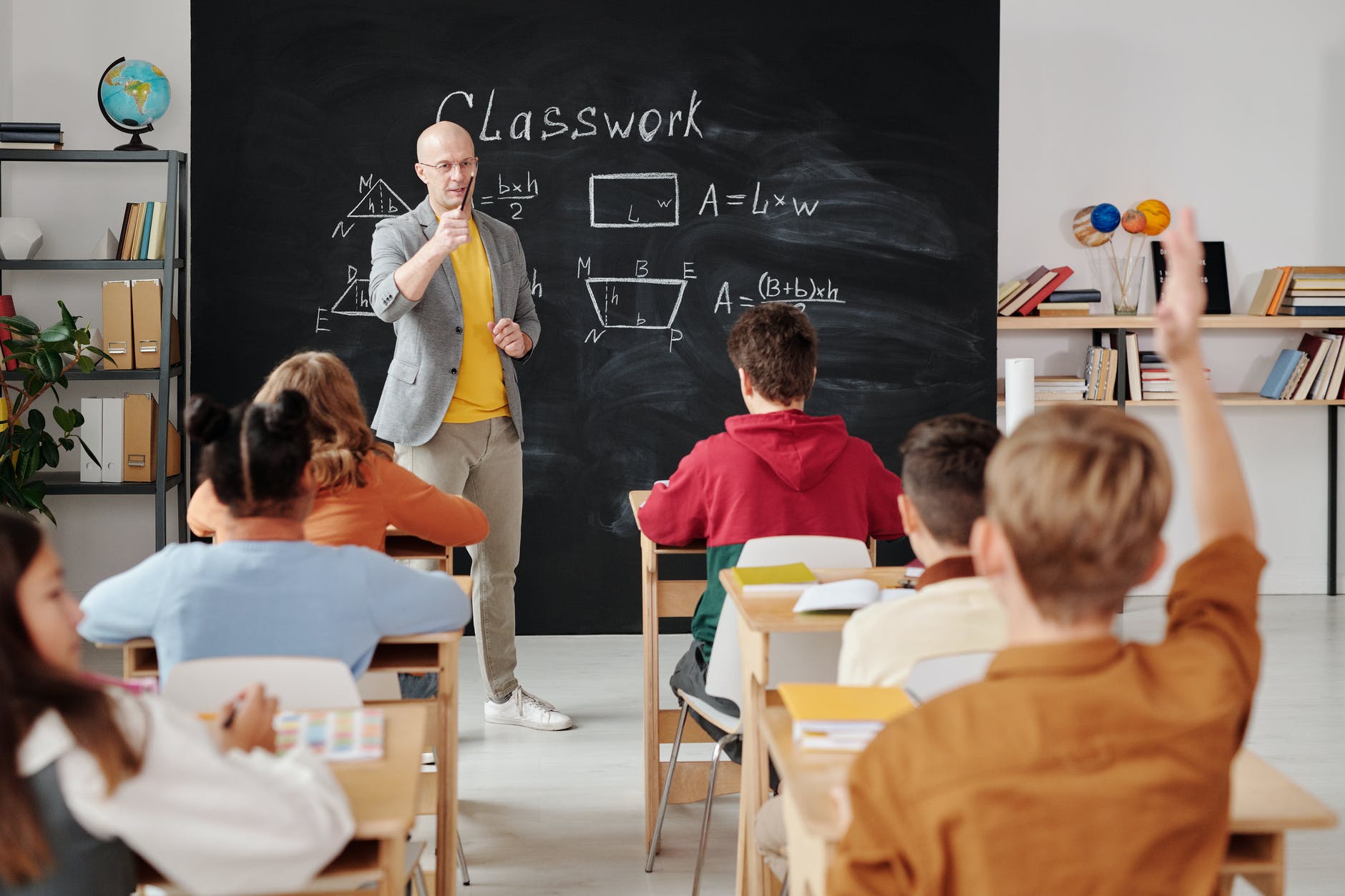
On Teachers’ Day, we go to school early to decorate our classrooms, and the best artist in the class writes Happy Teachers’ Day’ on the blackboard in big, bold letters. When the class teacher arrives, the monitor puts a ceremonial scarf around the teacher’s neck, while another pupil presents the gift or gifts. The teacher thanks us and takes his place in the last row among the students. Some bright student, who is dressed up as a teacher for the occasion, conducts a mini-class on a subject that he has chosen. Then the bell rings, and the whole school goes into the hall for the entertainment programme. This lasts for two hours, and by the time it ends, it feels wonderful for a teacher to be a teacher, and a student to be a student!
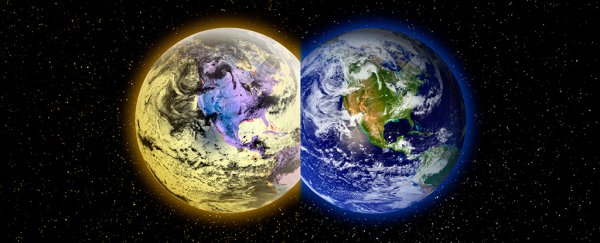
As far as we currently know, there is a single expanding blob of spacetime speckled with trillions of galaxies – that’s our Universe. If there are others, we have no compelling evidence for their existence.
That said, theories of cosmology, quantum physics, and the very philosophy of science have a few problems that could be solved if our blob of ‘everything’ wasn’t, well, everything.
That doesn’t mean other universes must exist. But what if they do?
What is a universe?
It should be a simple question to answer. But different areas of science will have subtly different takes on what a universe even is.
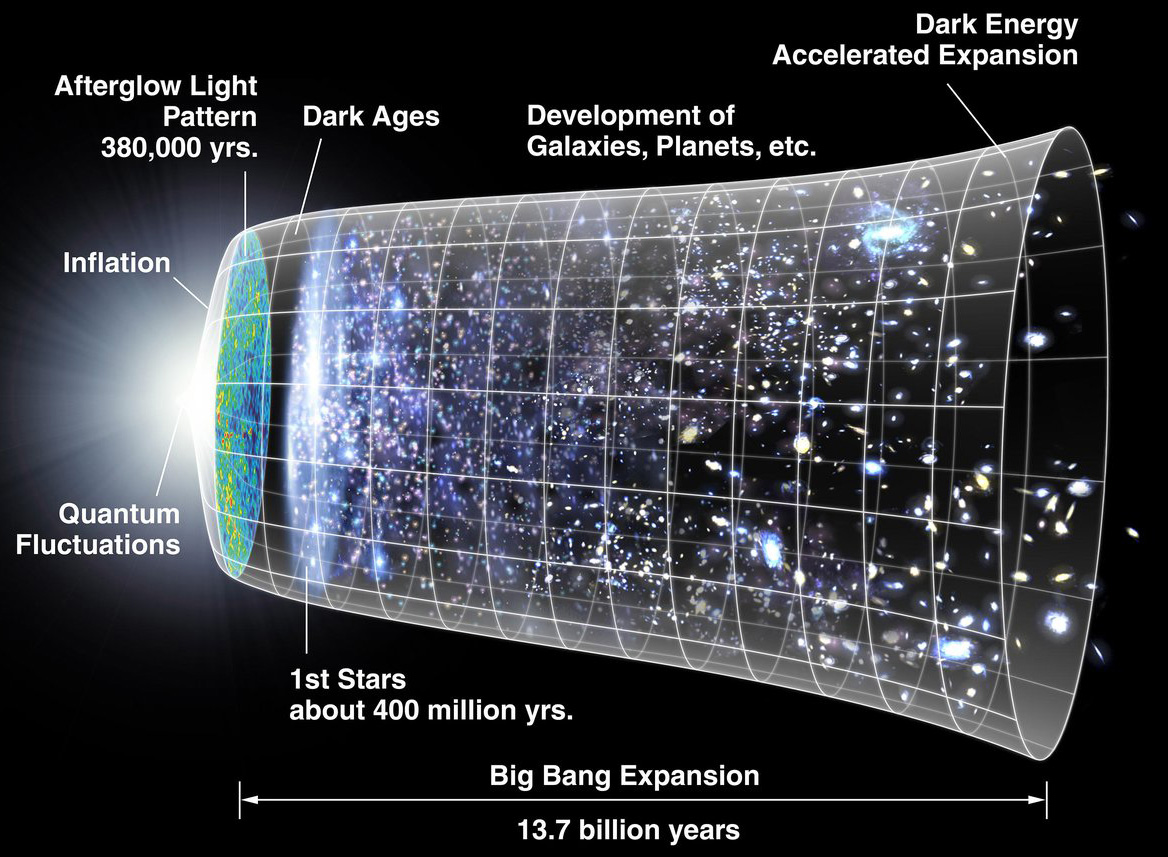
Cosmologists might say it describes the total mass of stuff (and the space in between) that has been slowly expanding from a highly concentrated volume over the past 13.77 billion years, becoming increasingly disordered with age.
It now stretches 93 billion light years from edge to edge, at least based on all of the visible (and invisible) stuff we can detect in some way. Beyond that limit, there are either things we can’t see, an infinite expanse of nothingness, or – in the unlikely scenario that all of space bends back around on itself – a round-trip back to the start across a hyperspherical universe.
If we’re talking quantum physics, though, a universe might refer to all fields and their particles, and their combined influences over one another. As a general rule, a universe (like ours, at least) is a closed system, meaning it can’t suddenly lose or gain a significant sum of energy.
Philosophically speaking, a universe might be a discrete set of fundamental laws that governs the behavior of everything we observe. A universe would be defined by its own rules that set its unique speed for light, tell particles how to push or pull, or space how it should expand.
What is a multiverse in cosmology?
A century of astronomical observations has told us a lot about the age, size, and evolution of galaxies, stars, matter and the four dimensions we sum up as spacetime.
We can theoretically squeeze all of the matter of the Universe down to a point where the concentration of energy reduces atoms to a soup of simpler particles and forces combine until we can’t tell them apart. Any smaller than that? Big shrugs.
If we go with what’s known as a cyclic model of cosmology, the parent universe preceded ours in some way. It might even be a lot like this one, only running in reverse compared with ours, shrinking over time into a concentrated point only to bounce back out for some reason. Played out for eternity, we might imagine the respective universes bounce back and forth in an endless yo-yo effect of growing and collapsing.
Or, if we go with what’s known as a conformal cyclic model, universes expand over trillions upon trillions of years until their cold, point-like particles are so spread out, for all mathematical purposes everything looks and acts like a brand new universe.
If you don’t like those, there’s a chance our Universe is a white hole – the hypothetical back end of a black hole from another universe. Which, logically, just might mean the black holes in our Universe could all be parents, pinching off new universes like cosmic amoebae.
What is a multiverse in quantum physics?
Early last century, physicists found theories that described matter as tiny objects only told half of the story. The other half was that matter behaved as if it also had characteristics of a wave.
Exactly what this dual nature of reality means is still a matter of debate, but from a mathematical perspective, that wave describes the rise and fall of a game of chance. Probability, you see, is built into the very machinery that makes up the gears of a universe like ours.
Of course, this isn’t our daily experience as vast collections of atoms. When we send a bucket of molecules called a rocket to the Moon as it zooms past 300,000 kilometres away, we’re not rolling dice. Classical old physics is as reliable as tomorrow’s sunrise.
But the closer we zoom in on a region of space or time, the more we need to take into account the possible range of measurements we might find.
This randomness isn’t the result of things we don’t know – it’s because the Universe itself is yet to make up its mind. There’s nothing in quantum mechanics explaining this transition either, leaving us to imagine what it all means. https://www.youtube.com/embed/dzKWfw68M5U?ab_channel=PBSSpaceTime
In his 1957 doctoral dissertation, American physicist Hugh Everett suggested the range of possibilities are all as real as one another, representing actual realities – separate universes, if you like – just like the one we’re all familiar with.
What makes any one universe in this many worlds interpretation distinct is how each wave correlates with a specific measurement taken of other waves, a phenomenon we call entanglement.
What ‘we’ means, and why ‘we’ experience one entangled set over waves over another, isn’t clear, and in some ways presents an even bigger problem to solve.
What is a multiverse in philosophy?
One of science’s most fundamental starting assumptions is that in spite of what your mother tells you, you’re not special. Nor is any other human, or our planet, or – by extension – our Universe.
While rare events occur from time to time, we don’t answer The Big Questions with ‘it just happened that way’.
So why does our Universe seem to have just the right tug-of-war of forces that allow not just particles to appear, but to congeal for long enough periods into atoms that can undergo complex chemistry to produce thinking minds like ours?
Philosophically speaking, the anthropic principle (or principles, since there are many different ways to spin the idea) suggests we might have it backwards. Without these conditions, no minds would have arisen to consider the amazing turn of events.
If just a single universe ‘just happened that way’ early one spring morning, it’d be one big coincidence. Too big really.
But if there were infinite universes, with infinite combinations of forces pushing and pulling, some would inevitably give rise to minds that just might ask ‘are we part of a multiverse?’
Will we ever discover other universes?
Given the very definition of a universe relies on some kind of physical fence keeping influencing factors apart, it’s hard to imagine ways we might ever observe the existence of a sibling for our universe. If we did, we might as well see it as an extension of our own Universe anyway.
That said, there could be some cheats that could give us a glimpse.
Any experiment to find one would have to rely on that ‘fence’ having some holes in it that allow particles or energy to leak across, either into ours, or away from it. Or, in the case of universes existing in our past, monumental events that left enough of a scar that not even a rebirth could erase.
For now, we still have no good reason to think our blob of everything is anything but unique. Given we’re still learning how our own Universe works, the current gaps in physics could yet be plugged without any need to imagine a reality other than ours.
In countless other versions of this article scattered throughout the multiverse, however, the question of whether we are alone just might have a different answer.
Soft skills… Every one of us has heard this phrase. Also, you might have heard from employees, grad students, millennials, school students, or young people complaining that they lack certain soft skills.
There is a wide range of skills that falls under the term “Soft Skills”. These skills are also known as “transferable skills”.
A definition of Soft Skills:-
Soft skills are certain sets of traits and interpersonal skills that don’t depend on the acquired knowledge. Soft skills include common sense, the ability to deal with people, a positive flexible attitude, or how you approach life and work.
The good news is one can learn and enhance their soft skills over some time. Though it is often hard to do so. Like Hard skills, one can work on their Soft skills and can make themselves capable of using them. One can’t measure Soft skills by any exam, the only way to measure the development of one’s Soft skills is by knowing how one manages relationships around them.
What are the most important Soft Skills?
Well, there are a lot of Soft skills. But, mentioned below are five skills that you need to learn/enhance:-
★ Communication Skills
The most essential skills include Communication skills. People with good communication skills can maintain/build good relationships around them. Also, they are likely to avoid misunderstandings and can make any workplace better.
★ Decision Making
Being able to make decisions is a crucial part of life. Everyone one of us has to make decisions in our day-to-day life from what we want to eat to what we should wear. But sometimes the actual decision doesn’t seem to matter; what matters is that you have made one and moved on.
★ Time management
Time management can help you finish any work within the deadline. Time management is sometimes described as having a ‘good work ethic’. Also, it is very useful for organizing family or team.
★ Leadership skills
These skills are needed to take the lead when necessary. These skills include the ability to manage and motivate others, and to commissioner work. One can learn leadership skills by enrolling in many leadership training courses.
★ Creativity and problem-solving skills
These skills are as highly valued as leadership skills because they are hard to develop. Although it is being believed that creative thinkers are born not made. But like any other skill, these skills can also be developed.
The skills mentioned above along with other Soft skills are required in every field whether you are a student, an employee/employer, a business owner, etc. You can reach to various programs to develop and enhance your soft skills.
Intergovernmental organisations (IGOs) have always played a very important role in the global economy . These groups are generally created through the enactment of a treaty and are composed of a group with member states . The goal of individual IGOs depends on their genre of function and membership . Some of the most common and widely known IGOs include the United Nations , the World Bank and International Monetary Fund ( IMF)
International Monetary Fund () IMF also called The Fund , based in Washington ,D.C. is an international monetary institution established by 44 nations under the Bretton Woods Agreement of July 1994.
The IMF was established to promote economic and financial cooperation among its members in order to facilitate the expansion and balanced growth of world trade . It started functioning from March 1,1947 , the Fund has currently 189 member countries each of which has representation on the IMF ‘s executive board in proportion to its financial importance .
IMF is an international organisation that promotes global economic growth and financial stability, encourages international trade and reduces poverty Quotas of member countries .
IMF ‘s mission is
“To foster global Monetary cooperation ,secure financial stability , facilitate international trade , promote high employment and sustainable economic growth and reduce poverty around the world.”
Origin :-
IMF was originally created in 1945 ,as part of the Bretton Woods Agreement, which attempted to encourage international which attempted to encourage international financial cooperation .
The principal aim was to avoid the economic mistakes of the 1920s and 1930s . The attempts of many countries to return to the old gold system after the First World War failed miserably.
The World Depression of the thirties forced every country to abandon the gold standard .This led to adoption of nationalist policies which marked decline in world trade and extension of depression.
44 nations assembled at the United Nations Monetary and Financial Conference at Bretton Woods, New Hampshire from July 1 to July 22,1944 and established The International Monetary Fund .
The Article of Agreement of the IMF provided the basis of the international monetary system .
Structure of The Fund
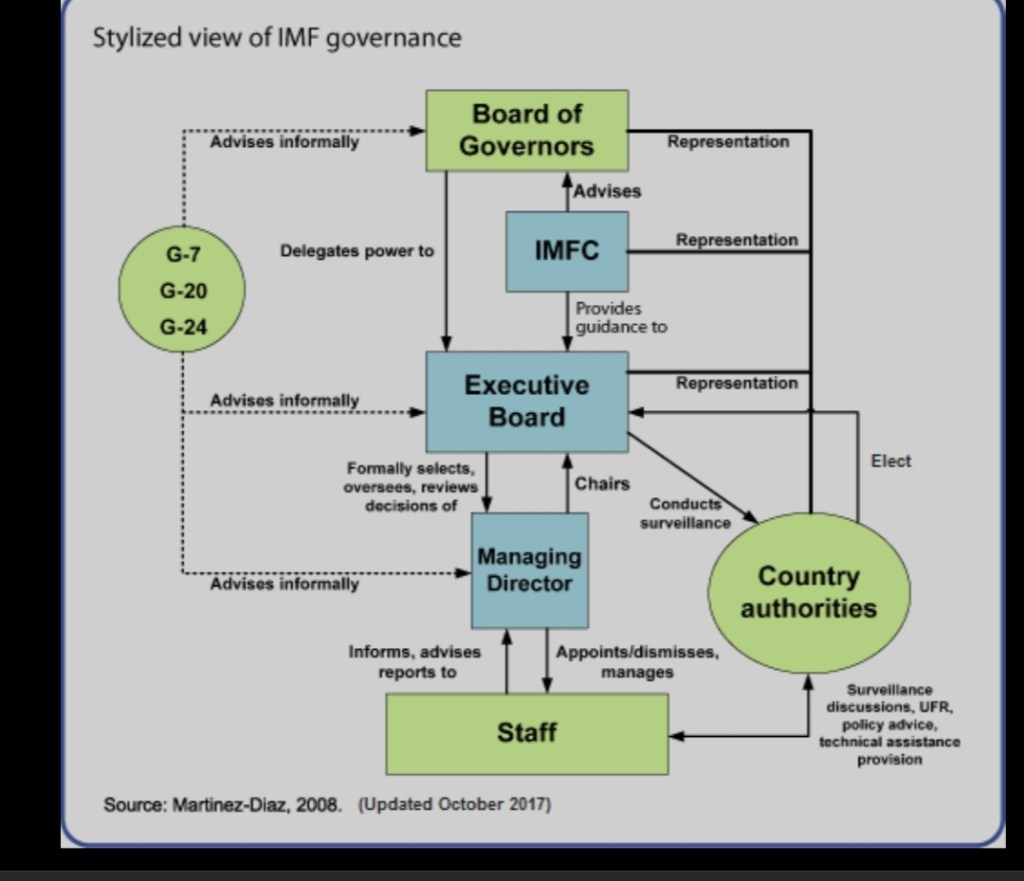
The structure of The Fund consists of a Board of Governors , an Executive Board , A Managing Director, a Council and a staff with its headquarters in Washington DC, USA.
The Board of Governors is the top in the structure of The Fund . They are decision making organs of the Fund..They exercise power and make decisions that are binding on members and the Fund .
The board of the Governors, which now has 24 members ,meets annually in which details of the Fund activities for the previous year are presented.
Other members include :-
The Executive Board , which has 21 members at present . Five Executive Directors are appointed by the five members ( USA , UK , Germany., France and Japan ) having longest quotas .
The Managing Director is elected by the Executive Directors .He is usually political or any other international official.
The Interim Committee (now IMFC ) , is established to advise the Board of Governors on supervising the management and adoption of international monetary policy .
The Development Committee advises and reports to the Board of Governors on all aspects of the transfer of real resources to developing countries .
Objectives :-
The fundamental purposes and objectives of the Fund had been laid down in Article 1 of the original Articles of Agreement . The major six objectives of IMF are :-
1: To promote international monetary cooperation through a permanent Institution which provides the machinery for consumption and collaboration in international monetary problems.
2: To facilitate the expansion and balanced growth of international trade, and to contribute thereby to the promotion and maintenance of high levels of employment and real income and to the development of the productive resources of all members as primary objective of economic policy.
3: To promote exchange stability, to maintain orderly exchange arrangements among members, and to avoid competitive exchange depreciation.
4: To assist in the establishment of a multilateral system of payments in respect of current transactions between members and in the elimination of foreign exchange restrictions which hamper the growth of world trade.
5: To give confidence to members by making the general resources of the Fund temporarily available to them under adequate safeguards, thus providing them with the opportunity to correct maladjustments in their balance of payments, without resorting to measure destruction of national or international prosperity.
6: In accordance with the above, to shorten the duration and lessen the degree of dis – equilibrium in the international balance of payments of members. ___________________________________________
Functions of IMF
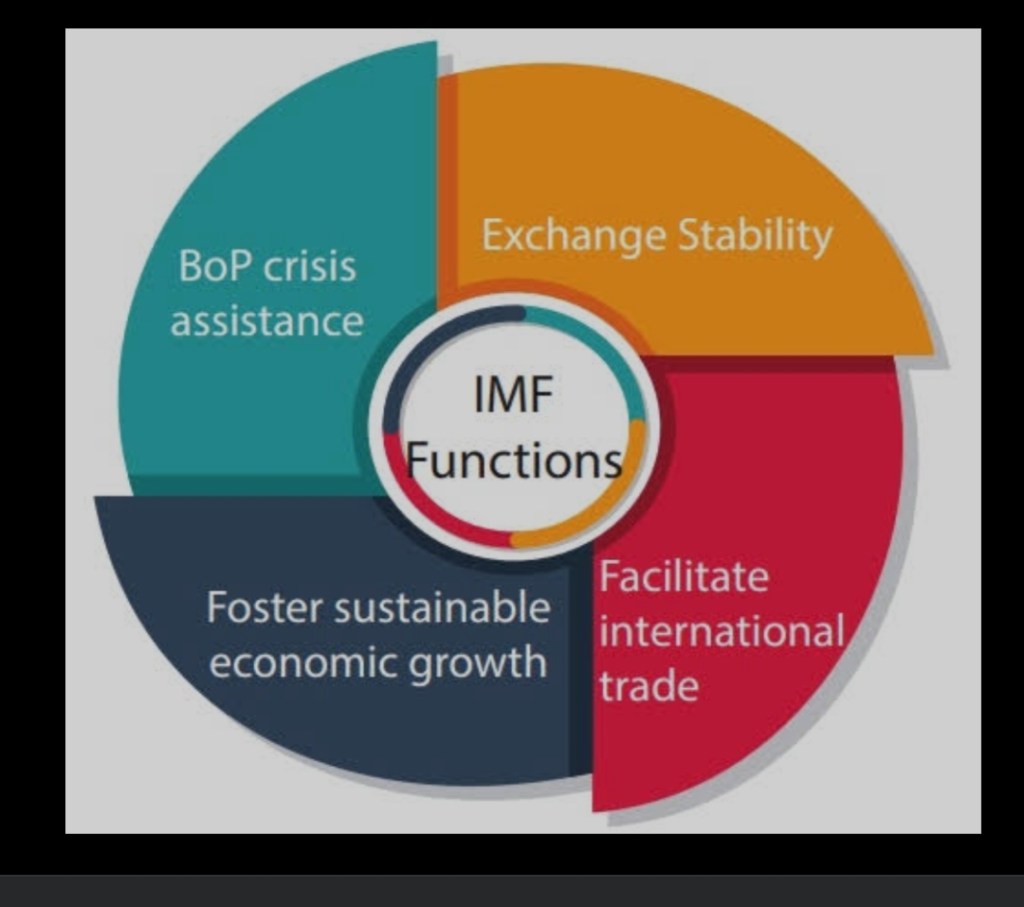
The principal function of the IMF is to supervise the international monetary system. Several other functions performed by the IMF . Three major functions of IMF are :-
Surveillance over Members Economic Policies :-
The IMF closely monitors each member’s country’s economic and financial development . The IMF holds a conference with member countries on a regular basis Usually once each year to assess its economic conditions with a view to providing policy recommendations .
Financial Assistance :-
IMF functions as an agency of providing resources to meet short term and medium term . It lends to its member countries facing BOP disequilibrium .
IMF loan is usually provided under an “arrangement ” requiring a borrowing country to undertake the specific policies and measures to resolve it’s balance of payments problem as specified in a “Letter of Intent ” . Most IMF loans are primarily financed by its member countries through payment of quotas .
Consultative Function:
It functions as a centre for international cooperation and a source of counsel and technical assistance to its members.IMF provides technical assistance to help member countries strengthen their capacity to design and implement effective policies in four areas :- monetary and Financial policy ; fiscal policy; statistics ; and economic and financial legislation.
Other functions :-
• Stabilizing Economics • Maintaining Balance between demand and supply of member countries. • Maintenance of Liquidity . • Reducing tariffs. • General watch . ___________________________________________
Financial Resources of The Fund :-
The bulk of financial assistance performed by the IMF has its financial resources from two sources .
(i) Subscription or quota of the member nations :-
Each member country is required to subscribe to an amount equivalent to its quota. It is the quota on which payment obligations, credit facilities, and voting right of members are determined. As soon as a country joins the Fund, it is assigned a quota which is expressed in Special Drawing Rights (SDRs).
(ii) Borrowings :-
The Fund is authorised to borrow in special circumstances if its own resources prove to be insufficient. It sells gold to member countries to replenish currency holdings. It is entitled to borrow even from the international capital market. Though the Articles of Agreement permits the Fund to borrow from the private capital market.
The IMF has two accounts of operation—the General Account and the Special Drawing Account. The Fund burrows under the General Arrangements to Borrow in order to forestall or cope with an impairment of the international monetary system. __________________________________________
Credit Tranches :-
To meet the severe BOP disequilibrium , the Fund has been gradually raising the limit of borrowing by its members under the credit tranche. Since the 1960s , the Fund has created several credit facilities for its members.
Some borrowing facility provided by the Fund are :-
(i) Stand-by Arrangements: The term “stand-by” here means that, subject to conditionality, a member has a right to draw the money made available, if needed. This method of borrowing has become the most normal form of assistance by the Fund. Under this form of borrowing, a member state obtains the assurance of the Fund that, usually over 12-18 months, requests for drawings of foreign exchange (i.e., to meet short- term BOP problems) up to a certain amount will be allowed if the country concerned wishes. However, the stand-by arrangements can be extended up to 3 years while repayments are required to be made within 3-5 years of each drawing.
(ii) Extended Fund Facility (EFF): Stand-by arrangements to stabilise a member’s BOP run usually for a period of 12-18 months. Developing countries suffer from chronic BOP problems which could not be remedied in the short run. EFF provides credit upto a period of 10 years and loan upto 300 percent of a member’s Quotas are allowed.
(iii) Compensatory Financing Facility (CFF): Apart from the ordinary drawing rights, there are some ‘special finances’ windows to assist the developing countries to tide over BOP difficulties. CFF, introduced in 1963, is one such special drawing provision. It can now draw up to 45 p.c. Since the mid- 1990s, this has been the least-used facility.
(iv) Structural Adjustment Facility (SAF) and the Enhanced SAF (ESAF): In 1986 a new facility—the SAF—was introduced for the benefit of low income countries. Under it, credit facilities for economic reform programmes are available at a low interest rate of 0.5 p. c compared to 6 p.c. for most Fund facilities. Loans are for 10 years with a grace period of five and a half years. SAF provides to undertake medium-term structural adjustment programmes to foster economic growth and improve BOP conditions The ESAF has been replaced by a new facility, called Poverty Reduction and Growth Facility in 1999.
(v) Poverty Reduction and Growth Facility (PRGF): The PRGF that replaced the ESAF in November 1999 provides concessional lending to help the poorest member countries with the aim of making poverty reduction and economic growth —the central objectives of policy programmes.
(vi) Supplemental Reserve Facility (SRF): This instrument provides additional short-term financing to member countries facing exceptional BOP difficulties because of a sudden and disruptive loss of market confidence reflected in capital outflows of countries concerned. Consequent upon the After the eruption of the East Asian financial crisis, the SRF was introduced in 1997.
___________________________________________
India And The IMF
India is one of the founder members of the IMF . It signed the Fund Agreement on 27 December , 1945 . Till 1970 India ‘s Quotas in the Fund was the fifth and it had the power to appoint permanent Executive Directors.
With increase in the Fund Quotas of other countries like Canada , Italy , Japan etc . India ceased to hold a permanent position as Executive Directors . With the Eleventh Review of Quotas , India’s quota in the IMF declined from 2.09 per cent . As a result , India’s position in the Fund quota came down to 13th .
The current IMF data shows India’s position at seventh .
India has been benefited in certain ways by the IMF by receiving loans to meet the deficit in its balance payment in several years .India has been getting advisory help from the Fund under the Fund surveillance conditionality . Hence , as a member India has gained much help from the IMF to have an economically stable system.
Modern art refers to the artistic work produced during the period of 1860s to the 1970s and represents the styles and philosophies of the art produced during that era. The term is usually pertains to the art in which the traditions of the past have been thrown aside in a spirit of experimentation. In India, the modern art movement began in the early 1900s. During 1900-1925, Bengal School dominated the Indian art. Bengal school of painting represented the first art movement in the country. Artists like Abindranath Tagore, Nandal Bose, Raja Ravi Verma, Jamini Roy were some of the pioneers of Bengal school. It was the rebirth of Indian art. Bengal school witnessed the departure of traditional painting methods like tempera. Chinese cloth painting and Japanese wash technique were used. The Japanese water colour technique called wash became the hallmark of Bengal school. This technique diluted the impact of the colours used giving the paintings a mystic sense of space and atmosphere. The these of the paintings included religious, social and historical events. Paintings of landscapes, birds and animals were also done. After 1925, artists refused to imitate the mannerisms of the art of the past. They argued that such imitation bounds the imagination and creativity of the artists. The contemporary artists stressed on liberating the imagination from the shackles of past. The art after 1925, was therefore very different from the previous Indian arts. There was variety in the techniques used and artworks were different from each other having more or less similarity. Technique like cubism was used by the artist Gaganendranath. Cubism is a European style of art which aims to show all of the possible viewpoints of a person or an object all at once. Cubistic artworks look like they are made out of cubes and other geometrical shapes. Chiaroscuro, which is a characteristic of the European Renaissance was used in his famous painting ‘Magician’. Chiaroscuro is the use of strong contrasts between light and dark, usually bold contrasts affecting a whole composition. The soft wash technique was discarded and oil painting started getting more recognition. These paintings had bold and contrasting colour scheme in comparison to the light wash technique of the Bengal school. The credit for popularising oil painting in India goes to Amrita Sher Gil. Graphic Prints stated getting popular as well. Artist Krishna Reddy used techniques like intaglio and kaleidoscopic effects in his graphic prints. Intaglio is a printmaking technique in which the image is incised into a surface and the incised line or sunken area holds the ink. It is a process of print on engraved design. In his painting ‘Whirlpool’ which is a intaglio on paper, Krishna Reddy has also used the method of viscosity printing. Viscosity printing is a multi-colour printmaking technique which is uses the viscosity of the paint or ink. Etching and aquatint was also used in contemporary print making. Etching is an intaglio printmaking process in which lines or areas are incised using acid into a metal plate in order to hold the ink. Aquatint is also an intaglio printmaking technique, a variant of etching that produces areas of tone rather than lines. Both of these techniques were used together to create contemporary prints. ‘The Children’ by Somnath Hore, ‘TheDevi’ by Jyoti Bhatt and ‘ Man, Women and Tree’ by K. Laxman Goud are some of the famous prints which have been made using these techniques.
Fortunately, you can make a gorgeous, fresh-flower crown for just about the same price as a fake one — and, it’s actually really easy!
Let’s make!
<gather the goods>
#1 Flowers –Two or three types of flowers #2 Floral tape – Floral tape is best for wrapping fresh flowers together. #3 Scissors – Keep a sharp pair of scissors handy to cut your flowers #4 Craft wire –You will use this to tie flowers to your crown. #5 Wire –This is used as a comfy base for your crown.
Directions
Step 1 – Shape the wire to your desired size. Step 2 – Wrap greenery around the base of the crown. Step 3 – Create mini-flower bunches Step 4 – Attach your flower bunches to crown.
Tip :Flower crowns look best when freshly made and after 48 hours can start to look droopy. Spray with a little water and store in the fridge to keep the flowers perky for as long as possible.
The concept of separation of powers is that the basic element for the governance of a democratic country. This principle endorses fairness, impartiality, and uprightness within the working of a government. Although it’s not followed within the strict sense yet, most of the democratic countries have adopted its diluted version in their respective constitution.
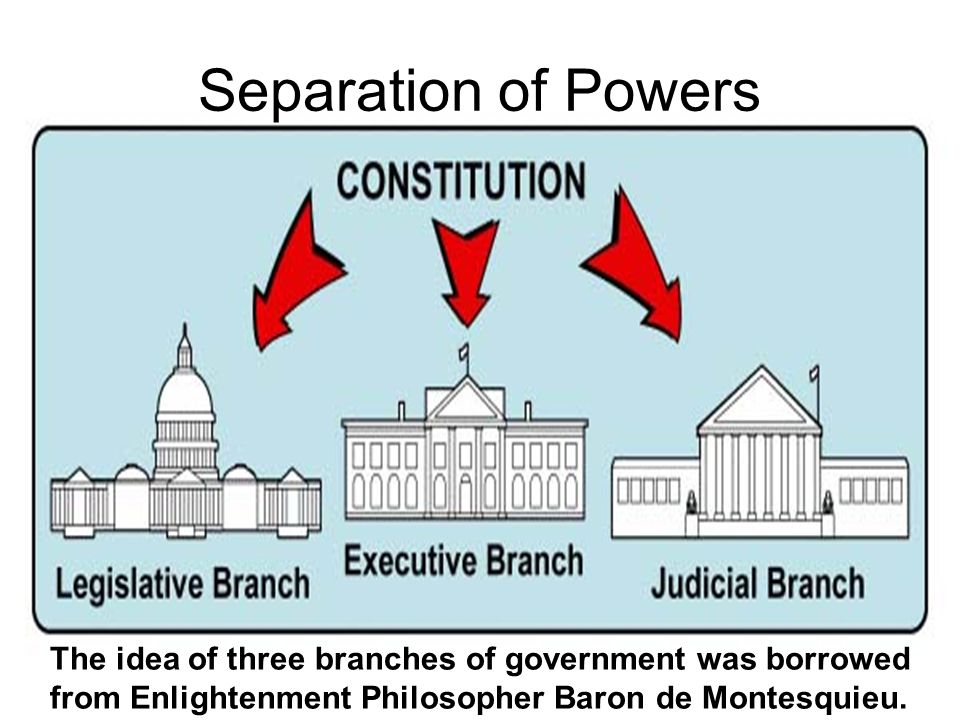
Meaning: – The term “trias politica” or ‘separation of powers’ was first coined by Montesquieu in 18th century French social and political philosopher. Under his model, the political authority of the state is split into Legislature, Executive, and Judiciary powers.
Generally, all the powers of the govt. will be categories into these three classes:
(1) Enactment of law created
(2) Interpretation of the enacted laws
(3) Enforcement of the enacted laws Separation of power, therefore, refers to the division of presidency responsibilities into distinct branches to limit anybody branch from exercising the core function of another.
Historical origin and Evolution: –
The doctrine of separation of powers is of ancient origin. The separation of powers concept was 1st originated in Greek and has become widespread within the Roman Republic as a part of the initial constitution of the Roman Republic. The history of the origin of the doctrine traceable to Aristotle in the 16th and 17th centuries, French philosopher John Bodin and British politician Locke respectively had expounded on the doctrine of separation of powers.
But it was Montesquieu ( a French jurist) who initially conveyed scientific evidence of separation of powers in his book “Espirit des Lois ” (The spirit of laws). Montesquieu’s view: – Montesquieu said that – ‘The accumulation of all power’s legislature, executive, and judicial within the same hand’s weather of 1, a few, or many and whether hereditary, self-appointed or elective, may justly be pronounced the very definition of tyranny.
Aristotle(384-322BC) in his book “The politics” stated that “These are three elements in each Constitution in respect of which each serious lawgiver must explore for what’s advantageous to it; of those are well arranged, the constitution is beyond to be arranged and also the differences in constitutions are sure to correspond to the difference between each of those elements.
The three are first the deliberative (which discuss everything of common importance), second the officials; and third the judicial element.
Objectives of separation of powers: –
(1) It aims to eliminate arbitrariness, totalitarianism, and tyranny and promote an accountable and democratic variety of government.
(2) It prevents the misuse of powers within the various organs of the govt..
(3) It keeps a check on all the branches of the govt by making them in control of themselves.
(4) This principle allows all the branches to specialize themselves in their respective field to boost and improve the efficiency of the govt.
Elements of Separation of powers: –
(1) Legislative: – Legislative means involving or regarding the method of creating laws. the first function of the legislature is to form laws for the governance of the state. it’s the authority of amending the present rules and regulations furthermore. Generally, in India, the parliament holds the facility of creating rules and laws.
(2) Executive: – The executive is that the part of the govt. exercising authority and holding responsibilities of the governance of the state. the chief executes and enforces laws made by the legislature. The president and therefore the Bureaucrats from the manager branch of the presidency.
(3) Judiciary: – The judiciary is that the branch of authority during a state which is anxious with the law and also the system or is that the system of courts that interprets defends and applies the law within the name of the state and safeguards the rights of the individuals. It can even be thought of because of the mechanism for the resolution of disputes within the state or internationally.
India is called the world’s largest democratic country. The power to make law exists with the Indian Parliament. The members of lower house of Parliament are elected from the direct election while the members of upper house are elected from the Legislative Assembly of States and Union territories by means of single transferable vote through proportional representation. The concept of parliamentary privilege in the Constitution of India has been taken from British Constitution. Parliamentary privileges are special rights, immunities, exceptions enjoyed by the members of the two houses of Parliament and their committees. The main motive of these privileges is to uphold the supremacy of the offence of the office of the Parliament and its members.
Who Enjoys Parliamentary Privileges
These rights are mainly for the members of both houses of Parliament. Apart from this, these rights are also given to those individuals who speak and participate in any committee of the Parliament, which includes the Attorney General of India and the Union Ministers. President, even if he is a part of Parliament, does not have parliamentary privileges.
Breach of Parliamentary Privileges
If any person or officer violates the individual or collective privileges of a Member of Parliament, such as, disrespect, abuse, attack, etc., such acts are comsidered as breach of Parliamentary Privileges which is punishable by the house.
Thus, the above facts make it clear that Parliamentary Privileges in India have been enforced so that the respect of the Parliament and its members can be ensured.
But it is observed that after winning the elections, these representatives do not respect the public while on the other hand they expect that the public should give them due respect. Apart from this, you may have noticed that the Parliamentarians are often seen misbehaving with the officials and the general public. This is called the misuse of parliamentary privileges.
Therefore, it is the need of the hour that if the government wants to maintain the dignity of the democracy then it should make appropriate changes in the parliamentary privileges because nobody can be superior to the general public.
Conclusion
The privileges are conferred on the members for smooth functioning of the Parliament. But, these rights should always be in conformity with the fundamental rights because they are our representatives and work for our welfare. If the privileges are not in accordance with the fundamental rights then the essence of democracy for the protection of the rights of the citizen will be lost. It is the duty of the Parliament not to violate any other rights which are guaranteed by constitution. The members should also use their privileges wisely and not misuse them. They should always keep in mind that the powers do not make them corrupt. The Parliament cannot adopt every privilege that is present in the house of commons but should adopt only those privileges that accordingly suits our Indian democracy.







 (
(






 Eduindex
You must be logged in to post a comment.