Antikythera-The Modern Invention in the Past.

After 2,000 years under thesea, three flat, misshapen pieces of bronze at the National Archaeological Museum in Athens are all shades of green, from emerald to forest. From a distance, they look like rocks with patches of mold. Get closer, though, and the sight is stunning. Crammed inside, obscured by corrosion, are traces of technology that appear utterly modern: gears with neat triangular teeth (just like the inside of a clock) and a ring divided into degrees (like the protractor you used in school). Nothing else like this has ever been discovered from antiquity. Nothing as sophisticated, or even close, appears again for more than a thousand years.

For decades after divers retrieved these scraps from the Antikythera wreck from 1900 to 1901, scholars were unable to make sense of them. X-ray imaging in the 1970s and 1990s revealed that the device must have replicated the motions of the heavens. Holding it in your hands, you could track the paths of the Sun, Moon and planets with impressive accuracy. One investigator dubbed it “an ancient Greek computer.” But the X-ray images were difficult to interpret, so mainstream historians ignored the artifact even as it was championed by fringe writers such as Erich von Däniken, who claimed it came from an alien spaceship. It wasn’t until 2006 that the Antikythera mechanism captured broader attention. That year, Mike Edmunds of Cardiff University in Wales and his team published CT scans of the fragments, revealing more details of the inner workings, as well as hidden inscriptions—and triggering a burst of scholarly research. 

The Antikythera mechanism was similar in size to a mantel clock, and bits of wood found on the fragments suggest it was housed in a wooden case. Like a clock, the case would’ve had a large circular face with rotating hands. There was a knob or handle on the side, for winding the mechanism forward or backward. And as the knob turned, trains of interlocking gearwheels drove at least seven hands at various speeds. Instead of hours and minutes, the hands displayed celestial time: one hand for the Sun, one for the Moon and one for each of the five planets visible to the naked eye—Mercury, Venus, Mars, Jupiter and Saturn. A rotating black and silver ball showed the phase of the Moon. Inscriptions explained which stars rose and set on any particular date. There were also two dial systems on the back of the case, each with a pin that followed its own spiral groove, like the needle on a record player. One of these dials was a calendar. The other showed the timing of lunar and solar eclipses.

Experts have been working to decipher inscriptions hidden inside the mechanism, in particular to understand the mechanism’s missing pieces, some destroyed, some probably still at the bottom of the sea. Though the pointers on the front face don’t survive, Alexander Jones, a historian at the Institute for the Study of the Ancient World in New York, says an inscription reveals that they carried colored balls: fiery red for Mars, gold for the Sun. 

Also missing are the parts that drove the planetary pointers, leading to debate about exactly how they moved. Because planets orbit the Sun, when viewed from Earth they appear to wander back and forth in the sky. The Greeks explained this motion with “epicycles”: small circles superimposed on a larger orbit. According to Michael Wright, a former curator at London’s Science Museum who has studied the mechanism longer than anyone, it modeled epicycles with trains of small gears riding around larger ones. Though some experts have dismissed this as beyond the Greeks’ abilities, Jones says he will publish evidence supporting the idea later this year.

Other inscriptions hint at where the mechanism was made. Paul Iversen, a classicist at Case Western Reserve University in Cleveland, reports that the calendar includes month names used in Corinth and its colonies in northwest Greece. A dial that displayed the timing of major athletic festivals, including the Olympics, lists Naa, a festival held in northwest Greece, and Halieia, held to the south on the island of Rhodes. Perhaps the mechanism hailed from Rhodes and was being shipped north. The ancient philosopher Posidonius had a workshop in Rhodes that could have been the source; according to Cicero, Posidonius made a similar model of the heavens in the first century B.C.

The tradition of making such mechanisms could be much older. Cicero wrote of a bronze device made by Archimedes in the third century B.C. And James Evans, a historian of astronomy at the University of Puget Sound in Tacoma, Washington, thinks that the eclipse cycle represented is Babylonian in origin and begins in 205 B.C. Maybe it was Hipparchus, an astronomer in Rhodes around that time, who worked out the math behind the device. He is known for having blended the arithmetic-based predictions of Babylonians with geometric theories favored by the Greeks. 

Regardless, the Antikythera mechanism proves that the ancient Greeks used complex arrangements of precisely cut wheels to represent the latest in scientific understanding. It’s also a window into how the Greeks saw their universe. They came to believe that nature worked according to predefined rules, like a machine—an approach that forms the basis of our modern scientific views. Edmunds argues that this “mechanical philosophy” must have developed as a two-way process. The ancient mechanics who captured the cosmos in bronze weren’t just modeling astronomical theories but were also inspiring them.

FEB15_J03_Antikythera.jpg

OSTEOARTHRITIS


Arthritis is joint inflammation ,which is most common in older adults .There are 2 types of Arthritis which are most common in adults (1) Osteoarthritis (2) rheumatoid arthritis. Osteoarthritis (OA) is the most frequent cause of disability among older adults. According to UN ,by 2050 around 130 million people around the world will suffer from OA and around 40 million will be severely disabled by this disease. Osteoarthritis is related to ageing but there are other factors like obesity ,lack of exercise ,gender etc which effect the condition.The best way to trackle with such diesease is by taking care of yourself take health diet,do yoga , meditation ,and avoid stress .

Why do Volcanoes Erupt?

You may have heard about the eruptions of volcanoes like Mount Vesuvius and Mount Tambora that devastated the land surrounding them and killed thousands of people living in their vicinity. However, not many of us stop to question why or how a volcano erupts in the first place. It is indeed not only an interesting, but also a useful bit of knowledge to have about one of the most fascinating natural phenomena that occur in our world.

What is the process?

We know that deep within the earth, the temperatures are extremely high. In fact, it is so hot that some rocks gradually start melting and become a thick flowing substance called magma. This melting takes place in the layer of the earth’s interior called the ‘mantle’. The mantle is the layer between the dense, superheated core and thin outer crust of the earth. The immense heat from the core melts the earth’s mantle and this melted rock (magma) begins its journey to the surface. The melting may happen where tectonic plates are pulling apart or when one plate is pushed down under another.

Magma being a lighter and more viscous substance than the rock surrounding it, starts rising to the top and collecting in areas known as magma chambers. As the magma rises, bubbles of gas also form inside it. Eventually, some of the runnier magma charges through any vents or fissures in the earth’s crust and gets released onto the surface as lava. Hence, magma that is released through volcanoes are then called lava, which flow in every direction away from the volcano to surrounding areas.

For the magma that is thicker in nature, the gas bubbles are not able to escape easily and the pressure starts building as the magma rises. When the pressure that is building reaches a point where it is too high for the earth’s surface to handle, an explosive eruption happens from the volcano. Such eruptions may also occur suddenly if the rocky surface above the magma has eroded over time, allowing the pressurized magma to easily burst through. Explosive eruptions are what often cause mass death and destruction, as the lava flows with much greater force and heat intensity. It can melt anything in its path, and most human creations will succumb to its natural power. The aforementioned bubbles, which are of undissolved water and sulphur, then burst with the intensity of a gunshot and release plumes of ash into the atmosphere. This ash can suffocate plants, animals and humans.

Another way eruptions happen is when water underneath the earth’s surface happens to come in contact with hot magma and creates steam. This may happen when ocean water is able to slip into the earth’s mantle and mingle with the magma. Over time, the rock strength of earth’s surface decreases as the pressure builds, and the steam can gradually build enough pressure to cause an explosion through the volcano.

It is important to highlight that some volcanic eruptions are explosive while others are not. As explained, it depends on the composition of the magma. If it is runny and gas is able to escape easily, lava will simply flow out. This is easy for people to avoid as it flows slowly and gives them time to move away. However, if magma is thick and gas cannot escape easily, pressure builds up until there is a violent explosion for it to escape. Magma blasts into the air, and lava flows at a greater speed for a greater distance. This is often unexpected and harder to escape from.

What is the role of Climate Change?

Geological studies have shown that human-induced climate change will most likely cause an increase in volcanic activity around the world. This is primarily because climate change has caused melting of glaciers in the earth’s crust. These glaciers have an impact on the flow of magma to the surface, and so melting glaciers may cause more magma eruptions. Basically, after glaciers are removed, the surface pressure decreases and the magma can more easily propagate to the surface and thereby erupt.

A team of researchers in the UK found that with the advancement of glaciers over time, there was diminishing volcanic activity. In turn, the team found that as the climate warmed up due to global warming and glaciers melted, there were more frequent and bigger eruptions. It has been found that even relatively minor climate changes may have an influence on this. Hence, it can be concluded that today’s global warming could mean more frequent, and even greater volcanic eruptions.

How to Write Formal Letter: Formal Letter Writing Tips

Want to write formal letter but don’t know how to write formal letter then this article is only for you and the learners who wants to learn letter writing. In today’s article we are sharing the steps, Tips or samples for writing formal letter.

Writing Formal letters are business like and get quickly to the point. Formal letters are different to personal letters. You do not write in a chatty manner or use slang. For example, you would write a different letter to your Principal inviting him to your class JCSP graduation as you would to your friend.

How to Write Formal Letter?

Formal letter writing is undoubtedly one of the most challenging types of letter format. When putting it together, often you are addressing a person or organization with whom you are not familiar and the quality of your content, including spelling and grammar will be strongly scrutinized.

Types of Formal Letter:

There are many types of latter :

  • Formal Request Letter
  • Formal Letter of Interest
  • Formal Apology Letter
  • Formal Complaint Letter
  • Formal Appeal Letter
  • Formal Reference Letter

Steps to Write All Formal Letter

  1. Introducing oneself if it is the first time you are writing.
  2. Referring to an earlier letter if you are responding to it.
  3. Stating the purpose of the letter.
  4. Stating action/information required from the addressee.
  5. Explaining action taken/supplying information.
  6. Urging action to be taken. 
  7. Offering assistance in future.

This is the basic structure of formal letter. It will have to be modified according to the purpose for which it is written and the person to whom it is addressed.

Typical Format of Formal letter

Business correspondence should get across the message in a direct, clear and natural way. In contrast to informal letter writing, one should avoid using slang and casual language, clichés, short forms and abbreviations.

The writer should avoid overly formal and rigid language too. The letter should be logically structured and organized. The layout of a formal letter follows basically the same order:

Sender’s Address: The sender’s address usually is included in letterhead. If you are not using letterhead, include the sender’s address at the top of the letter one line above the date. Do not write the sender’s name or title, as it is included in the letter’s closing. Include only the street address, city, and zip code.

Date: The date line is used to indicate the date the letter was written. However, if your letter is completed over a number of days, use the date it was finished in the date line.
Write out the month, day and year two inches from the top of the page. Depending which format
you are using for your letter, either left justify the date or tab to the center point and type the date.

Inside Address: The inside address is the recipient’s address. It is always best to write to a specific individual at the firm to which you are writing. If you do not have the person’s name, do
some research by calling the company or speaking with employees from the company. Include a personal title such as Ms., Mrs., Mr., or Dr. Follow a woman’s preference in being addressed as Miss, Mrs., or Ms. If you are unsure of a woman’s preference in being addressed, use Ms.

  • Mr. – for a male
  • Mrs. – for a married female
  • Miss – for an unmarried female
  • Ms. – for a female whose status is unknown or would prefer to remain anonymous
  • Dr. – for a person with the status of a doctor

If there is a possibility that the person to whom you are writing is a Dr. or has some other title, use that title. Usually, people will not mind being addressed by a higher title than they actually possess. For international addresses, type the name of the country in all-capital letters on the last line. The inside address begins one line below the sender’s address or one inch below the date. It should be left justified, no matter which format you are using.

Salutation: “Use the same name as the inside address, including the personal title. If you know the person and typically address them by their first name, it is acceptable to use only the first name in the salutation (for example: Dear Tejas:). In all other cases, however, use the personal
title and last/family name followed by a colon.

Leave one line blank after the salutation. If you don’t know a reader’s gender, use a nonsexist salutation, such as their job title followed by the receiver’s name. It is also acceptable to use the full name in a salutation if you cannot determine
gender. For example, you might write Dear Chris Harmon: if you were unsure of Chris’s gender.

Body of Formal letter: For block and modified block formats, single space and left justify each paragraph within the body of the letter. Leave a blank line between each paragraph. When writing a business letter, be careful to remember that conciseness is very important. In the first paragraph, consider a friendly opening and then a statement of the main point. The next paragraph should begin justifying the importance of the main point. In the next few paragraphs, continue justification with background information and supporting details. The closing paragraph should restate the purpose of the letter and, in some cases, request some type of action.

Closing: The closing begins at the same vertical point as your date and one line after the last body paragraph. Capitalize the first word only (for example: Thank you) and leave four lines between the closing and the sender’s name for a signature. If a colon follows the salutation, a
comma should follow the closing; otherwise, there is no punctuation after the closing.

Enclosures: If you have enclosed any documents along with the letter, such as a resume, you indicate this simply by typing Enclosures one line below the closing. As an option, you may list
the name of each document you are including in the envelope. For instance, if you have included many documents and need to ensure that the recipient is aware of each document, it may be a good idea to list the names.

A Note about Format and Font of Formal Letter

Block Format: When writing business letters, you must pay special attention to the format and font used. The most common layout of a business letter is known as block format. Using this format, the entire letter is left justified and single spaced except for a double space between
paragraphs.

Font : Another important factor in the readability of a letter is the font. The generally accepted font is Times New Roman, size 12, although other fonts such as Arial may be used. When
choosing a font, always consider your audience. If you are writing to a conservative company, you may want to use Times New Roman. However, if you are writing to a more liberal company, you have a little more freedom when choosing fonts.

Punctuation: Punctuation after the salutation and closing – use a colon (:) after the salutation (never a comma) and a comma (,) after the closing. In some circumstances, you may also use a less common format, known as open punctuation. For this gyanlog style, punctuation is excluded after the
salutation and the closing.

Important Points About Formal Letter Writing :

  1. The date and signature are very important in letters.
  2. Do not use commas after every line in the address.
  3. Do not begin your letters with hackneyed expressions like, ‘With reference to your letter dated 10 January’. Instead, use personalised variations like, ‘I was glad to receive your letter of 10 January…’ or ‘We were happy to note from your letter that the goods have reached you safely…’
  4. Never end your letters with hanging participles like ‘Thanking you’ or ‘Awaiting your reply’. Instead write, ‘Thank you’ or ‘We/I await/look forward to your reply’.

Children and Lack of Education

There are many circumstances of children around the world who experience a lack of education, resulting in them having a below average level of knowledge. Lack of education is a significant barrier for underprivileged children around the world.

Today, education remains an inaccessible right for millions of children around the world. More than 72 million children of primary education age are not in school and 759 million adults are illiterate and do not have the awareness necessary to improve both their living conditions and those of their children.

What Is Lack of Education?

  • A lack of education can be described by a state where people have lower than average common knowledge and basic skills to support them in their daily life.
  • This includes the ability to read, write, spell, speak, and do simple math.

What Causes Lack of Education?

  • A lack of education is a significant concern due to lack of funding for education, having untrained teachers, limited or no classroom space, limited resources (e.g., paper, pencil, etc.), living far away from school, and living in countries of conflict.
  • This concern is a leading issue in underdeveloped countries as an education system is highly dependent on region’s economic status.

People Who Are Less Likely To Receive Education

Females

  • Girls are commonly left uneducated because many countries believe there is more value in educating boys in comparison to girls.
  • Additionally, girls are forced to marry as early as eighteen years old which prevent them for continuing their education.

Children With Disabilities

  • Children with disabilities most regularly do not regularly receive education because teachers do not receive adequate training to work with these kids.
  • In addition, these children face a lot of discrimination in terms of accessibility to a safe learning environment, as well as communication with their surroundings.

Outcomes From a Lack of Education

  • Lack of education can prevent a person from having a sound voice in society, as they face communication barriers and are looked down upon
  • Not having enough education is a leading cause of unemployment, as many industries require well informed and educated individuals to step into an employment position
  • Being uneducated puts people at a higher risk of falling into the poverty trap, which is defined by being unable to escape poverty due to a lack of resources. This is because education provides people with the means to make a sustainable living; however, without it, the chances of having a sufficient income is low
  • Lacking education promotes exploitation, as many people without a proper education take on unsafe positions. Some of these positions include becoming a prostitute, sweatshop laborer, and can even result in child marriages.

Prevalence Rates

  • 34.3 million girls around the world do not attend primary school.
  • 97.4 million girls around the world do not attend secondary school.
  • In countries of conflict, girls are twice as likely to receive education in comparison to countries without conflict.
  • In developing countries, up to 95% of disabled children are not enrolled in school.
  • 51% of the uneducated population comes from South Asia.

What is Web Hosting? And its Types

Web hosting is an online service that enables you to publish your website or web application on the Internet. When you sign up for a web hosting service, you basically rent some space on a physical server where you can store all the files and data necessary for your website to work properly.

A server is a physical computer that runs without any interruption so that your website is available all the time for anyone who wants to see it. Your web host is responsible for keeping that server up and running, protecting it from malicious attacks, and transferring your content — such as text, images, files, etc. — from the server to your visitors’ browsers.

Types of Web Hosting Packages

  1. Shared Hosting

This type of hosting is the most common answer for most web hosting needs and it’s an excellent solution for most small businesses and personal blogs. With this type of hosting, you’re sharing one server with other clients. Websites hosted on the same server share all its resources, such as memory, computing power, disk space, and others.

  • Pros :
  • Low cost, excellent for small online business websites
  • No need for specific technical knowledge
  • Pre-configured server options
  • User-friendly control panel — hPanel
  • Maintenance and server administration is taken cared for you
  • Cons :
  • Little or no control over server configuration
  • Traffic surges on other websites can slow down your website

2. VPS Hosting

When you’re using a Virtual Private Server — or VPS for short — you’re still sharing a server with other users. However, your web host allocates an entirely separate partition for you on that server. This means you get a dedicated server space and a reserved amount of resources and memory. In fact, VPS hosting can be great for medium-sized businesses with a rapidly growing number of websites and traffic.

  • Pros :
  • Dedicated server space
  • Traffic surges on other websites have no effect on your performance
  • Root access to the server
  • Easy scalability and high customizability
  • Cons :
  • More expensive than other types of hosting
  • Technical and server management knowledge is a must

3. Cloud Hosting

Cloud hosting is currently the most reliable solution on the market. With cloud hosting, your host provides you with a cluster of servers — your files and resources are replicated on each server. When one of the cloud servers is busy or encounters a problem, your traffic is automatically routed to another server in the cluster. This results in little to no downtime, which is excellent if you own a very busy website.

  • Pros :
  • Little to no downtime
  • Server failures have no effect on your website
  • Allocates resources on demand
  • Pay-as-you-pricing strategy — you only pay for what you use
  • More scalable than other web hosting types
  • Cons :
  • Hard to estimate the actual costs
  • Root access is not always provided.

4. WordPress Hosting

WordPress hosting is a particular form of shared hosting, created for WordPress site owners. Your server is configured specifically for WordPress and your site comes with pre-installed plugins for crucial tasks, such as caching and security.

  • Pros :
  • Low cost and beginner-friendly
  • One-click WordPress installation
  • Good performance for WordPress sites
  • Customer support team trained in WordPress issues
  • Pre-installed WordPress plugins and themes
  • Cons :
  • Recommended only for WordPress sites, which can be a problem if you want to host more than one website on your server

5. Dedicated Hosting

Dedicated hosting means that you have your own physical server that’s dedicated solely to your website. Therefore, you’re given incredible flexibility over how you want to manage your website. You can configure your server as you wish, choose the operating system and software you want to use, and set up the whole hosting environment according to your own needs.

  • Pros :
  • Full control over server configuration
  • High reliability and security options
  • Root access to your server
  • Cons :
  • High cost, more oriented towards larger businesses
  • Technical and server management knowledge is a must

Use of MS Excel in today’s world.

Excel is typically used to organize data and perform financial analysis. It is used across all business functions and at companies from small to large. The main uses of Excel include: Data entry.

Excel is a software program created by Microsoft that uses spreadsheets to organize numbers and data with formulas and functions. Excel analysis is ubiquitous around the world and used by businesses of all sizes to perform financial analysis.

The main uses of Excel include:

1 Data entry
2 Data management
3 Accounting
4 Financial analysis
5 Charting and graphing
6 Programming
7 Time management
8 Task management
9 Financial modeling
10 Customer relationship management (CRM)
** Almost anything that needs to be organized!

Excel is used extensively in finance and accounting functions. In fact, many organizations run their entire budgeting, forecasting, and accounting functions entirely out of Excel spreadsheets.

While Excel is defined as a “data” management tool, the data that is most commonly managed is financial. At CFI, we would define Excel as the ultimate financial software. While there are other pieces of financial software that are tailored toward performing specific tasks, the strongest point about Excel is its robustness and openness. Excel models are as powerful as the analyst wishes them to be.

Accountants, investment bankers, analysts, and people in all types of financial career paths rely on excel to perform their daily job functions.

And one should know how to use MS Excel. Its on of the most important skill in today’s corporate world.

Beauty of Kashmir!

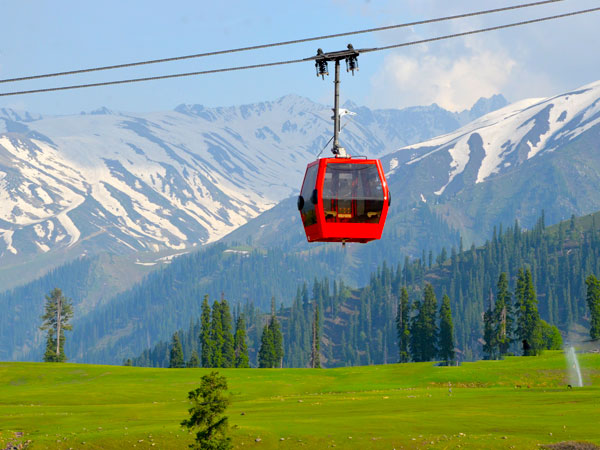
Kashmir is located on the Jhelum River in north India. It is always cold here. It is very beautiful. It is called Paradise on Earth. Its beauty seems very captivating in every season. In summer there is greenery everywhere and in winter everything is covered with snow. The red apples hanging on the apples look very beautiful. There are many tourist places to see in Kashmir like Gulmarg, Sonmarg etc. Gulmarg is called the life of Kashmir. Sarovars like Vullar add to the beauty of Kashmir.

The people of Kashmir are called Kashmiri Pandits and they are very beautiful. They are also non-vegetarians and consume kebabs etc. After eating here, it is rotated in sweets. Saffron is cultivated here. Whoever goes to this place makes sure to buy show pieces made of walnut wood, apple, Pashmina shawl and saffron. Kashmir is a matter of great dispute between India and Pakistan. Kashmir has its own flag and it has its own constitution under Section 370 of the Constitution of India. No person outside Kashmir can buy land in Kashmir.

The poet has rightly said about Kashmir that “if there is heaven on earth, it is here, it is here”. We have been fortunate enough to spend some of our holidays in Kashmir, but this happened a few years before the disturbances started in the valley. We usually visited Kashmir during our summer holidays. We took a train to Pathankot. Steal the bus from Srinagar. The last time we were there, we went to Chandan Van. A trip in the Kashmir valley is a beautiful experience. Green plains, long There are trees, lakes, springs, snow-capped mountains. Both sides of the streets are lined with Apple and Peer Orchard.

Wild strawberry grows in abundance everywhere, flowers and fragrant saffron are cultivated here. Kashmir relies on its image of being a paradise on Earth. A visit to the Shalimar and Nishat Gardens is a lake dating back to the Mughal era, when Nur Jahan’s favorite queen of Emperor Jahangir visited these gardens. There are beautiful poplar trees, flowers and fountains all over the place. Many Hindi films have been shot here. We often visited the lakes of Kashmir. Dal Lake, which is a major tourist attraction, has many home boats. Many foreigners come here and stay during their holidays. Many boats called the gazelle between these house boats and the shores of this lake. Likewise, there is the famous Wular lake, which is a large fresh water lake.

shooting of jab tak hai jaan movie, song jiya re

However, among all the lakes of Kashmir, my favorites were Evanabal and Gangarbil lakes. Mansabal Lake is situated between the mountains and the Indus River. While the Gangarbal Lake is considered the source of the Ganges. It is closed in the rocky center of Harmok, Kashmir also has many springs for their healing powers. The most famous among all is Chashma – Shahi, or Shahi Vasant. It is known for its medicinal values. There is also a sulfur lake called ‘Tatta Pani’ in Kashmir. It is believed that if all take a bath in these springs, then all types of skin diseases can be cured. Kashmir is a trekker’s paradise. There are several trails scattered all over the valley which are ideally suited for trekking. They are variously known as Gulmarg or path of flowers, Sonamarg or path of gold etc. In fact the beauty of Kashmir binds a person and does not allow him to leave the place.

reference-https://articles.pk/kashmir-land-of-heaven.html

How Archives transformed in the Digital era

The Word archive is derived from the Greek word ‘Arkheion’. The word was further referred from ‘Archon’, which meant a magistrate who oversaw the town hall where all the official public documents were stored. The Word Archive came to use for the first time in the 17th century.

Archives are also known as ‘memory institutions’ because they record and preserve memories and form a significant part of culture, community, official and unofficial history of any place or region or state, or any institution. Their function is to collect, store and preserve artefacts and documents of historical, cultural, and legal importance from the yesteryears and the present so that they remain accessible, informative, and useful to future generations. In general, any organization, government institution or individual can build archives. The National Archives, UK has described archives as “collections of records or documents, selected for lasting preservation due to their historical value, significance as evidence, or as a source for research studies”. International Council on Archives (ICA) has defined archives as “documentary result of various human activities conserved for its long-term value”. They further described archives as contemporary accounts created to can provide a true and verified version of past events.

The significance of the archives lies in the orderly collection of crucial source documents accumulated over an individual’s or organizations’ lifespan and preserved, which can serve as evidence or reference for future work. As archives are the repositories housing various historical documents and records of value, archival research is facilitative for scholars and researchers looking for data to assess and facts to study from the original documents. However, owing to the vastness and diversity of ample archival documents and records, archival analysis is a hectic and tedious job. Access to the artefacts and documents stored in an archive is not an easy task and requires permission from the respected authority. In addition, most of the information stored in traditional achieves is paper-based and thus, is susceptible to decay with time. The aforementioned limitation of traditional archives can be overcome by archiving documents and artefacts in various digital formats, which can ensure that the information is preserved for a substantially longer period.

With the advent of newer digital technologies, it became easier and more convenient to store and preserve the information in the digital space. With the assistance of new digital tools and methods, the process of transcending information from the physical world to the digital world became much efficient and easier. 

Digital archiving is an area where the relationship between digital tools/methods and information preservation can be witnessed. It is a blend of the former and current storage of information. Their function is similar to traditional archives, as repositories of elaborated collection of information in various digital formats at a virtual location. This also makes digital archives more accessible and democratic as the physical constraints are eliminated.

Advantages of Digital Archives:

  • The the digital archive allows “anywhere-anytime” accessibility to users ensuring a reduction of time, cost, and money.
  • The redundancy of information stored in digital archives can be reduced, which can promote ease of access.
  • No geographical site is required to build a digital archive, which is cost-effective.
  • The simultaneous requests of access from multiple users can be addressed by creating multiple copies of information stored, which can overcome the issue of bottlenecks encountered in traditional archives.
  • Managing and navigating objects or records stored digitally are easier in digital archives, which allow developing capacity to preserves terabytes of information.
  • Digital archives are less subjected to bureaucracy like traditional archives, which can ensure data accessibility to the general public.

Digital archives are not perfect. Many times due to the digital divide and other constraints, researchers are not able to access the information. Sometimes the information challenges the authority and due to this, the information can be unavailable in the digital archives because of censorship. But there is no denying that digital archives have transformed the way information is stored and processed.  

References:

WHY DO WE NEED TO BE PUNCTUAL?

Know the true value of time; snatch, seize, and enjoy every moment of it——-Lord Chesterfield

ITS MEANING

Punctuality means doing a work at the proper time. To account an engagement at 10 o’ clock in the morning and to arrive at the place to keep it at 10-30 does not become a gentleman. It annoys the other party and it harms the future of the caller. No one who is unpunctual in attendance to work can be depended on or trusted in. On the other hand, a punctual man is one who knows the value of time. Such a man is a perfect gentleman and everybody has faith in his efficiency and character.

IT GIVES A MEANING TO YOUR LIFE

Punctuality is important in every sphere of life. it is rightly said that punctuality is the crown of a king. It is the most precious jewel to the character of a man. A student has to be punctual at school or college. The manager of a big firm or its common clerk has to be punctual in his office. Equally it is necessary for a factory worker, a politician, or a statesman. The greatest value of punctuality is that it is a great time-saver. An unpunctual man is always worried about time. A student who is unpunctual in his class lags behind others in his studies, he creates confusion both for himself and for others in the class. He is considered a disturbing element and is looked down upon by his teachers as well as his classmates.

MISS IT AND WELCOME YOUR HARM

Many battles have been lost on account of unpunctuality. Many Cases in Courts of Law have been lost, because one of the parties did not come in time; many a train has been missed and business lost to unpunctuality. So, unpunctuality leads to dangerous consequences. Relation of free people knows the value of punctuality. Indians are now a free people and they should cultivate punctuality in everywhere. Unpunctuality is a vice and out of it are born other vices like dishonesty, falsehood, idleness and shirking of one’s duty.

So, we observe how punctuality plays a foremost role in anyone’s life. being unpunctual is a curse, we cannot be as winner as others. Besides, this rhythmic world demands punctuality so that all of us can be successful in life.

FAILURES

Do Our Failures Define Us?

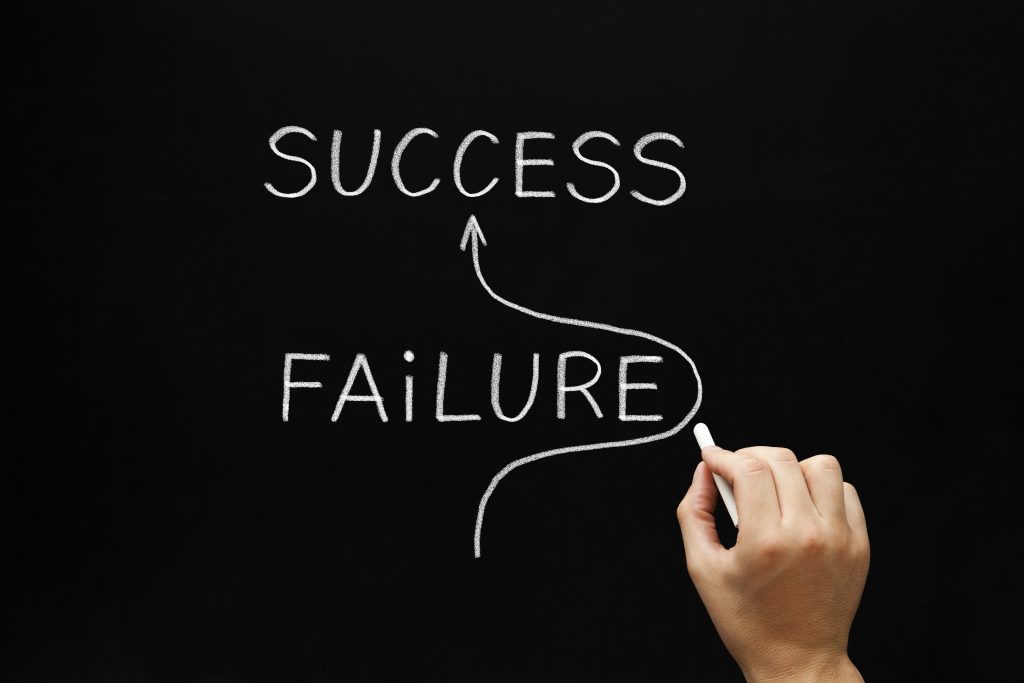
In today’s fast moving and overly competitive world, all people care about is being successful. And for the ones who are already there, it is hard to believe that they faced no failure on their way to the top. Failure is a part of success, it is the part of our lives. That one failed moment is enough to make you think about what you can do if you give it one more try. People want success but what they don’t desire is failure.

You must have heard life stories of many great people but I bet everyone had their challenges. If you try to do everything perfectly, made sure that everything goes according to your “plan” and leave no scope for failure, do you really think life would be easy to live? Is it that easy to control every aspect of your life? I think not. I am not saying you must leave scope for failure but you must consider it as a possibility because sometimes things are just not under your control. You need to know that failure is one of the key ingredients in the recipe for success. Failure is what pushes you to keep going. Failure is what keep you humble. Failure encourages you to take that risk again and we all know that ‘greater the risk, higher the reward’. Yes, failing at something you worked this hard for can take a toll on our emotional and mental health. But you have to think about the fact that now you are aware of your mistakes. You finally know what you have been doing wrong and if that isn’t a good thing then what is.

DO OUR FAILURES DEFINE US?

Your failure is not what defines you but your capability to pick yourself up, defines who you are. As it is rightly said that if you fall, the person to pick you up should be ‘YOU’. It is understandable that after a point of time failure takes you down mentally but you still have to believe in yourself because as Marilyn Monroe once said “Keep trying, hold on, and always, always, always believe in yourself, because if you don’t, then who will, sweetie?” . All you have got is you. Life is full of challenges and it is for sure that a life full of challenges will teach you more about the world then a smooth sailing one.

Another thing you have to realize is that you are not alone in this. Everyone falls. Some more often than others but the people who refuse to stand up and begin again are the real failures. You cannot just give up. If you do, you will live with the regret of what you could have been if you got up, dusted yourself and gave it one more shot. The feeling of regret is worse than failure because if you never try you shall never know what you were capable of all along. Let me ask you a question, during your final days what are you more likely to think about- your current status or the time you didn’t recover from that one failure which could have been your shot? Well, if the latter is your answer then you have to get up, make a new plan, go out there and show everyone who ever doubted you that your failure is not what defines you but your success will.

I’ll leave you with this quote by Nelson Mandela,
“Do not judge me by my successes, judge me by how many times I fell down and got back up again.”

Digital marketing

INTRODUCTION:-

Any marketing that uses electronic devices to convey promotional messaging and measure its impact. In practice, digital marketing typically refers to marketing campaigns that appear on a computer, phone, tablet, or other device. It can take many forms, including online video, display ads, and social media posts. Digital marketing is often compared to “traditional marketing” such as magazine ads, billboards, and direct mail. Oddly, television is usually lumped in with traditional marketing.
Did you know that more than 3 quarters of Americans go online on a daily basis? Not only that, but 43% go on more than once a day and 26% are online “almost constantly.” These figures are even higher among mobile internet users. 89% of Americans go online at least daily, and 31% are online almost constantly. As a marketer, it’s important to take advantage of the digital world with an online advertising presence, by building a brand, providing a great customer experience that also brings more potential customers and more, with a digital strategy

What is digital marketing?

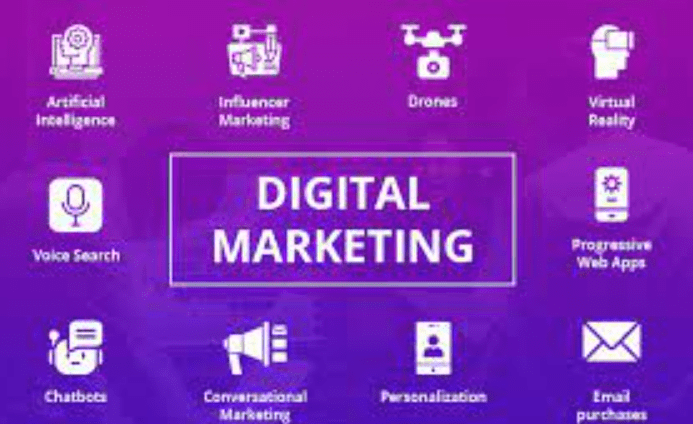
Digital marketing, also called online marketing, is the promotion of brands to connect with potential customers using the internet and other forms of digital communication. This includes not only email, social media, and web-based advertising, but also text and multimedia messages as a marketing channel.
Essentially, if a marketing campaign involves digital communication, it’s digital marketing.

Inbound marketing versus digital marketing:-

Digital marketing and inbound marketing are easily confused, and for good reason. Digital marketing uses many of the same tools as inbound marketing—email and online content, to name a few. Both exist to capture the attention of prospects through the buyer’s journey and turn them into customers. But the 2 approaches take different views of the relationship between the tool and the goal.
Digital marketing considers how each individual tool can convert prospects. A brand’s digital marketing strategy may use multiple platforms or focus all of its efforts on 1 platform.
Inbound marketing is a holistic concept. It considers the goal first, then looks at the available tools to determine which will effectively reach target customers, and then at which stage of the sales funnel that should happen.
The most important thing to remember about digital marketing and inbound marketing is that as a marketing professional, you don’t have to choose between the 2. In fact, they work best together. Inbound marketing provides structure and purpose for effective digital marketing to digital marketing efforts, making sure that each digital marketing channel works toward a goal.

B2B versus B2C digital marketing:-

Digital marketing works for B2B as well as B2C companies, but best practices differ significantly between the 2.

  • B2B clients tend to have longer decision-making processes, and thus longer sales funnels. Relationship-building strategies work better for these clients, whereas B2C customers tend to respond better to short-term offers and messages.
  • B2B transactions are usually based on logic and evidence, which is what skilled B2B digital marketers present. B2C content is more likely to be emotionally-based, focusing on making the customer feel good about a purchase.
  • B2B decisions tend to need more than 1 person’s input. The marketing materials that best drive these decisions tend to be shareable and downloadable. B2C customers, on the other hand, favor one-on-one connections with a brand.
Of course, there are exceptions to every rule. A B2C company with a high-ticket product, such as a car or computer, might offer more informative and serious content. Your strategy always needs to be geared toward your own customer base, whether you’re B2B or B2C.

Types of digital marketing:-

What is Digital Marketing & Types of Digital Marketing (2021)

The 7 Types of Digital Marketing:-

INTRODUCTION:-

A group of men and women sitting around a conference room table working in their role as digital marketers.
Digital marketing can be broadly broken into 7 main categories including: Search Engine Optimization, Pay-per-Click, Social Media Marketing, Content Marketing, Email Marketing, Mobile Marketing, Marketing Analytics.
In the past decade, digital marketing has become a vital component in organizations’ overall marketing strategy. It allows companies to tailor messages to reach a specific audience, making it possible to market directly to people who are likely to be interested in their product. Digital marketing encompasses a wide variety of marketing tactics and technologies used to reach consumers online. Two academic team members from Southern New Hampshire University (SNHU) spoke about how digital marketing aligns with traditional tactics and shared information on some of the types of digital marketing in practice now.
A senior associate dean of business programs, Dr. Mark Hobson, said although digital marketing seems like a new world, in fact it is based in many of the principles familiar to traditional marketers and requires both foundational marketing knowledge and technical know-how.
Dr. Jessica Rogers, associate dean of marketing programs, said the two disciplines serve to connect with distinct groups of consumers. “… Traditional media is a great way to reach a broad consumer base, whereas digital media has the ability to reach very specific audiences,” she said “A key point is that depending on the target audience, some channels are more effective than others.”

Types of Digital Marketing:-

Rogers talked about some of the most popular types of digital marketing, providing a brief overview of each

1. Search Engine Optimization (SEO):-

The goal of SEO is to get a business to rank higher in Google search results, ultimately increasing search engine traffic to the business’s website. To accomplish this, SEO marketers research words and phrases consumers are using to search for information online, and use those terms in their own content. According to leading SEO software company Moz’s “Beginners Guide to SEO,” SEO encompasses many elements, from the words on your web pages to the way other sites link to you on the web to how your website is structured. An SEO specialist can make around $59,000, according to Salary.com.
So, what are some things that can improve a site’s SEO? It’s important to understand that one of the things that makes SEO challenging is that the answer to this question always depends on Google and its most current algorithm. Keeping that in mind, here are a few of the most important things for SEO strategists and marketers in general to understand about how SEO works today, from Moz’s Beginners Guide to SEO:
  • Content indexing – It is important to allow search engines to clearly “read” what your site content is, by doing things like adding alt text for images and text transcripts for video and audio content.
  • Good link structure – It is important that search engines can “crawl” your site structure to easily find all the content on your site. There are many things that an SEO specialist can do to properly format links, URLs, and sitemaps to make them most accessible to site crawlers.
  • Keywords and keyword targeting – Properly deploying your keywords – i.e. the search terms you want your site to be found for—in your content and headers is one of the fundamental building blocks of SEO. It is no longer good practice to “stuff” your content with as many keywords and keyword variations as possible. Writing high-quality content that uses keywords in the headers and a few times in the crawl-able page content is now considered better practice, and will make pages rank better in search results.

2. Pay-per-Click (PPC):-

A laptop screen showing the analytics behind a pay-per-click digital marketing campaign.

Pay-per-click refers to paid advertisements and promoted search engine results. This is a short-term form of digital marketing, meaning that once you are no longer paying, the ad no longer exists. Like SEO, PPC is a way to increase search traffic to a business online.
Pay-per-click can refer to the advertisements you see at the top and sides of a page of search results, the ads you see while browsing the web, ads before YouTube videos and in ads in mobile apps.
One of the other things that differentiates pay-per-click from SEO is that you only pay for the results. In a typical PPC model like a Google AdWords campaign, you will pay only when someone clicks on your ad and lands on your website. You can spend just about any amount of money on pay-per-click advertising. Some companies may see results from investing just a few hundred dollars, but plenty of large companies spend tens of thousands a month on pay-per-click.
How much it costs to run an ad or promote your search results will depend primarily on how much competition there is for your keywords. High competition keywords (i.e. keywords that many people are searching for and that many sites are trying to be found for) will be more expensive and lower competition terms will likely cost less.
When you set up a pay-per-click campaign, you will also be able to choose whether you want your ad or promoted results to be shown to users all over the world, or only within a specific geographic area. If you are marketing a brick-and-mortar business, this ability to tailor by location helps you not waste ad dollars serving ads to users who don’t live anywhere near your business, according to Google.

3. Social Media Marketing:-

A woman using her cell phone to track the results of a social media marketing campaign.

This includes everything a business does via social media channels. Just about everyone is familiar with social media, but marketers must approach social with an integrated and strategic approach. Social media marketing goes far beyond simply creating posts for social channels and responding to comments.
To be effective, efforts must be coordinated and consistent rather than an afterthought. To help keep posts consistent, there are many online tools available to automate and schedule social media posts, although marketers only should use automation as a tool, not a “set it and forget it” solution. Users will figure it out quickly if there is no real person behind the posts.
Social media marketers should not be in a silo separate from other marketing functions. Social marketers need to work with the company’s wider marketing team to coordinate their message across all platforms, online and off, so that every part of the brand is telling the same story.
A crucial part of social media marketing is analytics: Social media marketers must also be savvy at analyzing the performance of their posts, and creating strategies based on that data. Another reason for marketers to be consistently measuring and tracking their campaigns is that this data allows marketers to demonstrate to business leadership that their efforts are driving users to engage with the brand and eventually converting users into customers, therefore providing value to the company, according to Forbes contributor Jayson DeMers.
In other words, social media marketing is a lot more complicated than managing your personal Facebook or Twitter profile. It requires a blend of creative thinking and objective, data-driven strategy, and may be a great fit for professionals who enjoy blending these two disciplines. A social media analyst with a bachelor’s degree can earn about $63,841, according to Salary.com.

4. Content Marketing:-

A digital marketer working on a content marketing article on his laptop.

Content marketing uses storytelling and information sharing to increase brand awareness. Ultimately, the goal is to have the reader take an action towards becoming a customer, such as requesting more information, signing up for an email list, or making a purchase. “Content” can mean blog posts, resources like white papers and e-books, digital video, podcasts, and much more. In general, it should first and foremost provide value to the consumer, not just advertise the brand or try to make a sale. Content marketing is about building a sustainable, trusting relationship with your customers that can potentially lead to many sales over time, not just making a single transaction.
Content marketing works in symbiosis with other types of digital marketing: It is a way to incorporate SEO search terms into fresh website content, and the content created can be shared as social media posts and in email marketing publications. Looking at the analytics for your content marketing can tell you a lot about your customers: what are they looking for when they land on your site? What kinds of content make them stay on the site longer and keep looking around? What kinds make them lose interest and navigate away?
Unlike a method such as PPC, content marketing is a long-term strategy. Over time, marketers build up a library of content (text, video, podcasts etc.) that will continue to bring users to the site via search engines, according to Marketo, a marketing automation company. This content library also helps promote knowledge of your brand and increases your profile as a resource for information. And, if users are visiting your site for information, ideally they will remember you as an authority when it’s time to make a purchase.
Content marketing is a great avenue for people who enjoy writing and/or video and audio production. But as with digital marketing in general, it also calls for strong strategic and analytic skills.

5. Email Marketing:-

A cell phone displaying bar graphs associated with an email marketing campaign.

Even with the emergence of social media, mobile applications and other channels, email is still one of the most effective marketing techniques, Rogers said. It can be part of a content marketing strategy, providing value to consumers and over time convert an audience into customers. Email marketing pros not only know how to create compelling campaigns, they also understand optimal audience outreach and are skilled at analyzing customer interactions and data, and making strategic decisions based on that data, according to the American Marketing Association. 
Email marketing software can offer many different analytical measures, but two that marketers are always striving to improve are the open rate –the percentage of recipients who opened the email – and the click through rate – the number of recipients who opened the email and clicked on a link in the email. According to leading email marketing software company Constant Contact, there are many things marketers can do to make their emails more appealing to users and more likely to be opened. These include:
  • Create a Sense of Urgency – Writing email copy that lets your recipients know that time is running out to get a special deal or that there are only a limited number of the offer available, can increase the number of people clicking through to your website.
  • Personalize Your Email – Setting your emails and subject lines up to incorporate the recipient’s name is a proven way to increase open and click through rates. (A sample subject line: “Katie, a special offer just for you.”)
  • Let Recipients Set Their Preferences – Allowing users to specify how often they want to hear from you can help keep some of your email subscribers subscribed to your list and clicking on your emails.

6. Mobile Marketing:-

A group of digital marketer looking at a tablet displaying the results of a mobile marketing campaign.

This digital marketing type is this focused on reaching your target audience on their smart phone or tablet. Mobile marketing reaches people through text messages, social media, websites, email and mobile applications. Marketers can tailor offers or special content to a geographic location or time, such as when a customer walks into a store or enters an event.
ccording to a recent TechCrunch article, consumers in the United States now spend five hours a day on their phones. This represents a 20% increase from the fourth quarter of 2015. Users are also spending much more of their time in apps rather than on mobile browsers. In 2017, users are spending much more time with apps than watching television. 15% of that app time is spent with entertainment apps like Netflix and Hulu, 19% of it is spent on Facebook’s mobile app, 12% on other social and messaging apps, and 11% in gaming apps, according to the TechCrunch article.
Retail Dive reports that 45% of all shopping always or frequently involves a mobile device in some way, whether it’s used to do research, compare prices or make a purchase. For a majority of Millennials (defined the Pew Research Center as people born between 1981 and 1997), that number is 57%.
Marketers know that you need to take your message to where you customers are, and in 2019 it is very clear: your potential customers are on their phones.

7. Digital Marketing Skills:-

A laptop screen showing the analytics behind a digital marketing campaign.

Digital marketers support the wider marketing team and the strategic goals of the whole company by rolling out marketing strategies in the online environment, Hobson said. Digital marketers strive to be a voice for the customer and how they want to interact with a brand digitally, Rogers said. “(Marketers) strategically approach the brand’s channels to maximize investments, drive traffic and conversions, as well as manage integrated digital content,” she said.
The need to be where the customers are at all times means that digital marketers have a significant responsibility to be attuned to changes in technology, social media and software.
Technology changes quickly; the hot social media app of today may be all but abandoned by next year, but many of the foundational principles of marketing remain the same.
Today, many employers are requiring experience in Google Analytics, Google and Facebook Ads, HubSpot and Hootsuite, according to Rogers. In a master’s in digital marketing program, you’ll learn the foundations of tools such as these, exploring and applying them through coursework. They are also looking for candidates who are proficient in Adobe Creative Suites and have a working knowledge of SEO and keyword research.
However, some important pieces of the marketing puzzle have not changed since the days when companies primarily advertised in print, radio and TV. All marketers need strong communication skills and a strong basis in marketing principles.
Employers include these soft skills with the technology-related proficiencies in job posting requirements, according to Rogers. 
“A basic tenant of marketing is communicating a marketing message to a target audience,” she said. “… Not only must we communicate with our teammates, but we must be able to communicate to customers, executives and more. These folks are our target audience and without strong communication skills, messages will not be received in the way in which we intended.”
Since digital marketing is a rapidly changing space and it is imperative for companies to stay up to date on new and emerging strategies, Hobson said. There are many ways that companies do this, some of which are the responsibility of digital marketers and some of which is done by other departments.
“Staying ahead of the competition has never been more important,” Rogers said. “The landscape for businesses is changing so rapidly, that is has become a key strategy to include looking to the competition to help inform your own digital strategy.”

Reference Links:-

https://mailchimp.com/marketing-glossary/digital-marketing/

https://www.snhu.edu/about-us/newsroom/2017/11/types-of-digital-marketing

10 tools for a Java Developer

When you talk about a Java developer, he can be a fresher or have experience of 10 years or more. That doesn’t matter. What matters is in this duration whether you have worked on different projects. So in those projects you might have used these tools or technologies but still it’s my job to list that for you. Even if you are a fresher, it’s good for you if you know these technologies because it will be helpful for you to get a job.

1) Companies are normally going for full standard uppers where one person should know both front end and back end web development. When it comes to front end, we tend to talk about HTML, CSS, JavaScript. But along with that you need to work on front end frameworks and that is where Angular and React comes into picture. You can learn and work on any one- either Angular or React.

2) When we work on a project, we also need to create the giant file creatingbthe word file and also manage the dependencies. What if, in your project you need to create jar files and also you need to create a jar out of it. That is where the build management tool- Maven and Gradle comes into picture.

3) Based on your experience, you may have worked on different IDE’s like eclipse. But to increase productivity, you need to start working in IntelliJ ultimate version. The community version does not support the exterprise part. So you have to use the ultimate version. But you have to pay for it. It is upto you to decide whether you want to save time or save money.

4) A developer normally focusses on the development part. But there is a need for debugging your code by yourself. There is a testing team. But if you want to test every class you create, that’s where unit testing comes into picture. One of the best frameworks for testing is JUnit. So make sure that you learn JUnit because it will help you test your software so that you will have less bugs in your code.

5) Okay, how can you increase your productivity more. Of course using IDE and using testing software. But of you follow a particular framework, it will help you to build your project faster and also help you to maintain your project. For different types of scenarios, we have different frameworks famous. But one framework is getting famous a lot and is used by companies now. That is Spring Framework. Spring Framework gives you a lot of features in built, you can write less code and it will also help you to maintain your project. We also have a concept of spring security. It will help you prevent your website from hackers.

6) If you need to include a payment gateway, you don’t need to create a new payment gateway. You can connect with a payment gateway service using REST/postman.

7) Once you built an application, you will release new versions upon development. It is better to have numbers for that. This version control is provided by Git. If you are in a team and you have to share the code you are working on to a team member, you can use Git.

8) If you have a big project and want to add a small module to that, just integrate it with the help of CI/CD. After integration, you can also deploy it.

9) Docker- Its primary focus is to automate the deployment of applications inside software containers and the automation of operating system level virtualization on Linux. It’s more lightweight than standard Containers and boots up in seconds.

10) Cloud- Cloud provides all the services instantly. We have Google could service, Amazon cloud service, Microsoft also has one. Amazon holds the most of the market share in cloud. The amazing this is for one year it would be free for a user. Try using it.

Don’t Change Your Tool—Change Your Purpose

Imagine that life consisted of one long construction project of a house. And imagine that you were born with one tool attached to your hand. Let’s say you were born with a hammer. 

Your primary skill is to slam nails into wood. But that’s not all you can do with a hammer. According to Wikipedia, a hammer is a versatile tool: “Hammers are used for a wide range of driving, shaping, and breaking applications.”

We need all those things if we’re building a house. It’s essential work. But let’s say you dislike those things. You prefer to draw like your neighbor, Jimbo, who was born with a pencil. He draws, designs, writes, and makes doodles. Since you can’t do any of that stuff with a hammer, you walk around frustrated and angry all the time.

Everybody tells you, “Look, buddy, you have this gift; use it!” And you say, “Screw that. This is a curse! I can only destroy things.” So you ignore people’s advice, and you try to draw…With a HAMMER. 

There’s Nothing Wrong With Your Tool

In life, we often look at the strengths of others and try to do what they do. We ignore our own strengths and pursue things that are not the right fit.

I firmly believe that every person is born with a key skill or gift that you can put to work in life. But the problem is that we use our tool for the wrong purpose. We try to become designers or architects with a hammer. We try to plaster a wall with a soft brush. 

Often, people say “I don’t know what my key skill is.” But the answer is always right in front of you.

Just like the example I shared at the beginning, you must stop looking at what Jimbo does, and start looking at what’s in your own hands. Look at yourself. Too often, we try to change ourselves so we can do something we “want” to do. And where do our wants come from? Not from within us. It comes from looking at others.

Look, I want to sing like the artist, The Weeknd. The guy has an amazing voice. He didn’t obtain that by training. He was born with those vocal cords. I wasn’t. So what? I’m not going to cry about it. Everyone is born with a unique strength.

Change Your Purpose

The legendary business thinker, Peter Drucker, always taught individuals and organizations to focus on their strengths. In Managing Oneself, you can learn more about that strategy. It’s a quick read that I recommend to every person who wants to improve their self-knowledge.

But one thing we need to keep in mind is that self-knowledge alone is not enough. If you understand your skills, you’re only halfway there. In the world of startups and venture capitalists, there’s a similar analogy. 

On the “This Week in Startups” podcast, I heard Jason Calacanis and his guest, Mike Jones, talk about how some founders are trying to cut a wall with a butterknife.

You’ll make some progress, but you’ll never destroy the wall. Does that mean your butter knife is bad? Of course not. You might destroy a wall with a sledgehammer, but you can’t make a peanut butter sandwich with it. 

In life, it’s all about figuring out what your tool is and where you can put it to work effectively.

A Self-Examination Exercise

But how do you figure out what your tool is? It can be frustrating going through life without having that self-knowledge. If you don’t know what your tool is, try the following exercise. Sit down with someone you’ve worked with—not your drinking buddy or book club friend. You want input from someone who has experienced your strengths and weaknesses firsthand.

Ask your friend to play a game with you. The objective is to figure out what you’re good at. 

The idea behind this game is that you can bounce ideas off each other. Your friend can serve like a sounding board—someone who gives you a view from the outside. Play the game like this:

  1. First, ask: ”What am I good at?”
  2. Then, ask: “Do I enjoy it?”

If you answer “no” on the second question, you have to restart the game. Keep going until you find something you’re good at and enjoy doing. 

You can also do this in your journal. But if you play it with someone else, you can feed off each other’s input. Sometimes we have a different idea about our own capabilities. 

It takes time, introspection, and humility to figure out what you’re good at. The humility part is often overlooked. When we have an ego, we’re not open to other people’s views. If the guy from my example listened to the people who told him to use his hammer, he could have saved himself a lot of time and frustration.

Ultimately, this is the nature of life. If we keep on looking at all the Jimbo’s in the world, we waste our time on what we don’t have. Instead, look at what you do have, and think about how you can use that in a big way.

On The Cyclical Nature Of Life

Up and down. That’s how you can describe real life in three words. But instead of accepting that life is cyclical, and that bad times are normal, we expect that we should always be on an upward cycle.

Almost everything we do involves other people. And because we’re emotional and inconsistent beings, outcomes are not consistent. Value investor and author of The Most Important Thing, Howard Marks explains this concept as follows:

“Mechanical things can go in a straight line. Time moves ahead continuously. So can a machine when it’s adequately powered. But processes in fields like history and economics involve people, and when people are involved, the results are variable and cyclical.” 

We can extend that conclusion to life in general. I can’t think of a human process that’s not cyclical. Take personal energy. It would be great if our energy would be consistently high, wouldn’t it? But most of us have days we feel great, and we have days we feel like a bag of potatoes. 

My aim with personal energy is to be as consistent as possible. I would rather be at 80% of my full energy potential every day instead of being 95% one day and 30% the next.

There is only so much within our control. And even if we work with things that are inside of our control, we still can’t control everything. Again, personal energy is a perfect example.

You can have a balanced lifestyle with enough sleep, nutritious food, and regular exercise, but still, you will have days you lack energy. Why is that? No one knows. The human body and mind are not like math. But this is something we don’t appreciate enough in life.

Measure the temperature

When Howard Marks talks about market cycles, he clearly states we can’t predict the future. Just because the market is going up for X years, it doesn’t mean that next year it will go down. You can’t extrapolate trends.

Understanding cycles will only help you to understand where you are now. When it comes to investing, Marks recommends to “figure out where we stand in terms of each cycle and what that implies for our actions.” Here’s what a market cycle looks like:

Let’s say that the market is currently in a Euphoria state. Does that mean it’s close to an Anxiety state? No one knows how long the current state will last. So we can’t make predictions. 

But we must know where we are in the first place. When we’re aware of what’s going on around us, we won’t be battered around by our surroundings. That’s one of the key strategies value investors use. And I think we can apply it to life in general. Here are a few examples:

  • Businesses—How long have you been in business? How many people in your industry are aware of your business? What’s the state of your industry? Is your product/service widely accepted? Or is it still considered as an innovation that’s not for everyone? How mature is your market? 
  • Careers—How many years of experience do you have? How big is your network? How much knowledge do you have? Is your skill still relevant in the economy? 
  • Energy—How do you feel? Do you have any big injuries? What does your lifestyle look like? Do you use drugs? Do you drink alcohol? What season is it? Do you feel tired in the winter? 

Everything is cyclical. Some businesses grow fast and bust quickly. Other businesses grow slow and never experience any exponential growth. Most jobs become irrelevant at some point. Some days, weeks, or months, you might feel weak. Or you might feel strong for years in a row and never get injured or ill. 

But nothing will remain the same forever. None of the above questions and implications means you can predict the future. If you’ve been feeling low on energy for the past four weeks, it doesn’t mean you will automatically feel better next week. It also doesn’t mean you’ll feel worse. 

Use cycles to make your decisions

Understanding where we are in a cycle helps us to make better decisions. When you’re low on energy, you want to preserve it and avoid actions that drain you. When you’re spread too thin, you want to take a step back, you don’t want to start a new project. Because what happens if you do that? You might burn out.

I’ve been using cycles to make career decisions as well. When I started my blog, I tried a lot of different things. I created different types of content, changed the design of my site, covered all kinds of topics, used different media channels, and so forth.

In the beginning of the cycle, I said yes to everything. But 4,5 years later, I’m more focused on specific actions. I say no to more things. For now, that helps me to build something very specific. Later in the cycle, that might change again. 

The main lesson I learned is that nothing in life is static. We must respect the cyclical nature of life. And when we’re aware of where we stand in the cycle, we can make better decisions. 

While there are a lot of ups and downs, understanding cycles will make you less susceptible to those changes. In fact, when you make good decisions, cycles will work in your favor. 

That’s how value investors like Warren Buffett and Howard Marks weren’t affected in the financial crisis of 2008-2009. They realized where they were in the cycle and adjusted their actions. 

If we do the same for every aspect of our lives, we can thrive when cycles go up and down.