College Courses Offer High School Students Access, Opportunity

By Cynthia Belliveau
What does a person’s future look like without a post-secondary education? In all likelihood, it’s going to be tougher for many reasons. Let’s face it, the days of only having a high school diploma are long gone. But here in Vermont, an alarming number of students are still not furthering their education. While Vermont’s high school graduation rate is significantly higher than the national average, the percentage of Vermont graduates who go on to college is much lower.
Despite having one of the highest high school graduation rates in the country, only 53 percent of Vermont high school graduates go right from high school to college. Fayneese Miller, dean of the UVM College of Education and Social Services, said in an interview with VPR that about 60 percent of Vermont high school students enroll in college within 16 months of graduation. Still, those figures are below the national average, and are the lowest in New England.
Last week, Gov. Peter Shumlin announced the statewide launch of Personalized Learning Plans (PLPs) for all Vermont students. The goal of the PLP program is to create a path for all Vermont students toward post-secondary education.
That’s good news. I applaud Governor Shumlin and Education Secretary Rebecca Holcombe for their efforts and commitment to helping students plan beyond high school. It’s also worth noting that the newly expanded Vermont Dual Enrollment Plan can provide some affordable options and access. At the University of Vermont, we offer an extensive summer college program for high school juniors and seniors who can earn college credit, explore campus life, and beginning in 2014, take up to two college courses tuition-free over two years under Vermont’s Dual Enrollment Program.
Last year, the Vermont Legislature passed Act 77 – the Flexible Pathways Bill – to expand Vermont’s Dual Enrollment Program by offering Vermont students up to two college courses tuition-free at several Vermont colleges, including UVM. Overseen by the Vermont Agency of Education, Vermont’s Dual Enrollment Program introduces college-level work to high school students and gives them a head start on college. The Dual Enrollment program is open to Vermont high school students who attend public schools.
A summer college program gives high school juniors and seniors an early start by helping them experience the challenge of a college-level course while earning college credit. High school students may explore career fields with professors who are leading experts, enroll in classes with other high school college students, and earn transferable college credit.
The University of Vermont is dedicated to affordability and access. With the help of Vermont’s Dual Enrollment program, a summer college program can help open the door for Vermont high school students who might not otherwise consider college as an option.

A Tweet from Michael Pollan Leads Food Systems Student to Vermont

A tweet from best-selling author Michael Pollan changed Rex Manchester’s life.
“Breakthrough Leaders Program in food systems at UVM opening enrollment for this summer,” Pollan shared on his Twitter feed. That was all it took. In less than 140 characters, Pollan’s tweet set Manchester on a new career path to food systems and public health.
A Cornell graduate with a degree in economics, Manchester’s heart has always been with food, health, and renewable energy. The Denver resident was aware of Vermont’s commitment to a sustainable food system and its innovative approach to support local food. Even though he had never visited Vermont, reading Pollan’s tweet prompted the 28-year-old to register for UVM’s Breakthrough Leaders in Sustainable Food Systems.
“I chose UVM because I’ve heard so much about Vermont and how food independent it was compared to other places in the country,” said Manchester, who previously worked in fitness education, nutrition, and wellness. “I had heard about the program through Michael Pollan’s tweet and looked into it further. In so many of the readings I’ve done on food systems, Vermont is consistently featured as a model for success.”
UVM Breakthrough Leaders
The Power of FoodThe Breakthrough Leaders in Food Systems Certificate Program is an online and on-campus program addressing problems and opportunities relating to sustainable food systems and leadership.
Manchester said he enjoyed the program’s opportunity to learn with a diverse group of students from a variety of career and educational backgrounds. Taking an in-depth look at Vermont’s food systems, interacting with farmers, and hearing their stories inspired Manchester to make a career change.
Since returning to Denver, Manchester has worked with an organic wholesaler to connect small, sustainable organic farms with commercial markets. “I’ve developed relationships with farmers, done farm tours and visits, and truly feel that UVM’s program has helped set me on a path to change the food system and start drawing parallels between what we learned in Vermont and what I see here on the ground,” he said.
Manchester is now setting his sights on applying to graduate school for a master of public health with a focus on healthy food.
“With the experiences that I’ve had in the last couple years in Denver and through UVM’s program, I’ve decided I can be challenged the most and make the biggest overall impact by going for a public health master’s degree,” he said. “After completing the UVM Breakthrough Leaders program, I kept thinking about the helpful ways to improve the health of a community. I kept asking myself, what’s the best way to solve so many issues that are important to me – mental health, obesity, substance abuse? It always kept coming back to food.”
Inspired by Vermont
While in Vermont, Manchester took notice of the Green Mountain State’s hands-on, educational, and passionate approach to local food. For example, Vermont has the highest number of farmers’ markets and CSAs per capita than any other state. It’s also consistently ranked as one of the healthiest and greenest states in the nation, a fact that doesn’t surprise Manchester in the least.
His four weeks in Vermont influenced Manchester to pursue a master of public health degree with a focus on nutrition and agriculture. “I’m going into public health to learn the tools to help communities in need through healthy, sustainable food. I want the skills a master’s in public health will bring, but through more of a nutrition and agricultural lens.”
Ultimately, Manchester sees himself working at a not-for-profit agency and doing research for public health policy to help implement community programs.
While he isn’t sure where he will pursue his graduate degree, Manchester said he’ll always remember the sense of community he felt in Vermont.
“In Vermont I experienced something I’ve never felt anywhere else. People in Vermont care about each other, and they care about their land and their neighbors,” he said. “When you are in a place where people care about where they live, their health, and their community, then you have something really special.

Save Our Children from Sitting Disease

By Al Scotton
Today’s children are more sedentary – and more overweight – than ever. Nearly all (98.5 percent) youth between the ages of 12 to 15 reported watching TV on a daily basis in 2012. Meanwhile, 73 percent of 12 to 15 year olds had more than two hours of combined TV and computer use daily, according to the Centers for Disease Control and Prevention.
While the time spent in front of a computer and TV contributes to total sedentary time, school-age children can spend six or more hours sedentary in the classroom, forced into desks that may wreak havoc on their bodies.
The Healthy People 2020 initiative called for a reduction in the proportion of children and adolescents who are obese. In the past 30 years, childhood obesity has more than doubled in children and quadrupled in adolescents. In 2012, over one-third of children and adolescents were considered overweight or obese, according to the CDC.

Combatting “Sitting Disease” in Schools

Promoting low-level activity and reducing sedentary time throughout the school day may be the key to improving the health of our children.
Recent studies have found that the more hours that people spend sitting, the more likely they are to develop diabetes, heart disease and other conditions, and potentially to die prematurely — even if they exercise regularly.
The American College of Sports Medicine and researchers at the University of South Carolina have recently published research suggesting that the health risks associated with a sedentary lifestyle cannot fully be redeemed by meeting the recommended amount of weekly exercise.
In fact, eight hours of sitting per day – between school and sedentary after-school time – could even be as bad as smoking.
A meta-analysis of ten studies on sedentary habits suggests “a 112% greater relative risk associated with a large duration of sedentary behavior for type 2 diabetes…[and] significantly greater odds for metabolic syndrome.” The analysis suggests that low-intensity physical activity can significantly reduce the risks of disease associated with sedentary lifestyles.
Another study suggests that breaks in sedentary time may reduce the risk of metabolic syndrome. Integrating healthy activity into children’s daily routine can develop healthy habits that last a lifetime – and may even help children struggling with ADHD.
While traditional physical education (PE) programs have been shown to increase physical activity and various markers of health in children, these programs utilize only a small portion of the entire school day.

Bringing Activity Into the Classroom

In order to investigate the health effects of low-level physical activity during instructional time, Monica Wendel, director of the Center for Community Health Development at Texas A&M, studied the use of standing desks in four first-grade classrooms in Texas.
Wendel told the Chicago Tribune that standing “actually improved attention, on-task behavior, alertness and classroom engagement.” And good news for the childhood obesity epidemic: the most overweight children in the study “burned 32 percent more calories while standing.”
Some classrooms are being equipped with standing desks, while others are being equipped with desks attached to stationary bicycles to allow for more movement. Use of stationary bicycle desks is in various classroom settings is a current topic of research at Clemson University, where “active workstations” have recently filled the university’s library.
Most classroom learning can be done while standing, pedaling, or stretching. Forcing children into desks for long periods of time may have long-lasting negative consequences for their health that can last well into adulthood.
Is there an opportunity for Vermont to help students be more active? UVM Assistant Professor Bernice Garnett of the College of Education and Social Services thinks so.
“Vermont schools are in a unique position to integrate physical activity into settings beyond traditional physical education classes as the updated educational quality standards (EQS) for Vermont schools now encourage schools to offer at least 30 minutes of physical activity outside of PE time,” Garnett says.
Garnett points out that while evidence-based models of integrating physical activity into classroom settings exist for elementary and middle grades, there is “a dearth of evidence-based practices for high schools, which will be a challenge but also an opportunity for Vermont high school leadership.”
Let us accept the challenge to promote more classroom movement and reduce health risks for our children. We should give our children the tools they need to live active, healthy lives, by supporting funding for research and initiatives that explore the use of standing desks and pedal desks in classroom settings.

Research and Education Drive Vermont’s Farm & Food Econom

By Matt Sayre
The purpose of education is to promote social progress. Research universities, such as the University of Vermont, were founded on the belief that teaching and research must be inseparable. Research at UVM helps create new knowledge with the potential to inform action, determine what progress really looks like, and identify the best approaches to make progress.
Educational programs, including UVM’s Farmer Training Program, Food Hub Management Program, Breakthrough Leaders Program for Sustainable Food Systems, and the UVM Food Systems Summit, translate and promote this research into best practices and applied solutions.
It’s clear that this research and education about the food system is having an impact, especially in Vermont as explained in the 2014 Farm to Plate Annual Report, which was released last month. Research and education at UVM shines a light on the good work being done in Vermont and helps others learn from the efforts of Vermonters.
The 2014 Farm to Plate Annual Report reveals how Vermont’s farmers and food enterprises are increasing food production and how programs such as farm to school, farm to college and farm to hospital, as well as the charitable food system are all working to increase the amount of fresh, local food that is available to Vermonters at all income levels.

Some highlights from Vermont’s food economy:

Vermont’s farm and food economy is growing.
  • From 2007 to 2012 food system economic output expanded 24 percent, from $6.9 billion to $8.6 billion.
Food manufacturing is growing at a faster rate than overall manufacturing in Vermont, as well as food manufacturing in the other New England states.
  • There are 748 food manufacturing firms in the state, a 37 percent increase over 2009 (539 firms).
  • The number of food manufacturing jobs increased by 1,596 between 2009 and 2013. Vermont’s 34.5 percent increase grew at a faster rate than other New England states (MA-21 percent, NH-4.2 percent, CT-3.6 percent, RI-1.5 percent, ME-8.5 percent).
Crop and livestock sales are on the rise.
  • The value of agricultural sales increased to $776 million in 2012, up from $746 million in 2007, a 4 percent increase. The number of farms with $10,000 or more in sales in 2012 was 3,018, a 5 percent increase from 2007 (2,883).
Job creation is strong.
  • 4,189 new jobs (7.2 percent increase) were created in the food system from 2009 to 2013.
  • For every 1 food system job created there are 1.28 additional jobs created in Vermont.
Vermont’s entrepreneurs are creating new businesses, thus employment.
  • 665 new farms and food businesses (5.9 percent increase) were launched in the food system from 2009 to 2013.
  • Over 60,000 Vermonters are employed as farmers, waiters, cheese makers, brewers, bakers, butchers, grocery stockers, restaurateurs, manufacturers, marketers, distributors, and many other food related jobs. About 12,000 businesses are part of Vermont’s food system.
More businesses are sourcing local food.
  • Sodexo spent $3.2 million on local food in 2014 served to Vermont college and university students at 16 campuses as well as at four additional locations.
  • The UVM Medical Center purchased $1.6 million in local food in 2014, including $343,000 directly from farmers (up 35 percent over 2013). They also purchased an additional $260,000 worth of food from regional food purveyors (up 18 percent over 2013).
  • City Market, one of Vermont’s 17 consumer food cooperatives, reported $11 million in locally sourced food sales, or 31 percent of their total gross sales in 2014.
  • The Vermont Food Venture Center in Hardwick processed 40,000 lbs. of locally grown produce for schools, colleges and hospitals in Vermont.
Innovation and collaboration across Vermont’s food access community are helping food insecure Vermonters.
  • The Vermont Foodbank, state agencies, and many community food security organizations are bringing fresh local food to food insecure Vermonters and providing job training to underemployed and unemployed people.
  • In 2014, the Vermont Foodbank distributed nearly 9 million pounds of food – over 1.3 million of those pounds were produce. This is the first time the Foodbank has distributed more than 1 million pounds of produce and is a 45 percent increase over the previous year. Of that, nearly 320,000 pounds were donated or gleaned from Vermont farms (a 9 percent increase over the previous year).
  • The Vermont Sustainable Jobs Fund, the non-profit coordinator of Vermont’s Farm to Plate Network, is responsible for reporting Farm to Plate Strategic Plan progress annually to the Vermont Legislature. Data sources and analysis relevant to each of the 25 goals of the Farm to Plate Strategic Plan can be accessed directly at the Farm to Plate website: www.VTFarmtoPlate.com/Getting-to-2020.

UVM Cannabis Webinar Series Examines Policy, Medicinal Use, Edibles

By Cynthia Belliveau, EdD
Dean, UVM Continuing and Distance Education
As cannabis laws in the United States evolve, the need for an informed and engaged community discussion is more important than ever. UVM Continuing and Distance Education is hosting a free Cannabis Speaker Series webinar program in May and June to examine the history, policies, and emerging dynamics around the legalization of cannabis.
UVM, the land grant university in this state, has a role in facilitating a sophisticated and informed conversation about cannabis policy, law, medicinal use, science, and edibles. There is a lot of information (and bad jokes) out there, and we want to facilitate a balanced and educated exchange.
The speakers are experts working in Vermont, Colorado, and Toronto who are navigating the opportunities and challenges of legalization both at home and globally. Registration for the series far exceeded our expectations, and we are encouraged that people – from Vermont and beyond –are taking advantage of this opportunity to become better informed.

NEW Schedule! Peer Advisor Quick Questions for Undergraduates

To provide more consistency and available times we’re implementing a new schedule. See below!
Schedule
Monday | Wednesday | Friday @ Driscoll South (Career & Professional Development):  9am – 11am
Tuesday | Thursday @ Beans Hospitality: 1pm – 3pm
Swing by to get help with your resume and/or cover letter. Learn about resources to get started with your internship or job search and find out about upcoming events. Peer Advisors are extensively trained by professional Career Advisors and are ready to take your questions! No appointment necessary. Each Quick Question runs approximately 15 minute

7 Steps on How to Pass a Job Interview Successfully

A job interview is a common and an inevitable part of acquiring a job. This is that very case when the first impression is of great importance. Many talented people lose their chance to get the job they wished due to a horrible interview. Therefore, you should be really prepared for it. You should avoid mistakes and fill in all the gaps in your plan.
A preparation means a lot! You should make steps after you have thought them thoroughly through. Here are some tips on how to pass it successfully.
1. Do a research about the company. In the occasion, you have some background knowledge about the company where you wish to work your chances of success will greatly increase. You should know its main profile, the directions it develops and the demands it requires. Show your seriousness and interest in your future position.
2. Work out the common interview questions. Regardless of the company and your specialization, there will be always some common questions, which are asked. For instance:
  • What things you know about the company?
  • Why should the company employ exactly you?
  • How can you benefit the team?
  • Describe your methods of overcoming challenges at work.
You should also think about other potential questions. Depend on the specification of the company and your own skills.
3. Tell about your strong and weak sides. You will be asked about your best skills and your biggest weaknesses. You should reveal your strongest qualities at full. Tell that you are quick in fulfilling orders, can easily manage your time schedule, organize the entire working process and so on. You have to mention all your positive aspects so that your employer knew what you are capable of.
In the case, you are asked about your weaknesses you should be honest and tell all of them. Nevertheless, you must prove your employer that you can easily deal with all of them and they would never interrupt the working process.
4. Put reasonable and smart questions of your own. Do not be afraid of putting your own questions. Why is it necessary? In such way, you will show that you are really interested in this job and that you are engaged in the conversation. You may ask the following questions:
  • What will I need for success here?
  • Whom will I collaborate with?
  • What are my main everyday duties?
  • Will I be able to develop myself with your company?
  • What difficulties may I face?
Makes allowances for the most important things that interest you and may help you while working at the company.
5. Avoid clichés. Nobody likes a stereotypical way of thinking. Some employers may think that you do not have your own ideas if you operate with canned answers. Show your individuality and emphasize your originality. Try to assure your employer that you can resolve problems in different ways regardless of the case. You can implement the ideas of your own and they will work.
6. Complete and bring all necessary documents ahead of time. You will require some necessary documents that are connected with your future position at the company. Bring along copies of your resume, portfolio and so on. While filling them, be watchful and avoid making any mistakes. This will show that your intentions are serious and that you act professionally.
7. Dress the part. Do not forget about your appearance. It also makes a positive impression on other people. Pick up a nice outfit so that it displayed you as a determined and confident person. It should also match the business you will be applying for. While your research about the company learn about possible dress code and choose it.
Following these pretty simple tips, you will easily prepare for a good job interview and will sufficiently increase your chances of getting the job of your dream.

Financing Your Graduate Education

Are you thinking about graduate school, or are in the middle of the admissions process? If so, you might be thinking about how you will finance your education. Financial aid looks a little bit different for graduate school than it does for your undergraduate education, but there are many excellent resources out there to help you think through this important piece of graduate school planning.
A few things to consider as you are in the planning stages:
  1. What types of graduate programs are you interested in, and what is the culture of these programs? Are you considering medical school, which might be loan-heavy, or a PhD program that might fully finance your education?
  2. What costs will I incur in the admissions process, and what my budget look like while I’m in graduate school? You will want to consider application fees, entrance exam fees, plane tickets, and lodging for interviews in the admissions process. How wide is the geographic net you are casting?
  3. Do you have some time to chat with current graduate students about their experience? LinkedIn, Pioneer Connect, and your professors/lab mates are incredible resources to connect you with graduate students who have experienced financing their educations firsthand.
  4. If you have the chance, take some time to chat with an admissions counselor for the graduate programs that interest you. Often times, you can get questions answered about institutional aid for graduate school, and for the specific programs that interest you.
Idealist is an incredible resource for tips on financing your education. Not only does Idealist offer resources for finding volunteer experiences and nonprofit opportunities, it also has a YouTube channel with tips and tricks on graduate school planning. Click on the Idealist link and scroll down to “Finance” for a number of articles and videos on this topic.
Other resources include:
As with any career development questions, your Career Advisors are here as a resource to help you in your graduate school planning!

Dealing Effectively with a Temp Agency – and What to Expect

Image result for temp hiring“A temp agency – are you kidding me?”  That’s the understandable reaction of many upcoming or new BAs when someone suggests  going to see a temp agency.  But for upcoming graduates or unemployed recent graduates, it may be one of a number of options to consider, especially if some of this applies to you…
  • You are very unclear about the career path you want to pursue, or even the employment sector that most interests you – government? non-profits? private sector? start your own enterprise?
  • You worked your way through school in a retail job, nannying, etc. – and this limited your opportunities to do internships.
  • You are facing financial pressures and need to start earning money asap, but working in a hardware store is not an appealing career path.
“Temp-to-Perm” Positions.  Try to focus on agencies that emphasize temp positions that could convert into longer-term jobs.  Here are a few possibilities in DC:
How to Present Yourself to Temp Agencies
  • Put a bulleted “Administrative Skills Profile” at the top of your resume, listing the number of words per minute you can type, your software skills, and any experience you have with data entry, other digital filing, physical filing, mailrooms, doing inventory. (BTW, there’s lots of typing-test freeware available on the web.)
  • Be upbeat & energetic in your demeanor (!) – because the temp agency staffer interviewing you is trying to determine whether their client will like you.
  • Be ready to answer interview questions without hesitation; e.g., Are you restricting yourself to Metro-accessible employers? (probably say “yes”); Can you work weekends or evenings if needed? (say yes, but probably won’t be necessary); When can you start?
  • Be ready to prove yourself with the temp agency; i.e. be willing to take an initial offer that is not temp-to-perm, but which will build your credibility with the agency when the employer gives them a glowing report about this. Such initial offers could be a month long or as short as a few days.
  • Remember – you are not the agency’s client; the employer is.
Finally, applying to temp agencies is just one strategy.  You also should be applying for jobs in the normal way, via job boards and contacts; you should be networking you should and trying to get informational interviews.  And see your AU career advisor!

NSM Students, Alumni, & Friends Come Together for Networking @ Nite!

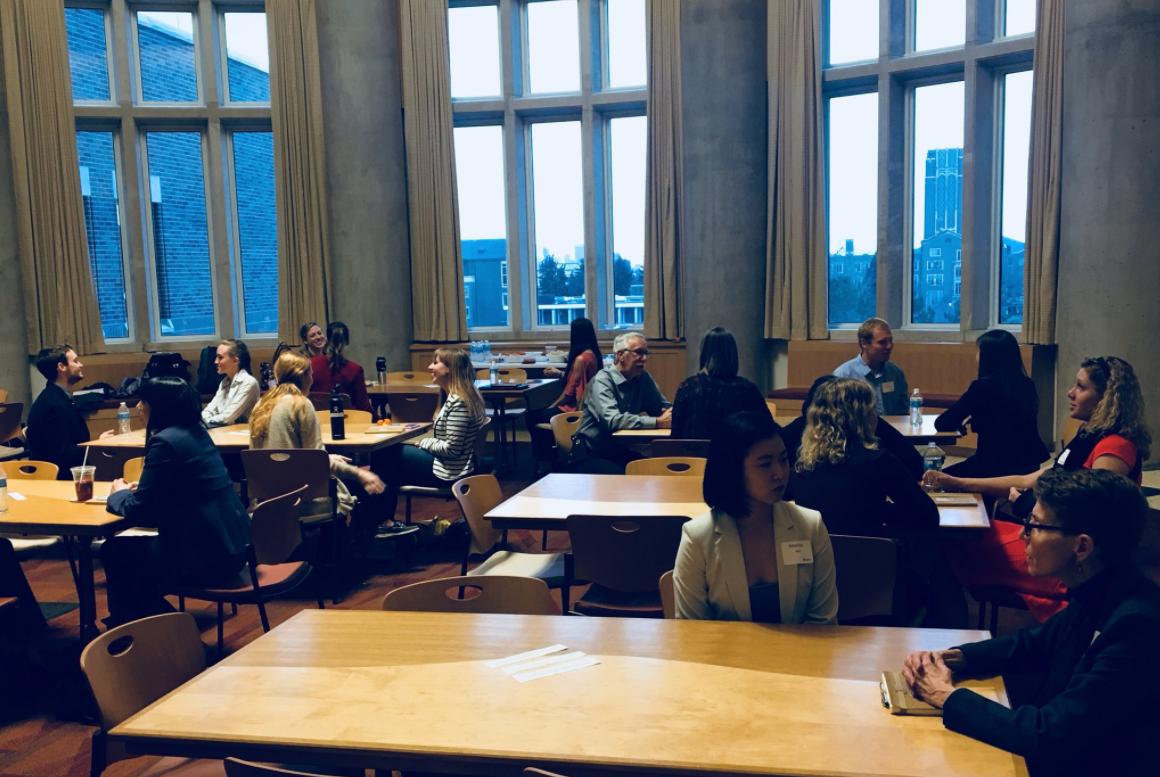
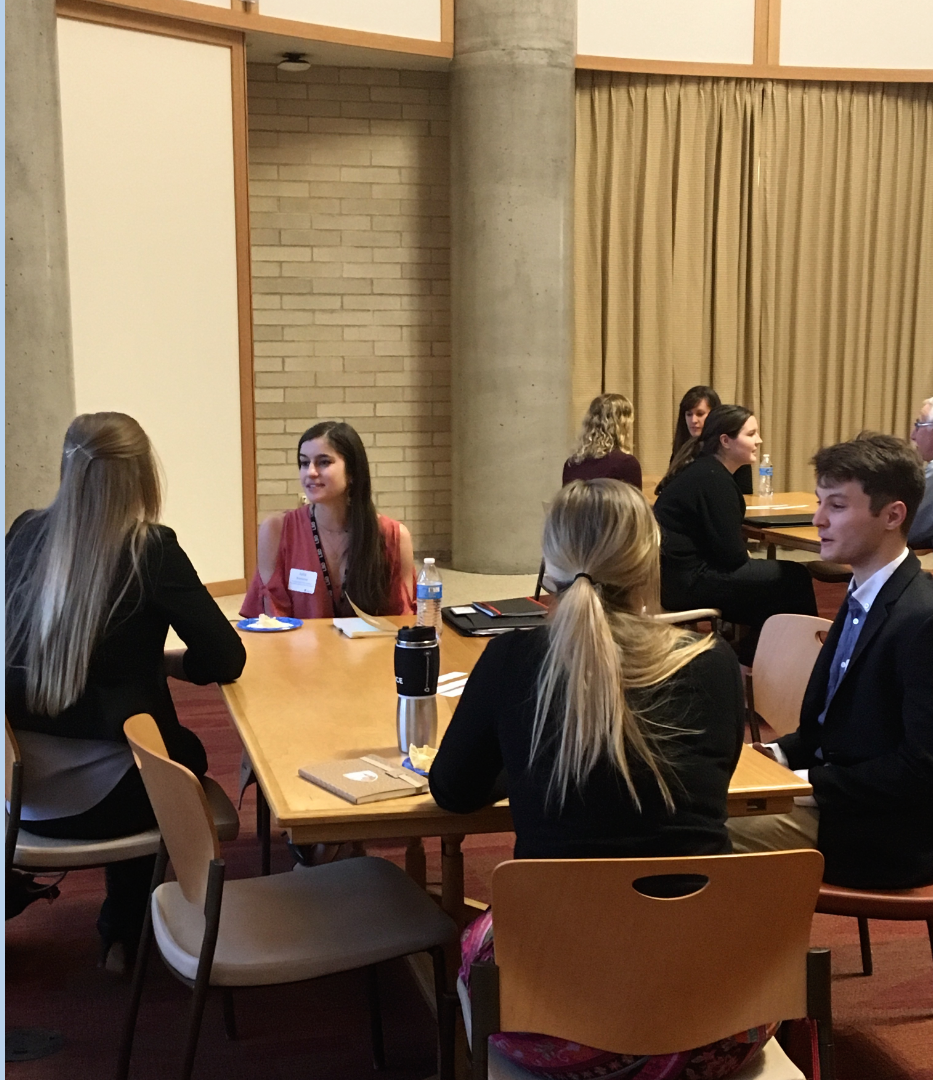
On February 28th, students, alumni, and friends of NSM came together on the 5th floor of ECS to chat about their career goals and interests across the sciences.

Photo by Kellan Barr, Communications Manager, NSM
Alumni from a number of disciplines, including Biology, Chemistry, Environmental Science, Mathematics, and Physics came back to campus for this exciting event. They represented an array of industries across the Denver area, from water treatment and analysis, to healthcare, and on to sustainability. The students who joined us also came from a number of majors across NSM, and they had the opportunity to network with each of our twelve volunteers for five minutes before moving on to another table. Open networking was offered for the final half hour, and it was fun to watch the participants come back together to excitedly continue conversations where they left off.
For the first hour of the night, students visited our alumni and friends both individually and in small groups. The students’ smiles as they left one table and joined another were so wonderful to see! It was a great evening that incorporated all of the fun and socialization of a networking event without the formal, frenetic energy of a career fair. Nervous energy quickly melted away as genuine connections were forged, and business cards were quickly exchanged before the end of the evening. Our alumni and friends were incredibly impressed with our NSM students’ professionalism, insightful questions, and career goals.

Photo by Kellan Barr, Communications Manager, NSM
Thank you so much to everyone – students, alumni, friends of DU, staff, and faculty – who made this event possible. We hope to bring more of our amazing, talented alumni back to DU so if you are a NSM undergraduate and you have suggestions on who you might want to meet, please share them with our office!

5 transferable skills interns can learn working in the insurance industry

The modern workplace requires skills that are not always taught in a formal education.  Many millennials find they have to develop these skills on the job or during an internship.  Some of these skills are industry specific, but many are tried and true skills that have been relevant for decades.  Some necessary skills include showing up on time, dressing appropriately, looking someone in the eye, and speaking clearly and concisely are still very important in the business world.  These skills are having to adapt to technology and the millennials who adapt the most effectively will have the most success throughout their career.  Here are four skills that interns and recent graduates can develop that will set them up for success in whatever field they go in to after their college career.
How can millennials develop transferable skills that can be used in the modern workplace.
Interpersonal Communication
One of the most important skills any college student can develop is the ability to effectively communicate a message and get a desired result.  Many people call this interpersonal communication while other people call it persuasion.  No matter what term you use to define this skill it is important to your career no matter what industry you go in to.  The ability to read something, interpret it and express your interpretation to another person is crucial to success in both life and in business.
Because of technology, it is easier than ever to communicate.  That does not mean people are better at communicating in the past.  It just means they are communicating more frequently.  Perfecting how you communicate in person, over the phone and in written form are skills you will learn and perfect interning in the insurance industry.  On average an insurance agent speaks with at least 20 clients or potential clients per day.  That is about 3 per hour over the course of a normal 8-hour day.  Each interaction with a client may involve receiving an email or a quote via electronic correspondence to a farmer in Iowa. The next conversation may be over the phone selling workers compensation insurance in Texas to the owner of an oil company.
Making a phone call to confirm some details and finally a follow up email when you are finished helping the client with their problem.  In another role in the insurance industry you may be responding to a negative review on yelp or a comment on the businesses Facebook page.  All of these different ways in which you might interact with a customer will prepare an intern to successfully interact with clients in many different forms.
Critical Thinking SkillsCritical-Thinking
Critical-thinking skills are crucial in the insurance industry and they will be important in the professional world no matter what industry a student eventually chooses. Being able to quickly interact with a co-worker, a vendor or a customer is extremely important.  In the insurance industry it is important to be able to determine what is most important to the other party and quickly determine several ways to solve the problem for the other person within an interaction. It is also becoming important to deliver that message in the form (email, text, phone call, etc.) the receiver wants to receive it.
On a typical day at an insurance agency, most agents interact with around 20 customers throughout the day.  Some of these customers just want whatever transaction they have to be done as quickly as possible.  They want this because they would like to get back to their daily lives. Other customers do not mind spending half a day to save an additional 5% on premium. A successful insurance professional has to determine what is important to the customer, deliver it to them the way they want to receive the message and make sure the customer is properly insured for the risks their business faces.
Risk Management
Risk management is in essence what the insurance industry is.  The simplest explanation of how a company in the insurance industry makes money is by collecting more in premium than they pay out in claims.  You will be a part of processing and analyzing risk constantly if you choose to intern or work in the insurance industry.  Every transaction in this industry deals with the ability to help your company offer as much coverage as possible while still managing a comfortable level of risk. These skills can transfer into a role as a mortgage broker, a risk management consultant, a manager of a retail store or a restaurateur. All of these roles require a professional to quickly assess the risks of a business and come up with adequate ideas to deal with those risks.
Professionalism in email communication
Email communication is an art all to itself.  It may seem obvious to the lay person how to communicate properly via email, but email communication is one skill many young professionals lack.  Many younger professionals do not differentiate between an email and a text message.  Most millennials are very comfortable using their mobile device.  Just because they are proficient at sending a message via their device does not mean they are proficient at representing themselves in a professional manner.  How much time someone spends on an email is usually obvious to the receiver of that message.  It is obvious when someone sits down and puts some thought in to their response and it is equally obvious when someone responds with a four-word answer while waiting in line at the local coffee shop.  When a millennial works or interns in the insurance industry, they frequently respond to clients about their child’s health insurance or about the specific of their small businesses workers compensation insurance policy.  These types of issues cannot be dealt with in a 4-word text message.  Dealing with these interactions will help a millennial quickly learn how to present themselves professionally both over the phone and via email.  Development of this skill will be crucial for success in any industry you work in moving forward.
Bio
Mitchell Sharp is a Marketing Associate for Workers Compensation Shop.com.  Mitchell has extensive knowledge of workers’ compensation and cyber liability insurance.  His passion is in using his expertise in commercial insurance and digital marketing to benefit the small business community.

How Does Gambling Affect Your Business?

Although often not recognized, problem gambling is a significant workforce issue.  The effects of a gambling problem almost always spill over into the workplace and can potentially disrupt the livelihood of your business.
The Marion County Health Department Prevention Services is offering free on-site training workshops for employees and supervisors for businesses in Marion County.  The training session will answer these questions and more:
Why is problem gambling a significant workforce issue?
What are the signs of problem gambling?
What causes a person to develop a gambling problem?
How will I know if one of my employees has a problem?
What can I do if I find out an employee has a problem?
How can I protect my business from the effects of problem gambling?
Training sessions can be tailored to business needs.  Visit the Marion County Health Department website at http://www.co.marion.or.us/HLT/ad/gambling/prevent/workplace.htm or contact Lisa Miller at 503-981-2461 or lmiller@co.marion.or.us for more information.

Job & Internship Search Boot Camp

Job-Search-Boot-Camp-newsfeed-image
Still looking to nail that job or internship?  What are you waiting for? The summer is almost here!
For many people, job hunting can be a painful process so they avoid it. Their focus is on luck and tired old methods that rarely produce a rewarding job. But what if you could make it fun, exciting and rewarding? You can with the right tools and a proven method.
In this popular seminar, attorney and DU parent, Paul Jorgensen, gives you seven key tools and a very simple, practical method to take control of your next job hunt.
Through entertaining experiences, Paul will help you see how the job hunt itself can be gratifying and even magical. Once you learn this method, you will never search for a job the old way again. Don’t leave success in your next job hunt to your resume, timing and luck. Whether you are searching for your first job or your tenth job, this seminar is for you.

Passion. Holy Cannoli! What is this thing called passion!?

Recently, I was making a 17-mile trek across Arvada when our guide brought us to a halt, stretched out his hand and presented us with a brown paper bag. Within this seemingly innocuous container was a collection of several pieces of paper each adorned with familiar type-written words; we were instructed to blindly choose one.
Heeding the instruction, I reached into the bag to extract my choice, held my breath the way one might do when cracking open a fortune cookie to reveal their future, and peered down at this small strip of paper imprinted with seven black letters.
It read, Passion.
Immediately, I felt my internal processes begin to kick and scream. I felt agitation percolating through my veins as the resistance around this very loaded word became activated. Here I was in a group of strangers, walking long-distance in 93 degree heat that practically had me hallucinating from dehydration and now we were being asked to self-reflect and share with a partner something very personal. On one hand, I appreciated the opportunity to be introspective and for intentional human connection. But, this word, Passion, was triggering me in an unexpected way, and with the oppressive heat, I wasn’t in the mood to illuminate what it meant to me.
But, I thought: What. Is. Passion?
Frankly, this word has always intimidated and frustrated me, because I have never been able to answer this question; well, maybe not until this brown bag exercise. Until then, this inability to articulate a response had made me feel inept, or as if I’m doomed to live a life of mediocrity devoid of purpose, meaning or aliveness. The opportunity to contemplate how I define Passion in my life became a gift when the guide, who is also my friend, mirrored back to me the possibility that passion doesn’t have to be something related to your calling, let alone a career path for which you’re passionate. Instead, he explained that for me, passion is embodied in the way I show up with deep curiosity for the human experience and the way I fill with enthusiasm and joy when bearing witness to the ever-unfolding beauty of life; the butterflies, the power and symbolism of the river, the old couple holding hands sitting shoulder-to-shoulder. I had never considered these aspects of my being to represent this nebulous term, and thus, something in me softened around this word and I was able to see myself in a new light.
We think passion has to be this fiery, intense response to something, whether a person, thing or idea; perhaps a cause that ignites us and motivates us to action; or that passion is what’s experienced when released through heated words when a boundary has been crossed; or that it’s a deep seeded interest that courses through our veins desperately in search of some outlet; or it’s simply being drawn to something with a one-pointed focus that is wildly intense and life affirming.  
Whatever it is and however it’s defined, somehow, we’re acutely aware of its void and the nagging voice in our head that implores us to go out in mad pursuit of this passion until we find it; as if we’re not worth anything, or wasting precious time if we haven’t found, or aren’t living, our passions.
That’s quite a bit of pressure on the psyche!
So, what to do?
Well, it ain’t gonna just bop you on the head and say, here I am; I’m passion!
You’ve got to become an Observer of your World, an Observer of Yourself; you’ve got to start paying attention.
Take Note.
What is it that lights you up? Truly. What is it you’re doing when you feel joy? And, consider this question: what was it you most loved to do when you were a kid? Embedded in the answer is a clue to what may light you up now.
Here’s your Assignment:
  • For the next 2-4 weeks, make a commitment to start tuning in to whatever it is that captures your attention, provokes a powerful, positive response, or brings you to a state of flow; that space where you are totally present, where you lose track of time and feel in the zone.
  • Grab a pen, a notebook, or the notes section of your phone and start to jot those observations down! It’s time to become the anthropologist of your own life.
  • And, if it helps, you can rally the troops and ask your friends, family or co-workers to reflect back what they observe in you; specifically, to identify what you’re doing when you are radiating joy, lighting up, or experiencing intense focus, or complete engagement with something.
  • After you’ve collected some data on yourself, go back and take stock of any patterns, or themes you notice.
Let the answers be your guide in discovering and unearthing the parts of you that make your heart beat faster, the moments when you become laser-focused and totally engaged and engrossed with an experience.
What does this information tell you? How could you be integrating more of these things into your daily life that bring you joy?
  • Are these passions needing outlet in a job, a hobby, or activity, or perhaps some other aspect of your life?
  • Whatever the answer, find a way to get intentional about integrating these things into your daily, or weekly schedule.
  • Are there people doing the very thing that brings you joy that you could possibly align with, or seek out as a mentor, or for an informational interview?
  • As my awareness around my own passions increases, I am now carving out more time for connection to nature, gardening, and creativity.

And, in the words of Howard Thurman:
“Don’t ask what the world needs. Ask what makes you come alive, and go do it. Because what the world needs is people who have come alive.”

How to Get the Job You Really Want

How to Get the Job You Really Want
When it comes to looking for a job, identifying the type of job you want is the single most important thing you can do. This will make it easier to be effective in your job search while also ensuring that you’re focusing on roles that match your interests and your skill set.
Here’s what you need to know about landing the job you really want.

1. Identify your career goals

Although it may seem a bit intimidating to outline your five-year plan when you’re just starting out, setting career goals is a great way to ensure that you’re focusing on the big picture and looking for roles that fit with your long-term plans. The best way to do this is by determining a specific career goal and outlining the steps you’ll need to take in order to get there. With this goal in place, you’ll be able to create a clear path for yourself and increase your chances of landing your dream job.
Pro Tip: If you want to outline more than one goal that’s okay too, but be sure that at least one of your goals is something you can achieve within the next one to two years. Short-term goals are great for maintaining focus in general and when you’re just starting out, having achievable goals is even more important.

2. Develop the right skills

Once you’ve identified your career goals, it’s time to take stock of your skills and identify opportunities for learning and improvement. This will help you determine where to focus your energies and also give you a better idea of how to showcase your current skills in an impressive way.
Pro tip: Don’t panic if you don’t have all the skills you need for a specific job. Instead, look for ways to develop those skills by taking classes or taking on projects. Hiring managers are always impressed by candidates who take a proactive approach to learning and building your skill set in this way will show them that you’re a self-starter who is motivated to learn and grow.

3. Have a great resume

Although having a strong skill set is important, those skills aren’t enough without a great resume to showcase them. When writing your resume, be sure to focus on your key achievements in each previous role (including internships and part-time jobs) and to use numbers to quantify those achievements.
Pro Tip: Your resume should represent not only your accomplishments, but also the fact that you’re a well-rounded person, so don’t be afraid to include skills and achievements from extracurricular activities or individual projects.

4. Network effectively

Networking is a key component of professional success and it’s especially important if you’re just starting out in a particular industry (or when you’re looking to change industries). The best way to go about it is by reaching out to people in your alumni and social networks and staying in touch with co-workers and managers from your previous jobs. This is a great way to ensure that you’ll hear about new opportunities directly from people in your network and that you’ll already be on their radar when they’re looking to recruit for that the role that might just be your dream job.
Pro Tip: If you don’t have any contacts in your particular industry, don’t be afraid to send a cold email to someone you admire asking them to grab a cup of coffee or have a 15-minute phone chat. Chances are, they’ll say yes and you’ll have the opportunity to connect with someone who can help you understand the ins and outs of the industry.

5. Nail the interview

The final step to landing the perfect job is nailing the interview and this comes down to doing your research and being prepared. We recommend the R.E.A.F. approach — doing your research, being enthusiastic, asking questions and following up. Once you know who you’ll be interviewing with, take the time to research them and their role at the company. This will give you a sense of how your role will interact with theirs and help you understand their specific expectations for that position. Another great thing to do is to practice answers to commonly asked interview questions like, “Tell me about yourself,” and “What are you passionate about?” so that you can answer them confidently and present yourself in the best possible light.
Pro Tip: If you’re feeling nervous about the interview, try practicing with a friend. Ask them to quiz you on specific questions and to give you feedback on your answers. This is a great way to get a confidence boost and will also help you realize that the interview is really just a conversation.
Having a plan of attack is the first step to landing the job you want. By following these tips, you’ll be well on your way to getting there.
Next, get more career tips for internships and entry-level jobs such as 6 Things to Do in Your First Week at a New Job and find answers to common interview questions such as What’s Your Dream Job?