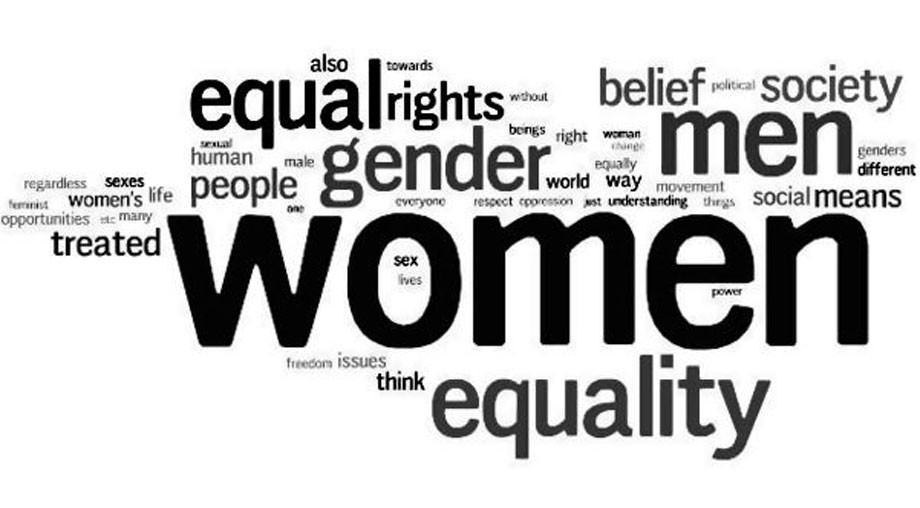
WOMEN EMPOWERMENT

Women's empowerment (or female empowerment) is the process of empowering women. It may be defined in several ways, including accepting women's viewpoints or making an effort to seek them, raising the status of women through education, awareness, literacy, and training. Women's empowerment equips and allows women to make life-determining decisions through the different problems in society. They may have the opportunity to redefine gender roles or other such roles, which in turn may allow them more freedom to pursue desired goals.
Women's empowerment has become a significant topic of discussion in development and economics. Economic empowerment allows women to control and benefit from resources, assets, and income. It also aids the ability to manage risk and improve women's well-being. It can result in approaches to support trivialized genders in a particular political or social context.  While often interchangeably used, the more comprehensive concept of gender empowerment concerns people of any gender, stressing the distinction between biological and gender as a role. Women empowerment helps in boosting the status of women through literacy, education, training and awareness creation.  Furthermore, women's empowerment refers to women's ability to make strategic life choices which had been previously denied them.
Nations, businesses, communities and groups may benefit from the implementation of programs and policies that adopt the notion of female empowerment. Empowerment of women enhances the quality and the quantity of human resources available for development. Empowerment is one of the main procedural concerns when addressing human rights and development.
People engage in public debate and make demands on the government for health care, social security and other entitlements.  In particular, education empowers women to make choices that improve their children's health, their well-being, and chances of acquiring survival skills. Education informs others of preventing and containing a disease. Such education empowers women to make choices that can improve their welfare, including marrying beyond childhood and having fewer children. Education can increase women's awareness of their rights, boost their self-esteem, and provide them the opportunity to assert their rights. 
inequalities persist. A major concern in many countries is not only the limited numbers of girls going to school, but also the number of educational pathways for those that step into the classroom. There are efforts to address the lower participation and learning achievement of girls in science, technology, engineering and mathematics (STEM) education. 
In some parts of the world, girls and women are attacked for attending school, and societal efforts to stop this may be lacking. 
Many of the barriers to women's empowerment and equity are the result of cultural norms. While many women are aware issues posed by gender inequality, others have become accustomed to it. Many men in power are hesitant to disrupt societal norms that are unfair to women. 
Research shows that the increasing access to the Internet can also result in an increased exploitation of women.[46] Releasing personal information on websites has put some women's personal safety at risk. In 2010, Working to Halt Online Abuse stated that 73% of women were victimized through such sites
Types of victimization include cyber stalking, harassment, online pornography, flaming, and especially sexual harassment in the workplace. It occurs most frequently in business, trade, banking and finance, sales and marketing, hospitality, civil service, and education, lecturing and teaching. According to the International Labour Organisation (ILO), sexual harassment is a clear form of gender discrimination based on sex, a manifestation of unequal power relations between men and women.
UN Convention on the Elimination of All Forms of Discrimination Against Women (CEDAW) is urging for increased measures of protection for women against sexual harassment and violence in the workplace. 54% (272) had experienced some form of workplace sexual harassment. 79% of the victims are women; 21% were men. 
Studies show that women face more barriers in the workplace than men. Gender-related barriers involve sexual harassment, unfair hiring practices, career progression, and unequal pay where women are paid less than men are for performing the same job. 
One should believe that healthy, educated and empowered women and girls are agents of change.
When women and girls are supported, they gain opportunities to speak up for their rights, and also to advocate for their communities. They are also able to rise in social standing, and they can feed this into future generations.
This means women’s organizations, women’s empowerment policies and women’s charities can gain momentum and contribute to a stronger world.

Jaipur: The Ancient 'Pink City' of Rajasthan

     OUR PINK CITY!!😍

Jaipur – land of the Rajputs, is an exuberance of colour, dance and traditional arts and crafts. Known, as the ‘Pink City’, Jaipur is home to a wonderful selection of ancient forts and palaces. One of India’s most well planned cities, Jaipur is built in 9 rectangular sectors symbolising 9 divisions of the universe, as per Indian cosmology!


 The first planned city of India, Jaipur has a rich history of a clan of rulers who lived in magnificent forts and palaces. But, that’s not only what the capital of Rajasthan is famous for. The entire city of Jaipur is painted in the colour pink and there’s a really interesting story behind this. Here’s all you need to know about the ‘Pink Paint Culture’ of one of the most hospitable cities on the planet.

The Hawa Mahal 

The reason behind the terracotta-pink colour of the city was the influence of a king named Sawai Ram Singh. In 1876, Queen Victoria’s son, Albert Edward, Prince of Wales (who later became King Edward VII, Emperor of India) visited India and, since pink was considered the colour of hospitality at the time, Maharaja Ram Singh had the whole city painted pink to welcome the royal guests. Lord Albert was said to have described Jaipur as the ‘pink city’, hence creating the name Jaipur is known by today.


This current round of gigs, I’m just doing it using pure electronics.

Electronics in Daily Life

Electronics is the branch of physics and technology that deals with circuits, transistors, microchips, and the behavior and movement of electrons.

It handles electric circuits containing active and passive elements and uses underlying techniques. It is an important part of engineering.

Technologies are growing at a very fast rate in the world, and it is important for technology enthusiasts to pace up with the latest changes in the society.

Electronic devices have become an important part of our day-to-day life. It has become difficult for us to do work without using the electronic device.

We live in a generation that uses electronics and technologies where robots and artificial intelligence is capable of doing human work with more ease and efficiency.

Electronics in our daily life are made up of active and passive electric elements and smaller integrated circuits (IC). 

The ICs, transistors, and diodes are made of semiconductor materials, which work when current flows through them.

History of Electronics

The first electronic device was introduced by an American scientist, Sir Joseph Henry, in the year 1835. He invented a remote switch which was controlled by electricity. 

However, the credit of this invention was given to an English inventor Edward Davy in his electric telegraph c. 1835.

Some other Inventions are:

  • Vacuum Diode – It was invented by John Ambrose Fleming.
  • Transistor – It was invented by the combined effort of John Bardeen, Walter Brattain, and William Shockley.
  • IC (Integrated Circuit) – Jack Kilby invented this.

Electronics is the study of electricity (the flow of electrons) and how to use that to build things like computers. It uses circuits that are made with parts called components and connecting wires to do useful things.

The science behind Electronics comes from the study of physics and gets applied in real-life ways through the field of electrical engineering.

Many people can name several simple electronic components, such as transistors, fuses, circuit breakers, batteries, motors, transformers, LEDs and bulbs, but as the number of components starts to increase, it often helps to think in terms of smaller systems or blocks, which can be connected together to do something useful.

One way of looking at an electronic system is to separate it into three parts:

  1. Inputs – Electrical or mechanical sensors, which take signals from the physical world (in the form of temperature, pressure, etc.) and convert them into electric current and voltage signals.
  2. Signal processing circuits – These consist of electronic components connected together to manipulate, interpret and transform the information contained in the signals.
  3. Outputs – Actuators or other devices that transform current and voltage signals back into human readable information.

A television set, for example, has as its input a broadcast signal received from an antenna, or for cable television, a cable.

Signal processing circuits inside the television set use the brightness, colour, and sound information contained in the received signal to control the television set’s output devices.

The display output device may be a cathode ray tube (CRT) or a plasma or liquid crystal display screen. The audio output device might be a magnetically driven audio speaker.

The display output devices convert the signal processing circuits’ brightness and colour information into the visible image displayed on a screen. The audio output device converts the processed sound information into sounds that can be heard by listeners.

Analysis of a circuit/network involves knowing the input and the signal processing circuit, and finding out the output. Knowing the input and output and finding out or designing the signal processing part is called synthesis.

Telepathy – A love language

Telepathy- this word simply means communication between minds or transfer of ideas or thoughts from one mind to another without the use of any human senses. Sounds intriguing, right? It is, definitely. One can also call it an extrasensory perception, just like precognition.

thumbs-prod.si-cdn.com/N8Kj1S3yDfmNErVwGhLyYiGu...

We all know that love is the most powerful force in the world, but do you know what’s even more powerful?

Feeling telepathically connected to someone 🙂

I didn’t believe in telepathic communication – two people reading each other’s minds or they think about the same thing at the same instant of time. I always thought it was just a mere illusion, nothing that exists and was real. Until I witnessed it myself.
Like every other night, I was walking on my verandah, and I looked up at the moon. It was pale yellow, shining brighter than usual. And like every other night, that moon reminded me of him.
I was longing to text him “Hey, It’s been a long time” or “Hey, How are you?” but it’s been years
since we didn’t talk.
Yet today, hesitantly, I texted him – “Did you see the moon?” Waiting for his reply while still gazing at the moon.
After a min, he texted – “Oh my god”
(I don’t know what reply I was expecting, but not that).
He was utterly dumbfounded, maybe because I texted him after so long out of nowhere. A few seconds later, he replied, “Yes, I was glaring at the moon too” and that as he searched for my contact to text me, my message popped up. I was glad to know, looking at the moon still reminded him of me; moon has always been our channel of communication. Even in these past years, miles apart from each other, looking at the moon and thinking ’bout him was as comforting as lying in his arms.
That day, we unknowingly made this pact that whenever we’ll see the night sky lit up with a white, bright moon, we’ll text each other.

Unlike other love languages, like physical touch and words of affirmation. Telepathic communication is more like a soul-to-soul connection. The celts called this phenomenon “anam cara” meaning a soul-friend or intently called a soulmate. It’s like we had been part of the same soul, and found each other again in the present. We felt telepathically connected.

Telepathy is truly a gift and those people that are blessed with it will develop spiritually and raise their consciousness to new, massive heights. When there is a telepathic connection between lovers, the communication between them can occur not only through talking, but they will also communicate when they are far away from each other through their thoughts. When those two souls are apart, they will have a sense of longing and yearning combined with anxiety, and those feelings are not only their own, but they also belong to the other person.

Review and Analysis of the video “Workplace Mental Health – all you need to know (for now)”

 The video “Workplace Mental Health – all you need to
know (for now)” by Tom Oxley, emphasized on the importance of
mental health at the workplace.
According to the speaker, many people working in the organizations are not able
to draw a line between their personal life and professional life.

                                                                              https://www.youtube.com/watch?v=G0XUimJbz44


 Many people look
at their phones before talking to their family in the morning or many people just
wake up suddenly at night where they still stress about work leading to
deprivation of sleep. Many people work every day, even on weekends. All these
things are early signs of stress which may have a harmful impact on the mental
health of the people working in the organization.


 Due to such hectic job routines, people working in organizations are so busy that
they are not able to draw a line between their personal and professional life and
maintain proper “Work life balance” where adequate working hours is followed
by adequate hours of rest and a reasonable time is given to focus both on
professional and personal life. 


Absence of required “Work Life Balance” and unresolved mental health issues
creates anxiety, stress and depression in employees. It leads to increased
abseentism in the organization and such types of situations are responsible for
musculoskeletal and physical injuries of employees as well. 


Unfortunately, in spite of such serious issues, people still work excessively and
not much importance is given to employees overall well being, especially mental
health.
People having poor mental health want to work the whole time and even while
doing work they tend to struggle a lot. They are not able to concentrate on the
work they are doing and have difficulty in communicating and juggling tasks.


 Moreover, they face difficulty to approach their managers regarding the
problems. The people working in organizations are hesitant because they think
maybe their managers would also not understand them or they would generalize
their problem as “work stress” or they may even think that the managers could
ask them to leave the organization. Employees often feel such type of stigma by
either from their work environment or even themselves.
People working in organizations are so busy doing their work that they do not get
time off even to think about such problems and since these issues are not resolved,
the employees themselves could not explain the reason behind increased
abseentism. 


This is because organizations do not emphasize much on mental
health of employees as well as maintaining a “proper work life balance”.
The speaker also emphasized that they are many personal matters of employees
too which need to be taken care of but due to the “presentism” in organizations,
employees prioritize their work first making them neglect their own personal
matters and therefore work becomes a compulsion for employees. 


This
“presentism” costs 1.8 times than that of abseentism.
In most cases, even the managers are not that well trained when it comes to taking
care of the mental health of employees. Since they don’t know how to converse
about it, they will tell their employees to see a doctor and be on medication, as
for the managers it’s just normal “stress”. 


This method is actually quite
ineffective and the employees, who were performing well earlier, would also at
some point, not be able to manage working continuously and thus they would be
disengaged from their work. Since the issue is not resolved, they would be more
depressed and anxious. Therefore it would be recommended that before sending
employees to therapists, such problems of employees should first be resolved by
managers and for this to happen the managers need to trained, so that they can
wisely handle employee’s mental health. 


For example : The speaker had interviewed two people : 

Nick who was a senior
manager at a global firm who performed very well in his work and constantly
exceeded expectations, as senior positions involve doing more work to earn more
money. When Nick’s family member died, he was only given two or three days
of compassionate leave. He wanted to have flexible time hours where he could
have holiday on Friday or weekends but his manager refused. Nick was hesitant
to speak to his manager and then went on medication. 


Unfortunately, he didn’t
benefit anything and became disengaged from work and wasn’t able to come back
completely to the organization. 

On the other hand, there was another person named Sally, who was also a
successful manager worked at International Charity and same situation had
happened with her. Her family member died. But this time the situation was
different. The manager knew that it was an unfortunate incident and she knew it
would have affected Sally mentally. So, she granted Sally a reasonable leave
without forcing her to prioritize work. The manager even suggested that she can
comfortably work from home.


 Many years passed and Sally still works
efficiently in the same organization and she is still a successful manager.
If we look at both the examples we can observe how it is important for the leaders,
managers and the organization as a whole to understand that “Work life balance”
is very important and the employee’s problems should be first resolved at
organizational level. 

The employees should be able to speak their grievances freely with their superiors
otherwise like Nick, an organization could lose its talented and hardworking
employees.
For this, there should be more emphasis on “mental health” of employees in the
organization. 


As leaders and managers, the most effective way to handle the
mental health of employees is to be a patient listener to the employee’s problems.
They should talk about mental health in a positive manner, giving employees an
opportunity to seek help as and when they need.
A leader should take initiative to train managers regarding mental health, to help
the managers identify the signs and symptoms whenever employees are facing
such kind if issues. They should be trained to be a patient listener. They should
be trained to understand the situation in depth and use the right words and advice
accordingly.


 The organization should also focus on a reasonable “Work life
balance” to ensure employees physical and emotional well being.
The leaders as well as managers should be very supportive to their employees.
One more effective way to handle the mental health of employees is to see
problem and the stressed and anxious feelings from their perspective and then to
think what method could resolve the problem.


 Reaching out as a helping hand to
employees is another great solution. The employees would then comfortably tell
what is bothering them and then the problems can be written down and reasonable
adjustments could also be made accordingly. Mindful meditation could also be
encouraged. 


Conclusion

In conclusion, employees of any organization want the commitment of its
superiors that they can speak safely and comfortably about any mental issues or
grievances that they are facing. So, an employer and a leader need to make sure
that the employees can find a safe and comfortable place where they can talk
about their grievances freely without any hesitation.


 If the organization does not understand the importance of mental health now, all
the stress and anxiety would have a negative impact on employees just like Nick.
It would lead to increased abseentism of employees and the employees would
eventually be disengaged from work, exhibiting low productivity and then the
organizations would eventually have to lose its talented employees. So,
organizations should consider using its resources to focus more on the mental
employees as well. After all, the prosperity of organization depends on the
prosperity of employees.

The whale shark

The whale shark (Rhincodon typus Smith, 1828) is the world’s largest fish, reaching 15 meters (m) and 18 metric tons (Colman 1997). The head is broad and flattened with a large terminal mouth, miniscule teeth, and large gill slits. The eyes are small and located just behind the mouth on each side of the head. There are three prominent ridges along the back. The first dorsal fin is larger than the second dorsal fin and is set midway back on the shark. Whale sharks have distinctive markings of pale white spots and stripes on their dark dorsal surface, which resembles a checkerboard pattern. It has been suggested that this checkerboard pattern functions as camouflage in the pelagic environment (Wilson and Martin, 2004). Since the arrangement of spots is specific to the individual, photographic identification libraries are being complied for whale shark populations around the world (ECOCEAN).

Habitat and diet

Though Whale Sharks have several hundred teeth, they don’t use them to eat. Instead, these fish are filter feeders, swimming forward to swallow prey. They are carnivorous, eating krill, crab and fish larvae, small schooling fish, and jellyfish. Humans are not on the menu. 

Whale Sharks live in all warm and tropical seas, are migratory, and swim more than 1,000 metres below the surface. Feeding aggregations occur seasonally at several locations, including Ningaloo Reef.

Where do whale sharks live?

What is well known is that whale sharks live in all of the world’s tropical and warm temperate seas and prefer surface water temperatures of 21 to 25 degrees Celsius. They are migratory, with individuals swimming thousands of kilometers to places where food “pulses,” like mass coral spawning events, at the same time every year. You’ll find no couch-potato habits among whale sharks, despite their size.

Whale sharks are considered to be highly migratory. Some moved over 8,000 miles in approximately three years (Eckert and Stewart 2001). In the Caribbean, specimens tagged off Belize moved westward to Honduras and others northward to the Yucatan peninsula (personal communication, R. Graham Wildlife Conservation Society). There are reports of a few sharks that have moved from Meso-American waters (e.g., Belize, Honduras) into the southern Gulf of Mexico (personal communication R. Graham, Wildlife Conservation Society). Two immature male whale sharks tagged off Holbox, Mexico, moved in different directions. One moved south to Honduras and the other moved north to Brownsville, Texas, (personal communication R. Hueter, Mote Marine Laboratory). There is no information on movements of whale sharks from the Caribbean Sea to the northern Gulf of Mexico.

Behaviour and reproduction

Whale Sharks do give birth to live young, but not in the way you’re thinking. The Whale Shark is oviparous, meaning the female sharks produce eggs that are hatched inside of her. These eggs are not all born at once, but are born in a steady stream over a certain period.

Able to birth around 300 young, Whale Sharks reach sexual maturity at 30 years and live to a total of around 70 to 100 years.

Threats

The Whale Shark population is at risk. Vessel strikes and being caught accidentally by commercial fishing vessels has led the Whale Shark to be considered a vulnerable species. 

Some Facts:

  • Whale Sharks can live up to 100 years.
  • Whale Sharks will often “cough” to clear particles from their filter pads.
  • Whale Sharks are covered in a pattern of spots that is unique to each shark, much like human fingerprints.
  • Sometimes, Whale Sharks allow swimmers to grab their fins and catch a ride!
  • A whale shark’s mouth is about 1.5 m wide. Inside, they have rows of over 300 teeth, but they don’t use these teeth to eat because they’re filter feeders.
  • While they are meat-loving carnivores, whale sharks do not attack humans. They are filter feeders and eat krill, crab and fish larvae, small schooling fish and jellyfish.
  • The whale shark is ovoviparous, meaning the female produces eggs that hatch insider her.
  • When the young are fully developed, the female gives birth to around 300 live young.

The ONE Thing : Book review

Friends, in today’s time, we have many different options. Now whether to take the important decision daily, or choose a carrier for life. I wish we could do this and sow too. Because most of the people don’t even know what their ONE thing is, on which they should focus. That’s why they are always confused. Whereas productivity in everyday life style or success of life long. Not by doing 10 different things. Rather, there is success in doing ONE thing. 

As we all get 24 hrs in a day, then why some people depend on the time to come to finish your work today and how some people finish all your important work on time. How some people succeed very quickly and become lentils, and why some people, even after trying for a long time, have not been able to identify you yet. To solve this problem, today I will tell you the summary of The ONE Thing book. The writer of this book is Gary Keller and Jay papasan.

What is ONE Thing:

ONE thing means to put all your time and energy to do one thing at a time. And for now forget the rest of the work. The work that is most important to you. Who matters the most. A job that fulfills your life purpose. For example you know Virat Kohli only for cricket. He has given maximum of his time in cricket. If he had been given in cricket as well as in software engineer or in some other work, then he would not have become an expert in any one thing.

Like most people, your mind must be asking to do or become more than one thing. Like sometimes you would like to become an engineer, sometimes to go to a film, sometimes to become a doctor. Friends, ask yourself clearly what do you want in your life, what is your life purpose. If you keep changing from one path to another, you will not get anywhere. If you try to catch two rabbits at once, then you will not be able to catch either one. So, what’s your ONE thing, you can find out by trying out the 80/20 principle. The 80/20 principle says, 20% of your work gives 80% result.

You are ought to do the work which is more important and should be done first. What is 20% of the work you have done that you should do now and that work will improve your future. Find the work before you finish it. 

6 lies that stand in the seed of your success :

1.Everything matters equally :

When we do any work, we feel that all the work is important for us. But in real, all the work is not important for us, there is a lot of work which is not so important and still we do it. Some work is such that we need to finish it first, and some work is such that we have to do it but if we do it later, it will work. So, finish the most important work first.

2.Multitasking :

Multitasking is an exemption. Which is not good and we don’t need it.

If I read A,B,C,D,E and 1,2,3,4,5 together it will take me 2.16 sec.

But if I combine,

A, B, C, D, E

1,2,3,4,5

A1, B2, C3, D4, E5, If I read this, it will take me 6.48 sec.

So, multitasking will take more time and you will not be able to do the same work properly.

3. A Disciplined life :

To be successful it is very important to have a disciplined life. This is also an exemption, friends, you can be successful even if you are less disciplined. Because success comes in doing the right thing in the right way. It is enough to be disciplined in life as much as you can work on your one thing.

4. It is necessary to always have desire in a human being, this is also an exemption :

Like a phone’s battery, human body power and will power…

It is necessary to charge after it expires. We have to charge our mind by listening to motivation video, motivation blog, motivation audio. Friends, when we wake up in the morning, when our mind is in full charge, at this time do your one thing.

5. Everything in life should be kept in balance:

This too is wrong and a subtle lie. Along with family, start your own business, full time job and see it is very difficult, friends. Sometimes we give all our time to our family because at that time we do not have any important work. But when we have more work, then we have to give more time to our work. You should give more time than one thing to your main goal, that is, your more time should be spent from where you can get big results.

6. Thinking big is wrong:

This is also a lie, friends, the bigger your thinking, the greater will be your chance of getting one thing. If you think small the action will also be small and you will get success too small.

The Four Thieves of productivity :

1. Learn to say No:

When you work on your one thing, many people will come to distract you and make them work. You do not tell them all and focus on your work.

2.Fear of chaos :

After you say no, there may be some disturbance in life. Face the situation like this and work on your one thing. no matter what happen, because your future is in your hands.

3.Poor Health Habits :

Bad habits that spoil your health, whether you have a gun, a knife or a knife, if your condition is not good then anyone can defeat you. Being sick, you will be able to focus on one thing. That’s why exercise daily and eat good food because health is wealth.

4. Environment Doesn’t Support your Goals :

If the environment of the palace in which you live is not good, then it will have a bad effect on your goal. Try to live in a good environment.

Book Review of The Hound of the Baskervilles

                                                              (Photo: Book Depository)

The Hound of the Baskerville is a book full of mystery and suspense. The story starts when Sir Charles Baskerville was found dead which was believed to be a murder. A friend of Sir Charles, Dr. Mortimer introduces the case to Watson and Holmes, so as to protect his heir, Sir Henry Baskerville. Watson is sent to the Dartmoor, where Charles was killed so as to protect Sir Henry while Holmes remains in London. Many unusual events occur in Dartmoor but later Watson learns that it was Sherlock doing his investigation secretly.

The main theme is superstition, evil, greedy for money and suspense. Holmes believes in science whereas Charles believed in superstition. Many unusual things occur in the Dartmoor which was later found by the Holmes doing the investigation. Holmes uses his intellectual powers to find the murderer. The superstitious theme is set up by the curse, the Baskerville Hall, and the hound. However, after so many suspense, Holmes learns that the murderer is Charles neighbor, Jack Stapleton, a Rodger Baskerville who wants to take over the family estate and plotted a plan to kill his relatives using a hound which he painted with phosphorus so as to make it look haunted. After seeing the hound, Charles got a heart attack. Holmes is a detective who was appointed to find the murderer. Watson is the assistant and friend of Holmes and is also the narrator. Dr. Mortimer is Charles friend and a house surgeon. Sir Henry is the heir of the Baskerville Hall who lived in America.

This book got a very great response by the readers. It’s widely accepted in the society and the popularity is also very high. It is one of the four crime novels written by the Sherlock Holmes. The book is unique and suspenseful in its own way and does not need any other changes according to me. The book is full of mysteries and supernatural elements which makes it very interesting for the readers. There is not a single instance where you will feel bored. Anyone can fall in love with this book who loves crime and suspense.

BUSINESS COMMUNICATION

 UNDERSTANDING COMMUNICATION

COMMUNICATION MATTERS

Communication is so important in business, because business need people with good communication skills and our people need business. So, both are interconnected with one another. While communication has always been the Central to business, the nature of work today presents special communication challenges.

MEANING IS MIND

‘WE SEE THE WORLD AS WE ARE NOT AS WHAT THE WORLD IS’, stated by German philosopher Nietzsche. The statement comes true by that there is no meaning in signs, symbols, clues and objects around us, the meaning is just vested in the mind coming to us from uniqueness which is the result of experience. Programming by external environment fixes our mindsets, perspectives, biases, preconceived notions and beliefs. The audience can make sense and interpret the world around them only through individual filters.

CONTEXTS OF COMMUNICATION

The relationship of communicators also forms an important context of communication. 

Organizational contexts: The Organization to which your audience belongs – priorities, circumstances, slow or fast in pace of work can be strongly influenced by the way the message is going to be delivered.

Professional Contexts: Different professionals have different perspectives. Being aware of the internal and external ones makes you identify the priorities.

Personal Contexts: It all depends upon the current circumstances. Who you are, success, failure relationship, financial ups and downs, state of health and the physical environment all can affect communicative act. If you are aware eg. The intended recipient of your message is under stress or having a bad day, you can adapt your communication accordingly.

ADAPTATION

Choose the best words for your message. Adapting your message to one reader requires care, but addressing many needs to be considered carefully. In general, use familiar words for better understanding. Avoid words that are stereotyped by age. Avoiding words that are typecasted with the disabilities and negative descriptions. Understand an adapt to the different generations of people in the workplace.

IS NOT WHAT YOU SAY BUT HOW YOU SAY

Use positive words. Because people generally prefer positive to negative feelings, positive words are usually best for achieving your message goals. This is not to say that one should not use negative words, rather to use. Such words are powerful, and you will sometimes want to use them. They create some kind of effect to the opposite party.
Focus on what you do, it employes what one achieves the goal and desired effects. Do more than expected. Too many of us, however, stop switch simple messages, we include only bare essentials. 
Use the three major techniques for emphasizing the positive and the de-emphasizing the negative.  The three most important managing emphasis is structured one, position, sentence. Make sure that you built these kinds of things properly and achieve your objective in business.


        FOLLOW ETHICS WIN COMMUNICATION

MAJOR DHYAN CHAND

Major Dhyan Chand (29 August 1905 – 3 December 1979) was an Indian field hockey player widely regarded as one of the greatest in the history of the sport. He was known for his extraordinary goal-scoring feats, in addition to earning three Olympic gold medals, in 1928, 1932 and 1936, during an era where India dominated field hockey. His influence extended beyond these victories, as India won the field hockey event in seven out of eight Olympics from 1928 to 1964.

Popularly known as The Wizard or The Magician of hockey for his superb ball control, Chand played internationally from 1926 to 1949; he scored 570 goals in 185 matches according to his autobiography, Goal. The Government of India awarded Chand India’s third highest civilian honour of Padma Bhushan in 1956. His birthday, 29 August, is celebrated as National Sports Day in India every year. India’s highest sporting honor, the Khel Ratna Award was renamed after Chand in 2021.


EARLY LIFE

Dhyan Chand was born in Allahabad on 29 August 1905 in a Bais Rajput family. He was the elder brother of another hockey player Roop Singh and the son of Sharadha Singh  and Sameshwar Singh. Dhyan Chand’s father was enlisted in the British Indian Army, and he played hockey for the army. Dhyan Chand had two brothers – Mool Singh and Roop Singh. Because of his father’s numerous army transfers, the family had to move to different cities and as such Chand had to terminate his education after only six years of schooling. The family finally settled in Jhansi, Uttar Pradesh, India.

Chand graduated from Victoria College, Gwalior in 1932. Being in the military, his father got a small piece of land for a house.

Young Chand had no serious inclination towards sports though he loved wrestling. He stated that he did not remember whether he played any hockey worth mentioning before he joined the Army, though he said that he occasionally indulged in casual games in Jhansi with his friends.


FINAL YEARS

Chand continued to hold his emergency commission in the Indian Army post-Independence, with the service number IEC 3526, but was apparently not granted a regular commission. In 1951 he was honoured at India’s National Stadium with the inaugural Dhyan Chand Tournament, which he attended to the admiration of the spectators.

After 34 years of service, Chand retired from the Indian Army on 29 August 1956 as a lieutenant (acting captain). The Government of India honoured him the same year by conferring him the Padma Bhushan, India’s third-highest civilian honour.

After retirement, he taught at coaching camps at Mount Abu, Rajasthan. Later, he accepted the position of Chief Hockey Coach at the National Institute of Sports, Patiala, a post he held for several years. Chand spent his last days in his hometown of Jhansi, Uttar Pradesh, India.

Chand died on 3 December 1979 from liver cancer at the All India Institute of Medical Sciences, Delhi. He was cremated at the Jhansi Heroes ground in his hometown, after some initial problems in getting clearance. His regiment, the Punjab Regiment, accorded him full military honours.

LEGACY

Dhyan Chand remains a legendary figure in Indian and world hockey. His skills have been glorified in various apocryphal stories and anecdotes. A number of such these revolve around the fact that Singh had extraordinary control over dribbling the ball. Chand’s birthday, 29 August, is celebrated as National Sports Day in India. The President gives away sport-related awards such as the Rajiv Gandhi Khel Ratna (now called the Dhyan Chand Khel Ratna), Arjuna Award and Dronacharya Award on this day at the Rashtrapati Bhavan, India.

The 20th National Award 2012, the Gem of India, awarded by the Union Minister of India, was given to Dhyan Chand. The award was received by Dhyan Chand’s son, Ashok Dhyan Chand (a hockey Olympian in his own right) on behalf of his deceased father. The award was given by Journalist Association of India under the flagship of Journalists Federation of India, Sirifort Auditorium, New Delhi, India, on 22 September 2012.

India’s highest award for lifetime achievement in sports is the Dhyan Chand Award which has been awarded annually from 2002 to sporting figures who not only contribute through their performance but also contribute to the sport after their retirement. The National Stadium, Delhi was renamed Dhyan Chand National Stadium in 2002 in his honour.

A hostel at Aligarh Muslim University, of which he was an alumnus, has been named after him.

He scored over 400 goals in his career, from 1926 to 1948.

An Astroturf hockey pitch, at the Indian Gymkhana Club in London, has been named after Indian hockey legend Dhyan Chand.

The government of India has issued a commemorative postage stamp and a First Day Cover in honour of Dhyan Chand. He remains the only Indian hockey player to have a stamp in his honour.

Dhyan Chand was among the nominees considered for India’s highest civilian award, Bharat Ratna, for 2014 and there was support for it. The award was then given to Sachin Tendulkar and C. N. R. Rao. The family members of Dhyan Chand were disappointed with government decision. The RTI was filed which suggested that the Prime Minister’s Office had ignored the recommendation from sports ministry on giving the award over Sachin Tendulkar. In 2021, India’s highest sporting honor, the Khel Ratna Award, previously called the Rajiv Gandhi Khel Ratna Award was renamed after Chand.

Knowing about Organizational behavior through the movie "EK RUKA HUA FAISLA "

 Introduction

The
movie “EK RUKA HUA FAISLA” is an Indian Film, year 1986, was directed by Mr.Basu
Chatterjee. The film is a remake of an American movie “12 Angry Men”. The movie
is a closed room drama of a murder trial where one dissenting juror in a murder
trial tries to influence the verdict with his personal prejudices and biases.


 Synopsis


Ek Ruka
Hua Faisla starts in a courtroom where a teenage boy from a slum stands trial
for stabbing his father to death. The Judge instructs the Jury to come to a
decision on whether they find the boy guilty of the crime or not. If found
guilty, the boy will be awarded a death sentence. The evidences against the boy
look irrefutable.


 The twelve member jury shuts itself in a closed room to
discuss the case. As the jury members get acquainted with each other, it
becomes evident that nearly all of them have already decided that the boy is
guilty and are in a hurry to get over with the formalities quickly and get back
to their routine lives.


However, during
the first round of vote, Juror #8 votes ‘not guilty’ as he believes that there
is too much at stake to pronounce the boy guilty without discussing all the
aspects of the crime in detail. There is a heated discussion among the jury
members, they are annoyed because the case which they had decided was open and
shut is being prolonged. 

It is clear that most of the jurors are biased which
is influencing their sense of judgement. How a small doubt in the mind of one
person slowly begins to create conflict in the mind of the 11 other jurors can
be seen with every round of voting.  


Slowly
emotions of the jurors become intense when they begin to relate the case with
some aspects of their personal lives. Their anger increases leading them to
shout at each other and even get violent as shown by Juror #3 who lunges at
Juror #8 yelling, “I will kill you”. Juror #10 exhibits the contempt he in
general has for the slum dwellers and clearly showing in his rage how this bias
is clouding his judgement. It then comes out that Juror #3’s contempt for the
boy has arisen from the poor treatment he has received from his own son. He
finally breaks down and changes his vote to ‘not guilty’.


The
characters in the movie are many layered. Their appearances hide inner
turmoil.  Slowly the characters’
strengths, weaknesses, fear, beliefs, prejudices and grudges are revealed. Each
aspect of the case is meticulously thought over, the jurors even act out the
scenes of the crime in an attempt to understand the truth of the case.

The
audience witnesses drastic change in the Characters, the seemingly weak showing
strength of character, while those who appeared to be tough and immovable at
the beginning of the movie crack up, expose their vulnerability. This film is a
very good analysis of human psychology, the power of influencing and the
complexities of the human mind.


Knowing about Organizational behavior through the movie 

In
context of Organizational Behavior, the film is a perfect example that depicts
group shift, group think, cohesiveness and social loafing.


Social
loafing, according to Stephen P. Robbins, Timothy A. Judge and Neharika Vohra in their book ” Organizational Behavior 16 e ” , 
is the tendency for individuals
to put less effort when working collectively than working individually.


 For
example:
  When all jurors were discussing
about the case in depth and detail, there was juror #12 was drawing something
on paper. All the jurors were asked to give their opinions one by one and when
his turn came, he did not know what was going on and whenever voting took place
to determine who is in the favor of accused person being guilty or not, since
he did not pay any attention and did not put in any effort, he changed his vote
according to the majority.

 The
second instance of social loafing which we can see is that when juror #7 was
keen on watching movie and he made many attempts to finish the discussion as
soon as possible. Even he changed his vote according to majority.

The third
instance of social loafing that we can see is when the discussion continued between
juror #3  and juror #7 and another juror
were playing tic tac toe.


According to Stephen P. Robbins, Timothy A. Judge and Neharika Vohra in their book ” Organizational Behavior 16 e ” , Groupthink is a process in which the norm for consensus
overrides the realistic appraisal of alternative courses of action.


 For
example: From the very beginning of the movie except juror #8 all other jurors
had already made up their minds that the accused is guilty without having any
deliberation. They wanted to get over with the discussion as soon as possible. For
them this was merely a formality. They did not think about the possibilities
that the accused could be innocent.

 All of them had a common mindset that the
boy was expert in using knives, there were three witnesses , one old man who
had seen him shouting at his father “I will kill you”, a woman who had seen the
boy stabbing his father to death and his friends who confessed that the knife at
the crime scene was exactly like the knife the boy possessed. 

One juror recalled
that when the accused was asked his whereabouts at the time of the murder, the
accused claimed to be watching a movie but was unable to recollect the name to
the movie. All these factors proved that the accused was guilty.

 Since
they wanted to end the discussion as soon as possible and all the circumstances
pointed towards the culprit as being the murderer, except juror 8, all had a
consensus which overrode the realistic approach or the alternative approach,
that is there is a possibility that the accused is innocent. 

The had already
come to a conclusion based on the facts that were visible to them until juror #8
by carefully discussing each and every aspect and possibility related to the
case became successful in convincing each juror that the accused is innocent
which is lead to “group shift”.


Group
shift
means a change between a group’s
decision and an individual decision that a member within the group would make,
the shift can be toward either conservatism or greater risk but it is generally
is toward a more extreme version of the group’s original position.


For
example:

There are
many instances where one can experience group shift during the course of the
movie. When juror #8 was opposed by juror #3 since juror #3 believed that since
the accused had shouted that he would kill his father in itself is proof enough
that he is guilty, juror #8 cleverly provoked juror #3 so much that juror #3
threatened to kill juror #8. 


Juror #8 pointed out that the threat was only
words and juror #3 did not actually mean to kill him. Juror #8 pointed out at
the possibility that the since accused was ill treated by his father and was
slapped by him, he would have uttered the words out of anger, but in reality
had no intention of killing his father. This convinced Juror #9 who changed his
vote to ‘not guilty’.


The
second instance which we can site is when juror #8 was trying to convince was
that there is a possibility that the old man did not recognize or hear the so
called voice of the accused properly. According to the old man, he heard the
accused yelling and then as soon as he woke up, he saw the accused running and
all this happened in 15 seconds. Juror #8 tried pointed out that the old man
had an injured leg and was unable to stand in court without help.  

Juror #8 had procured a map of the old man’s
house which showed that the distance between the old man’s room and the stairs
was 40 meters. Juror #8 demonstrated that even when the old man would have
walked fast with an injured leg he would have reached the stairs only after 40
seconds.

 Therefore, it was quite possible that the old man had heard the
accused and his father fighting some time previously. At the time of the
incident the old man had only heard the victim scream and fall, maybe also the
sounds of the running footsteps and had assumed that it was the accused. With
this juror #5, juror #2, Juror #6 and Juror #11 were convinced and they also changed
their vote to ‘not guilty’.


Supporting
Juror #8, Juror #2 had raised a question, that in the report it was stated the
victim had been stabbed from upward to downward direction. He doubted that the
difference in heights of the victim and accused did not make it feasible for
the accused to do so. Juror #3 was adamant and demonstrated that this was
possible on Juror #8. 

5 of the jurors
were convinced. It was juror #5 who informed everyone in the room that the
knife was of a special kind and is used by a special technique that is
downwards to upwards. To prove this he informed that he had been born in this
area and had been stabbed in the similar manner. Seeing his scar, juror #12
voted for not guilty.


The
incident which lead to a complete group shift was when juror #3 demanded a
reason to refute the claim made by the woman witness. The woman had stated that
she had seen the boy stab his father through the windows of the last two
coaches of a local train which passed between her and their window.  During the trail the woman had been
continuously rubbing her nose which was attributed to a weak eye sight by Juror
#9 when he saw Juror #4 doing  the same
thing.


It was
concluded that the woman’s eyesight was weak and did not wear spectacles out of
vanity. It was without doubt that she would not have seen the boy committing
the crime clearly.  Again Juror #4 and
Juror #1 changed their vote to ‘not guilty’. Juror #10 and Juror #7 changed their
vote in conformity to the majority.


Only Juror
#3 was adamant till the end that the boy was guilty of the crime. On being
repeatedly questioned, he broke down and disclosed that his judgement was
colored because he himself faced ill treatment at the hands of his son. The
others reasoned with him that the boy that juror #3 is trying to punish is not
his son and in all likely hood is innocent and therefore has the right to live.
Juror #3 finally agreed to set aside his prejudices and voted ‘not guilty’.


We can see
a classic case of group shift that took place from one person (juror 8) who
voted ‘not guilty’ and the rest voting ‘guilty’ to a shift where all the 12
jurors are convinced that the accused person is not guilty.




Groupthink is a process in which the norm for consensus
overrides the realistic appraisal of alternative courses of action.


For
example: From the very beginning of the movie except juror #8 all other jurors
had already made up their minds that the accused is guilty without having any
deliberation. They wanted to get over with the discussion as soon as possible. For
them this was merely a formality. They did not think about the possibilities
that the accused could be innocent. All of them had a common mindset that the
boy was expert in using knives, there were three witnesses , one old man who
had seen him shouting at his father “I will kill you”, a woman who had seen the
boy stabbing his father to death and his friends who confessed that the knife at
the crime scene was exactly like the knife the boy possessed. One juror recalled
that when the accused was asked his whereabouts at the time of the murder, the
accused claimed to be watching a movie but was unable to recollect the name to
the movie. All these factors proved that the accused was guilty.


Since
they wanted to end the discussion as soon as possible and all the circumstances
pointed towards the culprit as being the murderer, except juror 8, all had a
consensus which overrode the realistic approach or the alternative approach,
that is there is a possibility that the accused is innocent. The had already
come to a conclusion based on the facts that were visible to them until juror #8
by carefully discussing each and every aspect and possibility related to the
case became successful in convincing each juror that the accused is innocent
which is lead to “group shift”.


Group
shift
means a change between a group’s
decision and an individual decision that a member within the group would make,
the shift can be toward either conservatism or greater risk but it is generally
is toward a more extreme version of the group’s original position.


For
example:

There are
many instances where one can experience group shift during the course of the
movie. When juror #8 was opposed by juror #3 since juror #3 believed that since
the accused had shouted that he would kill his father in itself is proof enough
that he is guilty, juror #8 cleverly provoked juror #3 so much that juror #3
threatened to kill juror #8. Juror #8 pointed out that the threat was only
words and juror #3 did not actually mean to kill him. Juror #8 pointed out at
the possibility that the since accused was ill treated by his father and was
slapped by him, he would have uttered the words out of anger, but in reality
had no intention of killing his father. This convinced Juror #9 who changed his
vote to ‘not guilty’.


The
second instance which we can site is when juror #8 was trying to convince was
that there is a possibility that the old man did not recognise or hear the so
called voice of the accused properly. According to the old man, he heard the
accused yelling and then as soon as he woke up, he saw the accused running and
all this happened in 15 seconds. Juror #8 tried pointed out that the old man
had an injured leg and was unable to stand in court without help.  Juror #8 had procured a map of the old man’s
house which showed that the distance between the old man’s room and the stairs
was 40 meters. Juror #8 demonstrated that even when the old man would have
walked fast with an injured leg he would have reached the stairs only after 40
seconds. Therefore, it was quite possible that the old man had heard the
accused and his father fighting some time previously. At the time of the
incident the old man had only heard the victim scream and fall, maybe also the
sounds of the running footsteps and had assumed that it was the accused. With
this juror #5, juror #2, Juror #6 and Juror #11 were convinced and they also changed
their vote to ‘not guilty’.


Supporting
Juror #8, Juror #2 had raised a question, that in the report it was stated the
victim had been stabbed from upward to downward direction. He doubted that the
difference in heights of the victim and accused did not make it feasible for
the accused to do so. Juror #3 was adamant and demonstrated that this was
possible on Juror #8.  5 of the jurors
were convinced. It was juror #5 who informed everyone in the room that the
knife was of a special kind and is used by a special technique that is
downwards to upwards. To prove this he informed that he had been born in this
area and had been stabbed in the similar manner. Seeing his scar, juror #12
voted for not guilty.


The
incident which lead to a complete group shift was when juror #3 demanded a
reason to refute the claim made by the woman witness. The woman had stated that
she had seen the boy stab his father through the windows of the last two
coaches of a local train which passed between her and their window.  During the trail the woman had been
continuously rubbing her nose which was attributed to a weak eye sight by Juror
#9 when he saw Juror #4 doing  the same
thing.


It was
concluded that the woman’s eyesight was weak and did not wear spectacles out of
vanity. It was without doubt that she would not have seen the boy committing
the crime clearly.  Again Juror #4 and
Juror #1 changed their vote to ‘not guilty’. Juror #10 and Juror #7 changed their
vote in conformity to the majority.


Only Juror
#3 was adamant till the end that the boy was guilty of the crime. On being
repeatedly questioned, he broke down and disclosed that his judgement was
coloured because he himself faced ill treatment at the hands of his son. The
others reasoned with him that the boy that juror #3 is trying to punish is not
his son and in all likely hood is innocent and therefore has the right to live.
Juror #3 finally agreed to set aside his prejudices and voted ‘not guilty’.


We can see
a classic case of group shift that took place from one person (juror 8) who
voted ‘not guilty’ and the rest voting ‘guilty’ to a shift where all the 12
jurors are convinced that the accused person is not guilty.

Likeability right now

Most people think of topics like likeability and charisma as a form of manipulation. As if trying to be more likable means that you want to manipulate and (negatively) influence those around you.

The reality is that being more likable means you’re able to better connect with those around you, even if it doesn’t lead to a superficial goal like more income or status.

It’s qualities like sincerity, transparency, and capability of understanding that make someone genuinely likable, not their looks, status, or intelligence.

The good news is that research proves even adults can learn how to be compassionate, empathetic, and as a result, more likable. And if taken seriously, our level of compassion can shape our personal and professional relationships.

That’s partly because our ability to understand other’s feelings helps us better deal with their difficulties, be more helpful, and consequently, more likable.

The difficulty, however, is that quite often, it’s our subtle, unconscious behavior that makes us less likable and empathetic.

Unconsciously repeating the following habits might be the silent killers of your likability. It pays off to be more careful and, whenever possible, avoid them so you can build genuine relationships.

Talking more than doing

The famous businessman Henry Ford once stated that you can’t build a reputation on what you are going to do.

Yet that’s exactly what most people try. They talk about things but never do them.

They promise their partner to be more understanding and caring but fail to make time for a date night.

They talk about one business idea after the other but never launch a solid product or service.

They talk about losing weight but end up ordering a giant pizza with extra cheese and diet coke.

Talking is easy; doing is hard. But the problem is that constantly listening to someone who’s talking about the next big thing without ever lifting a finger is exhausting too.

Sharing your ideas and ambitions to receive feedback and encouragement is great, but don’t overdo it.

Sometimes, it’s better to keep your enthusiasm to yourself and share the things you actually do.

Putting your opinion over someone’s expertise

Sometimes, likeability is about shutting up and listening instead of sharing your own two cents on any given topic.

Most people are afraid of saying I don’t know because they think it’s a weakness.

The reality is that you can’t know everything. And admitting that you’re not the best at everything is a sign of intelligence because it allows you to save your resources.

You can’t be an expert on any topic. And you don’t need to have an opinion on everything.

The recent pandemic was a great example of how people often try to put their opinions over facts and data.

I constantly heard people saying things like I believe the government is making wrong decisions or I don’t think the vaccine is safe.

The truth is that sometimes, your opinion doesn’t matter and it’s better to save your time, energy, and effort for things you can actually influence.

Certain discussions require opinions. Others require competence, expertise, facts, and data.

You can’t be great at everything, so don’t try to pretend it. Allow experts to shine on stage if it’s their turn and focus on the things you’re actually good at.

Randomly highlighting your achievements

Most people enjoy listening to a true success story, but we all hate bragging.

Yet many people don’t understand the difference between being proud of yourself and being annoying.

And the reality is that most people don’t care much about you; they care about themselves.

So in most of your conversations, you’ll be better off if you ask your conversation partner about their wins and struggles instead of showcasing all your medals.

Sure, a conversation should always be two-sided and of course, you can share your experiences, including your success stories.

Yet, the most pleasant conversations happen when our conversation partner is relatable instead of out of touch.

If you want to be more relatable, ask more questions, be humble about your achievements, and let people feel that you genuinely care about them.

Don’t turn every conversation into a presentation about yourself but focus on the two-sided relationship and the value you can provide for your conversation partner.

“You can make more friends in two months by becoming interested in other people than you can in two years by trying to get other people interested in you.”

— Dale Carnegie

Being late

We like people we can trust. Being punctual is one of the simplest yet most underrated ways to build that trust.

If someone can’t even make it on time to a meeting, how can I trust that they’ll manage to keep other, more essential promises?

Our time is one of our most precious resources and being late indicates that you don’t value the time of your fellows.

Unexpected situations can happen to all of us, but whenever you have the choice, you’ll be better off when you’re 15 minutes early instead of 5 minutes late.

Only skimming the surface

Most of us are tired of small talk and superficial conversations around the weather or the pandemic. We want depth.

We want deep, genuine, and exciting conversations that feel enriching.

And we want trustworthy relationships — in our business and private lives.

Skimming the surface and talking about the same old things won’t make you interesting but rather boring.

What you should do instead is asking engaging questions, building eye contact, and showing your conversation partner that you’re genuinely interested in them.

As Heidi Grant Halvorson shares in her book No One Understands You And What To Do About It:

“People need to feel that they have been heard, even when you can’t give them what they are asking for or can’t be of particular help.”

Paying attention, e.g., through eye contact, is the most effective way to build that trust and a deeper relationship.

Final thoughts

Trying to be more likable is not about faking your personality but about minimizing the silent killers so you can better connect with those around you and build genuinely valuable relationships.

Our entire lives are based on humane connections, so it pays off to be a better, more caring conversation partner, parent, colleague, or friend.

Paupers or Princes ? — A Preview Of Team India (Part I)

“By far this is my biggest achievement. Has to be on top of the pile”, said an exuberant Virat Kohli at the press conference held shortly after the historic Border-Gavaskar Trophy victory in 2019. The victory was on the back of quite dispiriting, yet justifiable series losses against South Africa and England away from home. The defeats weren’t like the usual ones of 2011 wherein there was no sense of grit or valour on display, sparing the few displays by the cricketing thespian named Rahul Dravid in England or the fiery and young Virat in Adelaide, but these losses were subject to those decisive sessions ond days where there was everything to be played for, only for them to turn the tide against our way.

A shrewd and sturdy performance from Virat Kohli and co., giving India its first ever series win Down Under (Source: Google Images)
A masterclass by Vernon Philander in Cape Town, leaving team India scathing in the 1st Test(Source:BCCI)

Come 2021, a whole new amalgammation of protocol and the sport which we truly. A completely repackaged team, with some senior stalwarts, along with consistent performers in either the domestic circuit or the team’s low-key Mjolnir, called India-A, headed by an relative unknown yet sharp figure, Shitanshu Kotak. The word which has been going around with this team’s plethora of players (which has becoming quite irksome offlately), is ‘bench-strength’, courtesy of which the team was able to launch a massive offensive against Australia, inspite of losing key-figures in the series held earlier this year. But does it truly solve most of the problems that persist in the squad at this point of time, probably not.

A day when the flag held high, inspite of the trials and tribulations (Source:- Google Images)

In the World Test Championship Finals, it was clearly visible to the naked eye that there were things clearly not in place unfortunately, from the likes of Pujara and Rahane giving away their wickets, especially to delivery directed to the places where there are flaws in their armoury, this added to the pressure to the batsmen, which was a diminuendo in the batting. Cheteshwar Pujara, an usually reliable and a force in the team hasn’t made, if I may quote Mr.Gavaskar, the ‘daddy hundreds’ since the past 30 innings which seems to be a worrying sign for the man who has saved the nation at times from the blemishes. Since the start of the year, Pujara has scored just 364 runs across 12 innings @ 30.33 , with a best of 77 against Australia at the SCG. Strike rates and Pujara do not go hand-in-hand but it does leave the one at the other end will the responsibility of rotating strike, leading to false shots and some times, loss of a wicket at, for instance, at the cusp of lunch or at the stroke of tea.

At the time of writing, Mayank Agarwal has officially been ruled out of the 1st test against England due to concussion, this means that India are in search of an second opener, who shall play alongside Rohit Sharma. KL Rahul, who had, with all due respect, awful series against England and Australia in 2018 will likely open tomorrow. Personally, every fan would hope of a Virat-esque comeback from the Karnataka batsmen and looking at his form in the practice matches, one shouldn’t be surprised of a comeback if it happens.

KL Rahul showing intent in his knock against County Select XI

Ajinkya Rahane, once our standout batsmen in the SENA countries, has gotten time and time again when the team has expected him to stay put, especially in a dire situation against the mighty Kiwis. Sparring the tempo setting hundred in Melbourne, which in a couple of years will become a heroic folklore, there isn’t much to make a case for the vice-captain. It would be a make-or-break series for the Mumbai batsmen, as all eyes would be on him to put up some runs on board.

The piece on Indian bowlers and the allrounders comes up soon, happy reading till then…..

SpaceX

It still feels like it was yesterday that SpaceX announced its plans for building reusable rockets. They were mocked at, but continued to move towards their goal of making space travel a commercial venture. It was during the December of 2015, that the world witnessed the first successful recovery of the first stage of an orbital launch rocket. The Falcon 9 rockets (named after the Millennium Falcon from Star Wars) have created a new milestone in space exploration by achieving this feat. In March 2017, the first re-flight of a landed first stage took place and since then SpaceX has sent multiple rockets which used the recovered first stage systems.

(Launch of a Falcon 9 rocket)

Another extraordinary feat in this field was achieved through the launch of the Falcon Heavy rocket. In February 2018, SpaceX launched a Tesla roadster with a dummy dubbed ‘Starman’ in the driver’s seat aboard the rocket and successfully deployed it into orbit. This also acted as proof of concept that the reusable launching system could be modified to carry heavy and arguably, even super-heavy payloads into orbit.


(The Tesla Roadster orbiting earth)

The next step towards such systems will be the Starship rocket which is being designed such that both the stages will be reusable. This would truly be extraordinary as the second stage contains many hardware components of the rocket. If it turns out as it should, these rockets will be capable of delivering resources to Mars.


Now, let us look into the important question. Why are reusable rockets considered so important? As everyone might know, a typical rocket costs around a few hundred million to build and launch. But having reusable rockets, it becomes possible to lower the cost per run. With the starship system, it has been estimated that the cost could be brought down to a few million dollars. All such reductions make it possible to bring space exploration closer to the general public.
As the original plan of SpaceX was to send humans to mars, such advancements in technology, bring that dream closer to reality. These marvelous feats of physics and engineering being pioneered at SpaceX truly have changed the way we look at space travel. As the reliability of the Falcon 9s has been proven time and again, we can be sure that these starship rockets will also turn out to achieve their goals in the near future. It has also been estimated that with a bit of service, most of these reusable stages can perform well over 100 flights in their lifetime.

(A Starship Rocket)

As we edge closer and closer to space travel becoming a common activity, we truly have to appreciate the long way that we have come from initial rockets which couldn’t even break through the atmosphere to now when we can aim towards travelling to new planets. All of this just goes to show that if time and science are used to the fullest, humans can achieve various tasks which were once just dreams.

What is CRISPR?

Gene editing , also sometimes known as genome editing, is a method of altering or ‘editing’ the DNA of an organism through the help of technology. Through this, genetic material can be inserted, removed, or changed in composition to make changes in the genome. There have been various different ways scientists and researchers have tried this. One of the most recent technologies to be developed in the CRISPR-Cas9. The word CRISPR stands for ‘Clustered Regularly Interspaced short palindrome repeats’ which are a type of bacterial defence system that makes CRISPR technology possible. CRISPRs were initially discovered in archaea and later in bacteria, and were assumed to be defending bacteria from viral attacks. CRISPR consists of repeated sequences of genetic code that are interrupted by remains of genetic codes of prior invaders, called ‘spacer’ sequences.

The basic operation of CRISPR is simple: It locates a certain specific length of DNA inside a cell and then either alters it.

A CRISPR ‘spacer’ sequence is said to be transcribed into short sequences of RNA. These RNA help guide the system to matching sequences of DNA. After locating the DNA, an enzyme produced by CRISPR known as ‘Cas9’ attaches itself to The strand of DNA and cuts it. This effectively shuts down the desired gene.

CRISPR as an adaptive Immune system was discovered in the year 1987 after which three types of CRISPR technological systems were developed, namely – Cas3 (type I system), Cas9 (type II system) and Cas10 (type III system). The development of these systems is said to have begun around 2002, and was unveiled in 2012. Prior to this, the method of editing plant or animal genomes costed hundreds of thousands of dollars. CRISPR made it possible to carry out this process for much cheaper.

CRISPR is used abundantly in scientific research. There is a very real possibility that we may have plants or animals that have had gene alteration done by CRISPR in the near future.CRISPR also potentially possesses the ability to help create medicines that may prevent many diseases.

The ‘Cas’ protein found in bacteria to be the defenders against viruses. ‘Cas9’ is one of these proteins that have been researched and widely used by scientists. This protein is said to be easily programmed to locate and bind to nearly any required sequence. The CRISPR Cas9 protein, when introduced into a cell, allows the protein to attach to the guide RNA and travel throughout the length of the DNA until it locates and attaches itself to that part of the DNA.

In its initial stages, CRISPR Cas9 was first tried out in 2008 to improve the immunity of bacteria against viruses. This experiment helped food manufacturers to produce cheese and yoghurt. Further on, this system was used by Scientists to try and alter genes of animals such as mice, rats, pigs and zebrafish. Scientists even reported successful use of this technology on mice to eliminate muscular dystrophy and cure a rare liver disease. There is ongoing research and investigation to genetically modify insects so that insect-borne diseases such as malaria and lyme disease can be stopped. Similarly, it opens up the possibility of creating cures for high cholesterol, HIV, Huntington’s disease and more.

Although there are numerous advantages, applications and possible benefits of the CRISPR technologies, there are some issues that come up as well. For example, there has been an attempt to use this technology to alter human embryos, which has caused a debate about how ‘ethical’ this highly advanced method of gene modification is. Moreover, comes the question of how safe this technology is. Although by far the most advance, CRISPR is still in its very early stages. It is believed by scientists that altering one part of the genome may sometimes automatically trigger a change in a different part. Such an issue has to be tackled before even thinking of applications toward human cells.

The areas of applications are truly limitless when it comes to genome editing thanks to CRISPR. It has single handedly made research areas that were previously nearly impossible to explore very easy and cheap to explore. But will it always lead to progress in medical sciences or will it create trouble? Only time can tell.