CIRCULAR ECONOMY FOR A SUSTAINABLE WORLD

Almost everything around us starts and stops in a circle. From Earth to life to food chains, etc., everything is spherical or circular, a set of chain reactions with one paving way for the next and so on, till the last again reverts back to the first step of the reaction. Well, all we see in the nature we live in works in this manner. The human race has made significant developments to add to, modify or completely revamp the working of this nature. With new discoveries and a whole new lot of inventions, we have sustained ourselves well by utilising the Earth’s resources and making valuable products out of them. Now, the environment has got its own ways and mechanisms to start a process and regenerate useful materials out of the waste created at the end of the process, thus re-using almost all of the materials in the most efficient manner and creating a near-zero waste system. But humans aren’t the best masters of controlling and regenerating safe and useful things from the waste generated. A large amount of waste is created daily due to humongous industrialization and commercial development. The impact of disposing this waste daily is affecting the Earth and its biosystem drastically by infiltrating its land, water and air spaces and introducing non-biodegradable elements into it. This in turn is bound to have debilitating effects on us and the other living systems on the planet and we will soon be facing a catastrophic situation if we continue in the same manner. So with this realization, a lot of research has been carried out to make our processes and products waste free or causing minimal waste. This will go a long way into protecting, recreating and restoring the natural reserves and creating a pollution-free environment for the coming future generations to live in. It will also help in co-habitation of other living organisms in the world with minimal harm and danger of extinction. This introduced the concept of circular economy.

What is circular economy?

According to European Parliament, a circular economy is a model of production and consumption, which involves sharing, leasing, reusing, repairing, refurbishing and recycling existing materials and products as long as possible. In this way, the life cycle of products is extended. This means that waste production should be to a minimum, and the products should be used to their maximum utility, and then they should be reused with maximum productivity, to create further value. This will lead to zero or negligible waste generation, and whatever is created might be disposed off in the safest possible way either to be benefit the environment or to cause little or no harm to it. As the name suggests, circular economy aims to keep the process of production and revitalization indefinitely. Circular economy thrives on the goal of sustainability. The environmental and Government organizations are encouraging the use of a sustainable system that will result in higher resource efficiency and much less waste. As the United Nations Member States have aspired to adhere to Sustainable Development Goals since 2015, the linear supply chain consisting of material supply, design and manufacturing, distribution and use and discarding of product has found many branches of re-utilization like repair, reuse, optimization, remanufacture, recycle, reduction and energy production from waste which will ensure that the product is not completely discarded as waste or useless anytime.

Thus, with modern practices which are efficient, energy saving, are designed to create less waste and make up for the waste produced, we are walking towards a better tomorrow and a brighter and more favourable future for the years to come.


DEFORESTATION – A GRAVE CRISIS!

The universe and the Earth in particular, have been stupendous creations and nothing short of miracles, and it is a spectacle how our planet can sustain life and thrive in all the drastic conditions it is subjected to. Needless to say, humans have been bestowed with so many gifts by nature. We are dependent on nature for almost all our needs, and are truly fortunate to source our things from it for free (though human procuring and processing puts a hefty price on it!). With these resources, we have created a luxurious life for ourselves. We have built huge constructions on land and heights, literally everywhere possible to suffice our necessity of a stable living space. In order to procure such land space, we have cleared the natural flora of the area. Earlier, when human needs were limited and the population was sizable and controlled, the utilization of natural resources was done in an optimum manner. As technology came into the picture and great advancements led to urbanization and industrialization, the land requirement also went up drastically. After these revolutions picked up pace, the usage of available land increased to a great extent. As against this, though the Earth is a gigantic ball of habitable place, the actual land available to us is hardly 30% of it. Now as the necessity and utility increased, humans started occupying forest covers. This led to extensive deforestation and disruption of the balance in the natural ecosystem, resulting a number of problems. Today, the human race is largely responsible for a huge reduction in the number of trees and area under natural habitats, leading to a number of natural species being endangered or totally wiped out from the planet. Now, we ourselves might have to face the wrath of destroying this balance. As the area under forests dwindles day by day, we face numerous natural calamities and problems like scanty rainfall, climate change, increase in temperature leading to global warming, low fertility of soil, etc. which have been detrimental to a lot of living beings. The utilization of cutting these forest resources is done to make wooden furniture, paper, land for agriculture, commercial purposes, etc. But the demand of the time requires way more resources than the available and safely possible ones, leading to their over-utilization and depletion eventually, and causing way more harm in the process. As the nature is a chain of cycles and systems, if one step of the process is stopped or deleted, there is no bypass or alternative to complete the chain and the complete system gets disrupted thus affecting all the other elements in it. So, care needs to be taken in order to set and keep the process going smoothly. But as it is said, ’Destruction is easy, but creation is complicated and magical’, reverting and restoring environmental balance is way more difficult than safekeeping it while good. So, we need to realize that it is high time now and we need to stop the ginormous extent of deforestation in order to secure a good future for the Earth and a conducive and productive environment where all the creations will live in harmony. It is necessary to diligently plant and grow trees as many possible, recycle our available resources, use technology in the best possible way to reduce cutting of trees, find alternative sources of usage, implement laws to prevent deforestation and protect the existing and new trees, etc. in order to stop damage to our environment and preserve the antiquities the creator has gifted to us!

The Ultimate Resume Master Guide


Maybe you really like the feeling of money in your pocket or you want to gain the relevant experience needed to achieve your dream of becoming a Fortune 500 Company CEO. Either way, you need to dust off that old resume or create a fresh one. After all, how can you tell future employers about all of your impressive skills without that all-important document? Sort of like your Facebook (except more professional), a resume gives potential employers a quick snapshot of your experience.

Important? Yes. Scary? Definitely. For the newbies, how do you create the perfect resume without crashing and burning faster than someone running on two hours of sleep and six Redbulls?

RESUME BREAKDOWN

1. The Essentials


Without your name and contact info, your resume is only a list of impressive accomplishments. Don’t forget to include your email address (the one you actually check), phone number, and street address. Place this at the top so it’s the first thing they see.

2. Education


You’ll want to list your school, using its full name, your graduation date, your major, any minors, relevant coursework and awards/scholarships (if you have them). As for your GPA, only include that if it’ll blow their minds. In other words, if you cringe looking at your GPA, then keep it to yourself.

3. Experience


Pro tip: List only the most impressive and relevant points in reverse chronological order, including the location and the time period you worked there. While looking at a stack of resumes, your potential employer’s short attention span needs a reason to keep reading. If you’re applying for a marketing position, don’t bother including high school goalie, but make sure to list last year’s business internship. Don’t forget to write out a job description and acquired skills for each position to show how your previous experience will translate to the job you’re about to land.

4. Organizations


You know all those clubs that take up so much time? Here’s when they come in handy. List anything from sports teams to Greek life to honour societies, especially if you held a leadership position.

5. Skills


Use this section for any relevant skills for the job. Include your WordPress and Adobe premiere pro expertise, but leave out Microsoft Word since most people know how to use it.

Some of the obvious questions which would bother you while making your resume:-

Q1) SHOULD I INCLUDE MY LIFE STORY IN MY RESUME?

Absolutely not—only include anything relevant to the position you want. If you hope to land a writing internship, definitely mention your editor experience at your school’s paper. If you’re applying for a position at your school’s biology lab, nobody cares about your part-time barista experience.

Q2) HOW CAN I BEEF UP MY RESUME?

Do you need the experience to put on your resume to find jobs so you can get experience…sound familiar? If your professional experience equals zero, then volunteer experience, part-time jobs and internships come in handy. Keep in mind that part-time jobs may feel like a waste of time since you’re not gunning to become a fast-food server for the rest of your life, but the skills you gain (like time management) actually attract employers like college students flock to free food.

Q3) HOW DO I FORMAT MY RESUME?

Avoid fancy fonts and stick to a simple one that’s easy to read. Your contact info goes at the top, in a slightly larger font (think size 14–16 or so), while the body follows your typical font size of 12. You want to include a second page only if you can fill that entire page. Otherwise, cut down your resume to one page. A longer resume doesn’t necessarily look better, so don’t include fluff to make yourself seem more impressive. Your English teacher never appreciated long run-on sentences included only to meet the page requirement (curse those 10-page papers), and your employer feels the same way too.

If you’ll keep all these things in mind then your resume will definitely leave a good impression on your employer.

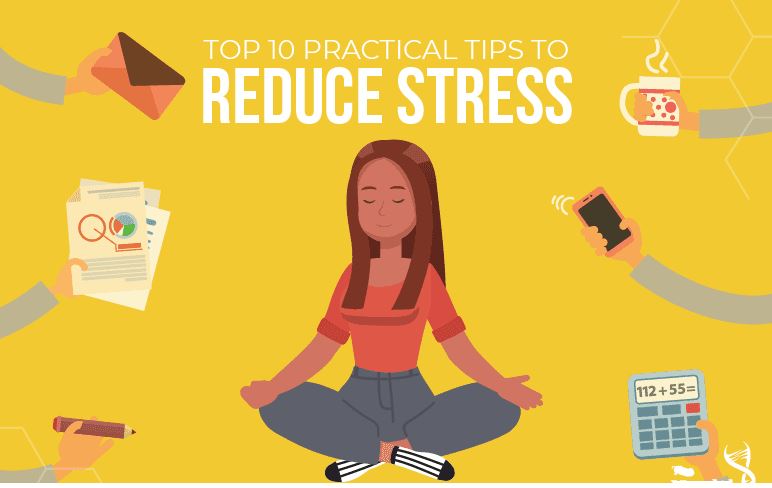
How to reduce stress.

Everyone is in the rat race to be super productive and to achieve life’s ambition neglecting the fact that how draining the entire process is. As overwork brings stress so is the topic, because we need to address these issues and it is quite necessary.

To deal with it we need to plan out the day effectively and manage everything as per the need. While no one can avoid all stress, you can work to handle it in healthy ways that increase your potential to recover.

Study and practice relaxation techniques. Taking the time to relax every day helps to manage stress and to protect the body from the effects of stress. You can choose from a variety of techniques, such as deep breathing, imagery, progressive muscle relaxation, and mindfulness meditation. There are many online and smart phone apps that provide guidance on these techniques; although some entail purchase costs, many are available free of charge.

Exercise regularly. In addition to having physical health benefits, exercise has been shown to be a powerful stress reliever. Consider non-competitive aerobic exercise, strengthening with weights, or movement activities like yoga or Tai Chi, and set reasonable goals for yourself. Aerobic exercise has been shown to release endorphins—natural substances that help you feel better and maintain a positive attitude.

Try to connect with people. A good support network of colleagues, friends and family can ease your work troubles and help you see things in a different way. If you don’t connect with people, you won’t have support to turn to when you need help,” says Professor Cooper. The activities we do with friends help us relax. We often have a good laugh with them, which is an excellent stress reliever.

Avoiding unhealthy habits could be good practice to reduce stress from day to day life. Speaking of which working on a sleep schedule is mandatory and sound of sleep of 8 hours should be taken.

Last but not least to try to stay positive as much as you can because you can never work on any of the aforesaid strategy unless you’re in the the mood to uplift you and do something better for yourself

TUTANKHAMUN – THE MOST FAMOUS PHARAOH

King Tutankhamen, popularly known as Tutankhamun, was born in the year 1341 BCE. “Aten’s living image” is the etymology of his name. He was crowned Egypt’s pharaoh at the young age of nine. He reigned from circa 1332 to 1323 B.C.E. as the 12th pharaoh of the 18th Egyptian dynasty. He ruled at a time when Egypt and the neighboring kingdom of Nubia were at odds over land and trade routes.

King Tut was confirmed to be the grandchild of the renowned pharaoh Amenhotep III and the offspring of Akhenaten, a contentious character of the 18th dynasty of Egypt’s the New Kingdom.

Akhenaten disrupted Egypt’s centuries-old religious system by favoring the worship of a single god, the sun god Aten, and relocating the country’s religious capital from Thebes to Amarna. Several of his father’s actions were annulled by King Tut, with the assistance of his advisor Ay, and Egypt returned to polytheism during his reign. Following Akhenaten’s demise, two pharaohs served for a short time until Tutankhaten inherited the crown.

Nearly a decade after attaining power, the “boy king” died under dubious circumstances only at 19. Below-mentioned are the few assumptions-

  • The Egyptian royal family’s longstanding incest is also believed to have contributed to the young prince’s ill health and early demise. His parents were siblings, as per DNA testing revealed in 2010, and his spouse, Ankhesenamun, was also his half-sister.
  • He stood tall but was fragile, with a terrible bone condition in his malformed left foot. He is the only pharaoh, believed to have sat while engaging in physical sports like archery. As per researchers, King Tut died from a gangrene infection, most likely triggered by a fractured leg.
  • It was assumed Tutankhamun was slain because his remains exhibited a hole in the back of his skull, but current findings reveal the wound was formed during mummification.
  • In 1995, CT scans indicated that the pharaoh had a crippled left leg, and DNA from his mummy showed signs of multiple malaria illnesses, all of which could have attributed to his premature death.
  • Tutankhamun suffered from malaria and was crippled, necessitating a cane to move, as per a 2010 analysis of his DNA, which could have triggered his fall and exacerbated his leg infection.

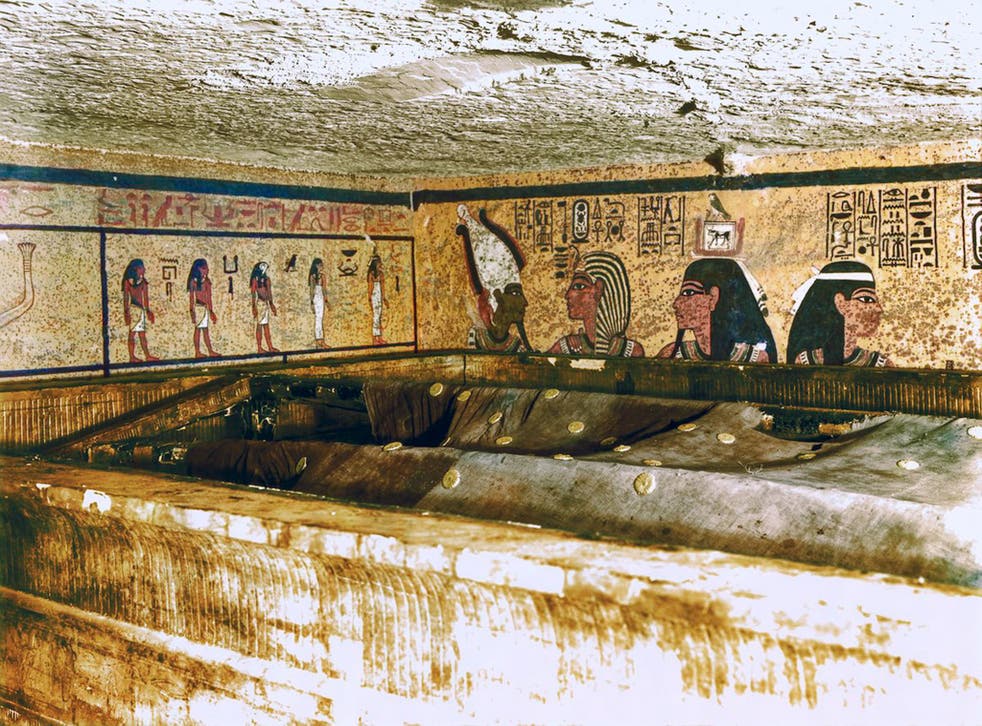
King Tut was mummified after he perished, in compliance with Egyptian religious practice. Embalmers removed his organs, dressed him in resin-soaked bandages, and then put in several nested coffins—three golden coffins, a granite sarcophagus, and four gilded wooden shrines, the greatest of which barely fit inside the tomb’s burial chamber.

According to archaeologists, King Tut’s death might’ve been unforeseen considering the modest size of his tomb.

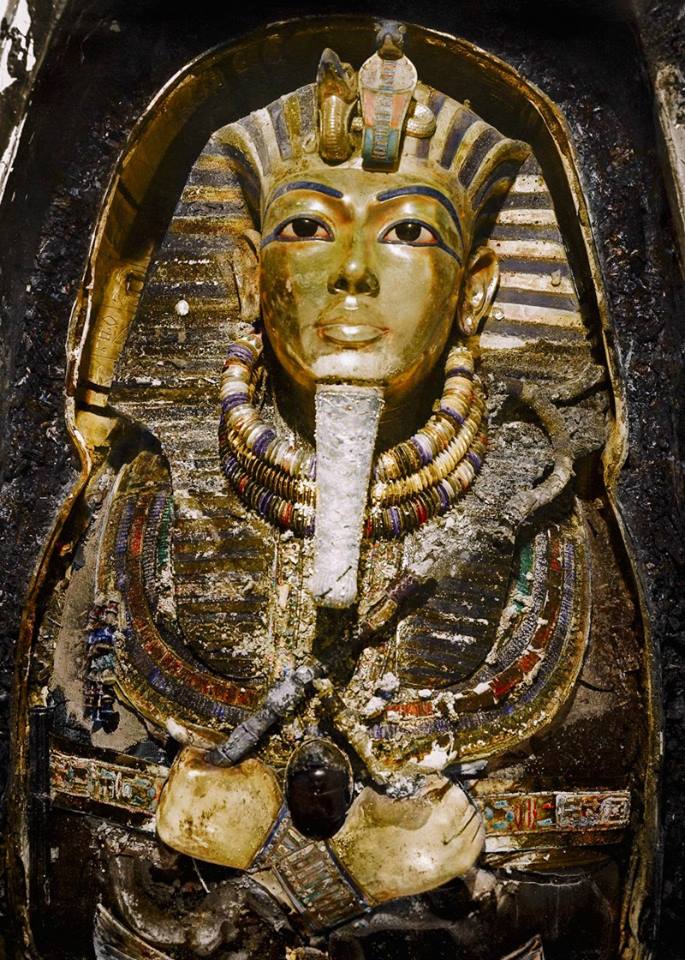
More than 5,000 antiquities, comprising a solid gold mask, furniture, chariots, apparel, couches, canopies, funerary objects, musical instruments, scribal instruments, jars, sticks, thrones, headrests, swords, and 130 of the crippled pharaoh’s walking sticks, were crammed into the tomb’s antechambers. The entryway passage was believed to have been ransacked shortly after the interment, whilst innermost chambers remained concealed. King Tut’s gold mask was crafted utilizing 22 pounds of gold.

TREASURES OF Tutankhamun

1. Walking on gold

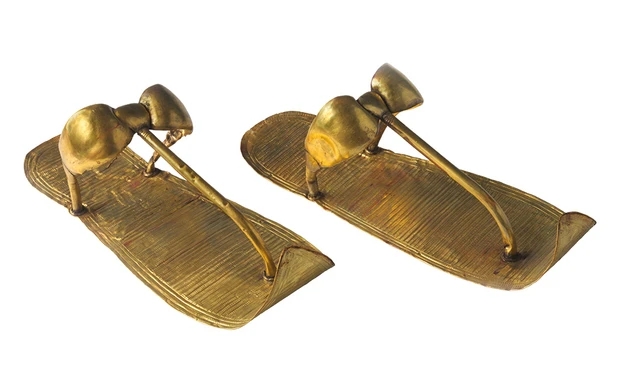
These sandals, made of solid gold for burial purpose, would’ve been put on dead Pharaoh’s feet before he was draped in layers of linen. These resembled the leather and plant sandals Tutankhamun wore in actuality.

2. Symbols of pharaonic power

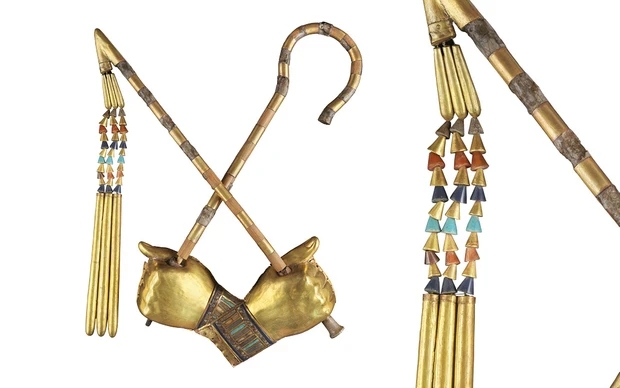
In Ancient Egypt, the crook and flail were the most important metaphor of royal power, with the shepherd’s crook symbolizing royalty and the flail indicating agricultural productivity. Within Tutankhamun’s mummy’s wrapping, The crook and flail featured silver centers, while the crossed hands were crafted of gold with colored glass.

3. Divine protection

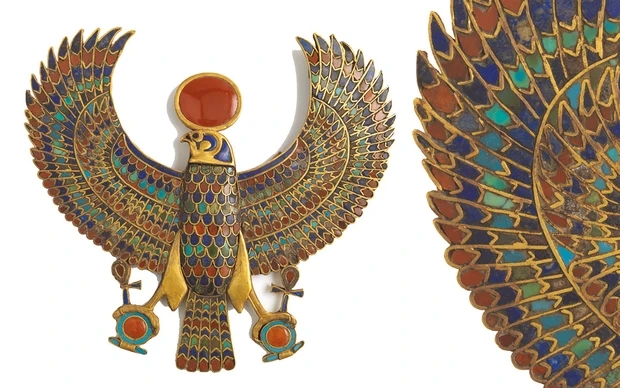
Pectorals, or extravagant pieces of jewelry, were worn across the chest.  The gold Falcon depicts god Horus clutching the sign for eternity in his claws. Horus was believed to be the pharaohs’ creator and guardian.

4. Fierce protector

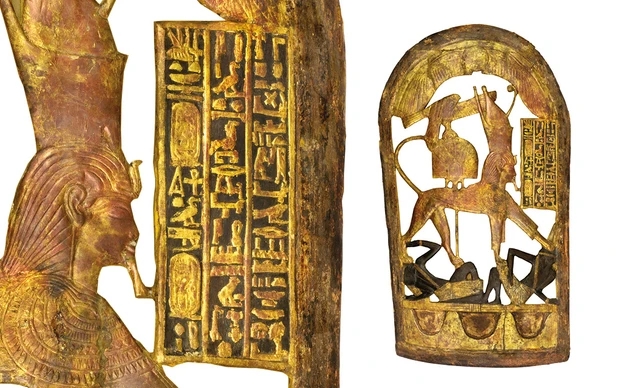
One of 8 wooden shields excavated in the tomb’s annex depicts Tutankhamun as a sphinx crushing his adversaries. The sphinx is surmounted by a falcon, which is a representation of the fighting deity, Montu. The openwork of the wood indicates that this armor was designed for ritualistic rather than fighting purposes. The Pharaoh’s armor represents him as a formidable pharaoh who safeguards Egypt from its enemies.

5. The hand of the king

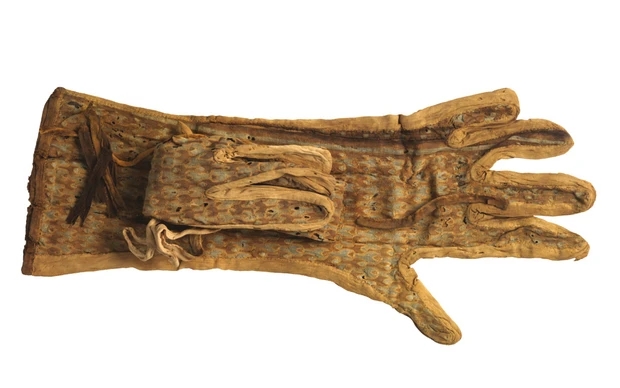
The majority of the items unearthed in the tomb were ritualistic or were meant for the Pharaoh’s afterlife use. But, researchers believe Tutankhamun used these linen gloves during his lifetime, most likely during the cold months, when in Memphis or while riding his royal chariot.

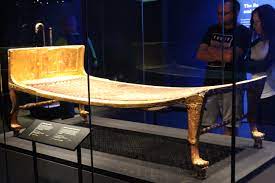
6. Gilded Wooden Bed

This gold-covered bed is assumed to have been prepared for King Tut’s funeral. The Ancient Egyptians felt that the deceased is just resting and that they’d awaken in the afterlife when they were reborn. Religious figures were carved on the bed to guarantee the Pharaoh’s safe travel into the afterlife and to keep evil powers away.

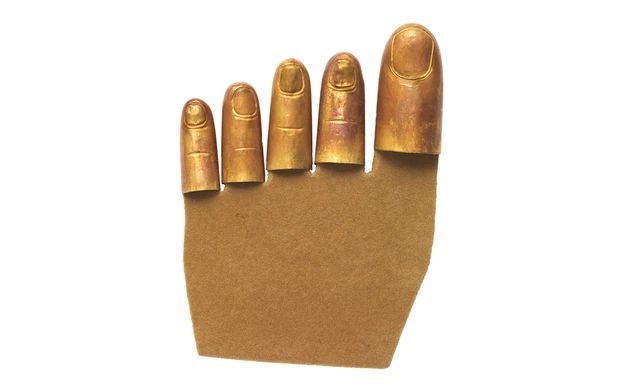
7. Immortal body

The ancient Egyptians believed that the body will be required in the afterlife, so they took great care to protect it after its demise. Stalls were used to maintain the shape of fingers and toes. Gold was highly regarded because it doesn’t rust or alter. It goes on and on.

Gurudev Rabindranath Tagore’s Death Anniversary: Had Tagore been alive today, he would have been upset to observe present WB Situation

Gurudev Rabindranath Tagore was a great patriot as well as an excellent  human being, a doyen of Indian literature and man of versatile qualities as in any field of Indian literature, song, drama including dance drama, painting, music, playwright, etc., without mentioning him  discussion would be incomplete.  According to him, “the highest education is that which does not merely give us information but makes our life in harmony with all existence.” – Rabindranath Tagore (7 May 1861 – 7 August 1941). It is evident from here that on 7 August 1941Tagore left for heavenly abode. 
  Let me first highlight his date of birth issue. The poet wanted his birthday to be celebrated as per Indian calendar and accordingly 25 Baisakh is taken into account not any Gregorian calendar. Born on 7 May, Tuesday 1861(as per Bengali/Indian calendar 25 Baisakh, 1268) in then Calcutta, now Kolkata, he was fourteenth child of Devendranath Tagore and Sarada Devi. As desired by Tagore 7 May is not considered for celebration but 25 Baisakh so as per Gregorian calendar it falls on 7May or 8 May or 9 May. This is a noteworthy point of his patriotism.

  From childhood Rabindranath was a genius and at the age of eight years he made his first attempt in his versification. His father Devendranath Tagore who was like a sage had a vision and arranged Rabindranath’s school-teaching at home under private tutors. While studying at home at the age of 13 years, he wrote a verse based on Macbeth and at the age of 14 years he recited a poem in public gatherings which later on was published in the local newspaper.  Tagore’s patriotic fervour was also clearly reflected when he returned the Knighthood, awarded by the then Imperialist British Government, as a protest against the Jallianwala Bagh massacre in 1919.The British initiated the policy to divide Bengal in 1905 based on religious line and used  the words ‘Hindu Bengal and Muslim Bengal’. Like many other stalwarts irrespective of religion, Gurudev also came forward and opposed the partition of Bengal. He ventilated his anguish by writing a poem ‘Amar Sonar Bangla……’ (My golden/beloved Bengal…) and subsequently the same has been adopted as the National Anthem of Bangladesh after liberation of East Pakistan in 1971.   Regarding our National Anthem “Jana Gana Mana………..” I wish to mention that  the British falsely propagated that  Jana Gana Mana……, was written to praise King George V and Queen Mary on their visit to India in 1911 which Tagore did not accept and vehemently protested. Another point, for the benefit of readers in general and north-east in particular I wish to highlight that only the first of five stanzas  has been adopted as National Anthem but in the last stanza poet has mentioned sun rises from the extreme hills of the east of India (that is present north-east).

    The poet was a great person and wanted to see a united India as he passed away on 7 August 1941 so did not see partition of India. In his ‘Bharattirtha’ (Holy India) poem, he has stated India is for all – Hindus ,Muslims, Christians, Dalits, Aryans, non-Aryans and others.  Even in this poem he specifically highlighted ‘do not bother about caste, have an open mind’. 

In the context of present West Bengal, I feel had Tagore been alive today; he would have been upset to observe WB Situation as ‘Bhadralokbabus’  have shown the level of poll violence and their cruelty. As a result death, assault took place etc., and many  fled from WB to Assam. The Calcutta High court has to intervene for the safety of human beings. My simple view is that in democracy citizens have the right to do politics but the Party in power should save them from the criminals whether criminals are ‘Bhadraloks’ or ‘non Bhadraloks’.  Another issue, a couple of days back Result of the third session of the Joint Entrance Examination (JEE) Main 2021 has been announced. In the third session, according to the National Testing Agency (NTA) 17 students have scored 100 percentile,  eight are from  Andhra Pradesh and Telangana (2 Telugu speaking states). Anyway not a single student is from West Bengal. Maybe now students of WB are more interested in politics than study. Third point, as many as 100 engineers, 500 postgraduates and 2,200 graduates have applied for six lab assistant posts also called ‘dom’ to handle corpses at a state-run hospital in Kolkata, indicating high unemployment in the state. In addition, many types of scams took place in the State of ‘Bhadralokbabus’. Only a few I am highlighting, the Saradha Group financial scandal, Narada sting operation, the Rose Valley financial scam, ‘fake vaccination’ scam, etc. It has to be admitted that many stalwarts and highly intellectuals were born once upon a time in the state.

I extend my Pronam to Gurudev Rabindranath Tagore on this day of his death anniversary.

AS INDIA IS THE COUNTRY OF DIVERSITIES THINKING ABOUT ‘ONENESS’ IS LIKE A NIGHTMARE

In ancient times India was ruled by hindu kings, earlier the entire society was divided into four categories starting from higher to lower. 
Brhaman were superior and were considered as gurus and mentors of the entire society. Second class was of Shatriya people; they were mainly sepoys and kings who ruled the kingdom, and their main work was fighting wars. Third class was of Vaishya people, they were Business men and were engaged in trade. The last class was considered the most inferior class, they were considered left out people and were not involved in any activity of the state, they were discriminated  in many ways. 
Later Mughals ruled over India and established their hegemony, rights of Indians were infringed by them, Mughals dominated over Indians, they established their political power and have influenced the Indian political history such that till today we study their rulers in the academics. They burnt all the evidences of Indian rulers, so that people could only come to know about them in future. 
As the time of Mughal rulers ended. Britishers started coming to India; they ruled almost one century over the Indian subcontinent and had robbed the golden sparrow so brutally. They broke down the unity of the nation, used it as a weapon to establish their hegemony in India. 
After the 1800s Indian people started realizing the need for freedom from the Britishers, and in 1857 a revolt took place which is known as the first struggle by the Indians for freedom. Later after the arrival of Gandhiji and various other social reformers. Finally after hard struggle on 15th August 1947 India got Independence from Britishers. 
Though after getting independence from the Britishers it was not easy to make India as a whole, as independence resulted as a partition of Indian subcontinent into two- India and Pakistan as Muslim community demanded for the separate nation. 
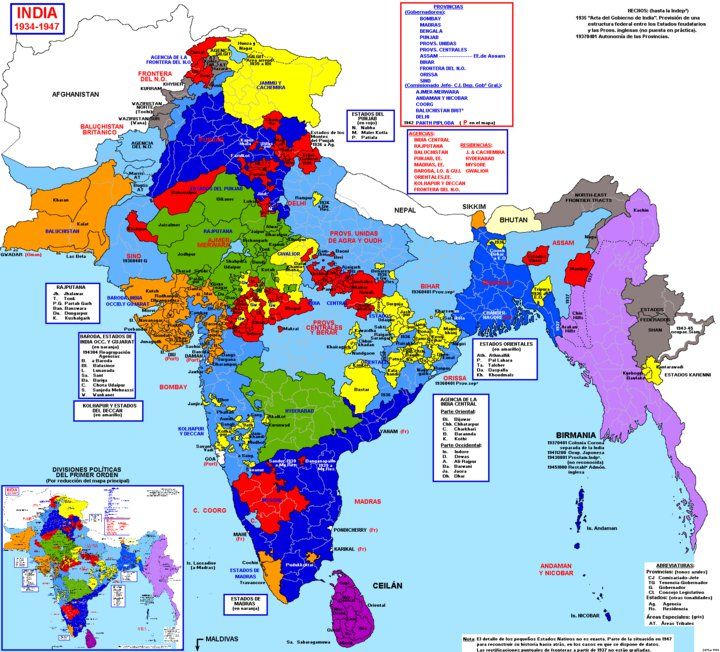
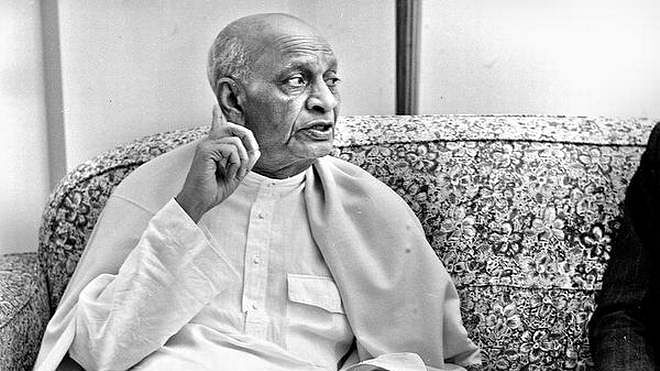
India consisted of 565 princely states before independence which worked separately. The task was to unite all these princely states of different culture, religion and tradition. Sardar Vallabh Bhai Patel emerged as a savior for India. He convinced all the Maharajas of princely state, still Maharaja of Kashmir and Nizam of Hyderabad want to make separate nation, they neither want to join India nor Pakistan. 
Finally Sardar Patel convinced both the princely state's Maharaja and Nizam and New India was formed. Sardar Patel is known as Iron Man of India, if he would have not interfered, the structure of India we can see today would be different. 
Today, India is the largest democracy of the world, with diverse culture and traditions. From North to South and East to West India is full of different colors of tradition, culture, living style, food, dance, dressing, festivals and many more. 
Each corner of the country is unique within itself. In the whole world one will not find anywhere this much diversity at one place. India is famous for its diversity and culture. 
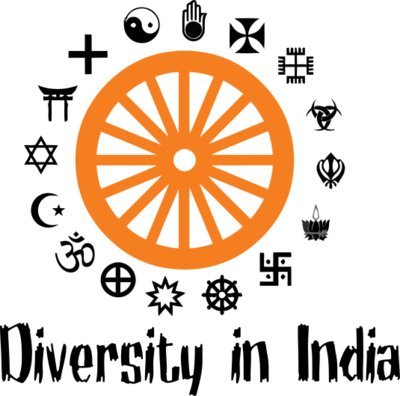
In India people of almost all religions are found, four major religions of the world were founded in India i.e Hinduism, Sikhism, Jainism and Buddhism. 
In India since ancient times the majority of people were of the Hindu religion, others either migrated or converted themselves. Christianity was brought along with Britishers in India. 
After Independence India adopted its own written Constitution on 26 January 1950 which today we celebrate as our Republic Day. 
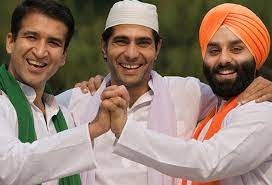
Under the Constitution India provides all rights to all religions equally without discriminating over any particular religion, culture and caste. All people of India follow one citizenship and identity of being Indian. 
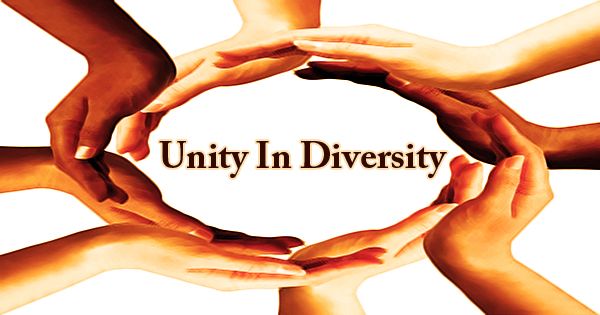
Therefore, India is well known globally for its title of 'unity in diversity'. All people of diverse cultures live under the shed of one Constitution and with one citizenship. 
As earlier mentioned that Indian society was divided among four divisions and were discriminated on the basis of work of each caste, in order to uplift the economically and socially backward classes Indian Constitution provides some special privileges and rights to them. They are given reservation in all aspects, special laws were made for protection of their  rights. 
Earlier women in society were considered as inferior and were stopped from enjoying their basic rights and hence to improve the condition of women Indian Constitution provides special rights and reservation to them. 
Among Indian population the majority of people follow Hinduism, hence one religion could not dominate over the entire society, special privileges are given to minor religion followers and are given equal rights in all the aspects. 
Imagine what would have happened if we hadn't got independence? Even if we would get it, what if the framing members of Indian Constitution would have not given such privileges which are mentioned above to the socially backward classes, poor and to minorities, what if any of the religion would have dominated over the entire society? What if after independence the nation builders would have chosen any other form of government rather than democratic one?
India would have missed the title of 'unity of diversity' and such a respected identity in the world. As India is known for unity in diversity, thinking about oneness is like a nightmare. 
If we see from bird's eye view India is still a democratic country, united where every section of society is enjoying all the constitutional, social and democratic rights, but deep inside at the ground reality people are not ready to accept these forms of administration. 
The reality is people are still fighting and rioting on the name of religion, and the main tussle is among Muslims and Hindus, from partition this conflict began and still after 75 years it is continuing, not only the India and Pakistan, the Hindu and the Muslims of within country are fighting for establishing their power and hegemony. 
Hindus want to make India as a nation of Hindus, they don't want any other religion to live here, Muslims want to make India as a Islamic nation, and same is with other religion followers. At the ground level both the religion followers have hatred in their hearts and minds towards each other. 
Discrimination has not been ended yet, still people discriminate against each other on the basis of caste. 
Politics is always like a mirage, what we see is something that never exists and so is with India, it may seem everything is going constitutionally and equally, but reality and truth can be experienced by observing the situation at ground level. 
Let's hope that this nightmare of oneness in United and diversed India never becomes real. Even if it's seeming to be. 

EVOLUTION OF INTERNET


From its early days as a military-only
network to its current status as one of the developed world’s primary sources
of information and communication, the Internet has come a long way in a short
period of time. Yet there are a few elements that have stayed constant and that
provide a coherent thread for examining the origins of the now-pervasive
medium. The first is the persistence of the Internet—its Cold War beginnings
necessarily influencing its design as a decentralized, indestructible
communication network.

The History of the Internet

The near indestructibility of information
on the Internet derives from a military principle used in secure voice
transmission: decentralization. In the early 1970s, the RAND Corporation
developed a technology (later called “packet switching”) that allowed users to
send secure voice messages. In contrast to a system known as the hub-and-spoke
model, where the telephone operator (the “hub”) would patch two people (the
“spokes”) through directly, this new system allowed for a voice message to be
sent through an entire network, or web, of carrier lines, without the need to
travel through a central hub, allowing for many different possible paths to the
destination.

The Internet has revolutionized the
computer and communications world like nothing before. The invention of the
telegraph, telephone, radio, and computer set the stage for this unprecedented
integration of capabilities. The Internet is at once a world-wide broadcasting
capability, a mechanism for information dissemination, and a medium for
collaboration and interaction between individuals and their computers without
regard for geographic location. The Internet represents one of the most
successful examples of the benefits of sustained investment and commitment to
research and development of information infrastructure. Beginning with the
early research in packet switching, the government, industry and academia have
been partners in evolving and deploying this exciting new technology.

Role of internet in today’s world

Internet has given the field of business
and trade a new face by taking it online. Undoubtedly, online business is
thriving on the net. The Corporate World can reach out to a wider base of
customers, through their websites. The number of active shoppers online is
progressively on the rise and the business world is tapping this fact for the
better. Locating resources like shops, outlets, businesses offering specific
products and services has become easier through Internet. Apart from speed,
reliability and an extensive reach, it also provides the buyers as well as the
sellers with a greater range of products and services to choose from. It also
eliminates the geographical limitations of trade and exchange. Thus, it is
proving to be a fairly profitable mode in the business arena. Advertising and
marketing have also experienced a radical makeover, all thanks to the Internet
and its enormous coverage. A new product can be introduced to a mass audience
within a matter of a few seconds through this high-speed medium. Apart from
garnering the attention of the consumers, sellers also get the all-important
feedback through various programs and polls. Looking at its colossal potential,
Internet has become a highly viable advertising medium, too.

 Internet
has made the tendering process smoother, safer and speedier. More secure and
quicker filling up of tenders and execution of orders is now possible through
e-tendering. Organizations using the new age methods undeniably enjoy a
striking edge over the organizations making use of the conventional methods.

Survival of the fittest

we all know that in today’s time it is very important to keep ourselves fit for our health. Because if we stay fit we will be healthy And we all know that in today’s time it is equally difficult for some people and not for some people.

But in today’s time, healthy is a very difficult topic, the one who will be healthy and fit, only he can survive. We used to see the people of earlier times that they used to be very fit, they never got sick, that’s why till today they are living their life so well.

For all of us to be healthy, there are many facilities like we should do yoga and exercise so that our body remain fit.

We must have seen that earlier people used to be very fit, the reason was that they used to work very hard. It doesn’t mean that today’s people don’t work hard. My opinion is that at that time there were no facilities like today’s time, so all of them used to work physically.

But today’s time is different, we have got many types of facilities, due to which time is being saved, we are able to give time to our family and rest of ourselves. But at the same time, the effect of all this is also read on our health.

We have seen in earlier times that as soon as the children got time, they run outside to play. But in today’s time, parents like to play video games on their children’s phones sitting at home, but they cannot see their children getting hurt by going out. All this is the reason for bringing laziness in our body. We must understand that being healthy is very important for the life of all of us but also for our family members.

If we are sick today, how many types of medicines do we eat to survive? But if we are already fit then we will not need any medicine. Whatever hard work we do today, we do it for our loved ones, then we should also think that our health will also affect the lives of our loved ones. Whatever hard work we do today, we do it for our loved ones, then we should also think that our health will also affect the lives of our loved ones.

In today’s time, we should pay attention to our health, we should do yoga or exercise whenever we get time. So that our mind also remains calm and we can live our life happily.

How to Win Friends and Influence People Book Summary

Book Name : How to Win Friends and Influence People

Author Name : Dale Carnegie

Year of Publication : 1936

There is a famous proverb. “Tell me who your friend is, and I will tell you who you are.” Adding friends who can stand by us is an art. In 1936 Dale Carnegie, a famous public speaker, wrote a book on how to make such good friends. The title of the book is ” How to Win Friends and Influence People.” The book has sold nearly 30+ million copies since its publication. To date, the book has been ranked 19th on Times Magazine’s 100 Most Influence Books list.

We are going to know about such a famous book. It can be said that this book is the beginning of self development. This book has made a changes in the lives of many. 

You can learn an 8 things by reading this book. What they are,

1. Come out of present self and get new thoughts and visions

2. How to farm a team easily

3. Increase popularity

4. Become a great Influencer

5. Increase your influence level on others

6. Learn how to handle complaints and deal with conflicts

7. Learn how to have a better conversation with others

8. Influence other to work with you

You can achieve the above 8 things by reading this book. Not only this but there are a lot of things in this book.

This book has a total of 32 chapters. Author holds this as a 4 part. 

PART I – Fundamental Techniques in Handling People

As we learn what is being said in this part, we will begin to interact properly with others. When we interact like that, we develop a respect among the people.

PART II – Six Ways to Make People Like You

Author has said here a 6 things for others to like us or for others to look at us and be impressed in this part. Why is it said that First Impression is the Best Impression. Always a lot of people will think we are like this when they see us. So he has explained how to make us believe when others see us or how to create best impression on us when they see us.  

PART III – How to Win People to Your Way of Thinking

Author has clearly stated in this part how to bring others our way. Some of the important things that Arthur has said in this are that we can never win a debate. Because it’s not a problem if you are arguing for proof in a discussion. But to those who argue that what I am saying is right author says that it is difficult for us to win. And in this part he has said many things about how we are creating our enemies, how to avoid it, and how to make others like us.

PART IV – Be a Leader : How to Change People Without Giving Offense or Arousing Resentment

Author has told us how to be a leader and how to bring people our way in this part. Sometimes there will be some arguments between us and those who follow us. It explains how to say it without offending them. If you are a team leader or manager in a company, the steps mentioned in this part will be very helpful to make your team do what you think.

Author has said a lot about things like this in this book. That is, no one likes to accept someone’s order. So he has said very clearly about everything from how we indirectly command someone and how to get them to do the work we need for us.

Handloom Day

It is observed on 7 August every year to honour the handloom weavers in the country. The National Handloom Day is celebrated to mark the 100th anniversary of the Swadeshi Movement, which started in 1905.The first National Handloom Day was organised by Prime Minister Narendra Modi in Chennai.This year 6th National Handloom Day is celebrated.Handloom sector is a symbol of the country’s glorious cultural heritage and an important source of livelihood in the country. The sector is key to women empowerment as over 70% of handloom weavers and allied workers are women. Lets respect, celebrate and encourage handloom sector thereby empowering our handloom weavers and workers financially and instilling pride in their exquisite craftsmanship in our Country.

Cancer may have started the fight, but I will finish it.

Cancer is a major burden of disease worldwide. Each year, tens of millions of people are diagnosed with cancer around the world, and more than half of the patients eventually die from it.

In many countries, cancer ranks the second most common cause of death following cardiovascular diseases. With significant improvement in treatment and prevention of cardiovascular diseases, cancer has or will soon become the number one killer in many parts of the world.

As elderly people are most susceptible to cancer and population aging continues in many countries, cancer will remain a major health problem around the globe.

In this review, we summarized published data to describe the severity of the burden. We also analyzed the GLOBOCAN 2002 database to evaluate the morbidity and mortality of cancer in various geographic regions around the world.

The GLOBOCAN 2002 database was put together using the huge amount of data available in the Descriptive Epidemiology Group of the International Agency of Research on Cancer (IARC), a World Health Organization agency in Lyon, France [1].

Incidence data are available from cancer registries. They cover either entire national populations or samples of such populations from selected regions. Cancer registries also provide statistics on cancer survival. Mortality data by cause are available for many countries through the registration of vital events.

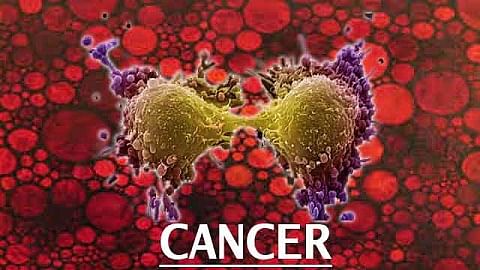
Cancer is a large group of diseases that can start in almost any organ or tissue of the body when abnormal cells grow uncontrollably, go beyond their usual boundaries to invade adjoining parts of the body and/or spread to other organs.

The latter process is called metastasizing and is a major cause of death from cancer. A neoplasm and malignant tumour are other common names for cancer.

Cancer is the second leading cause of death globally, accounting for an estimated 9.6 million deaths, or one in six deaths, in 2018.

Lung, prostate, colorectal, stomach and liver cancer are the most common types of cancer in men, while breast, colorectal, lung, cervical and thyroid cancer are the most common among women.

The cancer burden continues to grow globally, exerting tremendous physical, emotional and financial strain on individuals, families, communities and health systems.

Many health systems in low- and middle-income countries are least prepared to manage this burden, and large numbers of cancer patients globally do not have access to timely quality diagnosis and treatment.

In countries where health systems are strong, survival rates of many types of cancers are improving thanks to accessible early detection, quality treatment and survivorship care.

First Athletics Gold in Olympics

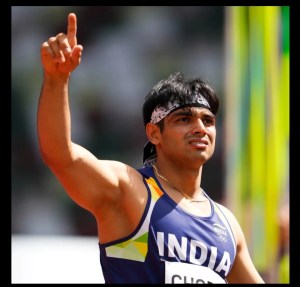
Neeraj Chopra won Gold in the men’s Javelin throw final with a throw of 87.58 to win the first gold medal in athletics for India and the second gold overall.

This is India’s 7th medal at Tokyo Olympic, the best ever medal haul for India at a single edition of the games.

The first Gold medalist in Olympics for India was Abhinav Bindra in shooting and Neeraj becomes the second Gold medalist for India in the history of Olympics.

So far, India won 1 gold, 2 silvers and 4 bronze at Tokyo Olympics.

NEERAJ CHOPRA

Neeraj Chopra VSM (born 24 December 1997) is an Indian javelin thrower. He is the first track and field athlete to win an Olympic Gold medal for India. He is the reigning Olympic champion with 87.58m winning throw on 7th August, 2021. Chopra hurled the javelin at 88.07m to break his own national record. His previous best was the 88.06m gold-medal winning throw at the 2018 Asian Games and 2018 Commonwealth Games. Chopra was also selected as the flag-bearer at the opening ceremony for India at the 2018 Asian Games, which marked his first Asian Games appearance. In his earlier career, he was the 2016 World U20 champion and set the world under-20 record of 86.48 m. He is the first Indian athlete to ever win a World title in Track and Field at U-20.


He won his first medal in Olympics in Sport Athletes, event – Men’s Javelin throw. His throw of 87.86m at his first competition after an elbow injury guaranteed a ticket to Tokyo. He then qualified in the qualification round with a throw of 86.65m and marched to the finals. He brought home the first Gold Medal in the 2020 Summer Olympics at Tokyo. Neeraj threw his first javelin round on a distance of 87.03 meter and again threw the best of finals that’s was 87.6 metres. He is the second person after Abhinav Bindra to win a gold medal in any individual games at the Olympics for India.

Neeraj Chopra is from Khandra village, Panipat district, Haryana. He was educated at DAV College, Chandigarh. In 2016, he was appointed a Junior Commissioned Officer in the Indian Army with the rank of Naib Subedar. On 31 March 2020, he donated Rs. 2 Lakh in PM Cares Fund for COVID-19 pandemic.

Neeraj won a gold medal in 2020 Summer Olympics on 7th August 2021 with the 87.58 m throw, which is the first Olympic medal in athletics won by an Indian. Neeraj Chopra is only the second Indian to win an individual Olympic gold medal. On 11 August 2008, Abhinav Bindra won the gold medal in the men’s 10 m air rifle in 2008 Summer Olympics.

Neeraj won a gold medal at the 2016 South Asian Games with a throw of 82.23 m, where he equalled the Indian national record.

He won a gold medal in 2016 IAAF World U20 Championships in Bydgoszcz, Poland. He also set a world junior record. Despite these performances, he failed to qualify for the 2016 Summer Olympics as the cut off date was 11 July. Neeraj won another gold medal in Asian Athletic championships 2017 with a throw of 85.23 meters.

Neeraj Chopra registered a season best effort of 86.47 meters in men’s javelin throw at 2018 Commonwealth Games (CWG). With that, Chopra not only joined an elite list of Indian athletes to win a gold medal on their Commonwealth Games debut, but also became the first Indian to triumph in Javelin Throw at CWG.

In May 2018, he again broke the national record at the Doha Diamond League with a throw of 87.43 meters.

The 22-year-old Chopra is the only track and field athlete to be recommended by the AFI for the country’s highest sports award in the year 2018. Neeraj Chopra has already been conferred with the Arjuna Award in 2018 after winning a gold in the Gold Coast Commonwealth.

He is currently being coached by German bio-mechanics expert Klaus Bartonietz. Previously, he has been coached by Gary Calvert, Werner Daniels and Uwe Hohn.

On 27 August 2018, Neeraj threw a distance of 88.06 m to win gold in the Men’s javelin throw at the 2018 Asian Games and set a new Indian national record, bettering his own previous record. He won the gold medal in Tokyo 2021 Olympics. On 5 March 2021, Neeraj Chopra again broke his past National Record setting the new at 88.07m, with a World Leading position in 2021.

Javelin thrower Neeraj Chopra opened his international season of 2021 with a throw of 83.18 metres that earned him javelin gold medal at an event in Lisbon, Portugal.

Climate change’s effect on monsoon

Climate scientists have spotted warning signs of the collapse of the Gulf Stream, also popularly known as our world’s crucial tipping point. Reported first by The Guardian, Potsdam Institute researchers have discovered a rather surprising loss of stability of the warm water currents over the previous century that they call ‘Atlantic Meridional Overturning Circulation or AMOC. The currents have been spotted at their slowest point in nearly 1,600 years and the most recent analysis revealed that this could be coming to a complete halt.

In case you were wondering if it’s a big deal — it is. It could severely disrupt the way rains function, especially in areas like India, South America and West Africa. It would also increase the frequency of storms while lowering temperatures in European nations while also resulting in the sea level off eastern North America to rise considerably. This would also affect the Amazonian rainforest as well as Antarctic ice sheets.

He warned stating that you know the kind of CO2 levels that would trigger an AMOC collapse, “So the only thing to do is keep emissions as low as possible. The likelihood of this extremely high-impact event happening increases with every gram of CO2 that we put into the atmosphere”.