What is Afforestation and Its Benefits?

AFFORESTATION

Forests provide the clean air, water, and food grains that organisms need to survive in the world. There are no lives without forests. So in this article we will look at the benefits of these forests and their current status.

The Source of Life is Forests

It is a scientific fact that only living things on earth live in the solar family, and that this is because only air and water exist on earth. The fact is that all living things on earth can survive, even though researchers are still researching whether the planets have enough air and water to sustain life. This air contains gases such as nitrogen, oxygen, and carbon dioxide. Organisms all absorb oxygen and release carbon dioxide. At the same time, plants absorb carbon dioxide, release oxygen, and provide clean air for organisms to live.

The Source of Water is Forests

Water is essential for human beings and living beings. This water is available to us through rainfall. Where it rains is mostly in the forests. It rains because of the forests. There are no trees in the deserts. So no rain. There are plenty of trees in the hills. So it rains generously. It is the forests that pour rainwater into the earth and give us groundwater.

Shade Trees and Forests 

Living beings rest in the shade of a tree as they travel from one place to another. That is why all the kings planted trees on both sides of the roads.

Forests That Prevent Soil Erosion

When it rains and the water flows away, the soil is washed away. Thus residential areas are devastated. But soil erosion is largely prevented as the roots of the trees cling to the soil. 

Forests to Help the Home

In addition to the above, trees are also used for building doors, tables, beds, and shelves for humans to live in.

Trees That Provide Food and Medicine

The fruits of the trees are used as food for humans and animals. The leaves, bark, roots, fruits and pods of many trees are also used medicinally. The water that falls on some plants and falls on us is also used as medicine. 

Disadvantages of deforestation 

Today forests are being massively destroyed in the name of civilization. Deforestation to build apartments. This causes erosion and many lives are lost. Decreased rainfall leads to drought, famine and starvation. Man has to wander for drinking water. 

So we will plant trees, grow forests and see resources to live healthily and happily in the world of organisms.
Motivational Literature

Introduction:

The motivational genre is concentrated on motivating the readers to achieve their goals. It focuses on problems and helps to solve the puzzle. It also helps to improve the character and the personality of the readers.

Motivation:

The term motivation is derived from the Latin word, ‘Movere’ meaning ‘To Move’. Motivation can be referred to as a combination of motive and action. Motivation is an action word that influences every aspect of our daily lives. Motivation is fundamental in the level of success and individual attains.

Characteristic of motivational literature:

In Literature, “Motivation” is defined as a reason behind a character-specific action or behavior. This type of behavior is characterized by the characters on consent and willingness to do something. Characters have some motivation for every action, as do people in real life. Therefore, The implicit or explicit reference to a motivation of a character makes the piece of literature seems closer to life and reality.

Indian motivational literature:

The God of Small Things by Arundhati Roy

Arundhati Roy is one of the prominent writers in India. Her famous works are “The God of Small Things” and “The mystery of utmost happiness”. The God of Small Things is an inspirational encounter with two twin sisters who go through a series of unfortunate events in life. This work is a big booster of inspiration that helps us to boost up our self moral self-esteem and inspiration to embark upon a new beginning full stop the book will make you realize that need for change on the futility to become rigid in life.

If you are happy in a dream, does that count?

African literature:

I know why the caged bird sings by Maya Angelou

I know why the caged bird sings is a 1969 autobiography describing the early years of American writer and poet Maya Angelou. It shows how the strength of character and the love of literature can help overcome racism and trauma. This autobiography touches on themes such as race, sexuality, love, and identity. Struggles to separate sexuality and love in two separate category due to the lack of love from her family and on account of being sexually abused.

Hoping for the best, prepared for the worst, and unsurprised by anything in between.

Austrian literature:

Man’s search for meaning by Viktor E Frankl

Viktor E Frankl is an Austrian doctor, a writer, and a Holocaust from the Nazi concentration camp. This book is about how he lived inside the camp and how he managed to survive. And to stand for the title he talks about logotherapy that is a person needs a reason to survive. This book is full of meaning and hope.

Those who have a “why” to live, can bear with almost any “how”.

Lebanese literature:

The Prophet by Kahlil Gibran

The Prophet is a short book with enormous wisdom within the pages. The Prophet provides timeless spiritual wisdom on a range of subjects including giving, eating and drinking, clothes, buying and selling, crime and punishment, laws, teaching, time, pleasure, religion, death, beauty, and friendship. It is not a religious book but it is spiritual. In this book every word is like a poem, it has its rhythm and rhyme schemes.

“Your children are not your children you may give them your love but not your thoughts for they have their own thoughts.”

The Ode

Two must-read books by Paulo Coelho part 2

Traffic Rules & Regulations Followed By People

 Traffic Rules & Regulations

Travel is an inevitable part of human life. No man can stay in a room for long. So it is necessary to go to public places. For that you have to use the roads. The rules to be followed on the roads are called traffic rules. We all read here to know what are the rules to be followed by pedestrians and motorists.

Rules for pedestrians

Pedestrians refer to people walking on foot.

  • They should only walk on roads, on sidewalks.  
  • Walk only on the black and white lines that are marked for it in certain places and cross the roads.
  • Pedestrians should cross the road only when allowed by the traffic police.
  • In the absence of police, vehicles from the right and left should pass only when they do not arrive. 

Motorists need to pay attention 

  • Drive only on the left side of the road.
  • Motorists should raise the sound when coming from a short distance to pedestrians. 
  • When returning to the road, the appropriate markings should be given to oncoming vehicles shortly before the specified location. 
  • Never use flashlights that glare at onlookers.
  • Only overtake on the right when overtaking ongoing vehicles. Never overtake on the left. 
  • Your vehicle should not overtake other vehicles for any reason on narrow roads and bridges.
  • Air horn should not be used in front of hospitals or schools.
  • Do not drive more than the speed specified for each vehicle. 
  • You need to drive at a steady pace and realize that you can only save fuel.
  • No more than two people can travel in a two-wheeler.
  • Helmets are required for both motorcyclists.
  • Do not drive under the influence of alcohol. 
  • Do not drive while talking on the phone or listening to music.
  • Four-wheeler drivers must use a seat belt attached to the seat.

Vehicle passengers should pay attention

  • Do not get on or off a moving vehicle.
  • Do not talk to the driver.
  •  Do not travel on stairs.
  • Space must be provided for boarding and disembarking passengers. 
  • Pregnant women, the elderly and the disabled should be provided with seating. 
  •  Need to get the appropriate ticket.
  • Be respectful to the conductor and fellow passengers.
  • Avoid mistakes such as smoking inside the bus, spitting, and stretching the hands and head out of the vehicle.

The purpose of the journey is only to reach the place we want to go, but also to realize that trying to go fast and not reaching death. We will all follow the traffic rules carefully.

WHY INDIA STRUGGLES TO WIN MEDALS IN OLYMPIC ?

India is nation of 1.3 billion individuals yet we are aching for gold medals. Though little nations like France, Japan and Germany have more gold medals than our complete awards till now. What could be the explanation ? Do our people need potential or difficult work ? No, we have potential however we don’t utilize it.

Since our youth we are advised to do well in examinations, we scarcely have any games period in our school. Numerous nations have sports like gymnastic, volleyball and swimming in their school however we don’t have any. A few guardians don’t permit their children to play any games since they imagine that it could influence their scholarly.

In our nation sports like cricket are given more significance. Cricketers are viewed as God though scarcely anybody knows the names of our Hockey players which is our national sport. Cricket isn’t directed in Olympics. Simply 10 to 12 nations play cricket and we feel extraordinary in the wake of winning a World cup directed between those 12 nations. Cricket is a game which brought by Britishers while games like Kabaddi and wrestling are from India.

Tokyo Olympics Daily: India wins hockey bronze after years of  disappointment | Financial Times

Our Government additionally spend extremely less cash on sports. A portion of the players don’t have appropriate equipment. They additionally need to battle a great deal since some of them come from small towns. They need to confront analysis which the players of different nations don’t confront.

After this load of issues we anticipate that our country should win medals and assuming we don’t, we censure our players. We have been playing Olympics from 100 years while China from 69 years then additionally they have all out 250 gold medals though our all out awards are scarcely 40. Our players are not lacking anyplace they simply need our help and legitimate offices. Assuming we need our nation to more win medals in next Olympics then we should chip away at these issues.

Tokyo Olympics​: India celebrates wrestler Bajrang Punia's wrestling  bronze- The New Indian Express

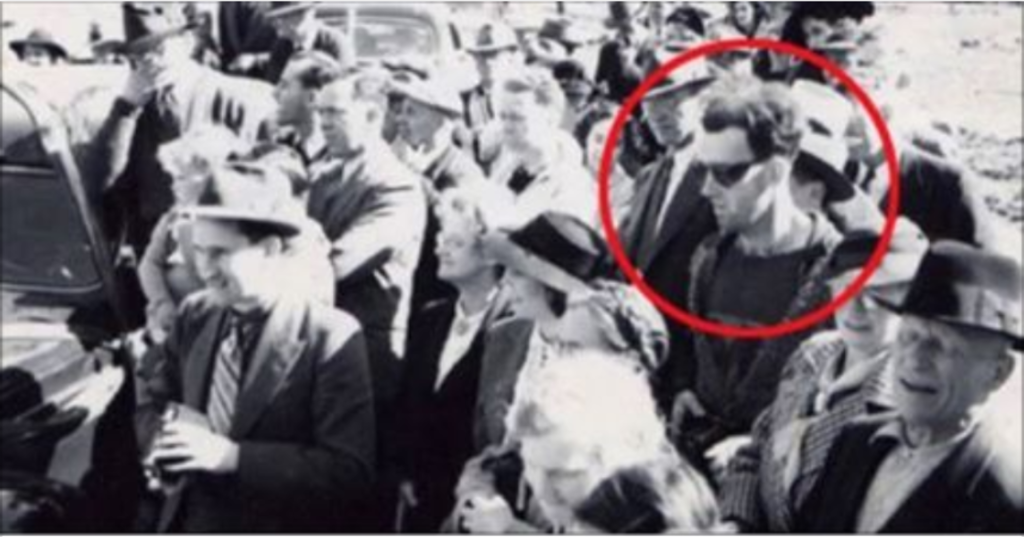
John Titor : Time Traveler

Who is John Titor?

John Titor described how he was an American historian with a specialism in the 20th century. His academic funding had been provided by the army, whilst he was as an enlisted soldier.

By the year 2036, he claimed, time travel had been developed by the government and had been used for several years by the time of his expedition. Titor said that he had been chosen to be sent to the year 1975, with the mission of retrieving an IBM 5100, a portable computer, which contained an outdated piece of coding that was needed in the future. The army had chosen Titor because of his historical knowledge, and because his grandfather had been one of the people who had worked on the very computer needed.

Why Did He Travel Back In Time?

According to Titor, he was sent back in time to pick up an IBM 5100, which his grandfather had helped design. Supposedly, he needed this model – one of the first portable personal computers – to correct predicted issues with Unix in his timeline. After acquiring the computer, he stopped in the year 2000 for “personal reasons” – and to warn people about the threat of Creutzfeldt-Jakob disease (which would be spread through beef products).

How Does The IBM 5100 Play Into This?

One of the oddest parts about the John Titor story is the part played by the IBM 5100. Why would someone from the future need such an old computer? In 1975, IBM released the 5100 as one of the world’s first personal computers, and it came with one feature that set it apart from other computers of the time: It could debug and emulate code written in other programming languages, such as BASIC and APL.

According to Titor, this feature would allow people of the future to keep their technological architecture running after a Unix timeout error in 2038. He said he wanted to snag a 5100 and help debug the code that would keep the world’s computers from having a meltdown.

The future according to John Titor

As well as describing his personal history, John Titor also revealed information about a future marred by warfare. A common theme in all of his posts is the detail he provides in describing alleged future events.

Titor Warns Of World War III

In his short time on the Internet, Titor made a series of interesting predictions that have seen mixed accuracy. One of his early messages warned of a Y2K disaster that would leave the US in a state of martial law.

His most dire warning was of a second American civil war that would begin in 2004. That turned out to be untrue, but his claim about the occurrence of a “Waco type event every month” – referring to the 1993 siege in Waco, TX – was not entirely inaccurate if you add up worldwide incidents of violence. He went on to say that by 2008, the world as we knew it will have disappeared, and that the US would split into multiple sovereign nations. He also predicted a short but intense World War III.

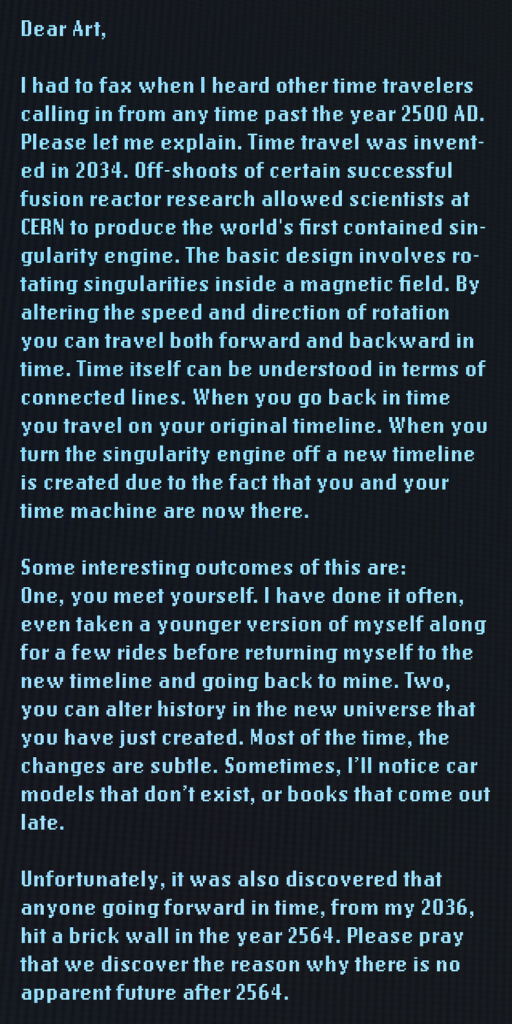
The invention of time travel

With peace reinstated, time travel was invented by the year 2034. However, Titor pointed out that – in his future – it has not yet been made available for public use.

Although it is reserved solely for official purposes, the general public are aware of its existence. In his forum posts, Titor is happy to discuss time travel at length, including its moral implications which he said are discussed in his own time. Titor claimed that the state, for example, had considered using time travel as a sort of punishment. 11

Is John Titor a Hoax?

The tenacity with which John Titor stated that he does not expect, or want to be, believed is an element of this story which – perhaps ironically – serves only to increase people’s general willingness to believe him. Unless, that was his intention all along. If an elaborate hoax, it stands to reason why someone would state this as an act of reverse psychology: a lack of motive makes the persona of John Titor inherently more enigmatic, and more importantly, more believable.

The debate surrounding the reality of John Titor is not an easy one to unpick. Both sides make genuine and sympathetic points. On the one hand, it all seems rather fantastical, and, as we already live in this future, redundant. Yet, the 2.5% divergency effect neatly explains away any inconsistencies, thus redeeming the argument.

Common Mistakes to Avoid on Your Resume


Saying YES to the mess

An unprofessional resume screams SKIP! Remember to keep it sleek and professional with proper highlighting, bullets, and minimal colours. Don’t make it fancy or too simple, don’t use any kind of word or sentence, which will look like a command or too unprofessional, make it professional.
Ensure that it isn’t too busy, too colourful or has illegible fancy font styles.

Check out my posts, ‘Tools to enhance your resume’ for more on this.

Not linking your portfolios, and recommendation

One of the most common mistakes that are made while creating a holistic resume is not providing links to these. Ensure you add a hyperlink to your port folio and recommendation. Also, ensure it is accessible to the employer to view!
Recommendations are like a golden star on your resume. Keep it short, but do provide a contact that they can reach out to, for verification.
Never forgot to add this!!

Not highlighting well enough

Sure, we did tell you what to highlight. But what do you not highlight? Unnecessary minor details, especially in a stretched – out manner. Just add what is important, that will make it look good but if you add small things, it will make your resume look bad. So just remember that you have added things which are important and don’t make it too long.
Use action verbs to describe your daily responsibilities and experience.

Sorry, they can’t come to the phone right now

Why? Because they listed an incorrect contact details on their resume or didn’t list one at all.
So many times we never check our personal information and because of this even if you got the job you will miss it.
Be careful to double and triple check your contact information. E-mail addresses and phone numbers should be highlighted for easier identification.

Too long to read

Keep it short. Your ideal resume should not exceed 2 pages. Employers usually have to go through several resumes in a single day. A super lengthy resume, just make it easier for them to glance and skip.
Make it effective and short.

Grammatical or spelling error

Not only is it extremely unprofessional, but it also implies to the employer that you are not very interested in the position. Use tools like Grammarly to run spelling and grammar checks. Additionally, you could also run it by a friend, just in case you missed something. It’s that easy!

The role of women in the civil rights movements

Introduction

The civil rights movement was an organised efforts by Black Americans to end racial discrimination and gain equal rights under the law full stop this moment was carried out from the late 1940 to 1960.

Cause of the moment

the idea of the moment was rooted in their heart over centuries. But the moment ignited only on December 1 1955 a 42 years old Rosa Park who seated on her design seat at the back of the bus due to the segregation laws at those thanks in USA. when the White man got on the bus and couldn’t locate a seat comer the driver instructor all the black passengers on the back seat to give up there seats Park refused and was arrested.

this instant started to spread as a wildfire on the black and white people parks unwittingly became the mother of the modern day civil rights movements.

The role of women in civil rights

many women played important role in the civil rights movements from serving as a lawyer to teaching in school they provide to the secretary Asian law and started to dismantle them one by one stop their efforts of UN overshadowed by men who still gets more attention under credits for the success in history.

during the moment many women experience to general discrimination and sexual harassment within the moment and delete the turn to do what the feminist movement.

How Important is Female Education?

FEMALE EDUCATION

“Women are the eyes of the country” is a universal suffrage. 

There is no doubt that the country will prosper if the light of women’s education shines. All good people will accept the need for women to be educated, which is equal to the world’s population. So let’s look at female education here. 

Importance of Female Education 

If a man is educated he will develop knowledge only for one. However, if a woman is educated, the whole family will be educated. Because the baby begins to learn in the mother’s lap. So it is natural for the whole family to be educated when all the children are educated. 

Female Education in Ancient Times 

It is a fact of history that the kings of the earth ruled and maintained the poets. Women were among the poets who brought good things to the kings of the world. 

Argument and Denial Against Female Education

Those who refused to accept the growth and importance of women uttered many words at that time. But many who felt the importance of female education supported it. It is an internationally accepted fact that a woman is hidden behind every man’s success.

The Benefits of Female Education 

The society of women who are paralyzed in the kitchen because women are educated has made many achievements. Today women have done their duty in various fields of the world.  From Kalpana Chawla to Sania Mirza, who have excelled in sports to aerospace research. Women make up the majority of the teaching profession. Indira Gandhi, who ruled India, was also a woman. Women have assumed responsibility for governance in various parts of the world; They have been performing to this day. Women are on par with men in all fields.

Women need to be educated to be healthy, prosperous and enlightened. We who worship women as gods should also educate women. We will develop female education.

Slime

Definition

a thick, wet, unpleasant substance that covers something

Slime is made from PVA school glue and a natural mineral called Borax, which is found in household items, such as eye contact solution and natural laundry detergents. When mixed, a reaction forms between the ions in Borax with the molecules in the PVA glue occurs, creating slime. We also use other safe ingredients to create different textured slimes, such as instant snow or biodegradable beads to create a unique experience with each slime.

Despite both of these products being safe to play with, slime should never be consumed. We also do not recommend people with highly sensitive skin or allergies to household items to play with slime, despite never having any complaints about such issues.

Origin and usage

The word slime likely comes from the Old English word ‘slim’ which was probably related to the Old English ‘lim’ meaning ‘sticky substance’. Slime is related to words in many other languages, including the Dutch word ‘slijm’ meaning ‘phlegm’, the German ‘Schleim’ (‘slime’), and the Latin ‘limus’ meaning ‘mud or mire’.

Difference: Fluid and Slime

Liquids consist of many small particles that are densely packed together but can move freely against each other. In thin liquids, the particles are usually small and move past each other quite unhindered. In viscous liquids, the particles are larger and often contain long chains that intertwine.

A good slime is wobbly, can be kneaded, formed, torn, and adheres easily to surfaces such as fingers without leaving any residue. It is a gel. A gel consists of at least two components: One component is solid and forms a 3D network. The other component is a liquid or gas that fills the pores of the network.

Original Slime

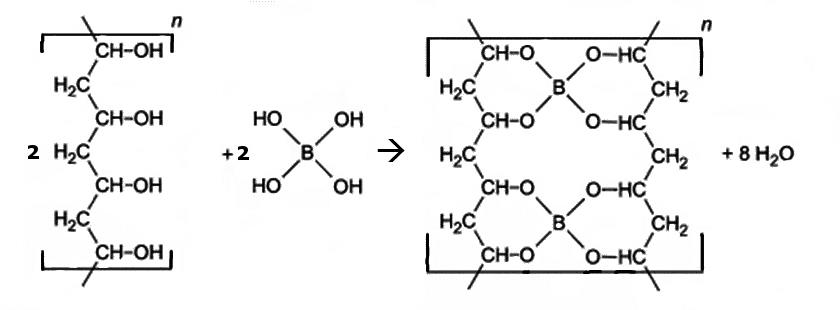
The original slime or DIY slime contains polyvinyl alcohol (PVA), borax (sodium tetraborate), and water. If borax is dissolved in water, boric acid is formed, which reacts further to tetrahydroxyborate. Tetrahydroxyborate reacts with PVA. The OH groups of both particles combine to form solid compounds so that the borate anions become “nodes” in a flexible network. In addition, water is formed which is stored in the pores of the network.

The bonds in the PVA borate network can be broken and newly formed relatively easily. Thus, the network is very changeable during kneading. This makes the slime really slimy.

Disposal

Borax and other boric acid compounds can damage unborn babies in the womb and impair fertility. Therefore, they are no longer sold to private households in EU countries and are banned from school laboratories. Borax must be disposed of as hazardous waste. If slime residues contain borax, they should be disposed of as hazardous waste.

How to make slime?

Though there are many variations, play slime can be made with a few basic ingredients and a simple recipe:

• Two 120ml bottles of liquid PVA glue

• Food colouring or glitter (optional)

• 5ml bicarbonate of soda

• 45ml saline solution (used for contact lenses)

To make slime, simply mix the ingredients in order in a large bowl. Continue stirring, then knead the mixture until it becomes thick and smooth. Slime can be stored for several weeks in an airtight container kept at room temperature.

Once you have the basic recipe perfected, you can experiment with your own slime variations by mixing colours and adding things like plastic gems, sequins or metallic confetti. Making slime is a great way to get kids busy in the kitchen, helping them practise important skills like measuring. Playing with slime is a fun, hands-on activity that can keep children occupied for hours!

The ode

Introduction:

The Ode may be defined as a ‘rhymed lyric often in the form of an address, generally dignified or exalted in the subject, feeling and style’. It is also defined as any ‘strain of enthusiastic or exalted lyrical verse directed to fixed purpose and dealing progressively with a dignified theme’. An ode is noted for its logical evolution of thoughts and it has a certain amount of complexity and elaboration, unlike a simple lyric.

An ode usually begins with an address to somebody or something. Sometimes the opening line or lines may contain an apostrophe as in the case of Shelley’s ‘Ode to the west wind’ or Tennyson’s ‘To Virgil’s. An ode may be written on an important public event or the death of a distinguished person. Marvell’s ‘Ode upon Cromwell’s Return from Ireland’ belongs to the first category and Tennyson’s ‘Ode on the Death of Duke of Wellington’ belongs to the second category.

Origin of Ode:

The ode is of Greek origin. There were two traditions of odes in Greece. The first type of the Dorian mode was so called from the district and dialect in which it arose. It is also called the Pindaric ode because Pindar, the ancient Greek poet, was its greatest exponent. The second type of ode is the lesbian old so-called because it flourished at first on the island of lesbos. It is also called the horatian ode because the great Latin poet Horace was its best practitioner. Thomas Gray’s odes ‘The progress of Poesy” and “The Bard” belong to the Dorian or Pindaric school. Marvell’s ‘Ode upon Cromwell’s Return from Ireland’ is the best example of a Horatian ode in English.

A pindaric or Dorian ade consists of three parts:

The strophe, the anti-strophe, and the epode. they correspond to the three stages of the recital of an ode during a dance. The Horatian ode consists of several short stanzas similar in length and arrangement.

In the early stages, the English ode was influenced by the two Greek models. But gradually the English ode begins to pursue a course of its own. There are two types of odes in English, the regular and the regular.

Regular odes:

The regular odes have a series of exactly similar stanzas as in the odes of Keats. Other examples of regular verbs are Collin’s ‘ode to evening’ and Shelley’s ‘ode to the west wind’.

Irregular odes:

Irregular odes have tons of different lengths and arrangements. There are sudden changes in versification, meter, and mood. Wordsworth’s Ode on Intimations of Immortality from recollections of early childhood and Coleridge’s ‘Dejection: An Ode’ are good examples of irregular odes.

Some famous odes:

  • Ode To A Nightingale John Keats. My heart aches, and a drowsy numbness pains.
  • Ode On A Grecian Urn John Keats.
  • Ode To Autumn John Keats.
  • Ode To The West Wind Percy Bysshe Shelley.
  • Ode To Wine Pablo Neruda.
  • Ode To Sadness Pablo Neruda.
  • Ode On Solitude Alexander Pope.
  • Ode To The Book Pablo Neruda.

Conclusion:

In English Ben Jonson, Milton and Gray wrote Pindaric Odes. Marvell road Horatian odes. Other important poets who wrote odes were Spenser, Collins, Keats, Shelley, and Tennyson. Perhaps the ode is the most popular lyrics form except the Sonnet.

The Lyric

The Science Fiction

India’s best Olympic ever

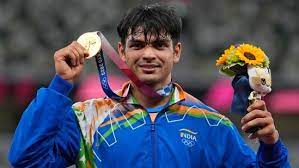
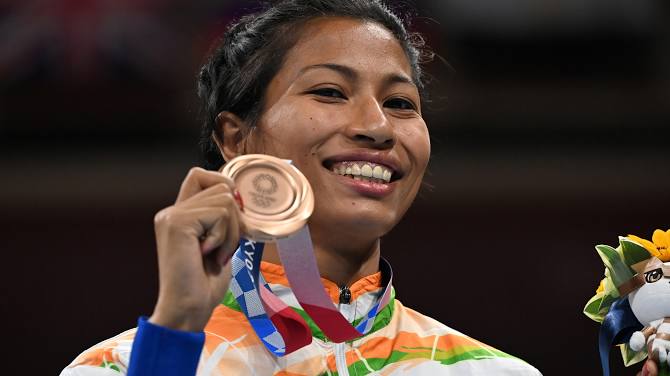
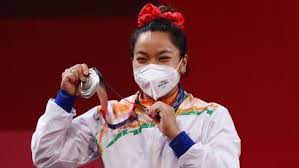
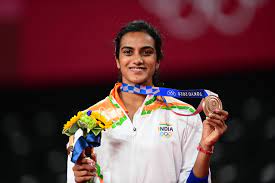
Today is the closing ceremony of the Tokyo Olympics 2020 , which has definitely become India’s best Olympic ever. India has managed to win 7 Olympic medals which is the highest number of medals in a single Olympic for India breaking the record of London Olympics where India won 6 medals back in 2012.

In this Olympics , there were many athletes who were considered as favourites to win a medal. some were able to cop up with the expectations of 1.3 billion Indians but some crumbled in pressure or by other reasons.

India’s first Olympic medal in Tokyo 2020 came in very first day of Olympics when India’s weightlifter Mirabhai chanu won Silver medal in 49 kg category. All of a sudden India’s medal came in day 1 of the Olympics and we thought this Olympics will be ours . But after day 1 , Indian athletes disappointed and could not increase the medal tally for few days, especially our shooters from whom we were having lot of expectations to win medals disappointed us.

But soon India was assured their second medal when Indian boxer Lovlina borgohain was qualified for semifinals in 69 kg category. she was assured of at least a bronze medal . unfortunately , she lost the semifinal match but she had already won bronze medal for India. she became 3rd boxer for India to win medal in boxing after Marykom in 2012 and Vijender Singh in 2008. In between some disappointed performances , some Indian athletes did really well. After Lovlina, it was the time for PV Sindhu , silver medalist from Rio Olympics. She started really well but lost in semifinal match against Chinese Shuttler TY Tai. But soon made great comeback and won bronze for India.

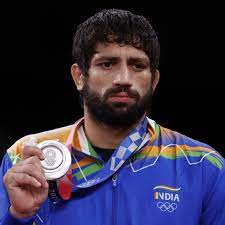
Till then , India had won 3 medals and was already better from last Olympics where we we only won 2 medals but India’s best was about to come after that . Indian Hockey team was doing consistently good from their first match and soon they qualified for semifinal after many years. Indian women hockey team started poorly but they soon came in their best and qualified for Olympics semi finals but unfortunately ,our both teams lost in semifinals after playing good throughout the match. At the same time , wrestling was also going on where Ravi Dahiya entered finals of freestyle wrestling in 57 kg category. and Deepak Punia after qualifying for semifinals , unfortunately lost his match and was later unable to win bronze medal. Ravi Dahiya later won Silver medal.

But the historic moment came soon when Indian men hockey team won bronze medal match against Germany and won an Olympic medal after 41 years. that was a very historic and special moment for Indian fans. though Indian women hockey team could not win a medal but they won our hearts by playing outstanding hockey. till now, India had won 5 medals.

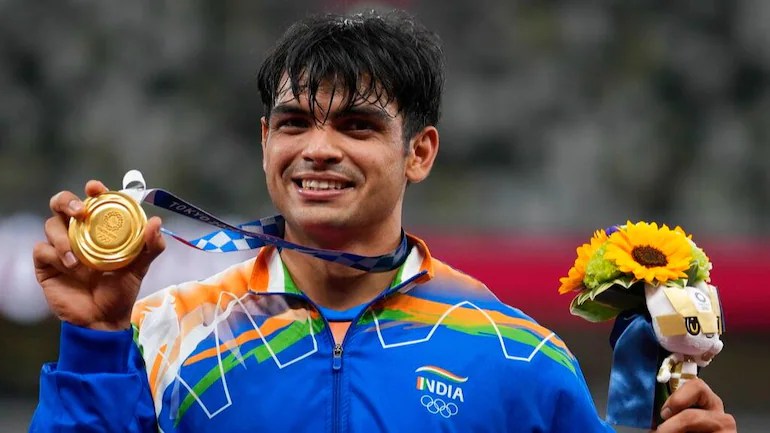
But the most historic and remarkable moment came yesterday when Indian athlete Neeraj Chopra won Gold medal in javelin throw event finals with a record 87.53 m distance. It was India’s first gold medal in Track and field events and 2nd individual gold medal after Abhinav Bindra’s gold medal in 2008 Beijing Olympics. And in the same day, India’s one of the biggest medal hopes Bajrang Punia also won a Bronze medal in 65 kg category.

That is why , this Olympic has become India’s best Olympics ever. There were some amazing performances who were not able to win a medal but won our hearts like Indian women hockey team , golfer Aditi Ashok, Kamalpreet kaur and many others.

.

Dance Forms Of India

India is the land various cultures, traditions. It is a cluster of various people who follow different lifestyles. With each different lifestyle there comes different dance tradition which goes back to their ancestors. Following are various dance forms of different states of the country.

Bharatanatyam

Earlier known as Sadir or Dasi Attam it is a dance form of Tamil Nadu widely popular in southern India. It has grown out of the art of dancers dedicated to temples. Bharatanatyam rests on principles of performance and an aesthetics set down in classics such as Bharata’s Natyashastra. It has a rich repertoire of songs in Telugu, Tamil and Sanskrit.

Kathak

It is the principal dance of northern India, and is widely practised in Uttar Pradesh, Rajasthan, Delhi, Madhya Pradesh, and even parts of western and eastern India today. It is believed to be connected with the narrative art of Kathakaras or story-tellers who have expounded the scriptures, the epics Ramayana and Mahabharata, and puranic literature to the lay masses since ancient times.

Odissi

This dance form originated in Orissa, performed as part of temple service by ‘maharis’ or female temple servants.The traditional dance was remoulded as a theatre art towards the middle of the twentieth century with reference not only to the existing dance art, but representation of dance in Orissa’s medieval sculpture, painting, and literature. In its remodelled form, Odissi dance has spread quickly across the country.

Kathakali

It is the dance form of Kerela, originated in the seventeenth century  under the patronage of the prince of Karnataka, who wrote plays for performance drawn from the epic Ramayana in Malayalam, the language of the region. Stories from the Ramayana and Mahabharata provide the content of most Kathakali plays, which have come down to us in a steady stream over three centuries.

Manipuri

Manipuri dance, evolved in Manipur in north-eastern India, is anchored in the Vaishnava faith of the Meiteis, or people of the Manipur valley. The temples of Manipur are still among the principal staging venues of the dance

Ghoomer

The Ghoomar dance is primarily performed by the female folk of Jaisalmer on special festive occasions.

Bhangra

It is a traditional dance form of Punjab with the accompaniment of short songs called boliyan and, most significantly, to the beat of a dhol(double-headed drum).

Nutrition

Nutrition is a science dealing with the composition of food, food intake and its assimilation in the body. It includes food, ingestion, digestion, absorption and egestion.

Types of Nutrition

Nutrition is the process of obtaining nourishment. It includes food, ingestion, digestion, absorption and egestion. Protozoans exhibit 6 types of Nutrition. They are as follows:

Holophytic nutrition. Holozoic nutrition, Saprozoic nutrition,mixotrophic nutrition, parasitic nutrition and coprozoic nutrition.

Holophytic nutrition

Here the protozoans synthesize carbohydrate by photosynthesis. They are provided with chlorophyll. They synthesize carbohydrate with the help of CO_2, water and animals. Holophytic nutrition is exhibited by protozoans bearing chlorophyll. Eg. Euglena, Chlamydomonas, Volvox, etc.

Holozoic Nutrition

This type of Nutrition is like that of animals. In this type, the solid or semi-solid food is swallowed. Eg. Amoeba.

Saprozoic Nutrition

The absorption of decayed organic materials as food is called Saprozoic Nutrition. The food consists of decayed plants and decayed animals. They are absorbed in solution through the general body surface. Eg. Euglena, Entamoeba, etc.

Mixotrophic nutrition

Certain protozoans feed by more than one method. Eg. Euglena. It exhibits holophytic nutrition, holozoic nutrition and Saprozoic Nutrition.

Parasitic Nutrition

Parasites obtain their food from their hosts. They feed by holozoic method Saprozoic method. Parasites may feed on the digested food of the host or on the tissues of the host. Trypanosoma feeds on blood by Saprozoic method. Trichomonas feeds on the digested food.

Coprozoic nutrition

In this method, the faecal materials are swallowed as food. It is exhibited by Copromonas living in the faeces of vertebrates.

Netaji Subhash Chandra Bose

The Grand Festival of the Indian Democracy is round the corner – You guessed it right! Its the Independence day!!!

On this occasion let’s remember a very Important Freedom fighter in the Freedom struggle of our Country – Netaji Subhash Chandra Bose

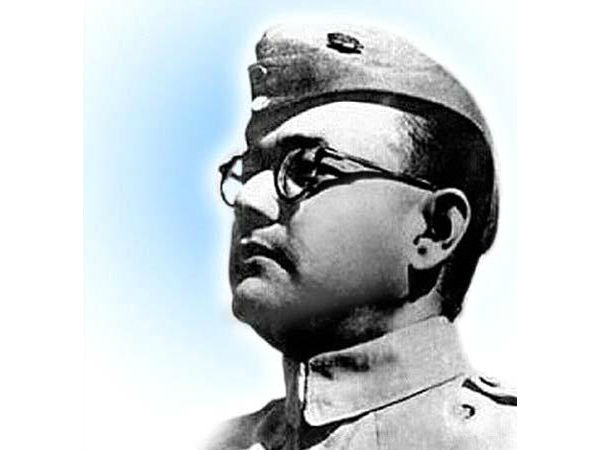
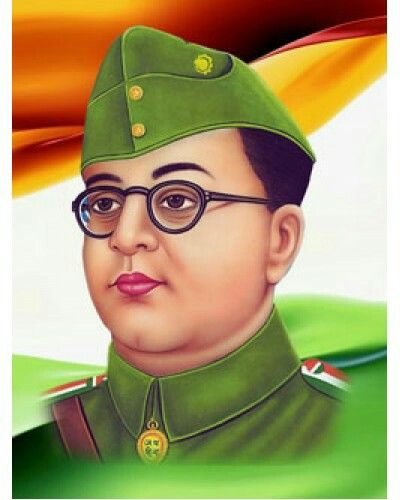
Netaji Subhas Chandra Bose was a fierce nationalist, whose defiant patriotism made him one of the greatest freedom fighters in Indian history. He was also credited with setting up the Indian Army as a separate entity from the British Indian Army – which helped to propel the freedom struggle.

Life of Netaji Subhash Chandra Bose

  • Subhas Chandra Bose was born on 23rd January 1897, in Cuttack, Orissa Division, Bengal Province, to Prabhavati Dutt Bose and Janakinath Bose.
  • After his early schooling, he joined Ravenshaw Collegiate School. From there he went to join Presidency College, Calcutta and was expelled due to his nationalist activities. Later, he went to University of Cambridge, U.K.
  • In 1919, Bose headed to London to give the Indian Civil Services (ICS) examination and he was selected. Bose, however, resigned from Civil Services as he believed he could not side with the British.
  • He was highly influenced by Vivekananda’s teachings and considered him as his spiritual Guru. His political mentor was Chittaranjan Das.
  • In 1921, Bose took over the editorship of the newspaper ‘Forward’, founded by Chittaranjan Das’s Swaraj Party.
  • In 1923, Bose was elected the President of the All India Youth Congress and also the Secretary of Bengal State Congress.
  • He was also sent to prison in Mandalay in 1925 due to his connections with revolutionary movements where he contracted Tuberculosis.
  • During the mid-1930s Bose travelled in Europe. He researched and wrote the first part of his book, The Indian Struggle, which covered the country’s independence movement in the years 1920–1934.
  • After his return, Bose took over as the elected President of Indian National Congress in 1938 (Haripur) and stood for unqualified Swaraj (self-governance) and the use of force against the British which then combated against Mahatma Gandhi and his views.
  • Bose was re-elected in 1939 (Tripuri) but soon resigned from the presidency and formed the All India Forward Bloc, a faction within the Congress which aimed at consolidating the political left.
  • He died on 18th August 1945, in a plane crash in Japanese-ruled Formosa (now Taiwan).

Netaji Subhash Chandra Bose Contribution to Freedom Struggle

  • Association with C.R Das: He was associated with C.R. Das’ political endeavour, and was also jailed along with him. When C.R. Das was elected Mayor of Calcutta Cooperation, he nominated Bose as the chief executive. He was arrested for his political activities in 1924.
  • Trade union movements: He organised youth and promoted trade union movements. In 1930, he was elected Mayor of Calcutta, the same year he was elected the President of AITUC.
  • Association with congress: He stood for unqualified swaraj (independence), and opposed Motilal Nehru Report which spoke for dominion status for India.
    • He actively participated in the Salt Satyagraha of 1930 and vehemently opposed the suspension of Civil Disobedience Movement and signing of the Gandhi-Irwin Pact in 1931.
    • In the 1930s, he was closely associated with left politics in Congress along with Jawaharlal Nehru and M.N. Roy.
    • Because of the endeavour of the left group, the congress passed very far reaching radical resolutions in Karachi in 1931 which declared the main Congress aim as socialization of means of production besides guaranteeing fundamental rights.
  • Congress presidentship: Bose won the congress presidential elections at Haripura in 1938.
    • Next year at Tripuri, he again won the presidential elections against Gandhi’s candidate Pattabhi Sitarammayya.
    • Due to ideological differences with Gandhi, Bose left congress and found a new party, ‘the Forward Bloc’.
    • The purpose was to consolidate the political left and major support base in his home state Bengal.
  • Civil disobedience movement: When World War II began, he was again imprisoned for participation in civil disobedience and was put under house arrest.
  • Indian National Army: Bose manages to escape to Berlin by way of Peshawar and Afghanistan. He reached Japan and from there to Burma and organised the Indian National Army to fight the british and liberate India with the help of Japan.
    • He gave famous slogans ‘Jai Hind’ and ‘Dilli Chalo’. He died in a plane crash before realising his dreams.

Azad Hind

  • Indian Legion: Bose founded the free India centre in Berlin and created the Indian Legion out of the Indian prisoners of war who had previously fought for the British in North Africa prior to their capture by Axis forces.
    • In Europe, Bose sought help from Hitler and Mussolini for the liberation of India.
  • In Germany, he was attached to the special bureau for India which was responsible for the broadcasting on the German sponsored Azad Hind Radio.
    • On this radio, Bose on 6th July 1944, addressed Mahatma Gandhi as the ‘Father of the Nation’.
  • Indian National Army: He reached Japanese-controlled Singapore from Germany in July 1943, issued from there his famous call, ‘Delhi Chalo’, and announced the formation of the Azad Hind Government and the Indian National Army on 21st October 1943.
    • The INA was first formed under Mohan Singh and Japanese Major Iwaichi Fujiwara and comprised Indian prisoners of war of the British-Indian Army captured by Japan in the Malayan (present-day Malaysia) campaign and at Singapore.
    • The INA included both, the Indian prisoners of war from Singapore and Indian civilians in South-East Asia. It’s strength grew to 50,000.
    • The INA fought allied forces in 1944 inside the borders of India in Imphal and in Burma.
    • However, with the fall of Rangoon, Azad Hind Government ceased to be an effective political entity.
    • In November 1945 a British move to put the INA men on trial immediately sparked massive demonstration all over the country.
  • Impact: The I.N.A. experience created the wave of disaffection in the British Indian army during the 1945-46, which culminated in the great Bombay naval strike of February 1946 and was one of the most decisive reasons behind the British decision to  make a quick withdrawal.
  • Composition of I.N.A: The I.N.A. was essentially non-communal, with Muslims quite prominent among its officers and ranks, and it also introduced the innovation of a women’s detachment named after the Rani of Jhansi.

He was indeed a Patriot in the true sense of the word who worked for freedom until his last breath! and played a very important role in the freedom struggle of India.