Internships-What is expected vs What we get

Internships are an opportunity for the freshers to get an insight into the corporate world by performing assigned tasks and duties. They provide real world experience to the college students to prepare for their future.

Usually, internships are unpaid. Even then the students apply and work for the companies just to gain experience in a field (since jobs demand experience). However this is becoming a problem now. How ? Read on to understand the issues that both the students and the companies are facing.

Be it big or small, profitable or non-profitable; companies make a call for the interns whenever they need the workers. But the problem is that it is not easy to get an internship. Getting a good job was already a trauma but internships too are going the same way.

Students search for internships that address their concern. Majorly they require a good internship that offer a certificate of completion along with a letter of recommendation(LOR) to them while supporting skill development. Getting a paid internship is a feather in the cap. But it is becoming rare to have all these features in a single offer.

What is the issue about Internships ?

Aspirant’s point of view

  • The offered internships don’t match the requirements and those which match, are not offered to the aspirant.
  • The task or work is manual and doesn’t support individual growth.
  • LOR is not provided after completion
  • No skill development
  • Good internships demand good skills from the candidate- Those willing to learn it don’t get the opportunity
  • Fear of fraud– personal info gets public through applications and resume
  • Full time work with no incentives gives pressure and tension
  • No direct communication
  • Some also require experience of work.

These are major issues faced by the interns applying for the internships which is why the employment rate is low even when the youth is ready to work. They work without being paid for the internships, with full dedication, just to gain some experience for jobs but the sad part is that the internships have also put forward the requirements of experience in various fields. Now, where would people go to learn something new! Of course they need practical knowledge since the books only cannot guide in how to fix a place for yourself in the world. You definitely need some practical knowledge and experience of the operations in this world.

Employers’ point of view

The companies want those individuals in their organisation who are capable of handling its daily operations, deal with clients, manage funds, etc. For this they seek good interns with proven ability of handling tasks and complete work on time. No firm hire people who don’t know about the corporate world or doesn’t have advanced knowledge since their aim is to succeed, not to teach.

This makes up the gap between the job seekers and givers. The givers are either too expecting or are underestimating the potential of the applicants whereas the seekers are either not interested in the job or they don’t have the required skills.

What is the need of the hour is that there must be a platform where the focus is on skill development without pressurizing the people. The aim should be to make the youth capable of working in the corporate world. Also, the firms should volunteer such programmes where the interns be provided with proper training and incentives while working. This would ultimately increase the worth of the organisation, both economically (through trained individuals) and socially (by working for the welfare of the society and its people). The employment rate and productivity will see a rise.

Only together we can achieve the goals. We all should show responsibility on our part and work for collective welfare. The gaps need to be filled. No one is born perfect but it is the environment that makes us worthy. Let’s create an environment where opportunities are available for everyone and all the resources are tapped. Each of us make a useful resource. What we need is a platform to early access it and put it to work. There is surely a place for everyone in this world!


India Rejects use of Israeli software Pegasus (What is Pegasus?)

Today, the Indian government is facing allegations that they have used Israeli software, Pegasus, on Indian citizens. And this allegation has been leveled on every government of the world except the Government of India.

[Israeli firm’s spyware found on phones worldwide post says]The government is using the Israeli software Pegasus to spying its own citizens.

And this issue has also been raised in Parliament and the government has simply said that we have never misused the software. But strange thing has been seen here that the ruling party is BJP at present. And he has some members of parliament. For example: Subramanian Swamiji who is saying that Pegasus was used to keep a watch on its own Minister Various, Politicians, Influencers by the government.

Here you see that this is his tweet: Strong Ramour that this evening east, the Washington Post will publish a list of all the people who have been spying by Pegasus Software.

Those which are from the ruling party are also demanding that its investigation should be done. And the Congress party is also saying that we need a proper investigation. And we want us to know how Pegasus software has been used by the Government of India.

What is Pegasus?

Pegasus is a very advanced spyware. Spyware is a type of malware, Malware means malicious software. There are many types of malware for example: ransomware is also a type of malware It will hijack the computer and then ask for a ransom to get the computer’s files realized. Spyware is a type of malware, as the name suggests, spyware is used for spying. And Pegasus is developed by Israeli private company NSO Group These people say that their spyware is world in a best, it can hack any person’s phone. For example: WhatsApp, chat, calling, chatting with someone or any other app, any other person can see all the information coming of Pegasus.

And then this question comes tao our mind that how Israel’s NSO Group will sell this software, is there no issue of human rights?

So of course there comes the issue of Human Rights but if we look on the website of NSO Group, it says That we focus on Global Security and Stability These people say that apart from the software we have, Pegasus, these people do a lot of software development .And main target is to catch all these terrorists, criminals and drug trafficking through Pegasus. And if the government thinks that there is a terrorist but there is no evidence against him, then absolutely Pegasus is used here to catch them.

if we see, thousands of lives have been saved through Pegasus. Terrorist attacks have been stopped because of Pegasus. And many criminals have also been caught. So Pegasus has been put to good use so far.If we think, Pegasus is a very powerful tool in itself. Anyone can spying with it.Anyone can open it and see, whom he is talking to, what he is talking about, everyone can know.to

So the allegations are being made on Sarkar that Sarkar is the spying figure of his own people The national security of the country is less here for its personal interest. And these charges apart from the Government of India and Azerbaijan,hungury , Kazakhstan, bahra,saud arbia,rwanda,morocco,mexico Like in the countries too. There have also been allegations against these countries that their government is using Pegasus to keep their government stable in their country.

all these allegations are being levelled together by 17 media organizations. Like: The Guardian, The Washington Post and The Wire from India and many other media whose articles we must have seen. These 17 media organizations gathered and they published a report According to them, Pegasus is being misused in all these countries and they do not have any evidence yet, they are just making allegations. And it was also raised in October 2019 that all Countries is misusing Pegasus. The software which is made for criminals and terrorists is being used by the government for politics. But there is nothing like this to keep your government stable.

What the government said?

So the government has to say that we have not tampered with the privacy of the people. The government says that right to privacy is very important according to the constitution of India. The government says that freedom and speech is a fundamental right. The government has is not spying any innocent person. And the government has rejected all these allegations.

So all these allegations against the government are false.

Music is the shorthand of emotion

Music can raise someone’s mood, get them excited, or make them calm and relaxed. Music also – and this is important – allows us to feel nearly or possibly all emotions that we experience in our lives. …

It is an important part of their lives and fills a need or an urge to create music.

Music is a form of art that uses sound organized in time. Music is also a form of entertainment that puts sounds together in a way that people like, find interesting or dance to.

Most music includes people singing with their voices or playing musical instruments, such as the piano, guitar, drums or violin.

The word music comes from the Greek word (mousike), which means “(art) of the Muses”. In Ancient Greece the Muses included the goddesses of music is known as a musician.

Though more studies are needed to confirm the potential health benefits of music, some studies suggest that listening to music can have the following positive effects on health.

1. Improve mood

2. Reduce stress

3. Lessens anxiety

4. Improves exercise

5. Improves memory

6. Eases pain

7. Provides comfort

8. Improve cognition

9. Helps children with autism spectrum disorder

10. Soothes premature babies.

“SCHOOLS REMOVING MUSIC AS A SUBJECT “, IS IT GOOD ?

Music gives you pleasure that heals your wounds , be it mental , be it physical.

Nearly everyone enjoys music , whether by listening to it , singing , playing instrument. But despite of this universal interest for music , schools are removing music from the list of their subjects that are taught in the schools. Are schools on right path ? Is this decision is in favor of students? NO , they are doing a big mistake ! Schools are not only loosing an enjoyable subject but a subject which enrich students life & help them to focus more on their education . Here are the benefits that music plays in the life of a student.

  1. Musical training helps develop language and reasoning: Students who have early musical training will develop the areas of the brain related to language and reasoning. The left side of the brain is better developed with music, and songs can help imprint information on young minds.
  2. Students learn to improve their work : music brings craftmanship among students, they learn the presentation part of their work
  3. Increased coordination: Students who practice with musical instruments can improve their hand-eye coordination. Just like playing sports, children can develop motor skills when playing music.
  4. Music can be relaxing: Students can fight stress by learning to play music. Soothing music is especially helpful in helping kids relax. A relaxed mind ensures proper work done .
  5. Music teaches discipline : Music teaches an important aspect of life that is discipline , students have to set aside time to learn the instruments that will make them learn discipline
  6. Better self-confidence: With encouragement from teachers and parents, students playing a musical instrument can build pride and confidence. Musical education is also likely to develop better communication for students.

Finally, music is an excellent way to relieve stress.  This is significant for students who may feel overwhelmed by schoolwork and try to balance extracurricular activities. Studies have found that music can reduce burnout and improve mood states. As students enter into the upper grades of the school system and begin considering applying for post-secondary schools, they might feel overwhelmed with the need to keep their grades high. Even young students can experience stress with the increasing amounts of homework school curriculums require. Some students may also have stressful home lives, and music will offer a way to escape from these situations.

Music helps you increase you memory power . Music is good for your memory. I bet you can remember the lyrics of a bunch of songs much better than an article you recently read. In nursing homes, they started using musical therapy in order to let the elderly remember things of their past, which they couldn’t remember without listening to music.

THE WASTE WATER TREATMENT PROCESS

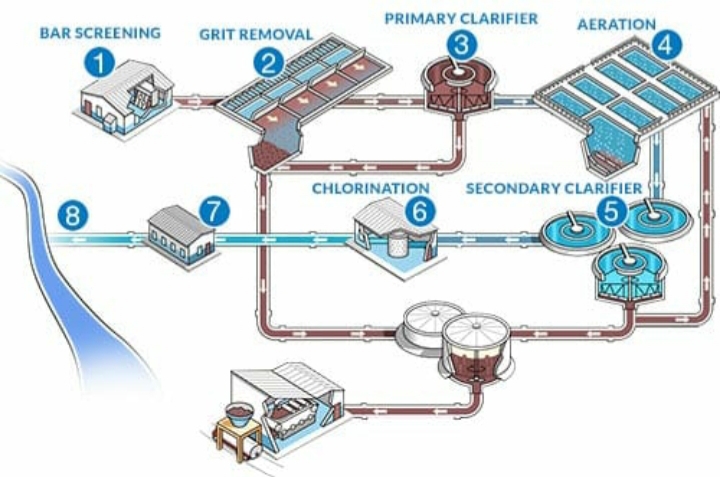
8 Stages of the Waste water Process:

Stage1: Bar Screening

The process of treating and reclaiming water from wastewater (any water that has been used in homes, such as flushing toilets, washing dishes, or bathing, and some water from industrial use and storm sewers) starts with the expectation that after it is treated it will be clean enough to reenter the environment.

The quality of the water is dictated by the Environmental Protection Agency (EPA) and the Clean Water Act, and wastewater facilities operate to specified permits by National Pollutant Discharge Elimination System (NPDES). According to the EPA, The Clean Water Act (CWA) establishes the basic structure for regulating discharges of pollutants into the waters of the United States and regulating quality standards for surface waters. Under the CWA, EPA sets wastewater standards for industry. The EPA has also developed national water quality criteria recommendations for pollutants in surface waters. EPA’s National Pollutant Discharge Elimination System (NPDES) permit program controls discharges.

As an example of expected standards, the Biochemical Oxygen Demand (BOD) of average wastewater effluent is 200 mg/L and the effluent after treatment is expected to be >30 mg/L. It is crucial a wastewater facility meets these expectations or risk stiff penalty.

The physical process of wastewater treatment begins with screening out large items that have found their way into the sewer system, and if not removed, can damage pumps and impede water flow. A bar screen is usually used to remove large items from the influent and ultimately taken to a landfill.

Step 2: Screening

Fine grit that finds its way into the influent needs to be removed to prevent the damage of pumps and equipment downstream (or impact water flow). Too small to be screened out, this grit needs to be removed from the grit chamber. There are several types of grit chambers (horizontal, aerated or vortex) which control the flow of water, allowing the heavier grit to fall to the bottom of the chamber; the water and organic material continue to flow to the next stage in the process. The grit is physically removed from the bottom of the chamber and discarded.

Stage 3: Primary Clarifier

Solids known as organics/sludge sink to the bottom of the tank and are pumped to a sludge digestor or sludge processing area, dried and hauled away. Proper settling rates are a key indicator for how well the clarifier is operating. Adjusting flow rate into the clarifier can help the operator adjust the settling rates and efficiency.

After grit removal, the influent enters large primary clarifiers that separate out between 25% and 50% of the solids in the influent. These large clarifiers (75 feet in diameter, 7½ inches at the edges and 10½ feet in the center as an example) allow for the heavy solids to sink to the bottom and the cleaner influent to flow. The effectiveness of the primary clarification is a matter of appropriate water flow. If the water flow is too fast, the solids don’t have time to sink to the bottom resulting in negative impact on water quality downstream. If the water flow is too slow, it impacts the process up stream.

The solids that fall to the bottom of the clarifier are know as sludge and pumped out regularly to ensure it doesn’t impact the process of separation. The sludge is then discarded after any water is removed and commonly used as fertilizer.

Stage 4: Aeration

Once converted to NO3, the bacteria remove/strip oxygen molecules from the nitrate molecules and the nitrogen (N) is given off as N2↑ (nitrogen gas).

At the heart of the wastewater treatment process is the encouragement and acceleration of the natural process of bacteria, breaking down organic material. This begins in the aeration tank. The primary function of the aeration tank is to pump oxygen into the tank to encourage the breakdown of any organic material (and the growth of the bacteria), as well as ensure there is enough time for the organic material to be broken down. Aeration can be accomplished with pumping and defusing air into the tank or through aggressive agitation that adds air to the water. This process is managed to offer the best conditions for bacterial growth. Oxygen gas [O2] levels below 2 ppm will kill off the bacteria, reducing efficiency of the plant. Dissolved oxygen monitoring at this stage of the plant is critical. Ammonia and nitrate measurements are common to measure how efficient the bacteria are in converting NH3 to N2↑.

A key parameter to measure in wastewater treatment is Biochemical Oxygen Demand (BOD). BOD is a surrogate indicator for the amount of organic material present and is used to determine the effectiveness of organic material breakdown. There are a number of other tests used to ensure optimal organic material breakdown (and BOD reduction) such as measuring pH, temperature, Dissolved Oxygen (DO), Total Suspended Solids (TSS), Hydraulic Retention Time (flow rate), Solids Retention Time (amount of time the bacteria is in the aeration chamber) and Mixed Liquor Suspended Solids. Ongoing and accurate monitoring is crucial to ensure the final required effluent BOD.

Stage 5: Secondary Clarifier

As the influent exits the aeration process, it flows into a secondary clarifier where, like the primary clarifier, any very small solids (or fines) sink to the bottom of the tank. These small solids are called activated sludge and consist mostly of active bacteria. Part of this activated sludge is returned to the aeration tank to increase the bacterial concentration, help in propagation, and accelerate the breakdown of organic material. The excess is discarded.

The water that flows from the secondary clarifier has substantially reduced organic material and should be approaching expected effluent specifications.

Stage 6: Chlorination(Disinfection)

With the enhanced concentration of bacteria as part of the aeration stage, there is a need to test the outgoing effluent for bacteria presence or absence and to disinfect the water. This ensures that higher than specified concentrations of bacteria are not released into the environment. Chlorination is the most common and inexpensive type of disinfection but ozone and UV disinfection are also increasing in popularity. If chorine is used, it is important to test for free-chlorine levels to ensure they are acceptable levels before being released into the environment.

Stage 7: Water Analysis and Testing

Testing for proper pH level, ammonia, nitrates, phosphates, dissolved oxygen, and residual chlorine levels to conform to the plant’s NPDES permit are critical to the plant’s performance.
Although testing is continuous throughout the wastewater treatment process to ensure optimal water flow, clarification and aeration, final testing is done to make sure the effluent leaving the plant meets permit specifications. Plants that don`t meet permit discharge levels are subject to fines and possible incarceration of the operator in charge.

Stage 8: Effluent Disposal

After meeting all permit specifications, clean water is reintroduced into the environment.

Amity University and CSC collaborate to provide higher education to rural students.

Being a private University, Amity has never been behind when it comes to providing quality education. Recently Amity joins hands with Common Services Centers (CSCs) to provide higher education to rural students. 

It is estimated that approx 15 lakh students in rural areas can now be able to access undergraduate and postgraduate courses with this collaboration of Amity University Online and CSC. Courses like BA, BCom, BCA, BBA, and MCA will be available for the students through over 6000 CSC Academy centers, the Education and CSR wing Of CSC.  Also, courses like BA and BCom will be made available in Hindi considering the language barrier faced by students in rural India. When students will enroll through the CSC Academy center, they will be able to join Amity’s online classes. Also, Amity is going to develop special courses for students, which will be offered through CSC Academy. Amity’s Online team will offer extensive assistance to students throughout the enrolment process. 

Ajit Chauhan (the Chairman of Amity University Online) said, “Amity University Online has always envisioned providing world-class quality education to all its learners. Our endeavor is to bring grassroots-level change and enable professionals in remote areas of India. We hope rural and remote India can benefit through this initiative.” 

MD, CSC SPV, Dr. Dinesh Tyagi, explaining the collaboration said, “We have endeavored to provide quality education to students and youth in rural areas, particularly to women who miss out on higher education due to societal inequality and patriarchy. Our association with Amity Online is a significant step in that direction and meets the Prime Minister’s vision of Digital India fulfilling the educational needs of rural India. Partnership with Amity will also help us reach out to rural youth with future skills like AI, Machine Learning, and BlockChain.” Also, the Director, Academics of Amity University Online, Dr. Priya Mary Mathew noted, “It is always heartening to see when an education provider looks beyond to create an impact on the society. We are partnering with CSC Academy and their penetration in the remotest parts of India will light up the dreams of the masses to get quality education within their reach.”

This collab will act as a boost to improve enhance rural India’s education base. Amity Online’s team will offer extensive assistance to students throughout the enrolment process.

Internet safety

Twenty years ago, kids in school had never even heard of the internet. Now, I’ll bet you can’t find a single person in your school who hasn’t at least heard of it. In fact, many of us use it on a regular basis and even have access to it from our homes ! The ‘net’ in internet really stands for network. Information can be shared , or sent from one computer to another. The internet is a vast resource for all types of information. You may enjoy using it to do research for a school project, downloading your favourite songs or communicating with friends and family. Information is accessed through web pages that companies, organizations and individuals create and post. It’s kind of like a giant bulletin board that the whole world uses! But since anyone can put anything on the internet, you also have to be careful and use your best judgement and a little commonsense. Just because you read something on a piece of paper someone sticks on a bulletin board doesn’t mean it’s good information, or even correct, for that matter. So you have to be sure that whoever posted the information knows what they’re talking about, especially if you’re doing research! But what if you’re just emailing people? You still have to be very careful. If you’ve never met the person that you’re communicating with online, you could be on dangerous ground! You should never give out any personal information to someone you don’t know, not even your name! And just like you can’t believe the information on every website out there, you can’t rely on what strangers you ‘meet’ on the internet tell you either. Just like you could makeup things about yourself to tell someone, someone else could do the same to you


Jainism and Buddhism

In the Gangetic plain,iron plough agriculture required the use of bullocks. But the indiscriminate killing of cattle for Vedic rituals and sacrifices caused resentment. The founders of Jainism and Buddhism did not prescribe killing as religious rite. They secured their livelihood mostly by alms. Celibacy and abstinence from holding property made the new teachers much more acceptable than the Brahman priests. The people’s resentment about the expensive and elaborate Vedic rituals, animal sacrifice and desire for wealth eventually took them towards Jainism and Buddhism. Mahavira and Buddha lived a life of purity and exemplified simplicity and self-denial. They lived in the times of Bimbisara and Ajatshatru,the famous kings of Magadha. The commercial development of the northern cities like Kaushambi, Kushinagara, Benaras, Vaishali and Rajagriha added importance to the Vaishyas who turned to Buddhism and Jainism in their eagerness to improve their social status.

Jainism

Mahavira : Birth and life

Mahavira

Vardhamana Mahavira was born in 599 BC (BCE) at Kundagrama near Vaishali. His mother was Trishala, a Lichchavi princess. He spent his early life as a prince and was married to a princess named Yashoda. The couple had a daughter. At the age of thirty ,he left his home and became an ascetic. For over twelve years, Mahavira wandered from place to place, subjecting himself to severe penance and self-morification . In the thirteenth year of his asceticism ,he acquired the highest knowledge and came to be known as Jaina (the conqueror) and Mahavira (great hero). Jains believe that Mahavira came in a long line of Tiruthankaras and he was the twenty fourth and the last of them. Rishabha was the first Tiruthankara and Parshvanath the penultimate or the twenty third. Mahavira travelled extensively as a preacher in the kingdoms of Magadha. Videha and Anga. Magadha rulers Bimbisara and Ajatshatru were influenced by his teachings. Thousands of people became his followers. After 30 years of preaching,Mahavira died at Pawapuri in 527 BC (BCE) at the age of seventy two.

Teachings of Mahavira

The three principles of Jainism,also known as Tri-ratnas, are the following:
         1. Right faith : Belife in the teachings and wisdom of Mahavira.
         2. Right knowledge : Acceptance of the theory that there is no God and that the world existed without a creator.
         3. Right action : It refers to the Mahavira’s observance of the five great vows: (a) ahimsa, (b) honestly, (c) kindness, (d) truthfulness and (e) not converting or desiring things belonging to others.

Spread of Jainism

In order to spread his new faith, Mahavira founded monasteries. The Jaina monks who led a very austere life. In North India, this new faith was patronised by rulers such as Dhana Nanda, Chandragupta Maurya and Kharavela. There was a notable followers of Jainism in Karnataka and western India during the 4th century BC (BCE). Jainism encouraged the public spirit among all who embraced it. Varna system practiced by Brahmas was challenged. People were spared from the costly and elaborate rituals and sacrifices. Mahavira believed that all objects,both animate and inanimate,have souls and various degress of consciousness. They posses life and feel pain when they are injured.

Split in Jainism

In course of time, Jainism split into two branches,namely the Digambaras (sky – clad) and the Svetambaras (white – clad).

Decline of Jainism

The lack of royal patronage,its severity ,factionalism and spread of Buddhism led to the decline of Jainism in India.

Buddism

Gautama Buddha : Birth and life

Gautama Buddha

Gautama Buddha was the son of Suddhodana, the chief of a Kshatriya clan of the Sakyas of Kapilavastu in present-day Nepal. His given name was Siddhartha. As he belonged to the Sakya clan, he was also known as’Sakya Muni’. He was born in 567 BC (BCE) in Lumbini Garden, near Kapilavastu. His mother, Mayadevi ( Mahamaya) ,died after a few days of his birth and he was brought up by his step-mother. In order to divert his attention towards worldly affairs, his father got him married at the age of sixteen to a princess called Yashodhara. He led a happy married life for some time and had a son by name Rahula.One evening, while Siddhartha was passing through the city, he came across an old man who had been abandoned by his relatives, a sick man crying with pain and a dead body surrounded by weeping relatives. Siddhartha was deeply moved by these sights. He also saw an ascetic who had renounced the world and found no sign of sorrows. These ‘Four Great slights’ prompted him to renounce the world and search for the cause of suffering. In 537 BC (BCE), he left his palace and went into the forest in search of truth. In the course of his wanderings, he sat under a peepal tree for several days untill he attained enlightenment. The place where he attained enlightenment,the Mahabodhi temple, still exists in Bodh Gaya (Bihar). After his enlightenment,Buddha decided to impart his knowledge to the people. He went to Varanasi and gave his first sermon at Sarnath. He preached in the kingdoms of Magadha and Kosala. A large number of people became his followers including his own family. After forty five years of preaching,he breathed his last in 487 BC (BCE) at Kushinagar (near Gorakhpur in Uttar Pradesh)at the age of eighty.

Teachings of Buddhism

(I) Four Great Truths : (1) There is suffering and sorrow in this world. (2) The cause of human suffering is desire and craving. (3) This pain or sorrow can be removed by suppressing desire and craving. (4) This is to be achieved by leading a disciplined life or by following what Buddha called the ‘ Noble Eight – fold path’.

(II) Attainment of Nirvana: According to Buddha, a person should aim at attainment of Nirvana or the highest bliss, and it could be achieved by any person by leading a virtuous life and by following the Noble Elight-fold path.

(III) The noble Elight – fold path: Buddha preached a new path to attain the purest state of mind: (1) right views,(2) right aspirations,(3) right speech,(4) right action,(5) right livelihood,(6) right effort ,(7) right mindfulness (8) right contemplations or meditation. Buddha preached that he who practices the eight-fold path can attain the highest and purest state of mind.

Spread of Buddhism

Buddha,in order to carry his message to different parts of India, established the Buddhist sangha or the Holy order of Monks. The bikshus (monks) and the bikshunis (nuns) were enlisted for spreading the faith and they were required to lead a life of purity and poverty. Buddhism spread to Central Asia, Sri Lanka, Tibet, Southeast Asia,as well as the eastern countries of China, Mongolia ,Korea, Japan and Vietnam.

The split in Buddhism

During the reign of Kanishka, the Buddhist monk Nagarjuna initiated reforms in the way Buddhism was followed. As a result, Buddhism was split into two as Hinayana and Mahayana.

( I )The Hinayana (Lesser Vehicle) was the original creed preached by Buddha. The followers of this form regarded Buddha as their guru and did not worship him as God. They denied idol worship and continued with the people’s language,Pali.

(II) In Mahayana (Greater Vehicle) ,Buddha was worshipped as God and Bodhisattva as his previous Avatar. The followers made images and statues of Buddha and Bodhisattva and offered prayers,and recited hymns (mantras) in their praise. Later, they wrote their religious books in Sanskrit. This form of Buddhism was patronised by Kanishka.

Assam: A Doctor infected with Alpha and Delta Variants simultaneously

First time a female doctor is found infected with both Alpha and Delta Variant of Covid-19. The doctor was simultaneously infected with both the virus and doctors have said that the condition of patient is fine and she will recover later.

The officilas have said that there is nothing to worry and the women will soon recover.

The women have previously been vaccinated and receiving the treatment as any other patient of Covid-19.

Earlier this month a Belgium Women was found infected with both the variants. The women died after five days when her conditions worsened following a collapse of her respiratory system, That happen due to being infected with both the variants of Corona Virus.

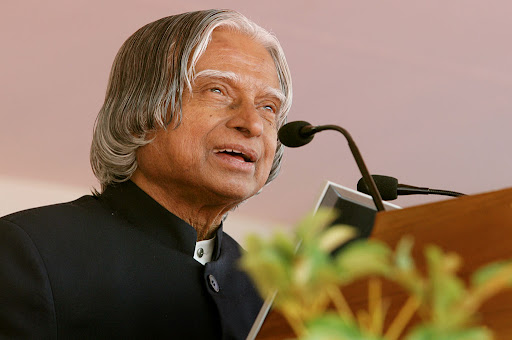
THE INSPIRING STORY OF THE MISSILE MAN – APJ ABDUL KALAM

“IF YOU WANT TO SHINE LIKE A SUN, FIRST BURN LIKE A SUN”- KALAM

Avul Pakir Jainulabdeen Abdul Kalam was the man loved by all the Indian as well as he was respected outside the India also. Kalam was the man with 0 haters he was one who gave the wings to fly. From a newspaper delivery boy to the President of Indian, his great contribution toward India is remarkable which cannot be ignored.

Let’s read more about the success of the missile man of India-

EARLY LIFE AND CHILDHOOD

Kalam was born on 15th October 1931 in a Tamil Muslim family in the city of Tamil Nadu, Rameswaram. Jainulabdeen, Kalam’s father was a boat owner and IMAM of a local mosque, Ashiamma his mother was a home maker. He was blessed with 4 brothers and 1 sister. He was the youngest among all the siblings.

In his childhood, due to the financial crisis in the family, Kalam was forced to sell newspaper at a very young age to support his family. Kalam was an average student during his school time, but he was hardworking, good learner as well as a bright student as per his teacher’s saying. Abdul Kalam completed his schooling in Schwartz Higher Secondary School. In the year 1954 he completed his graduation in physics from Saint Joseph’s College. Later in the year 1955, Kalam went to Madras Institute Of Technology to study aerospace engineering.

Kalam’s wanted to be a fighter pilot, but he almost missed his dream, as there were only 8 position and Kalam secure 9th position in the qualifiers of Indian Air Force (AIF).

ABDUL KALAM’S CAREER

Career as scientist: – After completing his graduation from Madras University in the year 1960. Kalam joined Aeronautical Development Establishment of the Defense Research and Development Organization [DRDO] as a scientist. His career began when he started to design small hovercraft, but he was not happy as he was not satisfied with his job. Later in the year 1969, he was appointed as the director of India’s 1st Satellite launch vehicle [SLV-III] in Indian Space Research Organization  [ISRO] which was successful in July 1980. Tremendous and huge contribution and efforts of Kalam in the development of Polar Satellite Launch Vehicle [PSLV] and SLV-III launched between 1970s and 1990s and by the grace of God both were successful and one of the most important victory for India. Kalam was also invited to witness the India’s first nuclear test ‘’Smiling Buddha” by Raja Ramanna.

Career as president: – Abdul kalam became 11th President of India in the year 2002, he was 3rd president of India who was honoured with Bharat Ratna before he became the President. He was the only scientist and bachelor to occupy ‘Rashtrapati Bhawan’.

The Tragic death of Kalam: – On 27th July, when he of 83, we lost the gem of India. When kalam was delivering a seminar on “Creating a liveable planet Earth” at IIM Shillong, he collapsed he was rush to near by hospital, but he was dead at that time due to the cardiac arrest. APJ Abdul Kalam was famously knowns as ‘Missile Man of India’. He was the one who made India to fly high and achieve success. He was love by children and his story inspires us for the success.  

SAFETY RULES

When we are careful with fire , electricity and chemicals we will be safe.

We have to follow certain simple rules. These rules are called safety rules.

Let us see some of the rules to be followed

Don’t play with fire

Be careful when you have to light a stove with a match stick.

Be careful while using blades or knives

Use a sharpener to sharpen pencil. Don’t use a blade and knife. You may cut your fingers, if you are not careful.

While putting on switches be very careful

Don’t touch any open wire or open socket. If you touch an open wire or socket, you may get an electric shock. Don’t touch a switch with wet fingers.

Don’t drink anything from a bottle without finding out what is in it

Sometimes kerosene or phenyl will be stored in empty water bottles. So make sure what is inside the bottle.

Don’t peep into wells

Don’t bathe in a pond which is very deep. If you don’t know swimming, don’t bathe in a river.

Follow traffic rules

While crossing the road, use the zebra crossing. Cross the road only when the picture of a walking man is seen in the light. Anyone driving a vehicle has to stop if the traffic light is red and get ready when it is yellow and start when it is green. If we do not follow traffic rules, we will meet with accident. Don’t put your head or hand outside the window while in a car or train.

Don’t get into or get out off a moving vehicle. If you do so, you may fall down.

ONLINE SHOPPING

Introduction:

Online shopping is a form of electronic commerce which allows consumers to directly buy goods or services from a seller over the Internet using a web browser or a mobile app. Consumers find a product of interest by visiting the website of the retailer directly or by searching among alternative vendors using a shopping search engine, which displays the same product’s availability and pricing at different e-retailers. As of 2020, customers can shop online using a range of different computers and devices, including desktop computers, laptops, tablet computers and smartphones.

An online shop evokes the physical analogy of buying products or services at a regular “bricks-and-mortar” retailer or shopping center; the process is called business-to-consumer (B2C) online shopping. When an online store is set up to enable businesses to buy from another businesses, the process is called business-to-business (B2B) online shopping. A typical online store enables the customer to browse the firm’s range of products and services, view photos or images of the products, along with information about the product specifications, features and prices.

Online stores usually enable shoppers to use “search” features to find specific models, brands or items. Online customers must have access to the Internet and a valid method of payment in order to complete a transaction, such as a credit card, an Interac-enabled debit card, or a service such as PayPal. For physical products (e.g., paperback books or clothes), the e-tailer ships the products to the customer; for digital products, such as digital audio files of songs or software, the e-tailer usually sends the file to the customer over the Internet. The largest of these online retailing corporations are Alibaba, Amazon.com, and eBay.

History of Online Shopping:

One of the earliest forms of trade conducted online was IBM’s online transaction processing (OLTP) developed in the 1960s and it allowed the processing of financial transactions in real-time. The computerized ticket reservation system developed for American Airlines called Semi-Automatic Business Research Environment (SABRE) was one of its applications. Here, computer terminals located in different travel agencies were linked to a large IBM mainframe computer, which processed transactions simultaneously and coordinated them so that all travel agents had access to the same information at the same time.

The emergence of online shopping as we know today developed with the emergence of the Internet. Initially, this platform only functioned as an advertising tool for companies, providing information about its products. It quickly moved on from this simple utility to actual online shopping transaction due to the development of interactive Web pages and secure transmissions. Specifically, the growth of the internet as a secure shopping channel has developed since 1994, with the first sales of Sting album ‘Ten Summoner’s Tales’.Wine, chocolates, and flowers soon followed and were among the pioneering retail categories which fueled the growth of online shopping. Researchers found that having products that are appropriate for e-commerce was a key indicator of Internet success. Many of these products did well as they are generic products which shoppers did not need to touch and feel in order to buy. But also importantly, in the early days, there were few shoppers online and they were from a narrow segment: affluent, male, 30+. Online shopping has come along way since these early days and -in the UK- accounts for significant percents (depending on product category as percentages can vary).

Growth in Online Shoppers:

As the revenues from online sales continued to grow significantly researchers identified different types of online shoppers, Rohm & Swaninathan identified four categories and named them “convenience shoppers, variety seekers, balanced buyers, and store-oriented shoppers”. They focused on shopping motivations and found that the variety of products available and the perceived convenience of the buying online experience were significant motivating factors. This was different for offline shoppers, who were more motivated by time saving and recreational motives.

English entrepreneur Michael Aldrich was a pioneer of online shopping in 1979. His system connected a modified domestic TV to a real-time transaction processing computer via a domestic telephone line. He believed that videotex, the modified domestic TV technology with a simple menu-driven human–computer interface, was a ‘new, universally applicable, participative communication medium — the first since the invention of the telephone.’ This enabled ‘closed’ corporate information systems to be opened to ‘outside’ correspondents not just for transaction processing but also for e-messaging and information retrieval and dissemination, later known as e-business. His definition of the new mass communications medium as ‘participative’ [interactive, many-to-many] was fundamentally different from the traditional definitions of mass communication and mass media and a precursor to the social networking on the Internet 25 years later. In March 1980 he launched Redifon’s Office Revolution, which allowed consumers, customers, agents, distributors, suppliers and service companies to be connected on-line to the corporate systems and allow business transactions to be completed electronically in real-time. During the 1980s he designed, manufactured, sold, installed, maintained and supported many online shopping systems, using videotex technology. These systems which also provided voice response and handprint processing pre-date the Internet and the World Wide Web, the IBM PC, and Microsoft MS-DOS, and were installed mainly in the UK by large corporations.

The first World Wide Web server and browser, created by Tim Berners-Lee in 1989, opened for commercial use in 1991.Thereafter, subsequent technological innovations emerged in 1994: online banking, the opening of an online pizza shop by Pizza Hut, Netscape’s SSL v2 encryption standard for secure data transfer, and Intershop’s first online shopping system. The first secure retail transaction over the Web was either by NetMarket or Internet Shopping Network in 1994.Immediately after, Amazon.com launched its online shopping site in 1995 and eBay was also introduced in 1995. Alibaba’s sites Taobao and Tmall were launched in 2003 and 2008, respectively. Retailers are increasingly selling goods and services prior to availability through “pretail” for testing, building, and managing demand.

Journalism And Mass Media


Mass Communication is all about impacting the masses through news, views, and opinions. People consume the news and views through multiple mediums like radio, TV, magazines, the internet, social media, films, or any other platform. People (the masses) then form opinions based on these communications emanating from these channels. Mass communication is a broad field that includes photography, filmmaking, journalism, advertisement, public relations, content writing, blogging, and print media, among others. Here, one should note that the purpose of mass communication includes news, entertainment, and information, to name a few. 


On the other hand, journalism mainly focuses on communicating news to people across all genres – politics, economics, business, science, sports, or entertainment news. Journalism includes three simple steps: Collecting data or news, writing and editing it, validating it with facts and pictures, broadcasting it to the masses through all channels including print and electronic media. As the name suggests, print media includes newspapers and magazines, and electronic media includes TV, radio, and the Internet.


Career Opportunities in Journalism

  • TV anchor/news reporter
  • Newspaper editor/reporter
  • Proof-reader in print/electronic media
  • Content Developer in print/electronic media
  • Photojournalist
  • Translator
  • Camera manager
  • Creative designer
  • Researcher in print/electronic media
  • Producer
  • Set Manager


Career Opportunities in Mass Communication

One can expect to make a remarkable career after finishing a course in Mass Communication as there are plenty of opportunities in different fields like:

  • Branding & Advertising
  • Film Making
  • Video Editing
  • Photography
  • Public Relations
  • Radio Jockey, Video Jockey
  • Journalism
  • Content Writing and Development
  • Event Management
  • Creative Direction
  • Sound Mixing and Recording


It’s time for action, make your move now!


Paranormal Existence- Myth for many


Paranormal Activity refers to them beyond the range of normal experience of or about the events or perceptions occurring without any scientific explanation. It is merely an extrasensory perception. It is used to describe a variety of activities and phenomena. It is also referred to as the phenomenon that in one or more prospects exceeds the limit of what is physically impossible according to scientific assumptions. Recent surveys have shown that a significant portion of the population believes in ghosts, leading some scholars to conclude that we are witnessing a revival of paranormal beliefs in Western society.

Recent research has shown that people who espouse paranormal and conspiratorial beliefs are much more susceptible to the conjunction-fallacy. For example, consider the fact that people often endorse multiple (or contradictory) conspiracy theories about the same event, where belief in one conspiracy serves as evidence for belief in another. Yet, the likelihood that two (or many) different conspiratorial explanations about world events are all true at the same time is increasingly unlikely. Similarly, belief in one paranormal phenomenon might quickly lead to the belief that many “magical” things are happening (it can’t merely be coincidence).

Recent survey data show that belief in the paranormal – including aliens, ghosts, telepathy, mind reading, and unlucky numbers – is widespread in India. Given the ubiquitous nature of paranormal beliefs in society, insight into why individuals believe in the paranormal is surprisingly limited. Although the few studies that do exist on this topic show that paranormal beliefs vary somewhat by race/ethnicity, gender, and social class, few studies have applied a rigorous test of theory to quantitatively understand why individuals believe in the paranormal. To address this key gap in research, we use an original dataset and apply the theory of self-control to the understanding of paranormal beliefs. Overall, the data demonstrate that the majority of respondents in our sample report belief in at least one paranormal phenomenon. Multivariate analyses show that individuals with lower levels of self-control report significantly greater belief in the paranormal than those with higher self-control, even after controlling for a range of variables. The characteristics of low self-control – a tendency to choose immediately gratifying courses of action while ignoring long-term consequences – may predispose people to endorse high levels of paranormal beliefs.

Many may dismiss the existence of spirits but those who have experienced it, cannot help but believe that there is, in fact, something beyond the realm of our understanding. India, like every other place, has its fair share of haunted places from Bhangarh Fort in Rajasthan, where no one is allowed to go in after sunset, to Ramoji Film City in Hyderabad where spirits haunt women more than men, from Kuldhara, the abandoned village of Rajasthan, to the royal palace of Shaniwar Wada in Pune, where cries of an assassinated prince are heard at night, all these places have a spooky tale to tell.

Here are some of the most haunted places in India. Get ready to be spooked!

1. Kuldhara Village


The village that is today maintained by the Archaeological Survey of India, Kuldhara’s story is quite well known. A quaint village that looks spectacular in the day turns into your worst nightmare at night. The story of why this happened is equally chilling. It is an abandoned village over 200 years old but you can find houses and temples in near-perfect condition even today. What led to this abandonment?

About 200 years ago, on a fateful night, the villagers of Kuldhara who belonged to the Paliwal Brahmins community, fled from their homes, leaving behind their land and property. If you are wondering what forced an entire village to do so, here’s the reason: The story involves a brutal prime minister, Salim Singh, who was rumoured to be even more powerful than the local king he served. Salim Singh (who was also called Zalim Singh for the brutalities he committed) was also infamous for debauchery. His tax collection methods were not fair and citizens were fed up with his ways. One fine day, the roving eye of Salim Singh fell on the beautiful daughter of Kundhara’s village chief. So mesmerised was he with her beauty that he declared his intentions to marry her! The Paliwal Brahmins were horrified by the proposal but were no match for the powerful prime minister who, by now, had threatened to levy heavier taxes on the villagers. Not having much of a choice, the villagers decided to pack their belongings and leave the village overnight.

To this day, no one really knows where the villagers went and settled after fleeing from Kuldhara.

2. Mukesh Mills Mumbai

Mukesh Mills is a popular location for TV serials and Bollywood films. Located in Mumbai’s tony Colaba area Mukesh Mills takes you back in time with its dilapidated structure and warehouse-like look. But the rundown structure is sure to send shivers down your spine not just with its interiors but because people who have worked here have had some unusual experiences here.

Mukesh Mills was once a thriving mill when it opened its doors in the 1870s. Its location right next to the Arabian Sea made it apt for ships to dock here for loading and unloading of cotton and yarn. The mill, however, went out of business in the 1980s when the workers struck work. The mill was later shut and then an unexplained fire broke out in Mukesh Mills which left it in the condition it now is.

But it seems like Mukesh Mills is as popular among the spirit world as it is in Bollywood. According to crew members and even actors who have worked here, there is something spooky about this location, so much so that shoots to wrap up before sunset as no one wants to be here late at night. People have allegedly heard strange voices, things are reported lost and on one or two occasions, people suddenly seem to get possessed. These occurrences have been reasons enough to avoid shooting here at night.

Most intriguing facts of Jagannath Puri

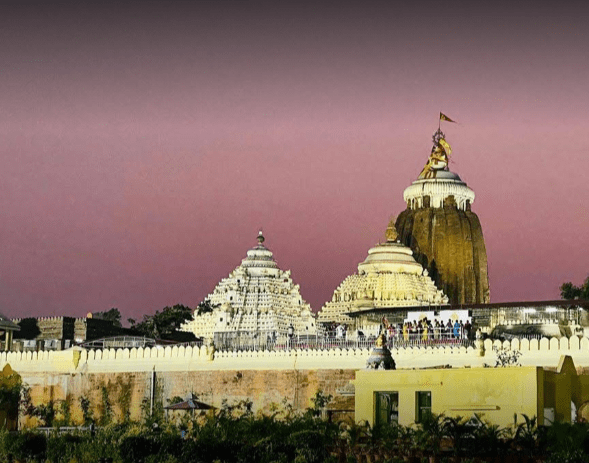
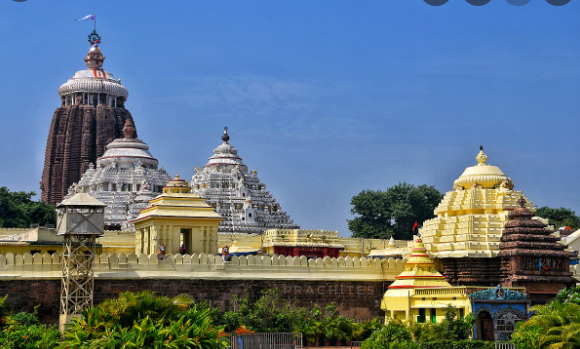
Shri Jagannath’s Temple in Puri has uttermost importance for the Hindu devotees as it is one of the Char-Dham pilgrimages i.e. Puri, Dwaraka, Badrinath, and Rameshwar. This temple is famous for its annual Rath Yatra, but that’s not the sole reason people worship Lord Jagannath and Devi Subhadra and elder brother Lord Balabhadra.

Jagannath Puri is also famous for the mysteries and undefinable facts that catch the traveler’s eye worldwide. Devotees believe that all these are blessings of Lord Jagannath, and people who consider these as myths should visit the place themselves and find themselves dumbfounded. So, here are some most intriguing facts about Jagannath Puri.

No birds, no planes fly above the Lord

They say no one’s above God, so nothing flies above it. It’ll leave you surprised to encounter such a divine miracle that no birds, no planes fly above the temple. This is a rare contrast compared to other temples, as we have always seen birds resting on the top of temples are other entities. The temple is considered as a no-fly zone, not by any state government orders but by the Lord himself. And this phenomenon apparently has no scientific explanation.

Flag defying the power of wind

All of us know that any cloth flows towards wind direction, be it the sails of ship or the kites we flew in our childhoods. But here, the flag that flies atop of the Jagannath temple is an exception to this common principle. No scientific explanations reason the flag flow in the opposite direction of wind.

Mute oceans

Odisha Tourism : Puri Beach
As soon as you step inside the main door, i.e. Singha Dwara entrance of the temple, you can’t hear the burble of water. And this phenomenon is more prominent in the evenings. But once you step out the audibility of water returns. It’s said that Devi Subhadra wished for serenity inside the temple walls and by this her wish was duly fulfilled.

Neela Chakra at the pinnacle

The riddle of Neela Chakra (Blue wheel) has still been unsolved. First, just think about the fact, how did the wheel made of 8 different alloys and a 36 feet circumference get up there at the pinnacle with just a human force of that century. Second, the view of this wheel doesn’t really depend on the direction that we look at it from. It’s like it was designed to look the same from all directions.

The temple casts no shadows

Every small object/thing/ peoples have shadows. But ever wondered what if something doesn’t have a shadow? The temple Jagannath Puri doesn’t cast any shadow on any part of the day under sunlight. If this is not a miracle, what would it be; just an unexplained phenomenon with no scientific reason to back up.

The magical techniques to cook

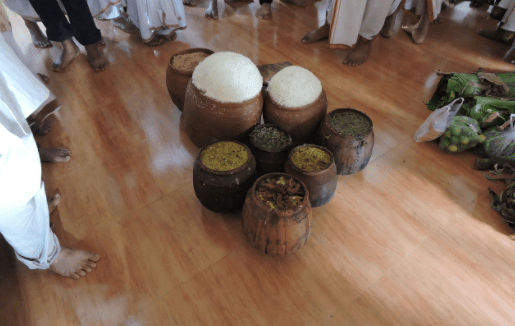
The traditional methods for cooking the mahaprasadam have been preserved here from the start. They place exactly 7 pots, one above the other on the firewood. Enchantingly, the upper pot gets cooked first, followed by the rest in order.

Mahaprasad never goes vain here

In India, wasting food is considered as a bad sign; the temple crew lives by this same. So, here at Jagannath temple the food is never futile, even if the crowd of devotees may vary from 2,000 to 2,00,000. Miraculously, the Parsadam prepared every day is never wasted, not even a bite. Could this be an effective management or the Lord’s will?

After reading such celestial facts, you might want to see them yourself. So, do not forget to check these facts on your next trip to Odisha and share your experience with me.