We know the term “city “that is on the ground,but there is another term when associated with the term city gives of a thrilling vibes and piques the curiosity of people and the term is “UNDERGROUND”
“Underground city” it is a city which is literally as the name says underneath the ground. So today we are going to discuss about a city called “Derinkuyu”.
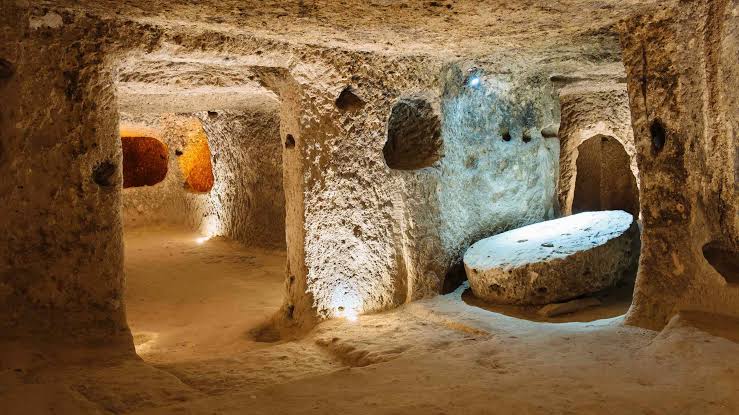
From viator.com
It is an ancient multi-levelunderground city in Turkey.
It is the deepest excavated underground city in Cappadocia and a stunning wonder.
The city is said extends to a depth of 200 feet and could have sheltered as many as 20,000 people together.
Derinkuyu city is famous for its capacity to hold thousands of families that is one of the highest among many underground cities that were found.
It’s said that this city dwelling not only could hold thousands of people, but also contained everything an entire population would need to survive any crises.
There are numerous subterranean dwellings and secret tunnel passages that were used as shelters.
From:Getyourguide
The underground city at Derinkuyu could be closed from the inside with large stone doors enhancing the security measures up a notch and each floor could be closed off separately.
It had aminities such as wine and oil presses, stables, cellars, storage rooms, refectories, and chapels.
On the second floor is a spacious room with a barrel-vaulted ceilings ,and rooms were used as a religious school and for study purposes.
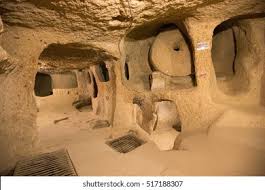
There is a series of vertical staircases between the 3rd and 4 th floor leading to the church located at lowest level.
From:Shutterstock
There is a large 55-metre ventilation shaft a which seemed to provide water to both the villagers above and, if the outside world was not accessible, to those in hiding.
What fascinates me is how did they build this city without having any access to the technology and designed it beautifully and they took all kinds off possibilities into account making a city which is anytime ready to face any kind of problem.
It is said to be one of the top most tourist destinations in Turkey. You can also visit this by booking tickets in a trusted website.
Size range – 0.21nm(0.008inch)-5cm(2inch) in length.
Usually 4 membranous wings
Forewing and hindwing are held together by small hook.
Hind pair smaller than front pair
Complete metamorphosis (Holometabolous).
Mouthparts modified for chewing and sucking
In some form especially bees, certain Mouthparts (labium and maxillae) form a structure for sucking liquid food.
Antennae usually with 10 or more segment.
Larvae usually maggot like(i.e. Leg less)
Large compound eyes, usually 3 simple eyes(ocelli) present.
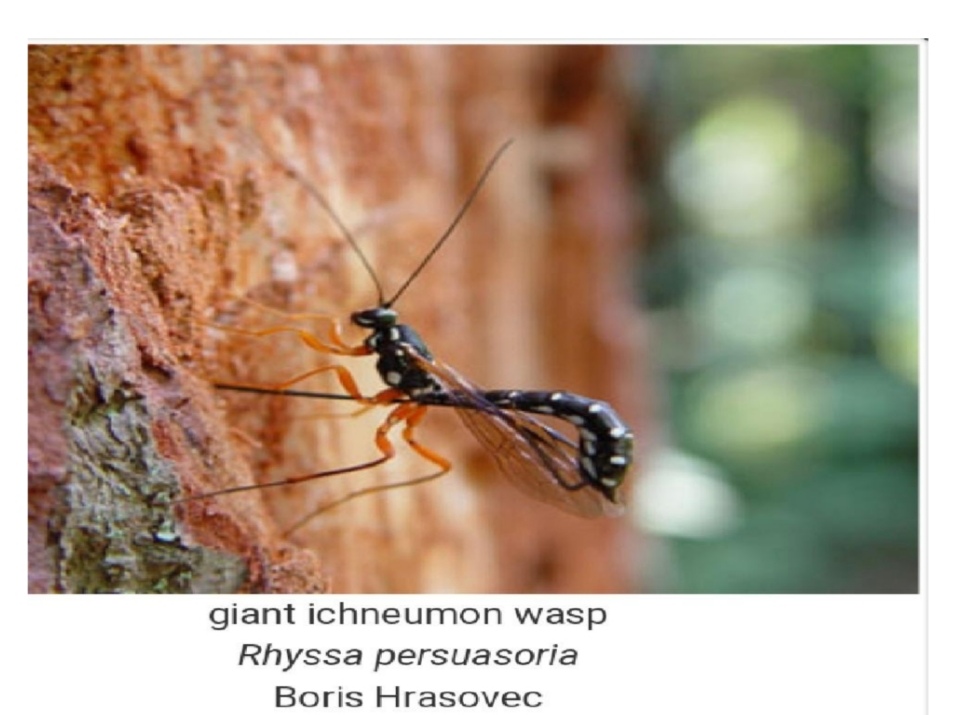
Females typically have a special ovipositor for inserting eggs into host or places that are otherwise inaccessible.
Most have constriction between the first 2 segment of the abdomen which is known as a wasp waist.
Worldwide there are over 100,000 species included in the Hymenoptera.
In Australia, there are about 1275 ant, 10,000 wasp, 2000 bee and 176 sawfly species.
Habitat
Found in all terrestrial habitat throughout Australia.
May occur in soil, leaf litter and range of vegetation types especially flowers.
Life Cycle
Some female produce young one without mating, while other can store sperms and spread out their egg laying to coincide with available food.
Most species lay their egg to the host plant or paralysed food sources they have gathered into specially constructed nest.
The Larvae will moult several times before they pupate.
Development may range from a few weeks for some parasitoid to much longer in social species.
Feeding Habit
Feed on a wide range of foods depending on the species.
Adult wasp mostly feed on nectar and honeydew.
Some species are predator or parasites and spend their time searching out invertebrate hosts to lay their eggs on.
Some are predator, scavenger, omnivores, seedeaters, fungus feeders or honeydew feeders
Suborder of hymenoptera :
1) Symphyta(sawflies and horntails)
2)Apocrita(ants, bees and wasps)
Symphyta :(sawflies)
Most primitive Hymenoptera
Have a broad junction between thorax and abdomen.
Body has no waist.
Paraphyletic group
Females have a saw-like egg laying device for cutting slits in plants into which eggs are laid.
Larvae are caterpillar-like and feed on outside and inside of plant tissue.
There are one or two parasitic families
lack of constriction at the base of the abdomen
fly-like appearance and more extensive wing venation.
They are often confused with lepidopteron larvae but it include–six or more pair of abdominal prolegs(which lack chrochet ), one lateral ocellus on each side of head.
Apocrita :(wasps,bees,ants)
The body has a distinct waist.
The first segment of the abdomen is incorporated into the thorax. A narrow region called the petiole joins this to the rest of the abdomen, called the gaster.
Characterized by Larvae that feed on other Arthropods.
The larvae are maggotlike.
Have narrow junction between thorax and abdomen.
Contain largest no. of species.
Node is usually present.
Further divided into:- Terebrantia(parasitica) which use their ovipositor for egg laying and the Aculeata, which have the ovipositor modified as a sting.
Disability etiquette is a set of guidelines dealing specifically with how to approach persons with disabilities . Before knowing about disability etiquettes , it is essential to understand certain basic things such as if someone has a disability don’t assume he/she needs help . In fact , adults with disabilities wants to be treated as an independent persons , So offer help only if the person with disability seems to need it . Physical contact should be avoided . Always speak directly to the person with a disability , not to his/her friend . Persons with disabilities are the best judge of what they can or can’t do .
General Disability Etiquettes
The general disability etiquettes are stated below :
Always put the person first , i.e., say ‘person with disability ‘ rather than ‘disabled person’ . Always avoid the outdated words like handicapped , retarded , physically challenged or differently – abled . For example , refer to ‘person who are blind ‘ rather than ‘ blind person ‘.
In case of introduction to a person with a disability , it is appropriate to shake hands .
When you meet a person with a visual impairment , always identify yourself and others who may be with you .
Leaning or hanging on a person ‘s wheelchair should always be avoided because such act is generally considered annoying . In fact , the chair is the part of the personal body space of the person who uses it.
Always listen carefully as well as attentively when you are having conversations with a person who has difficulty in speaking . Have patience and wait for the person to finish rather than correcting or speaking for that person . Generally , ask short questions that require short time .
When talking with a person who is on a wheelchair or person who uses crutches , keep yourself at eye level in front of the person to facilitate the talk .
To get the attention of a person who is deaf or having hearing impairment , tap the person on the shoulder or wave your hand . You should look directly at the person and speak clearly .
Never patronize person who use wheelchairs by patting them on the head or shoulder .
Always introduce yourself to persons who are blind using your name .
Always avoid asking personal questions to an individual who is differently-abled .
Always give additional time to a person with any disability to do or to say something .
Always have conversation at a normal tone of voice . Don’t talk in high pitch to such individuals .
Don’t pretend to understand if you are facing problem in doing so .
If you need to leave a person who is blind , inform him that you are leaving and ask him if he needs anything before you leave .
Researchers from the Universitat Politècnica de València (UPVCMT-Motores )’s Térmicos (Thermal Engines) group are developing new, more efficient cooling systems that use solar air conditioning, which will assist in addressing the summer increase in electricity bills Their study results made an appearance in the International Journal of Refrigeration.
“In the last month, the ‘perfect storm’ has occurred in all aspects of the electricity bill. On the one hand, there is the so-called rate change, which is divided into three segments, and on the other, there are consumption peaks in the summer during the hottest days of the year. In these days of high temperatures, air conditioning units and cooling systems consume more electricity, raising the cost of electricity significantly—without going any further, the price of electricity surpassed its annual record last Saturday. Solar air conditioning, while an oxymoron, has the potential to be a solution to this perfect storm, says “José Ramón Serrano”, a CMT researcher.
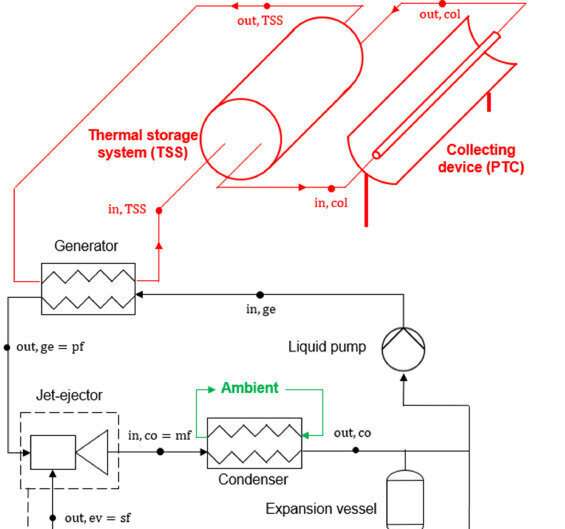
Solar-assisted thermal storage tank jet ejector cooling system.
Solar air conditioning equipment
Solar air conditioning is the equipment used to cool a space with solar energy. Two main groups are involved, as explained by Serrano: on the one hand, photovoltaic panels are used to produce traditional air conditioners. The problem with these solutions is their low efficiency: barely 10 percent, which means the nearly 1,000W per sqm that we get with the most solar radiation during the summertime, generates only 100W of electricity. “This represents about 300 W of cooling power in a traditional cold unit,” Serrano describes.
Solar thermal cooling systems, on the other hand, are more efficient and versatile. In this case, thermo-solar panels are used in place of photovoltaic panels that warm up a liquid by using surfaces that absorb or concentrate solar rays. These systems are used in the cold winter months in households to heat sanitary water and solar heating systems. The CMT-Motores Térmicos researchers concentrate their efforts on the latter to use them during the summer.
They propose coupling these panels to absorption or ejection cycles, which would allow them to cool the room using the sun’s heat as the source of energy. The 1,000 W per square meter received in these cases can be converted into 500 W of heating power using the thermal oil that flows through the thermo-solar panels. The 500 W can then be converted into 600 W of cooling power via high-efficiency absorption cycles.
“One advantage of using this equipment is that the cooling capability increases in tandem with the solar radiation, which coincides with periods of higher cooling demand,” says Vicente Dolz, UPV professor and CMT-Motores Térmicos researcher.
And how would this allow you to save money on electricity?
A typical household air conditioning unit in the living room has a cooling capacity of around 3,500 W. According to the UPV researchers, these values can be achieved with around 6 m2 of thermo-solar panels coupled to an absorption cycle during the hours of highest irradiation (midday in the summer) to completely replace the traditional air conditioning unit with the absorption cycle.
“A traditional air conditioning unit consumes approximately 1,170 W of electricity to achieve the 3,500 W of cooling power.” The technology that we propose would allow us to eliminate said consumption from our bills while enjoying the greatest level of comfort possible thanks to the combination of solar panels and absorption cycles.
CMT-Motores Térmicos proposed that solution can also be implemented as a hybrid system that provides part of the traditional system’s cooling capabilities or improves its efficiency while also reducing global electricity consumption by providing the solar air conditioning system.
Jeff Bezos will fly on the first passenger flight of his space company Blue Origin, which the company plans to launch on July 20, the billionaire announced Monday.
“I want to go on this flight because it’s the thing I’ve wanted to do all my life,” Bezos said in a video posted to his Instagram.
Bezos’ brother Mark will join him, as will the winner of an auction being held for one of the seats. The highest bid stands at $2.8 million as of Monday morning, five days before the auction closes.
“I wasn’t even expecting him to say that he was going to be on the first flight,” Mark Bezos said in the video. “What a remarkable opportunity, not only to have this adventure but to do it with my best friend.”
Jeff Bezos takes a look at the New Shepard rocket booster on the landing pad after a successful NS-15 flight and landing in April 2021.
New Shepard is designed to carry up to six people on a ride past the edge of space, with the capsules on previous test flights reaching an altitude of more than 340,000 feet (more than 100 kilometers). The capsule has massive windows to give passengers a view, spending a few minutes in zero gravity before returning to Earth.
Jeff Bezos opens the hatch of the New Shepard capsule after a test flight in April 2021.Blue Origin
The rocket launches vertically, with the booster detaching and returning to land at a concrete pad nearby. The capsule’s return is slowed by a set of parachutes, before softly landing in the desert.
“To see the Earth from space, it changes you,” the Amazon CEO said. “It’s an adventure; it’s a big deal for me.”
For the past few years, scientists have been studying a dust cloud near the centre of our Milky Way Galaxy. If there is a God out there, it seems that he decided to get creative – this dust cloud , named Sagittarius B2, smells of rum and tastes like raspberries… This gas cloud consists largely of ethyl formate. This large cloud is said to contain a billion , billion, billion liters of the stuff, which would be great , if it wasn’t rendered undrinkable by pesky particles like propyl cyanide. The creation and distribution of these more complex molecules is still a mystery to scientists.
Astrophysics is a branch of space science that applies the laws of physics and chemistry to explain the birth, life and death of stars, planets, galaxies, nebulae and other objects in the universe. It has two sibling sciences, astronomy and cosmology, and the lines between them blur.
In the most rigid sense: Astronomy measures positions, luminosities, motions and other characteristics Astrophysics creates physical theories of small to medium-size structures in the universe Cosmology does this for the largest structures, and the universe as a whole.
In practice, the three professions form a tight-knit family. Ask for the position of a nebula or what kind of light it emits, and the astronomer might answer first. Ask what the nebula is made of and how it formed and the astrophysicist will pipe up. Ask how the data fit with the formation of the universe, and the cosmologist would probably jump in. But watch out — for any of these questions, two or three may start talking at once! Goals of astrophysics Astrophysicists seek to understand the universe and our place in it. At NASA, the goals of astrophysics are “to discover how the universe works, explore how it began and evolved, and search for life on planets around other stars,” according NASA’s website.
NASA states that those goals produce three broad questions:
How does the universe work?
How did we get here?
Are we alone?
It began with Newton
While astronomy is one of the oldest sciences, theoretical astrophysics began with Isaac Newton. Prior to Newton, astronomers described the motions of heavenly bodies using complex mathematical models without a physical basis. Newton showed that a single theory simultaneously explains the orbits of moons and planets in space and the trajectory of a cannonball on Earth. This added to the body of evidence for the (then) startling conclusion that the heavens and Earth are subject to the same physical laws.
Perhaps what most completely separated Newton’s model from previous ones is that it is predictive as well as descriptive. Based on aberrations in the orbit of Uranus, astronomers predicted the position of a new planet, which was then observed and named Neptune. Being predictive as well as descriptive is the sign of a mature science, and astrophysics is in this category.
Milestones in astrophysics
Because the only way we interact with distant objects is by observing the radiation they emit, much of astrophysics has to do with deducing theories that explain the mechanisms that produce this radiation, and provide ideas for how to extract the most information from it. The first ideas about the nature of stars emerged in the mid-19th century from the blossoming science of spectral analysis, which means observing the specific frequencies of light that particular substances absorb and emit when heated. Spectral analysis remains essential to the triumvirate of space sciences, both guiding and testing new theories.
Early spectroscopy provided the first evidence that stars contain substances also present on Earth. Spectroscopy revealed that some nebulae are purely gaseous, while some contain stars. This later helped cement the idea that some nebulae were not nebulae at all — they were other galaxies!
In the early 1920s, Cecilia Payne discovered, using spectroscopy, that stars are predominantly hydrogen (at least until their old age). The spectra of stars also allowed astrophysicists to determine the speed at which they move toward or away from Earth. Just like the sound a vehicle emits is different moving toward us or away from us, because of the Doppler shift, the spectra of stars will change in the same way. In the 1930s, by combining the Doppler shift and Einstein’s theory of general relativity, Edwin Hubble provided solid evidence that the universe is expanding. This is also predicted by Einstein’s theory, and together form the basis of the Big Bang Theory.
Also in the mid-19th century, the physicists Lord Kelvin (William Thomson) and Gustav Von Helmholtz speculated that gravitational collapse could power the sun, but eventually realized that energy produced this way would only last 100,000 years. Fifty years later, Einstein’s famous E=mc2 equation gave astrophysicists the first clue to what the true source of energy might be (although it turns out that gravitational collapse does play an important role). As nuclear physics, quantum mechanics and particle physics grew in the first half of the 20th century, it became possible to formulate theories for how nuclear fusion could power stars. These theories describe how stars form, live and die, and successfully explain the observed distribution of types of stars, their spectra, luminosities, ages and other features.
Astrophysics is the physics of stars and other distant bodies in the universe, but it also hits close to home. According to the Big Bang Theory, the first stars were almost entirely hydrogen. The nuclear fusion process that energizes them smashes together hydrogen atoms to form the heavier element helium. In 1957, the husband-and-wife astronomer team of Geoffrey and Margaret Burbidge, along with physicists William Alfred Fowler and Fred Hoyle, showed how, as stars age, they produce heavier and heavier elements, which they pass on to later generations of stars in ever-greater quantities. It is only in the final stages of the lives of more recent stars that the elements making up the Earth, such as iron (32.1 percent), oxygen (30.1 percent), silicon (15.1 percent), are produced. Another of these elements is carbon, which together with oxygen, make up the bulk of the mass of all living things, including us. Thus, astrophysics tells us that, while we are not all stars, we are all stardust.
Astrophysics as a career
Advertisement
Becoming an astrophysicist requires years of observation, training and work. But you can start becoming involved in a small way even in elementary and high school, by joining astronomy clubs, attending local astronomy events, taking free online courses in astronomy and astrophysics, and keeping up with news in the field on a website such as Space.com.
In college, students should aim to (eventually) complete a doctorate in astrophysics, and then take on a post-doctoral position in astrophysics. Astrophysicists can work for the government, university labs and, occasionally, private organizations.
Take math and science classes all through high school. Make sure to take a wide variety of science classes. Astronomy and astrophysics often blend elements of biology, chemistry and other sciences to better understand phenomena in the universe. Also keep an eye out for any summer jobs or internships in math or science. Even volunteer work can help bolster your resume.
Pursue a math- or science-related bachelor’s degree. While a bachelor in astrophysics is the ideal, there are many other paths to that field. You can do undergraduate study in computer science, for example, which is important to help you analyze data. It’s best to speak to your high school guidance counselor or local university to find out what degree programs will help you.
Take on research opportunities. Many universities have labs in which students participate in discoveries — and sometimes even get published. Agencies such as NASA also offer internships from time to time.
Finish a doctorate in astrophysics. A Ph.D. is a long haul, but the U.S. Bureau of Labor Statistics points out that most astrophysicists do have a doctoral degree. Make sure to include courses in astronomy, computer science, mathematics, physics and statistics to have a wide base of knowledge.
Natalie Hinkel, a planetary astrophysicist who was then at Arizona State University, gave a lengthy interview with Lifehacker in 2015 that provided a glimpse into the rewards and challenges of being a junior astrophysics researcher. She described the long number of years she has put into doing her research, the frequent job switches, her work hours and what it’s like to be a woman in a competitive field. She also had an interesting insight about what she actually did day to day. Very little of her time is spent at the telescope.
“I spend the vast majority of my time programming. Most people assume that astronomers spend all of their time at telescopes, but that’s only a very small fraction of the job, if at all. I do some observations, but in the past few years I’ve only been observing twice for a total of about two weeks,” Hinkel told Lifehacker.
“Once you get the data, you have to reduce it (i.e. take out the bad parts and process it for real information), usually combine it with other data in order to see the whole picture, and then write a paper about your findings. Since each observation run typically yields data from multiple stars, you don’t need to spend all of your time at the telescope to have enough work.”
Device for harnessing terahertz radiation might help power some portable electronics.
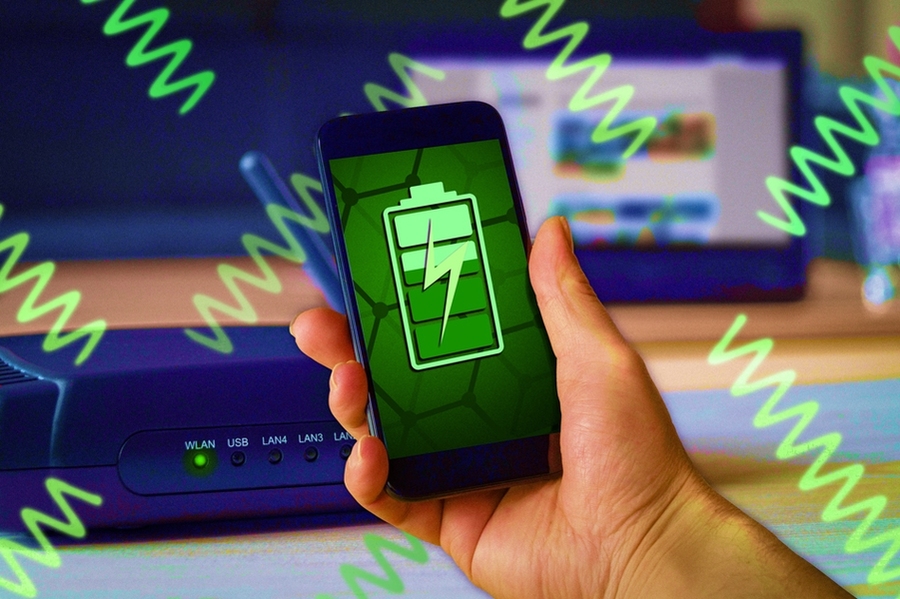
Terahertz waves are electromagnetic radiation with a frequency somewhere between microwaves and infrared light. Also known as “T-rays,” they are produced by almost anything that registers a temperature, including our own bodies and the inanimate objects around us.
Terahertz waves are pervasive in our daily lives, and if harnessed, their concentrated power could potentially serve as an alternate energy source. However, to date there has been no practical way to capture and convert them into any usable form.
Now physicists at MIT have come up with a blueprint for a device they believe would be able to convert terahertz waves into a direct current, a form of electricity that powers many household electronics.
Their design takes advantage of the quantum mechanical, or atomic behavior of the carbon material graphene. They found that by combining graphene with another material, in this case, boron nitride, the electrons in graphene should skew their motion toward a common direction. Any incoming terahertz waves should “shuttle” graphene’s electrons, like so many tiny air traffic controllers, to flow through the material in a single direction, as a direct current.
The researchers have published their results today in the journal Science Advances, and are working with experimentalists to turn their design into a physical device.
“We are surrounded by electromagnetic waves,” says lead author Hiroki Isobe, a postdoc in MIT’s Materials Research Laboratory. “If we can convert that energy into an energy source we can use for daily life, that would help to address the energy challenges we are facing right now.”
Isobe’s co-authors are Liang Fu, the Lawrence C. and Sarah W. Biedenharn Career Development Associate Professor of Physics at MIT; and Su-yang Xu, a former MIT postdoc who is now an assistant professor chemistry at Harvard University.
Breaking graphene’s symmetry
Over the last decade, scientists have looked for ways to harvest and convert ambient energy into usable electrical energy. They have done so mainly through rectifiers, devices that are designed to convert electromagnetic waves from their oscillating (alternating) current to direct current.
Most rectifiers are designed to convert low-frequency waves such as radio waves, using an electrical circuit with diodes to generate an electric field that can steer radio waves through the device as a DC current. These rectifiers only work up to a certain frequency, and have not been able to accommodate the terahertz range.
A few experimental technologies that have been able to convert terahertz waves into DC current do so only at ultracold temperatures — setups that would be difficult to implement in practical applications.
Instead of turning electromagnetic waves into a DC current by applying an external electric field in a device, Isobe wondered whether, at a quantum mechanical level, a material’s own electrons could be induced to flow in one direction, in order to steer incoming terahertz waves into a DC current.
Such a material would have to be very clean, or free of impurities, in order for the electrons in the material to flow through without scattering off irregularities in the material. Graphene, he found, was the ideal starting material.
To direct graphene’s electrons to flow in one direction, he would have to break the material’s inherent symmetry, or what physicists call “inversion.” Normally, graphene’s electrons feel an equal force between them, meaning that any incoming energy would scatter the electrons in all directions, symmetrically. Isobe looked for ways to break graphene’s inversion and induce an asymmetric flow of electrons in response to incoming energy.
Looking through the literature, he found that others had experimented with graphene by placing it atop a layer of boron nitride, a similar honeycomb lattice made of two types of atoms — boron and nitrogen. They found that in this arrangement, the forces between graphene’s electrons were knocked out of balance: Electrons closer to boron felt a certain force while electrons closer to nitrogen experienced a different pull. The overall effect was what physicists call “skew scattering,” in which clouds of electrons skew their motion in one direction.
Isobe developed a systematic theoretical study of all the ways electrons in graphene might scatter in combination with an underlying substrate such as boron nitride, and how this electron scattering would affect any incoming electromagnetic waves, particularly in the terahertz frequency range.
He found that electrons were driven by incoming terahertz waves to skew in one direction, and this skew motion generates a DC current, if graphene were relatively pure. If too many impurities did exist in graphene, they would act as obstacles in the path of electron clouds, causing these clouds to scatter in all directions, rather than moving as one.
“With many impurities, this skewed motion just ends up oscillating, and any incoming terahertz energy is lost through this oscillation,” Isobe explains. “So we want a clean sample to effectively get a skewed motion.”
One direction
They also found that the stronger the incoming terahertz energy, the more of that energy a device can convert to DC current. This means that any device that converts T-rays should also include a way to concentrate those waves before they enter the device.
With all this in mind, the researchers drew up a blueprint for a terahertz rectifier that consists of a small square of graphene that sits atop a layer of boron nitride and is sandwiched within an antenna that would collect and concentrate ambient terahertz radiation, boosting its signal enough to convert it into a DC current.
“This would work very much like a solar cell, except for a different frequency range, to passively collect and convert ambient energy,” Fu says.
The team has filed a patent for the new “high-frequency rectification” design, and the researchers are working with experimental physicists at MIT to develop a physical device based on their design, which should be able to work at room temperature, versus the ultracold temperatures required for previous terahertz rectifiers and detectors.
“If a device works at room temperature, we can use it for many portable applications,” Isobe says.
He envisions that, in the near future, terahertz rectifiers may be used, for instance, to wirelessly power implants in a patient’s body, without requiring surgery to change an implant’s batteries.
“We are taking a quantum material with some asymmetry at the atomic scale, that can now be utilized, which opens up a lot of possibilities,” Fu says.
This research was funded in part by the U.S. Army Research Laboratory and the U.S. Army Research Office through the Institute for Soldier Nanotechnologies (ISN).
Liquid water may still flow on Mars, but that doesn’t mean it’s easy to spot. The search for water on the Red Planet has taken more than 15 years to turn up definitive signs that liquid flows on the surface today. In the past, however, rivers and oceans may have covered the land. Where did all of the liquid water go? Why? How much of it still remains?
Observations of the Red Planet indicate that rivers and oceans may have been prominent features in its early history. Billions of years ago, Mars was a warm and wet world that could have supported microbial life in some regions. But the planet is smaller than Earth, with less gravity and a thinner atmosphere. Over time, as liquid water evaporated, more and more of it escaped into space, allowing less to fall back to the surface of the planet.
Where is the water today?
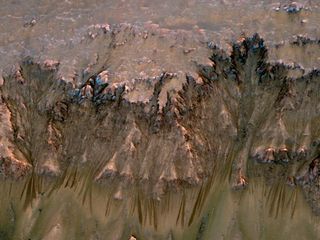
Liquid water appears to flow from some steep, relatively warm slopes on the Martian surface. Features known as recurring slope lineae (RSL) were first identified in 2011in images taken by the High Resolution Imaging Science Experiment (HiRISE) camera aboard the Mars Reconnaissance Orbiter (MRO). The dark streaks, which appear seasonally, were confirmed to be signs of salty water running on the surface of the planet.
“If this is correct, then RSL on Mars may represent the surface expression of a far more significant ongoing drainage system on steep slopes in the mid-latitudes,” a research team member told Space.com in 2012.
“The detection of hydrated salts on these slopes means that water plays a vital role in the formation of these streaks,” the study’s lead author, Lujendra Ojha, of the Georgia Institute of Technology in Atlanta, said in a statement. Vast deposits of water appear to be trapped within the ice caps at the north and south poles of the planet. Each summer, as temperatures increase, the caps shrink slightly as their contents skip straight from solid to gas form, but in the winter, cooler temperatures cause them to grow to latitudes as low as 45 degrees, or halfway to the equator. The caps are an average of 2 miles (3 kilometers) thick and, if completely melted, could cover the Martian surface with about 18 feet (5.6 meters) of water.
Frozen water also lies beneath the surface. Scientists discovered a slab of ice as large as California and Texas combined in the region between the equator and north pole of the Red Planet. The presence of subsurface water has long been suspected but required the appearance of strange layered craters to confirm. Other regions of the planet may contain frozen water, as well. Some high-latitude regions seem to boast patterned ground-shapes that may have formed as permafrost in the soil freezes and thaws over time.
The European Space Agency’s Mars Express spacecraft captured images of sheets of ice in the cooler, shadowed bottoms of craters, which suggests that liquid water can pool under appropriate conditions. Other craters identified by NASA’s Mars Reconnaissance Orbiter show similar pooling.
Evidence for water on Mars first came to light in 2000, with the appearance of gullies that suggested a liquid origin. Their formation has been hotly debated over the ensuing years.
But not everyone thinks that Mars contains water today. New research reveals that RSL may actually have formed by granular flows formed by the movement of sand and dust.
“We’ve thought of RSL as possible liquid water flows, but the slopes are more like what we expect for dry sand,” lead author Colin Dundas said in a statement. “This new understanding of RLS supports other evidence that shows that Mars today is very dry.”
That idea may have been washed away by the recent discovery of a possible subsurface lake near the Martian South Pole.
An underground lake?
Researchers made a big splash when they announced that Mars might be hiding a lake beneath its southern pole. The European Mars Express spacecraft used its Mars Advanced Radar for Subsurface and Ionosphere Sounding (MARSIS) to detect the proposed water. Ground-penetrating radar sent radar pulses to the surface, then timed how long it took for them to be reflected. The properties of the subsurface layers affect how long it takes for the beams to return.
MARSIS’ investigation revealed that the Martian south pole is composed of multiple layers of ice and dust to a depth of about nearly 1 mile (1.5 kilometers) spread over a 124-mile-wide (200 km) region.
“This subsurface anomaly on Mars has radar properties matching water or water-rich sediments,” Roberto Orosei, principal investigator of the MARSIS experiment and lead author of the new research, said in a statement.
MARSIS also revealed the presence of a subsurface lake among the pockets. According to the radar echoes, the lake is no more than 12.5 miles (20 km) across, buried nearly a mile beneath the surface. The scientists aren’t certain of the lake’s depth, but they have confirmed that it is at least 3 feet (1 meter) deep. According to the researchers, the lake must have salt to keep from freezing.
“This is just one small study area; it is an exciting prospect to think there could be more of these underground pockets of water elsewhere, yet to be discovered,” Orosei said.
Not all researchers are as certain about the presence of liquid water.
“I think it’s a very, very persuasive argument, but it’s not a conclusive or definitive argument,” Steve Clifford, a Mars researcher at the Planetary Science Institute in Arizona, told Space.com. “There’s always the possibility that conditions that we haven’t foreseen exist at the base of the cap and are responsible for this bright reflection.”
More than three decades ago, Clifford proposed that Mars could harbor liquid water beneath its polar caps in the same way that Earth does. On Earth, lakes beneath the Antarctic and Greenland ice sheets are created when heat from within the planets melt the glaciers in patches. Clifford told Space.com that a similar scenario could happen beneath the Martian polar ice caps.
“The bright spot seen in the MARSIS data is an unusual feature and extremely intriguing,” Jim Green, NASA’s chief scientist, said in a statement. “It definitely warrants further study. Additional lines of evidence should be pursued to test the interpretation.”
“We hope to use other instruments to study it further in the future,” Green said.
Liquid gold
Water may seem like a very common element to those of us stuck on Earth, but it has great value. In addition to understanding how Mars may have changed and developed over time, scientists hope that finding water will help them to find something even more valuable — life, either past or present.
Only Earth is known to host life, and life on our planet requires water. Though life could conceivably evolve without relying on this precious liquid, scientists can only work with what they know. Thus they hope that locating water on celestial bodies such as Mars will lead to finding evidence for life.
With this in mind, NASA developed a strategy for exploring the Red Planet that takes as its mantra “follow the water.” Recent orbiters, landers, and rovers sent to Mars were designed to search for water, rather than life, in the hopes of finding environments where life could have thrived.
That has changed, however, with the flood of evidence these robots have returned. Curiosity determined that Mars could indeed have supported microbial life in the ancient past, and the next NASA rover — a car-size robot-based heavily on Curiosity’s basic design — will blast off in 2020 to look for evidence of past Red Planet life.
Ocean acidification is defined as a drop in the pH of the ocean over time, largely due to the uptake of carbon dioxide (CO2) from the atmosphere. Defining it simply, as we all know human activities releases CO2 into the atmosphere which leads to atmospheric warming and climate change. The seas absorb around a third to half of the CO2 produced by human activities. While this serves to slow atmospheric warming and climate change, it also has a direct chemical impact on seawater, which we refer to as ocean acidification.
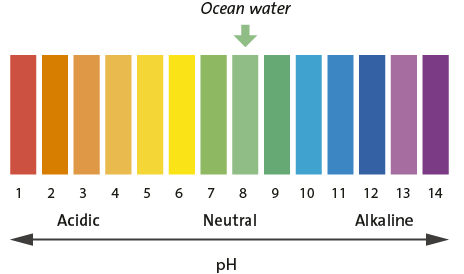
pH as mentioned above is frequently used to describe ocean acidification. The pH scale measures acidity and alkalinity. A pH of less than 7 is acidic, whereas a pH of higher than 7 is alkaline, or basic.
Currently, the average pH of ocean water is 8.1. Because the pH scale is logarithmic, a one-point change in concentration corresponds to a tenfold change in concentration. Carbon dioxide (CO2) levels in the atmosphere have been rising for more than 200 years, or since the industrial revolution, mainly to the combustion of fossil fuels and changes in land use. The ocean absorbs roughly 30% of the CO2 that is emitted into the atmosphere, and as atmospheric CO2 levels rise, so do ocean CO2 levels.
As a consequence, the median pH of ocean surface waters has dropped somewhat, from 8.2 to 8.1. This translates to a 26% increase in ocean acidity, which is about 10 times quicker than any other period in the previous 55 million years.
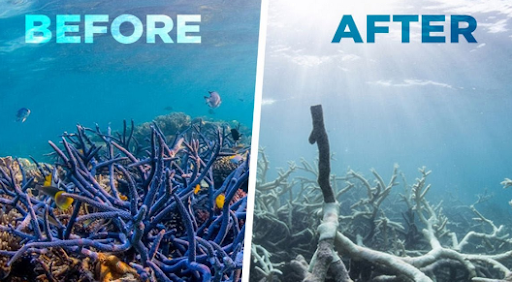
But now, the question arises why the seawater becomes acidic. So to answer this we must understand that When co2 is consumed by seawater, it triggers a chain of chemical processes that result in an increase in hydrogen ion concentration. As a result of this rise, saltwater becomes more acidic and carbonate ions become less prevalent. Carbonate ions are essential mainly for marine shells and carol skeletons because these ions are the building components of it. Reduced carbonate ions can make it difficult for calcifying animals including oysters, sea urchins, shallow water corals, deep sea corals, and calcareous plankton to develop and maintain shells and other calcium carbonate structures.
Due to such increased acidification, whole world’s seas especially coastal estuaries and rivers, are being affected by ocean acidification and it eventually affects the ocean chemistry because In more acidic environments, certain fish’s ability to detect predators is harmed. And when these creatures feel threatened, the entire food web feel threatened as well.
Taking the future world in view, due to the increase in atmospheric co2 , it will have a direct impact on the degree of future ocean acidification. So if, current greenhouse gas emissions continue, ocean acidity might rise by 0.4 units by the end of the century. However, Ocean acidification will not be consistent throughout the planet. Polar waters and upwelling zones, which are frequently located along continents’ west coastlines, are predicted to acidify more quickly than temperate or tropical regions. Depending on the environment, the pH will vary substantially.
Therefore, While the ultimate answer to lessen the ocean acidification is to reduce global greenhouse gas emissions. It can be done by adopting certain difficult decisions and activities which can help us prepare for the negative impacts of ocean acidification. On a smaller scale, Water quality improvements, Development of fisheries management methods that are sustainable, New technology implementation such as development of aquaculture industry and protecting Marine ecosystems that are very fragile and endangered may assist marine ecosystems adapt better with changing environmental circumstances by mitigating the negative impacts of other local factors.
Since the pandemic unleashed each country from every nook and corner of the world started the research on the virus to make a vaccines. Till date a lot of countries have produced innumerous vaccines. Following are some of the most widely used vaccines.
1.Covaxin
Released by Bharat Biotech, it has an efficacy of 78% against symptomatic cases. The phase 4 trials were started in June 2021. It constitutes an inactive form of the covid virus. This invokes the immune system which kills any such virus that enters the future. It is given in the form of 2 doses each 4 to 6 weeks apart. There may be side effects like pain, swelling, stiffness in the upper arm, etc. It has not been tested on infants, pregnant, and breastfeeding women.
2.Covishield
Developed by the Oxford-AstraZeneca, it is being manufactured by the Serum Institute of India (SII). It is also given in 2 doses but both are 12 to 16 weeks apart. When both doses are given 30 days apart it is 70% effective but when the doses are 2 to 3 months apart, the efficacy rises to 90%. It has the same side effects as covaxin and is also not tested on infants, pregnant, and breastfeeding mothers.
3.Pfizer
Developed by the German company BioNTech it is an mRNA bases vaccine that encodes the mutated form of the spike protein. Its efficacy is around 91% after the second dose. A gap of 3-4 weeks is recommended between the 2 doses. Side effects remain the same. It can be administered to children above 16 years of age.
4.Sputnik V
Produced by the Gamaleya Research Institute of Epidemiology and Microbiology in Russia, it is an adenovirus viral vector vaccine. Its efficacy is 91%. The second dose is different from the first and is given after 21 days gap. The export from one country to another is easy as it requires a storage temperature of +2-8 degrees Celsius. With the same side effects, it is not recommended to pregnant women.
5.Moderna
Produced by ModernaTX, Inc., an American pharmaceutical and biotechnology company in Cambridge, it is an mRNA-based vaccine. It is given in the form of 2 doses 28 days apart. It is recommended for people above 18 years of age with the same side effects. After 2 weeks of the second dose, the efficacy rises from 91% to 94%.
The side effects that these vaccines have are normal and only means that our body’s defense mechanism is working. Therefore each individual should get a vaccine as soon as possible.
The Bermuda Triangle is a region in the north-western part of the Atlantic Ocean, near the USA. It is also called the ‘Devil’s Triangle’, because of all the disappearances and supernatural activity that is associated with it. Till date, around 50 ships and 20 airplanes have gone missing in the Bermuda triangle, never to be heard of again. Not even the wreckage or debris of any vessel has been found. One such case was in 1945, when a squadron of US Navy bombers became disoriented while flying over the area and thereafter disappeared, never to be found again. Even the rescue plane sent after them disappeared with no trace. No one knows what happens to the vessels, or the people inside them after entering the Bermuda triangle. Oftentimes the boats and planes have vanished without even sending out a distress call or signal, and planes have been known to go off the radar in this region of the ocean.
What are the possible explanations?
Many people like to suggest supernatural or other-worldly causes as possible explanations, like alien abductions or some mythical sea creature. However, it is more likely to have a scientific explanation, with geophysical and environmental factors at play. One such factor is that the agonic line (imaginary line connecting the earth’s north and south magnetic poles) passes through this area, which pilots may fail to account for. This may have caused discrepancies in interpreting the magnetic compass and thereby led to significant navigational error, resulting in catastrophe. Another scientific explanation is that the region often has massive rogue waves passing through it (reaching up to 100 feet) which are enough to carry away and engulf any evidence of a ship or airplane, which is why none has been found. Since multiple storms may converge in the Bermuda triangle, and hurricanes often sweep by in that area, it is possible to form massive waves and winds that destroy, carry away, and leave no sign of any vessels.
Furthermore, the National Oceanic and Atmospheric Administration of America has said that “There is no evidence that mysterious disappearances occur with any greater frequency in the Bermuda Triangle than in any other large, well-travelled area of the ocean,” This means that though there have been mysterious disappearances, a larger number of ships and airplanes have travelled through the region, and continue to do so today, without any incident. So, the few cases in which disappearances did occur might have been due to certain unfortunate circumstances and events.
Conclusion
There is a lot of mystery and fantasy involved when talking about the Bermuda triangle, but this is because human minds are drawn towards things that are bizarre and memorable, and we are more likely to remember things that seem exceptional in nature. In this process, however, we often disregard the ordinary things that offer a more realistic view. We prefer to think about a mysteriously disappearing ship rather than a ship that simply sank in a hurricane. This leads to something known as the ‘frequency illusion’ where once we’re introduced to something, we tend to notice it more often in our lives. This makes us believe that that thing is more common and frequent than it really is. Hence, the world may suffer from a frequency illusion that makes us want to think that the Bermuda triangle keeps swallowing up vessels very often, when in reality it has been a select few cases. In fact, mysterious disappearances happen in every part of the world, and not just the Bermuda triangle. The classic example of this being Malaysia Airlines flight 370.
Regardless, the Bermuda triangle has managed to capture human imagination with the unexplained disappearances in its area, and has also been referenced in may pop-culture pieces of media like the Gulliver’s Travels and Percy Jackson movies. This shows the impact that any strange phenomenon can have on human minds, and its ability to impress us. Today the Bermuda triangle is a safe destination that even tourists can visit to see for themselves, without any risk of disappearing.
ELON MUSK, the famous and most successful person in the tech world, who played many roles and faced many struggles to become what he is today. Elon Musk was born and raised in South Africa.
We all know him as an entrepreneur, businessman, CEO of Tesla and spacex, but he is also a skilled investor, software developer, designer, inventor, rocket scientist, actor, film producer, one of the richest man in the world.
During his school days, he was a victim of severe bullying. At the age of 12, he created a video game(blaster) and sold it to a computer magazine. Elon Musk is the founder of X.com (later it became paypal), spacex, Tesla motors.
Recently Elon Musk turned 50, over the past decades Musk managed to become CEO of Tesla and spacex, founder of the boring company, co-founder of OpenAI, Neuralink. He also played a vital role in space rockets, electric cars, solar batteries.
“”Failure is a option here, if things are not failing then you are not innovative enough.””. – Elon Musk
“” I think it’s possible for ordinary people to choose to be extraordinary.”” –Elon Musk
Removal of nirogenous waste produce during metabolism of protein and nucleic acid.
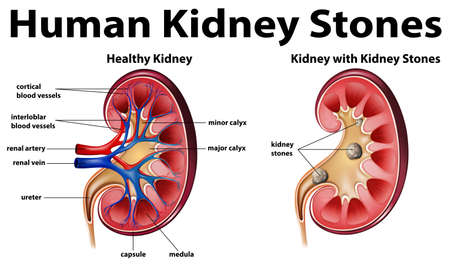
Human excretory system includes:- Pair of kidney Pair of ureter Urinary bladder Urethra
Function of kidney
Kidneys regulate the osmotic pressure of a mammal’s blood through extensive filtration and purification, in a process known as Osmoregulation.
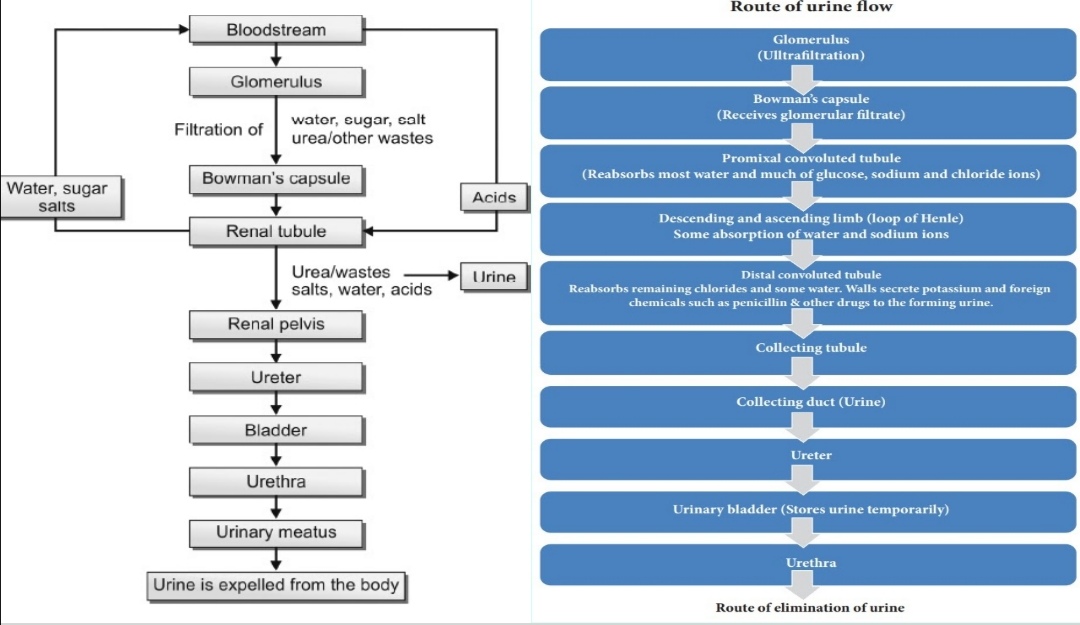
Kidneys filter the blood; urine is the filtrate that eliminates wastes from the body via the ureter into the urinary bladder.
The kidneys are surrounded by three layers:
Renal fascia
perirenal fat capsule
Renal caps
EXTERNAL ANATOMY
A typical adult kidney (mass – 135–150 g) is:
10–12 cm- long 5–7 cm – wide 3 cm cm- thick
The concave medial border of each kidney faces the vertebral column.
Near the centre of the concave border is an indentation called the Renal hilum, through which the ureter emerges from the kidney along with blood vessels, lymphatic vessels and nerves.
Human kidney are Retroperitoneal(covered with peritoneum)
Present between 12th thoracic vertebrae to 3rd lumber vertebrae.
Left kidney is higher than the right kidney due to position of liver in right side.
Three layers of tissue
a) .The Renal capsule(Deep layer) – Smooth, transparent sheet of dense irregular connective tissue that is continuous with the outer coat of the ureter.
It serves as a barrier against trauma and helps maintain the shape of the kidney.
b) The adipose capsule (middle layer) – Mass of fatty tissue surrounding the renal capsule.
Protects the kidney from trauma and holds it firmly in place within the abdominal cavity.
c) The renal fascia(superficial layer) – Thin layer of dense irregular connective tissue
Anchors the kidney to the surrounding structures and to the abdominal wall
On the anterior surface of the kidneys, the renal fascia is deep to the peritoneum
Internal anatomy
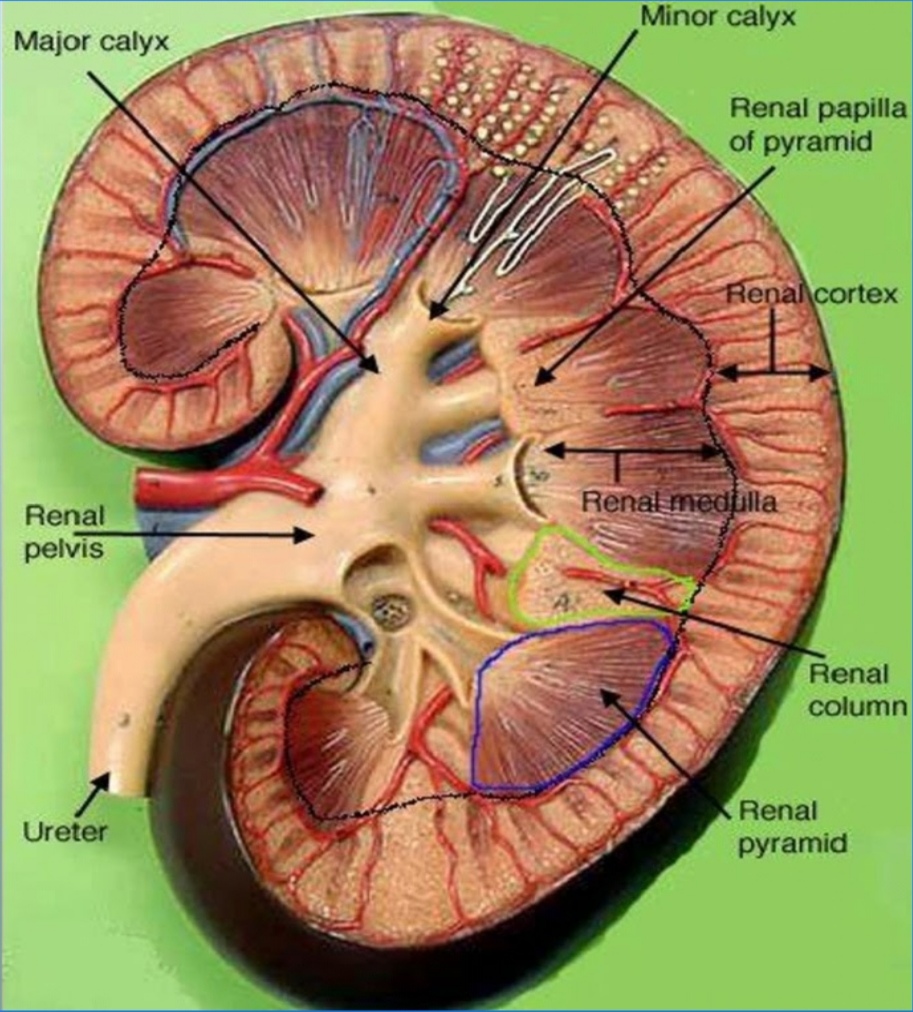
A frontal section through the kidney reveals two distinct regions:
Renal cortex (outer)
Renal medulla (inner).
The renal medulla consists of several cone-shaped renal pyramids.
The base (wider end) of each pyramid faces the renal cortex, and its apex (narrower end), called a renal papilla, points toward the renal hilum.
The renal cortex, smooth textured area extending from the renal capsule to the bases of the renal pyramids.
It is divided into an outer cortical zone and an inner juxtamedullary zone.
Ureter
Muscular tubes of 25-30cm length, 3m in diameter.
Wall of Ureter
Innermost-Transitional epithelium
Middle layer-Muscular(longitudinal and circular muscle)
Outermost layer – Tunica adventita.
Urine is move through ureter by peristalsis.
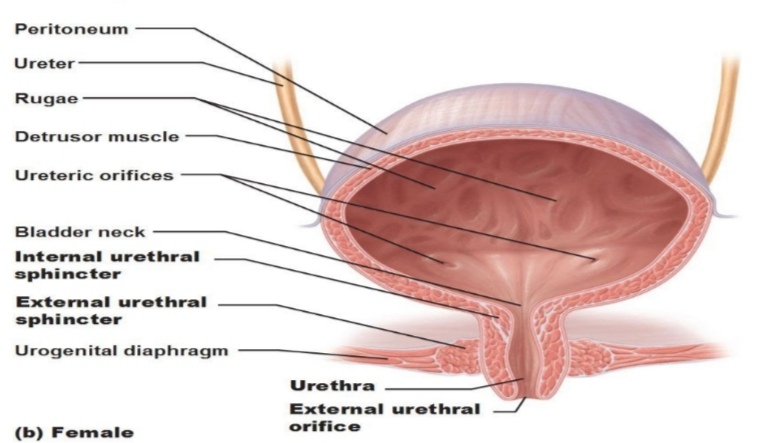
Urethra conduct the urine from urinary bladder to outside. Female urethra is short. Male urethra is long.
Urinary bladder
Urinary bladder
It is hollow muscular organ that stores urine from the kidneys before disposal by urination.
In humans the bladder is a hollow distensible organ that sits on the pelvic floor
Urinary Bladder
Nephron
Structure of nephron
Structure and functional unit of kidey.
Each kidney contain about 1 million nephron
Each nephron has 2 part
Glomerulus
Renal tubules.
Take a simple filtrate of the blood and modify it into urine.
Cleanse the blood and balance the constituents of the circulation.
Many changes take place in the different parts of the nephron before urine is created for disposal.
The term urine will be used here after to describe the filtrate as it is modified into true urine.
The principle task of the nephron population is to balance the plasma to homeostatic set points and excrete potential toxins in the urine.
RENAL CORPUSCLE
It CONSISTS OF A GLOMERULUS SURROUNDED BY A BOWMAN’S CAPSULE.
THE GLOMERULUS ARISES FROM AN AFFERENT ARTERIOLE AND EMPTIES INTO AN EFFERENT ARTERIOLE.
THE SMALLER DIAMETER OF AN EFFERENT ARTERIOLE HELPS TO MAINTAIN HIGH BLOOD PRESSURE IN THE GLOMERULUS.
THE BOWMAN’S CAPSULE IS DIVIDED INTO THREE LAYERS:
OUTER PARIETAL LAYER- MADE UP OF EPITHELIAL CELLS WITH MINUTE PORES OF DIAMETER 12NM.
MIDDLE BASEMENT MEMBRANE-IT IS SELECTIVELY PERMEABLE.
INNER VISCERAL LAYER-IT CONSISTS OF LARGE NUCLEATED CELLS CALLED PODOCYTE(BEAR FINGER-LIKE PROJECTIONS CALLED PODOCEL)
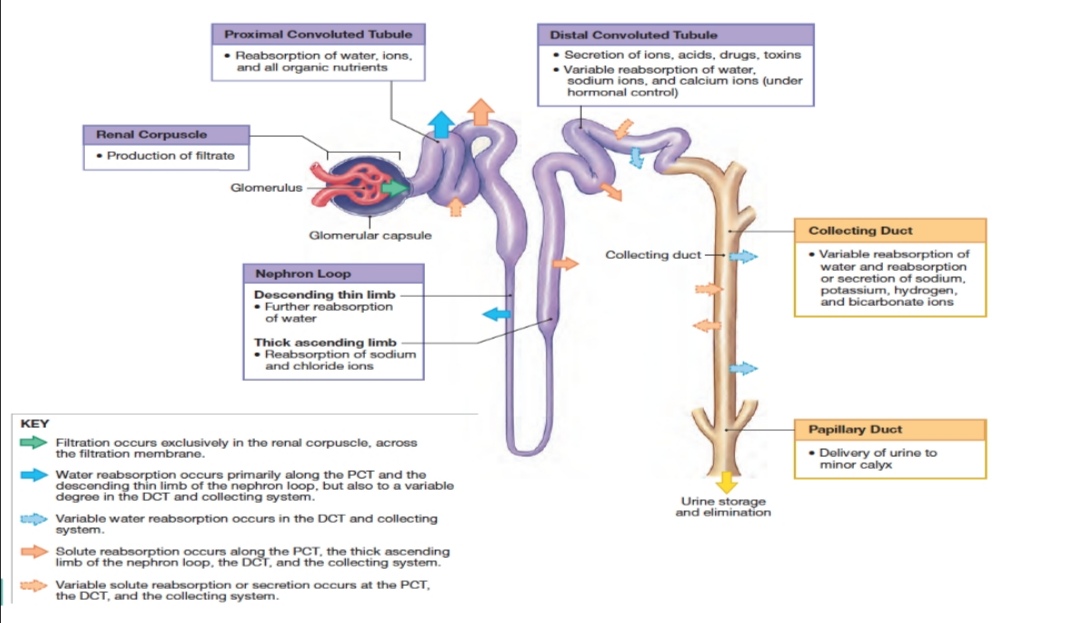
Renal tubule
It IS A LONG AND CONVOLUTED STRUCTURE THAT EMERGES FROM THE GLOMERULUS
IT CAN BE DIVIDED INTO THREE PARTS BASED ON FUNCTION:-
PROXIMAL CONVOLUTED TUBULE (PCT) – IN THE RENAL CORTEX.
THE LOOP OF HENLE, OR NEPHRITIC LOOP – IT FORMS A LOOP (WITH DESCENDING AND ASCENDING LIMBS) THAT GOES THROUGH THE RENAL MEDULLA.
DISTAL CONVOLUTED TUBULE (DCT)- IN THE RENAL CORTEX.
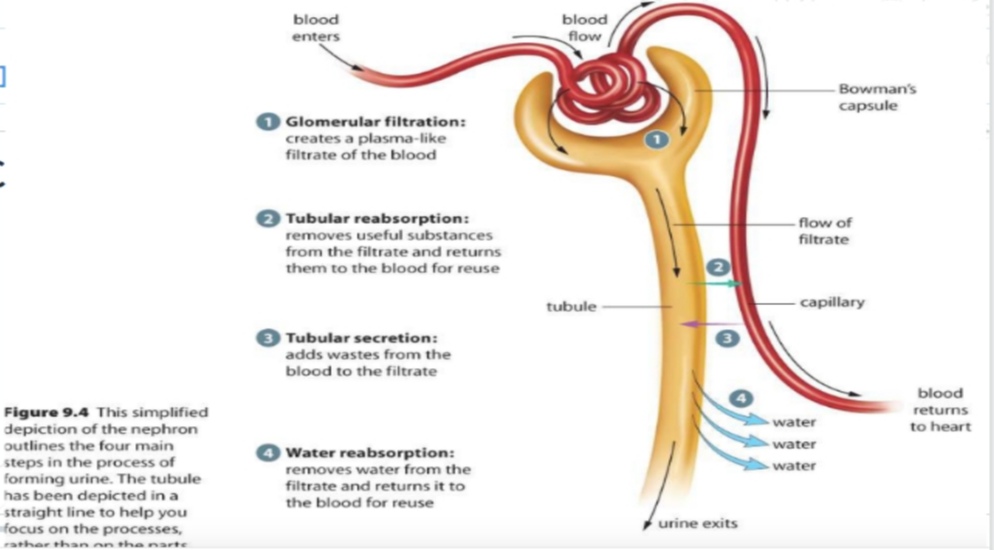
WATER AND SOLUTES ARE FORCED THROUGH THE CAPILLARY WALLS OF THE Glomerulus INTO THE BOWMAN’S CAPSULE (GLOMERULARCAPSULE)
FILTRATE –THE FLUID THAT IS FILTERED OUT INTO BOWMAN’S CAPSULE.
Glomerulus filtrate-same as plasma but protein are absent.
Contains-Water, ions, Glucose, amino acid, water soluble vitamin, urea, uric acid etc.
Tubular reabsorption
OCCURS BOTH PASSIVE AND Actively.
GLUCOSE, AMINO ACIDS, AND OTHER NEEDED IONS (NA, K, CL, CA, HCO3) ARE TRANSPORTED OUT OF THE FILTRATE INTO THE PERITUBULAR CAPILLARIES ( REABSORBED BACK INTO THE BLOOD)
ABOUT 65% OF THE FILTRATE IS REABSORBED IN THE PCT.
AS THESE SUBSTANCES ARE Reabsorbed, THE BLOOD BECOMES HYPERTONICSO WATER EASILY FOLLOWS BY OSMOSIS.
REABSORPTIONIN THE DCT IS UNDER Hormonal CONTROL ALDOSTERONE CAUSES MORE SALT TO BE ABSORBED
ADH CAUSES MORE WATER TO BE ABSORBED
TUBULAR SECRETION
WASTE PRODUCTS SUCH AS UREA AND URIC ACID, DRUGS AND HYDROGEN AND BICARBONATE IONS ARE MOVE OUT OF THE PERITUBULARCAPILLARIES INTO THE FILTRATE; THIS REMOVES UNWANTED WASTES AND HELPS REGULATE PH
Urine
It is pale yellow in colour due to Urochrome pigment that is byproduct of red blood corpuscles(RBC) breakdown.
Around 1-1.5 litre of urine is formed per day.
PH =6 (vary 4.2 – 8.2)
It can be four times as concentrated as the blood i. e-1200mosmol/L.
In the last blog, we have seen 2 best AI movies. Now we are going to continue that. Previously we have seen Ex Machina and 2001: A Space Odyssey. In our list, the movie that ranks 3 is Metropolis.
Metropolis
Metropolis is a 1927 German film, and undoubtedly, this movie served to be a pioneer for many AI related movies. This film depicts a future world where the wealthy people of the society live a easy and luxury life on the surface. In contrast to that,there is a city deep down in the underground where working- class people labour out of sight on the machinery that supports Metropolis. In time, this oppressive situation eventually leads to a class conflict. Freder Frierson, being a member of the wealthy class, falls in love with a working- class women named “Maria”. He also discovers the hard life under the city and is determined to help the workers. To support his plan and his relationship with Maria, Freder’s father, a scientist creates a robot in Maria’s image. Within the context of the film, the robot Maria seems to have its own mind that causes rebellion within the working class and eventually attempts to destroy Metropolis. With the massive popularity of ‘Metropolis’, the robot Maria stands as the first significant robot in film industry. It is the first film to attempt AI in the storyline.
Her
The movie “Her” ranks 2 in our list. This film highlights emotional intelligence in the form of Human- Robot romance. This film reveals the direction humanity might be headed if artificial intelligence continues to evolve. The main lead of the film doesn’t know what he wants from life and people after being pushed to the verge of divorce. His life takes an unexpected turn when he begins to find peace in the voice of his computer’s new OS – Samantha. The heartfelt conversations with the AI system Samantha makes him fall in love with it. Despite its advanced settings, the idea of this movie is alarmingly genuine and there relies its brilliance. Given our dependence on innovation, AI voice assistants and Virtual realities may soon witness relationships between devices. They are engaging, entertaining, yet sad.
Wall-E
Last on our list is Pixer’s masterpieces and one of the thought -provoking movies, “Wall-E”. Wall-E is an excellent contrast to other AI killer robots shown in films. This is the last solar-charged robot left on Earth. He spends his days tidying up the mess that humans have created before leaving the Earth. Yet, during 700 years, Wall-E has developed a character and it is being sad of being alone. At that point he spots EVE, a smooth and more advanced AI not sent back to Earth on a scanning mission to find any existence of life. It ignores Wall-E entirely as he was a robot. Smitten Wall-E embarks on his most incredible adverture and follows EVE across the galaxy and along the Milky Way. Wall-E can’t even talk but his characteristics and mannerisms resemble human behaviour. Another important aspect is Wall-E tells a story where AI saves humanity rather than destroying it. This is interesting as it shows a sense of dependency and the needs of AI for creating a better future. Wall-E is one of the best AI movies that do well to combat fears of AI potentially destroying the world.


















 Eduindex
You must be logged in to post a comment.