Data structures

Structure could be a data organization, management, and storage format that allows economical access and modification. additional exactly, an information structure could be a assortment of information values, the relationships among them, and therefore the functions or operations that may be applied to the info.Python has four basic inherent information structures specifically Lists, Dictionary, Tuple and Set. … Lists: Lists in Python square measure one amongst the foremost versatile assortment object varieties on the market. the opposite 2 varieties square measure dictionaries and tuples, however they’re extremely additional like variations of lists.Data structure provides the proper thanks to organize data within the digital house. the info structure could be a key part of engineering and is essentially employed in the areas of computing, operative systems, graphics, etc
The data structure isn’t any artificial language like C, C++, java, etc. it’s a group of algorithms that we will use in any artificial language to structure the info within the memory.

To structure the info in memory, ‘n’ range of algorithms were projected, and every one these algorithms square measure called Abstract information varieties. These abstract information varieties square measure the set of rules
Types of information Structures
There square measure 2 kinds of information structures:

Primitive organization
Non-primitive organization
Primitive organization

The primitive information structures square measure primitive information varieties. The int, char, float, double, and pointer square measure the primitive information structures that may hold one price.

Non-Primitive organization

The non-primitive organization is split into 2 types:

Linear organization
Non-linear organization
Linear organization

The arrangement of information in an exceedingly serial manner is understood as a linear organization. the info structures used for this purpose square measure Arrays, joined list, Stacks, and Queues. In these information structures, one part is connected to only 1 another part in an exceedingly linear type.

When one part is connected to the ‘n’ range of components called a non-linear organization. the simplest example is trees and graphs. during this case, the weather square measure organized in an exceedingly random manner.

We will discuss the on top of information structures briefly within the returning topics. Now, we are going to see the common operations that we will perform on these information structures.
Data structures may also be classified as:

Static information structure: it’s a kind of information structure wherever the scale is allotted at the compile time. Therefore, the utmost size is mounted.
Dynamic information structure: it’s a kind of information structure wherever the scale is allotted at the run time. Therefore, the utmost size is versatile.
Programiz

Search Programiz
DSA emblem Programiz

Learn DS & Algorithms
Tutorials
A computer virus could be a assortment of directions to perform a particular task. For this, a computer virus may have to store information, retrieve information, and perform computations on the info.

A information structure could be a named location that may be wont to store and organize data. And, associate degree rule could be a assortment of steps to unravel a specific drawback. Learning information structures and algorithms permit North American nation to jot down economical and optimized laptop programs.

Our DSA tutorial can guide you to find out differing types of information structures and algorithms and their implementations in Python, C, C++, and Java.

DSA Introduction
What is associate degree algorithm?
Data Structure and kinds
Why learn algorithms?
Asymptotic Notations
Master Theorem
Divide and Conquer rule

Data Structures (I)
Stack
Queue
Types of Queue
Circular Queue
Priority Queue
Deque
Data Structures (II)
Linked List
Linked List Operations
Types of joined List
Hash Table
Heap organization
Fibonacci Heap
Decrease Key and Delete node from Fibonacci Heap
Tree based mostly DSA (I)
Tree organization
Tree Traversal
Binary Tree
Full Binary Tree
Perfect Binary Tree
Complete Binary Tree
Balanced Binary Tree
Binary Search Tree
AVL Tree
Tree based mostly DSA (II)
B Tree
Insertion into B-tree
Deletion from B-tree
B+ Tree
Insertion on a B+ Tree
Deletion from a B+ Tree
Red Black Tree
Insertion in Red Black Tree
Deletion from Red Black Tree
Graph based mostly DSA
Graph organization
Spanning Tree
Strongly Connected elements
Adjacency Matrix
Adjacency List
DFS rule
Breadth-first Search
Bellman Ford’s rule
Sorting and looking out Algorithms
Bubble type
Selection type
Insertion type
Merge Sort
Quick Sort
Counting type
Radix Sort
Bucket type
Heap Sort
Shell Sort
Linear Search
Binary Search
Greedy rules
Greedy Algorithm
Ford-Fulkerson rule
Dijkstra’s rule
Kruskal’s rule
Prim’s rule
Huffman Code
Dynamic Programming
Dynamic Programming
Floyd Warshall rule
Longest Common Subsequence
Other Algorithms
Backtracking rule
Rabin-Karp rule

Why Learn DSA?
Write optimized and ascendable code – Once you have got data concerning completely different information structures and algorithms, you’ll verify that organization and rule to settle on in numerous conditions.
Effective use of your time and memory – Having data concerning information structures and algorithms can assist you write codes that run quicker and need less storage.
Better job opportunities – information structures and algorithms queries square measure commonly asked in job interviews of varied organizations as well as Google, Facebook, and so on.
Interview queries

  1. are you able to make a case for the distinction between file structure and storage structure?
    File Structure: illustration {of information|of knowledge|of information} into secondary or auxiliary memory say any device like disk or pen drives that stores data that remains intact till manually deleted is understood as a file structure illustration.
    What is associate degree array?
    Arrays square measure the gathering of comparable kinds of information hold on at contiguous memory locations.
    It is the best organization wherever the info part will be accessed willy-nilly simply by exploitation its fact.
    however could be a stack completely different from a queue?
    In a stack, the item that’s last another is removed 1st whereas in queue, the item least recently another is removed 1st.
    What is hashmap in information structure?
    Hashmap could be a organization that uses implementation of hash table organization that permits access of information in constant time (O(1)) complexness if you have got the key.

ARTIFICIAL INTELLIGENCE:

Artificial Intelligence refers to the intelligence of machines. This is in contrast to the natural intelligence of humans and animals. With Artificial Intelligence, machines perform functions such as learning, planning, reasoning and problem-solving. Most noteworthy, Artificial Intelligence is the simulation of human intelligence by machines. It is probably the fastest-growing development in the World of technology and innovation. Furthermore, many experts believe AI could solve major challenges and crisis situations.

Types of Artificial Intelligence:

First of all, the categorization of Artificial Intelligence is into four types. Arend Hintze came up with this categorization. The categories are as follows:

Type 1: Reactive machines – These machines can react to situations. A famous example can be Deep Blue, the IBM chess program. Most noteworthy, the chess program won against Garry Kasparov, the popular chess legend. Furthermore, such machines lack memory. These machines certainly cannot use past experiences to inform future ones. It analyses all possible alternatives and chooses the best one.

Type 2: Limited memory – These AI systems are capable of using past experiences to inform future ones. A good example can be self-driving cars. Such cars have decision making systems. The car makes actions like changing lanes. Most noteworthy, these actions come from observations. There is no permanent storage of these observations.

Type 3: Theory of mind – This refers to understand others. Above all, this means to understand that others have their beliefs, intentions, desires, and opinions. However, this type of AI does not exist yet.

Type 4: Self-awareness – This is the highest and most sophisticated level of Artificial Intelligence. Such systems have a sense of self. Furthermore, they have awareness, consciousness, and emotions. Obviously, such type of technology does not yet exist. This technology would certainly be a revolution.

Applications of Artificial Intelligence:

First of all, AI has significant use in healthcare. Companies are trying to develop technologies for quick diagnosis. Artificial Intelligence would efficiently operate on patients without human supervision. Such technological surgeries are already taking place. Another excellent healthcare technology is IBM Watson.Artificial Intelligence in business would significantly save time and effort. There is an application of robotic automation to human business tasks. Furthermore, Machine learning algorithms help in better serving customers. Chatbots provide immediate response and service to customers.

AI can certainly make education more efficient. AI technology can discover the needs of students. Then it can adapt according to their needs. AI tutors provide study help to students. Also, AI can automate grading which results in saving a lot of time.AI can greatly increase the rate of work in manufacturing. Manufacture of a huge number of products can take place with AI. Furthermore, the entire production process can take place without human intervention. Hence, a lot of time and effort is saved.Artificial Intelligence has applications in various other fields.

These fields can be military, law, video games, government, finance, automotive, audit, art, etc. Hence, it’s clear that AI has a massive amount of different applications.To sum it up, Artificial Intelligence looks all set to be the future of the World. Experts believe AI would certainly become a part and parcel of human life soon. AI would completely change the way we view our World. With Artificial Intelligence, the future seems intriguing and exciting.

GENDER EQUALITY – MYTHS AND FACTS

Gender equality – When the term is said, we immediately start thinking of men and women and the differences between them in our society. Do we think of other genders? Do we know how many genders are there apart from male and female? No or maybe few. But the actuality is there are different genders of people living all over the world. Without being aware of this, we just speak only about males and females or transgender at times. When we speak about the difficulties faced by them, are we also adding the opportunities and recognition they got along with this? No. It is our responsibility to give equal importance to the good and bad in our society. So, let’s try to understand the myths and facts about the some more commonly known genders – male, female and transgender.

MALE AND FEMALE

I would like to start with the good changes in society for women that are left unrecognized most of the time. Starting with the change in family backgrounds, we had certain roles and responsibilities to be played, as men should work in the outside world, and women were stereotyped to carry out household chores in the olden times. But now we live in the era where both men and women work in the corporate world and share the household responsibilities equally. So, no longer there exists a male chauvinistic society. Still, we talk about the olden scenario rather than the reality. Talking about social development is as important as raising a voice for the differences.

Moving on to the traditional differences, I already said women are stereotyped to play certain roles which are being criticized as a major difference. But the reality is women are said to carry out household chores as they are the physical exercises a woman can do. Those days there were no corporate jobs. All the men had to do physical work which women couldn’t carry out and she shouldn’t do as it affects her uterus. This was the scientific reason behind the traditional practices. And again, this is also misinterpreted as women are made to sit in their houses.

The next one is about male-dominant domains – Women emerge and maintain their place in every field making every domain equal for both genders. They work in prominent roles in the so-called male-dominant domains such as Army, Navy, Airforce, and many more. Still, certain fields come under the dominance of men even after women laid their step into it. For example, they have already started driving autos changing the tag “male dominant domains”. But we recognize this as their special talent than treating them equally. All men and women are equally bestowed by the lord and there is nothing special when a woman does the same a man does. 

TRANSGENDERS

Coming to the transgenders, the myth is they are not given enough support and chances to prove themselves. But the fact is they are provided with opportunities to showcase their talents. The difference is between whether they utilize it effectively or not. They are persons like Kalki Subramaniam who changed her identity from transgender to an entrepreneur cum inspirational speaker and some individuals are asking alms from the people in public places instead of standing on their legs. 

So, many such good things are happening around in our society. We should feel proud and accept the changes taking place rather than complaining blindly. NGOs are working for different genders other than the above-mentioned to grant the place they deserve in society. It all depends on how we perceive them. Let us look deep into them and together build a better society.

How to feel better in a pandemic?

We often feel low, especially during the pandemic. We cannot go out and have fun nor can we physically go to school or work. Yes, the situation is slowly getting better with the distribution of vaccines but it is still a lot to take on our mental health.

So, here are some things you can do in your own house and instantly feel better:

Taking a long hot bath: Our skin releases endorphins in response to warm water. This is why you must have noticed that before taking a shower we tend to be lazy and don’t feel like taking it but once we are in the shower we don’t plan on coming out.

 Make your shower more fun by listening to songs and lighting candles. If you are someone who has a bathtub you can add bath bombs, bath salts, flowers, etc. If you don’t have a bathtub you can use a shower melt which is like a bath bomb but for showers.

Treat for the skin: Now that we are done with our bath. It is time for treating our skin. Doing a small activity like applying a face mask or exfoliating your skin would make you feel good. This will also hydrate your skin and remove the excess oils from it. We often feel great after doing skincare because our skin feels great and we feel relaxed.

Getting ready: just because we don’t have anywhere to go doesn’t mean you can’t look good at home. An issue I faced in the lockdown was not being able to get ready as often. Getting ready is more than just looking good, it also makes us feel more confident. So, wear a good outfit, even if you plan on staying home.

Make the environment cozy: we have to stay in our house most of the time during the pandemic. So, find any place in your house and turn it into your spot. You can decorate it by putting on fairy lights and wallpapers. You can then read your books there, paint or watch movies.

You can also switch things up in your house, move in some furniture or decorate the house. You can do this by adding pictures, posters, or paintings to your walls. You can also add in some indoor plants. Making the house look more lively will automatically brighten the mood. It will also give you a nice change because we are bored seeing the same four walls of our house.

Meditate: we often hear how effective meditating is but we never really try it on our own. Listen to calm music while you meditate. Even doing this for 3-5 minutes will make you feel good.

Cook: I am aware that not everyone is good at it. So, you can try making simple things like a mug cake. It is fun and eating it would brighten your mood.

Watch something light: when you are feeling low I would not recommend watching anything serious. Watch something which will instantly give you light laughter, and improve your mood.

Talk to your friends: during the pandemic, we cannot meet our friends, so video call them instead. Trust me there is nothing better than talking to friends. Whenever I talk to my friends over a video call, it not only brightens my mood up but I keep laughing the entire time. So, call the people who instantly lift your mood.

Media, Disability & COVID-19

According to United Nations, about 1 billion people all over the world come under the category of “disabled” and that is 15% of the global population. Now, the question is, shall we as a society neglect 15% people in the world just because they happen to be in minority?

Media being one of the crucial facets of society has a major role to play when it comes to disseminating information and making people aware about significant and ignored issues. Now, let us go through what media has done to represent people with disabilities and their issue since the beginning of the pandemic.

1) Disability and Broadcast Media


A Look: Public Broadcasters of various countries

In 2020, the World Federation of the Deaf noted that 80 governments in the world have been providing sign language interpretations while Covid-19 press briefings.

For example, in order to curb Covid-19 pandemic, South Korean government aimed to strengthen the ways disabled people could be informed during the pandemic and other related disasters. The country’s public broadcaster KBS during the pandemic announced that it would work to expand the reach of information in its disaster countries. During the pandemic, the public radio in the country had continued to provide programmes dedicated to disabled community with daily news and health updates and general life advice.

When it comes to India’s public television broadcaster Doordarshan and public radio-All India Radio, very minimal representation of disabled community took place during the pandemic. Even though the objective of the these broadcasters is social welfare, disabled community was one of the most ignored ones as “no special programmes” were held for this community, nor was their issue highlighted specifically anywhere. News Bulletins with sign language were held for the disabled community though. More has to be done to ensure social inclusion of all communities including the disabled ones.

Private Broadcasters: nothing matters, but profits!

Media all over the world, including the Indian ones either portray disabled people as “nothing” or “everything” and both of them are dangerous. In 2019, Ministry of Information and Broadcasting in India directed the private channels to include special schemes for disabled community. Although some channels have started news bulletins for disable people but there was almost equal to zero representation of the disabled community during the pandemic.

There should be open space for the disabled community such as they should be invited for panel discussions and debates relating to different happenings in the world from politics to entertainment and like.

Digital Media: A hope in every way!

This is probably the best when it comes to serving and representing the disabled community during the pandemic. Digital and online media were the perfect mediums through which disabled people got proper spaces to talk about the issues they were facing during the pandemic.

One of the online apps called “News Hook” became increasingly popular among the disabled audience which used sign language specifically for the audience with hearing impairment. It covered headlines relating to technology, politics, entertainment, business and sports during the pandemic. It should also be noted that 65% of the staff here were from the disabled community.

Moreover, web portals of Indian Newspapers like The Indian Express and The Business Standards and many more gave enough of space to the disabled people so that they can talk freely about the issues they faced during the lockdowns.

The same above mentioned media channels also used platforms like YouTube to sensitise the audiences regarding the hindrances faced by the disabled community. Some reporters and even famous YouTube personalities covered the terrible times disabled people in India went through during the pandemic.

It should also be noted that online media was comfortable for disabled people as well as the medium is now more easily accessible with good quality content and also because of its low price rates.

Media, especially the mainstream media should be more responsible and sensitive in dealing with issues relating to the disabled community. More representation about the disabled community should take place in the mainstream media. Disabled people “aren’t incapable” and therefore they should be given proper employment in the media. They should be engaged and involved in live discussions and debates. Together, as society which includes the media we should create an environment which is inclusive, anti- discriminatory and diverse.

gaming- TYPES, GNERES AND CAREER

Gaming, a word which is shifting its meaning specifically towards electronic games. The technology is becoming more accessible. Internet prices are becoming low. And this field is becoming more and more familiar.

THERE ARE TYPES OF GAMES

  1. Arcade game: These type of games are typically seen in malls, refreshment parks and restaurants. These are usually coin operated. Pinball machines, videogames and electromechanical games are some of the games you might have seen. They have short levels in games with simple controls. players will rent the games to play. popularity of these games decreased with introduction of PC games.
  2. Console game: This type of game will provide interactive multimedia experience through a display device. A handheld control device is used to play games. Computer runs the game`s software. These games may come in a disk or can be downloaded directly from the internet. These are also played in specialized computers.
  3. Cloud game: This game resides on the company server instead of the users device. The gamer only have to install the client program. The client program will access the server to play games. These games will not require large storage and and processing power to play. The provider can also easily update the game.

POPULAR GENRES IN GAMES

  • Action games: Action games challenge the player`s physical capabilities like reflexes, hand and eye coordination, reaction time etc. These will have a great visuals to treat the player as well as give a punch of adrenaline rush while playing. They deliver a unique experience to the player. Innovations in these genre are frequent and dominating the other genres.
  • Sports games: This genre is present since the beginning of the gaming culture. Traditional physical sports are simulated here. The opposite team is controlled by Bots or by artificial intelligence. Some games will have actual sport tactics and rules. FIFA series is the best example to give here which has a record as fastest selling game.
  • Adventure games: These games involve storytelling themes with action and great visuals. These visuals take gamers on an adventure. Action-adventure games are also developed. The games will have adventure tasks like item collecting, puzzle-solving and explorations. The legend of Zelda is a good example for this genre.
  • Role playing games: These games showcase visually rich 3D experience. The gamer plays or controls a fictional character which goes on a quest. There will be a fantasy world for the character. The tasks assigned to the character are done by the gamer.
  • Simulation games: These games will create a simulation about the tasks of the real world or something near to that. These games try to copy various activities from the real life. These can be used for training analysis or prediction. These games will have more freedom of action within the game. sim city is an simulation game.
  • Battle royale games: This genre puts the player in exploration, scavenging and survival of the players character. This involves dozens of hundreds of players. Players start with minimal equipment and go on exploring and eliminating others. Winner is the last player to be alive. PUBG the game which took the gaming world with a storm is of this genre.
CAREER AS PROFESSIONAL GAMER

Gaming was once restricted to recreational purposes. But now this taking a form of a stable career. As it is a budding industry and not everyone is familiar with this field. But the professional side is picking up quickly. A professional gamer in India can earn between 5000 rupees to 45,000 rupees per month once they tie up with the e-sports company. Obviously the paycheck will depend on the performance and skills.

To become a gamer professionally one should find motivation and interest in playing e-sports. There are plenty of games out there but which game you are choosing to master on will also matter. Anyone who can play a game will not become a professional gamer. To be a professional gamer you have to practice the game you have to make a career in day and night. play and replay the levels so that you will master the levels. Participate in competitions happening around and get noticed by the e-sport companies. Make your own team and become a pro player.

Playing games is a fun task and a successful career from will be more fun. There are many gaming streamers in YouTube platform and game play has become one of the major content. Future will have more professional gamers and a big E-sports community will be built. There is no doubt that younger generations are obsessed with these games and we will definitely see E-sports as a mainstream sport throughout the world.

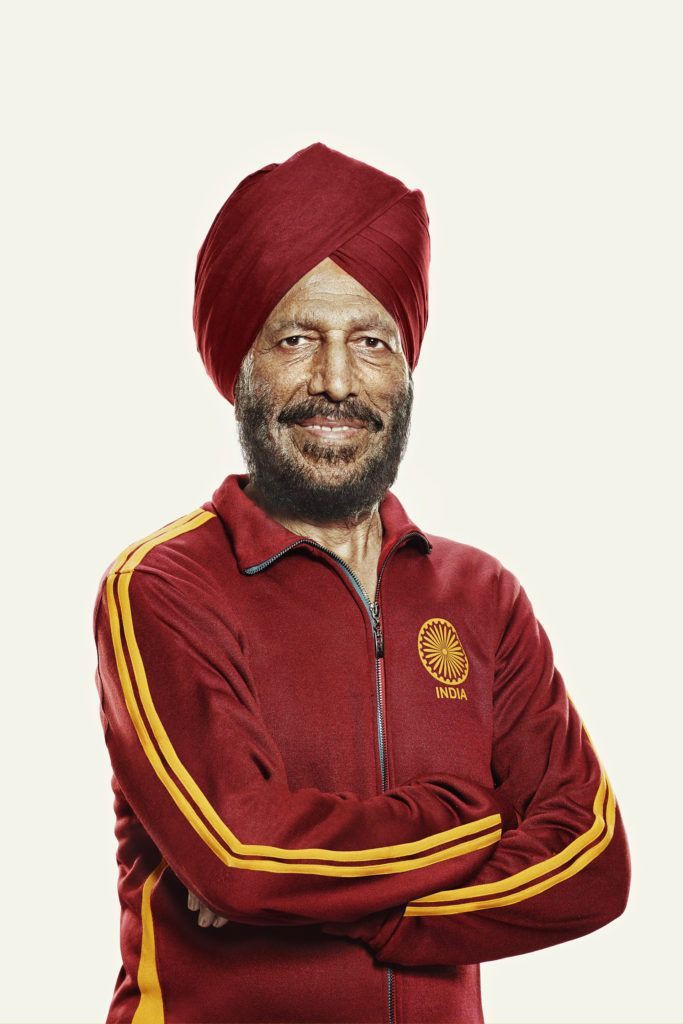
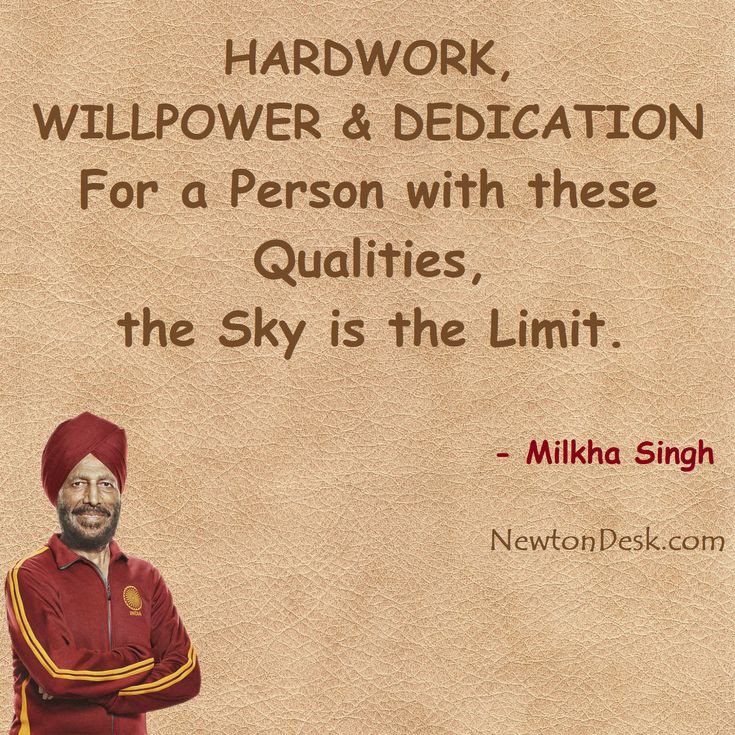
The Flying Sikh : The journey of MILKHA SINGH

I was moved to tears by the thought that from being nobody the night before, I had become somebody.

– Milkha Singh

The beginning

He was an athlete , an army officer and a proud citizen . He won for his motherland and inspired many . Yes , he was an inspiration and served for his nation .

He was born in November 20,1929 in Govindpura , Punjab ( present – Punjab , Pakistan ) . He was one of his 15 siblings from whom 8 died during the partition . In early age , he moved to Delhi , India in 1947 .

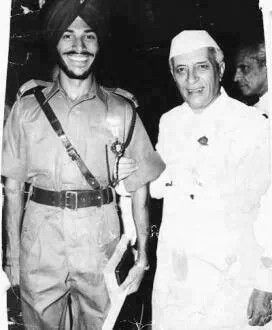
He wasn’t interested in army or becoming one but wanted to prove himself and others that he can be the one . It was his forth attempt when he gained access and introduced to the athletic later .

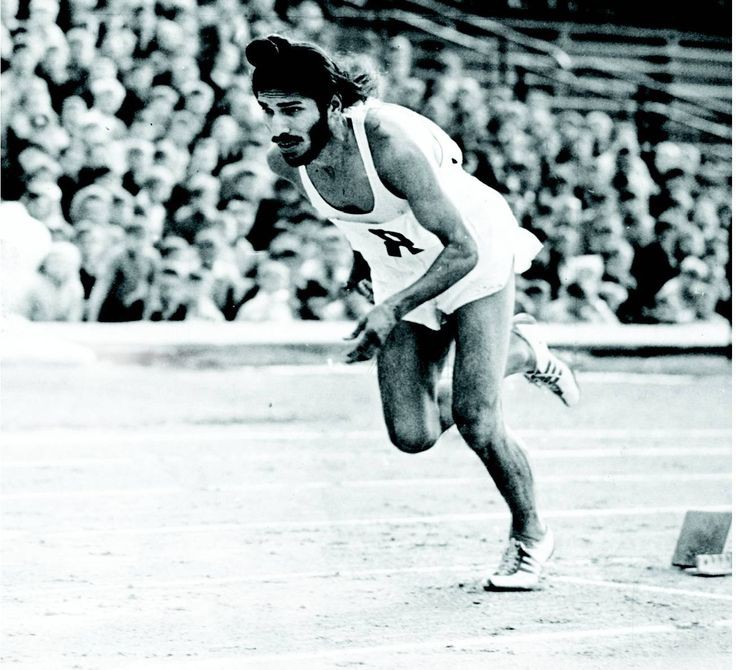
He once said that “I came from a remote village, I didn’t know what running was, or the Olympics”. And that’s where he started his journey as an athlete .

Medal awards and Popularity

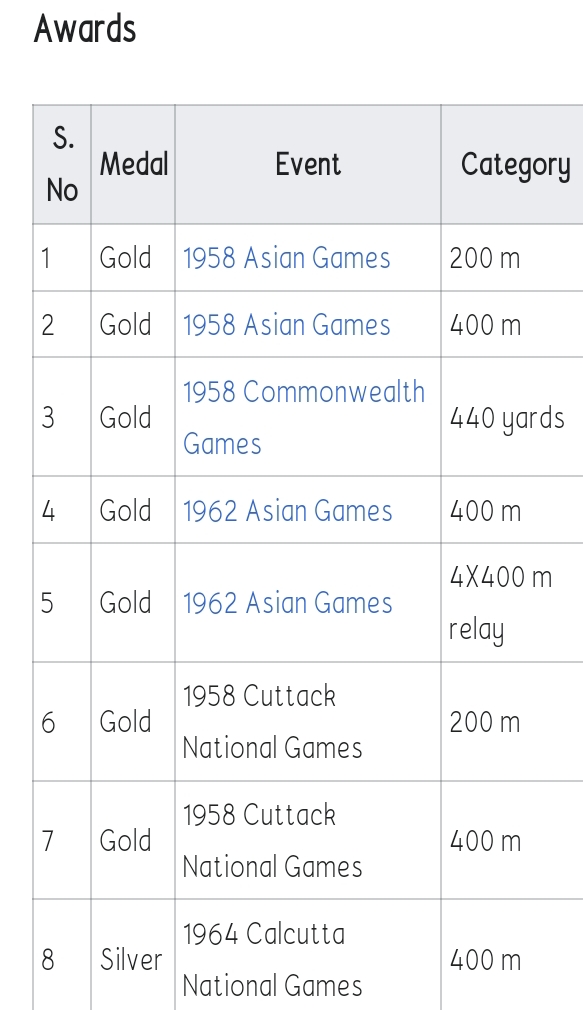
With many Olympic , National and International awards . Rather than his award Milkha Singh was quite popular in media . His powerful aura worked from sports men to the Ministry .

Later in his life he married Nirmal saini , a former captain of Indian women volleyball team and had three daughters and a son .

He became Director of sports in Punjab Ministry of Education and was awarded with Padmashri in 1959. He also turned down Arjuna award in 2001 by saying that it was to be awarded to younger atheletes rather than him.

An inspiration

As an athlete , he inspired young aspirants who want to become from Nothing to Something . He shared his ideas that before his first game he was just a runner but after he earn first postion he became Something from Nothing .

” I was moved to tears by the thought that from being nobody the night before, I had become somebody. “

-Milkha singh

He also co- wrote his biography with his daughter “THE RACE OF MY LIFE ” in 2013 . Which inspired “Bhaag Milkha Bhaag ” an autobiography film in 2013 . A trust had been founded for the poor and needy sports people in 2013 due to the recognition of film .

A day of loss

On June 18th ,2021 , we lost one of the legendary Indian icon , an ace of athlete due to the post covid – complication . “We are deeply indebted to the doctors at PGI for their valiant efforts and the love and prayers we received from across the world and from yourselves,” – statment given by his family .

PM Narendra Modi pay a tribute to MILKHA SINGH in his monthly radio program ‘Maan ki baat’ . He urged India to cheer and motivate for forthcoming Tokyo Olympics .

He said “When talking about the Olympics, how can we not remember Milkha Singh Ji. When he get hospitalized, I got a chance to speak to him, I had requested him to motivate the athletes going for Tokyo Olympics”

We lost one gem of our India but we didn’t lost his contribution to his motherland . He has given a lot and it’s our time to remember what gave to us .

Link:

Stock Exchange Market ( Meaning, Definitions , Functions , Members , Stock Exchange Market in India , Trading procedure , Members)

Stock exchange Market

What is a stock exchange market?

A market is said to be an arrangement between buyers and sellers to exchange goods or services for money.
A stock exchange is a highly organised market ,where listed securities are bought and sold under a code of rules and regulations.

A stock exchange Market is also known as a ‘security exchange or ‘, ‘security market ‘ or ‘share bazar ‘.

It is an organised market for the purchases and sale of industrial and financial securities or where financial instruments like stocks, bonds and commodities are traded.

It is a platform where buyers and sellers come together to trade financial tools or securities , adhering to SEBI’s well-defined guidelines. SEBI’s responsibility is to ensure that the securities market in India functions in an orderly manner.

( About SEBI )


Definitions

” A stock exchange is an association of persons engaged in buying and selling of shares , stocks , debentures and bonds for public on commission and are guided by certain Rules and usages “
…….. Dr. K.L Garg

” A stock exchange is an organised auction market where buyers and sellers come together through their brokers ,to effect transactions in securities admitted to listing on the exchange and unlisted securities for which a market is maintained “
……… Charles W. Gerstenberg .


” A stock exchange is a marketplace where securities that have been listed thereon ,may be bought and sold for either investment or speculation “
…….. W.Pyle .

” Stock exchange means a body of individuals ,whether incorporated or not , constituted for the purpose of assisting ,regulating and controlling the business of buying , selling and dealing in securities .”
…….. Securities Contracts ( Regulation ) Act , 1956


The stock market is a market where exchange of regular activities of buying, selling, and issuance of shares of publicly-held companies take place.


Key meaning :-

• it is an organised market where securities are purchased and sold
• transaction takes place between the members or their authorized agents on behalf of the investors.
• securities refer to shares , stocks , debentures and Government bonds .
• Securities are traded in a stock exchange in a systematic manner for investment .
• only listed securities are traded in a stock market.
• functions on the basis of rules and regulations.
•It is managed by the Board Of Directors elected by the shareholders .
• brings a huge amount of capital necessary for the economic progress of a country .


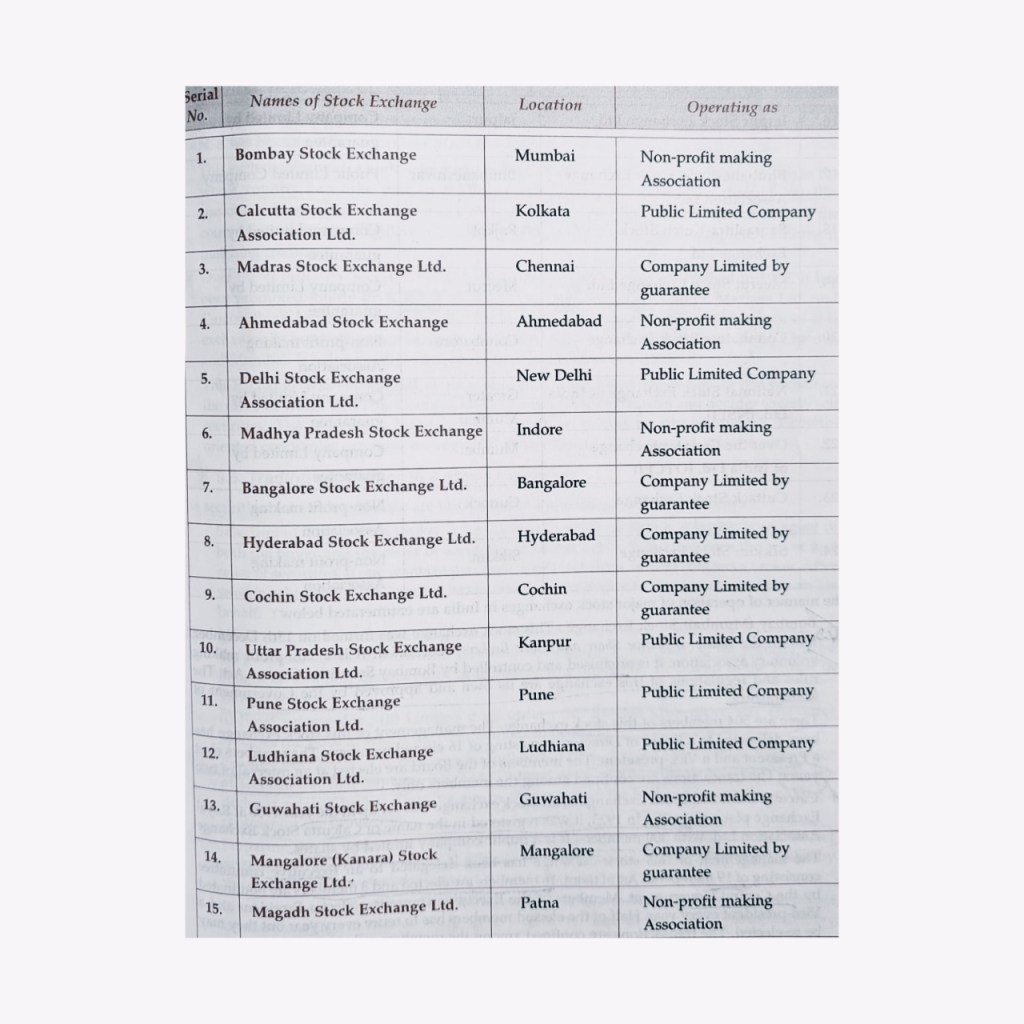
Names and locations of stock exchanges in India :-

At present there are 24 recognised stock exchanges in India .


The major stock exchanges in India :-


1: Bombay ( Mumbai ) Stock Exchange :-
This stock exchange was formed on 13th December , 1887 in the name of Native Share and Stock Brokers Association .
It is a non – profit making voluntary association . It is organised and controlled by Bombay Securities Control Act . The rules and regulations of this exchange are its own and approved by the Government of Maharashtra.


2: Calcutta ( Kolkata ) Stock Exchange :-
This stock exchange was set up in the year 1908 at Royal Exchange place , Calcutta . In 1923 , it was registered in the name of Calcutta Stock Exchange Association Ltd. with 300 members . It is a public company limited by shares .


3: National Stock Exchange ( Greater Mumbai ):- This stock exchange was recognised by the Central Government on 26th April , 1993 . The object of its establishment was to convert the exchange market into a professional market . It provides security (i.e , shares , debentures , bonds , etc.) trading facilities at the national level through satellite communications systems .


4: Over the Counter Exchange (OTCE) :-

(About OTCE )

This stock exchange was established in 1992 . It has been promoted jointly by ICICI , UTI , IFCI , IDBI , SBI , GIC ,LIC , Capital Market Ltd. and Canara Bank Financial Services Ltd. These institutions are the sponsor members of this exchange. Its head office is in Mumbai . It has four regional offices at Kolkata , Delhi , Chennai and Mumbai . It helps smaller companies to raise funds at low cost .


There are two types of stock exchange market investment :-


Primary market – Primary market creates opportunities for the issuer to issue shares and bonds , and acts as a market where companies meet their investment requirements . The companies enlist their shares for the first time in the market and sell their shares through an Initial Public Offering or IPO.

(About IPO )


Secondary market – The secondary market is a trading market platform for investors or issuers , and is also known as the stock market. It is a market where shares of a company are traded after being initially offered to the public in the primary market by the help of brokers or agents . It is a market where buyers and sellers meet directly.

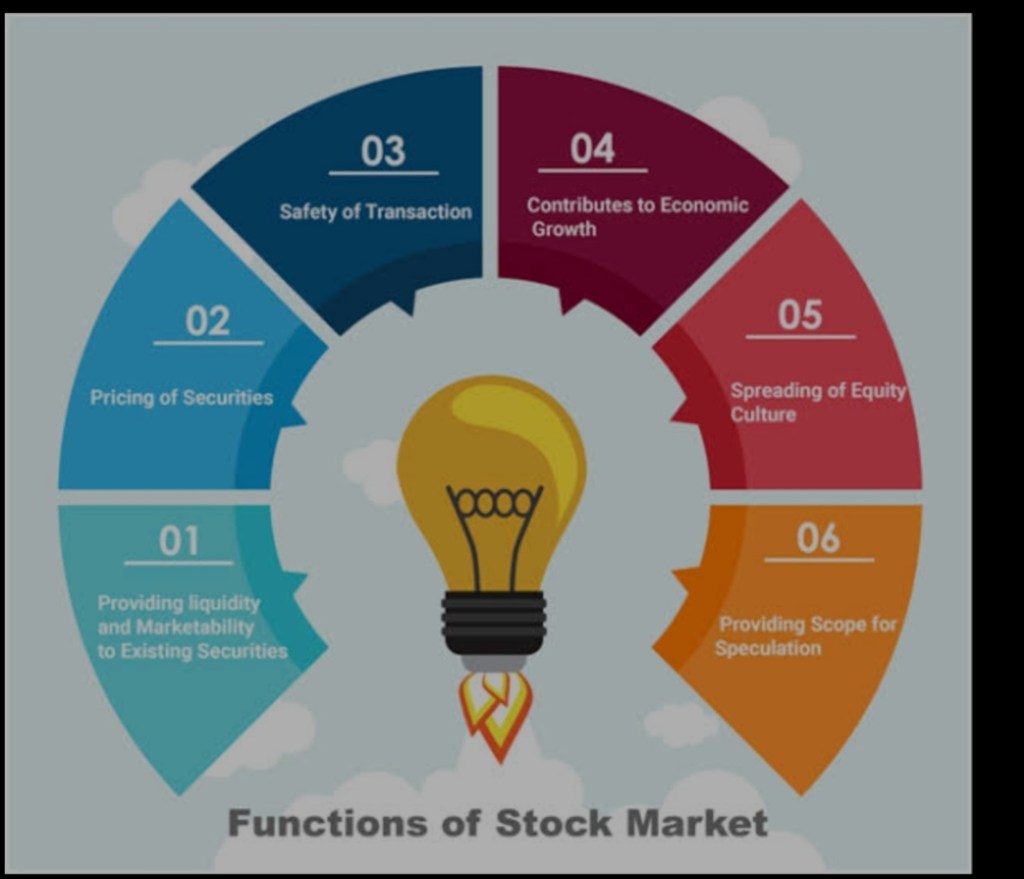
Functions and Services of a Stock Exchange:-


Stock exchange renders the following services :-

1:
Services to the Investors :-

• Investment guide :- Stock Exchange periodically publishes the quotations of listed securities. Investment can decide about purchase and sale of securities on the basis of stock exchange and quotations . Thus , the investors can get the maximum benefit from their investment.

• Liquidity of Investment :- Stock Exchanges are ready and continuous markets for purchase and sale of securities .The securities can easily be converted into cash as the needs of the investors arise .

• High Collateral Value of Listed Securities :- Listed securities in any stock high collateral value . These securities are preferred by rational investors . The securities of such companies can be sold easily . The investors have no fear of risk while trading in listed securities.

• Better use of Capital :-
The prices of shares reflect the profitability and efficiency of the company concerned . A stock exchange helps the investors in choosing good companies for their investment .

• Protection from Bad deliveries :- Securities in the stock exchanges are listed after the proper scrutiny . It prevents the trading of false and duplicate securities .

2:
Services to corporate sector

• Wide market for new securities :-
A stock exchange serves as a sales counter for new securities . Once a company gets listed in a stock exchange, it’s shares are traded freely in that exchange . Therefore , a company can raise a huge amount of capital from different types of investors.

• Increasing Goodwill of the company:-
The shares of only those companies are listed in the stock exchange which are financially sound . Therefore , listing of shares adds to the goodwill and credit standing of a company.

• Transfer of Securities at suitable prices :-
In the event of a merger or amalgamation ,the company whose securities are listed ,is in a better position than the company whose securities are not listed.

• Assist development of companies :-
A stock exchange is an essential adjunct of companies for quick capital formation . It provides a wider and a ready market for the secur of companies . It ensures higher bargaining power to companies in the event of further expansion and merger.

• Knowledge about future investment :-
Companies can get relevant information regarding trends of investment , investors choices and priorities etc., From the stock exchange on a regular basis .The companies can plan their future issue of capital on the basis of such information.

3: Services to Society :-

• Capital formation :- A stock exchange provides good investment opportunities to investors .It promotes the habit of savings and investment.

• Industrial Development :-
A stock exchange helps to mobilize public savings for the economical development of the country.This leads to industrial and commercial development .

• Utilizing scarce capital for productive purposes :- Idle lying funds can be invested in securities on account of stock exchange .

• Useful to Government :- The government plays a vital role as an entrepreneur in the promotion and management of commercial and industrial enterprises . A stock exchange helps the Government in raising sufficient funds for rapid industrial growth .


Operators In A Stock Exchange

Stock market operators are market participants who form a organise stock securities purchases and sales .

Generally found operators:-

Broker :-
A broker acts as a link between the investors and the jobber . He is a commission agent of buyer or seller of securities . A broker charges commissions from both the buyers and the sellers.
He does not specialize in any particular security .He assists in buying and selling all types of securities .

Jobber :-
Jobber can sell and purchase securities in his own name . He is a professional operator . He gets no commission for his service. His income is the profit in purchase and sale of his securities. The service of a jobber is both useful for both the investors and the stock exchange.


Speculators in Stock Exchange

On the basis of Zoological characters , speculators are of four types :-

Bull

In India , bull speculator is known as
Tejiwala “.
The stock market is called a ” bullish market ” when there are large numbers of bulls speculators .
A ‘bull’ is an optimistic speculator who buys securities with the exception of a rise in their prices . He makes purchases of Securities to be sold in future at a higher price to make profit .

Bear

In India , a ‘ bear ‘ speculator is known as a
Mandiwala “. When a stock market has large number of bears ,it is known as ” bearish market “.
A bear speculator expects a fall in the prices of securities . He sells securities with the hope of buying the same at a lower price before the date of delivery.

Stag

A ‘stag ‘ is a ” premium hunter “. He never holds securities as a permanent investment. He issues shares by the new company on the basis of their issued prospectus .He sells these shares at a premium soon after the allotment is made . The premium earned became his profit.

Lame & duck :-
A ‘lame-duck’ is a bear speculator struggling against the difficulties involved in meeting his commitments. He struggles like a duck to purchase shares so that he may deliver the same to another party . He is a bear speculator who is in no position to find shares .


Trading procedure in a Stock Exchange.

Trading in stock markets means the transfer (in exchange for money) of a stock or security from a seller to a buyer. This requires these two parties to agree on a price.


Procedure :-

• Selection of a broker
• Placing the order
• Executing the order
• Preparing the contract note
• Final settlement.

My year reading a book from every country in the world | Ann Morgan |

Something which kept me quite on to the edge was the reading journey taken up by Ann Morgan. It was quite wonderful of her to take up such a wonderful opportunity. As someone who loved to read I felt myself more closer to her perspective. I was able to identify myself with her and the way she spoke and carried herself, the more I noticed, the more I realized her idea of the world. 

The fact that we can understand a person by looking at their book shelf was a quite a point, Because we are what we read upon. What we encounter and read enhance us. They make us who we are. The socialization and books make us realize our potential. A good book is worth a good friend because it moulds you into a better version of yourself.

Reading about various things under the sun and not just sticking to one genre is very important for a reader. He/she must be ready to break the barriers and go beyond their comfort zone because it is only when we explore, we learn about the unknown and hidden and the voiceless. These are very important, because what the world need is a good reader because a good reader knows the world better than anyone else. The person will be objective and not subjective. A good reader knows the bias and learns to be impartial and be more open to the world. They know the  difference between empathy and sympathy. 

What Ann Morgan stresses again is that fact that if we need something so badly, then the whole world will be with us. Just like how Paulo Coelho said in Alchemist that if we really want something then the whole world will conspire. She brings in and stress some long forgotten words and values. 

I hope that more people realize the value of reading in their lives and learn to be better people and change the nation and break away from the stereotypes.

LEAST KNOWN SOCIAL REFORMERS OF INDIA

AHILYABAI HOLKAR- QUEEN OF MALWA KINGDOM

Looking back into the ancient times of the Indian History, we get to see that not only the people fought against the British Rule to free our country but some of them, mostly women, fought within their own community for the rights they were denied and for the wrong customs that were imposed on them.

One of those least known social reformers is AhilyaBai Holkar who came from the village of Choundi in Jamkhed, Ahmednagar, Maharashtra. Her stories of struggle are very inspiring for every man and woman.

STORY OF AHILYABAI

In the year 1733, MalharRao Holkar was on his way back home from his tour. On his way he decided to stop at the village of Choundi where he came across this young girl offering a prayer at the temple. They did not pass a single word between them. MalharRao Holkar for few minutes just kept looking at the devotion of this young girl. He was impressed by her vity and soon came to a decision that this girl should become my daughter-in-law as he thought that only someone like her could fix his stubborn son.

He came to know that this young girl was AhilyaBai, the daughter of Mankoji Shinde, a scion of a respectable Dhangar Yadav family residing at Choundi of the Beed district, was the Patil of that village. MalharRao wasted no time in securing the consent of Mankoji Shinde and on May 14,1733 AhilyaBai got married to Prince KhandeRao. It was long before AhilyaBai realized that KhandeRao was not an ideal husband. Fortunately, the same could not be said about her in laws. Her father-in-law MalharRao Holkar and her mother-in-law GautamaBai Holkar loved her. MalharRao even offered AhilyaBai to train her in the arts of warfare and statecrafts. AhilyaBai, in spite of everything she learnt and grew, did not give up on Prince KhandeRao. Instead she always used to discuss the things she learnt each day with him. She remained patient through all these times when Prince KhandeRao showed his stubborn behavior but after a long wait her patience finally paid off and now she saw an overtime change in his personality. He started taking active interest in the matters of the kingdom and learnt to first evaluate the things on his own and then listen to the problems of the people. With time his father MalharRao started to feel that he was becoming fit to take over the throne as his responsibility now.

Few years later, AhilyaBai gave birth to her son MaleRao. 3 years later, the couple had a daughter named MuktaBai. Even though she was a mother now, AhilyaBai was solely concerned with the domestic issues of the kingdom. She was an abled ruler in the absence of MalharRao. Her way of approaching the problems brought to her was quite impressive. She used to be way more attentive and patient. She also accompanied her husband and her father-in-law in various military campaigns. During one such campaign in Kumher(1754), a bullet hit her husband from the fort and he passed away. This incident devastated AhilyaBai and according to the norms of the society she was prepared to commit Sati. But MalharRao couldn’t bear to lose both, his son first and now his daughter-in-law. He requested AhilyaBai to change her mind for the sake of her father-in-law and she indeed did the same. Now her only aim was to live for her family and her kingdom.

In the year 1766, MalharRao set on a battle along with Raghu, the uncle of the Maratha leader MadhavRao Peshwa. Away from home MalharRao felt ill and passed away after that. By this time, AhilyaBai was completely heartbroken with the realization that she had lost both the people who would be her backbone and now she is all alone. Bad news didn’t stop here. Soon, her son MaleRao also departed. Her world was totally shattered but she knew that she had no time to grieve now as it was the time for an immediate call. The kingdom was now her responsibility. To the outsiders, the kingdom seemed to be weak and smelling blood they started to plan and conquer the same. But AhilyaBai did not give up and fought against each of them who tried to enter her capital. She appointed TukojiRao Holkar, who was the second son of MalharRao’s nephew, as the chief of her militia. After her first victory in protecting her kingdom she moved her capital to Maheshwar where she build temples, set-up schools and revived the tradition of Maheshwar sarees.

Positive and Negative Impacts of Industrialization

How Can Industrialization Affect National Economies of Less Developed  Countries (LDCs)?

IMPACT OF THE INDUSTRIAL REVOLUTION

The Industrial Revolution started in the 18th century in the United Kingdom and later spread too many other parts of the world, during which the agrarian and handicraft economies changed rapidly to industrial and machine-manufacturing-dominated ones. Not only did this economic change alter how work was done and goods were produced, but it also altered how individuals related to each other and to the world as a whole. Today, this wholesale shift in social organization continues and has created many impacts that have rippled through the political, ecological, and cultural spheres of the World.

POSITIVE IMPACTS OF INDUSTRIALIZATION

Goods became cheaper and more affordable:

The factories and equipment they housed started making goods faster and cheaper than they could make by hand. As the availability of different goods increased, their cost to the customer declined (see supply and demand). Shoes, clothes, household goods, equipment, and other products have become more common and less costly to improve people’s quality of life. For these products, international markets were also established, and the balance of trade changed in favor of the consumer, bringing increased prosperity to the businesses that manufactured these products and adding tax revenue to government coffers. It has, however, also led to the disparity in income between countries producing products and consuming goods.

Manual labour was replaced by machine work:

The rapid manufacture of hand tools and other useful objects has led to the development of new types of instruments and vehicles for moving goods and people from one location to another. The development of road and rail transport and the formation of the telegraph (and its related telegraph infrastructure and later telephone and fiber optic lines) meant that progress in manufacturing, agricultural harvesting, energy production, and medical techniques could be easily communicated between stakeholders. Also well-known products of the Industrial Revolution are labor-saving machines such as the spinning jenny (a multi-spindle machine for spinning wool or cotton) and other inventions, particularly those driven by electricity (such as home appliances and refrigeration) and fossil fuels (such as cars and other fuel-powered vehicles).

Evolution in the field of medicine:

The Industrial Revolution was the catalyst behind numerous medical advancements. Industrialization has made it possible to manufacture medical instruments more rapidly (such as scalpels, microscope lenses, test tubes, and other equipment). Using machine production, refinements to these tools could be more effective for the doctors who wanted them to roll out. When contact between doctors in various fields increased, it was possible to easily spread the information behind new cures and disease treatments, resulting in better care.

Increased standard of living:

Mass production reduced the cost to the common (i.e. non-aristocratic) people of much-needed tools, clothing, and other household goods, which allowed them to save money for other things and create personal wealth. Furthermore, new job opportunities emerged as new manufacturing devices were developed and new factories were established. The average citizen was no longer so tightly tied to land-related issues (such as being dependent upon the wages farm labor could provide or the plant and animal products farms could produce). The emphasis on land ownership as the chief source of personal wealth was diminished by industrialization. The increasing demand for manufactured goods meant that as factory workers and as employees of companies that sponsored the factories, average individuals could make their fortunes in towns, paying better salaries than farm-related positions.

Rise of Professional jobs:

As industrialization advanced, in search of better pay in the factories, more and more rural folk flocked to the towns. To improve the overall productivity of the factories and to take advantage of new business opportunities, factory employees have been qualified to perform specific tasks. The owners of the factory divided their employees into numerous groups, each group concentrating on a particular mission.

Some groups secured and transported the raw materials used in the mass production of goods (namely iron, coal and steel) to factories, while other groups worked different machines. When they broke down, some groups of workers repaired equipment, while others were tasked with making changes to them and the overall operation of the plant.

Additional teachers and trainers were required to pass on advanced skills as the factories expanded and employees became more specialized. Furthermore, factory workers’ lodging, transportation, and leisure needs contributed to the rapid growth of cities and towns. To support these, governmental bureaucracies expanded, and new specialized departments were formed to manage traffic, sanitation, taxation, and other services. As more builders, doctors, attorneys, and other staff were added to handle the diverse needs of the new inhabitants, other industries inside the cities also became more skilled.

NEGATIVE IMPACTS OF INDUSTRIALIZATION

Over crowded cities:

The prospect of better pay attracted refugees, who were ill-prepared to manage them, to cities and manufacturing cities. Although initial housing shortages ultimately gave way to construction booms and the development of new buildings in many areas, first existed crowded shantytowns made up of shacks and other types of poor-quality housing. The sudden influx of people overwhelmed local sewerage and sanitation schemes, and drinking water was frequently polluted. Ideal conditions for outbreaks of typhus, cholera, smallpox, tuberculosis, and other infectious diseases were provided by people living in such close proximity, fatigued by bad working conditions, and consuming contaminated water.

Environmental degradation:

In India two centuries ago, factories emitted toxins such as carbon di oxide, carbon monoxide, and other harmful gases that caused air pollution along with vehicular exhausts that were not heard or seen before. Because of Greedy Indians and their Expansionist conquests, India lost many of its forests and natural ecosystems and botanical and zoological species became Endangered or Extinct overnight. Water contamination is caused by heavy metals, arsenic, lead; hard water and industrial hazardous waste are released into lakes, rivers and other water bodies. Aquatic and aquatic animals are dying as a result of water bodies being polluted. As the human population of the planet continues to rise and more and more people are chasing the material benefits promised by the Industrial Revolution, more and more of the resources of the Earth are appropriated for human use, leaving a diminishing stock of plants and animals on which ecological services the biosphere depends (clean air, clean water, etc.).

Moreover, more than 40 percent of the Earth’s land-based net primary production is used by human beings, a measure of the rate at which plants transform solar energy into food and development. Coal, which had to be extracted or obtained after wood burning, was used by most factories, creating smoke and photo chemical smog in North Indian cities such as New Delhi, where visibility and breathing was difficult. Fossil fuels had to be imported from foreign countries and would again produce smoke, Green House Effect, Global Warming by using them for industrial purposes.

Poor working conditions:

Their owners valued production and profit above all else as factories appeared in the cities and industrial towns. Security and salaries of employees were less important. Compared with farm workers, factory workers received higher wages, but this also came at the cost of time and less than desirable working conditions. Factory staff frequently work six days a week for 14-16 hours a day. Human beings (employees) have become more vulnerable to exploitation, violence at work, more working hours and fewer fixed payments, job instability, and after retirement or termination of their employment, a bleak future. Also, finished Indian products were not on par with global standards and labels, but were more costly than comparatively cheaper imports from countries such as China, Hong Kong, Japan, etc.

Other problems

Nuclear plants are a threat to health and different forms of diseases can be caused by human beings living in close proximity. Farmers, who were in heavy debt to pay their dues to industrialists and real estate sharks, sold agricultural land with fertile and cultivable soil, and these lands have now become less yielding as factories or buildings have been constructed upon them. Inflation in India has always been increasing due to scarce natural resources or lack of availability.

India’s Anti-Hacking Laws


Many Indian official websites have been hacked, including state government and defence websites. Defense officials were unable to view their compensation information when the website of the Principal Comptroller of Defense Accounts was hacked. The government has agreed to DEITY’s recommendation to cease using popular email ids for official purposes, and has sanctioned a budget of Rs. 100 cores to protect the data, in order to reduce hacking of precise work. State government websites have previously been compromised.
Images of Hacker vs. Cracker

Following the revision of the IT Act in 2008, a very thin line of demarcation has been formed between the two words: hacking and cracking. Hackers are persons who are highly talented at computer programming and utilise their expertise to help the government and numerous other companies protect their sensitive information and trade secrets. They look for flaws in the software and try to figure out why they exist.


The Cracker’s Liability


Liability in civil cases
The IT Act’s Section 43A addresses the legal culpability of cyber criminals. The section deals with the compensation that should be paid in the event that the date is not protected. His was included as part of the Act’s modification in 2008. Section 43A, which requires corporations to establish reasonable security policies, emphasises corporate responsibility for data protection.
Liability for the consequences
When the cracker’s intent or liability to destroy the system or steal crucial information is demonstrated, criminal liability for cracking arises. If the cracker simply trespasses the system without intending to do harm, section 43A only applies to civil culpability. Criminal trespass can lead to further criminal behaviours that are punishable under the Indian Penal Code, such as computer theft, which is penalised under section 378.

India’s cybercrime laws
Data theft and hacking are covered by sections 43 and 66 of the IT Act, respectively, as civil and criminal offences.

A simple civil crime under section 43 occurs when a person gains access to a computer without the owner’s authorization and removes or damages the data stored on it. The cracker will have to compensate the persons who have been harmed. The maximum compensation cap under the ITA 2000 was Rs. One crore in fines. This ceiling, however, was eliminated in an amendment issued in 2008. Section 43A was inserted in the 2008 amendment to encompass the corporate shed, when employees took information from the secret files of the company.

Receiving a stolen computer resource or information is punishable under Section 66B. A year in prison or a fine of one lakh rupees, or both, are possible punishments. Under section 66A, mens rea is an important component. The existence of criminal purpose and the wicked mind, i.e. the concept of mens rea, destruction, deletion, alteration, or diminishment in the value or utility of data, are all major factors to bring any act under this Section. 2

How to File a Hacking Complaint

Any cyber cell in the world can receive a complaint regarding cybercrime. In India, there are several cyber crime units where a complaint can be filed.

To begin, write an application to the director of the cyber cell department, including your name, address, e-mail address, and phone number.
Second, accompany the cell with the following documents:

1. Log files that are automatically sent to the server when files are opened are known as server logs. It keeps track of daily activities.
2. All material that has been tampered with by the hacker must be submitted to the cyber unit as proof, in both hardcopy and soft copy format.
3. A tangible copy of both the original and defaced web pages should be submitted so that the work may easily identify the defaced or manipulated material.
4. Details of the control mechanism, including who had access to the password and the computer, as well as the complainant’s contact information.
5. If any person is suspected, a list of suspects should be provided for future reference, since this will aid the cyber cell in their investigation.

Conclusion
Hacking is an undeniable danger to the virtual world. This theft is largely unknown throughout the country. Hacking and cracking must be made more widely known throughout the country. The government’s rules are strict, yet they lack the power to be enforced and public knowledge. The majority of minor hacking cases go undiscovered because people are hesitant to file criminal charges for minor offences, even if the penalties are severe. Additionally, due to a lack of equipment, it is extremely difficult to track a virtual hacker. Because hacking can occur anywhere on the planet, it is difficult for authorities to track him down and prosecute him in another country.

GST which stands for Goods and Services tax

Definition and meaning

Goods and services tax is an indirect tax which is levied by government on taxable value of goods, services or both were supplied by persons. It is a value added tax which is charged in every stage of supply.

Goods and services tax came into force in India on 1st July 2017, which is marked as one of the historical dates in India’s tax history.

Goods and services tax which helped remove various taxes under one.

Excise duty, Service tax, VAT, CST, Entry tax, etc. = GST

Goods and Services tax is a destination-based tax which is levied on every stage from the manufacturing level to the final consumer of that goods or services, only on the value addition.

Salient features of GST or GOODS AND SERVICES Tax.

Levy on Good and ServicesGoods and services tax is only levied on taxable goods and services on each stage of transaction a tax on, Except supply of alcohol and liquor for human consumption
Indirect TaxGST is an indirect tax which means tax liability on consumer in indirect they pay tax indirectly to the government.
Dual GST in IndiaIndia is a federal country there fore a Dual GST system has been adopted.

1. On Intra state supply- The GST to be levied on intra state supply of goods or services would be called CGST or SGST. E.g., A transaction took place inside the state.
2. On Inter state supply- The GST to be levied on interstate supply of goods and services would be called IGST. E.g., A supply took place between M.P. and C.G.
Uniform GST law in India.SGST tax of each state is just a copy of CGST act passed by central government, except changing reference from central tax to state tax.
Forms and procedures are all same all over India and rates are also expected to be uniform.
There would be no difficulty for a businessman to set his/her business in many states.
Consumption based TAXGST is a consumption-based tax which means the state which is finally consuming the goods and services.
RegistrationA supplier of Goods and services or both should be registered under GST law –

1. Supplier of goods or/and services within the state.
2. Registration is not required for farmers and supplier of wholly exempted goods.
Multi point TAXGST is applied on every state of transaction.

GST is not only implied in India it is on effect in many parts of the words.

When the GST was not implemented in India and was in the process there were various challenges IN front of the makers. But with continuous efforts GST was implemented successfully in India.

Though the revenue collected from GST in the fiscal year 2019-2020 was about Rupee 10 lakh crore which is less than expected.

A administration is been set up to govern the Goods and services Act properly in India.

Sone of the link just for reference :

GSD WIKI: https://en.wikipedia.org/wiki/Goods_and_services


Difference Between Goods and Services: https://keydifferences.com/difference-between-goods-and-services.html#:~:text=%20The%20basic%20differences%20between%20goods%20and%20services,a%20different%20approach%20of%20carrying%20out…%20More%20

Hope this post helps you..!

BOOK REVIEW: The Magician’s Nephew

Author: C.S. Lewis

The Magician’s Nephew is the first book in The Chronicles of Narnia series. There are total seven books in the series. Three of them have been adapted into theatrical films. The Magician’s Nephew serves as the prequel to the movie ‘The lion, the witch and the wardrobe’.
The Chronicles of Narnia series is set up in a fictional world known as Narnia where talking beasts walk, and magic exists. The series follow stories of various people who are associated with Narnia. Each book is has it’s own timeline and is connected with other without loosing essence of it’s own.

Being a prequel of the film, this book deals with a lot of stuff that wasn’t completely explained in the film. It explains the origins of Narnia and the wardrobe and also deals with the backstories of characters which were in the film like white witch and professor. Reading this book prior watching the film make the experience better.

“This is a very important story”, explains the author at the beginning, “because it shows how all the comings and goings between our own world and the land of Narnia first began”.

https://www.goodreads.com/community_answer/93466/comments?reverse=true

The story revolves around a boy named Digory. He befriends a girl named Polly and both agree to go on some sort of adventure for fun but things don’t go so well when they encounter Digory’s uncle Andrew. He tricks the girl into using one of his experimental rings which send her to unknown dimension. Digory goes after her in a quest to save her and find a way back home.
The story then follows their journey through different worlds. The book has a total of 15 chapters. Chapter 3 and 4 in particular are very interesting. They represent the feeling of unfamiliarity very well. The sense of adventure when you try something new yet the feeling of uneasiness which comes out of fear are very well portrayed.
The writing style of the author is very casual and conversational yet very cunning and ominous. It is very descriptive and makes you imagine the stuff in the novel real quick. The world building in this novel as well as the series on the whole is phenomenal. There is a lot of referencing in this book as well and lot of foreshadowing too. The book is written in such a way, it feels like distant past and gives nostalgic vibes. The narration changes from third person to first person many times throughout the series. The later chapters deal with the creation of Narnia, the origins of Jadis, the white witch, who serves as the main antagonist in the sequel. The end of this story marks the beginning of all others and it serves a perfect intro for the rest of the series.

Talking about the lessons it teaches, the first one would be learning to contain your curiosity. Throughout the story, most of the problems occur because the characters are curious to find out what’ll happen if you do a certain thing or so. Values of friendship, loyalty and commitment are also presented well. Overall, this book is a must read.

https://youtu.be/nVBMw372IxU

Capitalism Over Purity In Lakshadweep

Lakshadweep is the smallest UT in India, most popularly known for its sandy white beaches with crystal blue waters and secluded lagoons.

But Lakshadweep is now in the news for all the wrong reasons. The accountability of such disturbance and row in Lakshwadeep can be credited to the fascist and corrupted minds of politicians. 

It has a population of around 60,000 people with 90% of Muslims and consists of somewhat 30 small islands. Once a peaceful area is now facing disruption because of the capitalistic, islamophobic and exploitative mentality of politicians. Praful Khoda Patel, a political leader of BJP presents the ideological projects as an idea for development. But these actions by him will only fill the pockets of capitalists on the mainland and will hurt the islanders.

Unlike Delhi and Puducherry, this union territory has no legislative assembly nor a Chief Minister. The President of India appoints an administrator to govern the whole territory.

Until 2020 this responsibility was given to bureaucrats, they were either IAS or IPS officers. In December 2020 misfortune happened, a greedy politician got the responsibility of the administration there. His ignorance and eagerness for materialism disrupted the lives of islanders.

Praful Khoda Patel | Mastermind for Lakshwadeep Row

The man who created a storm in India’s island of peace.

Before digging deep into the main cause, let’s have a brief history of our antagonist Praful Khoda Patel.

In 2014, when the reign of Narender Modi began, Praful Khoda Patel was allocated the administration of Daman And Diu. There also before him the bureaucrats were selected as the administrator for the governance.  In 2019, the administration of Dadar and Nagar Haveli was also allocated to him.

There were several instances in his tenure, where the houses on the seafront land were demolished in the name of progression. This step led to protests by the dwellers of the union territory. To harass and detain the protestors, section 144 was imposed several times.  

In February 2021  Mohan Delkar, a tribal rights activist and seven-time MP of Dadra and Nagar committed suicide. In his 15-page long suicide note, he mentioned Praful Khoda Patel. Patel allegedly harassed Mohan Delkar for 25 crore rupees. Patel threatened him that if he fails to do so, he’ll be falsely accused under the “prevention of anti-social activities” act. 

What is Happening in Lakshwadeep Right Now?

Since December 2, 2020, when the administrator took charge of the Union Territory, Patel has issued a series of orders, which haven’t sat too well with the island dwellers.

1. Spike in Covid cases: From Zero to 7000+

In 2020 Lakshadweep was one of the few areas in India, which was unscathed from the grasp of the coronavirus. As in Lakshwadeep, there were strict and mandatory quarantine rules for travelers.

But in 2021, more than 7,000 cases have been reported there. Citizens of Lakshadweep alleged that the spike was due to a change introduced in the covid management protocol by a new administrator Praful K Patel. The change was that anyone could enter within 48 hours of getting a negative RT-PCR test.

Thus, this proved that such ignorant politicians can work as a catalyst in making the Covid related situation worse. Just like political leaders who organized rallies all over the country and gave permission for ‘Kumbh Mela’ to take place, here also the leader is running from accountability.

Patel claimed that such a surge in cases is ‘natural’ as in Kerela to which Lakshadweep has strong links also witnessed the increase in cases. But that is evidently baseless, as he was the one who changed the earlier protocols.

2. Goonda Act- Equivalent to UAPA and TADA

Past events prove that a state always tries to introduce immoral acts to forcefully silent the masses when the rise of questioning the authorities occurs.  

Patel’s administration has proposed to enact the ‘Goonda Act’ (prevention of anti-social activities bill) which allows a person to be detained without public disclosure for up to a year.

This island already witnesses a very low crime rate. A question that comes up is- What is the need for such an ‘act’ to be implemented?

Just like UAPA, TADA, and Prohibition of Unlawful Religious Conversion Ordinance (Love jihad) this unnecessary implementation of the act could be interpreted as a means for misuse to disrupt the uprising of resistance against the bigotry.

3. Prioritising Alcohol Over Beef

A proposal to ban beef while removing the alcohol sale led to outrage on the island, which has a Muslim-dominated population. This particular step is being used to trigger and hurt the sentiments of the population there. The administration also invited criticism for stopping non-vegetarian food in school midday meals. 

4. Disruption in the name of Development?

The ‘Development’ agenda was one of the most controversial changes that were proposed.

It is a law that gives sweeping powers to the administration to take over private property for developmental activities. Critics said that this might leave people at risk of eviction and relocation and that unchecked construction could threaten the ecological balance of the islands. Patel argues that these laws were necessary to bring in development and to create a smart city in the atolls.

But, is there truly a need for resources to be used for a smart city, when people of an already beautiful island are fine with what they have?

Prioritizing development over the sanctity of the ecosystem is one of the causes of spoiling the harmony in the world. While the world battles climate change and the rising sea levels, this step might just contradict the effort being made by hurting the ecological balance of the islands.

Victims of The Lakshadweep Row

During the row in Lakshadweep, we witnessed how an entry of a single person disturbed, disrupted, and even ended the lives of the people on the island.

In a place where the existence of COVID was negligible, the cases have risen to 7,000 and resulted in 22 deaths.

The work of politicians is to govern and maintain harmony in the system. But when the introduction of such acts and bills makes the people of the state insecure about their existence, then it might not be a step worth taking.