Juvenile Justice

In order to achieve the objectives of the United Nations Convention on the Rights of the Child as ratified by India on 11 December 1992, the Juvenile Justice Act has been promulgated. The procedural guarantees applicable to children in conflict with the law are specified in this law. The current law addresses the problems of the existing law, such as delays in adoption processes, the high number of pending cases, the accountability of institutions, and so on.
The law also addresses the growing number of crimes committed by children aged 16 to 18 in recent years and by children in conflict with the law. Since January 15, 2016, the Juvenile Justice (Care and Protection of Children) Act, 2015 has come into force. It repeals the Juvenile Justice (Care and Protection of Children) Act, 2000.


Who is a juvenile as recognised by law?


In the Indian context, a juvenile or child is any person who is below the age of 18 years. However, the Indian Penal Code specifies that a child cannot be charged for any crime until he has attained seven years of age.


The Historical Evolution of Juvenile Justice Act in India


The United Nations Minimum Rules for Administration of Juvenile Justice of 1985 ratified by the United Nations Member States in Beijing in 1985, also known as the Beijing Rules, set out the rules, general principles and rules governing investigation and prosecution, adjudication, delivery, noninstitutional treatment and institutional treatment. Two essential concepts are explained in these principles. They are-

  1. Diversion– If children are treated in the criminal justice system, stigmatizing criminality increases the authority of the child, whose authority has been established from Rule 11 of the Criminal Code. Therefore, these principles aim at minimizing the contact of minors with the criminal justice system. To divert the child from the system, the second part of the rule legitimizes police officers, prosecutors and other authorities. This is why juvenile court judges do not wear the black coat and other judicial officials also try not to be as formal and put the child or minor at ease.
  2. Detention– A deliberate sentence imposed on minors but imposed for the shortest possible period and called “detention as a last resort”.

Juvenile Justice Act, 1986


Following the adoption of the United Nations Minimum Rules for Administration of Juvenile Justice of 1985, the term “minor” used in international law was coined for the first time. With the adoption of the Juvenile Justice Act of 1986, this change in terminology had a considerable effect on domestic law.


Before 1979, while Lakshadweep, Arunachal Pradesh, Tripura, Chandigarh and Sikkim had the Children’s Act but they did not apply it. In the case of Assam and Himachal Pradesh, although the laws have been enforced, no institution has been created to deal with the same thing and Nagaland does not even have a separate law for children. The Children’s Acts have been applied in 236 of the 334 districts in the case of other Indian states. In the mid-1980s, out of 444 districts, the number of children’s laws was increased to four hundred and forty-two.


As from October 2, 1987, the Juvenile Justice Act 1986 was applied by notification in all areas where it was extended. The need is for uniform laws over time for juvenile justice throughout the country and for the need to implement uniform laws that are fulfilled by the Juvenile Justice Act of 1986. In addition, there are States with no law in the area of justice of the sixteen, as well as uniformity at the national level. The Juvenile Justice Act, 1987 is nothing more than a full copy of the Children’s Act, 1960 which makes only minor and valueless changes here and there.


Juvenile Justice Act of 2000


The Indian legislator made a sincere effort in adopting the 2000 Act to inculcate the principles set out in the UN Conventions, such as the CRC, the Beijing Rules and the 1990 Rules. minors were promulgated to deal with offences committed by minors in a manner supposed to be different from the law applicable to adults according to the Supreme Court of India. The rehabilitation of the minor is the main concern of the Juvenile Justice Act, 2000 and not the adversarial procedure to which the courts are generally accustomed. A complete change in the mentality of those with the power to do so is necessary for its implementation, without which it will be almost impossible to achieve its goals.

Juvenile Justice Act of 2015


The increase in the number of crimes (including rapes) committed by juveniles (aged 16 to 18) was the main reason to introduce the new legislation. More retributive than reforming, the new law raised several questions. The new law is considered retributive because it contains provisions for teenagers who commit a heinous crime (punishable by 7 years or more) must be tried as adults but in the juvenile court. The child found guilty of the heinous crime is sent to a safe place until the age of 21, after which he is transferred to prison. The children’s court ensures it. This means that the benefit of a child is not granted to the minor when found guilty of committing a heinous crime.
Many protesters criticized the new law on minors for being unconstitutional. The Court noted that in Rule 4 of the United Nations Standard Minimum Rules for the Administration of Juvenile Justice, in the case of Pratap Singh v. the State of Jharkhand, one had to give all its importance to the moral and psychological elements even when responsible for a crime.
Many activists have raised another problem, namely that the 2015 law violates the spirit of article 21 (A), which states that a person can not be sentenced to a harsher sentence than that which would have been applied to him or her. by the law of the country. Under the new law, if a sentenced minor reaches the age of 21 but has not completed his entire sentence, he can be sent to prison if deemed appropriate. This new law undermines the spirit of Article 20(1).

What is the Institutional Care provided for the juveniles?

Rule 3 of the Juvenile Justice (Care and Protection of Children) Rules of 2007 states that “the institutionalization of a juvenile must be a measure of last resort after a reasonable inquiry and this also for the minimum possible duration.”


Observation Homes


Section 8 of the Juvenile Justice Act of 2000provides that the state government may establish and operate observation houses in each district or group of districts. A minor is temporarily received in these homes. For the duration of any investigation into them under the Juvenile Justice (Care and Protection of Children) Act 2000, minors are detained in observation houses. Minors are kept for a few weeks in the observation houses for the social study of minors.


Special Homes


Section 9 of the Juvenile Justice Act of 2000, states the state government may establish and maintain special homes in each district or group of districts. When the offence committed by a minor is proven and condemned by the competent authority, it is placed in the special home established by the state governments. In the special home, minors are treated for a long time or until their age ceases. Children’s Home
Section 34 of the Juvenile Justice Act of 2000 states “The state government may establish and maintain children’s homes in each district or group of districts.” The children’s home is a home where children in need of care and protection are placed on the order of a competent authority.


Shelter Homes


According to Section 37 of the Juvenile Justice Act of 2000, Shelters Homes as for children in need of urgent support. Shelter homes provide children with space where they can play and engage in creative activities. Children are engaged in music, dance, theatre, yoga and meditation, computers, indoor and outdoor games, etc, to spend their time productively. These creative activities are designed to encourage meaningful participation and interaction among peer groups.


What is the Non-Institutional Care provided for the juveniles?

Section 40 in The Juvenile Justice (Care and Protection of Children) Act, 2000 talks about the process of rehabilitation and social reintegration. The rehabilitation and social reintegration of a child must begin during his stay in a children’s home or special home monitoring organization.


Foster Care


Foster care is one of the non-institutional measures used for the temporary placement of children in accordance with Section 42 of the Juvenile Justice Act of 2000. Homeless, abandoned, neglected and deprived children benefit from a foster family. He replaces parents with others to provide care outside their own home. The child is placed in foster care when natural parents are faced with problems such as sentencing, life-threatening illnesses and being abroad.
The actual parents pay the corresponding price.


Adoption


Restoring family care for children deprived of their real family life Adoption is another non-institutional measure. Section 2(2) of the Juvenile Justice Act of 2015 defines adoption as the process by which the adopted child is permanently separated from his biological parents and becomes the legal child of his adoptive parents with all rights, privileges and responsibilities that are attached to a biological child.


Sponsorship


Another type of non-institutional measure called the Sponsorship Program provides additional assistance to families, children’s homes and special homes to meet the medical, nutritional, educational and other needs of children. Sponsorship is given to improve their quality of life. There are many types of sponsorship programs for children, such as individual-to-individual sponsorship, group sponsorship or community sponsorship.


After-care Organisations


The juveniles are taken care of in the organization of the aftercare, which is a transition home, after leaving the special homes and the children’s home. Minors in conflict with the law and children in need of care and protection, both categories are placed in aftercare organizations. Monitoring organizations allow minors to lead an honest and industrious life. Follow-up agencies are committed to the primary goal of enabling children and youth to adapt to society. In child care agencies, children and adolescents are motivated to stay in the wider society of their lives in institutional homes.

The increasing rates of juvenile crime in India in very concerning issue and need to be focused upon. Although government has laid various legislation and rules to stop the incidents of juvenile crimes but the present laws on juveniles is not creating a deterrent effect on the juveniles and thus the results are not fruitful and legislative intent is not accomplishing.
Russian Covid-19 immunogen still has miles to travel.

NEWS: Covid19

Do not pin your hopes thereon ‘successful’ Russian immunogen

On Monday evening, news portals and social media were suddenly flooded by the news that a Russian medical university has completed the trial of the world’s 1st Covid immunogen. folks were elated and quizzical at constant time because the news skint. therefore is that the wait extremely over for a good Covid-19 vaccine?

“A report by the TASS press agency of Russia on Gregorian calendar month ten aforesaid the clinical test clinical trials would endways Gregorian calendar month fifteen, whereas the second section would begin on Gregorian calendar month thirteen.”

Like all the opposite potential candidates, one being developed in Russia is additionally aloof from being prepared at this time. various reports on Sunday had claimed that clinical trials for a Russian immunogen had been “successfully” completed. What most of those reports didn’t specifically mention is that solely phase-I of the clinical trials had been completed. Phase-II trials area unit speculated to begin Monday, whereas there’s no clarity over phase-III trials.

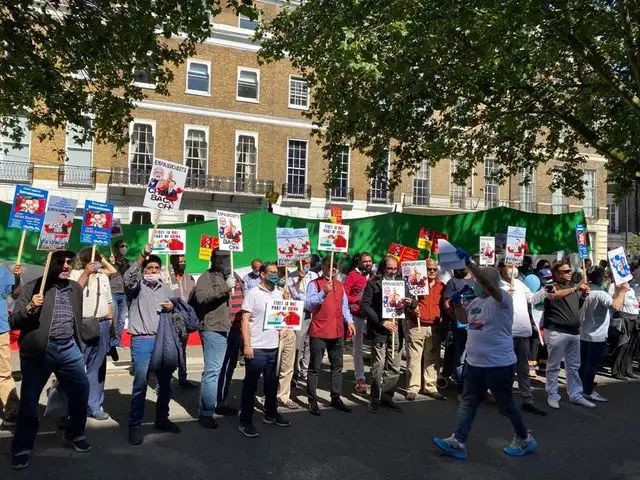
Pakistanis sing ‘Vande Mataram’ alongside Indians during anti-China protest in London….

New Delhi: Pakistanis singing Indian national song is rare. But Sunday saw quite a few of them joining hundreds of Indians, literally hand in hand, in a protest organised outside the Chinese Embassy in London.
Arif Aajakia, a Pakistani human rights activist who believes in speaking “bitter and naked truth” about his country, shouted “boycott China” and “down with China” along with the members of several Indian diaspora groups protesting against China’s expansionist policies.
“Today was also the first time in my life that I sang Vande Mataram,” said Aajakia.
Joining him also was Amjad Ayub Mirza, who hails from Mirpur in Pakistan occupied Kashmir (PoK), a few others from Karachi and many from Iran, all pretty upset with China meddling in their affairs too.

“I have travelled all the way from Glasgow for this protest. I am from PoK, an Indian living under Pakistani occupation. The Chinese are wreaking havoc across Gilgit-Baltistan through CPEC (China-Pakistan Economic Corridor) and the Pakistani government continues to work for hand in glove with them,” said Mirza, who has been quite vocal against oppression and injustice meted out to the people of PoK by Pakistani authorities.

The Indians, who’ve organised similar protests against China in the US, Canada and other parts of the world, carried posters and placards against Chinese President Xi Jinping, asking him to control his over-ambitious power play.

The growing outrage against China is quite visible on the streets of London too. In fact, Saturday night saw an image reading ‘Free Tibet, Free Hong Kong, Free Uyghurs’ projected onto the Chinese Embassy building in central London.

With the US sanctioning the Chinese government and its officials for their connection to serious human rights abuse against ethnic Uyghur Muslim minorities in Xinjiang, the world condemning China’s ‘brutal, sweeping crackdown’ against Hong Kong’s people, Indians boycotting Chinese products after People’s Liberation Army intruded the Indian territory and killed Indian soldiers in Ladakh’s Galwan Valley and countries from Japan till Australia up against the dragon, the noose is gradually tightening around the authoritarian regime.

Beautiful soul is better than beautiful appearence

In today’s world, almost every individual is obsessed with fair complexion. The obsession of fair skin has led the companies producing fairness products to earn profit more than any other business in the market.

The obsession for fair complexion is mostly found in the youth, who waste their money in buying expensive products hoping for a fairer skin but end up harming it.

You must have seen that the matrimonial Columns seem to be incomplete without people showing their desire for fair complexion in their spouse. The colour discrimination leads to alot of mental health issues for many individuals. People commit suicide under societal pressure for fair complexion and outer appearance.

We must understand that “Beauty lies in the eyes of the beholder” and the colour of one’s skin is just concerned with the outer appearance and we cannot judge them because of it.
An individual is beautiful by their heart not by their appearance.

Cannabis should be legalised

According to me cannabis should be legalised again like how it was before around 35 years back.Yes seeing it use in medical purposes would glad anyone for it being illegal.  The plant contains more than 120 components known as cannabinoids.In addition, it was identified as ‘one of the five holy plants’ by religious scholars in the ancient ‘Vedas’ scriptures. Marijuana belongs to a category of three psychoactive plants known as marijuana sativa, cannabis indica, and cannabis ruderalis. For centuries, cannabis was a component of India’s religious ceremonies and festivities. Ancient Indian Ayurvedic traditions used hemp in drugs as an active component, from digestive issues to blood pressure. In the Ayurvedic scriptures, almost 191 recipes and more than 15 treatment types have used cannabis as a main component. Which could also help us handle Covid 19

It was most sometimes connected with Shiva and believed to be a giver of happiness and a liberator. 

Later Charas smoking in an earthen pipe called chili used to be a community activity. In reality, Sadhus or ascetics are assumed to be seeking the divine through cannabis.

Dr. Peter Grinspoon created the two generally recognized cannabinoids present in cannabis plants: Cannabidiol(CBD) and Tetrahydro Cannabidiol(THC)

THC is a controlled drug which includes psychotropic components that offer the patient a ‘high.’ 

CBD is non-toxic and has a variety of legitimate applications, including for medication, cosmetics goods , furniture and gasoline.While knowing a strong past People have still lawfully and industrially ignored cannabis in India. Of reality, several of the films and ads promoted make it appear like a product is harmful for wellbeing. So because of that misconception, actual consumers are often reluctant to dig at the more beneficial is effective uses. Let me explain some of the uses:

Uses:

Since time people have proposed that weed is the “penicillin of Ayurvedic medicine. 

And that’s why numerous Indian medical practitioners are pressuring the government to remove the ban because they want to research the usage of cannaboids to manage cancer.chronic patients, anxiety patients.

Marijuana is also used in the manufacturing of body care goods and dietary additives, much as in the USA, a nation that has pressurized other nations to prohibit cannabis.

The second most significant aspect of this product is that it assists with our economies and unemployment by providing work prospects 

By legalizing cannabis, all control will come into the hands of the government (transportation, regulation, supply , demand) which will stop illegal trading activities.

Quitting cannabis is better than tobacco since marijuana is rare. But then smoking is legal in today’s country.

It is very needed to create tax on marijuana and to control it for our  nation, because even though it has completely failed to contribute to neither revenue nor trade, rather marijuana are still being used illegally, especially in Mumbai and Delhi.

 Past experiences with prohibition:

Do you really think that after prohibiting drugs people have actually stopped using them?NOOOOOO

Infact prohibition makes illegal drugs stronger and more potent. 

Prohibition eliminated a major amount of tax income and greatly boosted government expenditure. This also driven numerous users to turn to heroin, tobacco, proprietary drugs , alcohol, and other dangerous items that they may have been unable to find in the absence of prohibition.The numbers also show that stringent laws don’t deter people from using marijuana. 

Recently, another study, ABCD’s ‘2018 Cannabis Price Index,’ revealed that Delhi is the third-highest cannabis consumer in the world, only behind New York and Karachi. Mumbai was also in sixth position on the list. They couldn’t make drugs go away, so it can be handled easier. If it is legal, there would be more options for customers, so authorities might demand, for example. insist on a high level of CBD.

Conclusion:

Cannabis regulations in india are outdated and require long awaited reconsideration.Although it has been a trusted ingredient in the treatment of serious illnesses for thousands of years , the usage of cannabis in conventional medicine remains limited due to such restrictive legislation..While legalization is still a long way off, it is promoting the rising number of cannabis and hemp start-ups and the growing mainstream encouragement for legalizing the product. Given the medicinal and economic arguments for legalizing cannabis, the maximum benefits that legalization will offer will not be long until the Indian government activates.

Censorship of the Internet


Nowadays, the internet has been gaining its popularity at an amazing rate. The internet has become an important communicative tool, which brings significant convenience and efficiency for people. However, the internet also has severe weakness. Although the internet is comprehensive and the internet is not easy to limit, many countries are working on the censorship of the Internet. The issue of internet censorship is a complex and controversial one. As a matter of fact, the censorship of the internet is a double-edged sword. The censorship can work in some instances, but in others it can be detrimental to society.

The internet censorship can be a protection measure. As the internet is open and comprehensive, the quality and authenticity of internet information is questionable. There are a lot of undue materials online, such as pornography and violence, which undoubtedly exerts a negative influence on people especially children physically and psychologically. Although there are several laws which regulate the illegal information and illegal activities, the laws are not complete enough to regulate all the illegal or immoral activities. It is very hard to charge a person for internet crimes, especially if the person is from a foreign website. Thus, the illegal activities and undue information are still rampant on the internet. Thus, internet censorship is needed for internet regulation. The censorship of internet can cleanse the internet information and protect people to some extent.

The censorship of internet can filter the inappropriate information online and protect children from disturbing websites, such as, child pornography, sexual violence and detailed instructions in crime or drug use. The undue internet information may weaken children’s moral consciousness and pollute children’s soul. Thus, the undue websites can have a severely bad effect on the healthy growth of children or even cause adolescent crime. However, children are easy to contact undue internet information. Since parents can not monitor the web pages that children browse in any time and at any place, the censorship of internet can help the parents to filter undue websites for children and protect them from the misguidance and negative influence of internet.

The censorship of internet can help women. In order to get more click rate and benefits, many “adult” websites advocate violent sexual abuse of women. Many women suffer from the hell made by the internet because the internet makes them sold into slavery through the international sex trade. The censorship of internet can block access to these websites, regulate or even shut down some of these websites, and thus reduce the sexual exploitation of women in the internet. Thus, the censorship of internet can protect women to some degree.

The censorship of internet can guard people from the disturbing email spam. For many net citizens, junk email is a troublesome problem. Some junk emails may have malware, and the malware will be activated when net citizens open the email. Some junk emails may be phishing schemes that attempt to steal net citizens’ identity and threatens the economic safety and privacy. Some junk emails may be fraudulent schemes or offensive material. Besides, there are a lot of annoying unsolicited advertisements. Spam filters can block junk emails for net citizens and make their internet life more safe and simple.

The censorship of internet can protect the privacy life of people. Besides, there are some net citizens or websites that make a malafide use of internet to diffuse others privacy, like other’s private video, private pictures and so on. The censorship of internet can prevent these duly. Thus, sometimes, in order to protect the privacy of people, the censorship of internet is necessary.

The censorship of internet can protect people’s economic interest. Some internet information can threaten people’s economic interest. Internet banking frauds happens frequently. The censorship of internet can filter a great deal of fraudulent information in the internet and enhance the supervision and control of internet banking. Due to internet censorship, a great number of financial frauds, phishing, identity thefts, credits card thefts and many other illegal activities are prevented. Therefore, the economic loss of internet users are reduced or avoided.

The censorship of internet can decrease internet violence and protect people’s personal security. In India or even the whole world, internet bullying and violence has become a serious issue. There are many suicide cases caused by internet bullying. The internet users are anonymous and the information spread fast on the internet. Some users take advantages of internet to carry on internet violence. The users may slander, abuse others and expose others’ privacy, which will bring about great harm to the victims. Some websites make use of internet illegally, which will give rise to baneful influence and threaten people’s life security. Internet murders happen. Through social networking sites, internet users deceive and murder other users. There are some suicide websites that abet suicide, communicate suicide knowledge and provide suicide methods. The occurrence of all these incidents and similar incidents make the internet censorship necessary. Internet censorship can prevent unjustified defamation, limit internet violence and protect people’s life security.

The censorship of internet can help to protect social stability and national safety. Since the internet censorship can help to curb the large number of illegal activities and internet crimes, it is good to the stability of society.

Hunger

Source: Google

According to Jayanta Mahapatra “hunger” is the expression of solitude. The poet in his poem “hunger” explores his memories about his life. And defines his loneliness and need for a company and spiritual intimacy. The material love he was deprived of kept searching for that.
Humans are born with hunger. The desire is endless. Once you get the thing you want, you need something else. The need is endless.
In the poem ‘ Hunger’, the poet defines two types of hunger, one is sexual hunger or hunger for spiritual intimacy and another is about real hunger, the hunger for food.
The poem is like a short story that unfolds the slice of life. The poet found himself before a fisherman who is willing to compromise his daughter to get relief from the hunger of food. The insensitivity in the word of the father was probably to sanctify his guilt. According to the poet, even prostitutes have their command over their body but the girl doesn’t. A fifteen years old girl l, fully grown in flesh and beauty finds herself with some strangers who are coming to accomplish their hunger for sex.
There is a certain realization that comes about the real meaning of hunger. This is not coming from certain displeasure, but dismal of property. The girl meets the inevitability without any fight. This is a complete surrender to life and hunger.
There are several cases in India where the parents for the sake of money and with the desire to be rich throw their child to the darkness. Even there are many cases where the girl died due to being beaten up brutally because of refusing to be involved in sex work. Sometimes even hunger compelled to kill the parental emotion and throw the girls to be killed each day.
Supreme Court panels to ensure better work conditions for prostitutes recommended that the police can’t take criminal action against the adult sex workers “participating with consent”. The panel recommended deleting the offense of soliciting under section 8 of the Immoral Traffic Prevention Act. Soliciting or seducing for the prostitution works is the punishable offense which will end up with 6 months jail and fine of 500.
The report says the majority of India’s estimated 1.2 million prostitutes are forced into the trade by crushing property.
The panel suggested putting the sex workers into a correctional home rather than to jail while they are found plying in a public place. The decision was taken to stop the victimization of traffic.
When the girl in the poem opens her wormy legs to allow the person to enter her, the person sees the real hunger. The nonchalant surrender leads his libido to confront her real hunger slithering between two legs. The myth of inevitability reflects the picture of society. The compulsion of father and the misery of the daughter is stitched together in the never-ending poverty and helplessness.
The poem refers to the society’s image where we find how the girl was being treated not as a human but as commodities. In-room two hunger meets their need. Both are caught in the same net of situations where an indifferent god is accepting the worm-eaten offering.

Cyber Security: Cyber Crime

Source: Google

Technology and New Media has been a revolutionary medium in human life communication. But, the implementations of cyber security are being the hardest obstacle and leading students to dig their own grave. Sometimes the higher cyber security in academic campuses restricts students like a giant to access the number of websites, portals of quality information, and knowledge by blocking them, though there are ethical concerns as well. Now our daily using medium, Facebook, WhatsApp now under thread. The Data Security Council of India has established many practices and initiatives in data security and privacy. As the most established Industrial Control Systems Cyber Security Event in Europe, the ICS cyber security conference brings together leading practitioners, operators, and decision-makers from across Europe to share a wealth of practical experience in implementing cyber security in organizations, and best practice on defending against cyber security risk to Industrial Control Systems. Cyber attacks are usually aimed at accessing, changing, or destroying sensitive information; extorting money from users; or interrupting normal business processes. Implementing effective cyber security measures is particularly challenging today because there are more devices than people, and attackers are becoming more innovative. India can play a major role in global security. It also can build a cyber security data and services industry of USD 35 billion by 2025 and can cope up with the world booming demand.
In this era of technological emergence, it has become very essential to protect the data. The ethical hackers and the bug bounty program all find a way of vulnerability into the system before the cyber criminals to do unauthorized access. Now the companies do hire ethical hackers to secure their data privacy. When the illegal and unauthorized hacking is popping up constantly, the companies are trying to put ethical hackers to ensure their data privacy.
Now many applications have been banned in India to secure data privacy. There are different types of cyber security like critical infrastructure security, application security, network security, cloud security, internet of things security, etc. Though many sites have been blocked by the mobile network companies itself to prevent the data leakages and to avoid the miserable consequences.
Research says, 27.24% of cyber attack to be initiated by China. Moreover, it is also said that from the various estimation, 41% of the world’s cyber attacks trace their genesis back to China. Whereas the USA initiated 17.12% cyber attacks, Turkey has a 4.7% share to global cyber attack trafficking and 10.24% cyber attacks are done by Turkish hackers. There are countries like Brazil, Russia who comes under the list of potential hackers. Though most of the hackers are unknown the major attack sources are coming from these countries.
Cyber attacks are being in course as far back as the internet has come to the identification. But with time it has got exponential growth which brings the thread to governments and all other institutions all over the world. But the unrestricted access of different sites by the students on the phone is leading to serious hamartia to their life. The youngsters are also being the victim of cyber crimes.
.

Munchausen Syndrome

Source: Google

Munchausen syndrome is a mental disorder in which, the person thinks or acts to be sick physically or mentally when the person is not. It is a factitious disorder. It is considered to be a severe mental illness because it gives emotional difficulties as well. 

The Munchausen name has come after the name of a German officer who used to weave stories about his life and experiences. This is the most severe factitious disorder. Most of the people associated with this mental disorder related to chest pain, stomach pain, rather than a mental disorder. 

Symptoms 

  • The people who are suffering from this problem may fake to their illness and exaggerate their sickness. Moreover, they even hurt themselves to bring the symptoms.
  • The symptoms of this mental disorder are not so prominent rather the problem can get increased if it is not treated properly, also can get changed with proper care.
  • Excessive knowledge of medical terminology, illness, and hospitals
  • One can see the presence of symptoms when the person is getting observed 
  • The person doesn’t want the doctor to meet their family 
  • The patient might have a history of visiting numerous hospitals 
  • Problem with self-esteem 

Though there is no such cause is found for Munchausen syndrome but the researchers are looking for it. But from some theories, a justification has come that might be the abuse or neglect from 

How to diagnose 

This is very difficult to diagnose Munchausen syndrome because their dishonesty is involved. The doctor needs to diagnose the patient physically to be sure if the person has the problem or it is a mental disorder. The psychiatrist will understand through the way the patient describes their problem. To detect the syndrome doctor takes some assessment tools or other interview sessions. This includes the observation of the patient’s attitude. When the treatment starts, the first thing to do is to reduce the patient’s misuse or overuse of medical sources. Once it is done the treatment moves forward and doctors seek if there is an underlying syndrome. Sometimes the patients go to those doctors who are unaware of their syndrome.

Though no reliable statistical numbers of patients. The syndrome is considered to be a very rare condition. Because dishonesty is common with weakness. The person who has this syndrome goes for different health facilities which can lead to misleading statistics. This mental disorder is common to men more than women as per the survey. But this affects young adults the most.

Primarily the syndrome can be cured by psychological therapy to talk therapy. The first job is to change the way of thinking and behavior. In this regard, family therapy is also included so that they do not reinforce the problem again to arise. No medication is there to help from the factitious disorder. As there are many other mental disorders like depression, those medications can be used. But while the medicine is being applied to the patient if Munchausen syndrome should be under proper monitoring.

Airline with profit and loss

The exciting story of AirAsia’s rise to become one of the most respected carriers in the region is well known in Southeast Asia.

It started with the purchase of a destructive aircraft from the Malawian government in back in December 2001 by the founder of mythology and violence, Tony Fernandes. It was a very sad step in the wake of the September 11 American catastrophic collapse of the aviation industry. Although he actually paid 1 Malaysian Ringgit (now 23 US cents) for the aircraft, he had to take a debt of USD 11 million and in order to pay for the services, he had to borrow his house and cultivate all the money he had earned since then. no banks will lend him money as they have no previous experience of using aircraft. Before taking up this great roulette wheel nail, he had a high flying career as a Warner Music executive who joined as an accountant.

He and his business partner and old friend, founder Camarudin Meranun, took two old Boeing 737-3030 planes and 200 crew members after they were discovered and made a profit within a year, flying 200,000 passengers in 2002. 68 planes, some 175 in order, and had 5,000 people working on the planes. They flew 23 million passengers that year. That has more passengers than SIA (Singapore Airlines), MAS (Malasian Airlines), Thai Airways, Emirates or Cathay.

In 2017, it operated 220 airlines, employed 20,000 people, and carried 65 million passengers a year. Since 2019, AirAsia has had amazing access to winning the lowest-cost Skytrax in the world for 11 consecutive years in their international travel and flight awards.

AirAsia has adopted a less expensive carrier business model with the motto that applied to local travelers: “Now everyone can fly”. Encouraged the birth of many Southeast Asian airlines such as SIA’s Tiger Airways (now affiliated with Scoot), Jetstar Asia, Lion Air and Air Mandala of the Philippines, Philippines’ Cebu Pacific and Thailand Nok Air.

Local flights in India are a joint venture that started in 2013. It owns 49 percent of the work, with Tata Sons and Arun Bhatia other shareholders. This partnership saw the first return of Tata Sons pilots to the aviation industry after a 60-year absence.

After being listed in Asia Asia in 2004, Tony Fernandes, a citizen of India, was listed by Forbes as the 28th richest man in Malaysia with a net worth of $ 650 million in 2014. He once had a Formula One team and is currently the co-owner of London football club Queens Park Ranger.

AirAsia is sadly operated and with a reported cost of USD 0.0375 per seat available per kilometer (ASK) in 2019 operates at one of the lowest cost in the world with ASK for any carrier. Despite this, it was not possible to escape the genocide COVID-19 was suffering in the aviation industry as the borders were closed and flights were suspended. The AirAsia  had achieved some great achievement in the past and serving their customers the best services they can provide.

The Fates of Chinese Uighur Muslims

Uighur (Uyghur) Muslims are among the oldest Turkic-speaking people mostly residing in the northwestern part of China, in Xinjiang. The main Uighur populated cities are Kashgar, Silk Road, and Urumqi, the capital of Xinjiang.

When China re-established control after crushing the short-lived state of East Turkestan, a large population of Han Chinese (the majority ethnic Chinese) migrated to Xinjiang. This move caused a lot of economic disparities and ethnic tensions grew as the Uyghurs were mistreated and discriminated against.

A 2009 protest in Urumqi turned violent, killing 200 and injuring about 800 people. Violence increased soon after including knife-attacks, suicide-bombers, and bomb blasts. Most of these attacks were pinned to Uighur Muslims and they were tied to overseas Muslim terrorist groups.

China identifies itself as a “socialist state under the people’s democratic dictatorship led by the working class and based on the alliance of workers and peasants.” The current political leadership has been termed a “consultative democracy,” “people’s democratic dictatorship” and “socialism with Chinese characteristics” by its leaders.

In recent years, with the disclosure of the mistreatment of Uighur Muslims, China has been criticized for a lot more trouble. The UN and other Human Rights activists have been trying to help protect the oppressed.

Uighur Muslims have been subjected to many constraints. Those who’ve fled the country have many stories of torture to speak. Those who’ve returned have been separated and punished.

A New York Times article wrote about Abdurahman Tohti, who left Xinjiang and immigrated to Turkey in 2013. “When his wife and two young children returned to China for a visit a few years ago, they disappeared. He heard that his wife was sent to prison, like many Uighurs who have traveled abroad and returned to China. His parents were detained too. The fate of his children, though, was a mystery. He spotted his 4-year-old son, years later, in a video on Chinese social media that had apparently been recorded by a teacher. The boy seemed to be at a state-run boarding school and was speaking Chinese, a language his family did not use. Mr. Tohti, 30, said he was excited to see the child, and relieved he was safe — but also gripped by desperation. “What I fear the most,” he said, “is that the Chinese government is teaching him to hate his parents and Uighur culture.””

Many countries including but not limited to Saudi Arabia, Russia, North Korea, Venezuela, UAE, Qatar, Oman, Pakistan have written to the UN in support of the way China is handling the terrorizing groups, the Uyghurs. The letter these countries signed and sent included, “Faced with the grave challenge of terrorism and extremism, China has undertaken a series of counter-terrorism and deradicalization measures in Xinjiang, including setting up vocational education and training centers.” They attested to not finding any Human Rights violations in the “training centers” and added that since the people have been institutionalized, there hasn’t been even a single terror attack. Going as further as saying that the people “now enjoyed a stronger sense of happiness, fulfillment, and security.”

The Uighur activists have stated otherwise for decades, maintaining that the discrimination has persisted long before the “terror” attacks started. They have stood by their innocence in their involvement in the attacks and have also denied all ties to overseas terror organizations.

Below, is the timeline of a few (not all) key protests, attacks, and other decisions made with respect to the Uighur Muslims.

These are incidents that have been publicized internationally. It is quite possible that much more has been kept under wraps.

2003 

  • 21st December – Uighur “terrorists” demand freedom of expression and internet access
    • A Muslim separatist group branded as “terrorists” by China has said it was willing to disband if the communist state offered freedom of expression and internet access to Uighur Muslim minorities.

2009

  • July – Urumqi Han Chinese vs Uighurs Riots kill 200 and injure 1700
    • Several hundred were arrested and students were shot at by the police
    • More than 260 vehicles and 200 shops and houses were attacked and damaged.
    • “False” news of claiming 6 boys raping two innocent girls made the rounds prior to the riots and as a response internet and messaging services were shut off.

2010

  • June – Gheyret Niyaz, an Uighur journalist sentenced for 15 years
    • Gheyret Niyaz was sentenced for 15 years for speaking to a foreign-journalists during the 2009 Urumqi riots.
  • 30th July – 3 Uighurs jailed for website work
    • Uyghur American Association (UAA) said that 3 men were sentenced to 10, 5, and 3 years respectively.
    • Officials have not confirmed the charges despite already sentencing them.
    • Their main offense is to found and manage an Uyghur-language website.

2011

  • 18th July – – A knife and bomb attacks in Hotan
    • Suspected to be Uighur terroritsts
  • 30th – 31st July – A series of knife and bomb attacks in Kashgar
  • 15th September – China sentences 4 to death over Xinjiang attacks
    • The four Uighur men were found guilty of murder, arson, and running a terrorist organization.
    • Accused to incidents in Kashgar and Hotan in July.

2012

  • 2nd August – China jails 20 Uighurs for terrorism and separatism
    • Charges against the accused include making explosive devices, promoting religious extremism and plotting “holy war”

2013

  • October – 3 Uighur men sentenced over a fatal car crash in Tiananmen Square, Beijing
  • December – 16 people killed in a riot in a village. Another 8 were killed later near Yarkland county.

2014

  • 27th January – 12 dead in Xinjiang violence caused by “terrorists”
    • Xinhua news agency described the incident as “organised, premeditated terrorist attacks”. But the report gave no reason why the hair salon and the market were targeted.
  • February – Chinese authorities have shot dead eight people trying to attack police officers in Xinjiang,
  • 1st March – mass knife attack at the Kunming train station.
  • 30th April – knife and bomb attach at Urumqi’s central train station
  • 22nd May – suicide-attack on an open-air market in Urumqi’s predominantly Han-populated Shayibake district killed 31 people and 94 injured.
    • Officials blame Uighur Muslims
    • Claim these “terrorists are swollen with arrogance.”
  • 27th May – Chinese Police arrest Xinjiang “terror gang”
  • 21st June – Police kill 13 assailants of the Xinjiang attackers
    • Linking them to the October 2013 attacks, where 3 men were already sentenced.
  • 30th June – China jails 113 Uighurs for terrorism
  • 2nd July – China bans Uighurs Muslims from fasting for Ramadan.
    • Not the first time.
  • 5th July – Chinese Uighurs defy Ramadan fasting bans
  • 11th July – Muslim students forced to eat during Ramadan
  • 31st July – Imam of China’s largest mosque killed in Xinjiang
    • Jume Tahir, 74, was reportedly stabbed after he led the early morning prayers at the Id Kah mosque.
    • Reason of the death remains unclear
    • A hasty burial was performed the same afternoon
    • Police sealed off roads and cut internet and text messaging links.
  • 3rd August – China claims Xinjiang “gangs” killed 37
    • 59 of the 215 attackers were killed by security forces.
  • 12th October – Kashgar attack killed 22.
  • 18th November – Shache attack in which 15 were killed, including 11 attackers.
  • 11th December – Xinjiang Officials hold debated to ban veils for Muslim women.
  • 8th December – 6 people linked to the May 2014 market attack sentenced to death

2015

  • 27th May – Chinese authorities claim having busted 181 terror groups in a yearlong operation.
  • 14th July – 3 “Xinjiang Terrorists” shot dead by police
    • A woman was also injured
    • Police found “terrorist” suspects shouting Anti-China slogans
    • Police also detained 28-year old Uighur woman, and 3 children.
  • China police checkpoint attack kills 18 in Xinjiang
    • China refused to comment
    • Hospitals informed that many police officers here hurt
    • Local radio reported that the attackers used knives and bombs while speeding through the checkpoint.

2016

  • 7th June – police ordered residents to provide DNA samples and other biological data to apply for travel documents
  • 19th October – Notice was issued, warning citizens
    • Those who failed to turn in their passports risk being barred from leaving the country.
  • 20th October – China confiscates passports of Xinjiang People
    • Apparently aimed to combat terrorism.
    • Hand in their travel documents to the police for “safekeeping”
    • All residents must not apply for permission to leave the country before they can retrieve their passports

2017

  • 15th February – Eight assailants dead in a knife attack after killing 5 and injuring 10.
  • 1st April – no beards, no veils
    • Only older men are allowed to have beards
    • Women are not allowed veils as part of the “project: Beauty”

2018

  • 10th August – China mosque demolition issue in Ningxia
    • Hundreds of Muslims in north-western China are engaged in a standoff with authorities to prevent their mosque from being demolished.
    • On 3rd August a notice was posted outside the mosque that it would be forcibly demolished
    • Reason: it had not been granted the necessary planning and construction permits.
    • Many asked why the construction hadn’t been halted during the 2 years of construction
  • 31st August – UN alarmed by reports of China’s mass detention.
    • UN criticized the “broad definition of terrorism and vague references to extremism and unclear definition of separatism in Chinese legislation”
    • The UN committee called on Beijing to:
      • End the practice of detention without lawful charge, trial and conviction;
      • Immediately release individuals currently detained under these circumstances;
      • Provide the number of people held as well as the grounds for their detention;
      • Conduct “impartial investigations into all allegations of racial, ethnic and ethno-religious profiling”.
  • 10th October – China Uighurs: Xinjiang legalises ‘re-education’ camps

2019

  • February – Uighurs kids and youth ask china to show them that their parents are still live in the detention camps
  • 2nd May – Chinese police monitor Xinjiang Citizens using an app
  • 24th October – Jailed Uighur academic Ilham Tohti wins Sakharov Prize
    • The Sakharov Prize for free speech is awarded by the EU Parliament annually in memory of Soviet physicist and dissident Andrei Sakharov.
  • 28th November – Uighur activists claim China is running hundreds of more camps than it claims
  • 23rd December – Hong Kong protesters rally in support of Uighurs
  • 23rd December – TESCO finds a Christmas card with a cry for help message from the Uighur makers in China
  • 28th December – In China’s Crackdown on Muslims, Children have not been Spared.
    • Children of parents who have either been killed or detained are taken away from relatives and placed in state-run boarding schools.
    • These schools are designed to “assimilate and indoctrinate children at an early age, away from the influence of their families.”
    • These schools are tightly guarded and are off-limits
    • Media and official documents cover this up by claiming “education is a key component of President Xi Jinping’s campaign to wipe out extremists’ violence in Xinjiang.”
    • Many Xinjiang activists have described these schools as “incubators of a new generation of Uighurs who are secular and more loyal to both the party and the nation.

2020

  • 15th January – Leaked reports reveal China’s human rights violations against Uighurs
  • 27th February – UN demands unfettered access to China’s Uighur region
  • 3rd March – Uighurs forced to work in Chinese factories for meagre pay
  • 29th June – reports surfaced that China forced birth control on Uighurs to supress population.
    • Chinese scholar, Adrian Zenz’s report prompted multiple international called for the United Nations to investigate
    • Mr. Zenz’s report was based on a combination of official regional data, policy documents, and interviews with ethnic minority women in Xinjiang. It alleges that Uighur women and other ethnic minorities are being threatened with internment in the camps for refusing to abort pregnancies that exceed birth quotas.
    • Women with fewer than 2 children were forced to get fitted with an IUD
    • China denies allegations and calls them baseless.
    • Uighur growth rates fall 84% since 2015.
  • 13th August – China denies detaining 1 million Uighurs
    • Uighurs enjoyed full rights but “those deceived by religious extremism… shall be assisted by resettlement and re-education”, officials said.

THE MENTAL HEALTHCARE ACT,2017

Mental health is as much as required for the wellbeing of people and for the betterment of nation as the physical health is. Now a day’s mental health is being talked about a lot! Do you know Law and mental illness go hand by hand? Unlike, any other field of medical science. Because the rights of PMI (person with mental illness) must not be neglected and mental illness being one of the leading causes of disability, must be curtailed. World health organisation has also taken effective measures to help people coping with mental illness. Mental health not only affects the health of the individual but leads to social problems like unemployment, broken families, poverty, drug and alcohol addiction, suicide and related crimes. It also hinders the productivity of the people. Chronic illnesses like diabetes, cancer, heart diseases, thyroid etc are linked with mental illness. Hence noticing the severity of the issue, government has taken several initiatives.

The mental health care act 2017 was passed on 7 April 2017 and came into force on 7 July 2018, to provide mental health care and services for persons with mental illness and to protect, promote and fulfil the rights of such persons during delivery of mental healthcare and services. The act repeals the Mental Health care act, 1887. One of the main objectives of this act was to comply with the Convention on Rights of Persons with Disabilities, 2007. The United Nations Convention for Rights of Persons with Disabilities (UNCRPD), which makes a paradigm shift from considering mental illness a social welfare concern to a human rights issue, requires the laws of the country to align with the convention to which India is a signatory. The new act was enacted as the existing act does not precisely protect the rights of mentally ill people.

NEED OF THE ACT: –

According to a study conducted by WHO for National Care of Medical Health (NCMH), at least 6.5% of the Indian population suffers from some serious form of mental illness. Though there are effective measures and treatments available, there is an extreme shortage of mental health workers like psychologists, psychiatrists, and doctors and mental health care centers. The average suicide rate in India is 10.9 for every Lakh people. India, hence undoubtedly declared the most depressed country in the world. Mental health is considered different from general health as in certain situations mentally ill people may not be in a position to make decisions by themselves. Mentally ill people are considered as a danger to society as well. Those who suffer rarely get access to medical help as mental illness is still treated as social stigma. After the infamous Erwadi fire incident of 2001, when 28 inmates of a faith-based mental asylum died in the fire, the need to have an act which will recognize and widen the rights of mentally sick people and to provide better care to them, was felt more than ever.

There is a dynamic relationship between the concept of mental illness, the treatment of mentally ill and the law.  Unlike any other field of medical science, psychiatry and law are co related. You have not heard about health care act related to any other illness but mental health care act is required to protect civil, political, social, and economic rights of the mentally ill individual, including right to access to education, employment, housing and social security. 

The mental healthcare act is a crucial step taken by the government. The act ensures that all the people suffering from mental illness must have a right to live with dignity and must not be treated badly by the society and must not be discriminated or harassed. The act not only focuses upon treatment, but also focuses upon the reintegration of mentally ill people back to the society. After so many failed legislations, it can be said that, this act serves the purpose. With the establishment of several mental health care centres and availability of mental health care practitioners, we are awaiting to see the consequences.

IMPORTANT FEATURES OF THE ACT:-

  1. Advanced directive – A major of sound mind can write an Advance directive (AD) as specified by mental health authority regarding his intention for the way he/she wishes to be taken care of by a particular person nominated representative (NR) in case he/she suffers mental illness later in life
  2. Nominated representative – There is a provision in this act for nominated representative by a mentally ill person. Any person can nominate a person as a nominated representative in writing in AD.
  3. Rights of mentally ill person – it talks about the rights of mentally ill persons like right of non-discrimination and right to confidentiality.
  4. Decriminalization of section 309 of IPC- after the commencement of this act, attempt to suicide is no longer an offence and the sufferer must be provided with help than to be sent to jail.
  5. Establishment of specific boards – this act says that, there shall be Mental health care boards at state and central level.
  6. Responsibility of other authorities – other government authorities like police must help patient in case they see they are neglected or mistreated by the family or other people and must take the patient to magistrate and medical practitioner.

The ASEEM Portal

In a move planned for connecting the interest flexibly hole in the talented workforce post the relocation of laborers to their towns and give business chances to a huge number of individuals who have lost their positions The Ministry of Skill Development and Entrepreneurship (MSDE)  has built up the Aatmanirbhar Skilled Employee Employer Mapping (ASEEM) gateway that will help skilled individuals find feasible occupation openings.

“ The ASEEM portal has been envisioned to give a huge impetus to our persistent efforts to bridge the demand-supply gap for skilled workforce across sectors, bringing limitless and infinite opportunities for the nation’s youth.The initiative aims to accelerate India’s journey towards recovery by mapping skilled workforce and connecting them with relevant livelihood opportunities in their local communities, especially in the post Covid era ,” said Mahendra Nath Pandey, Minister of Skill Development and Entrepreneurship

The Ministry of Skill Development and Entrepreneurship (MSDE) has propelled ‘Aatamanirbhar Skilled Employee Employer Mapping (ASEEM)’ entryway to help skilled individuals find feasible livelihood openings. The Portal is required to improve the data stream and extension the interest gracefully hole in the skilled workforce market.

It will give ongoing information investigation about the interest and gracefully designs including – industry necessities, expertise hole examination, request per area/state/cluster​​, key workforce providers, key consumers​, relocation patterns​ and different potential vocation possibilities for competitors. It will empower policymakers to take an increasingly target perspective on different segments in the economy. Driven by Prime Minister’s declaration of ‘India as an ability force to be reckoned with’ at the India Global Week 2020 Summit, it will facilitate re-engineer the professional preparing scene in the nation guaranteeing a skilling, up-skilling and reskilling in an increasingly composed set up.

The Artificial Intelligence-based ASEEM will give bosses a stage to survey the accessibility of gifted workforce and figure their recruiting plans. ASEEM alludes to all the information, patterns and examination which depict the workforce advertise and will plan request of talented workforce to gracefully. ASEEM likewise accessible as an APP, is created and overseen by NSDC in a joint effort with Bengaluru-based organization Betterplace gaining practical experience in industrial representative management. Database of work vagrants in Indian states and abroad residents who came back to India under the Vande Bharat Mission and filled SWADES Skill Card has been coordinated with the ASEEM entrance.

The ASEEM portal targets supporting choice and policymaking through patterns and examination created by the framework for automatic purposes. It will help in giving continuous information examination to NSDC and its area aptitude boards about the interest and flexibly designs including industry necessities, ability hole investigation, request per region, state and bunch, key workforce providers, key buyers, movement designs and various potential vocation possibilities for up-and-comers. The portal will have all the information, patterns and examination which depict the workforce market and guide request of gifted workforce to flexibly. It will give constant granular data by distinguishing pertinent skilling prerequisites and business possibilities.

“Migrant labour has been severely impacted by the socio-economic fallout of the Covid pandemic. In the current context, National Skill Development Corporation (NSDC) has taken up the responsibility of mapping the dispersed migrant population around the country and providing them the means to re-build their livelihood by matching their skill-sets to available employment opportunities. The launch of ASEEM is the first step on that journey,” said AM Naik, Chairman, NSDC.

Extra-judicial Killing

An extrajudicial Killing (also called extrajudicial execution) is the murdering of an individual by administrative specialists or people without the authorization of any legal continuing or lawful procedure. The killing of gangsterVikas Dubey by Uttar Pradesh Police has put the spot light back on encounter or executive killing.


In the course of recent years, police in the Indian state Uttar Pradesh are asserted to have done 59 extrajudicial killings. The occasions have started a request by a board of four United Nations autonomous specialists on human rights, which in an announcement in January “communicated caution” about the killings that appeared to have occurred in police custody. Tragically, extrajudicial killings are not new to India. They have been utilized in the past by the police and security powers in changing settings – to subdue uprisings, for example, in the conditions of Bengal during the 1960s, and in Punjab during the 1980s. Right now, the appearance for a significant number of these killings identifies with national security offenses including psychological warfare, and in regions of dynamic clash, for example, in Kashmir, states in the North East of India including Manipur, just as territories of focal India influenced by the Maoist uprising.

Rights of Police:

The police force has the right to injure or kill the criminal, for the sole and only purpose of self-defense or where it is imminently necessary for the maintenance of peace and order. Under Section-96 of the Indian Penal Code (IPC), every human being has the right to private defense which is a natural and an inherent right. Section-46 of the Criminal Procedure Code (CrPC) authorizes the police to use force, extending up to the cause of death, as may be necessary to arrest the person accused of an offence punishable with death or imprisonment for life.

In spite of this most elevated judicial inclusion, there has been moderate advancement, with few charge-sheets recorded. What further muddles cases in strife territories is the uncommon enactment known as the Armed Forces (Special Powers) Act, 1958 (AFSPA), which requires authorize for arraignment and essentially concedes resistance to individuals from the security powers in assigned “upset regions”. A request by specific individuals from the military contending for the excusal of cases recorded has been dismissed by the Supreme Court. The Manipur case subsequently proceeds.

Another especially alarming viewpoint is the manner in which these violations are valorised in mainstream society and by the media. Police with such genuine claims against them are named “experience authorities“, and many have been granted decorations just as money related prizes. So as opposed to indictment and discipline, there seems institutional and well known help for these killings.

At last, to check this uncontrolled criminal practice there should be a deliberate exertion on numerous fronts – the lawful, institutional just as cultural. Global weight, for example, the ongoing explanation, is a significant advance in adding to pressure for change. Extrajudicial killings must be examined freely as they influence the validity of rule of law. There is a need to guarantee that there exists a standard of law in the general public that should be clung to by each State authority and the majority. Guaranteeing legitimate physical guardianship of the charged so as to forestall any assault by them on the police work force. Further, there is a desperate requirement for complete updating of the criminal equity framework and bringing out required police changes. Standard rules should be set down to all the more likely train the police staff and outfit them with every single important ability so they can viably handle each terrifying circumstance. Human rights points should be kept in the psyche while managing captured people/people.

Employee Onboarding – Make it or Break it?

Consider two scenarios:

Scenario 1: Debbie was pursuing her post-graduation from one of the Ivy League schools and she was interested to pursue her career as a Talent and Acquisition Specialist in one of the top finance-based company. Luckily the company decided to come to her campus for placements and as luck would favor it, she got the opportunity for the interviews. After series of group discussions and interviews, she finally gets selected as Talent and Acquisition Management Trainee. She received her offer letter and was scheduled to join after 6 months. But those 6 months fell short of her expectations. Apart from a couple of mails which were mostly about documents submission and verification, there was zero-communication. On her first day, there were no office tours, no dedicated workspace and moreover, there loomed a non-welcoming attitude. Months passed by, even her training and performance appraisal was very irregular. Feeling insulted and demotivated, she left the job in about 7 months and decided to go for another organization.

Scenario 2: Debbie joined a new organization which might not be one of the top financial organization, but it was a medium sized thriving organization. She was scheduled to join after a couple of months aftergetting selected. Surprisingly, during those 2 months, she received a congratulatory mail, company goodies and an employee handbook. Apart from that, her HR also completed all the required paperwork. Her first day went by in a blink of her eye. Starting with orientation, followed by leadership team introduction, office tour and a special lunch with her new team, her day went by exceedingly well. Even after 6 months, she went through a methodical training program and a transparent performance appraisal process. Satisfied, she overstayed in that company for almost 9 years.

Onboarding: Building a first-time experience that makes users ...
BAD EMPLOYEE ONBOARDING EXPERIENCE

So now let me ask you a question – Given a chance, which company would you choose?

Among the two scenarios, the first company lacked a major employee experience – Employee Onboarding, which was apparently instituted by the second company. Onboarding is the process of integrating a new hire with the company and with the company culture, values as well as providing all the necessary tools, software and information, so that the new hire becomes a productive member of the team. Believe it or not, employee onboarding experience plays a very crucial role in the employee engagement and is considered to be potential investment in the employee retention.

But some people might ask, what is the necessity of such a program. The sole reason is to allow the new hires to be familiarized with the company culture, to determine the fit and most importantly, to remove the confusion and the anxiety that usually haunts the hire on the first day. Research says that our new generation, that is Gen Z is very much dependent on the manager’s approval and they expect themselves to be highly productive from the very first day of hire. New hires have immense expectations from his new company in terms of engagement, career development and growth and similarly, the employer also has expectations from the new hire in terms of performance and contribution. And the very first step to build that relationship is this EMPLOYEE ONBOARDING EXPERIENCE.

Employee Onboarding consists of 5 major steps:

  1. Pre-hire – This is the period between the selection of the candidate and his first day. Operations HR plays a very important role in the pre-hire stage. During this time, the company sends the offer letter which is to be signed and sent back. The company also sends a company guide (mission, vision and values), an employee handbook (compensation and benefits policies) and company goodies (paper weight, coffee mug, coaster etc). During this time, background and documents verification is the most crucial part.
  2. First day – On this day, the HR Team plays a crucial role by welcoming the new hire. Usually the day starts with orientation in the form of webinars and videos, but mostly done face to face. An employment contract is also signed on this day. This is followed by meeting with the leadership team who delivers information about the company’s culture, an office tour, a lunch with the dedicated team and most importantly, assignment of the workspace.
  3. New Employee Orientation – During these days, the team lead introduces the entire team with the new hire and assigns a buddy and a mentor for guidance. Also, some important contact lists in terms of work and safety are also provided. Access and account creation is also done. It is very important for the new hire to get acquainted with all the team members and try to acclimatize in the new workplace.
  4. New Employee Training – After the orientation is complete, the hew hire should understand who are the major stakeholders of his work. A training program should be developed with quantifiable objectives to make the new hire productive and the training should be result oriented. Post that, small achievable goals will be set with milestones and deadlines. The new hire will be observed and then the ground is set for performance evaluation. This is usually done for the first 90 days.
  5. Performance Evaluation – Usually after 90 days, the new hire will be evaluated on the basis of training objectives and they will receive the performance ratings. The evaluation is done based on observation or interview. The result of the evaluation is either more training or normalization to the daily schedule, depending on the rating.
7 Problems With Your Onboarding Program
GOOD ONBOARDING EXPERIENCE

These are the major steps which should be followed by a company, with some modifications according to company’s culture. What an organization must remember is that the cost of new hiring is 3 times the cost of retaining the existing employee. So if a company has taken the pain to hire someone, it should bear the extra burden by providing an onboarding platform to make this entire journey a bit easier for the new employee.

“Be thankful to your employees, who are ultimately the face of your company.”

https://www.shrm.org/resourcesandtools/hr-topics/talent-acquisition/pages/new-employee-onboarding-guide.aspx

https://www.insperity.com/blog/employee-onboarding-vs-orientation-need/