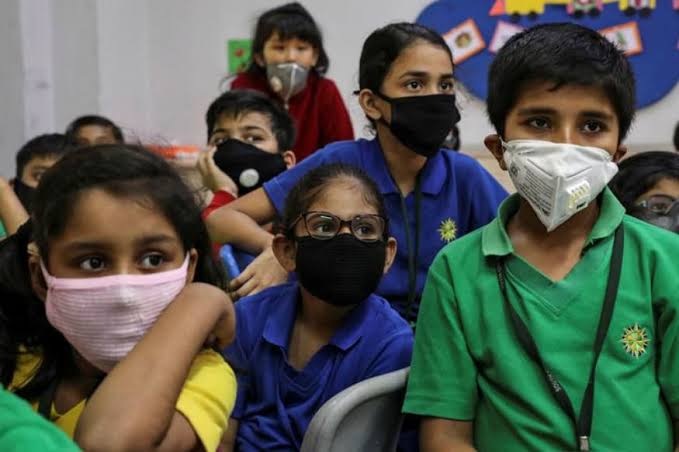
It has been a long time since the study of students of lower standard has been put on hold due to this novel Corona Virus.
this is necessary to maintain social distancing to provoke the spreading of the virus among the youth of the country who are considered to be the future of the nation.
Those students with having well educated parental control are getting their studies carried on with the help of their parents.
But those students, whose parents are not well educated, are waiting for good conditions to stroll out to carry on their studies.
Meanwhile students are losing their interest in studying and going out for school education.They are getting addicted to the virtual world of mobile phones and laptops. Which is surely harmful for their mental health as well as eye sight. they are losing what they learned in groups in classes .The feeling of team work which was usually developed in school education being erected from their mind. This erection is very harful to move with the society as well as for co-operation.
besides of this if we talk about graduate and above level students, it doesn’t seem that the students have any representation in education system. they are only considered for examination purpose now.whatever be the condition,corona cases and fear of students but they are getting pushed in exams by our government and universities.
In Universities, Mostly students are of out of cities, districts,states even countries in such situation where the markets are not fully stand up. All the Vendors are establishing their shops again after lockdown in rolling price high, students will have to face all the problems related to living and food and the health issues would be serious concern
Talking about Lucknow University, it has decided to take exams from 7 july. When university is surrounded by active hotspot.the Chief Minister Yogi ji has did very well in fighting with corona but this decision can be more severe.
some corona cases have already been estimated in the campus ,two professers were found positive 10-15 days earlier besides of this University has made the decision to start the exam with previous syllabus and module.
there is no certain infrastructure to deal with it how to resolve the problem if the situation gets critical in mid of the exam. Students are afraid as they would have to take public transport to get the exam and some of them not assured about their lodging and fooding.
Teacher association had already lifted his hands to deal the problem and sent a notice to the CM to cancel the exams for the present crisis in the norms of UGC.
The matter is to get inspected very carefully, as we have already some example of countries of corona spreading in school and colleges due to carelessness.
Meditation is a very important tool to manage stress and reducing anxiety and depression. It is a conscious effort of allowing your anxieties, fears, and anger to calm down so that one can order their own mind , eliminate the stressful thoughts and enhances physical and emotional well-being. It helps us in attaining peace of mind and soul and also helps us tune into a positive mindset.
Meditation can give us a sense of calm, peace and balance that benefits both your emotional well-being and your overall health. They also lead us to a state of self realization, where our mind is away from the anxieties of the past and the anticipations about the future. With emotional stability and calmness, one ends up feeling more confident and is able to face life. It makes people empathetic and thus able to understand others’ emotions, actions, and behaviors. It also improve our physical health by reducing strain on the heart, lowering blood pressure, improved blood circulation, less perspiration , improved data retention and focus , improved sleep patterns and deeper relaxation.
Types of meditation and relaxation techniques include:
1. Mindfulness
Mindfulness meditation practices require you to concentrate in your present. It ensures stability and control of the present state without getting disturbed by what comes or goes. We establish an embodied presence and learn to see clearly and feel fully the changing flow of sensations, feelings of both pleasantness and unpleasantness, emotions and sounds. For example : close your eyes and start breathing, neither long breaths nor too short ones. Breathe like you naturally do. Just that you are conscious about it, not controlling it in any manner. While you do so, you are sure to feel multiple sensations. What we want you to do is to just feel them, coming and going, not attracting any neither repelling one. You just rest and relax, without any judgement. When you practice this discipline of mindfulness meditation, and while you are onto exercising the breathing routine, your thoughts start mingling and flowing in the process. The intention is not to get involved with the thoughts or to judge them, but simply to be aware of each mental note as it arises.
2. Transcendental Meditation
This is a technique of detaching oneself and promoting harmony and self realization. It involves sitting up with your back straight. In this method, we use a mantra such as a word , sound or phrase repeatedly silently to narrow your conscious awareness and eliminate all thoughts from your mind. We focus exclusively on your mantra to achieve a state of perfect stillness and consciousness. It curbs insomnia, gives more power to our body and mind and increases productivity.
3. Walking Meditation
In this meditation, practitioners move slowly and continuously while staying aware of the body and mind. It encourages us to focus on each footstep in order to be fully present. We must take deep breaths , use good posture , take deep breaths, and experience the motions of the body. This allows us to cultivate a a sense of mind- body awareness by focusing on your body’s posture.
4. Mantra Meditation
In this type of meditation, we silently repeat a calming word , thought or phrase to prevent distracting thoughts and helps us concentrate on that one particular sound. In every moment that we pay full attention to the mantra, we are not disturbed by any other thoughts, memories, or sensations. This helps reduce stress and improves our concentration and well-being.
Meditation is a simple strategy that can help obtain better health and a happier life. It takes time to learn to meditate but the more we practice , the quicker we learn and the more benefits we get and hence this will certainly have a big difference in our life.
Even when we apply law ,it is not perfectly applied, when we will be left acquitted under the law, mistake of law is done by the convicted in Indian constitution where it is purely mention mistake of law is no defence. As our law is stratified ,superior always enjoys the power over inferior ,rule or any norms always passes through and superior to inferior even if Superior has a malaise intentions and inferior knows it, then also, superior will lead this always seems a major drawback of democracy, results, as we can see that politicians misleading their powers for their interest .
RESPONSIBILITY OF CITIZENS:
If people are on the lower hand and did it not follow The orders given by their superior ,eventually, they will get fired .Higher post in a major institutions is always filled by the public visit the present representative although ,evidently, as a democracy suggests that every citizen has the right of speech and expression suggested in article 19 of Indian constitution he or she can argue with these demagogue although this argument leads to the consequences Of suffering of the common man.
Magnificently it seems like they have no responsibility towards the public where on the other hand the same public shown their respect and faith towards this people and here comes out another drawback in which the educated people are left behind and here democracy denies this fact that educated people must be preferred as it violates article 14 of Indian Constitution right to equality education is left behind due to the leadership qualities in these people I do agree with the fact but probably will go with the educated people preferred over and educated one or the one having only leadership skills only.
Apparently it’s a fact which can easily be seen at many places these leaders don’t even know what development is, they are all over report of the secretaries and their subordinates. there is a reason behind of aiming at goal and achieving something which cannot be got in the absence of a thoughtful personality which acknowledge me that this elevates their credibility of free human hegemony by Play the religious code which often bring them better results as the card of caste always wins. These people are whole into corruption and political equivocal which ultimately resulting in the deprivation of the public development for their own deeds.
In the developing nation like India knowledge and innovative thoughts plays a very crucial requisites then some magniloquent behavior.
If we take this thing to the ancient time in the time of Mahabharata where Argon was a brilliant student of Dronacharya there also we can see that Arjun was having all the qualities to lead but their knowledge was the pro factor he taught the leadership skills but the knowledge to lead makes the odd work in the favour this can be a great lesson which can teach us how vulnerable are we if we are not going to educate people. This endangered the whole human civilization.
Music has emerged to be one of the major driving tools of life since the beginning of time. It does not confine itself into being a mere source of entertainment and its purpose transcends beyond our regular mode of existence while providing with a sense of peace and belongingness throughout the whole journey of life. Music therapy seems to have evolved as an effective therapeutic procedure that never fails to contribute to the betterment of mental health treatments across the globe. Music therapists use music as a developmental tool to help patients improve their social, emotional, psychological, aesthetic and spiritual life.
Apparently the concept of devoting a specific day to celebrate something as precious as music seems unlikely and baseless since music plays a huge role in our life on a daily basis to help us grow as individuals. However, the way it emerged is very interesting and it has found its way to establish itself as a remarkable day in our yearly timetable.
Festival of Music/ World Music Day aka Fête de la Musique was first celebrated in Paris on June 21, 1981. Although the initiative had been taken by American musician Joel Cohen in 1970s, France was the first country that made it possible to celebrate it in a royal manner for the very first time. This particular day also happens to be the longest day of the year. From 1981 onwards, this day has started to be celebrated as the World Music Day in over 120 countries which primarily focuses on recognizing the local musicians and their endless talents which are otherwise unnoticed and to some extent, ignored. In 1981, the culture ministers happened to organize an event that explored different strategies to bring out musicians on the street who would perform collectively. This event was a successful one that created a sense of harmony and unity amidst the chaotic monotony of life.
From this time onwards it has become a ritual in many countries where musicians come out on the streets and play their instruments for fun and entertainment and not any monetary purpose on this particular day. This concept started serving many purposes in the society which include but are not limited to conducting free concerts on the streets, creating a collective space where both the professional and the amateur musicians would feel free to show their art form, providing free and unlimited access to musical events to people who would otherwise not be able to afford it and bonding with people in general.
With the passing years, more and more people have started joining the venture. The way of celebration is subjective. People from different countries celebrate it in their own unique ways which has further created a diverse sphere among the countries where all aspects are different but music. This initiative therefore has eventually established itself as a collective movement that aims at creating a sense of togetherness and unity which never confines itself as a mere commercial source of entertainment. It allows everyone to involve themselves in a correlative space driven by music that knows no caste, religion, gender, age and goes beyond every preconceived mortal binary to achieve a state of endless peace and harmony.
Firstly define continuous improvement. Continuous improvement is a dedication to making small changes and improvements every day, every hour, every minute with the expectation that those small improvements will add up to something significant and increase your success rate rapidly. When we strive to become better than we are, everything around us become better too.
The classic path to self-improvement is to set a large goal, then try to take big surge in order to conclude the goal in as ln short time as possible. While this may sound good in theory, it often ends in emotional collapse, annoyance, and failure. Instead, we should focus on continuous improvement by slowly and some what accommodate our normal everyday habits and behaviors.
It is so easy to dismiss the value of making slightly better decisions on a daily basis. Attach with the elemental is not impressive. falling in love with disgust is not sexy. Getting 1% better isn’t going to make headlines.
How Does Continuous Improvement Work?
So often we convince ourselves that change is only meaningful if there is some large, visible outcome associated with it. Whether it is losing weight, building a business, traveling the world or any other aim, we are going to talk to everyone about some awesome improvement often put pressure on ourselves.
Meanwhile, improving by just 1 percent isn’t notable (and sometimes it isn’t even noticeable). But it can be just as meaningful, especially in the long run. Means our efforts never waste sometime their is no instant result but after 1week, 1 month, 1 year we can see the result or benefit.
Continuous Improvement Tools
Now, let’s talk about a few quick steps you can take right now to start focusing on continuous improvement.
Step 1: Do more of what already works
We often waste the resources and ideas at our fingertips because they don’t seem new and exciting.
There are many examples of behaviors, big and small, that have the opportunity to drive progress in our lives if we just did them with more consistency. Flossing every day. Never missing workouts. Performing fundamental business tasks each day, not just when you have time. Apologizing more often.
Progress often hides behind boring solutions and underused insights. You don’t need more information. You don’t need a better strategy. You just need to do more of what already works.
Step 2: Avoid tiny losses
In many cases, improvement is not about doing more things right, but about doing little things wrong.
This is a concept called improvement by subtraction, which is focused on doing less of what doesn’t work: eliminating mistakes, reducing convolution, and dispossess away the unimportant things.
Here are some examples:
Education: Avoid stupid mistakes, make fewer mental errors.
Investing: Never lose money, limit your risk.
Web Design: Remove the on-page elements that distract visitors.
Exercise: Miss fewer workouts.
Nutrition: Eat fewer unhealthy foods.
In the real world, it is often easier to improve your performance by cutting the downside rather than capturing the upside. Subtraction is more practical than addition.
One of the best ways to make great gains is to avoid little losses.
Step 3: Measure backward
We often measure our progress by looking forward. We set goals. We plan milestones for our progress. Basically, we try to predict the future to some degree.
There is an opposite and, I think, more useful path: measure backward, not onward.
Measuring backward means you make decisions based on what has already happened, not on what you want to happen.
Here are a few examples:
Weight Loss: Measure your calorie intake. Did you eat 3,500 calories per day last week? Focus on averaging 3,400 per day this week.
Strength Training: Oh, you squatted 250 pounds for last week? Give 255 pounds a try this week.
Every country in today’s era is working hard so as to make their economies strong and thus increase their GDP. This surely gives rise to better job opportunities to flourish, better infrastructure of the countries and also a tourism sector to thrive. India is one of the developing countries and has been able to mark it’s high GDP growth irrespective of its high population rate. But still there are various factors which makes it a bit tough for India to develop completely and cope up as a developed nation. The factor is dependency on other countries for most of the manufacturing technologies and products. India prefers importing most of the goods and services from other countries, and thus lacks its own manufacturing and research technologies. One of the most prominent country from which India is importing is China. China has been one of the most successful countries in exporting most of its products and thus achieving maximum productivity growth as compared to other big nations like the USA and Japan.
India is dependent on Chinese products for most of its cost saving benefits. Most of the products we do acknowledge and bully are Chinese as we do find them more feasible and lying in our budget. But still India is fighting back and stopping the import from China and various other countries and focusing on increasing it’s export to other countries. The mission and scheme as launched by our Prime Minister Mr. Narendra Modi of “Make In India ” has brought up various startups and investment in manufacturing technology and has led to growth of the country’s economy and job opportunities.
But still India does lack production and manufacturing of products at cheaper rates as compared to what China does. There are various things which do affect the cause of same which include:
Availability of cheap skilled labour: India being 2nd in world’s population, still lacks much of a literacy rate, which is not a case in China and other countries. People in China are much more skilled and educated . So companies do acquire much of these as a resource for their company at cheaper rates and thus reduce their manufacturing cost. While in India we lack much of literacy rate, thus affecting our availability of skilled labour
High production: Productivity as mentioned above of China is much more as compared to other countries. This reflects that they have an abundance of material which not only can be used for manufacturing products in their own country but also exported to other countries. India lacks much of the raw material required for manufacturing anything, so they do rely on foreign factors for manufacturing.
Selling products at cheaper rates : Chinese products are well known for their cheap rates. This mostly fascinates people to buy them. This surely leads to reduction in the sales of the other similar product and thus the company faces losses thus the company’s only 2 choices “Either to merge with that Chinese brand or to shut down”. It’s frequently bseen that most businesses and companies get off the business which gives these Chinese products a plus point and they become the lone survivor.And in future times they do raise the prices which market them with huge profits.
Production of duplicate or matching product: China has been investing more of its money in coping things,since we know for manufacturing of any new or original product, companies invest in it’s research work, qualified labour and number of tests and thus find the best and feasible product. China misses this step and jumps off to the production which saves a lot of money and also the manufacturing cost.
“There are many more reasons which give China and it’s product great power in our country. But we should understand the requirement of not investing our money in those Chinese products and rather bring up products manufactured in our own country so as to keep the countries money within the country. Also more startup ideas must be motivated to flourish and thus growth productivity must be targeted so as to manufacturers and use products made in our country only and rather from buying it from other countries, we must export them . These few efforts would bring out significant change which would lead our country to prosper be one of the developed countries in coming years”.
The Bhakti Movement, which moved in waves from one region to another, i.e., regionwise, originating from South India in the 6th century, is known for playing a vital role in shaping the social, cultural and religious life.
Basically, the Bhakti Movement began in the 6th century in South India and spreaded through out the country, which lasted till the 16th-17th centuries. Major Bhakti saints includes of – Kabir, Surdas, Raidas, Dadu Dayal, Eknath, Chaitanya Mahaprabhu, Tulsidas, Rahim etc.
The Bhakti Movement in India was marked by few major practices, such as –
The rejection of the existing ritual hierarchy and Brahmanical superiority.
The use of the vernacular in preference to Sanskrit, the language of the elite.
The emergence of the lower caste and non-literate individuals as great spiritual leaders.
Emergence of the women Bhaktas.
As mentioned above, it’s also not a very denying fact that the women too played a pivotal role in contributing for Bhakti Movement. The Bhakti traditions provided a space for women in the world of religion as well as everyday social relations. It was the patriarchal society and male dominated houses that paved the way for the emergence of the women saints. The Brahmanical rituals imposed a hierarchical social differences between men and women. Later, these were reversed by the rebelling women and thus, one can trace the emergence of the women saints from this point of time, thus.
The life and work of the women saints lie somewhere hidden unlike the male saints. This is partly because none of them established any guru-shishya parampara and none of the disciples are said to have has preserved the compositions of the women Bhaktas. Even lesser number of women were known for their spiritual greatness during their lifetime.
Some predominant women Bhaktas were-
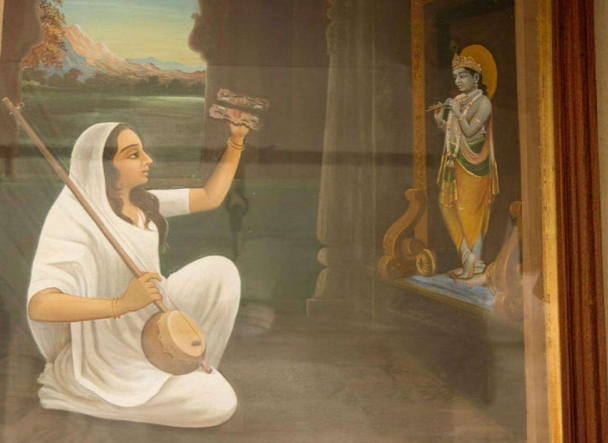
Meerabai in Rajasthan
Lalleshwari or Lalded in Kahsmir
Akkamahadevi in Karnataka
Sahajobai in Maharashtra
Meerabai
There were few exceptions like Meerabai, who constituted followers, but they were lesser in number. Unlike in the North India, women saints like Andal and Akkamahadevi were greatly recognized and admired in South India. As a matter of truth, Akkamahadevi was the leading member of a council of saints. In the context, the instance of Meerabai must be given. She was one of the major women Bhaktas of the 16th century. Although she didn’t attract a mass following but is recognized as a source of inspiration for centuries. According to some traditions, her preceptor was Raidas, a leather worker. This shows a complete defeat of the prevailing caste system and highly caste stratified society.
Now let us take a look on other major women Bhaktas of that period.
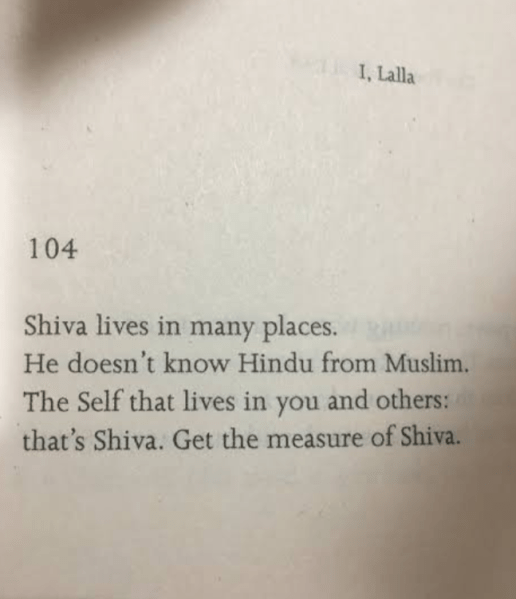
Lalleshwari or Lalded – she walked out of an oppositive marriage and opted for an ascetic oath. Also she composed several poems in praise of Lord Shiva.
One of the compositions of Lalleshwari or Lalded of Kashmir.
Bahinabai- she was again one of the best examples of women Bhaktas who defied all the caste and gender hierarchy, and came under the spiritual guidance of the Shudra saint Tukaram. She was herself a Brahman woman.
Akkamahadevi- she was one of the most famed women saints of Virashaiva tradition, who could walk naked on the streets, defying the patriarchal order and depicting a huge sense of courage. She was the one who considered Mallikarjuna or the Shiba as her husband.
Vinabai-she was the chief disciple of the saint Ramdas, who headed the mutt at Mirajal. The Ramdasi panth occupies a significant place in the history of the women Bhaktas, as this was the first time when a monastic institution was governed by a woman. This satirically shows a defeat of patriarchal and caste based society.
On the other side of the coin, although the women Bhaktas came up as individual spiritual leaders, but they were always under guidance or have remained disciples of male saints only, showing the prevalence of patriarchy in some sense. Hence, it is more logical to say that the women Bhaktas split between social confrontism and deviant rebelliousness, thus.
We all know that due to parents conflicts children also suffer a lot. Then also it is necessary to know that how these conflicts are harmful for children so that these conflicts are properly addressed by parents or family.
Any home is not free from conflicts pr arguments and every children sees parents arguing with each other. According to researchers if children see that they calmly and positively solving their disagreements and problems then it doesn’t have any negative effect on children. Infact, children learn conflict resolution skills and also use them in their lives and relationships.
If conflicts are frequent and it involves verbal insults, raised voice or when parents become physically agressive or when they withdraw themselves from argument and give each other a silent treatment or when conflict seems to threaten the intactness of family then it will be harmful for children.
According to the research, children show distress when parents fight, from a very early age. Their reaction can include fear, anxiety and there are a high risk of variety of health problems like disturbed sleep, difficulty in paying attention, performing good in school and due to which they become aggressive or internalize it in the form of depression, anxiety, withdrawal and dysphoria.
In research, it is also shown that children having high conflict at their homes are more likely to have poor interpersonal skills, problem solving abilities and social competence. It also have s negative impact on the romantic relations in adoloscences and adulthood as high conflict relations of one couple can produce negative relationships in next generation too.
These conflicts also have a negative impact on the parenting style of parent due to which it become harmful for the children. Parents who are in high conflict relations are more involved in agression, shouting, hitting etc, which may harm children.
Children experience physiological reactions related to stress which may harm their brain development. Parental conflict also have a varietal impacts depending on the age, sex and temperament of the child. Sibling relationship, attachment to the parents and socioeconomic pressure also impact how child react to conflicts.
So it is very important to notice what are you doing and how are you behaving infront of the child. Try not to argue infront of the child and if you are arguing or sometimes it happens by mistake always show your child, how positively you are solving that. Children are very sensitive so try not to do such things in front of the child which hurt them or lead to a negative impact on their development.
I practically cried when literally heard about Malala Yousafzai,the Pakistani blogger who fought for girl education and currently fighting for their rights. The youngest to win most prestigious Nobel Peace prize along with billions of hearts. But there are ongoing discussions on her overrating.
The allegations made on her despite bravery she showed were mentioned below which are depicted as conspiracy.
The three girls who shot during the same time didn’t get as much attention as Malala. The only girl who was hospitalized to London and the only girl who was being educated there was Malala which was one of the conflicting truth. The reason for shifting her to London hospital lies in severity of her injury. She was the one who got affected more due to the bullets. People write to defame her without knowing the actual truth.
She was victim of Taliban because of her dad since he rebelled against them. Being Ziauddin’s daughter made her special among Taliban. Her father made her to speak and she did it. It was her father who should be awarded not her. She did what is to be done. Her fater fought when Taliban attacked the school. The society we live in defame the daughter to fame the father. This is disgusting. Not everyone does what should be done. The so-called guts is necessary inorder to do few things. Her father made her speak but it’s her choice to speak and she spoke not only for herself but also for the rest. It’s her who spoke and world listened while she spoke.
She left the Swat valley and started to live happily in UK without bothering about her native. She never spoke about the wars in some other countries and never cared about the children of her valley after she left the place. People never speak about the happened and always bother about unhappened. She did everything she could and tried to do what she didn’t and failed it. She had a voice of women who are living not only in her region but the rest of the world.
Malala said, “I am ready to tell the world that Pakistan is safe place and teams can go and play cricket there”. If it’s safe then why are you in UK. The criticism she gets for every word she spoke is unbelievable. She tried her way best to make people of her country happy by making them view cricket match. She tried to bring happiness for her country and people depict it in a wrong way.
Another boy who has been shot 8 bullets didn’t get the same attention who tried to save the school attack from Taliban. He never spoke untill the moment. He had to do his job when it had to be done. He didn’t do when it wasn’t required. He had done a great job but what Malala shouldn’t be compared with it. She stood from the begining of war because she started the war.
She was the reason for the operation launched by Pakistani army namely Operation Rah-e-Rast. The army tried to finish its job within a month. SSG commandos tried to kill who resisted or captured who surrendered.
At least 20 people have died in clashes between Indian and Chinese troops along the disputed Himalayan border running along the Ladakh area of Kashmir. It is the first fatal clash since 1975 and the most serious since 1967.
Fighting broke out on Monday evening when an Indian patrol came across Chinese forces on a narrow ridge. During the confrontation an Indian commanding officer was pushed and fell into the river gorge. Hundreds of troops from both sides were called in and fought with rocks and clubs. Several fell to their deaths.
The Indian Army said there were casualties on both sides, and confirmed three of its soldiers were killed during the clashes, with another 17 later succumbing to injuries.
Beijing has refused to confirm any deaths on its side, but accused India of crossing the border twice and “provoking and attacking Chinese personnel”. The editor in chief of state-run the Global Times, said he understood there had been Chinese casualties, but the People’s Liberation Army wanted to avoid “stoking public mood” by comparing numbers.
Why now?
Tensions have been escalating since late April, when China sent thousands of troops into the disputed territory along the Line of Actual Control (LAC), bringing artillery and vehicles.
Analysts say the Chinese government, which has been more assertive in building infrastructure in the area, is anxious to frustrate any effort by India to upgrade its own military installations.
Their refusal to leave disputed areas, including the Galwan Valley inside Indian territory, has triggered shouting matches, stone-throwing and fistfights in key border areas. Last month, there was a massive brawl between patrols, but no deaths.
Earlier this month senior military leaders from both sides met and made a commitment to disengagement.
What is the history of the dispute?
India and China fought a war in 1962 over their contested border in the Himalayas. The war ended with a truce and the formation of a de facto boundary, known as the Line of Actual Control.
There has been an uneasy and fragile peace since, punctuated by skirmishes on the border, including in 2013 and 2017.
No official border has ever been negotiated, the region where the clashes occurred is hostile terrain, at high altitude and sparsely populated, running through the Ladakh region bordering Tibet, home to a Buddhist-majority population. It is a popular tourist destination.
What is the Line of Actual Control?
The LAC is a rough demarcation line separating Indian-controlled territory from Chinese-controlled territory. The exact location of sections of the line, particularly in the western Ladakh region, have remained in dispute. Efforts between the two countries to clarify the LAC have stalled in the past two decades,according to Indian media.
What do the two sides want?
Both countries have sought to establish their claims to territory, by heavily militarising the region. Both have built roads, airstrips, outpost stations, and other infrastructure, such as telephone lines. Troops conduct regular patrols along the disputed border. China claims more than 90,000sq km in the eastern Himalayas and another 38,000sq km in the west, both of which are disputed by India.
Everywhere we turn in life, there are expectations placed upon us. From birth, there are ways we are expected to behave, milestones we should achieve, choices we should make.
Who makes these expectations? Other people – virtually everyone we interact with has expectations on what we should do or be.
For the most part, this is all well and good. We are expected to uphold the law and be civilized members of society. If we are invited to an event, it goes unsaid that we are expected to arrive on time.
But what about the more grey areas of life? What about when we don’t want to do something other people want us to do, but feel pressured to do it?
Here are some things we should bear in mind whenever we encounter such situations:
First off, we should recognize that sometimes, expectations are just a figment of our oversensitive and insecure imaginations. The other person may not expect you to do the thing you think he expects you to do (sorry, that was a mouthful). Instead, he may just be offering it as a suggestion or as a piece of advice. It is always good to keep an open mind so that we hear them out, but we should also remember that people don’t give advice based on what’s best for YOU. They give advice based on what THEY would do in your shoes. (At least, this goes for most people.) It may not sound like a big difference, but it is. If you follow their advice and come to regret it later, you’ll only have yourself to blame. Because you did not understand that you and him are different, and what works for him may not necessarily work for you.
Second, if you are sure that it is clearly an expectation, then you must ask yourself: Why do you not want to meet this expectation? To answer this question, it is necessary to do some self-reflection. I am not saying that this feeling of not wanting to meet this expectation is wrong – on the contrary, I think it is an important step to take towards improving one’s self-awareness. Doing so will prevent situations like the one in the preceding paragraph, where you blindly follow advice given by others.
Most probably, you will find that you do not want to meet someone else’s expectation because your interests clash with his. Maybe you feel expected to babysit your nephews on a precious weekend when all you wanted to do was have some me-time after an arduous workweek, simply because your brother’s out of town. To agree or disagree? Or maybe you’re invited to attend the wedding of someone you don’t know very well. To go or not to go?
So assuming you’ve done the first and second steps above, and you’ve concluded that your not wanting to meet this expectation is due to a valid reason on your part (what is valid is up to you. YOU decide. Not others). But you still lack the courage to say no. The need to be liked is very strong in us humans, because we are social creatures. You see apes scratching each others’ backs and grooming each others’ fur? That’s what we are. If you don’t scratch my back and groom my fur, I’ll make you an outcast. That’s how our social fabric works.
To be able to say ‘No’ is not actually a question of having sufficient courage. It, like many other things, can come down to a simple logic test:
First, picture the expectation in your mind and the person who is making the expectation. If you gave in to this expectation, would that make you happy? I don’t think so, otherwise you wouldn’t be considering saying no.
So, if we assume you will be unhappy to give in to this expectation, then we should ask ourselves this question next: Will this person who is expecting us to do this thing still have this expectation, if he knew that we were unhappy to do it?
If the above scenario is true, then I’m sorry to say that this person has no understanding of who you really are, and does not care to know who you really are. All this person cares about is that he gets his way, and your happiness be damned. These are strong words, but the harsh truth is that human nature can be very ugly indeed. And if this is true about this person, we must consider and think real hard about why we are letting such a person determine what we should or should not do.
A person who truly cares about you will understand that you are not him. Therefore, his values are not your values. And it is not his right to impose his values over yours. Sure, he may be slightly disappointed that you may not feel or think the same way that he does, but he recognizes that that is precisely what makes you who you are – what makes you a unique and special person in your own right. And he respects that. If you can find such people in your life, hold onto them, for such empathetic people are truly rare.
There are some people who will read everything I’ve said above and conclude that I am simply trying to justify being selfish. These people completely miss the point because they fail to see that there is infinitely more value in something that is done spontaneously, freely and sincerely than something done out of resentful obligation. They may be proud to have done many things for the sake of others – to wear them as a badge of selflessness, perhaps. But the truth of it is that they valued their own face more than being true to themselves. In the end, they wanted to be liked not for who they were, but simply to be liked. And that is a real tragedy, that people are so willing to sell their own personalities and beliefs for the unattainable allure of universal adoration.
I must emphasize in my conclusion that all of this works both ways. Just as we must remember to stay true to ourselves whenever we are faced with external pressures, we must also remember not to become a source of pressure and expectations upon the people around us. When we are thinking only of ourselves, it is easy to fall into this line of thinking where you expect other people to simply conform to whatever you want them to be. So just as we must recognize this ugly trait in the people around us, we must also be vigilant to prevent any manifestation of it in ourselves. In other words, the Golden Rule applies.
If you skipped all the way to the end, or skimmed everything and forgot most of it, here’s the gist: Don’t become someone you’re not. Don’t blindly do what others want you to do. Recognize your self-worth and your rights and your freedom. Dare to be yourself.
“Be who you are and say what you feel, because those who mind don’t matter, and those who matter don’t mind.” ― Bernard M. Baruch
This life is a gift, and those who embrace it live it the most. It is astounding how much we can do with this gift, and as we evolve, we combine our thoughts and dexterity to create a remarkable device, machines which change the way we live. Such is this device- the intelligent box, which is one of our most fabulous creations. Who thought in the previous century that a human being would be able to see another one while sitting at home when the other is sitting at a far corner of the world? A parent sends his child to school to provide education. However, a school to has its limits. Theory outweighs practicality in many ways in schools but with channels such as Discovery, National Geographic and the History Channels, watching TV can be as educational as going to school.
Most people are limited in the amount of travel they can do. So, they can learn about different people and places as TV opens up the world, whether through watching documentaries or drama series with multicultural characters or simply watching travel channels. It is the power and reach of the intelligent box. TV provides food channels through which people can learn how to cook cuisines that many cannot teach. In this day and age, people do not have the time to meet and interact. A TV brings information closer to us and becomes a great medium to discuss matters of common interest. For instance, a father can talk about politics or sports to his son even if he gets one hour to spend with him. It is an irony of life that the rich run miles to reduce their fat. There are yoga classes on TV, aerobics and other fitness programs for the rich. The power of the world comes to us, and we do not have to run for it. One of many ironies is that people are so much occupied in the mundane treadmill of life that they seldom get opportunities to smile and laugh. As a result, health deteriorates. Since laughter is the best medicine as it has been found to increase circulation, lower blood pressure and do much more; watching a good comedy on TV can be a great way to find something to laugh about.
People can watch contests like Indian Idol and can support their favourite contestants. Shows like DID and other singing competition induce an urge to learn these arts. These are platforms for excellent talents to showcase their skills and also a launchpad for the people who are skilled to build this platform for others. If TV is not an intelligent box, it is not an idiot box.
God helps those who help themselves. Whatever we humans have achieved is a credit to out labour, i.e. work. We owe our success to our endeavours. Work is the root of all progress. It is believed that there is no alternative to hard work yet, with changing times, it has altered into smart work. Man has walked on the moon, devised weapons of mass destruction, created breakthroughs in all conceivable fields of study through his work. Indeed, when a man worships work, fruits of tenacity are reaped. To reach the level of worship, one must whole-heartedly be sincere and persevere.
Even in Bhagwad Gita, it is clearly stated that ‘Karma is Paramount’. Lord Krishna imparted a lesson in Arjun that, ‘Action is the duty and reward is not your concern’. The thread of karma weaves our destiny. It is not just Gita, every other religion has somewhere, or the other mentioned ‘Karma’. We have been endowed with the gift of free will. Hence, we must transform this feature into efforts to attain our goals in life.
Work is also what makes us feel lively. Without it, our lives would be mundane, dull and uninteresting. We have, over generations, developed directions in our lives by way of forming cultures and civilisations. We have been able to do this by worshipping work.
An idle mind is the devil’s workshop, and a concentrative mind coupled with smart, hard work leads to higher wisdom. We need to put efforts even to eat our food.
We study and worship work at school. Over multiple years of our hard work, we develop our respective personalities and forge our identity in this world. So, let us work and worship it for a bright future.
How our mind works, we can’t be too sure. But according to study mind is working just like heart. It means that how hurt is pumping up and down regularly like it Brain also controlling all the parts of our body. But interestingly Brain is also makes it separate from other parts, an unbelievable fact is that after a human death then also for few hours it is alive and try to communicate with other parts. But due to no communication it silently makes it close down completely.
Mood swings of a lady
It also makes us feel happy or sad. And brain is only that thing due to which we are superior to other creatures in this planet. Science is made just from the observation of our Brain. And for it doesn’t matter that if we know about it earlier or not. Through the high logical thinking analysis, we can understand the things easily. Not only this, we can also make super things through the brain. For example Space Ship,Rockets,and many more things.Those who control their mind and study on a topic,they are called Scientist. They are also one of among us. So the real thing is that if we can control over Brain and make it use to in a study, we can also find amazing things about that. And it’s really cool.
But we should also Know that if we can’t control our brain, then it can also harm us. So we should concentrate on our study also aware of good and bad outcomes of it. Thanks for reading my article ….
On 20 June 1969, a great human being, patriot also an artist, actor, painter, music composer, poet and writer of Assam left for heavenly abode, who is popularly known as Kalaguru Bishnu Prasad Rabha. He passed away at the age of 60 years at Tezpur, Assam, the Date (20 June) presently celebrated in Assam as ‘Bishnu Rabha Divash (meaning day)’. Kalaguru (meaning master of the arts) was born on 31 January 1909 in ST family in Dhaka (now in Bangladesh), then Bengal Presidency of British India.
Bishnu Rabha’s schooling started at Tezpur Government High School, Assam and later on he went to Calcutta now Kolkata for perusing higher education. He was a great patriot and from young age, he was in freedom movement and was influenced by leftist ideology so ardent supporter of the Communist Party of India. However, when Germany attacked Soviet Union during Second World War, the leaders of Indian communists decided to support the British Government which antagonised a section of the communist leaders and subsequently they formed the Revolutionary Communist Party of India (RCPI) in 1945 where he joined.
Anyway Kalaguru was a genius in creative activities. His work Bano Kobang depicts the life of various indigenous Assamese communities. His other works inter alia are MissingConeng, Sonpahi, Axomiya Kristir Hamuh Abhakh, and Atit Axom. Bishnu Rabha was a great poet also and composed many songs which are known as ‘Rabha Sangeet’. He had given music to most of his songs. He was a visionary, and through music, dance, acting, writing, etc., he endeavoured to realize his dream of a greater, prosperous Assamese society with every ethnic group as equal partners. He acted in a mobile theatre group of that time named ‘Ban Theatre’. He directed an Assamese film ‘Siraj’, where he also composed the music. Further, he acted in the movie ‘Era Baator Xur’. It is pertinent to mention that he was awarded the title ‘Kalaguru’ by Sarvapalli Radhakrishnan at Varanasi for his enthralling ‘dance of Lord Shiva’. Bishnu Rabha worked towards popularizing Vaishnavism initiated by Srimanata Sankardev (Saint and scholar) in Assam in 15th century. He painted portraits of both Sankardev and Madhavdev with water colours, awesome creation. He was a great human being also and always had feelings for the underprivileged and poor echelons of the society. He donated about 2500 bighas (1 bigha is approximately equal to 0.40 acres) of land received from the British Government to the peasants. His slogan was “Haal Jaar Maati Taar” means “those who cultivate, should own the land”.
He has passed away although on 20 June 1969 but he will be in the heart of millions for his genius activities.
The Following websites have been consulted while writing the paper:










 Eduindex
You must be logged in to post a comment.