About 3 months back, our cat gave birth to 4 adorable little munchkins. Especially, one of the 4, with a coffee brown colored fur, as soft as a cloud, big blue eyes and an adorable pink colored nose. It had caught my eyes and I was adamant on keeping him. But alas! We already had a dog and a male cat, both of whom were clearly not appreciating the recent addition to their family and so my mother decided that all of the kittens had to go. It had all happened about 1 month back.
And so the search began- the search for perfect loving safe house for the cats. And we found one. But the cats were 4. And so my mother let the adoptee decide who very happily picked my little kitty. But, I was adamant on not letting go. If I couldn’t keep him for myself, I will at least keep him with me for as long as possible, I decided. And so, I didn’t let him go at the first chance he got nor at second and third. Now, we aren’t meeting any more people who are willing to adopt a pet kitten and so he is still with us. All this had me thinking that a lot of times we do not let go the ones that we love
Yamuna is largest tributary of Ganga River.Under Namami Gange Programme,National Mission for Clean Ganga (NMCG) has sanctioned 23 projects costing Rs. 4290 crore for creating / rehabilitation of 1840 Million Litres per Day (MLD)Sewage Treatment Plant (STP) capacity in Yamuna basin. These 23 projects are spread in Himachal Pradesh (1 project), Haryana (2 projects), Delhi (12 projects includes consultancy project & public outreach project) and Uttar Pradesh (8 projects). Out of these 23 projects, 6 projects have already been completed. Upto December 2021, NMCG has released an amount of Rs. 1593.32crore for all the ongoing 23 projects for river Yamuna.
The cleaning of river is an ongoing process and this Ministry is supplementing the efforts of the States for checking the rising level of pollution of river Yamuna by providing financial assistance to States of Himachal Pradesh, Haryana, Delhi and Uttar Pradesh. The aforementioned projects are in different stages of planning/construction/completion. Close monitoring is being done to ensure timely completion.
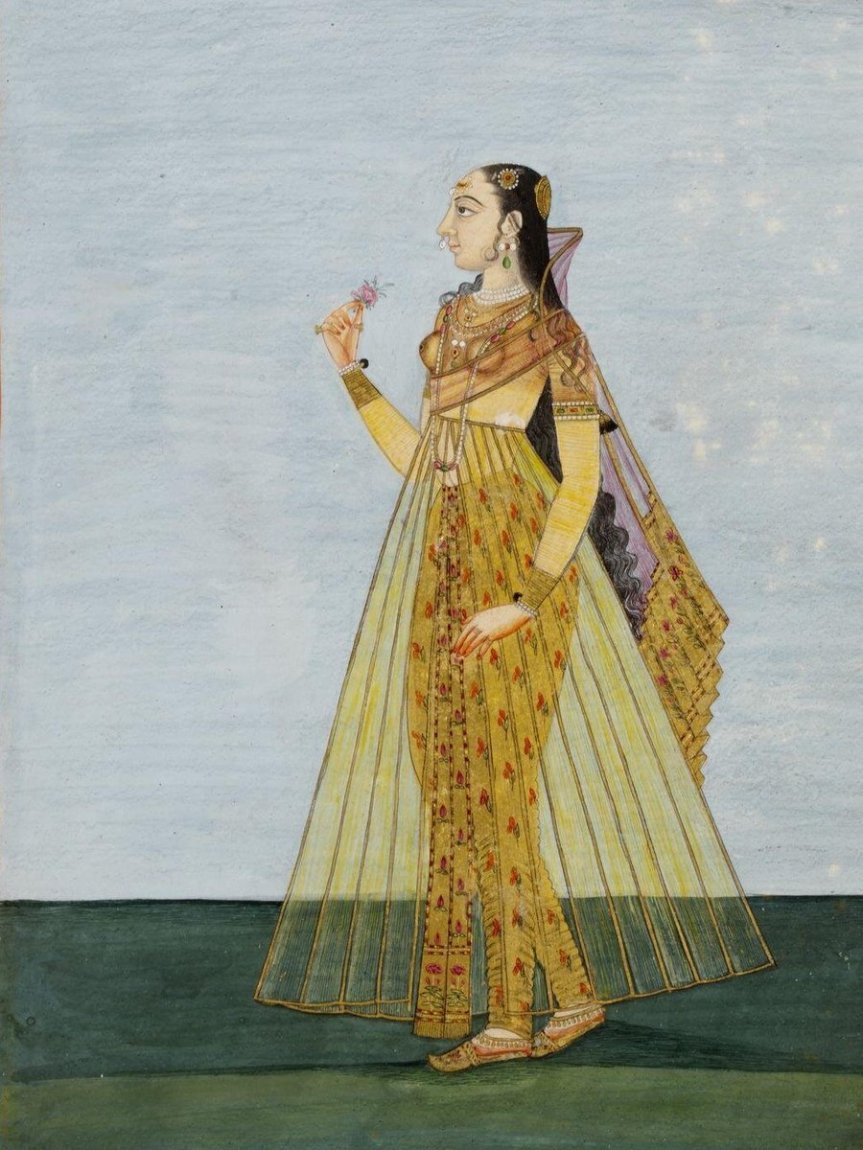
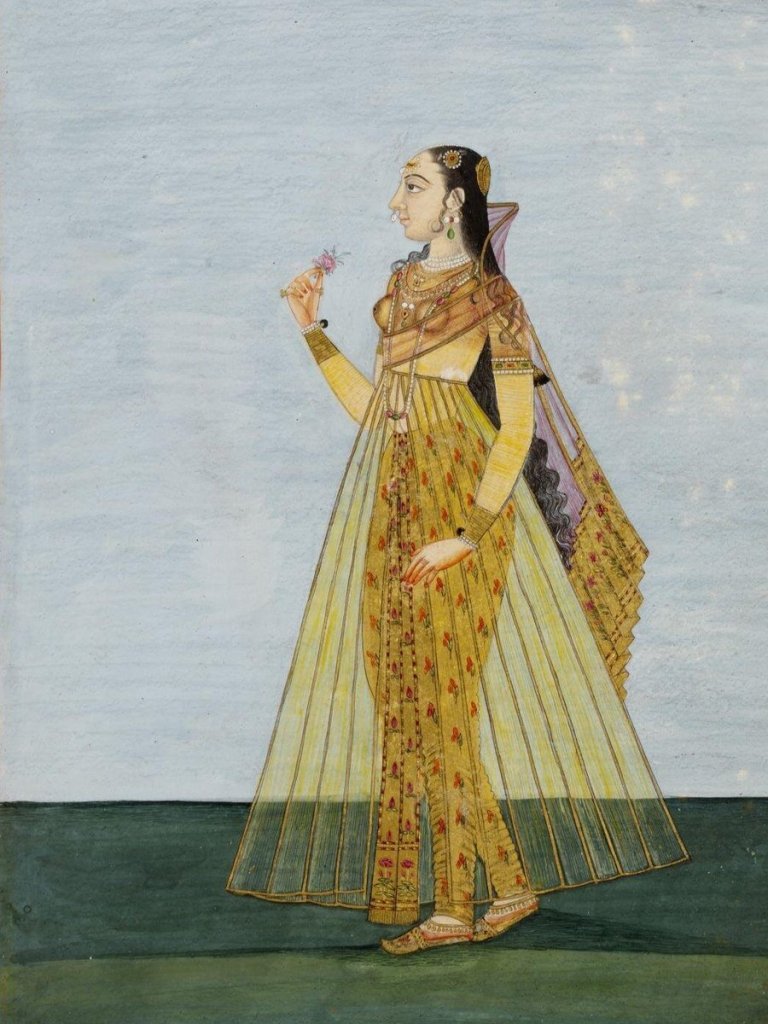
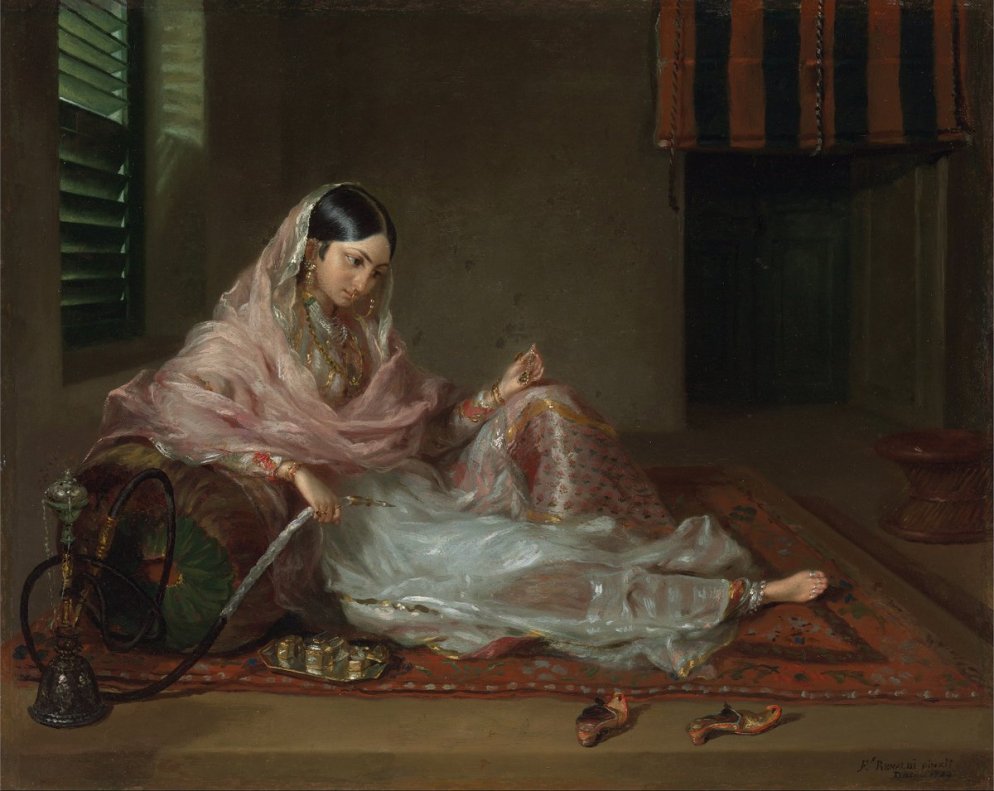
A portrait illustrating how Transparent Muslins were
Introduction
Muslin today has come to mean almost any lightweight, gauzy, mostly inexpensive, machine-milled cotton cloth. The word has lost all connection to the handwoven fabric that once came exclusively from Bengal. Cotton, stated the historian Fernand Braudel, was first used by the ancient civilizations on the Indus, while the art of weaving itself has been traced back to much earlier times. This head start perhaps was why ancient India became proficient in making cotton textiles. They became a staple export commodity to the Roman Empire, and they expanded in volume in the Middle Ages with the growth of the “maritime Silk Road” in the Indian Ocean.
Historic Background
Muslin a brand name of pre-colonial Bengal textile, especially of Dhaka origins. Muslin was manufactured in the city of Dhaka and in some surrounding stations, by local skill with locally produced cotton and attained world-wide fame as the Dhaka Muslin. The origin of the word Muslin is obscure; some say that the word was derived from Mosul, an old trade centre in Iraq, while others think that Muslin was connected with Musulipattam, sometime headquarters of European trading companies in southern India. Muslin is not a Persian word, nor Sanskrit, nor Bengali, so it is very likely that the name Muslin was given by the Europeans to cotton cloth imported by them from Mosul, and through Mosul from other eastern countries, and when they saw the fine cotton goods of Dhaka, they gave the same name to Dhaka fabrics. That the name Muslin was given by the Europeans admits of little doubt, because not only Dhaka cotton textiles, but cotton goods imported by the Europeans from other parts of India like Gujrat, Golconda, etc were also called Muslin.
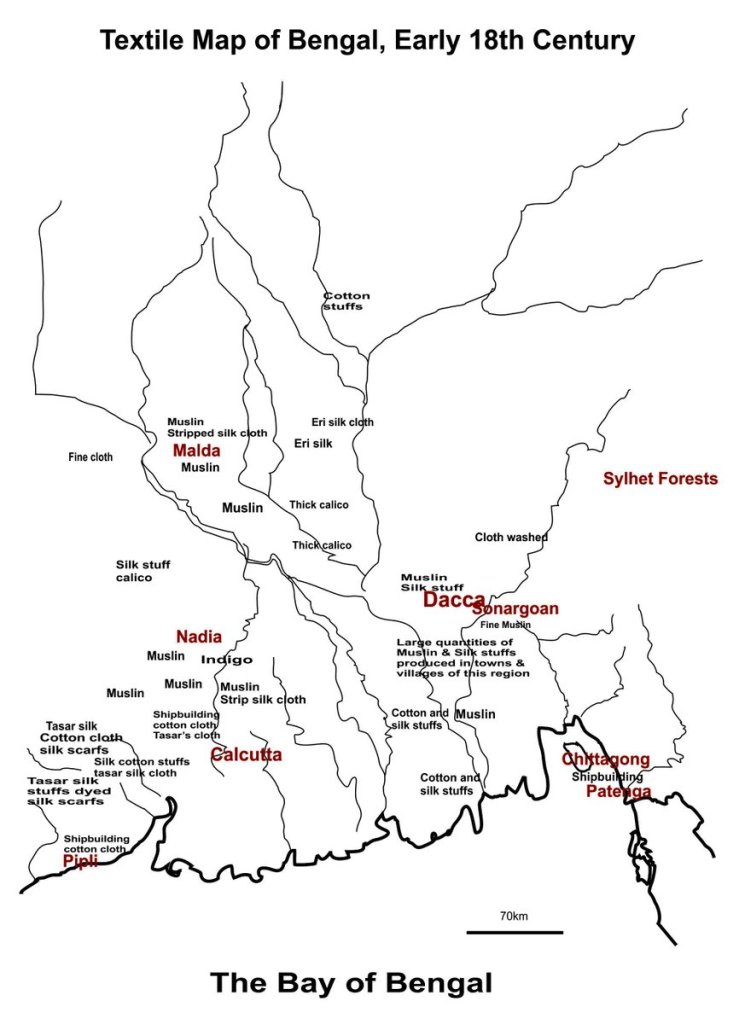
The route connecting the Hubs of Muslin Industry in Bengal
How Muslins Were Made
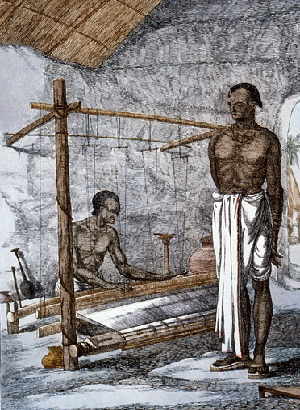
The textile industry of Bengal is very old. Bengal cotton fabrics were exported to the Roman and the Chinese empires and they are mentioned in Ptolemy’s Geography and the Periplus of the Erythraean Sea, and by the ancient Chinese travellers. But Dhaka Muslin became famous and attracted foreign and transmarine buyers after the establishment of the Mughal capital at Dhaka. The Muslin industry of Dhaka received patronage from the Mughal emperors and the Mughal nobility. A huge quantity of the finest sort of Muslin was procured for the use of the Mughal emperors, provincial governors and high officers and nobles. In the great 1851 Exhibition of London, Dhaka Muslin occupied a prominent place, attracted a large number of visitors and the British Press spoke very highly of the marvelous Muslin fabrics of Dhaka. Weavers in Dhaka, Bangladesh, used to make this incredibly fine cloth using a method called the discontinuous weft technique. This technique required the weaver to work two layers of weft – one as fine as spider’s silk to hold the cloth together and the other forming the pattern. Each pattern motif was worked individually, using fine bamboo sticks to interlace the pattern threads with the warp threads.
Weaving of Muslins under the supervision of royal official( Painting, in 1800s)
Types And Variations
The finest sort of Muslin was made of phuti cotton, which was grown in certain localities on the banks of the Brahmaputra and his branches. The other kinds of cotton called bairait and desee were inferior and were produced in different parts of Dhaka and neighbouring areas; they were used for manufacturing slightly inferior and coarse clothes.The productions of Dhaka weavers consisted of fabrics of varying quality, ranging from the finest texture used by the highly aristocratic people, the emperor, viziers, nawabs and so on, down to the coarse thick wrapper used by the poor people. Muslins were designated by names denoting either fineness or transparency of texture, or the place of manufacture or the uses to which they were applied as articles of dress. Names thus derived were Malmal (the finest sort), Jhuna (used by native dancers), Rang (of transparent and net-like texture), Abirawan (fancifully compared with running water), Khasa (special quality, fine or elegant), Shabnam (morning dew) Alaballee (very fine), Tanzib (adorning the body), Nayansukh (pleasing to the eye), Buddankhas (a special sort of cloth), Seerbund (used for turbans), Kumees (used for making shirts), Doorea (striped), Charkona (chequered cloth), Jamdanee (figured cloth). The finest sort of Muslin was called Malmal, sometimes mentioned as Malmal Shahi or Malmal Khas by foreign travellers. It was costly, and the weavers spent a long time, sometimes six months, to make a piece of this sort. It was used by emperors, nawabs etc. Muslins procured for emperors were called Malbus Khas and those procured for nawabs were called Sarkar-i-Ala. The Mughal government appointed an officer, Darogah or Darogah-i-Malbus Khas to supervise the manufacture of Muslins meant for the emperor or a nawab.
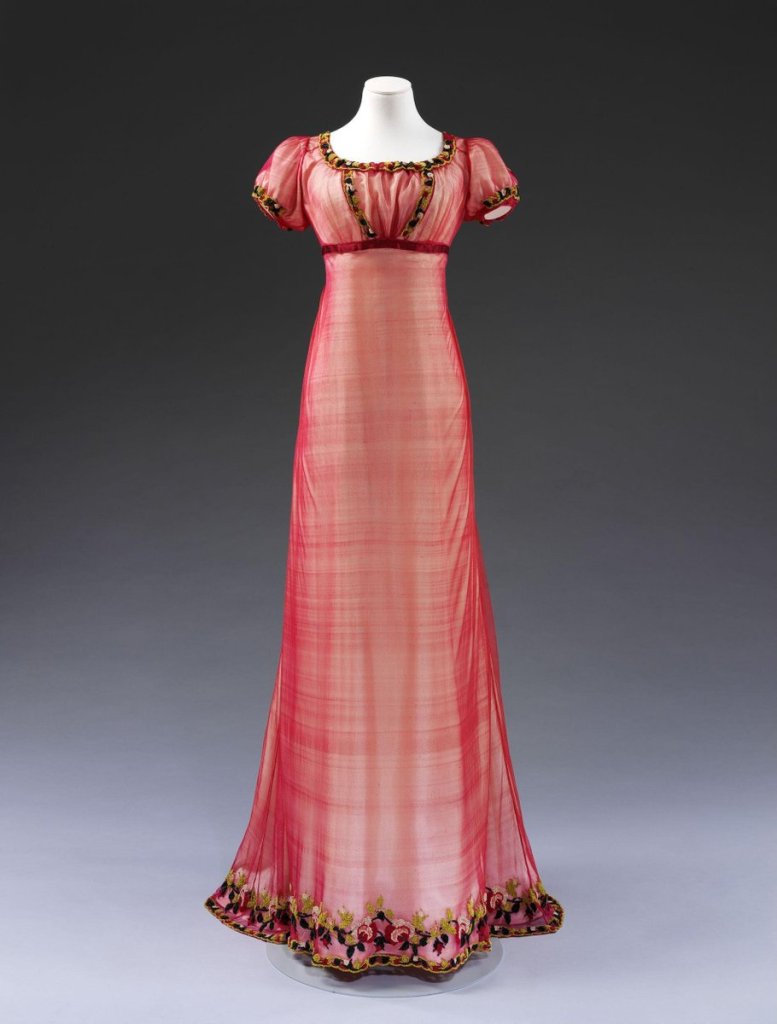
A real Muslin dress exported to England from colonized India
Areas of Production
Weaving was prevalent in the Dhaka district in almost every village, but some places became famous for manufacturing superior quality of Muslins. These places were Dhaka, Sonargaon , Dhamrai, Teetbady, Junglebary and Bajitpur.
Why It Was So Exclusive
The finest of Muslins were honoured with evocative names conjured up by imperial poets, such as “baft-hawa”, literally “woven air”. These high-end muslins were said to be as light and soft as the wind. According to one traveller, they were so fluid you could pull a bolt – a length of 300ft, or 91m, through the centre of a ring. Another wrote that you could fit a piece of 60ft, or 18m, into a pocket match-box. Dhaka muslin was also more than a little transparent.
Muslins were adored by the elites
How The Industry Was Lost
Unfortunately, during the period of the East India Company, European manufacturers all but destroyed the industry by flooding the market with factory produced muslin equivalents. Through a combination of punitive taxes on locally produced textiles and the dissolution of local and influential patrons, Jamdani muslin became uneconomical to produce and the skills were almost lost.
Conclusion
Thankfully, there are organisations in Bangladesh today that are encouraging local weavers to continue to practice their craft. Coupled with the UNESCO listing of Jamdani muslin on its Representative List of the Intangible Cultural Heritage of Humanity, there is more impetus to continuing production, albeit on a very small scale. With the proliferation of mass produced and synthetic fabrics on the market today, it is important that these historical techniques aren’t lost forever. No factory can ever emulate the quality arising out of a skilled artisan. Their skills are part of our textile heritage and it’s wonderful they are being recognised and preserved.
Union Education Minister Shri Ramesh Pokhriyal ‘Nishank’ today inaugurated the two-day Virtual International Akhand Conference ‘EDUCON 2020’ through video conferencing. This two-day International Conference is being organized by Central University of Punjab, Bathinda (CUPB) in collaboration with the Global Educational Research Association (GERA) under the patronage of Prof. (Dr.) Raghavendra P. Tiwari, Vice Chancellor, CUPB & Padma Shri Dr. MahendraSodha (Patron, GERA). The focal theme of EDUCON-2020 is Envisioning Education for Transforming Youth to Restore Global Peace.
Union Education Minister Shri Ramesh Pokhriyal ‘Nishank’ appreciated CUPB for choosing the appropriate and relevant theme for the conference. He stated that this two-day Akhand Conference will pass on the message to the researchers and students across the globe that the research is a 24X7 exercise and requires strong perseverance. He opined that this international conference will help the prospective teachers to become familiar with different technologies and their functioning to bring transformational change in the field of education. He expressed hope that deliberations made during EDUCON2020 by internationally-acclaimed speakers & young researchers will certainly prove to be significant in preparing a roadmap for effective implementation of NEP-2020 and developing necessary skill-set among youngsters to enable them to contribute towards building an AtmaNirbhar Bharat.
Shri Ramesh Pokhriyal ‘Nishank’ emphasized that the National Education Policy, 2020, is revolutionary in all aspect, as it focuses on multiple aspects of promoting mother language at primary level education, imparting vocational skills training for students at the secondary level & other innovative reforms. He further stated that NEP emphasizes on the interdisciplinary studies & integrated course curriculum in higher education for wider learning opportunities, with an aim to provide value-based holistic education, development of scientific temper and imparting skill training to youngsters. He further added that this policy also considers the need to design framework for extended use of technology in the teaching-learning process, development of online course contents, the introduction of Academic Bank of Credits and establishment of National Research Foundation (NRF) and National Educational Technology Forum (NETF), which would benefit the Indian scholars to compete at the global level. He gave the mantra of ‘Perform, Reform and Transform’ for successfully implementing all new imperatives of NEP-2020 essential for changing the society and transforming the life of youth for evolving global peace.
In his opening remarks Prof. Raghavendra P. Tiwari, Vice-Chancellor, CUPB said that CUPB is committed to quality higher education and cutting-edge research, this Conference will provide a platform to researchers and educationists to share their views on drawing strategic-plan for implementing the recommendations of the student-centric National Education Policy-2020, which is rooted in our Indian Culture and Value System. He informed that the Conference will focus, from the global perspectives, on various paradigms of NEP-2020, intended to transform the ‘learning system of our nation’ to meet world standard by empowering youth with the global competencies- thereby realizing the vision of the Prime Minister ShriNarendraModi. He said that deliberations of the conference would bridge out the connection between our past heritage and future education system to re-establish Bharat as the Vishwa Guru in the field of education.
In this International Conference, scholars from United Kingdom, Canada, Thailand, USA, Australia, Bhutan and India would be continuously discussing on the ten subthemes of the focal theme ‘Envisioning Education for Transforming Youth to Realize Global Peace’ for 31 hours. This conference is the first of its kind in India where scholars across the world would be continuously having a non-stop marathon dialogue sessionsfor 31 hours exploring the possibilities of the use of ICT in the higher education to promote the equitable quality education in India. Further, the conference will also provide a platform for discussions on emerging trends in education viz., likely scenario of higher education and school education by 2050, developing disruptive technologies for STEAM (Science, Technology, Engineering, Arts and Mathematics) Education, training youth for strategic future jobs in Universities, skill training programme for future graduates and relevance of ancient education system in 21st century.
Part of a comprehensive stress relief plan involves finding ways to calm down quickly so you can more effectively manage stress as it comes while avoiding the negative effects of chronic stress. Another important way to relieve stress is to maintain healthy lifestyle habits.
Learning to live a healthy lifestyle often brings additional benefits too, such as an endorphin rush, a release of frustration, or added longevity. Many of the healthy lifestyle habits discussed here can also help you to become less reactive to stress, in the long run, providing protection against stress you haven’t even experienced yet
While maintaining healthy habits is a bit more challenging than trying a stress relief method only once, the benefits you receive from maintaining a healthy lifestyle are more than worth the effort it takes to maintain it. The increases in health and wellness that you experience, as well as the reduction in stress, will make you wish you’d made these changes sooner, and can be wonderful sources of continued motivation.
CHANGES CAN BE INTIMIDATING:
Many people feel intimidated or frustrated with making healthy lifestyle changes for a few reasons, including:
Not knowing where to start: There are so many changes that can benefit health and wellness that it can be difficult to know how to begin.
Doing too much at once: People often try to make too many changes at once, then find it too difficult (or let perfectionism sabotage their efforts) and give up the effort.
Stress: Let’s face it—change is difficult, especially when you’re stressed. Sometimes lifestyle stress takes over and diminishes your momentum.
Given that living a healthy lifestyle can help with stress relief, and that making healthy lifestyle changes can be challenging, the following resources can help you with both choosing new goals for healthy living and with making these new goals a reality by adopting new healthy habits into your lifestyle.
HEALTHY LIFESTYLE CHOICES:
Here are some changes you can make to lead a healthier, less stressed lifestyle:
Healthy eating: One of the most popular changes people like to make to live a healthy lifestyle is to eat differently. Because of the negative health consequences of obesity, the influence fitness has on our self-esteem, and the effects on nutrition on our stress levels and longevity, switching to a healthier diet brings some of the greatest benefits for wellness.
Regular exercise: Getting regular exercise is another wonderful way to keep your weight in check, manage overall stress levels, and stay connected with others. Exercise can also help keep many health conditions at bay and is well worth the effort. The trick is to start gradually and work your way up.
Quality sleep: People often underestimate the importance of getting enough sleep, and getting the right type. However, lack of adequate sleep has many negative consequences—they’re subtle but significant. Getting enough sleep isn’t one of the most popular changes that people resolve to make, but it should be. Because stress can rob you of sleep, and because many of the techniques that promote sleep can also reduce stress , it’s a very good idea to learn more about how stress affects sleep and how to get quality sleep when you’re stressed.
OTHER BENEFITS:
The great thing about moving is that just a few minutes a day can have other lasting benefits, many of which you may not even be aware of. Just some of the benefits include:
Enhances self esteem
Helps maintain flexibility as you age
Improves joint stability
Improves memory in elderly people
Improves mood and reduce symptoms of anxiety and depression
Increases and improves range of motion
Maintains bone mass
Prevents osteoporosis and fractures
Reduces stress
Reduces the risk of heart disease, stroke, and diabetes
HOW TO MAINTAIN A HEALTHY DIET :
Eating a healthy diet is another part of a healthy lifestyle. Not only can a nutritious diet help with weight management , but it can also improve your health and quality of life as you get older.
You already know about the food groups and the fact that it is recommended that you eat more fruits and vegetables and fewer processed foods. You probably have a list of things you know you should do for a healthier diet but, again, making too many changes at once can backfire. Going on a restrictive diet may make you crave the very foods you’re trying to avoid.
Another approach is to look for ways to make smaller changes each day.Just a few ideas for changing how you eat include:
Cut back on sugary beverages. It’s easy to consume excess sugar and calories in the beverages that you drink. Sugary sodas, sweetened teas, juice drinks, and high-calorie coffee drinks can easily eat up your daily recommended allowance of added sugars. Consider drinking plain water or water flavored with fresh fruit or herbs. It’s a great way to stay hydrated and still get a burst of flavor.
Eat low-fat or fat-free dairy. Switching to skim milk or fat-free yogurt is another simple way to eat fewer calories without having to change too much in your diet.
Eat more fruits:Add it to your cereal, salads, dinners, or make it a dessert. The fruit is also a great snack after work or school to keep you going for dinner.
Make some substitutions. Look through your cabinets or fridge and pick three foods you eat every day. Write down the nutritional content and, the next time you’re at the grocery store find lower-calorie substitutes for just those three items.
Sneak in more veggies. Add them wherever you can—a tomato on your sandwich, peppers on your pizza, or extra veggies in your pasta sauce. Keep pre-cut, canned, or frozen veggies ready for quick snacks.
Try a healthy salad dressing: If you eat full-fat dressing, switch to something lighter and you’ll automatically eat fewer calories. You can also put the dressing on the side and dip, or even try making your own dressing.
CONCLUSION:
Creating a healthy lifestyle doesn’t have to mean drastic changes. You may adapt to change better when it doesn’t require you to overhaul your entire life. Just pick one thing and work on that one thing every day, letting the rest of your life and habits stay the same. You may be surprised that those small changes really can make a difference.
Kashi Vishwanath Temple is regarded as one of the oldest and most famous temple situated in India. The temple is believed to be dedicated to Lord Shiva and is one of the jyotirlingas of Lord Shiva. It is located on the west of the bank of sacred river Ganga in Varanasi, Uttar Pradesh.
In India, the Phase 1 of project of Kashi Vishwanath Corridor was inaugurated by the Prime Minister Shri Narendra Modi recently on 12 December 2021. The stone of foundation was laid on March 8, 2019. 23 other buildings are also inaugurated as a part of Kashi Corridor project. These buildings includes Vedic Kendra, facilitation centre for tourists, food court, city museums, gallery for viewing etc. It is the first huge renovation of the Kashi Vishwanath Temple as well as it’s surroundings, post the makeover by the Queen of Maratha. While the transformation of the Kashi Corridor, few other 40 temples of the ancient era were restored and rediscovered without distorting the original structure.
The corridor is 400 metre long. The Ghats along the holy river Ganga and the Temple of Kashi Vishwanath are connected by the project providing an easily usable pathway of open space for the pilgrims of Kashi Shrine to take sacred dip in the Ganga and also offering the sacred water at the temple. Mr. Bimal Patel was the architect of the following project. The most prevalent temple architecture in Northern India, the Nagara style was followed to construct the temple. The Jyotirlingas which is worshipped is a stone of dark brown colour and is enshrined in the Sanctum which is placed on a silver platform. The main temple is an open space area with buildings around it, basically it is surrounded by the other God’s shrines. Smaller shrines in series are consisted in the complex of the temple. To the north of the temple is a small well called the wisdom well ( Jnana Vapi). There is Congregation Hall (Sabha Griha) leading to the inner Sanctum Sanctorum ( Garbha Griha).
The tourism in Varanasi is believed to be boosted by the project of Kashi Corridor by furnishing the tourists, travelers and pilgrims all the essential facilities such as proper wide roads, clean water for drinking etc. Post inauguration, Varanasi has become one of the most captivating place for tourists in India. A great number of tourists would visit Varanasi in near future as it is now amongst the most admired destination of religion in India. An easy access for the old age and disable people is provided with the facilities of escalators, ramps and other modern provisions. It would also be a boost to local economy and the heritage will also be rightly preserved.
I felt obligated to read this because I’d already suffered through the rest of the series, and I couldn’t just.. not finish it. But my god. This entire series is so, so awful. And I’m a sucker for crappy entertainment, so that’s saying a lot.
Worst characters ever. Hardin is a sh*thead, through and through. The fact that he eventually becomes capable of developing feelings for another human does not negate his sh*thead status, especially since he only becomes capable of those feelings because he can’t fathom not being able to sleep with said human whenever he so wishes (as well as making sure he’s the only person who will ever get to see or touch pretty much any part of her for the rest of eternity, until the end of time, etc, etc). This book in particular shows what a sh*thead he truly is. Tessa is unbelievably and annoyingly naive and whiny. I was tempted to reread the first couple of books so I had more to say about what a crappy character she is for about five minutes before I realized it’s really not worth it. So, she sucks too, that’s it.
Worst attempt at creating a “relationship” with two people who have no connection other than an overwhelming love for each other’s naughty bits. They know close to nothing about each other before they’re mentally professing their undying love for the other. Remember, these are college aged people, not a couple of twelve year olds navigating their way through their first crush. Apparently, neither Hardin nor Tessa were ever taught the difference between lust and love. HUGE difference.
Full of unnecessary, over the top drama, simply for the sake of drama. Basically, the equivalent of a soap opera written by a hormonal teenager. The drama is exhausting; I can’t imagine waking up every day knowing that I’ll be in hysterics at least once, most likely multiple times, due to the unstable romantic relationship that I refuse to walk away from in order to save some sh*thead from thinking that he’s a sh*thead, despite the multiple reasons he’s given me to do just that, in addition to all of the other strained relationships in my life (family/frenemies).
Not even going to touch on the whole abusive relationship business that I see being complained about in a lot of other reviews of this series; that’s actually somehow less disappointing/annoying than the fact that EVERY SINGLE LITTLE THING is worthy of either walking away dramatically and vowing to never speak to the other person again, or confessing how one simply can’t survive without the other (dramatically, of course). Both scenarios are inevitably followed by sex, because that is the only way these two know how to “connect” to one another. Super possessive, jealous, emotionally closed off boyfriend mad at you for saying hi to a male coworker? Have sex, everything will be dandy! Until 10 pages later, when he gets mad at you for wearing the wrong socks. Is he mad at someone else for something totally unrelated to you or your relationship with him? Well, sex will fix that too! And if you’re angry at him for something silly, like lying or invading your privacy, just let him fondle you a bit and you’ll feel soooo much better. Moral of the story: Sex fixes everything!!!
To be fair, this last book was the best, mostly because it was the shortest and skipped over quite a bit of the drama included in the first four books.
The fourth book in the ‘After’ series, ‘After Ever Happy’ is the first book in the series that had a different “feel” to it. Don’t get me wrong, there is plenty of dramatic shenanigans between Tessa and Hardin. However, this time around they aren’t the sole focus of the book. The result is a much more somber vibe.
After everything that went down at the end of the third book, Tessa is left markedly changed from the girl she was before. Those tragic events forced her to take a long, hard look at her relationship with Hardin. She finally faces the facts — they’re toxic.
Despite her love for Hardin, she knows that she needs to get away from him. Like the clichéd saying, “sometimes love isn’t enough”. Nothing could be more true for this dysfunctional couple at that point in time.
Even though Hardin comes to his senses and does his best to get Tessa to forgive him, it won’t come easy this time around. Tessa has made up her mind and it will take years for Hardin to prove himself to her. It was long overdue.
With Tessa and Hardin living separate lives for most of this book, the story definitely had a different feel to it than earlier books. As much as it was what the logical me said needed to happen, the illogical part of me couldn’t help but feel like this new direction wasn’t as captivating. After all, this series’ entire guilty pleasure appeal was based on the very same things that made this couple such a train wreck — fighting, angst, jealousy, breaking up and making up. With those elements largely missing from this book, I didn’t feel the same pull to the story.
That being said, I think that the author had used up all of the major angst-ridden story elements that readers could handle. Although the loss of this drama resulted in a slightly less engaging story for me, I don’t think I could’ve handled another book full of Tessa and Hardin’s back and forth fighting. This series has left me emotionally exhausted and I just don’t have it in me.
Luckily, Tessa and Hardin do get the HEA eventually. It was long overdue and I was glad to see it. Finally, they have started to mature and deal with some of the issues in their relationship. As much as I loved to hate this couple, I have to admit that if there was ever a couple that stuck it out, it was them. Talk about hanging in there for better or worse.
Overall, this was still a great read. I have been completely hooked on Tessa and Hardin’s story right from the start. It was one hell of an emotional rollercoaster ride. I feel content, but emotionally drained. I know that there are two remaining books in this series, but I’m stopping with this one for now. I don’t want to upset the balance. I’m feeling content with how this book ended and I’m not sure I could handle it right now if something disrupted that peace.
After finishing the first book in the ‘After’ series, I immediately jumped into this second book. There was no way that I was going to quit this series with the way things ended at the end of ‘After’–absolutely, no way! I had to know how things were going to play out for this disastrous couple. They are like crack! It might kill me. I know it’s really not healthy…but I just can’t seem to pull myself away from it!
If I thought that Hardin and Tessa were going to grow up and start treating each other better, I would’ve been sorely disappointed. These two are every bit as toxic as they were the first time around. The back and forth, break-up and make-up, abusive cycle continues, strong as ever. Of course, I’m such a glutton for punishment that I had to have a front row seat for all of it!
Picking up right where the first book ended, Tessa does her best to try and piece her life back together. She has been betrayed by everyone that she thought were her friends — most of all, Hardin. Unfortunately, the manipulative jackass succeeded in tying her to him when he tricked her into moving into an apartment with him and away from the dorms. This will make distancing herself from him more difficult than she had hoped.
While Tessa makes a weak attempt at moving on, Hardin sets out to prove that his feelings for her are genuine. Of course, every time he starts to make any progress in that regard he does something that sabotages all of his efforts. They truly are their own worst enemies.
For what it’s worth, Hardin does seem to show some actual emotions in this book. Mainly, his regret and heartache shines through. It’s hard to feel sorry for him though, since all of his pain is entirely the result of his own cruel actions. To make matters worse, every time he starts to gain a little “nice guy” stock, he goes and does something abhorrent again, reminding me of what a despicable asshat he is. Some big revelations about his past only further prove that he is not to be trusted. He really is deplorable…but I love to hate him!
I also found myself feeling a little more irritated with Tessa’s weakness this time around. Can you say “doormat”? How many times is this girl going to fall for his crap? She also played the same childish games over and over, using other guys to make Hardin jealous, only to play the victim when she got the reaction she was looking for all along.
I felt sorry for Tessa at first. By the end of this book, I was marveling at the fact that she hadn’t been weeded out as part of the process of natural selection. Surely, this girl is too stupid to live!
That being said, I still can’t pull myself away from this angsty, infuriating story. It is like watching a trashy talk show or soap opera. It’s unrealistic. The relationships are toxic. It probably kills off brain cells. However, I can’t get enough of it. It is my latest guilty pleasure. I’m kind of ashamed to admit it, but I’m completely hooked on this series.
Like the first book, ‘After We Collided’ ends with a huge cliffhanger. Anna Todd certainly knows how to pull me back in. At this point, I think my relationship with this series is much like the relationship between Hardin and Tessa. I should probably cut all ties and get out while I can, but I just can’t seem to resist the pull. I’m on to the third book in this addictive, dysfunctional romance.
I know I’m late to the After party. But hey, better late than never! I started After by Anna Todd in the evening, then stayed up all night because I had to finish it. And then, I begged my teen sister for the second book. She kindly agreed to give the book to me. I hope she doesn’t change her mind just to torture me. We’ll have to see how this unravels.
Synopsis:
Tessa is just starting college, and she’s got everything planned. In one year, her boyfriend Noah will join her as well. But then she meets her wild roommate Steph as well as the incredibly rude guy with a British accent, Hardin. And everything changes!
My Thoughts:
Tessa is a good girl and she doesn’t do parties and short dresses. And she goes to a party with Steph and something changes. She can’t look away. Harding is doing something to her and she can barely resist. But she has a boyfriend. And also, everything she has a good moment with Hardin, two bad ones follow. Hardin is toxic, and Tessa hurts him in return as well. Also, their communication has to improve. Not the mention how the whole boyfriend situation was handled.
Honestly, I thought my opinions would be conflicting. But they’re not. I really enjoyed the book and I’m looking forward to the second one. Also, I know Hardin is based on Harry Styles, but while I was reading the book, he didn’t once cross my mind. I also often have fantasies about celebrities, I just don’t happen to write them. Honestly, it’s not a big deal.
My only worry was that teens might see Hardin’s toxic side and think that’s how a girl should be treated. But that would mean underestimating the girls out there. Even in the book, Tessa was aware Hardin’s behaviour was not okay, which is why she reacted the way she did. The facts she would return only meant that she had feelings for him. Their relationship has more issues than good parts, but in all honesty, when I think about my high school days, it was that way for me too. I didn’t handle things well. Sometimes I didn’t communicate well. I trusted people I shouldn’t have trusted. And that’s the beauty of this book.
After by Anna Todd is the perfect teenage book.
It reminded me of my days of high school and uni. Attending parties I shouldn’t have and trusting people that didn’t deserve my trust. Handling relationships badly and having terrible ability to communicate. And this book brought all the excitement back and more. Fond and not so fond memories that reminded me that I have lived at the fullest.
In the next book, I do hope that their relationship improves. I hope Hardin grows up and Tessa communicates to him, instead of hurting him back. Also, I hope Tessa fixes her relationship with her mother as well, even though her mother needs to work on her own biases as well. I also hope that the dramas continue as well – I really love them.
Rome C AD408 is laid out to us as an Empire on the edge of collapse, it’s allies the Huns alongside Roman forces under the command of General Stilicho defeat the barbarian hordes & Rome is saved (for now).
The players are thus introduced, one being a hostage, that of Attila as a boy in Rome alongside other barbarian leaders sons, his grandfather King Uldin (of the Huns) having just fought alongside the Romans. General Stilicho & his wife Serena are a coupla who feature in Attila’s life, somewhat surrogate parents to him in an otherwise hostile environment. The Emperor & Princess Galla are front & centre in Attila’s world too along with various others namely a servant & a soldier, all who have some way influenced a young Attila as we read of his early life at the hands of Rome. Other hostages, namely the Vandal Princes Gesaric & Beric become his protagonists, they appearing in a few scenes.
So what else happens…..?
The sack of Rome by Alaric of the Goths is covered in the period but only through the eyes of a travelling Roman soldier (lieutenant which is a rank I don’t recognise as being Roman tbh) & not really done in any detail… its jus mentioned which is an omission I think.
The character of Attila is well played & I warmed to him instantly, strong, wilful & mindful of his roots whilst in the belly of Rome, certainly not seduced by its trappings as other hostages appear to be. Always distrustful, listening & gathering intelligence all the while, making plans to escape, its all believable as part of the story. Its the only part of the story, at it’s ending, that I truly enjoyed.
Some parts contain mystical nonsense which don’t really fit in with the story but perhaps fit with the superstitious nature of the period, some are a little fantastical though. A Druid, shaman & witch all make appearances & have to say I mostly cringed when I read those excerpts, expecting unicorns or cave trolls to pop outta the mist at any moment…….
The part about the Huns was quite interesting & probably the only part where you felt immersed in the period & the people. The Romans could have been from any era especially the soldiering element.
As you can derive from the last statement I did expect a little more historical detail. As for its substance, in truth I found it a similar read to the Simon Scarrow Macro & Cato series (even the Centurion in it is called Marco!), not great depth or intrigue but good fun nevertheless…… not a read that takes itself to seriously. The author even nicks a coupla immortal lines from the film Zulu during a battle scene!
Quite a contrast throughout the book, sometimes the historical detail is there & the context is sound at others its a boys own adventure whilst in patches it’s puerile crassness. Bit of a mash-up I’m trying to say but for the most part it did hold my attention & i would give it 3.25 stars for an enjoyable enough romp, although not the historical content I had expected or was looking for, rounded down to a 3.
What comes to your head when you listen to the word developing country? How do you imagine developing countries? Some say developing countries are the countries lacking in capital, resources, infrastructure, revenues, and many more things. So with this, the main target of developing countries becomes to grow in the capital, money. Now here comes the slums that exist in abundance in these developing countries. What do you think can slum tourism help the people of slums and these developing countries in any way? let’s discuss, firstly we need to understand that most people consider slum people completely helpless and they don’t even prefer going there for tourism and instead they prefer going in the urban areas. Sometimes people from foreign countries do want to visit these slums and the government of developing countries must encourage slum tourism. The benefit that will come to these slum people when slum tourism will be encouraged will be that they will get the opportunity to grow economically, when foreigners will purchase something from the residents, then their sell will surely increase. Slum people will also be able to show their talents to others and there will be chances for more job creation. And when there will be job creation, the country will automatically develop as in the sense people will have a better lifestyle and a developing country will move towards being the developed one. Slum tourism will help the people change their perception towards the people living over there. These slums are called slums because there is a lack of connectivity, the horizon of vision of people is very much limited for these slum people. People don’t even bother to show some visit or any kind of awareness for these people. But when slum tourism will be there, people will come to know about the problems these people face and will try to connect to these people. When this connectivity will increase then definitely government will start focusing more on these areas and will pay more heed to the developmental tasks that should be performed for the benefit of these people. We all are very well aware that westernization has completely taken place in the urban area and robbed the national culture. But when tourists want to see the national culture then they will only be able to see that in the slum areas because their people live simply and are not at all aware of the determination and perform all the customs and rituals. So, we just can’t remove the slums but at least we can try to make the slum people grow and so that they can also try to put some effort into making their country a developed one. We can simple just not stop slum tourism just because we want to hide our poor sides of the country from the world instead we should make others as well as socially aware and give them a chance to grow, chance to improve because hiding the flaws won’t let us get rid of them but working on them will help us to get them slowly fade away.
There is a consensus of expert opinion that cricket may have been invented during Saxon or Norman times by children living in the Weald, an area of dense woodlands and clearings in south-east England. The first reference to cricket being played as an adult sport was in 1611, and in the same year, a dictionary defined cricket as a boys’ game. There is also the thought that cricket may have derived from bowls, by the intervention of a batsman trying to stop the ball from reaching its target by hitting it away.
Village cricket had developed by the middle of the 17th century and the first English “county teams” were formed in the second half of the century, as “local experts” from village cricket were employed as the earliest professionals. The first known game in which the teams use county names is in 1709.
In the first half of the 18th Century cricket established itself as a leading sport in London and the south-eastern counties of England. Its spread was limited by the constraints of travel, but it was slowly gaining popularity in other parts of England and Women’s Cricket dates back to the 1745, when the first known match was played in Surrey.
In 1744, the first Laws of Cricket were written and subsequently amended in 1774, when innovations such as lbw, a 3rd stump, – the middle stump and a maximum bat width were added. The codes were drawn up by the “Star and Garter Club” whose members ultimately founded the famous Marylebone Cricket Club at Lord’s in 1787. MCC immediately became the custodian of the Laws and has made revisions ever since then to the current day.
Rolling the ball along the ground was superseded sometime after 1760 when bowlers began to pitch the ball and in response to that innovation the straight bat replaced the old “hockey-stick” style of bat. The Hambledon Club in Hampshire was the focal point of the game for about thirty years until the formation of MCC and the opening of Lord’s Cricket Ground in 1787.
Cricket was introduced to North America via the English colonies as early as the 17th century, and in the 18th century it arrived in other parts of the globe. It was introduced to the West Indies by colonists and to India by British East India Company mariners. It arrived in Australia almost as soon as colonisation began in 1788 and the sport reached New Zealand and South Africa in the early years of the 19th century.
19th century cricket
The growth of cricket in the mid and late 19th century was assisted by the development of the railway network. For the first time, teams from a long distance apart could play one other without a prohibitively time-consuming journey. Spectators could travel longer distances to matches, increasing the size of crowds. Army units around the Empire had time on their hands, and encouraged the locals so they could have some entertaining competition. Most of the Empire embraced cricket, with the exception of Canada.[21]
In 1864, another bowling revolution resulted in the legalisation of overarm and in the same year Wisden Cricketers’ Almanack was first published. W. G. Grace began his long and influential career at this time, his feats doing much to increase cricket’s popularity. He introduced technical innovations which revolutionised the game, particularly in batting.
As we all know Tokyo Olympics 2021 are scheduled from 23rd July to 8th of august, and we have a lot of expectations from our players. Olympic is a international multi -sport event that is scheduled every 4 years. and so far India has won just 28 medals since they first participated in this global event.
India’s first appearance in Olympics was in 1900 Olympics ,when India sent an athlete (Norman Pritchard), but a whole contingent was sent in 1920 Olympics when India’s athletes competed in every sport. since then ,India has been part of every Olympics .the number of athletes increased every year from sending 5 athletes to sending 117 athletes in 2016. India has come a long way.
India’s journey in Olympics
India’s success in Olympics was majorly contributed by hockey . India won 11 medals in hockey. that was the golden period of India in Hockey. from 1928 to 1980 India won 8 gold medals in hockey. In 2000 ,karnam malleswari won bronze medal and became first Indian woman to win medal in Olympics. For gold medal after 1980(hockey), India won their next gold medal in 2008 Beijing Olympics where Abhinav Bindra won gold in men 10- M air rifle event. and Vijender Singh won bronze medal in the same year becoming first Indian boxer to win medal in Olympics.
Than in 2012 Olympics, India won a record 6 medals . wrestler Sushil Kumar won silver medal ,Saina Nehwal won bronze in badminton and Mary Kom became first Indian woman to win medal in boxing.
in 2016 Rio Olympics , India sent a record 117 Members but India just won 2 medals. PV Sindhu won silver medal in badminton and and Sakshi Malik became first Indian woman wrestler to win medal(bronze) in Olympics. that was a disappointing Olympics for our country where we won only 2 medals.
But still the most disappointed thing is that since 1900 India has just managed to win 28 medals that includes 9 gold,7 silver and 12 bronze medals. and there are many other countries who wins 28 or more medals in a single edition of Olympics consistently, Being a nation of 1.3 billion people, we have just managed 28 medals so far on the other hand if we look back to any other country like USA or Britain they are way ahead of us.
USA won 121 medals in 2016 Rio Olympics ,Britain won 67 medals in Olympics .But my point of view in this matter is that only population of a particular country does not depends on number of medals won. There are many other factors which contribute in it.but why our country still lagging behind many countries?
some of the reasons of India still struggling in Olympics are :-
1.infrastructiure of country
2.proper funding of players
3.poor rehab facilities and inexperience coaches
4.caring of athletes not only during Olympics but also in their preparation time.
5. one more reason i want to write here is cricket. Our country is a cricket loving nation every 2nd child in this country want to be a cricketer. but cricket is not introduced in Olympics so far. I am also a cricket fan, I love cricket. but the problems of us is that we hardly look beyond cricket. like England and Australia are also very good cricketing nations but they have also excelled in other sports. we should also play and concentrate in other sports to win more medals in Olympics.
Today we will direct new bloggers to pick various sorts of niches to begin blogging.
Is it true that you will start blogging? Furthermore, would you say you are befuddled about where to begin? On the off chance that Yes! then, at that point quiet down. We have raised some extremely valuable niches which can assist you with beginning your blogging vocation with a blast.
Indeed, You should know about your in addition to point, I mean your zone where you can work without getting rushed. Picking a niche is a genuine cerebral pain on the off chance that you don’t have the foggiest idea about your solidarity and your advantage. Here, we have carried some evergreen niche to begin blogging which can give you a thought what suits best as per your advantage.
1. Health & Fitness
Heath websites are consistently in pattern. These web journals never fizzle and this is among the top niches with exceptionally fewer contenders. That implies you get great positions without any problem. Google likes health web journals and wellbeing websites are a lot of deferential sort of sites. Yet, on the off chance that you are picking a health niche for blogging, you should have a little measure of information about the wellbeing sector. If you run a business in the Heath area we prescribe you to begin blogging in this. Clinical understudies are the significant crowd for this niche as they look for more data and information.
2. Web Marketing
This is the niche that has such a large number of contenders however it is best for specialized individuals who know a ton about web advertising, If you need website streamlining opportunities moreover factors then there is an extraordinary niche to blog. Prior to choosing these niches ensure you are wonderful with blogging stuffs and this niche is the generally looked through niche on the planet as there are a lot of online advertisers today on the planet and it is actually quite difficult to get a major name in these niches.
3. Innovation
This is extremely quickly developing niche which never pauses and increment everyday. Subsequently you wouldn’t run low on words to clarify things. Innovation is outstanding amongst another niche that gets huge loads of traffic. Consistently another item is coming into the market so through innovation blog you could compose audits, tech surveys are extreme catchphrases to create traffic. There is a decent niche for the tech fans to started blogging and bring in some cash. These niches additionally contain the cell phones surveys, which itself is the best watchword in Google and in each web search tool.
Food
Food online journals are utilized to share the plans of food things. This niche is chiefly for individuals who love to prepare food and for the most part housewife beginning utilizing the food blog to bring in some cash. As they share their insight and these is an evergreen niche to begin blogging. There are numerous individuals that are looking for the plans of food materials in online which makes you sure that you will get great traffic.
Profession Guidance
This is likewise among the best niche for experts, instructors, and individuals who know about the instructive areas. This is an extreme niche where you get a lot of traffic from a specifically designated gathering of individuals like understudies, educators, vocation counsels, and so forth You can make a parcel of cash from this niche by showing advertisements on your sites, compositions give you a colossal measure of cash for showing their promotions on your vocation direction site. Consequently, there is an extreme niche for the income part just as for the evergreen part. Presently as you come to realize that to begin blogging you need to initially pick the niche for your blog.
So you can choose any of the above niche dependent on your advantage.







 Eduindex
You must be logged in to post a comment.