5 TAKEAWAYS FROM INDIA’S HISTORIC WIN AT LORD’S

1.A Gift of Independence-

What better than THE EMPIRE WRITES BACK TO CENTRE could describe India’s triumph against England.CREATORS OF CRICKET lost to INDIA on the HOME OF CRICKET that too the eve being Independence Day.I could never witness India’s independence from Britishers but i got to witness this historic win of India against England at Lord’s.A feeling of Euphoria made it’s place in the heart of every Indian and what could be a better gift to your country than defeating the ones who ruled for over 200 years.India could not have asked for a better gift than this and hail our cricketers for giving us a reason to be proud.

2.This is new India, ye ghar me ghusega bhi aur maarega bhi-

A cliché that India cannot perform well overseas was shattered and it is not for the first time but previously in The Border Gavaskar trophy India was tattered and without it’s permanent captain but the way the last test was drawn was magical . It was not easy for them fighting against Australia in Australia without their permanent captain and the best player Of the World.Still they fought, they took blows, sat in pain after the Short Pitch balls were fired by Aussies but never surrendered.But the historic partnership of Ashwin and Vihari which was of 42 overs handled the situation well and the match was drawn.And the crowd got to witness same type of partnership from Bumrah and Shami in Ind Vs Eng.This tells the depth in our batting and how the tailenders can turn tables at most unfortunate times.

3.India’s bowling attack-

India is much more stronger and reliable both in Batting and Bowling.It was batting that all were satisfied with and now India’s bowling lineup seems to be the best in the world. From an all-spin attack on the 1971 tour of England – comprising Bedi, Chandra & Venkat – to an all-pace attack on the 2021 tour of England – comprising Bumrah, Ishant, Shami & Siraj – India’s bowling has come a long way indeed as the country celebrates fifty years of winning their first Test series on English soil.

4.Best Batting line-up-

India doesn’t rely on Virat Kohli alone and that’s another positive message coming from the recent performance.Rohit Sharma and KL Rahul had a great partnership during the first innings that made India stretch upto 350+ mark.Ajinkya Rahane delivered a great knock of 61 during the second innings and Jadeja too performs when the team needs him.

5.The fitness and the approach of India-

The players have become a lot more aggressive, fearless, positive and refusing to take anything lying down. Look at the fitness of each and every player. Especially the fast bowlers. It’s the fitness aspect which is pushing the players and deliver, junior or senior players. That’s what we saw at Lord’s.

Role of Women and Self Help groups in rural development

Role of women self help groups

Women self help groups is a scheme launched by indian government under the mission of National rural livelihood mission im 2011.The mission took pace around 2012-13.Bank accounts are provided by the government to these groups in which each member adds 10 rupees per week in their account to which the government provides economical support with very less interest.women can borrow loan from the group with a mere interest of 2 percent which is very low compared to the money lenders who charge 20 percent of interest.

Effect of National rural livelihood mission :-
The women self help groups formed under the above mission has worked magically in the field of women empowerment.because of availability of hassle fress loans without and security encouraged women to follow their passion or start a new business.Financial access and other support has increased family incomes of each member by almost 19 percent and savings by 23 percent according to the recent reports by National rural livelihood mission.This scheme proved to be most beneficial for educated women who get extra benefits.

Success stories :-
There are many cases or inspiring stories of women who started their own business in a country having very few women leaders whether they are in politics or in the field of business.Recently,Hemlata devi borrowed some amount from jai ambe swaya sahayata samooh in udaipur rajasthan to buy a pump for her farm.There was no way she could approach any bank for loan as she had nothing as security hence she approached to one of the self help groups in her district who provided her loan with mere interest of 2 percent .Because of this she could buy a pump which gave a powerful thrust to her family income and she easily returned the borrowed amount.

Benefits :-
These self help groups benefitted the scheduled castes and scheduled tribes the most.the programme increased income of households to a good extent and has helped in empowering women.these groups also provide skill training like sewing to the rural people so that they can start their own tailoring shops.they also provide other training as well such as agro ecological practices.these groups boosted confidence of women hence many women started taking part in politics as well.

Conclusion :-
Self help groups has empowered women of rural areas ,has provided training which are beneficiary to everyone despite their differences has motivated equality as well as provided support in the economy of their nation.No doubt SHGs has golden effects on the society and has helped in many ways in the development of their areas.A nation can be developed only if women are empowered and these groups did that.

Negotiable Instruments and it’s characteristics

Negotiable instrument act enacted on 9th December 1881, by Imperial Legislative Council is an act to define the law relating to negotiableinstruments.

Some imp dates and their significance for the act:

          Negotiable Instrument Act (1881)

            (Citation: ACT No. 26 of 1881)

1866 – The act was originally drafted.

1867- “Introduced in the council and was referred to a select committee.”

1877-“ the bill was revised by a select committee, after the lapse due to criticism by local governments , high courts and chamber of commerce.”

1880-“ By the order of secretary of state the bill was referred to new law commission as in spite of everything happened in the past bill could not reach the final stage.” The bill was redrafted.

1881- Thus after being prepared for 4 times, it was introduced in the council.

1882-  Commenced on 1 March 1882.

Characteristics of Negotiable Instruments :

  • These are freely transferable in nature. for example; property is a negotiable instrument and it is readily transferable by a simple process of delivery..
  • Presumed to have been

1. made

2. accepted

3. endorsed

4. drawn

5. negotiated

6. transferred for consideration

  • They are easy for recovery

Independent Title: “The general principle as regards the transfer of property, that is, no

“One can give a better title than he himself has, is not applicable in case of negotiable

instruments.  If  the  transferor  had  obtained  a  negotiable  instrument  by  exercising fraud, but the transferee obtains that negotiable instrument in good-faith (bona-fide)

for  value,  then  the  transferee  shall  enjoy  a  good  title  as  regards  that  negotiable

instrument.  Thus,  the  title  of  the  transferee  as regards  a  negotiable  instrument  is independent of the title of

the transferor.”

“The holder who acquires the instruments hold title free from all defects.”

“Every holder of instrument is presumed to be holder in due course.”

 Presumptions as to negotiable instruments: “Sections 118 and 119 of the Negotiable Instrument Act lay down certain presumptions which the court presumes in regard to negotiable instruments. In other words these presumptions need not be proved as they are presumed to exist in every negotiable instrument”. Until the contrary is proved the following presumptions shall be made in case of all negotiable instruments:

 1. Consideration: “It shall be presumed that every negotiable instrument was made drawn, accepted or endorsed for consideration. It is presumed that, consideration is present in every negotiable instrument until the contrary is presumed. The presumption of consideration, 6 however may be rebutted by proof that the instrument had been obtained from, its lawful owner by means of fraud or undue influence.”

 2.Date: “Where a negotiable instrument is dated, the presumption is that it has been made or drawn on such date, unless the contrary is proved.”

3. Time of acceptance: “Unless the contrary is proved, every accepted bill of exchange is presumed to have been accepted within a reasonable time after its issue and before its maturity. This presumption only applies when the acceptance is not dated; if the acceptance bears a date, it will prima facie be taken as evidence of the date on which it was made.”

 4. Time of transfer: “Unless the contrary is presumed it shall be presumed that every transfer of a negotiable instrument was made before its maturity.”

 5. Order of endorsement: “Until the contrary is proved it shall be presumed that the endorsements appearing upon a negotiable instrument were made in the order in which they appear thereon.”

 6. Stamp: “Unless the contrary is proved, it shall be presumed that a lost promissory note, bill of exchange or cheque was duly stamped. “

7. “Holder in due course: Until the contrary is proved, it shall be presumed that the holder of a negotiable instrument is the holder in due course. Every holder of a negotiable instrument is presumed to have paid consideration for it and to have taken it in good faith. But if the instrument was obtained from its lawful owner by means of an offence or fraud, the holder has to prove that he is a holder in due course.”

MEDITATION – A GUIDE TO START


MEDITATION – GUIDE TO START

WHAT IS MEDITATION? THE REAL ACTION:

We are all reactors to nature i.e. Whenever we hear a sound or noise, we tend to hear it, see what it is, at first case we feel it. You may think what is the relation between the above and meditation. The intense ability to control us by imitating ourselves. When you see a gorgeous beautiful thing, our eyes seek attention to it and makes us to go glare at it, but it is dangerous behind; which eyes doesn’t realize. Mind instructs not to see, eyes obey, that is when control occurs.


ATTAINING WAYS:

There are a ‘n’ number of ways to do meditation based on one’s nature. But the common attribute is to hold the heart. The Heart is like a lake, each stone thrown on it raises waves and these waves doesn’t allow us realize the true nature of us. The Moon’s light falls on the river, as the river is with waves, we couldn’t see the reflection clearly. Likewise, many things affect us externally for a stationary time; escaping from the trap make us find who we are and understand what we are.

WHERE TO DO MEDITATION?

“Arrange a separate, isolated room if possible. Sleeping, eating and entering the room without bathing should be totally avoided; keep it orthodox” says Swami Vivekananda. But in an era as such, it goes hardly possible. As there is a will, there is a path; take any place which is distraction free especially from the digital world. Make sure that while starting meditation, anger, worry or any other emotion should be avoided. Mind and heart should be neutral.

THE FIRST THING TO DO:

First, leave heart to wander around in its own direction. Slowly monitor them, keenly observe as its the prior idea to start it. Without knowing what your soul is doing, controlling it is impossible. There may be vivid, evil thoughts too, which to encounter may be shocked in the beginning. As you continue with the process, you can feel its reducing potency. Things get into your control and you become only yours.The Mind gets unaffected by extrinsic factors. First believe that your body is rigid and with it you can realize all that is possible in the world.

Japan to Counter china

Japan is stressed that US plans to pour billions of dollars into chip fabricating to battle off China might wrap up off what’s cleared out of a Japanese semiconductor industry that once overwhelmed the world.

After “three misplaced decades”, concurring to Japan’s industry service, the country’s share of worldwide chip fabricating has fallen from a half to a tenth because it spilled clients to cheaper rivals and fizzled to preserve a lead in cutting edge production.

As China and the Joined together States, driven by a exchange war and security concerns, incline up back for the fabricating of chips that run everything from smartphones to rockets, authorities stress Japan will be pressed out altogether. “We can’t just continue what we have been doing, we have to be do something on a totally distinctive level,” previous Prime Serve Shinzo Abe told individual administering LDP party individuals in May at a to begin with party assembly to examine how the nation can be a driving advanced economy.

Authorities fear that by attracting Asian chip foundry monsters such as Taiwan’s Semiconductor Fabricating Co (TSMC) to its soil, the Joined together States might entice these firms to follow.

“It’s conceivable for companies to construct in Japan and send out, but the closer you’ll be as a provider the superior, it’s simpler to trade data,” said Kazumi Nishikawa, executive of the IT industry at METI. While the move may not come instantly, “it seem happen over the long term,” he said.

The companies Nishikawa stresses almost incorporate wafer producers Shin-Etsu Chemical and Sumco photoresist provider JSR Corp and generation apparatus builders Screen Property and Tokyo Electron. “We are continuously arranged to reply to arrangement changes in each nation,” said a representative for JSR, which makes light delicate photoresist coatings utilized for etching chips in Japan, Belgium and the Joined together States. When inquired by Reuters, none of the companies said they right now arrange to move generation to the Joined together States.

To hold them, Japan needs chip foundries that will purchase their wafers, apparatus, and chemicals, and will moreover guarantee steady supplies of semiconductors for the country’s car companies and electronic gadget makers.

TSMC, which is looking to extend abroad in the midst of concern around the potential powerlessness of its Taiwan operations to terrain China’s regional aspirations, has set up a investigate and improvement middle close Tokyo. It is additionally looking into a arrange to construct a manufacture plant in Japan.

However, its greatest foreign venture by distant could be a $12 billion (roughly Rs. 89,140 crores) plant it is developing in Arizona within the Joined together States. In a offered to keep up within the innovation race, Prime Serve Yoshihide Suga’s government in June endorsed a procedure concocted by Nishikawa’s group at METI to guarantee Japan has sufficient chips to compete in advances that will drive future financial development, counting fake insights, high-speed 5G network, and self driving vehicles. One init

FOOD AND MALNUTRITION


FOOD AND MALNUTRITION

FOOD SECURITY

Food is defined as a substance that we people eat, drink to live and maintain life and growth. Food security would denote a person’s ability to eat enough, stay active and lead a healthy life.

Food security exists when all people at all times, have physical, social and economic access to sufficient, safe and nutritious food which meets their dietary needs and food preferences for an active life. This concept is now-a-days used in few decades. Initially it referred to as overall supply of for a global, regional or national context.

The basic components of food and nutrition is the availability of food, accessibility and absorption. Availability of food in desired quantities which might change stocks and imports. Capabilities and opportunities in turn are related mainly to one’s access to his/her own assets and education. Absorption of food is the ability of biologically utilization.

NUTRITION AND HEALTH STATUS


India has largest number of malnourished children in the world and half of the stunned children. However, records reveals that the stunning prevalence has been declined since 2020 and nearly 45 million suffered from wasting. The malnutrition measures are used to track the world to move along in its sustainable development goals. However the crises remains same or increased when it comes with percentage. India losing up to nearly 4% of GDP and 9% of productivity is also a combined failure.

MALNUTRITION

The COVID 19 has however caused the biggest increase in the world by hunger and malnutrition. For Indian children older than fiver years of age this is the first time that the national values are published. The National Family Health survey says that nearly 29% of the Indian children suffer from malnutrition. Besides COVID Malnutrition is till running around many. Hunger is most crucial pain in the world. When we let to see children with such pain, we will try to give what we have.

Twitter Testing to Flag ‘Misleading’ Content

Twitter on Tuesday declared a modern highlight to permit clients to hail substance that may contain deception, a flay that has as it were developed amid the pandemic. “We’re testing a highlight for you to report Tweets that appear deluding – as you see them,” the social arrange said from its security and security account.

Starting Tuesday, a button would be obvious to a few clients from the Joined together States, South Korea, and Australia to select “it’s deluding” after clicking “report tweet.” Users can at that point be more particular, hailing the deceiving tweet as possibly containing deception around “wellbeing,” “legislative issues” and “other.”

“We’re surveying on the off chance that typically an viable approach so we’re beginning little,” the San Francisco-based company said. “We may not take activity on and cannot react to each report within the experiment, but your input will offer assistance us recognize patterns so that we will move forward the speed and scale of our broader deception work.” Twitter, like Facebook and YouTube, frequently comes.

But the stage does not have the assets of its Silicon Valley neighbors, and so regularly depends on exploratory strategies that are less costly than selecting armed forces of moderators. Such endeavors have inclined up as Twitter toughened its deception rules amid the COVID-19 widespread and amid the US presidential decision between Donald Trump and Joe Biden.

For case, Twitter started blocking clients in Walk who have been cautioned five times almost spreading wrong data almost vaccines. And the organize started hailing tweets from Trump with a pennant caution of their deluding substance amid his 2020 re-election campaign, some time recently the then-president was at long last prohibited from the site for posting actuations to viciousness and messages undermining the race results. Moderators are eventually dependable for deciding which substance really damages Twitter’s terms of utilize, but the arrange has said it trusts to inevitably utilize a framework that depends on both human and mechanized ana

Quantum internet

Numerous of us have transferred our lives to the web. Managing an account, work emails, social media, dating profiles, therapeutic records – all that imperative, touchy data. So it could be a small perturbing that the web features a lethal security imperfection.

Don’t freeze; our private data is safe for presently. But some time recently exceptionally long the encryption calculations that ensure us online are attending to crack. That is the pressing driving drive behind a modern, more secure kind of web that saddles the control of the quantum domain. Once up and running, the framework will be able to do a parcel more than ensure our data.

It could bring us unanticipated quantum apps, and possibly gotten to be the platform for a world-spanning quantum computer of extraordinary power. Building the quantum web could be a colossal and multi-faceted building challenge, but the establishments are as of now being laid. Systems of filaments are spreading. Researchers are chatting in mystery on neighborhood systems. There are indeed plans to utilize minor satellites to empower long-dist

COVID'S IMPACT ON ECONOMY


IMPACT OF COVID-19 IN INDIAN ECONOMY

COVID’s IMPACT

The outbreak of COVID-19 became a challenge for the Indian economy due to the potential drop in GDP. However, the second wave was much more severe when compared to the first which made a downside risk to the economic activity due to National level lockdown.  Several segments like manufacturing, small scale, Information technology, small unions are lost in the pandemic. The supply chain management with the global economy along with the procurement was drastically affected.

The immensity of the impact is directly proportional to the health crisis and duration of the lockdown. In this the analysis had been done on the affected segments and the Government concentrations of lockdown to increase the capital expenditure and to implement the structured reforms as well.

CHANGES

There are several sectors which are impacted by the COVID-19 and the chances of their revival are not in the near future. Their profitability is continuously decreasing and fixed cost is intact. Like media and entertainment industry; all multiplexes are closed and people do not want to visit the multiplexes in the near future. Many organizations have taken loans from commercial banks and other financial institutions. They have to pay interest on the loan despite of poor financial position.

Increase in the income provisions for the supportive measures of the rural and urban population The productive way is to increase recovery rate by emergency approval of the foreign vaccines when the demand for the vaccines increases in India. The Government and the RBI need to keep interest rate low despite borrowing on policy basis. The Success of the borrowing program depends on RBI support, by providing indirect liquidity which is really big as this is pandemic. However, liquidity expansions have their own limits.

FORECOMING CHALLENGES

The sectors like construction, trade and transport, hotel, mining, quarrying sectors and some other services are having a strong base effect on the challenging recovery part. These kind of hard situation are monitored clearly and the demand for those kind of sectors are faltering due to the crisis which would become more aggressive and would be the most unavoidable once for the upcoming years. The country’s long term goal is affected badly and the performance needed to withhold by hard efforts for the further improved output.

THE YOUTH OPPORTUNITY


THE YOUTH OPPORTUNITY

BETWEEN THE NECESSITY THERE LIES THE OPPORTUNITY

India is a country where we have nearly 28% of the youth population in contrast to 37 in China and 45 in Western Europe. This says about the enormous growth opportunity that India will have as the highest number of people in the workforce. In some other words, we could say that the India’s non working population would be out numbered by the working population leading to the demographic dividend which is to be in favor.

Climatic effects

The increased use of non-degradable plastics, bio-medical waste have created climatic deterioration. The pandemic had paved the way for the increased use of plastics and also we have no other go to end up without being safe. This effects leads to the increased landfilling which would cost fisheries, tourism and maritime transport and service industries with an additional billion dollars according to the report given by the UN Environmental Program.

The changes

Though the population of youth in India with the high level of unemployment is high, still there is chance of silver line beyond it. By concentrating on the demographic dividend, this leads to the increase in labour force, which in turn leads to the productive outcome. This accelerates the industrial growth. As the purchasing power of the population is high, there is no doubt in the increased domestic growth and increasing opportunities. By analyzing all these factors into the current situation, India will become the third largest country by 2030.

The younger the people the more conscious they are. They are much more of the climatic changes and impact of the land population which affects the sustainability of their growth. The natural disasters and less number of natural resources are even known to the children as it affects climate badly. The UN report also tells us that nearly half a million of the youth generation are taking action against the polluted lands through small initiatives they can make around their schools, colleges, surroundings and other communities.

The future

Sustainable future, socio-economic progress with the flourishing economies need a gradual vibrant to be empowered for the best future of the great version. India’s youth are interested in the green job as they have a great belief that healing the environment is the sustainable way to move forward. India is often in the forefront of bringing the change but there are issues like inequality which still goes in the Environment. Although the UN government has set up various employment programmes, the dominance of the informal economy still makes it difficult to reap profits.

The rising youth young population provides India with a great opportunity for growth. The labour intensive sectors needed to more skillful for the better job creation. Ensuring the components of the life skills along with the technical skills makes one to get the better satisfaction in the life.

Role of NGOs in rural Development

Role of NGOs in rural development

NGO (Non Governmental Organization) came into use in 1945 .According to the UN,all private bodies which are free from government control are known as NGO.Voluntary organizations with no profit making objective were active in health,disaster relief,cultural promotion as early as medieval era.they proliferated during british empire working to improve social welfare.Many organizations like Friend in need socity(1857), Arya samaj(1875), National council for women in india (1875) emerged during the second half of 19th century as self help emerged as primary objective of socio political movements.When mahatma gandhi returned he identified poverty as major issue and hence focused on developing with available local resources. Concept of voluntary organisations is not new to india.time to time many voluntary organisations emerged each focusing on important things of their time.

Role of NGOs :-

Voluntary organisations can prove themselves as a very helpful hand to the government in order to develop an area or a nation.voluntary organisation have deep roots among the people they know their issues and people love them as they seek no profit for them.NGOs and government working together can develop an area at an exponential rate as these organisations know the root problems that people are facing and have comparatively very low corruption unlikely the government.The only thing they lack is power however government has taken measure so that NGOs can work with government to achieve great results like there are scheme which provide these NGOs permission to use resources directly for rural development.

Some of the major objectives of NGOs in the present world are listed as follows
Objectives of NGO in rural areas :-

  1. To establish a proper communication between the people and government
  2. To motivate people through social media to help poor people in rural areas
    3.To help people in need with fund raising movements for different causes like health issues ,shelter etc.
  3. To establish camps in order to provide basic medicines
    5.to organise programs teaching rural people new skills for their livelihood

Looking at the work quality of these organisations new five year plan was given to these NGOs focusing on rural development by the government.with each tenure new opportunities emerge and these NGOs work amazingly because if their direct connection with people in developing areas.With time NGOs in rural india is growing,so now they are hiring experts to help in solving different issues.

Few famous NGOs in india:-

  1. Garima samajh vikas sansthan :-
    Woks primarily in the domain of Gender, education ,food etc.

2.Anahita foundation :-
Established in 2009 works with the single minded focus of empowering rural india

3.Batika :-
Works in the field of sustainable development of rural india

  1. Centre for education and social development :-
    Works in the area of advocacy and research, art and culture,nutrition,legal aid etc

5.Akruti :-
Provides special education,health and vocation training to people with disabilities

Conclusion :-
NGOs in rural areas works in many inaccessible areas to provide basic needs to people They not only work as gap fillers but also as a failure mechanism if anything wrong happens in any rural areas.they work among the people and with the government strengthening the society and developing the area .they provide training related to agriculture help people during adverse weather provides food if needed hence we can conclude that NGOs has worked efficiently in rural development and hence are very important for further development as they are the bridge between the rural people and government.

Greenhouse Effect.

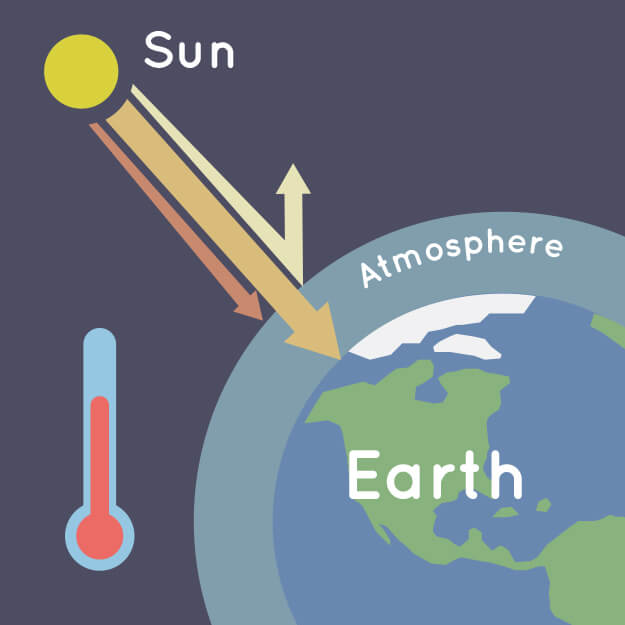
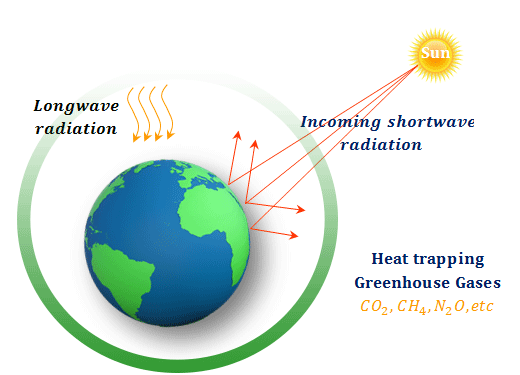
Greenhouse effect, a warming of Earth’s surface and troposphere i.e. the lowest layer of the atmosphere caused by the presence of water vapour, carbon dioxide, methane, and certain other gases in the air. Of those gases, known as greenhouse gases, water vapour has the largest effect.

The atmosphere allows most of the visible light from the Sun to pass through and reach Earth’s surface. As Earth’s surface is heated by sunlight, it radiates part of this energy back toward space as infrared radiation. This radiation, unlike visible light, tends to be absorbed by the greenhouse gases in the atmosphere, raising its temperature. The heated atmosphere in turn radiates infrared radiation back toward Earth’s surface.

Some of the re-emitted energy remains within the atmosphere or returns to the surface and warms the lower atmosphere and surface. The rest of the re-emitted energy leaves the atmosphere and goes into space. The outcome of this absorption-emission process by the greenhouse gases is that less energy leaves the atmosphere than is emitted by the Earth below. Despite its name, the greenhouse effect is different from the warming in a greenhouse, where panes of glass transmit visible sunlight but hold heat inside the building by trapping warmed air.

The increased amounts of greenhouse gases human activities are adding to the atmosphere have upset the balance that has been in place since the end of the last ice age. Adding more greenhouse gases decreases the amount of infrared radiation energy leaving the atmosphere. To get the energy back in balance, the surface of the Earth has to warm up, so that it will emit more infrared energy, some of which will leave the atmosphere and compensate for the effect of the added greenhouse gases. Thus, the greenhouse effect, which is essential for creating the climate for life on Earth, is also responsible for the Earth getting warmer than it was before we started burning large amounts of fossil fuels.

Importance Of Financial Litracy for rural development.

Financial literacy and financial markets are rapidly changing,with developments in technology and new and more complex financial products.From different kind of loans to mortgages,the range of financial products people have to chose from has changes drastically from what it was in the past.the exponential hrwoth in fintech(financial technology) is revolutionizing the way people take financial decisions.Ability to effectively manage money and taking financial decisions in order to become financially self sustainable is known as financial literacy.

The OECD( organisation for economic cooperation and development)defines financial literacy not only as the knowledge of risks and management but also the skills.What does financial literacy involve:-From keeping tracks and understanding when to spend money how to spend money so that it does not have any negative impact on one’s life comes under financial literacy. Importance of financial literacy in a farmer’s life :- Financial literacy enables a farmer to develop a budgetary guide to distinguish what he owes,what he buys and what he spends.This can help them in becoming independent and self sufficient instead of debtors to banks or someone.

Understanding your money and knowing basic principles can prevent farmers from fraud as it will help them with foreseeing risks and argue with anyone learned and well informed.Hurdles in farmer’s way to achieve self sustainability :-Financial literacy can help farmers in many ways, but in india ,most of the farmers are illiterate who dont know how to read,never went to school hence they dont know basics things such as calculating interest adding amounts which plays a very big role in their lives.Because of lack of proper knowledge farmers usually become victims of fraud by money lenders.Money lenders charge a very hight amount of interest which is illegal but many farmers dont know that.Not only this there are many cases when a money lender charges money even though farmers have already paid it . There are many cases in india where farmers hang themselves to tree , burns themselves only because they get trapped in a debt trap and they dont know how to come out of it. There are cases like sanjeev bhatnagar vs union of india 2006, related to this matter but evern supreme court couldn’t do much then asking governments for reasons behind deaths and ordering them to take proper steps. So farmer have tk become self sustainable so that they can prevent themselves and their families from these.And to achieve this the only way is financial literacySolution :- Government should organise specialised programs at every panchayat where trained teachers can teach farmers about 1.Calculating interest to a given amount

2. Managing credit debit system

3. Different places from where they can get low interest loans

4.How to spend money and manage bills so that they dont have to face negative impacts.

5.Asset management. Risk managementThey can also teach them skills and how to apply them because there is no use of knowledge if you dont know how to apply it and where.With proper knowledge and understanding of credit debit system farmers can provide a major help in the growth of economy of india . No farmer will end up having a day with no food,no money or loss of thier land. This will be a concrete step towards the converting our developing nation into developed nation

Importance of education for rural India.

Importance of rural education in india
India is a country with a population of 135 crores.According to reports by world bank in 2020, 65 percent of indian population resides in rural areas.With such a huge population living in rural areas,rural education in india becomes important not only to eradicate poverty and illiteracy,but also for a variety of social ,economic as well as cultural and political reasons.
In 1947 when india became independent policy makers realized the importance of education.Education is considered as the most strong weapon to improve community development as well as initiate social alterations in the world.For a nation ,education in urban as well as rural areas plays a huge role in growth of country . Although education in urban areas of india has progressed rapidly , there are places where still education is not a priority.
It is mandatory for the government to teach people about the importance of education,about the benefits of education and why it should be enforced even in most remote places.

Benefits of education :-

  1. In political system of rural india,it is necessary for rural people to be educated so that they can understand the programs and principles in a much better way and hence elect worthy representatives.
  2. Villages in india plays major part in the economical growth of the country by producing agricultural, industrial as well as other goods.For this it is necessary to have an understanding of the global economy as it is the international price movement of goods which regulate their quantity and price.for that its important for rural masses to be educated.
  3. With time and introduction of modern gadgets culture is also advancing at a rapid rate. To handle and utilize the benefits of these advanced gadgets whether it is for agriculture or daily life education is a prequisite.For example,a rural farmer must be educated in order to learn how to use harvesters , fertilizers, threshers etc. Education can affect the intellectual life of people and make them contribute in the advancement of society.
  4. Indian constitution provides several rights and principles to citizen such as right to education,right to speak,right to information . To understand the significance and functioning of these right modern education becomes must.

Thus we can understand that rural education not only helps in the rural development but it helps in the overall progress and development of the nation.

Thus many steps were taken time to time in order to enhance level of education by the government.many programs were organised to enlighten the people,many schemes were launched in order to attract people of rural areas having low income .
Scheme launched by indian government :-

  1. Samagra shiksha is an scheme launched by indian government to ensure inclusive and equitable quality education
  2. Since the inception of erstwhile centrally sponsored scheme in 2001, 3.18 lakh school building,18.8 lakh additional classrooms,2.3 laks water facilities were constructed.
  3. Mid day meal was started to attract poor families and encourage them fo send their children to schools.
  4. Based on national achievement survey,2017 was conducted to identify and design strategies to reduce the gaps. 5.section of 23(2) of the RTE Act has been amended to extend the period of untrained in-service elementary teachers.

6.NIOS has been entrusted to organise trainings as well as D.El.Ed was started to ensure quality of teachers.

Child Labor Act 1978

What is Child labor?

The term child labor is used when a child is involved into doing a work which is mentally, physically , socially or morally harmful and dangerous to a child and also deprives them of a better childhood and schooling opportunities forcing them to leave the opportunities they have and mature earlier than they should.

The Child Labor Act 1986:

Government has enacted the Child Labor (Prohibition & Regulation) Amendment Act, 2016 which came into force. The Amendment Act completely prohibits the employment of children below 14 years. The amendment also prohibits the employment of adolescents in the age group of 14 to 18 years in hazardous occupations and processes and regulates their working conditions where they are not prohibited. The amendment also provides stricter punishment for employers for violation of the Act and making the offence of employing any child or adolescent in contravention of the Act by an employer as cognizable.

The main objective of this act was to ensure, no involvement of children who have not completed the age of 14 in certain occupations.

The Act also prohibits employment of child in about 13 occupations and 51 processes. The constitution of India in the article 24 under right against exploitation also mentions for prohibition for employment of children in factories and other unorganized sector.

A lot of efforts were put in by PN Bhagwati and V.R. Krishna Iyer to get this litigation into running and in action.

The Path-breaking and Landmark Case of MC Mehta V. State of Tamil Nadu:

The case started with a PIL which was filed by Mr. MC Mehta, alleging that many children were being employed in several hazardous industries more particularly in the firecracker and matchstick industry in Sivkasi in Tamil Nadu.

What held in the court:

A committee was appointed by the Supreme Court of India to visit the site and to prepare a report keeping all the different aspects in concern.

The committee after the submission of the report on November 11,1991 , gave suggestions that the state of Tamil Nadu should be directed that no child should be employed in hazardous and damaging industries of any kind. They also suggested another premise for them to not work more than 6 hours. Proper transport and education facilities should be provided in or around the factory.

It was also recommended to start a national commission on children’s welfare to prepare a scheme for the abolition of child labour.

The case is a landmark case and is so important because it introduces a lot of reforms and amendments in the child labor act 1986 and the case threw light on Child labor as a major issue.

Some of the provisions after the MC Mehta Case are:

The provisions introduced as an after effect of the case were:

Article 24 – Prohibition of employment of children in factories, etc. – No child below the age of fourteen years shall be employed to work in any factory or mine or engaged in any other hazardous employment. 39€. That the health and strength of workers, men and women, and the tender age of children are not abused and that citizens are not forced by economic necessity to enter avocations unsuited to their age or strength.

Article 39(f) -Children should be given opportunities and facilities to develop in a healthy manner, in conditions of freedom and dignity and childhood should be protected against exploitation and against moral and material abandonment.

Article 41 – Right to work, to education and to public assistance in certain cases.- The State shall, within the limits of its economic capacity and development, make effective provision for securing the right to work, to education and to public assistance in cases of unemployment, old age, sickness and disablement, and in other cases of undeserved want.

Article 45 – Provision for free and compulsory education for children.- The State shall endeavor to provide, within a period of ten years from the commencement of this Constitution, for free and compulsory education for all children until they complete the age of fourteen years.

And many other more reforms.

 Reference: lawtimejournal ( for the prvisions)