

If anybody is reading what I am about to say, please your life is important this is not the way.
Now a days, now and then I find posts about people committed suicides, which is very disheartening to see.
I wonder what happened to our generation, why they are running away from their lives.
“Suicide is a permanent solution to a temporary problem, It doesn’t end the pain it just passes it on to your loved ones.”
Please take positive action, reach out for help from loved ones, save your life.
What to Bring to a Job Interview
Job Interview is the most crucial phase of a person’s life. It is one step towards your success in life. If you are here, that means you probably applied for a job and now you have got a callback. So don’t worry, you have come to the right place. Here you will find absolutely everything you need to know about preparing for an interview. Once you have made up your mind about the interview, then there’s only one thing you have to take care of, that is, a list of essentials to take with you.
The first step towards preparing for an interview is to make a checklist of all the essential items you have to bring to the interview. Don’t panic. Just take a deep breath and leave this tension on us. We will clear all your doubts and you can go ace your interview. We might need a Thank you note afterwards ! Anyways, the most important thing is your confidence. Then comes your A-game. Other than these there are a few things which are shown below. So to make the employers pleasantly surprised, check out our fully detailed and updated list of what you need to bring to your interview. Come on let’s have a look and dive straight into the main points.

What to bring to a job interview ?
You don’t want to make a fool of yourself if you show up half prepared for your interview. So we are here to help you with that. Here are some items listed below. Use this list to make sure you are fully prepared for your big day.
- Folder – There are many documents and papers you need to carry to the interview. So a folder is an organized way to do that. You can store all the necessary documents in the folder. Plus you will have an easy access to your documents when needed.
- Copies of your resume – You should carry at least 5 copies of your resume. It will ensure that you have a resume for every employer you meet. Keep them safe, otherwise you’ll lose them. Keep them in the folder so they don’t wrinkle or bend. And it certainly won’t hurt to print a copy to keep for yourself. Would it ?
- Copies of your cover letter – Keep at least 5 copies of your cover letter. Bring them in the folder to ensure that they are safe from bending and you have easy access to them. One for you and others for all the employers you meet. It will be helpful, trust us on this one ! It will also be helpful in case one gets misplaced.
- Portfolio or your Work samples – Your portfolio is the most crucial and promising step ahead to you securing the job. Your work samples should be neatly maintained and are required to be perfect for the level of the job. The portfolio will be the best option to showcase your talents and what you have achieved in the past. It also helps the employer in finding your true potential and increases your chances of getting the job. The hiring manager always goes for the portfolio first. Keep it in the folder to have easy access to it when needed.
- A notepad and a pen – You should absolutely carry a notepad to write down the names, the company’s information and of course to note down what the employer has to say. Maybe try to catch up on the important information you get. But don’t take so many notes that you forget to make eye contact. That will not be a good impression and will show you as incompetent. Make sure to carry more than one pen so you have an extra if one runs out of ink. Don’t forget to first ask for permission from the employer to take notes.
- A list of references – Now, even if you are going well with the interview, a list of references will be a good addition to the list of things you need to carry with you. The employer might ask you for references anytime during the interview. So it will be good to be prepared for this hurdle beforehand. Think of all the people who could vouch for you and maybe put in good word for you to the hiring manager. Make sure to include the contact information with the details of your references. But don’t worry if you are not much experienced or don’t have any references to list down. Any former teachers will also make a pretty good reference. Just don’t list down your family members or friends. That will surely be the embarrassing highlight of the day.
- A bag or a briefcase – Carry a briefcase so it looks professional and you have a great first impression on the employer. It will help you carry all the items easily to the location. You should organize the items and documents in a proper manner so that they are easily accessible to you when needed. You don’t want to look like you can’t even handle your things. Pages dropping out of your hand will not look good. Now, would it ?
- Identification proof or Photo ID – Of course this is a very common thing to remember to take anywhere. Nut we thought it might be beneficial for you to remember to take it with you for your big day ahead. You don’t want to lose a probable job because you forgot your photo id. That would be depressing but don’t stress, we are here to remind you. Taking your identification with you will be good and will look professional. It may also earn you more points on the employers priority list of selection for the job. And plus you might need it to get through the security outside of the building.
- Talking points – You might want to add this also to your list. These should basically be the summary of your experience in bullet points. Points will be easy to glance at once before the big meeting. It will also boost your confidence and keep you out of stress. These points can be your specific skills that you might want to put light on in front of the employer. And most importantly your accomplishments should be surely mentioned so that you remember to review them before the meeting and you don’t forget to tell all about them.
- Questions for the Hiring Manager – These are the questions for you to ask the hiring manager. Any queries you have regarding the job can be written down on a paper and asked during or after the interview. These questions may also be regarding any company policies you need to clarify about. You can ask about the position you are applying for. But remember, do not ask for the salary details. It might cast a bad light on you in front of the manager. At least wait until he / she brings it up himself / herself. And remember to be specific in your questions and of course, ask in a professional manner to make a good impression. The questions should be valid and easily understandable to the employer. They should be good and relevant enough to make you stand out from the other applicants.
- Travel directions to the interview – You should absolutely carry the travel directions to the building you are suppose to go to. You certainly don’t want to get lost in the middle of no where. Do you ? So better carry a print out of the directions to the company building. It will of course be helpful if you are going in a new city for the interview or travelling first time to the area. And getting lost might get you late for the meeting. It could also cost you the chance to work in the company. After all your hard work and preparation, you don’t want to get late because of unexpected delays and interruptions that might get in your way. So it is better to be prepared before hand. And even after planning your schedule 10 – 15 minutes early, you are still running late then you should definitely inform the office or the employer.
- Contact information – You should have the contact information of the employer as well as the front desk of the company you are going to. In case you are running late or any other interruption has entered your way, then you can easily get in touch with them and maybe they will understand. But good luck with that ! Mostly the hiring managers don’t consider any issues but you can always hope for better. However, it is better to make sure you reach to the building on time.
- Business cards – They may not be necessary but are certainly a good addition to the list. They can be eye catching and helpful for increasing your chances of getting the job. It is only because the hiring manager may find you smart and more experienced if you show a business card. It depicts you as a more professional candidate for the job. They might also be helpful in providing your contact information to the employer. Business cards are just a piece of paper to store your information in a concise form and in a single place.

What else you should carry with you ?
Well, there are a lot of other things that you need to keep in mind while preparing for an interview. They are not things to carry to the meeting, but rather some personality traits or may we say, a professional persona. Here, come on we will have a look at them.
- Positive mind – You need to remind yourself that you have worked so hard for this job and now this is where it all comes comes together. You need to keep a positive mind going into the big meeting. Do not stress or have doubts about the job just before the interview. It can destroy all your hard work that you put into it. You just need some positive vibes around you to keep you all ready to go and ace the interview. Believe in yourself and there it is. You did it. You will get through it with flying colors.
- Confidence – Now the next is confidence. Well all of us know that this is the most important and required component of your list. Remember, do not get nervous. Do not get cold feet at the last minute. It will ruin your preparation and afterwards you will feed bad and regret not being confident enough. But of course, you know there is a fine line between being fully mentally prepared and being overconfident. Do not in whatever circumstances, cross that line. More than anything else, being overconfident will surely almost drop your chances of getting the job.
- A professional outfit – Your first impression will be taken on how you look. It is very important for you to look absolutely professional. You need to set a work outfit for your big meeting with the employer. A suit with formal shoes and well trimmed hair should be a nice and presentable attire for men. And as for women, a shirt with trousers or maybe work skirts paired with nice pair of heels or shoes. These are just our suggestions for you, but it totally depends on what you have on your mind. Just remember that your outfit should be neat, presentable and properly ironed. You don’t want the employer to see the wrinkles on your shirt peeking out during your interview ! And one more last tip is that wear what you feel comfortable in but also maintaining the theme of a professional attire.
- Practice – All of us have heard that ‘Practice makes a person perfect.’ Haven’t we ? So this applies here too. Practice for the interview in advance. Like practice your communication skills. Maybe practice speaking your questions out loud. Check your confidence level too. Practice enough that you don’t regret afterwards. Search for the common interview questions that are mostly asked and practice answering those questions. And lastly, practice arranging and taking out items from your folder without fumbling.
- Attitude – This may sound absurd but it’s not what you think. We are not telling you to go to your interview with a snarky attitude. By this we simply mean that you should have a positive attitude when you go in. You should have hope and faith in yourself that you will ace it and get through certainly.
- A well prepared mind – A well prepared mind would be the perfect ingredient for a successful interview. You need to be mentally prepared and healthy while going in. Throw out the self doubts and the low self esteem surfacing your thoughts. Make sure you get a good sleep before the big day. Go get the job with a peaceful mind.
- Your A-game – This is a must. You need to bring out your A-game for the interview. Be well prepared. Don’t hesitate. And you will ace it.
- A good mood – A good mood will give you a fresh start for the big day. And you will go into the interview with a confident persona. You also won’t be impatient or scared.
- A convincing smile – As we know a smile is the key to fit in every where. Stride confidently into the room with your perfect smile. It gets the undivided attention of the hiring manager. A smile also makes the best first impression.
- Last minute check ups – The above listed things and extras are enough. But you can also check out these small items necessary for unwanted circumstances. Here it is.
- Silenced mobile phone – Bring you phone with you but it should be silenced and fully charged. You don’t want to have to be interrupted by a call.
- Cash – Some cash should be helpful to bring in any case of emergency.
- Research about the company – Do a thorough research about the company and the job you are applying to. Maybe about former employees and about the job requirements along with the rules inside the office.
- Breath mints or floss – They will help you maintain a good oral hygiene during the interview and will make you feel clean.

What not to bring to an interview ?
- A negative attitude – You don’t want to make a bad first impression. Your negative attitude might do just that. It might put you in a bad light and maybe cost your potential job.
- Salary demands – Do not ask about your salary in the interview. It might seem greedy and of course unprofessional. At least not until you are sure of getting the job or the employer brings it up himself / herself.
- A companion – Do not at any cost bring yourself a companion. Neither your parents or any guardian, nor any friends. Nobody is needed in the interview room. They might just give you a low confidence because of peer pressure.
- Hats or caps – Any type of accessories are not advisable to wear to an interview. They might just be a distraction for the employer during the interview. And in some cases, physical appearance can be a hurdle in the way.
- Strong perfume – Wearing strong perfume or cologne in a office might be risky as you never know, someone might have an allergy. It will just add to the distraction.
- Food or drinks – You can certainly eat food before or after the interview. You can even celebrate after with some drinks too. But bringing food items inside the building might not be a good idea to impress the employer.
- Untidy appearance – Wearing shabby or loose clothes is not a professional work attire. And certainly do not attend the interview with unclean and untidy hair. Again, physical appearance also plays a role in getting you a job.
So, these were the things you need to keep in mind while preparing for your big day. It is a special moment in anyone’s life and you sure don’t want to spoil it. At last we wish you All the Best and hope you come out with flying colors. You enter the room with confidence, and exit it with pride for yourself because you absolutely deserve it. It is important to be aware of what to bring to an interview but it is also necessary to know that what you say during it or the way you act in front of the employer, will have a bigger impact on your chances of getting the job.
Artificial Intelligence

The world has stepped into many engrossing horizons like self driving cars, smart assistants, social media monitoring, disease mapping, automated financial investing and many such persuasive developments. Have you ever wondered what is involved behind such innovative developments? It is certainly the Artificial intelligence. The hype for AI has been accelerated to a great extent to meet the demands of the contemporary world. The term refers to the simulation of human intelligence, induced in machines that are programmed to think and work like humans and pretend their actions as well. The term may also be applied to any machine that exhibits the traits associated with a human mind such as learning, problem solving, speech recognition, decisive making etc. It is a wide range of branch concerned with building smart machines making them capable of performing tasks that typically require human intelligence. Building an AI system is a careful process of reverse-engineering human traits and capabilities in a machine, and using its computational prowess to surpass what we are capable of. AI requires a foundation of specialized hardware and software for writing and training machine learning algorithms.
There are three types Artificial Intelligence
- Artificial Narrow Intelligence – Specializes in one area and solves one problem.
- Artificial General Intelligence – Refers to a computer that is as smart as a human across the board.
- Artificial Super Intelligence – An intellect that is much smarter than the best human brains in practically every field.
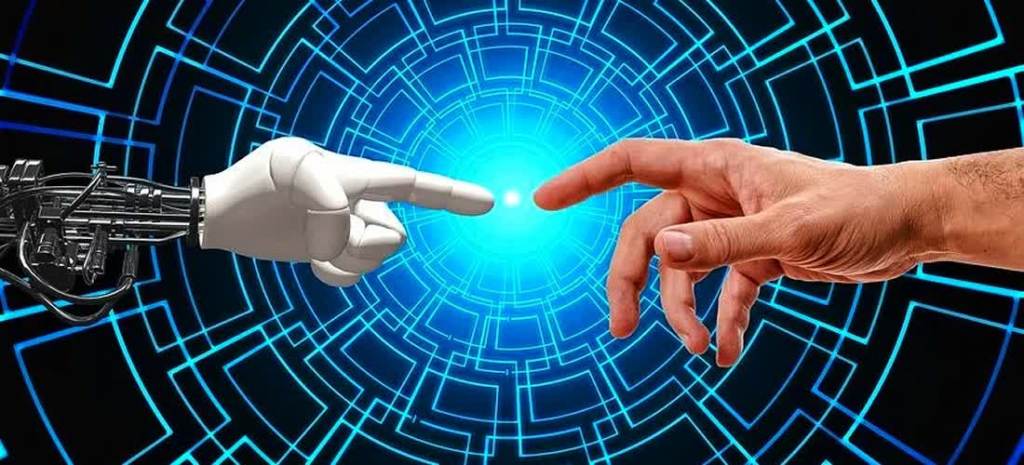
The Artificial Intelligence intend to aid human capabilities and help us make advanced decisions with far reaching consequences. It has the potential to help human lives significantly, devoid of hard labor and help manage the complex web of interconnected individuals, companies, states and nations to function in a better way. AI has seamlessly transitioned into our daily lives which we might have failed to notice from music recommendations, map directions, mobile banking to fraud prevention, AI has framed an advanced path. It has made it ways to many sectors from science to agriculture. It has its applications in various fields like retail, shopping and fashion, security and surveillance, sports activities etc. Here are some of the major sectors where AI are implemented for enhancement in the respective fields.
AI powered assistants – It is an application program that understands natural language voice commands and completes tasks for the user. Virtual shopping assistants and chatbots help improves the user experience while shopping online. The assistants have real time engagement with the customers. Amazon’s Alexa is a virtual assistant AI developed by Amazon capable of voice interactions setting alarms, providing weather , traffic, sports and other real time information and similarly so does the Apple’s Siri, Microsoft’s Cortana and so on.
AI in Robotics – Robots powered by AI are used for carrying goods in hospitals, factories and warehouses, cleaning offices and large equipment and inventory management where robots use real time updates to sense obstacles in its path and pre plan its journey instantly.
AI in Healthcare – It is used to build sophisticated machines that can detect diseases and identify cancer cells. It can help chronic conditions with lab and other medical data to ensure early diagnosis and used to identify trends or genetic information that would predispose someone to a particular disease.
AI in agriculture – AI aids in identifying defects and nutrient deficiencies in the soil and also detecting diseases in plants, pests and poor plant nutrition on farms. AI sensors can detect and target weeds and then decide which herbicides to be applied. This is done using computer vision, robotics, and machine learning.
AI in marketing – Using AI marketers can deliver highly targeted and personalized ads with the help of behavioral analysis, pattern recognition etc. It uses technologies to make automated decisions based on data collection, data analysis, and additional observations of audience or economic trends that may impact marketing efforts.
So the benefits of AI are widespread in various spheres. There is always a fine line between the advancements and destructions. There’s always two sides to a coin and so in the AI. There are some of the snags listed below.
- High cost of implementation
- If the super intelligence’s goals come to conflict with human values AI poses a risk of human extinction.
- With human cognitive power we would be able to evolve with age and experience. But it becomes skeptical with the AI machines, it starts to wear and tear with time.
- We cannot expect creative piece of work from AI’s. Creativity is limited to the persons who program and commands machines.
- With the rapid development in the sector of AI, it may carry risks of unemployment.
Why javascript is important?
JavaScript is a programming language used primarily by Web browsers to create a dynamic and interactive experience for the user. Most of the functions and applications that make the Internet indispensable to modern life are coded in some form of JavaScript.
The earliest incarnations of JavaScript were developed in the late 1990s for the Netscape Navigator Web browser. At the time, Web pages were static, offering little user interaction beyond clicking links and loading new pages. For the first time, JavaScript enabled animation, adaptive content and form validation on the page.
For many years, JavaScript only functioned on a limited number of browsers. Microsoft’s Internet Explorer, the largest browser base, did not support JavaScript until much later. Instead, Microsoft created its own proprietary client-side script called JScript. In the early days of Web development, programmers who wished to create dynamic websites were often forced to choose one browser family over the other. This was less than ideal because it made the Internet less universally accessible.
JavaScript did not become standardized and widely adopted until 1999. Even after standardization, browser compatibility remained an issue for over a decade.

JavaScript is what is known as a client-side script. Most Web applications, such as a search engine, work because of an interaction between the user’s device (e.g. computer, phone or tablet) and a remote server. The software on the remote server sends information to the client (i.e. the user’s machine) and the software on the client side reads the information and renders a Web page on screen.
A client-side script is a programming language that performs its tasks entirely on the client’s machine and does not need to interact with the server to function. For instance, if you have a Web page loaded on your computer and your Internet service provider goes down, you are still able to interact with the Web pages already loaded on your browser. You will not, however, be able to navigate to new Web pages or access any data located remotely.
Some of the dynamic website enhancements performed by JavaScript are:
- Autocomplete
- Loading new content or data onto the page without reloading the page
- Rollover effects and dropdown menus
- Animating page elements such as fading, resizing or relocating
- Playing audio and video
- Validating input from Web forms
- Repairing browser compatibility issues
While JavaScript is a client-side language, some of its most powerful features involve asynchronous interaction with a remote server. Asynchronous simply means that JavaScript is able to communicate with the server in the background without interrupting the user interaction taking place in the foreground.
Take a search engine for example. Today, search engines almost all have an autocomplete function. The user begins typing a word into the search box and a list of possible search terms or phrases appears below. The experience is seamless. Suggested search terms appear without reloading the page.
In the background, JavaScript reads the letters as the user types, sends those letters to a remote server and the server sends suggestions back.
The software on the server side analyzes the words and runs algorithms to anticipate the user’s search term. Such programs are diabolically large and complex. The JavaScript on the client’s machine is as simple and small as possible so as not to slow down the user’s interaction. The communication between JavaScript and the server-side program is limited by the user’s bandwidth. This is why developers prioritize efficiency in JavaScript functions and make the amount of data communicated between the programs as small as possible.
Only once the user selects a search term does the entire page reload and produce the search results. Engines such as Google have reduced or eliminated the need to reload, even for that step. They simply produce results using the same asynchronous process.
The future of JavaScript
While JavaScript is not the only client-side scripting language on the Internet, it was one of the first and it is still the most widely used. Many developers believe that JavaScript is inefficient and finicky, so they have made many improvements to the language over the years. Enterprising programmers have created JavaScript libraries – more concise languages constructed from the building blocks of JavaScript that are less complex and can be targeted for specific applications.
For instance, JQuery is a JavaScript library that simplifies and expands many of JavaScript’s animation and interactive functions, while Backbone.js makes responsive design easier.
JavaScript has become integral to the Internet experience as developers build increased interaction and complexity into their applications. Search engines, ecommerce, content management systems, responsive design, social media and phone apps would not be possible without it.
Course of the Russian Revolution under the leadership of Lenin 🇷🇺:

🔅Influence by the ideas of Kal Marx, Lenin believed that the way for freedom was through mass action.
🔅The social Democratic Party, spilt on the issue of organisation and strategy. Lenin gained the support of a small majority (bolshinstvo), known as Bolsheviks, which became the Boloshevik Party. His opponents, in minority (menshinstvo), were called Mensheviks.
Failure of Provisional Government🇷🇺:

🌟Lenin was in Switzerland when the revolution broke out. Lenin wanted continued revolution.
🌟His slogan of ‘All power to the Soviots’ soon won over the worker’s leader. The people were attracted by the slogan of ‘Bread,Peace and Land’.
🌟The Provisional Government made two grave mistakes. First, it postponed a decision on the demand for the redistribution of land and the other was Government decided to continue with the war.
🌟Frustrated peasant soldiers deserted their posts and joined those who had resorted to land grabbing. This intensified the rising in Petrograd led by Bolsheviks. The government banned Pravda and addressed all Bolsheviks.
Takeover by the Bolsheviks Party under Lenin’s 🇷🇺:

🔅In October Lenin persuaded the Bolsheviks Central Commitee to decide on immediate revolution.
🔅Trotsky prepared a detailed plan. On 7 November the key government buildings were seized by armed factory workers and revolutionary troops.

🔅On 8 November 1917 a new Communist government was in office in Russia. It’s head this time was Lenin.
🔅The Bolshevik Party was renamed the Russian Communist Party.
Outcome of the Revolution🇷🇺:
🔅The Russian Communist Party eliminated illiteracy and poverty in Russia within a record time .
🔅Russian industry and agriculture developed remarkably women were given equal rights, including rights to vote.
🔅Industries and banks were nationalised. Land was announced as social property and was distributed to poor peasants.
.jpeg)
.jpeg)
🔅Lenin thought the most important factor for the all of Provisional Government was its failure to withdraw from World War. So Lenin immediately appealed for peace.
🔅Unmindful of the harsh terms dictated by the Central Powers, Lenin opted for withdrawing from the War to concentrate on the formation of new government.
🔅In March 1918 the Treaty of Brest – Litovsk was signed.

COLLEGE LIFE-THE MEMORIES WHICH DOESN’T FADE AWAY

A college is a dreamland in a student’s academic career. College phase is the golden period for the youngsters and no one can forgot those memories till from the first day of the college to the last day we spent in the college. At initial days when we join in a college, we all feel so excited and curious by seeing our surroundings but at the same time we all have a small doubt or fear that how to mould our self in the new place where every thing is almost unknown to us. Most of us start our college life without having any idea about what we want to be in our future. We all have roughly four years where we have to play around with academics and extra curricular activities along with figuring out the passions in our life.
At the initial days we all think that college lecturers are too strict and we have to be careful with them but as the days pass away we came to know that even our lecturers also be friendly with us and they help us a lot in every moment of college life. The most important candidates in our college life is our friends with whom we do a lot of crazy things and the enjoyment with friends will be at next level in hostel rooms, Yes our hostel roommates will become a next family to us with whom we can share all our things.

The most excited and scary event that happens at the beginning of our college days is “FRESHER’S DAY” where we all see our seniors as like most dangerous people on the world and fear about the ragging but our thoughts will be changed totally when we talk with seniors in a friendly manner and also they are the one who will be as a back bone to all of us in entire our college days but sometimes whatever we think may turn into wrong also.
Whatever the situation may be, we always be ready to face that situation especially in the case of examinations. The preparation strategies will differ from person to person but once after completing our graduation we will definitely laugh by memorizing all those days. The most interesting part in college life is college fest, tours and interacting with diversified people which helps us to develop the spirit of unity, personality and brotherhood.

At last I can say that college life is the beautiful blend of joys and memories. On the whole, everyday that we spent in our college is loaded with some colourful events such as special breaks, bunks and sports. These charms will never fade away but in todays situation most of the students are unable to make such a great college life experiences due to COVID-19 pandemic. Let us all hope that the past days will come back again and we can happily make a lot memories getting together in our colleges.
FIELD HOCKEY-RULES AND HISTORY
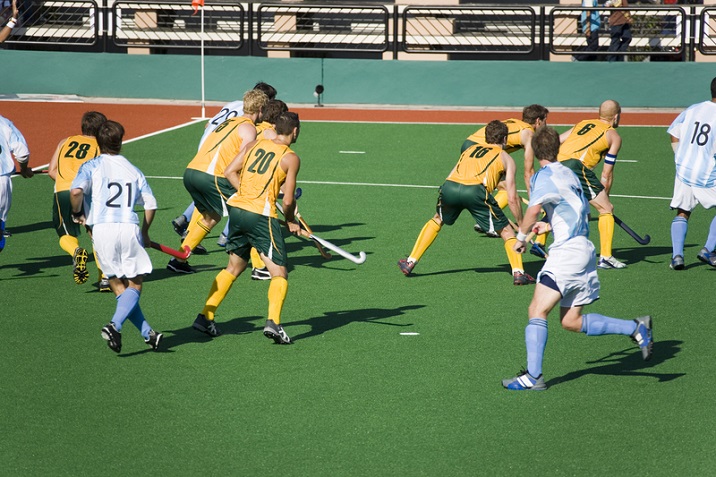
Hockey is normally played on grass field or turf field or an indoor stadium. Hockey is predominantly a stick and ball game. Hockey is also the National Game of India.Field hockey, also called Hockey, outdoor game played by two opposing teams of 11 players each who use sticks curved at the striking end to hit a small, hard ball into their opponent’s goal.The objective of this game is to pass the ball with a bat to the goal of opposite players’ court. Other players will be trying to take the ball away and make their goal. The players in the team will be assigned positions for which the duties will be defined earlier. The task of each player in the team is to get the ball in the opponent’s goal point. All the players should be co-operative in scoring more goals.
HISTORY OF HOCKEY :
Hockey, as a sport of stick and ball, dates back to middle-age. Some of the carvings of this sport were found in Ireland and Greece in 1200 and 600 BC respectively. It is assumed that the sport existed some 4000 years ago. However, hockey took its actual form with government organization to recognize the sport. Hence, specific rules of the game were introduced in early 19th century. Countries like England, Germany, Argentina, Spain, India, Malaysia, and Pakistan have international teams and take part in all the annual events organized by International Hockey Federation (FIH) formed in 1924.
TEAM SIZE :
The Hockey is either played girls against girls or boys against boys. The team consists of 11 members and each player is assigned with a particular position and task. Like most games, team work is the basic element of winning and the entire team’s contribution is crucial for success.
The 11 players consist of Goalkeepers, Defenders and Strikers. Individual player has got their tasks to work on in the game. The hockey squad will be having a total of 16 players as the game allows rolling substitutions under necessary conditions. The rest 5 players will be a backup most of the time
COUNTRIES PARTICIPATION :
As Hockey was literally originated in England, Scotland and Netherlands, it was encouraged by various other countries as they participated in the game. The International Hockey Federation governs the sport all over the globe. Men and women represent in competitions including Olympics Games, Champions Trophy, World League and Junior World Cup with many countries which run masters’, senior and junior club competitions. This body is responsible for rules development for the game.
Most countries take part in this game. There are more than 50 countries that participate in hockey. But to consider the countries that are termed as the Big Eight include Canada, Sweden, USA, Russia, Finland, Czech Republic, Slovakia and Switzerland. As Canada invented the game, they are the best in it. More than 60% of National Hockey League players are from Canada. It’s a right that if you are born in Canada, you are born for Hockey.
The top twenty hockey playing countries are Canada, Sweden, United States of America, Russia, Finland, Czech Republic, Slovakia, Switzerland, Germany, Latvia, India, China, North Korea, United Kingdom, Belarus, Denmark, Mongolia, Japan, South Korea and Indonesia. India was ranked as the eleventh country in Hockey playing.
HOCKEY GROUND DESIGN :
Hockey is a speed demanding game. It demands speed from its players and also from its playing surface. No other sport beats the surface like hockey does and hence, the surface should be incredibly durable handling the wear and tear of hockey sport. The surface has to be maintained to enable a top-level game to the players. The base design is to be maintained in any of the two designs namely Diagonal fall Design and Crown Design.
The diagonal fall design directs all the surface water to a collection pit at the corner. Whereas, the crown design flows the surface water to all the four corners allowing them to collect there like the crown in the center. It allows the water to collect at a corner or all the four corners for cleaning and slightly tilting the ground. This is the base design of the ground and is followed in all the ground designs.
After the base is finished, In-situ shock pad is to be installed over the base. It consists of black SBR granules and polyurethane binder. This is mixed on site and laid to specified depth. This gives a firm hold of the ground and the strength. The hardness below the ground makes it sustainable from the beatings of the hockey bat during the play. As per the requirement of the FIH (Federation International Hockey) the ground is made to shock absorbent.
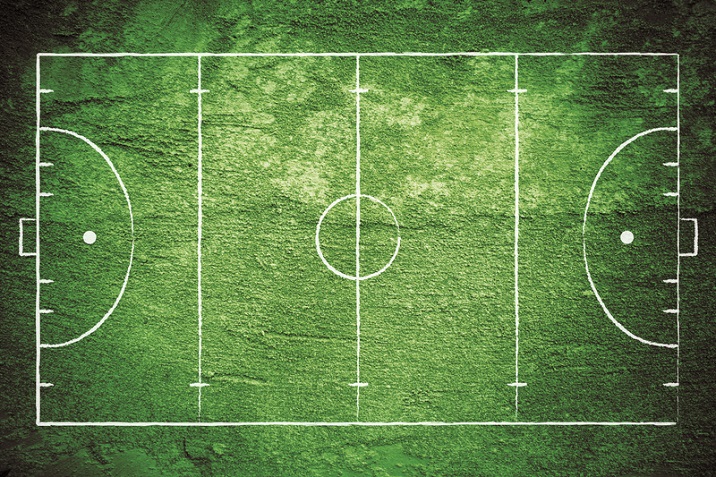
Earlier, the game was played on a natural turf or grass field. But now-a-days it is played on artificial turfs. In the 1970’s, the transition into artificial turfs came into existence and its being made mandatory since 1976. All the markings, lines, and goals are specified by the International Hockey Federation in the Rules of Hockey. The foul game is played in a 23 meter area.Standard pitch measurements are given as 100 yards by 60 yards. The total area of the field is 5027 square meters. The hockey pitch is shaped in rectangular manner. The long perimeter side is named as side lines and the short perimeter edges are named as back lines. The portion between goal posts is known as goal Lines. All lines are colored white with 75mm wide. At all the corners of the pitch, a flag of max 300 mm square is attached to a post of height 1.20 to 1.50 meters.
HOCKEY EQUIPMENT :
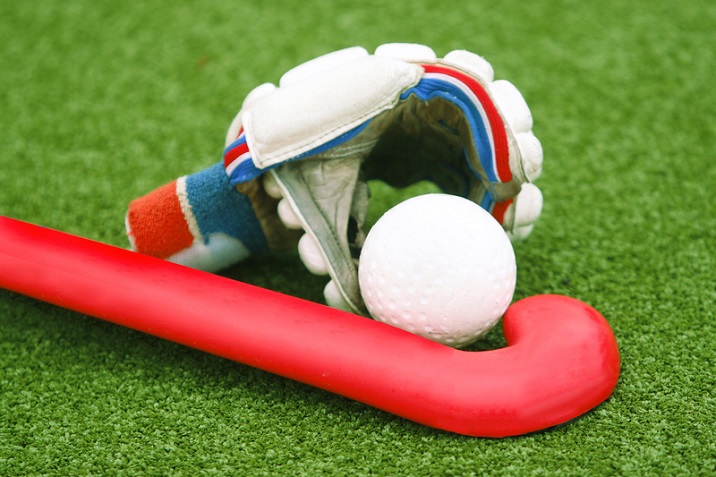
Hockey stick and ball are the most important equipment without which the sport cannot be played. There are many other equipment like shin guard, helmet, glove, shoes, etc., that a hockey player uses during the match.
The following are the equipment used in the hockey game by the goalie and the players.Hockey Stick − It is a wooden stick with length varying from 26’’ to 38.5’’ depending on height of the player. The bat has a hooked shape at the head. There are mostly four types of variations namely shorti, midi, maxiand the J Hook depending on the efficiency of the player holding the ball.
- The shorti type is used by players, who take an extreme control over the ball to increase the manoeuvrability. Generally, the players at the mid field position use this type of bat in the game.
- The midi type is used by the players who hit the ball more often and need to be strong on the reverse side. Strikers use midi predominantly.
- The maxi type is used by the players who act as defenders or attackers. This bat is similar to the midi type but the surface area is being increased. For stopping the ball, its strength allows it to be much more efficient in doing that.
- The J Hook type has a much larger surface area. However, it doesn’t possess the efficiency of the midi type in striking the ball. But, for stopping the ball it has an increased thickness. This head type is preferred by the defenders.
GAME PLAYERS AND THEIR ROLES :
Hockey has started its course from the English Public Schools to Olympics level. Each hockey team must have 11 members who should always be ready on the field to start the match. Total number of members in a team are 16 of which five are substitute. The guidelines on how to play the game is given by the International Federation of Hockey.
Substitution of players can be done any number of times. At any point of time, the team can give rest to a player and call a substitute on his behalf. The 11 players consist of one goal keeper, and the rest shall be in the field. The attributes for each player is as follows −
GOAL KEEPER:
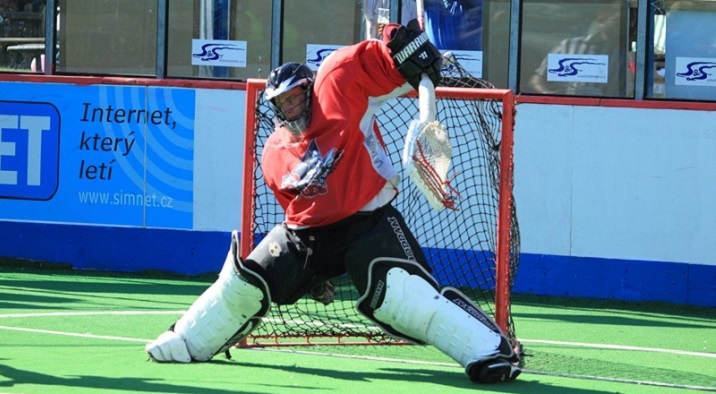
Arguably, the goalkeeper is the most important player in the whole team. The responsibility of the goalkeeper is to defend the goal post and prevent the other team from hitting a goal.
The key responsibilities of the Goal Keeper are listed as follows −
- Should be fast and also agile.
- Should be proficient at both right and left foot.
- Should be able to judge the shooting angle and close them down.
- Should be a good communicator and be able to organize the defense.
- Should be able to go down in a correct manner at defensive moments and at required moment should remain in standing position
The position of the goalkeeper needs to meet the following requirements.
- Should be able to save the straight shots towards the goal.
- Should be able to minimize the attacking team’s score by organizing the defensive attacks.
- Should establish good communication with other defenders.
DEFENDERS:
The defenders are positioned at four locations. They are right half, left half, right back and left back. The chief role of the defenders is to defend the back four. They should work as a team and try to minimize the score of their opponent.
The main attributes of a defender are as follows −
- Should be able to turn sideways and get back swiftly.
- Should be having strong basic skills. Effective in trapping the opponent, passing the ball and tackling the situation.
- Should be able to prevent opponent attack and put the ball away from the danger zone.
- Should understand both man-to-man as well as zonal defense and decide the correct approach to use.
- Should be able to have a good vision of other players and gather knowledge of best passing opportunities
MIDFIELD :
The three distributions in the midfield positions are inside right, inside left and center half. The midfield is the team’s engine room. It links the attackers and the defenders. It should avoid opponents to have clean breaks through the middle of the field. Midfielders should be major game distributors and have a great awareness of the game.
Attributes of a midfielder are as follows −
- Should possess a great acceleration with fitness, fast and agile.
- Should possess strong all-round basic knowledge of hockey.
- Should have a good knowledge in passing, ball carrying, receiving and shooting.
- Should have a great awareness and vision of the game.
- Should be able to switch play or change the point of attack.
- Should be able to understand the defenses and choose the right one at right time.
- Should be able to understand the lines and angles of attack and defense in the play at midfield.
STRIKERS :
The first role of a striker is to generate opportunities of scoring. These must be done by working as a team, creating width and depth on the attack, create a link with midfield and taking the best of all the possible opportunities.
Specific attributes of a good striker are as follows −
- Should be able to get a clear view on the lines and angles of attack and defense.
- Should be able to deploy pressure on the opponent defenders.
- Should be able to move fast and should be agile with high acceleration and pace change.
- Should have a good vision on the game and awareness of moves.
- Should have a constant movement where the key actions are creating space, attacking opportunities and leading the team.
- Should be able to execute and identify the best opportunity for shooting.
DURATION OF MATCH :
A regular hockey match takes place for 70 minutes consisting two halves each of 35 minutes. Also, sometimes matches end in draw. But the official matches should have a winner unlike other matches. If in any case, the game is a tie then extra time is given. If there is tie again then penalty flick competition decides the winner of the match.
A player passes the ball among them to progress it towards the goal using a triangle method of passing system. This prevents the opponent to intercept the ball.
The hockey players take their respective positions on the field. One of the teams starts the game with a centre pass and continues to attack opponent to score a goal. The player taking centre pass can only stand in the other half of field while his team members should stand within their half of defending goal. The player taking centre pass is permitted to hit the ball in any direction.
- The team members keep passing the ball and look for opportunities to score the goal while the opponents tackle them and try to take control of the ball.
- If the game is paused any moment for injury or substitution, it resumes by the player passing the ball from nearest spot of stoppage of play. This is called bully.
- A player from each team stands close to the ball with defending goals on their right to take a bully. Both players tap faces of their sticks and one of the players is allowed to hit the ball.
- A free-hit situation arises when a player hits the ball outside the sideline or baseline. Free-hit is taken by a defender by placing the ball 15 meters in line to the centre of goal.
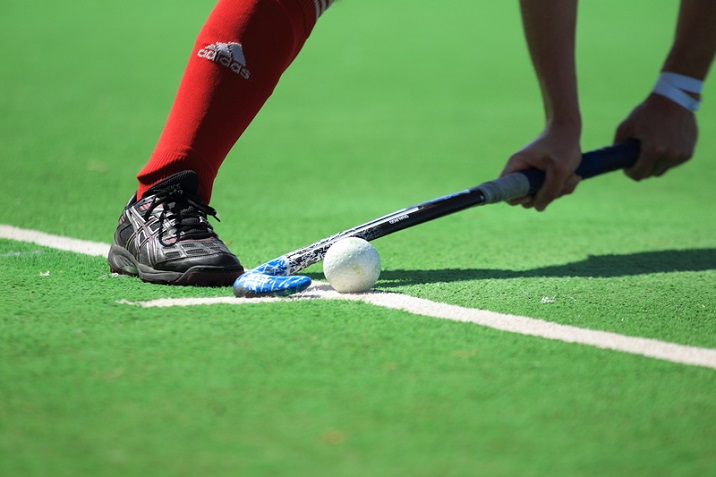
SCORING :
It is very interesting thing to learn how to score in hockey. Specific ways to win a score are penalty corner, field goal, and penalty stroke.
Taking a Penalty Corner:
Only four players are allowed along with a goal keeper. They must be behind the baseline inside or outside the goal. The other defending players must be behind the half way line or on the line. Any number of players from the attacking team can be there to attack but most probably seven will be the attacking players. One player will be injecting the ball from baseline.The presence of a stopper at the top of D depends on the set-up of the team. When the injection of the ball takes place before it re-enters D and shot at goal, it must go out of D first. For the first strike to be counted, it must be below the back board, if it is a drag or a deflection, it can end anywhere inside the goal and it can also be counted.
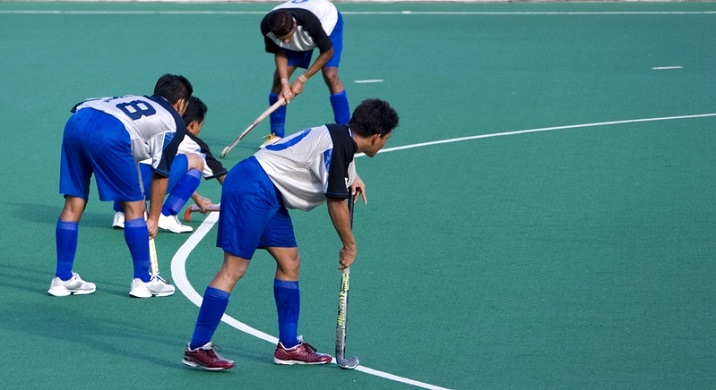
Taking a Penalty Stroke:
When there is an infringement inside of D, the penalty stroke is given if there was a definite goal scoring chance. It is a free shot that was taken by one attacker against one goal keeper only and from a distance of 6.4 meters straight in front of the goal. The duration of the match is stopped when there is a penalty stroke taken.
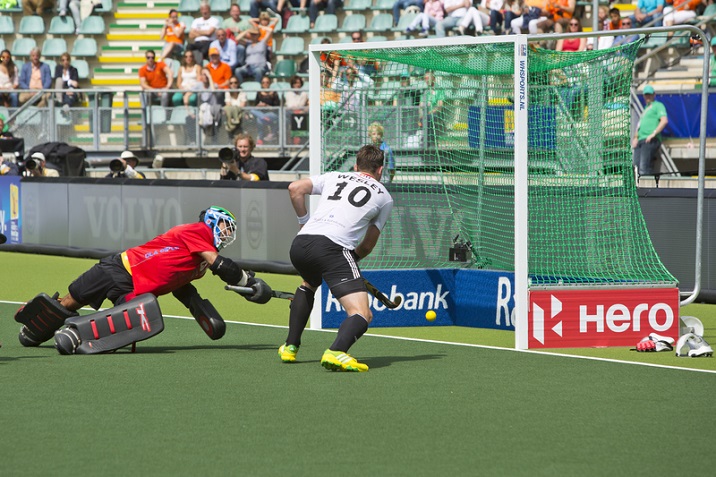
FOULS :
The on-field players are not allowed to control or stop the ball with feet or any other body part. A free-hit is awarded to a team if ball hits the opponent player’s body. The hockey ball is often scooped by players to pass it to their team members directly. However, the same shot is given as foul by the referee if it is played dangerously.
Apart from these, there are tackling fouls where players are found to be little rough with opponent players to take control of ball. The game is observed very closely by referee to declare fouls and make important decisions. The referees in the game display cards in three colors, each of which indicates the level of foul or offence committed by a player.
- Green card − The player may not leave the pitch (international standards say that the player may leave the pitch for two minutes), but further infractions indulge in a red or yellow card.
- Yellow card − It is a suspension where the time is decided by the card issuing umpire. Mostly, five minutes will be the chosen time by any umpire. But, if the offense is serious the time may exceed or the player is replaced.
- Red card − It is a permanent exclusion from the game. Here the player is banned for some time or for a few matches. The player should leave the pitch in this case.
HOCKEY AND ITS TYPES :
Field Hockey:
This game is played on ground with grass or artificial synthetic ground. It is predominantly for women in some countries like Europe. But due to the absence of hand gloves, injuries at fingers sometimes hamper the players to continue in the game. But advancement in the game and its rules resulted in security precautions of total body while playing.
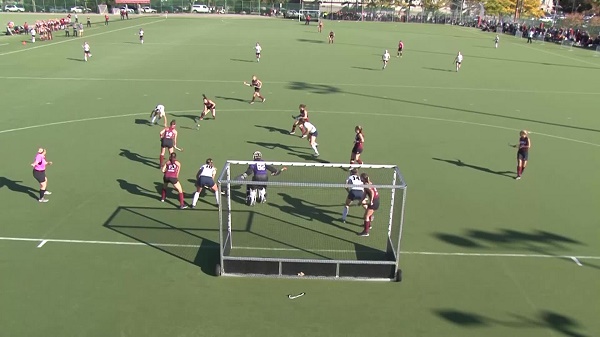
Ice Hockey:
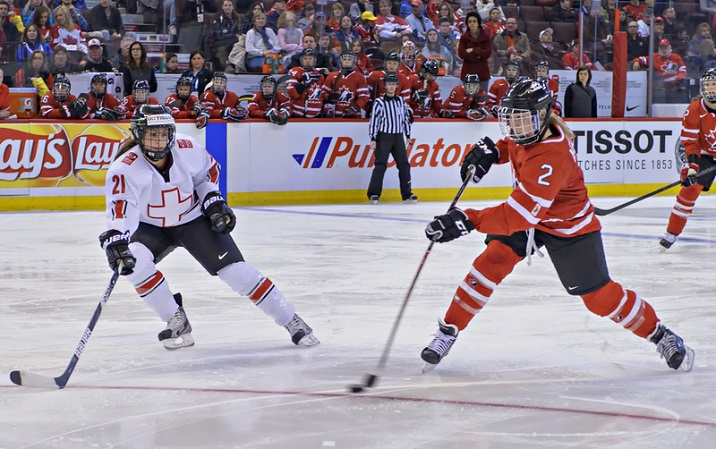
The same principle of pushing the ball into the goal post but instead of ground, the game takes place on ice. The players use skates to skate over ice and earn points. Their bats also differ in shape and size. The ball is actually not spherical in shape but a disc like solid that is used to roll over ice. It is fun watching this game and even more to take part.
Sledge Hockey :
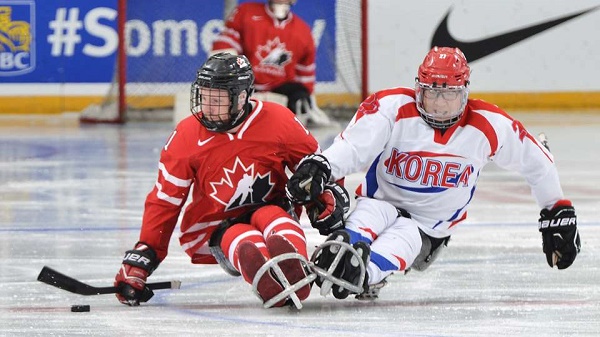
For disabled people who want to enjoy the fun of playing ice hockey, this game was invented. It has a board on which the player will be resting and with the help of skates it will be rolling on ice and the rest is same as ice hockey. It is also played by normal people sitting on the boards.
Bandy:
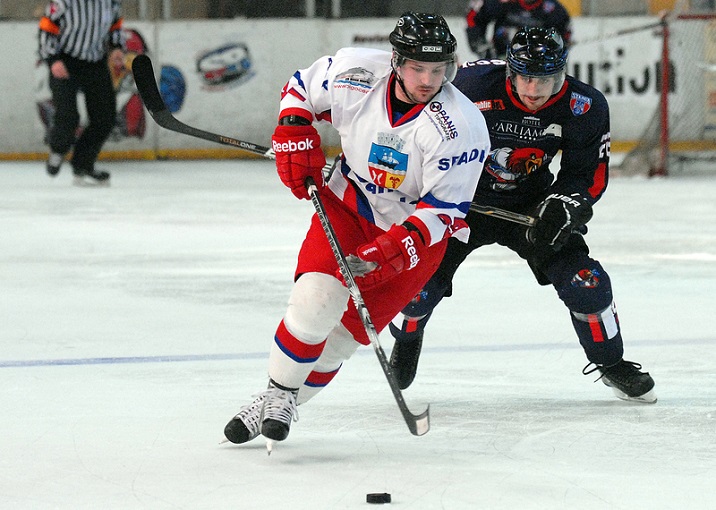
Bandy is Russian version of hockey and also the national sport. It became so popular across Europe that a bandy federation was formed during mid-20th century. The major difference from other versions is that Bandy is played in a field that is almost equal to the size of football field. This sport also took birth from ice hockey. Gradually by end of 20th century, Bandy was played professionally in parts of Asia and North America.
HOCKEY CHAMPIONS :
Santi Freixa (Spain)
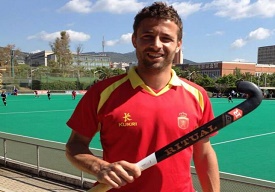
Santi is another great player from Europe. He has represented Spain in 2008 Olympic Games and won silver medal for the country. He has also won the FIH award for best young player.He is the captain of Spain’s hockey national team. He is also known for his off-the-field social activity campaign Stick for India that supports children of Anantapur with education and hockey skills.
Dhyan Chand (India)
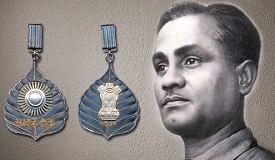
Dhyan Singh alias Dhyan Chand was believed to be the best hockey player ever. His ability to control the ball and break the defense of opposition with ease was the prime attraction. The way he carried himself both on and off the field brought him respect all over the world.He led Indian hockey team to three consecutive gold medals in Olympic Games. Many people around the globe followed and admired Chand’s stick play; some fondly called him magician of hockey.
Leslie Claudius (India)
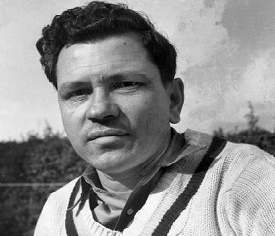
Another Indian legend who was born to play hockey only, as few experts of the game described. Claudius was short in stature and had bundles of stamina. He never used to get tired.Leslie holds a Guinness World Record for being part of a Hockey team that won maximum number of Medals at the Olympic Games.He took part in four Olympic Games and won four medals; three gold medals in 1948, 1952, 1956, and a silver medal in 1960 under his captaincy
Ties Kruize (Netherlands)
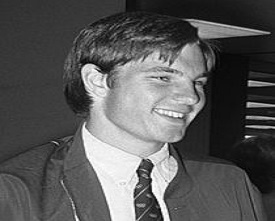
This Dutch player was simply superb on the field. He scored 167 goals in just over 200 international matches. He met with an accident during his prime and doctors told that he can never play the sport again.Surprisingly, he recovered to full health and returned to the sport only to stun the world with victories in World Championship (1973), two Champions Trophies in 1981-82, and European Championship in 1983.
Jamie Dwyer (Australia)
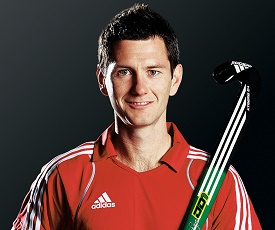
Dwyer was one of the legends of hockey in modern era. He was very quick on the feet with great skill to manoeuvre ball with the stick. He was nick named as foetus for his ability to shift positions from being an attacker to defender in a flash.He played for Australia to achieve hockey gold medal in Olympics after a long gap of 48 years. He also won World Cup and Commonwealth Games gold for his national side. Dwyer won world player of the year award five times.
Luciana Aymar (Argentina)

Aymar is considered as the greatest ever female hockey player. She was the finest dribbler when compared to her counterparts. She played an important role for her national side to win World Cup titles in 2002 and 2010. She also won eight FIH world player of the year titles.At junior level also she played very well and helped her team to win many tournaments. She represented Argentina as a flag-bearer for 2012 Olympics and was the second hockey player to receive this honour.
Natascha Keller (Germany)
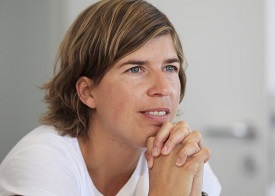
Natascha is one of the most popular female hockey players in the world with an Olympic gold medal to her kitty. She represented Germany in more than 400 matches.She won the gold medal in 2004 Olympic Games and was the flag bearer of Germany in 2012. Her family has an illustrious career in field hockey and that boosted her to play and represent the country at international level.
THANK YOU !
The Chernobyl Incident
In the early morning hours of April 26, 1986, the Chernobyl Nuclear Power Plant in Ukraine (formerly part of the Soviet Union) exploded, creating what many consider the worst nuclear disaster the world has ever seen.

Where is Chernobyl?
The Chernobyl Nuclear Power Plant is located about 81 miles (130 kilometers) north of the city of Kiev, Ukraine and about 12 miles (20 km) south of the border with Belarus, according to the World Nuclear Association. It is made up of four reactors that were designed and built during the 1970s and 1980s. A manmade reservoir, roughly 8.5 square miles (22 sq. km) in size and fed by the Pripyat River, was created to provide cooling water for the reactor.
The power plant
The Chernobyl plant used four Soviet-designed RBMK-1000 nuclear reactors — a design that’s now universally recognized as inherently flawed. RBMK reactors were of a pressure tube design that used an enriched U-235 uranium dioxide fuel to heat water, creating steam that drives the reactors’ turbines and generates electricity, according to the World Nuclear Association.

What happened?
The explosion occurred on April 26, 1986, during a routine maintenance check, according to U.N. Scientific Committee on the Effects of Atomic Radiation (UNSCEAR). Operators were planning on testing the electrical systems when they turned off vital control systems, going against the safety regulations. This caused the reactor to reach dangerously unstable and low-power levels.
Reactor 4 had been shut down the day before in order to perform the maintenance checks to safety systems during potential power outages, according to the Nuclear Energy Agency (NEA). While there is still some disagreement over the actual cause of the explosion, it is generally believed that the first was caused by an excess of steam and the second was influenced by hydrogen. The excess steam was created by the reduction of the cooling water which caused steam to build up in the cooling pipes — the positive-void coefficient — which caused an enormous power surge that the operators could not shut down.
The explosions occurred at 1:23 a.m. on April 26, destroying reactor 4 and initiating a booming fire, according to NEA. Radioactive debris of fuel and reactor components rained over the area while fire spread from the building housing reactor 4 to adjacent buildings. Toxic fumes and dust were carried by the blowing wind, bringing fission products and the noble gas inventory with it.
Radioactive fallout
The explosions killed two plant workers — the first of several workers to die within hours of the accident. For the next several days, as emergency crews tried desperately to contain the fires and radiation leaks, the death toll climbed as plant workers succumbed to acute radiation sickness.
Evacuations of Pripyat commenced on April 27 — about 36 hours after the accident had occurred. By that time, many residents were already complaining about vomiting, headaches and other signs of radiation sickness. Officials closed off an 18-mile (30 km) area around the plant by May 14, evacuating another 116,000 residents. Within the next few years, 220,000 more residents were advised to move to less contaminated areas, according to the World Nuclear Association.
Chernobyl today
The area has recovered to some extent, but is far from returning to normal.. But in the areas just outside the exclusion zone, people are beginning to resettle. Tourists continue to visit the site, with visitation rates jumping 30-40% thanks to a new HBO series based on the disaster. And The catastrophe that occurred at Chernobyl resulted in a few significant changes for the nuclear industry: concern about reactor safety increased in eastern Europe as well as around the world; the remaining RBMK reactors were modified to reduce the risk in another disaster; and many international programs including the International Atomic Energy Agency (IAEA) and the World Association of Nuclear Operators (WANO) were founded as a direct result of Chernobyl, according to the World Nuclear Association. And around the globe, experts have continued researching ways to prevent future nuclear disasters.
Thappad And The Volume It Speaks
Thappad: Bas Itni si Baat? Is a Hindi Movie directed by Anubhav Sinha, starring Taapsee Pannu as the main lead, Amrita. Some other cast of the movie include Pavil Gulati as Vikram Sabharwal, Amrita’s husband, Tanvi Azmi as Sulekha Sbharwal: Amrita’s mother-in-law, Kumud Mishra and Ratna Pathak Shah as Amrita’s Father and Mother and many other artists.
The movie’s main plot revolves around the orthodox Indian belief that woman should bear the responsibility of protecting her marriage and for that sake bearing any form of injustice or violence that she is faced upon with, in a silent and obedient manner. Thappad movie subtly touches the hearts and minds of the audience as it conveys a strong moral message that is highly needed in today’s world. This makes the movie stand out from the regularly entertainment-based movies that are preferred by the present generation in great demands.
The movie starts off by showing the dedicated house-wife Amrita who puts forth the needs of her husband and his family before her own wishes. Her husband Vikram, who is a workaholic is seen to prioritize himself and his needs before Amrita’s and expects Amrita to do the same. The story takes a major turn when Vikram slaps Amrita in the party organized at home, in anger and frustration due to some promotional issues in his company.
After this, the movie rolls forward with the decision of Amrita to take some time off from Vikram and his family in order to sort out her overwhelming feelings that occur after the slap incident. Thereby Amrtita deciding to return to her own home.
This whole plot raises not only a question of ethics and moral rights but also gender inequality.
The female characters in the movie are trodden and looked down upon by their own husbands and in-laws, just for the reason that they are females, thereby highlighting the thinking of Indians towards female.
The movie shows how even when a woman faces inequality in her marriage, the society and her own family expects and teaches her to bear the inequality and domestic violence all for the sake of protecting her marriage. We see the mother-in-law making comments like, “log Kya kahenge” and “Aaurto ko thoda sehna siklhna chaqhiye.” Throughout the story when Amrita suffers from the dilemma after the slap, no one comes for her comfort and neither does anyone blame or tell Vikram that he is at fault. Again, highlighting the concept of Man to be always right no matter what he does in his marriage.
Amrita’s fight doesn’t start because of a single slap, but the story perfectly weaves the injustice that she has been bearing up and moving on all along. It’s just that it takes that one slap for Amrita to realise how she has been living all along in her marriage. How she had to kill her only wish in life, which was to have respect and be happy. She realises how after her marriage all she did was become a submissive housewife. Though Vikram plays the negative role, who even after slapping his wife thinks that it was just an act due to heat of the moment and does not feel sorry for his action, is still empathised towards the end as he finally realises his mistake. This portrays how parents play a major role in the upbringing of children, as they are the first teachers from whom they learn the right and wrong in life.
Another gruesome scene that wrecks the heart of the audience is when the female lawyer is being raped by her own husband. One who does not know the definition of rape might not consider this as rape, however the definition of Rape is having sex with another person forcefully and without the consent of the other person. This applies even in relationships and to married couples. The female lawyer clearly denies the husband’s approach to have sex with him, however she finally gives up her struggle to resist when her husband forces himself upon her. The outline drawn from here is how women are expected to please and be sex objects for their men. A disgusting conventional ideology that still pertains in India is how husbands have the right to do whatever they like with their wives even when the wives do not agree to it.
The movie satisfies to a great extent and conveys a very important message that how women should stand for their own happiness and respect even if it means going against the odds. It also talks about how the preaching’s of the society are not always right. Although I liked the movie on a whole, but I was a bit disappointed by the ending of the movie. According to me, it ended on a positive note, with Vikram realising his mistakes. This may make the audience lose faith in the concept of fighting for their rights because it’s not always going to be this easy for your significant other to realise his fault. Also, the ending in a way hints the possibility of Amrita and Vikram getting back together ion future which may not always happen in every case. Apart from this, I feel the movie was great and is a really nice movie to watch and teach the present generation.
MONSOON- A SEASON NOT SO CHERISHED BY THE STRAYS
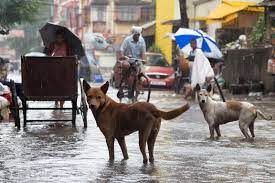
Putting an end to a long wait, surviving the hot humid weather for a great deal of time, monsoon has finally set foot in many parts of India. Albeit late than the scheduled date, it comes as a great relief for all. But the strays are badly affected by the monsoon since they don’t have a roof to cover them. Not everyone lives a life filled with luxuries. And sadly, stray dogs are among them. While a good amount of care is taken by pet parents during this weather, strays are often left to sustain on their own and not much heed is paid to them. They may have to sleep in muddy waters, walk through the puddles, and may have nothing to eat resulting in ticks, fleas, and maggots causing serious damages to their bodies. The maggots and ticks are a result of the moisture that favors their growth on the skin layer of the dogs.
Pneumonia is another danger many dogs suffer from due to frequent contact with dirty water which is home to a lot of bacteria during this weather. While the pet dogs get proper treatment, strays are devoid and suffer all alone.
Some dogs with an inappropriate immunity are exposed to a high fever which when not aided properly, can prove fatal for them.
While many help out the strays in these situations, others turn a blind eye to them. Some may try to help but due to feelings of obstruction and lack of resources, refrain from the same.
Here’s how one can help out the strays, using simple and easily doable techniques during the rains or the monsoon season altogether.
- Keeping some fresh food or leftover food – Filling their stomachs is a big problem the strays face which is also the primary reason for territorial aggression. During rains, food is scarce and whatever food the strays come across is mostly spoilt. So, one can prepare a chapatti or two extra and some boiled rice or store the leftover food instead of throwing it in the bin.
- Clean water – Water during rainy days is contaminated with a lot of mud, silt, and bacteria. It is advisable to keep clean water for them so that the risk of infections and fever is significantly reduced.
- Keeping medicines available – Keep a check on the temperature and keep some general medicines that are favorable to all dogs handy in case of causality.
- Providing them shelter at your house – It is understandable that some people don’t like the presence of dogs around them. But, that’s how life goes. We help each other and stand by each other in trying times. If elders or someone in your house are against the idea, try convincing them and provide shelter to the strays. Keep old mattresses or newspapers for them to sleep on.
- Building a shelter for them at a nearby park or unattended accommodation– Get in touch with the RWA of your area or the municipalities and pool in some money for the creation of shelters where the strays are safe during the monsoon months. This will be helpful and will be pocket-friendly too.
Mentioned above are simple steps that one can follow to help the strays. These are economically friendly and would not lead to consumption of your precious time and will also prove helpful to these friendly and loveable creatures.
Universal Basic Income(UBI)


Features of UBI:
1. Universal Scheme: UBI is a universal scheme in nature. It means UBI is not targeted so all citizens of the country will receive the payment of cash without any discrimination.
2. Periodic: Money will be distributed to the beneficiaries at a fixed interval i.e. monthly/yearly.
3. Cash Payment: The beneficiaries will get the cash directly into their account. So they won’t get anything in kind of cash i.e. vouchers for goods or services.
4. Unconditional Scheme: It means one need not prove his or her unemployment status or socio-economic identity to be eligible for UBI. So social or economic positions of the Beneficairy/individual are not taken into consideration.
5. Individual Beneficiary: In this scheme each citizen (or adult citizen) is considered as the beneficiary rather than each household.
An unconditional income that is sufficient to meet a person’s basic needs (i.e., at or above the poverty line) is sometimes called a full basic income; if it is less than that amount, it may be called a partial basic income.
One central motive for basic income is the belief that automation and robotization is paving the way for a world with fewer paid jobs.
Today, disruptive technologies like artificial intelligence are ushering in productivity gains that we have never seen before. They are also steadily reducing human capital requirements, making jobs a premium. The gap between the rich and everyone else has expanded significantly in recent years, and many fear that automation and globalization will widen it further.

Good Idea Why?
1. Currently, the government provides services through various social welfare schemes but now the government wants to change this trend by giving them cash so that peoples can buy services/goods of their choice.
2. UBI will provide secured income to individuals.
3. The scheme will reduce poverty and income inequality in society.
4. It will increase the purchasing power of the poor, so aggregate demand in the economy will get a boost.
5. It is easy to implement because the government needs not to identify the beneficiaries which is very tough task for State and Central Government.
6. This scheme will reduce the wastage of government money because its implementation is very simple.
If the only choice were between mass impoverishment and a UBI, a UBI would be preferable.
UBI is a project for reforming capitalism into an economic system by empowering labor in relation to capital, granting workers greater bargaining power with employers in labor markets, which can gradually de-commodify labor by separating work from income. This would allow for an expansion in the scope of the social economy by granting citizens greater means to pursue non-work activities (such as art or other hobbies) that do not yield strong financial returns.
Such a program would allow people to spend their money on whatever they value most. It would create a broad sense of ownership and a new constituency to shake up the system of big-money politics. Studies of conditional cash-transfer programs in developing economies have found that such policies can empower women and other marginalized groups.
Bad Idea Why?
1. There is a strong possibility that free cash to the poor can make them lazy or it may reduce the incentive for work, increasing the rate of inflation in the economy.
2. There is no guarantee that the given cash will be spent on productive activities, health & education, etc. It may be spent on tobacco, alcohol, drugs, and other luxury goods etc.
3. It may be that workers can refuse to work (as it had been observed in the case of MGNREGA) as a laborer or demand higher wages which can increase the cost of production of agricultural goods.
4. UBI is a flawed idea, not least because it would be prohibitively expensive unless accompanied by deep cuts to the rest of the safety net.
5. Without major cost savings, federal tax revenue would have to be doubled, which would impose massive distortionary costs on the economy.
And, no, a permanent UBI could not be financed with government debt or newly printed currency. Sacrificing all other social programs for the sake of a UBI is a terrible idea. Such programs exist to address specific problems, such as the vulnerability of the elderly, children, and disabled people.
Imagine living in a society where children still go hungry, and where those with severe health conditions are deprived of adequate care, because all the tax revenue has gone to sending monthly checks to every citizen, millionaires and billionaires included.
Basic economic theory implies that taxes on income are distortionary in as much as they discourage work and investment. Moreover, governments should avoid transfers to the same people from whom they collect revenue, but that is precisely what a UBI would do.
Besides, a more sensible policy is already on offer: a negative income tax, or what is sometimes called “guaranteed basic income.”
Rather than giving everyone $1,000 per month, a guaranteed-income program would offer transfers only to individuals whose monthly income is below $1,000, thereby coming in at a mere fraction of a UBI’s cost.
In conclusion it can be said that history has proven that freebies never changed the economic conditions of the people. So giving a sum of Rs.7,620 per person/year will not change much as we have seen this in the MGNREGA schemes which gives Rs.10,000 per year to the people.
So the government should focus to increase the skill of the people at free cost rather than free cash.
TABLE ETTIQUES AND IT HAS A MEANING!!!!!
WHEN WE MOVE INTO A RESTAURANT WE FOCUS ON EATING DELICIOUS FOOD BUT WE DOESN’T KNOW ABOUT THE CUTLERY (i.e.FROK and KNIFE) PLACING AFTER MEAL HAS A MEANING.LETS SEE ABOUT THE CUTLERY PLACING STYLES AND ITS MEANING.

1)BREAK :
If you talking to someone or using a restroom you can keep like this . It makes the server to know that you are not finished eating.
2)NEXT PLATE :
If you finished your first meal and ready to eat the second meal or waiting for the second meal to come. You can keep your cutlery this way.
3) excellent:
This way of cutlery placing indicates that you liked and enjoyed the meal very much . It was a way to appreciate the cook and the waiter/server that they are doing great.
4) FINISHED:
Keeping the cutlery parallel to each other means that you are done eating.
5)DIDN’T LIKE:
Inserting knife inside the fork means that you didn’t like the food and the service was bad .
What You Can Learn from Anne Frank’s Diary
A 13-year-old girl who was introduced through her relatable chapter about teachers was how I remembered Anne Frank before reading her diary. I still remember her phrase, “Teachers are the most unpredictable creatures in this World” because it was the funniest and most truthful statement that I had ever come across in my grade-school life. But it wasn’t until recently, years later, when I decided to give a shot at reading the complete diary of Anne Frank. And let me tell me, it totally wowed me away.
Anne Frank was born in Frankfurt, Germany in 1929. She was a Jew and her full name was Annelise Marie Frank. On her 13th birthday, her father Otto Frank gifted her a diary as a birthday gift. However, this diary became a place of solace and the chronicles of German-Nazi events as recorded by Anne Frank when she went into hiding with her family from the German Nazi in ‘Secret Annexe’. (1942- 1944). She died in 1945 after her family was captured by the Nazis and later killed in Holocaust. Her father Otto Frank, who was the last survivor, discovered Anne’s diary and decided to publish it.
Anne’s diary carries her confessions, philosophies, and convictions. The beginning of her diary starts on a casual note as Anne confesses her emotions to her diary ‘Kitty. She talks about her social life, crushes, and school. However, these entries change once she goes into hiding with her family and admits her worries, faults, anxiety, and ideas that she faces in the ‘Secret Annex’. Her thoughts are profound and simple, exploring the tiniest details of life and her longing for the joys and sorrows of ordinary life.
When I first read her complete diary, there were many instances where I was shooked by her maturity and thoughtfulness, and there were moments where I sympathized, related, and longed for life with her. What was more intriguing for me was how the thoughts that I began to have when I was 18 were the thoughts that Anne had at the age of 13. Her keen observations about life and herself made me realize so many things that I was blind to before. There were instances where I found her childish side and there were instances where I saw the grown-up in her. At each stage she made me feel for her and her philosophies.
So here is a short compilation of her profound thoughts that I have picked for you. I hope you can learn and appreciate life and people the way Anne did, and maybe get a bit more curious about this girl and decide to grab her diary to explore more of her life and thoughts.
At such moments I don’t think about all the misery, but about the beauty that still remains. This is where Mother and I differ greatly. Her advice in the face of melancholy is: “Think about all the suffering in the world and be thankful you’re not part of it.” My advice is: “Go outside, to the country, enjoy the sun and all nature has to offer. Go outside and try to recapture the happiness within yourself; think of all the beauty in yourself and in everything around you and be happy.
We aren’t allowed to have any opinions. People can tell you to keep your mouth shut, but it doesn’t stop you from having your own opinion. Even if people are still very young, they shouldn’t be prevented from saying what they think.
How noble and good everyone could be if, every evening before falling asleep, they were to recall to their minds the events of the whole day and consider exactly what has been good and bad. Then without realizing it, you try to improve yourself at the start of each new day.
As long as this exists, this sunshine and this cloudless sky, and as long as I can enjoy it, how can I be sad?
I soothe my conscience now with the thought that it is better for hard words to be on paper than that Mummy should carry them in her heart.
Because paper has more patience than people.
Start your own business – Part 1
During the lockdown, most of us lost our jobs and most of us got less paid than our actual wages due to the unpredictable economic statics and decrease percentage. So, everyone started to realize one passive income is not sufficient to run our lifestyle, especially in this pandemic situation. We always need two carriers to make money and satisfy our life needs.
- One is PROFESSION
- Another one is PASSION
A profession is something that you don’t hate but you do that to move on in day-to-day life. And passion is something that you love to do and doing that without any expectations. Nowadays nothing is free except viruses. So, even though if you love your passion as much as you even don’t give a second thought to get money out of it. You have to change that pessimistic mentality. Everything is an opportunity to improve both sides. That’s called Win and win solution. If you are teaching something he is earning knowledge and you are earning your deeds as money. So, how one can begin a start-up business? We are going to look at the most possible works to do without a large sum of investment. But, still get some side income from them. You don’t need to find a location or giant machines or decorating them etc… All you need is essential types of equipment for the idea in your mind and some Magic in your hands to achieve your destination. You can work from your home and sell them on Social Media like amazon, Instagram or you can even create your own website to place your products at one point.
Costume designing:
Costume designing is the best way to make a good profit out of essentials. All you need is an innovative mind, designing knowledge, fabrics, and sewing machine. And some customers must have their own ideas about their idea costumes. So, you can even customize your orders according to your customers. And trust me customizing optional website are countable in India. But people require customizing costume designers. You can do costumes like scarfs, veils, hats, dresses and innovative fashion and eligant costumes. Especially, people will roll over the red carpet for you if you sell them at affordable ranges.
Skincare products Making:
Skincare making is the Bestest economical friendly business. It doesn’t need higher investments but still, you can get a good profit if your products are reasonable and if you have magic in your hands to treat someone’s skin problem.
Nowadays skin problems are common to every human. If getting rid of the skin problems are one side. But, choosing a product to give a try is something everyone confuses. You can do skin products to the people’s according to the type of skin. People will celebrate you once they get visible changes. And people love natural ingredients without side effects keep it noted. There is a huge demand for good home-made products like hair oils, hair wash powders, soaps, cleansers, face packs, serums, etc.,
Some extra amount is something that no one will say no to. We will enroot many passionate start-up businesses like this in our upcoming articles. So, it’s time to switch our passion into action.
A “wobble” in the moon’s orbit, according to NASA, may cause record flooding on Earth.

Because of a “wobble” in the moon’s orbit, which is acting in concert with climate change-fueled rising sea levels, every coast in the United States is experiencing fast-growing high tide floods.
New research published recently in the journal Nature Climate Change by NASA and the University of Hawaii warns that future changes in the moon’s orbit might result in record flooding on Earth in the next decade.
Researchers discovered flooding in American coastal towns may be many times worse in the 2030s, when the next moon “wobble” is projected to begin, by mapping the National Oceanic and Atmospheric Administration’s (NOAA) sea-level rise scenarios, flooding thresholds, and astronomical cycles. They predict major infrastructure damage and community displacement as a result of the water.
While the study emphasizes the grave position that coastal towns are in, the lunar wobble is a natural phenomenon that was first documented in 1728. The moon’s orbit causes periods of greater and lower tides every 18.6 years, although they aren’t harmful in and of themselves.
“Earth’s typical daily tides are suppressed during half of the Moon’s 18.6-year cycle: high tides are lower than usual, and low tides are higher than normal,” NASA says. “Tides are magnified in the second part of the cycle, with high tides getting higher and low tides getting lower. High tides are only going to get higher as the world’s sea level rises. As a result, half of the 18.6-year lunar cycle reduces the influence of rising sea levels on high tides, while the other half increases it.”
Scientists, on the other hand, are more alarmed this time. The next high tide floods are anticipated to be more severe and frequent than ever before as sea levels rise owing to climate change, compounding already dire projections.
In 2019, the National Oceanic and Atmospheric Administration (NOAA) reported around 600 such floods. After another decade of sea-level rise, scientists predict three to four times that amount in the mid-2030s.
Based on the current study, these floods will emerge more often throughout the country and can occur in clusters lasting over a month, depending on the moon, Earth, and sun’s locations. Floods might occur as frequently as every day or every other day during certain alignments.
“Low-lying regions around sea level are becoming increasingly vulnerable and suffering as a result of rising floods, and the situation is only going to get worse,” NASA Administrator Bill Nelson said. “Coastal flooding on our coasts and throughout the world will continue to be exacerbated by the Moon’s gravitational pull, increasing sea levels, and climate change.”
Almost all of the United States’ continental coasts, as well as Hawaii and Guam, are likely to be affected. By the end of the century, sea-level rise is anticipated to have rendered hundreds of thousands of square kilometers of coastline untenable, displacing over 100 million people globally.
Researchers hope that their findings will spur more focused efforts to avert as many harmful effects on the environment and people’s welfare as possible before it becomes too late. While high tidal floods may not include as much water as hurricanes, their regularity poses a serious threat.
“What will have an impact is a cumulative effect over time,” said lead author Phil Thompson. “A firm cannot operate with its parking lot underwater if it floods 10 or 15 times each month. People lose their employment as a result of their inability to get to work. Sewage ponds have become a public health concern.”
 Eduindex
You must be logged in to post a comment.