HOW TO WIN AN ARGUMENT

Arguments, whether they are interpersonal or professional, are essential. Be it a constructive or non-beneficial disagreement, we engage in it more frequently than we plan to in our regular lifestyle.

Nobody can win an argument against you unless you give the opportunity to.

Even if this isn’t your strongest suit, there are a few straightforward strategies you may use to quickly and easily win. To assist you, here are a few of them:

Image credit : pixaby.com https://images.app.goo.gl/dv31TkrJaxJ7cZRm9

1. Do your research – In a professional setting when you know you’re likely to have to get into an argument, prepare yourself beforehand with all the information and facts so that you have an upper hand in the discussion

2. When it’s unlikely – Sometimes you could encounter yourself in a heated argument in an unusual situation, caught off guard and unsure of what to say. It’s typically best to try to reason with the other person so that you can depart the argument quickly.

3. Calm down – The most important thing to remember when in an argument is to keep your composure and maintain decorum, especially if your parents are on the other side. However, this is true for practically all contentious discussions.

4. Don’t raise your voice – Being ear-splittingly loud won’t help you win, instead strengthen your case. Maintaining your mental fortitude will help you make your point to the opposing side as effectively as you can.

5. Decapitate them delicately – Be gentle and kind! Talk calm and pleasant until your generosity and encouraging words cause the opposition’s rage to subside. In between disputes, you must remind the other person of the good in you in case they have forgotten. This works!

6. Be reasonable Avoid making assumptions just to justify your assertions. Provide evidence to back up your claims so the opposite side won’t have a chance to refute the information.

7. Choose your next word carefully- Remember in an argument the point is not just winning but also successfully winning at it. So communicating the issue that you’re debating about is also vital because that is the reason it happened in the first place. In doing so,  be careful how you choose your words.

8. Don’t rush— Time may not always be to your advantage, so consider whether it is the appropriate time to protest before you start the conversation. Better to steer clear of it for a while if not. Additionally, it will offer both parties a chance to think things through.

9. Listen!- If you aren’t willing to listen and consider the opposing viewpoint, how can you expect others to? It’s crucial to hear what the opposing side has to say because a one-sided discussion is not an argument.

10. Make believe – when you really want to win and your case isn’t solid enough, make the opposition believe that your perspective is stronger and their claim needs to be reevaluated. Even if you’re wrong, trick them into thinking otherwise.

You’ll master the art of argumentation in no time, just follow these simple methods and the win is yours.

Importance of Self-Confidence

Self-Confidence is one of the important things needed in our life. It has the power to either push us up or pull us down. Most people lack self-confidence at some point in their life due to failures and disappointments. Self -Confidence can be increased due to the motivation of others, but it is not the only way to boost our inner confidence. The confidence that comes from inside is the one that resists for long and helps us achieve more and more in our life. Let us see some of the ways to boost our confidence and try to use them in our daily life.

Photo by Snapwire on Pexels.com

Ways to Boost Self Confidence

  1. Tell good words to yourself : It may feel silly on reading this. But actually it works during the time of crisis. Whenever we feel low, we can tell some good words to “We can do it”,”We are capable of doing it”,”Nothing is impossible”. These words lowers our stress as well as helps in boosting our confidence. We can even ask our friends and family to tell good words to us. Getting these words from those we trust , gives immense amount of confidence in our life.
  2. Take a deep breath : Before starting any task, taking a deep breath will definitely helps us. We should allot some two to three minutes before the beginning of the job and we should take a deep breath without thinking about anything else. During that time, we should not concentrate on the outside environment or thinking about how to do the job. Our only focus must be on taking a breath and relaxing both our mind and the body.
  3. Thinking on past success : When we are doing a difficult or stretchy job, we can think on our past success or achievement for some moments. Beware, it must only be for some moments. Sometimes it will lead to over -confidence and destroys both the time ,the effort and the task.
  4. Thinking on our good time : Everyone will definitely have such moments in our life that brings us instant laughter or instant happiness on our face. During our low time, we can think on these things for some moments to boost up our energy and confidence to do the job. These times can be with the family or friends or colleagues or anyone. Here too, over thinking may lead to procrastination , which is the dangerous one that won’t led us to finish the job.
  5. Hobbies : Hobbies can make an individual feel happy, calm ,satisfied and acts as a complete stress buster. Taking out some time for hobbies can help us to make our brain relaxed and peaceful. These hobbies can be done during breaks or free time.
  6. Talk to yourself : This task doesn’t need anyone to perform. During our low times or when we have no one with us, this is the best way to keep us away from negativity and low confidence. We can talk anything and everything to ourselves. Just imagine yourself as another human and tell everything that is going on our mind.

Believe you can and you’re Halfway there.

Theodore Roosevelt

How to rebuild your confidence?

Building and rebuilding confidence

Rebuilding confidence is not the same as building confidence.

  • When building confidence, you’re trying to do something you’re not sure you can do.
  • However, rebuilding confidence means you used to be good but failed at some point. Getting back is much harder to do.
Confidence is essentially about expectations

You think you’ll excel, but considering the probability of success and feeling confident is not that easy.
Framing effects happen when the same thing looks different when the context change. If you’re a good student in a mediocre class, you feel smarter than if you’re a good student in an elite class.

Relearning confidence

When practising a skill that you have forgotten, you may lack the confidence to pick it up again.
However, those doubts are exaggerated. Not remembering is normal, and relearning happens faster than you may expect. Yet, you may still lack self-confidence, which will undermine your self-image and motivation.

Play over Performance

When we improve in a skill, our mindset will start to shift from play to performance. Rebuilding confidence requires you to relive that initial play mindset.

  • Make failures painless. Your first practice should have zero consequences. Do warm-up exercises for low stakes before you put on pressure to perform. However, if you review your skill but continue to get everything wrong, it is a signal to stop.
  • Expect frustration and failure. When you expect failure, it won’t bother you so much when performance suffers. Set the bar lower.
  • Trust the rebuilding process. You don’t need confidence that you will excel, just confidence that you’ll eventually rebuild your confidence.
  • Reframe your expectations. You have no responsibility to live up to other people’s expectations of you.
reference

https://www.scotthyoung.com/blog/2020/07/20/rebuild-confidence/

Top motivational quotes to awaken the beast hiding in you

Motivation is something that helps you grow. Not only from inside but also from all aspects, all ups and downs in your life, whenever you feel low why do you need motivation? Have you ever thought about it. Here, is the answer because motivation is something that helps you to grow, that helps you to be you, that makes you. It has the power to awaken the beast hiding inside you.

Your perspective with either become prison or your passport.

-Steven Furtick

Realise deeply that the present moment is all that you ever have.

– Eckhart Tolle

How you love yourself is how you teach others to love you.

– Rupil Kaur

The Secret of your success is determined by your daily agenda.

– John C. Maxwell

Burn the past, Turn the page, Move on.”

– Safura Arsh

Act as what you do makes a difference, IT DOES.”

– William James

Excessive fear is always powerless.”

– Aeschylus

A good Education is the foundation of better future.”

– Elizabeth Warren

Between thinking and seeing there is a place called knowing.”

– Carolyn Myss

You can’t build a reputation on what you are going to do.”

– Henry Ford

Believe you can and you are halfway there.”

– Theodore Roosevelt

Take care of your body, It is the only place you have to live.”

– Jim Rohn

If you hear a voice within you say ‘ you cannot paint,’ then by all means paint and that voice will be silenced.”

– Vincent Van Gogh

Ofcourse motivation is not permanent. But then, neither is bathing: but it is something you should do on a regular basis.”

– Zig Ziglar

The only way to do a great work is to love what you do.”

– Steve Jobs

It’s not the load that breaks you down, it’s the way you carry it.”

– Lou Haltz

Nothing will work unless you do.”

– Mayo Angelo

Do one thing everyday that scares you.”

– Anonymous

If you are not willing to risk the usual, you will have to settle for the ordinary.”

– Jim Rohn

When I hear somebody sigh, ‘ Life is hard,’ I am always tempted to ask, ‘Compared to what?’

– Sydney Harris

Success is walking from failure to failure with no loss of enthusiasm.”

– Winston Churchill

All progress takes place outside the comfort zone.”

– Michael John Bobak

The only place where success comes before work is in the dictionary.”

– Vidal Sassoon

Here are some of the motivational quotes that if you implement in your lives will be successful for sure. Motivation will help you to achieve all your goals and so are these quotes.

How to boost your self-esteem?

Self-esteem is basically the overall opinion about yourself, how you feel about yourself which includes your abilities and limitations. Everyone lack confidence at some point of time in different situations which is temporary but having low self-esteem leads to unsatisfied and unhappy with themselves for most of the time. Generally people who are having low self-esteem are:-

  • Critical about their own personality
  • Ignores their positive qualities or aspects
  • Uses negative or cuss words to describe themselves
  • While having self-talk with themselves, they are always negative or self-blaming.
  • Doesn’t believe if someone compliments them.
  • When things go wrong they always blame themselves for the failure instead of considering other things in account such as actions of other Individual or some crisis externally.

With these things in low self-esteem person, it reduces the quality of life which often leads to:-

Fear of Trying – The person who has low self-esteem will always doubt themselves in terms of their abilities, worth and challenges to experience something new in their life.

Fear of getting judged – People with low self-esteem may avoid the social gathering or some activity based on a group of people, just because they are afraid of being judged on negative basis.

Self-care – People with low self-esteem lacks in taking care of their self as they neglect themselves.

Negativity – Person with low self-esteem constantly abuses or neglects themselves which leads to attracting negative feeling which eventually causes anxiety, sadness, depression, shame or guilt.

Self-harming behaviors – Person with low self-esteem always puts themselves in a situations where they are at increased risk of harming themselves. For e.g. – Drug abuse, eating disorder or suicide.

There are many causes of low self-esteem like unhappy childhood, relationship break ups, low performance in academics, ongoing medical problem or Mental illness. But there are simple ways to boost your self-esteem and that are:-

Record your story

recording your life story is a fun and therapeutic strategy that countless people have used not only does it help you remember what you love about yourself but telling your story also motivates you to maintain that positivity in the future but it’s not just about reflection the fact that you’re writing down your story plays an important role because when you write something down you have to be clear you have to be concrete you’re forcing yourself to be specific about who you are so if you’re feeling confused your story can give you the clarity that you’re looking for.

A Point to Pride

Instead of looking back in time you can also boost your self-esteem by setting goals for the future for example, you’re an aspiring author but you’ve never actually written a book before you’ve written plenty of short stories but you’ve always been too scared to try something bigger maybe you’re worried you’re going to fail or you’re just feeling overwhelmed and you don’t have enough faith in yourself to take on the challenge how can you build the self-esteem you need to accomplish your dreams try setting something called a point of pride a point of pride is one specific goal that you accomplish in order to prove something to yourself.

Self-evaluation

You can boost your self-esteem by changing basic things like the way you speak for example you might be using self-critical language you undercut your own success you belittle your own accomplishments and you overrate the value of the people around you. The problem is you probably don’t even realize that you’re doing it it’s become almost automatic for you so how do you change something that you don’t even think about try studying the way you speak every time you undermine your own achievements go and write it down that way you can focus your attention on your harmful language and gradually change it for the better you may not notice a difference at first but over time this simple strategy you can use it to make a huge impact on your self-esteem.

Self-compassion

One of the hardest things of building self-esteem is learning how to forgive your own mistakes you want to be perfect, you want to be respected and successful so whenever that doesn’t happen you either pretend that nothing happened or you become your own worst enemy you criticize yourself and you hold a grudge but both of these approaches have the same fundamental problem they’re focused on preserving the good you’re trying to maintain this fragile image of yourself you expect to be that perfect successful person so you react negatively every time that doesn’t happen you either ignore your mistakes or you tear yourself down and slowly but surely you chip away at your self-esteem so what should you do instead the real secret behind your self-esteem has nothing to do with preserving the good it’s about forgiving the bad you’ll spend the rest of your life making mistakes we all do there’s just no way around it so before you can believe in yourself you have to learn to live with those failures little by little you can boost your self-esteem by actively forgiving yourself each time you say something stupid or make a careless error just take a minute to acknowledge what you did wrong.

When a person is having a high self-esteem then they appreciate themselves and others too, they see the world from the positive light and also understands other people’s problem. Their relationships are loving and calm full and also they speak up calmly and tell other their opinion towards and topic freely.

Generation Gap

Maya Angelou quoted, “I’ve learned that regardless of your relationship with your parents, you’ll miss them when they’re gone from your life. ” It is indeed the truth. Lately I have been thinking a lot about relationship between parents and child nowadays.

Though we love our parents more than anything in this world and so they do. It is of no question that our parents took care of us and will always do, no matter how old we become. But, don’t you think that these days parents-child conflict are increasing way too much? What could be the reason behind that?

The first thing that comes in our mind is obviously generation gap and it’s true. Why generation gap? It is basically age gap between parents and children. However, the major issue arrives due to the mental gap in terms of thinking and current trends. These days, children, mostly teenagers believe that they are grown-ups and it’s high time for them to be independent. This helps them to gain more self-esteem. On the whole, both parents and children do not see things from the standpoint of each other and thus leads to conflict.

Some teenagers feel that their parents should trust them and give them freedom but they also know that parents are more concerned about their safety, which sometimes make children irritated.

Technology also affects the relationship between them. Technological ability is also important. Parents might not learn technology as quick as teenagers and when they try to learn from them, they get impatient. Our world keeps changing and developing, things rarely stay the same, causing generation gaps between the parents and their children.

Below are some of the significant points which need to be understood.

• Parents often do not tolerate mistakes and tend to tell their children off. They need to understand that this is their learning phase and making mistakes will make them grow in life, but if they only get punished for it, it widens the gap and creates a lack of proper communication.

• Children are expected to be replicas of parents often have dreams for their kids. They should not impose their wish on them without knowing what they want.

• Comparing children to each other or telling them how you were as a child also widens the gap. Due to this, they lose confidence and enthusiasm they may previously had.

• Lack of understanding is also the major cause. Listening and understanding what a children is trying to convey could be a good step. But, it is lacking these days. Parents often feel like because they have already been the age their child is currently, that they understand how their child thinks. They should understand things have changed from then to now.

Now, how to solve these problems? Here are some ways :

  1. Keep an open mind – The way that kid think is different from how parents do. Keeping an open mind and not assuming that they are same as you were at their age is very important. You must also understand that there are some things that are acceptable in society and therefore acceptable to your child that may not have been acceptable when you were the same age.
  2. Communicate – Taking out time to communicate with your kids will be very helpful. Your child must feel comfortable to talk to you about anything. The children must be assured that they can approach their parents with anything and can speak freely without any fear. And this way parents need not to worry about their children hiding thing from them.
  3. Listen – Parents need to allow their kids time to talk without interruption and listen to what they have to say. Learning your child’s thoughts and opinions makes them feel like what they want or feel matters to you, which in turn makes them feel much closer to you than before. Having a parent who listens as well instead of only talks and lectures will give your child more encouragement to listen to you in return.
  4. Understand – With listening comes understanding and this means that you have to learn to put yourself in your child’s shoes and trying to understand how they feel and what they want from what they tell you. If you are able to understand where your child is coming from, you will be able to close that generation gap to some extent.
  5. Unconditional Love – Love has a way of crossing boundaries and bringing people together if acted upon. So show your children how much you love them. This unconditional love and support that they get from you is very encouraging and makes children more inclined to show that same love and understanding back.

In the end, I would like to mention that children should also treat parents with love and affection because they did and are doing a lot for you everyday that is unnoticed. Your one word of affection can make their day. No matter how miserable you feel while they’re scolding you, never stop respecting them.

What to expect from an Internship

1. Networking

One of the most rewarding takeaways from internship is definitely Networking. It helps build professional relationship right at beginning of your professional career. Networking during an internship is really important for your career growth and social life. The power of relationships can provide you with professional opportunities in the future that you would never dreamed of. It will help you to hear tips and gain advice from others who are successful. There are so many advantage of networking, it will definitely help you to build a great future. Exchanging information on challenges, experiences and goals is a key benefit of networking because it allows you to gain new insights that you may not have otherwise thought of. Similarly, offering helpful ideas to a contact is an excellent way to build your reputation as an innovative thinker.  

In the future, these contacts could be potential references and may be also help connect you to new opportunities.


2. Soft Skills

Apart from enhancing skills in your professional domain, internships come bearing gifts in the form of soft skills. Alongside time management, teamwork and communication skills, you also learn to work with people who get on your nerves, adapt to demanding superior and long work hours and take accountability for your work. Skills like punctuality, multi-tasking, creative thinking, problem solving will help you with your full time job.

3. Working World Experience

Internship essentially serve as blueprint of how professional offices work. Regardless of the responsibilities, most internship follow a similar profile. Through an internship, you can learn more about responsibilities, hierarchies and schedules in a real time office. When students have an opportunity to experience real-world situations, it allows them to practice the skills they learn about in their books and truly understand the task at hand. Teamwork is an extremely important thing in the industry.

So if you want to try those big girl pant before buying them, an internship is your way to go!!

4. Compensation

We are gonna be loud and clear for everyone to hear, experience does not pay bills. You’ll come across internship offering ‘learning’ and ‘experience’ as compensation for your work. And often, in the rush to add a few lines to your resume you may be tempted to take up the first internship that comes your way. Trust me, there are tons of internship out there that will monetarily compensate you for your efforts and skills.

If an internship offers you all of these just grab it!!


Meaning of Confidence

Confidence means having security about oneself and oneself ability. It is belief of being valuable, worthwhile and capable. Confidence turns thoughts into action.

Factors affecting Confidence

There are several factors that affect confidence both internal and external. Genetics, childhood, environment, society, media, health, experience can all add or take away how you feel about yourself and your abilities. The choices you make, risks you take and how you respond to challenges play major role in confidence development.

Tips to boost Confidence

  • Don’t compare yourself to others.
  • Surround yourself with Positive people.
  • Take care of your body.
  • Face challenges.
  • Continuous practice to sharpen your skills.
  • Good diet plan.
  • Try new things.

Bedazzle – Book Review

Introduction

What boosts up your confidence in social media? Apparently, the amount of kindness and appreciation from the wonderful people here on our site boosts my confidence.

Bedazzle‘ by Shamoly Khera is an effective self help book that educates the readers about how confidence sprouts inside everyone, the author has given many instances to make the readers understand some crucial topics. The book is well researched and efficacious.

‘Our ‘weirdness’ is actually our uniqueness. Our only job in this world actually is to not be like anyone else, but be the best version of ourselves.

– From ‘Bedazzle’ by Shamoly Khera.

Interpretation

This book explores the idea of adapting yourself to the environment around you, coming out of your comfortable zone and the significance of perspectives. I loved how the author has elucidated about discerning our aspirations and drives, a lot of you would feel reluctant to take up a job/stream of education you really love, Shamoly Khera has given an interesting example of the different dispositions we watch in the ‘Friends’ series, if you’ve watched the show, then the way the author has drawn a parallel line will definitely fascinate you.

The mindset of an individual matters a lot, in order to become successful or achieve something you should have a clear mindset. The information about the ‘Fixed Mindset’ and ‘Growth Mindset’ is one of the best insights I’ve got from this book. I’ve added some of the best insights in my book journal as well.

This book offers you the beneficial information to boost your confidence, the amount of research and the plausible instances the author has given are really convincing. If you are looking for an insightful self help book, you can go for this one.

Insecurity

Everyone feels a little unsure at times. As humans, we constantly think, and some of our thoughts can be filled with doubt. This can lead to thoughts of insecurity. Too much insecurity can lead to other problems — in relationships and in your everyday life. However, there are ways you can work through your insecure thoughts and live life more confidently.

What Is Insecurity?

Insecurity is a feeling of inadequacy (not being good enough) and uncertainty. It produces anxiety about your goals, relationships, and ability to handle certain situations. Everybody deals with insecurity from time to time. It can appear in all areas of life and come from a variety of causes. It might stem from a traumatic event, patterns of previous experience, social conditioning (learning rules by observing others), or local environments such as school, work, or home. It can also stem from general instability. People who experience unpredictable upsets in daily life are more likely to feel insecure about ordinary resources and routines.On the other hand, insecurity can have no definite, external cause. Instead, it can appear as a quirk of personality or brain chemistry. Understanding the nature of insecurities can help you manage your own and offer others the support they need.  

Types of Insecurity:

There are almost limitless areas of potential insecurity. Moreover, insecurity often bleeds over from one area of life into another. However, there are some types of insecurity that appear frequently.

Relationship Insecurity: One of the most common kinds of insecurity concerns relationships or “attachments.” Attachment theory originated out of a desire to connect the attachment patterns of early childhood to later relationship patterns and expectations. When a child’s “attachment figures”, often parents or guardians, aren’t reliably available and supportive, the child often feels insecure, forms a negative self-image and relationship models, and experiences greater emotional distress and maladjustment later in life. Relationship or attachment insecurities don’t need to begin in early childhood. They can arise wherever previous experience or personal insecurity undermines someone’s security in their closest relationships.

Job Insecurity: Job insecurity occurs when you are anxious about your continued employment or about the continuation of certain benefits attached to your employment. It can be triggered by anxiety over your own job performance or anxiety over factors beyond your control, such as the economy, industry trends, workplace conflict, or the danger of company restructuring or failure. High rates of unemployment and temporary work increase job insecurity on a national scale and contribute to widespread mental health problems.

Body Image Insecurity : A common source of insecurity is body image. Many people feel insecure about the way they look and question whether they measure up to an imposed ideal. There is no necessary connection between actual body health or appearance and body insecurity. People of all body types can experience this type of insecurity.

Social Insecurity/Anxiety : Another common type of insecurity surrounds the way we are perceived by our peers and the ease with which we interact with them. This insecurity can be a recurring, low-level problem or can blossom into full-blown social anxiety disorder or social phobia.

Signs of Insecurity:

Signs of insecurity are as variable as the condition itself, but there are some common tendencies you can look out for.

Low or Superficial Self-Esteem : One sign of insecurity is low self-esteem or negative self-image, particularly when that image seems to be inconsistent with external observation. Low self-esteem means you think badly about yourself or your abilities. It can lead to other problems, especially concerning mental health. Talk to a doctor if your self-esteem is very low.Because the measurement of self-esteem generally relies on self-report, insecurity can lead to superficial self-esteem. People with insecurity often want to appear secure, and their explicit comments may be at odds with their automatic responses to certain stimuli. Deliberate self-misrepresentation or false behavior/information on social media can also be a sign of social anxiety. The act of faking then reinforces the social insecurity.

Perfectionism : The inability to be satisfied with progress and need to control and refine projects until they’re perfect can be a sign of insecurity. It stems from the sensation that you or your performance is never enough. It can appear as a manifestation of insecurity in any area of life but is frequently found in cases of job insecurity and body insecurity. Eating disorders, for example, often appear along with both harmful perfectionism and attachment insecurities.

Self-Isolation : Social insecurity can lead people to avoid social interactions, isolating themselves. Sometimes these people prefer to interact virtually in internet situations they feel they can control.

Anxious or Avoidant Attachment Styles : Attachment insecurities often result in problematic attachment styles, or dysfunctional approaches to relationships. The two most common are anxious or avoidant attachments. Anxious attachment styles are characterized by emotional dependence (relying on someone else for your emotional well-being), a fear of being alone, and fantasies of perfect relationships that can never be fulfilled. Avoidant attachment styles also stem from insecurity but go in the other direction. People with this style tend to keep relationships superficial and disengage from more intimate connections.

Poor Job Performance : Job insecurity (not having a stable job) can work to motivate some people, but it more often results in poorer performances. It can lead to absenteeism (avoiding work), turnover intention (wanting to change jobs soon after starting), disengagement from colleagues and in group projects, and poor work attitudes.

Depression or Anxiety : All types of insecurity can lead to decreased mental wellness. Depressive or anxious behavior or thinking is often an effect of insecurity, particularly when that insecurity produces (or is accompanied by) erroneous beliefs and patterns of thought.

Dealing with Insecurity :

Occasional insecurity is a natural part of life. For deeper and more longer-lasting feelings of insecurity, however, professional therapists can help you sort through your emotions and develop strategies for everyday life. In dealing with insecurity, there are a couple of helpful tips to keep in mind.

Social Networks Matter : Broad and meaningful social networks — frinedships, relationships with coworkers, and more — help to lessen both insecurity and its negative effects. There’s an inverse correlation between healthy social networks and insecure attachment styles. Having a wide circle of friends and many close connections allows you to develop the tools and confidence to engage in deeper adult relationships.Developing good friendships both in and out of the workplace also has a proven record of success as a coping strategy that helps prevent job insecurity, depression, and general anxiety. People who disengage from colleagues in response to job insecurity more frequently suffer in their mental health and job performance.

Trust Takes Practice : While having an overly trusting behavior creates its own problems, ask yourself if you have any reason to distrust expressions of affection or liking from others. People with insecurities sometimes express doubt and perceive rejection in everything from partner relationships to new acquaintances. These expressions can be self-fulfilling. Practice taking displays of interest at face value, something that can be easier in more casual relationships. You can build up the confidence to accept deeper affection and intimacy.

Confidence:a key to success?

Confidence means feeling sure of yourself and your abilities in a realistic and secure way. Yes, it is rightly said that confidence is the key to success. It is built on the choices and accomplishments that feed your passion, most of all making you happy and feeling proud on yourself.

It doesn’t mean to feel like superior from others or in any arrogant way but to believe in a positive manner that you’re capable. A confident person can achieve the goals and face the scenarios of life far better than those who lacks it.

The people who are confident enough are admired by others ,can take the risk , look up the situations positively and also inspire others.

” low self-confidence isn’t a life sentence. Self confidence can be learned , practiced and mastered- just like any other skill. Once you master it, everything in your life will change for the better”.

Barrie Davenport

Tips to be confident:

  1. It is obvious that if you don’t believe in yourself how do u expect any other person to do that ? Confidence begins to develop by the time of accomplishment of the goals. So GET THE THINGS DONE is the foremost step in which you are required to set-up your day-to-day goals and when you will achieve them, automatically you will have the confidence of doing it.
  2. Just setting up of the goals is not enough and there comes the second tip to MONITOR THE PROGRESS by which you can easily know how much you have achieved and also can make any changes in your goals if needed to satisfy them.
  3. The way you appear or dress have a significant impact on your confidence .So DRESS SMART , it is the international symbol of status and no matter where you live it is always preferable to bring more attractiveness and confidence in you.
  4. Here comes the role of a BODY LANGUAGE which plays more important role in judging the personality of a person. Behave in a manner which will present you more confident . Always walk tall ,have an eye contact while talking and be energetic.
  5. Find out your strengths and try to LEVERAGE YOUR STRENGTHS dont give much focuss on your shortcomings otherwise you will become less confident. Just know your areas of master and bring them to more upper level to increase them it will eventually help you to be more confident about yourself.

Tips for Interview

Going to an interview always gives us jitters, we are constantly worried about our looks, dressing and face and how we are going to perform.

With these following tips, you can ease any interview.

  • Be Yourself

This is one of the most important aspect. You should always focus on being yourself and never try to imitate someone or pick up a new accent. It is always what is natural that matters and not what is artificially created. Interviewers can easily detect if a person is behaving quite out of their way, after all they have years of experience. So always be your natural self than putting up an act just to be liked by others. Try getting into places where they accept you as who you are.

  • Dress Neatly and Professionally

Dressing up properly always matters. People always judge you sometimes on your appearances. How you dress up and present yourself shows a side of your personality as well. Being neat and tidy is an important part of any job and it all starts with the way you present yourself. Wear properly ironed clothes and always keep your hair neatly in place.

  • Looking in the Eye

When the interviewer asks you a question always look them in the eye and answer. This is a very basic thing but we always ignore the small details all the time. Some of us gets tensed and do not look in the eyes while speaking. In all circumstances make sure to look straight in the eye and answer. Looking in the eyes always let the judges know that you are a confident person. People always search for confident and smart personalities. Keep that in mind always

  • Answer carefully

When you are asked a question, don’t try to answer that moment. Take some time of your own to think about a proper and logic answer. Its always better than blurting out the wrong details. Answering diplomatically in all situations makes a person more reliable in troubled situations.

  • First Impression

When you are called down to walk to the chair for the interview, make sure to flaunt your confidence and charisma. First impressions always stay deep in peoples mind and for an interview it is quite important because you might not get a chance again. Walk confidently with your head high in the air. Make sure to greet them and ask permission to sit down.

  • Voice

Making sure to speak in a fluent and calm voice, this is quite important. Candidates are required to use proper language and avoid mistakes of any kind.

  • Knowing about the company/ or the Job

Whenever you attend an interview, you should always do a background research on the company you are applying for. It is always important to know more about your interviewer.

  • Making a Good CV and Resume

An important selling point is to have a good CV and resume. People get to know more about you and the kind of work you do by the way you present your paperwork.

  • Always ask question to the interviewer

Before you finish off your interview prepare some questions to ask to the interviewer. This is one of the basic things we tend to forget.

With these tips you can always ease any interview.  All the best.

20 Tips for Mastering the Art of Public Speaking

When my class was asked to describe our greatest fear- some said spiders while some said ghosts. But when the fingers were pointed at me and the entire class was staring at me for an answer, I froze. That is exactly when I knew my greatest fear was public speaking. The best way one can get over their fear is by practising it hence I made it my goal to be an ace at it. Today I’m a teacher and I speak in front of my students with ease and charisma.

The Wolf of Wall Street': A howling disappointment

Here are some of the tips that helped me through my process of practising public speaking:

1. Know your audience.

If you are speaking in front of an audience, there is usually a reason. Know who you are speaking to and what they want or need to take away. If it’s friends and family, entertain them. If it’s a corporate event, teach and inspire them. Knowing the demographic of the audience is imperative.

2. Rehearse, rehearse, rehearse.

Nothing becomes muscle memory unless you practice relentlessly. If you have a big speech coming up, make time every day to practice. Prepare your goals and the content well ahead of time. This can be done while driving, exercising, in the car, on a plane…anywhere.

3. Practice with your friends and family.

Once I know the content, I like to add a little bit of distraction to test how well prepared I really am. Turn on the TV or rehearse while pushing your child in the swing. Anything that adds a little more challenge. While taking a shower or even while dinner with your parents.

4. Maintain your own style.

Different events will often require a different approach or style. Sometimes reading a prepared speech is fine. But know it backward are forward so you’re not staring down at the pages the whole time. Some use notes. Others prefer to be 100 percent scripted and memorized. If that’s your style, memorize the content so well that you can go off script if needed — and so you don’t sound like you’re reciting a poem. Use the proper approach for the appropriate event.

5. Know the environment.

Know the venue where you will be speaking. Get there well ahead of time. Walk the room. Walk the stage. Get a feel for the vibe of the environment so you are more comfortable when its “go time.”

6. Test all equipment.

Nothing sucks more that last-minute technical difficulties. Avoid adding even more stress by testing any and all equipment and audio visual functions ahead of time. And have backups.

7. Practice in front of a mirror.

Practicing in front of a mirror is a good way to learn the proper amount of body motion, hand usage and facial expressions.

8. Take every opportunity to speak.

The only way to get better at anything is to do it all the time. Rehearsing is good, but nothing compares to actually getting up in front of an audience and doing it for real.

9. Practice body language and movement.

Remember, communication is much more about tone and body language than the words we say. The words of course matter, but emphasis comes with movement and body language.

10. Slow down.

We have some great sayings in the SEAL teams: “slow is smooth, and smooth is fast, ” and “don’t run to your death.” Nothing shows nerves more than racing through your presentation. If you want to impact the audience in a meaningful way, make sure they actually hear what you are saying. Slow it down.

11. Make eye contact, but avoid heavy body movements.

This one is very important, and it doesn’t matter how big the audience is. Make eye contact with as many people as possible. It makes the audience members feel like you are speaking directly to them. And don’t just stick to people in the first couple rows. Look at the people in the back too.

12. Know your material.

If your goal is to become a thought leader or actually teach the audience something, only a truly authentic understanding of the material will get you there.

13. Take long pauses.

Similar to slowing things down, make a point to take long pauses. And make them longer than you even think is appropriate. It can have a great impact on emphasizing key points and emotionally connecting to the audience.

14. Practice tone and voice modulation.

Don’t just eek your way through a speech using the same tone and volume. Tone and projection add a layer of entertainment and help keep the audience fully engaged from start to finish. These too must be practiced religiously.

15. Use humor and emotion.

It doesn’t matter what you are talking about. There is always a place for emotion or humor, or both. I find self-deprecating humor to work the best. And if you are starting to get emotional, so what? Use it. The audience may not remember everything you said, but they will remember how you made them feel. 

16. Mentally prepare.

Find time during the hour before your speech for some solitude. Get your mind right. Clear your head. If it’s five minutes before, just relax. The time for making sure you know the material perfectly has passed.

17. Exercise before you go on.

It’s almost impossible to feel stress and anxiety after a good workout. If you have the time, exercise. The closer to your speech, the better. It’s also a good time to practice. I like to rehearse while running or swimming.

18. Project confidence.

The more you project confidence, the more confident you are likely to feel. Get out there and own the room. Even if you are terrified. Fake it. Look people in the eye and command their attention.

19. Don’t go over the allotted time.

When in doubt, go under the allotted time. Less is sometimes more. But never, ever, go over. It’s poor speaking etiquette and shows you are not prepared. It’s also disrespectful of the agenda for the event. Again, just practice.

20. Ask for feedback.

Most of us don’t like to ask for feedback, especially when we know the response may include some constructive criticism.

However feedbacks if taken positively can do wonders for your speech improvisation especially from a third-party point of view.

Why Are We Clapping? - A History of Applause

Speaking is a great way to connect with people and a skill we all should master.

It’s a must for leaders and managers. It’s a must for sales. It’s basically a requirement for all entrepreneurs and business leaders.

So go on and practice this skill which will be your life saver!

Approaching opposite gender

Why can’t I speak to opposite sex? What is the reason for it? What is it stopping many of us to atleast reply them in a gentle manner? I too don’t have a answer but the answer to my question lies in question itself. Is it shy or fear which is taking us far from here? These are common and frequently faced question by almost every individual.

When you can’t face you will never face it. If you face it now you will never have to face it again. Facing now will make you face it forever and will not make you feel as though you are facing it. If you have no wrong intention then you will feel free to talk. Feeling insecure about the opinion of the person whom you wanna talk will make you feel about yourself what you feel about the feel the other person gonna feel. But he’s never gonna feel because you will never gonna speak. It’s just a feeling that you feel that will be never felt by other person. If you can speak then speak, if you can’t speak then sont think about it. Wasting time on something that you will never do is something that you never get. It will happen all of sudden. If it is meant to happen it will happen for sure. Thinking about something that you can’t do unless some force make you do so is mere waste. Don’t wait for the moment because the moment happens when it wanted to.

Feel free to make a move. Have guts to do something that is not wrong. Doing something that never gonna harm others is acceptable and it’s never done because people beleive it as some wrong thing. Speaking to speak is good but speaking for the purpose of wrong intention is wrong. If you speak something that is not wrong then no one treats you in a wrong way. If you can’t speak and it’s not intended then atleast there will sometime in future where a situation arises where you have to speak because it had to happen. The only thing is stop wasting time on thinking on how to approach opposite sex to talk. It’s as simple as that. If you can, you will. If you can’t, you can’t. Don’t think of it, if it’s intended then it will happen. Daring at the moment will make you comfortable not inly to thay moment. The intensity of comfort increses as the fear decreases. Everything is normal unless you feel it so.

The New Consumer Protection Act,2019 in India is an upper hand and an added advantage for the consumers in manifold ways

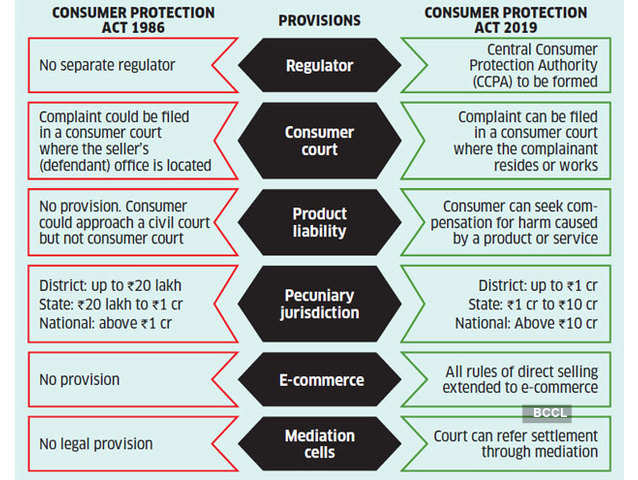
The Consumers can now cheer as the Consumer Protection Act, 2019 has recently replaced the three decade old Consumer Protection Act, 1986. The Consumer Protection Act, 2019 which came into effect on Monday (July 20) has replaced the earlier Consumer Protection Act, 1986.

The new Act as per the Experts say that “it gives more power to the consumers”. It seeks to revamp the process of administration and settlement of consumer disputes, with strict penalties, including jail term for adulteration and misleading ads by firms.

On July 20, 2020 certain provisions of the Consumer Protection Act, 2019 came into force as notified by the Central Government. Following the the key features of the relevant provisions:-

Key features of the Consumer Protection Act, 2019 which came into effect on July 20, 2020:-

1) Consumers can now institute a complaint from where they reside or work for gain.

2) The original pecuniary jurisdiction of the District Commissions has increased upto ₹1 crore from ₹20 lakh earlier.

3) The Pecuniary jurisdiction of State Commissions has been increased from ₹1 crore to Rs. 10 crore.

4) The National Commission can hear cases above ₹10 crore when compared to above ₹1 crore earlier.

5) While the provisions relating to e-commerce are not yet notified, a section relating to electronic service provider (covering software services, electronic payments) is notified.

6) The opposite party needs to deposit 50% of the amount ordered by the District Commission before filing an appeal before the State Commission. Earlier, the ceiling was a maximum of ₹25,000, which has been removed.

7) The limitation period for filing of appeals to the State Commission has been increased from 30 days to 45 days.

8) The Parties can be allowed to settle the disputes through mediation.

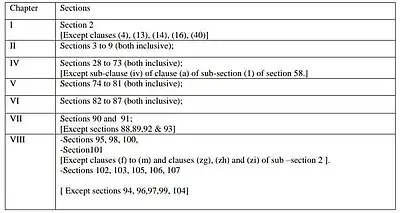
Following are the Sections which came into force:

Consumer Protection Act 2019- Sections to come into force from July 20,2020

Above mentioned provisions pertain to the Consumer Protection Councils, Consumer Disputes Redressal Forum, Mediation, Product Liability, punishment for manufacturing, selling, distributing etc spurious good or products which contain adulterant.

As per the rules, the e-commerce players will have to display the total ‘price’ of goods and services offered for sale along with break-up of other charges. Only a few certain miscellaneous provisions with regards and respect to the powers of the Central and State Government to make the rules and regulations have also been enforced.

On misleading advertisements there is provision for jail term and fine for manufacturers. There is no provision for jail for celebrities but they could be banned for endorsing products if it is found to be misleading.

For the first time there will be an exclusive law dealing with Product Liability. A manufacturer or product service provider or product seller will now be responsible to compensate for an injury or damage caused by the defective product or deficiency in services.

The Act has also defined an “e-commerce” as the buying or selling of goods or services including the digital products over digital or electronic networks. The existing definition of e-commerce has been adopted from India’s FDI Guidelines on e-commerce.

The definition of ‘e-commerce Entity’ as provided under the FDI Guidelines includes inventory and market place models.

There is also a provision for class action law suit for ensuring that rights of consumers are not infringed upon. The authority will have power to impose a penalty on a manufacturer or an endorser of up to 10 lakh rupees and imprisonment for up to two years for a false or misleading advertisement.

WEBSITES REFERRED

1)https://consumeraffairs.nic.in/acts-and-rules/consumer-protection

2)https://www.barandbench.com/news/law-policy/provisions-under-consumer-protection-act-2019-to-come-into-force-on-july-20-2020-centre-notifies

3)https://www.google.com/amp/s/www.thehindu.com/news/national/tamil-nadu/new-consumer-protection-act-gives-more-power-to-consumers-experts-say/article32135908.ece/amp/

4)https://www.google.com/amp/s/www.livemint.com/news/india/consumer-protection-act-rules-for-e-retailers-to-be-effective-by-this-weekend/amp-11595291549084.html

5)https://www.google.com/amp/s/zeenews.india.com/economy/new-consumer-protection-act-2019-comes-into-force-today-know-how-it-will-benefit-you-2297012.html/amp

6)https://www.google.com/amp/s/m.economictimes.com/wealth/spend/heres-how-consumers-will-benefit-under-the-new-consumer-protection-act/amp_articleshow/70711304.cms

7)https://www.google.com/search?q=consumer+protection+act%2C2019&tbm=isch&ved=2ahUKEwjOhv7-sN7qAhVIH3IKHTOCBfMQ2-cCegQIABAC&oq=Consumer&gs_lcp=ChJtb2JpbGUtZ3dzLXdpei1pbWcQARgAMgQIIxAnMgUIABCxAzIFCAAQsQMyBQgAELEDMgUIABCxAzoHCCMQ6gIQJzoCCAA6BwgAELEDEEM6BAgAEENQ0xRYzipg1jBoAnAAeACAAZABiAGHCJIBAzAuOJgBAKABAbABBcABAQ&sclient=mobile-gws-wiz-img&ei=e-QWX47dJsi-yAOzhJaYDw&bih=682&biw=393&prmd=ivn#imgrc=eILduqMFjleJaM

8)https://www.vecteezy.com/free-vector/consumer

9)https://www.google.com/amp/s/www.livelaw.in/amp/news-updates/most-provisions-of-consumer-protection-act-to-come-into-force-160003