There are many historical structures in Delhi. Red Fort is one of them. It is renowned all over the world. It is a sign of Mughal power and majesty. The Emperor Shah Jahan built Red fort in 1648. It is built of red stone. It is located on the west bank of the river Yamuna opposite the famous Chandni Chowk market.
Significance of The Red Fort
Everyone knows Red Fort as one of the several wonders in India. Though it has witnessed many centuries that has a treasured history of our country, Red Fort stands young always. Every year on 15th August, that is our independence day the Prime Minister of India addresses its country about its virtue and purpose of life. It is one of the greatest and most significant historical formations in India. Thus, we can say that this monument embraces together the walls that have witnessed the Mughal dynasty, imprisoned India during British empowerment to now a democracy.
Origin of Red Fort
This monument embraces the utmost significance in Modern Indian History. It is made of Red Sandstone alone. Sited in central Delhi it was placed where the Mughal emperors lived for many periods. Red Fort was a magnificent castle coated with precious jewels but the Britishers looted these precious jewels during their empowerment over India.
Since Delhi was the capital of India until the British men shifted it, Red Fort was the control place for the whole nation. Built on the banks of Yamuna River, the walls of this magnificence fort have been built from 30 meters high Sandstone. It is supposed that Red Fort was made after 9 years of hard work of numerous masons for day and night during all seasons.
Architecture of Red Fort
The architecture of Red Fort is amazing and appreciable for its creations of five centuries ago without any modern-day technologies and methodologies. It is built with typical Mughal art and view. It has a Dewan-e-Am which is courtroom for all. The king held a hearing from common men about their complaints.
The Red Fort is built right beside the Fort of Islam Shah Suri, namely- Shalimar Fort. He built it in 1546 as his fortified Palace. Both the forts are combined together by a water channel, namely- Stream of Paradise, or Nahr-i-Behisht.
Prominent Structures within the Fort
Though as many as 66% of the buildings within the fort were either broken or badly damaged, the Red Fort still houses many historic structures and some prominent ones are listed below:
MumtazMahal – Located in the women’s quarters (zenana) of the fort, Mumtaz Mahal was one of the six palaces inside the fort. All these palaces were constructed along the banks of Yamuna River and the Stream of Paradise.
KhasMahal – The Khas Mahal used as the king’s private residence. The palace was separated into three parts namely the chamber of telling beads, sitting room and sleeping chamber.
RangMahal – The Rang Mahal which literally means ‘Palace of Colors’ was built to house the emperor’s mistresses and wives. Thus, the palace was built to look colorful with bright paints and ostentatious decorations.
HiraMahal – Bahadur Shah II built it in 1842. the Hira Mahal is probably one of the last constructions of a Mughal emperor before the invasion of the British. It is only a pavilion but has an interesting legend related to it.
MotiMasjid – Moti Masjid which literally means to ‘Pearl Mosque’. Aurangzeb built this for his personal use. Therefore, the inhabitants of the Zenana also used the mosque. It is constructed using white marble, Moti Masjid has three domes and three arches
Hammam – The Hammam is mainly a building that housed the baths, for the emperors. On the eastern apartment, was the dressing room. In the western apartment, hot water came through the taps.
Red Fort is not only a building but a true witness of the national movement of Indian freedom. Thus, it is a symbol of the great and golden history of India. So the Indian republic, as well as every citizen of India, have great affection and respect towards the Red fort. Undoubtedly it will always be a symbol of great Indian history. Also, it holds a special place in Indian history because Jawaharlal Nehru announced the independence of India from Red Fort.
The Consumers can now cheer as the Consumer Protection Act, 2019 has recently replaced the three decade old Consumer Protection Act, 1986. The Consumer Protection Act, 2019 which came into effect on Monday (July 20) has replaced the earlier Consumer Protection Act, 1986.
The new Act as per the Experts say that “it gives more power to the consumers”. It seeks to revamp the process of administration and settlement of consumer disputes, with strict penalties, including jail term for adulteration and misleading ads by firms.
On July 20, 2020 certain provisions of the Consumer Protection Act, 2019 came into force as notified by the Central Government. Following the the key features of the relevant provisions:-
Key features of the Consumer Protection Act, 2019 which came into effect on July 20, 2020:-
1) Consumers can now institute a complaint from where they reside or work for gain.
2) The original pecuniary jurisdiction of the District Commissions has increased upto ₹1 crore from ₹20 lakh earlier.
3) The Pecuniary jurisdiction of State Commissions has been increased from ₹1 crore to Rs. 10 crore.
4) The National Commission can hear cases above ₹10 crore when compared to above ₹1 crore earlier.
5) While the provisions relating to e-commerce are not yet notified, a section relating to electronic service provider (covering software services, electronic payments) is notified.
6) The opposite party needs to deposit 50% of the amount ordered by the District Commission before filing an appeal before the State Commission. Earlier, the ceiling was a maximum of ₹25,000, which has been removed.
7) The limitation period for filing of appeals to the State Commission has been increased from 30 days to 45 days.
8) The Parties can be allowed to settle the disputes through mediation.
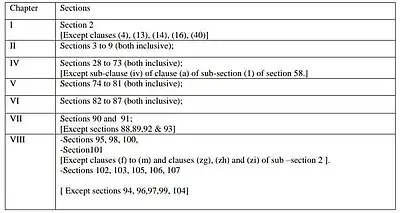
Following are the Sections which came into force:
Above mentioned provisions pertain to the Consumer Protection Councils, Consumer Disputes Redressal Forum, Mediation, Product Liability, punishment for manufacturing, selling, distributing etc spurious good or products which contain adulterant.
As per the rules, the e-commerce players will have to display the total ‘price’ of goods and services offered for sale along with break-up of other charges. Only a few certain miscellaneous provisions with regards and respect to the powers of the Central and State Government to make the rules and regulations have also been enforced.
On misleading advertisements there is provision for jail term and fine for manufacturers. There is no provision for jail for celebrities but they could be banned for endorsing products if it is found to be misleading.
For the first time there will be an exclusive law dealing with Product Liability. A manufacturer or product service provider or product seller will now be responsible to compensate for an injury or damage caused by the defective product or deficiency in services.
The Act has also defined an “e-commerce” as the buying or selling of goods or services including the digital products over digital or electronic networks. The existing definition of e-commerce has been adopted from India’s FDI Guidelines on e-commerce.
The definition of ‘e-commerce Entity’ as provided under the FDI Guidelines includes inventory and market place models.
There is also a provision for class action law suit for ensuring that rights of consumers are not infringed upon. The authority will have power to impose a penalty on a manufacturer or an endorser of up to 10 lakh rupees and imprisonment for up to two years for a false or misleading advertisement.
Authors, in todays world authors are considered as minor celebrities. Most of the best seller authors are usually in fame for a short period of time after which they are lost to obscurity. Yet there are some with writings of such epic proportions that they are still celebrated as influential authors by many. One such author was the world’s first author, and despite such a feat not much is known about her by the general populace. 4,300 years ago, in ancient Sumer, the most powerful person in the city of Ur was banished to wander the vast desert. Her name was Enheduanna, a high priestess and the world’s first author. And by the time of her exile, she had written forty-two hymns and three epic poems— and Sumer hadn’t heard the last of her. Who was this woman, and why was she exiled?
Enheduanna lived 1700 years before Sappho, 1500 years before Homer and about 500 years before the biblical patriarch Abraham. Born in Mesopotamia, her birthplace was one of the first cities and cultures to have emerged in the world. Her father was King Sargon the Great, history’s first empire builder who conquered the independent city states and was often seen as somewhat of a foreign invader by the Sumerian cities of the south. Thus, to bridge the gap between the cultures, Sargon appointed his only daughter, Enheduanna, as high priestess. Female royalty was traditionally given religious roles, and she was educated to read and write in both Sumerian and Akkadian and make mathematical calculations. The worlds first writing started in Sumer as a system of accounting, allowing merchants to communicate over long distances with traders abroad. This pictogram system of record keeping developed into a script about 300 years before Enheduanna’s birth. But until Enheduanna, this writing mostly took the form of record keeping and transcription, rather than original works attributable to individual writers. As high priestess, she oversaw hundreds of temple workers, interpreted their dreams and set about unifying the older Sumerian culture with the new Akkadian civilisation. To accomplish this feat, she wrote 42 religious hymns that combined both mythologies. Since each Mesopotamian city was thought to be ruled by a patron deity, her hymns were dedicated to the ruling of each major city. In her writing she humanized the once aloof gods- now they suffered, fought, loved and responded to human pleading. Enheduanna’s most valuable literary contribution is said to her poetry dedicated to Inanna, the goddess of war and desire. Her odes to Inanna, mark the first time an author used the pronoun “I” and the first-time writing was used to explore deep, private emotions. After the death of king Sargon, a power-hungry general took advantage to the power vacuum to stage a coup. As a powerful member of the ruling family, naturally Enheduanna was targeted, thus the general exiled her from Ur. Her nephew, the legendary Sumerian king Naram- Sin, ultimately crushed the rebellion and restored his aunt as the high priestess. She died after serving as high priestess for 40 years. After her death she was regarded as a minor deity and her poetry was copied, studied and performed throughout the empire. Her poems influenced the Hebrew Old Testament, the epics of Homer and Christian Hymns.
Today, Enheduanna’s legacy still exists on clay tablets that have stood the testaments of time. To end lets celebrate a quote of Enheduanna herself “With your strength, my lady teeth can crush flint”.
Bans, they are measures taken by the government to control whatever they feel is threatening to their rule or to the general populace. They say the pen is mightier than the sword, and authorities have often agreed. From outlawed religious tracts and revolutionary manifestos to censored and burned books, we know the potential power of words to overturn the social order. But as strange as it may seem, some numbers have also been considered dangerous enough to ban. Our distant ancestors long counted objects using simple tally marks. But as they developed agriculture and began living together in larger groups this was no longer enough. As numbers grew more complex, people began not just using them, but thinking about what they are and how they work.
By 600 B.C.E ancient Greece, the study of numbers was well developed. Pythagoras, one of the most famous mathematicians and his school of followers found numerical patterns in shapes, music and stars. For them math held the deepest secrets of the universe. But one Pythagorean named Hippasus discovered something disturbing. Some quantities like the diagonal of a square with sides of length one each couldn’t be expressed by any combination of whole numbers or fractions, no matter how small. These numbers which we call irrational numbers, were seen as a threat to the Pythagorean notion of a perfect universe. They imagined a reality that could be described with rational, numerical patterns. Historians write that Hippasus was exiled for publicizing his findings while legends of the Pythagorean era claim he was drowned by the god themselves as punishment for his blasphemous findings. While irrational numbers upset philosophers, later mathematical inventions would draw attention from political and religious authorities as well. In the middle ages, while Europe was still using roman numerals other cultures had developed positional systems that included a symbol for zero. When Arab merchants brought this system to Italy, its advantages for merchants and traders was clear. However, the authorities were wary as Hindu- Arabic numerals were quite easy to forge or alter, especially since they were less familiar to customers than to merchants. And since the concept of zero opened the path to negative numbers and the recording of debt at a time when money-lending was regarded with suspicion. In 13th century, Florence totally banned the usage of Hindu- Arabic numerals for record keeping. Even though they were immensely useful, controversies regarding zero and negative numbers continued for a long time. Negative numbers were dismissed as absurd and prominent mathematicians like Gerolamo Cardano avoided using zero despite the easier route it provided to solve cubic and quartic equations. Even today it is illegal to use various numbers for a plethora of reasons. Governments usually ban the usage f numbers which have symbolic meanings or connections to opposing political figures and parties. Some numbers are banned because of the sensitive information they carry. These days any image, file, video or executable program can be translated into a string of numbers. So, this means protected materials such as copyrights and state secrets can also be represented as numbers, so possessing or publishing these are considered a criminal offense.
Thus, in a world where calculations and algorithms, shape more and more of our lives, the mathematicians pen grows stronger each passing day.
India is one among the world’s fasting growing economies. It had been touted as an economic and geopolitical counterweight to China. But recently its growth fell to its slowest pace in six years. Investment has weakened, and unemployment has risen. So what’s causing the slowdown, and how can it be reversed? Since the turn of the century, India’s economy has grown at a rapid rate, helping transform the country. Between 2006 and 2016, rising incomes lifted 271 million people out of poverty, meaning the proportion of Indians still living in poverty has fallen dramatically, from around 55% to twenty-eight . Access to electricity has also improved. In 2007 just 70% of the population had access to power. By 2017, that grew to nearly 93%.
More recently, the Indian government constructed around 110 million toilets — a huge step towards better sanitation designed to prevent the practice of open defecation. It’s a signature program of Prime Minister Narendra Modi, known as Swachh Bharat, or Clean India. All this development has been supported by a booming economy, but as lately , that expansion has begun to run out of steam. In the third quarter of 2019, India’s economic output grew by 4.5% – making it the primary time the country’s growth dipped below 5% since 2013. For context, 4.5% growth remains much above that of developed economies just like the U.S., But with 12 million Indians entering the workforce per annum , economists say the country needs annual growth rates to remain above nine percent to make sure there are enough jobs. So, what’s causing this recent slowdown? Well, officialdom argue turbulence in international financial markets is guilty.
Political uncertainty and U.S.-China trade tensions mean confidence levels among investors and consumers everywhere have sunk. The United Nations has even warned that a global recession in 2020 is now a “clear and present danger”. But back to India – many economists say the country’s growth problems are literally self-inflicted. One obvious culprit is the shadow banking sector. During the 2000s, India saw an investment boom. It was fuelled by state banks dispensing a load of loans for giant infrastructure projects. But some of the companies taking advantage of these loans couldn’t keep up with the repayments. That meant the state banks weren’t getting paid back and therefore struggled to give out new loans. To keep business moving, shadow banks stepped in. These financial institutions, which operate like ordinary commercial banks but don’t follow traditional banking rules, eventually made up an estimated third of all new loans nationwide. The loans played a pivotal role for the millions of small businesses and consumers who would otherwise have no access to credit. But in 2018, shadow banking giant Infrastructure Leasing & Financial Services, defaulted on its debt repayments. Its collapse sent shockwaves through the economy and shook up more traditional banks that had supported the world.
It became harder for people to shop for expensive items like cars. That hurt India’s automotive industry, which is one among the country’s biggest. It employs about 35 million people and makes up about 7% of India’s GDP. Last summer, the industry suffered its worst sales performance in nearly 19 years, and reports suggest tens of thousands of workers are laid off. The agriculture and construction sectors have also been hurting, with small and medium businesses being hit the hardest. The country’s percentage has been on an overall upward trend since July 2017, rising several percentage points to 7.7%. Higher unemployment means consumers are buying less, resulting in the unfortunate cycle of slower manufacturing, production, investment and job creation.
A survey from the Reserve Bank of India found consumer confidence has fallen to its lowest level in five years. But Indians still have a positive outlook for the longer term , with most consumers expecting to feel more optimistic during a year. However, if things don’t improve, debt could become another issue. Expecting better days ahead, many households have continued to spend, by taking out loans and dipping into savings. Household savings as a proportion of GDP has fallen from 23.6% to 17.2%. Meanwhile, household debt has surged to 10.9% during the same period. Critics say the govt in New Delhi has did not spot these risks and hasn’t done enough to urge the economy moving again. The Reserve Bank of India’s former governor Raghuram Rajan recently blamed the lack of significant reforms and a slowdown in investments since the global financial crisis. Even the country’s chief economic advisor recently admitted reforms are needed to form India more friendly to investors.
India has cut its corporate rate , but labor and land laws are still extremely strict. He also says the country must become pro-market, instead of just pro-business, to avoid costly government bailouts of failing sectors. But not all reforms have been good to the economy. In 2016, Prime Minister Modi tried to crack down on corruption, counterfeits and evasion by banning high value bank notes. In one night, the cash ban made 86% of all cash invalid. Three years later, many analysts say the policy disrupted the economy and did not achieve many of its original goals. In 2017, a replacement nuisance tax placed small businesses struggling and a few of them were forced to shut . In mid-2019, India’s government introduced a controversial new tax on foreign investors. Consequently, India’s stock exchange suffered its worst July performance in 17 years. Just one month later, the measure was scrapped.
The government has now refocused its efforts on international trade and investment, and thus the recent changes to the corporate rate could indeed help attract businesses and investors to India. But if the country wants to be a part of the world’s largest supply chains, it’ll need low and consistent tariff levels to encourage outsiders to take a position for the long term.
The country’s shifting export policy has harmed several of its largest industries, particularly clothing. India’s share of the worldwide apparel market has increased only slightly within the past 20 years. And though the Indian workforce is vast, both Bangladesh and Vietnam now export more. On top of that, the country’s import tariffs on the average are much above the world’s biggest economies. They’re also among the highest of the world’s emerging economies. Even U.S. President Donald Trump has called for the country to bring down its duties.
Has India’s growth actually slowed the maximum amount as we think? The government’s former chief economic advisor Arvind Subramanian caused a good little bit of controversy in June 2019, when he claimed the country’s official stats probably overstated GDP growth by 2.5% from 2011-2012 to 2016-2017. He says the bottom line is that India never recovered from the global financial crisis. The government denies this. But none of this has hurt Prime Minister Modi at the polls – he won by a landslide in the most recent election. So how will he keep his promise and double the dimensions of the economy by 2025? Many economists insist a well-explained economic vision would help. As would more long-term investment, better skilled workers and enhancements to infrastructure. It may not matter who or what’s responsible for India’s recent economic challenges, but bottom line – India’s economic process must recover , and fast.
Treadmill, a machine that can be seen in any gym one steps into regardless of the country one stays in. Treadmill has become an iconic exercise when it comes to the gym. The constant thud underneath your feet. The constrained space. The monotony of going nowhere fast. Feeling like hours have gone by as you slog on it, but in reality, mere minutes have passed by. Running on a treadmill can certainly feel like torture, but did you know it was originally used for that very purpose. Its true the now easy to access treadmill was once used to torture and get troublesome inmates into line.
In the 1800’s, treadmills were created to punish English prisoners. It was at a time when the English prison system was abysmally bad. Execution and deportations were usually the punishment of choice and those who were locked away faced hours of solitude in tiny confined filthy cells. So social movements led by religious groups, philanthropists and celebrities like Charles Dickens sought to change these dire conditions that the inmates faced and tried to reform the prisoners and prison system. When the movement succeeded, entire prisons were remodelled and new forms of rehabilitations, such as the treadmill were introduced. Invented by an English engineer, Sir William Cubitt in 1818 the original version was vastly different than the commercial ones we know today. Prisoners stepped on 24 spokes pf a large paddle wheel. As the wheel turned, the prisoner was forced to keep stepping up in order to reduce the risk of falling down, similar to modern stepper machines. Meanwhile the rotation of the wheel made gears pump water, crush grain and power mills, which is where the name Treadmill originated. These devices were seen as a fantastic way to whip the prisoners into shape with the added benefit of powering the mills helped rebuild a British economy that was devastated by the Napoleonic wars. It was win-win situation for everyone except of course the prisoners. It is estimated, on an average that the prisoners spent around six hours or so a day on treadmills which can be an equivalent of 5000 to 14000 feet a day which is roughly climbing Mount Everest to its halfway point. They did so five days a week with little food to energize themselves with. Cubitt’s idea quickly spread across the British Empire and America. And within a decade of its creation over 50 English prisons boasted a treadmill and America also quickly surmounted to a similar amount. Unsurprisingly the exertion combined with the poor nutrition being provided saw any prisoners suffering from breakdowns and injuries but unfortunately prison guards did not seem to care. In 1894, New York prison guard James Hardie credited the device to have taming his most boisterous of inmates claiming that the monotonous steadiness, not its severity is what terrorized the inmates. The treadmills lasted in England until the late 19th century, when they were banned for being excessively cruel under the Prison Act of 1898.
Soon the torture device returned with a vengeance, this time targeting the unsuspecting public. In 1911, a treadmill patent was registered in the US and by 1952 was thrust into limelight with the model that we are so familiar with. As an easy and convenient way to improve aerobic fitness, it soon gained a lot of familiarity in the exercise business.
Thus is the tale of the torture device that soon became a staple in every corner of gyms and exercise squares.
Chess, a brilliant pass time to hone and develop out mental acumen, has been in our lives for more than a millennium. Chess is a two-player strategy board game played on a checkered board with 64 squares arranged in an 8×8 grid. Played by millions of people worldwide. However, it was not always the same kind of game that it is now, it has evolved immensely from the time that it was made. Over roughly one and a half millennia of its existence, chess has become a tool of military strategy, a metaphor for human affairs and a benchmark of genius. While our earliest records of chess are from the 7th century, legend has it that it was actually originated at sometime in the 6th century. So how did it start and evolve to the game enjoyed by so many today.
Supposedly when the youngest prince of the Gupta empire was killed in battle, his brother devised a way to represent the scene to his grieving mother. Set on an 8×8 ashtapada board used for other popular pastimes, a new game emerged with two new features, different rules for moving different pieces on the board and a single king whose fate decided the outcome of the game. The game originally called chaturanga, a Sanskrit word for four divisions was soon popularised and spread to Sassanid Persia and acquired its current name and terminology – “chess” derived from “shah” meaning “king” and “checkmate” from “shah mat” which means “the king is helpless”. After the 7th century Islamic conquest of Persia, chess got introduced to the Arab world. Thus, transcending its role as a tactical simulation and becoming a rich source of poetic imagery. Diplomats and courtiers used chess terms to describe political power, even ruling caliphs became avid players and historian al-Mas’udi considered the game a testament to human free will compared to the games of chance. Medieval trade along the silk road carried the game to east and south east Asia, where many local variants developed. In china, chess pieces were placed at intersections of board squares rather than inside them as in the native strategy game of Go. In the Mongol times, chess saw an 11×10 board with safe square called citadels while in japan shogi developed where captured pieces could be used by an opposing player. But it was really in Europe that the game acquired its modern form. By 1000 AD, the game had become a part of courtly education with chess becoming an allegory for different classes with different functions. At the same time church remained suspicious of games. Moralists cautioned against devoting too much time to it with chess even briefly being banned in France. Yet the game proliferated and the 15th century saw it cohering into the form we know today. With the enlightenment era, the game moved from royal courts to coffee houses. Chess was now seen as an expression for creativity, encouraging bold moves and dramatic plays. This “romantic” style of play reached its peak in the immortal game of 1851 which is hailed as the most dramatic and game so far. With the emergence of formal competitive play in the 19th century, it saw the dramatic flair being squashed under the strategic calculation that the era had brought forth. This chess took on a new geopolitical stance with the Soviet Union dominating the rest of the century by devoting great resources to cultivate chess talent. But a player emerged who truly upset the Russian dominance and it wasn’t even human. The IBM computer called Deep blue triumphed over Garry Kasparov in 1997 and hailed the emergence of chess software with AI so advanced as to beat human players with ease.
However, these machines are the products of human ingenuity and the same ingenuity can perhaps help us get out of the apparent checkmate.
Mathematics, the scourge to students everywhere, be it high school or colleges. The study of the measurement, properties, and relationships of quantities and sets, using numbers and symbols. Mathematics includes the study of such topics as quantity, structure, space, and change. It has no generally accepted definition. Mathematicians seek and use patterns to formulate new conjectures. One of the most influential mathematicians of all time was Nicolas Bourbaki, who completely revolutionized the field of mathematics. However, when Nicolas Bourbaki applied to the American Mathematical Society in the 1950s, he was already one of the most influential mathematicians of his time. He’d published articles in international journals and his textbooks were required reading. Yet his application was firmly rejected for one simple reason: Nicolas Bourbaki did not exist.
Bourbaki had published articles in international journals and his textbooks were mandatory reading for any budding mathematician. Two decades before this application, the mathematical world was in complete disarray, many mathematicians had lost their lives in the first word war thus making the field fragmented. Different branches used disparate methodology to pursue their own goals and this lack of a shared mathematical language made it difficult to share and expand work. Thus in 1934, a group of fed up French mathematicians were particularly fed up and started a journey which would change the mathematical field in a way no one had imagined. While studying in the prestigious Ecole normale superieure, they found their books so disjointed that they decided to write a better one. The small group soon took up new member and as the project grew so did their ambition. The result was “Elements de mathematique”, a treatise that sought to create a consistent logical framework unifying all branches of mathematics. The text began with a set of simple axioms – laws and assumptions it would use to build its argument. From there its authors derived more and more complex theorems that corresponded with work done across each field. But to truly reveal common ground, the group needed to identify consistent rules that applied to a wide range of problems. To accomplish this, they gave new, clear definitions to some of the most important mathematical objects, including the Function. It was believed that functions were like machines an input was given which in turn gave an output. But they sought to think functions as bridges between two groups, which made them formulate logical relationship between their domains. Thus, the group began to define functions by how they mapped elements across domains. This allowed mathematicians to establish logic that could be translated across the function’s domains in both directions. Their systematic approach was in stark contrast to the belief that math was an intuitive science, and an over-dependence on logic constrained creativity. But this rebellious band of scholars gleefully ignored conventional wisdom. They were revolutionizing the field and to mark the occasion they pulled their greatest stunt yet. They published their work under the collective pseudonym of Nicolas Bourbaki. Over the next two decades the publications became standard references and the group took their prank as seriously as work. They gave their Russian reclusive character due diligence, by sending telegrams announcing his “daughter’s wedding” and publicly insulting anyone who doubted his existence. In 1968, when they could no longer maintain the ruse, the group ended the prank in the best possible way, they printed out his obituary full of mathematical puns. Despite his “death”, his legacy lives on today.
Like Aristotle said “No great mind has ever existed without a touch of madness.” And these certainly were geniuses who pulled the greatest scholarly prank ever.
In this universe, there are many interesting facts that will blow up our mind and make us think twice about them.As it is said change of subject is rest of mind ,Knowing about interesting facts help us in relieving stress and keep mind updated, as such in this crisis times let us be worry less and tension free and explore some of the interesting facts:
1.It can take a photon 40,000 years to travel from the core of the sun to surface, but only 8 minutes to travel the rest of the way to earth.
2.It would take 1.2 million mosquitoes,each sucking once to completely drain blood of average healthy human.
3.Dead people can get goose bumps (Scary).
4.Kumbh Mela gathering is visible from space.
The 2011 kumbh mela was the largest gathering in world with over 75 million piligrims. The gathering was so huge that it was visible from space.
5.Brain information travels up to an impressive 268 miles per hour speed and its capacity is virtually unlimited.
6.a woman jumped off from 86th floor but wind pushed her back. She survived(wow , wind power).
7.Believe it or not That most of the oxygen on earth doesn’t come from trees. It’s comes from plankton(animal) in the ocean.
8.There isn’t a single bridge across amazon river.
9.Trees can send secret warning signals to other trees about incoming insect attacks (weird but true).
10.400 million years ago ,the earth was covered with mushrooms, that were 8 meters tall !!! (just imagine)
Hope the facts were amazing and made readers amused.
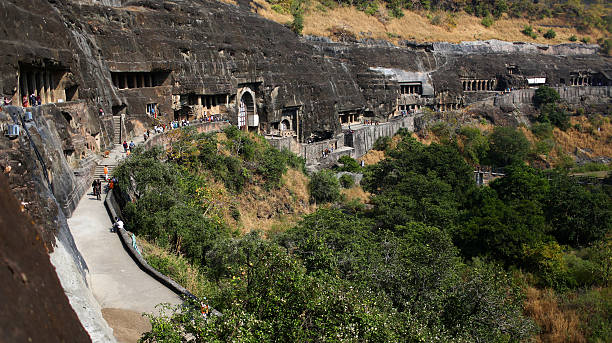
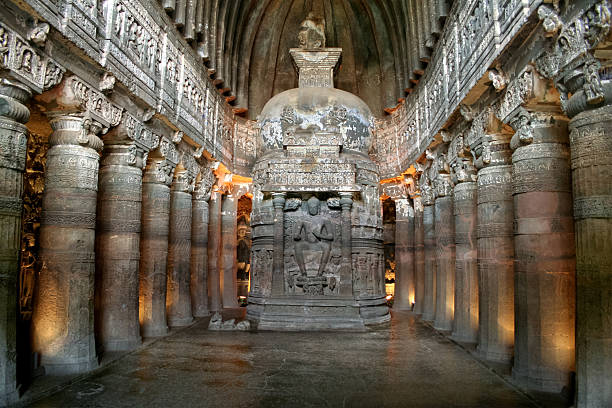
Carved over a period of several centuries, the mystery of Ajanta Caves might never have been uncovered had it not been for a chance pursuit of a tiger by the British Officer John Smith in the year 1819! As old as 200 BCE, the caves are located in Aurangabad district of Maharashtra. Over the multitude of years they fell into disuse and a forest grew over and around them. Carved over many many years by different artisans, they are believed to have been made a refuge for the Buddhist monks during the rains. Some go as far as to say that they were pathways to heaven.
With numerous carvings that describe the life and times of the eras, they are like a window that one can peek through into the glorious past of India. The caves run for a mind numbing length of 29 rock cut caves, all of which have both female and male representation, which is a rare sight! Examples of immense scientific calculations are evident too, as the sun lights up cave 19 on the winter solstice and cave 26 on the Summer solstice in a precision that has persisted over the years!
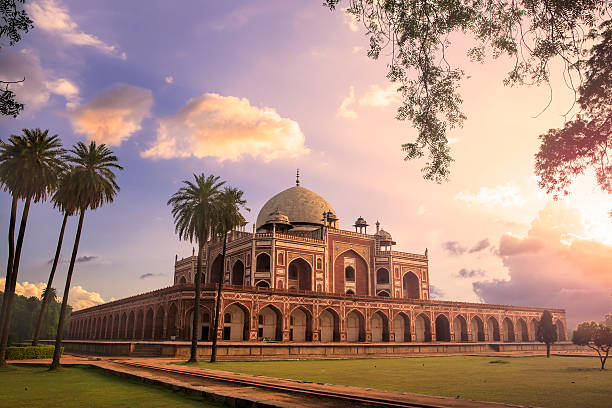
The monument to love that inspired the Taj Mahal-The Humayun Tomb
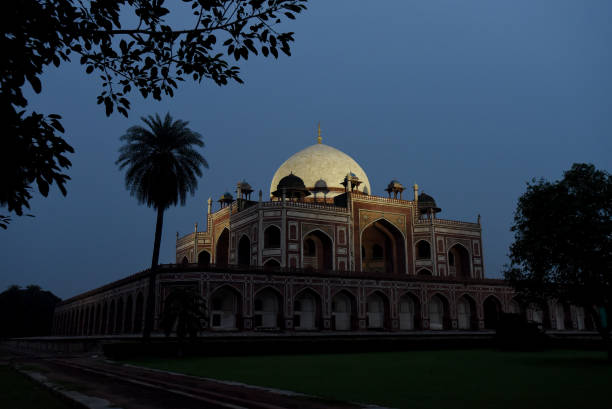
The Humayun’s Tomb
Pick up any form of literature and you will notice that ‘Taj Mahal’ has forever been cited as the all enduring monument of the love of a king for a queen. But, there was one tomb before that, that a grieving widow built for the love and devotion that she felt towards her husband; The Humayun Tomb. The pioneering example of Mughal architecture, its glorious combination of Persian and Indian architecture forms was to set a prelude to an era that was to be embellished by the grandeur of Mughal architecture. Bega Begum, spent her entire life overseeing the construction and design of this tomb that was commissioned to the great Persian architect Mirak Mirza Ghiyas.
One of its kind architecture, this garden tomb houses the graves of over 150 members of the Mughal family. The UNESCO cites it’s reasons for considering it as one of the greatest examples of architecture by saying, “This building tradition culminated in the Taj Mahal, constructed a century later. Despite being the first standardized example of this style, Humayun’s Tomb is an architectural achievement of the highest order.”
Konark Sun Temple
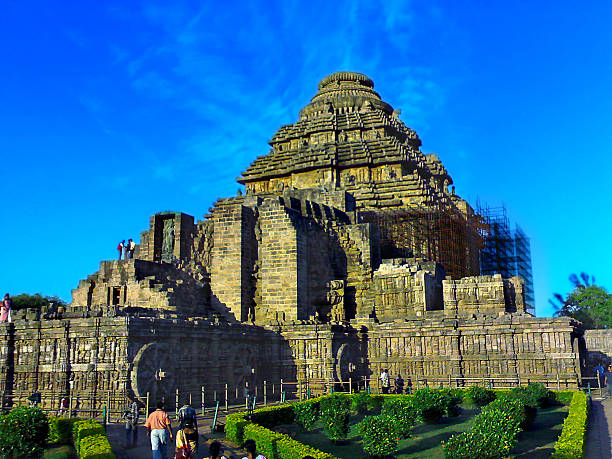
An ode to Sun God, where even stones speak up in prayer- Konark Temple
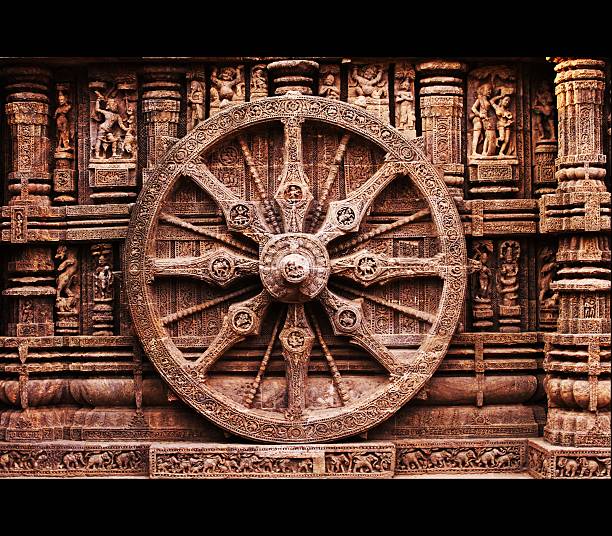
No text of architecture in India is complete without the mention of Sun Temple at Konark, the namesake of the city itself is an elegy to the Sun God, Kona (Corner) and Arka (Sun). On the sparkling coasts of Bay of Bengal rests this edifice that commemorates the work of the masters of ancient times. The temple has an elaborate and intricate mammoth structure that depicts the chariot of the Sun God replete with 24 carved wheels, each of them 3 m in diameter, pulled by seven horses and guarded by two lions at the entrance that bravely crush elephants.
An example of beautiful melee of science, architecture and devotions the sun dials on the temple can calculate time to the exact minute even to this day! There are also three statues of the sun god that catch the rays of the sun precisely at dawn, noon and sunset! Rabindranath Tagore has famously said about the temple “Here the language of stone surpasses the language of man.” The temple beckons to question the monotonous styles of architecture that India has regressed itself to!
A eulogy to undying love set in white marble- The Taj Mahal
Taj Mahal
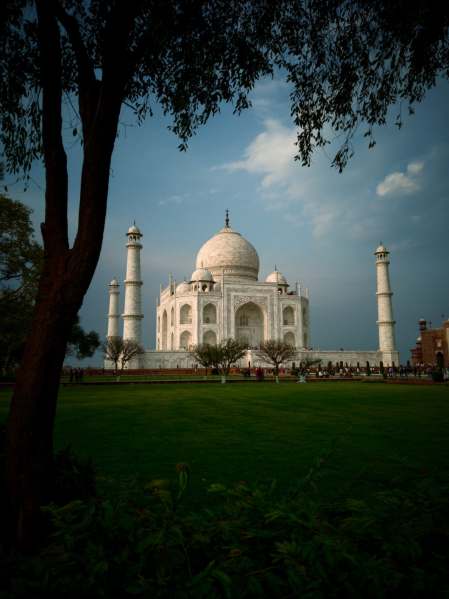
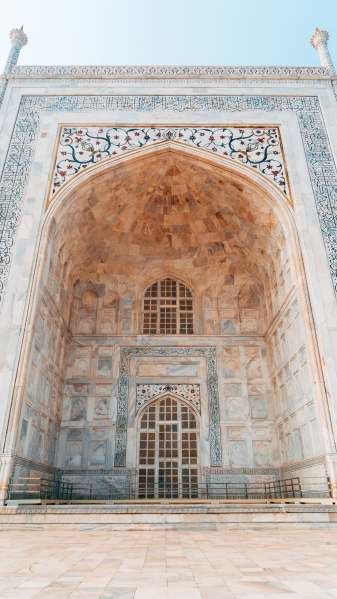
Ask anyone, any man or woman about the icon they associate with India, and their answers would most likely allude to the Taj Mahal. Built by the Mughal Emperor Shah Jahan, it is one of the most grandiose gestures of love to ever be materialized on the face of earth. As famously said by the greatest poet, Rabindranath Tagore, “The Taj Mahal rises above the banks of the river like a solitary tear suspended on the cheek of time.” Inspite of the multitude of tourists that visit it, the declarations of love that it has witnessed and countless examples that it has set, there is a sense of melancholy as one approaches the monument, a sense of pain of a lover separated from his wife by death.
The Taj Mahal was built in 1653 AD by over twenty thousand artisans who toiled over 22 years! The white marble was bought in from Makrana in Rajasthan and was transported by elephants. In its days of glory the Taj Mahal was adorned with no less than 28 types of precious stones, brought in from as far as Tibet and Persia. Like the moods of his lady love, the exterior of the Taj also changes colors from a pinkish hue in the dawn to a dull gold at noon and finally, all enduring sparkling white under the moonlight. Legends say that as the emperor lay imprisoned by his own son in the Agra Fort, he derived solace from gazing at the tomb of his beloved wife, at whose side he was finally laid to rest.
The integral land of three beliefs, The Ellora Caves
Ellora caves
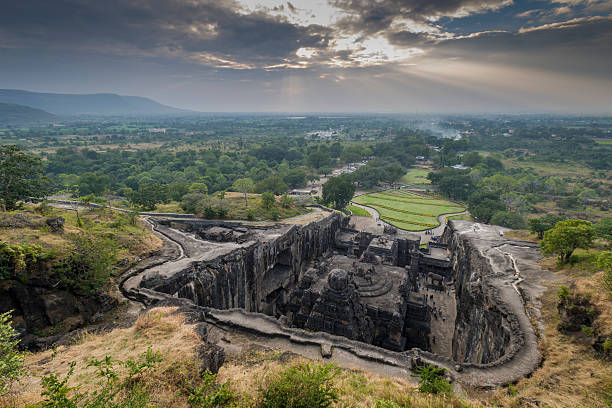
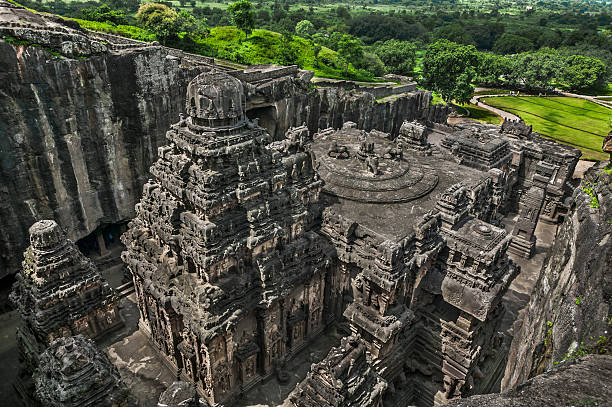
The Ellora caves is a sculpture’s beautiful blended expression of three major Indian regions: Buddhism, Brahmanism and Jainism. There is something beautiful about this place that takes you to a journey in the past where all these religions born and grew together. The 34 monasteries and temples are carved and dug all together on the wall of a huge basalt cliff in Maharashtra. These splendors of art is a beautiful combination of, when art meets religion
The twelve caves of the Buddhist group speaks about the benevolence of this calm religion, Buddhism. The ‘Cavern of the Ten Avatars’ is a majestic art piece constructed under the reign of Krishna I. The ethnicity of Jain group is well reflected by the sanctuaries carved by the Digambra sect of this pure religion. These gems of art are the immortal legends of the vast rock-cut architecture in India. The elegance of Dravidian Sikhara, which is a flat roofed madapa positioned over sixteen pillar, the gigantic Ravana figure reflecting the strength of this villainous legend as the sculpture here shows him lifting Mt Kailasha is an epitome of the ancient Indian art.
Where the walls sing and sculptures dance, the Chola temples
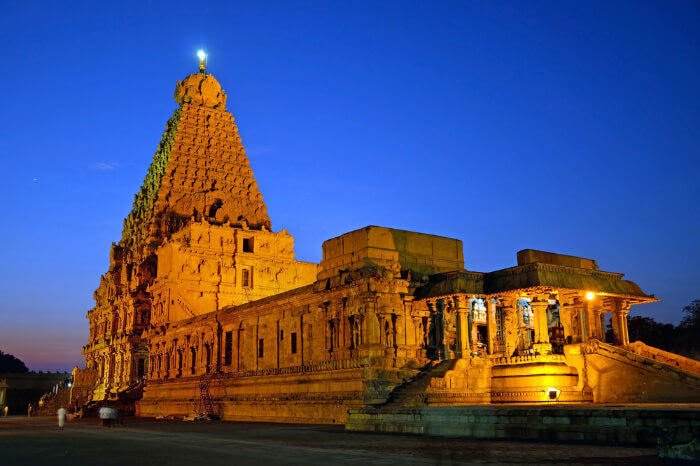
Brihadisvara Temple
The beautiful Chola temples are living tales of the vast empire that Cholas established in Thanjavur. These magnificent temples built during the reign of Rajaraja were the epitome of the vast religious inclination of these rulers as the inscriptions and the chronicles on the wall sing about their opulent rule. This temple in the ancient time was note a mere religious center but a full functional business establishment which was served and maintained by a permanent staff of several hundred priests, 400 devadasi and 57 musicians.
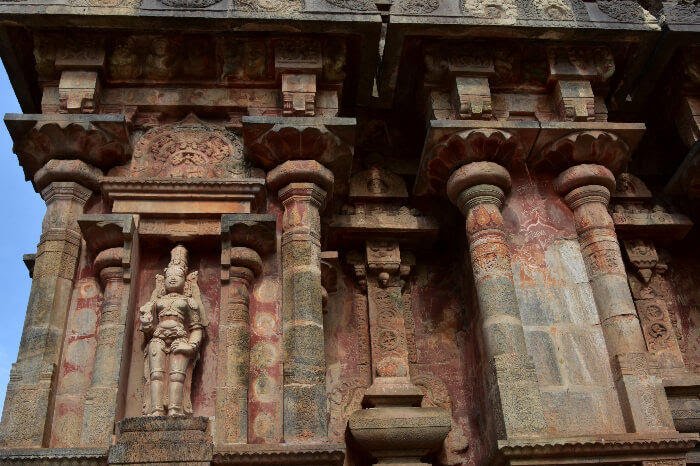
Airavatesvara Temple At Darasuram
The temple was also used for lending money to ship-owners, craft guilds and villagers on a fixed interest rates. The entire temple carved in granite is believed to be inspired by the Pallava architecture. The beautifully adorned 108 poses of the Bharata- Natyam on the walls reflects the hours of torturous patience the sculptures went through. The beautiful series of carvings depicting the legend ruler Rajaraja conversing with his guru, Karuvir Devar is stunningly sculpted in rich colors which rewinds you to the beautiful ancient time of king and queens.
A rock cut sonnet to the great war of Mahabharata, Mahabalipuram
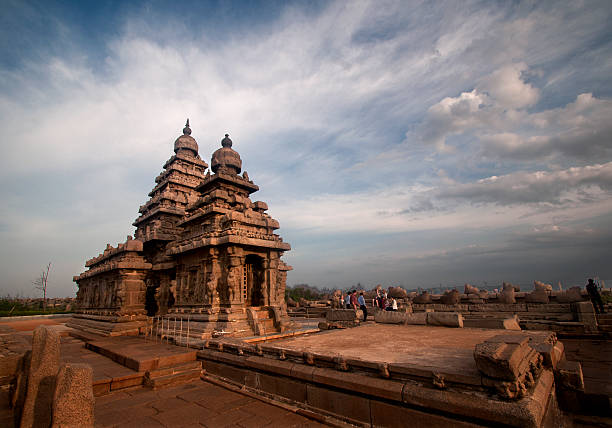
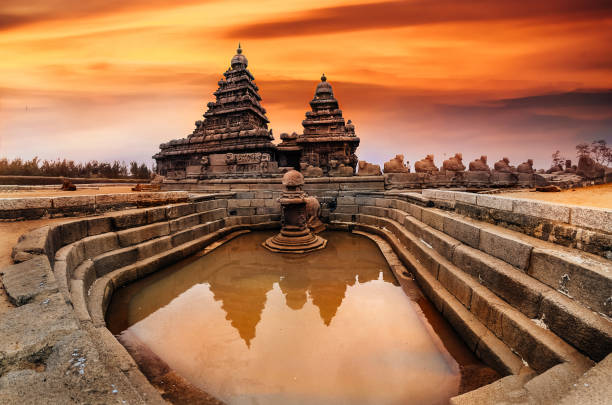
Shore temple Mahabalipuram
It is a widely accepted belief that the great war fought between the Kauravas and the Pandavas, at Kurukshetra, is instrumental in shaping the history and geography of the Indian subcontinent as we know today. The temples of Mahabalipuram demonstrate exactly that, in the rock cut carvings of the great temple architectures, one can clearly see the scenes from the great epic.
The architecture demonstrates a clear allusion to the sectarianism that had started during the period as different areas were assigned to different Gods. The travels of Marco Polo also describe the Seven Pagodas of Mahabalipuram that belonged to the original structure built in the time when the city was a thriving merchant port. Out of these seven only one has survived in the form of a beautiful shore temple!
Sunset reflection of shore temple
The architect represents neither a Dionysian nor an Apollinian condition: here it is the mighty act of will, the will which moves mountains, the intoxication of the strong will, which demands artistic expression. The most powerful men have always inspired the architects; the architect has always been influenced by power.
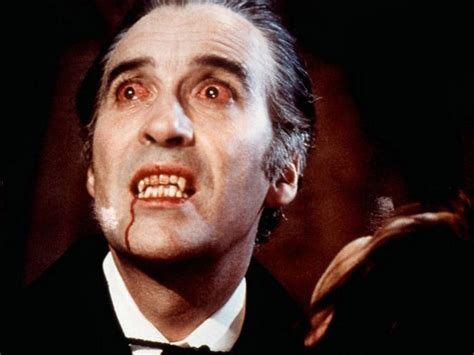
Vampires, they are a staple of the common folklore and a gold mine when it comes to shows of the drama and fantasy genre. They are amongst the most recognized when considering mythical creatures, and with numerous TV shows and movies constantly showcasing them one could very well say that they are the top of the chain in show biz as well. And even among the vampires, there is one figure who lives on in people’s minds as the most famous vampire ever, Dracula. While he is neither the first fictional vampire nor the most popular of his time, he may very well have remained buried in obscurity if not for a twist of fate.
Before Dracula came along, blood sucking monsters had already been a part of folklore for at least 800 years. It was the Slavic folklore that gave us the name vampire or “upir” in old Russian. The terms first known written mention came from the 11th century. Vampire lore in the region had predated Christian arrival and despite the church’s attempts to eliminate all pagan beliefs, vampiric folklore persisted. The stories of vampires originated from misinterpretations of diseases such as rabies and pellagra, and even decomposition. In the case of the latter, gasses swelling the body and blood oozing from the mouth could make it look like a corpse had recently been alive and feeding on blood. Vampires were often described as bloated with sharp teeth and overgrown nails, which had a perfectly well reasoned scientific explanation, however since the people then were ignorant of them, they fell into superstition. This gave rise to many rituals intended to prevent the dead from rising, such as burying bodies with garlic and poppy-seeds as well as having them staked, mutilated and even burned. Vampire lore remained a local phenomenon until the 18th century, when Serbia was caught between the struggle of two great powers of that time, the Habsburg monarchy and the Ottoman empire. Austrian soldiers and government officials observed and documented the strange rituals and their reports became wildly publicized which resulted in a vampire hysteria. It got so out of hand that in 1755, the Austrian Empress was forced to send her personal physician to investigate and debunk the rumors. The panic subsided but the vampire fascination had already taken root in western European imagination. This spawned books like “The Vampyre” in 1819 and “Carmilla” in 1872. These would go on to influence a young Irish drama critic named Bram Stoker who was born in Dublin in 1847. Until the age of seven he was severely bedridden with an unknown illness, during which his mother would tell him folktales and her experience during an outbreak of cholera in whose real-life horror would inspire Stoker to write. In 1897 he wrote “Dracula”, although the book’s main villain and namesake is thought to be based on historical figure Vlad III or Vlad the Impaler, it is only his name that they share. The rest of his characteristics were influenced by various works of the Victorian Era. The novel upon release saw moderate success and was only briefly ever mentioned in Stoker’s obituary in 1912. However, a critical copyright battle soon changed Dracula’s fate. In 1922 a German studio adapted the book into the now classic “Nosferatu” which despite minor changes was largely plagiarized, and was sued into bankruptcy. Stoker’s widow decided to copyright by approving a production by family-friend Hamilton Deane. This became a classic largely due to Bela Lugosi’s performance on Broadway. Lugosi would go on to Star in the 1931 film version of it by Universal, lending the character many of his signature characteristics.
Since then Dracula has risen again in many adaptations, finding eternal life beyond the humble pages of his birth.
Witch hunt, a phrase often used by politicians whenever accused has become very common these days. A witch hunt often means a persecution of someone through baseless facts and inconclusive evidence. But essentially it refers to the attempt to punish someone whose opinions are unpopular and said to be a danger to society. But the question arises as to how and when did the original witch hunts related to witchcraft started. Contrary to popular belief it wasn’t because of the uneducated masses started accusing those with odd behavior but rather belief in witches, in the sense of wicked people performing harmful magic, had existed in Europe since before the Greeks and Romans. In the early part of the Middle Ages, authorities were largely unconcerned about it. Things began to change in the 12th and 13th centuries, ironically because educated elites in Europe were becoming more sophisticated. Universities were being founded, and scholars in Western Europe began to pore over ancient texts as well as learned writings from the rest of the world, which often gave some sort of complex system of magics as an explanation for day to day phenomenon. Ordinary people – the kind who eventually got accused of being witches – didn’t perform elaborate rites from books. They gathered herbs, brewed potions, maybe said a short spell, as they had for generations. And they did so for all sorts of reasons, such practices were important in a world with only rudimentary forms of medical care.
Christian authorities had previously dismissed this kind of magic as empty superstition. Now they took all magic much more seriously. They began to believe simple spells worked by summoning demons, which meant anyone who performed them secretly worshiped demons. These ideas of common folk engaging in witchcraft really gained traction after the pope gave a friar and a professor of theology called Heinrich Kraemer permission to conduct inquisition in the search of witches in 1485. At first his ideas did not gain traction as the people disapproved of his harsh questioning of respectable citizens and shut down his trials. However undeterred in his supposed quest to rid the world of the devil’s influence Kraemer wrote a book called “Hammer of Witches”. He wrote a lot of ideas which would subsequently be seen practiced in various towns across Europe. His book spurned others to write their own books on the topic and give sermons on the “dangers of witchcraft”. Even though there was no evidence to support any of these claims belief in witchcraft became widespread. A witch hunt often began with a misfortune; a failed harvest, a sick cow, or a stillborn child. Many of the accused were people on the fringes of society, the elderly, the poor or social outcasts but it wasn’t just limited to them, any one could be targeted even children. While religious authorities sanctioned these hunts, it was the local secular government that carried out the detainment and punishment of the witches. Those suspected were tortured rather than questioned, and under these tortures thousands of people falsely confessed to witchcraft and implicated others to save their hides. This was a time where the way repentance rather than justice prevailed in the courts, so even with flimsy evidence a lot of people were persecuted. Punishments varied from a fine to burning at the state, for many of the poor it was always the later. While motivations of witch-hunters varied considerably from jealousy, anger and spite, many genuinely felt they were doing good by rooting out the evil in society. But like even in these troubled times, there were those of sound mind who dissented various scholars, jurists and physicians countered with logic and sense against the mob mentality of the masses and with a rise of strong central governments, witch hunting slowly declined until it disappeared altogether.
Both the onset and the demise of these atrocities came gradually and the potential for similar situations to arise is still there, where authorities use their power to mobilize against false threats, but with reasoned dissent to combat it we as a society can still move forward.
America’s economy is approaching a big milestone. If it keeps humming until July 2019, it’ll be the longest expansion in U.S. history. It would be exactly one decade and one month old by then. But there’s another country with an even more impressive run It’s even called the ‘lucky country’ Three big lessons from Australia.
Be smart.
Be organized.
Be lucky.
So, if I’ve got any advice for other countries, it’s try and be as lucky as Australia That luck has to do with Australia’s treasure trove of natural resources. You know Australia is on the other side of the world and sitting on tremendously valuable minerals right at the point where the Chinese economy is just around the corner and exploding. Australia and every one its natural resources were within the right geographic neighborhood even as the Chinese economy began to begin . And it just so happens that China did a big fiscal stimulus in 2008 and spent a great deal of money building new cities. So all of these resources were drawn from places like Australia. So that also served as a huge tailwind at a time when developed markets were in a whole lot of trouble.
The year 2008 was a time of economic turmoil The Global Financial Crisis hit and markets crumbled around the world. But as it turns out this was also a year for Australia’s economic management to really show off At the time the government had a very helpful and very low level of debt. One reason? Pension reform in the 1990s. Australia set up a compulsory retirement system called the superannuation system. It requires employers put money into its employees’ retirement savings.
Since companies and citizens have to build up retirement savings, some of the financial burden to pay off pensions was taken off of Australia’s government As other economies reeled in the wake of the 2008 crisis, the Australian Government was then able to put money directly into people’s bank accounts This boosted consumer spending in order to stimulate growth In 2008, the Australian Government unlike some other developed market governments actually jumped in very quickly with fiscal stimulus, so that helped to kind of minimize the effect of the crisis The country’s numbers continued to look sluggish after the financial crisis. But they never quite dipped low enough or for long enough to satisfy the definition of a recession. It takes two quarters of negative growth to fall into a recession. Australia’s economy did post a couple of negative quarters since 2008, but no country’s perfect. Overall Australia’s economy has been managed pretty much in recent years partly due to a robust and stable financial institution.
Australia has an independent financial institution and it is a very well-run financial institution . It also has a floating exchange rate and the exchange rate helped it adjust to international shocks. Australia’s economic reforms gave it flexibility in times of hardship. For example, floating the Australian dollar In 1983, Australia’s government moved the dollar onto a floating exchange rate This meant that the dollar would be valued by supply and demand instead of being subject to influence from its government or its central bank It allows the economy to react to shocks as well Typically when an economy is hit by some sort of negative shock. The currency will adjust. It will depreciate and that helps promote exports. Another reason behind Australia’s economic diary lies in its immigration policy. Since the late 1990s, Australia has seen growth in temporary migration, many arriving to the country on student or temporary work visas. The number of temporary migrants peaked in the year 2000. However a recent change to immigration law in 2018 gave visa applicants more hurdles to get through if they wanted to come to the country Even when our GDP per capital average incomes aren’t rising by much because the number of people continues to rise that means the total GDP continues to rise at even more rapid pace Part of that’s underpinned by much faster population growth Most experts think Australia’s economy remains strong in 2019, but it’s not without risks.
Australia’s suffering at the instant from pretty weak wage growth. That’s worrying a lot of people. There’s a lot of fear right now that China is hitting a wall. That will hit demand for Australian products. The good news is to the extent that the Chinese are buying commodities hopefully will find buyers from overseas for many of those commodities if the Chinese are not there The bad news is the rest of the world economy is not doing that well.
Cannibalism, a frowned upon act which society vehemently opposes or so we think. Cannibalism is the act of consuming another individual of the same species as food. Organisms from the animal kingdom practice cannibalism on a regular basis in fact more than 1,500 species alone practice it. Even as society frowns upon it, human cannibalism is well documented, both in ancient and in recent times. So how did this start? The word cannibal is dated back to the time of Christopher Columbus, which he may even have coined himself. It was first recorded in Columbus’s reports to the queen of Spain. He described the indigenous people as friendly and peace loving but sparked rumors about a group called Caribs, who apparently raided, plundered and ate their prisoners. The queen granted permission of capture and enslaving of anyone who ate flesh. However once Columbus found that he would not get gold from any of the locals, he began labeling any who resisted him as a Caribe. As the term reached Europe, somewhere along the way it had transformed from Carib to Canibe to Cannibal.
It was first used by colonizers to dehumanize indigenous people; it has since been applied to anyone who eats flesh. The term comes from an account with no hard evidence but it does have a real and complex history. Throughout the course of history, it has taken diverse forms such as 15th century Europeans believed they had hit upon a miracle cure: a remedy for epilepsy, hemorrhage, bruising, nausea and virtually any other medical ailment. It was a brown powder known as “mumia,” and was made by grinding up mummified human flesh. It had a large demand in 15th century Europe so much so that the stolen mummies from Egypt used to keep up with the mumia craze started dwindling. This opened up avenues for opportunists to use stolen bodies from European cemeteries to keep up with the craze. The use of mumia was so widespread that it continued for hundreds of years. It was even listed in Merck index a popular medical encyclopedia into the 20th century. During various famines, sieges and wars there have been accounts of survival cannibalism as the only options were starving or eating the dead. But various cultures saw a normalization of consumption of human flesh even in ordinary circumstances. Blood in liquid or powdered form used to treat epilepsy, human liver, gall stones, oil from human brains and pulverized hearts were popular medical concoctions back in the day. In china the written record of socially accepted cannibalism goes back to 2000 years. One form of cannibalism was filial cannibalism where adult sons and daughters provided a piece of their flesh to their sick parents and often seen as a last-ditch effort to save them. Cannibalistic funerary rites were yet another form of culturally sanctioned cannibalism. The best-known example came from the Fore people of New guinea. Through the mid-20th century, members of the community would, make their funerary preferences known in advance, often requesting family members to consume their flesh after death, however even though this honored the dead it bore the spreading of a deadly disease known as Kuru throughout the community.
Between fictionalized stories, verified facts and big gaps that still exist in our knowledge, there is no one history of cannibalism, however one thing we can be sure of that humans throughout the course of history have eaten and volunteered to be eaten by their fellow man. As Michel de Montaigne wrote “Everyone gives the title of barbarism to everything that is not in use in one’s own country”.
Intelligence, it is what set us apart from our primate ancestors. Human evolution led to the emergence of anatomically modern humans, beginning with the evolutionary history of primates—in particular genus Homo—and leading to the emergence of Homo sapiens as a distinct species of the hominid family, the great apes. Now since intelligence is a major factor in the distinction of humans from all other animals, we must understand what intelligence is. Intelligence has been defined in many ways: the capacity for logic, understanding, self-awareness, learning, emotional knowledge, reasoning, planning, creativity, critical thinking, and problem-solving. And in order to measure a person’s intelligence we need a method to scientifically determine the amount of intelligence factor a person has which is usually measured in terms of IQ.
In 1905, psychologists Alfred Binet and Théodore Simon designed a test for children who were struggling in school in France. Designed to determine which children required individualized attention, their method formed the basis of the modern IQ test. Beginning in the late 19th century, researchers hypothesized that cognitive abilities like verbal reasoning, working memory and visual-spatial skills reflected an underlying general intelligence or g factor. So, Simone and Binet designed a battery of tests to measure each of these abilities, and combine the results for a single score. Questions were made for each age group and a child’s score reflected how they performed relative to others in the same age group. Today a score of 100 is the average of a sample population, with 68% scoring within a 15-point radius. However, both then and now there is no single agreed upon definition of general intelligence. Which left the door open for people to use the test in service of their own preconceived assumptions about intelligence. What started as a way to identify those who needed academic help, soon became a tool to sort people in other ways, often in service of deeply flawed ideologies. One of the first large scale implementations occurred in the US during WWI when the military used IQ tests to sort recruits and screen them for officer training. However, that time people believed in Eugenics, the idea that desirable and undesirable genetic traits could and should be controlled in humans through selective breeding. This was a deeply flawed idea as it linked intelligence as not only fixed and inherited but linked to a certain race. This belief and results from IQ tests gave forth a wrong theory that certain races were superior than others, thus creating an erroneous intelligence hierarchy of ethnic groups. This not only influenced science but also policies in many countries. In 1924 Virginia ordered forced sterilization of anyone with low IQ scores, a decision that the supreme court of US upheld. We all know what happened in Nazi Germany due to such prevalent ideals, authorization of murder of children based on low IQ scores. Following the Holocaust and the Civil rights movement, the discriminatory usage of IQ tests was questioned on moral and scientific grounds. Scientists began gathering evidence as to how our environment impacts our IQ.
Today, IQ tests employ many similar design elements and types of questions as the early tests, though there are better techniques to identify potential bias in the tests. And due to many failed applications in the past they are no longer used to diagnose psychiatric conditions. And psychologists still use IQ tests to identify intellectual disability which can be used to determine educational support, job training and assisted living. As Alan Alda said “Be as smart as you can, but remember that it is always better to be wise than to be smart”.





























 Eduindex
You must be logged in to post a comment.